







Abstract
Over the past four decades, there has been a proliferation of interest in the causes, consequences, and dynamics of contestation over collective memories across a variety of fields. Unfortunately, collective memories—particularly those of traumatic experiences of violence such as wars and revolutions—have been largely absent from party politics research. Using data collected in an expert survey on the policy positions and ideological orientations of all relevant political parties, as well as an extensive survey of more than ten thousand voters in the six post-conflict countries of Southeast Europe, we demonstrate that collective memories of war are not only subjects of historiographical contestation but are also significant sources of ideological and policy differentiation among political parties, as well as one of the strongest determinants of voter choice. Our analysis shows that collective memories are politically contested and that party politics research would benefit from taking them seriously.
“Who controls the past controls the future. Who controls the present controls the past.” George Orwell, 1984
The study of collective memories has developed into a rich field crossing the boundaries between sociology, political science, and history over the past several decades. It has remained, however, largely detached from the study of party politics (Malka et al., 2019). This is unfortunate. Keeping collective memories on the sidelines of electoral politics research, and treating them as purely epiphenomenal, risks not capturing the essence of political competition in many polities where debates over recent and more distant pasts often dominate public discourse (Olick, 2016). Collective memories are in many ways societies’ connective tissues (Hite, 2012). They strike at the core of people’s identities (Alexander, 2004; Gillis, 1994). This is particularly the case when it comes to national identities and collective memories of violent and traumatic events such as revolutions or wars. “War made the state, and the state made war,” Charles Tilly famously remarked (1975: 42). Following Said’s (2010) argumentation, one could transform this observation into “memory of war created the nation, and the nation created the memory of war.”
This is not to say that national collective memories are uniform or homogenous—quite the contrary. All collective traumatic events are followed by contestations, challenges, and struggles over their remembrance and commemoration (Edkins, 2003). This memory contestation takes many shapes and forms and comes from a variety of directions—from center and periphery, from within and without, and from above and below (Olick and Robbins, 1998). Nevertheless, it is ultimately political and is fought over in the electoral arena. Its public prominence may move with the ebb and flow of social and political priorities, but its staying power is often long lasting and can span generations, as has been the case with the “politics of history” and the “historical consciousness problem” in post-World War II Germany and Japan (Hashimoto, 2015; Wolfrum, 1999), or with the debates over the historical legacies of the Civil War that continuously seem to wash over American politics. What is important to note is that these contestations over memories of traumatic conflicts—although to some extent limited by the historical events themselves (Kubik and Bernhard, 2014)—are shaped by contemporary considerations about what is yet to come. As we suggested by this article’s epigraph, collective memories of the past are fought over in the present, in order to shape the society’s future.
In this article, we examine whether political parties in the post-conflict polities of Southeast Europe differentiate themselves based on value stances toward the memories of the ended conflicts, and whether voters make their electoral choices based on these different value stances of the parties. We wish to expose the extent to which electoral competition in societies marred by recent violent conflict is founded upon considerations of how that conflict should be remembered. To this end, we analyze data collected in an expert survey on the policy positions and ideological orientations of all relevant political parties, as well as an extensive survey of more than ten thousand voters, in Bosnia and Herzegovina, Croatia, Kosovo, Montenegro, North Macedonia, and Serbia. These countries are good objects of study for two reasons. First, they have functioning, if flawed, democratic political marketplaces of ideas, policies, and parties, and their elections over the past two decades have been largely free and fair. And second, questions of collective war memories have maintained their public prominence to this day despite temporal distance from the regional wars of the 1990s.
Those regional wars of the 1990s were representative of the larger number of conflicts that erupted as the systemic constraints of the Cold War collapsed. All six countries under study were part of the Yugoslav federation, whose protracted break up resulted in a string of violent conflicts in: Slovenia (1991), Croatia (1991–1995), Bosnia and Herzegovina (1992–1995), Kosovo (1998–1999), and North Macedonia (2001). These conflicts took the lives of more than 130,000 people and led to the forcible—and in many cases permanent—displacement of more than four million people. The causes of the Yugoslav wars were complex, but in essence, they were nationalist wars fought for control of territory. Their logic was perhaps best summed up by the economist Gligorov (2011): “Why should I be a minority in your state when you can be a minority in mine?” In addition to devastating human loss and extensive damage to physical infrastructure, the conflicts also poisoned inter-ethnic and inter-state relations in the region with slow recovery partly due to the flawed process of transitional justice. Despite many efforts at reconciliation, memories of the 1990s conflicts continue to be a nearly constant presence and burden in regional politics to this day, with political entrepreneurs using the recent past to gain electoral advantage.
Our analysis convincingly shows that political parties in contemporary Southeast Europe indeed take different positions related to war memory and these positions are one of the principal determining factors of their overall ideological orientation, independent of factors that led to the regional wars in the 1990s, such as nationalism or attitudes toward the rights of ethnic minorities. What is more important, our results show that views on war memory are also of critical importance in voters’ decision-making on which party to support. Voters to a significant extent base their electoral choices on the level of their agreement with the political parties’ stance toward how recent wars should be remembered, even when we control for a number of other policy positions, as well as voter and party characteristics, including voters’ own war experiences. We argue this is clear evidence that political competition in post-conflict Southeast Europe—even more than two decades after the wars that plagued this region—is defined by voters and parties’ divisions on war memory. Considering everything we know about postwar societies in a variety of geographic and temporal contexts, we believe the results of our analysis can help us better understand the impact of war on postwar political competition far beyond the borders of contemporary Southeast Europe. The Yugoslav wars of the 1990s may have belonged to a particular class of post-Cold War conflicts, but the trauma suffered by the local populations, as well as the politicization of recent war memory, are virtually universal to all societies that experienced similar events. Simply put, collective memories of violent conflicts are politically contested, and party politics research would benefit from taking them seriously.
Collective war memories and political contestation
The study of collective memories has been a “nonparadigmatic, transdisciplinary, centerless enterprise” without agreement among scholars even on some of the field’s basic terminology such as “collective memory” (Olick and Robbins, 1998: 106). If we trace the field to what is generally considered its foundation in the scholarship of Maurice Halbwachs, we can find the roots of the concept of collective memory in the Durkheimian idea of “collective representations”—symbols or meanings that constitute the character of a social group (Olick et al., 2011). Though obviously closely related, collective memories should be understood as distinctive from individual memories, history, and historiography (Olick, 2016). Instead, they should be thought of as shared corpora of remembrances and understandings of historical information by social groups that strike at the core of the groups’ meaning and identity. What is critical to understand here is that memory scholarship, in spite of its Durkheimian roots that are often critiqued for essentializing and reifying social groups, has always considered collective memories as politically and socially contested and constructed (Gillis, 1994; Olick et al., 2011).
This contestation is obviously constrained to a certain extent by historical events and the repertoire of interpretations that could be deemed as culturally credible or potentially valid (Kubik and Bernhard, 2014). Nevertheless, the selectiveness of collective memory according to present-time conditions of remembering the past has been recognized by memory scholars from the very beginnings of the field. As much as they are connected to the historical record, collective memories are not permanent but are instead representations of that historical record, which are subjectively (and often consciously) constructed to fit the needs of the present (Hashimoto, 2015). This is particularly the case when it comes to collective memories of traumatic social experiences of violent conflict. Collapses of colonial empires and dictatorships, ends of civil wars and international conflicts, and revolutions—all of these events place collective memories at the heart of public discourse and political debate (Zubrzycki and Woźny, 2020). They do so not only because political identities are often defined by violent conflict but also because different forms of remembering (and forgetting) can serve as the means of social recovery from trauma (Edkins, 2003).
In spite of their undeniable importance and the proliferation of interest in their causes, consequences, and dynamics of contestation/construction across a variety of fields over the past four decades, collective memories have been absent from party politics research, save for a recent contribution looking at discursive expressions of different memory modes associated with the Israeli Mapai party (Malka et al., 2019). Researchers have provided us with tremendously insightful case studies of collective war memory social contestation in a string of important geographic and historical contexts, such as Japan (Hashimoto, 2015), Poland (Hackmann, 2018), or Germany (Olick, 2016; Wolfrum, 1999). They have also improved our understanding of concepts of increasing social relevance such as transitional justice (Rigney, 2012). The study of the politics of memory, however, has been marked by scarcity of systematic theorizing based on larger numbers of cases and comparative approaches.
One notable exception to this trend has been the proposition of a theory of the politics of memory by Kubik and Bernhard (2014). Together with the contributors to their edited volume, they trace the politics of memory and commemoration of communism in post-communist Eastern Europe and find the nature of the “memory regimes” (fractured, pillarized, or unified) in the countries of the region to be dependent on the interactions among the different “mnemonic actors” (warriors, pluralists, abnegators, and prospectives). We find great value in their approach, but the question we are primarily concerned with is different. Our goal is to distill the potential political contestation over collective memory of a violent conflict to its foundational essence. We believe that essence to be centered on the question of victimhood and the acceptance by different groups of the suffering of others.
Indeed, memory scholarship has long recognized that the denial of the reality of suffering of others is at the core not only of rejection of responsibility but also of perpetuation of conflict (Alexander, 2004). Very often, individuals and communities perceive memories of victimhood as zero-sum games. As Assmann (2007: 16) has argued, “one remembers something in order to be better able to forget something else. When applied to the realm of national memory, this means that one recalls one’s own suffering in order to avoid being reminded of one’s own guilt.” Or, to turn things around, one rejects recalling others’ suffering in order to be reminded of one’s own. Making that leap of acceptance of others’ suffering, however, is key to finding and building lasting peace. As Dixon (2018) has shown in her study of narratives of guilt in Turkey and Japan, acknowledging harmful acts is the first step on the road toward finding closure of dark chapters in nations’ histories. In fact, as Lind (2008) has demonstrated in her analysis of the politics of states’ apologies, the mere avoidance of denial of past violence is a critical facilitator of reconciliation—even without the additional steps of apology, compensation, or commemoration of the other side’s victims. Acknowledging harmful acts committed against others, therefore, is not just a symbolic show of solidarity. It also has real impact on the diffusion of conflict, prospects for reconciliation, and all the political, social, and economic consequences that a lasting peace could bring. We do not deny that war memories are complex social concepts that encompass a number of dimensions. At this early stage of scholarship on collective war memories and party politics, however, we believe a focus on what we see as the essential question of acknowledgment of guilt and victimhood is important in order to gain the strongest possible empirical footing, with refinements and greater theoretical richness to come with further research.
Ultimately, broad social acknowledgment of harmful acts committed against others is usually determined by a string of political decisions made by those who have control over the government. As all political decisions, it is subject to contestation that political parties can choose to engage in. A long strand of scholarship on party politics has recognized the role of parties in fostering issue salience and even cleavage formation (Lijphart, 1999; Sartori, 1969). In this line of argumentation, parties are seen as political entrepreneurs who articulate a certain agenda in public space in search of support (Inglehart, 2015; Lijphart, 1999; Sartori, 1976). The salience of politicized issues is thus a function of the competition among parties, who highlight certain social divisions to secure an electoral advantage (Hlousek and Kopecek, 2016). Considering everything we know about political competition in postwar societies—particularly those in Southeast Europe of the past two decades—this argumentation is in our view very plausible when it comes to contestation over collective war memories. Indeed, (some) parties in postwar societies actively keep the memory of war alive by partaking in commemorations of war-related events and engaging in public discourse and activities loaded with meaning related to the war past so much so that it has become an integral part of the political culture even decades after the wars end (Ashplant et al., 2015; Chirot et al., 2014; Lazic, 2013). The politics in Southeast Europe is replete with such examples that continue to mar the local political landscape to this day: from parties in Croatia sparring over the role of war veterans in society or the commemorative practices in the town of Vukovar that was the sight of the biggest battle during the war, to politicians in Bosnia and Herzegovina, Serbia, and Montenegro continuously debating the wars’ causes or the genocidal nature of the massacres at Srebrenica.
To be clear, the events of the wars in the 1990s in Southeast Europe, with the destruction of property, the often permanent expulsion of people from their homes, the decades-long struggles to find out what happened to lost loved-ones and to bring perpetrators to justice have the potential to shape political decisions of voters regardless of what political parties do. We, therefore, do not argue that the memory of war would have been politically impotent if it were not for the actions of political elites nor do we argue that parties simply respond to the aspirations of the voting public. Rather, we believe political parties amplify war-related sentiments that are at their core very much real. In this way, a number of scholars have argued that “keeping the war alive” has been the strategic choice of many postwar political parties in Southeast Europe with the goal of obtaining an electoral advantage (Bieber, 2019; Gödl, 2007), just like ethnicity and national identity have been politicized and constructed by political players across a variety of polities (Linz and Stepan, 1996). We do not disagree.
The causes of the Yugoslav conflicts were obviously rooted in pre-existing cleavages centered around nationalism and rights of different ethnic groups in the states created on the ruins of the dissolved federation. Moreover, these conflicts and the very dissolution of the Yugoslav federation were precipitated by politicians who (ab)used the memories of past inter-ethnic strife. Nevertheless, we argue that the impact of collective war memories on the contemporary politics of the region cannot be reduced to these pre-existing lines of division. Instead, the wars and their memory have added something unique to the nature of political competition. We firmly believe that the wars of the 1990s fundamentally altered local social structures and created populations with real and objective differences rooted in their vastly different experiences of the war. We also, however, firmly believe that political parties in the region have actively worked to politicize the recent war past in an effort to mobilize supporters. The essence of that politicization has been the question of collective memory of the conflict’s perpetrators and victims, that is, to which extent the suffering of the members of the out-group is deserving of acknowledgment and commemoration. Our first task is to demonstrate that parties in contemporary Southeast Europe indeed have different standpoints when it comes to collective memory of war victimhood, as there can be no political contestation without parties taking different positions.
Our proposition, however, goes further than this and suggests that war memories strike at the core of the central left–right political divide in the party politics of postwar societies. The left–right continuum occupies a central place in politics, both for elites and the public; this has been the case for decades (Downs, 1957). The labels “left” and “right” serve as instruments with which people are able to orient themselves in a complex political world. In other words, the left–right spectrum is a taxonomic system that allows people to understand, store, and order political information. The content of the left–right continuum, therefore, can reveal what issues are most important in a given society in a given era (Inglehart and Klingemann, 1976: 244–245). Classic accounts argue that the left–right divide was related to the conflicts between workers and the owners of the means of production (Kriesi, 2010). However, left–right semantics are dynamic and can change meaning following societal transformations and pivotal events. One example is the emergence of materialist/post-materialist politics in Western societies following WWII (Inglehart, 1984). We argue here that war and its memory can have a similar transformative impact on what a society considers left and right. Obviously, contestation on war-related issues in postwar societies can be completely unrelated to other ideological differences, as was the case in Ireland, where the two main competing parties, Fianna Fáil and Fine Gael, represented the two sides of the Irish Civil War but differed little in terms of other issues (Gallagher, 1985). We believe this scenario, however, to be an exception.
There are four major theories on how societal changes impact the left–right continuum (Kitschelt and Hellemans, 1990; Knutsen, 1995). The first argues that old meanings of left and right will be discarded in favor of new ones. The second that the labels left and right become outmoded by an entirely new political language. The third predicts that new and old meanings will be merged into one ideological dimension. The fourth and final argues that new meanings to left and right will be added to the old ones, without replacing them or making them fade away. This last perspective has received most empirical support and has guided our own expectations. Considering the nature of wars and collective war memories in former Yugoslavia, we propose that positions on collective war memories help define ideologically what it means to be a leftwing or rightwing party in the region today. The distinction between the nationalist right and the more liberal center in Serbia, for example, could not be clearer than when it comes to their attitudes toward Serbia’s role in the wars of the 1990s. Similarly, the distinction between the nationalist right and the social-democratic left in Croatia could not be clearer than when it comes to their attitudes toward war veterans (Dolenec, 2017).
While conceptually clear, our ability to discern the independent impact of one issue dimension on the left–right scale as a whole is hampered by the fact that parties engage in “ideology-making,” in which they group issues together because of a superordinate value or because they deem issues to belong together (Converse, 1964). A whole body of literature has demonstrated high levels of positional constraint among elites (Burt and Neiman, 1987; Jennings, 1992; Lesschaeve, 2017). In Southeast Europe, this is likely to be the case for war memories and nationalism, ethnic minority rights, and the gal/tan dimension in general. Nevertheless, the degree to which war memories have an independent effect on parties’ left–right positions would suggest that the war and the views on it have shaped the nature of political competition in the region. Our empirical propositions reflect this view. We therefore first suggest that:
Parties take different positions on war memory. These positions are closely related to their general worldview and ideological orientation.
Whether or not parties take different positions on an issue is ultimately, however, irrelevant if the voters find that issue not salient enough in their decision-making on which party to support. Harking back to the information processing models of Zaller (1992) and Iyengar and Kinder (1987), individuals retain a large number of possible frames or considerations relevant to political choices and decisions in their memory. When asked to evaluate an object, voters sample from these considerations. For instance, voters can evaluate parties on the basis of economic performance or the fight against corruption. However, not every consideration is equally accessible, and it is these differences in accessibility that determine the manner in which voters judge political parties (Scheufele and Tewksbury, 2006). Considerations that are highly accessible are more likely to shape voters’ assessments (Belanger and Meguid, 2008; Green and Hobolt, 2008). Voters are, therefore, expected to prioritize opinion congruence, that is, the sharing of policy views with parties, on dimensions that are more accessible to them. In turn, accessibility is determined by the importance or salience of a policy dimension (Soroka, 2006). This has been demonstrated numerous times in non-war contexts (Lefkofridi et al., 2014; Walgrave and Lefevere, 2013) but arguably extends to Southeast Europe as well.
The central claim of this study is that the memories of the ended conflicts are potent and relevant in the political competition of the region; through the inherent importance, the war past still enjoys decades after the conflicts’ end and the deliberate efforts by parties to amplify this importance. Attitudes toward and views of the (recent) war past, thus, strike at the core of people’s value systems giving rise to a new ideological conflict or cleavage which is rooted in cultural divisions that have transcended objective structural and experiential causes (see Kriesi, 2010; Torcal and Mainwaring, 2003). As such, voters’ preferences for political parties likely depend on the extent to which their personal views of the memory of war victimhood correspond to the parties’ views of the memory of war victimhood if those views are important to voters. If this is indeed the case, which we believe it is, then it would follow that voters’ support for political parties is dependent on the congruence between theirs and parties’ views of the memory of war victimhood—regardless of their personal experiences of war violence. More specifically, voters with less conciliatory views of war victimhood should support political parties with similarly hardline positions, and voters with more conciliatory views of war victimhood should support parties with similarly broadminded positions. This is why we hypothesize that:
Voters’ level of support for political parties is dependent on the level of their agreement with parties’ positions on war memory.
Data and method
To test our propositions, we rely on an expert survey on the ideological character, policy positions, and behavior of political parties and a voter survey with more than ten thousand respondents, both of which we conducted concurrently between October and December 2018 in the six post-conflict countries of Southeast Europe. For the former, we contacted political scientists in relevant fields from all major universities in Southeast Europe, as well as scholars working on the region from abroad, and invited them to participate in an online survey. In total, 73 experts participated. The expert survey follows the standard set by the Chapel Hill Expert Survey (CHES) requiring a minimum of four experts before a country can be included in the dataset (Polk et al., 2017), with our average number of respondents per country being 11. The party list (presented in the appendix) includes all major parties in each country, as well as a number of smaller parties that are nevertheless considered relevant to the country’s party politics. While expert surveys are certainly not without their problems (Budge, 2000), they have been found to produce similarly valid estimates of party positions on issue dimensions, when compared to the manual coding of party statements and elite surveys, regardless of parties’ general left–right positions (Hooghe et al., 2010; Marks et al., 2007; Ruedin and Morales, 2019; Steenbergen and Marks, 2007). In other words, expert placements of parties are made in their own right and are not simple deductions based on other political reputations.
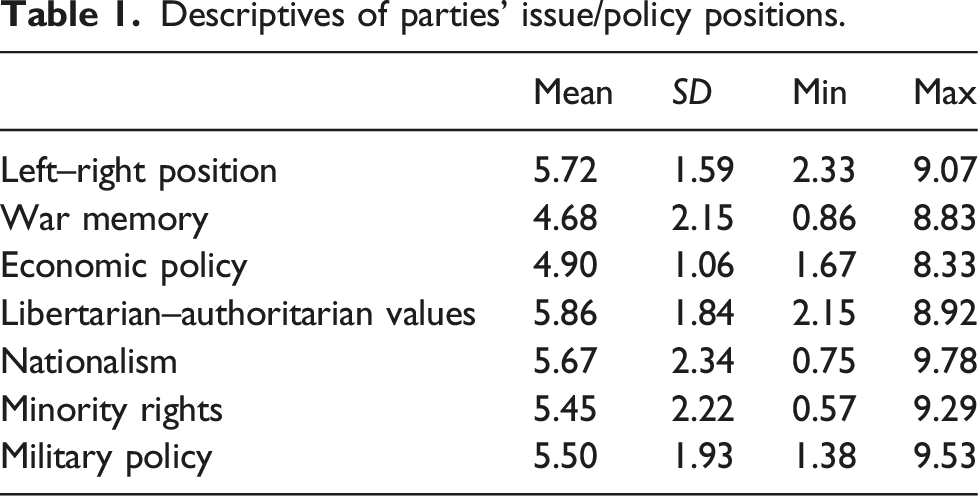
Descriptives of parties’ issue/policy positions.
The total size of the sample in our voter survey that was conducted on a dedicated online platform and mobile app, on the other hand, was 10,736, with 2718 respondents coming from Bosnia and Herzegovina, 2324 from Croatia, 1311 from Kosovo, 722 from Montenegro, 1460 from North Macedonia, and 2201 from Serbia. 2 To ensure representativeness of our sample in terms of gender, age, education, and region, we apply survey weights in all our analyses (Ansolabehere and Rivers, 2013) based on the raking method (Kalton and Flores-Cervantes, 2003). The voter survey captured respondents’ views on memory of their country’s most recent armed conflict with a Likert scale question identical in substance to the one asked in the expert survey. In addition to the respondents’ socio-demographic characteristics (gender, age, education, income, ethnicity, and religiosity) and attitudes toward a number of social issues and policy areas, the survey also captured respondents’ political preferences and commitments through a string of propensity to vote questions. For each party relevant to the respondents’ polity, respondents were asked on a 0–10 scale how likely it was that they would vote for that party in the future. In our research design aimed at answering our second hypothesis, we follow the approach proposed by Van der Eijk and Franklin (1996) and make these propensity to vote (ptv) scores into the dependent variable. With ptv scores we create a stacked data matrix in which the unit of analysis is the respondent*party combination. In other words, there are multiple observations per respondent, one for each party included in the survey. In contrast to discrete choice models, which only measure actual party choice, this approach allows for a far more detailed view of how individual and party characteristics make a party more or less electorally attractive. In addition, it allows researchers to test hypotheses of party choice determinants across a large number of parties and countries instead of estimating a model for each individual party.
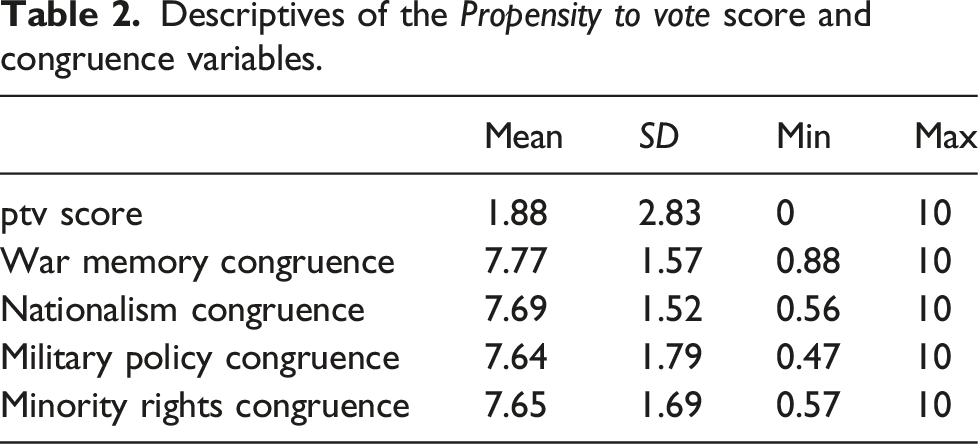
When examining the role of standpoints on issues or values in party choice, the standard approach is to use a measure of distance or congruence between the positions of respondents and those of political parties (De Vries et al., 2011; Lefkofridi et al., 2014). Congruence is measured as the absolute difference between the mean respondent score (rescaled to match the expert survey format) subtracted from 10 in order to obtain scores ranging from 0 (no agreement) to 10 (complete agreement). The principal congruence value of our interest is related, obviously, to the question on the acknowledgment of harmful acts committed against other groups as it helps us address our second hypothesis, that is, whether voters’ level of support for political parties is dependent on the level of their agreement with parties’ positions on war memory.
Descriptives of the Propensity to vote score and congruence variables.
To control for the role played by economic and libertarian–authoritarian attitudes, as well as respondents’ social characteristics, linear regressions are estimated for each party separately before the data is stacked (Walczak et al., 2012). For instance, in the case of social class, the ptv scores of one party are regressed on a set of social class indicators. This process is visualized in Figure 1 (also see Van der Eijk et al., 2006). Based on these regressions, predicted ptv scores, or Creating the stacked dataset.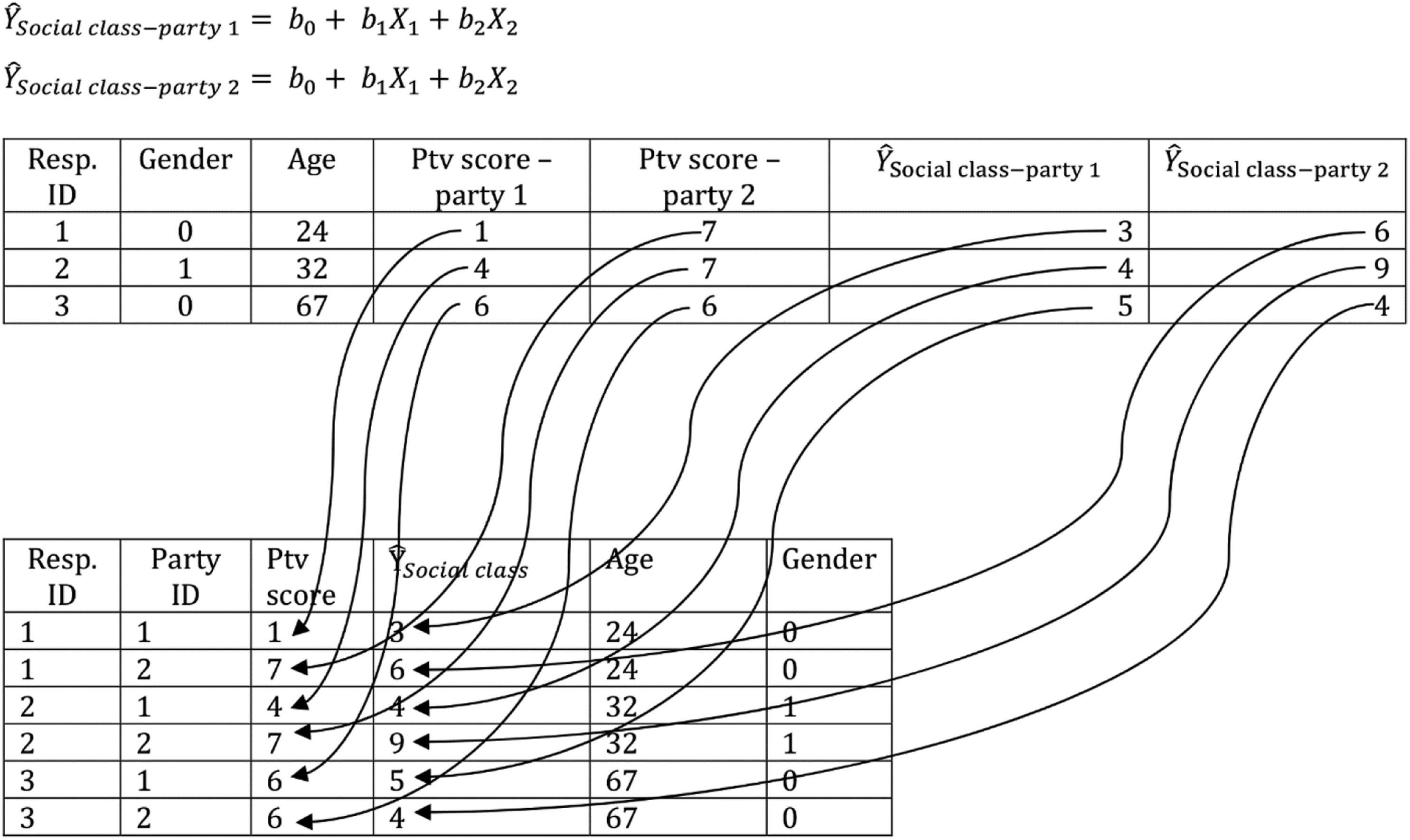
Here, we should particularly highlight that our analysis controls for respondents’ personal war experiences, captured as a composite variable operationalized as the 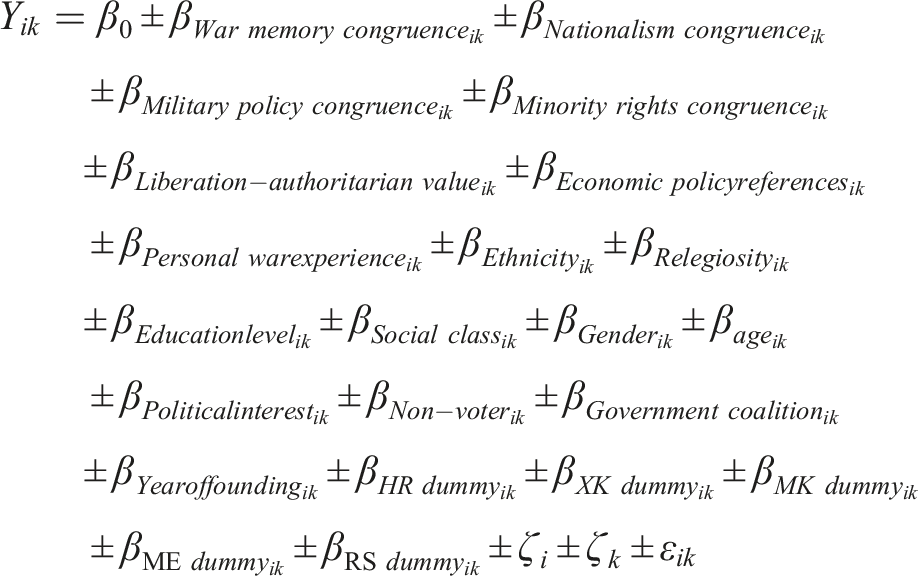
Results
As stated above, the first task in establishing whether parties’ stance toward war memory could be structuring the content of political competition is demonstrating that there actually exists a sufficient difference among political parties when it comes to their views of war memory. Figure 2 shows the violin plots of party positions on this issue in all six countries of the region (the scores for parties in Bosnia and Herzegovina being split into those for the Federation and the Republika Srpska), with party positions weighted based on their seats in parliament. In other words, the plots show the likelihood of encountering the party positions in the legislature. Only in Republika Srpska does the party landscape exhibit little to no diversity. Parties in the Serb entity of Bosnia and Herzegovina seem to be united in their unwillingness to acknowledge war crimes—in our view—unsurprising considering how Republika Srpska was created. In all other countries of the region—and in particular in Croatia, Montenegro, and Serbia—there are parties representing a wide range of positions when it comes to war memory, with the depicted level of support varying depending on their contemporary electoral fortunes. Distribution of party positions on war memory.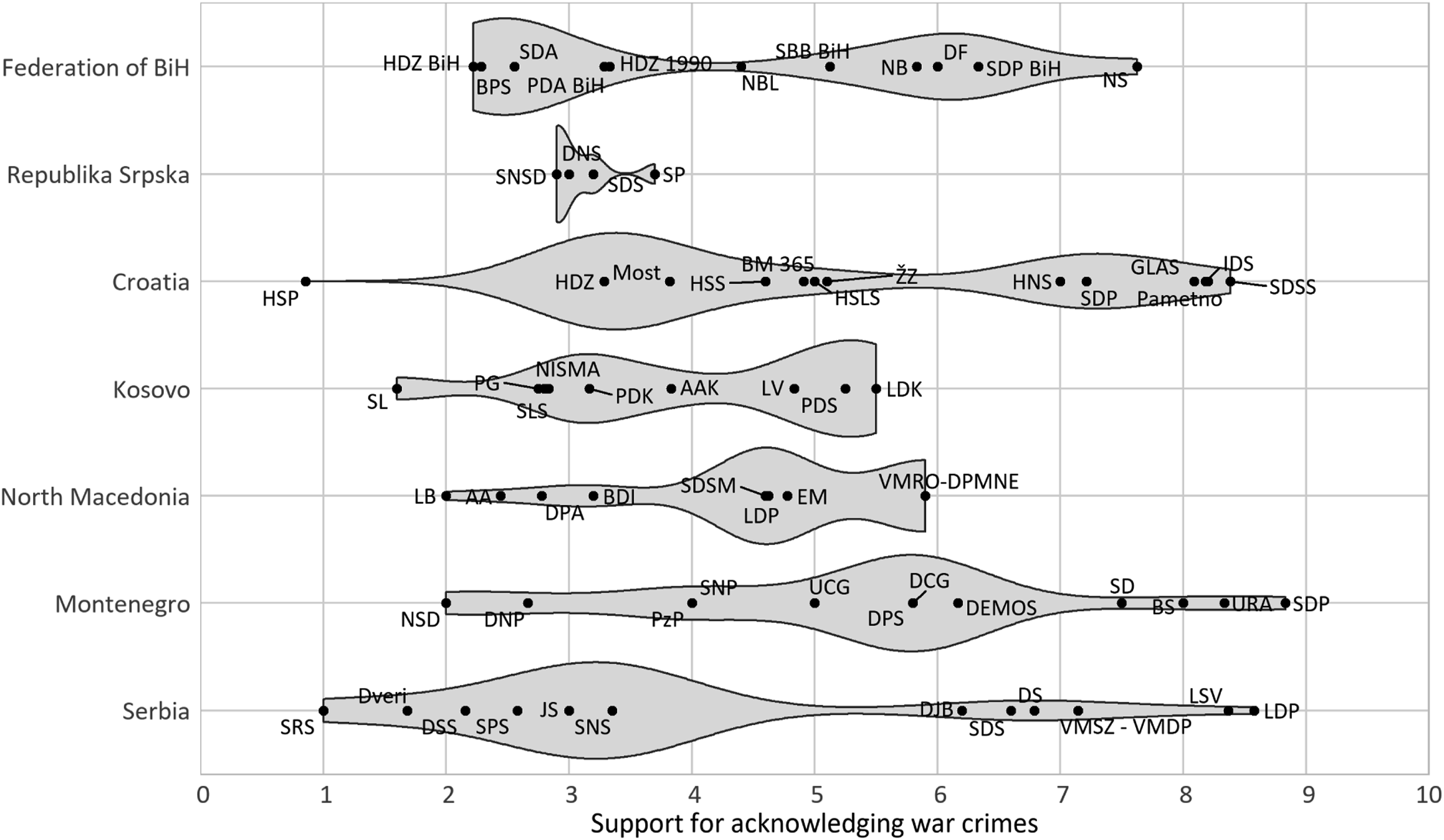
Our first hypothesis, obviously, went beyond merely stating that parties in the post-conflict countries of Southeast Europe had differing positions toward war memory. It proposed that war memory was related to the parties’ overall worldview and that it struck at the core of their positioning on the ideological left–right continuum. Figure 3 shows the bivariate relation between parties’ left–right position (x-axis) and their views on war memory (y-axis). War memory is indeed strongly related to parties’ overall left–right position. Parties opposed to acknowledging war crimes are consistently found on the right side of the spectrum. This pattern is confirmed even when we split up the graphs by country in the Supplemental Appendix, with the only exception possibly being the parties in North Macedonia. Parties’ left–right position and stance toward war memory.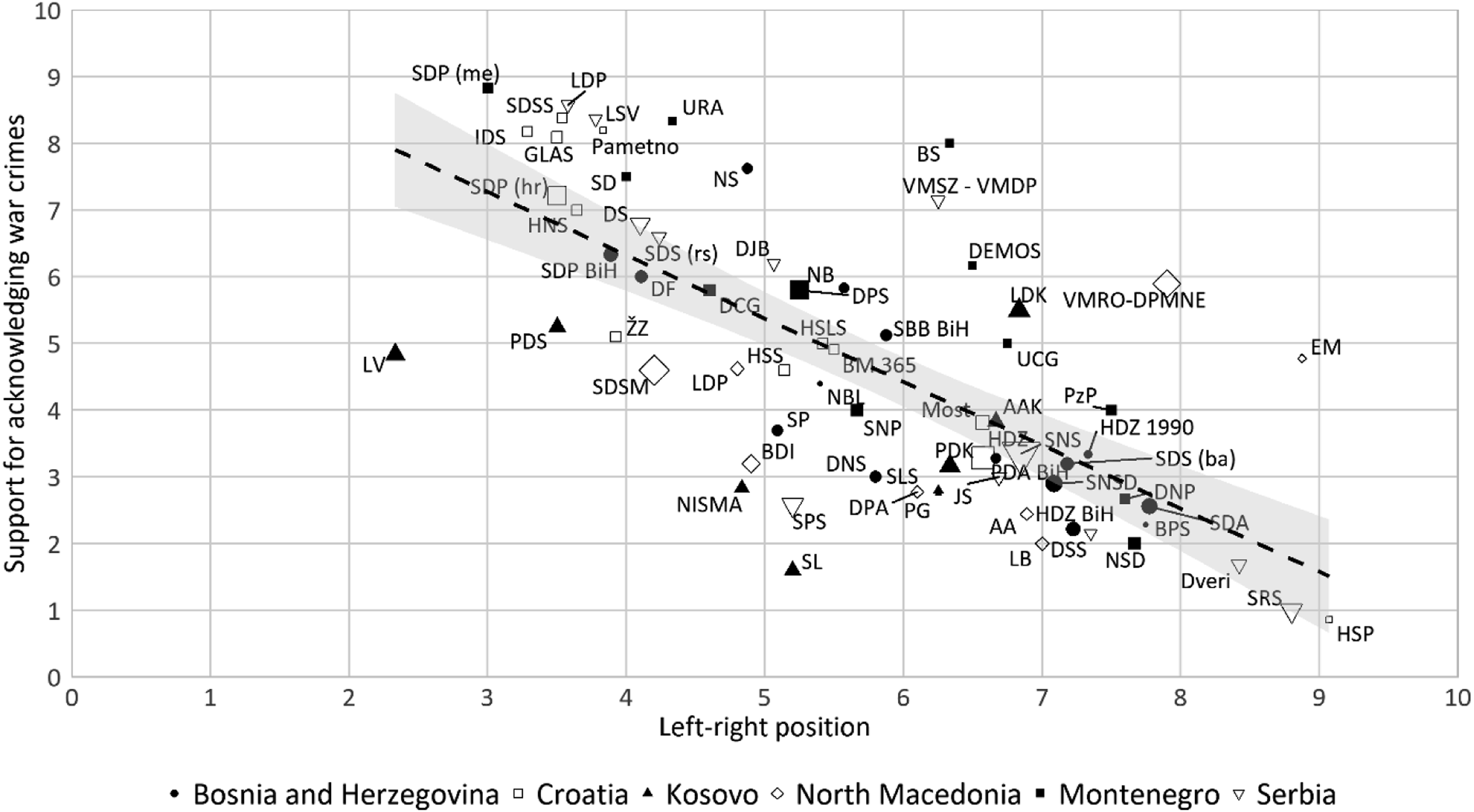
Determinants of parties’ left–right positions.
Note: †p < 0.1; *p < 0.05; **p < 0.01; ***p < 0.001; Δ Adj. R2 indicates the improvement in explained variance when compared to the model with only country controls.
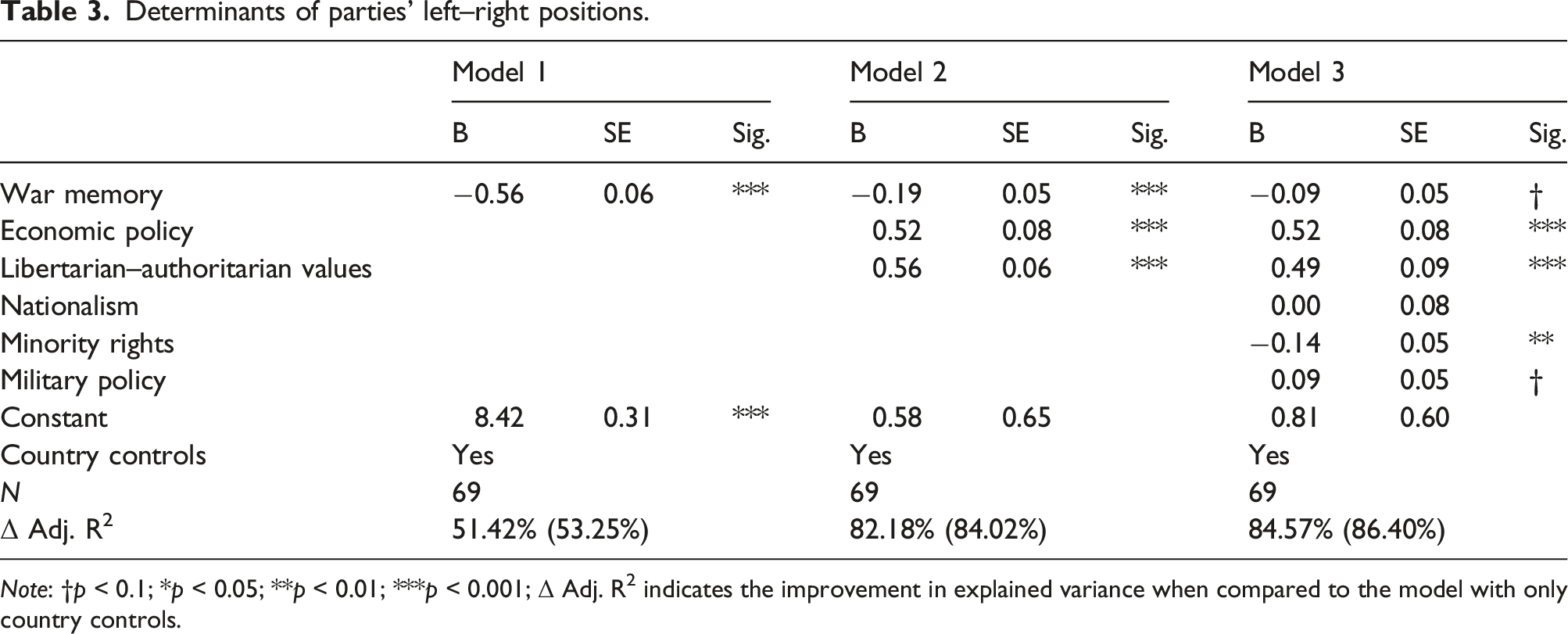
Model 1 shows that War memory has a strongly statistically significant (at the 0.001 level) and negative relationship with left–right orientation. Substantively, Model 1 suggests that a one standard deviation (equal to 2.15) move toward greater acknowledgment of war crimes committed by members of the in-group leads to a decrease of the party’s left–right score (i.e., a move to the left) equal to 1.2. Considering that the standard deviation of the Left–right position variable is equal to 1.59, this is a substantively large effect. What is equally important to note is that even this simple model does well, with more than 53% of the variation explained. The effect of War memory survives the inclusion of Economic policy and Libertarian–authoritarian values in Model 2, though it obviously becomes smaller. The effects of the two newly added variables are also highly statistically significant and in the expected direction. With only these three explanatory variables, this model does exceptionally well as it succeeds in explaining 84% of the variation. The inclusion of Nationalism, Minority rights, and Military policy in Model 3 does little to improve the model’s explanatory power. Even here, however, the variable War memory remains statistically significant. The diminishing effect of War memory due to the inclusion of other party positions should come as no surprise and is evidence of the ideology-making tendencies of political parties (Converse, 1964). The origins of the conflicts in the 1990s can be traced to the pursuit of national self-determination and the rights of ethnic groups. It is therefore only natural for parties’ positions on these two issues to be connected to their War memory views. However, the fact that war memory views retain an independent effect on parties’ left–right positions heavily suggests that the wars and their memory have added something unique to the nature of political competition. Cognizant of all the limitations of this methodological approach, we feel confident in concluding that the evidence supports our first hypothesis.
Analyses of respondents’ party preferences.
Note: †p < 0.1; *p < 0.05; **p < 0.01; ***p < 0.001; Δ AIC compares the model to a model with only the country controls.
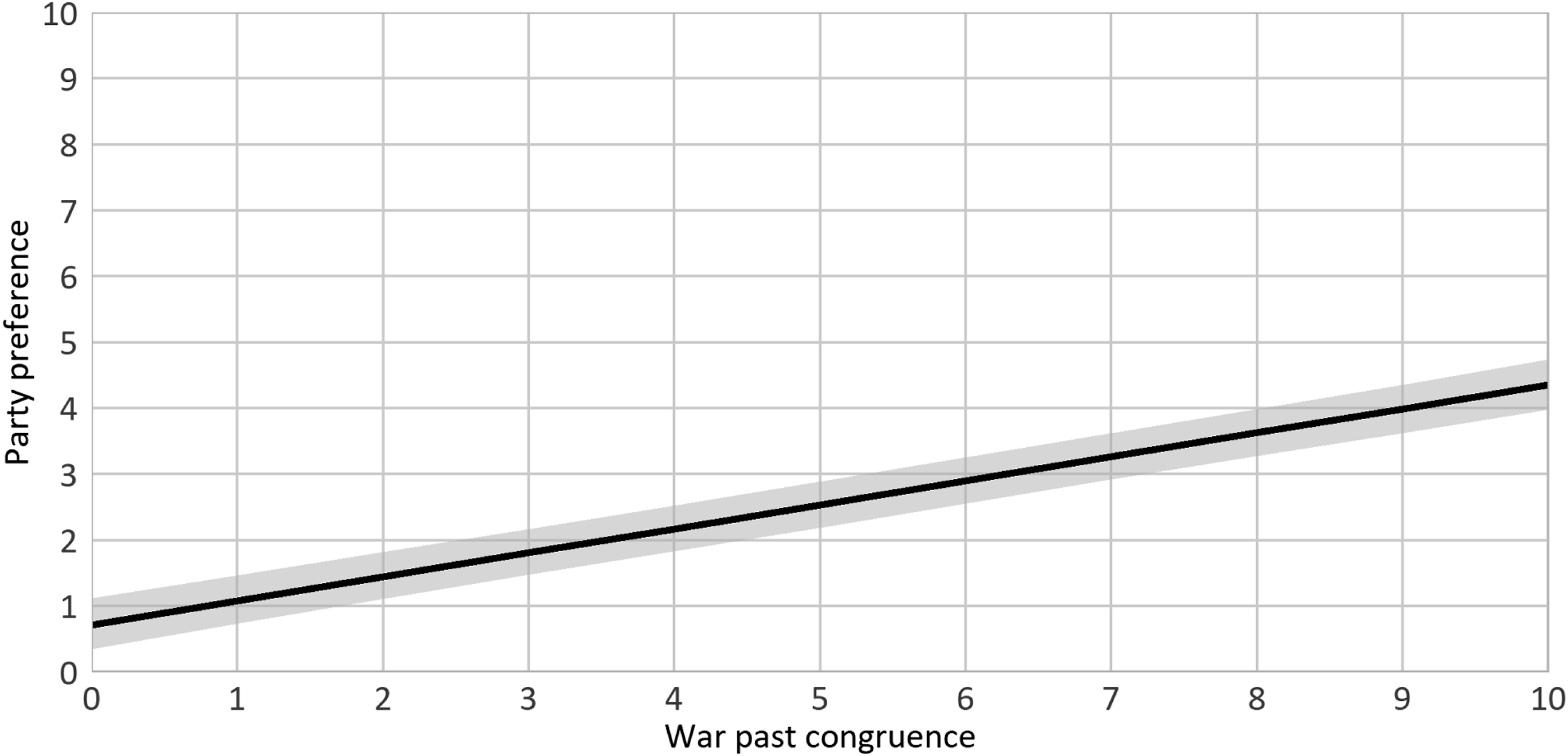
Relation between war memory congruence and party preference.
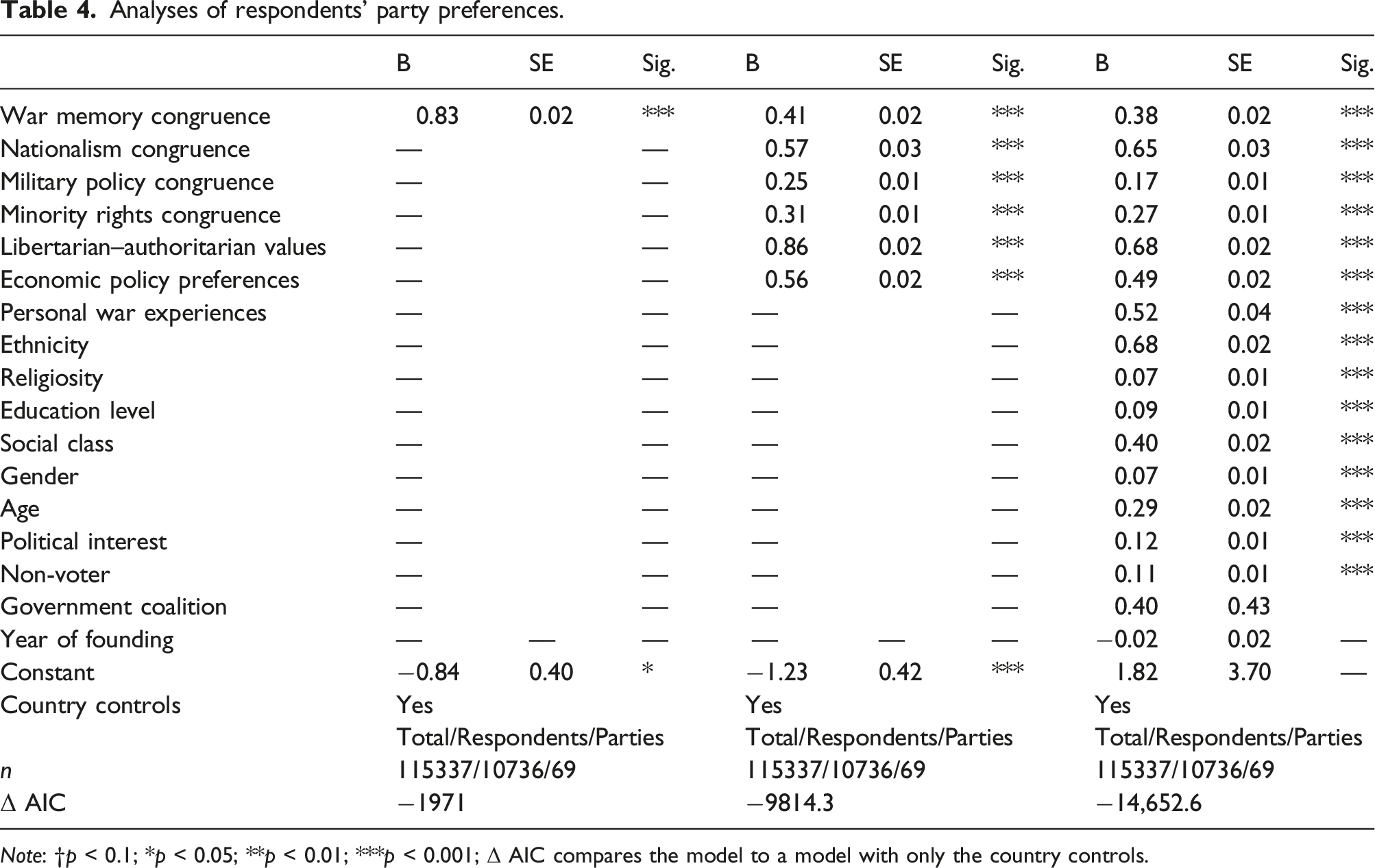
Regarding our control variables, voter/party congruence on nationalism also exerts a particularly large effect on party preferences, increasing propensity to vote scores by 0.99 for a one standard deviation increase in congruence. The effects of one standard deviation increases in Military policy congruence (1.79) and Minority rights congruence (1.69) are, on the other hand, substantially smaller (0.3 and 0.42 respectively). Here, we should also comment on the set of our socio-demographic control variables that are not measuring congruence on various issues. Their coefficients cannot be interpreted substantively. They represent predicted ptv scores based on indicators of the listed concepts. As such, they are scaled according to the dependent variable, that is, a 10-point scale (Van der Brug, 2010: 593). The values of the coefficients thus indicate how well the—ptv scores can predict the actual ptv scores. Most interestingly, the coefficient 0.51 for Personal war experiences means that for every increase in—based on respondents’ six measures of personal war experiences, the actual ptv scores go up by 0.51. This is a sizeable effect that is surpassed only by the effects for Libertarian–authoritarian values and Ethnicity. For the other variables in the model, these coefficients are smaller, suggesting that they play a weaker role. This suggests that voters’ personal war experiences are a sizeable factor in their decision whether to vote for a party or not. Our further robustness tests, however, do not offer solid clues about the direction the effect of Personal war experiences takes. 4 This could be the case for a number of reasons: from specificities of party systems in individual countries to the possibility that party preferences in the region can be a matter of identity that war experiences have generated that is conceptually distinct from policy preferences. This question is beyond the scope of this article but will be the subject of our further research.
Conclusions
In January 2020, the President of Serbia, Aleksandar Vučić, during his visit to Serb-populated areas of the Federation of Bosnia and Herzegovina, stated “There will be no ‘storms’ and no tractors in the future of the Serb people” (Tportal, 2020). Vučić obviously referred to Croatia’s 1995 Operation Storm that defeated the Serb Krajina statelet and led to the exodus of nearly 200,000 Serbs, many of them escaping violence on their tractors and other agricultural vehicles. Mere days following Vučić’s statement, at the commemoration of the Markale massacre in Sarajevo, proceedings were interrupted by a local man who demanded that the ceremony clearly states that the people killed by mortar shells on the Markale market died at the hands of the Bosnian Serb forces (Glamoč, 2020). Such episodes are standard in Southeast Europe, even decades after the disastrous wars of the 1990s. However, does the fact that war has a significant role in politicians’ public discourse or in the everyday social and political lives of the people mean that war memories structure the nature of political competition? Our article strongly suggests that they do.
We demonstrate that war memory in Southeast Europe is not only the subject of historiographical contestation (Kasapović, 2019) but is also one of the principal sources of ideological and policy differentiation among political parties, as well as one of the strongest determinants of voter choice. Voters choose which parties to support based on the level of their agreement with the parties’ positions on the way recent war past should be remembered. Parties in turn take different positions on war memory and these positions are significant determinants of their general ideological profile and placement on the left–right continuum. We believe these lessons from post-conflict societies of Southeast Europe are portable across geographic and time contexts. A growing body of research shows that traumatic divisions such as wars can remain embedded in social relations and political competition for decades after the violence ends in societies as diverse as Peru, El Salvador, Sri Lanka, and Sierra Leone (Wood, 2008). There is nothing contextually so specific about the experiences of war trauma in Southeast Europe that would disqualify the lessons from this region being applicable across a wide range of cases, though obviously this needs to be empirically tested. We argue that how political players conceptualize public memories of such traumatic events is the principal mechanism that keeps these events and the resulting divisions politically relevant—most often with disastrous consequences, regardless of context.
As Kubik and Bernhard (2014) have shown, the implications of contentious fractures in collective memory and their active politicization are nearly uniformly negative. They destabilize institutions and poison public discourse. They heighten political contention to the levels of debates over legitimacy, thus complicating coalition- and consensus-building, as well as governance. They thus result in more polarized forms of party pluralism and lower levels of inter-personal trust, which can have negative effects on the development of cultural and social capital and economic growth. Does this mean, however, that the societies of Southeast Europe, or other contemporary post-conflict societies, will remain prisoners of their past for decades to come? After all, as Lipset and Rokkan’s argument suggests, political divisions remain salient as long as the underlying issues have not been resolved (Rohrschneider and Whitefield, 2009), and in many post-conflict societies, memories of past wars do not seem to be resolved. Our analysis does not offer much cause for optimism. We firmly believe that the only way for the spiral of politicization of war memory to be broken in Southeast Europe is for the societies of the region to have a clear European future. As Kitschelt et al. (1999) have argued more than two decades ago, only new relations, institutions, and development may gradually help historical legacies recede into the past.
Supplemental Material
sj-pdf-1-ppq-10.1177_13540688211039378 – Supplemental Material for Contesting war memories: Parties and voters in contemporary Southeast Europe
Supplemental Material, sj-pdf-1-ppq-10.1177_13540688211039378 for Contesting war memories: Parties and voters in contemporary Southeast Europe by Josip Glaurdić, Christophe Lesschaeve and Michal Mochtak in Party Politics
Footnotes
Declaration of conflicting interests
The author(s) declared no potential conflicts of interest with respect to the research, authorship, and/or publication of this article.
Funding
The author(s) disclosed receipt of the following financial support for the research, authorship, and/or publication of this article: This article is supported by H2020 European Research Council (714589).

Supplemental material
Supplemental material for this article is available online.
Notes
Author biographies
References
Supplementary Material
Please find the following supplemental material available below.
For Open Access articles published under a Creative Commons License, all supplemental material carries the same license as the article it is associated with.
For non-Open Access articles published, all supplemental material carries a non-exclusive license, and permission requests for re-use of supplemental material or any part of supplemental material shall be sent directly to the copyright owner as specified in the copyright notice associated with the article.
