






Abstract
How do citizens differ in their view of democratic governance when they are more affectively polarised? This study examines how the support for different forms of governance in Germany – focusing on populist governance, and technocratic governance – vary at different levels of affective polarization. We argue that heightened affective polarization is linked to support for less pluralist forms of governance. Populist voters, especially from radical right parties, tend to favor direct democracy, which aligns with their majoritarian beliefs, while non-populist voters with high affective polarization favor technocratic governance. Using observational survey data from Germany, we illustrate how preferences for different forms of governance vary at different levels of affective polarization and how this relationship is conditioned by partisan identity. These findings contribute to understanding how political divisions reshape democratic attitudes in multiparty systems.
Introduction
Concerns about the democratic commitment of populist radical right parties and their leaders are fortified by debates about the consequences of an increasing polarization within society. The extent to which political leaders can abuse their power and violate democratic norms also depends on whether their voters are willing to accept such violations (Goodman, 2022). Particularly when polarization in society transcends ideological conflicts and results in a strong aversion towards supporters of the other political side, voters might care less about the rights of their political opponents (Svolik, 2019).
Affective polarization – the extent to which partisans dislike opposing parties and their partisans compared to their own party and partisans (Iyengar et al., 2012) – has received increased attention in more recent years, particularly in the U.S., where affective polarization has seen a sharp increase in the past 25 years (Gidron et al., 2020). Although the picture is more mixed in the multiparty systems of Europe, with rising levels of affective polarization in some but not all countries (Garzia et al., 2023), the rise of populist radical right parties functions as additional driver of affective polarization also there. Radical right voters and the voters of all other parties often meet each other with hostility, that, with their rising success, even surpasses the levels of affective polarization between left- and right-wing voters which has been present already for a longer time (Bantel, 2023; Harteveld et al., 2022). As a result, several recent studies have looked at whether affective polarization undermines the support for democratic norms in the US and Europe (Broockman et al., 2022; Janssen and Turkenburg, 2024; Kingzette et al., 2021).
In this research note, we focus on a core assumption of the literature, namely that affective polarization weakens the pluralist idea that society consists of diverse segments with opposing but legitimate viewpoints. As a result, the idea that there is a ‘general will’ or objectively ‘best solution’ for society gains in support. Rather than asking whether this translates into weaker support for democracy, we ask how affective polarization shapes citizens’ view on how democracy should work. In particular, we argue that a more polarized and less pluralist view has varying consequences across partisan lines. It is associated with higher individual support for two alternative forms of governance: direct democracy and technocracy. These forms of governance can be presented as a way to implement the “common will”, or “the best solution” and thus are likely strengthened by the belief in a unitary will that stands in tension with a pluralist vision of society.
First, we expect that affective polarization increases the support for direct democracy. In contemporary democracies of Western Europe, populist parties are the main advocates for direct democracy in current Western democracies (Engler et al., 2023). In their vision of a society that is divided into two homogenous entities, “the good people” and the “corrupt elite”, populist parties depict mainstream parties and their supporters as the main obstacle to realizing the popular will. Direct democracy is presented as a way to restore this will to politics (Mudde and Kaltwasser, 2017). Unlike representative democracy, in which multiple parties are elected to parliament and political decisions are mediated, direct democracy offers a more immediate expression of “the general will” (Caramani, 2017). Therefore we expect that affective polarization increases the support for direct democracy mainly among voters of populist parties.
Second, we argue that affective polarization among non-populist voters fosters support for another less pluralist form of governance: technocracy. Like direct democracy, the belief in technocracy is based on a unitary vision of society (Caramani, 2017), but it emphasizes expert rule grounded in rationality and scientific knowledge rather than political representation (Meynaud, 1969). Among non-populist voters, affective polarization is often directed most strongly toward the populist radical right (Harteveld et al., 2022). We expect that this aversion contributes to increased support for technocracy among non-populist voters, which offers an alternative to representative democracy without empowering actors associated with populism.
We fielded a survey with 2000 respondents in Germany (January 2023) and find empirical support for the claim that at higher levels of affective polarization respondents show lower commitment to pluralist attitudes. Furthermore, the more partisans dislike supporters of other parties, the more likely they are to support either direct democracy or technocracy. As expected, these results diverge by party family. While supporters of the populist radical right AfD are more supportive of direct democracy when affective polarization is high, supporters of most non-populist parties react with the demand for more technocracy when they display high levels of aversion towards out-partisans. The support for these forms of governance, however, does not go hand in hand with a lower support of democracy per se, nor for liberal elements of democracy. This research note gives a more nuanced picture of how affective polarization changes citizens’ attitudes towards different forms of democratic governance.
Affective polarization and democracy
The popularity of authoritarian political leaders worldwide, such as Donald Trump in the U.S or Jair Bolsonaro in Brazil, has led to a surge of literature that tries to understand why voters often do not punish anti-democratic behaviour (Gidengil et al., 2022; Goodman, 2022; Krishnarajan, 2022; Saikkonen and Christensen, 2022). One strain of literature has focused on the role that polarization plays in the acceptance of democratic norm violations arguing that in highly polarized societies voters are more willing to trade democratic principles for their preferred policy outcome (Fossati et al., 2022; Graham and Svolik, 2020; Svolik, 2019). While stakes are higher for voters in ideologically polarized societies, affective polarization can further delegitimize the opinion of others and thus decrease the willingness of citizens to protect the political rights of their opponents. A recent study by Jenke (2023) shows for instance that highly affected citizens are less likely to believe out-party information and more likely to believe in-party misinformation.
Observational studies provide some evidence for a negative association between affective polarization and democratic attitudes in the U.S. context. Kingzette et al. (2021) show that citizens with higher levels of affective polarization are more likely to reject constitutional protections, but only when the preferred party is in power at the time of the survey. Masood et al. (2024) furthermore show that when affective polarization is high, the support for legal institutions drops along the expected partisan lines. However, experimental studies that were able to reduce out-party dislike (and as a result, affective polarization) did not find any evidence for a causal relationship between affective polarization and the voters’ aversion towards democratic norm violations (Broockman et al., 2022; Voelkel et al., 2023). So far, the empirical evidence for a detrimental effect of affective polarization on democratic support is therefore mixed at best (Druckman et al., 2023). More recent scholarship also argues that affective polarization - at least in moderate terms - can also be beneficial for the support of democracy since only when individuals feel attached to an in-group and identify an out-group do they see the need of democratic institutions that enable their political representation and protect their political rights (Janssen and Turkenburg, 2024).
Instead of focusing on support for democracy, in this research note, we thus want to focus on the question how citizens think democracy should work. We start from the core assumption that affective polarization weakens the pluralist idea that builds the foundation of democracy as a marketplace of ideas (Dahl, 1978). When partisans strongly dislike those on the other side, they are less likely to see them as legitimate political actors. As a result, democratic disagreement becomes devalued, and the idea that there is a ‘general will’ or objectively ‘best solution’ for society gains appeal. This belief stands in contrast to the pluralist idea that society consists of different groups with opposing but legitimate views whose competition is accepted as part of democratic politics (Caramani, 2017). We therefore expect that at higher levels of affective polarization, respondents are more likely to endorse the anti-pluralist attitudes. What follows from this anti-pluralist belief, however, may vary.
Two sides of anti-pluralism: ‘The popular will’ versus technocracy
We argue in this research note that anti-pluralism created by higher affective polarization can lead to two different outcomes: more support for the populist form of governance or more support for technocratic forms of governance. Both of which rely on the anti-pluralist idea that there is one unitary “common good” that serves everyone (Caramani, 2017).
Much has been written about the anti-pluralist character of populism, which divides society into two homogeneous groups, “the good people” and the “corrupt elite” (Mudde and Kaltwasser, 2017). A rising number of studies looked at the question whether the populist radical right’s success also leads to more diverging views about how democracy should work (Brug et al., 2021; Guinjoan, 2022; Zaslove and Meijers, 2021). Within this stream of literature, direct democracy has received most attention (Caramani, 2017). Anti-elitism as well as the belief in a general will should make populists more likely to support more direct forms of citizens involvement. And indeed, recent studies on the political stances of political parties show that populist parties are the strongest advocates for direct democracy in recent years (Engler et al., 2023; Lisi and Silva, 2020; Silva, 2026). Bedock et al. (2023) even show that the populist radical right’s demand for more direct democracy made mainstream parties more reluctant to support it. In particular center-left parties that used to be quite positive towards direct democracy in the past started to reconsider their support. 1 At the individual level, however, the empirical evidence is mixed regarding whether populist voters are indeed more supportive of direct democracy or not (Guinjoan, 2022; Rojon and Rijken, 2020; Zaslove and Meijers, 2021).
We argue that affective polarization strengthens the dynamic. By deepening hostility towards political opponents, affective polarization reinforces the populist idea that “the people” are blocked by a corrupt elite. This increases the appeal of direct democracy as a way to bypass pluralist institutions particularly among voters of populist parties. We therefore expect a positive correlation of affective polarization on the support of direct democracy mainly among supporters of populist parties (
Another form of governance that rests on the idea of a unitary “common good”, though with less scholarly attention, is technocracy. Like populism, technocracy is critical of the political elite, arguing that they do not act in the best interest of society (Bertsou and Caramani, 2020; Caramani, 2017). However, instead of advocating greater citizen involvement, technocracy proposes to increase the influence of experts in policy-making (Meynaud, 1969). Previous research shows that support for technocracy is stronger among individuals with higher education and lower political trust, and among those closer to the political center or center-left (Bertsou and Caramani, 2020; Bertsou et al., 2024; Bertsou and Pastorella, 2017).
We argue that affective polarization can serve as an additional driver of technocratic support. By reinforcing an anti-pluralist outlook, affective polarization increases the appeal of technocracy as a way to depoliticize governance, avoid political conflict and deliberation with disliked out-groups, and pursue what is believed to be the ‘best solution’ through expert-led decision-making. This logic should be particularly relevant for non-populist partisans who feel alienated by the rise of populist parties. We therefore expect affective polarization to be positively associated with support for technocracy mainly among supporters of non-populist parties (
In a nutshell, we argue that only by taking into account both options, technocracy and direct democracy, we are able to fully understand how rising affective polarization influences citizens’ view of democracy. While we expect that affective polarization can increase the support of both, we expect voters of populist parties to be more likely to believe that direct democracy will lead to the preferred outcome, as this is what populist parties claim, while partisans of non-populist parties will more likely support technocracy.
Data and methods
We conducted a survey with 2000 respondents in Germany between 5 October 2022 and 18 January 2023. We focus on Germany as a typical case of multiparty system in Western Europe with populist parties on the left (Die Linke) 2 and the right (AfD), as well as major centre-left (Social Democrats, Greens) and centre-right parties (Christian Democrats, Liberals). Furthermore, Germany has some direct democratic instruments on the regional level, so that its use is not unfamiliar to people, but no popular votes are possible on the national level (Leemann and Stadelmann-Steffen, 2022). The introduction of direct democracy would thus still be a change in the status quo. Other than Italy or other crisis-ridden countries, Germany has also no tradition of technocratic-led governments. Hence, preferences for alternative forms of governance should not be driven by recent experiences with either technocratic governments or regular popular votes.
Together with the survey company Bilendi, we recruited respondents that were eligible to vote in the German national elections. We applied quotas for the sample to be representative of the German population regarding gender, federal state, age, education, and vote choice for one of the six parties represented in a faction in the German parliament (AfD, CDU/CSU, FDP, Greens, SPD, and The Left). We excluded respondents who did not vote for or did not feel close to one of these major parties, and respondents who did not vote at all. Furthermore, we excluded respondents who did not carefully read the questions and failed an attention check. 3
We asked respondents how much they like or dislike the partisans for each party on a scale from 0 (dislike) to 100 (like). In Table A2 we show the average scores for each in-party out-party combination. 4 In line with previous studies, our data shows that AfD voters have low feelings for all other partisans, while AfD voters are the least liked group of partisans among all other voters. We then calculate affective polarization on the individual level 5 as the difference between the in-party and the out-parties like-dislike score. We created a variable that uses the highest value of affective polarization towards a group of out-partisans as main independent variable. For example, if an SPD partisan has moderate values of affective polarization towards most other parties but a high value towards the AfD, we use the value of affective polarization towards AfD supporters. This measure of affective polarization comes closest to our theory that stipulates that the dislike of one group of partisans is enough to increase the demand for other forms of governance. In multi-party systems, people tend to like partisans from parties within their own ideological camp (not just party), so averaging like–dislike scores across all parties bears the risk of obscuring individuals’ substantial negative sentiment toward a certain party (Bantel, 2023). As we only include the six largest (parliamentarian) parties in our survey, and not also minor and electorally irrelevant parties, we see the dislike of one of these parties’ partisans as sufficient for stronger anti-pluarist attitudes. Importantly, our results still hold when we use the Wagner formula (2021), which relies on the values for all parties (not only the least liked one) and weighs them by vote share, instead (shown in Table A4, Model II in Table A5, in Model II in Table A7, and in Model II in Table A8). 6
We look at three dependent variables. Support for anti-pluralism is measured by the respondent’s agreement with the statement “If people had enough knowledge, they would all agree on what is best for the country”. This measures reflects the respondents’ belief in “unitary and common interest of society” that contradicts the pluralist idea (Caramani, 2017: 54). Support for direct democracy measures the respondents’ agreement with the statement “Germany would function better if citizens had the final say on the most important political issues by voting on them directly in a referendum.” Lastly, support for technocracy looks at the respondents’ attitude towards the statement “Germany would function better if political decisions were left to experts”. All three items are measured on a scale from 1 (‘completely disagree’) to 5 (‘completely agree’).
To facilitate the interpretation of the marginal effects, we calculate logistic regression models and therefore recode all three variables to a dichotomous variable in which values of four and five are coded as “support”. In the appendix, 7 we also present the results for ordered logistic regression models that show that the results do not change. We include age, income, education, sex, political interest, and political extremism (measured as distance from the mid point of the left-right scale) as control variables in all models. In addition to the main models that predict the support for anti-pluralism, direct democracy and technocracy, we also calculate linear regression models that predict the support for various institutions of (liberal) democracy (free and fair elections, rule of law, free media, procedures, freedom to protest) that are measured on a scale from 0 (‘not important at all’) to 10 (‘very important’). 8
Results
We first look at our core assumption that at higher levels of affective polarization citizens are more likely to believe in the idea of a “general will”— which then lays the foundation for our hypotheses that they will support alternative forms of governance such as technocracy or direct democracy instead. In Figure 1 we plot the predicted probabilities of supporting a non-pluralist view of politics. To do so, we model the expected response of a median/modal respondent: Female CDU/CSU partisan, 50–64 years, no tertiary education, income category 7, political interest score of 4, and a moderate value of extremism of 2. These values reflect the modal category or median response in the survey sample. Predicted probability of supporting anti-pluralism. Note. Full estimation results in Table A5 (M1).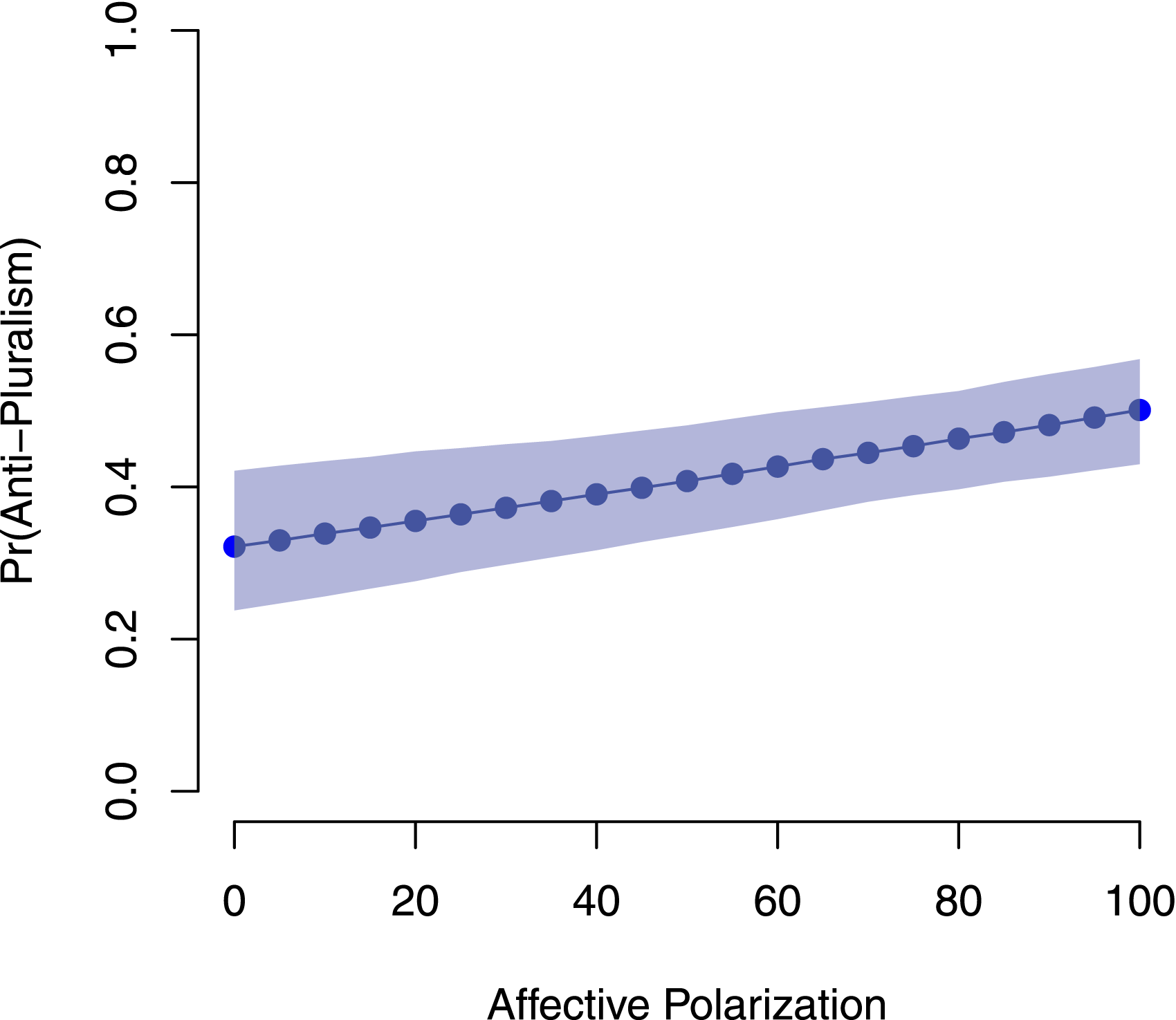
In line with our theoretical expectation, we find a positive, and significant coefficient for affective polarization – representing a positive partial correlation with support for anti-pluralism. There is a clear correlation between affective polarization and anti-pluralist attitudes which is reflected in the estimation results underlying Figure 1 which are presented in the first model in Table A5. The p-value for the coefficient is smaller than 0.001. The relationship between affective polarization and anti-pluralism is the same across all parties (see Figure A2 and Table A6 in the appendix).
Crucially, the increase in support for anti-pluralism does not go hand-in-hand with a reduction in support for democracy per se or towards principles of liberal democracy such as free and fair elections, freedom of media, the right to protest, the rule of law, and the importance of politicians respecting constitutional procedures. Figure A1 in the appendix shows that in fact, affective polarization even (significantly) increases the support for democracy and liberal principles of democracy even when controlling for in-party and political interest (see Table A3 in the appendix). Hence in line with previous findings, we do not find any support for the claim that affective polarization directly threatens citizens’ support for crucial elements of democracy (see also Broockman et al., 2022; Voelkel et al., 2023). Still, the increase of anti-pluralist attitudes matters, as we demonstrate in the next section.
We now turn to our main hypotheses. Looking at the correlation of affective polarization of direct democracy (hypothesis 1) and technocracy (hypothesis 2), we are less interested in the overall relationship but rather in how this relationship varies across different groups of partisans. We therefore include an interaction term of affective polarization and partisanship (dummy variable for each party) in our models.
Figure 2 plots the predicted probabilities to support direct democracy for all groups of partisans. When we just look at individuals with low affective polarization, partisans of non-populist parties such as of the FPD and the CDU/CSU show moderate to high levels of support for direct democracy, similar to partisans of the AfD and die Linke. We argued that higher affective polarization co-occurs with stronger support for direct democracy among populist partisans, but not among partisans of non-populist parties (hypothesis 1). Elite cueing, in particular the positive framing of direct democracy by populist parties, should create a divide between populist and non-populist partisans that only plays out at high levels of affective polarization. This is indeed what we find empirically when looking at AfD partisans. As Figure 2 shows, affective polarization goes together with significantly higher support for direct democracy among AfD partisans (but not Die Linke), while there is no such relationship among partisans of the other parties.
9
This result lends support to our first hypothesis when it comes to the populist radical right voters, but not for the left-wing voters of the populist die Linke. There are two possible reasons why we find different results for these two types of populist parties. First, the populist nature of die Linke has weakened and, other than the AfD, it has been classified as borderline case between populist and non-populist in recent years (Rooduijn et al., 2024). Second, there are several studies that discuss to what extent the host ideology of populist parties matters for the support of direct democratic reforms (Engler et al., 2023; Lisi and Silva, 2020; Silva, 2026). Even though the empirical evidence for this claim is inconclusive, we cannot rule out that the differences between partisans of the AfD and die Linke stems from their different host ideologies. Predicted probability of support for direct democracy by party. Note. Full estimation results in M1 in Table A7.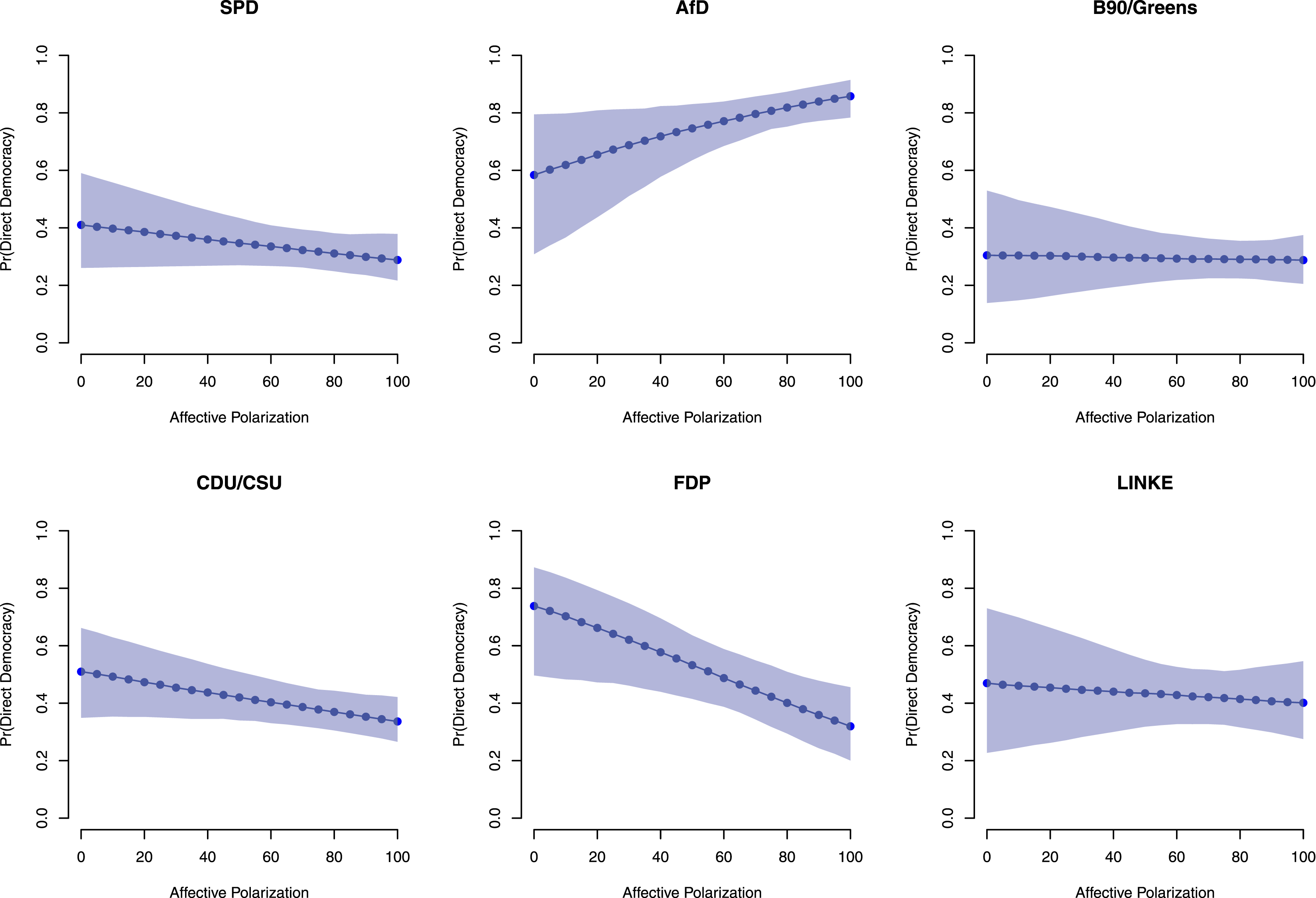
The picture reverses when we look at the relationship between affective polarization on the support for technocracy. Figure 3 plots the predicted probabilities to support technocracy for all groups of partisans. While the level of support for technocracy is similarly high across partisans of populist and non-populist parties at low levels of affective polarization, we again find evidence that the level of affective polarization increases the support for some, but not all partisans. As expected in hypothesis 2, we find no (significant) relationship among partisans of the populist AfD and the populist borderline case die Linke (in the case of AfD and Die Linke, the change from 0 to 100 is insignificant). Affective polarization is statistically significantly associated with higher levels of support among partisans of the Green Party (Bündnis 90/Die Grünen), the liberal FDP and the conservative CDU/CSU, but not the social democrats (SPD). With the exception of the latter, this supports our claim that partisans of non-populist parties tend to support technocracy the higher the relative dislike of out-party partisans.
10
Predicted probability support technocracy by party. Note. Full regression results in M1 in Table A8.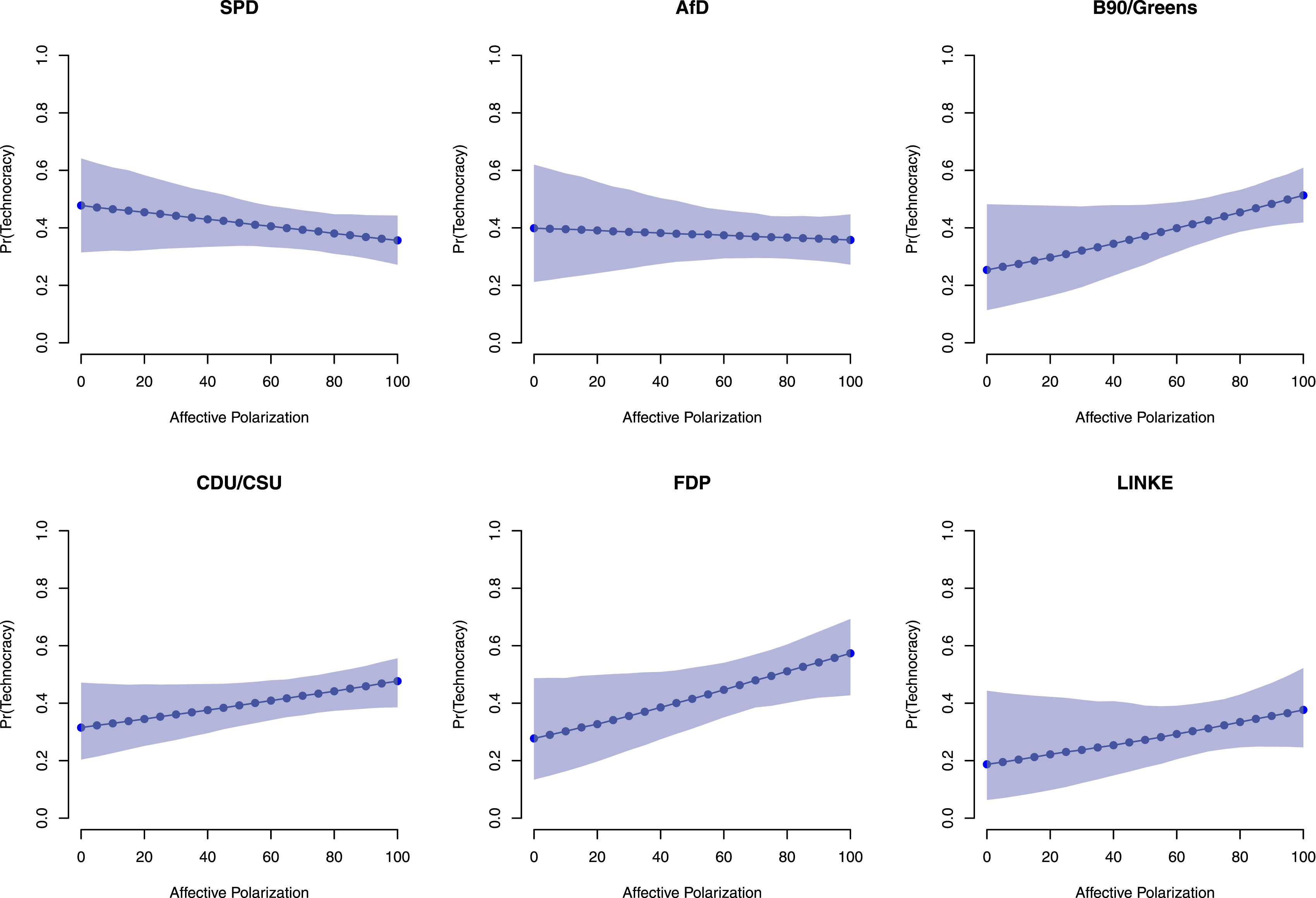
Based on the survey data we can demonstrate that at higher levels of affective polarization respondents’ support of anti-pluralist attitudes is higher, but that this does not lead to a general support for other types of governance. Rather, it seems that elite cueing by populist parties promoting the unmediated ‘will of the people’ plays an important role whether voters consider direct democracy or technocracy as viable alternative or complement to representative democracy.
Robustness
To illustrate the robustness of the empirical results, we provide a number of additional estimation results. First, we provide estimation results for all our models relying on an ordered logit model. A second alteration is with respect to the measure of affective polarization. The main results are based on the affective polarization towards out-partisans with the highest dislike score, while in the appendix we show the main models with the measure based on the formula of Wagner (2021).
For the analyses testing our main hypotheses, presented in Figures 1–3, each table in the appendix presents the main model but also provides the results for the alternative model estimation (ordered logit) and the alternative measurement based on Wagner (2021). None of the substantive results change in a meaningful way (see Tables A5, A7 and A8). Regardless of these changes, the relationship between affective polarization and support for liberal democracy also remains positive (Table A4).
Conclusion
Several recent studies have raised concerns that the rising levels of affective polarization might lead to a deterioration of democratic norms and increase the likelihood of democratic backsliding. They argue that citizens are less likely to punish non-democratic behavior of politicians or that they are even less supportive of democracy itself (Svolik, 2019). The empirical assessment of the effect of affective polarization on democratic attitudes has so far produced mixed results (Broockman et al., 2022; Janssen and Turkenburg, 2024; Kingzette et al., 2021).
We argued that rather than focusing solely on support for liberal democracy it is necessary to broaden the scope of possible outcomes associated with rising affective polarization. The core concern that affective polarization weakens the pluralist idea of democracy may manifest in diverging preferences for two alternative forms of governance: direct democracy and technocracy. In a survey with 2000 respondents, we have analyzed how democratic attitudes change across different levels of affective polarization in the multiparty context of Germany.
Our results confirm a more complex, but also more optimistic view on how polarization matters for citizens’ attitudes. First, like other recent empirical studies, we do not see that people with high levels of affective polarization are less supportive of liberal democracy, but on the contrary affective polarization is positively associated with liberal democratic attitudes. Second, our analysis finds a positive association of affective polarization and anti-pluralist attitudes which eventually results in higher support for direct democracy and technocracy.
Whether individuals choose technocracy or direct democracy, however, plays out along the lines the parties discuss these forms of governance, and populist radical right parties in particular. The support for direct democracy only rises among highly polarized AfD partisans, while the voters of other parties (the Greens, FDP and CDU/CSU) often display stronger support for technocratic forms when affectively polarized. This shows that it matters how the political elite, or in this research note, the political parties frame potential alternatives to representative democracy. Rising affective polarization might weaken the citizens’ pluralist attitudes, but the translation of these attitudes into the demand for other forms of governance is not fully detached from the elite level.
We show that direct democracy and technocracy are popular among individuals with high levels of affective polarization. Populist parties present direct democracy as main instrument to implement the “will of the people”, while technocracy is often seen as “rational response” to populism. While these narratives follow anti-pluralist visions, and affective polarization reinforces these visions, the implications of our findings for democracy are far from negative. Institutions of direct democracy and evidence-based policy-making, when implemented in a representative democracy, are not anti-pluralist by nature. On the contrary, when respecting pluralist institutions they have the potential to foster the inclusion of different segments of society and compromise in politics (Dorren and Wolf, 2023; Leemann and Wasserfallen, 2016).
Our study has several limitations. First, we cannot say to what extent ideology beyond the concept of populism matters for how individuals at high levels of affective polarization view democracy. We show that what follows from affective polarization depends on whether voters feel close to the populist AfD or to non-populist parties. We have argued that this stems particularly from the vision of democracy that populist radical right parties - the main drivers of affective polarization in many Western European countries, and in our case Germany - provide. However, we can say little on whether the differences across non-populist parties, and also between die Linke and AfD partisans, may stem from ideological differences. Clearly, the Greens emphasize technocracy more often when it comes to their core issue environmentalism, as does the FPD when it comes to economic efficiency. However, this cannot explain why the voters of the conservative party CDU/CSU also respond with technocratic attitudes at higher levels of affective polarization, while the social-democratic voters of the SPD do not. Hence, future research should explore how ideology shapes the relationship of affective polarization and citizens’ view of how democracy should work. Second, our study only tests moderate measures of alternative forms of governance. While we show that affective polarization strengthens anti-pluralist attitudes, along with increasing levels of support for direct democracy and technocracy, we do not know how voters weigh different democratic principles against each other. When asking them directly about their support for liberal principles of democracy we, as many other studies, do not see a negative effect of affective polarization. This result might very well differ when they are confronted with the constraints and trade-off that exist between liberal principles of democracy and less pluralist visions of governance.
Although ideology and democratic trade-offs require further study, our findings contributes to the debate about the impliciations of affective polarization for democratic preferences by emphasizing the crucial role of political parties in shaping citizens’ democratic attitudes.
Footnotes
Acknowledgments
Special thanks to Joshua Starbatty, and Klara Bruhn for impeccable research assistance. We received valuable feedback from Monika Bauhr, Verena Fetscher, Diego Garzia, Claudia Landwehr, Gefjon Off, Vera Troeger, and Aiko Wagner. Previous versions of this paper were presented at the Quality of Government Institute Conference (February 2025), the 14th Annual Conference of the European Political Science Association in Cologne, the Hamburg Political Science Seminar Series - HPS3 (31 January 2024), 2023 American Political Science Association’s Annual Meeting (APSA) in Los Angeles, the workshop “Democratic Citizens and Political Elites: Communication, Interaction, and Congruence”, Johannes Gutenberg-Universität Mainz, 9–10 March 2023.

Funding
The authors received no financial support for the research, authorship, and/or publication of this article.
Declaration of conflicting interests
The authors declared no potential conflicts of interest with respect to the research, authorship, and/or publication of this article.