







Abstract
Understanding what factors play a role in people’s decisions to travel during a pandemic is important to public health officials and to stakeholders in the travel and tourism industry in the United States (US) and worldwide. This study examines factors influencing people’s decisions to cancel/postpone recreational travel within the US amidst the COVID-19 pandemic. Our conceptual framework extends the Expected Utility model, commonly used in economics to model decisions under risk and uncertainty, to incorporate subjective norms and perceived behavioral control from the Theory of Planned Behavior. Our results suggest that risk perceptions, subjective norms, and concerns over transmitting COVID-19 to others play a significant role in the decision to cancel and postpone recreational travel. Results also suggest that perceived behavioral control may be less relevant to travel decisions when traveling involves elevated health risks.
Keywords
Introduction
In addition to general risks a person traveling for leisure faces including being injured in an accident or developing stomach problems, traveling during a pandemic poses qualitatively different risks of contracting and spreading a potentially lethal disease. This paper examines factors that influence people’s decisions to cancel or postpone recreational travel within the United States (US) amidst the COVID-19 pandemic. Understanding what factors play a role in people’s decisions to travel during a pandemic is important because of the consequences on both personal and public health and on the travel and tourism industry. Travel is a strong force in the emergence and spread of disease. One of the first actions of public health officials worldwide at the outset of the COVID-19 pandemic was to issue stay-at-home orders restricting travel and gatherings to reduce activities associated with community spread of COVID-19, including population movement and close person-to-person contact outside the household (Center for Disease Control and Prevention (CDC), 2020). During the COVID-19 pandemic, travel restrictions and decision by millions of individuals to cancel or postpone travel imposed huge costs to stakeholders in the travel and tourism industry in the US and worldwide. According to the US Travel Association, since the beginning of March 2020 through the end of the year, the pandemic resulted in $492 billion in cumulative losses for the US travel economy (US Travel Association, 2021).
In this paper, we model traveler behavior using a conceptual framework based on Expected Utility Theory (EUT) where individuals weigh the utility derived from traveling with the disutility of being infected by COVID-19 (or infecting others), using subjective risk perceptions. The EUT model is expanded to incorporate subjective norms and perceived behavioral control from the theory of planned behavior (TPB) (Huang et al., 2020). Subjective norms are the perception of other people’s approval of an individual’s particular behavior (Ajzen, 1991), while perceived behavioral control refers to an individual’s perception of the capacity to perform the behavior (Bish et al., 2000). We hypothesize that, in addition to the perceived risk of contracting or transmitting COVID-19 while traveling, the decision to engage in recreational travel depends on subjective norms as well as perceived behavioral control, particularly given public appeals from government to engage in social-distancing and travel restrictions. Our analysis tests the relative strength of these predictors.
Many previous studies on tourism, leisure, and hospitality management rely on the TPB, particularly to analyze consumer behavior (e.g., Joo et al., 2020; Petrescu and Bran, 2020; Ulker-Demirel and Ciftci, 2020; Meng et al., 2020; Huang et al., 2020; Lee et al., 2019). However, within this literature, it has been noted that the TPB fails to fully reflect behavioral change (Matsumori et al., 2019), disregarding some underlying factors addressed through behavioral economic models, especially centered on uncertainty. The Expected Utility Theory (EUT) is one such model commonly used in economics for making decisions under uncertainty. Similarly, EUT does not capture the social psychological factors involved in decision-making, which are better accounted for within the TPB. Therefore, to more accurately explain behavioral change, the current work uses the EUT and the TPB in a complementary fashion. To our knowledge, only two works have combined the EUT and TPB frameworks to explain behavioral change. Matsumori et al. (2019) used an expected utility model to extend the theory of planned behavior so as to derive a decision-theoretic model of behavioral change. Similarly, Borges et al. (2015) used the TPB to extend EUT to explain farmers’ innovation adoption decisions. Not only were these works outside the realm of travel and tourism, they were theoretical in nature, stopping short of empirically evaluating their proposed models. Our study is the first to combine EUT with TPB in an effort to explain behavioral change concerning leisure travel from theoretical and empirical perspectives.
To estimate an empirical model of travel sentiment and behavior based on the conceptual framework, we used survey data collected in two waves, the first one in June–July 2020 and the second one in October 2020. The survey was administered through Qualtrics, Inc. who randomly selected a representative sample of 1454 US residents (541 for wave 1, and 913 for wave 2) from its proprietary panel covering 48 states in the US. The survey gathered information on travel behavioral change, subjective norms, perceived behavioral control, risk perception, health risks, financial risks, and a wide range of socio-demographic variables. One advantage of analyzing the same survey conducted at two different points in time is that it allows us to test if the strength of the predictors of travel decisions changes over time, perhaps as people were getting more informed, developing coping strategies, or experiencing COVID-19 fatigue.
Our results suggest that risk perceptions and subjective norms have played a significant role in the decision of US residents to cancel or postpone recreation travel due to the COVID-19 threat. The effect of risk perceptions on the decision to cancel recreational travel is statistically significant and has decreased over time (i.e., from wave 1 to wave 2). The decline was not found to be statistically significant; however, perhaps because of the short period between waves. Unsurprisingly, health risks play a greater role in the decision to cancel recreational trips than financial risks. Concern about infecting others matters greatly: all individuals who canceled leisure trips in our survey indicated that they were concerned about transmitting COVID-19 at their travel destination or upon their return. On the other hand, perceived behavioral control was not a significant factor for canceling/postponing recreational travel in our study.
Our contribution to the literature is threefold. First, we evaluate consumer behavior in an industry that is especially susceptible to risk, namely tourism, by combining two theoretical frameworks, EUT and TPB, commonly used (although separately) to explain decisions under risk. Previous papers have combined the health belief model (HBM) and TPB (Bae and Chang 2020; Huang et al., 2020). 1 Instead, our model extends the expected utility model, and is the first of its kind in explaining tourist behavior. We note that the proposed model is not limited to health risks and tourist behavior and that it could be applied to a wide range of risky situations that affect behavior. Second, we extend the concept of subjective norms in TPB to account not only for others’ approval of one’s decision to travel but also to account for the externality imposed on others by one’s behavior. That is, our model allows for individuals caring about the possibility of infecting others. Third, we account for a potential temporal change in leisure tourist behavior in the face of evolving uncertainty by using data collected at different time/waves.
The remainder of the paper is organized as follows: the Background section provides information and a brief literature review in regard to COVID-19 and its impact on tourism. The Conceptual Modeling section extends the expected utility model to account for subjective norms and perceived behavioral control. The Empirical Modeling section introduces the econometric model (binary logistic regression) used to examine and test travel behavior hypotheses based on the conceptual model. The Data section provides information about data collection, variable construction, and summary statistics. The Results section provides the main results. The Discussion and Conclusion section provides policy implications and our final thoughts.
Background
As of 2017, the US travel and tourism sector provided 7.8 million jobs and $1.62 trillion in total travel and tourism output, or 2.8% of the country’s GDP (NTTO, 2018). Travel disruptions caused by natural disasters, terrorism, and health and safety crises profoundly impact tourism (Ghaderi and Henderson, 2013; Samitas et al., 2018). To curb the spread of COVID-19, lockdowns (in the form of stay-at-home orders) and travel restrictions were implemented worldwide and in about 42 states in the United States since mid-March 2020 (CDC, 2020). In most if not all US states and/or cities within states during 2020, restrictions to various degrees were placed on eating and drinking establishments, sport and entertainment venues, and other hospitality and tourism-based businesses. These measures combined with people’s reluctance to travel, stay in hotels, or go out to eat or drink had enormous negative economic impacts on the hospitality and tourism industry. The cumulative loss in the US travel economy 2 since the beginning of March 2020 through the end of the year amounted to $492 billion, resulting in about $64 billion loss in tax revenue at the federal, state, and local levels (US Travel Association, 2021).
The study of health risk perceptions and behavior of individuals regarding travel is important from an economic standpoint, and also for public health reasons as travel poses a threat for the spread of infectious disease (Jonas et al., 2011; Aro et al., 2009; Lopez-Velez and Bayas, 2007). Regarding COVID-19, Gössling et al. (2020) state that there is a need to “understand the behavioral demand responses of tourists in the short- and longer-term.” There is also a need to better understand how different types of travelers (e.g., business vs. leisure travelers) perceive and assume health risks (Aro et al., 2009). Several studies have assessed the impact of COVID-19 on the tourism industry (Kaushal and Srivastava, 2020; Gössling et al., 2020; Hoque et al., 2020; Higgins-Desbiolles, 2020; Lee and Chen 2020; Boto-García and Leoni, 2021; Watson and Deller, 2021). Kaushal and Srivastava (2020) examined the challenges facing tourism and hospitality amid the pandemic and the lessons the tourism industry can learn from COVID-19 conditions. Gössling et al. (2020) examined whether COVID-19 was an “unknowable risk” and assessed the reported impacts of COVID-19 on global tourism. Bae and Chang (2020) used the health belief model (HBM) and an extended theory of planned behavior (eTPB) to examine the impact of risk perception of COVID-19 on behavioral intention towards “untact” tourism.
Conceptual model
We extend the expected utility theory (EUT) model using the theory of planned behavior (TPB) to conceptualize the decision to engage in recreational travel during the COVID-19 pandemic. EUT is the standard “workhorse” model in economics to explain decision making under risk and uncertainty (Kahneman and Tversky, 1979; Schoemaker, 1982; Starmer, 2000; Harrison and Rutström, 2009). Expected utility is measured by weighting the utility of alternative actions with their probabilities. When the outcomes of individual decisions are uncertain, EUT says that individuals will choose the decision that maximizes their expected utility.
Our baseline model is exclusively based on the EUT. In our application, the decision of whether to travel for recreation is made in an uncertain context, where traveling provides utility but also increases the probability of getting sick with COVID-19. We define two states C = {C
1
= contract COVID-19, C
2
= do not contract COVID-19} and a set of two actions T = {t
1
= yes, travel, t
2
= no, do not travel/postpone}, where the subjective probability of a state is contingent on the decision to travel;
Total utility is assumed to be additive and to depend on the utility of state j,
The expected utility can then be written as



Extended expected utility model
The expected utility model in equations (1–3) is a stylized model that highlights how rational individuals would choose between alternative options in a risky situation. In practice EUT can make faulty predictions when, for example, decisions are influenced by the opinions or the welfare of relevant other people in one’s life such as family and friends. We hypothesize that, in addition to the risk perception of contracting COVID-19 while traveling, the decision to engage in recreational travel depends on subjective norms as well as perceived behavioral control. TPB incorporates attitudes, subjective norms, and perceived behavioral control to evaluate intentions to perform a behavior (Ajzen, 1991; Bish et al., 2000). Thus, we extend the EUT model by adding two additional variables: subjective norms


In equations (4) and (5), the subjective norms term can be positive or negative depending on whether the approval/disapproval of others reinforces or contradicts the individual’s decision to travel or not.
Moreover, the effect that the “utility” of others has on an individual’s decision to travel,


Empirical model
For the empirical application, we assume, as it is common in the literature, that a binary decision (to travel in our case), can be modeled by a sigmoid function, for example, a logistic function (Harrison and Rutström, 2009; Chakravarty and Roy, 2009). Thus, we estimated a binary logistic regression model

We estimate two different models. In the baseline model,
Data
We collected primary data through an online survey administered through Qualtrics, Inc. which was designed to gather information on the impact of COVID-19 on travel sentiment and behavior. The data collection was drawn randomly by Qualtrics, Inc. for a representative sample of the US population covering 48 states. The final sample covers all US states except North Dakota and New Hampshire. Data collection was in two waves: wave 1, from June 23 to 1 July 2020 (about 3 months after the first state in the US declared a mandatory stay-at-home order), with 541 respondents; and wave 2, from October 1 to 15 October 2020, with 913 respondents. Total respondents are thus 1454 for both waves. Data collection at different time periods during the pandemic allows us to examine travelers' behavioral changes as the severity of the pandemic measured by the total numbers of confirmed cases varies over space and time and as people developed coping strategies over time. It took respondents an average time of approximately 16 minutes to complete the survey.
Definition of variables and descriptive statistics.

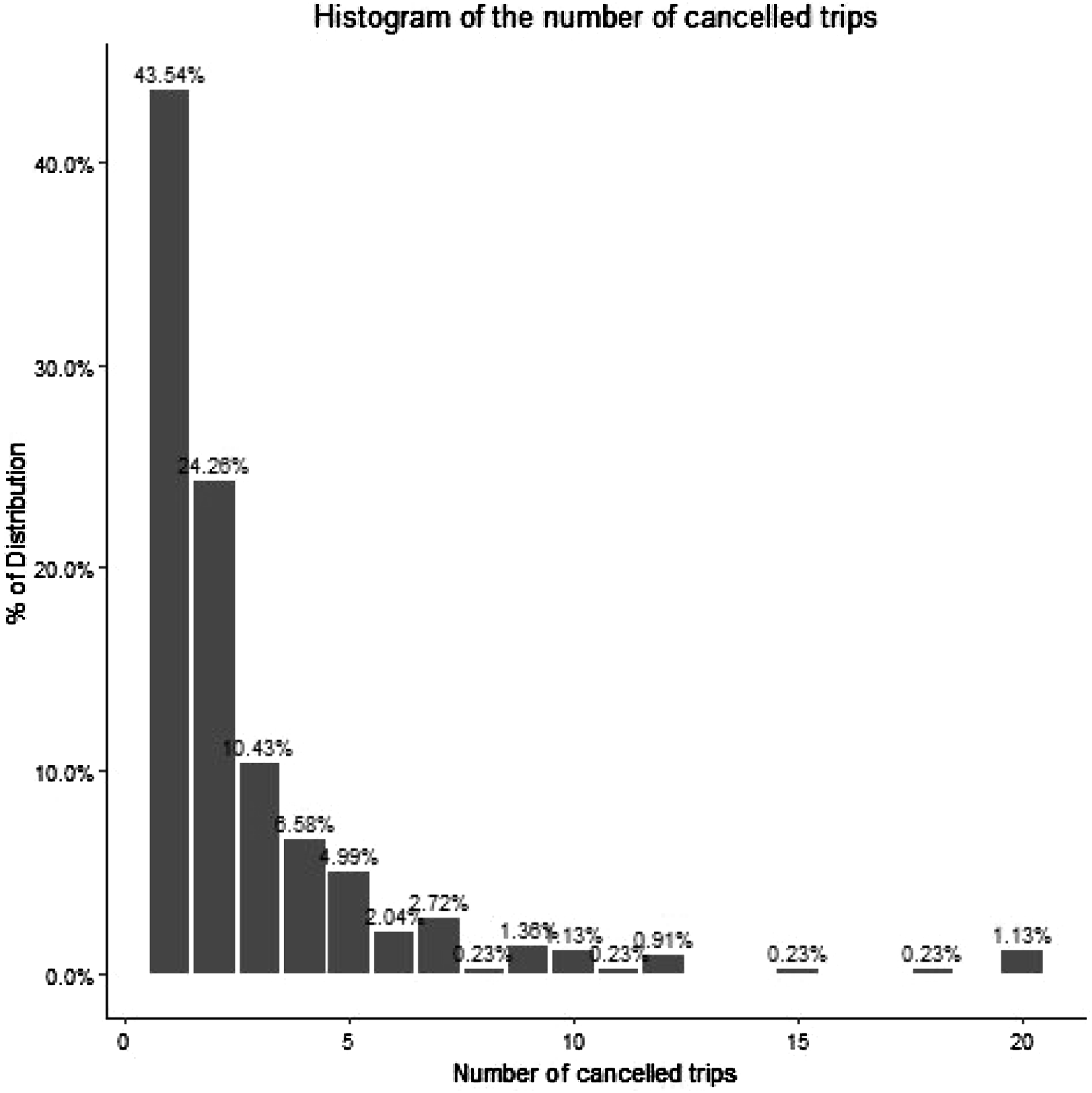
Histogram of the number of intended recreation or leisure trips cancelled or postponed in 2020.
In order to capture risk perceptions, the survey asked: “What is the probability that traveling within the U.S. in the next 6 months will lead you to: 1. Be around others with COVID-19, 2. Contract COVID-19, 3. Be hospitalized with COVID-19?”, with responses on the scale of not probable, somewhat improbable, neutral, somewhat probable, and very probable). In addition, the survey had two questions that allow us to evaluate the relative importance of health and financial risks in the decision of whether to cancel or not travel: Health Risk (“in your opinion, how serious do you think the health risks of COVID-19 are to you?”), Financial Risk (“in your opinion, how serious do you think the financial risks of COVID-19 are to you?”), with responses on a 5-point Likert scale: “not at all serious, slightly serious, moderately serious, very serious, extremely serious” that were recoded into two categories of “not serious” and “serious.”
Subjective norms were assessed based on the level of agreement in a 5-point Likert scale with the following statements: 1. “Most people who are important to me think I should travel within the U.S. in the near future,” 2. “The people in my life whose opinions I value would approve of me traveling within the US in the near future.” 3. “Most people who are important to me would travel within the US in the near future.” The concern of disease transmission, Transmitting to others, was measured with the yes/no answer to the following question: “In your decision to cancel or postpone your US overnight recreation or leisure trips, which factors played a role?” with “concern of inadvertently transmitting COVID-19 to people at the destination or to relatives and friends upon my return” being an option.
Perceived behavioral control was assessed based on the level of agreement in a 5-point Likert scale with the following statements: 1. “It is easy for me to travel within the US in the near future.” 2. “Whether or not I travel within the US in the near future is completely up to me.” 3. “If I wanted to, I could travel throughout the US in the near future.” 4. “I have complete control over traveling throughout the US in the near future.” 5. “It is possible for me to travel throughout the US in the near future.”
Pairwise correlations of the key variables of interest.
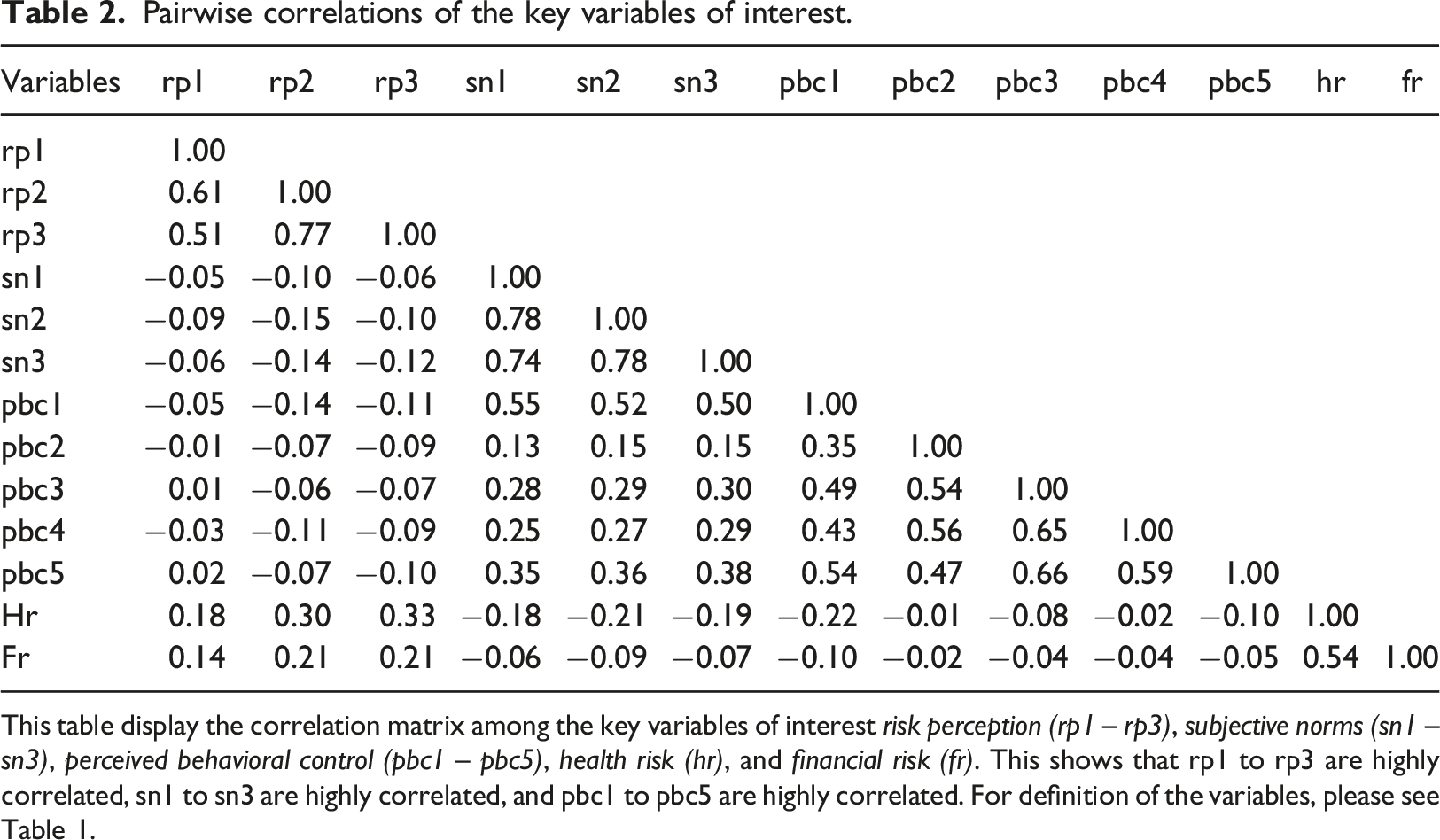
This table display the correlation matrix among the key variables of interest risk perception (rp1 – rp3), subjective norms (sn1 – sn3), perceived behavioral control (pbc1 – pbc5), health risk (hr), and financial risk (fr). This shows that rp1 to rp3 are highly correlated, sn1 to sn3 are highly correlated, and pbc1 to pbc5 are highly correlated. For definition of the variables, please see Table 1.
Other questions on the survey gathered socio-economic information (such as age, marital status, or employment). Our sample is slightly younger than the US population (25.38% of respondents are between 25 and 34 years of age, compared to a corresponding 13.9% from the US Census, 2019). 65.06% are white; 57.12% are either partially or fully employed, and 53.17% are female. This compares to corresponding US Census figures of 72%, 60.2% and 49.2%, respectively (United States Census, 2019).
Results
Logistic regression result of the decision to cancel or postpone recreation overnight travels within the U.S.
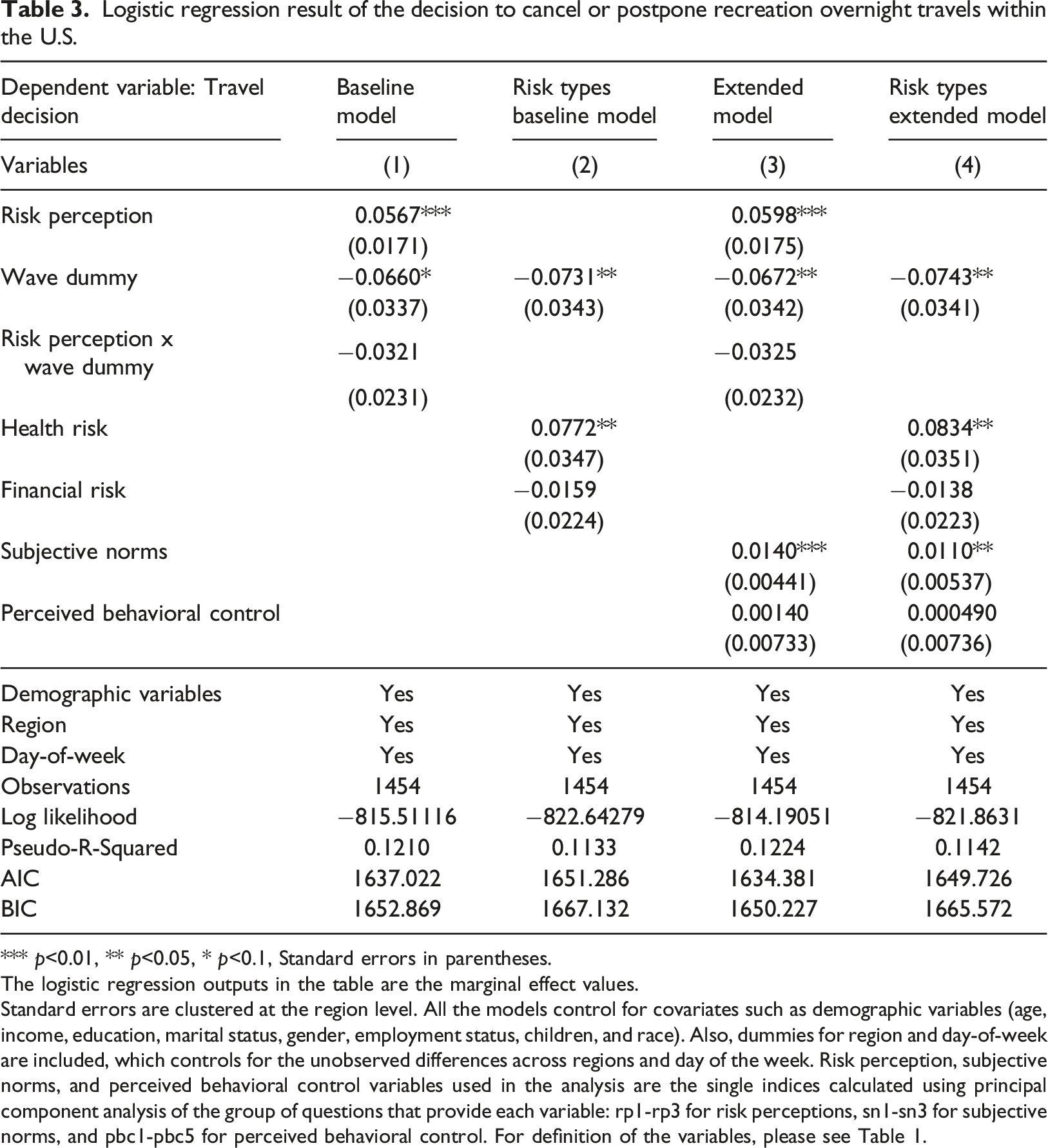
*** p<0.01, ** p<0.05, * p<0.1, Standard errors in parentheses.
The logistic regression outputs in the table are the marginal effect values.
Standard errors are clustered at the region level. All the models control for covariates such as demographic variables (age, income, education, marital status, gender, employment status, children, and race). Also, dummies for region and day-of-week are included, which controls for the unobserved differences across regions and day of the week. Risk perception, subjective norms, and perceived behavioral control variables used in the analysis are the single indices calculated using principal component analysis of the group of questions that provide each variable: rp1-rp3 for risk perceptions, sn1-sn3 for subjective norms, and pbc1-pbc5 for perceived behavioral control. For definition of the variables, please see Table 1.
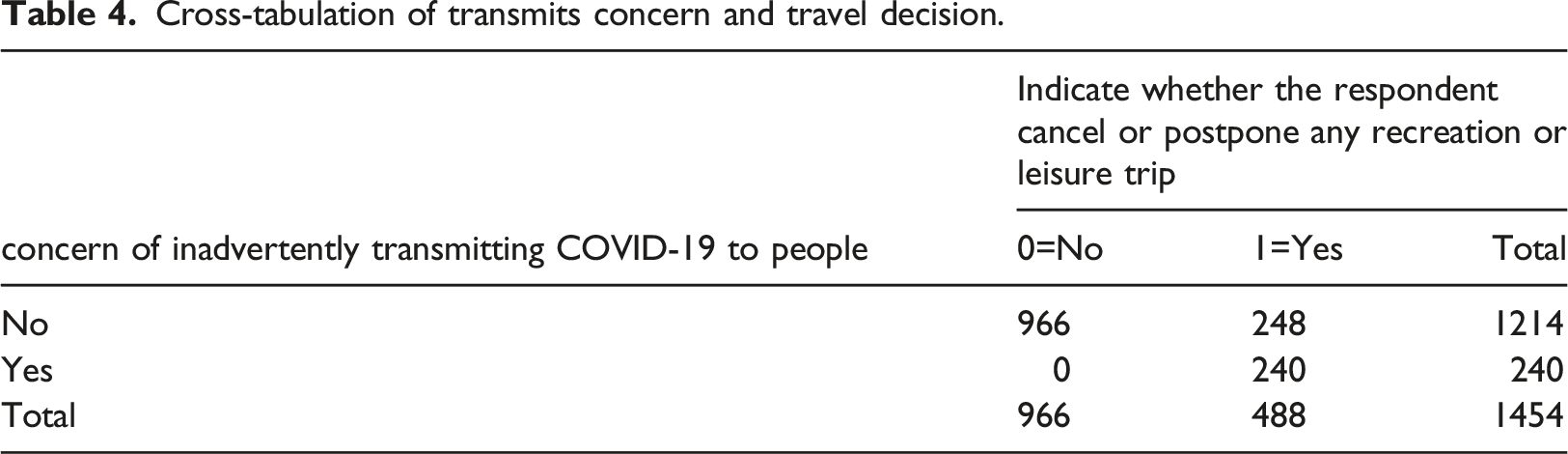
Cross-tabulation of transmits concern and travel decision.
For the baseline model (column 1 Table 3), the estimate for risk perception is statistically significant at a 1% level. This indicates that a 1-point increase in respondents' risk perception index leads to a 5.67% increase in the probability to cancel/postpone overnight trips within the US. The wave dummy exhibits a negative sign and statistically significant at 10% suggesting that US residents may have experienced some fatigue from COVID-19, and they are less likely to cancel or postpone leisure travel when asked later in the year (October vs. July 2020) despite the country still being hit by the pandemic. Also, the interaction term of risk perception and wave shows a negative coefficient that is not statistically significant, perhaps because the two survey waves are close together.
In column 2, we differentiate between different risk types, namely health and financial risks. Health risk is statistically significant at a 5% level with a coefficient of 0.0772. This is an intuitive result indicating that the probability of canceling or postponing leisure travel is larger for individuals who take the health risk of COVID-19 seriously compared to those who do not. In contrast, the financial risk variable is not statistically significant, suggesting that health risks are a more important factor in people’s decision to cancel/postpone recreation trips amidst COVID-19. As in column 1, the wave dummy variable is statistically significant at 5%. The interaction variable between the risk perception and wave dummy is not reported here for simplicity as it was not statistically significant (see Appendix Table A2, column 1 for full set of results).
Column 3 of Table 3 shows the estimates of the extended EUT model. In the extended model, we further decomposed subjective norms into two variables; the relevant others' perception and the negative externality on others of traveling (based on equations (6) and (7)). As indicated above, however, all those who cancel or postpone recreational travel are concerned about transmitting COVID-19 (Table 4). In column 3, risk perception is statistically significant at a 1% level, and of comparable magnitude to the estimate in column 1. The coefficient estimates on the subjective norms variable is statistically significant at 1%. It indicates that as the level of agreement with important others approving of them to recreationally travel, their probability of canceling/postponing recreation trips increases by 1.40%. Perceived behavioral control (PBC) is not statistically significant suggesting that PBC is not an important reason for canceling or postponing trips in our sample. The Akaike information criterion (AIC) and Bayesian information criterion (BIC) model selection criteria show that the extended model is preferred (Table 3). The interactions between the wave dummy and the TPB variables in the extended model (subjective norms, and perceived behavioral control), reported in Appendix A Table A2 column 2, are not statistically significant.
Finally, column 4 displays the coefficients for risk type. As in column 2, while health risk is found to be statistically significant, financial risk is not.
Discussion and conclusions
This paper shows that risk perceptions and subjective norms are significant factors influencing traveler’s decisions to cancel or postpone recreation trips in the US in both June–July 2020 and October 2020. Further investigation into the nature of the travel risks suggests that it is health risks rather than financial risks perception that changed travelers’ decisions. This is consistent with Jonas et al. (2011) who found that health risk perception ranks high among other types of risk perception (although their study focuses on tourists traveling to low-income countries). Our finding reflecting the importance of COVID-19 health risk perceptions is consistent with more recent studies on travel intention and vacation travel behavior change during the pandemic (Perić et al., 2021; Bratić et al., 2021; Neuburger and Egger 2020; Falahuddin et al., 2021).
In the way of theoretical implications, our results also indicate that an EUT model extended to incorporate TPB constructs is preferred to the baseline EUT model to explain travelers' behavior during the COVID-19 pandemic. EUT is concerned with individual utilities and subjective probabilities while TPB measures behavioral intention using attitudes, subjective norms, and perceived behavioral control. Our results indicate that both subjective probabilities (those reflecting health risks) and subjective norms affect individuals’ decision to travel, while perceived behavioral control does not affect that decision. This last result is consistent with Arikkatt and Mohana (2021) and suggests that perceived behavioral control (PBC) may be irrelevant when travel decisions involve elevated health risk, such as with the COVID-19 pandemic. PBC found to be insignificant may be as a result of the health risks. This might be greater than an individual perception of easiness or difficulty to travel for leisure during COVID-19 pandemic. Despite this potential explanation, Aschwanden et al. (2021) recently found that perceived behavioral control was a significant predictor of individuals’ preventative behaviors during the pandemic.
One of the TPB constructs included in the extended EUT model is subjective norms. A large literature in behavioral studies has studied the role of social norms in decision making (Baron, 1992; Bicchieri, 2005; Bicchieri and Xiao, 2009; Tesar, 2020). Bicchieri (2005), categorized social norms into two groups: empirical expectation (what an individual expects others to do) and norm expectation (what we think other expect us to do). The subjective norms considered in our paper are related to norm expectation. In addition, our study considers another element reflecting concern for others’ welfare that may be considered more altruistic and people willingness to contributes to a public good (external benefit or positive externality): the concern of transmitting COVID-19 to others in the destination or upon returning from travel. This element proves to be extremely important. Further, all surveyed individuals who canceled or postponed recreational travel were concerned about transmitting COVID-19, which is what Li et al. (2020) proposed would occur in their recent work concerning tourists’ behavioral changes in response to risk perceptions of transmitting COVID-19.
COVID-19 has tremendously affected the hospitality and tourism industry and has underscored that understanding of factors that lead to massive cancelation or postponement of recreational travel is important not only from a public health perspective but also from an economic perspective. Our findings suggest that strategies to influence travelers’ subjective norms and health risk perceptions, particularly the concern of infecting others, may be helpful as the recovery from the pandemic is ongoing. One possible strategy would be to enhance destination trust regarding health risks. One example of such actions can be promoting safety measures and precautions of COVID-19 at hotels, restaurants, and tourist attractions (Assaf and Scuderi, 2020). These efforts could take the form of visible postings of standards for social distance, vaccination, and mask requirements on-site at establishments but also on lodging, eateries and bars, and attraction webpages and social media platforms. Such efforts may allay some potential behavioral change and provide visitors with greater peace of mind in deciding to visit.
Application of the proposed model in this study is not limited to the COVID-19 pandemic. Our complementary model uniting EUT and TPB can be tested and applied in additional contexts where tourists are faced with risks and uncertain outcomes in deciding to travel during, for example, other viral disease outbreaks, natural disasters (e.g., floods, hurricanes, wildfires, etc.), times of war and armed conflicts, and terrorism. In each of these contexts, travelers’ potential for behavioral change can be examined, especially as we see each of these contexts currently occurring throughout the globe. Furthermore, subsequent research can examine how potential factors affecting U.S. residents’ travel decisions evolve over time as we recover from the pandemic, and as vaccines becomes widely available across the country. In so doing, additional model predictors may include potential travelers’ vaccine status, perceptions of vaccination, age, response efforts of transportation corporations, availability of health care, established restrictions, number of those infected with COVID-19 within the destination, etc. Others have offered these constructs as viable predictors within their works (see Chua et al., 2020; Parady et al., 2020; Shamshiripour et al., 2020; Zhang and Lu, 2021).
Our study does indicate that risk perceptions are an important factor explaining the decision to cancel travel, but that other predictors (such as concern of transmitting COVID-19) cannot be ignored. By extending the expected utility theory with the theory of planned behavior to explain decisions that involve risk (the decision to travel during a pandemic), our study contributes to the to the growing literature on COVID-19, and more broadly to the behavioral and decision-theoretic literature.
Footnotes
Declaration of conflicting interests
The author(s) declared no potential conflicts of interest with respect to the research, authorship, and/or publication of this article.
Funding
The author(s) received no financial support for the research, authorship, and/or publication of this article.
Data availability statement
The data that support the findings of this study are available upon request from the correspondence author.

Notes
Appendix
Appendix A
Logistic regression result of the decision to cancel or postpone recreation overnight travels within the U.S. (Estimate results with the full interaction variables).
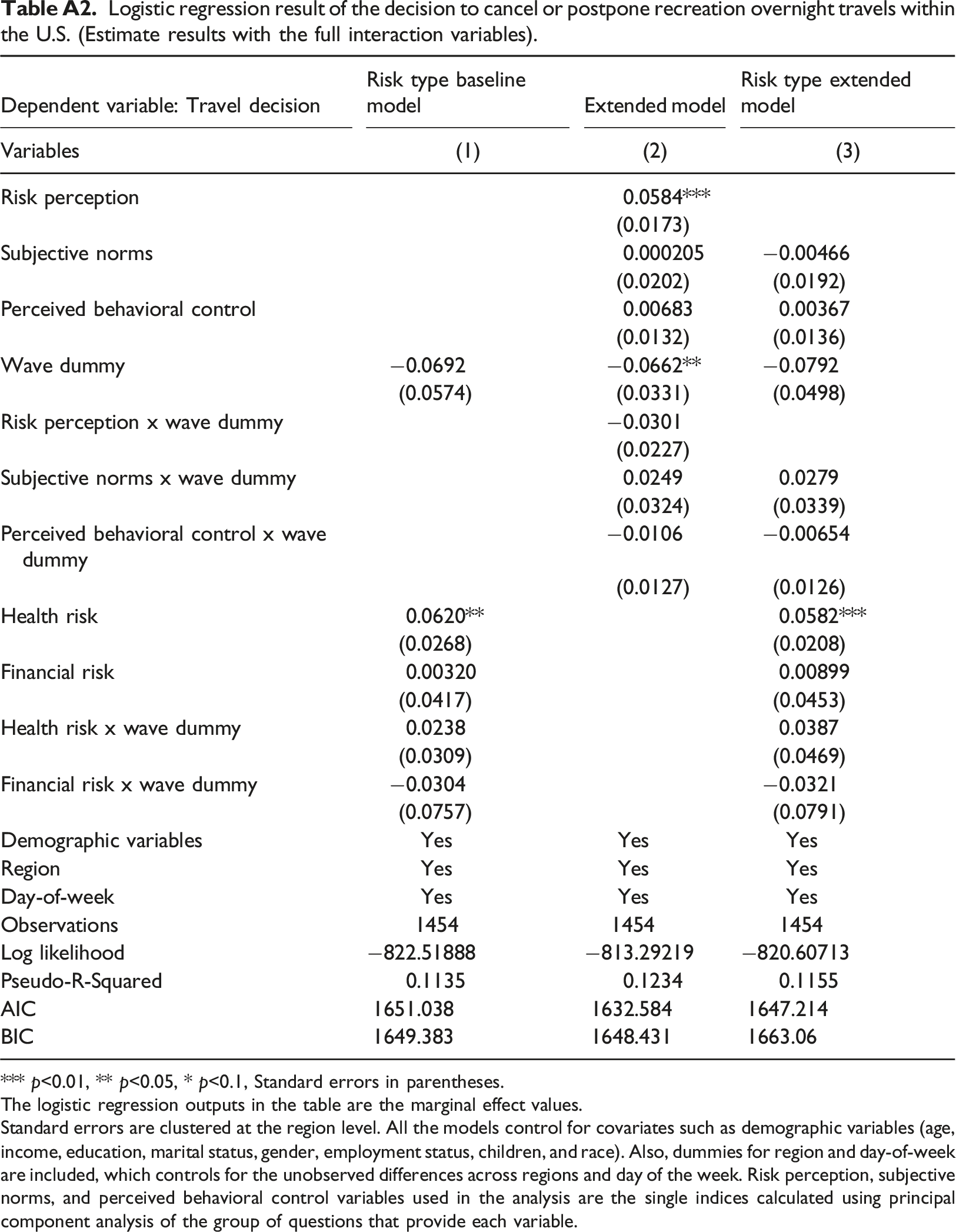
| Dependent variable: Travel decision | Risk type baseline model | Extended model | Risk type extended model |
|---|---|---|---|
| Variables | (1) | (2) | (3) |
| Risk perception | 0.0584*** | ||
| (0.0173) | |||
| Subjective norms | 0.000205 | −0.00466 | |
| (0.0202) | (0.0192) | ||
| Perceived behavioral control | 0.00683 | 0.00367 | |
| (0.0132) | (0.0136) | ||
| Wave dummy | −0.0692 | −0.0662** | −0.0792 |
| (0.0574) | (0.0331) | (0.0498) | |
| Risk perception x wave dummy | −0.0301 | ||
| (0.0227) | |||
| Subjective norms x wave dummy | 0.0249 | 0.0279 | |
| (0.0324) | (0.0339) | ||
| Perceived behavioral control x wave dummy | −0.0106 | −0.00654 | |
| (0.0127) | (0.0126) | ||
| Health risk | 0.0620** | 0.0582*** | |
| (0.0268) | (0.0208) | ||
| Financial risk | 0.00320 | 0.00899 | |
| (0.0417) | (0.0453) | ||
| Health risk x wave dummy | 0.0238 | 0.0387 | |
| (0.0309) | (0.0469) | ||
| Financial risk x wave dummy | −0.0304 | −0.0321 | |
| (0.0757) | (0.0791) | ||
| Demographic variables | Yes | Yes | Yes |
| Region | Yes | Yes | Yes |
| Day-of-week | Yes | Yes | Yes |
| Observations | 1454 | 1454 | 1454 |
| Log likelihood | −822.51888 | −813.29219 | −820.60713 |
| Pseudo-R-Squared | 0.1135 | 0.1234 | 0.1155 |
| AIC | 1651.038 | 1632.584 | 1647.214 |
| BIC | 1649.383 | 1648.431 | 1663.06 |
*** p<0.01, ** p<0.05, * p<0.1, Standard errors in parentheses.
The logistic regression outputs in the table are the marginal effect values.
Standard errors are clustered at the region level. All the models control for covariates such as demographic variables (age, income, education, marital status, gender, employment status, children, and race). Also, dummies for region and day-of-week are included, which controls for the unobserved differences across regions and day of the week. Risk perception, subjective norms, and perceived behavioral control variables used in the analysis are the single indices calculated using principal component analysis of the group of questions that provide each variable.