







Abstract
This article contributes to research on children’s YouTube, online video genres and media consumption practices by focusing on genres that take shape at the intersection of digital media content and embodied sensation and in particular ‘oddly satisfying’ (OS) videos. This type of content has become popular on YouTube, where examples of satisfying and OS content include the manipulation or movement of a range of colourful or tactile materials such as slime, kinetic sand or icing a cake. To document the evolution and key characteristics of this genre, we analyse YouTube videos using content analysis methods. Our findings show the characteristics of this sensory genre can be understood through the concept of visual tactility, which highlights the synaesthetic feel of watching these videos. Further, we identify and examine how OS videos demonstrate ambiguities in children’s YouTube content, audiences and regulation by overlapping with other sensory genres and more adult content, such as ASMR. This analysis thus situates this sensory genre in relation to the developing study of children’s YouTube entertainment industries and media regulation.
Introduction
This article contributes to research on children’s YouTube, online video genres and media consumption practices by focusing on genres that take shape at the intersection of digital media content and embodied sensation and in particular ‘Oddly satisfying’ (OS) videos. The term ‘satisfying’ is used in children’s vernacular to reference all sorts of everyday mediated content, materials or processes that are deemed to have reached a threshold of sensory enjoyment. Adding ‘oddly’ to ‘satisfactory’ in keywords or video titles highlights how such visual experiences often incorporate an unexpected sensory quality or feeling derived from the act of viewing. This type of content has become popular on YouTube, where examples of satisfying and OS content include the manipulation or movement of a range of colourful or tactile materials, such as slime, kinetic sand or icing a cake. To document the evolution and distinctive qualities of the OS genre over time, we analysed YouTube videos associated with the search term OS, which we broke into three sets of 100 OS videos at three different temporal junctures: pre-2016 (2014–2015), pre-2018 (2016–2017) and pre-2020 (2018–2019). Using content analysis methods, this article articulates the key characteristics, content and sensory features of this genre.
Our findings show that as popular content organised around particular keywords and characteristics, OS videos emerged as a distinct genre of YouTube content. We analyse the OS genre in this article in reference to the idea of visual tactility, a concept that builds upon haptic media studies and in particular haptic visuality (Marks, 2000), as part of what we describe as sensory genres of YouTube. In doing so, we discuss the emergence, boundaries and definitions of this genre as a part of children’s YouTube, as well as other related child-oriented YouTube genres that have become popular in recent years involving slime, play doh, cooking and DIY videos. However, we also identify and examine how OS videos demonstrate ambiguities in children’s YouTube content, audiences and regulation by overlapping with other sensory genres and more adult content, such as the genre that has come to be known as ASMR, which stands for autonomous sensory meridian response. OS videos elicit an overlapping but also distinct sensory response to ASMR videos, which feature miscellaneous auditory and visual sensory stimuli that promote a synaesthetic and pleasurable response (Maddox, 2021).
This analysis thus situates the OS and ASMR genres in relation to the developing study of children’s YouTube entertainment industries, emerging and sensory genres and media regulation (Bridle, 2017; Burroughs, 2017; Craig and Cunningham, 2017; Nicoll and Nansen, 2018; Balanzategui, 2021). The article also contributes to the nascent area of ASMR research by focusing on the OS genre, its audio and visual elements of sensory stimulation and its relation to the kids YouTube ecology. We discuss how ASMR’s ambivalent associations with sex, which are perceived as culturally outside the bounds of child-appropriate content (Andersen, 2015; Gallagher, 2019; Waldron, 2016), problematise the platform cultures and regulation of children’s YouTube genres. Finally, we analyse how this genre slips between and thus highlights key ambiguities between child- and adult-oriented content on the platform – ambiguities that have recently become a major site of cultural and regulatory tension, which we discuss in relation to recent changes in YouTube’s children’s content policies.
Background – The emergence of the oddly satisfying genre
Children’s YouTube genres
YouTube is now a dominant platform in children’s viewing (OfCom, 2019, 2020). This popularity is determined by the breadth of available video content, which includes child created video content. In addition, child YouTube viewing is influenced by the dynamic archive and algorithmic curation of content that serves up a personalised and compelling platform experience for children. Within this platform ecology, children’s YouTube video consumption is individually organised through direct search entries, channel subscriptions and notifications, as well as via ‘up next’ and autoplay features. Here, content is queued by the platform’s algorithmic sorting and recommendation features based on data points including search history.
Within such algorithmic organisation and viewing ecologies, an increasing number of video creators are making use of analytics in order to identify content that is appealing and popular with viewers and to develop content production strategies accordingly (Cunningham et al., 2016; Lobato, 2016). Child viewers have emerged as a key target of such content monetisation, production and platform strategies (Burroughs, 2017). Since 2017 in particular, controversies have arisen around content types native to YouTube that seemingly target child viewers to maximise views, but are not ‘child-appropriate’ according to the expectations and age-based classification frameworks of legacy broadcast media (Di Placido, 2017; Bridle, 2017; Balanzategui, 2021). 1 In contrast to television, the algorithmic arrangements of YouTube also create new and emergent genres through feedback loops between content creators and YouTube viewers.
Here, the viewing and content selection practices of child viewers – and the ways these are operationalised by content creators and YouTube’s sorting algorithms – play a key role in the formation of children’s digital genres. This process of generic development contrasts starkly with children’s media production traditions in legacy media (film and broadcast/cable TV) and even with new trends of professionally produced children’s content on subscription video on demand (SVOD) platforms (Baker et al., 2020; Potter, 2017). On YouTube, children’s content preferences and selection practices operate within the ‘ambivalent’ production and distribution mechanics of the platform (Burgess, 2018) in the formation of content trends and genres. Moreover, children often contribute directly to the formation of popular genres by featuring in and/or creating content themselves (Abidin, 2017; Lange, 2014; Nicoll and Nansen, 2018).
In this participatory and dynamic environment in which genres consist of an amalgamation of user-created and professional content, popular child-oriented genres often bear little resemblance to older genres of children’s TV. On television, children’s genres are clearly distinguished from adult content not just through form and mode (for instance, animation, puppetry, credit sequences, certain types of performers and their modes of address), but through production, regulatory and distribution architectures, like timeslots and ratings. Instead, on YouTube, new generic configurations emerge and evolve through factors including entangled relations between children’s media consumption practices, algorithmically recommended and promoted videos and various different types of content creators operating within these platform economies of programmatic advertising. In contrast to TV genres, emergent children’s YouTube genres are often organised around seemingly arbitrary and unexpected popular culture-related trends, such as the romantic coupling of Spider-Man and the character Elsa from Disney’s Frozen (2013) at the centre of the controversial ‘family entertainment character mash-up’ genre: a trend that effectively – and, in the opinion of a number of journalists, exploitatively – harnesses YouTube’s algorithmic distribution mechanics like video tags and thumbnail art (Balanzategui, 2019, 2021; Bridle, 2017; Di Placido, 2017).
Whilst some popular children’s genres on YouTube are inherited from traditional entertainment industries, others are unique to and have emerged from user-created content trends on YouTube. For example, amongst the reported popular genres of children’s YouTube videos are craft, hack, DIY, slime, make-up, vloggers and YouTube families, along with genres with closer relationships to traditional entertainment industries such as gaming, TV clips and music videos (OfCom, 2019). A significant shift in genre formations can be seen in the popularity of genres based around cultural activities such as unboxing toys, or, as in the case of OS videos, organised around sensory rather than narrative characteristics. Within these generic environments of YouTube and other video-sharing platforms, sensory stimulation or ‘satisfying’ videos involving materials like slime have emerged as a significant genre: “…many children of different ages were watching videos whose appeal seemed to be related to their sensory or tactile nature, beyond the normal audio and visual features of video content. These often fell under key search words such as “satisfying” and “oddly satisfying”. Videos typically involved compilations of different tactile or textural materials being manipulated by the video maker’s hands in different ‘satisfying’ ways” and they “stimulated sensory experiences” (OfCom, 2019: p. 23).
Other related sensory experiences in this type of content involve manipulating, cutting up or melting materials such as soap, candles, modelling clay and kinetic sand. A material that is particularly popular is ‘slime’, “a malleable and sticky substance made by mixing sodium borate and water. Slime videos are made and uploaded to YouTube by both adults and children, often without the need for speech and many have gained over one million views. This is thought to be because of their ‘oddly satisfying’ quality” (OfCom, 2019: p. 35). As a hugely popular feature of YouTube videos, slime reproduces some of the ambiguities surrounding OS and ASMR videos more generally: they are made by both adults and children and although not classified explicitly as child content by YouTube or the media regulators, they are ostensibly aimed in part at and popular with a child audience. As we highlight at the end of this article, play with slime and similar tactile materials has long been a prominent feature of children’s culture and slime videos on YouTube continue this phenomenon.
The Oddly Satisfying genre appears to be organised primarily around providing a sensory experience to the viewer, more precisely a form of visual tactility rather than recurring narrative characteristics and thematic preoccupations. The concept of visual tactility emerges from a broader history of haptic media, which involves extended and synaesthetic forms of mediated tactility found in both digital media interfaces (Parisi et al., 2017), as well as experimental cinematic experiences that provoke intercultural embodiment (Marks, 2000). Laura Marks coined the term ‘haptic visuality’ in her influential work on film aesthetics to highlight how the screen can activate a complex sensory and embodied form of audience engagement. Oddly Satisfying videos and other YouTube genres like ASMR extend these qualities by constructing a tactile sensation in an audiovisual medium, but as Marks’ work indicates, this embodied mode of engagement is not necessarily a new phenomenon unique to YouTube content. Indeed, while they tend to be more narrative driven, certain legacy media genres can also be defined via their intended sensory and affectual effects rather than their semantic or syntactic patterns: for instance, Noël Carroll famously asserts that the horror genre is ‘essentially linked with a particular affect’ after which the genre is named and the genre as a whole is ‘designed to elicit’ this affect (1990, p. 15).
Of course, affect is a critical part of any screen genre, or indeed, any interaction between bodies and external stimuli – as affect theorists Gregory J. Seigworth and Melissa Gregg explain, ‘affect is persistent proof of a body’s never less than ongoing immersion in and among the world’s obstinacies and rhythms’ (2010: p. 1). Yet in the cultural consciousness and across scholarly definitions, it is not the norm to define a screen genre primarily through its affective and/or sensory properties and potentialities. As Xavier Aldana Reyes explains of Carroll’s influential contention about horror, ‘Carroll argues that horror’s identifying trait is its capacity to emote, to instil affect. The predominance of affect is therefore understood as the base for its recognizable status in opposition to other genres that may also use it’ (2012, p. 247).
Furthermore, children’s genres in legacy media tend to be defined and operate differently to genres like horror that are generally regarded as adult-oriented genres. For instance, Messenger-Davies points out that children’s TV is defined largely by the perceived needs and capacities of its intended audience and is thus ‘expected to aid appropriate psychological and cognitive development and to stimulate youthful imaginations’ (2001, p. 97–99). Indeed, certain genres like children’s horror television have attracted controversy for their seeming prioritisation of entertainment and affect over children’s wellbeing and development (Balanzategui, 2018). Yet, even controversial horror television series like Goosebumps were professionally developed and distributed in accordance with classification frameworks that set out clear guidelines for child appropriateness. By contrast, while the OS genre on YouTube may echo legacy children’s content traditions like art and craft TV programmes, the genre has developed in ‘ambivalent’ ways around an ambiguously articulated sensory experience ungrounded from narrative structures, thematic preoccupations and classifications frameworks. Marks points out in her work how haptic visuality has a subversive potential in its activation of embodied knowledge processes. For instance, she advocates for seeing ‘the haptic as a visual strategy that can be used to describe alternative visual traditions, including women’s and feminist practices’ (2000, 170). That OS content engages children via visual tactility similarly amounts to an alternate way to understand and engage with screen content, the subversive elements of which are considered below. In this way, OS videos are intertwined with ASMR, further emphasising the ambivalent process of generic development on YouTube and attendant ambiguities between child- and adult-oriented content.
We deploy ‘visual tactility’ rather than Marks’ term haptic visuality in this article because Oddly Satisfying videos do not tend to engage in the kinds of ‘explicit critique of visual mastery’ (2000, 151–152) Marks illuminates in her analysis of experimental intercultural films. She expands that her focus on haptic visuality seeks to ‘find culture within the body’ rather than articulate ‘a primordial state of sensory innocence’ (152). OS videos by contrast offer brief flashes of sensory satisfaction detached from broader contexts. Thus, while they construct a tactile experience via audiovisual means in parallel with the examples Marks addresses, they do not typically do so in a way that engages, deepens, or contests embodied cultural knowledges – or in fact in a way that has any intentions or effects beyond eliciting sensory pleasure. As the section below articulates, the discourses that surround visual tactility do tend to associate the experience with something akin to the ‘primordial state of sensory innocence’ rejected by Marks, albiet ambivalently: as is suggested by the genre’s name, ‘oddly satisfying’ content foregrounds fleeting moments of unexpected and seemingly inexplicable sensory pleasure. The sensation of tactility is thus the emphasis and key unifying feature of this content.
Defining the ASMR genre as a discursive category
OS videos are closely related to autonomous sensory meridian response (ASMR) videos, which seek to produce a calming and tingling sensation by reproducing mundane tasks and sounds, like tapping, scratching, or whispering into a microphone, with the intent to produce physical sensory responses in their audience (Maddox, 2021). ASMR has been a popular mode and subculture on YouTube since at least 2008 (Andersen, 2015: p. 684), with research focusing around the physiological and psychological effects of ASMR videos, such as tingling sensations or relaxation (Barratt and Davis, 2015; Young and Blansert, 2015). Studies have also addressed ASMR videos on YouTube in terms of cultural and media subjectivities, communities or consumption (Andersen, 2015; Gallagher, 2019; Maddox, 2021; Malone, 2017). The ASMR genre harnesses YouTube’s distinctive affordances as both a user-generated video and social media platform, having formed on YouTube in part due to the platform’s central position within an ecology of social networking sites (Maddox, 2021). As Gallagher (2019: p. 261) points out, the ‘discourse and culture’ surrounding the ASMR genre coalesced across platforms including Reddit, Facebook and Yahoo Groups.
The ASMR genre evolved in a participatory and multi-platform way, suggesting a move beyond traditional text-based understandings of genre analysis dominant in screen studies (see, for instance, the influential work of Altman, 1984, 1999). We instead propose that YouTube genres be understood as a discursive category, to use terminology introduced by Mittell (2001) in relation to the study of television genres. According to Mittell’s model, which is influenced by Foucault, genre forms through a series of ‘cultural operations’ and concepts (p. 8–10) that are inflected and shaped by the affordances and specific qualities of the media on which they form (p. 8). Indeed, the ASMR genre is not particularly legible if the videos are considered in isolation: the meanings, functions and pleasures associated with ASMR videos are constructed by and bound to the commentary that surrounds them. Such commentary is an example of the cultural ‘terms and definitions’ that Mittell associates with the ‘discursive practices’ which constitute genre and that ‘circulate around and through’ video genres as groupings of texts with shared audio-visual characteristics (p. 8). In this article, such an approach is undertaken in order to analyse and understand OS videos and their connections to both the ASMR genre and popular sensory based child-oriented genres on YouTube.
Extant research on the ASMR genre has focused on how it invites and constructs a particular affective experience, which scholars have described as ‘the shiveries’ (Andersen, 2015: p. 684), ‘a mysterious, blissfully relaxing tingling sensation’, colloquially referred to as a ‘braingasm’ (Gallagher, 2019: p. 261–263), an experience related to ‘the phenomenon of frisson (pleasant chills or shivers)’ (Kovacevich and Huron, 2018: p. 40) and more broadly as an online experience that is fundamentally embodied and sensory. The content of the videos is organised around prompting such sensory and affectual responses from viewers: indeed, the genre’s title, Autonomous Sensory Meridian Response, is a quasi-scientific descriptor of the affect these videos aim to provoke. As Gallagher puts it, as a genre, ASMR videos function less as “‘texts” to be interpreted or narratives to be followed than as “inputs” that succeed or fail in producing the desired physiological output’ (2019, p. 264). The videos thus feature a wide variety of themes and objects, including hair-brushing, caressing and massaging slime or goo or cutting up bars of soap. Orange (2017) points out that the genre tends to feature ‘whispering, word repetition, role playing, close-ups, eye contact, lens caressing, brushing, tapping and an intensely hot mic’. A number of scholars have highlighted that presenters of ASMR videos tend to be female and that the mildly erotic whispering (Kovacevich and Huron, 2018: p. 49; Andersen, 2015: p. 697) or quietly ‘reassuring’ (Iossifids, 2016) female voice is a key feature of the genre. Our analysis of the OS genre builds on such work to pinpoint which sensory features are also prevalent in this more explicitly child-oriented – or at least, child ‘friendly’ – YouTube genre.
Defining the oddly satisfying genre
In some senses OS videos operate as a more mundane nomenclature or euphemism for ASMR, eliciting similar sensory responses such as tingling, as well as broader affective responses associated with positive feelings. Yet, this terminology shifts the register from a quasi-scientific domain to one that is more prosaic and, importantly, accessible and meaningful to children. Like ASMR, the OS genre has evolved through a discursive process in which videos that spark a certain sensory, affective response amongst viewers have been defined and categorised via YouTube user comments and through discussion about the materials, feelings and qualities of OS content on other social networking sites, especially Instagram and Reddit. In this way, the discursive formation of the concept and its media consumption evolves through a cross-platform ecology of user content production and reception. Kevin Allocca, head of Culture and Trends at YouTube, points to this process in describing how the genre crystallised on the platform: ‘You started to have a nomenclature around it and you started having a taxonomy and you were able to explain a thing you’d always seen and enjoyed which allowed it to flourish’ (cited in Matchar, 2019). Matchar highlights a community on Reddit dedicated to ‘Oddly Satisfying’ gifs and videos that has existed since May 2013: discussions amongst this community have been fundamental to the genre’s discursive formation and popular commentary like Matchar’s piece in the New York Times have translated such vernacular generic definition for a wider public.
In popular commentary, OS videos are often linked to ASMR, but they are also described in more mundane terms with less emphasis on sensory responses. For instance, in a Wired article Faramarzi describes the OS genre as tied to ‘the inexplicably pleasing quality that watching some mundane thing could rouse in the viewer’, from industrial machines cutting through ice to throwing paper and ‘getting it smack bang in the trash can the first time around.’ Matchar quotes a Biopharmaceutical Sciences scholar, Craig Richard, who started a website called ‘ASMR University’ and describes OS videos as a branch of ASMR content he calls ‘observation-mediated ASMR’. He notes that such videos often feature people doing tasks with their hands and this genre is thus more attuned to child viewers than ASMR generally, because it supports young children’s interest in hand movements, an interest he claims is ‘hardwired’ in children because it supports the development of fine motor skills. Thus, despite the aesthetic, thematic and formal differences between OS content and professionally produced television for young children, Richard’s comments imply that OS videos have a productive developmental function for young audiences, in so doing distinguishing this type of content from ASMR more broadly. In his reflective essay on the aesthetics of OS videos, Evan Malone also emphasises tactile moments of what he calls ‘flashes of perfect fit’: like the ‘clean crisp click’ of a makeup compact, in which the sound ‘just fits with the task of closing it’.
Thus, in paratextual commentary seeking to define OS videos, the emphasis and register of the discourse intersects with, while being distinct from, discussions about the pleasures of ASMR videos. Rather than seeking to articulate the sensuous pleasures of the ‘shiveries’ or ‘braingasm’, the emphasis in OS commentary is instead on moments of satisfying tactility and sensory or auditory ‘fit’ emerging out of mundane, everyday activities. In the case of OS videos, then, the genre is reinscribed so the affective and sensory pleasures are more clearly directed at children in terms of the language used to describe the genre and the playful and colourful materials represented in the genre, framing this content as unambiguously child-appropriate.
ASMR, sensory genres and child-appropriate content
Because the ASMR genre is designed to provoke vaguely defined affective and physiological pleasures associated with tingling, goosebumps, shivers and so on, scholars have highlighted how the genre intersects with sexuality (Andersen, 2015; Kovacevich and Huron, 2018; Waldron, 2016). In the ASMR community, the genre’s association with sex is an ambivalently articulated and even controversial subject. Indeed, Jennifer Allen, a passionate longterm member of and contributor to the ASMR community who coined the term ‘Automated Sensory Meridian Response’, has described how she sought to come up with terminology to replace commonly used terms ‘brain orgasam’/‘braingasm’ that ‘sounded like some sort of erotic fetish kind of thing’ (cited in Keiles, 2019). In her scholarly analysis of how media infrastructures like ASMR ‘produce the incarnation of sexuality through the process of mediated intimacy’, Waldron contends that while the ASMR community has sought to position the genre as a mode of non-sexual therapy, ASMR actually offers what she defines as a ‘radical mode of sexuality’ (p. 4). Similarly, in their study of viewer responses to ASMR videos via comments on popular videos, Kovacevich and Huron found that the third most popular theme amongst the comments analysed was that the videos offered sexual arousal (56). They conclude that the most notable and consistent characteristic of the genre is its ‘high levels of intimacy and proximity’ (p. 58).
The ASMR genre’s discursively constructed identity as a sensual or even sexual practice – however ambivalently defined – results in cultural tensions of a different order with the emergence of the OS genre, which is popular with and in many cases seemingly oriented towards children. Theorists of childhood have dealt with the deep and longstanding friction between ideologies of childhood and sex in Western culture (see Higonnet, 1998; Kincaid, 1998), illuminating key related issues such as how sex and queer identities trouble cultural fixations with the teleological process of growing ‘up’ (Stockton, 2004) and the extent to which ‘notions of child powerlessness and child sexual ignorance stand as unsubstianted assumptions, begging the question of their political and performative function’ (Angelides, 2004: p. 148). As Egan and Hawkes have highlighted, cultural intersections between sex and children have long been problematically dealt with via discourses of protection and harm (2009, p. 391). In his analysis of life-writing that narrates the author’s discovery of the ASMR subculture and genre, Gallagher finds that the ASMR community tend to raise associations with childish pleasures to downplay ASMR’s sexual element or undertones. In a statement that resonates with the aforementioned ‘primordial state of sensory innocence’ raised and rejected in Marks’ theorisation of haptic visuality (2000, 152), Gallagher quotes a writer who claims that the genre offers pleasures in line with a mythical time of pre-sexual childhood innocence, as is evidenced by its popularity with children: ‘how can so many millions and millions of four-year olds get it and it be sexual? It just isn’t!’ (WhispersREd cited in Gallagher, 2019: p. 270).
Other scholars also implicitly or explicitly raise ASMR’s associations with childhood. While Andersen (2015) does not directly address the issue of child participants and viewers of the ASMR genre, in defining the ‘shiveries’ provoked by ASMR content, she opens by referring to the children’s rhyming game ‘Dot Dot Line’, which aims to provoke a ‘shivery’ affective experience that she aligns with the pleasures of ASMR. Similarly, Orange’s (2017) analysis of ASMR highlights how these content creators associate the sensory experience with their childhoods. Orange goes on to suggest that while the genre is ‘kinky’, fans insist it induces a ‘childlike state of total care and protection’. Barratt and Davis (2015) also contend that ASMR enthusiasts tend to report that the sensation provoked by ASMR was first experienced in their childhoods. Thus, ASMR has complex, ambivalent associations with both sexuality and childhood and the OS genre – which more directly engages children through its themes and content – highlights how evolving YouTube genres have the potential to subversively trouble clear demarcations between child- and adult-oriented content. Moreover, shifting forms of children’s media consumption and practice embodied by sensory YouTube genres do not only carry implications for the boundaries of appropriate content for children, but also connect to wider historical issues associated with the material and discursive divisions between child media production and consumption, assumptions and judgements about beneficial versus wasteful child leisure and play activities and ultimately the boundaries in conceptions about childhood itself (e.g Balanzategui 2021; Nansen, 2020).
In our research, in order to illuminate the evolution of the OS genre and to unpack its sensory qualities, we analysed three sets of 100 OS videos at three different temporal junctures: labelled below in findings as pre-2016 (to capture data from 2014–2015), pre-2018 (to capture data from 2016–2017) and pre-2020 (to capture data from 2018–2019). Our aim was to categorise the videos by theme and identify how these have changed over time, taking into account how the genre has developed in ways that position it as related to and distinct from ASMR and also to consider the genre in relation to child-appropriate content, children’s content trends and changes in YouTube’s children’s content policies during 2019–2020.
Research design and methods
We collected video data from YouTube in mid 2020 using the YouTube data tool (Bernhard, 2015). YouTube Data Tools (YTDT) is a collection of software data collection tools for extracting data from the YouTube platform via YouTube’s API, developed by Bernhard Rieder at the Digital methods Initiative. The Video List Module used in this research, creates a list of videos retrieved though a particular search query. In this case, we used the search term ‘oddly satisfying’ (OS). This script then generated a tabular file where each row is a video, with a number of data point variables captured for each video. These data points included: video title, channel title, video ID, date published, video description, duration, video category. We ranked search results by relevance and selected the top 100 videos at three chronological time periods, which we label as: pre-2016 (to capture data from 2014–2015), pre-2018 (to capture data from 2016–2017) and pre-2020 (to capture data from 2018–2019).
summary of coding schema.
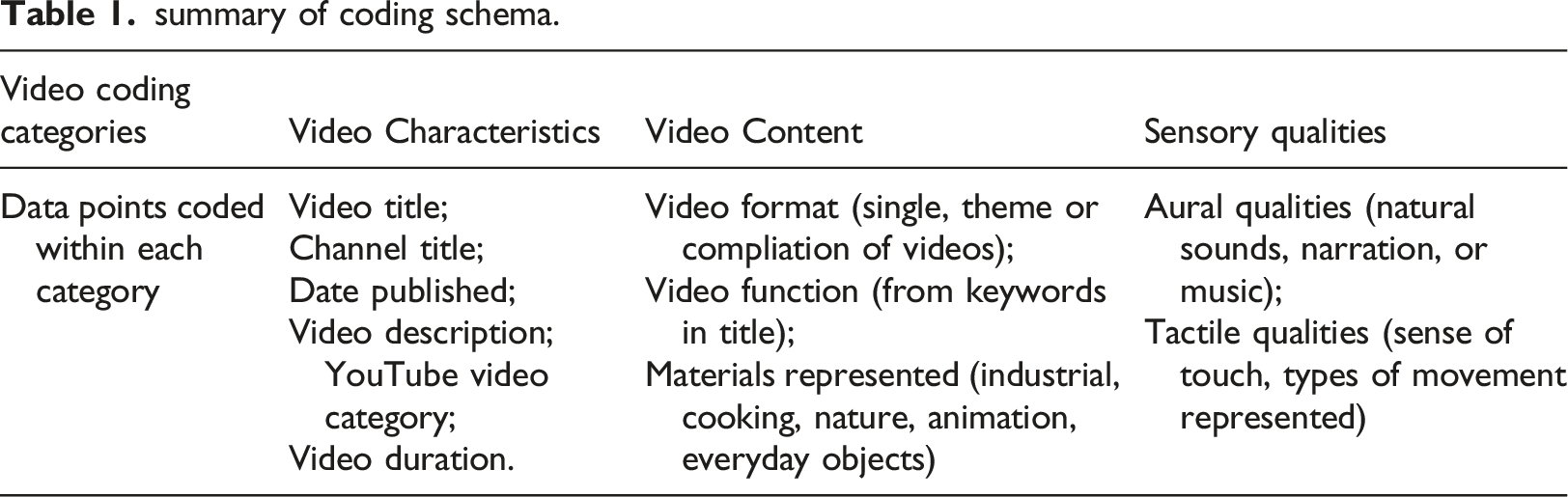
Limitations of the research relate to the structure of YouTube, which has extensive volumes of user-created content and is organised via personalised filtering and recommendation algorithms. This issue was addressed through the use of YouTube searches not associated with any account and with cleared internet search histories. Other limitations of the data collection strategy related to the ranking by ‘relevance’ process, which appears to prioritise videos featuring terminology of OS in the video or channel title. This meant that the sample reached a point of generic uniformity of certain OS video types, especially compilation videos, rather than other related types of satisfying videos such as purely slime videos that could also be classified as OS. Therefore, some materials may not have appeared as frequently or highly, as they were not being ranked by the algorithm as relevant. Nevertheless, the sampling strategy meant that saturation was reached in terms of the breadth of possible materials represented within the OS genre, which was cross-referenced through trialling multiple search terms and documenting results from the autocomplete search feature. 2
Analysis of OS video genre: Characteristics, content, sensation
Video characteristics – channels, categories, duration
The pre-2016 OS videos were more diverse in terms of the number of YouTube channels uploading OS video content, the YouTube categories the videos were identified within (see Figure 1) and the duration of the videos (see Figure 2). After 2016, the channels uploading OS videos went from mostly single uploads of a relatively short video, to popular YouTube accounts uploading multiple OS videos and then the establishment of dedicated OS channels aggregating and curating OS content and uploading multiple compilation style OS videos. For example, early examples include unknown amateur uploaders, while later we see more well-known YouTubers such as Azzyland or Lazarbeam participating in this trend and the emergence of reaction videos to OS compilations. After 2018, the genre progressed via the emergence of dedicated channels organised around specifically posting compilations of OS content (e.g. ‘Best Oddly Satisfying’; ‘Funny Vine’). Finally, we can observe the early establishment of the compilation form within this genre, which can be traced to one early popular channel, Buzzfeed Video, which posted a series of predominantly video listicles naming oddly satisfying as a feature of different objects or activities, for example, ‘16 everyday things that are oddly satisfying’. BuzzFeed compilation videos provide video lists of all kinds of things related to oddly satisfying content. Buzzfeed started to use this term in their titles to describe content prior to the emergence of the genre (e.g. ‘21 oddly satisfying foodie moments’). YouTube video category listed by time period.
3
Duration of YouTube video by time period.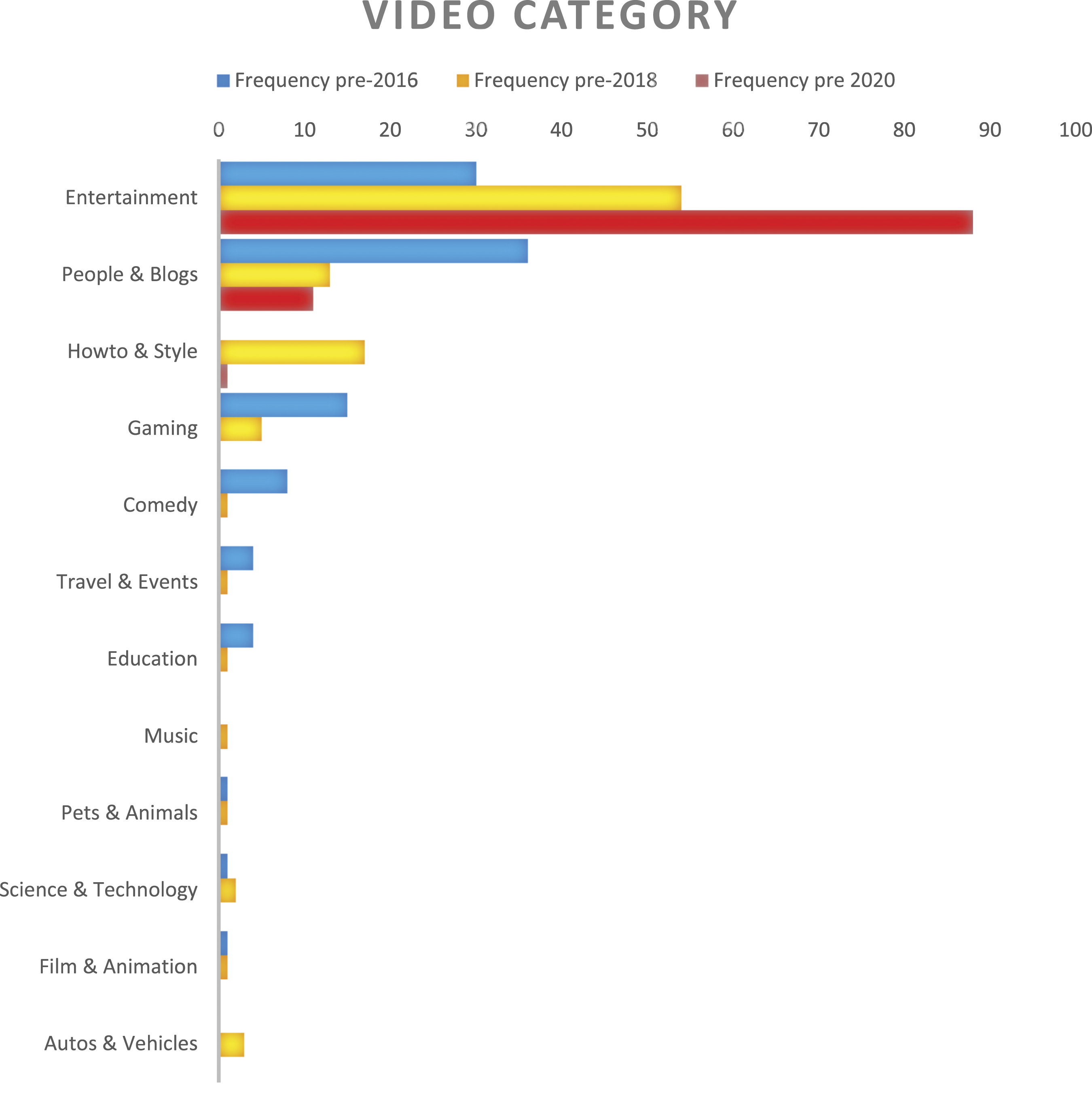
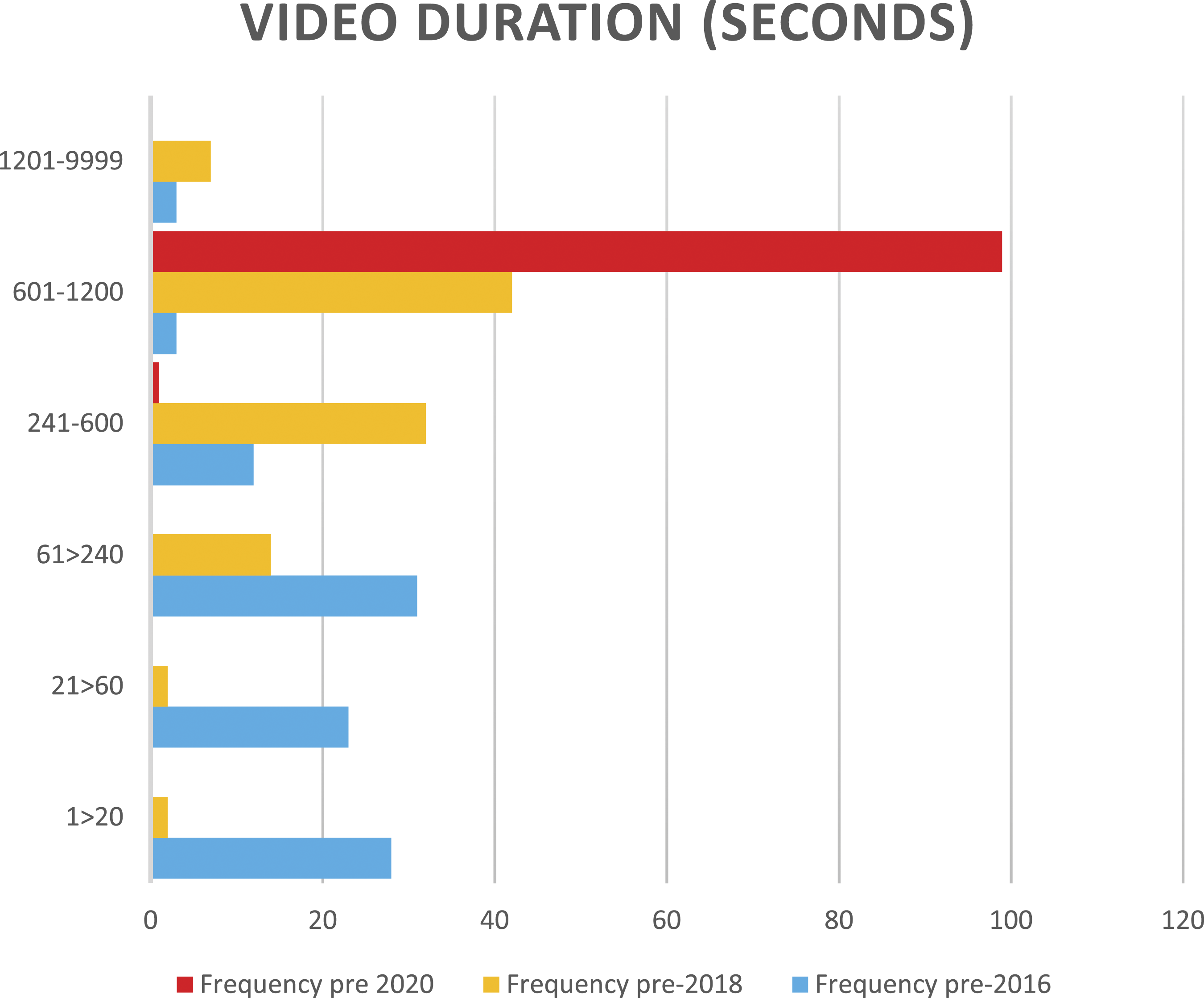
Similarly, the earlier pre-2016 videos were also much more diverse in terms of the YouTube video category selected to capture the type of content posting (e.g. entertainment, gaming, comedy, education, people and blogs). Progressively, after 2016 and especially after 2018, however, videos were categorised by uploaders overwhelmingly in the ‘entertainment’ category and in so doing aligning themselves with more leisure, playful and child-oriented content (see Figure 1). Likewise, the duration of videos posted settled into a more standard duration, with a greater range of durations amongst OS videos posted prior to 2016 compared to videos posted after 2018 and a concomitant shift from predominantly shorter to longer videos. Pre-2016 videos would often run for less than 60 s, but as the genre developed, from 2016 onwards and particularly after 2018 this content increasingly trended toward longer and standardised video duration of over 600 s, or 10 min, fitting in with evolving child Youtube viewing habits of extended and repetitive video watching (Burroughs, 2017; Nansen, 2020) (see Figure 2).
We can see, then, how the various characteristics of the videos helped to establish the emergence of OS as a genre. The nascent field of OS was initially composed of amateur channels uploading short videos of a single item, which they felt prompted a sense of satisfaction, a positive sensory experience in viewing, which they wanted to share. Over time, however, we see the stabilisation of the genre, with popular or dedicated channels uploading multiple OS videos, categorising their videos in more consistent ways as a form of entertainment and settling into a more standard duration, lending themselves to algorithmic sorting and recommendation familiar to child viewers. The shift, discussed below, from single to compilation videos is also initiated through Buzzfeed Video producing thematic compilations in recognisable formats like video listicles. From 2018 onwards, the standardisation of the genre intensifies, with even fewer channels dominating the genre and channels using the terminology of Oddly Satisfying in their channel names. In addition, duration becomes dominated by the 10 min sequence and videos are almost exclusively listed within the entertainment video category.
Video content – format, function, materials
In addition to the platform’s metrics of data characterising the videos, we analysed the content of the OS videos – the materials represented as satisfying, the intended function of the content for viewers and the format of videos within the OS genre. The format (see Figure 3), was coded according to whether the video was a single scene or shot, a themed set of videos, or a compilation of assorted and unrelated videos. Key in the transition to a stabilised genre over time is the disappearance of single shot short videos, which are dominant in pre-2016 videos (see Figure 3). As noted above, these single shot videos often identify something deemed to constitute a feeling or sensation of satisfaction in their title or video description (e.g. ‘Just breaking the glass on an oven door’; ‘Freshly tilled soil and bare feet!’). After 2016, however, the OS videos tended towards theme or compilation formats, often of less idiosyncratic materials and either of a theme such as cooking, nature, or industrial production, or more often of assorted but unrelated video compilations, which nevertheless become highly repetitive and standardised, as discussed below. Format of OS YouTube video by time period.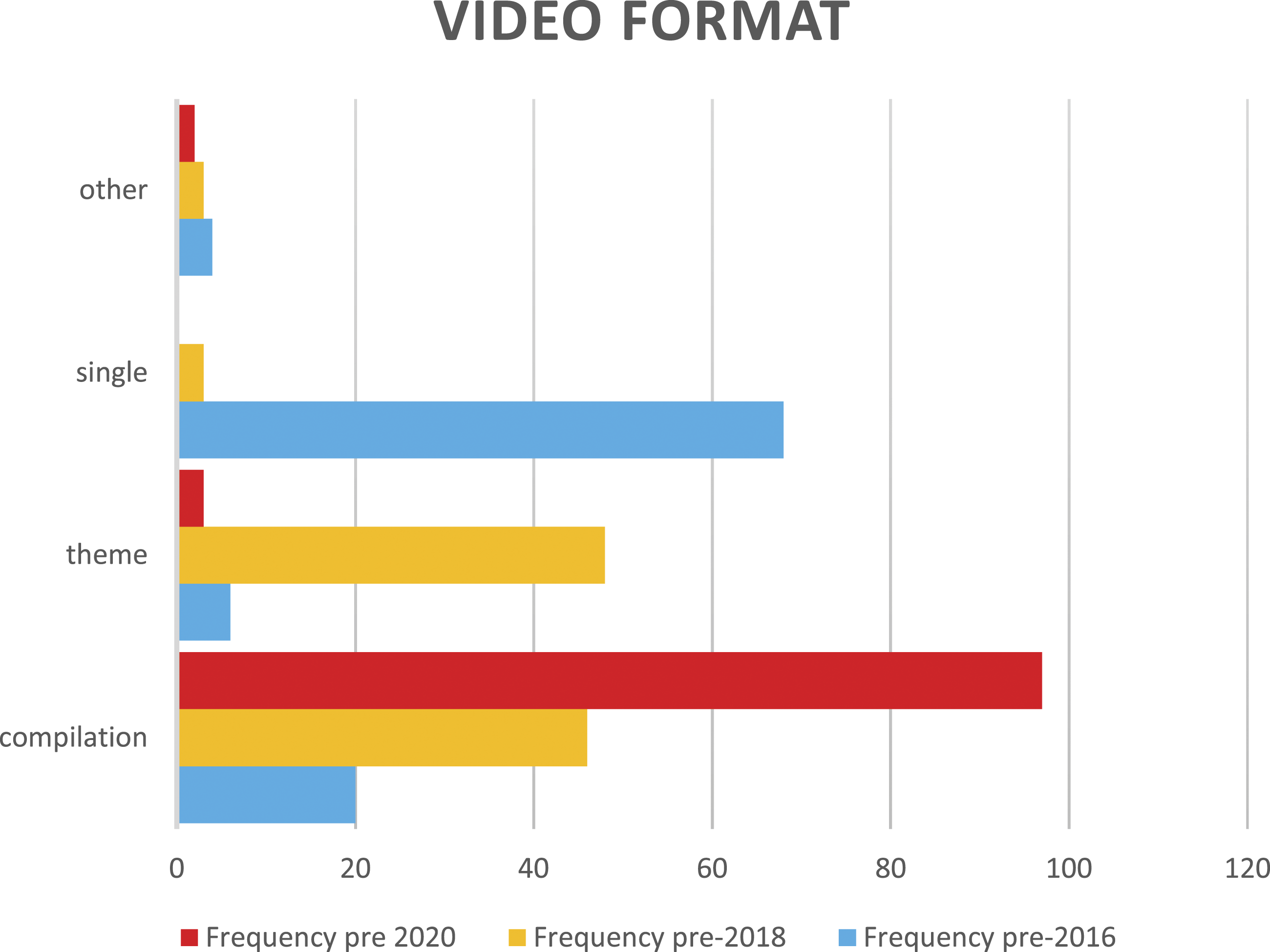
Function of YouTube video.

The materials represented were in some senses also more diverse in earlier pre-2016 videos, even though there were fewer materials represented at this time due to the prevalence of single shot videos versus later compilation videos. Pre-2016 videos tended to be extremely short single shot videos of a random material (e.g. bubbling noodles; water streaming; a spinning top; glass breaking and so on), labelled simply as ‘oddly satisfying’. People uploading the videos noted these randomly observed and recorded materials could produce a sensory or affective pleasure. In this early stage, videos began using the OS terminology to try to describe the content, yet at this stage videos were not explicitly labelled as or organised around a distinct genre or recognisable category with consistent formal and thematic qualities. These videos, however, cumulatively contributed to the formation of a recognisable genre of YouTube video, which was then picked up on, imitated and repeated through compilations of less idiosyncratic materials and more repetitive and standardised materials. After 2018, OS videos settled into a well-established genre when the same material recording started to appear in multiple video compilations.
Nevertheless, some types of content and materials that were popular at this pre-2016 period did not persist, especially videogaming OS videos, in which animated clips of something ‘satisfying’ recorded in-game were prominent early on, but disappeared over time. While single activities or materials were replaced by compilation videos that edited together various materials and scenes in seemingly random arrangements, they shared a similar visual style and sensory aesthetic based on repeating similar types of materials and aural and tactile qualities. These aesthetic qualities and featured materials came to define the genre of OS, as we discuss in further detail below.
The video coding process also revealed a suite of distinct materials that nevertheless overlapped with the OS genre. That is, certain materials often featured within videos described as OS and so operate as a subset of OS videos, but at the same time many of these materials have come to be organised within their own distinct and separate genre and subgenres of YouTube videos. Such videos thus intersect with but came to diverge from the OS genre and its aesthetic and formal characteristics. These videos and materials included popular children’s activities and play materials such as: slime making and play; cake decorating, kinetic sand, dominoes; hydro-dipping; orbeez; spinning tops or ice-cream rolling.
The broader materials represented within OS videos were diverse, but could be captured by various popular and repeated categories of things, which appeared in both themes and compilation video sequences. These included: industrial machines, making things in factory settings and assembly line production processes such as conveyer belts. These clips included materials in the process of production, such as printing presses, pouring liquids, moulds in food production, or laser cutting of metal, or machine cutting or drilling of timber in manufacture, injection moulding, spinning lathes, spray painting, 3D printing and so on. In addition, this category of materials extended outside factories to various farming, harvesting fields, grass cutting and agricultural machinery processes. Cooking and kitchen activities, such as making dough, bread baking, egg mixing, batter dipping, making pretzels, pouring coffee, ramen bubbling, icing cakes, baking in oven, noodle cutting or stirring, waffle making and so on, was another common category of materials. The food and cooking activities overwhelmingly involved sugary foods and making desserts, which appeals to children’s tastes. Nature was prominent through natural events or interactions such as avalanches, leaf blowing, rain falling on glass, snow falling or snow cleaning, icebergs breaking, lava flowing, fire, steam, waves, river rapids and so on. Animation was a less common but identifiable category, which included drawing geometric shapes, screensavers, video game footage, canvas painting, time-lapse drawing and calligraphy. Finally, a whole range of materials that did not fit into these categories, but could be grouped together as random everyday objects, included materials such as: bubble wrap, opening cans, people marching, grass cutting, bullet magazine loading, wave simulator, blowing bubbles, opening packets, pouring liquid, peeling vinyl record, fitting box in box, swiping phones, key unlocking, crushing balls, synchronised dancing, foam, coins falling, coloured pencils, painting nails, balloons popping, mixing paint, hair cutting and glass blowing. Many of these everyday objects were connected to childhoods in terms of their colourful appearance or playful function.
As with video characteristics, the stabilisation of the OS genre is evident through standardisation of video content in terms of the format, materials and clear and explicit statements of the video’s function. Furthermore, as OS content crystallised into a recognisable genre, video titles came to follow a trend of using repetitive arrangements of keywords that precisely articulated the video’s purpose, with the video often labelled as a number within a series (e.g. ‘Oddly Satisfying Video that Makes You Feel Comfort Before Sleep, 42’). These titling and labelling processes are efforts to negotiate YouTube’s algorithm through optimising content for discovery and recommendation as the OS genre became increasingly recognisable and popular. Thus, OS videos coalesced into a recognisable genre with a set of well-defined intended affective and sensory effects when a coherent set of generic ‘terms and definitions’ emerged around the textual features of the content, to return to Mittell’s description of the discursive process underpinning genre formation (p. 8).
Sensory video qualities – aurality, tactility
The third and final area of content analysis was the sensory qualities of the videos, captured in their aural and tactile elements. Aural coded elements included: natural sounds, narration, or music in videos; tactile elements included: the kinds of touch, activities, actions and so on in the interaction with materials represented in videos. As with other video characteristics and content, we can see from the coding of sound across the OS videos that earlier pre-2016 videos displayed a greater variety of aural qualities (see Figure 4). These included various soundscapes and background music, but the dominant sound in earlier videos was the natural sounds of the recording, which captured sounds of the natural recording environment, including sounds associated with the materials such as water trickling sounds or machines drilling, as well as people talking in the background or even whispering in the foreground of an ASMR type video. But after 2018, we see that the genre is also standardised over time through the shift from recordings that capture sounds of natural environments to the overwhelming use of more repetitive electronic or instrumental music, particularly bright, playful pop and synth music that connects with longstanding musical trends in children’s media, edited over compilation videos (see Figure 4). Aural characteristics of OS YouTube video by time period.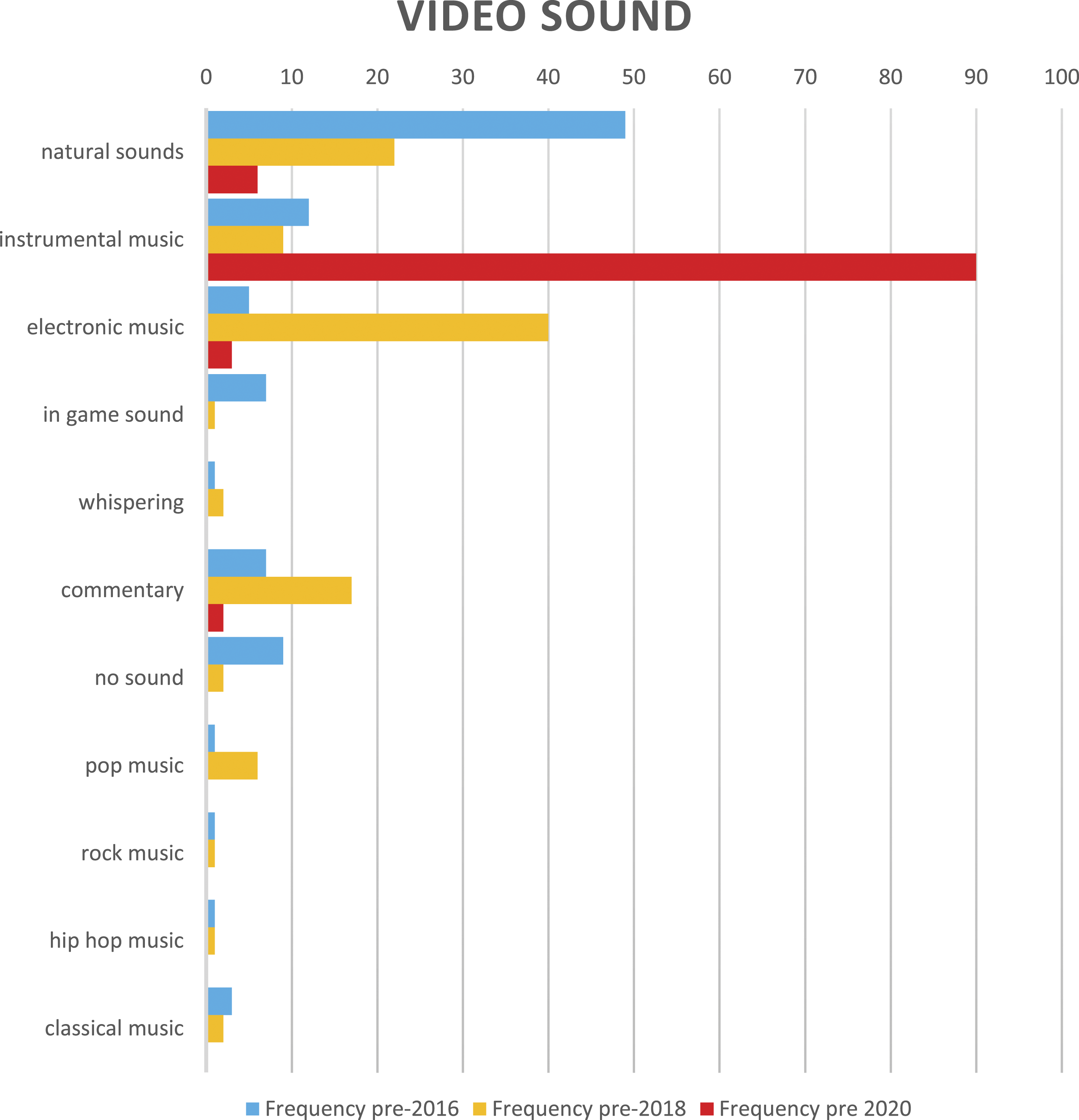
Similarly, certain physical and tactile qualities of these pre-2016 videos were picked up, refined and repeated over time, setting the template for the types of things compilations include and define as OS in videos posted after 2018. They shared a similar visual style and sensory aesthetic based on repeating similar types of materials and aural and tactile qualities, which came to define the genre. The tactile qualities of the genre centred around forms of motion or movement, especially in a repetitive pattern, sometimes synchronising multiple parts or people or other times producing a neat fit or hypnotic effect. Often the effect was achieved through editing techniques such as close-up filming or time-lapse photography.
The sense of touch and feeling in the videos was then produced through a focus on the tactility of things that are materially compelling, an affect animated via repetition, motion, objects or materials that produce a ‘neat fit’, a sense of precision, or patterns. 4 These were applied to different materials and contexts across the categories of materials, industrial processing, cooking, nature, animations and everyday objects. Collections of videos stitched together compounded and intensified these tactile and kinaesthetic qualities by repeatedly showing processes of making, assembling, carving, cutting and so on, as well as showing colourful materials, such as kinetic sand. A key subset of such tactility was a range of ASMR-associated sounds applied to various materials, such as light scraping, cutting and rubbing.
Overall, these qualities of materiality can be understood as a form of tactile representation or visual tactility, in which the visual stimuli represented in the videos produces a physical feeling. This is the feeling of sensory satisfaction: the OS pleasure manifested through a physical synaesthetic response in the viewer. As we see in our content analysis research, this type of content features a form of tactile play with many colourful and playful materials, including jelly, kinetic sand or slime – each of which have long been key to children’s play and material cultures – and which share characteristics with popular physical toys, most notably popular fidget toys that also involve synaesthetic experiences.
Overall, this content analysis reveals that whilst OS videos may not be exclusively made for children or clearly labelled as children’s content, they have formatting, content and experiential qualities that intimately appeal to child viewers and audio-visually mediate tactile trends in children’s play and material cultures. Furthermore, these elements are delivered within the standardised and repetitive formats that work within YouTube’s algorithmic sorting systems to deliver child recommended content. OS content thus depicts modes of interaction with objects, toys and play that are familiar and accessible to young children in its mediation of ‘satisfying’ tactile and sensory experiences. As such, significant generic and regulatory tensions are raised by the ambiguous position of child viewers in relation to the intentions and format of the content, and by the ambivalent role of YouTube’s own algorithmic content categorisation and distribution processes in the construction of the OS genre and similar sensory genres. We turn to these ambiguities in the following discussion section, where we draw on our data analysis and findings to discuss children’s sensory genres, the relationship of OS to ASMR in children’s YouTube and the challenges in regulating OS as child YouTube content.
Discussion – Visual tactility and the development and regulation of sensory genres
The development of the genre
Our analysis has demonstrated how Oddly Satisfying videos on YouTube have crystallised into a clearly recognisable genre. Whilst there are some variations and subgenres across the OS genre, we can make a general observation that there is a heavy standardisation of the genre through video characteristics, content and sensory qualities including the title, format, content, length and sensory dimensions, which appeal to children. The generic archetype might be something like a 10 min compilation video with repetitive scenes of content like cake decorating, labelled as relaxing and edited with instrumental music. In turn, video creators have tactically identified and produced videos that aim to fit within the recommendation systems for OS videos, especially as this sort of content became increasingly popular with children.
As we noted previously, OS emerged as a sensory rather than narrative based genre and as a multi-platform user-generated phenomenon, and thus the discursive process of genre formation extended beyond the genre’s evolution on YouTube. The OS genre crossed over from Reddit in 2013 through the subreddit, ‘/r/oddlysatisfying’: this subreddit dedicated to posting Oddly Satisfying videos and GIFs now has 2.6 million members and remains an active thread for oddly satisfying posts. Thus, Reddit played a key role in defining the genre, as the connection of the term ‘Oddly Satisfying’ to a particular sensory effect and the content types that provoke it developed on Reddit before this type of content became a recognisable genre on YouTube. This type of content is also popular on Instagram, with journalist Faramarzi pointing out that ‘nearly 900k posts tagged as #oddlysatisfying on Instagram alone’. As the genre became increasingly popular on YouTube, it began to feature a standardised range of materials appealing to child audiences, while video labels and tags remained ambiguous in terms of the intended audience demographic. However, the emergence of a coherent and repeated set of titles and tags gathered under the ‘entertainment’ category would have ensured that this type of content was increasingly well-positioned for algorithmic distribution processes like autoplay queues and ‘up next’ suggested videos, features that are a key (albeit problematic) component of young children’s YouTube viewing practices (Elias and Sulkin, 2017: p. 4).
We see key moments and materials informing the increasingly child-directed nature of the genre as it developed, such as the centrality of materials like slime and kinetic sand as OS content cohered into a standardised format. Indeed, Faramarzi notes that in 2017–2018, the tag ‘oddly satisfying’ was popularised by young people on YouTube ‘making psychedelic videos that feature disembodied hands mixing glitter, glue and other materials in a play-dough like substance called slime’. The look and feel of slime being made and handled, its colourful appearance and sticky, slurping, sucking sounds of play then informed a whole raft of other substance-type videos, such as kinetic sand slicing, soap cutting, paint mixing and cake icing – materials that were malleable, tactile and satisfying to watch being made and handled.
Slime and related materials with a malleable and tactile quality, have long been a key part of children’s play cultures (Hanson, 2002; Levingston et al., 2019), with such ‘tactile manipulatives’ being marketed for children and adopted in a range of contexts (including teaching and play therapy) to encourage ‘learning by doing’ amongst young children (Levingston et al., 2019, p. 52). As it evolved, the OS genre featured slime and similar ‘tactile manipulatives’ in ways that have clear connections to children’s play cultures. By contrast, however, the aim of including such materials is to provoke the characteristic OS sensory effect rather than to promote play-based learning. This prioritisation of a sensory outcome both fosters ambiguity around intended audience while distancing OS content from legacy children’s content traditions that prioritise learning and imaginative or cognitive development in specific age ranges.
Thus, the YouTube genre acts as a centripetal force for a range of aural and tactile qualities associated with materials that continue popular trends in children’s play cultures, while not explicitly engaging with legacy children’s media traditions. Faramarzi notes, ‘Whether it’s pouring, cutting, washing, mixing or slicing, an entire ecosystem of these videos has surfaced, hypnotising the internet in a technicolour dream of instant satisfaction’ (2018). Indeed, as our content analysis highlighted, the intended function of the videos is to provoke a specific sensory effect – one that was clarified and further defined through connections between titles and specific types of interactions with materials as the genre developed. Viewers are invited to embody and feel dimensions of materiality through the visual and sonic qualities of the videos, inviting a kind of mediated touch – a visual tactility – as a key element of the genre of sensory satisfaction videos. This visual tactility continues and resonates with longstanding trends in children’s play cultures in which ‘tactile manipulatives’ like slime are ‘touched, molded and shaped into various configurations’ in ways that provoke ‘great satisfaction from touching, feeling and manoeuvring’ the substance (Levingston et al., 2019: p. 53–54). The visual tactility we see as central to OS content thus translates the sensory experience of play with tactile manipulates into a video format.
Regulating OS as a children’s YouTube genre
As a genre, then, there is little in the way of narrative structure or plot or character representation. Instead, these videos focus on the thing, material, or process. Occasionally fragments of plot are evident, such as YouTubers reacting and commenting on the genre, but other than this meta form, the videos are overwhelmingly about feeling and sensation rather than story. The question, however, of whether these videos are made primarily for a child audience remains unanswered. The OS genre invites a form of sensory stimulation that has specific links with children’s play cultures and genres, as discussed above, ambiguously positioning this content type in relation to the kids YouTube ecology. The OS genre’s close links to the ASMR genre – with its aforementioned vaguely defined associations with sex and fetish practices – further highlights the ambivalent generic development process surrounding the cultures and curation of children’s YouTube genres. As our content analysis illustrated, the term ASMR was explicitly stated in 20 of the OS video’s titles, with other terms often being used with implicit links to ASMR content terms such as brain tingle. Thus, the OS genre certainly evolved in tandem with and adjacent to the ASMR genre. Yet, the materials and terminology that become key defining features as this genre cohered into a standardised format re-position the sensory pleasures of ASMR in relation to children’s cultures.
Whilst these videos are very popular with children and have clear links to children’s play cultures, it does not appear that any of the videos have been flagged by YouTube as directed at children under new regulatory arrangement with the Federal Trade Commission (FTC), which would turn off comments and other social media features. 5 OS content does not clearly or explicitly align with any of YouTube’s child-directed content indicators: Children or children’s characters; Popular children’s programming or animated characters; Play-acting, or stories using children’s toys; Child protagonists engaging in common natural play patterns such as play-acting and/or imaginative play; Popular children’s songs, stories or poems (YouTube, 2020). However, OS content does resonate with many of these indicators, and in some instances draws quite close to them, such as in the case of the representation of ‘common natural play patterns’, especially when considered in relation to the above described histories of tactile manipulatives in children’s play cultures, including on television (for instance, Levingston et al., (2019, p. 55) point to the animated TV series ‘Grossology’, around which a 3-week slime-related play programme was developed in the US).
Ultimately, the OS genre occupies a grey area between child- and adult-directed content, an ambiguity heightened by the genre’s intersection with ASMR content. The audiences of OS content are not just children, but include many children, especially when relating to colourful or playful materials like jelly, kinetic sand or slime. Furthermore, one of YouTube’s defining child indicators is videos featuring ‘toys that appeal to children’: while materials like slime and kinetic sand do not align with this indicator in ways that would trigger automated recognition of child-directed content, such materials could certainly be considered toys that appeal to children. We have already pointed to slime’s longstanding popularity with children, educators and children’s play therapists, but kinetic sand has also been used in preschool settings and recognised as a valuable play and therapeutic tool amongst young children (Andreeva et al., 2018; Andreenko, 2017). Indeed, the OfCom (2019) report locates the popularity and significance of this subgenre in the contexts of children’s YouTube video consumption. Notably, despite the ambiguous positioning of OS content, it has not featured as a source of anxiety in the aforementioned recent cycle of journalistic reportage about inappropriate children’s genres on YouTube. Unlike the OS genre, the content types that do feature prominently in this reportage – like the ‘entertainment character mash-up’ videos featuring Elsa and Spider-Man as a romantic couple and also nursery rhyme videos with strange themes and low-quality animation (Balanzategui, 2021) – do align with YouTube’s new indicators for child-directed content. The OS genre may have escaped controversy in part because this content appeals to child audiences without clearly or explicitly targeting them, thus mitigating concerns amongst journalists about the exploitation of child viewers in the quest to monetise child-oriented content (Bridle, 2017; Kimel, 2017; Di Placido, 2017).
Conclusion
By undertaking a content analysis of Oddly Satisfying videos, this article has illuminated the types of formats, materials and sensory qualities that characterise the emergence and stabilisation of the OS genre. This analysis situated this emergent genre in relation to the developing study of children’s YouTube entertainment industries, sensory genres of content and children’s media digital regulation. In doing so, this analysis highlights how this sensory genre serves as an example of ambiguous content which attracts a large child audience despite not being explicitly directed towards children according to YouTube’s current criteria for regulating children’s content. The shift from the quasi-scientific register of ‘ASMR’ videos to the prosaic terminology and colourful content of the OS genre makes the everyday consumption of OS videos accessible and meaningful to children. Thus, these videos operate within an ambiguous convergent space between YouTube’s platform logics, content creator economies and children’s media content and consumption (Burgess, 2018). Ultimately, it is the ambiguity of intended audience for Oddly Satisfying videos that allows videos within this and related sensory genres to slip between the cracks of recent regulatory changes to children’s YouTube in the wake of settlement with the FTC over violations of US children’s privacy regulation and associated allegations related to child data tracking and targeted advertising.
