






Abstract
Digital Ecologies of Hope is a collaboratively produced field guide that documents how people use media to sustain care, resilience, and imagination in the face of technological, political, and social constraints. Drawing inspiration from naturalist field guides and critical fabulation, the project reinterprets everyday practices as “specimens” of digital hope, each annotated with classifications, habitats, conservation statuses, field notes, and illustrations. These specimens span diverse contexts—from Sudanese youth defending theses during civil war to Afro-Brazilian students reclaiming identity in elite institutions, to transgender voice archives on TikTok and youth activist networks resisting surveillance in schools. Rather than reinforcing dominant techno-pessimism, this guide foregrounds how digital practices foster agency and solidarity, often emerging most vividly in conditions of constraint. By offering an accessible, multimodal archive, the project reimagines media research as an act of care, collective meaning-making, and future-oriented scholarship.
Keywords
Introduction
Media studies finds itself responding to an accelerating cascade of technological crises—from surveillance capitalism and algorithmic bias to disinformation and democratic erosion—that understandably focuses scholarly attention on how digital systems amplify harm and concentrate power (Arora, 2024; Sebastián-Martín, 2024; Srnicek, 2017; Zuboff, 2019). In such moments, critical frameworks become essential tools for understanding these urgent threats. Yet this necessary hermeneutics of suspicion can obscure other dynamics within the same systems. Alongside exploitation and control, we continue to witness emergent practices of care and imagination—practices that offer crucial insight into how people navigate technological constraints while opening up possibilities for different futures.
Building on Rosner’s (2018) formulation of critical fabulations, this project attends to these hopeful practices without abandoning critique. By fabulation, we do not mean fabrication. Rather, following Rosner, we use the term to describe methods of reinterpreting and representing real-world practices in ways that surface alternative meanings, suppressed histories, and collective aspirations. Rosner writes of “telling stories that awaken alternative histories” and “shift according to the aspirations of those who absorb them” (p. 119). In extending Hartman’s (2008) concept of “writing against the archive,” she positions fabulation as a strategy of collective meaning-making that surfaces possibilities suppressed by dominant techno-narratives. Drawing inspiration from naturalist field guides, our project enacts this strategy, weaving together rigorous observation and creative representation in ways that privilege care and imagination over academic convention.
Developed collaboratively within Media and Social Change Lab—an international research collective exploring global intersections of media and social justice—this project brings together 14 researchers working across diverse cultural and methodological contexts. Our collective operates as a horizontal network rather than a traditional hierarchical laboratory: through regular meetings, collaborative projects, and shared commitments to participatory and multimodal research methods, members create spaces of mutual support, solidarity, and collective meaning-making. The collective itself functions as a source of care—providing both intellectual community and emotional sustenance amid political and institutional precarity. Members span career stages (from masters students to senior faculty), cultural backgrounds (Brazil, China, Ecuador, South Africa, India, Sudan, United States, etc.), and methodological traditions (ethnography, digital trace analysis, participatory action research, visual methods), yet share commitment to centering marginalized voices and challenging extractive research models.
The specimens emerged organically from ongoing research projects that collective members were already conducting. Rather than designing new studies for this field guide, we recognized patterns of hope and care within our existing work—patterns that dominant academic framings often rendered invisible or marginal. Each researcher contributed specimens from their fieldwork, representing instances where media practices foster agency, resilience, and collective imagination amid intersecting technological, social, political, and economic constraints. Reflecting our own backgrounds and sites of inquiry, these specimens span diverse contexts: Sudanese youth using social media to maintain educational communities amid civil war; Afro-Brazilian students finding identity affirmation through Instagram; transgender youth documenting voice transitions as acts of collective becoming; among others. We documented each specimen using field guide conventions: • Classification (connecting practices to broader taxonomies of digital resistance); • Habitat (mapping sociotechnical conditions enabling emergence); • Conservation Status (assessing resilience against algorithmic and political threats); • Field Notes (offering situated researcher observations); and • Visual Documentation (providing ethical anonymization through hand-drawn illustrations).
These visuals were hand-drawn by co-authors Abu Abdelbagi and Shell Avenant, added to further animate the field guide metaphor and offer the reader a multimodal window into these digital ecologies.
Our collaborative process thus involved several iterative stages: (1) each researcher identifying a practice from their fieldwork that exemplified digital hope; (2) collective discussion to develop shared analytical language; (3) iterative feedback on field notes and illustrations; and (4) cross-case analysis to identify recurring themes. This process itself enacted the collaborative and care-oriented practices we document—our research collective became a living example of the very phenomena we study. As a space of knowledge-sharing across contexts, mutual aid across career stages and institutional positions, and collaborative imagination of research otherwise, the collective models how utopian media studies might be practiced, not just studied.
The field guide as form and method
The choice of a field guide format is both methodological and political. Traditional field guides combine visual identification, habitat descriptions, and behavioral notes to make the natural world legible to expert and amateur observers alike (Peterson, 1934; Sibley, 2000). What makes them distinctive is their commitment to accessibility, their embrace of the visual alongside the textual, and their understanding that knowledge emerges through patient, repeated observation in situ.
We adapt this form here for several reasons. First, the field guide allows us to honor specificity while revealing patterns—each specimen is documented in its particularity, yet the collection as a whole reveals broader ecological dynamics. Second, the visual language of field guides—particularly hand-drawn illustrations—creates ethical distance (protecting privacy through anonymization) while maintaining affective proximity (the warmth and care evident in hand-crafted images). Third, field guides embody an accessible epistemology that democratizes expertise, inviting readers to become observers themselves. This matters for a project concerned with amplifying marginalized practices often invisible to dominant academic frameworks.
We recognize that referring to human practices as “specimens” may initially seem to objectify lived experience. This terminology is intentional and invites reflection. We use “specimen” not to reduce people to objects of study, but to honor how individual practices participate in larger ecosystems of hope. Each specimen represents not a person but a practice—a way of using media that might be recognized, studied, protected, and cultivated. This reframing resists extractive research models that treat communities as data sources. Instead, we document practices as living phenomena within sociotechnical ecologies, emphasizing relationality, habitat, and resilience. The slight defamiliarization of “specimen” also creates critical distance, reminding readers that these are representations, fabulations, and interpretations—not unmediated access to others’ lives.
Most importantly, the field guide reframes our relationship to the phenomena we study. Rather than positioning hopeful digital practices as anomalies requiring explanation, the field guide treats them as species in their own right—worthy of careful documentation, protection, and cultivation. This shift from critique to cultivation represents our methodological intervention: we seek not just to analyze hope but to create conditions for its recognition, study, and proliferation.
Specimens
Specimen #2025-A
Aspirational AI self-imaging
Field notes
She stands in the harsh fluorescence of a college bathroom, phone raised, purple hoodie, uncertain pose. What catches my attention isn’t the mirror selfie (these are common enough specimens), but what she does next: using AI to cast herself forward in time, to try on the white coat and stethoscope she’s studying for.
“Using this trend to stay motivated,” she writes, but I see something more specific here: a young person using AI not just to dream, but to endure. The scrubs, the stethoscope, the confident smile—these aren’t costumes she’s trying on. They’re coordinates on a map she’s drawing for herself, marking the distance between today’s school bathroom and tomorrow’s hospital corridor.
In this quiet digital ritual, I recognize something raw and honest: how sometimes we need to see it to believe it, to picture ourselves there to keep going. Not a grand statement about technology or society, just one student’s small act of hope-crafting during a long journey. She transforms the mirror from a space of self-scrutiny into one of possibility, and shares it—perhaps so others might recognize their own reflections in hers.
In an era often dark with technological dystopias, these emergent practices suggest a different evolutionary path—one where AI tools become instruments not of surveillance but of collective imagination, helping young dreamers bridge the delicate gap between who they are and who they might become (Figure 1). Aspirational AI self-imaging. Illustration by Shell Avenant.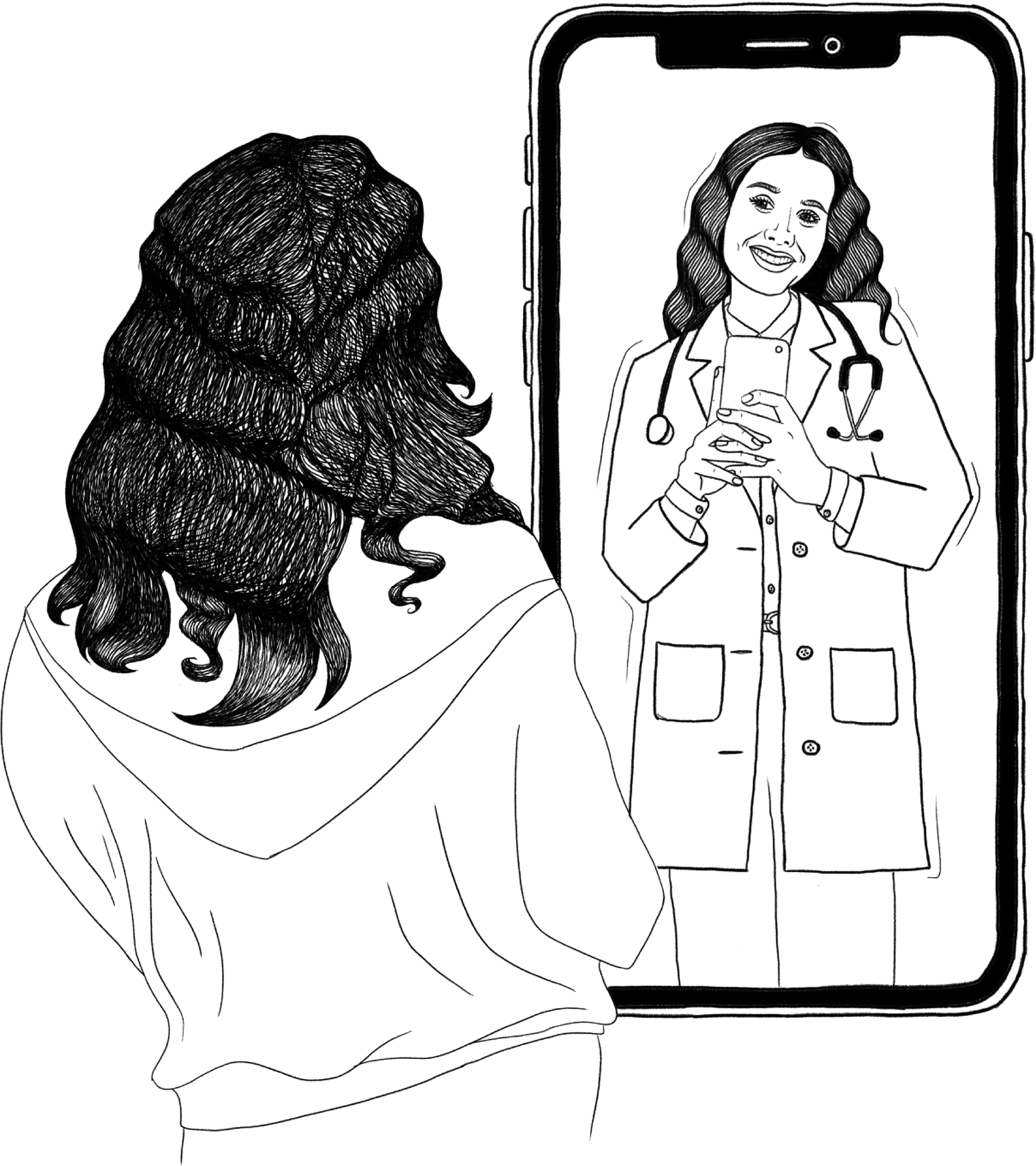
Documented by:
Specimen #2025-B
Freedom dreamers: Collective care in the cloud
Field notes
Four youth activists appear on a live Zoom session, each speaking with urgency. These voices aren’t just echoing statistics or reports about police presence in schools; they are the voices of those directly impacted by the policies they’re challenging. In this teach-in, their stories aren’t only heard—they are felt.
Their presentation is supported by bilingual slides, with each bullet point in both English and Spanish. This choice is intentional, reflecting their awareness of who is most affected by these issues. A reminder that we keep us safe.
As I continue to listen and watch, it becomes clear that this digital space is more than a forum for advocacy—it’s a space for “freedom dreaming.” When these students are calling for the removal of police from schools, they’re envisioning a future where mutual care replaces fear and control. They’re inviting us to imagine a world where we are responsible for each other’s well-being, and where education fosters growth, not surveillance.
In a world often shaped by fear-based ideologies, these youth remind us that digital spaces don’t have to replicate that fear—they can become sites of radical hope, where we dream together about the future our children deserve.
The students’ message extends beyond the live broadcast: later archived on social media, it serves as a touchstone for others to revisit, reflect on, and share as they continue organizing. Beyond immediate organizing, digital spaces thus become archives of collective memory, preserving and amplifying the voices leading the charge for a better future (Figure 2). Freedom dreamers: Collective care in the cloud. Illustration by Abu Abdelbagi.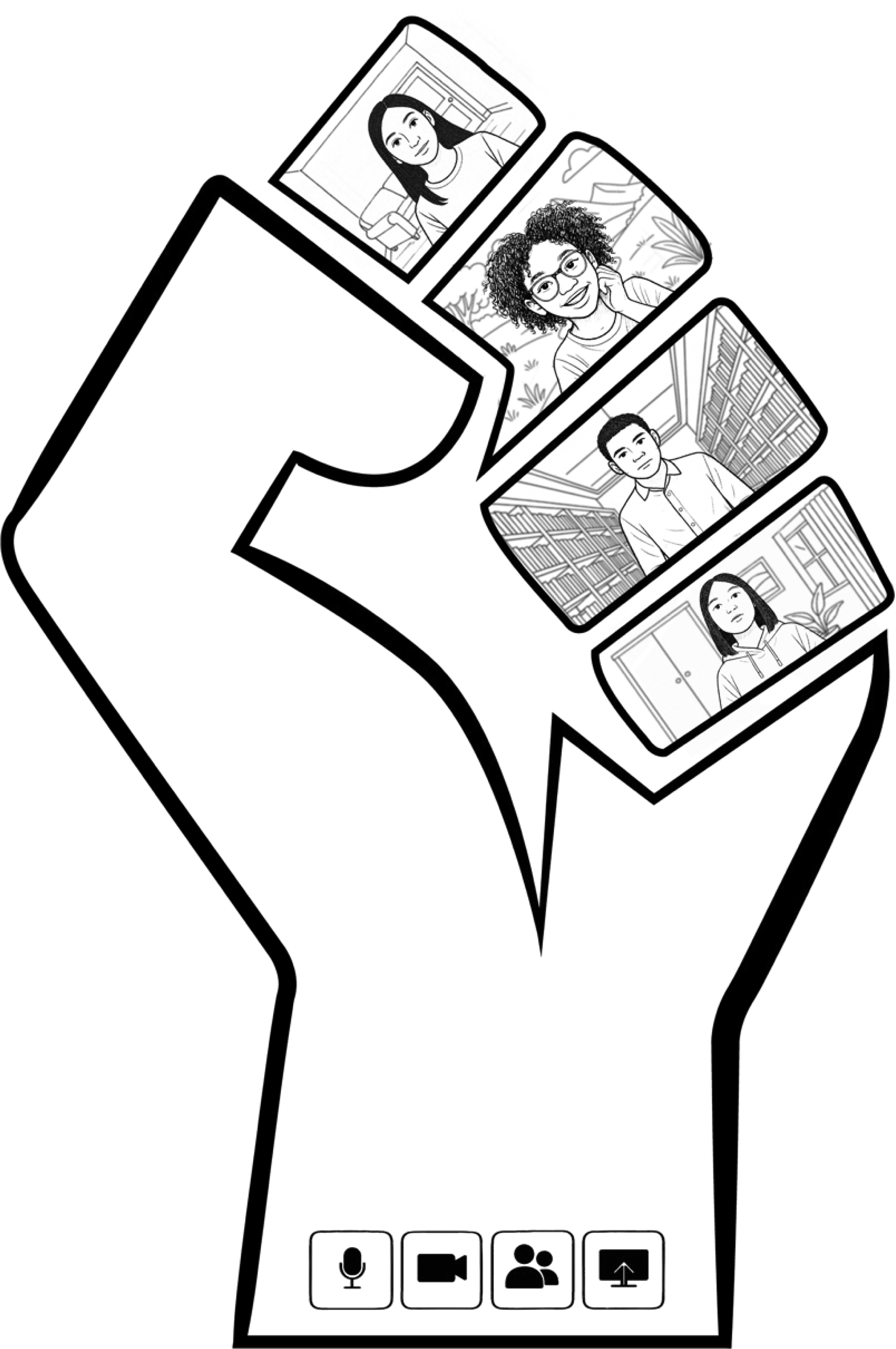
Documented by:
Specimen #2025-C
Video testimony and/as collective witnessing
Field notes
“YouTube calls it storytime. I like to call it testimony time.” A woman, sitting on a couch, invites viewers into her lived experience.
A fifteen-minute chronicle of her college journey follows, spanning a decade, multiple schools, and many moments that felt like “an epic fail.” Poor grades. Financial crises. A marriage. Her daughter. A divorce. Night classes. Two jobs. Retaking a class three times. Failing by three points. Taking it again. Hiring a tutor.
A sense of purpose: “I just want to take care of my daughter.” A desire, stated with hands clasped and eyes closed: “I made it so far. This is my dream.”
The narrative is affective and embodied. Healing, even. Her legs gave out in gratitude when her final bill was paid. “I did move in faith,” she says, nodding, a slow smile spreading across her face. At the video’s end: photos of her in her cap and gown, hugging her daughter.
This public sharing of memories reconstitutes her journey as testimony, one grounded in mutuality between creators and viewers. One commenter writes, “This testimony has blessed me. I know it was meant for me.” The perils the creator has weathered are re-oriented as possible futures for others who dare to forge similar paths. Another commenter writes, “I’m next! I will succeed in school. I’m going to be debt-free and I will be a helping hand to others! I’ll come back and update you on my testimony.”
And so, the cycle continues, the creation and sharing of personal narratives, among those who recognize that the journey of uplifting themselves means nothing without lifting others up (Figure 3). Video testimony and/as collective witnessing. Illustration by Abu Abdelbagi.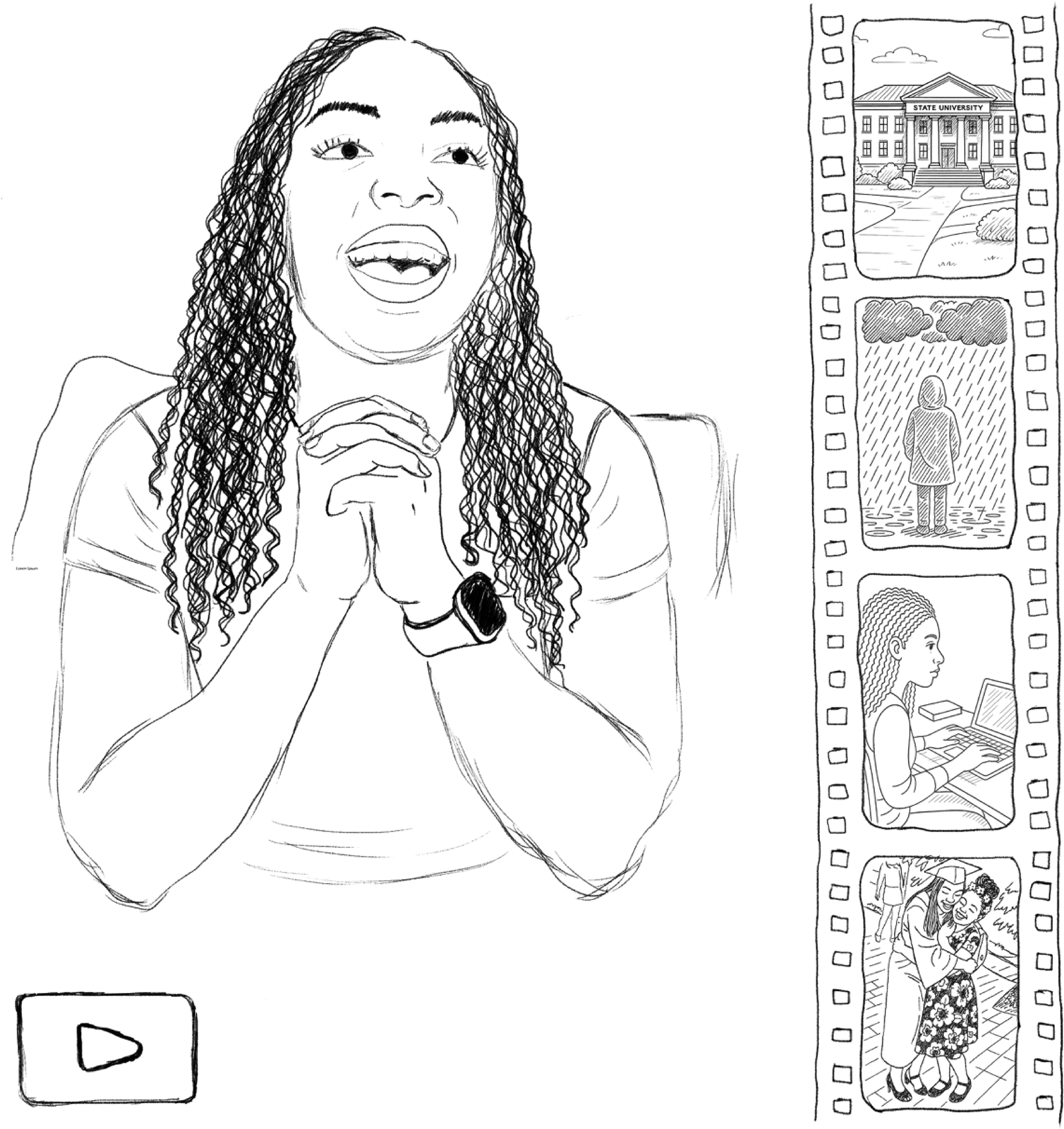
Documented by:
Specimen #2025-D
Digital resilience networks: The case of neijuan (内卷)
Field notes
A student shares a meme: a solemn cat, eyes half-closed in contemplation. The caption reads: 在上班和上进之间选择了上香。 (“Faced with the choice between working and self-improvement, I chose prayer.”) The comments flood in: “Who can relate?”, “+1”, “+1”—a wave of weary solidarity.
At first glance, just another instance of GenZ self-deprecating humor. But this is more than that. It’s a networked coping mechanism, a way of turning individual burnout into collective recognition.
It speaks to the reality of 内卷, nèijuǎn (“involution”)—a term used by Chinese youth to capture the suffocating reality of academic pressure, where greater effort does not necessarily yield greater rewards, but opting out is not an option. Here, memes, vlogs, and digital interactions become tools for resilience, offering a way to reframe burnout as a shared experience rather than an isolating struggle.
This is a quiet rebellion, a refusal to let involution define them entirely. The feelings described in these memes and echoes in the comments—humor, shared struggle, creative redefinition—are hope in action. They do not dismantle neijuan, but they restructure its weight, dispersing it across networks of collective resilience.
In a world where technology often deepens competition, these emergent rituals suggest another trajectory—where media isn’t just a mirror reflecting crisis, but a tool to subtly, insistently, carve out new ways of being (Figure 4). Digital resilience networks: The case of neijuan. Illustration by Shell Avenant.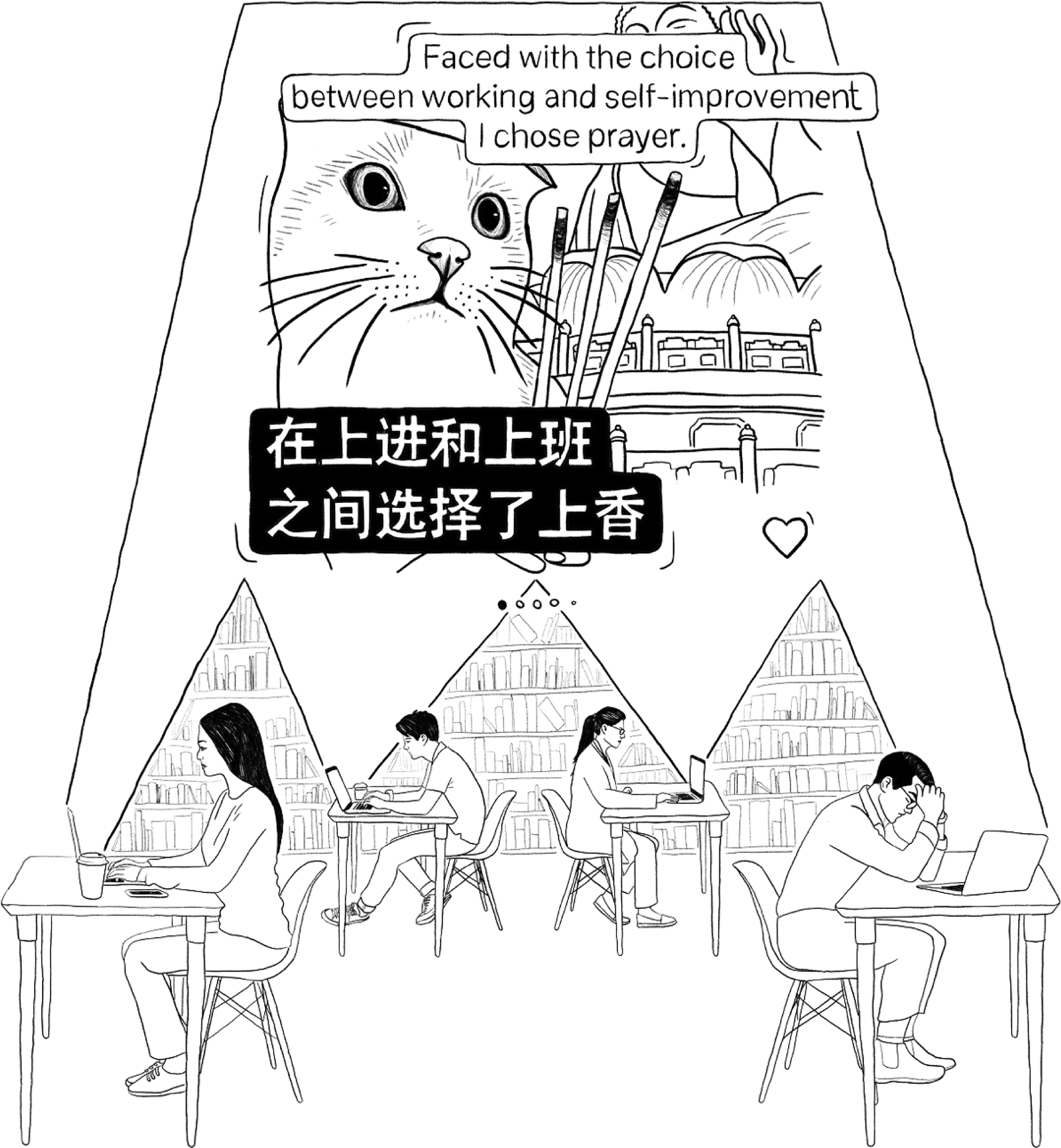
Documented by:
Specimen #2025-E
#MyVoiceOnT: Transgender voice documentation on TikTok
Field notes
#myvoiceont is another addition to a rich genealogy of transgender media practices—a lineage of self-cataloguing that charts how Internet users document, reflect on, and imagine their evolving identities. Previous guidebooks (Allphin, 2024; Horak, 2014; Srouji, 2022) have emphasized the importance of these practices in how they allow users to understand themselves and imagine possible futures through both participation and commentary. Each video is a sort of public archive, a step in its creator’s evolution, aurally and temporally bound.
The creation of these videos is itself an act of hope, verbalizing a trans person’s past, present, and looking toward a future. This hope, however, is not exclusive to the creators. Observers, silent or participatory through comments, witness the slow transformation of strangers’ voices, their faces, and their confidence. The viewer is as much a participant as the video creator, a welcome witness to the speaker’s evolution.
Silent observers, those who have recorded their own shy videos in the quietude of their bedrooms, those for whom transition is only a curiosity or a distant opportunity, those who seek to understand loved ones and their possible futures, those who feel such a consuming sense of protectiveness and homesickness for young trans people, these videos beg your ear. Listen, the videos whisper. This is me becoming (Figure 5). #MyVoiceOnT: Transgender voice documentation on TikTok. Illustration by Shell Avenant.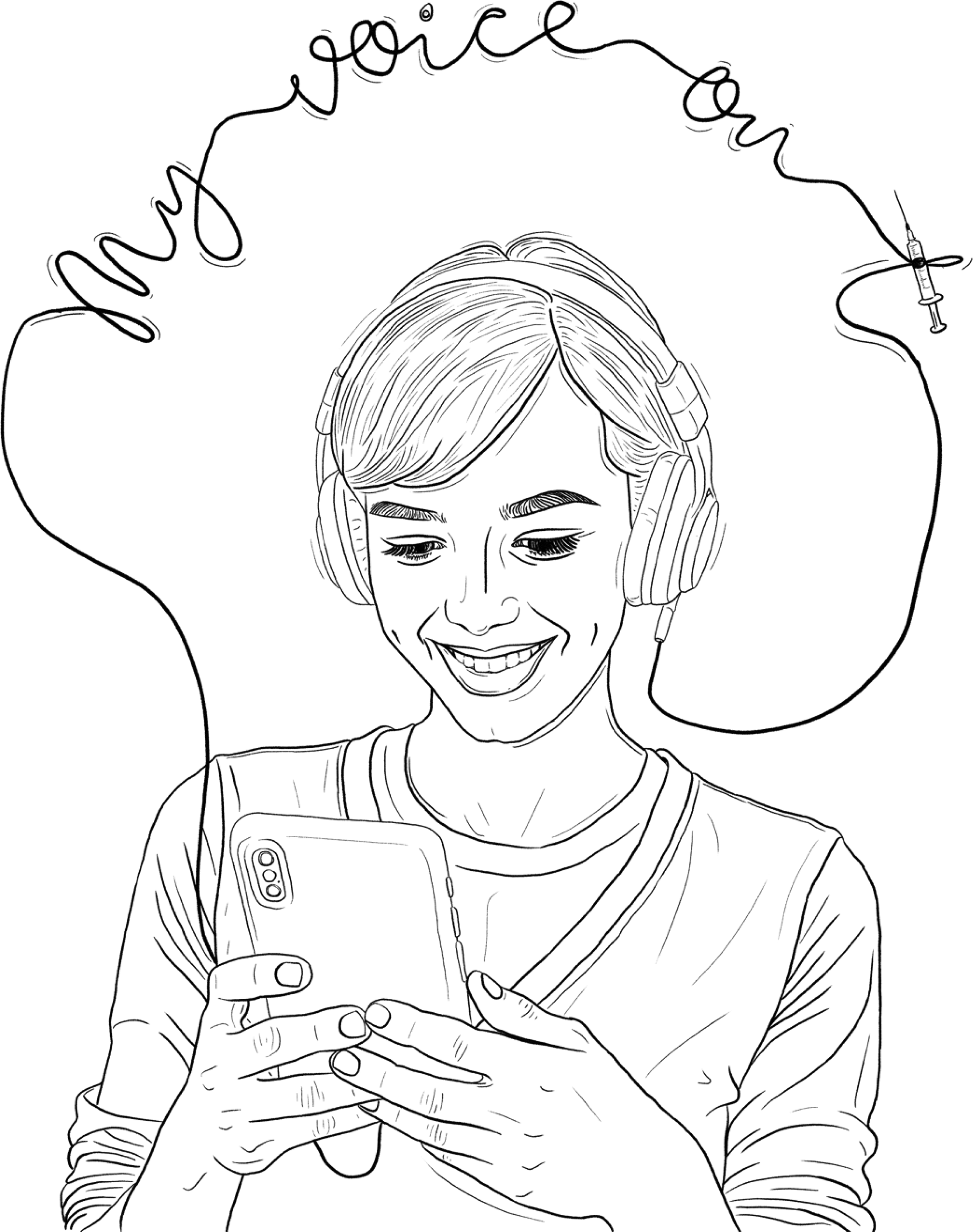
Documented by:
Specimen #2025-F
Digital sanctuaries: Afro-Brazilian identity in elite academic spaces
Field notes
She stands at the gates of her Ivy League institution, school ID card in hand, yet she is questioned about whether she belongs. This is not a one-off challenge, but a daily ritual that marks her existence as a first-generation Afro-Brazilian student in this space. The walls, architecture, portraits, books in the library—all reflect histories and futures in which she is conspicuously absent.
The displacement is multi-layered. Even among Brazilian peers, her experience remains distinct, her “Brazilian-ness” complicated by deep racial, regional, and social inequalities. Though they are all foreigners here, some carry a legacy of belonging that she does not share. Coming from Brazil—where 60% of the population is Black, a country that was the last in the Americas to abolish slavery, a country that only universalized education in 1998—her very presence in these halls represents an unlikely statistical outcome.
When peers don’t share her experiences, she turns to Instagram. Here, the feeds of Black women intellectuals and activists become a lifeline, providing frameworks to process emotions and reflect on identity. These connections extend beyond the screen as she creates tangible artifacts—handmade dolls that reconnect her to her cultural roots and childhood self. The dolls serve as both therapeutic tools and physical manifestations of her identity, allowing her to process her present while reimagining her future.
Through this creative process, what began as displacement transforms into self-affirmation. These digital and creative practices work in tandem, allowing her to carve out (co)existence on her own terms. By engaging with the stories of other Black women and creating art that reflects her inner world, she establishes alternative pathways to belonging, carving out a space for herself in an environment that often seeks to erase her (Figure 6). Digital sanctuaries: Afro-Brazilian identity in elite academic spaces. Illustration by Abu Abdelbagi.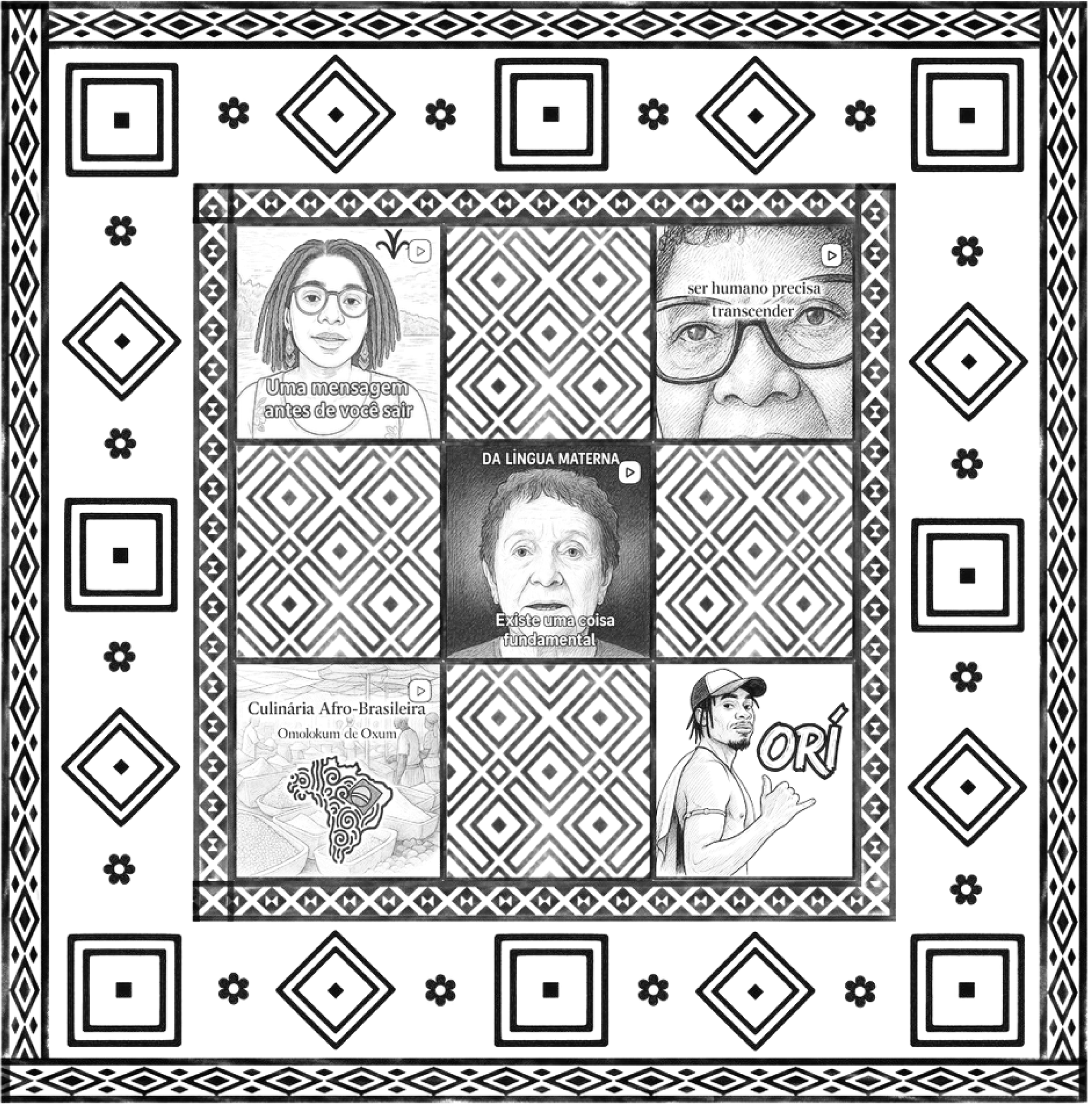
Documented by:
Specimen #2025-G
Digital playlists as reflection and refuge in an Israeli-Palestinian research collective
Field notes
The music from our curated YouTube playlist greeted each of us—Palestinian and Israeli co-researchers alike—as we joined Zoom. Hearing these songs created a sense of audible place and space, creating sonic structures of resonance and familiarity. Each song possessed a story connected to the co-researcher who chose it. Over time, the songs became a sound capsule of our collective story as we met on Zoom for over 10 months to engage in narrative research about Israeli-Palestinian music education-encounter dialogue programs.
Our playlists accompanied us throughout our meetings, serving as an audible spacemaker to bolster and hold our supposed placelessness. The music of Abdulrahman Mohammed, Sergey Belikov, Andrew Bird and Nunu buoyed our writing for full presence ritual. When writing reflections were shared within the group, additional embedded stories arose detailing childhoods, special connections, and difficult life changes. The music of Nina Simone, Bashar Murad, Joan Baez, and System Ali sustained our reflective closing questionnaire, bookmarking time and place, blending with our goodbyes.
These were some of the ways in which intercultural media practices uplifted our “ethic of care” (Noddings, 2015) as a multilingual, intergenerational, multiracial group of Palestinian and Israeli co-researchers implicated in very different social locations and power differentials. There is pervasive asymmetry of power between Israelis and Palestinians due to systemic inequalities as a result of Occupation and Apartheid (B’Tselem, 2021). And there are power imbalances in respect to race, ethnicity, class, sexual orientation, ability, gender, and state status that disrupt this binary from within and throughout.
When our community was affected by the brutality of attacks and atrocities occurring on October 7, 2023 and thereafter (Human Rights Watch, 2024), our digital intercultural practices took on new meaning, shifting to meet the moment as we experienced despair, fear, anger, and loss. We added new music to our playlists, seeking comfort and reassurance to weather the nightmare.
Shared society work is essential to foster critical learning, healing, and justice. The possibilities afforded through digital media for that work is continuing, steadfast with the understanding that through these mediums, there is still the power to alter what seems impossible (Figure 7). Digital playlists as reflection and refuge. Illustration by Abu Abdelbagi.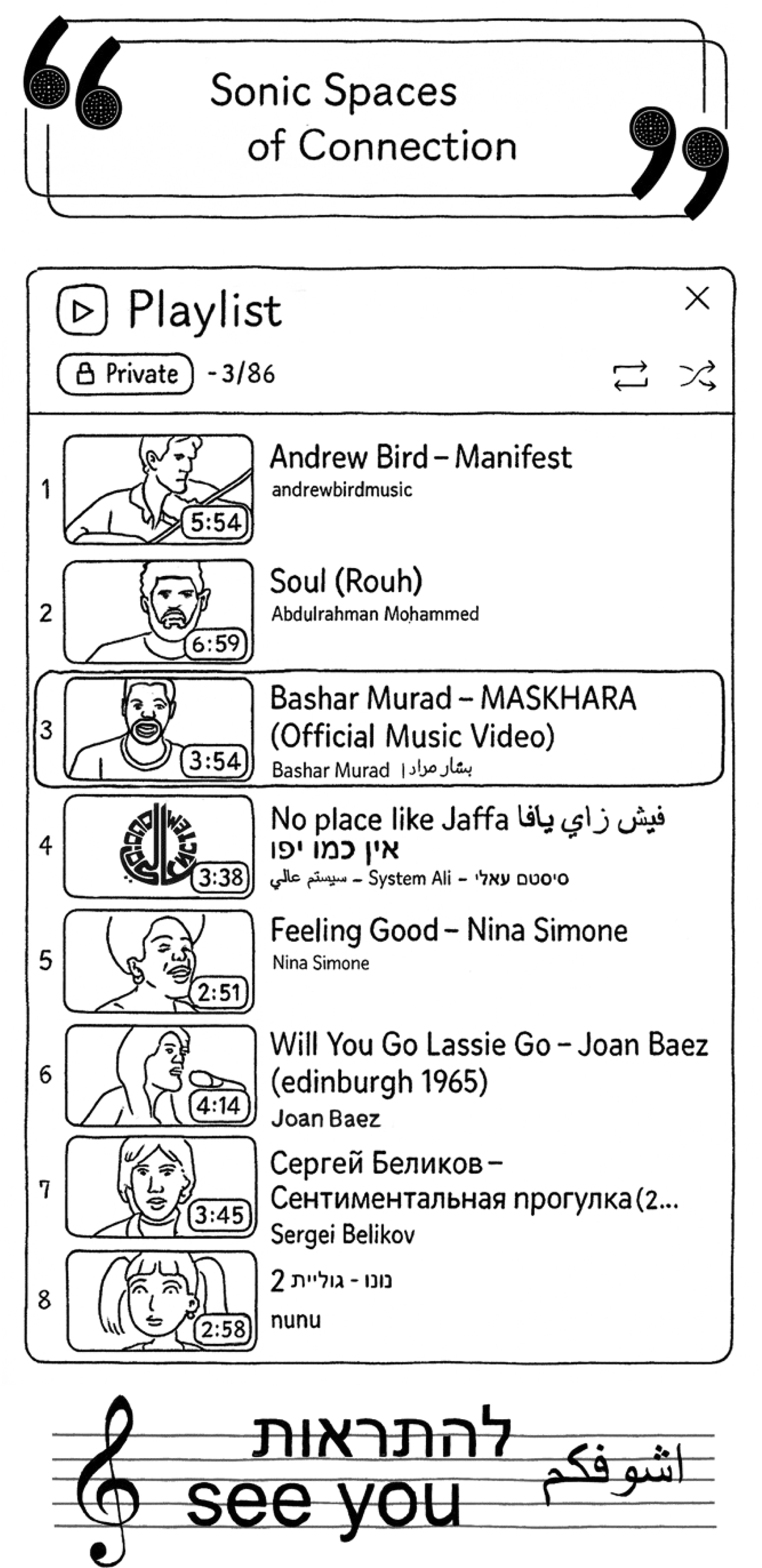
Documented by:
Specimen #2025-H
Algospeak: Linguistic evolution in algorithmic ecosystems
Field Notes
In the shifting digital terrain of content moderation, I observe a fascinating linguistic adaptation: users speaking in code not to hide from each other, but to remain visible to algorithms that would otherwise render them silent.
On TikTok, an adult entertainer, calling herself a “mattress actress,” raises awareness about personal risk and exploitation within the “corn industry.” Lesbians find online community using code words like “le$bean” or “le dollar bean.” Activists share political resistance tactics under the guise of talking about “cute winter boots.” These terms are not merely wry internet slang, but sophisticated evolutionary adaptations to algorithmic censorship.
What distinguishes this phenomenon from earlier internet wordplay is its relationship to (in)visibility. On platforms where “shadowbanning” silently reduces reach, users can never be certain why their visibility suddenly diminishes. Is it the algorithm’s natural fluctuation, or something they said? In this environment of uncertainty, algospeak emerges as a collective defense strategy—a shared immune response against algorithmic erasure.
In a digital landscape where powerful entities control what can be seen and said, algospeak represents a quiet reclamation of agency. It’s not merely evasion—it’s a creative assertion that community connection matters enough to fight for, even as the rules of visibility constantly change. These emergent linguistic practices suggest that wherever communication faces constraint, human ingenuity will find a way to maintain connection—evolving new forms of expression that balance visibility with authenticity in an increasingly algorithmic world (Figure 8). Algospeak: Linguistic evolution in algorithmic ecosystems. Illustration by Shell Avenant.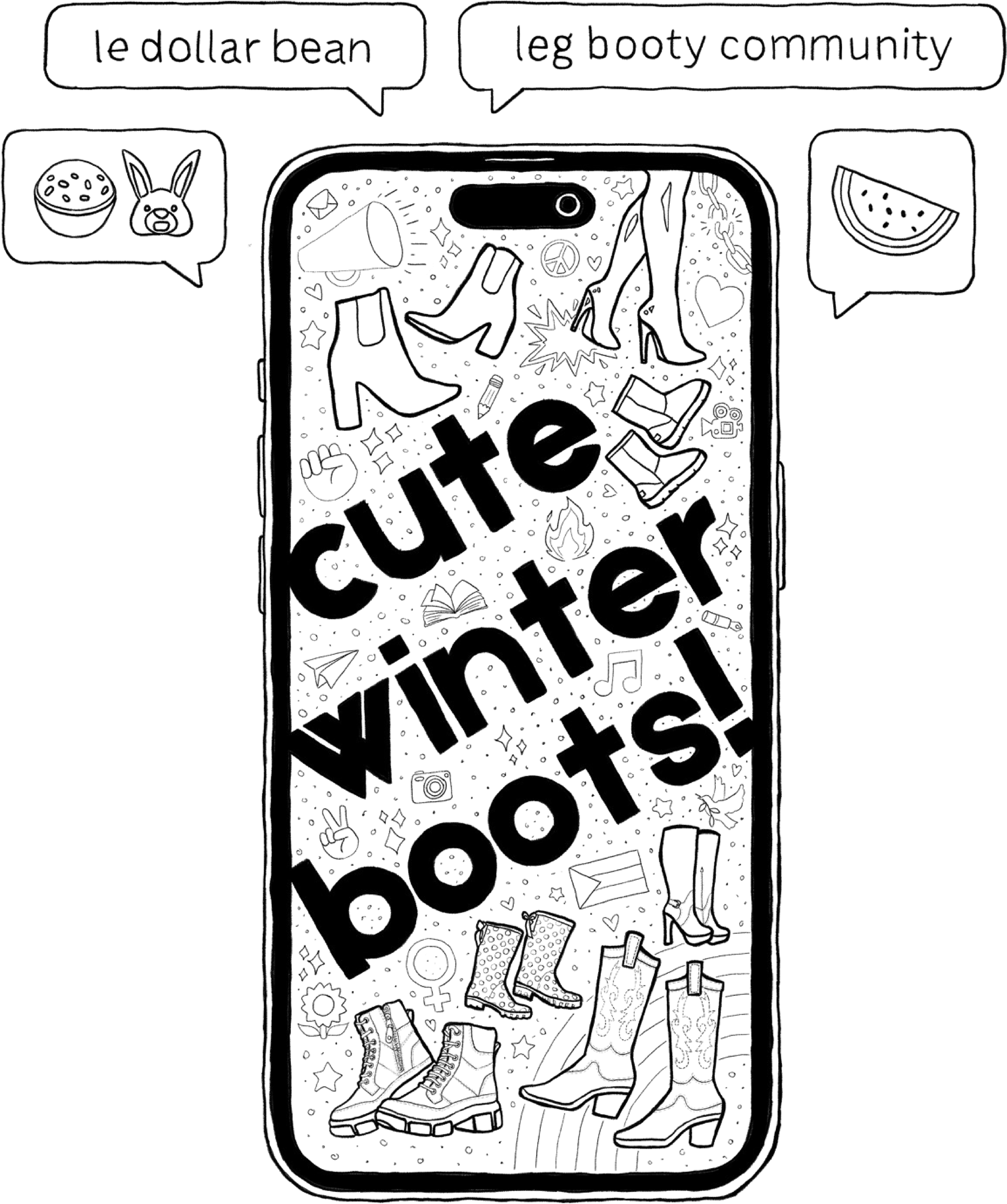
Documented by:
Specimen #2025-I
Cinema’s digital afterlife in diasporic communities
Field notes
In early 2025, the film Detective Chinatown 1900—set in San Francisco’s Chinatown in 1900 and depicting Chinese immigrants’ struggles in a hostile new world—catalyzed an unexpected wave of identity reflection among Chinese international students.
Searching “唐探1900” (the film’s title) + “留子” (a humorous insider term for international students) on RedNote revealed hundreds of emotional testimonials: “Just finished Detective Chinatown 1900. This international student who’s lived in the U.S. for ten years is gently shattered”; “There is no Chinese international student who will walk out of this movie smiling.”
Within these digital spaces, the film served as a mirror, reflecting both historical trauma and present alienation. Students shared personal experiences of discrimination and marginalization, finding in the film’s historical representation a validation of their contemporary struggles in the United States. One post described this connection as “a Möbius band of history from ‘Chinese and dogs cannot enter’ to ‘H1B slaves’.” Others talked of exiting theaters into present-day Chinatowns with a newfound perspective, feeling for the first time connected with the country and its history: “after a hundred years, we are still writing our stories on this same land.”
The film may be fictional, but the digital discourse it sparked creates authentic bridges—between historical trauma and contemporary alienation, between homeland and host country, between individual isolation and collective solidarity.
In a political climate increasingly hostile to international students, these social media exchanges are not mere emotional outlets. They are collaborative spaces of meaning-making that cultivate resilience, affirm belonging, and sustain hope through shared recognition. From where I sit, the digital afterlife of this cinematic experience may prove more transformative than the film itself (Figure 9). Cinema’s digital afterlife in diasporic communities. Illustration by Abu Abdelbagi.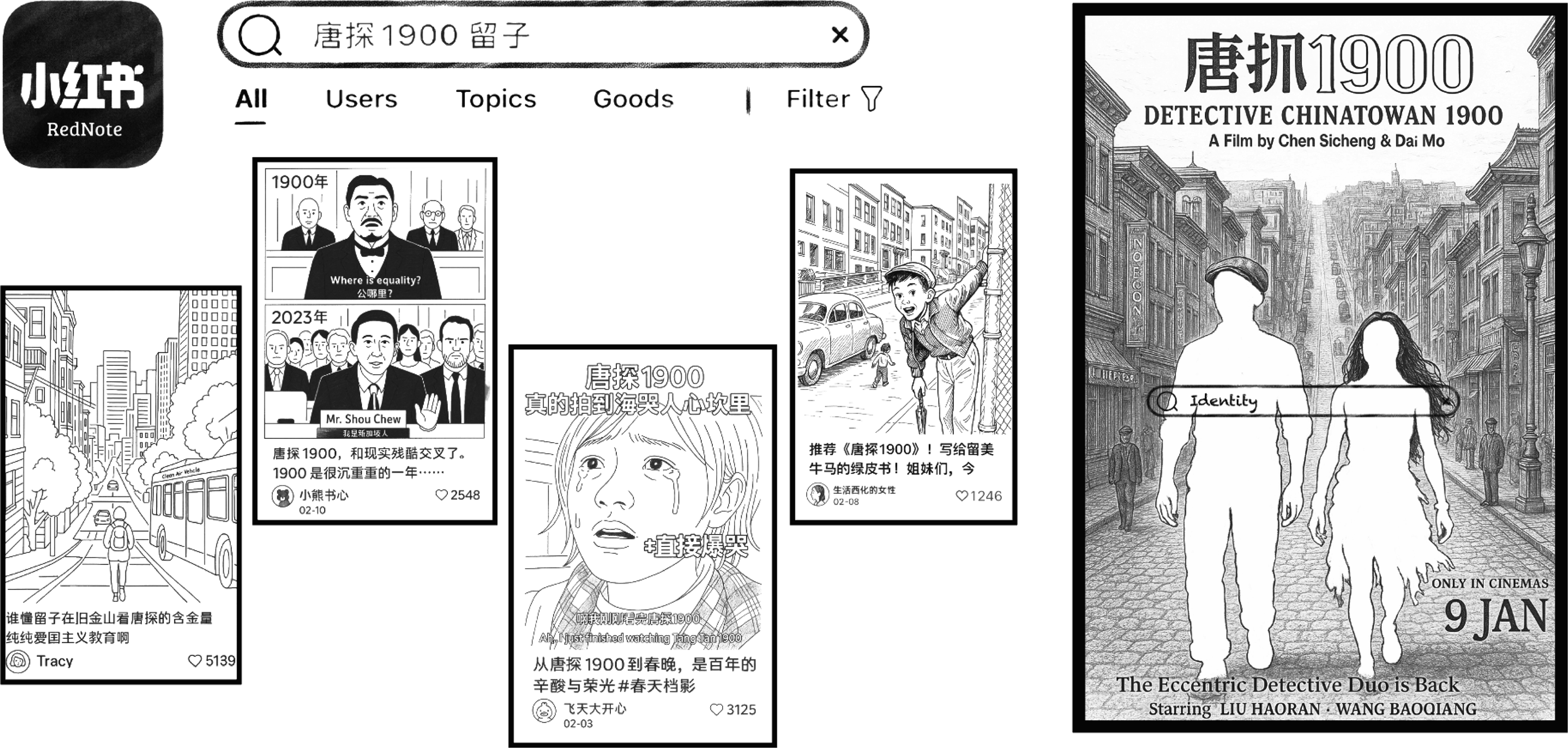
Documented by:
Specimen #2025-J
Screens of possibility: Resilience and connectivity among Sudanese youth
Field notes
Against a backdrop of smoke and partially collapsed buildings, a young man sits poised before his laptop. His space is makeshift—a corner of relative quiet carved from chaos—yet his demeanor is composed, formal.
The Zoom room’s title reads: “Thesis Defense.” Three committee members in formal attire appear in their respective squares, listening intently as the student navigates slides detailing research conducted amid sirens and gunfire.
This is not simply education continuing despite obstacles—it is a deliberate rejection of temporal compression. The student refuses the confinement of present circumstances, instead projecting himself forward through this ritual of academic advancement. He wages his battle in the realm of imagination (Benjamin, 2024), refusing to concede to a reality shaped by the violent imagination of others.
Observing similar specimens across platforms (virtual graduation ceremonies shared in WhatsApp family groups, weddings live-streamed via private YouTube links), I note how these digital rituals allow Sudanese youth to traverse time—connecting past investments to future possibilities, despite a present that threatens to collapse both. In the ecology of human resilience, these digital practices represent a remarkable adaptive strategy—not merely surviving conflict, but actively sustaining the fragile threads of anticipated futures that might otherwise be severed by crisis. Here, hope is an active practice, digitally mediated and collectively sustained (Figure 10). Screens of possibility: Resilience and connectivity among Sudanese youth. Illustration by Abu Abdelbagi.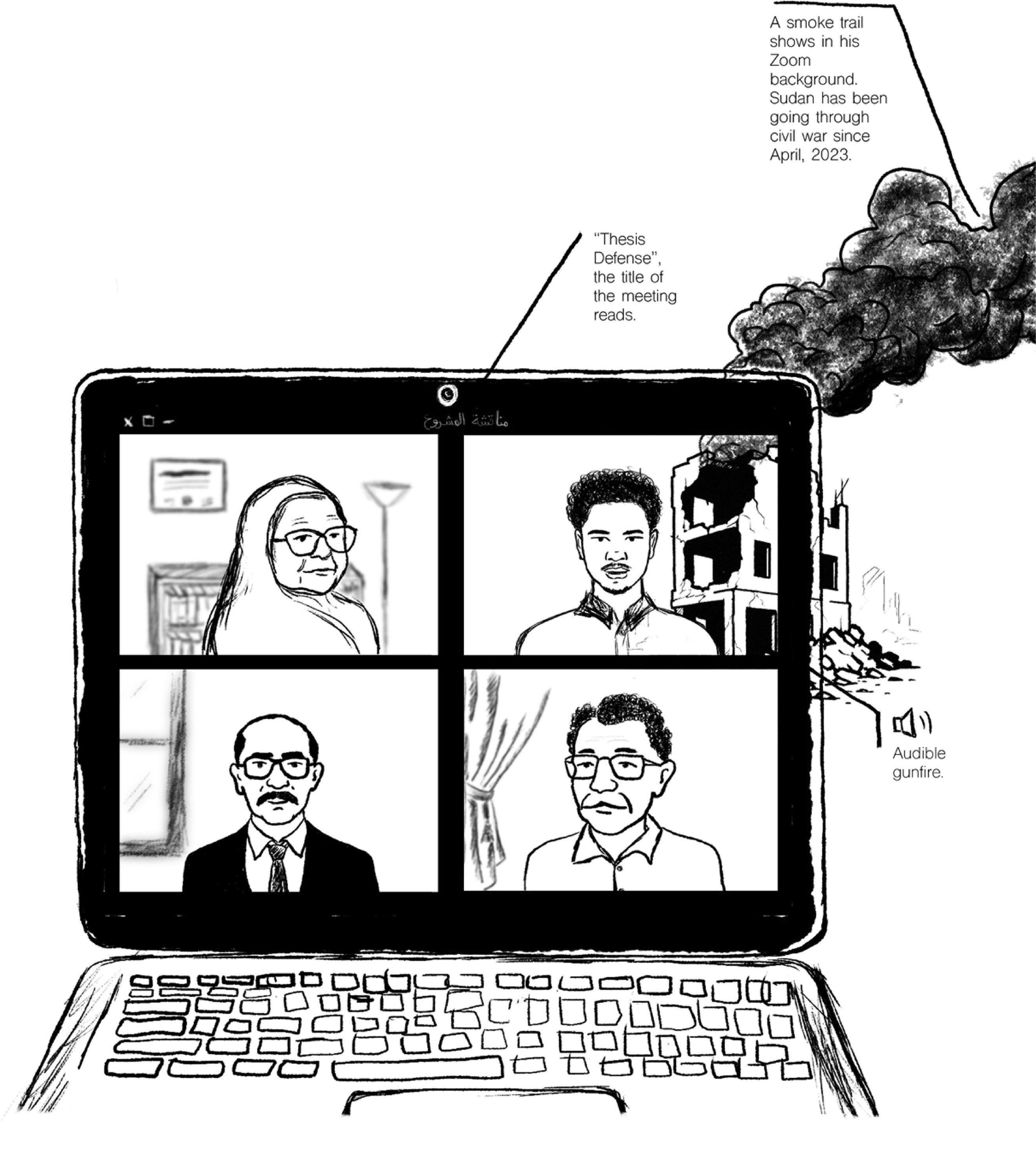
Documented by:
Specimen #2025-K
Friction as pedagogy: AI debates in educator networks
Field notes
The Reddit thread begins with a simple question: “Is using generative AI to teach wrong?” A fourth-grade English teacher shares a classroom breakthrough: students who struggled with visualizations now get excited when AI-generated images bring adjectives to life. They raise their hands, ask questions, and engage—the lesson works!
Then, an unsettled art teacher replies, arguing that AI-generated art is theft, and that an ethical line has been crossed. What was a pedagogical win transforms into a site of friction. Not just about technology, but about the values of labor, creativity, and intellectual ownership that underpin education itself.
But the conversation doesn’t shut down—it expands. From across grade levels and disciplines, teachers on Reddit jump in, tackling this complex question head-on. And rather than collapsing into polarized camps, the thread expands as educators approach this complex question with nuance. One even suggests using this very tension as curriculum: let students research, debate, and decide!
Of course, there is disagreement. Yet, a sense of possibility emerges. This isn’t simply a debate about AI—it is a glimpse into the adaptability of teachers, their care, and their ability to wrestle with change and make it meaningful. Not simply for efficiency, but for curiosity and deep learning.
This is the nature of educator discourse in the algorithmic era: a mix of pragmatism, resistance, and adaptation. The debate will not be settled here, in this thread, but something is happening—a collective shaping of what it means to teach in a time of machine-generated possibility (Figure 11). Friction as pedagogy: AI debates in educator networks. Illustration by Abu Abdelbagi.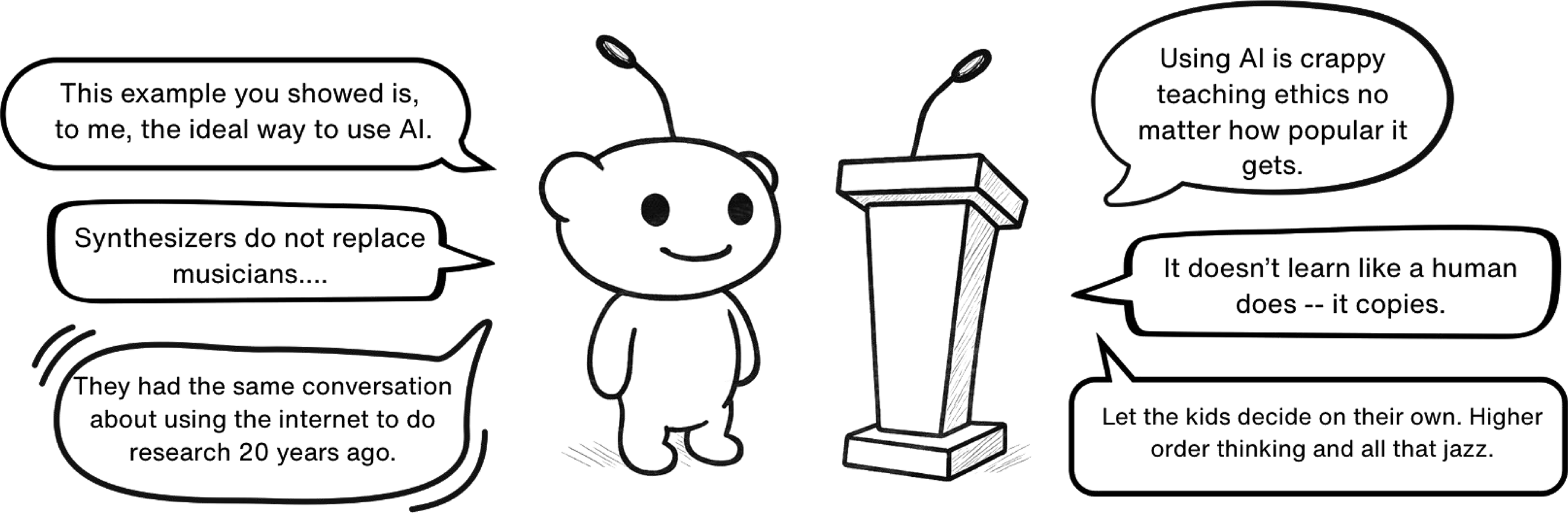
Documented by:
Specimen #2025-L
POVs as self-dialogue across time: Digital rituals of recovery from diet culture
Field notes
Most remarkable is this species’ unique ability to communicate through time and space, using the aesthetic language of POVs (point-of-view videos) for temporal exploration of worlds both real and imagined.
Some speak to their child-selves, creating an opportunity to re-parent their inner child. Others give viewers a peek into their current world, showing the healing they’ve undergone or sharing protective techniques. Still others explore how they wish someone in their life had spoken to them about food, health, body image, projecting what it would feel like to receive that encouragement.
The species evolved as a defense against diet culture predators—messages internalized from peers, loved ones, and self, but that reflect the broader inequity and misogyny characterizing these habitats. Against the backdrop of these systemic factors, POVs create windows for exploring expansive embodiment across time. These healing dialogues—gentle when reworking inner narratives, nurturing when re-parenting the self—highlight multiple pathways to healing.
While the temperament of this species is tender and kind, it also demonstrates a fierce protective instinct, creating space for embodiment to evolve in imagined futures. This consistent patterning suggests an instinctual understanding of the healing potential in these temporal dialogues—a digital adaptation specifically evolved to neutralize diet culture’s harmful influence (Figure 12). POVs as self-dialogue across time. Illustration by Shell Avenant.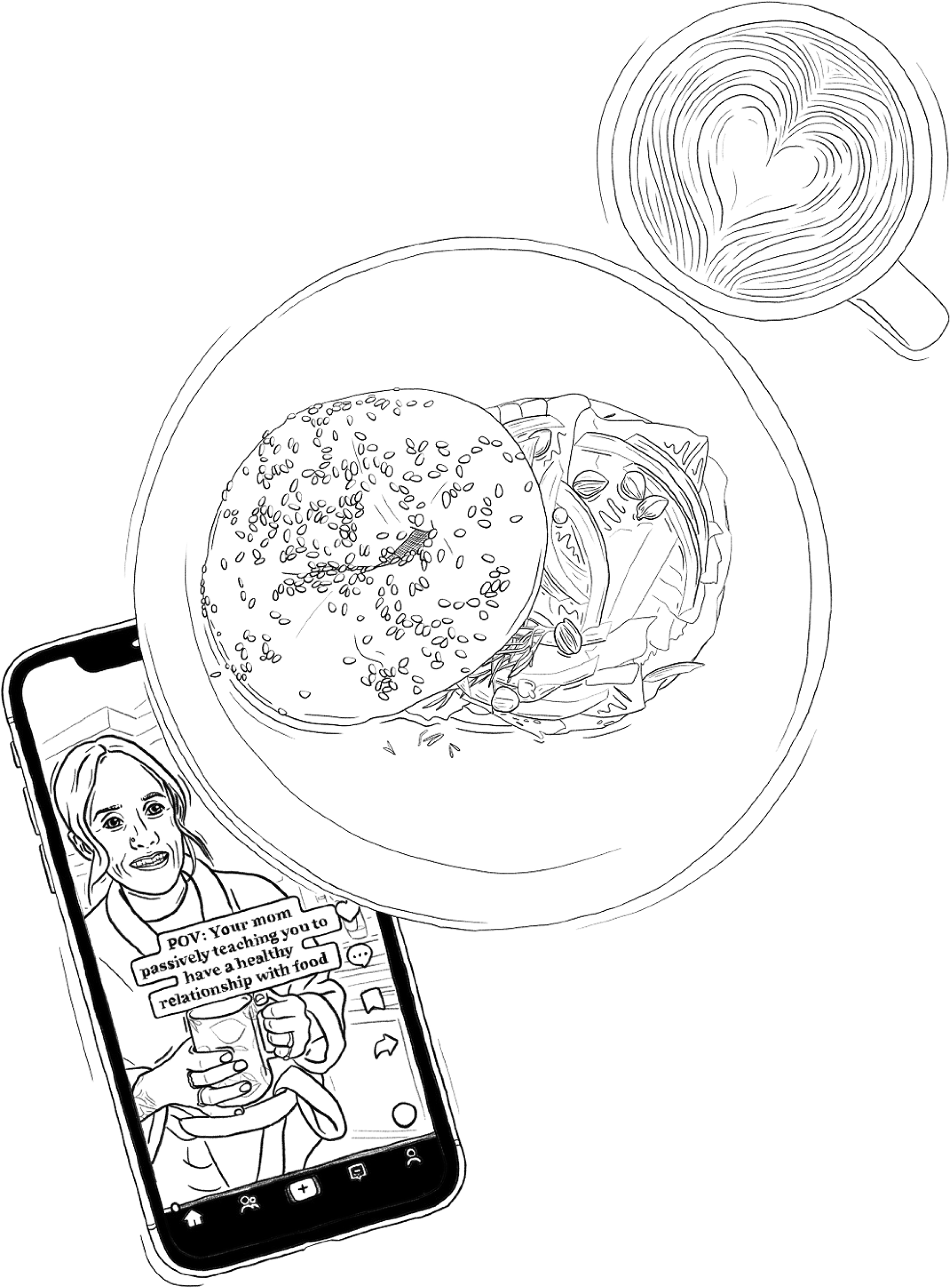
Documented by:
Specimen #2025-M
Recess therapy and the radical wisdom of children
Field notes
A man kneels in front of a child, microphone in hand, and asks: “What’s the meaning of life?”
The child blinks, unbothered by the weight of the question. “To eat ice cream and be nice to people.”
Laughter follows. But why? Because it’s funny? Because it’s true? Or because, at that moment, an adult is being forced to reconsider their overcomplicated worldview—confronted with the simplicity of a wisdom they have long forgotten?
Recess Therapy is more than “wholesome” content. More than a viral dose of serotonin. It’s a public experiment in intergenerational wisdom exchange, a quiet rebellion against adult forgetfulness. Here, children are not unfinished versions of who they will become; they are already whole, already wise, already building worlds from the raw material of wonder.
Their truths are delivered without hesitation, without footnotes, without the doubt that comes with growing older. What if we listened? What if we recognized that joy is not a distraction from knowledge, but knowledge itself? That play is not just an escape, but a way of making sense of the world?
In an era where adult discourse is thick with cynicism, Recess Therapy offers a different way forward: listening to children, not as entertainment, but as guides. Their words, unpolished and unfiltered, carve pathways where adults see dead ends. They remind us that clarity is often mistaken for naïveté, and that a world built on kindness is no small dream.
“The future is in good hands,” people comment. But the truth is even more radical: the present is in good hands, too (Figure 13). Recess therapy and the radical wisdom of children. Illustration by Shell Avenant.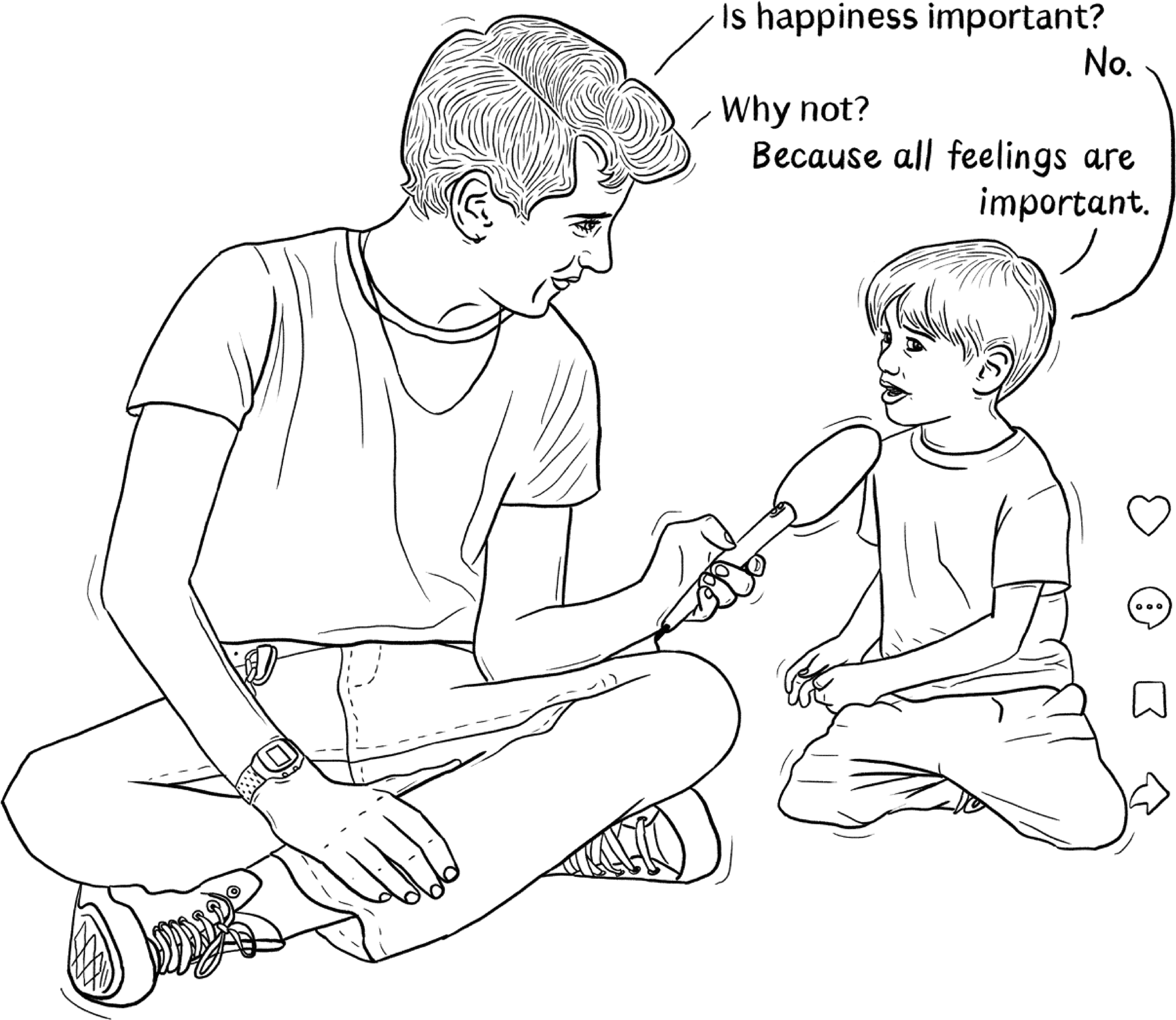
Documented by:
Specimen #2025-N
The laboratory of hope: Digital habitats of persistence and problem-solving
Field notes
In the digital habitat of r/3Dprinting, I observe a vibrant ecosystem of makers. A first-time maker proudly shares their maiden print: a wobbly but earnest Benchy boat. The comments pour in: “Thank you for this great feedback!” and “[it takes] courage to post failings. Errors are welcomed!” These words are not just polite gestures, but validating lifelines, pulling the newcomer into a web of shared purpose.
In this space, failure is not an end but a beginning. A user posts a photo of a “spaghetti” print—a tangled mess of filament—and instead of ridicule, they receive troubleshooting tips, humorous comments, and empathy: “Nice print though. I was proud of my Benchy on my first print.” The thread becomes a mini-classroom, where knowledge is exchanged freely, and encouragement is the currency of progress.
What strikes me most is the way hope is woven into the fabric of every interaction. A user shares a story of printing a gift for her husband’s birthday. Another posts a whimsical creation—a 3D-printed whistle that sounds like a scream—and the community rallies to refine the design, turning a playful idea into a collaborative project.
This is the laboratory of hope: a place where experiments in creativity and kindness yield tangible results. It is not just a forum but a living ecosystem, where every post is a hypothesis, every comment a reagent, and every upvote a spark of encouragement. Here, the future of learning is not just imagined but built, one thread at a time (Figure 14). The laboratory of hope: Digital habitats of persistence and problem-solving. Illustration by Shell Avenant.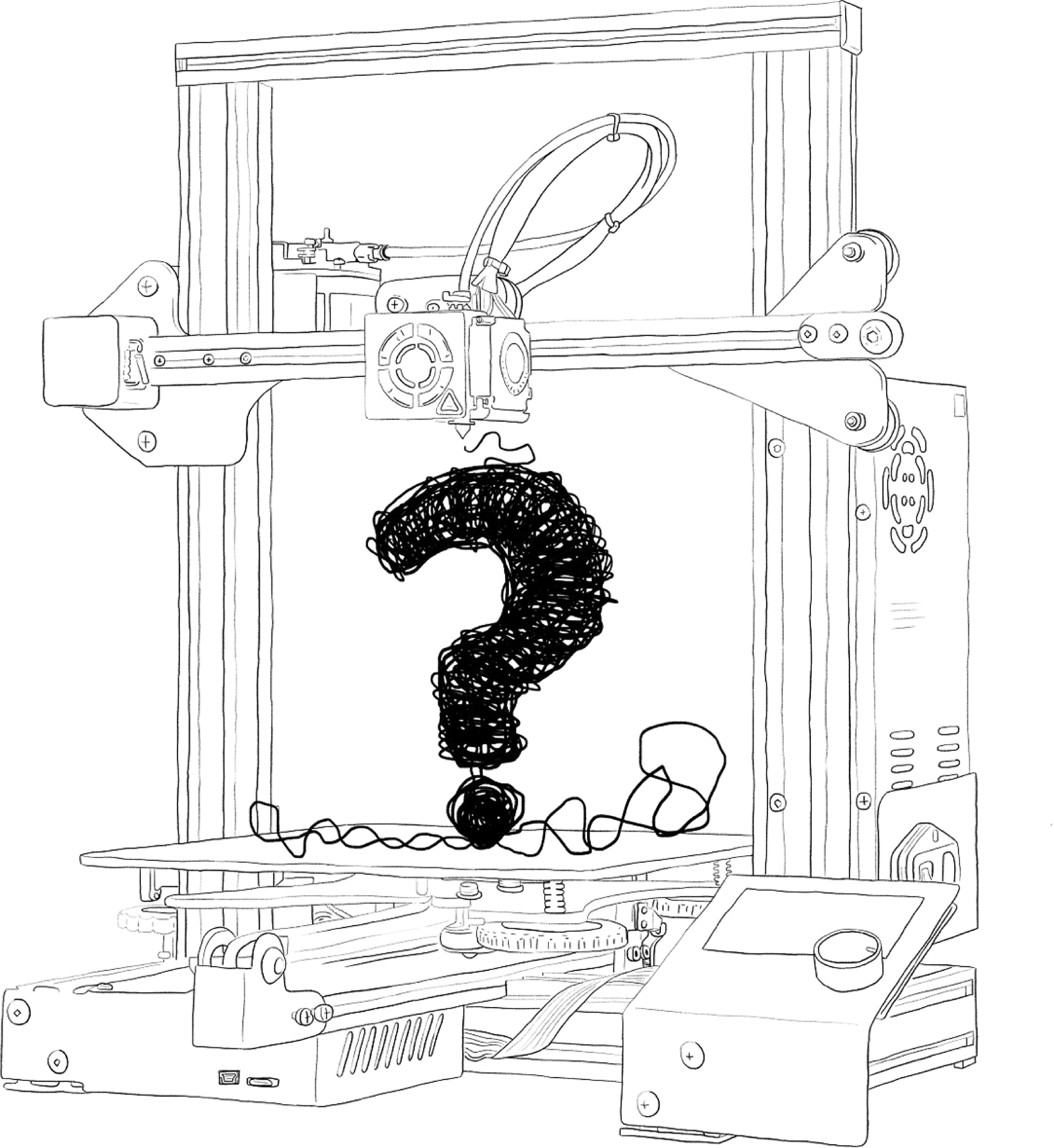
Documented by:
Conclusion
This project contributes to a growing body of work on utopian media studies—including scholarship on media and hope (Fenton, 2016; Shade, 2021), utopia as method (Levitas, 2013), and imagination in social transformation (Benjamin, 2024; Duncombe, 2007)—by showing how practices of documentation and preservation can themselves provide utopian perspectives to research. Where much utopian scholarship focuses on explicit movements, manifestos, or alternative institutions, we show how utopian orientations infuse everyday digital practices—small-scale practices that assert technology could be otherwise, that present arrangements are not inevitable, and that care and connection can be cultivated even within extractive infrastructures. In doing so, our field guide rises up to a critical challenge in contemporary utopias: producing “adequate maps of the present which permit images of a connected but transformed future” (Levitas, 1993: 257).
Research as utopian practice: Care and collectivity
Importantly, we extend utopian media studies by proposing that research itself can be utopian practice. As we have argued elsewhere, “doing research is not only a process of inquiry, data collection and analysis, but also an imaginative act that in itself is civic and political” (Literat & Kligler-Vilenchik, in press). We attend to the affective and imaginative orientations embedded in scholarly work—what we term “felt futures,” the emotionally charged visions of possibility that animate research. Our collaborative authorship model, our commitment to accessible and multimodal representation (see also Literat et al., 2017), and our stance of cultivation rather than critique all enact the values we observe in our specimens: care, collective meaning-making, and orientation toward possibility. Echoing Benjamin’s (2024) charge to dismantle dominant imaginaries and cultivate forms of imagination rooted in solidarity, we treat hope not merely as an object of study but as a sustainable and equitable way of conducting research itself.
The concept of care functions here as both practice and analytical orientation, connecting our work directly to utopian media studies’ concern with prefigurative politics—enacting the values one wishes to see realized (Fenton, 2016). Drawing on feminist care ethics (Held, 2006; Puig De la Bellacasa, 2017; Tronto, 1993), we understand care as the often-invisible work of sustaining relationships, communities, and possibilities across time.
In the context of utopian media studies, care practices are utopian practices: they assert that mutual aid, collective witnessing, and sustained attention to others’ flourishing are both possible and necessary, even within systems designed for extraction and competition. When Sudanese youth use Zoom to hold thesis defenses amid civil war (Specimen 2025-J), this is care work that refuses the violence’s temporal compression—insisting on futures beyond survival. When Chinese students share memes about academic pressure (Specimen 2025-D), transforming individual burnout into collective recognition, this is care work that redistributes emotional weight across networks. When educators debate AI ethics with nuance rather than resorting to polarized positions (Specimen 2025-K), this is care work that holds space for complexity and collective sense-making. Thus, care, in our framework, is how hope becomes material and sustainable. It is the infrastructure of utopian practice—the relational work that allows possibility to persist across time and space, even under conditions of profound constraint.
Everyday utopian practices as tactical appropriations
The care practices documented in our field guide enact what Levitas (2013) calls the “holistic reconstruction of society”—they don’t just resist current arrangements but actively build alternatives in miniature. Many specimens involve dominant corporate platforms (TikTok, Instagram, Zoom, Facebook), revealing how people bend technologies designed for extraction toward ends of care and collective flourishing.
The practices we document emerge within and against dominant infrastructures, as tactical appropriations (De Certeau, 1984) that assert technology could be otherwise. As Scholz (2016) argues, recognizing cooperative practices within platform capitalism prepares ground for more fundamental transformations.
What is more, this is the material reality for marginalized communities globally: they cannot wait for perfect tools or revolutionary ruptures. They must fashion hope from available materials. When Sudanese youth use Zoom to hold thesis defenses amid civil war, when Chinese international students process diasporic alienation through RedNote, when Afro-Brazilian students create digital sanctuaries on Instagram within exclusionary institutions—they are working with what exists rather than waiting for better alternatives. As Arora (2024) observes from her Global South fieldwork, “[techno]pessimism is a privilege for those who can afford to live in despair. The rest of the world has little choice but to be optimistic as their future depends on it” (p. 15). Her critique underscores how dominant academic frameworks often marginalize the innovative ways in which people use technology to sustain community, create opportunity, and build change under precarious conditions. Keenly attuned to this critique, our specimens deliberately center perspectives often marginalized in dominant media studies discourse, particularly from the Global South and diasporic communities. Spanning contexts from conflict zones and diasporic classrooms to transnational activist networks, they reveal how digital hope emerges within, and perhaps because of, conditions of constraint.
Many of our specimens center on young people, reflecting both our collective’s research sites and a deliberate focus on those who face futures most shaped by technological uncertainty (boyd, 2014; Livingstone, 2009). Their practices reveal complex dynamics of agency and collectivity. The individual/collective binary proves misleading in digital contexts (Jenkins et al., 2016): when a young person documents their voice transition on TikTok, they engage in personal transformation while creating a collective archive; when a student shares educational testimony, that individual narrative becomes a template others inhabit. These practices show how individual expression scaffolds collective imagination and capacity; our field guide documents this relational infrastructure, with a particular eye on communities navigating precarity.
The field guide as living archive
Looking ahead, we envision this field guide as a living archive, open to expansion, revision, and reinterpretation by others working in diverse research contexts. Its specimens offer what we might think of as the genetic material for imagining alternative technological futures: ones organized around care, connection, and collective flourishing. Of course, field guides are never definitive; rather, they capture particular encounters with systems in motion. In this same way, the practices documented here will continue to evolve with shifting technological, political, social, and ecological conditions.
Our aim is that this guide offers not just a record of hopeful practices, but a set of tools for recognizing, sustaining, and joining them. For scholars, it models methods that take hope seriously as both object and orientation of inquiry. For educators, activists, and practitioners, it provides repertoires—practices that might be adapted to new contexts, tactics that might inform new struggles. For the communities whose practices we document, it offers reflection and recognition—a mirror showing their resilience and imagination rendered visible, worthy of study, worthy of protection.
Supplemental material
Supplemental material - Digital ecologies of hope: A natural history of emerging media futures
Supplemental material for Digital ecologies of hope: A natural history of emerging media futures by Abu Abdelbagi, Shell Avenant, Inara Bezerra, Meier Clark, Shoshana Gottesman, Julio Intriago Izquierdo, Rhea Jaffer, Andrea Kim, Sonia Kim, Ioana Literat, Siyao Lyu, Chenxi Shi, Madison Smith, Carolina Soterio in Convergence
Footnotes
Acknowledgments
The authors wish to thank the Media and Social Change Lab (MASCLab) for the collaborative spirit and mutual support that made this project possible, and the special issue editors, Steve Jankowski and Jakko Kemper, for their sustained advocacy for this work and for the scholarly vision that enabled it.

Funding
The authors received no financial support for the research, authorship, and/or publication of this article.
Declaration of conflicting interests
The author(s) declared no potential conflicts of interest with respect to the research, authorship, and/or publication of this article.
Data Availability Statement
This article draws on publicly available social media content and researcher fieldwork observations. No dataset is archived or available for sharing.
Note on Format
This article was developed as a multimodal field guide, with a visual design that is integral to its argument about alternative forms of scholarly knowledge production. The fully designed version—including hand-drawn illustrations and the original field guide layout—is available as Supplementary Material accompanying this article. Readers are encouraged to engage with this version.
Supplemental material
Supplemental material for this article is available online.
References
Supplementary Material
Please find the following supplemental material available below.
For Open Access articles published under a Creative Commons License, all supplemental material carries the same license as the article it is associated with.
For non-Open Access articles published, all supplemental material carries a non-exclusive license, and permission requests for re-use of supplemental material or any part of supplemental material shall be sent directly to the copyright owner as specified in the copyright notice associated with the article.
