






Abstract
Objective
Routine administrative data have been used to show that patients admitted to hospitals over the weekend appear to have a higher mortality compared to weekday admissions. Such data do not take the severity of sickness of a patient on admission into account. Our aim was to incorporate a standardized vital signs physiological-based measure of sickness known as the National Early Warning Score to investigate if weekend admissions are: sicker as measured by their index National Early Warning Score; have an increased mortality; and experience longer delays in the recording of their index National Early Warning Score.
Methods
We extracted details of all adult emergency medical admissions during 2014 from hospital databases and linked these with electronic National Early Warning Score data in four acute hospitals. We analysed 47,117 emergency admissions after excluding 1657 records, where National Early Warning Score was missing or the first (index) National Early Warning Score was recorded outside ±24 h of the admission time.
Results
Emergency medical admissions at the weekend had higher index National Early Warning Score (weekend: 2.53 vs. weekday: 2.30, p < 0.001) with a higher mortality (weekend: 706/11,332 6.23% vs. weekday: 2039/35,785 5.70%; odds ratio = 1.10, 95% CI 1.01 to 1.20, p = 0.04) which was no longer seen after adjusting for the index National Early Warning Score (odds ratio = 0.99, 95% CI 0.90 to 1.09, p = 0.87). Index National Early Warning Score was recorded sooner (−0.45 h, 95% CI −0.52 to −0.38, p < 0.001) for weekend admissions.
Conclusions
Emergency medical admissions at the weekend with electronic National Early Warning Score recorded within 24 h are sicker, have earlier clinical assessments, and after adjusting for the severity of their sickness, do not appear to have a higher mortality compared to weekday admissions. A larger definitive study to confirm these findings is needed.
Keywords
Introduction
Patients admitted to hospitals over the weekend appear to have a higher risk of death than patients who are admitted on weekdays.1–3 This phenomenon, known as the ‘weekend effect’ has been observed in Canada, 4 UK,5–7 USA 8 and Australia, 8 in planned and unplanned admissions. Two mutually non-exclusive hypotheses1,9 have been proposed for the ‘weekend effect’. First, patients admitted at the weekend are sicker than their weekday counterparts. Second, the quality of care in hospitals over the weekend is worse due to lower staffing levels and less access to the support services.
Most studies of the ‘weekend effect’ have relied on analyses of routine administrative data.1,2,8 Although this yields large sample sizes, the clinical information is of variable quality, in particular providing little or no data on how sick patients are on admission. Recently, in England, NHS hospitals have been encouraged by the Royal College of Physicians (London), to standardize the assessment of severity when patients present to hospital as part of the process of care and recorded on a clinical observation chart. 10 They recommend the use of an approach based on scoring seven variables, known as the National Early Warning Score(s) (NEWS): respiration rate, oxygen saturations, any supplemental oxygen, temperature, systolic blood pressure, heart rate and level of consciousness (Alert, Voice, Pain, Unresponsive). These are routinely collected by nursing staff, usually for all patients, and then repeated thereafter depending on local hospital protocols. 10
The clinical rationale for NEWS is that early recognition of deterioration in the vital signs of a patient can provide earlier opportunities for intervention.10,11 NEWS is known to be a good predictor of mortality in hospital though is not suitable for certain patient groups such as those with end-stage renal failure or acute intracranial conditions, who are characterized by abnormal physiology, or may not be suitably calibrated in some patients such as those with chronic obstructive pulmonary disease. 12 NEWS is now routinely available in most NHS hospitals, is integral to the clinical decision making process, is regularly updated and is clinically valid.
Our aims were to conduct an exploratory study to compare emergency medical admissions at the weekend with admissions on weekdays to determine if: weekend admissions have higher index NEWS; weekend admissions have a higher risk of death and if this risk is modified when the index NEWS is taken into account; and weekend admissions experience longer delays in the recording of their index NEWS.
Methods
Setting
The study was conducted in four acute hospitals in the Yorkshire and Humberside region of England: Diana, Princess of Wales Hospital; Scunthorpe General Hospital; Scarborough Hospital; and York Hospital. The hospitals have approximately 400, 400, 330 and 700 beds, respectively, and have been using electronic NEWS (eNEWS) scoring since at least 2013 as part of their in-house electronic patient record systems.
Sample and data
We considered all adult (age ≥ 16 years) emergency medical admissions discharged during 2014. For each admission, we obtained a pseudonymized patient identifier, patient’s age, sex, discharge status (alive/dead), admission and discharge date and time, and eNEWS. We excluded records where eNEWS was missing or recorded outside ±24 h of the admission time because such scores are less likely to reflect the presenting sickness profile of acutely ill patients.
Patients’ eNEWS ranged from 0 (lowest severity of sickness) to 18 (the maximum value is 20). Weekend admissions were defined as occurring on/after midnight on Friday up to midnight on Sunday, and the index eNEWS was defined as the first score recorded within ±24 h of the admission time. We did not consider children and elective admissions because such analyses are likely to be underpowered because of the low mortality in these subgroups, and NEWS is not recommended for children. 10
Statistical analyses
We used multilevel linear and logistic regression models according to whether the response variable was continuous or binary with hospital as a random intercept term which allows for clustering of patients within hospitals. We commenced with models with a single binary weekend (yes/no) covariate to estimate the crude (unadjusted) risk of death for weekend admissions versus weekday admissions. We then added additional covariates (index eNEWS, age, sex and calendar month) on the basis of their clinical justification (not statistical criteria) to produce adjusted estimates of the ‘weekend effect’. For the logistic regression models, we report the effect sizes in terms of odds ratios (OR). Statistical significance was set at p < 0.05. Our results focus on size of the ‘weekend effect' reported from model coefficients with 95% confidence intervals (95% CI).
The first set of models was used to determine the crude and adjusted ORs of in-hospital death following emergency medical admission to hospital over the weekend versus the weekday admissions. We used a series of multilevel logistic regression models, with died in hospital (yes/no) as the response variable. The preliminary model was a crude (unadjusted) model with weekend as the only covariate. A subsequent model included index eNEWS as an additional continuous covariate. The final model included age (years), sex, admission month and index eNEWS as additional covariates.
A second set of multilevel linear regression models was used to investigate the extent to which admissions over the weekend were sicker than those over the weekdays. We used the index (on-admission) eNEWS as the response variable with age, sex, died, admission month and weekend as covariates in a linear regression model.
A third set of multilevel linear regression models was used to investigate the extent to which emergency medical admissions over the weekend had delays in the recording of the index eNEWS than those over the weekdays. The time interval (hours) from admission date-time to date-time of the index eNEWS was calculated. A negative value was legitimate because the index eNEWS can be recorded before formal admission to hospital (for example in the Accident and Emergency department). The time to index eNEWS (hours) was the response variable with age, sex, died and weekend as covariates in a linear regression model.
All analyses were carried out using R (for pre-processing and graphics) 13 and STATA (for statistical modelling). 14
Results
Cohort description
There were 48,774 emergency admissions across the four hospitals during the period. We excluded 1005 (2.1%) of admissions because they did not have any eNEWS recorded and a further 652 (1.3%) admissions because the index eNEWS was not recorded within ±24 h of the admission time. Emergency admissions with no eNEWS had a 17.2% (173/1005) mortality and those where the index eNEWS was not recorded within ±24 h of admission had a 8.3% (54/652) mortality. The proportion of admissions with missing eNEWS was lower at weekends (1.6%) than on weekdays (2.2%). The proportion of admissions where eNEWS was not recorded within ±24 h of admission was similar for weekends (1.36%) and weekdays (1.33%). The crude mortality for admissions with missing eNEWS at weekends was 27.5% compared with 15.0% on weekdays. The crude mortality for admissions where the index eNEWS was not recorded within ±24 h of admission was 11.0 % at weekends compared with 7.4% on weekdays.
After exclusions, we analysed 47,117 emergency admissions with a mortality of 5.8% (2745). The deaths in the excluded subgroups accounted for 7.9% (236/2981) of all deaths.
Figure 1 shows the relationship between index eNEWS and in-hospital mortality on weekends versus weekdays in emergency medical admissions, which shows that mortality increases with higher index eNEWS.
Observed in-hospital mortality versus index electronic NEWS. Vertical bars are exact 95% confidence intervals.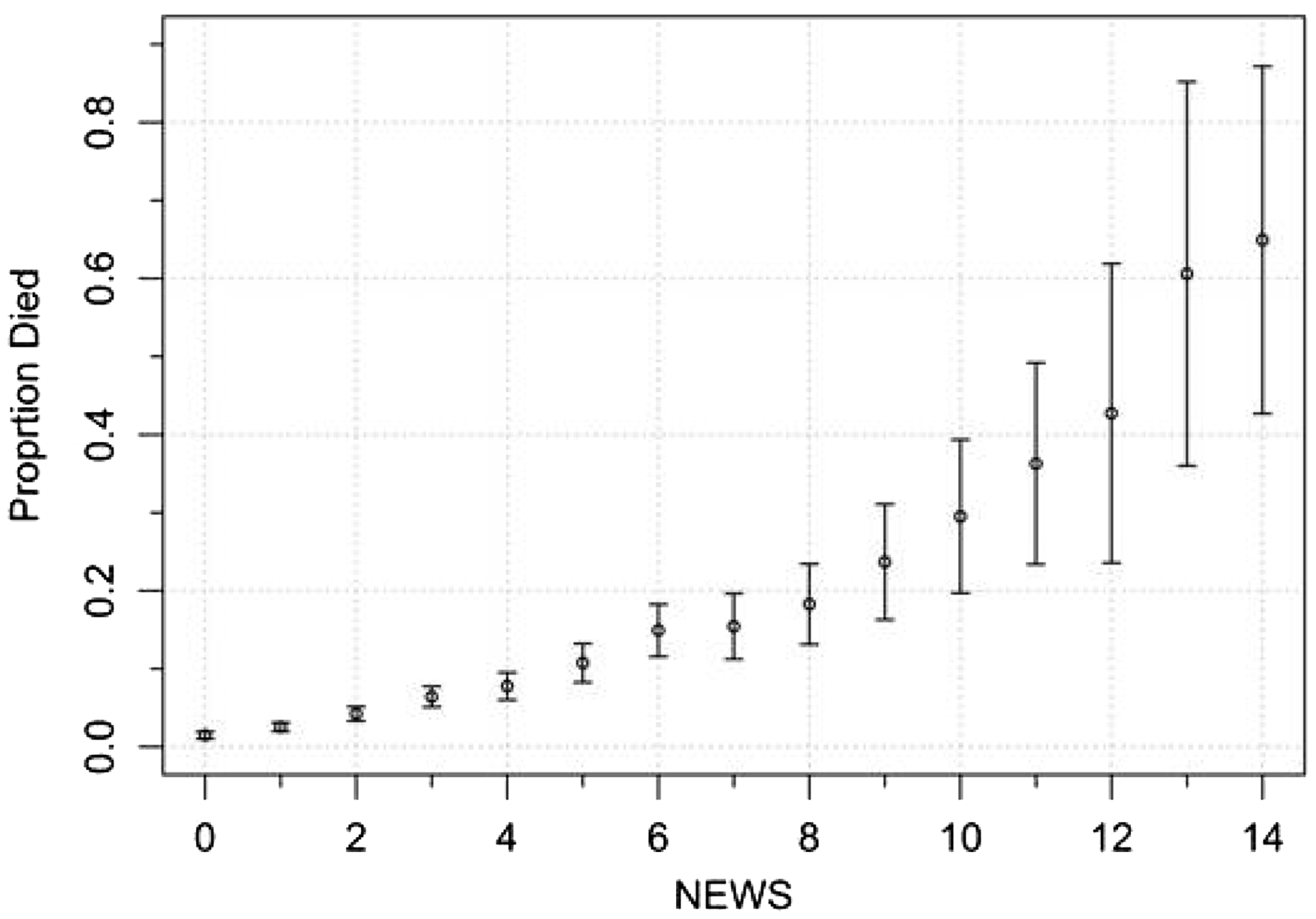
Characteristics of weekend versus weekday emergency admissions.
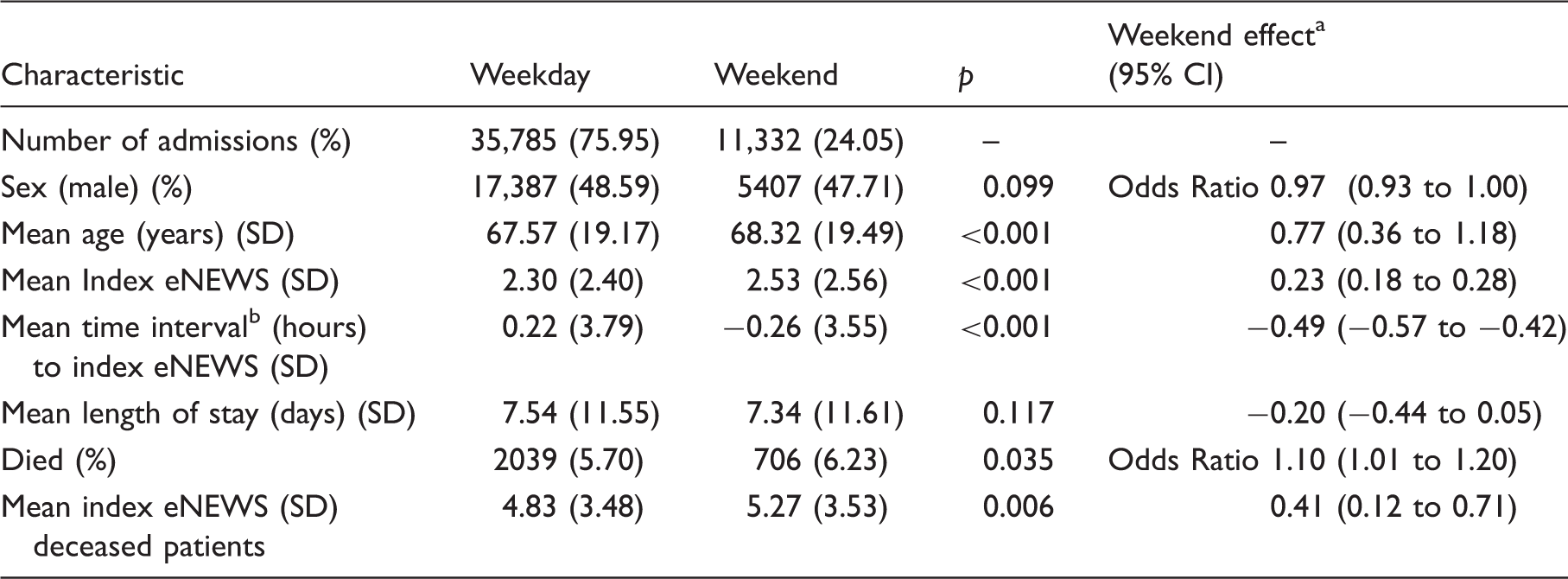
P-values and estimates (95% CI) of effect are from a weekend term in a linear (for continuous variables) or logistic (for binary variables) regression model with hospital as a random effect.
Negative time interval indicates that the index eNEWS was recorded before the administrative date and time of admission.
Risk of in-hospital death
Odds ratios or effect sizes (95% CI, p-values) for mortality comparing weekend versus weekday emergency admissions.
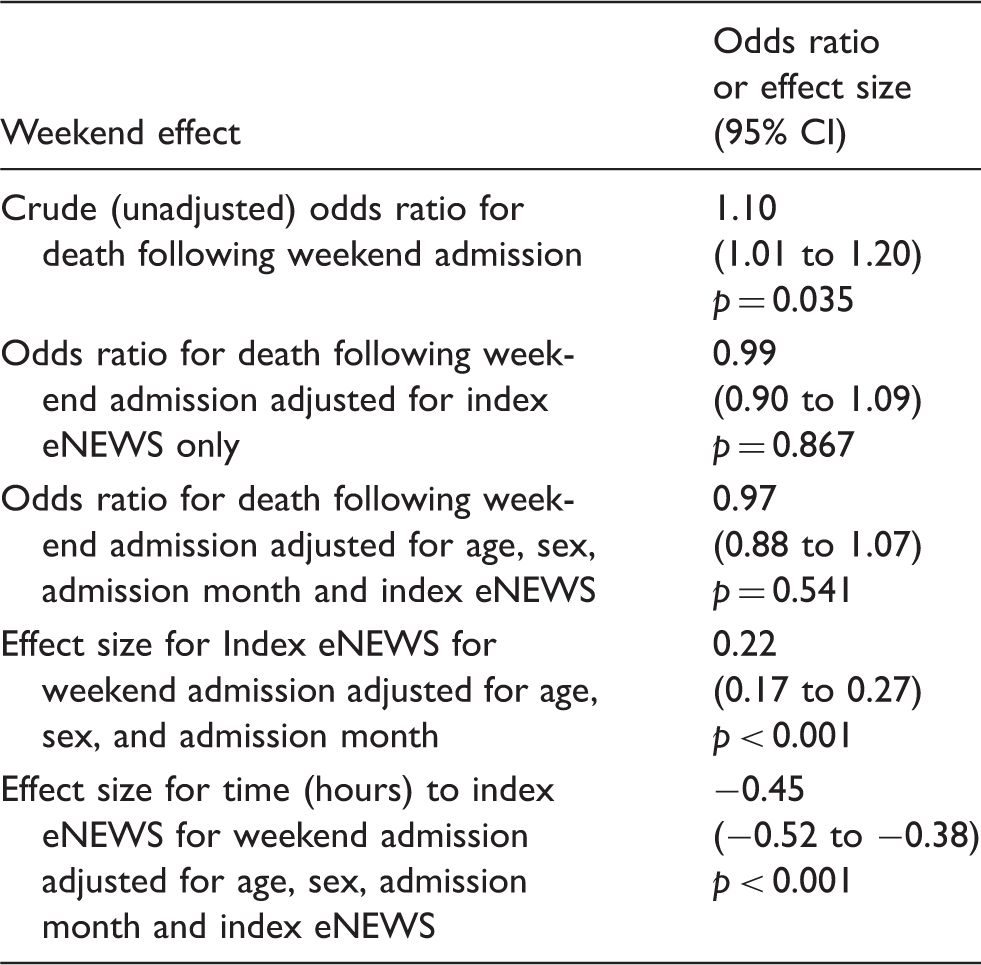
Note: Effect sizes are absolute differences.
eNEWS: electronic NEWS.
Severity of index eNEWS
Emergency medical admissions over the weekend had higher adjusted (Table 2) index eNEWS than weekday admissions. The adjusted effect size was 0.22 points higher which equates to a standardized difference of 0.09 (0.22/2.43, where 2.43 is the pooled standard deviation).
Time to recording of index eNEWS
Emergency medical admissions at the weekend had their index eNEWS recorded more promptly than weekday admissions (Table 2). The adjusted effect size was 0.45 h earlier.
Discussion
Main findings
Patients admitted as medical emergencies over the weekend are sicker than those who are admitted on weekdays and are not at increased risk of in-hospital mortality once that level of sickness using their index eNEWS, recorded within ±24 h of admission, is taken into account. The index eNEWS was recorded about 30 min sooner at the weekend compared with on weekdays. This is surprising given the lower staffing levels on weekends and important because the principal concern around the ‘weekend effect’ is the extent to which it results in clinically avoidable deaths1 (and a principal cause of clinically avoidable deaths is poor clinical monitoring).15
Our findings are based on the analysis of eNEWS which is a predictor of hospital mortality and is central to the monitoring and detection of patient deterioration. Previous studies have shown that failure to respond to deterioration due to poor monitoring and inadequate responses are an important cause of avoidable deaths. 15
Our study involves emergency medical admissions in four hospitals (teaching/non-teaching, smaller/larger, coastal/city, deprived/affluent, with local escalation policies for NEWS) with electronic NEWS which simultaneously enables us to consider the severity of sickness on admission, albeit with limited evidence of reliability and validity, 11 as well as the monitoring of vital signs of patients. Our indicator of sickness, eNEWS, is derived from seven vital signs routinely collected as part of the process of care which provides some insight into the quality of monitoring vital signs because eNEWS is date-time stamped. Nonetheless, our study does not report on other aspects of the quality of care which have been found to vary over weekends or other problems (e.g. diagnostic errors, inadequate drug or management) seen with clinically avoidable deaths. 15 Indeed, the index eNEWS may also be confounded by care in the emergency department, such that suboptimal initial care at weekends may lead to a higher index eNEWS. Thus, causality could be reversed – poor initial care at weekends leads to higher index eNEWS at weekends. While this is possible, it is unlikely because we found that the time to index eNEWS is earlier on the weekends versus the weekdays.
A key challenge with the use of routine data is to determine its quality and reliability. While there is evidence to show electronic NEWS16 is superior to pen and paper NEWS,17–19 the integrity of the data in routine settings is more difficult to determine. However, unlike administrative data, NEWS is integral to the process of care and clinical decision making. This provides a higher degree of assurance because eNEWS is continually exposed to human and electronic validation17,20 and is also supported by regular internal audits in our hospitals. We are not able to determine the subsequent clinical response to NEWS and how this differed at weekends versus weekdays.
Limitations of the study
There were four limitations to this study. First, our study is based on only four hospitals, so the extent to which these exploratory findings are generalizable to other hospitals is unclear. Second, we excluded 3.4% of emergency medical admissions that did not have eNEWS recorded at all or within ±24 h of admission. These excluded admissions accounted for 7.9% of all in-hospital deaths. Indeed, the higher mortality (17.2% and 8.3% vs. 5.8%) seen in the excluded subgroups does suggest that they are at higher risk. To provide some indication of the extent to which our findings are robust to exclusions, we repeated the analysis after multiple imputation (see online Appendix) of the index NEWS for excluded records (n = 1657). The subsequent crude OR for the weekend effect (n = 48,774) was now 1.13 (95% CI 1.02 to 1.24, p = 0.019), which reduced to 1.02 (95% CI 0.94 to 1.10, p = 0.64) after adjusting for index NEWS. Nonetheless, we urge caution over this analysis, because imputed records will have included patients in whom NEWS is not recommended, such as those requiring immediate resuscitation, direct admission to intensive care, patients with end-stage renal failure or with acute intracranial conditions. 11 Third, our study was not sufficiently powered to find an adjusted ‘weekend effect’ although the results do exclude an OR of 1.10 for an increased mortality at weekends. And fourth, we considered in-hospital mortality which is confounded by the length of stay, whereas 30-day mortality would overcome this, and likewise we did not consider patients who died on arrival to hospital before being admitted.
Results in relation to other studies
The ‘weekend effect’ has been explored in over 100 studies 1 and in most cases, this has been undertaken using administrative data. An exception is a single hospital study which also reported that patients are sicker on the weekend and that once severity of sickness using biochemical markers were included in the model, the ‘weekend effect’ disappeared. 21 Likewise, a recent study found no difference in mortality following stroke when based on a clinical database, 22 whereas a previous study using administrative data reported a 26% higher death rate for weekend admissions. 23 Another recent study found circumstantial evidence of a selection effect, whereby the threshold used to admit at the weekends is higher than during the weekdays. 24 Our study also found that patients admitted at weekends are sicker. A recent study by Anselmi et al. 25 found that after adjusting for arrival to hospital by ambulance (used as a marker for sickness severity), there was no increased risk of death following admission at night or any period of the weekend apart from Sunday daytime, suggesting that risk adjustment using inpatient administrative data does not adequately account for sickness severity.
Administrative data do not include the physiological variables used in the NEWS, 26 likewise, the NEWS does not include the diagnoses and comorbidity labels reported in administrative data. Indeed, as some diagnostic subgroups (e.g. brain injury) are not appropriately assessed using the NEWS, we cannot extrapolate our findings to these subgroups. Nevertheless, O’Sullivan et al. 27 found that including comorbidity did not improve the accuracy of a laboratory data model to predict mortality in emergency admissions suggesting that the omission of comorbidity in our approach may not be a major limitation, although further work is warranted.
Furthermore, while previous studies which have examined the quality of care have found longer delays and higher error rates,29–32 we found no evidence of delays in respect of monitoring patients using eNEWS.
Implications for clinicians or policymakers
The notion that there is a generic ‘weekend effect’ that applies to all hospitals may be overly simplistic. The ‘weekend effect’ is a complex phenomenon1,3 requiring further study to understand the underlying mechanisms and inform our efforts to improve safety for patients. Our results provide evidence against the ‘weekend effect’ and so do not support calls for changes in hospital working practices based on higher weekend mortality. However, if patients are indeed sicker at the weekend, this may suggest the need for greater resources at the weekend, although we found that they have earlier, not later, clinical assessments under the current staffing model.
Implications for research
There is a need for a definitive study to investigate the ‘weekend effect’ using a physiological measure to adjust for levels of sickness to confirm that studies based on routine administrative data have exaggerated the ‘weekend effect’ because of inadequate risk adjustment.
We also need to determine why emergency admissions are sicker at the weekend and possible delays in presentation or referral that might account for this observation. The combined use of data sources, such as routine blood test results as well as administrative and staffing data26,32 may allow analyses of specific disease groups using physiological data. Patients who do not get eNEWS also merit study as they are a group with higher mortality rates if they are admitted over the weekend as compared with weekdays. Finally, future studies could also consider how sickness profiles change over time along with other health outcomes such as length of stay, escalation to critical outreach and admission to intensive care.
Footnotes
Acknowledgements
The authors would like to express their gratitude to Sue Rushbrook and Gary Hardcastle at York Hospital for their support in obtaining the data frame.
Declaration of conflicting interests
The author(s) declared no potential conflicts of interest with respect to the research, authorship, and/or publication of this article.
Disclosure
An earlier analysis of these data was reported in a publication in the Quarterly Journal of Medicine but was subsequently withdrawn.
Ethical approval
The study was approved by the Research & Development Unit at York Teaching Hospital (R&D Unit reference YOR-A02486).
Funding
The author(s) received no financial support for the research, authorship, and/or publication of this article.