







Abstract
The present study develops and validates an extended model of tourists’ adoption intention towards self-service technologies (SSTs) to examine whether tourists prefer SSTs over employee-mediated services. Tourists’ need for interaction (NI) with hospitality employees has been proposed as an important variable influencing tourists’ propensity towards SST adoption in an offline hospitality context. The proposed model illustrates the reasons behind consumer choice between alternative service delivery processes – modern service delivery by SSTs and traditional service delivery through employees. It is based on primary responses collected from a sample (n = 648) of domestic and foreign tourists in India. Findings show that NI and perceived usefulness perform vital roles in choosing SSTs over employees in trial and adoption stages of innovation adoption model, respectively. Results also suggest that a few non-technical concerns and motivations (perceived trust and perceived performance risk) might offset SST deployment. The proposed model assists service firms and managers in analysing tourists’ adaptability towards SSTs and deciding an appropriate combination of SSTs and employees for superior service delivery.
Keywords
Introduction
With the rising prominence of services, the emphasis of service providers has shifted towards the development and implementation of self-service technologies (SSTs), such as self-check-in and checkout systems, e-guides and other self-service kiosks (SSKs) and information dining systems in hospitality and tourism industry (Kim et al., 2012; Riebeck et al., 2008; Stockdale, 2007). SSTs have become frequently used and widely accepted technological interfaces (Kaushik et al., 2015). Through the successful adoption of SSTs, firms and customers enjoy many post-adoption benefits, which are both direct and indirect (Iacovou et al., 1995). Direct benefits refer to operational cost savings and are related to internal efficiency, including reduced labour and transaction costs (Chang and Yang, 2008). Indirect benefits, on the other hand, refer to the influence of SST use on business processes, relationships with customers as well as competitors, and include increased operational efficiency, improved customer services and greater competitive advantage (Curran et al., 2003; Chwelos et al., 2001).
Meuter et al. (2003) described the perceived benefits of SST adoption as follows: (i) dominant benefits – allowing a transaction to be accomplished in a convenient and time-saving manner; (ii) intrinsic benefits – enjoyment or feelings of independence; (iii) high quality services with greater control over them; (iv) cost savings; and (v) alternative options of service delivery. However, service providers remain cautious towards SST adoption because it requires significant resource allocation, especially when customers may exhibit certain pre-adoption and consumption avoidance practices (Kaushik and Rahman, 2016).
Past studies focused on various SST characteristics such as perceived usefulness (PU) and perceived ease of use (PEOU) (Davis, 1989), relative advantage, complexity, compatibility and so on (Rogers, 2003) and adopter characteristics including technological anxiety, need for interaction (NI), subjective norm and so on (Igbaria and Parasuraman, 1989). These studies also confirmed their significant influence on likelihood of technology adoption. While numerous SST characteristics have been investigated, PU and PEOU have received most attention among them (Kaushik and Rahman, 2015a, 2015b). These two characteristics were found significant mainly in product adoption research (Kaushik and Rahman, 2015a, 2015b). But such characteristics are anticipated to be less effective in SST adoption due to the distinct nature of services and related behavioural changes required. This might hold true for offline SSTs as well, as depicted in Figure 1.
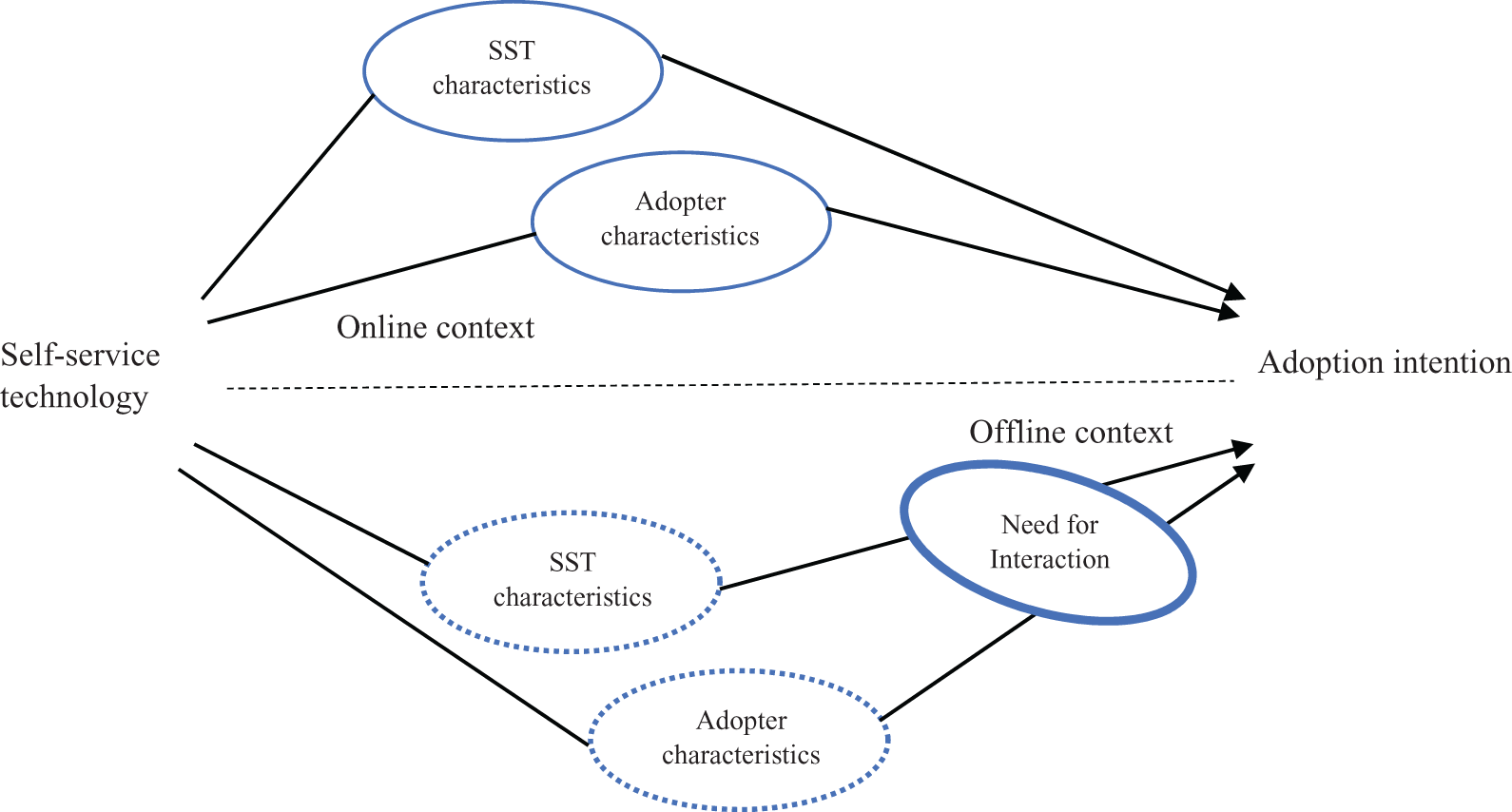
Theoretical conceptualization.
Past research also showed that the acceptance of new technology is not always possible, as several external factors (subjective norms, image, job relevance, output quality and result demonstrability) may disrupt the process (Beatson et al., 2007; Venkatesh and Davis, 2000). A firm’s fear of losing crucial interaction between customers and employees might also affect service recovery efforts, relationships with customers and employee perceptions of using SSTs as the primary service delivery options (Beatson et al., 2007). Thus, the problem is not only with choosing appropriate service delivery options (SSTs vs. employees) but also maintaining the balance between them. Even though past research measured customers’ attitudes to determine their influence on adoption intentions towards SSTs (Curran and Meuter, 2005; Dabholkar, 2000), NI as a crucial variable was not studied widely. Given this shortcoming, service providers in the hotel industry need to determine the level at which the two service delivery options – SSTs and employees – affect tourist adoption behaviour. Unlike other studies in this domain, this study is conducted in an offline service context, where both these options are available. This study also explored the conditions under which tourists visiting and staying in hotels adopt or reject various SST-enabled services.
This study sheds light on how tourists’ fundamental need of interacting with service employees during offline service delivery process influences their perceptions and decisions regarding SST adoption. Figure 1 illustrates how this study differs from previous research by showing the need for an additional construct (NI) that might not be essential in an online context. However, e-services offered by some websites like online chats and information providing assistance, to form ‘trusting beliefs’ (Agag and El-Masry, 2017; Loo and Leung, 2016) are beyond the scope of the present study. This study focuses on face-to-face interaction with employees during service delivery process in an offline context. Even studies that have focused on offline SST adoption have ignored this construct. Contributing to extant literature, this study suggests that innovation characteristic (PU) and the adopter characteristic (NI) are crucial mediating factors. Thus, this study examines how these two variables (PU and NI) mediate the effect of PEOU, perceived trust and perceived performance risk on SSTs and employee-based service adoption.
Theoretical background
Intrinsic desires
Deci and Ryan (1985) explained the reasons behind tourists’ actions through self-determination theory of motivation (intrinsic and extrinsic motivations). Ryan and Deci (2000: 56) define intrinsic motivation as ‘the doing of an activity for its inherent satisfactions rather than for some separable consequence’. Thus, intrinsic motivation refers to doing something because it is inherently interesting or enjoyable rather than due to any external pressure or reward. More than three decades of academic research has revealed that the quality of an individual’s experience and performance may differ with the motivations (intrinsic or extrinsic) behind one’s behaviour.
In more recent studies, various intrinsic reasons affecting consumer innovativeness (propensity to adopt innovations) have been identified (Kaushik and Rahman, 2014). For instance, service employees start using new technology once they perceive it as enjoyable (Dabholkar, 1996), and/or playful (Moon and Kim, 2001), mainly in the case of web-based technologies. Fun is another intrinsic motivation found in adoption-related literature (Chang and Yang, 2008; Dabholkar and Bagozzi, 2002). Although intrinsic motivation exists within an individual, it has a strong relationship with the individual’s activities.
Extrinsic desires
Extrinsic motivation refers to ‘doing something because it leads to a separable outcome’ (Ryan and Deci, 2000: 60). Theory of extrinsic motivation provides an effective background to understanding technology adoption research (Davis et al., 1989; Meuter et al., 2005). The theory proposes that individuals usually try to accomplish certain tasks due to some benefits they are looking for or any risk they need to keep away from. Thus, extrinsic motivation may be defined as ‘the motivation to perform an activity because it is perceived to produce valued outcomes that are distinct from the activity itself’ (Webster and Martocchio, 1992). The researchers, during the literature review, found that extrinsic motivation is typically considered an impoverished form of motivation in explaining SST adoption, compared to intrinsic motivation. Among numerous forms of extrinsic motivation suggested by self-determination theory, few denote impoverished forms of motivation, while others represent active forms.
Early service delivery is a common extrinsic motivator leading an individual to select and adopt SSTs instead of human interaction–based services (Dabholkar, 1996; Meuter et al., 2003). Other examples include individual self-esteem (Standing et al., 2008), user satisfaction with successful transactions (Chang and Yang, 2008) and wide acceptance of SSTs by society (Curran et al., 2003). In the context of tourism industry, Riebeck et al. (2008) measured user adoption of e-guides for tourists on the basis of two crucial dimensions – social habit and practical acceptability.
While choosing between SSTs and services delivered through employees, customers are generally influenced by the strength of the motivation (extrinsic or intrinsic). For instance, speedy check-in and/or checkout service in a hotel is typically perceived as high quality (Oh and Parks, 1997). Tourists who are offered these services with options (either through a kiosk or the traditional way – with the help of employees) may choose either one of the two. Actually, their selection might be based on their intrinsic or extrinsic desires. Sometimes, hotel check-in and checkout kiosks might not provide tourists the ideal opportunity to fulfil their technology-related intrinsic needs like enjoyableness, playfulness and fun. Alternatively, selecting traditional way of services presents a chance to interact with service employees. Thus, tourists selecting a kiosk might be more interested in fulfilling extrinsic desires, for example, avoiding delayed services. However, those preferring a front office desk might be fulfilling their intrinsic need of interacting with service employees. Thus, the mode through which tourists seek to fulfil their extrinsic or intrinsic desires through their selection of service delivery options (SSTs or service employees) requires further investigation.
NI was viewed in previous adoption studies either as a direct measure of adopter’s attitude (Dabholkar, 1996; Kaushik and Rahman, 2015a, 2015b) or as a moderating variable between external variables (e.g. service quality) and SST adoption (Meuter et al., 2005). However, this study proposes and validates a conceptual model (refer to Figure 1) considering NI as crucial mediating variable to examine tourists SST adoption behaviour.
Hypotheses and model development
The model proposed in the present study is depicted in Figure 2. The model illustrates a state wherein both service delivery options (SSTs and employees) are available and service delivery by SSTs requires some tourist involvement. Following Meuter et al. (2005), both intrinsic and extrinsic motivators are direct measures of SST adoption; therefore, the present research explores the basic technology acceptance model (TAM) by including additional intrinsic and extrinsic desires related with the selection of SSTs and employee-based services by tourists in the offline hospitality context. In this model, PU mediates the effect of all motivators on tourists’ behavioural intentions to adopt or use SST-based services. NI serves as a crucial mediating variable between the different motivators and PU. At the same time, NI mediates between the same set of motivators and adoption intention. In the extended TAM in this study, two other variables relating to consumers’ privacy and security (perceived trust and perceived performance risk) have been included as measures of PU. Majority of people are concerned about their security when using SSTs, primarily when they need to provide personal information (Kaushik and Rahman, 2015b). All hypothesized relationships and their directions are shown in Figure 2.

Proposed conceptual model.
The basic TAM (Davis, 1989) evolved from the fundamental construct of Fishbein and Ajzen’s (1975) Theory of Reasoned Action. Ajzen’s (2002) attitude theory defines behavioural intention as one’s readiness to adopt or use an SST. Behavioural intention towards SSTs is described as the possibility to adopt or use an SST over employee-based service delivery options. PEOU and PU – the two central constructs of TAM – have been extensively researched (Morosan, 2012; Zhu et al., 2012) and it has been found that PU directly affects consumer intention towards SST adoption (Lu et al., 2009). Thus, PU is more important in shaping adoption intention towards SST adoption as compared to service employees (Meuter et al., 2003). If a given SST is perceived useless by customers, they will start searching for alternative ways of service delivery. Here, the researchers assume that PU of SSTs improves the chances of SST adoption even if employee-based service delivery option is available. To examine this assumption statistically, the study proposes the following null hypothesis, assuming that the relationship between these two (PU and adoption intention) is not statistically significant:
The NI between service providers and consumers is important for providing quality services (Seth et al., 2005). Generally, reciprocal interactions promote interpersonal relations between service employees and customers (Kaushik and Rahman, 2015a), leading to valued experiences in the process of delivery of services (Bitner et al., 1994). Tourists repeatedly seek to maximize these experiences. Such interactions are significantly important for providing tourists deeper insights into the mechanisms of delivery of service through SSTs, at least initially (Seth et al., 2005). During SST usage, however, interpersonal relationships and interactions are not present and tourists might overlook the usefulness of SSTs, perceiving overall service quality differently.
Relationship building is more valuable to consumers consuming employee-based services as compared to those consuming SST-based services (Dabholkar, 2000). Several customers assess SSTs based on the interactions they have with employees. Therefore, interaction should be instilled in the service transaction process (Cunningham et al., 2009). Past studies have established both direct and indirect effects of NI on behavioural intention towards SST adoption (Dabholkar, 1996; Meuter et al., 2005). One customer base might choose SST adoptions over interaction with service personnel to exhibit their independence (Meuter et al., 2000; Ojiako, 2012). On the other hand, customers seeking interactive relationships are likely to ignore SST use (Forman and Sriram, 1991). The discussion above allows us to say that greater desire for interaction and interpersonal relationships results in decreased user intention to adopt SSTs. Thus, it is hypothesized:
According to Davis (1989), PU may be defined as ‘the degree to which a person (tourist) believes that using a particular system (SST) would enhance his or her job performance (service transaction)’. As discussed earlier, for customers with two distinct service delivery options – SSTs and employees – motivating variables (either intrinsic or extrinsic motivators) significantly affects consumer choice of any one kind of option. Once they finalized one service delivery option, they apply additional mental efforts to defend their selection and may even start criticizing the other rejected option to get out of possible internal conflict. In such a situation, motivations behind adopting SSTs or employee-based services possibly counteract each other. The researchers propose:
Davis (1989: 320) defines PEOU as ‘the degree to which a person believes that using a particular system would be free from effort’. The basic TAM also identifies PEOU as an important antecedent of PU, and many related studies (for example, Lu et al., 2009) confirm that PEOU significantly measures PU. Like other SST users, tourists may also not perceive SSTs easy to use if they do not find the said SSTs useful. It is thus posited:
Trust refers to a group of beliefs held by a person derived from his or her perceptions of certain attributes and is considered a crucial antecedent of PU (Pavlou, 2003; Sun and Han, 2002). Security and privacy are top priority issues in transaction services such as banking and insurance. Surveys show that 59–68% of tourists prefer SSKs in order to secure themselves (Hospitality Technology, 2009). Trust-related issues such as data security and privacy become more crucial when technology gets involved in financial transactions (Phelps et al., 2001). In fact, consumer online purchase behaviour associates adversely with customer trust in an online medium (Phelps et al., 2001). Sometimes, consumers need to provide some personal information before adopting and using any transaction service. In such situations, trust is required to ensure that such information will not be misused by anyone else. Therefore, service providers must handle data security and privacy issues carefully. On the basis of the discussion above, the following null hypothesis is presented:
Perceived performance risk is another antecedent belief used to predict consumers’ perception towards SSTs. Perceived performance risk has been researched extensively and found negatively associated with attitudes of potential adopters (Dabholkar, 1996; Meuter and Bitner, 1998). Past research has mainly emphasized customers’ attitudes towards SST adoption while overlooking their attitudes towards crucial changes in the service delivery system brought about by their involvement in co-production of services (Meuter et al., 2005). Despite the several benefits, SSTs provide to service providers and their firms, SST adoption necessitates crucial changes in how customers perceive and perform certain tasks while using SSTs (Ellen et al., 1991). Users with high-performance risk might perceive a specific SST as not useful and/or difficult to use. A strong reason behind this might be the lack of interaction with and instructions from service employees. In many studies on technological frameworks, the concept of risk is discussed in relation with reliability (Dabholkar, 1996), accuracy and recovery (Meuter and Bitner, 1998). The primary objective is to analyse the effect, if any, of perceived performance risk on PU, which in turn affects consumers’ adoption decision towards SSTs, is negated in the offline hospitality context (Eastlick et al., 2012). Therefore, the present study proposes the following:
The NI has been conceptualized as a key countervailing mediator between PU and motivators and also between adoption intention and motivators. Thus, if motivating variables display a positive association with behavioural intention through PU, the same variables may exhibit a negative link with behavioural intention through NI with employees. To illustrate, if tourists perceive a particular SST as easy to use, it may result in increased SST adoption with decreased NI with employees. In the same way, high trust in SSTs may dissuade them from choosing alternative service delivery options such as services through employees. On the other hand, tourists who perceive high-performance risks with SSTs and believe that employees deliver superior services, thereby maximizing user satisfaction, may choose service employees instead of SSTs. The researchers thus propose the following null hypotheses:
Methodology
Tourists in renowned spots in North India, including Rishikesh and Haridwar (Uttarakhand), Shimla (Himachal Pradesh), Mohali (Punjab) and Chandigarh, were chosen for the study for the following reasons: ‘India Tourism Statistics 2014’ suggests (i) consistent growth in the tourism industry; (ii) hotels invest significantly to improve quality of services where tourists have other service delivery alternatives (SSTs vs. employees); and (iii) even when new SSTs are regularly introduced, the industry provides conventional service delivery in the form of both SSTs and employee-based service delivery options.
Preliminary studies
To get a clear understanding of the target population, the study followed a statistical report ‘India Tourism Statistics’, published in 2014. The report mentioned the number of tourists, both foreign and domestic, who toured main tourist spots in India during 1998–2014. According to the report, foreign tourists stood at 7.68 million in 2014 against 6.97 million in 2013, for a growth rate of 10.2%, while domestic tourists stood at 1281.95 million in 2014, against 1145.28 million in 2013, for a growth rate of 11.9%. Based on the statistics mentioned above, the present study selected hotels situated at several renowned spots in North India (Rishikesh, Haridwar, Shimla, Mohali and Chandigarh) with relatively higher tourist density. Permission of hotel owners and caretakers was sought for conducting the field survey. Participants were given surprise gifts (e.g. INR 20–50 mobile/data recharge coupons) for their voluntary participation.
Further, those tourists whose contact information was publicly available were contacted over the telephone. Thus, several public transport service providers and hotel staff members were contacted. Tourists were initially called to determine their willingness to participate in the online survey. After consent was received, the survey instruments were mailed. This course of action was followed to inexpensively reach a greater number of respondents and get a broader range of responses (Cook et al., 2000).
Measurement scales
A self-administrated questionnaire was distributed in over a hundred hotels of different grades and sizes located in North India. An initial section of the instrument sought socio-demographic information of tourists such as yearly travel frequency and experience with SSTs in hotels frequented. The following section included 21 questions based on numerous items measuring tourist perspective on adoption of SSTs in hotels. Measures of PU and PEOU were adopted based on basic TAM research carried out by Davis (1989). Items for added variables were also instituted. All items were assessed on a seven-point Likert-type scale ranging from strongly disagree (1) to strongly agree (7). The third and final section of the research instrument asked for basic demographic information pertaining to tourists (income, education, age, etc.).
Research design
The study included two types of accommodation (hotel vs. resort), three separate queue lengths at the front office with employee-based service option (small vs. average vs. large) and three classes of accommodation (three star vs. four star vs. five star). The three manipulated variables could influence tourists’ choice of service delivery option (SSTs vs. employee). Manipulation check may result in increased overall generalizability of findings across separate check-in conditions at various hotels and/or resorts. It has generally noted that in tourism research, both online surveys and paper-based field surveys contain bias (Dolnicar et al., 2009). Thus, both online and offline mediums were used in the present study. This allowed participants to select the medium they preferred. While approaching participants online, necessary information like title of study, name(s) of investigator(s) along with their affiliation and contact information, objective of the study, directions to fill questionnaires (with expected time to complete filling of questionnaire), rights of respondents and word of confidentiality and an online survey link was provided. For offline survey, some respondents were also contacted over the telephone to get their approval for the survey.
Currently, the multimode survey approach is regarded very reliable in tourism research (Dolnicar et al., 2009). This study employs multistage sampling. In the first stage, a number of research sites like hotels and resorts were chosen based on high tourist footfalls and convenient location. In second stage, respondents were randomly selected within these chosen locations. Two thousand seven hundred eighty e-mail invitations were sent initially and 407 usable responses were received. A significant number of e-mails (n = 178, approximately 6.4%) sent remained undelivered because of incorrect email addresses and people’s tendency to change e-mail addresses frequently. The online survey yielded a response rate of 14.6%, which was lower than the response rate (18.7%) found earlier in similar context (Kaushik and Rahman, 2015b). It should be noted that email-based studies on tourism industry have received a response rate ranged between 12% and 19% in long term (Qian and Schneider, 2016). Therefore, response rate in the present study should be considered acceptable. However, there may be non-response bias in the data and this may limit the extent to which the findings can be generalized. The field survey resulted in 245 responses gathered from different sites. Both online and offline responses accounted for a total of 648 usable responses after the exclusion of four questionnaires that were incomplete. All responses were gathered from September 2015 to December 2015.
Findings
Profile of respondents
Table 1 depicts the numerous characteristics of surveyed respondents. Of 648 respondents, 356 (55%) were male and 292 were female (45%). Female respondents were younger (average age – 24.5 years) than male participants (average age – 27.4 years). Three hundred thirty-eight (52.16%) were domestic tourists, while rest 310 (47.84%) were foreign visitors. A significant majority (72.5 %) of the respondents were either bachelors or postgraduates from a recognized college/university. The researchers found quite similar proportions of service and business class respondents, with a household income over INR 500,000 (65.86%) per annum. Respondents’ socio-demographic profile revealed that a majority (51.7%) toured over five times (both domestic and foreign tour) and about 33% travelled 4–5 times in a financial year. About 52% of respondents generally made hotel reservations online, either directly through a hotel website or indirectly through third-party websites.
Descriptive statistics of respondents’ characteristics.
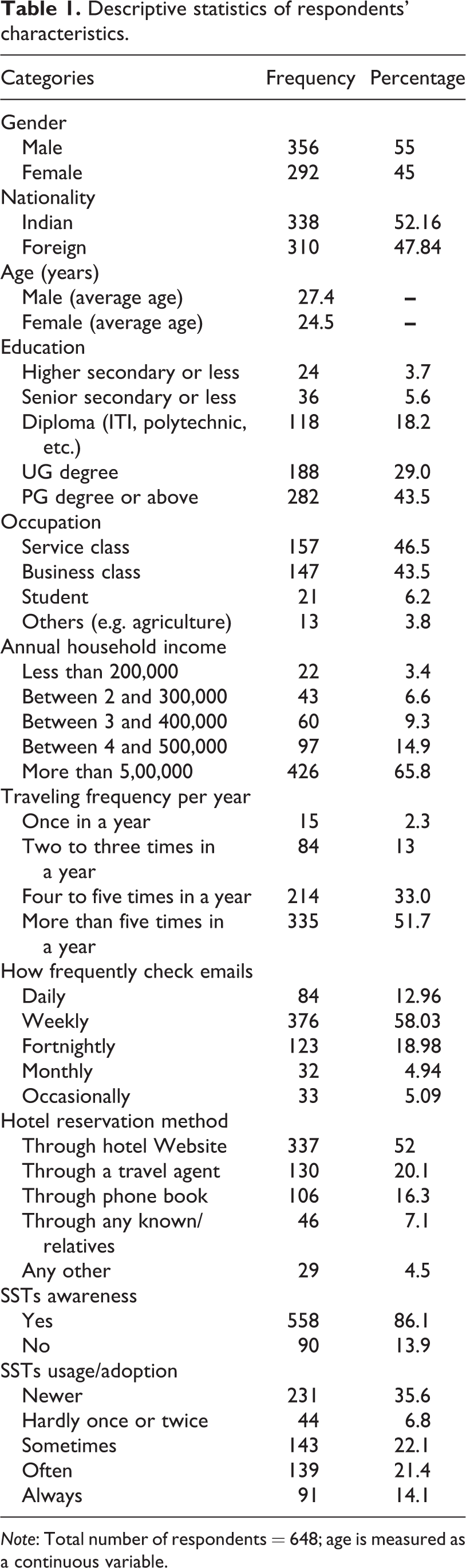
Note: Total number of respondents = 648; age is measured as a continuous variable.
In this study, two categories of respondents were considered as SST-aware: (i) those who knew about the various SSTs available in different hotels (86.1%) and (ii) those who had used them at least once (64.4%). It was thus discovered that most tourists had adopted SSTs occasionally. About 86.45% (n = 268) of total foreign tourists were found familiar with SSTs, which is more than the sampled domestic tourists. This may be because foreign tourists have used numerous SSTs for comparatively long time and are more frequent travellers than domestic ones. Interestingly, majority of sample respondents were young and highly educated; therefore, higher SST awareness and usage is along the line established in previous research also (Goldsmith et al., 2003, 2005; Kaushik and Rahman, 2014). It was observed that nearly 58% respondents check their emails weekly, followed by those checked fortnightly (18.98%), daily (12.96%), occasionally (5.09%) and monthly (4.94%). The purpose of recording this was to assess their level of comfort with using technology, assuming more tech-savvy people would prefer SSTs over employees as service delivery option.
The primary purpose of this study was to validate the proposed conceptual model (refer to Figure 1) based on primary responses collected from both domestic and foreign tourists visiting North India, also increasing generalizability of our findings. The study did not consider the role of cognitive dissonance that is mandated due to the difference in tourist demographics (e.g. age, nationality, ethnicity), and certainly different levels of service interactions. This aspect, however important, was not within the scope of this study. Certainly, it can be an important avenue for future studies.
Manipulation checks
As both accommodation type and accommodation category were categorical variables, manipulation checks were not necessary. The research instrument included one question to know respondents’ perception about length of queues (at front office) on a seven-point Likert-type scale (where, 1 – very short and 7 – very long). One-way analysis of variance established that all three lengths of queue were perceived significantly different by the tourist sample (mean value, m = 3.14, 4.09 and 5.82, respectively; F 2;335 = 138.273, p < 0.001); post hoc analysis for these three pair differences showed variances in tourists’ perception regarding the length of each queue.
Main effects
Data analysis was performed through multivariate analysis of variance via statistical package for the social sciences (SPSS) 20.0. The Cronbach’s α coefficient confirms internal consistency of scale items. All the values of item-to-total correlations exceeded 0.50 and Cronbach’s α values ranged from 0.81 to 0.91, more than the minimum threshold value of 0.70 (Churchill, 1979). Findings revealed that type of accommodation (hotel vs. resort) and star category of accommodation (three star vs. four star vs. five star) did not significantly affect the variables considered (Wilks’ λs > 0.87; p > 0.05). On the other hand, perceived performance risk was discovered to be significantly convincing for three-star accommodation (m = 3.88) as compared to five-star accommodation (m = 3.76; Wilks’ λ = 0.98, F = 13.73, p < 0.001).
Length of queues displayed significant differences among several variables of the model proposed. First, waiting line length was positively linked with tourist intention to adopt SSTs (Wilks’ λ = 0.97, F = 23.4, p < 0.05). The average strength of adoption intention was about 3.43 for small, 4.23 for average and 5.37 for large queues. Both PEOU and PU were statistically distinct for small (m = 3.17 and 3.28; Wilks’ λs = 0.93, F = 4.78, p < 0.05) and average queues (m = 4.15 and 4.18; Wilks’ λs = 0.95, F = 6.13, p < 0.05). Length of average line was essentially similar to length of large waiting line, as both PEOU and PU displayed nearly equal mean values (m = 3.46 and 3.48, respectively). Length of queue, however, did not influence perceived trust, as the strength was about 4.47 for small lines, 4.53 for average lines and 4.43 for large lines (Wilks’ λ = 0.96, F = 2.76, p < 0.05).
Perceived performance risk displayed a strength of 3.23 for small line, 3.59 for average line and 3.68 for large line (Wilks’ λ = 0.98, F = 8.97, p < 0.05). Queue was found to be negatively linked with NI with strengths of 3.26, 3.82 and 3.43, respectively (Wilks’ λ = 0.98, F = 13.98, p < 0.05). This disagrees with tourists’ behavioural intention towards adoption. The outcomes mentioned above necessitate further validation of the model proposed, especially in terms of people having distinct experiences with queues in distinct offline service contexts.
Measurement model
To assess and validate the scale in the present context, various estimates for construct validity, composite reliability and average variance extracted (AVE) were determined. As reported in Table 2, all reliability indices were found to be greater than the threshold limit of 0.70 (Bagozzi, 1980) and all AVE scores higher than the cut-off value of 0.50. The findings establish the internal consistency of all existing measures adopted for this study. Further, all standardized factor loadings for all sets of indicators in the measurement model were significant at 0.05 level (Gefen et al., 2000). Thus, the measurement model shows a good fit and good-fitting measurement model necessary before interpreting causal paths of the structural model (Kenny and McCoach, 2003). On the whole, the scale used in the extended model appears valid and reliable.
The results of the measurement model.
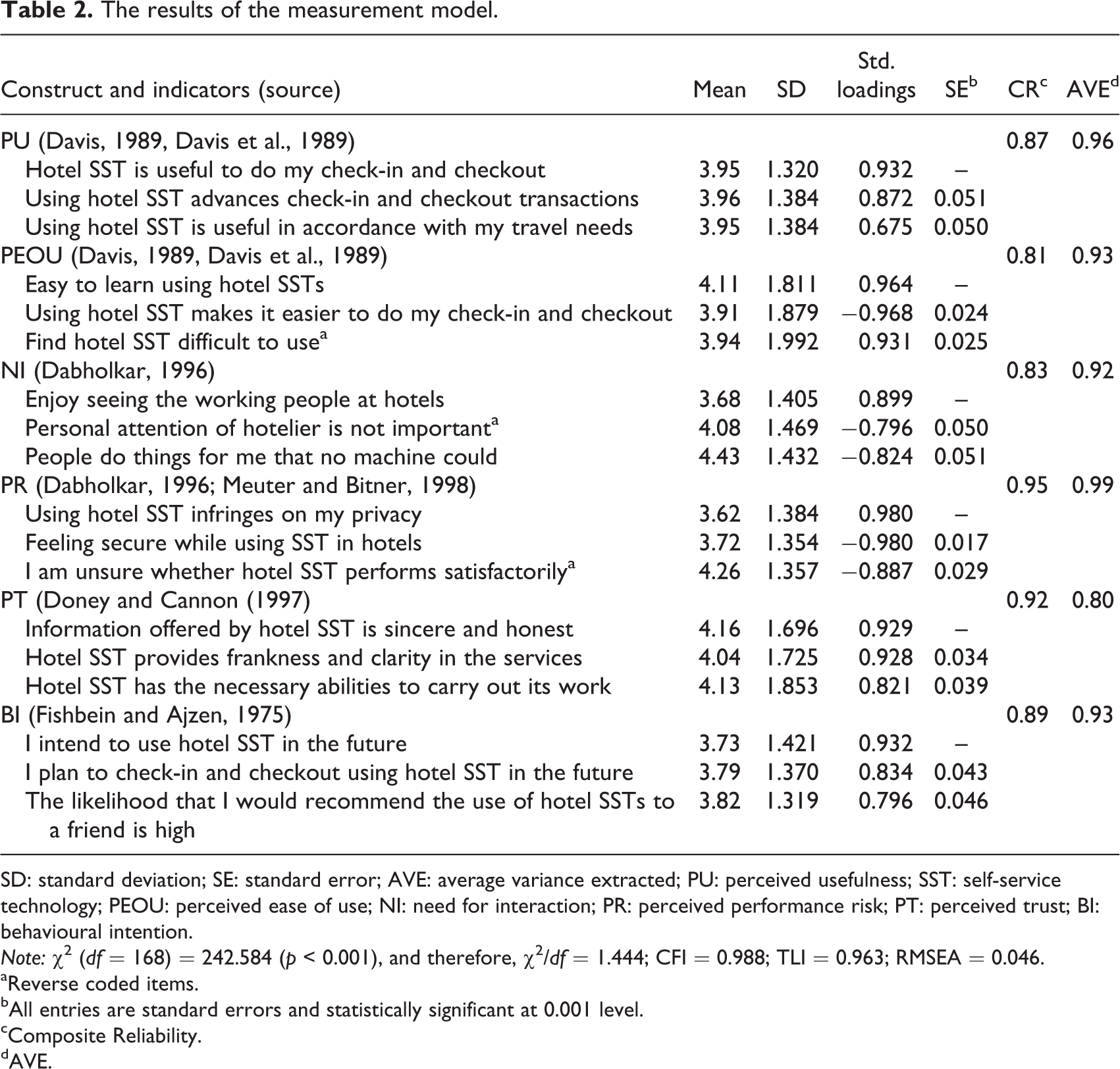
SD: standard deviation; SE: standard error; AVE: average variance extracted; PU: perceived usefulness; SST: self-service technology; PEOU: perceived ease of use; NI: need for interaction; PR: perceived performance risk; PT: perceived trust; BI: behavioural intention.
Note: χ 2 (df = 168) = 242.584 (p < 0.001), and therefore, χ 2/df = 1.444; CFI = 0.988; TLI = 0.963; RMSEA = 0.046.
aReverse coded items.
bAll entries are standard errors and statistically significant at 0.001 level.
cComposite Reliability.
dAVE.
To assess overall factor structure, confirmatory factor analysis was successfully applied. Results showed a good model fit with a significant χ 2 168 = 242.584 (p < 0.001), CFI = 0.988, Tucker Lewis Index (TLI) = 0.963 and Root Mean Square Error of Approximation (RMSEA) = 0.046. Past studies suggested that ‘a value of the RMSEA of about 0.05 or less would indicate a close fit of the model in relation to the degrees of freedom’ and that ‘the value of about .08 or less for the RMSEA would indicate a reasonable error of approximation and would not want to employ a model with a RMSEA greater than 0.1’ (Browne and Cudeck, 2008: 144). It is noteworthy that these studies state that such cut-off points are just subjective measures which may differ with research problems. Other indices such as goodness of fit index (GFI) = 0.934, AGFI = 0.910 and NFI = 0.963 were found to be greater than 0.9, showing a good fit.
Structural model and multi-group validation
The conceptual model resulted in a good model fit with χ 2 179 = 365.883, CFI = 0.970, TLI = 0.965 and RMSEA = 0.056. It accounted for almost 63% of the total variance in behavioural intention to adopt SSTs, 84% in PU and 29% in NI. Table 3 shows that majority of the proposed null hypotheses concerning distinct constructs considered were rejected, resulting in significant effect of independent variables on dependent variable. First, PU showed significantly strong (0.67) influence on tourists’ behavioural intention towards SST adoption, thereby supporting hypothesis 1. Therefore, alternative hypothesis could be accepted. NI exhibited a negatively significant influence on behavioural intention (−0.23), supporting hypothesis 2. The proposed association between NI and PU was revealed to be negative and significant (−0.12), endorsing hypothesis 3.
Structural model estimates.
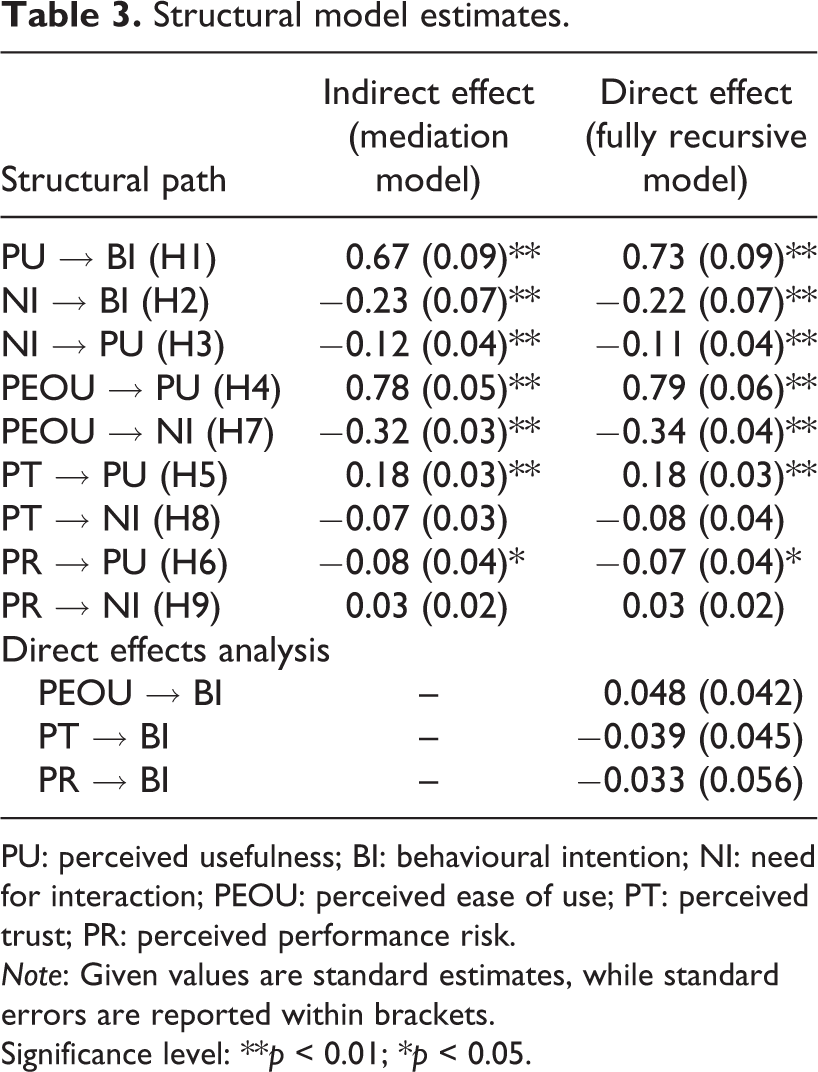
PU: perceived usefulness; BI: behavioural intention; NI: need for interaction; PEOU: perceived ease of use; PT: perceived trust; PR: perceived performance risk.
Note: Given values are standard estimates, while standard errors are reported within brackets.
Significance level: **p < 0.01; *p < 0.05.
Hypothesis 4 was supported, as the link between PEOU and PU was positive and statistically significant (0.78). This was also in agreement with basic TAM. PEOU also exhibited a negatively significant relationship with NI (−0.32), supporting hypothesis 7. Hypothesis 5 was supported, as tourists’ perceived trust had a positive significant influence (0.18) on PU of SSTs. However, its influence on NI did not show any empirical support (−0.07), rejecting hypothesis 8, showing the lack of influence of perceived trust on NI with employees in views of current sample population. The influence of perceived performance risk on PU (−0.08) was negative and significant, supporting hypothesis 6, but the effect of perceived performance risk on NI was not found significant (0.03). Thus, the researchers again failed to reject null hypothesis 9.
Following Cook et al. (2000), validation of the proposed structural model (in Figure 2) was conducted by applying a multi-group analysis on the basis of all three manipulated variables considered in the present study. A two-group analysis for the two types of accommodation (hotel vs. resort) samples showed a good model fit (χ 2 356 = 935.388, CFI = 0.911, TLI = 0.915, RMSEA = 0.058). Of 22 structural parameters, just 2 (nearly 9%) exhibited a distinctive value but in identical direction in sample data collected from resorts. The conceptual model again appears sound (χ 2 378 = 956.845, CFI = 0.935, TLI = 0.923, RMSEA = 0.049) across the 3 sample groups of distinct lengths of waiting lines (small vs. average vs. large) with 3 of the 33 structural parameters (nearly 10%) resulting in distinct values, albeit again in a similar direction.
The structural model also provides a good model fit (χ 2 534 = 1153.245, CFI = 0.924, TLI = 0.907, RMSEA = 0.059) across the three levels of accommodation (three star vs. four star vs. five star); 17 of the total 55 structural parameters (21%) provide distinctive but unidirectional values. A random split-half analysis resulted in a good model fit, where χ 2 178 = 475.323, CFI = 0.957, TLI = 0.931 and RMSEA = 0.054 in the case of the initial group, while χ 2 178 = 472.281, CFI = 0.961, TLI = 0.948 and RMSEA = 0.053 in the case of another group. Essentially, a minor section of the structural parameters showed more or less unsystematic instability, yet the structural model appears sound.
PU and NI as mediating variables
To determine the mediating roles of PU and NI in an offline service context, the direct influence of all four exogenous variables on tourists’ behavioural intention towards SST adoption was measured and reported in Table 3. It was found that no direct influence of any variable was sufficiently significant; the indirect influence of every exogenous variable on behavioural intention was assessed as shown in Figure 3. Table 4 shows that of the total indirect effects of PEOU on tourists’ behavioural intention towards adoption, 92% were mediated through PU, 4.7% through NI and the combination of these two (PU and NI) mediated only 2.3% of the total indirect effects. Much the same way, most of perceived trust (71.3%) and perceived performance risk (53%) on tourists’ behavioural intention towards adoption was mediated through PU only. PU and NI mediated almost a third of the total effect (31.2%). NI mediated only about 38% of behavioural intention to adopt SSTs.
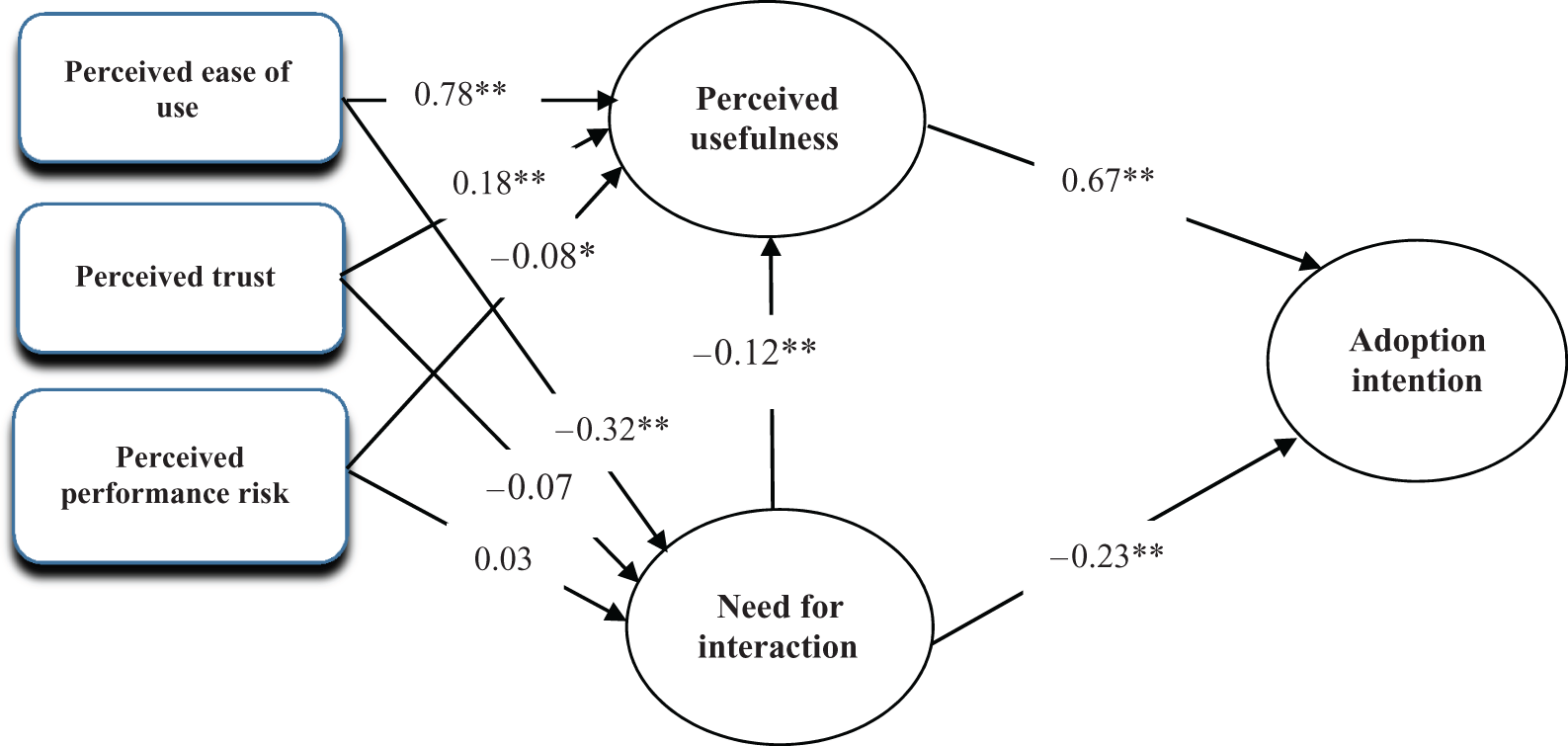
Model with path estimates.
Decomposition of indirect effects of motivating variables on tourist’s BI towards SSTs adoption.
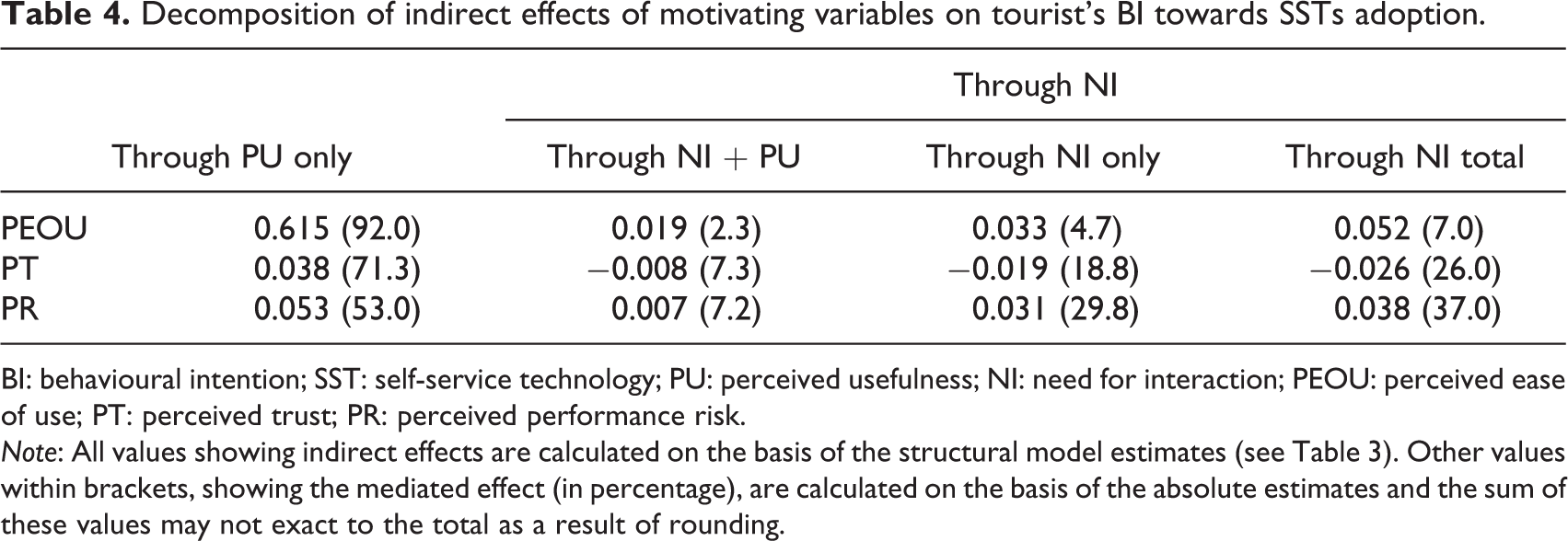
BI: behavioural intention; SST: self-service technology; PU: perceived usefulness; NI: need for interaction; PEOU: perceived ease of use; PT: perceived trust; PR: perceived performance risk.
Note: All values showing indirect effects are calculated on the basis of the structural model estimates (see Table 3). Other values within brackets, showing the mediated effect (in percentage), are calculated on the basis of the absolute estimates and the sum of these values may not exact to the total as a result of rounding.
Discussion
Theoretical implications
The present study carries both managerial and theoretical implications. It expands TAM with some added external measures to assess tourists’ adoption behaviour towards SSTs in an offline hotel context, thereby contributing to adoption theory. The results of the study support the conceptual adoption model for both SST and employee service delivery options. The proposed model attends to key concerns associated with customer adoption behaviour in an offline context. The model conceives PU and NI as two important mediating variables and appears robust, as corroborated by the trustworthiness of the measurement model, good model fits and results suggesting PU and NI constructs as significant mediators. Thus, both these variables (NI and PU) play significant roles in trial and adoption stages of innovation adoption model, respectively. For instance, NI with employees would influence whether someone tries SSTs or not. PU of SSTs would influence its adoption in case of actual adoption.
Review of literature revealed that most studies conceptualized NI as an independent variable that predicted behavioural intention towards SST adoption, SST trial or customers’ attitude towards SSTs adoption (Curran and Meuter, 2005; Kaushik and Rahman, 2015b). The present study conceptualizes NI as intrinsic need, affected by some additional innate desires like perceived trust and perceived performance risk. The need remains for additional descriptive and empirical research to augment the relevance of adoption theories, particularly in service contexts such as hospitality, banking and airline services.
Implications for industry
Today, people have become more reliant on tech-based services and have generally adopted such service delivery options in different offline service contexts such as SSKs in banking and retail services (Kaushik and Rahman, 2015b). The conceptual model indicates that tourists feel the NI with employees, especially when they get a choice in service delivery options (SSTs vs. employees). NI with service employees has thus emerged as a key construct influencing tourists’ adaption intention towards SSTs in context of the hotel industry. These emotional needs have not been taken into consideration in basic TAM, which emphasize innovation characteristics such as PU and PEOU of the system. It is important that service providers acknowledge the significance of NI as a construct. It is noteworthy that the need for interacting with service employees may differ because of situational factors such as transaction situation, mode of delivering services, type of service required and so on. Customer–employee interaction is also vital to gain customers loyalty, and service providers would do well to build such interaction processes.
Results imply that SST designers should take into consideration certain non-technical concerns and motivations (perceived trust and perceived performance risk) when designing an SST. The proposed model suggest that such non-technical concerns and motivations might offset SST deployment. The aforementioned concerns may also establish the extent of tourists’ adaptability towards self-service hotel technologies (SSHTs) by assessing their usage/adoption behaviour towards other SSTs. Several SSTs have been commonly adopted in various service industries, such as automatic teller machines (ATMs) in banking services (Curran and Meuter, 2005) and airline check-ins (Wang et al., 2014). An examination of the issues stated above might help managers understand how motivating variables differ with SSTs.
Policy and strategy makers may recognize a few pre-adoption avoidance practices of tourists when they are given choice of SST adoption. Some such practices are (i) ignorance – tourists ignore information/instructions regarding SST use; (ii) diffuse – tourists apparently reject SST use and (iii) delay – tourists postpone SST use. To encounter such customer practices, service firms may employ the following pre-adoption confrontative strategies: (i) pretest – giving tourists a chance to test the SST before offering employee services; (ii) heuristics – giving tourists a chance to learn SST use; and (iii) extended decision making – demonstrating several uses of a given SST.
The process of selecting between two service delivery options (SSTs and employees) does not apply only to initial stages of adoption. Tourists may choose not to adopt the delivery option even after having used the option initially. The following are several consumption avoidance practices among tourists: (i) neglect – tourists neglect SST use either because of a bad initial experience or less than satisfactory performance of the SST; (ii) abandonment – tourists completely abandon or stop SST use, even with knowledge of how to use it; and (iii) distancing – tourists maintain physical distance from a given SST. To overcome such avoidance practices, the following confrontative approaches could be used: (i) accommodation – giving tourists information on various SST applications; (ii) partnering – developing personal relationships with users by offering SST interfaces that are user-friendly; and (iii) mastering – giving opportunities to learn so as to augment users’ knowledge of a given SST.
Further research directions
Future research may overcome the limitations of the present study. First, the lower online response rate (14.64%) may be examined, as those who failed to participate in the survey may hold perceptions different than those who participated. Second, the study focused on both foreign and domestic tourists, assuming that they had experience with similar service delivery options (SSTs and employees). This extends the generalizability of results but also offers an opportunity to observe specific type of tourists with similar SST usage in the past.
Third, this study analyses tourists’ adoption behaviour towards SSHTs with respect to two different varieties of hotels (hotel and resort) offering two distinct service delivery options (SSTs and employees), thus, findings might not apply to other service settings, particularly where either one of the delivery options is absent. Also, the extent of perceived trust, performance risk and interaction possibly varies with different services, warranting differing levels of employee involvement in the process of service delivery.
Fourth, the conceptual model (in Figure 2) proposed in this study provides important information on several considered customer-related and innovation-related variables signifying innovation acceptance as well as ignorance. The model requires improvement, as it does not include generic transaction goals such as customer satisfaction. Incorporating the customer satisfaction variable may yield more information on consumers’ adoption behaviour and reveal the reasons behind their preference of SSTs over employees.
At the end, the predictive ability of proposed conceptual model may also be augmented, mainly for NI variable. Comparable with existing models developed and validated in various service contexts, the model proposed in this study predicts tourists’ behavioural intention to adopt SSHTs more comprehensively as the study has R 2 = 0.63 that is comparatively greater than 0.49 for the first model (SST1 = ATM), 0.19 for the second model (SST2 = phone banking) and 0.39 for the third model (SST3 = SSKs), as established in a study by Kaushik and Rahman (2015b). As the conceptual model explains 29% of the variance in NI only, the addition of appropriate antecedents in future studies may increase the significance of the construct.
Footnotes
Declaration of conflicting interests
The author(s) declared no potential conflicts of interest with respect to the research, authorship, and/or publication of this article.
Funding
The author(s) received no financial support for the research, authorship, and/or publication of this article.