







Abstract
This study surveyed 185 parents to determine whether their perceived risk of their child developing obesity and their implicit theories about the malleability of weight independently and/or interactively predict their child-feeding and pursuit of child-related obesity risk information. Higher risk perceptions were associated with healthier feeding intentions and more information seeking. More incremental (malleable) beliefs predicted healthier feeding intentions and greater pursuit of environmental, but not genetic, information. Contrary to hypotheses, the influence of implicit theories and risk perceptions were primarily independent; however, more incremental beliefs predicted less “junk food” feeding among only parents with lower perceived risk.
Introduction
An estimated 57% of children in the US today will have obesity by the time they are 35, and roughly half of these cases will emerge during childhood (Ward et al., 2017). Parents play a major role in preventing obesity in their children, as they are responsible for selecting much of the child’s diet (Moore et al., 2016; Spill et al., 2019). Parents’ feeding behavior is influenced by a wide array of factors both in and out of the caregiver’s control, from socio-structural barriers such as lack of financial resources, to modifiable, individual-level cognitions. Here, we focus on the latter, investigating how parents’ preexisting perceptions of their child’s risk for obesity and their beliefs about the malleability of body weight relate to their feeding intentions and behavior. We also explore how these factors influence parents’ interest in receiving more information about their child’s obesity risk. The use of personalized feedback about unique environmental and genetic risk profiles for obesity is increasing (Frühbeck et al., 2018), and can improve weight-related parenting cognitions and behavior (Koehly et al., 2015; McBride et al., 2013). In order to reap the benefits of such information, it is important to understand what motivates parents to pursue it in the first place.
Perceived risk
Perceived risk consists of multiple components, including deliberative and affective perceptions. Deliberative risk perceptions are beliefs about the objective or comparative likelihood of the health threat occurring, whereas affective risk perceptions are the emotions associated with the health threat, such as worry and anxiety (Ferrer and Klein, 2015). Nearly all health behavior models posit that higher perceived risk motivates healthier behavior (Ferrer and Klein, 2015). Meta-analytic evidence shows that this relationship is indeed causal; interventions that increase risk perceptions tend to improve the targeted behavior (Sheeran et al., 2014).
Perceived risk and feeding behavior
Little research has explored how perceptions of others’ risk motivates behavior (Klein and Ferrer, 2018), even though people may experience greater anxiety about a loved one’s risk than they do about their own (Ghassemi et al., 2020). As such, little research has specifically examined how parents’ perceptions of their child’s risk for obesity relate to the way they feed their child (Moore et al., 2012). Perceived personal risk for weight-related diseases or obesity is related to healthier eating intentions (Lee et al., 2011; Sanderson et al., 2010; Yan et al., 2018). Further, parents who express more concern about their child’s current weight report greater motivation and efforts to prevent weight gain (Seburg et al., 2014) and to improve the child’s diet (Moore et al., 2012). However, it is unclear whether parents’ perception of their child’s future risk for obesity is associated with healthier feeding behavior.
Perceived risk and information seeking
Similarly, no research has explored whether parents’ preexisting perceptions of their child’s risk for obesity relate to their interest in learning more about this risk through personalized feedback or educational resources. However, parents who believe their child to be at higher risk for developing other diseases (e.g. cancers, Type II Diabetes) report greater willingness to have the child receive genetic testing for those diseases (Madeo et al., 2014; Tercyak et al., 2011). Further, higher personal risk perceptions are associated with more interest in health educational materials (Chae, 2015) and genetic testing for the self (Chae, 2015; Hay et al., 2006). The influence of perceived risk on child-related information seeking may be even stronger. Klein and Ferrer (2018) found that participants who learned about how weight could affect a close other’s disease risk showed greater interest in follow-up information (e.g. diagnostic testing) than those who learned about their own risk. Therefore, parents’ perceptions of their child’s risk for obesity should be strongly, positively associated with their interest in learning more about this risk.
Implicit theories of weight
Implicit theories and feeding behavior
Implicit theories of body weight may also influence parents’ feeding behavior and information seeking. Implicit theories of weight are beliefs about whether weight is malleable or fixed (Dweck et al., 1995). People who believe that weight is more changeable are said to hold a more incremental theory, whereas those who believe weight is relatively stable are said to hold a more entity theory (Burnette, 2010). Incremental theorists (i.e. those who hold a more incremental theory) report more healthful eating than entity theorists (Parent and Alquist, 2016), and experimental studies suggest that this relationship is causal. Participants who receive information that instills a more incremental (vs entity) theory of weight plan to exert more effort in dieting (Burnette, 2010), intend to eat more healthfully (Thomas et al., 2019), and consume less unhealthy snack food (Ehrlinger et al., 2017). Among dieters, those with more incremental theories of weight experience less weight gain in response to dieting setbacks (Burnette and Finkel, 2012). Notably, implicit theories of body weight are conceptually and practically distinct from self-efficacy for weight management (Burnette, 2010; Burnette and Finkel, 2012). Whereas self-efficacy is the extent to which a person believes themself capable of carrying out specific behaviors, implicit theories are more intuitive, schematic knowledge structures that may unknowingly influence individuals’ motivation and behavior (Lüftenegger and Chen, 2017).
Despite a robust association between implicit theories of body weight and managing personal weight, no studies have examined how implicit theories of body weight relate to child-feeding. Implicit theories measure individuals’ beliefs about the general malleability of an attribute, rather than beliefs about personal ability to change the attribute (De Castella and Byrne, 2015). Therefore, parents’ implicit theories should apply to their beliefs and behavior regarding their child. A study in another domain supports this assertion. Matthes and Stoeger (2018) found that parents who held a more incremental theory of intelligence participated in more productive learning-related parenting, including less controlling behavior and less homework-related conflict.
Implicit theories and information seeking
The limited research on this topic suggests that incremental theories about an attribute predict greater interest in information about that attribute. In a cross-sectional study, Taber et al. (2017) found that people with a more incremental theory of overall health reported greater intentions to learn about their genetic risk for disease. Another recent study found that parents with a more incremental theory of health reported greater interest in pursuing medical information about their child (Kain et al., 2021).
Implicit theories may related to information seeking for two reasons. First, incremental theorists may be more willing to receive information because they find negative feedback about an attribute to be less threatening than entity theorists, believing that they can improve the attribute (Dweck et al., 1995). Indeed, Taber et al. (2017) found that participants with more incremental theories of health expected that they would experience less negative affect if they were to learn that they personally were at risk for a disease. Second, personalized obesity risk information may be more valuable to incremental theorists, because this information can direct future efforts for managing the child’s weight. Entity theorists, who see effortful weight management as relatively pointless (Burnette, 2010), may perceive little benefit to risk information. Taber et al.’s (2017) findings support this, as individuals with less incremental theories were less willing to learn genetic results and reported lower intentions to use genetic test results to change behavior. Thus, we hypothesize that parents with more incremental theories will be more likely to seek information about their child’s risk.
Potential influence of implicit theories on effects of perceived risk
Because implicit theories of body weight are strong predictors of weight-related behaviors (at least for the self; Burnette, 2010; Burnette and Finkel, 2012), they may also influence the extent to which risk perceptions motivate such behavior. Although higher perceived risk typically leads to healthier behavior, these effects are smaller and more variable than one might expect (Sheeran et al., 2014). For example, some studies show no relationship between perceived personal risk for weight-related diseases and healthy eating behavior or intentions (Bassett and Ginis, 2011; Imes and Lewis, 2014; Kim et al., 2012). Similarly, some research has found no association between perceived personal risk of disease and willingness to receive more information through personalized risk feedback (Howell and Shepperd, 2013; Orom et al., 2021).
One explanation for the inconsistent or weak relationship between perceived risk and behavior change is that risk perceptions are more motivating when people feel that avoiding the risky outcome is possible. Interventions that increase perceived risk are more effective in changing behavior when they also increase self-efficacy for managing the risk (Sheeran et al., 2014). Similarly, Lee et al. (2008) found that worry about cancer risk was associated with greater information seeking among those with greater self-efficacy for managing the disease, but was related to less information seeking among those with lower self-efficacy. Implicit theories and self-efficacy both ultimately capture the extent to which people believe an outcome is controllable. Although no research has tested this question, it is likely that implicit theories would also interact with risk perceptions to influence behavior. Parents with high risk perceptions may be more motivated to seek information about their child’s risk for obesity and feed their child more healthfully if they also believe that the disease is very malleable, (i.e., if they have more incremental beliefs about weight).
Current study
Data from the current study was collected from a larger experiment testing the influence of different obesity risk messages on child feeding behavior among parents with overweight (Persky et al., 2021), whose children are at higher risk for obesity (Birbilis et al., 2013; Heslehurst et al., 2019). Hypotheses were preregistered at https://osf.io/v6gwf/?view_only=3b8c40358c0b47bdaa0b9a40137adb95.
Hypothesis 1a
Parents with more incremental theories of body weight will demonstrate greater information seeking regarding their child’s risk for obesity.
Hypothesis 2a
Parents with more incremental theories of body weight will report healthier feeding intentions and behavior.
Method
Procedure
Data for this study were drawn from a larger study on communicating children’s obesity risk to parents. The study was approved by the relevant Institutional Review Board and written informed consent was obtained from all participants. Parents were recruited through flyers, newspaper advertisements, online advertisements, and listserv messages to participate in an experiment that examined the effects of communicating information about children’s obesity risk to parents. These analyses examine the influence of self-reported cognitions in the baseline survey on self-reported outcomes in the follow-up survey while controlling for the influence of experimental condition. 3 To be included in the study, parents needed to self-identify as overweight/having obesity and have a biological child between the ages of three and seven (of any weight). Objective BMI was not an inclusion criterion. Parents were excluded from participating if they could not read or speak English, if they had an eating disorder, if they were not at least partly responsible for feeding their child, and/or if the child’s other parent or another household member had participated in the study. 4
Parents first completed an online screening survey in which they responded to questions about demographics and eligibility criteria. Eligible participants were then sent to a website where they provided informed consent and completed the baseline survey. The baseline survey assessed their risk perceptions and implicit theories of body weight, among other variables. Participants were contacted to schedule a time to visit the lab to complete the experimental portion of the study. During the lab visit, parents viewed a presentation in which they were randomly assigned as to whether they received information about how genes affect child weight and about how family environment affects child weight. Approximately 1 week after their lab visit, parents completed an online, follow-up survey in which they reported their interest in learning weight-related information, feeding behavior, and their intentions to improve feeding in the future. Parents also indicated whether they would like to receive a variety of informational resources about managing their child’s weight, which would be emailed to them after the study. The average time between the baseline and follow-up survey was 27 days (SD = 16). Parents were paid $90 for their participation in the full study.
Time 1 measures
In the baseline survey, parents reported their demographics, including their height and weight, which was used to calculate their BMI. Parents reported their risk perceptions (mean of three items, α = 0.85) through a measure created for this study that assessed their worry about whether their child would develop obesity later in life (1, not at all worried to 7, extremely worried), their perceived likelihood that their child will be obese later in life (1, certain not to happen to 7, certain to happen) and their perceptions of their child’s chances of developing obesity later in life compared to the average child (1, much lower than average to 7, much higher than average). Parents also completed the validated measure of implicit theories of body weight (α = 0.85; Burnette, 2006, 2010) which consists of six items assessing beliefs about the malleability of body weight (1, strongly agree to 6, strongly disagree). Responses are averaged, and higher scores indicated more incremental (i.e. more malleable) beliefs. An example item is “You have a certain body weight, and you can’t really do much to change it.”
Time 2 measures
Genetic information seeking
All information seeking variables were created for the present study. We measured genetic information seeking through three separate items. Parents were first asked “How important is it to you to learn more about how [child’s] genes affect his/her chance of obesity?” and responded on a scale from 1 (not at all important) to 7 (very important). They then responded to the question “How interested would you be in learning about a genetic test that could give information about [child’s] future genetic risk for obesity?” on a scale from 1 (not at all interested) to 7 (very interested). Lastly, at the end of the survey, participants were given a list of various educational materials about obesity risk and were asked to check a box next to each resource they wanted to receive. Researchers recorded whether or not parents opted to receive information about the role of genes in weight (yes/no).
Family environment information seeking
Parents’ family environment information seeking was assessed through two separate items. Participants were asked “How important is it to you to learn more about how elements in [child’s] family environment affect his/her chance of obesity?” and responded on a scale from 1 (not at all important) to 7 (very important). At the end of the survey, researchers also recorded whether participants chose to receive information about how the family environment can affect children’s weight and eating habits (yes/no).
Feeding behavior and intentions
Feeding behavior was assessed through combinations of items from the Family Life, Activity, Sun, Health, and Eating (FLASHE) survey (Smith et al., 2017). Junk food feeding was a sum of parents’ reports of how often they fed their children candy/chocolate, baked goods, chips, fried potatoes, and frozen desserts in the past 7 days (0, not at all to 5, three or more times per day; Smith et al., 2017). Fruit and vegetable feeding was calculated by summing parents’ reports of how often they fed their children fruit, green salad, non-fried vegetables, and cooked beans in the past 7 days using the same scale (Smith et al., 2017). Parents also reported their feeding intentions (2 items, r = 0.86) by indicating their plans to make changes in their child’s diet in the next 6 months (1, strongly disagree to 7 strongly agree) and the likelihood that they would do so (1, very unlikely to 7, very likely).
Statistical analysis
SPSS Statistics Version 25 was used to conduct all analyses. Neither implicit theories (M = 4.58 vs M = 4.51, t = 1.47, p = 0.145) nor risk perceptions (M = 3.14 vs M = 3.10, t = 0.73, p = 0.469) changed from the baseline interview to the follow-up interview, indicating that the experimental manipulations unrelated to the current study did not influence these variables. Nevertheless, we controlled for experimental condition in all analyses.
Continuous independent variables (i.e. implicit theories, risk perceptions, and BMI) were centered. Interactions were calculated using these centered variables. Multiple linear regressions examined the influence of risk perceptions, implicit theories, and their interaction on all continuous outcomes while controlling for experimental condition, parent BMI, and parent gender, given the latter two variables’ correlation with other variables in the model. Logistic regressions using these two models were used to predict dichotomous outcomes. For significant interactions, simple slopes analyses examined the association of one variable at one standard deviation above and below the mean of the second variable.
Results
Participants
The sample of 185 parents (51.9% women) had a mean age of 39.30 (SD = 6.33) and a mean BMI of 30.55 (SD = 6.41; 42.7% with obesity (BMI > 30); 44.1% with overweight (25 < BMI < 30), and 13.0% normal weight (18 < BMI < 25). The sample was 57.8% White, 16.8% Black or African American, 9.2% Asian, and 7.5% Multiracial. With respect to ethnicity, 7.6% identified as being Hispanic/Latino. Participants were highly educated; 53.0% had a post-graduate degree and an additional 29.2% had a college degree. A slight majority were parents of boys (52.2%), and only 9.2% reported that their child was “a little” overweight, and 3.2% reported that their children were overweight. Participants reported highly incremental theories, with a mean of 4.58 (SD = 0.73; range of 1–6). Mean risk perceptions were 3.10 (SD = 1.22; range of 1–7).
See Supplemental Material for a correlation table with the means and standard deviations of all study variables.
Hypothesis testing
See Table 1 for linear and logistic regressions examining the influence of risk perceptions, implicit theories, and their interaction on all study outcomes. 5
Implicit theories and risk perceptions on all study outcomes: multiple linear regressions and logistic regressions.
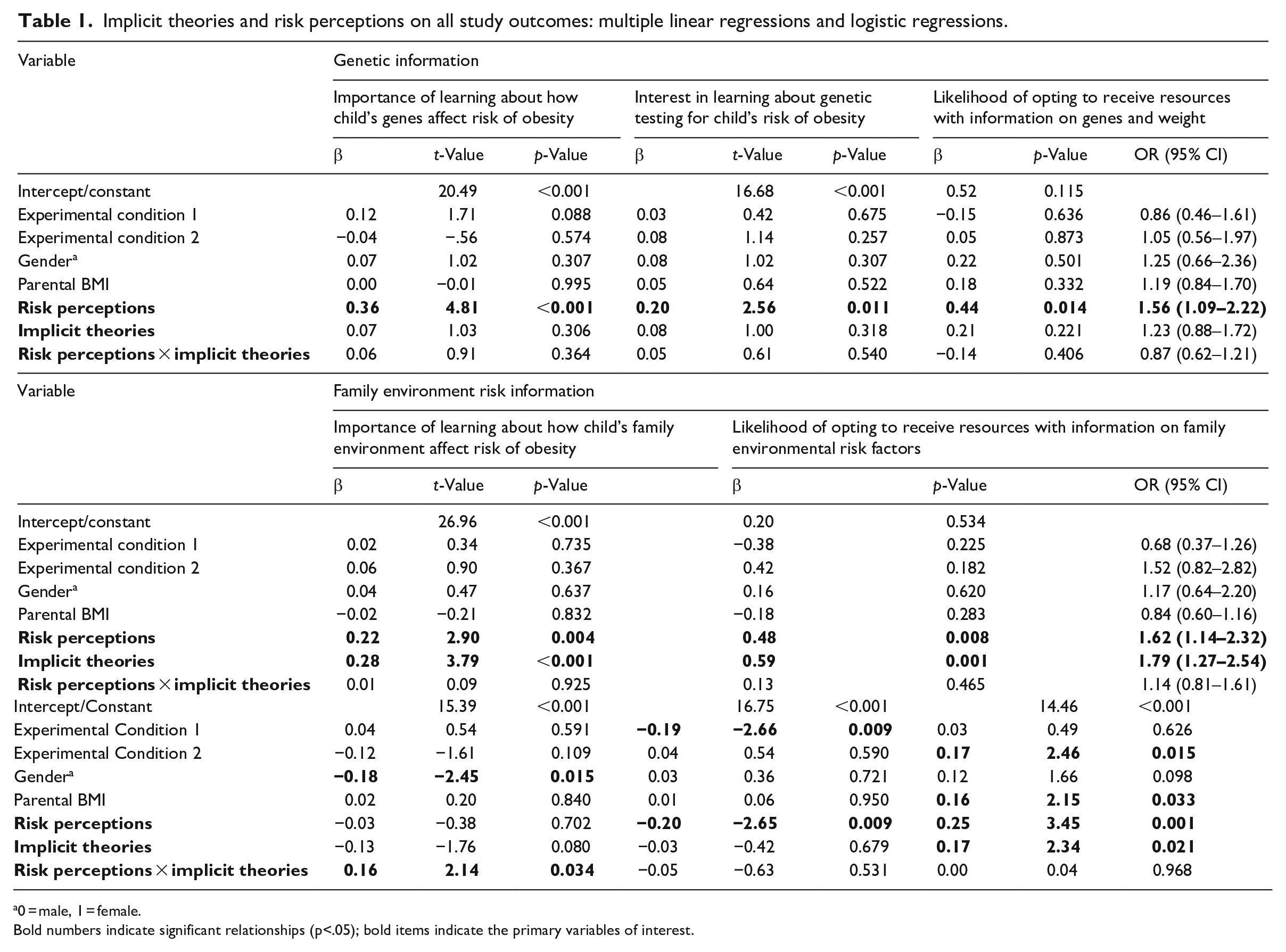
0 = male, 1 = female.
Bold numbers indicate significant relationships (p<.05); bold items indicate the primary variables of interest.
Predicting genetic information seeking
Parents with higher perceived risk had greater perceived importance of learning about how their child’s genes affect their risk for obesity, greater interest in genetic testing, and greater likelihood of opting to receive information on genes and weight. Implicit theories were not associated with any of these outcomes. There were also no interactions between implicit theories and risk perceptions on genetic information seeking outcomes.
Predicting environmental information seeking
Parents with greater risk perceptions felt that it was more important to learn about how their child’s family environment affects their risk of obesity. They were also more likely to opt to receive information on family environment and weight. Parents with more incremental implicit theories also had greater perceived importance of learning about the family environment, and had greater likelihood of opting to receive this information. There was no interaction between implicit theories and risk perceptions on either outcome.
Predicting feeding behavior and intentions
Parents with greater risk perceptions and those with more incremental theories reported greater intentions to improve feeding in the future; there was not a significant interaction. Parents’ implicit theories were not associated with fruit and vegetable feeding, and higher perceived risk was associated with less fruit and vegetable feeding.
There was a significant interaction between risk perceptions and implicit theories on junk food feeding, and no main effects of either variable. Simple slopes analyses revealed that more incremental theories were associated with less junk food feeding at lower levels of perceived risk (−SD, b = −.29, p = 0.005) but not at higher levels of perceived risk (+1 SD, b = 0.02, p = 0.841). Risk perceptions were not associated with junk food feeding at any level of implicit theories (ps > 0.05). See Figure 1 for a depiction of the interaction. There was not a significant interaction between implicit theories and risk perceptions on either fruit and vegetable feeding or intentions to improve feeding.
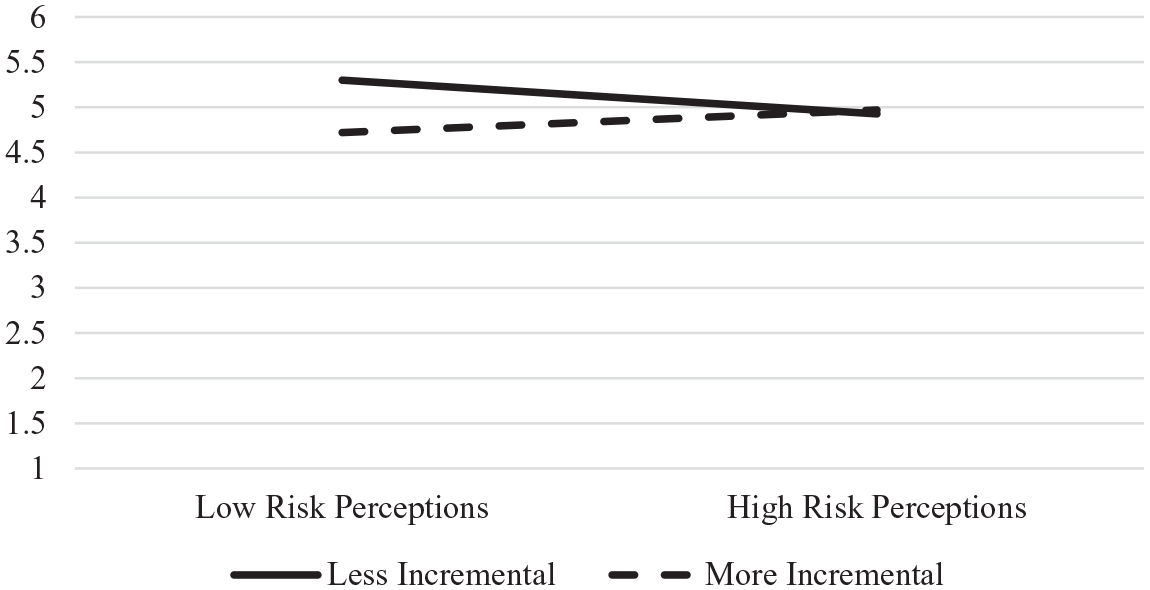
Significant interaction between risk perceptions and implicit theories on junk food feeding.
Discussion
This study was the first to examine the associations between parents’ risk perceptions and their weight-related parenting cognitions and behavior in the context of implicit theories. Overall, risk perceptions were strong predictors of all information seeking outcomes and of intentions to improve in the future, but were unrelated (or negatively related) to feeding outcomes. Implicit theories were associated with some but not all outcomes of interest. Contrary to hypotheses, the influence of parents’ risk perceptions on outcomes (other than junk food feeding) was not dependent on their implicit theories.
Parents reported highly incremental theories of body weight, as only 3.2% of parents in the sample had a mean of three or below on this scale, indicating the belief that weight is fixed. The highly incremental theories in the current study may be typical of most populations. Similar means for implicit theories of body weight have been found in past research (Burnette and Finkel, 2012), and more generally, research suggests that holding a truly entity theory of any attribute is rare (Chen and Tutwiler, 2017). Average risk perceptions of the total sample fell below the midpoint of the scale. Because this sample included only parents with overweight, whose children are at increased obesity risk (Bahreynian et al., 2017), this may indicate some unrealistic optimism similar to that shown in previous related studies (Wright et al., 2017).
Information seeking
The consistently strong main associations of risk perceptions suggest that the sometimes-documented gap between risk perceptions and self-related information seeking (Hwang et al., 2008; Persoskie et al., 2014) may be less prevalent for parents seeking information about their child. This is consistent with Klein and Ferrer’s (2018) finding that participants engaged in greater pursuit of information about cancer after learning about a close other’s risk than when they learned about their own risk.
The influence of implicit theories on information seeking was less consistent. A pattern emerged, such that holding a more incremental theory was associated with greater pursuit of information related to the family environment, reflecting literature showing that individuals are more willing to learn risk information about diseases that are more controllable (i.e. preventable and/or treatable; Howell and Shepperd, 2012; Melnyk and Shepperd, 2012). However, implicit theories were unassociated with genetic information seeking. These null relationships were unexpected in light of Taber et al.’s (2017) finding that individuals with more incremental theories of health reported greater interest in genetic testing for their own disease risk.
This pattern of findings sheds light on why implicit theories might influence information seeking. Participants in the current study may have seen genetic information as less relevant to weight management than environmental information. If implicit theories are related to pursuit of risk information that is relevant for future efforts but unrelated to other risk information, then people with more incremental theories may engage in more information seeking because they perceive more benefit in it, not because they are less threatened by it. This supposition is further supported by the fact that implicit theories showed similar patterns in predicting parents’ pursuit of general information resources vs. personalized risk information. If perceived threat had affected parents’ willingness to learn information, we would have expected the influence of implicit theories to be stronger for personalized risk information, which is inherently more threatening than general educational resources (Dijkstra, 2014; Schüz et al., 2013).
The hypothesized interaction (1c) of risk perceptions and implicit theories on information seeking was not supported. That is, higher risk perceptions motivated information seeking regardless of parents’ beliefs about the malleability of weight. The lack of interactive associations may be due to the limited variation in parents’ implicit theories, which were highly incremental. When all parents believe that weight is changeable, nuances in the extent to which they believe it is changeable may not be powerful enough to alter the influence of other factors (i.e. perceived risk) on information seeking.
Feeding intentions and behavior
Both perceived risk and implicit theories were strongly predictive of parents’ intentions to improve feeding behavior in the future. However, the relationships with actual feeding behavior were more complicated. As hypothesized, there was a significant interaction between risk perceptions and implicit theories on junk food feeding, but the pattern was unexpected. Risk perceptions were not significantly associated with junk food feeding at either low or high implicit theories. Instead, the interaction was driven by the influence of implicit theories at low, but not high, risk perceptions. This finding expands the research on the influence of implicit theories on personal eating behavior, showing that (for some parents), more incremental theories promote healthier child-feeding as well.
However, the null main associations of risk perceptions and junk food feeding in the full sample (despite a significant interaction) are inconsistent with past literature showing that parents with greater concern about their child’s weight practice healthier feeding (Moore et al., 2012; Seburg et al., 2014). Instead, these findings may reflect the evidence that risk perceptions are less predictive of behavior when the behavior is especially difficult to enact (Brewer et al., 2007). Whereas risk perceptions consistently predicted information seeking, a simple behavior, they were unassociated with junk food feeding, which is arguably more difficult. Even when parents are motivated to manage their children’s weight through healthy feeding, they may be unable to do so if children are, for example, selective eaters (Nepper and Chai, 2016).
Alternatively, the null associations between risk perceptions and junk food feeding could be a product of the bidirectional relationship of risk perceptions and healthy behavior (Sheeran et al., 2014), in which higher risk motivates healthier behavior but healthier behavior leads to lower risk perceptions. To this point, risk perceptions were negatively associated with healthy feeding behavior (i.e. fruits and vegetables), which is likely due a preexisting relationship in which parents’ lack of fruit and vegetable feeding drives greater risk perceptions.
Limitations and future directions
The unexpected direction of the relationship found between risk perceptions and parents’ healthy feeding behavior illuminates the limitations of non-experimental research. Because the relationship between absolute risk perceptions and behavior is almost always bidirectional (Sheeran et al., 2014; Weinstein et al., 1998), future studies should examine how manipulating perceived risk affects child feeding to better understand the causal impact. Issues of directionality are less of a concern for the remainder of the analyses in this study, as information seeking and intentions to improve feeding both capture current or future decisions that temporally succeed the baseline cognitions. Further, implicit theories within a given domain are generally stable across time (Dweck et al., 1995) and did not change across time in the current study (i.e, from Time 1 to Time 2). This stability suggests that implicit theories are more likely to be influencers rather than outcomes in cross-sectional associations.
Another limitation of the analyses examining feeding outcomes is that parents’ self-reports of feeding are imperfect measures of their actual behavior, susceptible to problems with recall (Goran, 1998) and social desirability (Miller et al., 2008). Due to a survey error, we did not have data on the index child’s age, meaning that we could not calculate or control for child BMI, as the formula for children requires age (Inokuchi et al., 2011). However, the variation in parents’ self-reports of their child’s weight was very small, with only 9.2% and 3.2% of parents reporting that their child was “a little overweight” and “overweight,” respectively. Further, when controlling for child BMI using the standard formula for adults, the pattern of results largely remained the same.
The current sample included only parents with overweight, and was highly educated, so these results may not generalize to a more representative population. Specifically, highly educated parents may be disproportionately interested in health information such as genetic testing due to lower levels of medical mistrust in populations with higher socioeconomic status (Benkert et al., 2019). They also have resources to feed their children healthy food (e.g. financial resources, access to healthy foods) that those with lower SES do not (Claassen et al., 2019). Finally, parents’ generally high levels of information seeking might be due to a selection bias. The study was advertised as “Parents’ Thoughts about Kids and Eating,” which may have deterred parents who were truly avoidant of this topic.
Conclusions
Both perceived risk and implicit theories were independently associated with intentions to improve feeding and with obesity risk information seeking among parents with overweight. This is the first study to demonstrate that implicit theories of weight are associated with child-related dietary management. Contrary to hypotheses, the associations of implicit theories and perceived risk were primarily independent rather than interactive, but the limited range of implicit beliefs may have contributed to these patterns. The fact that implicit theories were associated with several outcomes despite their limited range emphasizes the powerful influence of these beliefs.
Health interventions and communication that heighten parents’ perceptions of their child’s risk for obesity and/or emphasize the malleability of weight may improve parents’ intentions to improve feeding. Such strategies may also increase parents’ interest in learning more about obesity through personalized feedback, which can assist them through the sometimes challenging process of managing their child’s weight.
Research Data
sj-docx-2-hpq-10.1177_13591053211061412 – Supplemental material for How beliefs about weight malleability and risk perceptions for obesity influence parents’ information seeking and feeding
Supplemental material, sj-docx-2-hpq-10.1177_13591053211061412 for How beliefs about weight malleability and risk perceptions for obesity influence parents’ information seeking and feeding by Charlotte J Hagerman, Rebecca A Ferrer and Susan Persky in Journal of Health Psychology
Supplemental Material
sj-docx-3-hpq-10.1177_13591053211061412 – Supplemental material for How beliefs about weight malleability and risk perceptions for obesity influence parents’ information seeking and feeding
Supplemental material, sj-docx-3-hpq-10.1177_13591053211061412 for How beliefs about weight malleability and risk perceptions for obesity influence parents’ information seeking and feeding by Charlotte J Hagerman, Rebecca A Ferrer and Susan Persky in Journal of Health Psychology
Research Data
sj-pdf-1-hpq-10.1177_13591053211061412 – Supplemental material for How beliefs about weight malleability and risk perceptions for obesity influence parents’ information seeking and feeding
Supplemental material, sj-pdf-1-hpq-10.1177_13591053211061412 for How beliefs about weight malleability and risk perceptions for obesity influence parents’ information seeking and feeding by Charlotte J Hagerman, Rebecca A Ferrer and Susan Persky in Journal of Health Psychology
Research Data
sj-sav-4-hpq-10.1177_13591053211061412 – Supplemental material for How beliefs about weight malleability and risk perceptions for obesity influence parents’ information seeking and feeding
Supplemental material, sj-sav-4-hpq-10.1177_13591053211061412 for How beliefs about weight malleability and risk perceptions for obesity influence parents’ information seeking and feeding by Charlotte J Hagerman, Rebecca A Ferrer and Susan Persky in Journal of Health Psychology
Research Data
sj-sps-5-hpq-10.1177_13591053211061412 – Supplemental material for How beliefs about weight malleability and risk perceptions for obesity influence parents’ information seeking and feeding
Supplemental material, sj-sps-5-hpq-10.1177_13591053211061412 for How beliefs about weight malleability and risk perceptions for obesity influence parents’ information seeking and feeding by Charlotte J Hagerman, Rebecca A Ferrer and Susan Persky in Journal of Health Psychology
Research Data
sj-spv-6-hpq-10.1177_13591053211061412 – Supplemental material for How beliefs about weight malleability and risk perceptions for obesity influence parents’ information seeking and feeding
Supplemental material, sj-spv-6-hpq-10.1177_13591053211061412 for How beliefs about weight malleability and risk perceptions for obesity influence parents’ information seeking and feeding by Charlotte J Hagerman, Rebecca A Ferrer and Susan Persky in Journal of Health Psychology
Footnotes

Data sharing statement
Declaration of conflicting interests
The authors declared no potential conflicts of interest with respect to the research, authorship, and/or publication of this article.
Funding
The authors disclosed receipt of the following financial support for the research, authorship, and/or publication of this article: This work was supported by the Intramural Research Program of the National Human Genome Research Institute.
Notes
References
Supplementary Material
Please find the following supplemental material available below.
For Open Access articles published under a Creative Commons License, all supplemental material carries the same license as the article it is associated with.
For non-Open Access articles published, all supplemental material carries a non-exclusive license, and permission requests for re-use of supplemental material or any part of supplemental material shall be sent directly to the copyright owner as specified in the copyright notice associated with the article.
