







Abstract
This study examines the interplay between Time Perspective (TP), Psychological Capital (PsyCap), and mental health, employing a person-centred approach. Latent Profile Analysis of 540 participants identified three clusters for each construct: Balanced, Moderately Balanced and Ill-Balanced TP; High, Moderate, and Low PsyCap; and Optimal, Emergent, and Vulnerable mental health. Balanced TP profiles exhibited higher PsyCap and better mental health. Grounded in the Conservation of Resources theory, moderation analysis revealed that TP profiles significantly moderated the PsyCap–mental health relationship, with Balanced TP strengthening effects by 38%. Mediation analysis demonstrated PsyCap partially mediated the relationship between temporal balance and mental health. Age was the only significant demographic predictor. Findings highlight dual pathways through which temporal balance and PsyCap jointly impact mental health. The implications of the study are discussed in light of the study’s findings.
Keywords
Introduction
In today’s fast-paced and uncertain world, mental health has emerged as a cornerstone of personal and societal well-being (Jiang et al., 2023). Mental health frameworks have shifted towards universal preventive strategies, emphasising positive psychological flourishing alongside addressing distress (Keyes, 2002), recognising mental health as a dynamic state that integrates emotional, psychological and social dimensions rather than merely the absence of illness.
Among factors shaping mental health, Time Perspective (TP) and Psychological Capital (PsyCap) stand out as pivotal yet understudied constructs in their interactive influence on well-being (Youssef-Morgan, 2024; Zhang et al., 2013). Time Perspective captures how individuals cognitively and emotionally relate to the past, present and future, serving as a lens through which people interpret experiences, make decisions, and plan for the future (Zimbardo and Boyd, 1999). While certain temporal orientations, such as positive reflections on the past or goal-oriented future outlook, foster mental health, others, including excessive regret over the past or fatalistic views of the present, have been linked to psychological distress (Carelli et al., 2015).
Individuals’ mental health depends not only on temporal cognition but also on the psychological resources they possess (Hobfoll, 2002). PsyCap encompasses hope, self-efficacy, resilience and optimism (Luthans and Youssef, 2004). These psychological resources serve as protective buffers, enabling individuals to manage stress, overcome challenges and pursue meaningful goals (Youssef-Morgan, 2024). Together, TP and PsyCap provide valuable yet underexplored insights into mechanisms driving mental health (Avey et al., 2011; Boniwell and Zimbardo, 2015).
A critical limitation of prior research is reliance on variable-centred approaches, which treat individuals as homogeneous and overlook diversity in psychological constructs (Howard et al., 2016). Such methods fail to capture complex interplay among psychological constructs and ignore within-population heterogeneity (Morin and Marsh, 2015). To address this gap, the present study employs Latent Profile Analysis (LPA), a person-centred approach identifying subgroups with similar psychological patterns (Morin et al., 2017). LPA provides robust classification criteria, allowing exploration of how TP and PsyCap interact to influence mental health while accounting for individual differences.
By adopting this person-centred framework, the study contributes both theoretically and practically to positive psychology and mental health promotion. Specifically, this study aims to: (1) identify distinct profiles of TP, PsyCap, and mental health using LPA; (2) examine whether TP profiles moderate the relationship between PsyCap and mental health; and (3) explore whether PsyCap mediates the relationship between temporal balance and mental health outcomes.
Literature review
Time perspective and its profiles
Zimbardo and Boyd (1999) defined Time Perspective (TP) as the often nonconscious process of assigning experiences to temporal categories, which shapes thoughts, behaviours and emotions. Their model comprises six dimensions: Past-Negative (PN, focus on distressing experiences), Past-Positive (PP, nostalgic and constructive memories), Present-Hedonistic (PH, immediate pleasure), Present-Fatalistic (PF, resignation to fate), Future-Positive (FP, long-term goals and optimism), and Future-Negative (FN, anxiety about adverse outcomes; Carelli et al., 2015; Zimbardo and Boyd, 1999).
A Balanced Time Perspective (BTP), characterised by high PP and FP, moderate PH and low PN, PF and FN, enables flexible temporal focus and adaptive responses, whereas overreliance on specific dimensions produces maladaptive outcomes (Boniwell and Zimbardo, 2015; Stolarski et al., 2020). The Deviation from Balanced Time Perspective (DBTP) quantifies the distance from this optimal profile, with lower DBTP scores indicating greater temporal balance and being associated with enhanced well-being, life satisfaction and adaptive functioning (Rönnlund et al., 2017; Zhang et al., 2013).
Person-centred approaches using Latent Profile Analysis (LPA) have identified three to five distinct TP profiles across populations, including balanced, maladaptive and intermediate configurations (Braitman and Henson, 2015; Kee et al., 2018; Kossewska et al., 2023). However, most studies have been conducted in Western contexts. Given collectivist values and distinct temporal orientations in Indian society (Srivastava, 2013), cultural variations in TP profiles warrant investigation.
Psychological capital and its profiles
PsyCap encompasses four positive psychological states: hope (goal-directed energy and pathways), self-efficacy (confidence in one’s ability to execute tasks), resilience (the ability to recover from adversity) and optimism (a positive attributional style; Luthans and Youssef, 2004). These components serve as psychological resources that enhance mental health by promoting goal pursuit (through hope and optimism) and buffering against setbacks (via resilience; Avey et al., 2011).
While variable-centred research demonstrates PsyCap’s benefits for mental health (Luthans and Youssef-Morgan, 2017), person-centred approaches reveal heterogeneity in PsyCap configurations. LPA studies have identified distinct profiles ranging from high to low PsyCap, as well as profiles characterised by specific dimensional strengths or deficits (Bouckenooghe et al., 2019; Gao et al., 2023; Zhang et al., 2024). This heterogeneity suggests that individuals exhibit unique combinations of psychological resources, having implications for well-being.
Mental health and its profiles
Mental health comprises emotional, psychological, and social well-being dimensions. Keyes (2002, 2005) Mental Health Continuum (MHC) framework conceptualises mental health as ranging from flourishing (optimal functioning with positive emotions and fulfilment) through moderate mental health to languishing (emptiness and stagnation). The MHC-SF operationalises three dimensions: Emotional Well-being (life satisfaction, positive affect), Psychological Well-being (self-acceptance, purpose, personal growth), and Social Well-being (societal integration).
Person-centred investigations using LPA have identified three to five mental health profiles across populations, including flourishing, vulnerable, languishing and intermediate configurations (Chan et al., 2022; Jiang et al., 2023; Reinhardt et al., 2020). These profiles reflect distinct patterns of well-being with important implications for intervention.
Moderating role of TP clusters
Prior research has consistently demonstrated strong associations between Time Perspective, PsyCap and mental health. Positive TP dimensions, such as Past Positive and Future Positive orientations, are consistently linked with higher PsyCap and better mental health outcomes, whereas negative orientations, such as Past Negative and Present Fatalistic, are associated with poorer well-being (Stolarski et al., 2018; Zhang et al., 2013). However, limited research has examined the role of TP profiles as moderators of the PsyCap–Mental Health relationship.
Drawing on the Conservation of Resources (COR) theory (Hobfoll, 2002, 2011), the present study conceptualises TP as a contextual cognitive framework that determines how effectively individuals mobilise psychological resources to promote well-being. COR theory posits that personal resources such as PsyCap are most effective when deployed within supportive cognitive contexts. A BTP provides such a context by integrating adaptive temporal orientations, including positive reflections on the past, mindful engagement with the present and a goal-directed focus on the future. This balance facilitates the effective utilisation of PsyCap components such as hope, efficacy, resilience and optimism in maintaining mental health. In contrast, an ill-balanced TP constrains resource use by fostering maladaptive focus on regret, loss, or fatalism, thereby diminishing PsyCap benefits (Carelli et al., 2015; Stolarski et al., 2015).
Conceptually, TP operates at a broader contextual level than PsyCap, influencing how personal resources are translated into psychological outcomes. PsyCap, in contrast, functions as an internal psychological resource that reflects individuals’ positive motivational states of hope, efficacy, resilience, and optimism (Luthans et al., 2007; Youssef-Morgan, 2024). Within the COR framework, such resources yield optimal effects when activated within favourable cognitive environments. TP provides this environment by shaping how individuals perceive challenges, regulate emotions and plan for future goals (Boniwell and Zimbardo, 2015; Zimbardo and Boyd, 1999). Consequently, TP, rather than PsyCap, serves as the moderating variable in this framework because it defines the cognitive context in which psychological resources are mobilised and converted into mental health outcomes. Hence,
Mediating role of PsyCap
Beyond moderation, PsyCap may also function as a mediating mechanism linking TP with mental health. A balanced temporal orientation fosters adaptive cognitive and motivational patterns, such as optimism, self-efficacy and resilience, that comprise PsyCap (Boniwell and Zimbardo, 2015; Stolarski et al., 2015). Within the COR framework, balanced temporal orientations facilitate the accumulation of psychological resources, which subsequently promote well-being (Avey et al., 2011; Luthans and Youssef-Morgan, 2017). This conceptualisation provides a resource-based explanation for how temporal balance enhances mental health by strengthening psychological capital (Zhang et al., 2013).
Materials and methods
Participants
The study comprised 540 respondents (57% male, 43% female; Mage = 23.44 years, SD = 4.00) residing across India. Purposive sampling was employed with inclusion criteria requiring participants to be: (1) at least 18 years of age, (2) proficient in reading and comprehension of the English language and (3) absence of diagnosed psychological disorders (self-reported). Participant recruitment employed both online and offline methods. Participants were recruited online through social media and professional networks, as well as offline through in-person visits to various educational institutions. All received informed consent forms and study questionnaires. Approximately 97.3% of approached individuals participated. The sample comprised 61.5% undergraduates/graduates, 25.9% postgraduates and 12.6% doctoral degree holders. Residence distribution included 36.7% urban, 41.5% semi-urban and 21.8% rural settings. Data collection occurred between January 2025 to March 2025.
Procedure
Ethical approval was obtained from the Institutional Review Board (IRB) of the Indian Institute of Technology Kharagpur (Approval No. IIT/SRIC/DEAN/2025). Participants were informed about the study’s purpose, procedures, confidentiality and their rights to voluntary participation, consistent with the International Ethical Standards. Informed consent was obtained from all participants. No incentives were provided. The researcher addressed participant queries to ensure transparency.
Measures
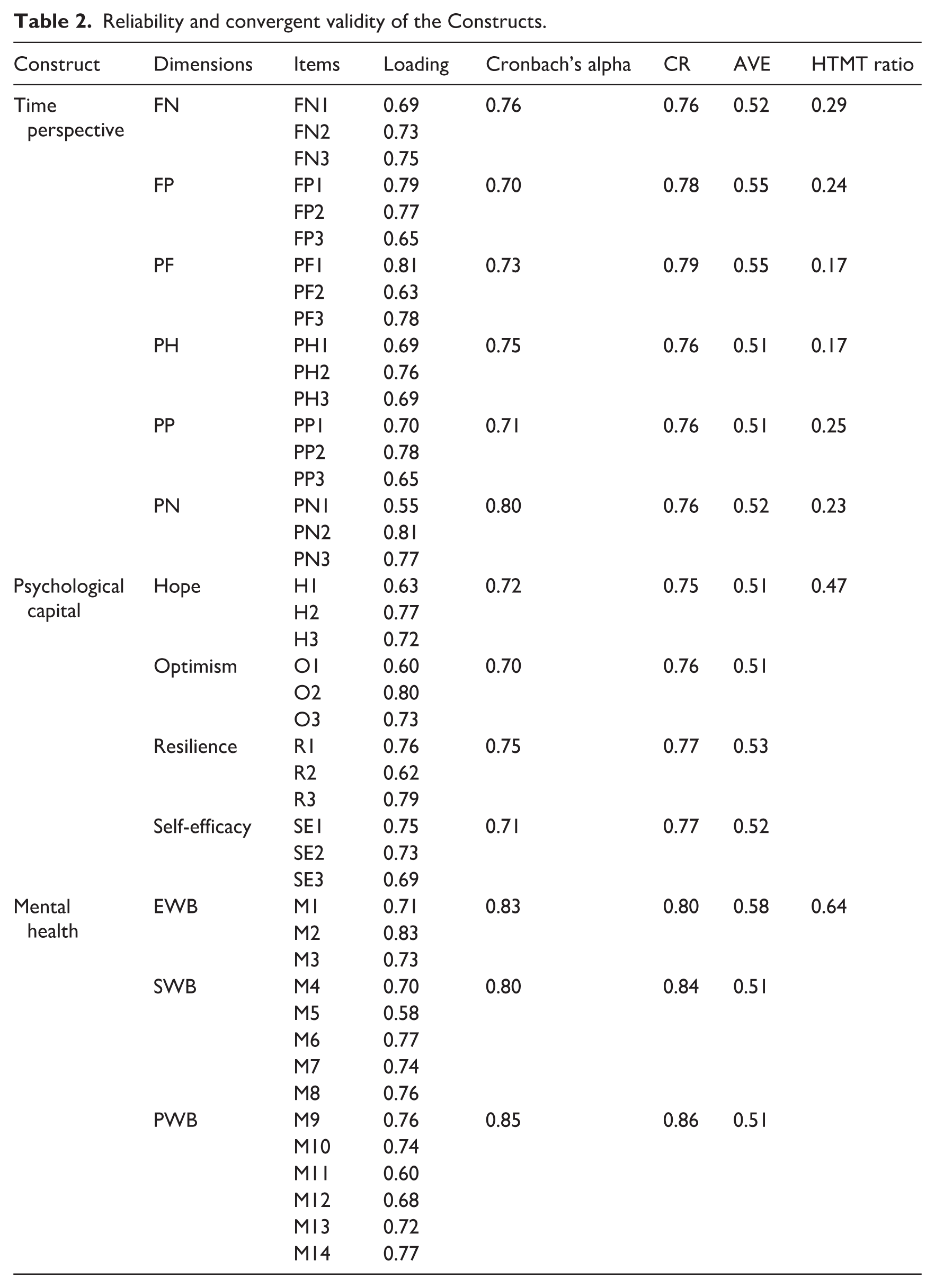
Zimbardo Time Perspective Inventory–Short (ZTPI–Short; Košťál et al., 2016): The 18-item ZTPI–Short assesses six TP dimensions (Past Positive, Past Negative, Present Hedonistic, Present Fatalistic, Future Positive, Future Negative) with three items per dimension rated on a five-point Likert scale (1 = very untrue to 5 = very true). Confirmatory factor analysis supported the six-factor structure (χ2/df = 2.73, GFI (Goodness of Fit Index) = 0.94, TLI (Tucker-Lewis Index) = 0.92, CFI (Comparative Fit Index) = 0.94, SRMR (Standardised Root Mean Square Residual) = 0.054, RMSEA (Root Mean Square Error of Approximation) = .057). In the present study, Cronbach’s α for FN, FP, PH, PF, PP, and PN were 0.76, 0.70, 0.73, 0.75, 0.71 and 0.80, respectively (see Table 2).
Compound PsyCap Scale-12 (CPC-12; Lorenz et al., 2016): The 12-item CPC-12R measures PsyCap across four dimensions (hope, optimism, resilience, and self-efficacy), with three items per dimension, rated on a 5-point Likert scale (1 = strongly disagree to 5 = strongly agree). Confirmatory factor analysis supported the second-order four-factor structure (χ2/df = 3.24, GFI = 0.95, TLI = 0.90, CFI = 0.92, SRMR = 0.054, RMSEA = 0.065). The scale showed acceptable psychometric properties as Cronbach’s α for the entire scale was 0.83, and for dimensions, hope, optimism, resilience and self-efficacy, was 0.72, 0.70, 0.75, 0.71, respectively.
Mental Health Continuum–Short Form (MHC-SF; Lamers et al., 2011): The 14-item MHC-SF assesses emotional, social, and psychological well-being on a six-point Likert scale (0 = never to 5 = every day). Confirmatory factor analysis supported the second-order three-factor structure (χ2/df = 3.14, GFI = 0.93, TLI = 0.94, CFI= 0.95, SRMR = 0.040, RMSEA = 0.063). The scale showed acceptable psychometric properties as Cronbach’s α for the entire scale was 0.91, and for dimensions of emotional, social and psychological well-being, it was 0.83, 0.80, and 0.85, respectively.
Statistical analyses
Preliminary Analyses: Descriptive statistics and intercorrelations were computed using SPSS V26. Independent sample t-tests (Cohen’s d for effect size) and one-way ANOVAs (partial η2 for effect size) examined demographic differences across clusters. To control for demographic differences, categorical variables such as gender, educational qualification, and place of residence were dummy-coded prior to analysis. Gender was coded as 0 = male and 1 = female. Educational qualification was represented by two dummy variables with undergraduate as the reference category (postgraduate and PhD). The place of residence was represented by two dummy variables, with ‘rural’ as the reference category (urban and semi-urban). These dummy-coded variables were included as covariates in the PROCESS analyses.
Confirmatory Factor Analysis (CFA): Structural equation modelling with maximum likelihood estimation (AMOS V22) was used to test the measurement model fit. Multiple fit indices were evaluated, including GFI, CFI, TLI, RMSEA, SRMR and the χ2/df ratio (Bollen, 1990).
Latent Profile Analysis (LPA): LPA was conducted using RStudio 4.4.2 to identify distinct profiles within the TP, PsyCap, and mental health. Models with one to six profiles were systematically compared using Bayesian Information Criterion (BIC), entropy (⩾0.70), Bootstrap Likelihood Ratio Test (BLRT), and theoretical interpretability (Nylund et al., 2007).
Moderation Analysis: PROCESS macro (Model 1) tested whether TP clusters moderate the PsyCap–mental health relationship. TP clusters (Balanced, Moderately Balanced, and Ill-Balanced) were dummy-coded, with Balanced TP clusters serving as the reference category. Significant interactions were probed via simple slopes analysis.
Mediation Analysis: PROCESS macro (Model 4) examined whether PsyCap mediates the relationship between DBTP and mental health. DBTP was calculated as the Euclidean distance between observed and optimal TP scores (Stolarski et al., 2015):
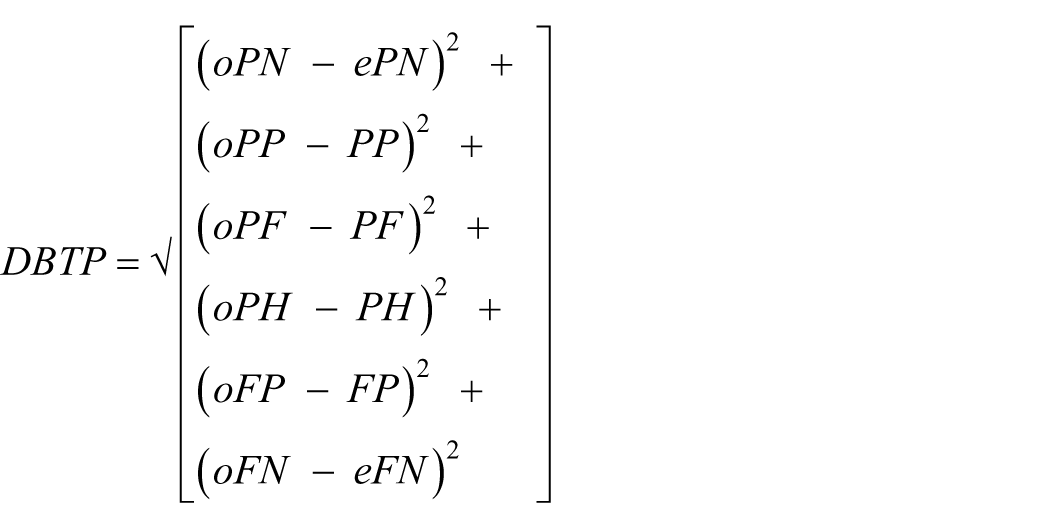
Optimal values were 4.6 (Past Positive), 3.9 (Present Hedonistic), 4.0 (Future Positive), 1.8 (Future Negative), 1.95 (Past Negative), and 1.5 (Present Fatalistic; Zimbardo and Boyd, 2008). Lower DBTP values indicate greater temporal balance (Rönnlund et al., 2017; Zimbardo and Boyd, 2008). Indirect effects were estimated using 5000 bootstrapped samples with 95% bias-corrected confidence intervals.
Results
Table 1 presents descriptive statistics and intercorrelations. Positive TP dimensions and PsyCap correlated positively with mental health, whereas negative temporal orientations and DBTP correlated negatively with well-being indicators.
Descriptive statistics and correlation analysis.
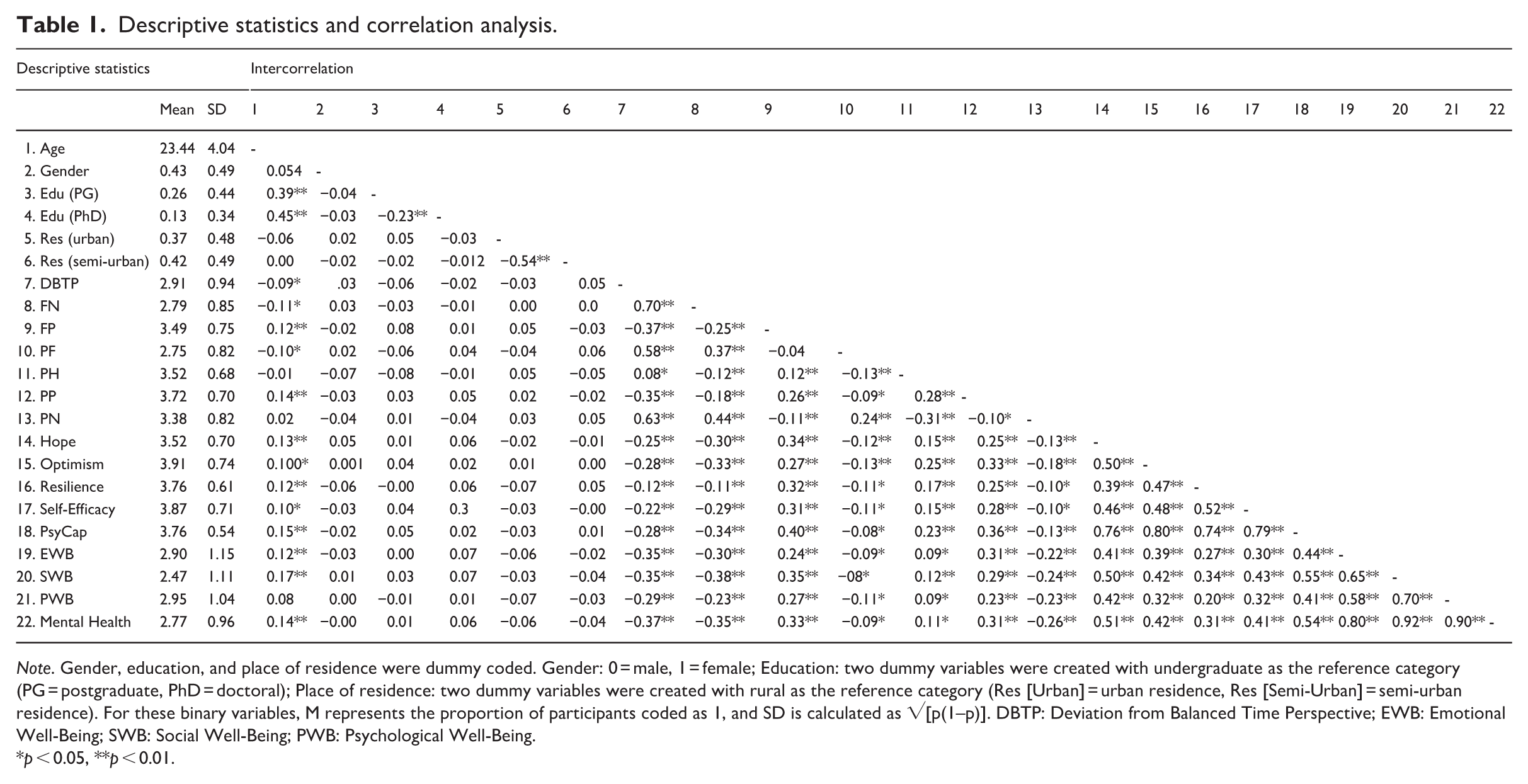
Note. Gender, education, and place of residence were dummy coded. Gender: 0 = male, 1 = female; Education: two dummy variables were created with undergraduate as the reference category (PG = postgraduate, PhD = doctoral); Place of residence: two dummy variables were created with rural as the reference category (Res [Urban] = urban residence, Res [Semi-Urban] = semi-urban residence). For these binary variables, M represents the proportion of participants coded as 1, and SD is calculated as √[p(1–p)]. DBTP: Deviation from Balanced Time Perspective; EWB: Emotional Well-Being; SWB: Social Well-Being; PWB: Psychological Well-Being.
p < 0.05, **p < 0.01.
Confirmatory factor analysis
The results of the confirmatory factor analysis showed that the 13-factor model (six dimensions of TP, four dimensions of PsyCap, and three dimensions of Mental Health) showed acceptable model fit indices (χ2/df = 2.06, CFI = 0.94, TLI = 0.90, SRMR = 0.04, RMSEA = 0.06), indicating that the model fits the data well.
Standardised factor loadings, composite reliability (CR) and average variance extracted (AVE) were calculated to assess the convergent validity of the constructs. Table 2 depicts the standardised factor loadings, CR and AVE of the constructs. Each item has a standardised factor loading greater than the recommended value of 0.5. The CR value of the study variable ranged from 0.75 to 0.86, which is above the recommended value of 0.7. All the focal variables had an AVE value greater than the recommended value of 0.5 (Hair et al., 2018). All the above-mentioned indicators establish the convergent validity of the constructs. The discriminant validity was assessed through the Heterotrait-Monotrait (HTMT) ratio (Franke and Sarstedt, 2019). The HTMT values were below 0.85 for all the constructs, indicating that discriminant validity was established (Table 2).
Reliability and convergent validity of the Constructs.
Latent profile analysis of time perspective, psychological capital and mental health
R 4.4.2 was used to identify the optimal profile model for TP, PsyCap and mental health. First, the average score of each dimension was normalised before conducting LPA. Second, the best model was identified according to several fit indices such as Akaike Information Criterion (AIC), Bayesian Information Criterion (BIC), Sample-Size-Adjusted BIC (SSABIC), Integrated Completed Likelihood (ICL), Entropy, Bootstrap Likelihood Ratio Test (BLRT), and Sample proportion of the profile (Nylund et al., 2007). Lower values of AIC, BIC and SSABIC indicate a superior and more parsimonious model fit. Significant results from the BLRT values suggest that the k-profile model provides a better fit than the k-1 profile model. An Entropy value exceeding 0.8 reflects high classification accuracy, while each profile must maintain a sample proportion above 5% to ensure reliability (Nylund et al., 2007). Lastly, the optimal model selection should align with theoretical justification, and each profile must exhibit meaningful interpretability. Table 3 shows the model fit indices of one to six models of the focal constructs. Across the three constructs (TP, PsyCap, and Mental Health), the three-profile model emerged as the most statistically robust and parsimonious solution, based on multiple model-fit indices. For TP, although the five-profile model produced a slightly lower BIC value, it demonstrated poorer entropy (0.68) and included a very small class (6.71%), indicating overfitting and limited classification accuracy. In contrast, the three-profile model (entropy = 0.83) offered superior class separation, adequate profile sizes (>10%), and stable convergence. For the current research, clusters identified through LPA on TP are termed Balanced TP, Moderately Balanced TP, and Ill-Balanced TP, reflecting participants’ temporal orientations.
Summary of fit indices of one-to-six models on study variables.
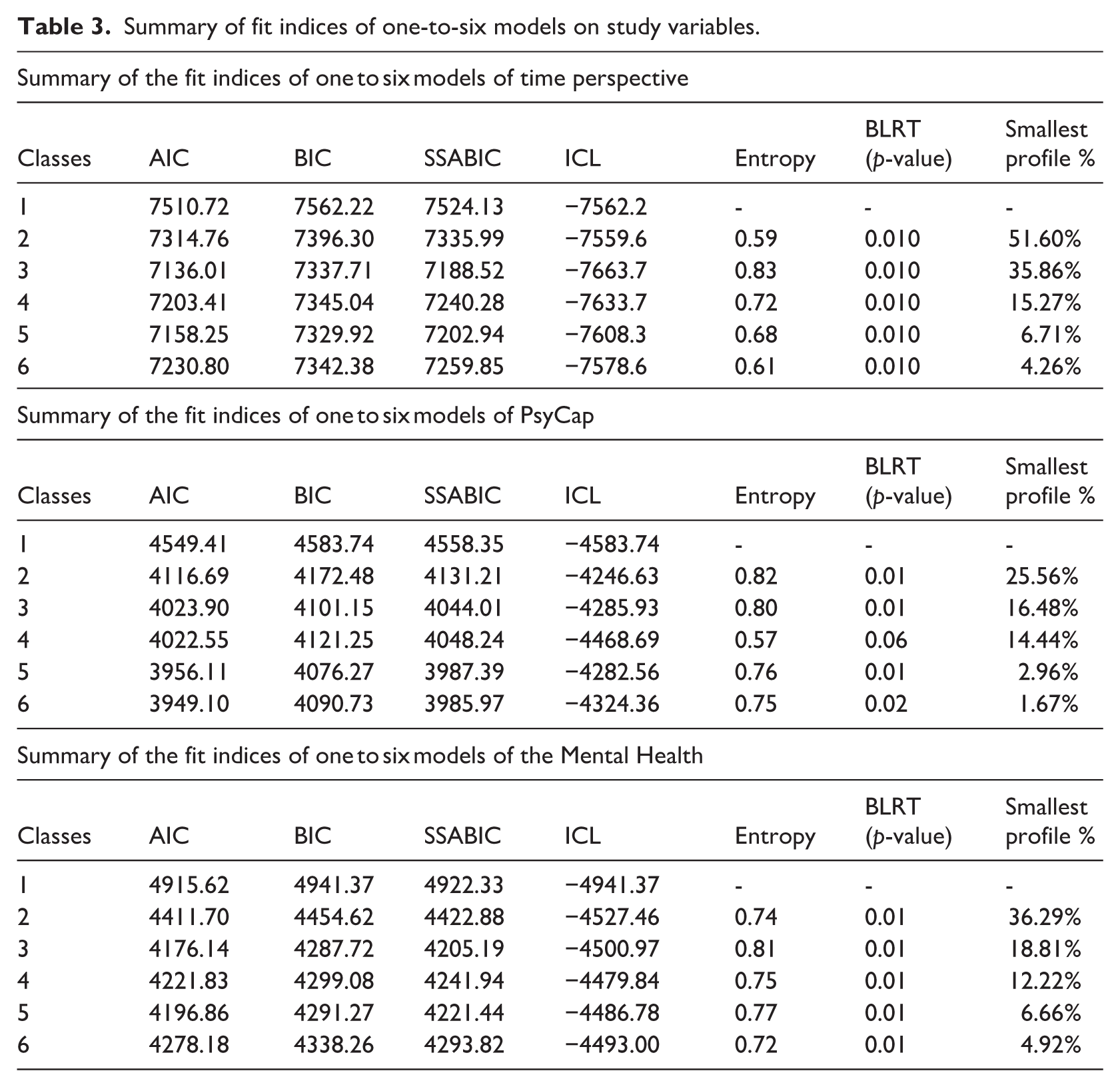
For PsyCap, the five- and six-profile models yielded slightly lower AIC and BIC values, but they included very small classes (2.96% and 1.67%) and lower entropy (<0.76), which undermines reliability and interpretability. The three-profile model (entropy = 0.80) demonstrated the most stable and interpretable class structure with clear subgroup distinctions. For the current research, clusters identified through LPA on PsyCap are termed High PsyCap, Moderate PsyCap, and Low PsyCap to represent varying levels of psychological capital among participants.
Similarly, for MH, the three-profile model (entropy = 0.81) demonstrated the best overall fit and classification quality, while higher-profile models yielded smaller, less stable subgroups (<10%) and lower entropy values (<0.77), suggesting overextraction of classes. The three-cluster solution aligns with Keyes’s (2005) Mental Health Continuum framework, which conceptualises mental health along flourishing, moderate and vulnerable states. Accordingly, the clusters identified through LPA on MH are labelled Optimal Mental Health (OMH), Emergent Mental Health (EMH), and Vulnerable Mental Health (VMH) to reflect varying levels of well-being. Overall, the three-profile solution across all constructs provided the best balance of statistical adequacy, parsimony, and interpretability, warranting its selection for subsequent analyses.
Comparative analysis of TP, PsyCap and mental health clusters across study variables and ANOVA results
Comparative analyses across TP, PsyCap and mental health clusters revealed significant differences (see Supplemental Tables S1–S3). Balanced TP, High PsyCap and Optimal Mental Health profiles exhibited higher scores on positive dimensions (Future Positive, Past Positive, hope, resilience), whereas Ill-Balanced TP, Low PsyCap and Vulnerable Mental Health profiles showed elevated negative orientations (Past Negative, Present Fatalistic) and lower psychological resources. Moderate/Emergent profiles demonstrated intermediate scores. Full statistical details, effect sizes (partial η2), and post-hoc comparisons of TP, PsyCap and MHC clusters on study variables are mentioned in Supplemental Tables S1–S3. Effect sizes indicate moderate to large differences across clusters.
Demographic insights across PsyCap, TP and mental health clusters
The demographic analysis revealed no significant differences across TP, MHC or PsyCap Clusters based on gender, educational qualification, place of residence, or work experience (See Supplemental Tables S4–S6). However, age showed significant differences across all clusters (See Supplemental Table S7). Further post-hoc analysis revealed that Participants in the Ill-Balanced TP Profile were significantly younger than those in the Moderately Balanced TP Profile, while individuals in the High PsyCap Cluster were significantly older than those in the Low PsyCap Cluster. Similarly, participants belonging to the OMH Cluster were older than those in the VMH Cluster (see Supplemental Tables S8–S10). These findings suggest that while demographic factors like gender, education and work experience do not substantially influence cluster membership, age may play a pivotal role in shaping psychological patterns across TP, PsyCap and MHC dimensions.
Table 4 presents the hierarchical regression results, testing whether TP clusters moderate the relationship between PsyCap and mental health, while controlling for demographic variables. The overall model was significant, R2 = 0.33, F(9, 530) = 29.38, p < 0.001. The interaction between PsyCap and TP Clusters was significant (β = 0.15, p < 0.05, 95% CI [0.08, 0.34]), indicating that temporal orientation profiles moderate the effect on mental health. Simple slopes analysis revealed that PsyCap’s positive effect on mental health strengthened progressively across TP clusters: Ill-Balanced (β = 0.55, p = 0.00), Moderately Balanced (β = 0.68, p = 0.00), and Balanced (β = 0.76, p = 0.00). The 38% increase in effect size from Ill-Balanced to Balanced clusters demonstrates that balanced temporal orientations substantially amplify PsyCap’s mental health benefits. Among demographic covariates, age, gender, education and residence were non-significant predictors, indicating that the moderation effect operates independently of demographic characteristics.
Moderation analysis of time perspective clusters on the PsyCap–mental health relationship with demographic controls.
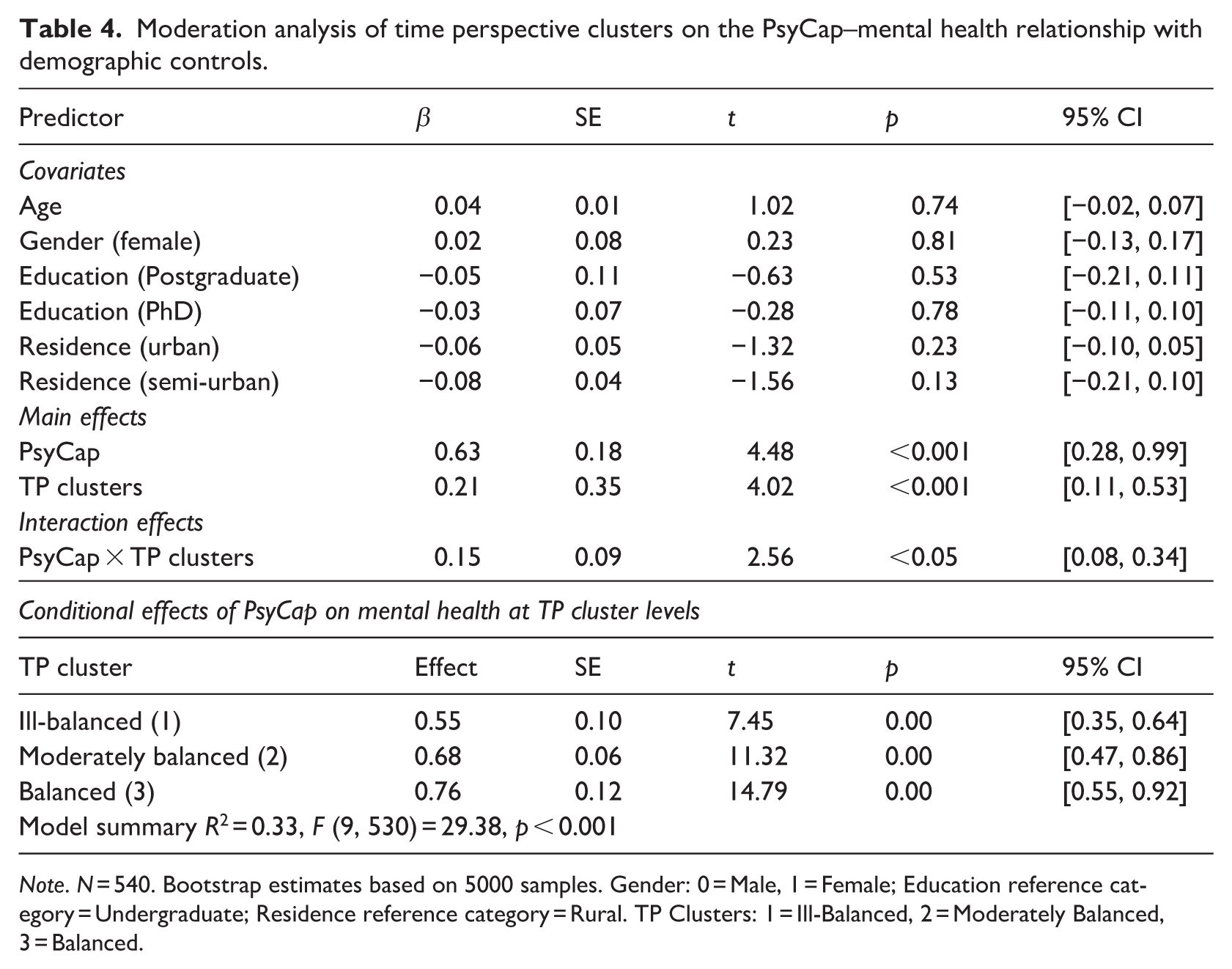
Note. N = 540. Bootstrap estimates based on 5000 samples. Gender: 0 = Male, 1 = Female; Education reference category = Undergraduate; Residence reference category = Rural. TP Clusters: 1 = Ill-Balanced, 2 = Moderately Balanced, 3 = Balanced.
Table 5 presents the results of the mediation analysis examining whether Psychological Capital (PsyCap) mediates the relationship between DBTP and Mental Health while controlling for demographic variables. DBTP significantly predicted PsyCap (β = −0.28, p < 0.001), indicating that greater deviation from temporal balance was associated with lower PsyCap. PsyCap positively predicted Mental Health (β = 0.46, p < 0.001), and the direct effect of DBTP on Mental Health remained significant (β = −0.24, p < 0.001), indicating partial mediation. The indirect effect of DBTP on Mental Health via PsyCap was significant (β = −0.13, 95% CI [–0.17, –0.09]), accounting for approximately 34% of the total effect.
Mediation analysis of DBTP on mental health through PsyCap with demographic controls.
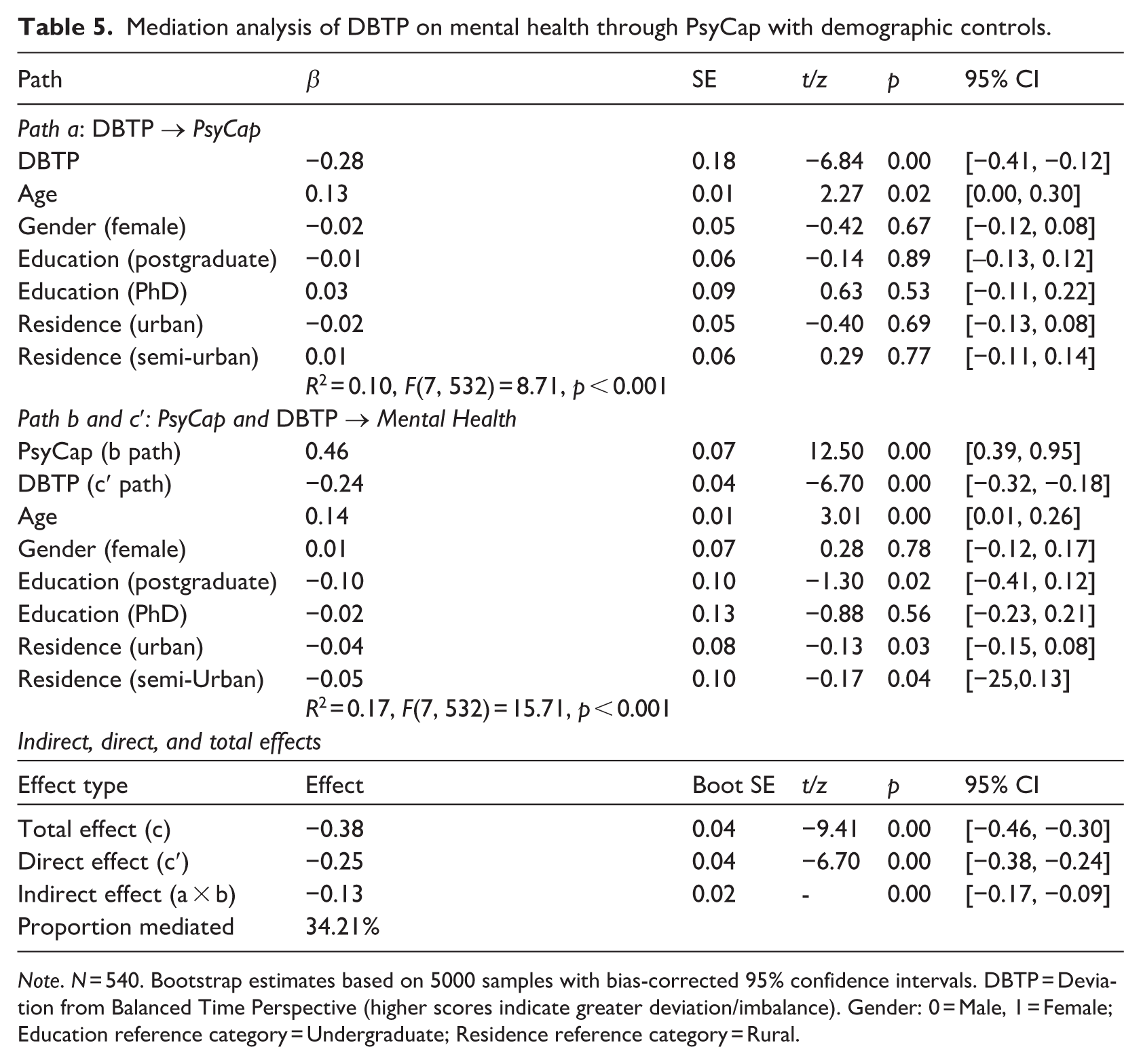
Note. N = 540. Bootstrap estimates based on 5000 samples with bias-corrected 95% confidence intervals. DBTP = Deviation from Balanced Time Perspective (higher scores indicate greater deviation/imbalance). Gender: 0 = Male, 1 = Female; Education reference category = Undergraduate; Residence reference category = Rural.
Among the demographic covariates, age emerged as a significant positive predictor of both PsyCap (β = 0.13, p = 0.02) and Mental Health (β = 0.14, p = 0.01), suggesting that older individuals tend to report higher psychological capital and better mental health. In contrast, gender, educational qualification, and place of residence were nonsignificant predictors, indicating that these demographic factors did not substantially influence the main mediation pathways. Overall, the findings suggest that a balanced time perspective enhances psychological resources and well-being, even when demographic characteristics are used as covariates.
Discussion
The present study employed a person-centred approach to identify distinct psychological profiles within Time Perspective (TP), Psychological Capital (PsyCap), and mental health constructs. Latent Profile Analysis revealed three profiles for each: Balanced, Moderately Balanced, and Ill-Balanced TP; High, Moderate, and Low PsyCap; and Optimal, Emergent and Vulnerable mental health, reflecting meaningful heterogeneity in psychological functioning. These profiles exhibited systematic associations, as balanced temporal orientations co-occurred with greater psychological resources and optimal mental health, whereas temporal imbalance was associated with depleted resources and vulnerability. Extending beyond descriptive profiling, we investigated moderation and mediation mechanisms using the Conservation of Resources theory (Hobfoll, 2011). Controlling for demographic variables, results demonstrated that TP profiles significantly moderate PsyCap’s influence on mental health, while PsyCap mediated the relationship between deviation from balanced time perspective and mental health. Together, these findings demonstrate the multifaceted role of temporal cognition in shaping psychological resource dynamics and mental health outcomes.
Profile structures and theoretical justifications
The three-profile structures identified across TP, PsyCap and mental health were statistically sound and theoretically coherent, capturing meaningful heterogeneity in temporal orientation, PsyCap, and mental health. For TP, the three clusters (Balanced, Moderately Balanced, and Ill-Balanced) differed significantly across all six temporal dimensions (See Supplemental Table S1). Individuals in the Balanced TP cluster exhibited high Past-Positive and Present-Hedonistic orientations, as well as low Past-Negative and Present-Fatalistic tendencies, reflecting adaptive temporal integration. They also reported elevated PsyCap and better mental health outcomes, indicating that temporal balance is associated with stronger psychological resources and well-being. In contrast, individuals in the Ill-Balanced cluster demonstrated increased Past-Negative and Present-Fatalistic orientations, reduced PsyCap, and poorer mental health outcomes. The Moderately Balanced group displayed intermediate levels across constructs, reflecting a gradual continuum of psychological adjustment. This configuration aligns with Zimbardo and Boyd’s (1999) Balanced Time Perspective (BTP) framework and corresponds with findings from Kee et al. (2018) and Kossewska et al. (2023), who identified similar three-profile configurations across diverse samples.
Similarly, the three PsyCap clusters (High, Moderate, and Low) differed significantly across all PsyCap components (See Supplemental Table S2). The High PsyCap group reported greater optimism, resilience and self-efficacy, along with more adaptive temporal orientations and enhanced mental health, consistent with the Conservation of Resources theory (Hobfoll, 2011). The Low PsyCap group displayed diminished personal resources and more imbalanced temporal orientations. Comparable three-class PsyCap structures have been documented by Gao et al. (2023) and He et al. (2025).
The three mental health clusters (Optimal, Emergent, and Vulnerable) also differed significantly across TP and PsyCap dimensions (See Supplemental Table S3). Participants in the Optimal Mental Health cluster exhibited more adaptive temporal orientations and higher PsyCap, whereas those in the Vulnerable cluster reported lower PsyCap and less adaptive time perspectives. This triadic structure corresponds to Keyes’s (2005) Mental Health Continuum and is empirically supported by Jiang et al. (2023) and Zhou et al. (2020). Collectively, these findings suggest that balanced temporal orientations and robust psychological resources are associated with positive mental health.
Several TP and PsyCap dimension reliabilities (α = 0.70–0.80) fell below ideal thresholds, reflecting the ZTPI-Short’s and CPC-12 abbreviated three-item format, which prioritises practical administration over internal consistency (Košťál et al., 2016; Lorenz et al., 2016). This issue is particularly relevant for Balanced TP, which relies on coherence among multiple temporal dimensions. Despite these limitations, confirmatory factor analysis indicated satisfactory model fit and discriminant validity of both the construct, supporting the adequacy of the measures (See Table 2). PsyCap demonstrated strong overall reliability (α = 0.83), reinforcing confidence in the mediation and moderation results.
The demographic analyses (see Supplemental Tables S4–S10) indicated that age was the only variable significantly associated with cluster membership across TP, PsyCap and mental health. Older participants were more frequently classified within the Balanced TP, High PsyCap, and Optimal Mental Health clusters, whereas younger individuals tended to belong to the Ill-Balanced, Low PsyCap and Vulnerable Mental Health clusters. These findings align with Socioemotional Selectivity Theory (SST; Carstensen, 2006), which posits that as individuals perceive time as increasingly limited with age, motivational priorities shift from knowledge acquisition towards emotionally meaningful goals. This motivational reorientation enhances emotional regulation and resource conservation, which may contribute to more balanced temporal orientations, higher psychological capital and improved mental health (Carstensen et al., 2011; Luthans and Youssef-Morgan, 2017; Stolarski et al., 2015). Laureiro-Martinez et al. (2017) found that older adults exhibit more adaptive temporal orientations, characterised by lower impulsivity and greater affective stability. Meanwhile, Xin and Li (2023) reported that older adults display greater PsyCap, particularly in resilience and optimism, which contributes to enhanced mental health outcomes.
The absence of gender, education and residence effects contrasts with some literature suggesting that women report lower PsyCap (Luthans et al., 2007). Several explanations warrant consideration. The most plausible is the relative homogeneity of the current sample, which was predominantly young (Mage = 23.44) and educated. Such limited demographic variability may have constrained the detection of effects across these variables, a challenge frequently observed in university-based convenience samples (Jager et al., 2017). This outcome also aligns with studies emphasising the broad generalisability and cross-demographic stability of TP, PsyCap and mental health constructs (Luthans et al., 2007; Stolarski et al., 2015).
Moderating role of TP clusters
The moderation analysis indicated that TP clusters significantly influenced the strength of the association between PsyCap and mental health, leading to acceptance of
Mediating role of PsyCap
PsyCap partially mediated the relationship between temporal balance (DBTP) and mental health, leading to acceptance of
Together, these findings delineate dual pathways through which time perspective relates to mental health, by mediating outcomes through processes of psychological resource acquisition and conservation, and by moderating the contextual conditions that determine how such resources influence well-being, thereby advancing the COR framework.
Theoretical and practical implications
The findings contribute to both theory and practice by integrating Time Perspective (TP) and PsyCap within the COR framework (Hobfoll, 2011) by demonstrating that temporal balance not only influences mental health directly but also conditions the extent to which internal resources, such as PsyCap, enhance well-being. A Balanced TP operates as a cognitive context that facilitates adaptive use of psychological resources, while temporal imbalance constrains their benefits. This dual role, moderating the PsyCap–mental health link and mediating the pathway from temporal balance to well-being, clarifies how temporal cognition contributes to mental health.
Practically, the results underscore the value of integrating TP-focused strategies with PsyCap-based interventions. Evidence suggests that TP is a malleable construct that can be modified through structured interventions such as Time Perspective Therapy (Zimbardo and Boyd, 2008), reflective journaling, and goal-setting exercises that encourage positive engagement with past, present and future experiences (Boniwell and Zimbardo, 2015). Such methods can cultivate temporal balance, thereby enhancing the effectiveness of PsyCap-focused programmes. Health promotion initiatives should integrate these approaches to help individuals regulate temporal biases, mobilise psychological resources and maintain mental health in demanding contexts. Furthermore, the findings advocate designing age-sensitive interventions that prioritise fostering temporal balance and PsyCap among the younger population to strengthen their mental health.
Limitations and future directions
Several limitations warrant consideration. The cross-sectional design restricts causal inference; longitudinal or experimental studies should test how shifts in TP and PsyCap interact over time to influence mental health. The sample’s sociodemographic homogeneity may limit generalisability, as PsyCap and temporal balance may be resource-dependent constructs. Individuals from different socioeconomic backgrounds may potentially exhibit different temporal orientations and resource configurations. Future research should examine whether these relationships hold across diverse socioeconomic and cultural backgrounds. Future research should utilise culturally adapted and extended measures of TP and PsyCap to elucidate the link between temporal balance, PsyCap and mental health.
Conclusion
The present study extends understanding of the interrelations among time perspective, PsyCap and mental health through a person-centred exploration. By demonstrating that TP moderates and mediates the relationship between PsyCap and mental health, the findings position temporal cognition as a contextual mechanism through which psychological resources translate into mental health benefits. The study emphasises the importance of incorporating temporal-balance interventions within health psychology frameworks aimed at strengthening PsyCap and mental health among individuals.
Supplemental Material
sj-docx-1-hpq-10.1177_13591053261416354 – Supplemental material for Profiling and relating time perspective, psychological capital and mental health: A person-centred exploration
Supplemental material, sj-docx-1-hpq-10.1177_13591053261416354 for Profiling and relating time perspective, psychological capital and mental health: A person-centred exploration by Rabindra Kumar Pradhan and Peeyush Anand in Journal of Health Psychology
Footnotes
Acknowledgements
We would like to express our sincere thanks to all the study participants.

Ethical considerations
This research was approved by the Institutional Review Board (IRB) of the Indian Institute of Technology Kharagpur (Approval No. IIT/SRIC/DEAN/2025).
Consent to participate
Verbal informed consent was obtained from all individual participants prior to data collection, in accordance with ethical guidelines.
Consent for publication
Consent for publication is not applicable to this article as it does not contain any identifiable data
Author contributions
Dr. Rabindra Kumar Pradhan – Overall Supervision, Editing, Manuscript Development, Proof-Reading, Editing. Peeyush Anand – Data Collection, Data Analysis, Manuscript Development, Editing.
Funding
The authors received no financial support for the research, authorship, and/or publication of this article.
Declaration of conflicting interests
The authors declared no potential conflicts of interest with respect to the research, authorship, and/or publication of this article.
Data availability statement
Data will be made available to the corresponding author upon reasonable request.*
Supplemental material
Supplemental material for this article is available online.