







Abstract
This study examines the predictive effects of motivational beliefs and self-efficacy on multiple dimensions of self-regulated learning (SRL) strategies in English as a foreign language (EFL) writing. Undergraduate students (n = 389) were recruited voluntarily from four universities in mainland China. They were invited to complete a set of questionnaires to measure their motivational beliefs (extrinsic and intrinsic goal orientation, task value, and control of learning belief), self-efficacy (linguistic self-efficacy, performance self-efficacy, and self-regulatory efficacy) and SRL strategies (cognition, metacognition, social behavior, and motivational regulation). Multiple regression analyses revealed that motivational beliefs had significant predictive effects on SRL strategies; among which task value and intrinsic goal orientation were significant predictors of nine sub-factors of SRL strategies. Self-efficacy was a strong predictor of metacognitive, cognitive, and motivational regulation strategies. While linguistic self-efficacy had a significant predictive power on text processing alone, self-regulatory efficacy generated a significant effect on a collection of SRL strategies including knowledge rehearsal, goal-oriented monitoring, idea planning, peer learning, and interest enhancement. Pedagogical implications are also discussed.
I Introduction
Self-regulated learning (SRL) emphasizes learners’ intentionally activating, sustaining, and adjusting cognition, affect, and behavior to achieve their learning goals (Zimmerman, 2013). SRL is a dynamic and cyclical process in which learners need to deploy a range of strategies to help them actively control their mental states, beliefs, observable behaviors, and learning environments (Zimmerman, 2013). Therefore, SRL strategies include multiple dimensions to regulate cognition, metacognition, social behavior, and motivation in different learning contexts (Oxford, 2017; Teng & Zhang, 2016a; Zimmerman, 2013). The use of SRL strategies requires motivational support to help learners initiate, maintain, and increase learning efforts (Zimmerman & Schunk, 2008). Much of the research in this field has focused intensively on cognitive and metacognitive strategies and explored their relationships with psychological and motivational factors in various disciplines such as reading, writing, and educational psychology (Schunk & Greene, 2018).
Motivation is regarded as a situated, multi-faceted construct which includes several trait-like and state-like components for directing and energizing learning behavior (Dörnyei, 2006). Previous studies have revealed that different components of motivational beliefs (e.g. goal orientation, task value, and attribution) are closely related to SRL strategy use (e.g. planning, goal setting, monitoring, and evaluation). Schunk and Zimmerman (2008) summarized that highly motivated students outperformed poorly motivated students in utilizing cognitive and metacognitive strategies, paying attention, and making efforts in their learning processes. As a critical component of SRL, self-efficacy plays ‘a central role in the exercise of personal agency by its strong impact on thought, affect, motivation, and action’ (Bandura, 1991, p. 248). Pajares (2008) has argued that a high level of perceived self-efficacy contributes to greater persistence and better academic performance. It is reported that with positive self-efficacy, students can adapt to the evolving demands of learning tasks by actively deploying a range of SRL strategies in learning a second/foreign language (e.g. Csizér & Tankó, 2017; Kim, Wang, Ahn, & Bong, 2015; Teng, Sun, & Xu, 2018).
A review of the empirical evidence provides merit for an exploratory approach to examining the affective differences (motivation and self-efficacy) in SRL strategies. However there is a paucity of research investigating how different components of motivational beliefs and self-efficacy affect learners’ regulation of their cognition, metacognition, motivation, and behavior in English as a foreign language (EFL) contexts. This study is designed to fill this gap by investigating how motivational beliefs and self-efficacy impact multi-dimensional SRL strategies in EFL writing. It is expected that exploring individual differences in the use of different dimensions of SRL strategies will extend the application of self-regulation principles to studies on second/foreign language writing as well as inform curriculum design and writing instruction for promoting proactive learners.
II Literature review
1 Motivational beliefs and self-regulated learning
Regarded as a social and educational activity, motivation explains why people select a particular activity, how long they are willing to persist in it, and how much effort they invest in it (Dörnyei, 2005). Schunk and Zimmerman (2008) explain that motivational beliefs can serve as ‘precursors, mediators, and concomitant outcomes of SRL’ (p. 5), and thus play a core role in regulating learners’ efforts to learn. Literature indicates that motivational beliefs (e.g. interest, goal, attribution for success and failure, self-efficacy, and value) interact with cognitive, behavioral, and contextual variables in self-regulatory processes (Oxford, 2017; Zimmerman & Schunk, 2008).
Informed by a socio-cognitive view of motivation, this study focuses on three dominant components of motivational beliefs: expectancy, value, and goal orientation, which are well-researched in educational contexts (Pintrich, 2004). Expectancy-value theories hold a belief that ‘humans are innately active learners with an inborn curiosity and an urge to get to know their environment and meet challenges’ (Dörnyei, 2005, p. 20). Within this theoretical framework, expectancy components refer to students’ beliefs about their abilities to accomplish a task (Pintrich, Smith, Garcia, & McKeachie, 1991). Control of beliefs is another important component, referring to learners’ perceptions that ‘outcomes are contingent on one’s own effort, rather than external factor such as the teacher or luck’ (Duncan & McKeachie, 2005, p. 119). It has been reported that control of beliefs is closely connected with metacognitive strategies in education contexts (Duncan & McKeachie, 2005; Pintrich et al., 1991). Value components focus on the reasons for students engaging in academic tasks (Pintrich et al., 1991). Other researchers (e.g. Bai & Wang, 2020; Pintrich & De Groot, 1990) have further reported that students’ intrinsic values were strongly related to cognitive and metacognitive strategies both in general education and in second/foreign language environments.
Another critical and well-researched dimension taps into goal-oriented motivation, which is typically divided into intrinsic goal orientation and extrinsic goal orientation (Pintrich, 2000). Intrinsic goal orientation refers to ‘a state in which learners are willing to learn a subject matter or target skills for different reasons such as interest in the content, a wish to improve knowledge or skills, or a desire to feel a sense of achievement’ for challenge, curiosity, and mastery (Pintrich et al., 1991, p. 14). Extrinsic goal orientation refers to a state whereby ‘learners are driven to learn based on external reward such as obtaining a reward, getting a good grade, or avoiding situations that are likely to threaten their ego’ (Pintrich et al., 1991, p. 14). Previous studies have shown that intrinsic goal orientation is closely related to SRL strategy use, thus contributing to academic achievement in a variety of education contexts (Lyke & Kelaher Young, 2006; Pintrich, 2004). Although a growing body of studies in educational psychology underscore the importance of motivational beliefs in self-regulatory processes, how different motivational components work on SRL strategies for second/foreign language writing has been less investigated.
2 Multi-faceted structure of self-efficacy and self-regulated learning
Self-efficacy refers to people’s judgments of their abilities to organize and execute courses of action required to attain goals (Bandura, 1997). The above definition reveals that self-efficacy reflects the expectancy value feature of motivation (Dörnyei, 2005). Within self-regulatory processes, self-efficacy is a dynamic construct interacting with different variables such as strategy use, effort, persistence, goals, self-monitoring, and evaluation (Bandura, 1997; Schunk & Ertmer, 2000). People with a high sense of self-efficacy tend to have great intrinsic interest, set themselves challenging goals, and maintain strong commitment to tasks (e.g. Schunk & Pajares, 2010). Schunk and Ertmer (2000) summarized that students with high self-efficacy tended to actively engage in learning activities with longer persistence and effectively deploy a range of SRL strategies. In the specific domain of writing, a wealth of empirical research consistently reveals that learners’ self-efficacy is closely related to their perceived value of tasks, extrinsic motivation, use of learning strategies, and academic outcomes (e.g. Kim et al., 2015; Pajares, 2008; Pintrich, 2004; Teng et al., 2018).
Although the essential role of self-efficacy has been extensively examined in writing contexts, the majority of the literature has explored self-efficacy as a unidimensional construct. Only a few studies investigated the factorial structure of self-efficacy in writing contexts. Bruning and colleagues (2013) made an extraordinary effort to develop and validate the three-factor model of self-efficacy, namely writing ideation, writing conventions, and writing self-regulation. They collected data from middle and high school students and the results confirmed the three-factor model, which had moderate correlations with self-reported writing performance. This theoretical model has had a profound influence on the investigation of writing self-efficacy in ESL and EFL contexts. For instance, Wang and Bai (2017) situated their study in Hong Kong and examined the sub-factors of self-efficacy in general English language skills (listening, speaking, reading, and writing). Sun and Wang (2020) extended the linguistic factor of Bruning et al.’s model (2013) and included ideation, organization, grammar and spelling, and use of English writing. Grounded in socio-cognitive and self-regulation theories, Teng et al. (2018) developed a multi-dimensional self-efficacy scale for second/foreign language writers and reported an extensive description for measuring reliability and validity on the newly-developed scale. Their data revealed satisfactory psychometric properties for the three-factor self-efficacy model including linguistic self-efficacy, performance self-efficacy, and self-regulatory efficacy.
In short, although limited, the empirical evidence discussed earlier attests the importance of aligning measures of self-efficacy tightly with psychological, behavioral, and linguistic features of the writing process. Investigating the multi-faceted structure of self-efficacy could provide in-depth information about the function of self-efficacy for learning to write and writing itself; render pedagogical implications for effective writing instruction; and foster learners’ proactive engagement in the learning-to-write process (Bruning et al., 2013; Chen & Zhang, 2019; Teng et al., 2018; Zimmerman & Bandura, 1994).
3 Links among multi-dimensional SRL strategies, motivational beliefs, and self-efficacy
In self-regulatory processes, learners need to deploy a range of strategies to help them intentionally activate, sustain, and adjust cognition, affect, and behavior to achieve their learning goals (Zimmerman & Schunk, 2011). Self-regulation scholars have acknowledged the multi-dimensional feature of SRL strategies, among which cognitive and metacognitive strategies have received sufficient empirical investigation in different learning environments (Winne, 2018).
One of the prominent branches of the research in this area has underscored the important role of motivational beliefs and self-efficacy in energizing SRL strategy use in second/foreign language contexts. Csizér and Tankó (2017), for instance, investigated second language motivation and self-regulatory strategies of first-year English majors. Informed by Tseng, Dörnyei, and Schmitt’s (2006) conceptual model, they examined five types of self-regulatory strategies namely commitment control, metacognitive control, satiation control, emotion control, and environmental control. Their data revealed that self-regulatory strategy use was linked to an increased level of motivation and self-efficacy, and to a decreased level of writing anxiety. Although Tseng et al.’s (2006) taxonomy of self-regulatory strategies made a significant contribution to applying self-regulation theory to learning strategy research, the conceptual model, unfortunately, ignored the cognitive and social dimensions of self-regulatory processes, which are closely connected to second language production (Oxford, 2017; Zhang, 2013).
Focusing on ESL contexts, Bai and Wang (2020) collected data from primary school students in Hong Kong and reported that students’ motivational beliefs namely growth mindset, self-efficacy, and intrinsic values predicted self-regulation strategies (i.e. monitoring, effort regulation, and goal setting and planning) in different ways. Later they (2021) continued investigating the relationships between motivational beliefs, SRL strategies, and English writing competence. Results from the structural equation modelling revealed that interest (which reflects intrinsic values of motivational beliefs) had positive predictive effects on some types of SRL strategies (i.e. self-initiating, acting on feedback, and revising) while perceived utility as an extrinsic value generated a weak predictive effect on text-generation. It is clear that Bai and Wang’s studies have advanced our understanding of the reciprocal relationships of motivational beliefs and SRL strategy use (e.g. cognitive strategies and metacognitive strategies) for young ESL learners in Hong Kong. What deserves more attention is how different components of motivations relate to other dimensions of SRL strategies, such as motivation regulation strategies (e.g. emotional control and interest enhancement) and social behavior strategies (e.g. help seeking and environment structuring).
Encouraging as these findings are, what remains to be accounted for is the multi-dimensionality of SRL strategies in a specific skill context. A review of literature indicates that insufficient studies have investigated how motivational beliefs affect motivational regulation strategies and social behavior strategies although the salient role of the two dimensions have already been acknowledged in self-regulatory processes (Teng & Zhang, 2016b, 2018; Teng, Yuan, & Sun, 2020). As Dörnyei (2005) argued, the purpose of motivational regulation strategies is ‘to generate and enhance student motivation, as well as maintain ongoing motivated behavior and protect it from distracting and/or completing action tendencies’ (p. 117). Different aspects of motivational regulation strategies (e.g. emotional control, interest enhancement, mastery self-talk, performance self-talk, and self-consequencing) were reported being positively related to persistence, effort, goal orientation, cognitive and metacognitive strategies, and academic achievement (Teng & Zhang, 2018; Wolters & Rosenthal, 2000). Another dimension that deserves more attention is the use of social behavioral strategies which involve individuals’ attempts to control their learning behavior under the influence of contextual and environmental aspects (Karabenick & Gonida, 2018; Zimmerman & Martinez-Pons, 1986). Zimmerman and Risemberg (1997) have postulated that self-regulated learners do not work in isolation but need social mediation and interactive support from people around them. When faced with a complex task, they either seek help from others who are knowledgeable such as their teachers, peers, and family members or consult written resources. However, the above two dimensions of SRL strategies have not received as much attention as cognitive and metacognitive strategies do in ESL/EFL contexts (Zhang & Zhang, 2019). Thus it is important to examine SRL as a dynamic and constructive process from a multi-dimensional perspective for promoting strategic learning. This study makes an initial attempt to investigate the predictive effects of the value, expectancy, and goal orientation components of motivations on multiple dimensions of SRL strategies. The findings are expected to provide a better understanding of how individual differences function as an important set of proximal determinants of human self-regulation in ESL/EFL writing.
III Methods
This study was designed to investigate how motivational beliefs (extrinsic and intrinsic goal orientation, task value, and control of learning belief) and self-efficacy (linguistic self-efficacy, performance self-efficacy, and self-regulatory efficacy) predict different dimensions of SRL strategies (cognition, metacognition, social behavior, and motivational regulation) in EFL writing. Three research questions were proposed:
Research question 1: What are the relationships between motivational beliefs and self-efficacy with multiple dimensions of SRL strategies in EFL writing?
Research question 2: To what extent do sub-factors of motivational beliefs predict multiple dimensions of SRL strategies in EFL writing?
Research question 3: To what extent do sub-factors of self-efficacy predict multiple dimensions of SRL strategies in EFL writing?
1 Participants
A total of 389 undergraduate students (30% freshmen, 28% sophomores, 27.5% juniors and 14.5% seniors) were voluntarily recruited from four medium-ranking universities in mainland China. They were from six academic disciplines, including Education (20%), Linguistics (19%), Engineering (18%), Business (15%), Computer (14%), and Electronics (14%). All the participants are of Chinese nationality and they all speak Chinese as their mother tongue. There were slightly more females (56%) than males between the ages of 18 to 24 (M = 20.45, SD = 1.39). These participants had on average 11 (SD = 1.95) years of formal English learning.
2 Measures
a Motivational beliefs
This study used a well-established and widely-validated tool, Motivated Strategies for Learning Questionnaire (MSLQ) to investigate four components of motivational beliefs: extrinsic goal orientation, intrinsic goal orientation, task value, and control of learning beliefs (Pintrich et al., 1991). The measurement uses a 7-point Likert scale ranging from 1 (not at all true of me) to 7 (very true of me). Because the MSLQ was developed in general classroom environments, the wording of the selected items was adapted to fit EFL writing at the tertiary level. Two experts, who have extensive research expertise in applied linguistics and educational psychology, were invited to evaluate the consistency of construct and item relevance and wordings of the modified items. Following that, focus group interviews with EFL students and teachers were conducted to evaluate the clarity and readability of these items. The adapted version of the questionnaire included 18 items (for a complete list, see Appendix 1). Table 1 presents the four factors of motivational beliefs and sample items.
Four factors of motivational beliefs.
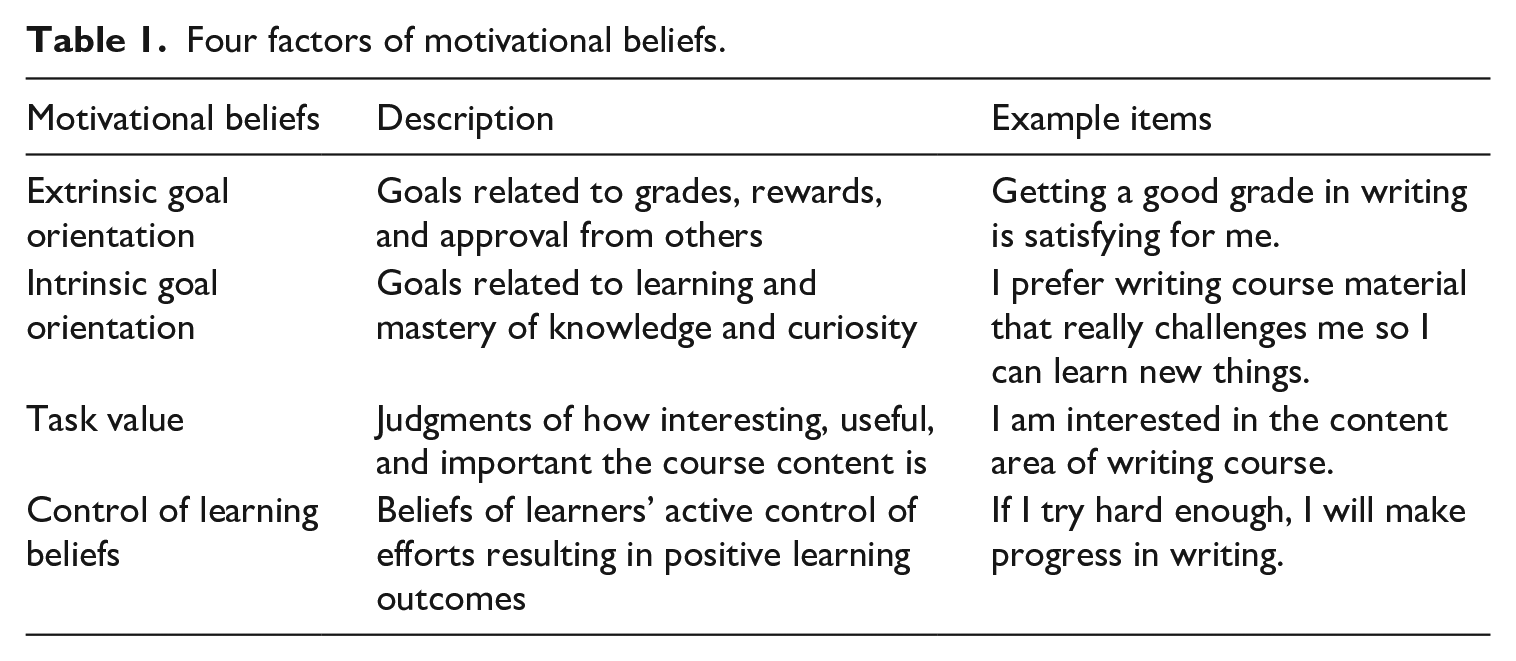
Confirmatory factory analysis (CFA) was applied to examine the psychometric properties of the adapted questionnaire. CFA is a reliable and valid method for assessing theory-driven, hypothesized models (Kline, 2010). Informed by literature (Pintrich et al., 1991), CFA was used to examine the four-factor correlated structure of motivational beliefs using the maximum likelihood (ML) estimator. The ratio of chi-square to its degree of freedom (χ2/df), the root mean square error of approximation (RMSEA), the standardized root mean square residual (SRMR), the comparative fit index (CFI), and the Tucker–Lewis index (TLI) were employed to measure the overall goodness-of-fit of the model (Kline, 2010). Specifically, a decent model fit should meet the following criteria: χ2/df < 3, RMSEA < .08, SRMR < .07; CFI > .90, and TLI > .90 (Hair Jr. et al., 2014). The internal reliability of the adapted questionnaire was examined by Cronbach’s alpha. Overall, the model fit was satisfactory (χ2 = 359.45; df = 156; χ2/df = 2.30; p < .001; TLI = .93; CFI = .93; RMSEA = .060, 95% CI [.057, .065]; SRMR = .064). Internal coefficient values of the four factors were all above the benchmark value of .70 (extrinsic goal orientation α = .81; intrinsic goal orientation α = .83; task value α = .80; control of learning beliefs α = .79).
b Second language writer self-efficacy
This study used the Second Language Writer Self-efficacy Scale (L2WSS) which was designed to evaluate the multi-dimensional structure of self-efficacy in ESL/EFL writing (Teng et al., 2018). The development of the L2WSS was informed by socio-cognitive theory and self-regulation theory, embracing 20 items to evaluate linguistic self-efficacy, self-regulatory efficacy, and performance self-efficacy. The three sub-factors are summarized with example statements in Table 2.
Three sub-factors of self-efficacy in the Second Language Writer Self-efficacy Scale.
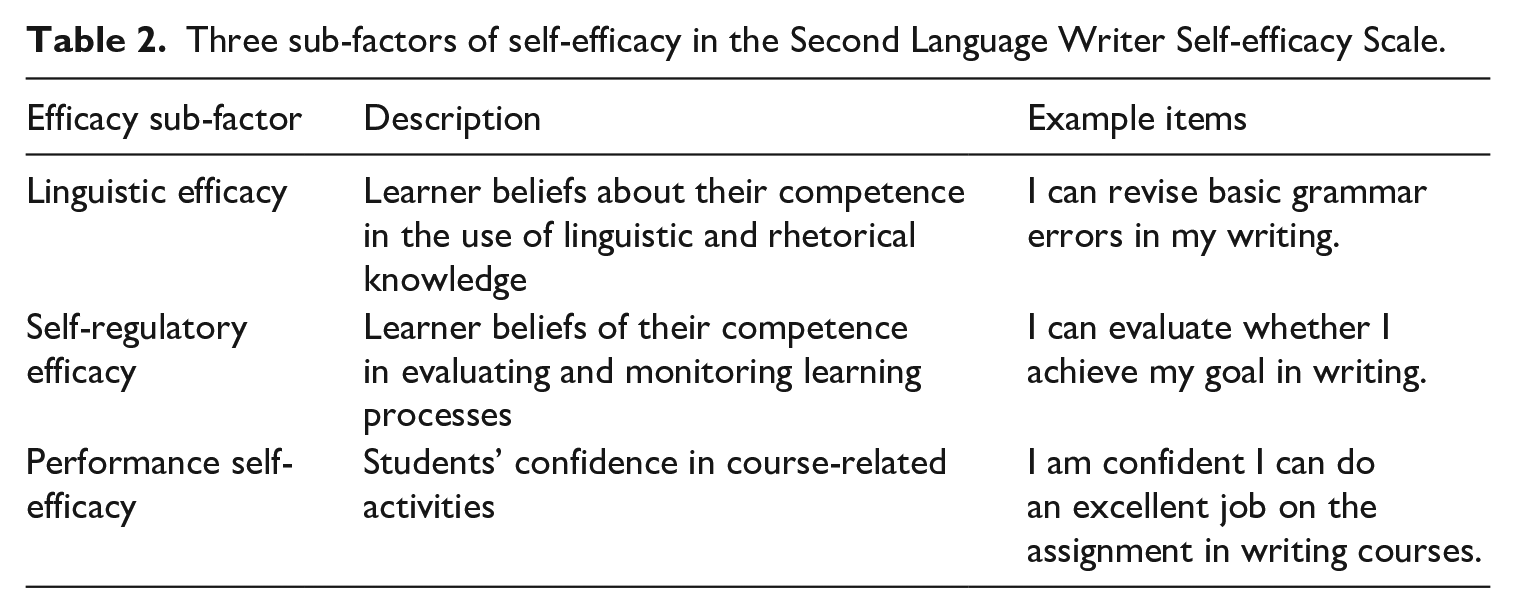
The psychometric properties of the three-factor correlated structure were evaluated. CFA results revealed an acceptable model fit (χ2 = 321; df = 116; χ2/df = 2.76; p < .001; TLI = .91; CFI = .92; RMSEA = .069, 95% CI [.060, .078]; SRMR = .062). The internal reliability coefficients for the three factors were above the benchmark value of .70: linguistic self-efficacy α = .83; self-regulatory efficacy α = .82; performance self-efficacy α = .84. Appendix 2 provides a descriptive analysis of the three factors of self-efficacy.
c The writing strategies for self-regulated learning questionnaire
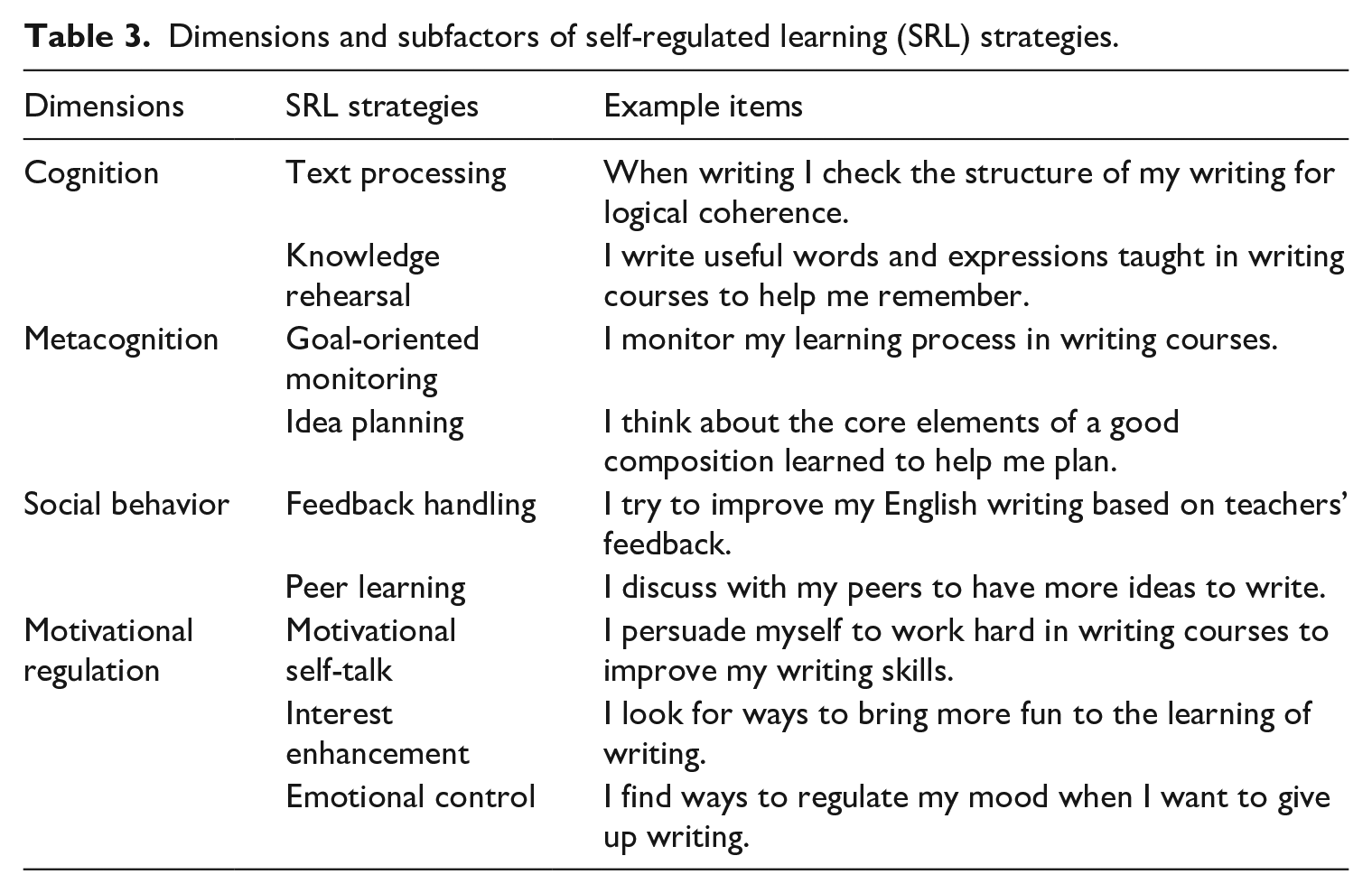
The Writing Strategies for Self-regulated Learning Questionnaire (WSSRLQ) is a pioneer measurement designed to assess four dimensions of SRL strategies including cognition, metacognition, behaviors, and motivational regulation in second/foreign language writing (Teng & Zhang, 2016a). There are 40 items assessing nine types of SRL strategies, summarized in Table 3 below. Overall, the nine factor correlated model revealed an satisfactory model fit (χ2 = 1173.273; df = 627; χ2/df = 1.87; p < .001; TLI = .93; CFI = .94; RMSEA = .054, 95% CI [.048, .059]; SRMR = .055). The internal reliability coefficient values range from .73 for idea planning to .90 for motivational self-talk. Appendix 3 lists the complete items of the nine SRL strategies.
Dimensions and subfactors of self-regulated learning (SRL) strategies.
3 Data analysis
This study used multiple-regression analyses to evaluate how motivational beliefs and self-efficacy predicted different dimensions of SRL strategies in EFL writing. Multiple regression analysis is a powerful technique used for predicting the unknown value of a variable from the known value of two or more variables (predictors) (Raykov & Marcoulides, 2008). Simultaneous regression, in which all variables are added into the regression equation, was applied. The aim of this study is to depict a detailed investigation of how motivational beliefs and self-efficacy with their sub-factors respectively worked on each type of SRL strategies rather than their interactive and confounding effects. Two independent regression models were proposed and the independent variables in each model are listed as follows:
Model 1: task value, intrinsic goal orientation, extrinsic goal orientation, and control of learning beliefs;
Model 2: linguistic self-efficacy, performance self-efficacy, and self-regulatory efficacy
The dependent variables are the nine types of SRL strategies including cognitive strategies (text processing and knowledge rehearsal), metacognitive strategies (idea planning and goal-oriented monitoring), social behavioral strategies (peer learning and feedback handling), and motivational regulation strategies (interest enhancement, motivational self-talk, and emotional control).
Assumptions of multiple regression analysis were first examined in terms of sample size, linear relationship, multivariate normality, multicollinearity, and homoscedasticity. Correlations of predictors (independent variables) were examined for checking multicollinearity.
IV Results
1 Correlations of SRL strategies, motivational beliefs, and self-efficacy
Results of bivariate correlations showed that SRL strategies were significantly correlated with most sub-factors of motivational beliefs (see Table 4). With respect to cognitive strategies, text processing was moderately correlated with task value (r = .314) and intrinsic goal orientation (r = .348) while knowledge rehearsal was only significantly correlated with task value (r = .300). Similarly, two types of metacognitive strategies had moderate correlations with task value and intrinsic goal orientation. As expected, motivational regulation strategies were positively correlated with the four components of motivational beliefs. Specifically, motivational self-talk strategy was strongly correlated with task value (r = .526) and moderately correlated with intrinsic goal orientation (r = .454) and extrinsic goal orientation (r = .451) as well as control of learning beliefs (r = .399). Feedback handling as a type of social behavior strategies had moderate correlations with task value (r = .326) and control of learning beliefs (r = .308).
Correlations of self-regulated learning (SRL) strategies with motivational beliefs and self-efficacy.
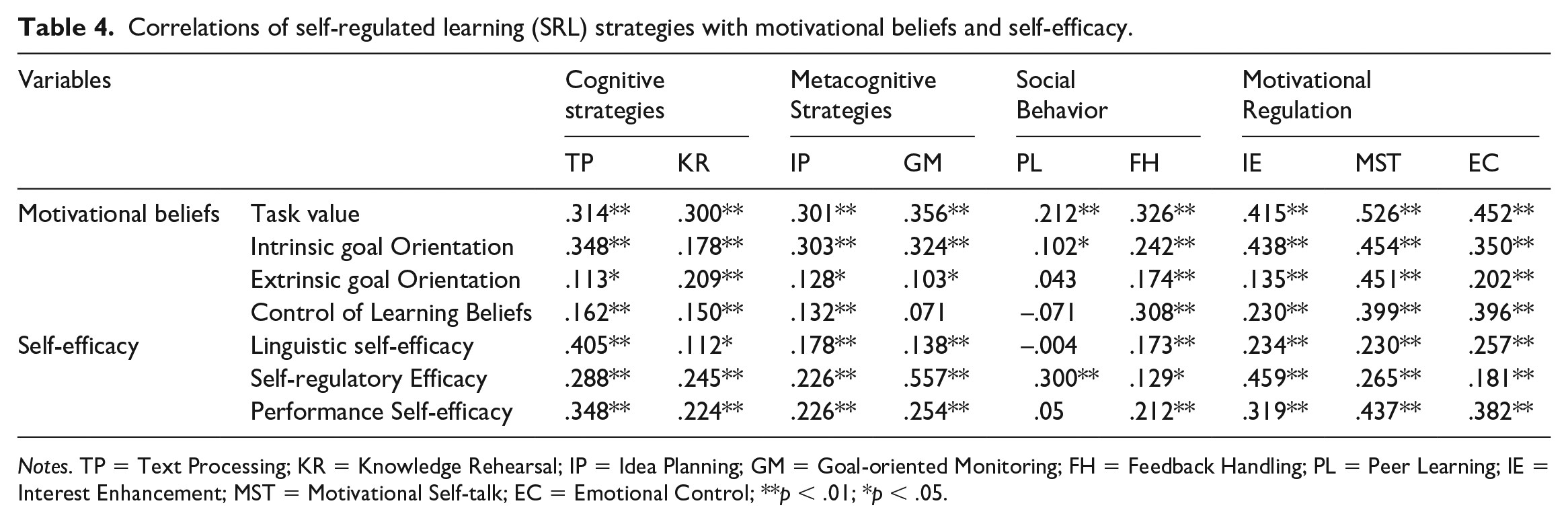
Notes. TP = Text Processing; KR = Knowledge Rehearsal; IP = Idea Planning; GM = Goal-oriented Monitoring; FH = Feedback Handling; PL = Peer Learning; IE = Interest Enhancement; MST = Motivational Self-talk; EC = Emotional Control; **p < .01; *p < .05.
Table 4 also shows that cognitive strategies, metacognitive strategies, and motivational regulation strategies had small to moderate correlations with the three sub-factors of self-efficacy beliefs. The highest correlation was between goal-oriented monitoring and self-regulatory efficacy (r = .557) and the lowest was between knowledge rehearsal and linguistic self-efficacy (r = .112). For social behavior strategies, feedback handling was significantly related to the three factors of self-efficacy beliefs with trivial effect sizes, but peer learning only had a significant, moderate correlation with self-regulatory efficacy.
2 Predictive effects of individual differences in multiple dimensions of SRL strategies
a To what extent do motivation beliefs predict SRL strategies?
Multiple regressions showed that together, the four components of motivational beliefs explained a substantial amount of the variance in each of the SRL variables ranging from 14.5% for idea planning to 44.6% for motivational self-talk. For cognitive strategies, motivational beliefs explained 16.9% of the variance for text processing F (4, 388) = 15.630, p < .001, R2 = .169 and 13.9% of the variance for knowledge rehearsal F (4, 388) = 12.416, p < .001, R2 = .139. For each individual predictor, only intrinsic goal orientation and task value had significant effects on text processing (βtask value = .288, p < .001; βintrinsic goal = .207, p < .001) and knowledge rehearsal (βtask value = .267, p < .001; βintrinsic goal = .112, p = .003) respectively.
Regarding metacognitive strategies, motivational beliefs overall explained 13.3% of the variance for idea planning F (4, 388) = 11.771, p < .001, R2 = .133 and 23.5% of the variance for goal-oriented monitoring F (4, 388) = 23.595, p < .001, R2 = .235. Intrinsic goal orientation (β = .212, p < .001) and task value (β = .207, p < .001) both had similar predictive effects on idea planning. For goal-oriented monitoring, task value (β = .350, p < .001) made a large contribution, followed by intrinsic goal orientation (β = .196, p < .001).
In terms of social behavior strategies, motivational beliefs explained 16.7% of the variance for peer learning F (4, 388) = 23.637, p < .001, R2 = .167. Task value (β = .239, p < .001) generated a positive effect on peer learning while control of learning (β = -.144, p < .01) had a negative effect on that strategy. Motivational beliefs accounted for 15.2% of the variance in feedback handling F (4, 388) = 13.778, p < .001, R2 = .152 while only task value (β = .228, p < .001) had a significant predictive effect.
Regarding the motivational regulation strategies, motivational beliefs as a whole had a large statistical power on motivational self-talk, explaining 44.8% of the variance F (4, 388) = 64.423, p < .001, R2 = .448. Specifically, task value (β = .506, p < .001) had a strong predictive effect on motivational self-talk, followed by extrinsic goal orientation (β = .155, p = .001) and intrinsic goal orientation (β = .119, p = .006).
For interest enhancement strategies, motivational beliefs explained 29.7% of the variance F (4, 388) = 32.293, p < .001, R2 = .297, in which both intrinsic goal orientation (β = .360, p < .001) and task value (β = .308, p < .001) had analogous positive effects. Regarding emotional control strategies, 26.3% of the variance was explained by the four components of motivational beliefs F (4, 388) = 23.462, p < .001, R2 = .263. Intrinsic goal orientation (β = .156, p = .002), task value (β = .297, p < .001) and control of learning (β = .234, p < .001) had significant, predictive effects on emotional control.
b To what extent do sub-factors of self-efficacy predict SRL strategies?
For cognitive strategies, three dimensions of self-efficacy beliefs together explained 20.8% of the variance for text processing F (3, 384) = 32.125, p < .001, R2 = .208. Linguistic self-efficacy was a powerful predictor of text processing (β = .293, p < .01), followed by performance self-efficacy (β = .139, p = .016) and self-regulatory efficacy (β = .140, p = .007). However, self-efficacy beliefs as a group only predicted a small amount of the variance for knowledge rehearsal F (3, 384) = 10.229, p < .001, R2 = .077.
For metacognitive strategies, self-efficacy beliefs provided a large amount of the variance for goal-oriented monitoring F (3, 384) = 55.619, p < .001, R2 = .312 but only a minimal amount of the variance for idea planning F (3, 384) = 9.875, p < .001, R2 = .075. Regarding each individual predictor, only self-regulatory efficacy (β = .352, p < .001) had significant, predictive effects on goal-oriented monitoring (β = .556, p < .001) and idea planning (β = .152, p = .009).
Regarding social behavior strategies, self-efficacy beliefs explained a small amount of the variance for peer learning F (3, 384) = 14.032, p < .001, R2 = .103 and feedback handling F (3, 384) = 6.694, p < .001, R2 = .052. Specifically, only self-regulatory self-efficacy (β = .352, p < .001) had a significant effect on peer learning while performance self-efficacy generated a small effect on feedback handing (β = .152, p = .0059).
In terms of motivational regulation strategies, self-efficacy beliefs accounted for different variances in interest enhancement F (3, 384) = 36.635, p < .001, R2 = .230, motivational self-talk F (3, 384) = 33.230, p < .001, R2 = .198, and emotional control F (3, 384) = 21.913, p < .001, R2 = .152. For each predictor, performance self-efficacy produced significant, strong effects on motivational self-talk (β = .384, p < .001) and emotional control (β = .384, p < .001). Self-regulatory efficacy was a strong predictor of interest enhancement (β = .384, p < .001).
V Discussion
This study found that EFL students’ motivational beliefs and self-efficacy were closely related to different dimensions of SRL strategies. Among these variables, task value and intrinsic goal orientation had significant moderate correlations with cognitive and metacognitive strategies. This suggests that students who approach their course work with an intrinsic goal for learning or who believe that the course material is interesting and important, tend to use cognitive and metacognitive strategies in EFL writing. Similar results were also reported in other learning environments such as ESL (e.g. Bai & Wang, 2020; 2021) and general learning contexts (Lyke & Kelaher Young, 2006; Pintrich et al., 1993). As a factor of social behavior strategies, feedback handling was reported having a moderate correlation with task value. This indicates that if a learner places more value in a writing task, she/he would be more likely to take consideration of peers’ or teachers’ feedback on their written text. Lending support to the previous research (e.g. Teng & Zhang, 2018; Wolters & Rosenthal, 2013), this study revealed that motivational regulation strategies had moderate correlations with task value and intrinsic goal orientation. This might be attributed to the features of motivational regulation strategies, which were designed to elicit learners’ use of intrinsic and task-related strategies to regulate their learning behavior (e.g. increasing learning interest, self-motivation, and active regulation of negative emotions). Also evident are findings that three sub-factors of self-efficacy (i.e. linguistic self-efficacy, self-regulatory efficacy, and performance self-efficacy) were significantly correlated with SRL strategies. This indicates that learners’ confidence in their linguistic, self-regulatory, and performance competence might generate motivational support for their cognitive engagement, metacognitive control, and motivational regulation when completing a writing task (Kim et al., 2015 Teng & Zhang, 2020).
Motivational beliefs as a whole had significant predictive effects on each of the nine SRL strategies. This indicates that the way students reflect and interpret their own motivation directly impacts their use of SRL strategies. These findings provide empirical support for the contention that higher-level motivation is a prerequisite for using SRL strategies (Schunk & Zimmerman, 2008). Task value was a significant predictor of all the nine SRL strategies. This means that students who add more value to their learning tasks and/or highlight their desire to have a better task performance tend to use a wide range of SRL strategies such as a) using linguistic and rhetorical knowledge to generate a text for a writing task; b) actively remembering the writing knowledge learned in the writing course; c) using different ways or resources to generate more ideas for writing; d) setting up task goals and evaluating performance and achievement. They might also actively engage in peer interactions and use different strategies to make a task more fun or use goal-directed self-statements to increase or sustain their learning efforts. Evidently, task value positively fosters learners’ strategic behaviors and their active deployment of SRL strategies (Pintrich, 2004).
Intrinsic goal orientation was another salient predictor of cognitive, metacognitive, and motivational regulation strategies. This indicates that EFL writers intrinsic goals (e.g. learning for challenge, curiosity or mastery) produce a strong impetus for their strategic learning. According to Deci and Ryan (1985), human beings naturally look for what evokes their interest and attempt to overcome the challenges they encounter, the function of which drives and promotes a self-initiated or self-determined behavior.
Control of learning beliefs was an individual predictor of emotional control but negatively predicted peer learning strategies. As mentioned earlier, this type of motivational beliefs reflects a socio-cognitive view of learning, which emphasizes how individuals use their own agency to control learning processes (Winne & Hadwin, 2010). Therefore, students who feel capable of controlling their academic performance are more likely to enact appropriate strategies as needed, such as deploying different ways to regulate their negative emotion rather than seeking help from others (e.g. peers) (Teng & Zhang, 2020). As Zimmerman and Risemberg (1997) explained, self-regulation ‘[interacts] reciprocally via a cyclic feedback loop through which writers self-monitor and self-react to feedback about the effectiveness of specific self-regulatory techniques or processes’ (p. 73).
Regression analyses further revealed that writing self-efficacy beliefs, as a whole, produced significant predictive effects on SRL strategies. This indicates that a key determinant of whether learners can actively regulate their learning rests in their perceptions of capacities. This study also revealed that students’ self-efficacy beliefs exerted more effort on metacognition, cognition, and motivational regulation but less on behavior strategies in social contexts. As an integrated construct, the perceived self-efficacy was a significant predictor for metacognitive strategies in EFL writing. Such findings are somewhat aligned with previous studies. For instance, Bai and Wang (2020) found that along with growth mindset and intrinsic value, self-efficacy was a significant predictor of metacognitive strategies (monitoring, effort regulation, goal setting and planning) for Hong Kong primary students in ESL environments. However, Wolters and Rosenthal (2000) collected data from eighth-grade students in the southern United States and reported that learners’ self-efficacy was not significantly related to motivational regulation strategies in math class. However, these mixed findings are more understandable in light of the dynamic and contextual-situated nature of self-efficacy (Bandura, 1997; Pajares, 2008). In other words, learners’ judgments of their learning outcomes is under the influence of social variables (e.g. age, learning context, and subject) and learning behavior (e.g. types of SRL strategies), and psychological factors (e.g. goal setting) (Zimmerman & Schunk, 2008).
Self-regulatory efficacy was a significant predictor of five types of SRL strategies that included knowledge rehearsal, goal-oriented monitoring, idea planning, peer learning, and interest enhancement. The factor had a strong predictive power on goal-oriented monitoring, revealing that self-efficacy in metacognitive monitoring and evaluation is closely linked to task-related learning goals (Wolters & Rosenthal, 2000). Performance self-efficacy made predictive contributions to knowledge rehearsal, feedback handling, motivational self-talk, and emotional control. As noted earlier, performance self-efficacy included students’ judgments about their abilities to accomplish a task and their confidence in their skills to perform that task. This means that the stronger students perceive their self-efficacy for completing tasks, the firmer they commit to them by using various ways to relieve the cognitive burden and regulate their affect to sustain learning efforts. Also notable is the significant predictive effect of performance self-efficacy on motivational self-talk and emotional control. Results indicate that learners who have a strong sense of confidence in learning tasks tend to devote more time and effort to regulating their motivation. These successful experiences might help learners accumulate more confidence in completing the tasks. This finding adds evidence to the notion that enactive experience is an essential source of students’ self-efficacy (Zimmerman, 2000).
It should be noted that linguistic self-efficacy only made a significant contribution to text processing. As aforementioned, this factor explored students’ judgments of their capabilities to retrieve words from long-term memory, to use appropriate syntax to express ideas, and to follow discourse requirements for the production of composing. This may explain why this sub-factor of self-efficacy generated a significant effect on cognitive strategies (i.e. text processing) rather than other dimensions of SRL strategies. Another possible reason is the confounding effect on the factorial structure of self-efficacy in the regression model, in which self-regulatory efficacy and performance efficacy exerted influential contributions to other dimensions of SRL strategies. Thus the effect of linguistic self-efficacy might become waned. However, such a finding does not undermine the essential role of linguistic self-efficacy in promoting writing performance and self-regulatory processes. Aligned with this view, Teng et al. (2018) reported that linguistic self-efficacy had a significant predictive effect on writing performance and Bai and Guo (2018) posited that the use of SRL strategies had significant and positive relationships with students’ self-efficacy.
VI Conclusions
This study, framed within socio-cognitive theory, empirically investigated the predictive effect of motivational beliefs and self-efficacy on different dimensions of SRL strategies in EFL writing. Our data reveal that expectancy, value, and goal orientation serve as a prerequisite for SRL strategy use, which contributes to the development of strategic self-regulated writers. Thus this study lends empirical support to Zimmerman’s (2013) characteristics of self-regulated learners who ‘set superior goals proactively, monitor their learning intentionally, use strategies effectively, . . . and are more motivated to sustain their efforts to learn’ (p. 135). The significant correlations between intrinsic motivation and goal-related monitoring strategies render support for the contention that self-regulated strategic writing should be motivated with goal orientation (Dörnyei, 2006). Furthermore, the different relationships between self-efficacy and SRL strategies reveal that self-efficacy is a generative capability in which cognitive, motivational, emotional, and behavioral skills must be organized to serve various purposes (Bandura, 1997). In brief, the varying correlations and predictive relationships between these variables indicate that strategic behavior is a complex process under the influence of individual differences (Boscolo & Hidi, 2007; Zhang, 2013).
1 Pedagogical implications
This empirical study has some significant implications for writing instruction. First, it is important for language educators and practitioners to understand how motivational factors influence learners’ strategic learning so that they can tailor and redesign writing instruction with the consideration of individual differences and targeted SRL strategies for optimizing pedagogical effectiveness and making language learning and teaching enjoyable (Kim et al., 2015). This study further indicates that students’ motivational beliefs and self-efficacy provide a motivational base for their engagement in academic learning. Thus, it is necessary for practitioners and researchers to take learners’ motivational differences into consideration when they implement strategies-based writing instruction (Teng & Zhang, 2020). Given the essential role of task value and goal orientation, students should be provided with personally challenging, meaningful, and interesting tasks throughout writing instruction to increase their intrinsic task value. Meanwhile, language teachers are advised to implement different goal-directed activities to help students set up task-related goals and then model how to use metacognitive strategies to evaluate and monitor their performance during the learning-to-write process.
Another important pedagogical implication is that classroom teachers are encouraged to cultivate students’ linguistic and self-regulatory efficacy during the strategies-based writing instruction to promote effective and proactive learners. For example, it is recommended that teachers and practitioners implement collaborative learning activities such as peer interactions and peer discussions to relieve students’ cognitive load in using linguistic knowledge for producing and revising written products. Meanwhile teachers are encouraged to help students develop high levels of self-efficacy beliefs by providing them with appropriate feedback on their performance. Teachers, for instance, are suggested to evaluate students’ course performance positively by recognizing students’ efforts and improvements (Bai & Wang, 2020; Teng et al., 2018).
2 Limitations and future directions
Some limitations in this study should be noted along with recommendations for future research. First, the study sample was selected from a group of undergraduate students in four Chinese universities; thus the results cannot be generalized to other groups of population such as younger learners in China. Future studies are recommended to include students from different age groups, which may help elicit information about how these predictive relationships change across age and year levels. Secondly, the validity of self-reported questionnaire has been challenged in empirical psychology. It is suggested that conducting actual observations, behavioral measures, or microanalysis of SRL strategies would provide rich data for revealing self-regulatory processes (Cleary, Callan, & Zimmerman, 2013; Zhang, Thomas, & Qin, 2019).
Supplemental Material
sj-pdf-1-ltr-10.1177_13621688211006881 – Supplemental material for Individual differences in self-regulated learning: Exploring the nexus of motivational beliefs, self-efficacy, and SRL strategies in EFL writing
Supplemental material, sj-pdf-1-ltr-10.1177_13621688211006881 for Individual differences in self-regulated learning: Exploring the nexus of motivational beliefs, self-efficacy, and SRL strategies in EFL writing by Lin Sophie Teng in Language Teaching Research
Footnotes
Appendix
Descriptive analysis of the Writing Strategies for Self-regulated Learning Questionnaires (WSSRLQ).
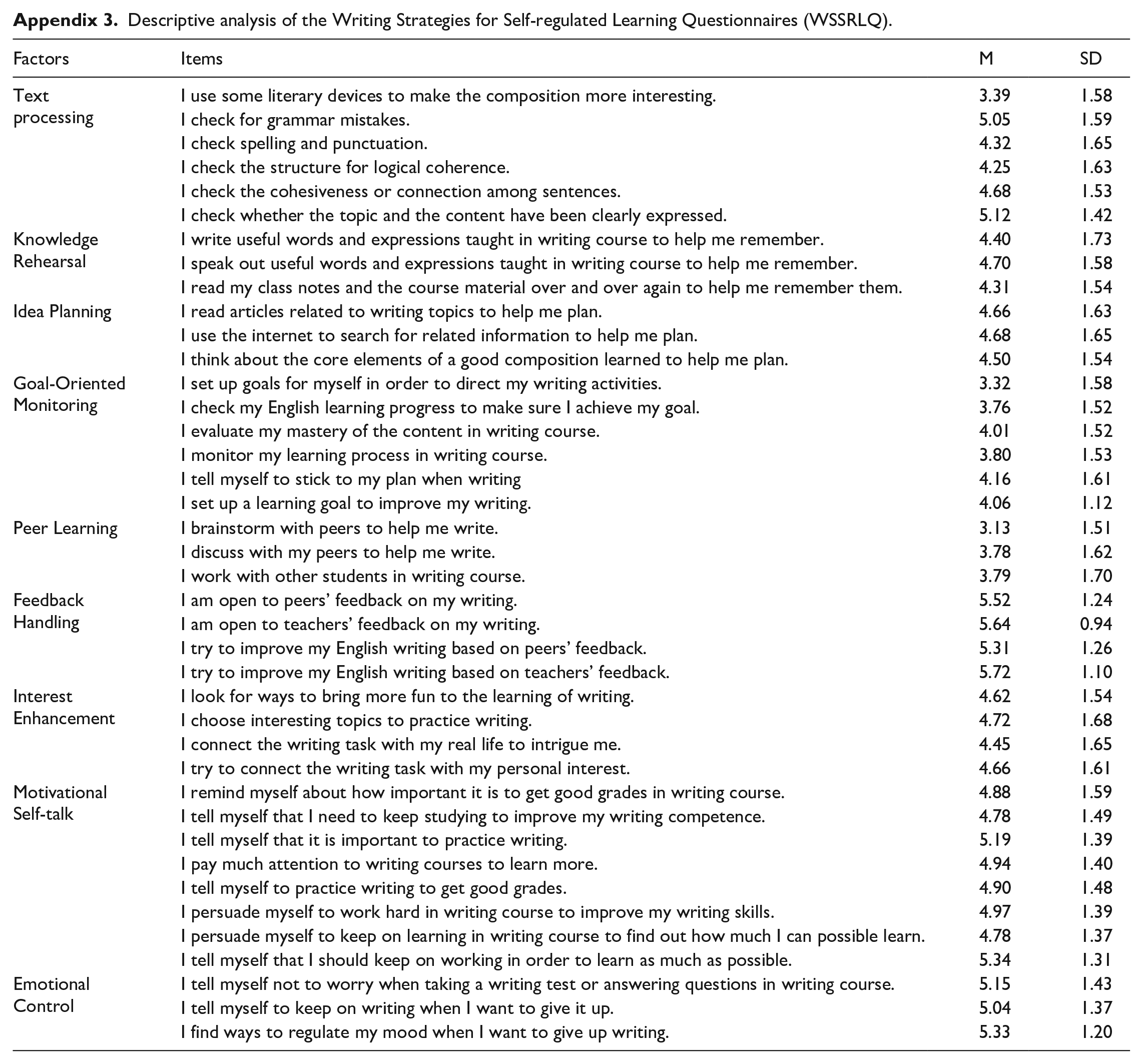
| Factors | Items | M | SD |
|---|---|---|---|
| Text processing | I use some literary devices to make the composition more interesting. | 3.39 | 1.58 |
| I check for grammar mistakes. | 5.05 | 1.59 | |
| I check spelling and punctuation. | 4.32 | 1.65 | |
| I check the structure for logical coherence. | 4.25 | 1.63 | |
| I check the cohesiveness or connection among sentences. | 4.68 | 1.53 | |
| I check whether the topic and the content have been clearly expressed. | 5.12 | 1.42 | |
| Knowledge Rehearsal | I write useful words and expressions taught in writing course to help me remember. | 4.40 | 1.73 |
| I speak out useful words and expressions taught in writing course to help me remember. | 4.70 | 1.58 | |
| I read my class notes and the course material over and over again to help me remember them. | 4.31 | 1.54 | |
| Idea Planning | I read articles related to writing topics to help me plan. | 4.66 | 1.63 |
| I use the internet to search for related information to help me plan. | 4.68 | 1.65 | |
| I think about the core elements of a good composition learned to help me plan. | 4.50 | 1.54 | |
| Goal-Oriented Monitoring | I set up goals for myself in order to direct my writing activities. | 3.32 | 1.58 |
| I check my English learning progress to make sure I achieve my goal. | 3.76 | 1.52 | |
| I evaluate my mastery of the content in writing course. | 4.01 | 1.52 | |
| I monitor my learning process in writing course. | 3.80 | 1.53 | |
| I tell myself to stick to my plan when writing | 4.16 | 1.61 | |
| I set up a learning goal to improve my writing. | 4.06 | 1.12 | |
| Peer Learning | I brainstorm with peers to help me write. | 3.13 | 1.51 |
| I discuss with my peers to help me write. | 3.78 | 1.62 | |
| I work with other students in writing course. | 3.79 | 1.70 | |
| Feedback Handling | I am open to peers’ feedback on my writing. | 5.52 | 1.24 |
| I am open to teachers’ feedback on my writing. | 5.64 | 0.94 | |
| I try to improve my English writing based on peers’ feedback. | 5.31 | 1.26 | |
| I try to improve my English writing based on teachers’ feedback. | 5.72 | 1.10 | |
| Interest Enhancement | I look for ways to bring more fun to the learning of writing. | 4.62 | 1.54 |
| I choose interesting topics to practice writing. | 4.72 | 1.68 | |
| I connect the writing task with my real life to intrigue me. | 4.45 | 1.65 | |
| I try to connect the writing task with my personal interest. | 4.66 | 1.61 | |
| Motivational Self-talk | I remind myself about how important it is to get good grades in writing course. | 4.88 | 1.59 |
| I tell myself that I need to keep studying to improve my writing competence. | 4.78 | 1.49 | |
| I tell myself that it is important to practice writing. | 5.19 | 1.39 | |
| I pay much attention to writing courses to learn more. | 4.94 | 1.40 | |
| I tell myself to practice writing to get good grades. | 4.90 | 1.48 | |
| I persuade myself to work hard in writing course to improve my writing skills. | 4.97 | 1.39 | |
| I persuade myself to keep on learning in writing course to find out how much I can possible learn. | 4.78 | 1.37 | |
| I tell myself that I should keep on working in order to learn as much as possible. | 5.34 | 1.31 | |
| Emotional Control | I tell myself not to worry when taking a writing test or answering questions in writing course. | 5.15 | 1.43 |
| I tell myself to keep on writing when I want to give it up. | 5.04 | 1.37 | |
| I find ways to regulate my mood when I want to give up writing. | 5.33 | 1.20 |
Funding
The author disclosed receipt of the following financial support for the research, authorship, and/or publication of this article: This work was supported by the National Social Science Fund of China under Grant 18BYY108 and the Fundamental Research Funds for the Central Universities.

Supplemental material
Supplemental material for this article is available online.
References
Supplementary Material
Please find the following supplemental material available below.
For Open Access articles published under a Creative Commons License, all supplemental material carries the same license as the article it is associated with.
For non-Open Access articles published, all supplemental material carries a non-exclusive license, and permission requests for re-use of supplemental material or any part of supplemental material shall be sent directly to the copyright owner as specified in the copyright notice associated with the article.
