







Abstract
With the large increase in online English language learners, there is a need to explore how those learners practise self-regulated writing in such an autonomous learning context. This article reports on an exploratory study of self-regulated learning strategies used by two writing-proficiency groups (low and high) of Saudi English majors within an online context. Data were collected from a total of 50 (high proficiency = 23 and low proficiency = 27) students using video-stimulated recall of two online writing tasks. Quantitative analysis of the students’ stimulated recall data revealed that students in both proficiency groups used 11 self-regulated strategies to complete the two online writing tasks. Results also revealed a positive correlation between self-regulated learning strategy use and the students’ writing proficiency level. The chi-square test analysis revealed statistically significant differences between the two groups in six strategies overall favouring the high writing-proficiency group. Further qualitative analysis of the stimulated recall data within the framework of sociocognitive theory revealed that the high proficiency students stood out from their low-proficiency counterparts in how they self-regulated their personal, behavioural, and environmental processes. Implications for writing instruction to improve students’ writing performance in online learning contexts and future self-regulated writing strategy research are discussed.
Keywords
I Introduction
Accessibility and mobility of digital resources have taken the composing process to a whole new level of autonomous learning through supporting second language (L2) students’ needs to overcome linguistic challenges (automatically fixing vocabulary, grammar, and mechanics mistakes) and clearly communicate planned ideas and thoughts (Leacock et al., 2006). This constitutes a totally different learning context from the conventional writing classroom (Barnard et al., 2009; Yen et al., 2018). In this open, non-linear, and self-paced context Learners typically have more autonomy and control over their learning process. Learner autonomy pertains to learners’ ability to set learning goals, develop learning plans, find supporting resources, and self-evaluate (Moore, 2007). This indicates that practising autonomy encompasses metacognitive processes, strategic competencies, and decision making (Hurd et al., 2001), which in turn calls upon the employment of self-regulatory processes (An et al., 2020; Barnard et al., 2009). Jansen et al. (2020) stated that “when the learning process is less externally regulated (e.g. by the teacher), learners must then manage their learning to a greater extent” (p. 2).
Studies conducted in different online learning contexts revealed that employing self-regulated learning (SRL) strategies, including planning, self-monitoring, time management, and self-evaluation, enhances students’ academic performance and learning satisfaction (Lee et al., 2019; Teng & Zhang, 2020; Wong et al., 2019). Research also found that online self-regulation plays a significant role in students’ engagement, being cognitively, motivationally, and behaviourally involved in their learning processes (Zimmerman, 1998), regardless of the type of online learning (self-driven or course-driven) or types of learning activities (Kizilcec et al., 2017; Littlejohn et al., 2016). A recent study by Tao et al. (2020) revealed that low-engaged learners demonstrated limited knowledge and low level in employing online self-regulation strategies, including help-seeking, self-evaluation, and time management.
However, practising SRL online turned out to be challenging for students; many online learners flounder or fail to employ essential SRL strategies (Pedrotti & Nistor, 2019; Teng & Zhang, 2020; Wong et al., 2019), which would warrant them to understand and benefit from the educational tools of this context, monitor their needs, and accomplish their learning objectives (Jansen et al., 2020; Wandler & Imbriale, 2017). In this vein, Broadbent (2017) highlighted that the online learning environment, in contrast to traditional face-to-face environment, lacks several structures that motivate students to practise SRL and be on track with their learning such as having fixed times for study, where learners are expected to get involved in the content, and peer associations in and out of the class where students can discuss their learning with others. In the Saudi context, university students of English as a foreign language (EFL) often face more challenges in online learning due to their transition from general English paper-based writing at school to academic English online writing at university where they do almost all their writing assignments online (Alhujaylan, 2019). Moreover, the dominated classroom teacher-centred model with little opportunity for learner autonomy, lack of intrinsic motivation for EFL learning (Al-Seghayer, 2014; Liton, 2012), and L1 (Arabic) interference (Sabah, 2015) result in students’ feelings of incompetence, language anxiety, and poor or limited motivation for regulating their learning. (Khan, 2011). Within a post-Covid-19 world, where online learning has become an integral part of the teaching and learning process, students are required to master online self-regulation (Xu, 2021). Consequently, there is a persistent need for more exploratory studies to understand how EFL students self-regulate their writing process in an online context, in terms of the types of strategies used and how they are used (An et al., 2020; Leacock et al., 2006; Teng & Zhang, 2020).
Furthermore, most empirical studies that investigated the correlation between self-regulated strategies and the quality of the writing performance primarily relied on quantitative data, in the form of self-report questionnaires, with a shortage in connecting these data to actual performance measures (Oxford, 2017). The use of such questionnaire-based studies might fail to provide comprehensive insights into the dynamic nature of self-regulated writing processes and identify the actual self-regulatory strategies used in authentic writing tasks. Hence, more in-depth studies employing qualitative methods, such as stimulated recall, reflective journals, and interview, that capture the complexities of English language learners’ self-regulated writing strategies use in natural contexts are warranted (Pintrich, 2004; Teng & Zhang, 2020).
Aiming to extend knowledge on self-regulated writing strategies use in online context, the present study adopted a theoretical framework of sociocognitive perspectives of writing as shall be elaborated in Section II and used video stimulated recall to (a) identify precisely and describe objectively how Saudi English majors self-regulate their writing process in an online context; and (b) investigate any distinction in self-regulated writing strategies use based on the students’ writing-proficiency level (high vs. low). The findings of this study can contribute to L2 writing strategy research by exploring the multivariate nature of self-regulated writing processes in an online context and how differences in writing-proficiency may potentially affect students’ personal, behavioural, and environmental self-regulation processes. It can also provide writing instructors and course designers with evidence-based self-regulated writing strategies use that distinguish high writing-proficiency students. Thus, instructors may reflect on the differences among students in writing-proficiency levels and self-regulation abilities when designing online writing tasks that best match their learning needs. They can also design and implement online SRL interventions, with the aim of improving students’ online writing performance and academic outcomes.
II Theoretical framework
In the present study, the classification of self-regulated writing strategies was framed within Zimmerman and Risemberg’s (1997) sociocognitive model of self-regulation in L2 writing, which views self-regulated writing as a product of a reciprocal interacting influence of contextual and behavioural variables along with personal variable of thinking and transforming meaning, which in turn form a complex system of synergetic interrelated processes. According to this triadic model, writers strategically regulate the composing process via three general categories of self-regulation processes: personal self-regulation pertains to the adaptive employment of strategies for self-regulating one’s cognitive beliefs and affective aspects pertinent to writing, including goal setting and planning, organizing, and revising. Behavioural self-regulation relates to adaptive usage of strategies that writers use to self-regulate their observable motoric activities, such as self-monitoring and record-keeping. Environmental self-regulation refers to the adaptive application of strategies related to adjusting the writing physical and social settings including environmental structuring, and seeking information (Zimmerman & Risemberg, 1997).
Based on this sociocognitive view, scholars, and researchers (Graham & Harris, 2000; Harris et al., 2010; Zimmerman & Risemberg, 1997) identified various self-regulated writing strategies that enable writers to deliberately control over their own thoughts and behaviours, the composing process, and the writing environment (Usher & Schunk, 2018). Graham and Harris (2000) specified a group of 16 self-regulated writing strategies classified under the three sociocognitive categories of self-regulation processes as shown in Figure 1. A large meta-analysis study by Santangelo et al. (2016) revealed that these strategies received support from empirical research for their significance in improving the writing performance of L2 student writers. Consequently, the researcher adopted them in the coding scheme of the present study.
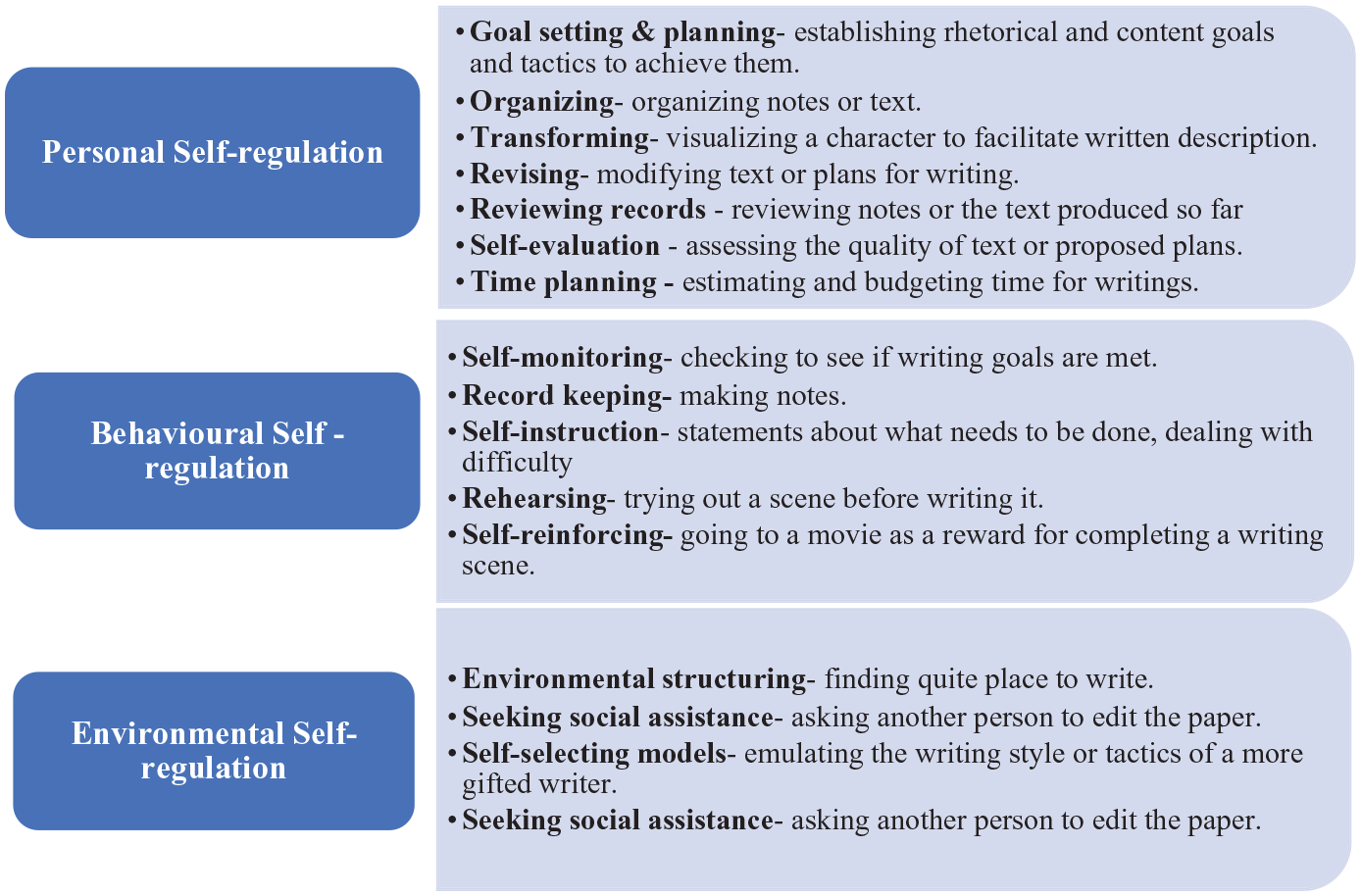
Self-regulated writing strategies.
Scholars in online education highlighted the significance of designing instruction based on learning theories that can assist in comprehending how students learn and how metacognitive and cognitive skills improve in online learning contexts (Barak, 2010; Johnson, 1997). Johnson (1997) underscored the need for a theoretical framework for investigating learners’ sociocognitive abilities in online learning context. Binali et al. (2021) also argued that investigating online learners’ behaviours should be closely linked to how they utilize metacognitive regulation. Literature review revealed that Zimmerman and Risemberg’s (1997) sociocognitive model has a hypothesized relevance to online learning context (Barak, 2010; Barnard et al., 2009; Binali et al., 2021). According to Jackson and Park (2020), since self-acquisition and adaptation of knowledge are defining conditions of success in autonomous online learning environments (White, 2008), this sociocognitive model offers an appropriate framework for online learning research through offering ‘insights into the functioning of autonomous learners’ (Jackson & Park, 2020, p. 2). Its concept of ‘triadic reciprocity’ can help in capturing a more comprehensive view of EFL students’ online writing self-regulation processes without overemphasizing the effect of the technology-rich environment on students’ personal and behavioural abilities. Consequently, an adopted framework based on Zimmerman’s model guided the present study procedures for analysing and interpreting research data in two levels as shall be elaborated in Section IV.
III Literature review
1 Research on self-regulated strategies and writing achievement
Emerging evidence supports that the active use and control of self-regulated strategies positively correlates with improvement in L2 students’ writing-proficiency level (Teng & Huang, 2018; Teng & Zhang, 2016). In their cross-sectional study, Teng and Zhang (2016) investigated self-regulated writing strategies used by a sample of 790 Chinese undergraduate EFL students. Findings revealed nine main strategies classified under four self-regulation dimensions (cognition, metacognition, motivation, and social behaviour); with one or more strategies of each dimension predicting writing test score. A similar study by Teng and Huang (2018), aimed to investigate the predictive effects of self-regulated writing strategies on EFL students’ writing proficiency and the personal features that can anticipate differences in self-regulated writing strategies use. Results identified seven self-regulated writing strategies (goal oriented and monitoring, motivational self-talk, text processing, idea planning (content planning), interest enhancement, course memory, and emotional control) that had significant effects on students’ writing proficiency. Results also reveal that students’ personal characteristics (gender, English learning experience, time commitment to writing, interest in learning English) influenced their use of SRL strategies.
Comparing the performance of skilled and less-skilled writers, some researchers contended that skilled writers employ a variety of self-regulation strategies more than less-skilled writers which in turn has a significant effect on their writing performance (Bai et al., 2014; Harris, et al., 2010; Sasaki, 2000). Some other researchers proposed that ‘there are no good or bad strategies’ (Anderson, 2005, p. 762), and good strategies depend on the way writers implement and adapt them (Lei, 2016; Sun & Wang, 2020; Teng & Huang, 2018). For example, Manchon and De Larios’s (2007) study found that skilled writers were inclined to assign more time for constructing their textual and ideational representations before typing as well as integrating them in their text than their less-skilled counterparts. A recent study by Teng et al. (2020) investigated the relationship between EFL writing proficiency levels and use of motivational regulation strategies among 389 Chinese undergraduates. Quantitative data analysis revealed that students with high-writing proficiency used more self-talk, interest enhancement, and emotional control than their counterparts of the low-proficiency group. Qualitative data also confirmed that high writing-proficiency students showed more flexibility and maturity in utilizing these strategies. In this regard, Graham (2006) stressed the importance of understanding how skilled writers apply self-regulation strategies while writings and pinpointing the factors that may interfere with employing certain patterns of these strategies.
L2 writing research revealed that learner’s personal traits, including motivation, self-efficacy, and readiness to employ learning strategies, can impact their usage of self-regulated writing strategies (Teng, 2021; Teng & Huang, 2018). A questionnaire-based study by Teng (2021) examined the predictive impact of self-efficacy and motivational beliefs on various dimensions of self-regulated writing strategies among Chinese EFL undergraduates. Findings revealed that motivational beliefs, including task value and intrinsic goal orientation, had significant predictive effects on nine self-regulated writing strategies sub-factors, and self-regulation efficacy had a significant effect on a set of self-regulation strategies, including idea planning, goal-oriented monitoring, and interest enhancement, while linguistic self-efficacy had a strong predictive effect only on text processing.
Research have also highlighted the significant effect of contextual factors on employing self-regulated writing strategies; students sometimes choose either to apply major domain or specific strategies to fulfil a certain goal based on the available sources and facilities (Harris, Santangelo & Graham, 2010). A study by Kaplan et al. (2009) investigated differences in using 14 self-regulated writing strategies among EFL students from various educational contexts; findings showed that contextual factors had a significant role in making the use of specific strategies more pertinent for students’ engagement to pursue certain goals. A study by Csizér and Tankó (2017) on 222 English majors from different Hungarian universities revealed that though self-regulation strategy use was linked to enhanced levels of self-efficacy and motivation, there was no insignificant correlation between writing performance and self-regulation. Though contradicting with the results of the studies mentioned earlier (Teng & Huang, 2018; Teng & Zhang, 2016), this result supports the critical role of contextual factors that may interfere with the self-regulation effect on EFL writing. Hence, it is incongruous to neglect the effect of the context when investigating self-regulated writing strategies. based on the previous analyses, it can be noted that almost all L2 self-regulation studies focused mainly on examining self-regulated writing strategies used in classroom contexts. It remains unclear how L2 students regulate their writing in an online context, and how their writing-proficiency level affects their use of these strategies.
2 Computer-assisted writing vs. pen-and-paper writing settings
With the prevailing use of the computer as the leading medium for academic writing, the word processor has altered the conception of drafting, redrafting, and revising through its special functions of flexible manipulation of texts, including grammar and spelling checkers, and block moving/deleting (Barkaoui, 2016; Gánem-Gutiérrez & Gilmore, 2018). Several L2 writing studies in the last two decades have distinctly studied the shift from paper-and-pencil to the keyboard by comparing the differences in the quality of writing (Cheung, 2016; Lee, 2004; Li, 2006) and revision-practices (Barkaoui, 2016; Xu, 2018) between the two modes. Nonetheless, these studies have reached mixed results. While some studies showed that computer-assisted writing resulted in higher revision levels (Barkaoui, 2016; Xu, 2018), a study by Li (2006) indicated that revisions of students who used the word processors were at a superficial level. In this vein, a study by West et al. (2006) highlighted that it is not environmental factors or students’ characteristics but their behaviours (learning strategies) that influence their success in computer-based learning contexts. This result was intriguing as it redirected responsibility for failure or success from the learning context to students.
3 Self-regulated learning strategies and online-learning contexts
Online learning context with its special conventions, including student-centredness, autonomous nature, and nonlinearity, has made learners’ ability to engage in SRL a decisive factor for success in this context (Barnard et al., 2009; Chih-Hsuan et al., 2013). In reviewing studies on online self-regulation, a positive correlation between utilizing SRL strategies and possible enhancement in the achievement level and task value has been reported (Cazan, 2014; Leacock et al., 2006). Moreover, some studies highlighted a group of self-regulated strategies as indicators of better academic performance in this context, including goal setting (Jansen et al., 2020; Pedrotti & Nistor, 2019) time management (Lynch & Dembo, 2004; Xu & Qi, 2017), environmental structuring (Sharp & Sharp, 2016), revision (Barkaoui, 2016; Xu, 2018), and help-seeking (Cheng & Tsai, 2011; Cheng et al., 2013). Jackson and Park (2020) proposed other additional self-regulated strategies that can be potentially important aspects of successful online learning, including organizing and self-talk.
Furthermore, L2 writing studies revealed that students’ personal characteristics (beliefs, motivation) may affect their online self-regulation (Su et al., 2018; Teng & Zhang, 2020). Teng and Zhang (2020) investigated the relationship between EFL learners’ personal traits (beliefs, anxiety, and motivation) and online self-regulation. The overall findings revealed that stronger beliefs with a perceived value of EFL learning helped promote learning motivation and self-regulation while higher anxiety negatively affected learners’ motivation and online self-regulation. With the increase of online learning resources and the major shifts in how L2 courses are taught after the Covid-19 pandemic (Xu, 2021), a detailed analysis of how self-regulated strategies can support L2 students’ writing performance in this context is necessary (Bol & Garner, 2011; Cazan, 2014; Xu, 2018).
To sum, the reviewed literature provided empirical evidence for the significant effect of SRL strategies on writing performance, suggested that skilled writers tend to use writing strategies differently and probably more productively than less-skilled writers, highlighted the significance of contextual factors and learner’s personal beliefs that bring about motivation to do a task and employ specific SRL strategies to achieve writing goals, and provided significant insights into the nature of online self-regulation and the need for investigating how SRL strategies can supporting L2 student writers in online contexts. Building on the findings of these studies, the present study seeks to contribute to online self-regulation and expand the scope of L2 writing research by investigating how Saudi English majors self-regulate their writing in an online context, and how their writing-proficiency level affects their use of these strategies. The following two research questions were posed:
Research question 1: What were the self-regulated writing strategies used by Saudi English majors in completing two online writing tasks?
Research question 2: How did low and high writing-proficiency students differ in their use of these self-regulated strategies?
IV Methodology
1 Participants
The initial participation pool included 85 students. However, only 50 students qualified for the study. In response to an invitation email sent to all fourth-year students, 85 students signed an informed consent form and voluntarily sat for a writing test. Based on the test total scores, the students were divided into three writing-proficiency groups (high – medium- low) as set out in the following section. The study targeted only the high and low writing-proficiency groups (n = 50). All participants were Saudi female seniors majoring in English, and all have passed the academic writing courses assigned for BA degree in their college (College of Languages and Translation). Upon joining the College, they were categorized as intermediate EFL learners, based on their scores on a standardized public English exam (Standardized Test for English Proficiency (STEP)) administered at the end of High school. Their proficiency level is supposed to be Level C1 (CEFR) when they finish their study program. The average age of the participants was 21.23 years (SD = 1. 59). The rationale behind choosing only female students is that the Saudi universities follow the single-sex education system; all students, instructors, personnel are of the same sex. The researcher had access to only female students.
2 Instruments
a Writing test
To examine students’ writing-proficiency level, 85 students were invited to sit for a writing test in class with one given topic adapted from IELTS Task 2 (see Appendix 1). Students had to write at least 250 words within 40 minutes. The written essays were assessed by two specialized raters, using the analytic scales of the standard IELTS task 2 (task response, coherence and cohesion, lexical resource, and grammatical range and accuracy). The two raters received a training guide with a writing scoring rubric (see Appendix 2) and marked samples of various writing-performance levels. The inter-rater reliability between the two raters was r = 0.86, p < .001. Students’ scores ranged from 4.25 to 7 in the IELTS band scores (see Appendix 3) which ranged from 0 to 9. The profile score is reached via calculating the mean of the scores assigned for the scale four criteria. To reflect students’ performance more precisely, the original scores were used, instead of rounding the scores to the next whole or half band as is the norm for IELTS. Those who scored 5 or less were categorized as limited and modest users based on the IELTS band score and were, thus, classified as low-proficiency students for the purpose of this study. Those who scored from 5.25 to 6 were identified as medium-proficiency students. Those who scored more than 6 were categorized as good users and were, thus, identified as high-proficiency students. Based on the writing test total scores, the 85 students were divided into three sub-groups (see Appendix 4): the high writing-proficiency group (n = 23, M = 6.78, SD = 0.253), the low writing-proficiency group (n = 27, M = 4.34, SD = 0.198), and medium group (n = 35, M = 5.88, SD = 0.222). ANOVA analysis indicated a significant difference between the low and the high groups (F = 774.097).
b Two online writing tasks
To investigate self-regulated writing strategies used in an online context and any possible effect of the writing-proficiency level (high vs. low), the high (n = 23) and the low (n = 27) writing proficiency students were invited to type two argumentative essays (at least 250 words each) on their laptops using the screen recording software ‘Bandicam’, which helped in tracking the students’ actions and pauses while composing. The students were allowed to use all Microsoft word processing features and all available online writing resource (for a copy of the two tasks, see Appendix 5). Each task was emailed, at the same time, to all students to complete and submit within one hour (time-based on a pilot study; see Appendix 6). The students completed one task per day over two consecutive days. To better follow the self-regulated writing process through the recorded videos, students were asked to draft only on the computer. The recorded videos were shared with the researcher via Google drive and stored in two folders of high- and low-writing-proficiency groups for analysing the differences between the two groups concerning the use of SRL strategies, as shall be elaborated in Sections IV.3 and IV.4 (click here  to watch a sample video).
c Video-stimulated recall
Video stimulated recall has been advocated for examining self-regulation processes (Meier & Vogt, 2015; Spörer & Brunstein, 2006). It has the potential to help researchers elicit ‘task-specific strategy descriptions with corroborating evidence of their use’ (Chamot, 2014, p. 25). To ensure the reliability of this method, the time delay between behaviour and recall should be short to ensure that the information is still in the participants’ short-term memory for easy access (Lyle, 2003). It is suggested that a time frame of 48-hour (Henderson and Tallman, 2006) or even less than that (Ericsson & Simon, 1980) is appropriate. Also, the selection of video segments should be done carefully to avoid bias. Moreover, probing questions have to be authentic, open to all types of responses, and delivered in a supportive and encouraging way to ensure acquiring comprehensive and reliable data (Applebee et al., 2003). Bearing in mind these considerations, the researcher of the present study conducted the stimulated recall (15–20 minutes) with the participants within the 48-hr following the submission of the two writing tasks using the Zoom app to elicit their online writing experience and accurately identify all types of self-regulated strategies used in completing the two writing tasks. Segments of the screen-recorded videos were played back to stimulate the students to recall how they thought, what they have done, and why they made certain choices while working on the two writing tasks. Additionally, both structured and open probing questions were used to ensure all possible strategies were elicited from the participants, as shall be elaborated in the following section.
3 Data collection
The researcher and another assistant researcher watched the videos and took notes by filling in an observation form for notes concerning self-regulated strategy use (see a sample in Figure 2). These notes formed the basis for selecting the video segments for the stimulated recall and permitted the researcher to avoid bias and present the video recordings to the participants earlier.
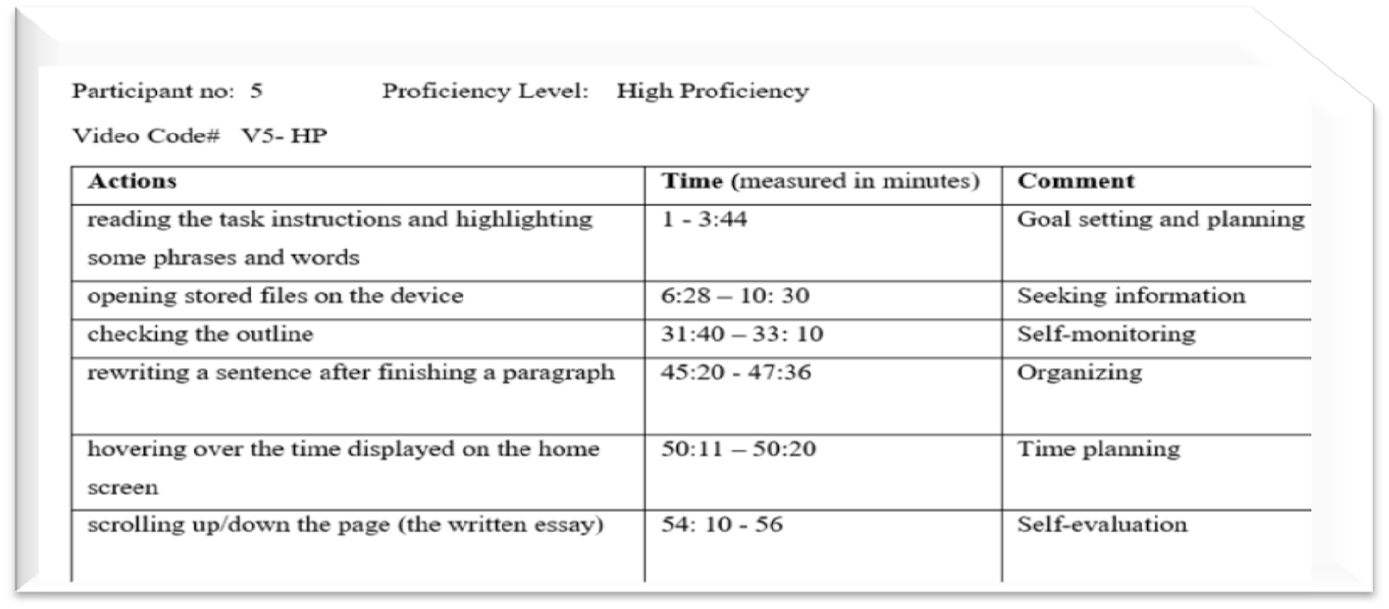
Sample of the observation form for notes on the videos.
Then, stimulated recall was conducted using Arabic (L1) to allow the students to express their ideas and experiences freely and in a detailed fashion. The stimulated recall sessions were conducted in a form of a conversation between the researcher and individual students with questions and answers about the selected segments. Open questions and prompts about students’ video-recorded actions and pauses were used and modified to students’ responses. Also, structured questions were used to assess students’ employment of other strategies that were not mentioned (for sample questions, see Appendix 7). Moreover, the researcher sometimes had to restate something to clarify the meaning or to obtain more information about the students’ cognition and behaviours without judging or evaluating what has been said. These recall sessions were recorded.
4 Data analyses
The video stimulated recall data, called ‘recall data’ thereafter, were first transcribed verbatim and then coded manually, using Microsoft Word, by the researcher and another assistant researcher based on a prior coding scheme (see Appendix 8). Following Zimmerman and Risemberg’s (1997) sociocognitive model of writing, this coding scheme comprised 16 strategies (identified by Graham & Harris, 2000) grouped under the three main categories of self-regulated writing processes (personal, behavioural, and environmental). These three broad categories constitute the first level of data analysis. The second level personal strategies included strategies of goal setting and planning, organizing, transforming, revising, reviewing records, time planning, and self-evaluation. The second level behavioural strategies consisted of self-monitoring, self-instruction, self-reinforcing, rehearsing, and record keeping. Environmental strategies included environmental structuring, seeking information, self-selecting models, and seeking social assistance. These 16 individual strategies from the second level onwards were established by detecting each instance that one strategy was used in the recall data.
The coding process comprised various cycles in four stages: first, the researcher and the other assistant researcher coded 12 students’ stimulated recall protocols (24%). They endeavoured to precisely identify and code all expressions (sentences and paragraphs) and instances of the self-regulated strategy used in those recalls, as sub-strategies. Then these coded sub-strategies were sorted and grouped under each sub-category (the 16 strategies) using the prior coding scheme. Second, the researcher and the assistant researcher met to discuss differences between them and reach a common understanding of the coding scheme. Accordingly, the initial coding scheme was revised, and a refined coding scheme was developed. Third, to ensure the scheme’s adequacy and coding reliability, the two coders coded another six students’ recall protocols (for a sample of the coded transcripts, see Appendix 9). Results indicated that no further changes to the coding scheme were required. The inter-rater reliability between the two raters was high, r = 0.83, p < .001. They also recoded the previous 24% using the refined coding scheme. Whenever new sub-strategies are identified, they were first agreed on by both coders then added under their corresponding categories. All disagreements were resolved through discussion based on the prior coding scheme. Fourth, the researcher compared the strategies that emerged from the data analysis with the self-regulated strategies identified by Graham and Harris (2000). This process, as shall be discussed in Section V, resulted in a group of self-regulated writing strategies and example sub-strategies used by the participants (research question 1) (see Appendix 10). It is noteworthy that writing notes and memos throughout the coding process smoothed the data analysis process. Finally, the frequency of strategy use was analysed, and a Chi-square test was administered to compare the use of each strategy in the two proficiency groups (research question 2).
V Results
1 Self-regulated writing strategies used by the students
The analysis of the recall data revealed that students used 11 self-regulated writing strategies (see Appendix 7). Five strategies in the prior coding scheme (record keeping, reviewing records, rehearsing, self-reinforcing, and seeking social assistance) were not used by any of the students. Concerning the frequencies of using these 11 strategies, the results (see Figure 3) showed that strategies of seeking information (264), revising (248), and self-selecting models (157) were the most frequently used strategies. Oppositely, strategies of self-evaluation (56) and transforming (34) were the least frequently adopted.
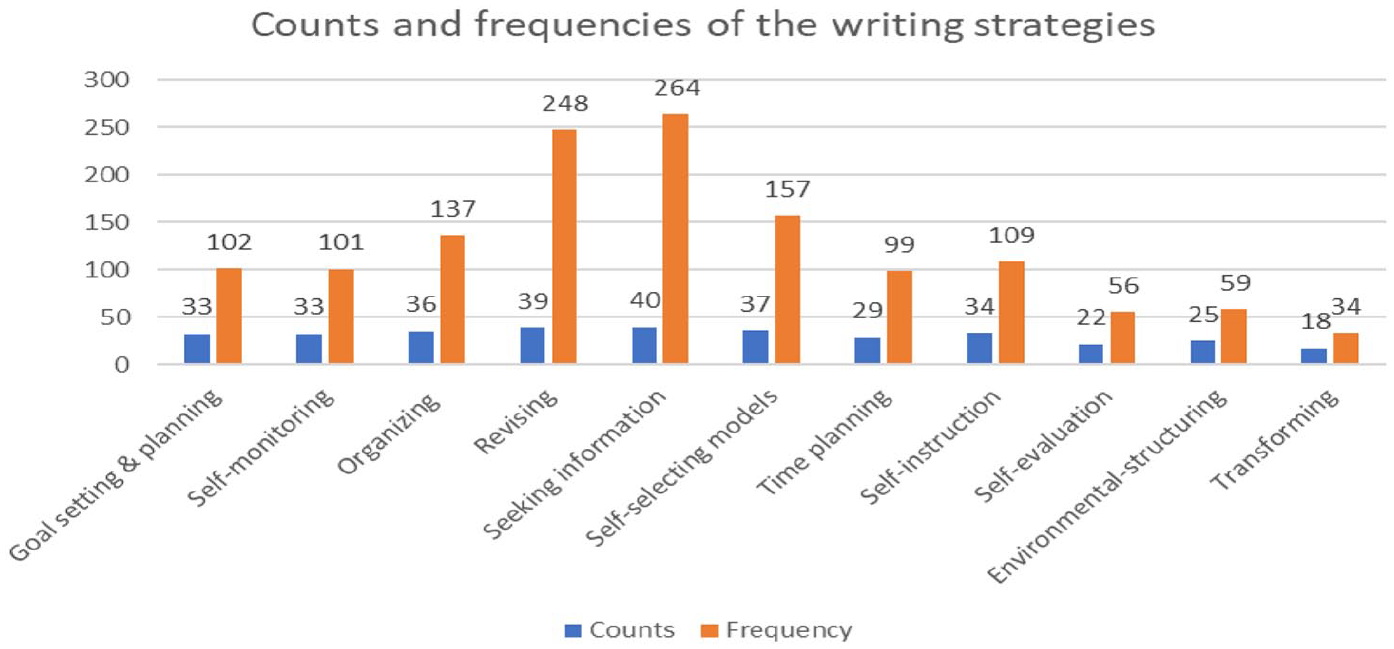
Frequencies of the 11 strategies used by the students.
2 Differences in using self-regulated writing strategies between groups
Quantitative analysis results revealed that the high writing-proficiency students used the 11 self-regulated strategies more frequently (M = 8.47) than their low-proficiency counterparts (M = 5.59). Moreover, the chi-square test results revealed that the high and low writing-proficiency students differed significantly in their overall use of these strategies (df = 8, F = 24.615; p < 0.05). It also revealed statistically significant differences between the two groups (see Table 1) in five strategies tapping the personal processes (goal setting and planning, organizing, revising, time planning, and self-evaluation) and one strategy tapping behavioural processes (self-monitoring), overall favouring the high writing-proficiency group.
Differences in self-regulated strategy use between high and low writing-proficiency groups.
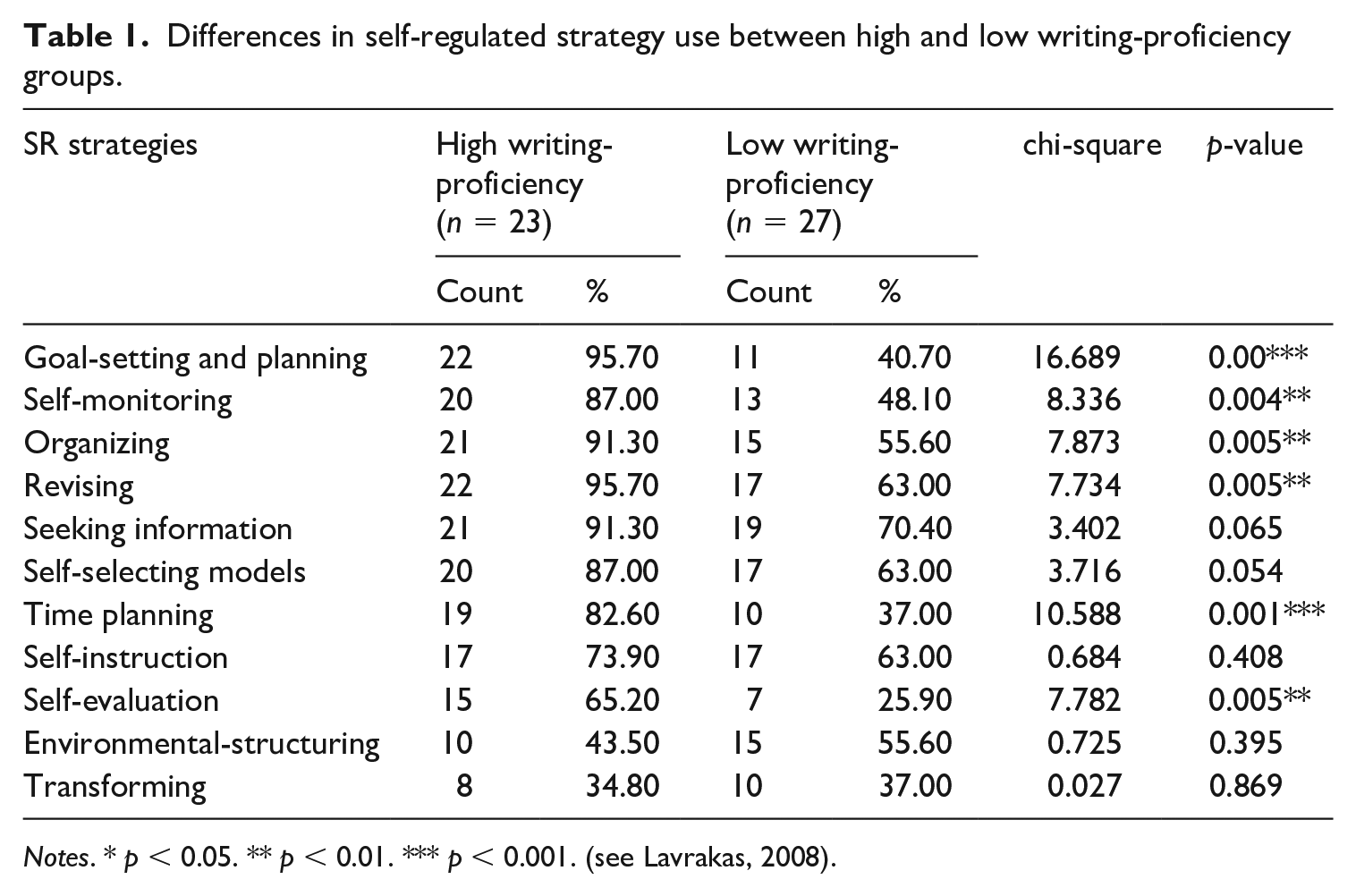
Notes. * p < 0.05. ** p < 0.01. *** p < 0.001. (see Lavrakas, 2008).
Table 1 also shows that the most frequently used strategies by the high-proficiency group are goal setting and planning, revising with the highest proportion at 95.65% followed by organizing, and seeking information at 91.30% each. The least frequent strategies are environmental structuring (43.48%) and transforming (34.78%). On the other hand, the most frequently used strategies by the low-proficiency group are seeking information (70.37%) followed by revising, self-selecting models, and self-instruction with a proportion of 62.96% each. The least frequent strategies are time planning at 37.04% and self-evaluation at 25.93%.
Further qualitative analysis revealed that though both high-and-low-proficiency groups used the same strategy types, they differed in their intentions behind using these strategies and the way they used them. The following sections elaborate on this result using frequencies and instances of each strategy along with selected illustrative extracts from the transcripts. It is noteworthy that participant codes with important tagged information were used to protect the participants’ identity (HP = high-proficiency student; LP = low-proficiency student).
a High-proficiency students
Results showed that almost all high-proficiency students (95.70%, n = 22) tend to set both local goals (e.g. using accurate academic language), and global goals (e.g. improve their writing performance) for their writing. They also tend to plan for their essays at global (essay structure and organization) and local (ideas and language) levels through various sub-strategies, such as consulting a rubric, brainstorming ideas, and thinking about what to write next. Moreover, most of the students reported having plans in their heads. As declared by one of the students ‘Here I was planning in my mind the ideas I will write about’ (HP-9). Similarly, most students (n = 22, 95.70%) used the revising strategy. This strategy pertains to the changes that students made to their essays during writing to clarify meaning including changes to the content and/or structure. Using various online tools and Microsoft Word features, the students tend to juxtapose content revising and typing to clarify meaning using various sub-strategies, such as addition, deletion, and substitution, while keeping revisions of linguistic errors (lexical; grammatical) to the final stage.
Most students (n = 21, 91.30%) tend to organize the outline and/or the content of their essays regularly using various sub-strategies such as following essay 4-paragraph outline and rearranging the sentences within a paragraph (considering coherence) using Microsoft word block moving feature. The following extract is an instance of organizing the content ‘I moved this sentence to the end of the paragraph as a closing sentence’ (HP-2). 21 students (91.30%) tend to seek information through consulting stored writing course files on their computers and accessing a wide range of online resources including TESOL blog, Online writing labs, thesauruses). While the majority tend to search for content ideas pertinent to the writing topic, some searched also for linguistic information, such as phrase/word synonyms and collocations. Likewise, 20 students (87%) searched for model essays and articles written by professional authors to improve the quality of their texts. They used various sub-strategies including noticing, selecting some key ideas, and emulating writing style. One student (HP-21) reported using adjective and noun clauses ‘to sound like English writers’. Practising noticing affected their writing at both linguistic and cognitive levels, as one student (HP-12) commented, ‘analysing more than one model sharpened my reasoning about how I can [argue] logically and systematically’.
Moreover, most students (n = 20, 87%) tend to monitor their writing performance through simultaneous attention to various aspects, including meaning, coherence, and language accuracy, through reading and reading the written text and consulting an analytical rubric. One student (HP-11) commented, ‘At this moment, I was reading what I wrote to ensure that the ideas are relevant, and the style is academic.’ Nineteen students (82.60%) tend to structure the writing time by estimating and dividing the task time among the main stages of the writing process (pre-, during, and post-writing) with the majority assigning less time for the post-writing stage.
Seventeen students (73.90%) used self-instruction (self-talk) in English when starting to write and/or when struggling during the writing process. One participant (HP-11) said, ‘I question myself to ensure that I covered both sides equally.’ Self-evaluation was used by 15 students (65.20%). Those students disposed to evaluate the quality of the writing outline and then judge the quality of the final drafts guided by specific criteria in a rubric or criteria learned in academic writing class. One student (HP-7) said, ‘teacher always says keep it natural, organized, and well supported.’ It is noteworthy that students disposed to use negative judgements about different aspects of their written texts.
Only 10 students (43.50%) checked the writing environment to ensure that it is supportive and conductive. The sub-strategies used included choosing a quiet place with a good internet connection and turning off notifications on their devices. Transforming was the least frequently used strategy. It was used by only 8 students (34.80%). This strategy alludes to students’ exercise of visualizing essay outlines and/or relations between ideas to facilitate the written argumentation through drawing a mind map, consulting Google images, and producing illustrative examples to support certain ideas.
b Low-proficiency students
Seeking information was the most frequently used strategy among low-proficiency students. It was used by 19 students (70.37%). However, their online search was limited to either general ‘Google search’ or ‘Wikipedia’ to find content information related to the given topic. Most students also tend to use ‘Google translate’ and/or some other online thesaurus to find word synonyms and collocations. The second most frequently used strategy was self-selecting models. Seventeen students (62.96%) used model essays related to the given topics; however, they disposed to search only for essays written by EFL students. They found them simple and less sophisticated. Copying was the most frequently used sub-strategy. Likewise, 17 students (62.96%) tended to practise self-talk (self-instruction strategy) in Arabic to guide and sustain their understanding of the writing prompt and brainstorm related vocabulary and phrases.
Although revising was a main part of the writing process of 17 students (62.96%), they focused on extensive revisions of linguistic errors at word and sentence levels, without checking the intended meaning. They also depended heavily on using Microsoft word tools (cutting-and-pasting and spelling and grammar checking) and only one online writing assistant programs (Grammarly) to polish their writing. Only, 15 students (55.60%) tend to organize the content of their essays by rearranging sentences and/or paragraphs using Microsoft word block moving and deleting feature. Similarly, 15 students (55.60%) tend to set up appropriate writing environments; however, the sub-strategies used were limited to choosing a place with good internet access and checking device battery.
Likewise, only 13 students (48.10%) tend to monitor their writing performance, mainly through reading what has been written in terms of language accuracy and checking word count. Some students tend to download an online writing application (Grammarly) to get instant feedback about their writing performance. One of the students (LP-7) said ‘Grammarly is my true assistant; the received emojis show me how my writing sounds.’ Likewise, only 11 students (40.70%) tend to set goals and plan for completing their writing tasks. However, their main goal was to finish the task on time. Also, they focused mainly on planning the layout of the essay (mechanical planning) in terms of the number of paragraphs and the number of sentences/lines in each paragraph. They also tend to plan the content of their writing through thinking about what to write next (local planning) during writing. They reported negative perceptions towards the effectiveness of setting goals and planning as a way for improving their writing. The following extracts are instances of this negative perception: ‘I didn’t have an outline or any kind of plan. I wrote whatever came into my mind’ (LP-4); ‘I don’t believe that spending time on planning would improve my writing’ (LP-5).
As for transforming strategy, only 10 students (37%) consulted Google images for some pictures/infographics about the essay outline. Similarly, 10 students (37%) tried to manage the writing time with the majority reported that they did not have fixed plans. The only detected sub-strategies were setting a timer or checking the time regularly to make sure that they will finish on time. Self-evaluation was the least frequently used strategy. It was used by only 7 students (25.90%). The students tend to evaluate the final draft of their essays through reading or checking over the written essay once to make sure it is complete (covered all the required points). They also tend to make negative judgements of their essays. One student (LP-3) said, ‘I know my essay is full of errors.’
VI Discussion
1 Self-regulated writing strategies used by the students
Results revealed that students in both proficiency groups used 11 self-regulated writing strategies, six tapping personal self-regulation, three tapping environmental self-regulation, and two tapping behavioural self-regulation, to complete the two online writing tasks. The absence of other strategies identified in the prior coding scheme (record keeping, reviewing records, rehearsing, self-reinforcing, and seeking social assistance) may suggest that the students were more familiar with the strategies they used based on their long pen-and-paper writing experiences and kept on using them online. Nevertheless, this finding should be treated cautiously, as the type of the writing tasks and the writing context (online) may have interfered with the students’ use of these strategies. Vandevelde et al. (2015) suggested that tasks and contexts may moderate self-regulated strategy use among students. Given the open and nonlinear nature of online learning environments, learners often experience difficulty in practising SRL strategies (Barak, 2010; Steffens, 2006). In this vein, research on online self-regulation proposed that learner’s self-efficacy, including internet self-efficacy (Chang et al., 2022; Kuo et al., 2014), the convergence of technology self-efficacy with satisfaction as a motivational variable (Binali et al., 2021; Broadbent & Poon, 2015; Wang, 2013), language self-efficacy (Tao et al., 2020; Teng and Zhang, 2020) along with cognitive strategies are potentially main factors in practising online self-regulation.
2 Writing-proficiency and self-regulated strategy use
Echoing findings of previous research on L2 writing self-regulation (Hu & Gao, 2018; Teng & Huang, 2019; Sun & Wang, 2020; Teng et al., 2020), and online self-regulation (Jansen et al., 2020; Xu, 2018; Xu & Qi, 2017) the results of the quantitative and qualitative analysis of the recall data, through the lens of sociocognitive theory, revealed that the high-proficiency students stood out from their low-proficiency counterparts in how they self-regulated their personal, behavioural, and environmental processes as follows.
a Personal self-regulation
The results revealed that all statistically significant differences between the high and low proficiency groups, except for self-monitoring, tapped strategies under the personal self-regulation category. This means that this category is less stable and therefore more susceptible to online contextual variables. In contrast to their low-proficiency counterparts, the high proficiency students showed a superior skill of personal self-regulation through frequent use of goal setting and planning (F = 16.689, p < 0.00), organizing (F = 7.873, p < 0.01), and revising (F = 7.734, p < 0.01) strategies. These strategies represent learners’ metacognitive and cognitive abilities that are described as higher-order, directive, and practical abilities (Winne, 2018) through which learners practise conscious control and management over their writing process. Additionally, the high proficiency students distinct from low proficiency students did planning on both global and local levels. Making use of their technology skills through employing various online tools and features, they also tend to use organizing strategy throughout the writing process in such a manner that helped them match their planned ideas (outline) with the content smoothly and accurately. This reflects their internet self-efficacy and perception of writing as a recursive rather than a linear process. This result is partly consistent with other related studies, which revealed that successful online learners (Broadbent, 2017; Xu & Qi, 2017) and skilled writers (Bai, 2018; De Larios et al., 2008; Manchon & De Larios, 2007) are more likely to set more time for constructing pragmatic and textual representations before performing a task (writing). On the other hand, the infrequent use of planning and organizing strategies among the low proficiency students can be linked to the challenges they appear to have with managing writing time (Graham & Harris, 2000), which was among the infrequent strategies used by them as shall be discussed below. This result echoes the findings of Honeck’s (2013) study, where the participants reported that they do not develop an outline or use graphic organizers, for it takes much time.
Moreover, low proficiency students’ poor writing performance and their low outcome expectations may have caused a case of indifference that made them less motivated to set goals, plan and organize their writing, as declared in their comments. A reported connection between motivation, self-efficacy and self-regulated strategies use in an online context has been confirmed (Teng & Zhang, 2020; Wandler & Imbriale, 2017; Wang et al., 2013). According to social cognitive theory, belief in one’s abilities (self-efficacy) is the most influential and decisive factor in self-regulated learning (Zimmerman, 2013; Zimmerman et al., 2017).
The high proficiency students’ superiority was also reflected in their strategic use of revising. using various technological tools, they tend to juxtapose revision of content and typing and keep revision of linguistic errors to the end. Low-proficiency students, contrarily, focused heavily on using Microsoft language checker and/or an online writing application (Grammarly) to revise only linguistic mistakes at the sentence and word level. This result echoes the findings of some related studies (Barkaoui, 2016; Gánem-Gutiérrez & Gilmore, 2018; Xu, 2018; Xu & Qi, 2017), which highlighted that high proficiency students usually revise for meaning and make more corrections at both sentence and theme levels. A possible explanation for this finding is instructional practices, in Saudi Arabia evaluation of written texts focuses heavily on students’ linguistic competence (lexical, syntactic, and grammatical errors) than on content (Al-Seghayer, 2014). Also, for the same reason, students of both groups tend to make more negative judgements about their writings.
Similarly, the high proficiency students were distinguished from their low proficiency peers in time planning (F = 10.588, p < 0.001) and self-evaluation (F = 7.782, p < 0.01). The infrequent use of time planning among the low proficiency students can be referred to their lack of writing goals, as discussed earlier. Moreover, while the high proficiency students used self-evaluation at the pre-writing stage to evaluate their outline and at the post-writing stage to judge the quality of different aspects of the final text, the low proficiency students used it only as a post writing step to only check that they covered the required points in the task.
However, there was no significant difference between both groups in using transforming strategy (F = 0.027, p > 0.05). The infrequent use of this strategy among students of both groups could be attributed to the instructional influence which does not put adequate emphasis on integrating visualization or mental imagery in the writing process. Empirical studies (Kaur et al., 2016; Seker, 2016) suggested insufficient teaching or ineffective classroom practices can result in the underdevelopment of some strategies.
b Behavioural self-regulation
The high proficiency students’ superiority in behavioural self-regulation was reflected in their frequent use of self-monitoring strategy (F = 8.336, p < 0.01). A gain counting on their technology skills, they disposed to use sub-strategies to attend to different aspects of writing, including meaning, style, and language accuracy. The significance of self-monitoring as a characteristic of skilled writers has been confirmed in literature (Bai, 2018; Teng & Zhang, 2018). The low proficiency students, contrarily, focused mainly on monitoring the linguistic accuracy of their writing through consulting the same online software program (Grammarly). Based on the review of related literature, less-skilled student writers often approach the writing process as ‘knowledge telling’ through memorizing related information and writing them down mechanically with little attention to the reader’s needs, restrictions of the assigned topic, or the organization of the written text (Graham & Harris, 2000; McCutchen, 1995).
Though there was no significant difference between both groups concerning self-instruction strategy (F = 0.684, p > 0.05), they differed in how they used it. While the high-proficiency students demonstrated more maturity and flexibility in using self-instruction (in English) at the pre-writing stage to think out ideas and during writing to guide their performance, the low proficiency students used L1 (Arabic) to compensate for their low writing-proficiency level through brainstorming related vocabulary and phrases and then use ‘Google Translate’ to find English synonyms. This result stresses the significant role of language self-efficacy in practising online self-regulation (Su et al., 2018; Teng & Zhang, 2020).
c Environmental self-regulation
Results revealed insignificant differences (p > 0.05) between the two groups in using strategies of seeking information, self-selecting models, and environmental structuring. Seeking information as one of the main self-regulated strategies that distinguish online learning contexts (Cheng et al., 2013) was used frequently by both high (91.31%) and low (70.40%) groups. However, the use of this strategy varied in form and focus from one group to the other. While the low proficiency students tend to use it to compensate for their deficient linguistic skills, the high-proficiency students used it to consolidate their writing through accessing more varied and specialized online resources. This result revealed some quite sophisticated thinking in terms of technological practice and knowledge among the high proficiency students. Research suggests that using this strategy may bring about a general pattern of resilience that helps students overcome learning obstacles (Karabenick & Newman, 2010; Newman, 2002).
Likewise, the results revealed that though both groups actively used model essays to support their writing (high = 87%, low = 63%), the types of the selected models and the way they used them in supporting their writing differed. High writing-proficiency students, empowered by their advanced writing goals and standards, intentionally and consciously inclined to select models written by professional writers and endeavoured to imitate them at both content and linguistic levels. Low proficient students, contrastingly, focused on using only models written by EFL students and limited their practices to copying without revision. In this regard, research has differentiated between two main types of help-seeking: strategic or more adaptive help-seeking and excessive or less adaptive help-seeking (Karabenick & Newman, 2010; Newman, 2002). According to Karabenick and Newman (2010) technology-assisted help-seeking with its widespread and wide availability of resources enhances the potential for using expedient and less adaptive help-seeking. The infrequent use of environmental structuring among students of both groups (high = 43.50%, low = 55.60%) can be attributed to culturally accepted conventions (Malpique & Veiga Simão., 2015) such as finding a quiet place with a good internet connection.
3 Pedagogical implications
The findings of this study can pragmatically help writing instructors and course designers cognize the requisite support to boost students’ self-regulation processes while composing online and thus help them benefit from the proper technological sources, tools, and features to improve their writing performance. First, writing instructors are encouraged to prioritize peer learning activities, such as online buddy journaling, peer-to-peer learning associations, to help low-proficiency students learn with and from high-proficiency students how to self-regulate their writing process online. Second, writing teachers are also encouraged to motivate and train low writing-proficiency students to set personal writing goals, develop clear plans, and monitor online writing tasks using suitable planning tools and apps, such as FocusWriter and smart planners. Third, writing instructors should stimulate both high and low-proficiency students to practise self-evaluation using evidence-based practices such as online self-study logs and e-portfolios accompanied with reflection worksheets and/or self-evaluation rubrics. Writing course designers also need to incorporate online tools/applications that help students get constant and opportune evaluative feedback on their writing process. Fourth, writing instructors should encourage students to integrate visualization in their writing process through developing visual illustrations or mental images of their ideas using online resources such as diagrams, note sketching, and process graphs. Fifth, since low-proficiency students focused on revising only linguistic errors, writing instructors are encouraged to strike a balance between meaning-focused and accuracy-focused feedback in their teaching and to personalize feedback through utilizing online facilities, such as audio chats, to give more informative feedback whenever needed. Moreover, including online collaborative writing tasks using Office SharePoint or Google Docs accompanied with timely oral corrective feedback would consolidate low-proficiency students’ revision activities and encourage them to seek social assistance from peers and teachers, and thus enhance their language self-efficacy. Sixth, Low proficiency students demonstrated poor internet skills, which resulted in accessing unprofessional websites when seeking information and selecting model texts, so writing instructors should familiarize low-proficiency students with adequate online academic writing resources and tools, and how they can use them to support their online writing performance. In this vein, teachers should also guide students to differentiate between adaptive and expedient use of online resources through encouraging more mastery-focused instructional settings than performance-focused settings. Finally, teachers are encouraged to incorporate analytical thinking activities, which go beyond outlining and labelling the main sections of a self-selected model text/essay and provide students with opportunities to notice abstract ideas and rhetorical features from the selected writing model(s).
VII Conclusions
This study aimed to investigate self-regulated writing strategies used by two writing-proficiency groups (low vs. high) within an online context. Quantitative data analysis revealed a positive correlation between self-regulated learning strategies use and students’ writing proficiency level. Further qualitative analysis of the data within the framework of sociocognitive theory revealed that the high-proficiency students demonstrated more consciousness and flexibility in how they self-regulated their personal, behavioural, and environmental processes. Though rich data have been collected in this study, two issues remain. First, while writing-proficiency level was controlled for, future research should examine more factors, such as gender, and internet self-efficacy, that may also impact self-regulated writing strategies use within online context. Second, the present study gave some details on several SR writing strategies, so larger in-depth exploration research targeting specific SR strategies, mainly less researched ones, including transforming and self-evaluation, are warranted to facilitate the construction of adapted online instruction programs to improve students’ writing performance.
Footnotes
Appendix 1
Appendix 2
Appendix 3
Appendix 4
Appendix 5
Appendix 6
Appendix 7
Appendix 8
Appendix 9
Researcher: I will play the video of you working on the two writing tasks. since it was improbable to record everything, you were thinking about, would you tell me what you were doing or thinking about at this time (conversation as on the video shown in the recall . . Segment 0:20 – 2:34)
HP1: Well, I had to read the task instructions carefully first. Then read both topics to decide which one I will write about [Note: Goal setting and planning: Analysing and task instructions]. I usually give myself time to check if I have enough ideas about the topic unless I would move to the next one.
Researcher: How would you do that? I mean how did you plan for your writing?
Hp1: as you can see in the following 5-6 minutes, I started to brainstorm ideas for the first topic. when I felt that these ideas are enough and solid [Note: Goal setting and planning: Brainstorming ideas], I immediately started to build my essay’s outline [Note: Goal setting and planning: Using an outline]. Actually that’s my typical way of writing: look up ideas, outlining then writing. This gives my confidence. I seek the opportunity to improve my writing as well as writing an essay that is up to my academic level as a university student [Note: Goal setting and planning: Goal setting].
Researcher: How did you check that you achieved this goal?
HP1: I compared my performance to level 4 (excellent) on the writing rubric that my writing teacher used when evaluating our assignments. I took it as a standard [Note: Goal setting and planning: Targeting a specific level in writing rubric].
Researcher: why did you return to the outline? (Segment 16:10- 18:24)
HP1: yeah, here I got confused whether the idea I am writing about really fits with the topic, so I reread the task instructions and the topic again [Note: Self-monitoring: Rereading]. Then I modified the outline by rephrasing the sentence then started writing my thesis statement again [Note: Rehearsing: Proofreading the written sentences].
Researcher: what were you searching for at this moment? (Third segment 20:00 – 22: 50)
HP1: I wanted to find model essays about the topic I was writing about . . . mainly finding ideas and how these ideas are supported with examples [Note: Self-selecting models: Reading model essay and taking notes] . . . a point that I find difficulty in . . . also I learn about the structure of the essay itself beside language . . . as you can see I tend to search for models that are written by professional writers within academic field. This improves my writing style. I believe that reading is the key for good writing . . . it really opens my mind . . . if you played the video . . yes, one more minute . . here . . you can see me here rewriting the ideas in my outline . . . I replaced one idea with another and rephrase the second [Note: Rehearsing: Proofreading and editing the writing plan/outline] after reading.
Appendix 10
Acknowledgements
I thank Dr Enas Al-sheik and Dr Jehan Mohamad for their assistance, as specialized raters, in the data analysis process that greatly supported the research.
Funding
The author received no financial support for the research, authorship, and/or publication of this article.

Supplemental material
Supplemental material for this article is available online.
References
Supplementary Material
Please find the following supplemental material available below.
For Open Access articles published under a Creative Commons License, all supplemental material carries the same license as the article it is associated with.
For non-Open Access articles published, all supplemental material carries a non-exclusive license, and permission requests for re-use of supplemental material or any part of supplemental material shall be sent directly to the copyright owner as specified in the copyright notice associated with the article.
