







Abstract
English-medium instruction (EMI) has been implemented in higher-education institutions around the world. This study examines the states of EMI-related professional development (PD) for Korean science and engineering professors and their perceptions of such programs. Faculty members at the three major science and engineering schools in Korea participated in a questionnaire survey and the follow-up interviews. The results show that the vast majority of them had not participated in pre- or in-service PD programs and had negative attitudes towards certified EMI-related PD programs mainly due to their institution’s strong emphasis on their research performance rather than the quality of their teaching. The study offers suggestions for future directions of EMI-related PD at institutions with a similar tendency.
Keywords
I Introduction
English-medium instruction (EMI) is a fast-growing phenomenon at universities across the world (Dearden, 2014). EMI is defined as ‘the use of the English language to teach academic subjects (other than English itself) in countries or jurisdictions where the first language of the majority of the population is not English’ (Macaro et al., 2018).
As EMI in higher education spreads, European researchers have conducted studies on EMI professional development (PD) at universities. O’Dowd (2018) conducted a survey on the PD and accreditation of EMI professors at 70 European universities. The results show that universities need to be more involved in pre- and in-service EMI-related PD. Approximately 30% of the survey respondents felt that their universities did not consider EMI-related PD important, and 30% of the surveyed universities did not offer such programs. Furthermore, while most universities provided programs or courses for the improvement of professors’ language skills, half of them did not offer any related to EMI teaching methods. In addition, no agreement was established among universities with regards to the minimum level of English required for EMI professors. However, O’Dowd agreed with Halbach and Lázaro (2015) that a B2 level, or the upper intermediate level in the Common European Framework of Reference (CEFR), is not sufficient for an EMI professor (Language Policy Programme, 2018). Finally, while many European universities did not institute a formal accreditation process, some required a certain level of linguistic competence or both linguistic and teaching competence in an evaluation process of EMI professors. O’Dowd points out that there is a wide range of approaches to the training and accreditation of EMI professors among European universities and that there is a need for further research to establish systematic international accreditation procedures.
Lauridsen (2017) investigated PD for EMI professors teaching diverse international students and observed that most PD programs tend to be ad hoc activities, and, thus, a more systematic and holistic approach to PD is needed. She argues that PD programs should reflect ‘the close links between linguistic and cultural issues and their didactic and disciplinary implications’ (Lauridsen, 2017, p. 34). In addition, according to Dafouz (2018), as EMI is becoming popular in universities around the world, teacher education programs (TEPs) are being restructured to prepare professors for international classrooms. She points out that most TEPs aim to improve professors’ English language proficiency, but do not take pedagogical and identity issues into consideration. Macaro et al. (2019) investigated professors’ views of EMI certification in Spanish universities and reported that they generally supported EMI-related PD and certification but were unsure of how such programs should be implemented. Furthermore, Macaro et al. (2020) conducted an international survey on EMI-related PD and certification and concluded that although universities did not see urgent needs for EMI-related PD, such programs are essential to enhance professors’ competencies, and those who participate in such programs should be appropriately rewarded by official certification.
When it comes to EMI-related PD for science and engineering universities, however, only a few studies are found in Europe. Klaassen and Bos (2010) reported that science professors who were nonnative speakers of English at Delft University of Technology (DUT) had a language proficiency level of C1 (advanced) on average according to the CEFR. They argued that even the C1 level was not sufficient and professors should be given training to upgrade their English skills to a C2 level (proficient) as students need to be exposed to professors’ high level of English for their acquisition of global citizenship.
Margic and Vodopija-Krstanovic (2018) also pointed out the importance of language competence. They investigated a PD program for prospective EMI professors at the University of Rijeka (UNIRI), Croatia. The program participants were 60 content professors who were mainly from the science and engineering departments, including informatics, mathematics, physics, biotechnology, and civil engineering majors, and who had no prior experience in EMI. Their levels of English ranged from B1 to C2. The program was primarily a language development program, offering teaching practice, corrective feedback, and self-reflection. The authors concluded that professors’ linguistic fluency is a primary requirement for EMI and that professors should be given continued language training to attain the required C1 level.
On the other hand, Torra et al. (2014) examined an EMI-related PD program focusing on both language and teaching. The Institute of Education Sciences of the Universitat Politècnica de Catalunya – Barcelona Tech (UPC) provided a PD program for professors who wished to offer content courses in English. The program had double objectives of offering linguistic and methodological scaffolding. The authors suggested that experienced and beginning EMI professors be placed together in the same program so that the experienced could help the less experienced with methodological issues.
Moncada-Comas and Block (2019) conducted a study of an EMI professor in the field of agronomic engineering at a Catalan university, using interviews and classroom observations, and reported that the professor did not believe teaching language was part of his EMI instructor identity. He often used translation as a teaching strategy to communicate with his students to ensure their comprehension of important concepts. Although the professor did not see improving his students’ English language proficiency as one of his responsibilities, he took on the role of English language teacher sometimes by emphasizing vocabulary learning. The study concluded that these discrepancies in the professor’s behaviors were due to the lack of the university’s clear policy for EMI and the professor’s partial understanding of his role as an EMI instructor and that language learning should also take place in CLILized EMI.
Compared to studies on EMI-related PD at European science and engineering schools, those at Asian tertiary science and engineering schools are rare. Thus, this current study attempts to fill this gap and investigates EMI-related PD in Korean science and engineering schools.
Our research questions are as follows:
What is the current state of EMI-related professional development (PD) at Korean science and engineering schools?
What are professors’ perceptions of EMI and EMI-related PD at Korean science and engineering schools?
II Methodology
1 Research setting
This study, adopting a mixed method approach, examines EMI-related PD programs at three Korean higher-education institutions that are specialized in science and technology. Institution I is the nation’s first science and engineering school, established by the Korean government in 1971. It is considered one of the most competitive universities in Korea and is a well-reputed institution internationally, ranked 16th place in 2020 QS rankings in engineering/technology. It is located in a large metropolitan city in the central region of South Korea. The student population consists of 3,879 undergraduate students and 6,800 graduate students (as of 2019). Institution II is a private university established in 1986 and is located in a main seaport in the southern region. It is also a well-reputed research-oriented institution, ranked 8th place in 2016 Asia university rankings by the Times Higher Education. The student population consists of 1,432 undergraduate students and 2,151 graduate students (as of 2019). Institution III is a public university established in 2011, the youngest among the science and engineering schools in Korea. It is located in the largest metropolitan city in the southern region. The student population consists of 851 undergraduate students and 688 graduate students (as of 2019).
The majority of students at the three institutions pursue goals to become researchers and professionals in the fields of science and engineering. The departments and colleges comprising each school are predominantly science and engineering fields of study, and most of the courses offered are of science and engineering fields. While humanities and social science courses are also offered, they are mostly offered as part of general education for future science and engineering professionals. For instance, Institution I offered 338 courses in natural sciences, 103 in biological sciences, 842 in engineering, 659 in humanities and social sciences, 395 in management, and 29 in others (2,366 in total) in 2020, while Institution III offered 358 courses in science and engineering and 168 in humanities and social sciences at the undergraduate level and 136 in natural sciences, 296 in engineering, 72 in biological sciences, 3 in convergence, and 12 in others at the graduate level (1,045 courses in total) in 2020.
Science and engineering institutions have taken the lead in the trend of EMI among Korean universities, offering the highest percentages of EMI classes (Kim & Yoon, 2018). Institution I offers 72.9% of all classes in EMI: 84% of undergraduate classes and 72.5% of graduate classes. Institution II offers 87.8% of all classes in EMI: 80.5% of undergraduate classes and 95% of graduate classes. Institution III offers 74% of all classes in EMI: 53% of undergraduate classes and 100% of graduate classes.
2 Data collection
To examine the current state of EMI-related PD programs at the three schools, we examined the webpage of the Center for Teaching and Learning at each school and pertinent policy documents and contacted center directors and employees for further information.
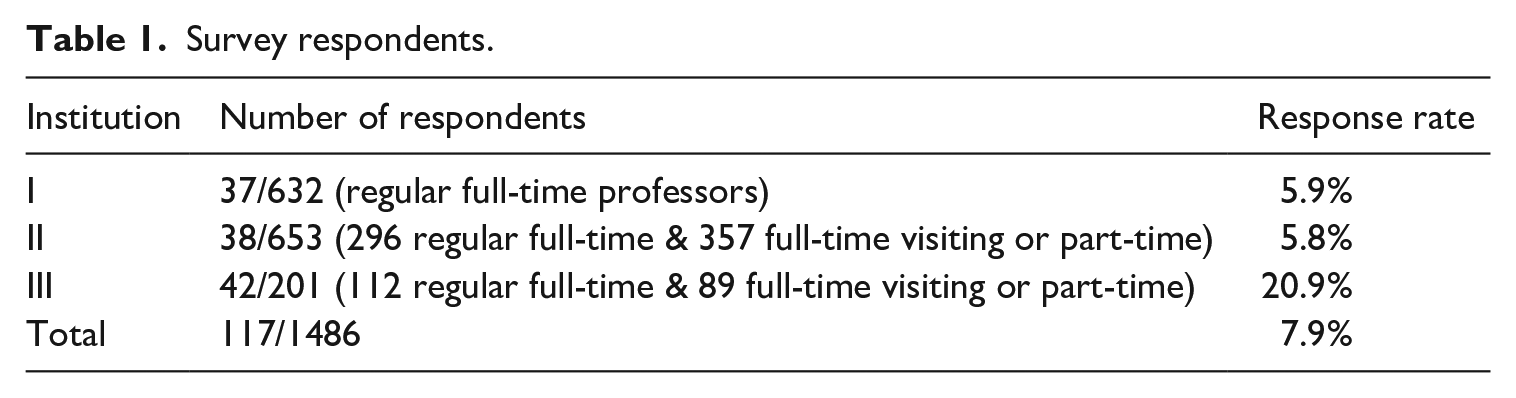
To investigate professors’ perceptions of EMI-related PD programs, we conducted a questionnaire survey, which was adapted by Bradford et al. (2021) based on Macaro et al. (2020). The survey consists of 32 questions: 23 closed-ended and 9 open-ended questions. The questions are categorized into four areas: the first area is related to personal information such as respondent’s age, gender, first language, and language of instruction during one’s final degree program; the second is related to respondent’s EMI and EMI-related training experience, such as years of teaching EMI classes and type of EMI-related training received; the third includes questions on respondent’s perceptions of EMI, such as language proficiency and confidence in teaching in English; the last includes questions on respondent’s perceptions of certified EMI PD programs, including the importance, length, contents, and barriers of such programs. The survey was administered online using Google Forms. Email requests to participate in the survey were sent to faculty members of the three institutions, and 117 professors in total responded between May 18 and June 4, 2020 (Table 1).
Survey respondents.
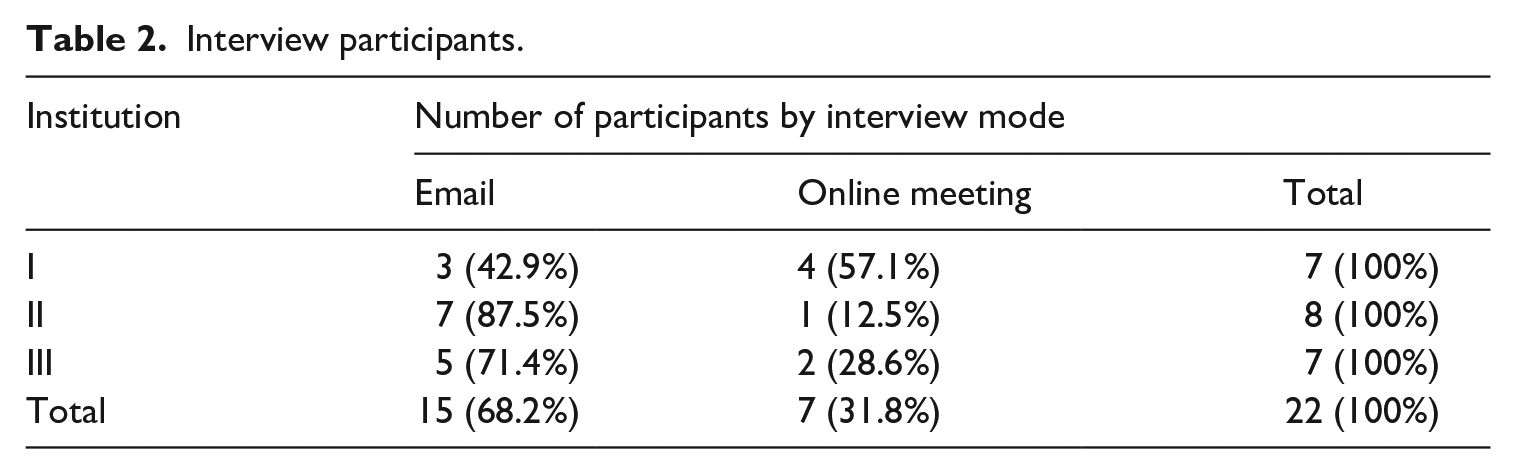
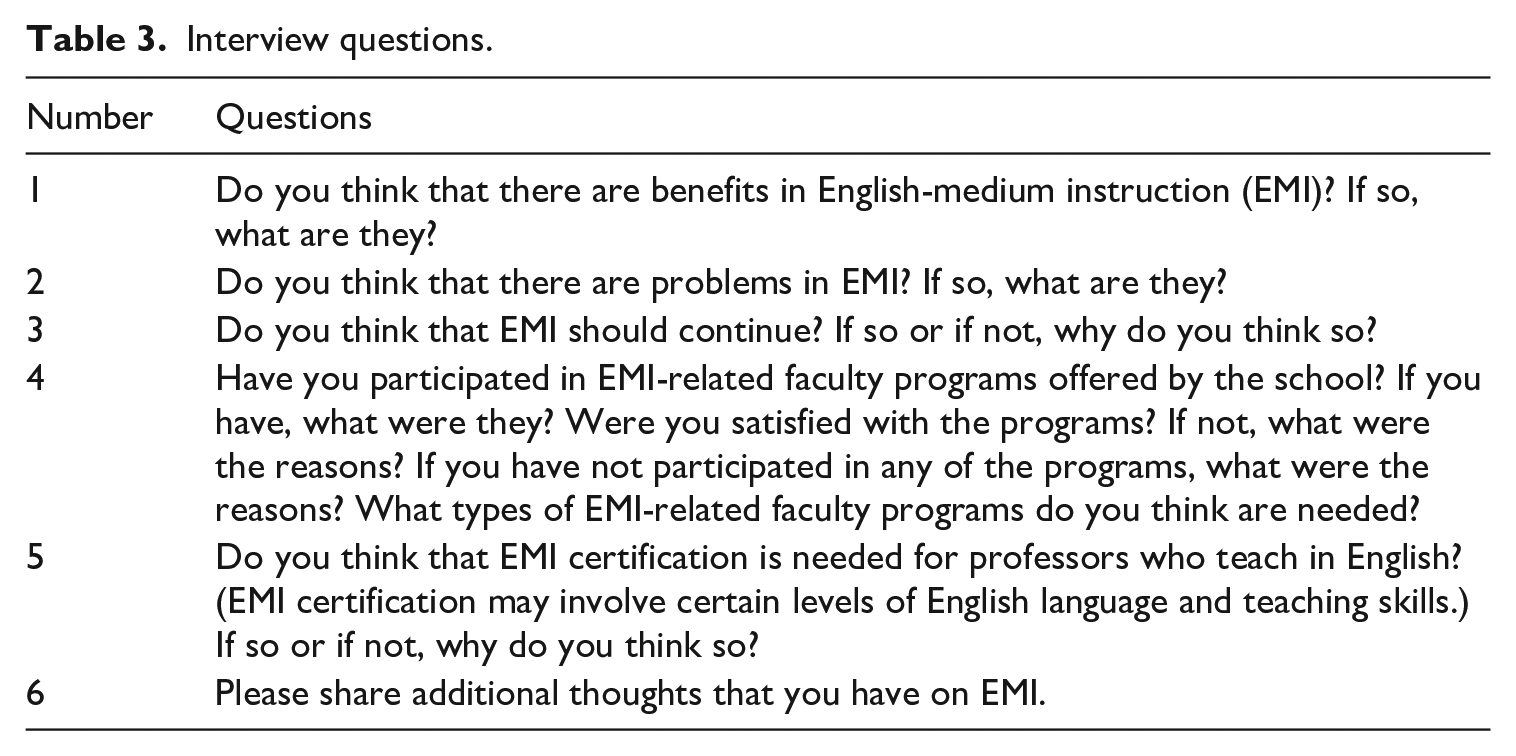
Among the 117 survey respondents, 22 professors volunteered to participate in the follow-up interviews (Table 2). The interviews were conducted via either email or a virtual meeting platform, Zoom, depending on the participant’s preference. For consistency, the same researcher conducted all the online interviews, where questions on EMI and EMI certification were further asked (Table 3). Each interview took 15 to 20 minutes and was recorded with the participant’s permission.
Interview participants.
Interview questions.
3 Data analysis
Content analysis of the materials in the PD programs of the three schools was conducted. Similarities and differences among the programs were analysed, and analysis results were drafted by one researcher and verified by the others. All of the data were shared among the four researchers on a Google drive.
Regarding the analysis of the questionnaire survey, numerical data were entered into Python for statistical analysis. Along with the respondents’ background information, data on their perceptions of EMI and certified EMI PD programs, such as their experience in pre- or in-service EMI training, their perceptions of the importance of EMI certification, and their interests in EMI training activities, were analysed. We further examined the correlations between the participants’ confidence in EMI and their personal characteristics including years of teaching EMI and the medium language at their final degree program. The numerical data were also visualized by Python Data Visualization Library, and further statistical analysis was conducted to explore if any correlation was statistically significant. In addition, the responses to the open-ended questions were examined independently by two of the researchers. These questions included respondents’ experiences or opinions in relation to EMI and were asked to have respondents’ direct insights and to complement quantitative analysis. The responses were categorized according to similar themes, and the two researchers’ analysis results were verified by the other researchers.
The follow-up Zoom interviews were transcribed, and the transcribed responses were analysed independently by two researchers to ensure inter-rater reliability. The interview data in Korean were translated into English by a researcher and verified by the other. The researchers analysed and categorized the answers into positive, negative, neutral or suggestions. Words and syntactic patterns were analysed based on sentiment analysis (Biber, 1989; Hunston, 2011; Martin & White, 2005). Instead of using a software program, the analysis was done manually due to the relatively small data size and to prevent any computer errors (Feldman, 2013; Liu, 2015; Sonntag & Stede, 2014). Where discrepancies occurred between the two researchers, further discussion was carried out to reach an agreement. Afterward, a list of subcategories was decided on the basis of the keywords that most frequently appeared in the interviews. These analysis results were verified by the other researchers.
III Results and discussion
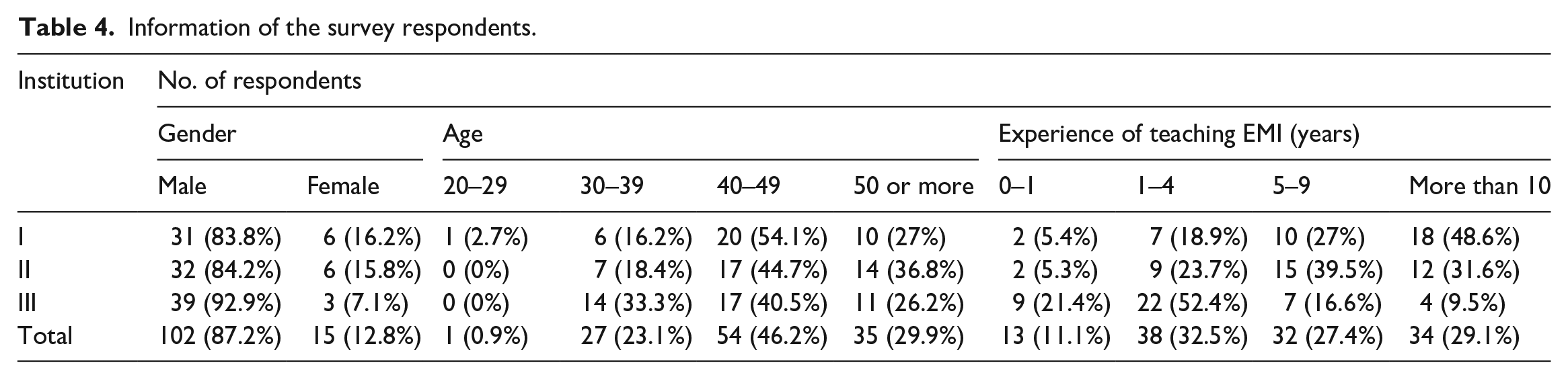
Regarding the survey participants, 102 (87.2%) of 117 were male and 15 (12.8%) were female, which reflects the gender makeup at the three institutions (among the 1,931 professors, 86.5% were male and 13.5% were female). In terms of age, the largest percentage of participants were in their 40s (46.2%), and those with between one and four years of EMI experience (32.5%) participated most in the survey (Table 4).
Information of the survey respondents.
Research question 1: What is the current state of EMI-related PD at Korean science and engineering schools?
The three universities provided a variety of instruction-related PD programs for professors. Institution I established the Center for Excellence in Learning and Teaching in 2009. Since 2014, the center has provided workshops entitled ‘Lecture Power Series’ over 38 times on teaching methodology, didactics, and technology use by inviting guest speakers with expertise in teaching and learning. In addition, several lunch talks and special talks have been arranged for instructional support for the faculty. However, most of the workshops and talks have not been specifically oriented toward EMI; instead, they have provided general methodological or technical suggestions to improve professors’ teaching ability without distinction between non-EMI and EMI classes. As the majority of the classes at the institution are conducted in EMI, it is assumed that most of the participants attempted to find benefits for their EMI classes.
Furthermore, at present, these workshops and talks are not as prevalent as before. Instead, the ‘Class Consulting Program’ is provided to help individual professors reflect on and improve their classes by getting feedback from their students and from professional consultants with expertise in teaching and learning based on video-recorded class sessions. Professors who want to get objective evaluations about their teaching may apply for the consulting program. However, assistance directly related to EMI methods and English language skills has yet to be provided, apart from a manual of Classroom English provided by the Language Center.
At Institution II, the Innovation Center for Education was first established in 1999 under the name of the Learning and Teaching Center. Faculty workshops focusing on diverse teaching and learning methods were provided twice a year from 2009 to 2017 and could be voluntarily attended. Workshop participants were given credits in their evaluation by the university. At the same time, an obligatory program ‘Orientation for New Faculty’ has been offered to newly hired professors with less than three years of teaching experience. The ‘Course Consulting Program’ is also obligatory for new faculty members, while all other professors can participate in the program on a voluntary basis. The program is offered as a course once a semester: classes are videotaped twice, each with a class observation and then followed by feedback from students and an interview with teaching consultants who are former professors of the institution. These senior professors are considered experts in teaching and are selected by the university president to participate in the program. An official certificate on teaching competency is given upon completion of this program. Apart from this program, an online program called ‘Self-Diagnosis of Class’ is available for professors who want feedback on their classes from students via an online survey. All these programs at Institution II are not specifically EMI-oriented programs but are general PD programs providing methodological and didactic support for professors.
Institution III established the Center for Teaching and Learning in 2015. Although recently established, the center has provided diverse programs for improving faculty’s and students’ teaching and learning capabilities. ‘New Faculty Workshops’ have been offered twice a year since 2016 as an orientation program for new faculty on the educational philosophy of the university, effective teaching methods, and basic knowledge of academic and administrative affairs of the university. Since 2017, the ‘Teaching Methodology Seminar’ program has been held six times a year by inviting guest speakers from all walks of life, including lawyers and entrepreneurs. The Center has implemented the ‘TwL (Teaching with Learning)’ program, in which three or more faculty members from different fields of study work together to develop a multidisciplinary course. In addition, informal faculty meetings have been held to enhance the quality of education through interactive cooperation among faculty members. Moreover, Institution III provided three faculty workshops with a focus on EMI in 2018, when the school decided to implement EMI for undergraduate courses.
To sum up, the three universities have provided their faculty with various types of instructional support in pedagogy, didactics, and technology. Despite the high rate (over 70%) of EMI implementation, however, the universities have scarcely offered PD programs specifically aimed at EMI teaching methods.
Furthermore, none of the schools provided courses or programs to improve professors’ English language proficiency. EMI classes in Korean universities are taught mostly by content professors who are native speakers of Korean. Science and engineering schools are no exception (Kim, 2014). As the majority of the content professors at the three universities are non-native speakers of English, it may be natural to assume that PD programs are offered for the improvement of faculty’s English language proficiency. However, this was not the case. This issue is examined further in the analysis of respondents’ perceptions of EMI and EMI certification below.
Research question 2: What are professors’ perceptions of EMI and EMI-related PD at Korean science and engineering schools?
a Effect and scope of EMI
Almost all of the 22 interviewees acknowledged the benefits of EMI. All the e-mail interviewees agreed that EMI courses are beneficial. Similarly, all the online verbal interviewees except one professor thought positive of EMI implementation at Korean science and engineering schools. All interviewees recognized two main advantages of EMI. First, they believed that EMI helps improve the English language skills of both students and professors. English is the most widely used language in academia, and the majority of technical terms in science and engineering are in English. Furthermore, many flagship journals publish articles in English, and international conferences require presenters to use English. Thus, they believed that EMI classes are necessary and helpful in preparing students to be the global leaders and researchers. Also, some interviewees argued that professors could maintain or develop their own English proficiency by teaching in English: Certainly there are benefits in EMI. EMI gives students important opportunities to improve their listening and speaking abilities in English by exposing them to an English-only environment for a relatively long period of time. This will allow students to be more accustomed to conversing in English, a skill that will be essential for their life after college. (I15, humanities and social sciences)
1
EMI classes keep me using both spoken and written English, which helps me maintain my English proficiency, which I acquired through my study abroad experience. (I2, humanities and social sciences)
Second, some of the interviewees believed that EMI classes help universities attract international students and offer diverse courses for them. In fact, as more than 70% of classes at the three universities are defined as EMI classes, exchange or international students would have a lower barrier in their universities’ classrooms than in the classrooms of other universities with lower rates of EMI classes.
On the other hand, some interviewees pointed out the low English proficiency of both professors and students as the major problem in EMI. One observed that the linguistic barrier degenerates professors’ instructional quality, and therefore, hinders students’ learning: When I teach EMI classes, I feel that students’ understanding dramatically decreases by 50% due to my [limited] English ability as well as students’ [insufficient] listening skills. This phenomenon is more frequent in freshmen classes. (I29, information and communication engineering)
Another interviewee emphasized that students were not ready for EMI because they had not gained enough English skills in their secondary schools: The majority of Korean students learned science with Korean textbooks in their middle and high schools. Thus, there should be a process for them to learn science concepts in English again before being able to take EMI classes. EMI reduces learning efficiency and causes more students to avoid studying science because it is taught in English, an unfamiliar language. I believe that EMI is necessary only for students who want to study abroad later. Otherwise, it is a national waste. (I22, biology)
Despite these problems, all of the interviewees agreed that EMI should continue, but their opinions on the extent of mandatory EMI varied. Some interviewees argued that the majority of classes should be taught in English, similar to the current situation, because of the advantages of EMI: Implementing EMI isn’t a matter of dispute in this globalized world. Although students and sometimes professors do not feel comfortable with EMI classes, they should be exposed to EMI because it is the only way to get familiar with communicating in English, a qualification of a leading position in the globalized world. (I6, materials science and engineering) It would be contradictory if we invite international students to our university but provide only a limited number of EMI courses. (I4, humanities and social sciences) I do think that EMI should continue in schools that intend to develop students’ abilities to succeed in the international sphere. Also, in schools with a multicultural environment, it goes without saying that EMI should not only continue, but flourish. (I17, biology)
Other interviewees, approximately a half (n = 10), however, asserted that the current scope of EMI should be narrowed; that is, EMI needs to be implemented based on stakeholders’ needs: In spite of globalization, the main purpose of classes is to deliver content knowledge. However, current EMI sacrifices such a purpose in order to have students get accustomed to English. Don’t put the cart before the horse. English skills should be enhanced in English language classes. EMI needs to be provided by professors and for students who want it. (I27, biology) EMI classes should continue only for senior-year students. (I5, mathematics) EMI needs to be limited for graduate students in fields that require active international communication. (I29, information and communication engineering)
In brief, most of the interviewed professors believed that EMI classes should continue, but it needs to be implemented with flexibility and based on the actual needs of those involved rather than offered indiscriminately.
b Confidence in EMI
Regarding professors’ confidence in EMI, approximately 90% of the survey respondents said that they were confident or somewhat confident about teaching in English. More precisely, 57 (48.7%) of 117 said that they were confident, 48 (41%) said ‘somewhat confident’, and only 12 (10.3%) said that they were not confident.
This high percentage of professors who felt positive about teaching in English is rather striking because 108 (92.3%) of 117 confirmed that their native language was Korean. These participants’ responses differed from Kim et al. (2021)’s findings. They reported in their study of Korean science and engineering professors in EMI classes that content professors tended to give one-way instruction without interactions with their students; they also had pronunciation errors and lack of proper in-class management strategies which ‘clouded and confused’ their class atmosphere and students.
In order to find the causal factors of the respondents’ confidence in EMI, their background information was analysed. It is shown that 80 (68.4%) of 117 received their final degrees from an English-medium institution, while 31 (26.5%) did from a Korean-medium institution. Also, 37 (31.6%) of them taught EMI classes for 10 or more years; 29 (24.8%), for 5 to less than 10 years; 38 (32.5%), for less than 5 years; and 13 (11.1%) were about to start teaching in English. The respondents’ confidence in teaching in English was closely related to the language used in their highest degree programs and years of teaching EMI classes.
Figure 1 shows that the respondents felt more confident about EMI if English had been the language of instruction in their highest-degree program. Pearson’s correlation coefficient confirms that the two factors establish a moderately positive correlation (r = .45, t = 5.37, df = 115, p < .001).
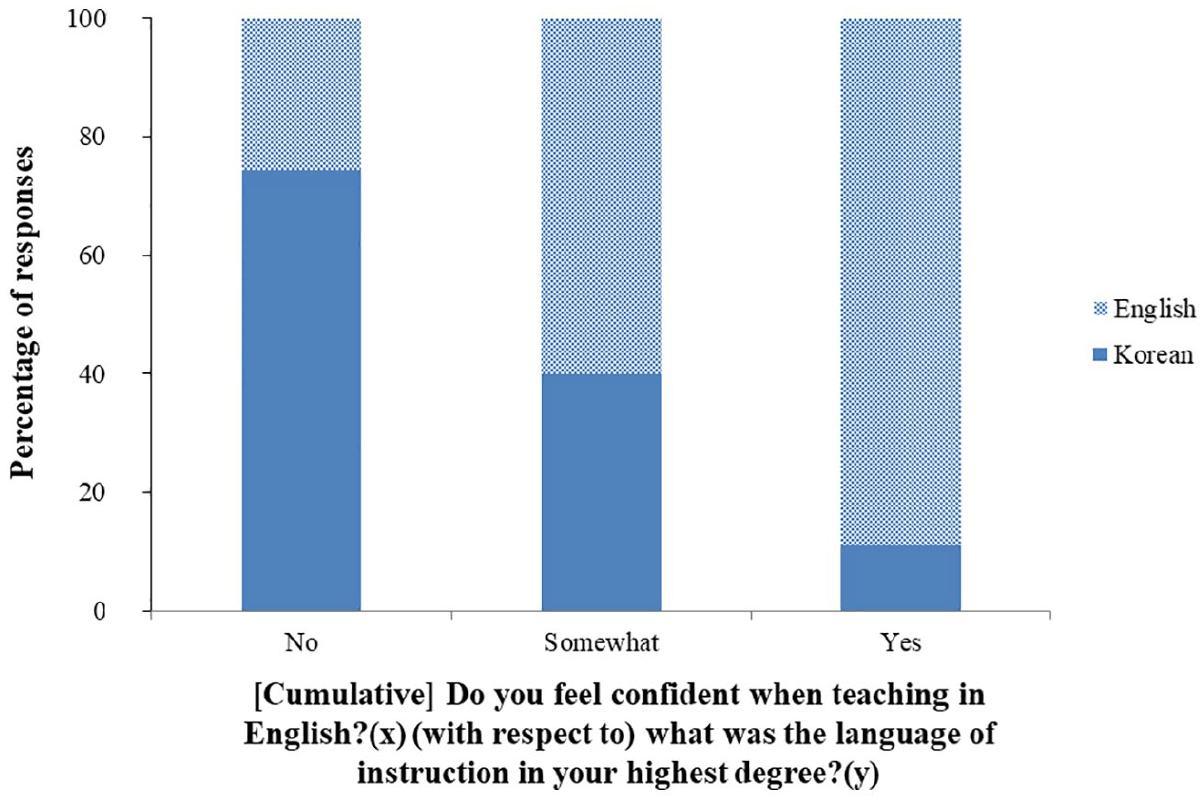
Professors’ confidence in EMI vs. the medium of instruction at their final-degree program.
In addition, Figure 2 visualizes the correlations between professors’ confidence in EMI and their years of teaching in English. The respondents who had just started teaching in English were more concerned about EMI than the others, while the respondents with more than 10 years of EMI teaching experience tended to show relative confidence. Pearson’s correlation coefficient confirms a moderately positive correlation between the two factors (r = .41, t = 5.39, df = 115, p < .001).
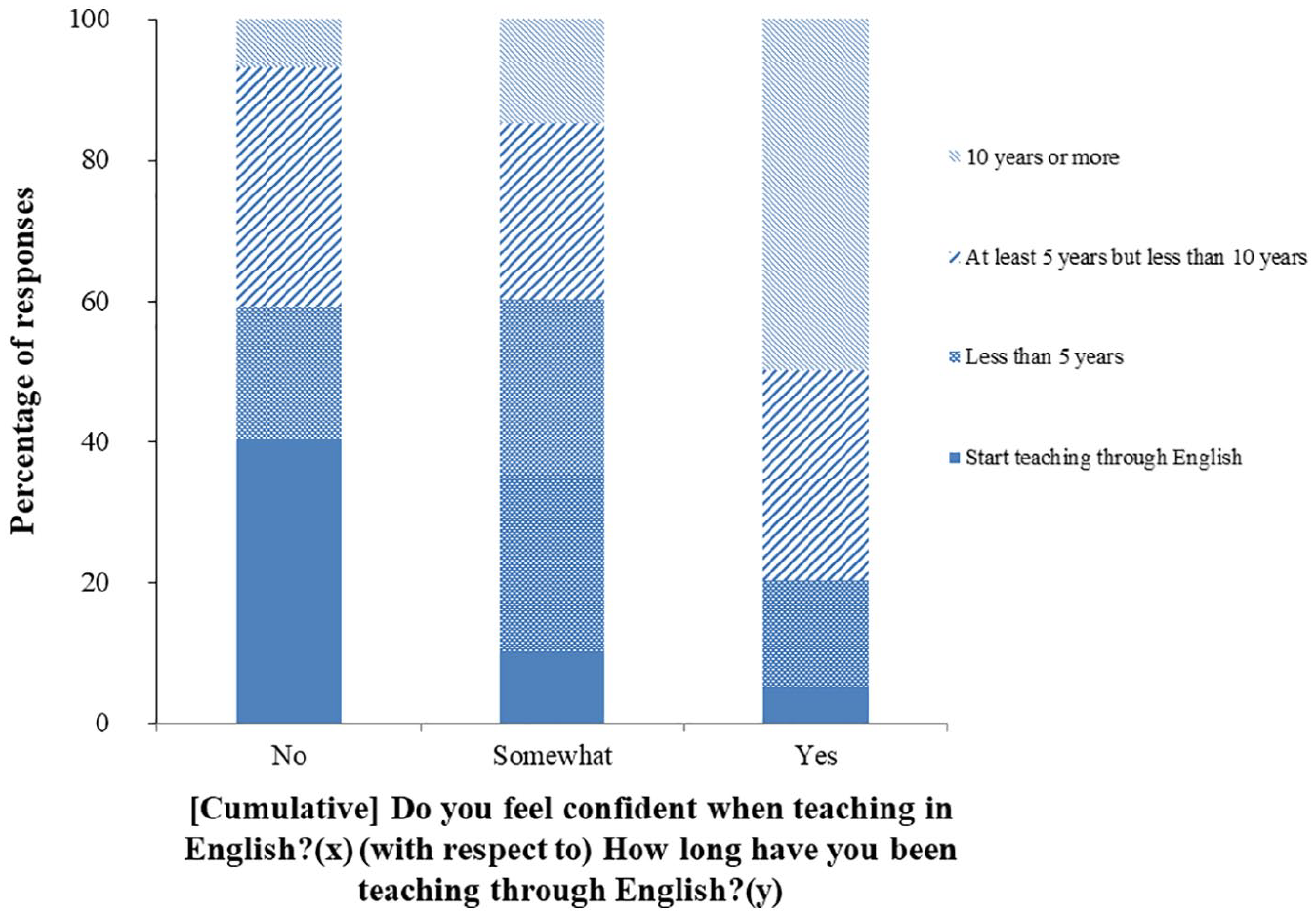
Professors’ confidence in EMI vs. years of teaching in English.
To sum up, the majority of the respondents were confident about their ability for EMI, and their confidence showed correlations with the language of instruction in their final-degree program and their years of EMI experience.
c Language proficiency and teaching methods
Regarding the survey item ‘There is a difference, in terms of English proficiency, between presenting at conferences and teaching EMI classes,’ 75 (64.1%) of the 117 respondents agreed, 20 (17.1%) disagreed, and 22 (18.8%) said they were not sure. In other words, most of them believed that there were different types of language proficiency for presentations at conferences and for teaching EMI classes. The main reason for these differences was that the target audiences in the two situations differed, several respondents observed. Conference presenters interact with professionals who already possess expertise and need to understand their presentations quickly. On the other hand, EMI professors are expected to use easier words in the classroom to explain concepts for students’ comprehension than the words they use in conference presentations. One survey respondent (SR25) emphasized these differences, ‘A conference presentation is short in time, attendees are experts, and the subject is limited in scope. But, class management is long in time, attendees are not experts, and the professor needs to cover various matters of daily life on top of the class subject.’
However, regarding teaching methodology, almost a half of the respondents did not believe that there is a difference between teaching EMI classes and teaching their first-language (L1) classes. That is, 57 (48.7%) of them disagreed with the statement ‘the way of teaching has to change when switching from an L1-medium context to an EMI context,’ 38 (32.5%) agreed, and the others were not sure. One respondent (SR27) defined teaching as ‘essentially a type of communication, which is universal in its nature regardless of the medium of instruction.’ These responses may seem contradictory to another finding that the majority of professors believed that there would be a difference, in terms of English proficiency, between presenting at conferences and teaching EMI classes. Here they seemed to focus on the pedagogical aspect rather than on the linguistic environment and to believe that the same pedagogical principles are applied to teaching in L1 and teaching in English.
In brief, although most of them thought that the language used in EMI classes was different from that used in conferences, almost a half of them did not believe that the teaching methodology involved in EMI was different from that used in the classroom where students’ first language was used.
d EMI-related PD and certification
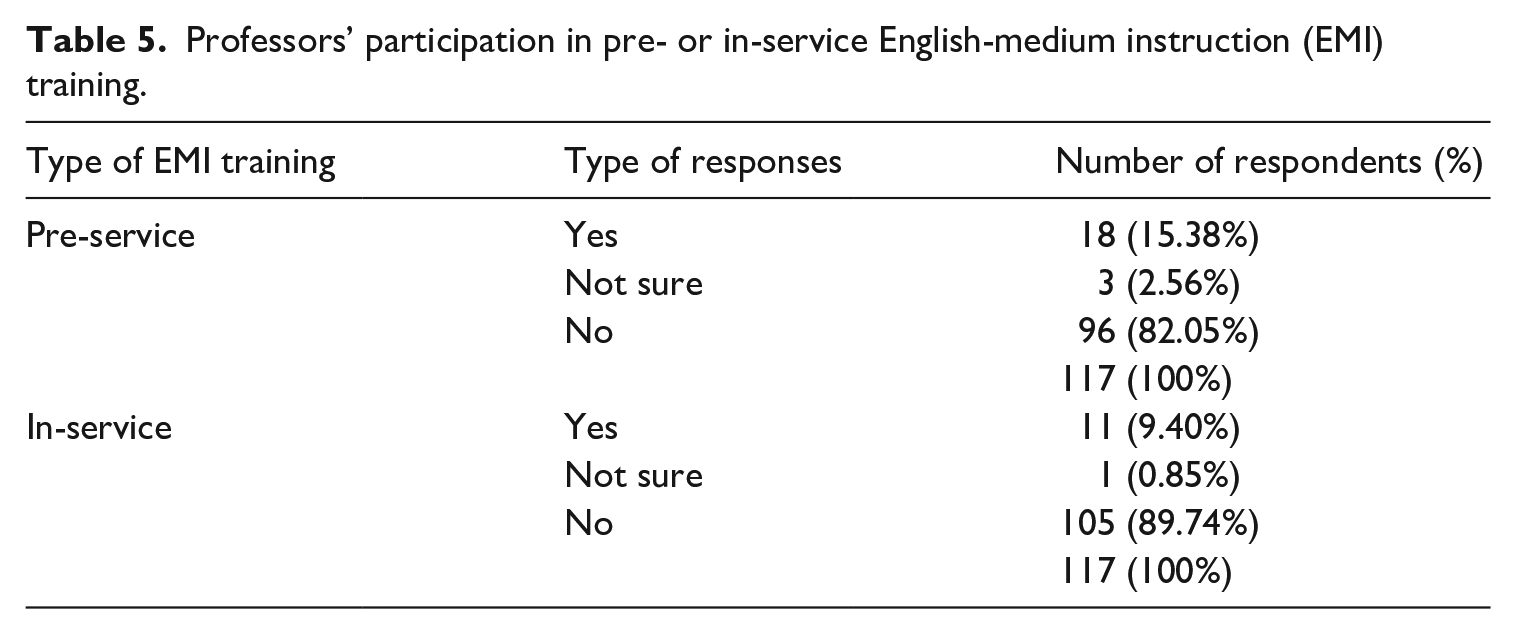
The survey results show that more than 80% of the participants had not taken part in any type of EMI training (Table 5). Among the 117 participants, 96 (82.1%) professors had not participated in pre-service EMI training; 105 (89.7%) of them had not in in-service EMI training. For the small number (15.4%) of respondents who participated in pre-service EMI training, most of them received such training as a requirement for teaching assistants during their graduate studies at an American university. One respondent (SR24) reported participating in a ‘one semester English course for TAs, offered by Syracuse University’. Another respondent (SR62) stated that he participated in the ‘Kaufman Teaching Certificate Program at MIT’. It appears that the pre-service EMI training that they had received ran over an extended period of time.
Professors’ participation in pre- or in-service English-medium instruction (EMI) training.
In contrast, the in-service EMI training that the few respondents (9.4%) received tended to be short in duration. One respondent (SR74) talked about participating in a ‘one-time deal’ program provided by the university’s center for teaching and learning, and another (SR57) detailed, ‘I had two of my lectures video-taped in the presence of one senior member of my department and a staff person from the university’s education support center. I received peer review reports and analysis reports on the lectures.’ Only one respondent (SR15) exceptionally mentioned, ‘When I started my academic position at Queen Mary University of London UK, I completed a postgraduate-certificate course on teaching in higher education. Completing this took about 3 years.’
In brief, only a few respondents received pre-service EMI training, usually at an American institution as graduate students, whereas even fewer professors attended in-service EMI training, mostly provided by their Korean employer university, and these in-service programs tended to be short in duration and a single nonobligatory incident.
Moreover, the interviewees discussed their reasons for not participating in EMI-related PD programs. One reason is that they were not aware of the existence of such programs; another reason is that they did not feel a need because they felt confident about their language or teaching capability: First of all, I don’t know what the university offers. Also, I personally do not feel a need to participate in such a program (I3, computing) I have never participated in EMI-related faculty support programs. I have a bit of different background from that of other professors. I came here as a foreign professor and I was born in another country and lived in Sweden for 10 years. My first language is Swedish, and English is not difficult for me. (I6, materials science and engineering) I think it is right to enhance one’s teaching methodology, but I myself and other professors are not bad at teaching classes in English. Some of us may feel uncomfortable a little, but there are others who feel comfortable. (I16, electrical engineering) I have never participated in an EMI-related professional development program provided by the university . . . As a matter of fact, I did not know if such a program existed. Even if there are such programs, to be honest, I thought the training that I received as a teaching assistant when I went to the U.S. for my [graduate] studies would be enough . . . (I4, humanities and social sciences)
More importantly, most of the interviewees said that they had not participated in an EMI PD program because it was not their priority. Working in a highly competitive research-focused university, they did not see the need to attend such programs especially when their performance is evaluated mainly by their research output and when they have extremely busy schedules: My university provides seminars on teaching methods every month, but I have never participated in them . . . I am somewhat doubtful about how effective and helpful they are. Also, for a tenure-track professor like me, producing graduate students, carrying out research, and getting projects take precedence, so I haven’t really taken time and made effort to provide good instruction in class. (I23, robotics engineering) One of the reasons why professors cannot participate in EMI-related faculty support programs is that research demands are too big that it is not easy to invest time in teaching. (I26, robotics engineering)
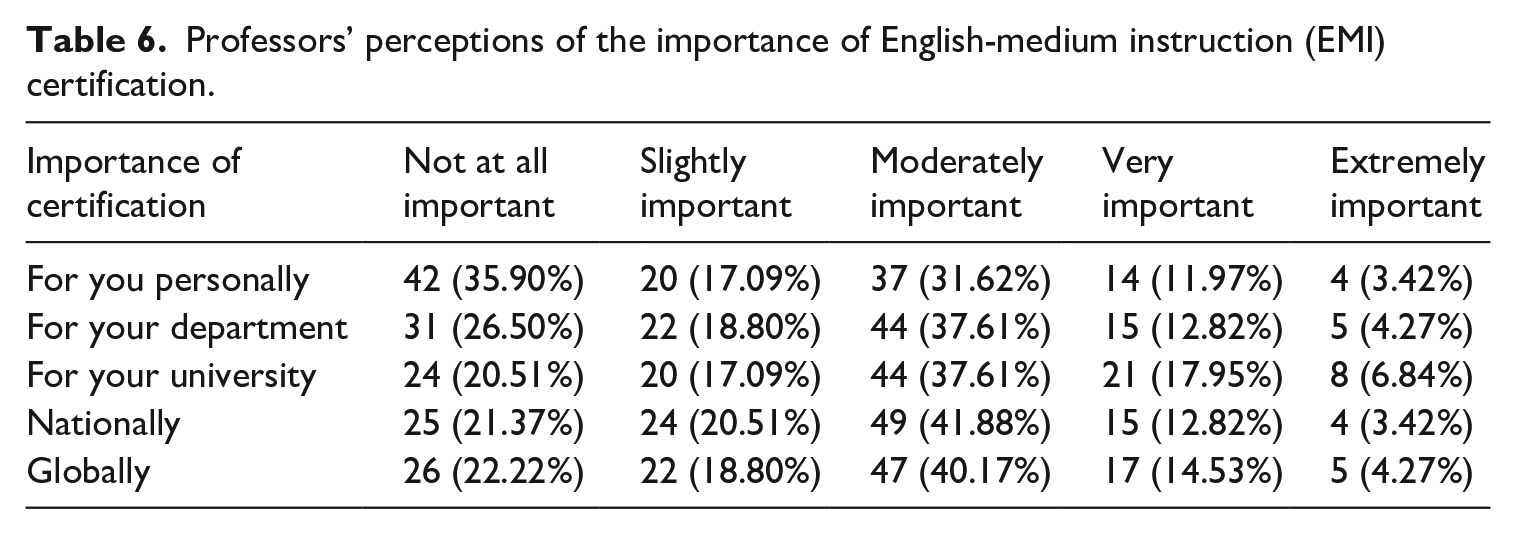
Accordingly, many respondents also showed negative attitudes towards EMI certification. To the question ‘Does your institution already use certification for EMI professors?’ a half of the respondents (n = 58, 49.6%) replied ‘no’, and 56 respondents (47.9%) said they did not know. In addition, more than 30% of the respondents (n = 42, 35.9%) answered that EMI certification would not be important for them personally, while only 15.4% said that it would be ‘very’ or ‘extremely important’ for them (Table 6). Many also believed that it would not be crucial for their department, university, nationally or globally. Those who answered ‘very important’ and ‘extremely important’ were minorities: 17.1% for their department, 24.8% for their university, 16.2% for nationally, and 18.8% for globally.
Professors’ perceptions of the importance of English-medium instruction (EMI) certification.
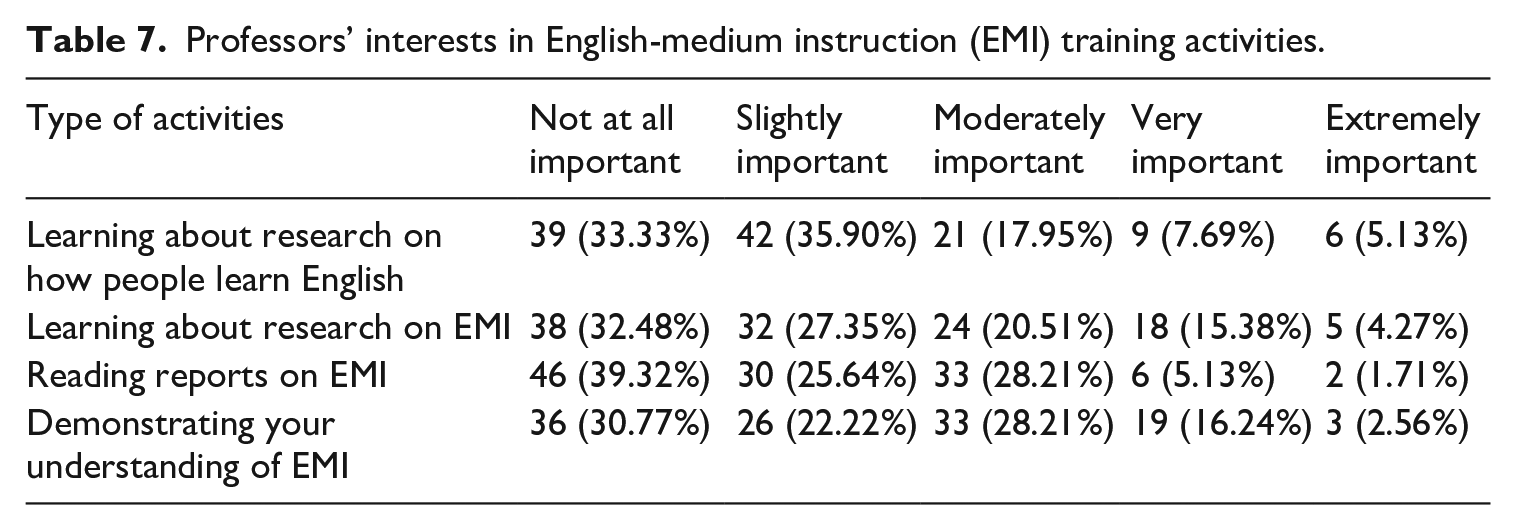
Furthermore, Table 7 shows professors’ low interests in various types of EMI PD activities. The highest numbers of respondents said that they were not interested in finding out about EMI-related research or demonstrating their knowledge of EMI. Interestingly, however, the majority of the respondents (n = 68, 58.1%) preferred an EMI PD program with both aspects of English language proficiency and teaching skills rather than one with language proficiency only (n = 20, 17.1%) or teaching methods only (n = 29, 24.8%).
Professors’ interests in English-medium instruction (EMI) training activities.
Regarding the observation method as part of a PD program, only 32 (27.4%) respondents were positive about being observed by others. The others were either negative (n = 40, 34.2%) or not sure (n = 45, 38.5%). Among the respondents who were positive about observation, 65.4% preferred EMI experts as their observer to their colleagues (25.5%) or supervisor (9.1%).
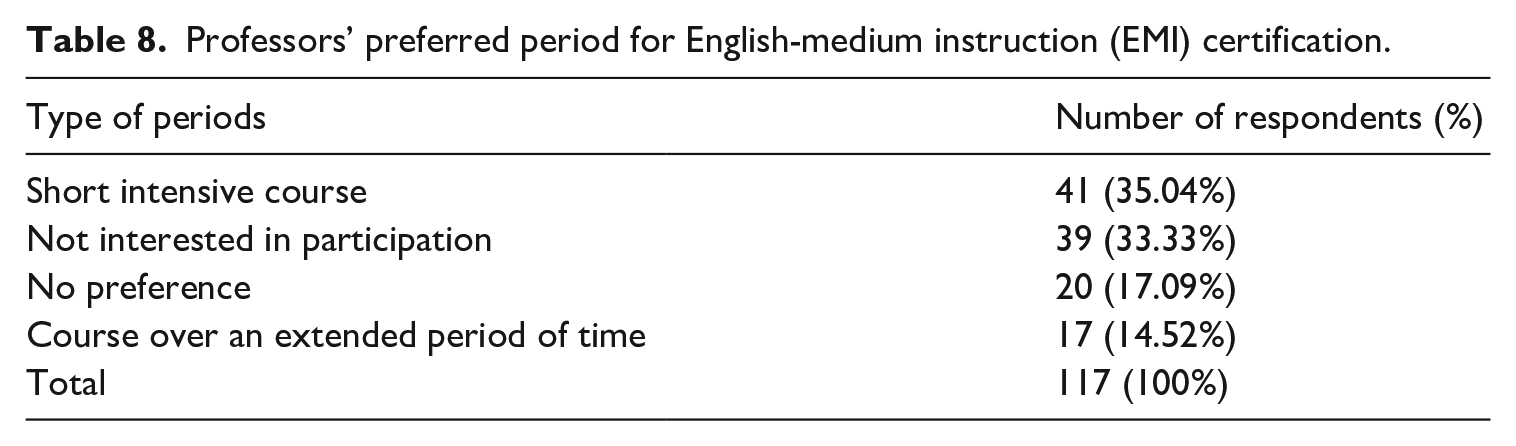
More professors preferred a short intensive course (e.g. one week, 35%) to a course over an extended period of time (e.g. meeting once a week for one semester, 14.5%). Overall, the respondents’ reluctance to participate in certified PD programs was noticeable (Table 8). A third of them claimed that they would not be willing to take part in a certified EMI-related PD program.
Professors’ preferred period for English-medium instruction (EMI) certification.
We further explored this phenomenon of professors’ resistance against EMI certification in the follow-up interviews. Even though most interviewees acknowledged the importance of EMI and the needs to enhance professors’ language and teaching capability, only one supported EMI certification positively: I would be willing to join such a program. It’s always good to go back and think about what I’m doing and how I should do it better. (I7, chemistry)
The others were strongly skeptical about the possibility of actual implementation of EMI certification. They observed that professors may not want to take part in an EMI certification program because they are reluctant to be assessed by others: It would be challenging for professors who obtained the highest degrees from renowned universities and got hired through an extremely competitive process to confess their low English proficiency to teach in English. They may get horrified if someone judges their teaching in EMI classes and asks them to take part in a certification program. (I1, science and technology policy) Many students have raised the issue of professors’ limited English proficiency. For professors’ instructional quality, there should be EMI-related faculty support programs. However, first, I doubt that professors, who tend to have a big ego, would make effort to improve themselves after their problems are pointed out. (I4, humanities and social sciences)
The second reason for their resistance shows more fundamental problems of EMI certification. The three universities in the present study are highly research-oriented institutions, so professors’ evaluation is mainly based on their research performance, not teaching: In my opinion, professors are involved in two important activities: research and education. In fact, the most important mission of a university is to train and educate students to be outstanding human resources for our society. However, our university is research-focused, so professors concentrate on improving their research capability . . . (I6, materials science and engineering) In a research-focused university, for one to be evaluated as a good professor, he or she needs to have good research performance; teaching well is not really needed. (I16, electrical engineering) As you know very well, no matter how many times the university emphasizes that lectures or education is important, at the end professors are evaluated by their research performance, so I am not sure how motivated professors will be about an EMI certification program. There may be needs for such programs, but I see considerable difficulties ahead in introducing and implementing them. (I4, humanities and social sciences)
Overall, it seems that EMI certification programs at Korean science and engineering universities are likely to fail due to the universities’ nature that strongly emphasizes faculty’s research output, not teaching.
However, although most of the interviewees indicated their negative attitude towards EMI certification, they argued for consistent EMI-related faculty support such as content-related teaching resources, pronunciation workshops, and other English language services: Sometimes resources from the education support center are for professors of humanities and social sciences, which I cannot utilize for my science classes. It would be better if teaching materials directly related to science classes are provided. (I16, electrical engineering) It would be great if resources are available online. Professors are pretty busy during the semester. (I20, life sciences) Sometimes I am not confident about my English to make exam questions or to write emails. Proofreading services would be highly helpful. (I2, humanities and social sciences)
IV Conclusions
Our study results show that the three universities have provided their faculty with various types of instructional support in the areas of pedagogy, didactics, and technology. However, they have scarcely offered PD programs specifically aiming at EMI teaching methods. Furthermore, none of the schools provided support to improve professors’ English language skills even though the vast majority of professors at these schools are Korean, that is, nonnative speakers of English.
This stands in marked contrast to European universities, most of which provided programs for the improvement of professors’ language skills (Dafouz, 2018; O’Dowd, 2018). European science and engineering schools also emphasized the importance of language development for EMI professors: their PD programs focused on language development while treating their linguistic fluency as a primary requirement for EMI (Klaassen & Bos, 2010; Margic & Vodopija-Krstanovic, 2018).
It is not likely that the lack of PD for the improvement of professors’ English proficiency at the Korean science and engineering schools is due to professors’ advanced levels of English language ability suitable for EMI. In fact, none of the schools has instituted a system to measure their faculty’s English ability, so their English levels are unknown. Furthermore, the majority of professors are native speakers of Korean who tended to have limited exposure to an English-speaking environment during their graduate studies at an institution in an English-speaking country. Thus, it is most likely that their English levels require further development for adept EMI.
Moreover, it is shown that more than 80% of the participants had not taken part in any type of EMI PD programs, mainly because it was not their priority. Working in a highly competitive research-focused university, they did not see the need to take part in such programs when evaluations of their performance center on their research output. This negative attitude toward EMI PD is also reflected in their unenthusiastic attitudes towards EMI certification: many believed that EMI certification would not be important for themselves, their department, university, nationally or globally.
Surprisingly, despite their debatable English ability and lack of participation in EMI PD programs, most of the respondents showed confidence in teaching EMI classes. One possible reason for this phenomenon is that EMI was introduced in Korean science and engineering schools in the mid-2000s, so many professors have been able to learn by trial and error what works and what does not in their own EMI classes for more than a decade; they may now feel settled and satisfied with their own ways of teaching. Moreover, at these well-reputed universities, professors highly proficient in their major areas may deliver outstanding contents to their students in class, which may result in students’ high satisfaction with their classes irrespective of professors’ English proficiency.
However, this does not mean that there is no room for PD for Korean science and engineering professors who teach EMI classes. They have rarely been given PD in relation to EMI-specific teaching methods and English language skills. Also, it was shown that science and engineering professors at a Korean institution tended to give one-way instruction without interactions with students in their EMI classes, and their pronunciation errors and lack of proper in-class management strategies lowered the efficacy of their classes (Kim et al., 2021).
In addition, the majority of the respondents preferred an EMI PD program with both aspects of English language proficiency and teaching skills rather than one with language proficiency only or teaching methods only. Therefore, an EMI PD program that addresses both aspects will be attractive to professors. Also, most of the interviewees argued for the needs of consistent EMI-related faculty support such as content-related teaching resources and language-related programs including pronunciation workshops.
The most critical measure needed to improve Korean science and engineering professors’ EMI capability is amending the current university policy that excessively focuses on its faculties’ research performance, disregarding the importance of and need for enhancing the quality of education. Unless central administration realizes this need for change and implements it, faculty members will continue to be driven to achieve higher research goals, and education for students will likely take a back seat. It may be necessary for students to be more vocal about their rights to a proper education.
Once universities realize the importance of providing high-quality EMI, they need to take a more systematic, direct approach to the development of professors’ EMI capability (Lauridsen, 2017). EMI PD programs with an indiscriminate and arbitrary approach would not be effective (Torra et al., 2014). As discussed, Korean science and engineering professors have not been given assistance in English language development or EMI-specific teaching methodology. It will be necessary to start the process of identifying what they actually need in order to improve their EMI capability and provide precise services to satisfy such needs. Furthermore, professors tend to be highly time-pressured; thus, individualized EMI PD programs that are flexible and have immediate effects with measurable outcomes may be necessary. For example, EMI PD resources can be provided online for professors’ easy access; one-to-one consultation programs can be offered online or by EMI trainers’ direct visit to their offices. Universities would need to establish and implement plans to supply quality EMI trainers from outside the university or provide EMI training to experienced EMI professors within.
We would like to conclude our study with poignant observations from the interviewees: Good teaching must exist even at research universities. (I6, materials science and engineering) Our students have enormous potential. Their potential is developed when they encounter good lectures. Therefore, professors should not underestimate the importance of teaching, and EMI is a natural and beneficial trend in globalization. Both research and teaching EMI classes are part of our vocation. (I26, robotics engineering)
This study has examined the state of EMI-related PD at Korean science and engineering schools and professors’ perceptions of it. There may be an argument that the results apply only to those in similarly competitive, research-focused educational environments. However, we believe that any EFL institution that contemplates the introduction or expansion of EMI-related PD for their faculty will find the study enlightening and informative. For many research-oriented Asian institutions in particular, the findings of the study are likely to serve as guidance for their development of EMI-related PD.
