







Abstract
The aim of this study was to test a model of second language (L2) boredom based on coping self-efficacy (CSE), foreign language enjoyment (FLE), and mindfulness among English as a foreign language (EFL) learners. In so doing, 456 EFL learners from Iran took part in this study by completing an online survey which included scales tapping into the four latent constructs under investigation. Two-step structural equation modelling was utilized to analyse the data and examine the associations among the constructs. Results revealed that CSE and mindfulness positively affected FLE. Also, FLE was a direct negative predictor of L2 boredom. Concerning the mediation hypotheses, FLE was found to fully mediate the effect of mindfulness on boredom. However, FLE was a partial mediator between CSE and boredom. These findings provide a basis for important implications for L2 research and practice.
I Introduction
The last few decades have witnessed a growing interest in psychological factors (i.e. emotions) in the field of second and foreign language (L2) learning and teaching (C. Li & Wei, 2023). Given the fact that language learning is an emotional endeavor (Plonsky et al., 2022), there is a longstanding tradition of research on emotions in L2 education (e.g. Dewaele et al., 2018; C. Li, 2020; Piniel & Albert, 2018; Shao et al., 2020). Moreover, studies have shown that emotions are of considerable importance in the field of second language acquisition (SLA) (Dewaele & Li, 2020), as they play a pivotal role in the process of L2 learning and use (Shao et al., 2019).
Boredom is one of such emotions which has long been recognized as a common negative psychological state experienced by students (Eren & Coskun, 2016; Kruk et al., 2021; V. Tze et al., 2016). As one of the most frequently experienced emotions in school (Pekrun et al., 2010), boredom is a negative emotional or psychological experience that prevents individuals from staying focused on and engaging in learning tasks (Eastwood et al., 2012; Macklem, 2015). Boredom is an amalgam of disengagement, dissatisfaction, disappointment, lack of motivation and attention in pursuit of one’s goals (Kruk & Zawodniak, 2018), which, if ignored, can lead to inaction and depression (Macklem, 2015). Moreover, given that it is not as disruptive as anxiety (M. C. Tze, 2011), boredom is often neglected by foreign language (FL) teachers (Pawlak, Zawodniak & Kruk, 2020), which can result in inhibiting the L2 learning process (C. Li et al., 2023; Pawlak, Kruk, et al., 2020). Therefore, efforts should be made to investigate boredom and its antecedents with a view to alleviating its pernicious effects in L2 classrooms. Accordingly, researchers have recently addressed L2 boredom and its precursors in a variety of contexts (e.g. Derakhshan et al., 2021; Dewaele et al., 2023; C. Li, 2021; Pawlak, Kruk, et al., 2020). The empirical evidence accumulated so far indicates that that there are a number of reasons why individuals might succumb to boredom when learning a foreign language, such as, for example, lack of enjoyment in performing L2 learning tasks (C. Li, 2022; C. Li & Wei, 2023; Kruk et al., 2022).
In line with the recent shift of emphasis from negative emotions to positive emotions in educational psychology (Kristjánsson, 2012), triggered by the recognition of the tenets of positive psychology (PP) in applied linguistics (C. Li, 2020), emphasis has recently been placed on the positive emotions experienced by L2 learners (C. Li et al., 2018). This has resulted in a more holistic view of affect in which both negative and positive emotions are considered as prime motives of language learning (MacIntyre & Vincze, 2017). Furthermore, in this holistic approach, scholars no longer view positive emotions as the mere flip side of negative emotions, but as independent variables (Resnik & Dewaele, 2020; Shao et al., 2020). Being the two academic emotions that are the most frequently experienced by learners (Goetz et al., 2007), enjoyment and boredom are significant psychological constructs, and thus understanding their interconnections can be conducive to successful learning (Pekrun et al., 2017), especially in the FL learning context (C. Li & Wei, 2023). Moreover, positive emotions such as foreign language enjoyment (FLE) can not only contribute to L2 learning (Botes et al., 2021; Dewaele & MacIntyre, 2016; Jin & Zhang, 2021), but they can also to some extent reduce the consequences of negative emotional reactions involved in L2 learning (C. Li, 2022). Specifically, the construct of FLE has been shown to have a key role in the prevention and reduction of disruptive effects of boredom in FL classrooms (Kruk et al., 2022; C. Li, 2022).
Although well-recognized and researched in educational psychology (C. Li et al., 2023), boredom still remains an often-overlooked research area in the field of English as a foreign language (EFL) (Pawlak, Zawodniak & Kruk, 2020). Furthermore, since boredom is less noticeable than other emotions (i.e. anxiety or anger) (Coşkun & Yüksel, 2022), the empirical evidence concerning this aversive emotional state is still fairly limited in L2 contexts (C. Li & Dewaele, 2020; Pawlak, Kruk, et al., 2020). Therefore, the investigation of boredom is vital for successful L2 learning because misconceptions in this area may diminish the effectiveness of L2 instruction (Zawodniak et al., 2017). Accordingly, a number of recent studies have addressed boredom in EFL contexts (e.g. Derakhshan et al., 2022; C. Li et al., 2023; Pawlak, Kruk, et al., 2020; Pawlak et al., 2022; L. J. Zhang et al., 2022), but research on its nature, antecedents, and outcomes surely needs to be further extended, in particular by taking into account other individual difference (ID) factors. The present study seeks to address this gap by investigating the concept of boredom and its potential predictors in L2 learning. Specifically, we explored the extent to which boredom is predicted by L2 learners’ mindfulness and coping self-efficacy (CSE), also taking into account the mediating effects of FLE.
II Literature review
1 Theoretical framework
a Broaden-and-Build Theory
With the introduction of PP, the past decade has witnessed a positive renaissance in SLA research (MacIntyre & Gregersen, 2012). One leading foundation theory for this so-called ‘renaissance’ is the Broaden-and-Build Theory (Fredrickson, 2001, 2003), in which it is maintained that ‘positive emotions, including joy, interest, contentment, pride, and love, although phenomenologically distinct, all share the ability to broaden people’s momentary thought–action repertoires and build their enduring personal resources, ranging from physical and intellectual resources to social and psychological resources’ (Fredrickson, 2001, p. 219). Put differently, based on this theory, positive emotions (i.e. FLE) can prepare learners to effectively deal with or regulate their negative emotions (i.e. boredom). While positive emotions can broaden L2 learners’ perspectives and promote their language outcomes, negative emotions tend to hinder the optimal learning potential of L2 learners and restrict their focus (Guo & Qiu, 2021; Yu, 2021). Given the added value of these insights to a new wave of emotion studies in the L2 context, SLA researchers have tried to examine a wider spectrum of emotions (i.e. FLE, pride, hope, shame, and boredom) rather than solely focusing on anxiety (Davari et al., 2020; C. Li et al., 2023). Consequently, there has been a growing body of literature recently intended to shed more light on the relationship between boredom and positive emotions of EFL learners (e.g. Dewaele & Li, 2021; C. Li, 2022; L. J. Zhang et al., 2022).
b Control-Value Theory of achievement emotions
In addition to Broaden-and-Build Theory, we draw upon the Control-Value Theory (Pekrun, 2006), which offers a conceptual framework to identify the origins, precursors, and results of achievement emotions (i.e. FLE, boredom). This theory has provided theoretical and epistemological foundation for many L2 emotion studies (C. Li, 2021). According to this theory, a three-dimension taxonomy conceptualizes achievement emotions: object focus, valence, and activation. Object focus differentiates activity-related emotions such as enjoyment and boredom from outcome-related emotions like anxiety and hope. Valence has to do with positive emotions (i.e. enjoyment, satisfaction) and negative emotions (i.e. anxiety, stress). Activation refers to the differentiation of physiologically activating emotions, such as enjoyment and anxiety, and deactivating emotions, such as boredom and relaxation (Pekrun et al., 2011). As Pekrun and Perry (2014) suggest, in line with the Control-Value Theory, achievement emotions can have significant effects for the learning process and achievement. This theory has been utilized to explore the link between achievement emotions and their antecedents or effects. For instance, investigating the enjoyment experiences of FL learners, Piechurska-Kuciel (2017) indicated that learners’ enjoyment is ascribed to their language achievement, which is linked to proximal antecedents of achievement emotions, namely, control and value appraisals. C. Li (2021) reported that appraisals of perceived control and value had a negative predictive role in affecting boredom.
This having been said, little empirical research has been undertaken regarding achievement emotions, their antecedents, and outcomes particularly in the EFL context. In addition, to the best of our knowledge, few if any previous studies have included mindfulness and CSE as antecedents of achievement emotions, namely FLE and boredom.
2 L2 boredom
Boredom, a complex and multifaceted construct (Pawlak et al., 2022), is an unpleasant emotional experience which is recognized as an ‘affective indicator of unsuccessful attentional engagement in valued goal-congruent activity’ (Westgate & Wilson, 2018, p. 690). Accompanied by a sense of emptiness and aimlessness (Eastwood et al., 2012), boredom is a negative psychological state resulting from one’s perception of the learning environment (Weinerman & Kenner, 2016), which leads to disengagement and avoidance behaviors (Kruk & Zawodniak, 2020). While motivated learners effectively participate in assigned tasks and activities, those manifesting boredom are apathetic towards the learning process, and thus they struggle to stay focused on what transpires in the classroom (Preckel et al., 2010). Individuals who suffer from boredom are likely to experience various consequences: cognitive (e.g. the feeling of time slowing down), affective (e.g. feelings of discomfort and aversive reactions), expressive (e.g. vocal, facial, and postural signs of boredom), motivational (e.g. the desire to change the activity or to leave the situation), and physiological (e.g. decreased arousal) (Nett et al., 2010).
There exist various causal mechanisms of boredom which can be discussed in terms of a number of models and theories. First, the under-stimulation model (Larson & Richards, 1991) posits that students suffer from boredom due to the scarcity of new stimuli as well as repetitive and unchallenging activities leading to disengagement. Second, the forced-effort model (Hill & Perkins, 1985) pertains to situations when learners find teacher-imposed activities monotonous and complex, realizing that they are not in control of their own learning. Third, the Control-Value Theory of achievement emotions, discussed in more detail above, (Pekrun, 2006) posits that students may attach little value to activities when they perceive low subjective control over tasks that exceed their abilities. For example, Niculescu et al.’s (2016) study indicated that students’ reduction of perceived control over and value of the tasks leads to an increase in their boredom. Fourth, the attentional theory of boredom proneness (Fahlman et al., 2013) concerns situations in which students exhibit poor attentional control and are unable to sustain attention. Fifth, the emotion theory (Eastwood et al., 2007) is based on the assumption that students who have difficulty in identifying, understanding, and communicating their own emotions are more likely to get bored.
Much of the recent research on boredom and its antecedents has been conducted outside of the field of SLA (e.g. Bench & Lench, 2019; Mikulas & Vodanovich, 1993; Sharp et al., 2020). However, in recent years the construct of boredom has also made its way into research into L2 learning and teaching. For example, drawing on the Control-Value Theory (Pekrun, 2006), C. Li et al. (2023) recruited Chinese EFL students and teachers, conceptualizing foreign language learning boredom (FLLB) as a |three-dimensional achievement emotion, including valence, arousal, and object focus. Also, based on data collected from 314 Chinese college students, Wang and Xu (2021) found that boredom constituted two interacting dimensions, namely state and trait. They also reported that state boredom significantly affected L2 learning, whereas trait boredom did not have any substantial impact on it. Examining the diaries of English philology students, Zawodniak et al. (2017) came to the conclusion that factors such as language activities, lesson preparation, and teacher behavior had an important role in evoking boredom. In another study in the Polish context, Pawlak, Kruk, et al. (2020) uncovered two distinct factors underlying boredom in English classes, that is, disengagement, monotony and repetitiveness, and lack of satisfaction and challenge. In a mixed-methods study, C. Li (2021) examined control-value appraisals as precursors of boredom in the Chinese EFL context. Findings demonstrated that the more learners felt competent in EFL classrooms, the less boredom they experienced. It was also confirmed that competent learners attached more value to learning English, which, in turn, made them immune to the disruptive effects of boredom. Derakhshan et al. (2021) reported that long and monotonous monologues of teachers, lack of student participation, logistical problems, and haphazardly selected, repetitive tasks were the major antecedents of boredom among Iranian EFL students.
As illustrated above, the empirical evidence concerning L2 boredom points to a wide array of sources influencing this aversive emotion. However, the association of boredom with positive emotions and other learner-related variables as well as the potential role that such variables can play in alleviating the consequences of L2 boredom have remained under-researched.
3 Mindfulness
Mindfulness is conceptualized as ‘the awareness that emerges through paying attention on purpose, in the present moment, and non-judgmentally to the unfolding of experience moment by moment’ (Kabat-Zinn, 2003, p. 145). Conceptualized as awareness of an individual’s inner and outer worlds, mindfulness is a process of gaining insight into thoughts, emotions, actions, or surroundings, especially at the present moment (Brown & Ryan, 2004). Mindfulness is a state of mind that can be best described by the term ‘carpe diem’, that is, ‘being in the moment’. Even though mindfulness is associated with concentration, they are in fact two distinct constructs (Dunn et al., 1999). This is because concentration refers to a situation in which one’s attention is restricted to a single interoceptive or exteroceptive object while ignoring other inputs, whereas mindfulness entails voluntary and appropriate regulation of attention and awareness (see Brown et al., 2007). Among others, mindfulness has been found to promote learners’ creative thinking, academic performance, and physiological/psychological well-being (Fallah, 2017; Henriksen et al., 2020), and to reduce their levels of negative emotions, including anxiety, stress, and boredom (Shearer et al., 2016). Based on the attentional theory of boredom proneness, it is assumed that the cultivation of attention can minimize one’s propensity to experience boredom (LePera, 2011). Mindfulness has also been reported to be associated with enjoyment (Bóo et al., 2020; Langer et al., 1978; Thompson, 2009).
To date, the association between mindfulness and boredom has been investigated in a number of studies in the field of psychology (e.g. Galla et al., 2020; Lee, 2017; Waterschoot et al., 2021). Employing two psychometrically valid measures, namely the Mindfulness Attention Awareness Scale (MAAS) (Brown & Ryan, 2004) and the Boredom Proneness Scale (BPS) (Farmer & Sundberg, 1986), LePera (2011) examined the link between mindfulness and boredom proneness, as well as the association between mindfulness and negative outcomes such as anxiety, depression, and substance use. The findings demonstrated that boredom proneness was positively associated with these negative phenomena but negatively with mindfulness. Furthermore, mindfulness was negatively associated with anxiety, depression, and substance use. In another study, Lee (2017) reported that mindfulness was negatively correlated with boredom. It was also found that depression, anxiety, and stress were positively associated with boredom proneness and negatively related to mindfulness. Despite such empirical evidence, there is a relatively small body of research that has directly investigated the relationship between boredom and mindfulness in educational settings. Galla et al. (2020) indicated that students with higher levels of mindfulness were more immune to boredom. Similarly, Trunnell et al. (1996) demonstrated that students who were equipped with mindfulness felt less bored and more engaged.
Although the construct of mindfulness and its relationship with boredom has been the focus of some empirical investigations, mostly conducted within the field of educational psychology, to the best of our knowledge, no study has investigated the link between the two constructs in the area of SLA. With this gap in mind, in view of the salient influence of mindfulness in alleviating negative effects of boredom (Koval & Todman, 2015), the current study explored the predictive effects of mindfulness of the experience of boredom in EFL contexts. As mentioned earlier, the attentional theory of boredom proneness argues that students sustain a low level of self-awareness of attention and therefore find it hard to focus on what is going on around them (LePera, 2011). At the same time, the concept of mindfulness pertains to awareness that arises through paying attention to present events and thus being cognizant of what is happening in the immediate environment (Baer, 2003; Brown et al., 2007). This has led us to also examine the potentially influential role of mindfulness in shaping L2 boredom, an objective that has not thus far been pursued in any study in L2 contexts.
4 CSE
Coping pertains to ‘constantly changing cognitive and behavioral efforts to manage specific external and/or internal demands that are appraised as taxing or exceeding the resources of the person’ (Lazarus & Folkman, 1984, p. 141). Commonly viewed in terms of strategies and emotional responses, coping aims to solve a problem, cognitively re-evaluate it, or minimize its consequences (Ritsner et al., 2003). It is argued that the experience of boredom is an inherent and inevitable aspect of the learning process, especially when it comes to L2 learning (Kruk, 2021a). Importantly, it must be recognized that learners do not only just experience boredom, but also utilize various strategies to cope with this aversive emotion (Eren & Coskun, 2016). In fact, some previous research has linked the use of coping strategies to students’ boredom. Nett et al. (2010) developed the Boredom Coping Scale (BCS) to explore how individuals deal with experiences of boredom. Four categories of boredom-related strategies were evaluated:
cognitive-approach, e.g. changing the perception of the situation by focusing on the significance of learning;
behavioral-approach, e.g. changing the boring situation by asking the teacher for alternate tasks;
cognitive-avoidance, e.g. forgetting about the boring class by thinking about something more exciting; and
behavioral-avoidance, e.g. distracting oneself from boring situations by chatting with classmates.
Based on the results, three distinct groups of students were recognized: reappraisers, criticizers, and evaders (Nett et al., 2010). Reappraisers preferred cognitive-approach strategies, they were less frequently bored, and attached more value to learning. By contrast, criticizers preferred behavioral-approach strategies, while evaders tended to rely on both types of avoidance strategies. The results of the study conducted by Nett et al. (2011) showed that coping strategies representing the cognitive-approach were associated with lower levels of boredom.
Not only is it important to identify boredom coping strategies, but also to explore the construct of self-efficacy that is intrinsic to these strategies and can impact their application (Freire et al., 2020). As Hamill (2003) found in her study, in the face of challenges a higher sense of efficacy translated into greater effort and coping. Self-efficacy can be characterized as one’s belief about the capacity to execute a particular behavior (Lawrance & McLeroy, 1986). In a transversal correlational explanatory study (Montero & León, 2007), Sánchez-Rosas and Esquivel (2016) examined the link between boredom, task value, and self-efficacy among 454 university students. The results indicated that task value and self-efficacy strongly affected participants’ boredom, with self-efficacy having a significant impact on task value. Y. Liu and Lu (2017) explored the association between self-efficacy and boredom of 514 high school students. Utilizing a linear mixture model, they demonstrated that self-efficacy negatively predicted boredom. Furthermore, self-efficacy has also been found to be positively linked to L2 learners’ positive emotions, such as FLE (An et al., 2021; Demir & Okyar, 2021). In their study, Z. Li and González (2021) reported that self-efficacy exerted a direct effect on learners’ FLE.
As Benight and Bandura (2004) suggest, self-efficacy can be investigated within specific domains to ensure its better assessment and to further illuminate its predictive capacity. One such particular domain is CSE (Pisanti et al., 2008). CSE relates to the confidence that individuals have in their capabilities to effectively cope with external stressors (Chesney et al., 2006). Bandura (1977) demonstrated that individuals with a high sense of CSE have greater confidence in their capabilities and are more likely to cope with and manage adversity through the use of appropriate strategies. CSE has been associated with psychological well-being and subjective performance (e.g. Mazaheri & Bahramian, 2016; Reeves et al., 2011). Using the CSE scale (Chesney et al., 2006), Nicholls et al. (2010) found that CSE was positively related to subjective performance and negatively to anxiety in the case of athletes. The results also indicated that self-efficacy promoted athletic performance via improving CSE beliefs. Laschinger et al. (2015) administered surveys to new graduate nurses and revealed with the help of structural equation modeling that CSE was a significant predictor of burnout and emotional well-being. CSE has also been found to exert a strong influence on academic success (Barrows et al., 2013). Using regression analysis, Watson and Watson (2016) showed that students who were confident in their capacity to cope with challenges experienced less academic stress, thus demonstrating a negative link between these two constructs. Moreover, Zhou and Kam (2017) revealed the prominent role of learners’ self-efficacy and boredom coping strategies when experiencing boredom in classroom. Fallah (2017) probed the relationship between mindfulness, CSE, and anxiety among Iranian EFL students, providing evidence for significant positive correlations between mindfulness and CSE. Moreover, it was found that mindfulness and CSE were significantly and negatively correlated with anxiety. With the exception of Fallah’s (2017) study, CSE still remains blatantly underappreciated and insufficiently understood, particularly in L2 learning and teaching. Thus, it seems warranted to investigate the construct of CSE and its potential contributions in EFL contexts, especially in connection with the occurrence of boredom.
5 FLE
In the 1980s, Krashen (1985) proposed the affective filter hypothesis which underlined the crucial role of emotions in L2 learning. His hypothesis led many SLA scholars to explore emotions, dedicating most of their attention to negative affect, in particular anxiety (Dewaele et al., 2018; MacIntyre, 2017). Nonetheless, with the advent of PP (Peterson, 2006), research on emotion has ventured into new territories in the context of SLA. Drawing on PP and the concept of flow (Csikszentmihalyi, 1990), Dewaele and MacIntyre (2014) proposed the construct of FLE, which is conceptualized as ‘a complex emotion, capturing interacting dimensions of challenge and perceived ability that reflect the human drive for success in the face of difficult tasks’ (Dewaele & MacIntyre, 2016, p. 216). FLE is an activating-positive achievement emotion which is rooted in the Broaden-and-Build Theory of positive emotions (Fredrickson, 2001) and the Control-Value Theory of achievement emotions (Pekrun, 2000, 2006). Dewaele and MacIntyre (2014) view FLE as a positive emotional state experienced by L2 learners when their psychological needs are met during learning an L2.
FLE has been positively associated with academic achievement and FL proficiency (e.g. Botes et al., 2022; Derakhshan & Fathi, 2023; Dewaele & Proietti Ergün, 2020; Dewaele et al., 2018; Fathi et al., 2023; C. Li, 2020, 2022; Mohammad Hosseini et al., 2022) by promoting psychological resiliency and broadening the mindsets of individuals (C. Li et al., 2018; Resnik & Schallmoser, 2019). Botes et al. (2020) conducted a study with an international sample of FL learners to examine correlations between FL proficiency and positive and negative emotions. The results indicated that participants’ self-perceived proficiency was associated with higher levels of FLE and lower levels of foreign language anxiety (FLA). In another study, H. Zhang et al. (2020) demonstrated that FLE of Chinese EFL students positively correlated with academic achievement. In the realm of SLA, it is essential to examine in a single study how positive and negative emotions interact to exert effects on EFL (Dewaele & MacIntyre, 2014), as these emotions coexist in EFL learning. Although L2 boredom has been recently associated with FLE in several studies (e.g. Dewaele & Li, 2021; Dewaele et al., 2023; Kruk et al., 2022; C. Li & Wei, 2023), researchers have thus far failed to give proper attention to the ways in which these two constructs can be linked. Adopting the Control-Value Theory of achievement emotions, C. Li and Wei (2023) probed independent and joint predictive roles of FLE, FLA, and FLLB in L2 achievement among 954 EFL learner in China. Structural equation modelling (SEM) analysis revealed that all the three emotions were predictors of achievement, with the effect of FLE being the strongest and the most enduring. Pursuing the same line of inquiry, Dewaele et al. (2023) investigated the relationship between three emotions, namely, FLE, FLA, and FLLB. The results demonstrated that FLE was negatively related to FLLB and FLA, while FLA and FLLB were positively linked to each other. In addition, it was found that FLA and FLLB had a negative effect on achievement, whereas FLE was a positive predictor in this respect. In a study focusing on the dynamic growth of FLE and FLLB in an EFL context, Kruk et al. (2022) reported that an increase in FLE was strongly associated with a decrease in FLLB, highlighting the negative link between FLE and FLLB.
6 The hypothesized model
As shown above, research dealing with the relationship between FLE and FLLB as well as the investigation of their effects on FL achievement remains in need of further empirical inquiry. Furthermore, despite the fact that the constructs of boredom, mindfulness, CSE and FLE have been, to a greater to a lesser degree, the focus of various studies conducted in the realm of education or EFL, to the present authors’ knowledge no study has so far sought to investigate the relationships between and/or among the constructs in question. With this gap in mind, the study reported below examined relationships among mindfulness, CSE, FLE, and boredom, also taking into account mediating effects of boredom. Based on the theoretical and empirical considerations discussed above, a structural model, specifying the interconnections between the constructs (i.e. boredom, coping self-efficacy, mindfulness, and FLE) was hypothesized and is presented in Figure 1.
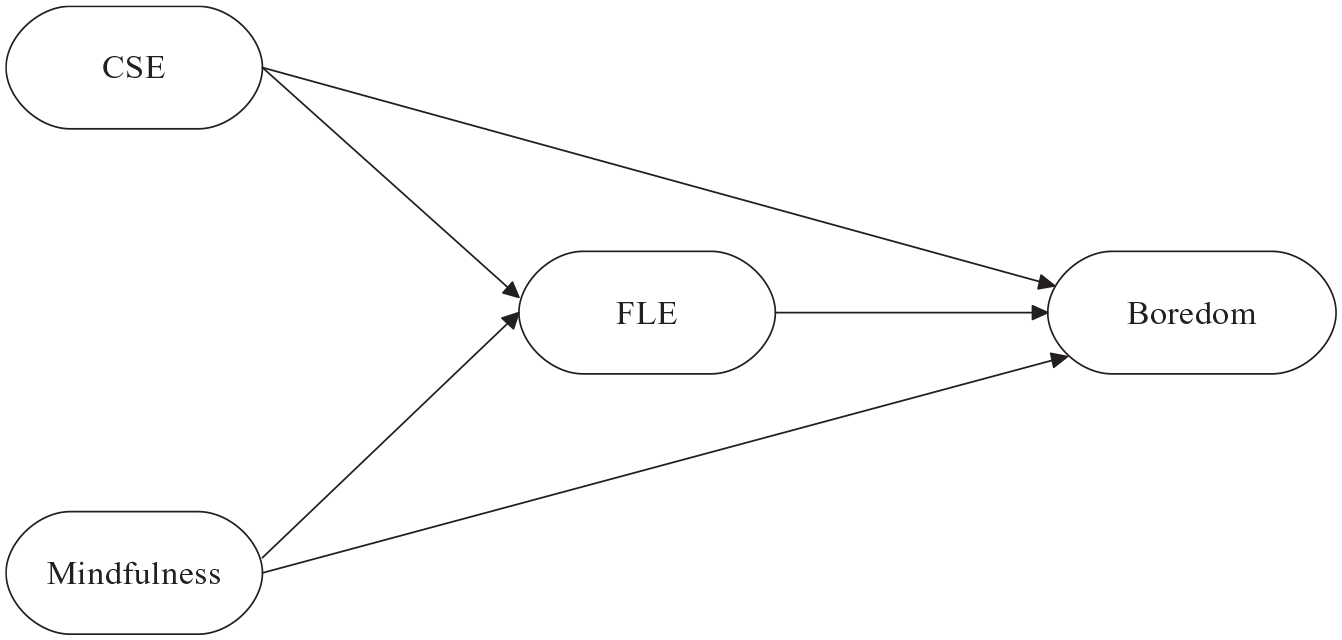
The hypothesized model of second language (L2) boredom based on coping self-efficacy (CSE), mindfulness, and foreign language enjoyment (FLE).
Following Z. Li and González (2021), we hypothesized that CSE directly influences learners’ FLE. Hence, a path from CSE to FLE was drawn. Moving on to the next hypothesis, a path from mindfulness to FLE was projected. This path was based on previous empirical research (e.g. Bóo et al., 2020; Langer et al., 1978; Thompson, 2009) in which mindfulness positively predicted learning enjoyment. Consistent with the Control-Value Theory of achievement emotions (Pekrun, 2006), the Broaden-and-Build Theory (Fredrickson, 2003), and prior empirical evidence (e.g. Dewaele & Li, 2021; Kruk et al., 2022; C. Li, 2022; C. Li & Wei, 2023), we hypothesized a path from FLE to boredom. Although previous empirical studies have revealed a bidirectional relationship between FLE and boredom (e.g. Dewaele et al., 2023), we opted for a unidirectional path from FLE to boredom following the Broaden-and-Build Theory. According to this theory (Fredrickson, 2003), positive emotions can build cognitive and emotional resources, which in turn can act as antidotes for the detrimental effects of negative emotions. Nevertheless, the reverse causality (i.e. boredom → FLE) might be less plausible, as negative emotions experienced by an individual might necessitate the absence of his/her positive affect during a task. In other words, by widening the scope of attention and cognition, positive emotions (i.e. FLE) can reduce the intensity of negative ones (i.e. boredom). In this connection, some previous studies have also identified a unidirectional relationship between negative and positive emotions (Chow et al., 2007; Sutter-Brandenberger et al., 2018). However, since the research literature on the association between FLE and boredom is still in its infancy, positing both unidirectionality and circular causality in the relationship between the two constructs seems to be warranted and merits further empirical explorations.
Concerning the link between CSE and boredom, Zhou and Kam (2017) indicated that self-efficacy and coping strategies negatively affect boredom. Recent empirical studies have also reported a negative correlation between self-efficacy and boredom (e.g. Y. Liu & Lu, 2017; Sánchez-Rosas & Esquivel, 2016). Accordingly, we added a path from CSE to boredom. Based on the attentional theory of boredom proneness (Fahlman et al., 2013; Harris, 2000) and previous studies (e.g. Galla et al., 2020; Lee, 2017; Trunnell et al., 1996; Waterschoot et al., 2021), mindfulness is hypothesized to be negatively correlated with boredom. Correspondingly, a path from mindfulness to boredom was also drawn. Finally, following the Broaden-and-Build Theory (Fredrickson, 2001, 2003), we hypothesized that FLE acts as a mediator affecting the paths from CSE and mindfulness to boredom. FLE as a positive emotion provides EFL learners with the capability to broaden their thought–action repertoires and enhance their individual resources. From this perspective, more self-efficacious and mindful learners, who are more likely to feel enjoyment in their L2 learning, are endowed with positive affect, enhanced personal resources, and heightened resilience, all of which help reduce the experience of boredom. Against this backdrop, the following hypotheses guided the aims of this study:
Hypothesis 1: CSE positively predicts FLE.
Hypothesis 2: Mindfulness positively predicts FLE.
Hypothesis 3: FLE negatively affects boredom.
Hypothesis 4: FLE mediates the relationship between CSE and boredom.
Hypothesis 5: FLE mediates the relationship between mindfulness and boredom.
III Method
1 Participants
Four hundred and fifty-six EFL learners from Iran partook in this study. The sample comprised all first-year college students at the University of Kurdistan in Iran. They were studying various disciplines in the Faculty of Humanities and Social Sciences, such as psychology, counseling, accounting, economy, tourism, management, and sociology. These students were required to pass a mandatory three-credit General English course at the university. Since one of the researchers in this study was a faculty member of this university and had more access to these students, the convenience sampling procedure was used to select these participants. The sample comprised male (N = 192) as well as female (N = 239) university students whose age varied from 18 to 25 years (M = 19.68, SD = 2.71). All the participants had studied English in school before being admitted to the university. Their proficiency level was A1 or A2, as estimated by the university’s placement test.
2 Measures
The original English versions of the scales were translated into Kurdish in this study. They were then piloted with 10 EFL learners, and a skilled translator back-translated them to guarantee the accuracy of translation. The translated questionnaires were also checked by an independent expert. These translated versions were revalidated in the present study, as explained in Section IV.
a CSE
The coping self-efficacy scale designed by Chesney et al. (2006) was used to measure CSE. This 26-item questionnaire taps into respondents’ abilities in dealing with tough and anxiety-provoking contexts. It comprises the following subscales: using problem-focused coping (UPFC, 12 items), stopping unpleasant emotions and thoughts (SUET, 9 items), and getting support from family and friends (GSFF, 5 items). Each item is assessed on an 11-point scale (0 = cannot do at all, 10 = certain can do). A sample item: ‘Take your mind off unpleasant thoughts.’
b Mindfulness
The Mindfulness Attention Awareness Scale (MAAS), developed by Brown and Ryan (2003), was employed to assess participants’ mindfulness. This self-report scale measures respondents’ inclination to attend to what is currently occurring. This scale includes 15 items that are assessed on a 6-point Likert scale ranging from ‘almost always’ (1) to ‘almost never’ (6). A sample item: ‘I find it difficult to stay focused on what’s happening in the present.’ The psychometric properties of this scale have been confirmed in previous studies (e.g. Brown & Ryan, 2003; Fallah, 2017).
c FLE
Students’ level of enjoyment in learning a foreign language was gauged through 10 items taken from Jiang and Dewaele (2019). These items measure FLE at both social and private levels: social enjoyment (SE, 6 items) and private enjoyment (PE, 4 items) (Dewaele & MacIntyre, 2016). Each item is evaluated on a five-point Likert scale (1 = not at all, 5 = very much so). A sample item: ‘It is cool to know English as a foreign language.’
d Boredom
The L2 boredom scale (BPELC-R) validated by Pawlak, Kruk, et al. (2020) was employed to gather the data on L2 boredom. This questionnaire includes 23 statements which are evaluated on a seven-point Likert scale from 1 (strongly disagree) to 7 (strongly agree). The two underlying components of the BPELC include: (1) Disengagement, monotony and repetitiveness (DMR, 14 items), and (2) Lack of satisfaction and challenge (LSC, 9 Items). A sample item: ‘During language classes, I often think about unrelated things.’
3 Data collection
Data collection began by distributing an electronic survey through Google Forms, which included the scales described above in Spring 2022. Then the link to the online questionnaire was shared with the General English course instructors who offered their cooperation. They were also notified of the purpose of the study. Then, the instructors shared the link with their students and asked them for voluntary participation. Participants were informed that no additional advantage or grade would be given to them, and the obtained data would remain confidential. For the purpose of obtaining more credible data, the respondents were given about 10 days to complete the survey.
4 Analytic procedure
The data analysis was conducted with SPSS 24 and AMOS 26. After examining the data as a preliminary screening, a two-stage structural equation modelling (Kline, 2019) was employed. To this end, measurement and structural models were tested, respectively. SEM was employed to test the suggested model to explore the potential associations among the latent constructs. The model fit was evaluated using goodness-of-fit indices: Chi-square divided by degree of freedom (χ2/df), Comparative Fit Index (CFI), Goodness of Fit Index (GFI), Tucker–Lewis Index (TLI), Root Mean Square Error of Approximation (RMSEA), and Standardized Root-Mean-Square Residual (SRMR). A model is considered to have good fit when χ2/df < 3, CFI, GFI, and TLI ⩾ .90, and RMSEA ⩽ .08 as well as SRMR < 0.10 (Kline, 2019; Vandenberg & Lance, 2000). Finally, to examine the potential mediating role of FLE among the constructs, Baron and Kenny’s (1986) method was employed.
IV Results
1 Preliminary analyses
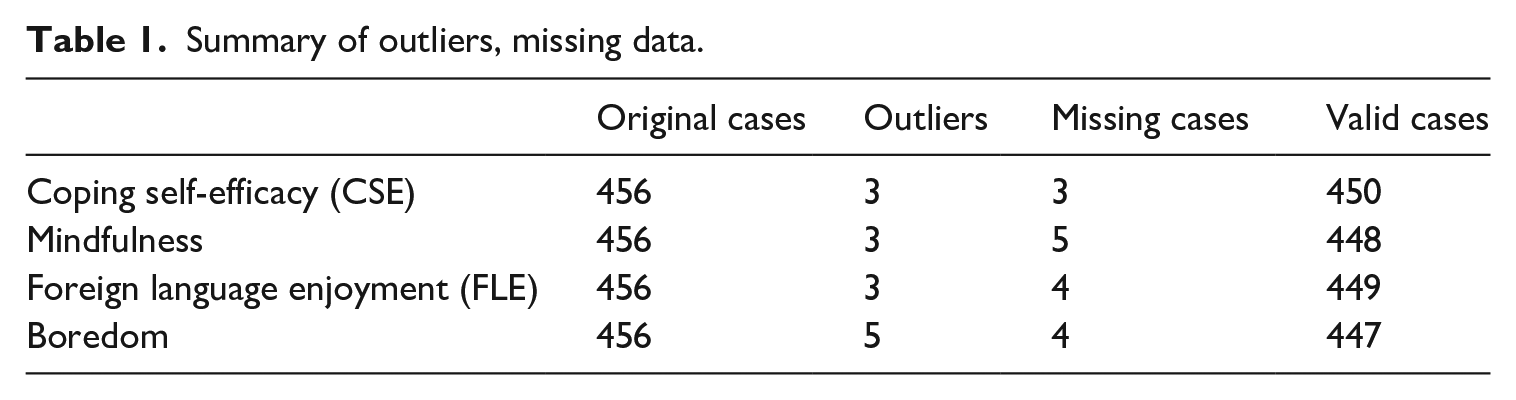
Prior to testing the hypothesized model of boredom, the data were screened using SPSS 23. Missing values, outliers, and normality were examined. As the sample size was not very large, Expectation–Maximization algorithm was employed to address the missing data (Kline, 2019). Univariate as well as multivariate outliers were investigated using Z scores and Mahalanobis D2, respectively. Additionally, normality assumptions were checked employing skewness and kurtosis indices and values exceeding of ±2.0 showed non-normal distribution (Kunnan, 1998). Outliers and non-normal values were detected and discarded before further analysis. A summary of outliers, missing data and valid cases is presented in Table 1.
Summary of outliers, missing data.
2 Testing the measurement model
To evaluate the construct validity of the measurement models, confirmatory factor analysis (CFA) was performed. The factor loadings for all items in the CFA model can be found in Table 2. Adjustments were made as some measurement models did not meet the recommended level of data adequacy. Upon examining the results, it was evident that four CSE) items (C6, C8, C14, and C24), two mindfulness items (M13 and M15), and three boredom items (B10, B12, and B16) showed factor loadings below the threshold of 0.5. Consequently, in accordance with the recommendation by Hair et al. (2006), these items were excluded from the model. The final model (see Figure 2) was derived after implementing these modifications to the original design, and the outcomes of the final CFA model indicated an acceptable fit, as evidenced by χ2/df = 2.32, GFI = 0.92, CFI = 0.94, RMSEA = 0.06 (90% CI: 0.05–0.07), TLI = 0.92, and SRMR = 0.07.
The confirmatory factor analysis (CFA) model estimates.
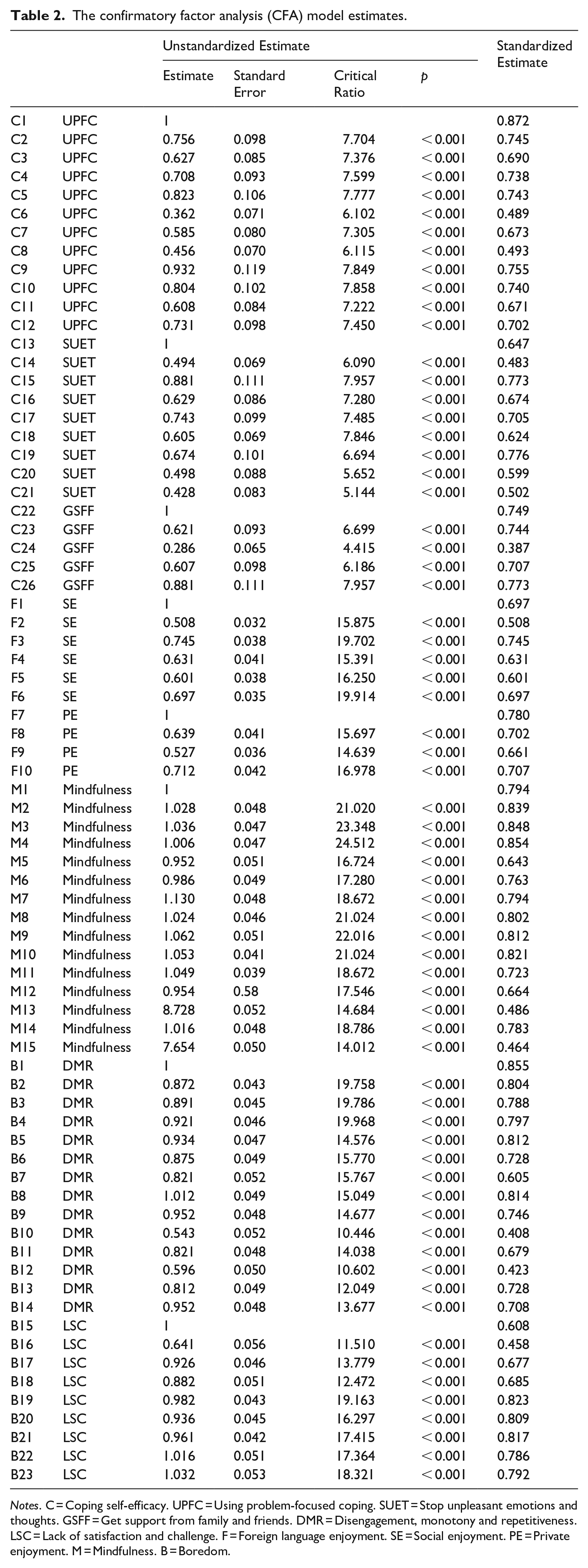
Notes. C = Coping self-efficacy. UPFC = Using problem-focused coping. SUET = Stop unpleasant emotions and thoughts. GSFF = Get support from family and friends. DMR = Disengagement, monotony and repetitiveness. LSC = Lack of satisfaction and challenge. F = Foreign language enjoyment. SE = Social enjoyment. PE = Private enjoyment. M = Mindfulness. B = Boredom.
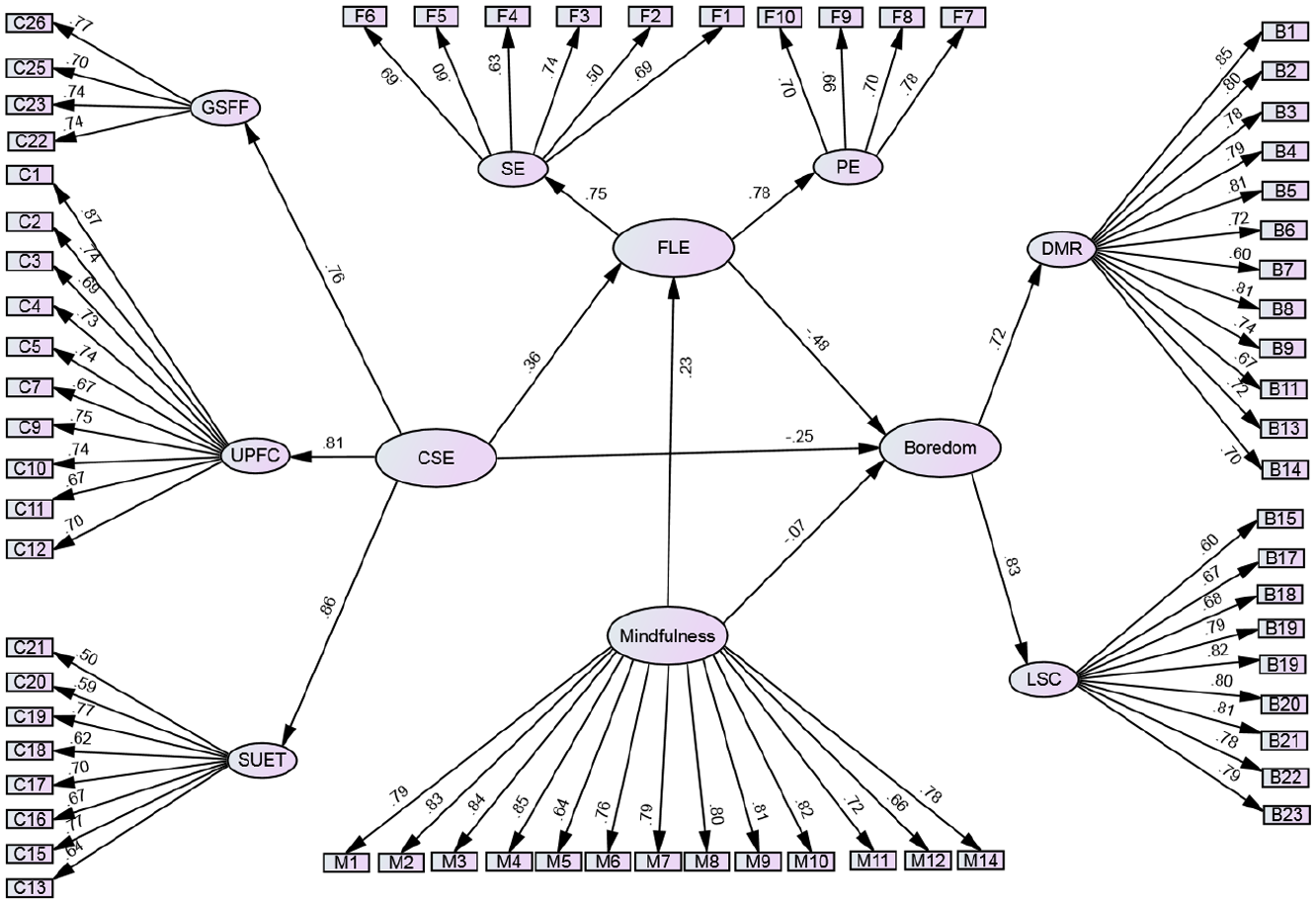
The final model.
Subsequently, the convergent and discriminant validity among the constructs were evaluated. Table 3 shows the Average Variance Extracted (AVE), Composite Reliability (CR), and correlation coefficients between the constructs. The results show that all constructs had acceptable levels of convergent validity, with AVEs ranging from 0.661 to 0.812 and CRs ranging from 0.852 to 0.903. The diagonal values represent the square roots of the AVEs. The correlation coefficients between the constructs in the convergent validity analysis were positive and significant, ranging from 0.234 to 0.901, indicating that the constructs are related to each other. In contrast, the discriminant validity analysis shows that the correlation coefficients between the constructs were generally lower than the square roots of the AVEs, indicating that the constructs are distinct from each other. Overall, the results provide evidence of the convergent and discriminant validity of the measures used in the study.
Convergent and discriminant validity.
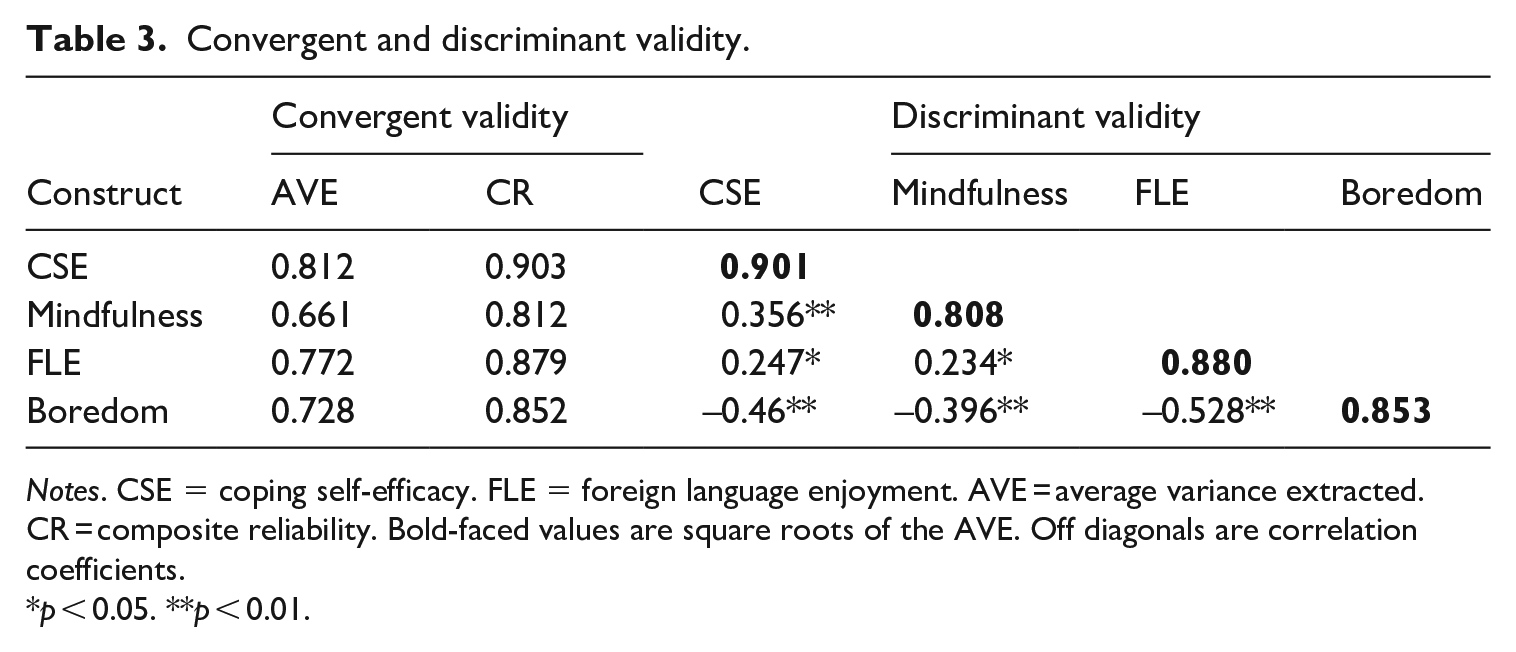
Notes. CSE = coping self-efficacy. FLE = foreign language enjoyment. AVE = average variance extracted. CR = composite reliability. Bold-faced values are square roots of the AVE. Off diagonals are correlation coefficients.
p < 0.05. **p < 0.01.
Then, descriptive statistics and correlations were calculated for all the constructs (see Table 4). In Table 4, the correlations among the variables are reported. The results indicate a positive correlation between CSE and mindfulness (r = 0.35, p < .01), suggesting a significant association between these constructs. Similarly, a positive correlation is observed between CSE and FLE (r = 0.24, p < .05). On the other hand, there is a negative correlation between CSE and boredom (r = −0.46, p < .01), indicating an inverse relationship between these variables. Additionally, a positive correlation is found between mindfulness and FLE (r = 0.23, p < .05), while a negative correlation is observed between mindfulness and boredom (r = −0.39, p < .01). Furthermore, a negative correlation is detected between FLE and boredom (r = −0.52, p < .05). As for the reliability coefficients of the scales, the alpha values were all higher than 0.70, confirming the adequacy of their internal consistency (Hair et al., 2010).
Descriptive statistics and correlations.
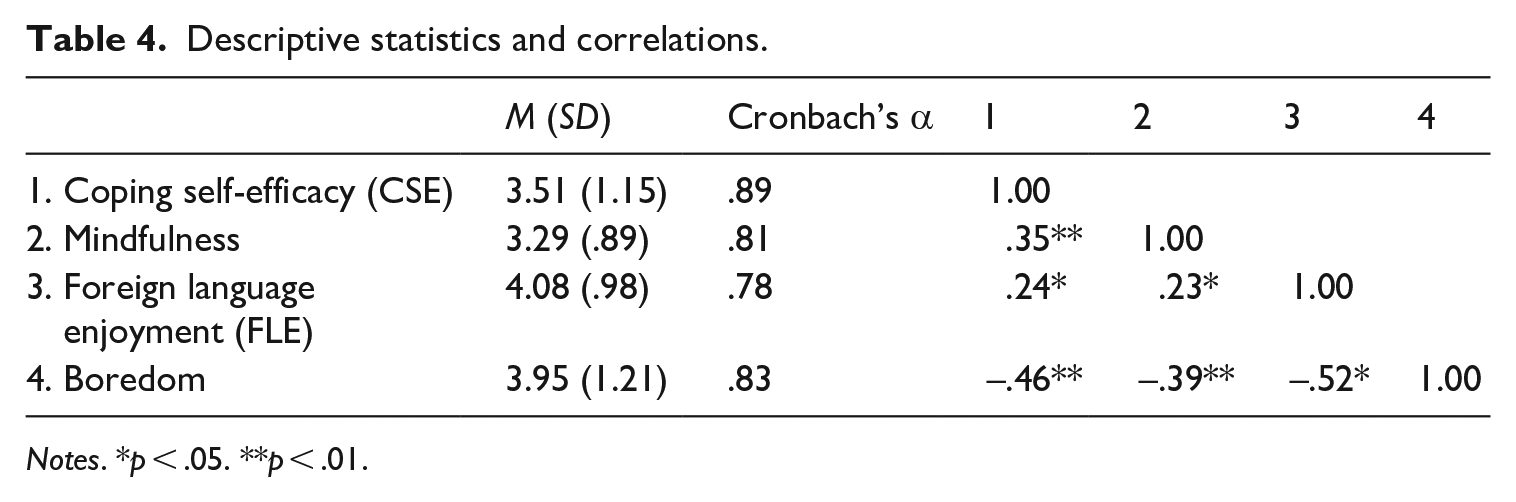
Notes. *p < .05. **p < .01.
3 Testing the structural model
After confirming the measurement model, several structural models were examined to test the research hypotheses. These included the hypothesized partial mediation model (Model C), the full mediation model (Model B), and the alternative direct model (Model A). The fit indices for these three models are presented in Table 5. The results indicated that the fit indices of the partial mediation model were significantly superior to those of Model B (Δdf = 4, Δχ2 = 35.16, p < 0.001) and Model A (Δdf = 6, Δχ2 = 98.86, p < 0.001), suggesting that the partial mediation model provided the most concise representation of the relationships between the latent constructs. As such, based on the obtained SEM values, the partial mediation model (Model C) was considered as the preferred model for capturing the associations among the variables, in accordance with its higher fit indices.
Results of fit indices of structural models.
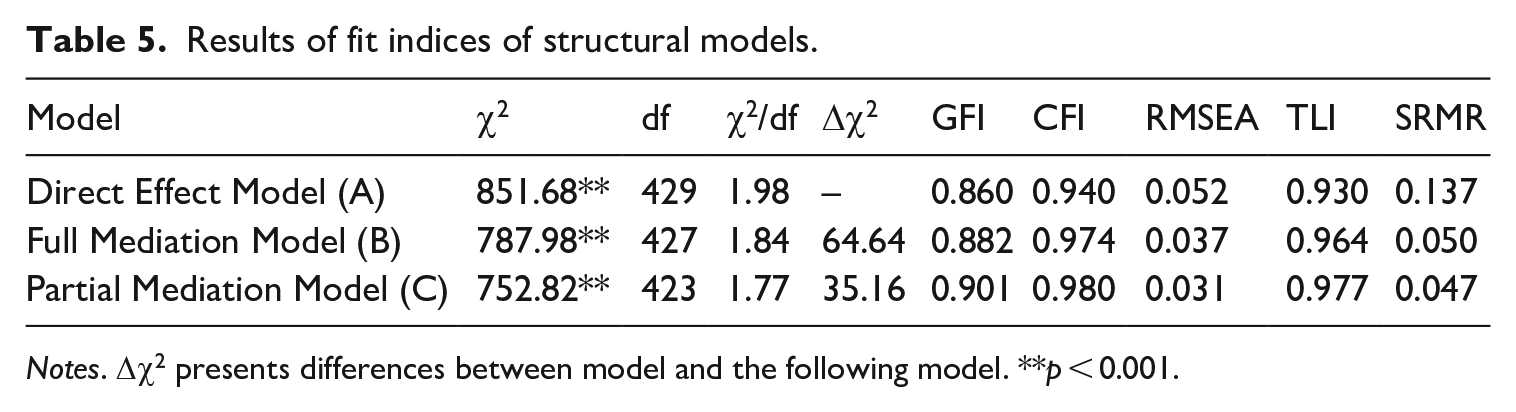
Notes. Δχ2 presents differences between model and the following model. **p < 0.001.
Figure 2 presents the path coefficients for the finalized partial mediation model. In this model, all path coefficients were found to be statistically significant, except for the path linking mindfulness to boredom. The results of the structural model revealed that CSE had a significant positive effect on FLE (β = 0.36, p < 0.001), providing support for Hypothesis 1. Similarly, mindfulness showed a significant positive effect on FLE (β = 0.23, p < 0.001), thereby supporting Hypothesis 2. Additionally, FLE demonstrated a significant negative impact on boredom (β = −0.48, p < 0.001), lending support to Hypothesis 3.
Then, the method proposed by Baron and Kenny (1986) was employed to examine whether FLE served as a mediating variable among the constructs. Utilizing the direct model (Table 6), significant path coefficients were observed between CSE and boredom (−0.33, p < 0.001) as well as between mindfulness and boredom (−0.16, p < 0.05), satisfying the initial condition of Baron and Kenny’s test. Subsequently, in the full mediation model, a significant path coefficient was found between CSE and FLE (0.39, p < .001) as well as between mindfulness and FLE (0.25, p < .01), confirming the second requirement of Baron and Kenny’s method. Finally, in the partial mediation model, a significant link between CSE and boredom was identified (β = −0.25, p < 0.01). Combined with the indirect effect of FLE, the impact of CSE on boredom (−0.16; 0.36 × −0.46) was smaller than the direct effect (0.16 < 0.25) of CSE on boredom. Hence, FLE partially mediated the association between CSE and boredom, providing partial support for Hypothesis 4. Furthermore, no significant effect of mindfulness on boredom was observed. However, FLE was determined to be a full mediator between mindfulness and boredom (0.23 × 0.48 = 0.11 > 0.07). Consequently, the influence of mindfulness on FLE contributed to a reduction in boredom, fully supporting Hypothesis 5.
Path estimates of structural model: Standardized path coefficients (t-value).
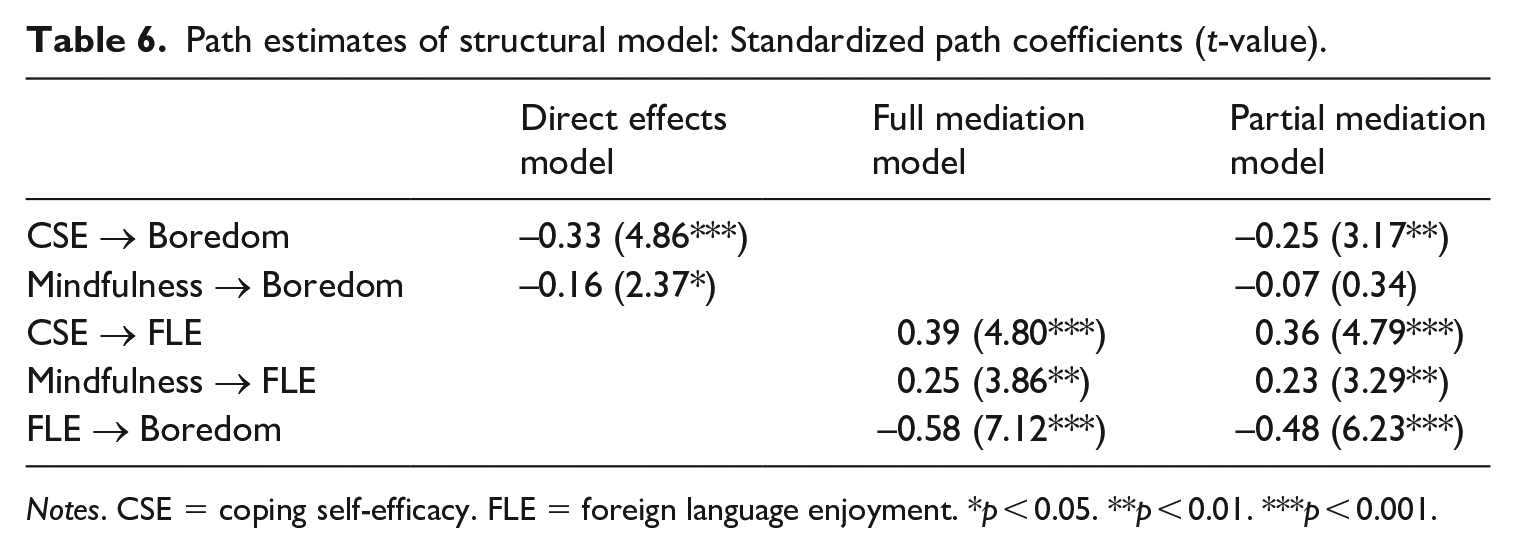
Notes. CSE = coping self-efficacy. FLE = foreign language enjoyment. *p < 0.05. **p < 0.01. ***p < 0.001.
Lastly, since the data collection relied on self-report scales, it is important to consider the potential influence of common method bias on the findings. To address this concern, Harman's single factor test was conducted following the approach outlined by Podsakoff and Organ (1986). In this test, all the indicators corresponding to the four latent constructs (CSE, mindfulness, boredom, and FLE) were included in the maximum likelihood extraction method. The results indicated that the first factor accounted for 23.14% of the variance, which fell below the 50% threshold. Hence, it can be argued that common method bias did not significantly impact the results of this study.
V Discussion
The current study focused on exploring the associations among the four constructs of FLE, CSE, mindfulness, and boredom among EFL students. Furthermore, the mediating role of FLE in influencing the interplay among mindfulness, CSE, and boredom was investigated. First, the construct validity of the used scales was approved by testing the measurement model. Then, SEM results indicated some key findings with regard to the hypothesized model.
With respect to the formulated hypotheses, the analyses yielded several important observations. First, CSE was found to be a direct positive predictor of FLE (supporting hypothesis 1). Given the fact that CSE was conceptualized or closely associated with self-efficacy in the present study, the outcomes of this study are in line with the results reported by Z. Li and González (2021) who suggested that self-efficacy can play a central role in affecting FLE. Our findings also mirror the results of the studies carried out by Demir and Okyar (2021) as well as An et al. (2021), showing an association between self-efficacy and FLE. When EFL learners face difficulties and challenges during the learning process, they must overcome their limitations to face up to these difficulties and enjoy learning English (Csikszentmihalyi, 1990; C. Li et al., 2018). In order to do so, they need to believe in their abilities or, in other words, they should manifest greater CSE. The results reported above are also in accordance with previous research regarding the positive association between self-efficacy and enjoyment (Aldridge et al., 2012; R. D. Liu et al., 2018; Mun & Hwang, 2003; Pekrun, 2014; Sağkal & Sönmez, 2022; S. Yang et al., 2016). Hong et al. (2017) also demonstrated that students’ enjoyment was correlated with their self-efficacy. Furthermore, the findings also partially resonate with the results of Smith et al. (2012) who found that students with higher levels of confidence in their reading abilities experienced more enjoyment in reading, confirming a substantial relationship between self-efficacy and enjoyment.
Second, it was revealed that mindfulness was a direct positive predictor of FLE (supporting hypothesis 2). This finding should come as no surprise in light of the study conducted by Huang (2022), which revealed that EFL teachers’ mindfulness exerts a strong influence on students’ FLE. Given that mindfulness can positively affect EFL learners’ positive orientation, it is reasonable to assume that positively oriented L2 learners are likely to experience more enjoyment during the learning process (Dewaele et al., 2018). This finding also resonates with the results of Bóo et al.’s (2020) study who provided evidence for a positive link between mindfulness and enjoyment of students. Following the non-judgmental nature of mindfulness (Dreyfus, 2011), we argue that students who adeptly draw on mindfulness strategies have the ability to either deal with negative thoughts (i.e. fear of failure) or ignore them, which, in turn, give rises to enjoyment for learning (Deci & Ryan, 2008). Understood as the ability to be in the present and to seize the moment (Cardaciotto et al., 2008), mindfulness enables students to stay focused on the learning process and avoid worrying about the past and future events, which leads to FLE. As illustrated in the literature review, mindfulness has long been assumed to be linked to enjoyment (Langer et al., 1978; Thompson, 2009).
Third, FLE was found to influence boredom negatively (supporting hypothesis 3). This finding corroborates prior empirical evidence for the negative relationship between these two constructs (e.g. Dewaele & Li, 2021; Dewaele et al., 2023; Kruk et al., 2022; C. Li & Wei, 2023). Conceptualized in terms of dissatisfaction and disengagement, boredom as a negative emotion can be significantly affected by students’ lack of interest (Kruk & Zawodniak, 2020; Pawlak, Derakhshan, et al., 2021). Students with no interest in the activities they are instructed to perform do not enjoy the learning process and can easily get bored. A possible explanation for this finding can draw upon Dewaele and MacIntyre’s (2014) description of FLE as ‘enjoyment, fun, interest, and lack of boredom’ (p. 242). Thus, we argue that the absence of FLE in the L2 classroom is likely to trigger boredom among learners (C. Li & Wei, 2023). On the whole, our results support those reported by C. Li (2022) who found that FLE was strongly and negatively correlated with boredom of EFL learners.
Fourth, it was found that FLE played a mediating role in affecting the relationship among CSE, mindfulness, and boredom. More specifically, CSE affected boredom via the mediation of FLE (CSE → FLE → boredom; partially supporting hypothesis 4). EFL learners who have the competence and confidence in overcoming difficulties are more likely to enjoy learning tasks (Smith et al., 2012) and, consequently, experience less boredom (Dewaele & Li, 2021). Since CSE is a subtype of self-efficacy, our findings add support to the growing body of empirical evidence suggesting that self-efficacy plays a significant role in creating positive emotional outcomes, including lower levels of boredom (Y. Liu & Lu, 2017; Luo et al., 2016; Sánchez-Rosas & Esquivel, 2016). Self-efficacious learners attribute further value and importance to learning tasks (Schunk, 1991), and students who perceive learning as interesting and attach value to it experience more enjoyment and less boredom (Kruk & Zawodniak, 2020; C. Li, 2021; Pawlak, Kruk, et al., 2020; Pawlak, Zawodniak & Kruk, 2020). Consequently, we argue that self-efficacy can increase learners’ perceived value of learning tasks (Sánchez-Rosas & Esquivel, 2016), which in turn may decrease their experience of boredom. Furthermore, students with higher levels of confidence in their ability to perform well during the learning process are more likely to feel enjoyment in their learning, which reduces their boredom experience (Pekrun, 2014). By contrast, learners’ conviction of their inability to cope with difficult and adverse situations is a significant cause of their boredom (Kruk & Zawodniak, 2020). As Robinson (1975) demonstrated, for example, students who resort to appropriate coping strategies are likely to avoid incipient boredom and are better able to alleviate its consequences. In other words, we argue that L2 learners who can adeptly employ coping strategies and, even more importantly, have sufficient confidence that strategies they use will be effective, stand a better chance of combating negative emotions such as boredom. This indicates that students characterized by high CSE are likely to experience further positive emotions (e.g. FLE) and become immune to aversive emotions (e.g. boredom). These results are in line with Zhou and Kam’s (2017) findings highlighting the influential role of self-efficacy and boredom coping strategies in the face of boredom experiences.
Likewise, mindfulness influenced boredom mediated by FLE (fully supporting hypothesis 5). Mindful learners are more likely to exhibit positive orientations towards their learning activities, resulting in greater enjoyment (Huang, 2022), which in turn leads to less likelihood of experiencing boredom (C. Li & Wei, 2023). The significant mediating role of FLE in this model testifies to its importance in L2 learning. Drawing on the Broaden-and-Build Theory (Fredrickson, 2001), we can argue that experiencing enjoyment in L2 learning can enhance EFL learners’ awareness or mindfulness and instigate their employment of innovative and useful thoughts and actions to cope with difficulties in their learning process, all of which contribute to lessening the boredom in the L2 learning process. This finding also partially corroborates the outcomes of the study conducted by Waterschoot et al. (2021) who reported the significance of mindfulness in relation to boredom and indicated that an increase in individuals’ mindfulness is likely to be accompanied by a drop in the intensity of this negative emotion. Additionally, this outcome accords with the attentional theory of boredom proneness, which demonstrates that a deficit in attention can act as an antecedent of boredom (Harris, 2000). Since mindfulness can improve attention and mood (Lee, 2017) while boredom is negatively related to these two constructs (Eastwood et al., 2012; Harris, 2000), it can reasonably be argued that mindfulness can contribute to reducing the level of boredom by enhancing attention and positive emotions (LePera, 2011; X. Yang et al., 2021). According to Eastwood et al. (2007), if attention cannot be sustained, it will either be misallocated or disengaged with inner or outer worlds (e.g. thoughts or feelings), and one will not be able to regulate his or her attention and awareness to the activities, which in turn can trigger the experience of boredom. Such theoretical assumptions have found support in Galla et al.’s (2020) study demonstrating that students with higher levels of mindfulness experienced less boredom while learning. Similar results were reported by Trunnell et al. (1996) where students characterized by high levels of mindfulness felt less bored and were more motivated and engaged. Furthermore, our findings add support to the growing body of empirical evidence suggesting that mindfulness plays a pivotal role in creating positive outcomes for individuals (Koval & Todman, 2015; Lee, 2017; LePera, 2011). Given that non-judgmentally evaluation of thoughts and emotions is a significant characteristic of mindfulness (Wright et al., 2009), one can regulate his or her negative emotions and thoughts as ‘passing phenomenological events that may momentarily capture attention but can then be let go of’ (Frewen et al., 2008, p. 759). Therefore, we argue that although boredom is an inevitable aspect of FL learning (Kruk, 2021a, 2021b), EFL learners characterized by mindfulness can distance themselves from and easily deal with negative emotions such as boredom. The findings might also be justified in terms of the effects of FLA in L2 learning since this emotion has been frequently found to be positively correlated with boredom in EFL contexts (e.g. Dewaele et al., 2023; Kruk, 2016, 2021a, 2021b, 2022; LePera, 2011; C. Li & Wei, 2023). Thus, there are grounds to assume that mindfulness can lead to diminished anxiety (Strohmaier et al., 2021), particularly in the context of EFL (Fallah, 2017; Mortimore, 2017). In fact, as Charoensukmongkol (2019) found, L2 learners’ mindfulness was negatively correlated with their FLA.
VI Conclusions
In order to lend further support to the importance of learners’ psychological characteristics in EFL contexts, this study sought to test a structural model of CSE, mindfulness, boredom, and FLE. Moreover, a mediation model was examined in which it was hypothesized that FLE would mediate the effects of learners’ CSE and learners’ mindfulness on their boredom. As the results demonstrated, CSE, mindfulness, and FLE can reduce the probability of experiencing boredom and help elucidate the instigation of this construct in L2 settings. To our best knowledge, no previous empirical investigation has addressed the relationships among these constructs.
When it comes to implications, the results of the current study are significant to EFL administrators and development researchers interested in promoting the psychological well-being of learners, and offer valuable insights into implementing emotional interventions in L2 learning contexts. Additionally, the present investigation, as an innovative one, can enrich the picture of the psychological pathways between mindfulness, CSE and L2 boredom by showing that their relationship is mediated by pleasant emotion (e.g. FLE). Given the significance of mindfulness in affecting FLE and boredom, educators might consider implementing mindfulness intervention programs to enhance EFL learners’ mindfulness. By the same token, attempts should be made to foster CSE of EFL learners by focusing on using practical strategies to bolster their perceptions of competence in overcoming hurdles in tough situations and managing stressful learning activities. Taking more viable steps to enhance levels of FLE, CSE and mindfulness, L2 practitioners might be able to diminish the likelihood of the occurrence of L2 boredom. Also, prospective researchers might take into account these findings as a basis for future investigations into the nature, features, multidimensionality, and antecedents of boredom in EFL contexts.
The study is not exempt from limitations. First, the sample of this research was selected from one university in Iran, thereby reducing the generalizability of the findings to other EFL settings. Second, reliance on a quantitative design and self-report measures is unlikely to tease out the real nature, intensity, and interconnectedness of such constructs as boredom, FLE, CSE and mindfulness. Thus, researchers are encouraged to avail themselves of qualitative data collection tools in their future investigations. Furthermore, emotions and affective variables are perhaps best examined using longitudinal designs due to the fact that dynamicity has been attested to in L2 contexts (Saito et al., 2018). Additionally, based on previous research regarding the bidirectional relationship between FLE and boredom (e.g. Dewaele et al., 2023), researchers can carry out longitudinal and experimental studies to capture the dynamics of the bidirectionality or circular causality between these two constructs.
Footnotes
Consent to participate
Informed consent was obtained from all the participants in this study.
Data Availability Statement
The raw data supporting the conclusions of this article will be made available by the authors, without undue reservation.
Funding
The author(s) received no financial support for the research, authorship, and/or publication of this article.
