







Abstract
Synchronous computer-mediated communication (SCMC) offers second/foreign language (L2/FL) learners’ interactional environments that are unique to face-to-face (F2F) communication. Such modes have the potential to facilitate better learning outcomes under certain conditions. The aim of this study was to compare the capacity of two online modes – text chat and voice chat – to promote uptake of targeted vocabulary in an English as a foreign language (EFL) classroom setting. Three distinct tasks (opinion exchange, dictogloss, problem-solving task) were used to measure the effectiveness of both modes to facilitate immediate and delayed uptake compared to F2F communication. The study investigated: (1) how task design and communication mode affected EFL uptake; (2) the effect time allocation had; and (3) the degree to which task perceptions differed depending on communication mode. The effectiveness of the three modes and tasks was measured using a series of pre-tests and post-tests. Post-questionnaires and interviews were also conducted to gain insight into the participants’ perceptions of the tasks. The investigation revealed both similarities and differences in the way SCMC and F2F communication affected learner uptake and demonstrated that certain task design features, such as input, time allocation, and goal orientation, can play a role in the effectiveness of text chat and voice chat to promote uptake in the EFL classroom.
Keywords
I Introduction
Language learning is a social endeavour that necessitates opportunities for individuals to engage each other in meaningful exchanges. Interaction is the driving force behind cognitive and linguistic development in second language (L2) learning (García-Mayo & Alcón-Soler, 2013; Loewen & Sato, 2018; Long, 1996; Mackey, 2007; Mackey & Goo, 2007). Yet, generating meaningful learner interactions in English as a foreign language (EFL) contexts can be a challenge. EFL classes often consist of large numbers of learners who mostly speak the same first language (L1) and exposure to English is limited to the confines of the classroom. Consequently, it is challenging for teachers to promote a sense of purpose and authenticity in their students’ English conversations, and EFL learners at times cannot be faulted for thinking of English as a test-based subject like any other at school rather than a legitimate means of communication.
Task-based language teaching (TBLT) is an approach that facilitates purposeful student-centred interactions. Motivated by earlier communicative teaching methods (e.g. Curran, 1972; Moskowitz, 1977), TBLT draws on the premise that acquisition takes place when learners actively engage in task-based communication. Such communication compels learners to construct meaning through experiences and problem-solving goals (Larsen-Freeman & Anderson, 2011). Primarily viewing learners as independent agents, the objective of TBLT is to foster the learner’s own innate capacity to learn the language within the confines of the classroom (Krashen & Terrell, 1983). The TBLT approach is well suited to EFL learning contexts (Ahmad & Mahmood, 2010; Huong Thi et al., 2021; Page & Mede, 2018; Thanh & Huan, 2012; Van de Guchte et al., 2016).
At the same time, advances in digital technologies allow synchronous computer-mediated communication (SCMC) to conceivably promote more learning opportunities both inside and outside of the classroom. Adequately supported by the tenets of TBLT, González-Lloret (2017) argues that SCMC has the potential to lessen learners’ anxiety levels, as well as raise their motivation to take risks and be creative in their interactions with others. Lai and Li (2011) assert that SCMC technology has the capacity to enhance noticing, self-monitoring, and equal participation. The benefits of such technology for distance education are evident (for further reading, see White, 2017). However, in the EFL classroom, where proximity to one’s classmates is not an issue, it remains unclear whether there is any potential advantage to utilizing online communication.
Computer-mediated communication (CMC) studies often incorporate the TBLT framework (e.g. Baralt, 2013; Blake, 2000; Guo & Möllering, 2016; Satar & Özdener, 2008; Zeng, 2017) as a way to measure the potential of technological innovations for language learning purposes (González-Lloret, 2017). A review of computer-assisted language learning (CALL) literature (e.g. Chapelle, 2014; H.Kim, 2017; Li & Lewis, 2018; Smith, 2017) indicates that more research on task-based learning is needed. Smith (2017) asserts that the most relevant CALL studies are those that critically assess the capacity of specific tools or apps to promote L2 learning. Where technology-mediated TBLT is concerned, it is necessary to evaluate the suitability of tasks and the rationale for using them in various settings (Chapelle, 2014). In EFL classroom contexts, more studies are needed to learn how SCMC may affect learning differently to face-to-face (F2F) communication (H.Kim, 2017), and other SCMC modes (Li & Lewis, 2018). The study reported in this article evaluated the potential impact text chat and voice chat had on task-based learning opportunities in EFL classroom settings. These modes were selected for their accessibility online, as well as the unique features that distinguish them from F2F communication. For text chat, the capacity to maintain a record of utterances and scroll over them at the interlocutor’s convenience is different from voice chat, which does not provide any form of visual aid. Both modes allow teachers the ability to manipulate learner interactions. Requiring learners to use only text or voice communication in certain task-based contexts has the potential to enhance or impede learning outcomes. The study provides new insight into the relationship between task design, mode, and learner, and how classroom-based TBLT can be either facilitated or impeded by SCMC technology.
II Literature review
1 Task-based language teaching
TBLT is a cognitive-interactionist approach to teaching that prioritizes meaning, while not overlooking the value of form (Long, 2015). The approach views acquisition as being learner-driven rather than teacher-driven and language as a tool for communication rather than an object to be systematically taught and learned deliberately. In TBLT, pedagogical tasks facilitate learner interaction around specified target forms (e.g. comprehend them, manipulate them, produce them) while maintaining an overall focus on meaning (Nunan, 2004). Particularly in EFL settings, where contact time with the language is limited, periodically drawing learners’ attention to form-related issues both directly and indirectly may more effectively promote noticing of unfamiliar (particularly less-salient) forms. Richards and Rodgers (2001) provide examples of five common types of pedagogical tasks: jigsaw task, information task, problem-solving task, decision-making task, and opinion exchange task.
The long-term objective of TBLT research is to ascertain how different design and implementation variables affect language development. Ellis (2017) proposes that split information tasks can promote more negotiation than shared information tasks; more task familiarity can lead to more accuracy and fluency; and tasks that require consideration of multiple things at the same time result in more complex language use. Task difficulty and how it can be measured are of great importance to textbook designers, curriculum developers, and teachers alike. Criteria commonly proposed to determine the difficulty of pedagogical tasks include: the linguistic complexity and amount of input provided; the number of steps involved in their execution; and the degree of structure in the information presented or required (Ellis et al., 2020). What makes determining task difficulty so challenging is that there are a number of overlapping elements involved in making such calculations. At the very least, these relate to the learner, the structure of the task, and the complexity of the text used.
Although a learner may be confident and motivated to engage in a task that appears straightforward, things like unfamiliar language, time restrictions, and insufficient experience doing such tasks can dramatically increase their difficulty. In correlation with the language proficiency of learners, such factors can either have a positive or negative impact on their capacity to notice form-related issues. Robinson (2001) and Martyn (2001) argue that task features that cause greater cognitive demands and complex communication lead to increased negotiation and pushed learner output. On the other hand, Skehan (2018) warns that, if the cognitive demands of a task are too great, it causes an overload of the learner’s working memory and diminishes their ability to notice learning opportunities. Depending on how task complexity affects cognitive load, noticing relates to how willing learners are to engage or avoid the language presented to them. Skehan (2018) states that knowledge about task characteristics and conditions is key to understanding how tasks can help foster automatization and guarantee that new language is adapted into usable and non-attention-demanding language.
2 Synchronous computer-mediated communication in the classroom
Until present, there has only been a relatively small number of EFL studies that have directly compared the learning effects of F2F communication with SCMC (e.g. text chat, voice chat, video conferencing). Of those studies, some (e.g.H.Kim, 2017; Zeng, 2017) have shown that task designs promote similar learning patterns across all communication modes. Other studies (e.g. Baralt, 2013; Li & Lewis, 2018; Satar & Özdener, 2008; Yanguas, 2010, 2012; Yilmaz, 2011) have found that different SCMC modes have the potential to either intensify or reduce the cognitive load experienced by learners depending on task design. SCMC technology (e.g. video chat, voice chat, text chat) affects the cognitive load of learners, particularly those who are unfamiliar with the technology or not proficient L2 speakers (Guo & Möllering, 2016). As such, when conducting research, it is important to consider learners’ digital literacy, which is ‘the ability to use digital technologies at an adequate level for creation, communication, collaboration, and information search and evaluation’ (Son, 2015, paragraph 1). As Table 1 shows, mode features of SCMC vary.
Overview of synchronous computer-mediated communication (SCMC) mode features.
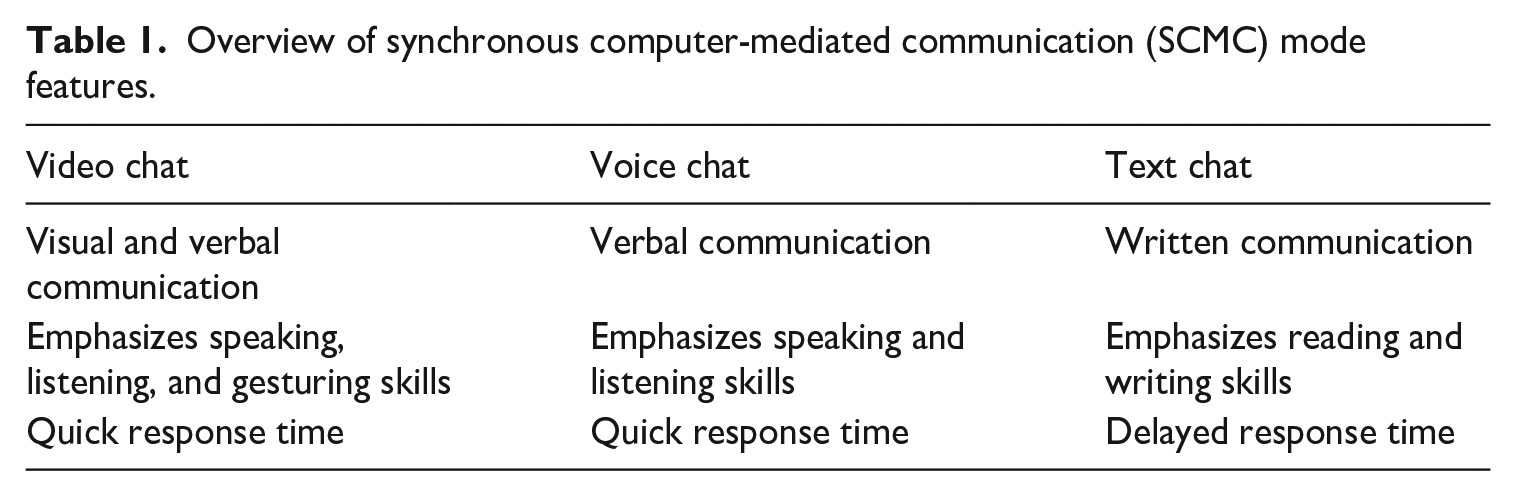
For text chat, the capacity to type, maintain a record of previous utterances, and scroll back, is different from voice chat, which does not provide any form of visual support. Early studies touted the capacity of text chat to lower learner anxiety (Satar & Özdener, 2008), increase learner involvement (Kern, 1995) and enhance attention to form (Warschauer, 1997). Arguments have also been made about its capacity to help learners increase their rate of grammatical development (Pellettieri, 2000), spoken fluency (Abrams, 2003), lexical improvement (Smith, 2004), and ability to negotiate meaning (Blake, 2000). Text chat has also been suggested to provide better learning opportunities in simple tasks (Baralt, 2013; Yilmaz, 2011), particularly for lower-level learners (Satar & Özdener, 2008).
At the same time, Fuente (2003) and Hamano-Bunce (2011) found that time constraints negatively impacted learner negotiations on text chat more than F2F communication. Similarly, Gurzynski-Weiss and Baralt (2014) found intermediate learners using text chat engaged in less negotiation during an information gap task than their F2F counterparts. In another study by Tang (2019), F2F pairs outperformed their text chat counterparts in learning modal verbs through two decision-making tasks. It was argued that the meaning-focused orientation of the tasks, coupled with the use of target features being optional, possibly meant that ‘the CMC group used the extra processing time for meaning negotiation and decision-making, rather than experimenting with modal verbs’ (Tang, 2019, p. 56). The F2F pairs were observed to use the modal verbs much more in their interactions than their text chat counterparts, who often replaced them with abbreviated forms or symbols. Such actions may be indicative of the text chat participants’ attempts to lessen their cognitive loads in order to complete the task in a timely manner.
In other investigations on voice chat (e.g. Li & Lewis, 2018; Yanguas, 2010, 2012), it has been suggested that the mode’s communication environment positively strengthens task-based interactions and negotiations for intermediate level learners. In two studies by Yanguas (2010, 2012), time limits placed on the completion of a jigsaw task were seen to create more turn-taking and negotiation between voice chat dyads than either F2F or video chat dyads. The inability to use facial cues or gestures on voice chat was argued to amplify the awareness and urgency the learners felt to achieve the task’s goal. In another study by Yanguas and Bergin (2018), a dictogloss and jigsaw task were used to compare learners’ video chat and voice chat interactions. The number of form-related discussions on both modes was calculated as being the same. However, a significantly larger number of unresolved incidents was noted on voice chat, possibly caused by the inability to use visual aids. In classroom environments, dependence on spoken language may have the potential to increase the intensity of negotiation patterns in task-based learner interactions, particularly for those who are highly motivated to improve their spoken communication skills (Li & Lewis, 2018).
Through SCMC technology, teachers have the power to manipulate learner interactions. This includes placing limitations on or altering the communicative features available to learners. Research on classroom interactions in EFL settings usually focuses on isolated factors and conditions that can change the frequency and types of interactions learners engage in, or how such variables affect acquisition itself. Such variables can include different task designs, interlocutor characteristics, or contextual constraints. As Loewen (2020) argues, there is mounting interest in the probability that SCMC technology is one such variable. Although a growing body of research (e.g. Bagheri & Zenouzagh, 2021, Y.J.Kim et al., 2019; Moradi & Farvardin, 2020; Tang, 2019) indicates that technology does affect the way learners engage each other in task-based learning environments, much is still unknown. Increasing recognition of SCMC’s potential makes it important to understand its strengths and weaknesses.
This study compares task-based text chat, voice chat, and F2F interactions by examining the following questions:
To what extent does task design and communication mode affect uptake of targeted vocabulary?
To what extent does the time allocated for task completion affect learner uptake?
To what extent do learner perceptions of task difficulty and enjoyment differ depending on the communication mode they use?
In this study, uptake refers to what new language learners could explicitly demonstrate they learned as a result of participating in a task. This definition is similar to the one provided by Allwright (1984), who refers to uptake as new information that learners can recall after having participated in a lesson (as cited in Ellis, 2003). Time allocation refers to the set amount of time given to the learners to complete each task. Learner perceptions refer to how positive or negative each of the participants felt about different tasks.
III The study
1 Participants
Participants in the study started at 146 university students enrolled in a required first-year English communication course offered at a Japanese university. At the time, the students had not selected their majors yet. The average participant was 18 years old and had at least 6 years’ experience learning English at junior high school and high school. Upon entering the university, they all took the Test of English for International Communication (TOEIC). The average score was 414.65 out of 990. Consequently, most were deemed to be in the upper beginner range. For the treatment periods of each sub-study (Sub-study 1 and Sub-study 2), the first author of this article took over the role of instructor for the classes. Of the 146 students registered, only 106 data sets were usable due to attendance issues.
2 Procedures
A total of six sample groups were included in the study: three groups for Sub-study 1 in Semester 1 and three groups for Sub-study 2 in Semester 2. Each group was a separate class of students, randomly assigned to one of 26 English communication courses: TC (text chat) 1 – 14; VC (voice chat) 1 – 19; F2F (face to face) 1 – 20; TC 2 – 15; VC 2 – 19; F2F 2 – 19. After obtaining the university’s and course instructors’ permission, the first author of this article took charge of these six classes for the duration of the treatment periods. Initially, all aspects of the study were explained to the students, including its goal, the process involved, their roles, data collection and storage methods, steps to ensure confidentiality, and the distribution of results. The students were also informed that any test results or questionnaire feedback obtained for the study would have no bearing on their final grades. In accordance with the university’s guidelines, all students had to attend each week. However, they were allowed to excuse themselves from doing the tests, questionnaires, and interviews if they so wished. Those who were willing to participate signed a consent form.
For each sub-study, one group acted as the control group, carrying out the tasks face-to-face while the other two classes used either text chat or voice chat. Text chat rooms were set up on Moodle using the chat function, while a free version of the software Chat&Messenger (https://chat-messenger.com/en) 4.04.43 was used for voice chat. Text chat and voice chat were introduced through two short pair-work activities: a checking information task and an information gap task. Afterwards, each group was allocated a specific communication mode (F2F, text chat, or voice chat) to use for the subsequent three weeks. Then, all participants carried out a pre-questionnaire and a pre-test of the targeted vocabulary of all three tasks.
In Weeks 2 to 4, each group carried out three treatments: an opinion exchange, dictogloss, and problem-solving task (Appendices 1, 2 and 3) in a random order to reduce the possibility of conditioning effects. Table 2 outlines each task design using the framework developed by Ellis (2003). All three tasks were designed to be convergent in nature, meaning the participants were expected to work interdependently to achieve the objectives.
Tasks in the study.
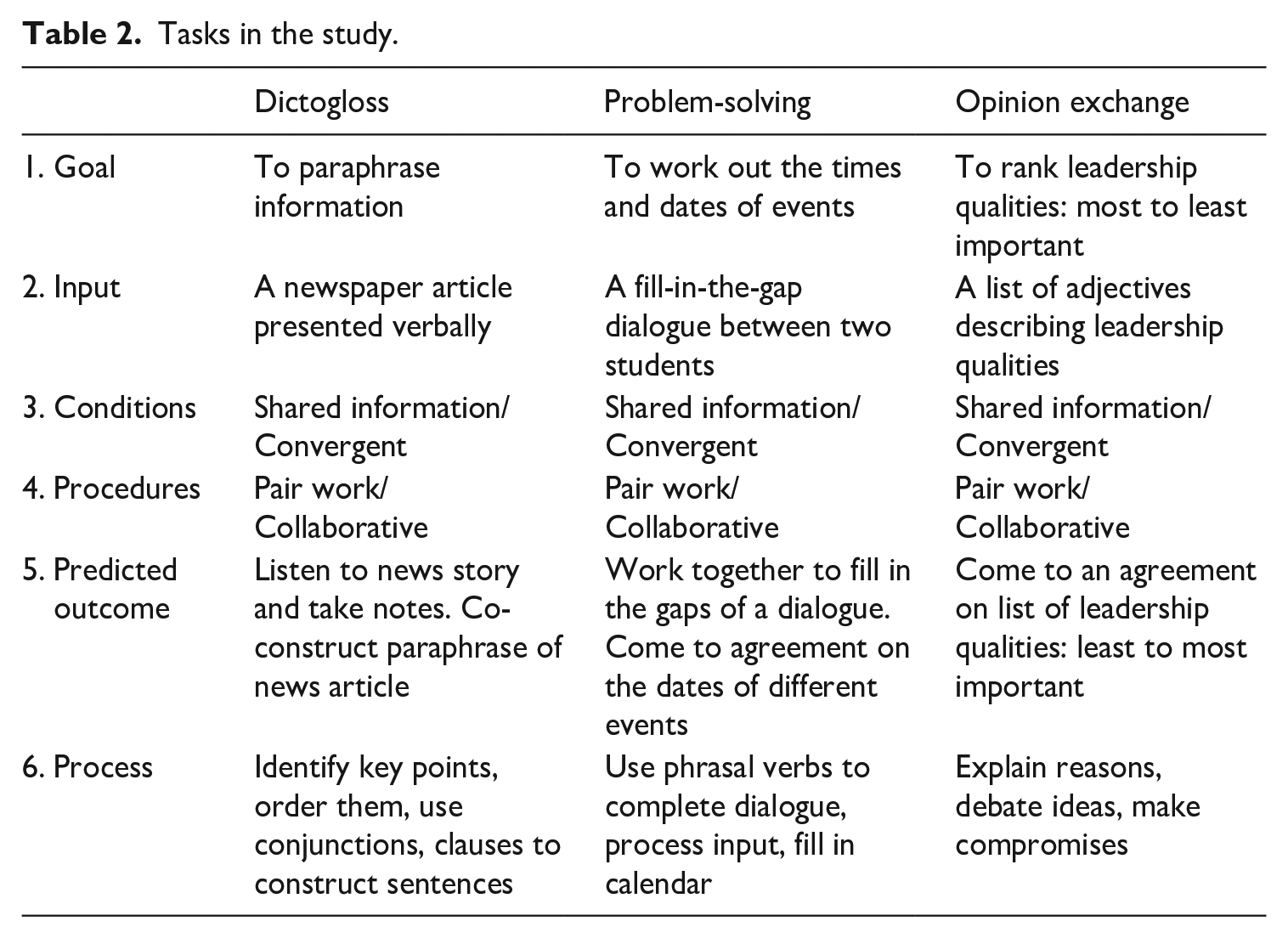
Drawing on previous TBLT design proposals (e.g. Lee, 2000; Willis, 1996), the tasks were broken down into three stages: (1) the pre-task phase; (2) the main-task phase; and (3) the post-task phase. Ellis (2018) describes these three stages as:
the activities students and teachers perform preceding the main task (pre-task phase);
the actual performance of the task (main-task phase); and
any activities engaged in subsequent to the main task (post-task phase).
Each of the tasks used in the study consisted of 4 or 5 steps. At the conclusion of each task, the participants were given an immediate post-test of the targeted vocabulary for that particular task. In Sub-study 2, the participants were also asked to respond to an extra question regarding how sufficient they felt the time allocated to them was; this was done after determining that the post-questionnaire feedback from Sub-study 1 lacked such information. In Week 5 the participants completed the post-questionnaire, and in Week 6 they took the delayed post-test of the targeted vocabulary all three tasks. After the qualitative and quantitative results were considered, two participants from each of the SCMC groups were asked if they would mind being interviewed. Table 3 provides an overview of the weekly schedule of each sub-study.
Overview of Sub-study 1 and Sub-study 2.
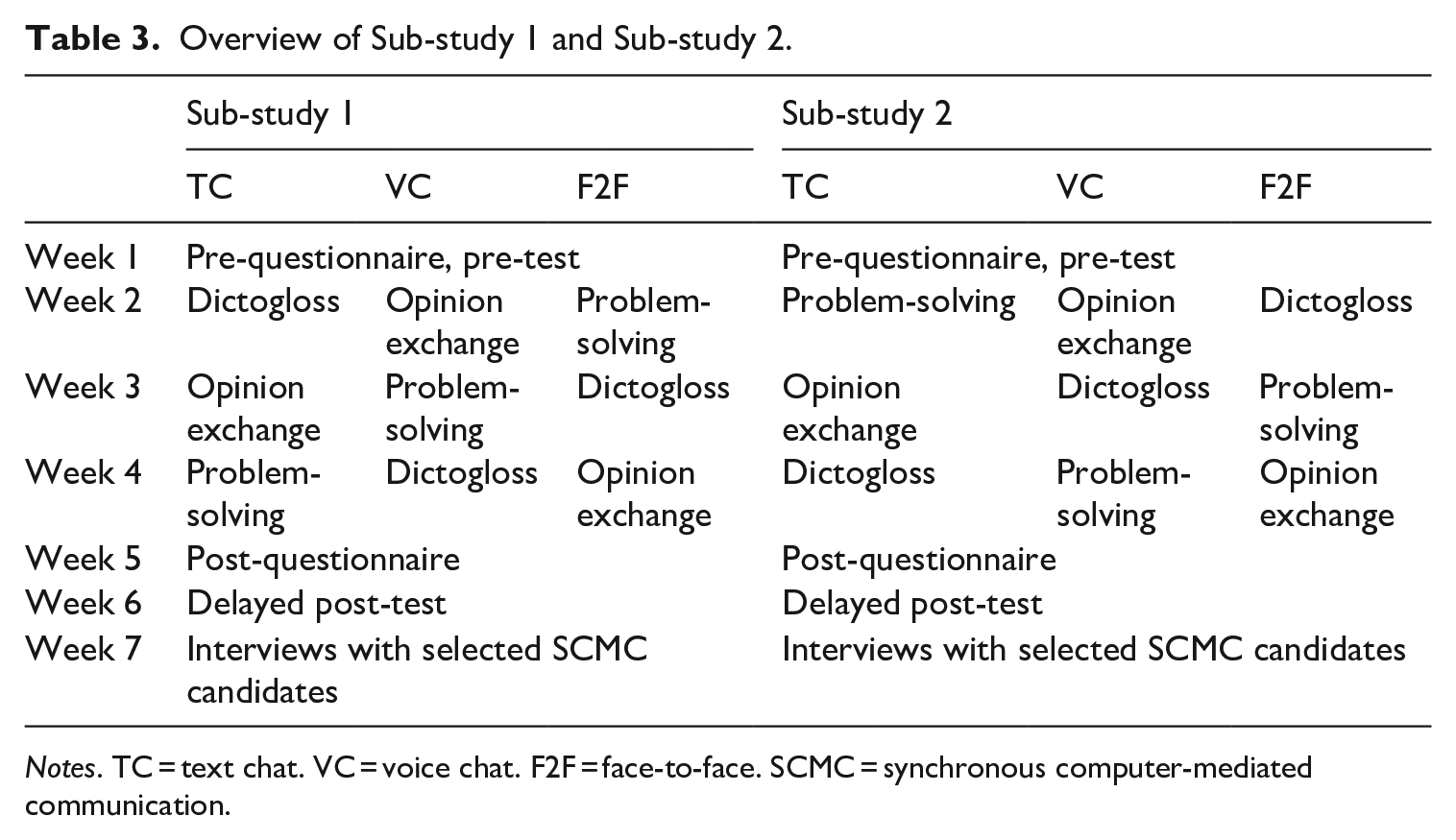
Notes. TC = text chat. VC = voice chat. F2F = face-to-face. SCMC = synchronous computer-mediated communication.
3 Data collection instruments
The data collection instruments for the study included a pre-test, a pre-questionnaire, three immediate post-tests, a delayed post-test, a post-questionnaire, and post-interviews. With guidance from all course instructors, 10 targeted lexical items were selected for each task. The lexical items chosen were those thought to be mostly unfamiliar to the participants but still common enough to be used in general task-based discussions. As Krashen and Terrell (1983) argue, input of this nature ensures all learners have the best opportunity to receive at least some i+1 input that is suitable to their current stage of linguistic development. Such input entails content that marginally exceeds the learners’ existing comprehension or skill level. For the pre-test and post-tests, each item was translated into Japanese along with additional items used as distractors, which were similar in spelling and pronunciation. A total of 30 targeted lexical items and 15 distractors were prepared for the pre-test and delayed post-test. These were divided into 10 targeted language items and 5 distractors for each immediate post-test.
The participants matched the English words to the Japanese translations using the quiz function on Moodle (https://moodle.com). A pilot pre-test was given to 11 first-year students from unrelated classes prior to the study, to gauge the difficulty levels of the targeted items. Their average score was 14.5 out of 30, which was considered to demonstrate that the targeted items were in the difficulty range suitable for most participants. In Week 1 each group did the pre-test, followed by an immediate post-test after each treatment in Weeks 2 to 4, and then a delayed post-test in Week 6.
The structure of the pre-questionnaire and post-questionnaire was divided into themes. In the pre-questionnaire, the first half elicited responses regarding the participants’ digital literacy. The second half gauged their familiarity with text chat and voice chat, and their attitudes towards using them for EFL learning in the classroom. The post-questionnaire provided to the SCMC groups was more comprehensive than the one administered to the F2F groups. This was done to gauge perceptual changes after the treatments regarding the participants’ willingness to use text chat or voice chat for classroom learning and how similar or different they felt both modes were to F2F communication. All questions were translated into Japanese and put on Moodle. The pre-questionnaire and post-questionnaire were carried out during class time. The participants were asked to write all of their open-ended responses in Japanese to ensure the most detailed accounts of their opinions.
Upon reviewing the results of the immediate post-tests and post-questionnaire, two students were selected from each SCMC group to be interviewed through typical case sampling. Teddlie and Tashakkori (2006) explain that typical case sampling ‘involves selecting those cases that are the most typical, normal, or representative of the group of cases under consideration’ (p. 176). The participants’ closed-ended responses in the post-questionnaire were calculated, and candidates were selected based on how representative their answers were. In a number of incidences, the percentage of responses for more than one answer was virtually the same. Consequently, in the selection process, candidates that represented two common viewpoints were chosen. The interviewee sample represented 10% of the total SCMC participant population, making eight in total, two from each group. A semi-structured approach to the interviews was adopted. Seven general questions were created to commence each interview. Once these initial questions were answered, more personalized questions were then asked based on the comments provided. Each interview took approximately 15 minutes and was recorded. The interviews were conducted in both English and Japanese. Throughout the interviews, notes of the participants’ responses were recorded along with any thoughts that occurred to the interviewer (the first author of this article) at the time.
4 Data analysis
The data from both sub-studies – including the pre-test, pre-questionnaire, immediate post-tests, post-questionnaire, delayed post-test, and interviews – were compared, contrasted, and merged together to ascertain their overall significance. One-way ANOVA analysis was first used to detect any significant differences in the pre-test results per task for each group (6), and each mode (3) by combining the scores of both sub-studies. Post hoc measures in the form of a Tukey (HSD) analysis were employed if any were found, to pinpoint which groups or modes were involved. This process was repeated for the post-test results. Paired t-tests were also used to determine if uptake of the targeted language items after each treatment was significant or not. The closed-ended responses in the post-questionnaire were also broken down into percentages and compiled. Common responses from each group were then identified and compared. The participants’ open-ended answers were also examined to isolate any commonalities or dissimilarities in the feedback from each group.
Descriptive statistics were then used to measure changes in each group’s pre-test, immediate post-tests (scores combined), and delayed post-test results. The statistics included measurements of central tendencies (mean; median; mode), and variability (standard deviation; maximum and minimum values). Paired t-tests were again used to compare the pre-test and delayed post-test results of each group. An analysis of the pre-questionnaire was done by merging the three groups’ data sets to gauge the participants’ overall feelings about their own digital literacy levels, as well as SCMC, and using text chat or voice chat in the EFL classroom. Moreover, the two SCMC groups’ responses in the pre-questionnaire were compared with their feedback from the post-questionnaire to determine whether their perspectives had changed or not.
Finally, thematic analysis of the interviews was done by organizing the participants’ comments into two groups: (1) those relating to communication mode; and (2) those relating to task design. These categories were further divided into positive and negative feedback. The data was coded this way to identify common topics, ideas, or patterns and help draw preliminary conclusions about the participants’ views and experiences. The comments given were then categorized and compared with feedback from the post-questionnaires. The process of coding and analysing the interview data was carried out separately in both sub-studies by only one of the researchers. The data sets from Sub-study 1 and Sub-study 2 were then compared to identify common themes or inconsistencies. Any detected were then compared with the other quantitative and qualitative data sets of both sub-studies to determine the extent to which general trends or variations existed between the two.
IV Results
1 Pre-test and post-test results
Initial one-way ANOVA analysis of the 6 groups’ pre-test results found one significant difference between TC 1 and F2F 1 for the targeted vocabulary in the dictogloss (p < 0.05). F2F 1 scored an average of 7.8 out of 10, while TC 1 only scored 6.8. As a result, comparisons of these two groups’ post-test results were disregarded. Further analysis of the combined results of both sub-studies found no significant difference between the pre-test results per task of each mode. This meant that analysis of the combined post-test scores of both sub-studies per mode was valid.
A comparison of the participants’ mean gain scores revealed that voice chat was the most successful mode in the study (see Table 4), attaining the best immediate post-test and delayed post-test gains overall (VC 11.95; TC 10.58; F2F 10.69 / VC 5.84; TC 5.12; F2F 4.87). Per task, voice chat achieved the highest immediate post- and delayed post-results for the opinion exchange (VC 4.5; TC 4.3; F2F 4.3 / VC 2.8; TC; 2.3; F2F 2.6) and problem-solving task (VC 4.8; TC 3.2; F2F 4 / VC 1.6; TC; 1.1; F2F 1.5). For the dictogloss, text chat was the most successful mode (TC 2.9; VC 2.2; F2F 2.3 / TC; 1.6; VC 1.3; F2F 0.8). At no time did F2F communication achieve the highest mean gain score for any of the tasks.
Average test scores and mean gain scores.
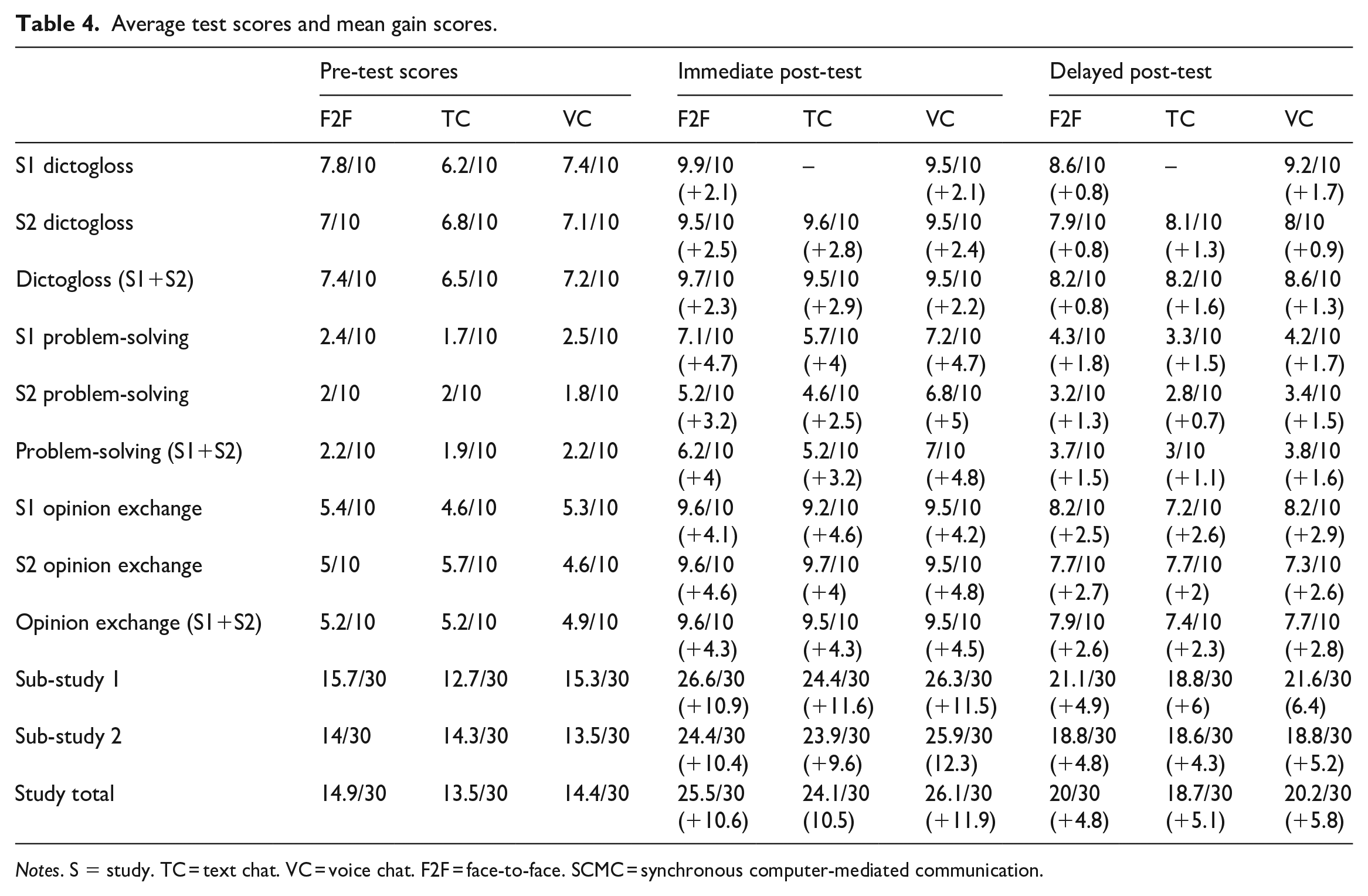
Notes. S = study. TC = text chat. VC = voice chat. F2F = face-to-face. SCMC = synchronous computer-mediated communication.
A series of t-test comparisons of the pre-test, immediate post-tests, and delayed post-test results demonstrated that significant learning gains were made most of the time by each group per task and overall. Only in one t-test analysis of the delayed post-test results for the problem-solving task was uptake for the TC 2 group found to be insignificant (0.09).
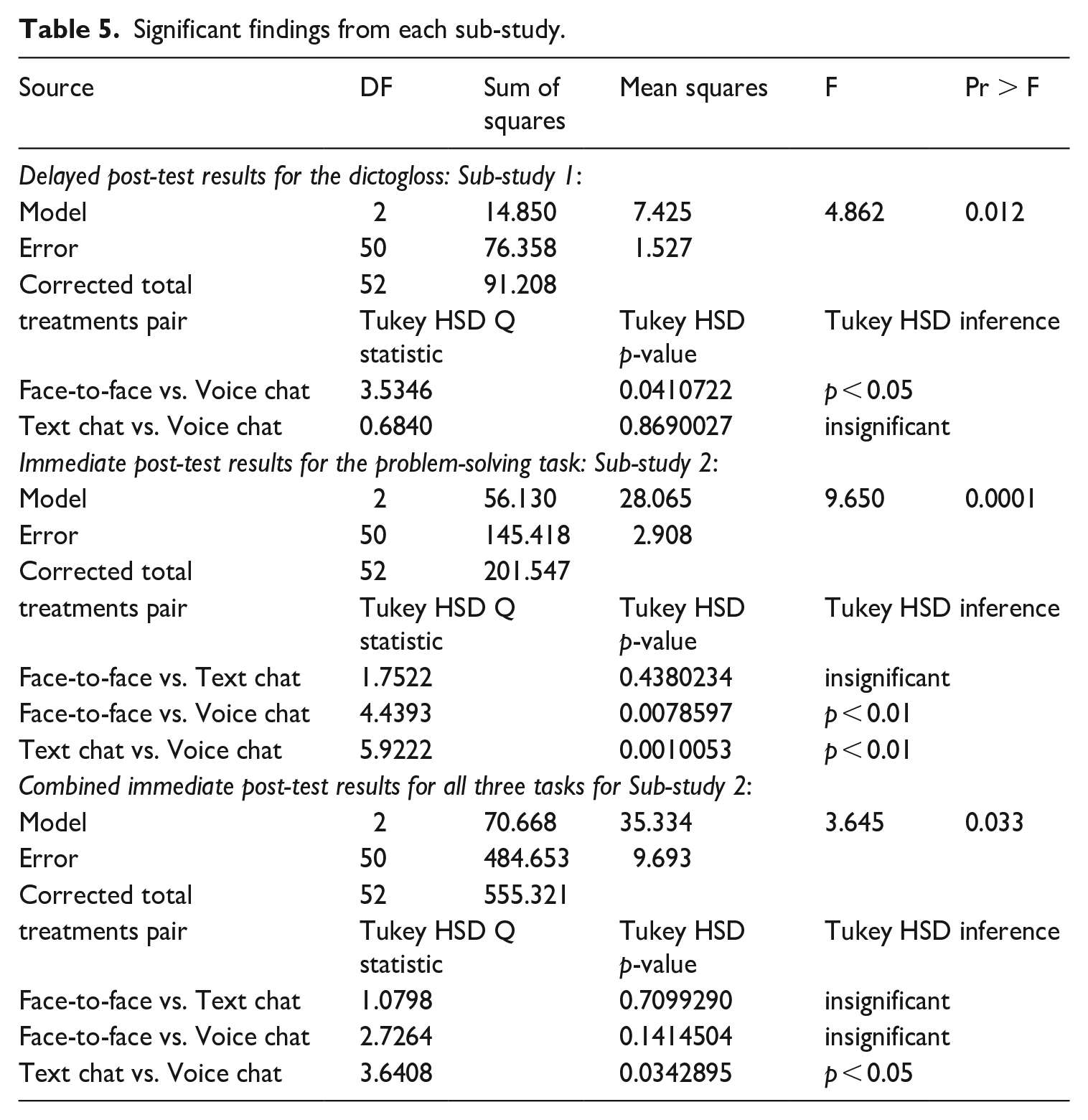
Comparing the post-test gain scores across groups and mode for each sub-study, a total of 16 one-way ANOVA analysis were performed. Table 5 presents only the three significant findings. The first significant ANOVA analysis difference found was for the delayed post-test results for the dictogloss. A follow-up post-hoc analysis revealed VC 1 achieved considerably better uptake than F2F 1 (1.7 > 0.8 p < 0.05). Another one-way ANOVA found significant differences in the immediate post-test results for the problem-solving task in Sub-study 2. Post-hoc analysis showed VC 2 attained significantly more uptake than either F2F 2 (5 > 3.2) or TC 2 (5 > 2.5 p < 0.01). A final one-way ANOVA also found the VC 2 group achieved significantly more immediate uptake than TC 2 in the study overall (12.36 > 9.6 p < 0.05).
Significant findings from each sub-study.
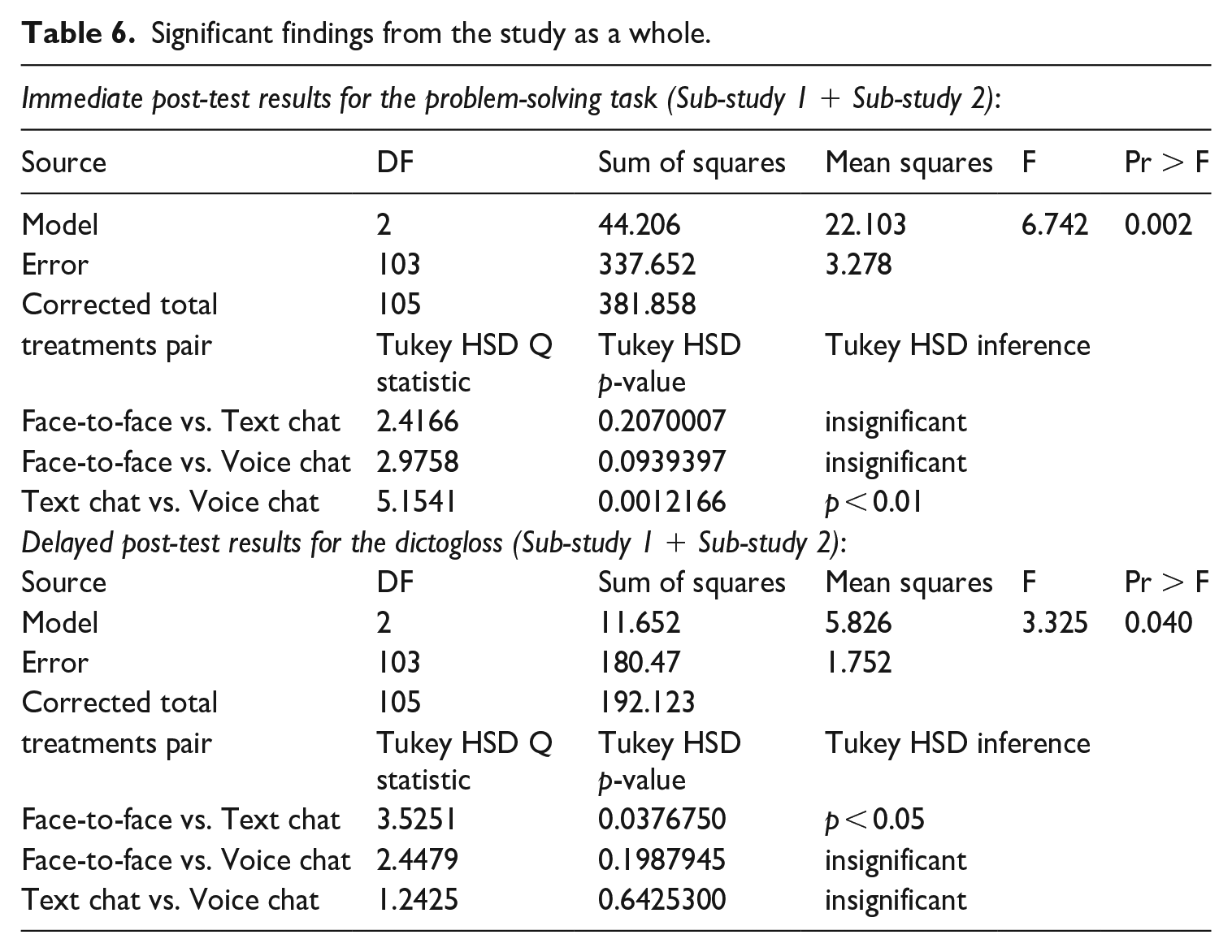
Another series of one-way ANOVA analysis was carried out on the combined results of the study (per task × 3, and for the immediate and delayed scores × 2). Table 6 shows only the two significant findings. An ANOVA analysis of the immediate post-test gain scores from both sub-studies showed a significant difference in uptake in the problem-solving task. A further Tukey (HSD) analysis that revealed voice chat’s effect on uptake was significantly more positive than text chat’s (4.8 > 3.2 p < 0.01). Further one-way ANOVA analysis of the combined delayed post-test gain scores of both sub-studies for the dictogloss indicated another significant mode effect on uptake. A post-hoc Tukey (HSD) showed that retention of the new lexical input over time was better sustained on text chat than face-to-face communication (1.6 > 0.8 p < 0.05). Finally, a one-way ANOVA analysis of the overall delayed post-test results for both sub-studies revealed no significant differences between the three modes. There was also no significant difference in either the combined immediate post-test or delayed post-test results. In certain circumstances, mode and task design had either a positive or negative impact on uptake. However, the overall data implied that all participants obtained similar learning outcomes regardless of the mode they used.
Significant findings from the study as a whole.
2 Pre-questionnaire and post-questionnaire results
Pre-questionnaire feedback showed that there was almost an even divide between those who said they enjoyed and felt comfortable using digital devices and those who were either unsure or did not feel comfortable. Most were comfortable using online communication (52% somewhat; 10% very) and enjoyed text chatting (51% somewhat; 13% very). At the same time, the majority said that they were unsure if they liked voice chat (26%) or they did not enjoy it (25% not really; 17% not at all). Most participants were more versed in text chatting (58% daily; 15% weekly) than voice chatting (23% weekly; 3% daily). Two-thirds of respondents stated that they felt online communication was somewhat different (47%) or very different (17%) to F2F communication. Nevertheless, the majority were positive about using SCMC tools to practise English in the classroom.
For post-task impressions about time, the majority of F2F and voice chat participants stated that they felt they had sufficient time for each task, particularly the opinion exchange (VC 72%; F2F 85%) and problem-solving task (VC 83%; F2F 87%). On the other hand, the majority of text chat participants stated that they felt they had insufficient time for those tasks (opinion exchange 41%; problem-solving 40%). Only for the dictogloss, there was an even divide between those who felt the allocated time was sufficient or those who did not (50%). Post questionnaire feedback from the F2F participants indicated that the majority enjoyed doing the opinion exchange the most (64%). Some comments included: I could hear different ideas and it made me think more deeply. (F2F 1 – S6) My partner talked a lot and the conversation worked well. (F2F 2 – S10)
A similar percentage of participants stated that they disliked the dictogloss (41%) and the problem-solving task (33%) the most. Common reasons given were: Listening and making a summary for the dictogloss was difficult. (F2F 1 – S3) It was hard to continue the conversation in the problem-solving task. (F2F 2 – S5)
Almost an even number selected the dictogloss and the opinion exchange as being the easiest (dictogloss 38%; opinion exchange 41%). Conversely, the opinion exchange was also rated as the most difficult (46%). Two participants stated: The conversation did not continue much because of my lack of vocabulary. (F2F 2 – S3) The conversation was hard to carry on. (F2F 2 – S5)
As Table 7 shows, the overwhelming majority of text chat participants said that they enjoyed using the mode to practise English in the classroom (65% somewhat; 14% very much) and felt positive about continuing to use it sometimes in the future (72% somewhat; 21% very much). Of the three tasks, the opinion exchange was selected as the most enjoyable (62%) and the easiest (62%). The dictogloss was selected as the most disliked (62%) and the most difficult (69%). Two comments regarding the opinion exchange were: Communication for this task was the smoothest of the three. (TC1 – S4) I could work on it and text at the same time. (TC 2 – S10)
Two other comments regarding the dictogloss were: Explaining my ideas on text chat was hard. (TC 1 – S14) It was difficult to paraphrase. (TC 2 – S1)
As shown in Table 8, most voice chat participants stated that they enjoyed using the mode to practise English in the classroom (49% somewhat; 36% very much) and were positive about the prospect of continuing to use it in the future (43% somewhat; 38%; very much). Similar to F2F feedback, the impressions of the tasks were fairly evenly divided. Comparable numbers voted both the opinion exchange and the problem-solving task as being the most enjoyable task (opinion exchange 41%; problem-solving task 36%). There was also a fairly even split between those who felt the dictogloss and opinion exchange were either the easiest (39% for both) or most difficult tasks (37% for both). No task stood out as being particularly more disliked than another (dictogloss 36%; opinion exchange 32%; problem-solving task 32%). Like other participants, those who used voice chat found the opinion exchange enjoyable for its capacity to promote sustained meaningful interaction.
Text chat participants’ post-questionnaire results.
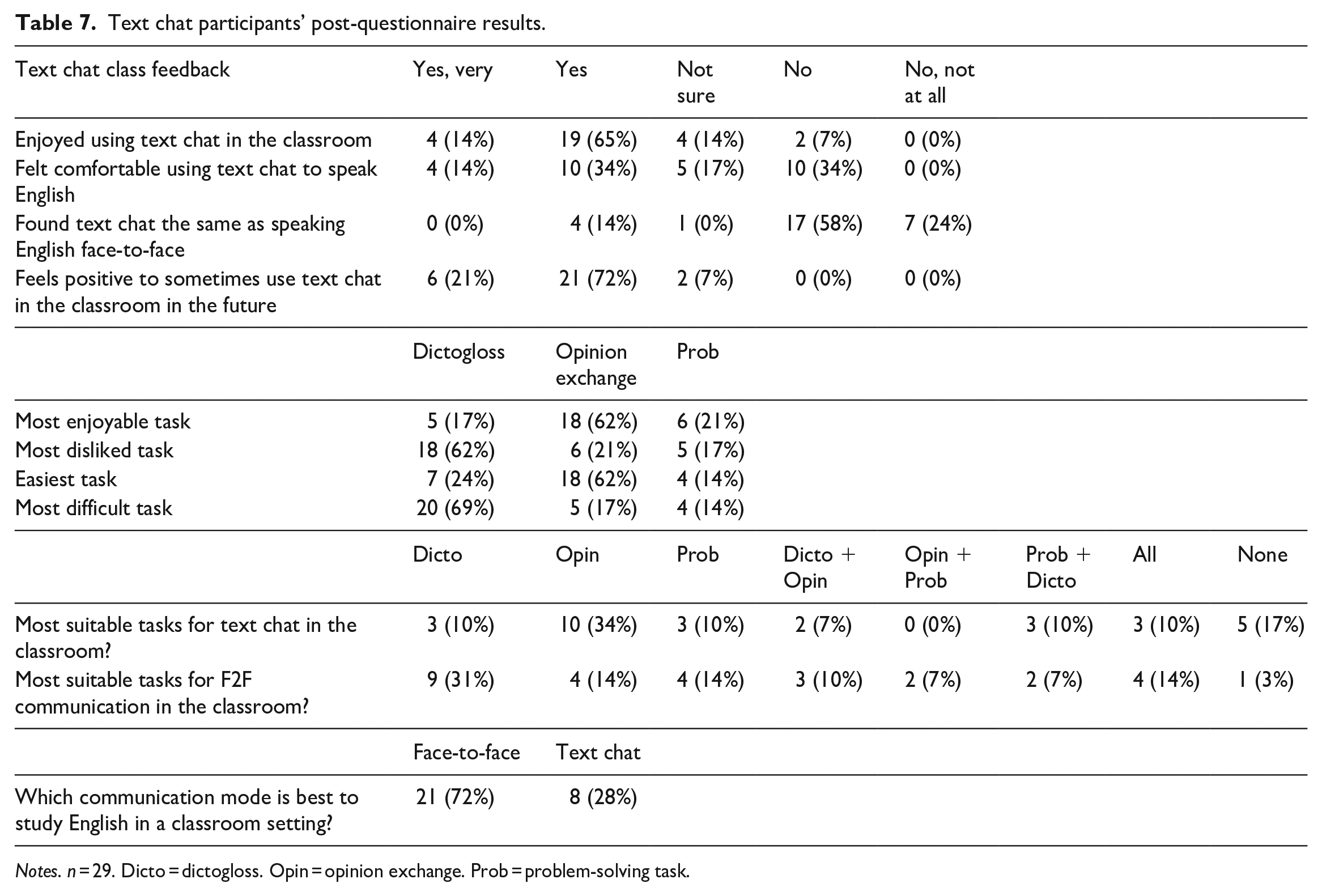
Notes. n = 29. Dicto = dictogloss. Opin = opinion exchange. Prob = problem-solving task.
Voice chat participants’ post-questionnaire results.
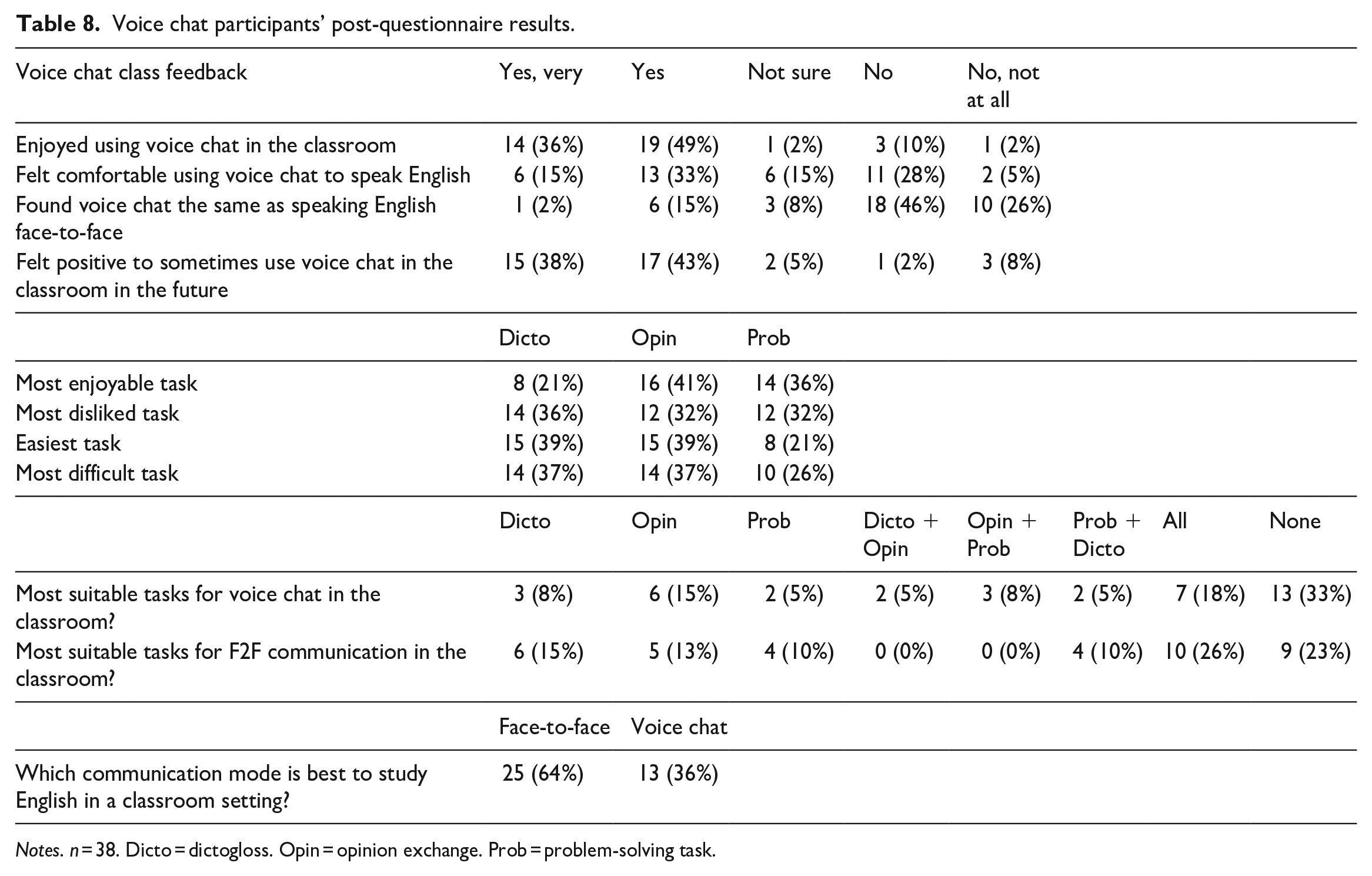
Notes. n = 38. Dicto = dictogloss. Opin = opinion exchange. Prob = problem-solving task.
Unlike other participants, however, five voice chat participants stated that they liked the problem-solving task for the challenge it presented. Two comments included: We could answer it by helping each other. (VC 2 – S8) It was fun to solve the problem together. (VC 2 – S10)
Additionally, there was also a similar divide between those who felt frustrated by not understanding the listening section of the dictogloss (12 comments), and those who found the opinion exchange conversation to be arduous (9 comments). Some comments provided were: The dictogloss was hard because even if I didn't understand the content, I had to talk about it with my partner. (VC 2 – S17) Talking about leadership characteristics using simple words was hard. (VC 1 – S13)
This resulted in a greater range of opinions regarding impressions of the tasks compared to other groups, particularly text chat.
3 Interview results
Examining the feedback provided by the four text chat interviewees, positive comments made about using the mode to practise English included: I had more time to think between sentences. (TC interviewee 1) I had more control over the pace of the conversation. (TC interviewee 2) Not being able to see my partner’s face challenged me to change the way I communicated. (TC interviewee 4) It can help learners gain confidence speaking. (TC interviewee 4)
On the other hand, some negative comments included: Waiting for a response, I sometimes was not sure my partner understood me. I would type more, then partway through I would get a response. It was confusing. (TC interviewee 1) It is hard looking at the screen all the time. (TC interviewee 3) It takes time, sometimes I could not finish what I wanted to say. (TC interviewee 4)
One interviewee stated that the problem-solving task was the most difficult because: Focusing the conversation on sentences from the dialog got tiresome. (TC interviewee 1)
Another interviewee stated that the dictogloss was the hardest because: Understanding the listening section and paraphrasing the input was tough. (TC interviewee 3)
Nonetheless, the dictogloss was stated to be the best task for learning because: It involved talking about complex sentence structures. (TC interviewee 2)
Finally, it was also stated that: It was better to do the dictogloss on text chat than F2F as the task needed lots of thinking time. (TC interviewee 2)
As for voice chat, positive comments included: Not being able to read my partner’s face forced me to listen harder. (VC interviewee 1) I felt satisfied when I could get my point across. (VC interviewee 3) The challenge was enjoyable. (VC interviewee 4) The atmosphere was more relaxed and fun compared to speaking F2F. (VC interviewee 4)
Conversely, some negative feedback included: It was hard to catch words sometimes because of bad connections. (VC interviewee 2) I am not a good speaker, so it was frustrating not being able to use gestures. (VC interviewee 3) Speaking all the time through voice chat gets lonely. (VC interviewee 4)
The interviewees felt that the dictogloss and the problem-solving task demanded more cognitive processing than the opinion exchange. For the dictogloss, it was stated that: I had to keep repeating myself to help my partner understand me. (VC interviewee 2) It was easy to get stuck not knowing what to write next. (VC interviewee 4)
On the other hand, for the problem-solving task, comments included: The dialogue was easy to talk about. (VC interviewee 3) It was fun to fill in the calendar with a partner. (VC interviewee 4)
The interviewees thought that using voice chat to carry out all three tasks was not so problematic. Each task was considered fairly enjoyable but as with F2F communication, it was said to depend on the partner they had.
V Discussion
The results of the study confirm the capacity of text chat and voice chat to promote uptake in an EFL classroom setting was similar to F2F communication. The paired t-tests showed significant test score improvements across all three modes. These findings are comparable to earlier F2F studies (e.g. Keck et al., 2006; Mackey & Goo, 2007) and CMC studies (e.g. Blake, 2000; Pellettieri, 2000; Tudini, 2003), which also demonstrated learners in both communication environments exhibited similar learning traits. In accordance with Ziegler (2016), CMC has a similar capacity to F2F communication to produce learning features and outcomes and provide opportunities for negotiation and feedback. This was most evident in the opinion exchange (see Appendix 1). The task’s simple design put the participants on an equal footing as it did not necessitate the co-construction of any type of output besides a final list of leadership traits. Its open-ended nature also possibly lessened the potential for the participants to lose face or become disorientated by turn adjacency issues.
At the same time, voice chat’s overall marginally higher immediate and delayed uptake may have resulted from the participants’ inability to see each other but retain the ability to speak and hear. Having to adhere to standard conversational norms (e.g. avoiding long silences, keeping up chitchat) was likely felt more strongly by the F2F participants, slightly diminishing their capacity to attend to the targeted language items. In another investigation by Edwards and Young (2016), learner interactions on voice chat were found to contain 48% to 60% more targeted language output than on text chat, resulting in stronger delayed uptake. Smith (2003) argues that ‘CMC removes, or at least reduces, many of the para- and non-linguistic aspects of face-to-face speech that facilitate verbal communication’ (p. 47), such as using body language, gestures, or facial expressions. In Yanguas’ (2010) study, it was found that such impediments obstructed the voice chat participants’ ability to describe objects illustrated on their worksheets. However, for the opinion exchange in the current study, the inability to use paralinguistic cues could not be as strongly linked to uptake since all participants were provided the same worksheet, listing the same targeted lexical items and their Japanese meanings. In short, the advantage of being able to gesture was cancelled out.
For the dictogloss (see Appendix 2), the combined results of the text chat participants from Sub-study 1 and Sub-study 2 showed that this mode facilitated more delayed uptake in the study than F2F communication. The challenge of carrying out the dictogloss through the text medium seems to have promoted more opportunities for noticing to occur. Having to co-construct a paraphrase appears to have increased the text chat participants’ attention to form. In accordance with H.Kim (2017), the unique interactional features of text chat, such as ‘the visual presentation of the discourse, the time lag between the initiation of the message and its receipt, and the absence of paralinguistic cues’ (p. 220) likely affected the way the participants approached the dictogloss. Not being able to see or hear each other likely lowered the text chat participants’ awareness of social presence. Social awareness and issues of face have been found to affect learners’ willingness to engage in form-related discussions more greatly in F2F exchanges than text chats (Lai & Zhao, 2006; Van der Zwaard & Bannink, 2014), particularly in collaborative writing tasks. Text chat necessitated longer periods of waiting between responses, which possibly lowered the sense of urgency those participants felt in the study to respond quickly. Conversely, the F2F participants likely felt more pressure to respond promptly or risk feeling uncomfortable, reducing opportunities for private thinking time and lowering their capacity to notice input. Similar to H.Kim (2017), the slowed pace of turn-taking on text chat likely necessitated longer use of the participants’ cognitive resources as they constructed their paraphrased sentences.
For the problem-solving task (see Appendix 3), text chat was the least successful mode at facilitating uptake. Difficulty with the phrasal verbs and design features is suspected of having weakened the text chat participants’ attention to form. Input discussions required the participants to point things out on their worksheets. For those using text chat, this appears to have been a challenge. The spaces for the phrasal verbs to be added in the dialogue were not clearly numbered, likely increasing the time it took the text chat participants to direct each other’s attention to different points on the worksheet and discuss the items.
As purported by Baralt (2013), tasks that are simple and require less turn-taking appear to have facilitated higher rates of noticing on text chat. Increased task complexity appears to have had a negative effect on turn adjacency and noticing. There was more textual information in the problem-solving task than the opinion exchange. The task also placed a higher emphasis on accuracy. The participants had to fill in the gaps of the dialogue on the worksheet correctly using the phrasal verbs. Doing so required a focus on meaning and grammatical accuracy. Alternatively, the option to avoid the phrasal verbs was available, as the main objective of the task was to fill in the dates on the calendar. To an extent, it was possible for the participants to do so, even if they did not complete the dialogue. Although they were encouraged to confer with each other throughout the process, the task’s design made interaction more of an option than a requirement. It was observed that oftentimes pairs did not immediately start discussing the textual information. The problem-solving task’s design appears to have compounded the likelihood of communication breakdowns occurring on text chat, making turn-taking problematic and running the risk of deterioration into split-screen negotiation routines, a phenomenon commonly seen on the mode (Baralt, 2013; Lai et al., 2008; Smith, 2003). Similar to a study by Salbego and Tumolo (2020), it is possible that form-related negotiations became split when the participants did not attempt to clarify or resolve communication problems immediately. It is also possible that a lack of strict turn adjacency caused delays between triggers and responses, resulting in meaning negotiations getting side-tracked or forgotten as triggers went unanswered (Smith, 2003).
Out of the three modes, voice chat achieved the highest immediate and delayed gain scores overall for the problem-solving task. It demonstrated a significantly more positive immediate post-task effect on uptake than text chat. Although the inability to read visual cues or use gestures would have been the same, the ability to communicate verbally likely helped reduce potential misunderstandings from occurring. Having less social presence to deal with than in a F2F conversation also may have promoted more private thinking time. For text chat, the communication difficulties related to task design possibly offset any potential benefit extra time would have afforded its participants.
Regarding the Sub-study 2 participants’ feedback on time, less than 50% using text chat claimed to have had adequate time for the opinion exchange or problem-solving task, compared to 90% or more on voice chat and F2F. Although the voice chat and F2F participants demonstrated similar perceptions of time for all three tasks, a slightly higher number of the voice chat participants claimed to have had excess time. The data suggest that possibly lacking some paralinguistic and non-linguistic aspects of communication helped the voice chat participants maintain more focus on completing the task at hand. As a result, time constraints may have ended up being less of a concern, allowing for greater attention to be paid to form-related issues. Similar to Yamada and Akahori (2009), the inability to make eye contact likely increased the participants’ capacity to focus on the task at hand and its targeted expressions. Likewise, Guichon and Cohen (2014) also found that the lack of social presence experienced on voice chat helped its participants increase their focus on task input.
Of all three tasks, the three groups’ perceptions of time were most closely matched in the dictogloss. This was the only time 50% of the text chat participants gave a positive response regarding the time allocated, meaning there was likely less anxiety. As mentioned previously, this was the only task that required co-construction of a written text. As noted by other researchers (e.g. Fiori, 2005; Sauro, 2009; Sotillo, 2005), the capacity to scroll on their computer screens likely helped the text chat participants do this, allowing them to efficiently attend to the sentences they were collaborating on. Although co-construction of a paraphrase was time consuming, synthesization of the input through text chat may have provided its learners with increased private thinking time. Despite the overall amount of learner output likely being less on text chat than F2F or on voice chat, in the case of the dictogloss, it did not matter so much. Paraphrasing the input required each pair give careful consideration how best to synthesize the information in a few short sentences, meaning the focus was on composition.
Regardless of mode, the majority of the participants felt the opinion exchange was the most enjoyable task, particularly those who spoke F2F or used text chat, where more than 60% stated so. Two common themes in the feedback were: (1) the interaction felt natural; and (2) having to give their reasons, while challenging, was also satisfying. Irrespective of the medium, it is evident that a large number of the participants enjoyed the opinion exchange because they felt it promoted the most meaningful discussions. Compared to F2F and voice chat, the text chat participants’ task impressions were much more decisive with 62% stating the opinion exchange was the easiest, and 69% stating the dictogloss was the most difficult. Comparing the communicative objectives of both tasks, having to simply express opinions versus co-constructing output appears to have strongly influenced the participants’ perceptions as to which task they felt was easier than the other.
Unlike text chat, there was a much closer divide between the voice chat participants who said they enjoyed the opinion exchange (41%) or the problem-solving task (36%) the most. The voice chat participants appear to have been more at ease working on the problem-solving task with their partners than those using the other modes, particularly text chat. Even though much of the positive feedback was given in Sub-study 2, in both sub-studies voice chat achieved the highest immediate post-test uptake for the problem-solving task and overall. Another equal divide was found between the voice chat participants who selected the dictogloss or opinion exchange as being the most difficult (37% each). The ability to verbalize messages but not use certain paralinguistic cues possibly created a split in their perspectives. Feeling more pressure than the text chat participants to respond quickly likely increased the cognitive load of the weaker interlocutors on voice chat during the opinion exchange. Likewise, the inability to use gesturing or visual cues to aid comprehension appears to have increased the perception that the dictogloss was hard. Some reasons given included not knowing what to say, needing to memorize what was being said quickly, and not being able to explain the information well. For text chat and voice chat, a correlation can also be made between the large percentage who voted the dictogloss as the most disliked, as well as the most difficult task (Text chat – 69%; Voice chat – 37%). The data suggest that, while 41% of the F2F participants also stated that they disliked the dictogloss, only 23% found it to be the most difficult. This may provide another reason why significantly less delayed uptake was achieved F2F than on text chat. Some F2F participants stated the task was monotonous, hard to catch everything being said, and hard to summarize.
VI Conclusions
Although the results of the study indicated that the gain scores achieved by all three modes (i.e. text chat, voice chat and F2F) were similar, the results per task revealed a number of differences. Generally speaking, the production cost of typing (Lai & Zhao, 2006) means text chat produces less output than F2F exchanges (Yilmaz & Granena, 2010; Zeng, 2017). However, written production can also increase the attentional demands placed on language learners more so than speaking (Grabowski, 2007). Text chat’s slower pace of communication appears to have helped during the dictogloss. The challenge of co-constructing a paraphrase demanded a substantial amount of processing. Sharing the information textually slowed the participants’ interactions compared to those who did the task verbally. For the problem-solving task, verbally exchanges appeared more effective at promoting noticing than texting. Generally, most participants were unfamiliar with the phrasal verbs. This unfamiliarity, coupled with the challenge of having to point things out on their worksheets, possibly detracted from the text chat participants’ willingness to focus on the targeted language items. At the same time, while the voice chat participants also lacked visual clues and the ability to gesture, having to rely completely on verbal messaging not only mitigated potential communication breakdowns but also increased language awareness through a need to carefully explain textual clues and repeated verbalizations of the targeted items.
Communication mode least affected uptake for the opinion exchange. Although the voice chat mode again obtained the best results in both sub-studies, there were no significant differences in the combined results. The task’s simple design, minimal input, straightforward instructions, and reduced emphasis on accuracy appear to have negated mode effects to a large extent. The voice chat participants’ higher levels of uptake can be linked to their need to rely on verbal messaging and having to repeatedly say the targeted language items more so than those who spoke F2F (i.e. who had the option of physically pointing them out), or text chatted.
The results of the study demonstrate that SCMC can positively impact learning in EFL classroom settings. Text chat and voice chat provide unique communication environments that offer teachers the capacity to stretch the communicative abilities of their learners in ways that F2F interaction cannot. Depending on task design, the added challenge of communicating through text chat or voice chat can either stimulate or impede a learner’s awareness of L2-related issues. At times, the capacity of voice chat to put space between speakers and have them rely completely on verbal messaging can lead to closer attention to form-related issues. Compared to F2F interaction, the uptake results were consistently better overall despite not being significantly different. For these task types, creating conditions where social presence is reduced but verbal communication is permitted may allow EFL learners more opportunities to notice new L2 input during these types of task-based discussions.
In future studies, the use of different sample groups for each treatment round is desirable to reduce the risk of conditioning. When measuring uptake, careful consideration needs to be given to the type of targeted language used in the tasks and how it is presented. Incorporating the same targeted items into a number of different task designs is one possible solution. It could assure the difficulty level of the input presented in each task is exactly the same. Another option would be to use the same task but to change certain features that potentially can either increase or decrease the cognitive load. In such a research design, sample groups could be assigned different difficulty levels rather than particular communication modes, taking turns using different modes to carry out various tasks and to provide qualitative feedback. Moving forward, SCMC research must continue to identify design features that are most suitable for L2 learners to carry out tasks in online environments and provide more in-depth understanding about the dynamics of learning through online communication.
Footnotes
Appendix 1. Opinion exchange task
Would you like to be the boss of a company?
Do you think you could be a good leader?
What type of personality should a leader have? Why?
Approachable 率直な
Candid 刺激を与える
Charismatic 謙遜な
Inspiring 近づきやすい
Humble カリスマ的な
Passionate 情熱的な
Innovative 支える力になる
Knowledgeable 目標を見定めた
Supportive 知識のある
Goal oriented 革新的な
Separate the words above into two groups. Choose your top five (most important) and bottom five (least important) leadership qualities. In pairs, explain why you think so.
With your partner, list leadership qualities you think the next Prime Minister of Japan should have. Using the words above, make a new list from 1 (most important) to 10 (least important).
Appendix 2. Dictogloss task
When was the best time in your life?
Are you happy with your age now? Why?
What do you think about getting older?
Do you feel like an adult yet?
The following words are from the news story. Listen to the news story once and mark down the order in which you hear the words.
Apply 申し込む
Recognized 認識する
Pension 年金
Taxes 税金
Adulthood 成人期
Healthcare 健康保険
Officially 公式に
Legal 法定の/合法の
Consent 同意する
Gender 性別
Listen to the news story twice more and take notes. Compare your notes with a partner.
With your partner, paraphrase the news story. You can use the words list above.
______________________________________________________________________
______________________________________________________________________
______________________________________________________________________
______________________________________________________________________
______________________________________________________________________
______________________________________________________________________
Read your summary to another member of the class.
Would you like to see the law change? Why or why not?
Do you think the legal age for drinking and smoking should change too?
Japan has lowered the age of
The new law should help Japan's economy. More people will get married and start families. This will help the falling birth rate and ageing population. More financial freedom could provide more
Appendix 3. Problem-solving task
Hold off 延期する
Find out 見つけ出す
Figure out (答えなどを) 見つける
Head up ~の方へ向かう
Turn up 現れる
Figure on 想定する
Knuckle down 真剣にとりかかる
Sort out 整理する
Hang out つるむ
Go ahead 先にどうぞ
When did Jim miss football practice? (1)
When was Jim’s teacher sick and could not go to class? (2)
When is Jim going to do his French presentation? (3)
When is Tony and Jim’s next football game? (4)
When is Tony and Chris go bowling? (5)
Using the phrasal verbs above can you come up with three statements about yourself?
Tell your partner and have a short discussion.
______________________________________________________________________
______________________________________________________________________
______________________________________________________________________
______________________________________________________________________
Funding
The author(s) received no financial support for the research, authorship, and/or publication of this article.
