







Abstract
Although research on written corrective feedback has proliferated over the past decades, scant attention has been paid to how dyadic interaction pattern influence English-as-a-foreign-language learners’ behavioral engagement with feedback. This study explored the extent to which patterns of interaction affect the degree of learner engagement with teacher corrective feedback, learners’ revision behavior, and revision outcome. Forty learners of English as a foreign language on an advanced writing course participated in the study. Learners were provided with comprehensive teacher feedback on six writing tasks and were required to collaboratively process feedback over a 4-month semester. The qualitative analysis of recorded learner talk revealed that although the learners were at the same proficiency level, they adopted a variety of patterns of interaction including collaborative, expert/novice, dominant/dominant, and dominant/passive. By analyzing learners’ pair talk, revised texts, and retrospective interviews, the study revealed that, first, the pattern of dyadic interaction affects the degree of learner engagement with feedback, with collaborative pairs exhibiting a substantially higher amount of extensive engagement with feedback than non-collaborative pairs; second, the pattern of dyadic interaction affects learners’ revision behavior, with non-collaborative, particularly dominant–dominant pairs, showing several instances of unrevised and abandoned errors; and third, the pattern of dyadic interaction affects the outcome of revisions—the collaborative pairs revised their writings significantly more successfully than the non-collaboratives. Furthermore, learners’ perception of their partner’s proficiency was found to be a key factor contributing to a non-collaborative relationship between pair members. These findings are discussed based on relevant literature.
Keywords
I Introduction
Writing in a second language (L2) is a challenging yet crucial skill that L2 learners need to develop (Bitchener & Ferris, 2012; K. Hyland, 2019). Several discussions exist, among both teachers and researchers, as to how learners of English as a second language (ESL)/English as a foreign language (EFL) can be supported to improve their writing. Corrective feedback is a key strategy that theory and research suggest for developing L2 writing (Ellis, 2012; Hinkel, 2022; Kartchava & Nassaji, 2017, 2024). Written comments on various aspects of language use (particularly grammar, mechanics, and vocabulary), referred to as written corrective feedback (WCF), is commonly employed by L2 teachers (F. Hyland & Hyland, 2019).
Second language acquisition (SLA) theories adopt different views as to the role that corrective feedback can play in language learning (Ellis & Shintani, 2014). The behaviorist perspective toward L2 learning views learning as a process of habit formation. Accordingly, corrective feedback needs to be omnipresent in order for correct habits to be formed (Z.H. Han, 2021). In other words, feedback is believed to help learners to align to target language norms. Innatist accounts of language learning, however, either dismiss corrective feedback on the grounds that there is no role for negative evidence or consider it to be of minor importance in fostering acquisition (Polio, 2012). Both oral and written feedback are seen as contributing only to learners’ explicit L2 knowledge. Corrective feedback, according to the cognitive–interactionist perspective, triggers the cognitive mechanisms (such as noticing and noticing the gap) involved in learning (Ellis & Shintani, 2014). For example, recast informs learners of both the error and its correct form. So, learners notice the gap between their own language and the correct target form. More recently, sociocultural theory claims that feedback (provided through interaction) mediates learning by providing learners with the opportunity to construct a zone of proximal development (ZPD) (Bitchener & Storch, 2016). From this perspective, language development is evidenced if the learner is successful in self-correcting.
Although more recent theories have recognized the significance of providing learners with corrective feedback, WCF is still a vexing issue, particularly with regard to learner engagement with feedback. The literature highlights that the learning affordances of WCF lie in whether and how learners engage with feedback; whether it is noticed, understood, and acted upon in an effective way (Ellis, 2012; Moser, 2020; Roca de Larios & Coyle, 2021). Learner engagement is essential to “unlock the benefits of feedback” (Zhang & Hyland, 2018, p. 90). Probably the most comprehensive definition of learner engagement is provided in Ellis’s (2010) framework for corrective feedback, in which learner engagement concerns the ways that learners respond to corrective feedback. Ellis proposed three perspectives for examining learner engagement: the cognitive perspective, the behavioral perspective, and the attitudinal perspective. Cognitive engagement refers to “how learners attend to the CF they receive” (p. 342); behavioral engagement involves learners’ revisions of the errors; and attitudinal engagement mainly deals with learners’ attitudes toward corrective feedback. The present study particularly focused on the impact of interaction pattern on behavioral aspect of learners’ engagement with WCF.
Learner engagement with WCF, however, should not be taken for granted (Bitchener, 2017; Cerezo et al., 2019; Nguyen, 2024). Multiple individual, instructional, and contextual factors, as Zhang and Hyland (2018) emphasized, might affect how learners engage with their teacher’s feedback. Type and frequency of feedback, teacher–student relationship, learning strategies, language proficiency, learner attitude, and motivation are among the key factors that theory and research have considered influential (e.g., Frear & Chiu, 2015; Ma, 2025; Mao & Lee, 2024; Moser, 2020; Nguyen, 2024; Shen & Chong, 2023; Wigglesworth & Storch, 2012). Probably due to the fact that the bulk of studies in this area has focused on individual learners’ engagement with WCF, little attention has been paid to the potential impact that patterns of peer interaction might have on EFL learners’ collaborative engagement with teacher feedback.
Despite this, recent studies have demonstrated that peers can support each other in accurate interpretation of feedback points that they initially consider difficult to understand (e.g., Mohammed and Alharbi, 2022; Saeed & Alharbi, 2023), can revise their texts more successfully in both synchronous and asynchronous situations (e.g., Alharthi, 2025; Cho et al., 2022; Costley et al., 2023; Kahyalar, & Yılmaz, 2016; Kim & Emeliyanova, 2019; Mujtaba et al., 2021), and can conduct a wide range of revision operations: word-level, content-level, and organization-level (e.g., Peng et al., 2023; Zhang, 2022). Thus, given the significant role that peers can play in collaborative revision of teacher WCF and the impact that the interaction pattern is proved to have on group interaction/outcome, the present study aimed to address how patterns of dyadic interaction might influence the degree of learner engagement with WCF, learners’ revision behavior, and revision outcome (i.e., accuracy of revisions).
II Literature review
WCF has been extensively studied and debated over the past decades in the field of L2 writing. Substantial theoretical discussions and empirical studies have delved into the issue since Truscott’s (1996) argument that error correction is ineffective in L2 writing and should be abandoned. Scholars have accordingly endeavored to explore the efficacy of various types of teacher WCF at different educational levels and contexts (e.g., Bitchener, 2012; Frear & Chiu, 2015; Sheen, 2007). There is now a growing consensus that it is the learners’ active engagement with feedback rather than the feedback itself that contributes to developing L2 writing (Cerezo et al. 2019; F. Hyland & Hyland, 2019; Lipnevich et al., 2023; Roca de Larios & Coyle, 2021; Zhang & Hyland, 2018). This focus on student engagement with feedback has triggered several researchers to explore various aspects of it. Overall, literature in this area can be categorized according to Ellis’s (2010) three dimensions of learner engagement with WCF.
One line of studies has investigated learner behavioral engagement or how learners act on feedback. Revision behaviors of individuals and pairs were compared by Kim and Emeliyanova (2019). The pairs were found to be more successful at revising their writings: they corrected their errors more accurately than individuals. Suzuki et al. (2019) further indicated that both feedback explicitness and type of target structure affect accuracy in revision. More recently, Mujtaba et al. (2021) investigated the effect of individual and group processing of WCF on revision behavior and writing accuracy. Collaboratively processed teacher WCF, according to the results, produced fewer verb/word choice errors, increased revision attempts, and reduced unresolved and abandoned errors. Some research further investigated the impact of different types of feedback on the accuracy of revisions (e.g., Hamano-Bunce, 2022; Park & Kim, 2019; Sun & Wang, 2022; Tabari et al., 2023). Lira-Gonzales and Nassaji (2023), for instance, compared the differential effects of focused and comprehensive WCF on the accuracy of revision and new pieces of writing. Both focused and comprehensive feedback types improved learners’ accuracy of revision and subsequent writings, but focused feedback was more effective than comprehensive feedback.
A second line of studies has targeted learners’ affective engagement with feedback. Mahfoodh and Pandian (2011) conducted a qualitative case study to investigate EFL learners’ affective reactions to and perceptions of their teachers’ written feedback. The learners showed high variation in how they viewed their teacher’s corrective feedback, which was found to be affected by contextual factors such as students’ past experience and teachers’ wording of written feedback. Y. Han (2017) further explored the dynamic nature of learner beliefs in relation to learner engagement with WCF. The data revealed a non-linear and reciprocal relationship between learner beliefs and learner engagement with WCF. Y. Han (2019), who examined the relationship between affective and behavioral engagement with feedback, found that learners’ willingness to perceive and act upon learning opportunities highly contributes to their behavioral engagement with WCF (i.e., revision). More recently, Sinha and Nassaji’s (2022) study found no significant relationship between learners’ perception of different WCF types and the improvement of grammatical accuracy in revisions.
The third line of studies has examined learners’ cognitive engagement with WCF. Using think-aloud protocols, Qi and Lapkin (2001) investigated the effect of depth of processing feedback on uptake of feedback. The results distinguished two types of noticing: substantive noticing, where the learners articulated reasons for the feedback received, and perfunctory where they did not. Importantly, the authors found that substantive noticing led to greater improvements in the revised text than perfunctory noticing. In a similar vein, Sachs and Polio’s (2007) study revealed that when learners noticed and understood why a linguistic feature was corrected by the teacher (as think-aloud results showed), they were more likely to revise the item correctly. Cerezo et al.’s (2019) more recent study also found that leaners’ noticing and accurate understanding of teacher feedback facilitates the overall correction of the final text. Storch and Wigglesworth (2010) further focused on the nature of learners’ engagement with the feedback received. Analysis of multiple sources of data showed that feedback type might affect the degree to which learners notice feedback, with reformulation leading to learners’ higher meta-awareness of the feedback received than editing. A similar study by H.R. Kim and Bowles (2019) also revealed that reformulation led to more learner noticing and deeper cognitive processing than direct feedback.
More recent studies addressed the issue using the three dimensions of learner engagement (Alsahil et al., 2024; Cheng & Liu, 2022; Cheng et al., 2023; Y. Han & Hyland, 2019; Tay & Lam, 2022). Zheng and Yu (2018), for example, explored how Chinese students engaged affectively, behaviorally, and cognitively with teacher WCF in EFL writing. The results showed that although the learners’ affective engagement was relatively positive, their behavioral and cognitive engagement was not extensive. In other words, learners’ revision attempts did not necessarily result in greater accuracy, and there was scant noticing at the level of understanding the WCF, particularly for the indirect WCF. A similar more recent study by Pan et al. (2023) addressed the issue among Chinese university students. The study found imbalances among the three dimensions of engagement, with relatively high affective engagement and less extensive cognitive and behavioral engagement, which was explained by the interplay of individual factors including language proficiency, writing self-efficacy, learner belief, and contextual factors like the student–teacher relationship.
The bulk of studies on learner engagement with teacher WCF, as the above-mentioned literature revealed, targeted individual learners’ processing of feedback. Grounded in sociocultural theory, the literature, however, argues that when WCF is dealt with collaboratively among learners, it can trigger collective scaffolding where peers negotiate grammar and lexical choices, co-constructing knowledge beyond any individual’s capability alone (Donato, 1994; Nguyen, 2024). In other words, peers can use teacher comments as springboards for negotiation, collectively discussing, interpreting, and reconstructing linguistic forms and meanings in their writing. Despite this, collaborative engagement where peers jointly revise their drafts using the feedback provided by the teacher has received little empirical attention in the L2 literature. Hanjani and Li (2014) examined how five pairs of Iranian EFL learners revised their writing based on their instructors’ feedback. Data analysis revealed that both members benefited from the joint revision regardless of their level of L2 writing proficiency. That is, the learners scaffolded each other abundantly through a variety of ways including providing revision options, instructing, offering advice, and decoding. No instance of non-collaborative interaction was reported/detected by the researchers. The study, hence, could not examine the extent to which non-collaboration might affect the outcome of revision. More recently, Zhang (2022) found that adopting a collaborative approach to revising writing resulted in extensive affective, cognitive, and behavioral learner engagement with feedback. As far as revision behavior was concerned, the results particularly showed that joint revision of writings enabled learners to successfully conduct a wide range of word-, content-, and organization-level revision operations.
Few scholars furthered this line of research by comparing the revision behavior of pairs and individuals. Kim and Emeliyanova (2019), for instance, examined how pairs and individuals in an ESL writing course revised their writing over an 8-week academic session. The pair-correction group, according to the findings, corrected their errors more accurately than the self-correction group. Both groups, moreover, showed significant improvement in the accuracy of their writing after receiving feedback during the semester. However, no difference in improvement was found between the individuals and pairs. The efficacy of processing feedback collaboratively, the authors discussed, might have been compromised by a myriad of factors, particularly dyadic interaction patterns, which were not addressed in the study, but were recommended for further research.
Peng et al.’s (2023) investigation of the issue among young low-proficiency EFL learners further indicated that students in both individual and collaborative feedback processing conditions acted on most teacher feedback points. The authors attributed the high rate of revision among the individual revision group to the written languaging task that the participants, unlike those in prior research, were required to do. However, the collaborative processing group showed a significantly higher rate of successful revision of feedback on content and organization and there was no significant difference between the two groups in terms of revising language. Confirming this finding, Peng (2024) additionally found that the gains for collaborative revision group were limited to accuracy of writing, but not fluency and complexity measures. More recently, Alharthi (2025) explored Saudi EFL learners’ engagement with teacher feedback in self-dialogue based, learner–learner dialogue-based, and teacher–learner dialogue-based editing settings. Learner–learner dialogue-based groups, as analysis of revisions revealed, outperformed the self-dialogue-based in terms of both the quantity and quality of editing. More successful revisions were also demonstrated in studies exploring the issue in technology-mediated (Cho et al., 2022) and synchronous teacher WCF situations (Mohammed & Alharbi, 2022; Saeed & Alharbi, 2023). Obanos-Gil and Villarreal (2025) is the only study to date which has found accuracy gains for individual processing of WCF. The study, which included child EFL learners, revealed that individual processing groups outperformed collaborative processing groups in terms of correction and accuracy rates.
Learners’ perception of their partner’s proficiency level, beliefs and experiences about WCF and L2 writing, willingness to communicate, and peer familiarity and trust are among the key learner variables that have turned out to affect the nature of peer collaboration, hence learner engagement with teacher written feedback (e.g., Fung, 2010; Y. Han & Hyland, 2019; Y. Kim, 2020). Studies delving into L2 learners’ collaborative revision of WCF, however, did not consider the pair/group interaction pattern and the potential impact it might have on learners’ behavioral engagement with feedback. The traces of such an impact can be seen in a recent study by Y. Han (2019). Although Y. Han did not directly address the issue, the results of his study on learner and contextual factors influencing learner engagement with WCF demonstrated that learners who, out of friendship, feel comfortable consulting each other show higher degrees of engagement with WCF. It is still unclear whether optimal (e.g., collaborative) and less optimal interaction patterns (e.g. dominant–dominant) for L2 learning might influence whether and how learners engage with WCF. Therefore, there is a need, as De Guerrero and Villami (1994) and later Kim and Emeliyanova (2019) recommended, to investigate how variables related to types of interaction pattern affect the collaborative processing of feedback. As such, the current study sought to shed light on this point. Thus, it attempts to answer the following questions:
How does a dyadic interaction pattern influence the degree of EFL learners’ engagement with teacher WCF?
How does a dyadic interaction pattern influence EFL learners’ revision behavior?
How does a dyadic interaction pattern influence EFL learners’ revision outcomes?
III Method
1 Participants and instructional context
Forty Iranian EFL learners on an advanced writing course agreed to participate in this study, which was conducted during the second half of the winter semester of 2024. The course primarily aimed at developing learners’ academic writing through various writing techniques. The learners were all female, and their ages ranged from 18 to 22. They were at the intermediate level of proficiency based on the Oxford Placement Test results (Allan, 2004). Since, as the participants reported, this was the second writing course they had all had during their university studies, they had experience of getting WCF from their teachers. Besides, they had some familiarity with collaborative work since their high school courses, as they reported, included some pair/group activities. Informed consent was obtained from all participants (all learners expressed willingness to cooperate in the study). They were informed about the main goal of the study and were assured that their anonymity would be fully preserved. Also, pseudonyms were used to protect the participants’ anonymity.
2 Materials and data collection procedure
In the first session of the course, the learners were introduced to Hedgcock and Lefkowitz’s (1992) five aspects of writing they should consider in composing a piece of text including content, grammar, vocabulary, organization, and mechanics. In the following session, the teacher modeled how learners should deal with her WCF, explaining some typical errors and possible ways to correct them. They were given the opportunity to ask questions at the end of the two training sessions. Handouts with the sample errors and corrections were provided to the learners to keep throughout the semester. Learners’ writing and revision tasks began in the third session of the semester. The learners were initially required to write a four- or five-paragraph essay in the classroom (see Appendix 1). The designated topics concerned three key issues currently influencing the lives of Iranian young people so as to make it both concrete and challenging for the learners. Following similar prior studies, the time allotted for this task was 50 minutes.
The teacher then collected their writings and returned them to the learners in the next session with feedback on the five aspects of the texts to which they were introduced during the first sessions (i.e., content, grammar, vocabulary, organization, and mechanics). The learners were then given about 30 minutes to discuss teacher feedback and revise their writings jointly. The learners were asked to self-select their pair members and to stay with the same partners during the semester, except when a learner was absent. Most learners chose to work with their nearby classmates and formed the same pairs for most of the collaborative work. Overall, the learners were required to collaboratively revise their writings every two session, leading to six collaborative revisions of teacher WCF. A recorder was employed to record learners’ conversations during feedback processing which was then transcribed for analysis. The revised writings were then collected by the teacher and were returned to the learners the following session with markings. An ‘x’ above a revision was employed to indicate that the revision was incorrect, a check mark was employed to show that the revision was correct, and corrected forms were supplied by the teacher in cases of unrevised and abandoned errors. Since no time was devoted to further analysis of the marks during the class time, the learners were encouraged to have face-to-face conferences with the teacher in case of any further questions. However, they rarely did so.
Although not planned apriori, considerable instances of abandoned and unrevised errors, particularly among dominant–dominant non-collaborative pairs, led the researcher to employ stimulated-recall interviews to explore these learners’ reasons for both skipping some feedback points and leaving some unrevised. In other words, theses learners were provided with three representative samples of their pair talk and were asked to explain their reasons for abandoning or not revising particular errors.
3 Data analysis
The analysis of students’ behavioral engagement with teacher feedback examined the degree of learner engagement with WCF, learners’ revision behavior, and revision outcomes. The degree of learner engagement with teacher feedback, following Storch and Wigglesworth (2010), was categorized into limited versus extensive engagement with feedback. Limited engagement, or what Moser (2020) calls “shallow engagement,” occurred when “one member of the pair read the feedback, suggested a revision option and the other merely acknowledged or repeated it” (Storch & Wigglesworth, 2010, p. 334) or when each member of the pair mandated revision options in an authoritative manner, showing no/little evidence of involvement with each other’s views. Extensive engagement, however, concerned instances of learner talk when both learners offered revision suggestions, explanations, or meta-linguistic comments; drew on their explicit knowledge of language and content; asked questions; checked comprehension; and reached agreement at the end. Learners’ revision behavior concerned analyzing whether learners took actions to revise the error or not, distinguishing between acted-on, unrevised, and abandoned errors. The first concerned errors which were revised either successfully or unsuccessfully. Unrevised errors were those that learners addressed, but left unrevised. Abandoned errors were those that learners did not attempt to revise or simply skipped them. As to revision outcomes, the codes “successful” and “unsuccessful” were employed to categorize learners’ revisions in response to teacher feedback on language errors including vocabulary, grammar, and mechanics. Revisions of content and organization were, however, coded as “appropriate” or “inappropriate” based on whether the feedback was properly addressed. Chi-square tests were finally used to detect the extent to which the dyadic interaction pattern affect the degree of learner engagement with WCF, learners’ revision behavior, and the accuracy of revisions.
The data was further analyzed for the patterns of interaction. To this end, we employed Storch’s (2002) four patterns of interaction—collaborative, expert/novice, dominant/dominant and dominant/passive—which are defined according to Damon and Phelps’s (1989) concepts of equality and mutuality. Equality refers to “the degree of control or authority over a task,” and mutuality concerns “the level of engagement with each other’s contribution” (Storch, 2002, p. 127). Accordingly, the collaborative pattern involves interactions with high degrees of equality and mutuality. That is, pair members equally contribute to the task and engage with each other’s contribution. Dominant–dominant pairs exhibit a high degree of equality but low mutuality. In other words, while both members participate in the work at hand, they resist each other’s suggestions and opinions. Dominant–passive pairs are characterized by low degrees of equality and mutuality: one member dominates the task while the other remains submissive. In an expert–novice pair, one learner is the primary contributor to the task. However, the so-called expert (unlike the dominant member of a dominant–passive pair) does not impose their views and instead encourages the so-called novice to participate in the task at hand.
Following similar prior research (e.g., Mozaffari, 2017), each instance of the learner talk was assigned the pattern of interaction which was present in at least 75% of the episodes. To examine inter-rater reliability, two independent raters (including the researcher) coded five randomly selected transcripts. Disagreement arose as to two transcripts. These patterns were, hence, re-analyzed based on the coding scheme (see Appendix 2) till a consensus was reached regarding all the patterns.
Finally, content analysis was employed to analyze stimulated-recall interviews which aimed at identifying non-collaborative learners’ reasons for unrevised and abandoned errors. The transcribed data was initially read several times to gain an overall sense of the data. The meaningful chunks related to learners’ reasons for either skipping or abandoning teacher feedback points were then coded. Finally, the codes that shared similar characteristics were put into categories.
IV Results
The primary purpose of the study was to explore how patterns of dyadic interaction influence EFL learners’ behavioral engagement with WCF. Learner talk was, hence, initially examined for patterns of interaction. To this end, Storch’s (2002) four interaction patterns—collaborative, expert/novice, dominant/dominant, and dominant/passive—were employed. All four dyadic patterns emerged in the transcripts (see Appendix 3). Table 1 shows the results. As Table 1 displays, 60% of the pairs (n = 12) showed consistent patterns of interaction during the semester, whereas the remaining (n = 8, 40%) moved back and forth on two patterns, particularly during the initial sessions. Following similar prior research (Tajabadi et al., 2020), a single pattern of interaction was assigned to each pair to facilitate data analysis. To this end, each dyadic interaction was coded based on its most recurring pattern (at least 66% of the total interactions over six sessions). Thus, six pairs were regarded as collaborative (30%), six as dominant/dominant (30%), four as expert/novice (20%), and four as dominant/passive (20%).
Pairs’ patterns of interaction over six collaborative revisions.
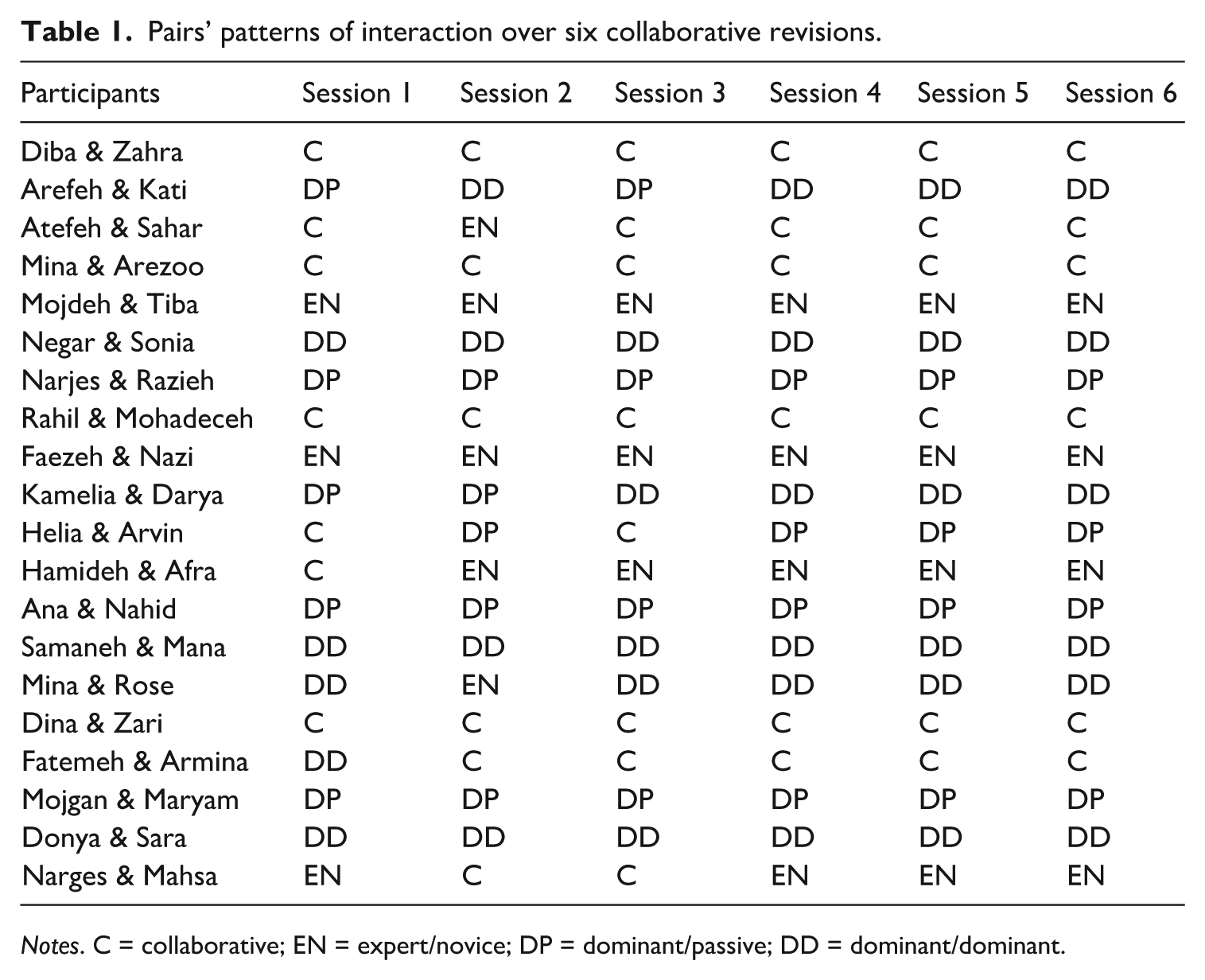
Notes. C = collaborative; EN = expert/novice; DP = dominant/passive; DD = dominant/dominant.
The study then investigated the degree to which pair members engaged with teacher corrective feedback, distinguishing, based on prior research (e.g., Storch & Wigglesworth, 2010; Tocalli-Beller & Swain, 2005), between limited and extensive engagement with teacher corrective feedback (explained in data analysis). The analysis of learner talk found significant variations between collaborative and non-collaborative pairs in this regard. Collaborative and non-collaborative pairs showed 84% and 25% of extensive engagement, the difference being statistically significant with a large effect size: (1, n = 1,673) = 20.42, p < .001, φ = .61. The rest of learner engagement fell into the category of limited engagement. The collaborative pairs, hence, engaged with their teacher’s feedback points much more extensively than pairs showing non-collaborative patterns of interaction.
Next, learners’ revision behavior was examined. In other words, we analyzed the extent to which EFL learners responded to the feedback points provided by the teacher to find the relation between the dyadic interaction pattern and learners’ revision behavior. The analysis of learners’ revisions revealed three patterns of dealing with teacher feedback including acted-on, unrevised, and abandoned errors (explained in data analysis). Both collaborative and non-collaborative dyads acted on most teacher feedback, 97.7% and 68.1% for the collaborative and non-collaborative pairs, respectively. The difference, however, was statistically significant with a moderate effect size: (1, n = 1878) = 31.54, p < .001, φ = .41.
Not all teacher feedback, however, was acted on. The analysis of revised texts revealed some instances of unrevised and abandoned errors. Abandoned errors were those that learners did not attempt to revise. Unrevised errors were those that the pair members, particularly dominant–dominant pairs, addressed but left unrevised. Non-collaborative pairs ended up with 18.2% and 13.7% instances of unrevised and abandoned errors, respectively. The collaborative pairs, however, showed a substantially smaller amount of these patterns, 1.1% unrevised and 1.2% abandoned errors. The difference between the two groups was statistically significant with a large effect size for both unrevised ([1, n = 173] = 23.41, p < .001, φ= .53.) and abandoned errors ([1, n = 125] = 22.77, p < .001, φ = .55). The analysis of learner talk further revealed that unrevised and abandoned errors were substantially more common among dominant–dominant non-collaboratives than the other two patterns. In other words, it amounted to 25.2% for dominant–dominant non-collaboratives and 5.5% and 1.2% for dominant–passive and expert–novices, respectively.
The study further targeted the role that dyadic interaction patterns might play in revision outcomes (i.e., accuracy of revisions). Overall, this study showed that both groups had high accuracy rates in revised drafts in response to teacher feedback points: 89% for collaborative pairs and 75% for non-collaboratives. Statistical analysis, however, showed that collaborative processing of feedback resulted in a significantly higher rate of accurate revision of feedback on both language errors (i.e., vocabulary, grammar, and mechanics) (1, n = 1754) = 32.89, p < .001, φ = .63), and content and organization with a large effect size (1, n = 212) = 5.57, p < .001, φ = .55.
Content analysis of the interview results revealed one major reason for either abandoning or not revising some of the feedback points received from the teacher. Learners’ perception of their pair members’ language proficiency emerged as the key factor among dominant–dominant and dominant–passive non-collaborative pairs. In other words, learners with a dominant–dominant relationship queried the efficiency of collaborative revision, questioning how learners of similar language proficiency can help each other revise their text. Accordingly, they showed resistance to their partners’ views and suggestions, hence their decision to either skip or leave unrevised some teacher feedback. One dominant member of a non-collaborative pair, for instance, commented: I was quite sure that “influence” is much more formal than “affect”. I read English magazines a lot. But, she didn’t accept it. How should I know that she was right? I’m quite fluent. She was just insisting that she was right. What else could we do? Sometimes, we preferred to skip errors we couldn’t agree in any way.
Regarding dominant–passive pairs, dominant learners, as they reported, did not encourage their partner to participate in the task at hand given the perception that collaboration does not work in a similar proficiency pair. Such negative perception reportedly decreased their motivation to deal with all the feedback they got from their teacher. Sharing the same perception, the passive members of the pair made no attempt at contributing to the revision, preferring to succumb to the dominant member’s suggestions, which consequently demotivated them to accomplish the task to the full. One dominant member of a dominant-passive pair argued: All learners in this class are more or less at the same level. I can’t claim that I am or my partner is more knowledgeable. So, when she first suggested that we should change the preposition to “about”, I agreed. I guess, it is in fact kind of individual work . . . perhaps, if it was done individually, each of us focused more intensively on each feedback and were more eager to do so.
Finally, the rare occurrence of unrevised and abandoned feedback among expert–novice pairs was not justified. The learners had no clear idea, as stimulated-recall interviews showed, why they abandoned or left unrevised a few cases of feedback they received from their teacher.
V Discussion
The overarching purpose of the present study was to investigate the link between patterns of dyadic interaction and EFL learners’ behavioral engagement with teacher WCF. The results revealed that the degree of learner engagement, learners’ revision behavior, and revision outcome can fluctuate immensely as a result of the interaction pattern as a mediating factor. In other words, the analysis of learner talk showed that collaborative pairs engaged with teacher WCF significantly more abundantly and more extensively, and revised their writings much more successfully than the non-collaborative pairs (i.e., dominant–dominant, expert–novice, dominant–passive pairs). Previous research had already emphasized the role that learner proficiency level, attitude, motivation, and favorable learning environment play in learner engagement with teacher corrective feedback (e.g., Frear & Chiu, 2015; Mao & Lee, 2024; Moser, 2020; Shen & Chong, 2023; Yang & Yang, 2023; Zheng et al., 2020). Through targeting patterns of dyadic interaction, the current study, hence, furthers prior research revealing another key factor mediating how EFL learners behaviorally engage with WCF provided by the teacher.
Importantly, the results indicated high degrees of stability in learners’ patterns of dyadic interaction over the six sessions. That is, most pairs (60%) were consistent in the type of interaction they adopted during the semester, whereas the remaining (40%) changed between two patterns, particularly during the initial sessions. The stability of interaction patterns over time and the fact that the emerged change of patterns mostly occurred during the initial sessions confirm Storch’s (2002) argument that learners bring their prior experience and preferences into collaborative working contexts; hence, their patterns of interaction primarily remain stable over time. Stability of interaction type was previously found in studies such as Y. Kim (2020) and Tajabadi et al. (2020) who addressed peer interaction in collaborative reading/speaking/writing tasks and collaborative revision of peer feedback, respectively. Teachers, hence, need to monitor pair/group dynamics to create positive collaborative experiences for their learners so as to promote learning affordances of peer interaction or else adjust their instructional activities to their learners’ preferences (i.e., learners who prefer individual work might be allowed to do so).
The results further demonstrated that although the collaborative pairs acted on the majority of teacher feedback points, the non-collaborative pairs either abandoned or left unrevised almost one-third of the feedback they received from their teacher. Such instances were substantially more recurrent among the dominant–dominant non-collaborative pairs. It seems that these learners’ strong insistence on their own views and suggestions and resistance to their partners’ opinion led them to decide to either leave some feedback points unrevised or even not to attempt to revise some other points. This behavior seems to contradict the commonly assumed coordination-oriented nature of East Asian students including the Iranian participants in the present study, implying the possibility of some other factors at play. Stimulated-recall interview results provided some insights in this regard. Learners with a dominant–dominant relationship queried the value of collaborative revision, questioning how learners of similar language proficiency can help each other revise their text. Each learner, as they reported, was quite sure of their language knowledge and did not let the other question their revision options. One learner, for instance, commented: “Why should I accept her explanation? She is not more knowledgeable than me.” The case participant in Watanabe and Swain (2008) similarly considered a peer of higher rather than similar or lower proficiency (perceived proficiency) as a legitimate partner for collaboration; that is, someone who can offer peer assistance.
Existing research, albeit limited in volume, has suggested strong links between EFL learners’ perception of their partner’s language proficiency and the nature of their collaboration (e.g., Y. Kim, 2020; Kos, 2023; Watanabe & Swain, 2008). The results of the current study particularly corroborate Y. Kim (2020), which investigated the impact of L2 learners’ willingness to engage with their pair members on the nature of their interaction over collaborative activities. Their partner’s perceived proficiency level turned out to be a key contributor to learners’ willingness to engage with their pair members during interaction. In particular, learners who perceived their partners as more proficient showed more trust in their suggestions and were hence more willing to engage with their comments and views. As Stone (1993, as cited in Y. Kim, 2020) has rightly emphasized, “learners need to trust each other’s opinions and be considered as playing a legitimate role while working together” (p. 14).
Raising EFL learners’ awareness of the fact that even individuals of the same proficiency level can construct a ZPD for each other through collaboration can be a first step toward changing such learners’ perception and accordingly interactive behavior (Ellis, 2012; Ellis & Shintani, 2014; Lantolf, 2000). The co-construction of a mutual ZPD among peers of equal status is made possible through a dynamic interplay of social, linguistic, and cognitive mechanisms rooted in sociocultural theory. Although Vygotsky (1978) originally conceived the ZPD within an asymmetrical relationship between a novice and a more capable other, later scholars have shown that learning can also emerge reciprocally within symmetrical peer interactions (Ohta, 2001). Central to this process is language as a mediational tool, through which learners externalize thought, negotiate meaning, and establish intersubjectivity. In collaborative interactions, learners actively used language as a mediational tool to negotiate form and meaning, clarify understanding, and jointly engage with the teachers’ feedback, thereby constructing intersubjectivity, the shared understanding necessary for collaborative problem-solving (Vygotsky, 1978). In contrast, the non-collaborative patterns, characterized by limited negotiation or unilateral control, restricted opportunities for such reciprocal mediation. Consistent with Donato’s (1994) concept of collective scaffolding, the collaborative participants in this study further appeared to alternate expert and novice roles as they pool their knowledge, providing and receiving support in a dynamic, reciprocal process that enables joint construction of linguistic understanding. This fluid exchange created a ZPD where knowledge and responsibilities were shared, enabling peers to co-manage attention to form and meaning. The non-collaborative pairs, however, displayed minimal or ineffective collective scaffolding. Their interactions were marked by asymmetrical participation, limited responsiveness, and a low level of negotiation. Instead of jointly elaborating on the teacher’s feedback, one learner often dominated the task while the other remained passive or subservient. As a result, scaffolding failed to become collective, preventing the co-construction of a shared ZPD.
Similarly, Rogoff’s (1990) notion of mutual regulation is evident in the way collaborative pairs jointly regulated task engagement and monitored comprehension. Within these interactions, learners actively monitored each other’s comprehension and negotiated how to interpret and apply the teacher’s feedback, thus transforming corrective feedback into a shared problem-solving activity rather than an externally imposed correction. These interactional mechanisms, supported by mutual trust, enabled collaborative learners to extend each other’s repertoires. Thus, rather than viewing development as the outcome of one-way scaffolding from an expert, the present findings align with the view that L2 development emerges through the collaborative, dialogic constitution of a shared ZPD, where meaning-making and development are mutually achieved through collaborative interaction. Teachers can play a vital role in raising learners’ awareness in this regard. They can, for instance, provide learners with video models of how similar proficiency learners can support each other through interaction (e.g., Y. Kim & McDonough, 2011). Training learners how to use peer language-learning strategies has been also found influential (e.g., Sato & Dussuel Lam, 2021). Teachers can also engage learners in discussions about the benefits of peer support for learning before employing collaborative tasks (e.g., Kos, 2023).
It is worth noting that the non-collaborative pairs in the present study attributed their lack of willingness to engage with/accept their partners’ suggestions to their perception that their pair members should be more linguistically proficient to promote task accomplishment (i.e., revision). Despite this, the problem may stem fundamentally from the learners’ failure in trust-building which is so prevalent among pair/group members in educational contexts (e.g., Laal & Laal, 2012; Poort et al., 2020). Trust among EFL working partners is believed to facilitate constructive feedback exchanges and communication (Al-Malki, 2022; Fung, 2010). The possibility of trust-building issues among the pair members in the present study, however, needs further investigation.
It needs also to be noted here that the non-collaborative pairs did not report any difficulty in understanding the feedback points they preferred to skip or abandon. No evidence of this problem was detected in the analysis of learner talk during interaction. Despite this, prior research addressing individual and collaborative revision of WCF has demonstrated strong relations between not understanding teacher feedback and leaving feedback unrevised (e.g., Park & Kim, 2019; Zheng & Yu, 2018). Peng et al. (2023) particularly revealed that the mutual support the pair members provide for each other during the collaborative processing of teacher feedback assists learners to become more capable of understanding teacher feedback, hence leaving less feedback unrevised. Given the non-supportive behavior evidenced among the non-collaborative pairs in the current study, effective instruction on and modeling of teacher WCF that the participants received from their teacher in the initial sessions of the course might explain why learners did not report any difficulty in understanding teacher feedback. Hence, it was not reported as a reason for either skipping or abandoning certain errors. That might be why the literature (Kim & Emeliyanova, 2019; Zheng & Yu, 2018) strongly suggests that teachers should initially model their feedback for their learners to reduce confusion.
The results further indicated that the collaborative pairs engaged with their teacher’s feedback points much more extensively than pairs showing non-collaborative relationship. This finding matches the nature of each interaction pattern. Collaborative patterns of interaction genuinely involve high degrees of equality and mutuality; working partners equally participate in the task at hand and engage with each other’s contribution. Such behavior represents what literature (e.g., Moser, 2020; Storch & Wigglesworth, 2010) call extensive engagement with feedback. In non-collaborative patterns, particularly dominant–passive, revision is mostly done by one individual member of the pair, while the other member either repeats or accepts the suggestions. Also, in non-collaborative dominant–dominant patterns, although both members give their suggestions for revision, they do not engage with each other’s contribution; each member attempts to prove their own views in an authoritative manner. They are in fact focused on imposing their own revision options rather than contemplating the feedback itself, or what is called shallow or limited engagement with feedback (e.g., Storch & Wigglesworth, 2010).
This finding provides evidence of the extent to which EFL learners negotiated form and meaning during interaction. In other words, participants with collaborative relationship asked questions, articulated their thoughts when interacting with their partners, checked comprehension, deliberated about language choice, tested hypotheses, offered each other suggestions, and reached resolutions in the end. Non-collaboratives, on the other hand, showed little or no evidence of negotiation; they either succumbed to their peer’s suggestions (as in dominant–passive pairs), or minimally engaged with each other’s thoughts and views (as in dominant–dominant and expert–novice pairs). Negotiation of meaning, the opportunity created through collaboration, facilitates language learning since it “connects input, internal learner capacities, particularly selective attention and output in productive ways” (Long, 1996, p. 451). It enables learners to provide each other with comprehensible input, to give and receive feedback, and to produce output so that meaning is clear (Crawford, 2021; Suzuki, 2018; Swain & Lapkin, 2001). The collaborative learners’ mutual deliberations over linguistic forms further represent what Swain (2006) called “collaborative dialogue,” one form of languaging; that is, using language in making meaning when learners are faced with some linguistic problem. In this process, learners pool their linguistic resources to co-construct new knowledge which can then be internalized for leaners’ own use (Storch, 2013). Languaging hence mediates learning (Storch, 2013). The effects of such negotiations and dialogues among collaborative pairs are so promising, particularly in an EFL context where the classroom is the main place where learners are provided with the opportunity to interact with other L2 users.
Regarding revision outcomes, the analysis of revised texts showed that collaborative processing of feedback resulted in a significantly higher rate of accurate revision of feedback on both language errors (i.e., vocabulary, grammar, and mechanics), and content and organization. It seems that through pooling their knowledge of language and content, and accepting and supporting each other’s lack of knowledge, the collaborative learners, as opposed to the subservient or authoritative non-collaboratives, could manage to revise their written texts more successfully. This result corroborates some similar prior studies. For instance, found significant links between patterns of interaction and learners’ engagement with peer feedback. Similarly, mutual scaffolding during the interaction helped EFL learner pairs in Hanjani and Li (2014) to substantially improve their initial drafts in terms of language. The analysis of learner pair talk indicated that their interaction was primarily characterized by mutual support and scaffolding. The study, hence, could not address how non-collaboration might affect learner revision behavior.
The results, however, contradict some prior studies such as Peng et al. (2023) which compared individual and collaborative revision of teacher WCF. Upon finding no significant difference in revision outcomes between the two conditions (despite the authors’ initial hypothesis), the authors questioned the type of interaction the pair members adopted during joint revision, pointing to peers’ potential non-collaborative orientation while processing teacher corrective feedback. The issue, however, was not addressed by the study. A similar study by Kim and Emeliyanova (2019) also found only minimal accuracy gains for collaborative processing of teacher feedback. The authors attributed this finding to many learners’ limited engagement with several feedback points (as evidenced in pairs’ conversations). Storch and Wigglesworth’s (2010) study has in particular demonstrated that learners who engage with feedback more extensively show higher levels of uptake than those whose engagement is limited. Thus, the discrepancy between the current research and previous studies may be ascribed to the degree to which pairs collaboratively engaged with teacher feedback.
Finally, since the value of corrective feedback lies in the extent to which learners actually engage with it, teachers need to find ways to enhance learners’ engagement with the feedback they provide to learners (Y. Han & Hyland, 2015). One mediating factor, as the current study revealed, is the pattern of interaction learners adopt when interacting to accomplish a task; in this case, revising their writings. In other words, a collaborative relationship was found to contribute to significantly deeper behavioral engagement with teacher WCF. But what learner/teacher/contextual factors can also facilitate is a more collaborative relationship among pair/group members. EFL learners’ perception of their partner’s proficiency, as the interviews showed, is a key factor in both learners’ contribution to the task at hand and engagement with each other’s suggestions. Previously, Mozaffari (2017) revealed that the friendship-based student-selected pairs made a significantly more collaborative relationship than pairs formed by the teacher on a random basis. Later found that learners’ attitude toward the task at hand can contribute to a more collaborative relationship among working partners. EFL teachers, thus, need to take these potential mediating factors into account to have more collaborative pairs/groups, hence higher and deeper engagement with teacher feedback which ultimately, as theory and research highlight, promotes language development (e.g., Kim & Emeliyanova, 2019; Peng et al., 2023; Tajabadi et al., 2020).
VI Conclusion
Overall, the results suggest that mere participation in a pair task does not suffice; that is, the extent of learner collaboration plays a significant part in shaping the nature and outcome of the interaction. The present study showed that those EFL learners who adopted a collaborative pattern of dyadic interaction engaged with teacher WCF extensively and significantly outperformed the non-collaborative pairs in accomplishing the assigned task; in this case, joint revision of writings based on the feedback received from the teacher. This finding can be explained from the sociocultural perspective of learning. The non-collaborative pairs failed to create what Vygotsky (1978) called the “zone of proximal development.” Such a learning space can be constructed during peer interaction when learners mutually engage with and equally contribute to “a situation wherein a reciprocal exchange of knowledge occurs with the goal of reaching a higher level of understanding than one could have achieved alone” (Devos, 2016, p. 67). It seems that learners who employed collaborative interaction were substantially more successful in creating mutual ZPDs, leading them to more successfully revise their writings. Importantly, not recognizing the efficacy of similar proficiency pair work turned out to be a key factor affecting the nature of EFL learners’ interaction while trying to revise their writings. Before embarking on collaborative activities, teachers should consider, among other factors, the weight EFL learners give to their pair member’s role in successful accomplishment of the task at hand. They can, accordingly, take actions to develop a collaborative mindset among EFL learners.
Finally, it is necessary to acknowledge some limitations. Although the current study did not explore the potential impact that revision outcome might have on EFL learners’ writing development, the level of success shown during the six sessions is promising. Further research, however, needs to be conducted to address the long-term impact that patterns of dyadic interaction might have on both learner engagement with WCF and writing development. Moreover, recent research has shown that certain aspects of learner characteristics such as gender can affect the nature of learners’ interaction with their pair/group members (e.g., Young & Tedick, 2016). Future research can employ mixed gender to explore how this learner variable might influence collaboration among pair members as well as revision behavior.
Footnotes
Appendix 1. Writing prompt
Write 4–5 paragraphs about one of the following topics (i.e., discuss how one of these issues is currently affecting the lives of Iranian youth and suggest some possible solutions; there is no limit on the number of words).
Acknowledgements
We would like to thank the teacher and students who participated in the study, and the research assistant who helped with coding parts of data for checking reliability.
Data availability
All necessary data are included in the submitted manuscript.
Funding
The author received no financial support for the research, authorship, and/or publication of this article.
Ethical considerations
Informed consent was obtained from individual participants. All learners showed willingness to cooperate in the study. Also, the participants were informed about the main aim of the study and were assured of their anonymity. Pseudonyms were used, in particular to protect the participants’ anonymity. They were further informed that they could withdraw from the study at any time.
