







Abstract
Although previous studies have examined the effects of context on students’ emotional responses to second language (L2) feedback, very few have explored how teachers can proactively intervene in these emotions through different feedback types. This quantitative study examines English as a foreign language (EFL) learners’ emotional responses to direct and indirect written corrective feedback (WCF) in L2 writing, and whether the feedback context influences the link between these emotional responses and the subsequent revision behavior. The results indicated that direct WCF made students more contented and less anxious than indirect WCF. Under the direct WCF condition, emotions seemed to exert a marginal influence on students’ revision rates, whereas under the indirect WCF condition, contentment led to higher revision rates. This distinct pattern across contexts showed that the link between emotions and revision behavior varied depending on whether feedback was provided directly or indirectly. These findings revealed that contextual factors, such as feedback types, could affect students’ emotional responses and the relationship between emotions and revision. Therefore, it is suggested that future studies in the field of instructed second language acquisition continue to explore the interplay among feedback context, emotional responses, and learning, to enable teachers to manage students’ emotions more productively.
Keywords
1. Introduction
Feedback is an emotionally laden educational area where students’ emotions are likely to affect how they receive and process feedback (Värlander, 2008). Emotions used to be largely overlooked in the field of second language acquisition (SLA) due to its focus on cognitive dimensions of language learning rather than the emotional ones (Richards, 2020). With the student-centered shift in feedback practice (Winstone et al., 2017) and the emotional turn in SLA (White, 2018), there has been increasing research interest in students’ emotional reactions to teacher feedback in second language (L2) learning. Existing studies (e.g., Agudo, 2013; Mahfoodh, 2016; Mahfoodh & Pandian, 2011; Zacharias, 2007) have mostly used qualitative methods and found that students experienced a range of discrete emotions when receiving feedback from teachers, including both positive and negative emotions. Such studies have mainly examined what emotions are aroused by feedback, while only a handful of researchers (e.g., Han & Xu, 2020; Mahfoodh, 2016) have explored the effect of emotions on revision, the subsequent learning behavior. Moreover, many studies (e.g., Geng & Yu, 2024; Han & Xu, 2020; R. Liu & Xin, 2025) have focused on understanding how to help students regulate feedback emotions after they arise. Few have explored how teachers might shape students’ emotions at the beginning of the feedback process by adjusting contextual factors such as feedback types. In light of these considerations, this study adopted a quantitative approach to examine the interplay of feedback context, emotions and revision within the domain of teacher written corrective feedback (WCF) in L2 writing instruction.
2. Literature Review
2.1. Feedback in L2 Learning and Emotions
Feedback is regarded as a powerful and influential strategy to improve learning achievement (Hattie, 2009; Winstone & Carless, 2019) and is central to student learning (Carless, 2006; Mulliner & Tucker, 2017). Since the early 2010s (Dawson et al., 2019), the teaching-centered view of feedback has given way to a more learner-centered interpretation of feedback: feedback is a process where students receive and act upon the information given to them about their work to improve their learning (Boud & Molloy, 2013; Hattie & Timperley, 2007; Winstone et al., 2017). In this student-centered view of feedback, students are no longer passive recipients of teachers’ constructive information but active agents getting the most out of the feedback to improve their learning (Winstone & Carless, 2019).
To realize the facilitating role of feedback for learning, students’ emotional experiences cannot be overlooked. Emotions are not peripheral but central to our ways of knowing, acting as a powerful force that can either facilitate or hinder learning (Dirkx, 2001; Hill et al., 2021). The moment students receive feedback, the emotional process is triggered, which might determine whether and how students will respond to and engage with the feedback (Fong & Schallert, 2023; Hill et al., 2021). Värlander (2008) highlights the significance of emotions in learning activities, contending that their role in feedback situations warrants a deeper, more nuanced understanding. Similarly, students’ emotional reactions to feedback are crucial in the field of L2 learning (Hyland & Hyland, 2019). Adverse emotional experiences might exert a negative effect on students’ processing and utilization of feedback (Lee & Mao, 2025). Despite the importance of emotions in learning, their role has been largely marginalized in the field of SLA (Richards, 2020; Swain, 2013). In recent years, with the emotional turn in SLA (R. Liu & Xin, 2025), there has been increasing research interest in learners’ and teachers’ emotions (Richards, 2020), resulting in a growing body of research on students’ emotional reactions toward L2 feedback.
2.2. Students’ Emotional Reactions to L2 Feedback
Among the existing studies on learners’ emotional reactions to teachers’ feedback in L2 learning, most of them have focused on L2 writing. Zacharias (2007) examined students’ emotional reactions to teachers’ feedback in L2 writing. While most students (75%) reported that they felt excited, there were a range of other emotions, including confusion (39%), discouragement (25%), irritation (3%), disappointment (3%), and stress (1%). Mahfoodh and Pandian (2011) employed semi-structured interviews and think-aloud protocols to find out English as a foreign language (EFL) students’ emotional reactions to teachers’ written feedback. The interview data suggested that students’ emotions varied from positive affections (e.g., happy and satisfied) to negative ones (e.g., disappointed and surprised). Going one step further, Mahfoodh (2016) examined 8 EFL university students’ emotions toward teachers’ written feedback and the impact of emotions on revision. It was found that students’ emotional reactions included acceptance of feedback, rejection of feedback, surprise, happiness, dissatisfaction, etc. Moreover, emotional responses impacted students’ revision behavior, with “acceptance of feedback” leading to the highest revision rate. Compared with feedback in L2 writing, research on students’ emotional reactions to teacher feedback in L2 speaking is relatively scarce. Agudo (2013) investigated how EFL secondary school learners reacted emotionally to teachers’ oral feedback in the classroom. Based on the questionnaire results, 34.65% of the students felt satisfied, followed by students who reported being embarrassed (14.85%), angry (12.87%), bothered (9.90%), happy (7.92%), and indifferent (7.92%). All of these studies focused on what emotions were triggered by L2 feedback except Mahfoodh (2016)’s research, which also looked at how emotions impacted revision.
While the above studies employed no emotion-related theories in their investigations, other researchers have applied the analytical framework of academic emotions (Pekrun & Linnenbrink-Garcia, 2012) to discuss feedback emotions and emotion regulation strategies. Han and Xu (2020) explored four EFL students’ academic emotions and their emotion regulation strategies. The study revealed positive, neutral, and negative emotions at varying activating levels. It was found that the participants used emotion-oriented, appraisal-oriented, and situation-oriented strategies to cope with the emotions throughout revision. The interview data also showed the effect of emotions on students’ revision behavior. Different from Zacharias’ (2007) findings, where the undergraduate students mainly showed positive emotions, the 16 doctoral students in Geng and Yu’s (2024) study reported more negative emotions such as anxiety, confusion, and frustration. Geng and Yu’s (2024) study also identified four categories of emotion regulation, namely cognitive change, task-related regulation, co-regulation, and attention deployment. Also employing a qualitative approach, R. Liu and Xin (2025) explored two Chinese as a foreign language (CFL) students’ emotional reactions to their teacher’s oral and written feedback. Like Han and Xu (2020), they discussed how participants employed appraisal-oriented, emotion-oriented, and situation-oriented strategies to regulate negative emotions. These studies showed the value of the academic emotion framework in facilitating the discussion of emotions toward L2 feedback and deepening our understanding of the role of emotions in the processing of feedback.
A growing body of research has also attended to the factors influencing students’ emotional reactions to feedback in L2 learning. Students’ emotional experiences are affected by both individual factors and social context (R. Liu & Xin, 2025). The contextual factors include different types of feedback (Mercer & Gulseren, 2023), English as a second language (ESL) and EFL instructional settings (Hedgcock & Lefkowitz, 1994), teachers’ hand-writing (Mahfoodh & Pandian, 2011), and teacher–student relationship (Zheng et al., 2020). Learner factors include learners’ emotional intelligence (Long & Zhu, 2025), language proficiency (Cheng & Liu, 2022), English learning motivation (Ni & Xu, 2025), students’ expectation of feedback (Ni & Xu, 2025), students’ goals related to L2 learning (Zheng et al., 2020), and students’ beliefs about feedback (Zheng et al., 2020). However, these studies have only investigated how different factors, whether contextual or individual, affect learners’ emotional reactions, few of them have examined whether teachers’ interventions on these factors, especially the contextual ones, could influence learners’ emotional experiences.
Based on the literature reviewed, several key observations can be made. First, it can be seen that the above studies have examined learners’ emotional reactions to feedback in L2 learning, evidencing the student-centered shift in instructed second language acquisition (ISLA) research. However, only two (Han & Xu, 2020; Mahfoodh, 2016) have addressed the effect of emotional reactions on subsequent learning, i.e., the utilization of feedback for revision. Feedback should not only be learner-centered, but also learning-centered (Wu & Jiang, 2025). While researching students’ emotional reactions places students in the center of feedback and highlights their agentic role in feedback practice, probing into the effect of these emotions on L2 learning would enable feedback research to be more learning-centered. We argue that integrating these two aspects in specific L2 learning contexts could inform the provision of emotionally sensitive feedback to better facilitate learning.
Second, most of the research has investigated learners’ emotional reactions to teacher feedback in general without looking at how teachers’ feedback interventions, as a contextual factor, shape learners’ emotional reactions to feedback and whether the feedback context affects the relationship between emotional reactions and revision. The absence of such studies might have led to the focus of existing research (e.g., Geng & Yu, 2024; Han & Xu, 2020; R. Liu & Xin, 2025; Liu & Yu, 2022) on how learners cope with their emotions when they have already been triggered by feedback. However, since previous research has pointed out that contextual variables such as feedback types might influence learners’ feedback emotions, we believe that greater scholarly attention should be directed toward understanding the role of teachers’ feedback interventions as a precursor to learners’ emotions. By elucidating this role, we could enable teachers to proactively shape students’ emotional and behavioral responses to feedback, rather than leaving them feeling powerless and hopeless when students reject or fail to learn from feedback (Yu et al., 2021).
Third, the extant research, whether focusing on what emotions are aroused by feedback or how emotions influence revision, has been predominantly qualitative. More quantitative research is warranted to increase the generalizability of the research findings. To sum up, more research is needed to explore the interplay of feedback context, emotional responses and learning, to make feedback not only student-centered but also learning-centered. To address these gaps, this study adopted the academic emotion framework (Pekrun & Linnenbrink-Garcia, 2012) to quantitatively examine: (a) students’ emotional reactions to different teacher feedback interventions, namely direct and indirect WCF in L2 writing; and (b) how the feedback contexts shaped by these two types affect the impact of emotions on revision.
2.3. Academic Emotions
Academic emotions are emotions that are specifically related to learning and achievement (Goetz & Bieg, 2016). Pekrun and Linnenbrink-Garcia (2012) classify academic emotions based on valence, activation, and object focus. Defined by valence and activation, there are positive activating emotions (e.g., joy and pride), positive deactivating emotions (e.g., contentment and relief), negative activating emotions (e.g., frustration and shame), and negative deactivating emotions (e.g., sadness and disappointment). Grouped by object focus, academic emotions can be general and specific moods (e.g., joyful mood), achievement emotions (e.g., pride for success), epistemic emotions (e.g., curiosity about WCF), topic emotions (e.g., boredom arising from reading an uninteresting story), and social emotions (e.g., gratitude for teachers’ WCF).
Academic emotions are a crucial factor in learning, as they influence students’ engagement in learning which further affects the final learning outcomes (Goetz et al., 2006). While increasing research has been looking at the effect of emotions on L2 learning, there is a notable lack of theories in such discussions that could account for the relationship between emotions and effects (Dewaele & Li, 2020). Against such a background, two emotion theories pertaining to the effect of emotions (C. Li, 2021) are worth highlighting: the broaden-and-build theory (Fredrickson, 1998) and the control-value theory (CVT) (Pekrun, 2006). According to the broaden-and-build theory (Fredrickson, 1998), positive emotions such as joy and contentment can broaden an individual’s momentary thought–action repertoire, which in turn has the effect of building that individual’s physical, intellectual, and social resources, whereas negative emotions will narrow an individual’s thought–action repertoire.
CVT provides a theoretical framework for surveying the antecedents of achievement emotions. Based on this theory, learners’ academic emotions related to learning achievement are influenced by appraisals of control and appraisals of value (Pekrun, 2006). The former refers to students’ self-assessment of their own controllability over a learning task or the learning outcomes, while the latter refers to learners’ perceptions of the importance and value of a learning situation. Therefore, if students believe that performing well in a certain exam is of great importance and, meanwhile, they have prepared sufficiently, they might look forward to the coming of the exam. In contrast, if students are not confident in their own ability to obtain a good mark in this exam, they might feel anxious (Pekrun, 2006).
With its nuanced classification of emotions, CVT (Pekrun, 2006) offers a more complex understanding of their effects. Positive activating emotions, such as hope, can boost learners’ motivation, both intrinsic and extrinsic, and therefore facilitate learning, while negative deactivating emotions, such as hopelessness, will impede learning. The effect of positive deactivating emotions and negative activating emotions is more ambiguous. For example, contentment that follows success is likely to diminish immediate motivation to reengage with the learning material, but it can bolster a stronger long-term motivation to persist (Pekrun & Linnenbrink-Garcia, 2012). These two theories are relevant to this study because they provide theoretical support for the analysis of the causes and effects of students’ emotional responses to WCF.
2.4. WCF in L2 Writing
WCF is a common pedagogical practice among EFL teachers to improve students’ linguistic accuracy in writing (Zhang et al., 2021; Zheng & Yu, 2018). WCF has been considered a central component in language writing classes (Karim & Nassaji, 2020). As literature has shown, teachers’ feedback seems to be more valued by college students than other types of feedback such as peer feedback (Yang et al., 2006). Following Truscott’s (1996) controversial claim about the ineffectiveness and potential harm of WCF in L2 learning, numerous studies have explored WCF practices in L2 writing instruction.
In terms of feedback explicitness, WCF could be direct and indirect (Mao et al., 2024). Direct WCF and indirect WCF are two widely used feedback strategies that have received much attention in corrective feedback literature (Tang & Liu, 2018). Direct WCF, or explicit WCF (Bitchener & Knoch, 2009), points out errors in students’ writing and provides the correct linguistic forms or structures (Zhang et al., 2021). Teachers might cross out a redundant word, change for another word, or add a missing word. In contrast, indirect WCF, also called implicit WCF (Bitchener & Knoch, 2009), only indicates the problematic words or structures without the provision of the corrective forms (Zhang et al., 2021). Indirect WCF could be coded, which means using codes to indicate the nature of the mistakes or the grammatical rules contained or uncoded, whereby teachers just underline or circle the errors, or note the number of errors in each line in the margin (Lee, 2008). For some teachers, instead of using codes, they would just write down a short metalinguistic explanation near a linguistic error. Furthermore, it is worth mentioning that WCF research has not been consistent in the classification of direct or indirect WCF. While Bitchener and Knoch (2009) consider metalinguistic explanation as a possible component of direct WCF, Ellis (2009) separates metalinguistic WCF from both direct and indirect WCF, and defines metalinguistic feedback as feedback that explains the cause and nature of an error by offering short metalinguistic descriptions or using error codes.
Based on feedback scope, WCF can be divided into focused WCF or unfocused WCF (Q. Liu & Brown, 2015; Mao et al., 2024). Focused WCF targets only one or several types of linguistic errors, such as the incorrect use of the past tense, singular or plural forms of nouns, articles, and so on. This type of WCF is aimed at improving students’ acquisition of specific grammatical rules or linguistic knowledge. Ellis et al. (2008) classify focused WCF into two types: highly focused WCF, which targets only one type of error; and somewhat less focused WCF, which addresses a limited number of preselected error types. On the other hand, unfocused or comprehensive WCF refers to feedback that points out all or most of the errors made in students’ writing.
After receiving WCF, students are usually expected to revise their writing. Revision generally refers to any changes students make to their writing in response to teachers’ written feedback (Mahfoodh, 2016). Although revision is not considered a robust indicator of learning (Ferris, 2004), it is an important part of learning and a proxy for learners’ engagement with feedback (S. Li & Vuono, 2019). Revision is looked upon as an indicator of behavioral engagement in Ellis (2010)’s framework of feedback engagement, which might contribute to improved accuracy in subsequent writing (Ekanayaka & Ellis, 2020). Therefore, to optimize WCF provision, it is critical to examine students’ revision behavior across different WCF types.
The cognitive bias in the field of SLA is also observable in the research on WCF, which has mostly focused on the effectiveness of various types of correction with affective aspects on the part of students remaining sidelined (Han & Hyland, 2019). Recently, researchers have emphasized that affective aspects of WCF should be given considerable importance because students’ emotional experiences could be a decisive factor in their engagement with correction (Fong & Schallert, 2023; Mahfoodh, 2016). An increasing number of studies (e.g., Han & Hyland, 2019; Han & Xu, 2020; Pan et al., 2023; Zheng et al., 2020) have explored students’ emotional responses to teacher WCF as a whole. Some researchers (Han & Hyland, 2015; Pan et al., 2023; Zheng et al., 2020) have noted that students’ emotional responses could be affected by both learners’ individual differences and contextual factors. Han and Hyland (2015) further point out that contextual factors, such as the types of WCF (direct or indirect), might influence students’ emotional responses to WCF.
2.5. Academic Emotions toward Direct WCF and Indirect WCF
Some qualitative studies have revealed that direct and indirect WCF may elicit distinct emotional responses among L2 learners. Han and Hyland (2015) conducted case studies on 4 college students to explore their engagement with teacher WCF. Among the 52 WCF points the participants received, only 1 was direct WCF, while the rest were all indirect WCF. Therefore, the research could be considered carried out in an indirect WCF context. Two findings are of relevance to our study. One participant, Song, experienced great disappointment upon seeing the feedback, and felt uncertain about her revision, leading to limited revision. Another participant, Lin, said that he was confused by the indirect WCF and ended up handing over the most difficult revision to a peer. This echoes the complaint “why didn’t she (the teacher) correct these errors directly on the script?” voiced by a participant in Zheng et al.’s (2020) study.
Han and Hyland (2019) tracked the dynamic emotional changes of two Chinese EFL undergraduate students in the process of revision. The two participants, Du and Hong, received mainly indirect WCF and direct WCF respectively. Du, with a higher proficiency level and stronger motivation, reported feelings of being surprised, anxious, curious, and actively revised the errors. In contrast, Hong was also anxious at first, but then he felt relieved because the errors were not severe and most errors could be easily corrected due to the teacher’s direct WCF. Since the two participants were given different types of WCF, apart from the influence of learner factors, the disparity in their emotional reactions might have also resulted from this contextual factor. Similar emotions toward direct WCF were also expressed by a participant in Han and Xu’s (2020) research, who said that since seven out of nine pieces of feedback were direct WCF, this helped reduce his disappointment and he soon became relieved.
Mahfoodh (2016) explored the relationship between EFL university students’ emotional responses and their success in revisions. The study revealed that acceptance of feedback led to a high percentage of successful revisions; despite the possibility of discouraging students, surprise, disappointment, and frustration did yield some cases of successful revisions; disappointment was mostly related to unsuccessful revisions; rejection of feedback could result in a high percentage of no revision. However, even though the study evidenced the association of “acceptance of feedback” with higher levels of revisions, this term was not specific enough because “acceptance” might include multiple positive emotions such as happiness, contentment, and relief. It is therefore essential to conduct more research to examine the relationship between discrete emotions and revision.
The above research seems to indicate that teachers’ use of direct WCF might generate more positive emotions than indirect WCF and emotions might affect students’ revision. However, in all of these studies, the effect of WCF types on students’ emotions remains underexplored and only one study (Mahfoodh, 2016) has explicitly investigated the relationship between discrete emotions and revision behavior. Moreover, since they are all case studies, which can only serve as sporadic evidence with limited power of generalization, a quantitative study with a larger sample is needed. Considering these gaps, guided by the CVT and the broaden-and-build theory, we set out to explore how learners react emotionally to teachers’ use of direct or indirect WCF and how these feedback interventions affect the role of emotions in revision. In doing so, we hope to demonstrate the feasibility of teachers adjusting feedback interventions in a specific teaching context to regulate students’ emotions in a more proactive way, and ultimately improve both the efficacy of feedback and the well-being of students. A quantitative approach was employed to address the following two research questions.
RQ1: What were students’ emotional reactions to teacher feedback, direct and indirect WCF, in L2 writing?
RQ2: To what extent did the role of students’ emotional reactions in their revision vary depending on feedback types?
3. Research Methods
3.1. Research Participants
At the beginning of this study, 244 students at a university in China were chosen as research participants. They were from six freshmen classes, 18–20 years old. Having enrolled in a 3+1 Sino-Foreign Joint Education Program, some of them would study abroad in the last year of university. In the first semester, the participants took the course of Academic English Reading and Writing, which included IELTS writing task training to help them prepare for the exam.
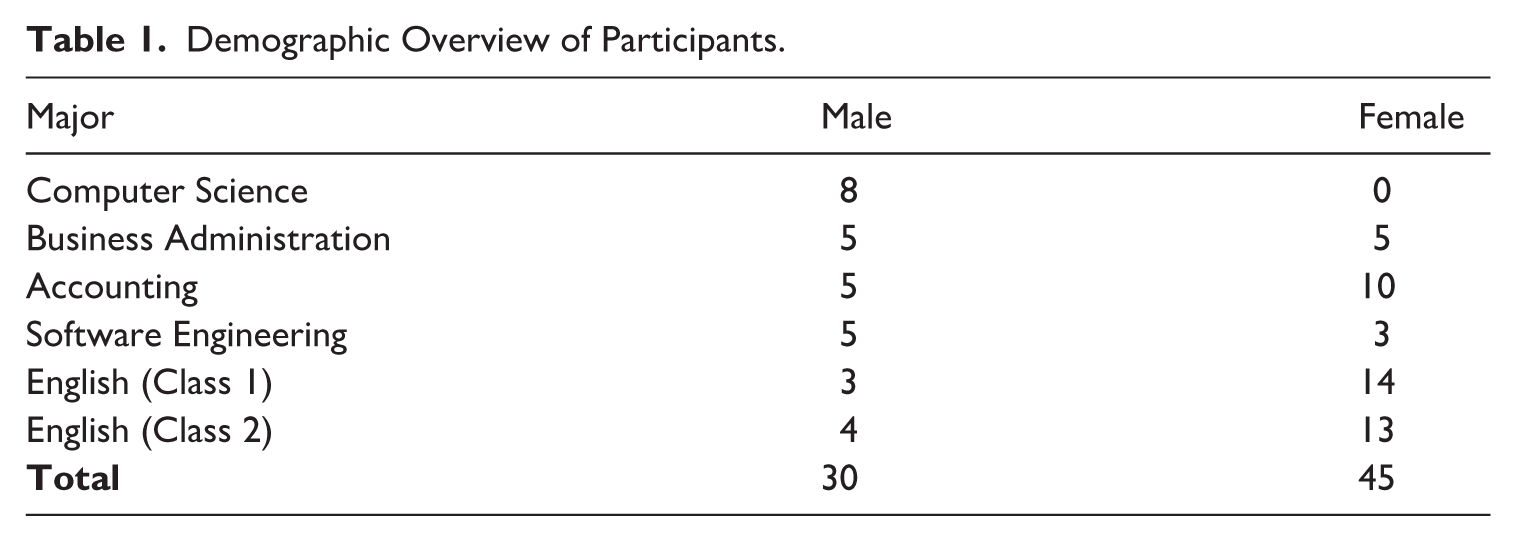
During this study, each participant wrote two essays and completed the Academic Emotions toward WCF (AEWCF) Questionnaire twice. Considering that some students had been used to revising their writing with the help of AI before handing in their assignments, the researcher did not particularly ban the use of AI. Students were regarded as having used AI in writing if their essays had absolutely no lexical or grammatical errors, but had similar expressions and sentences that were present across different essays. AI use was identified through a combination of AI detection software and manual review. Essays flagged by the detection tool were further examined for characteristic AI patterns, including unnaturally error-free text inconsistent with the students’ typical performance and formulaic phrasing common to AI-generated content. Because AI-polished essays contained few to no errors, the teacher provided minimal WCF for these submissions. This would fundamentally alter students’ emotional responses, as their reactions would not be based on feedback addressing their actual writing performance. Thus, the inclusion criteria of participants were: (1) participants agreed to give informed consent; (2) participants must have completed both writing tasks authentically without AI assistance, as verified through careful screening; (3) participants must have completed both questionnaires, as matched data across both conditions were required for the within-subjects design. Finally, the data of 75 participants from these six classes (Table 1) were included and analyzed in this study.
Demographic Overview of Participants.
3.2. Writing Tasks
To ensure the ecological validity, two IELTS writing tasks were selected since IELTS writing was the focus of the course. The first writing topic was: “The Internet is probably the most significant invention of the last 30 years. Without it, our lives would be completely different. To what extent do you agree or disagree?” The second writing topic was: “Some people think success in life comes from hard work and determination, but others think there are more important factors like money and appearance. Discuss both sides and give your own opinion.” Based on the requirement of IELTS Writing Task 2, the participants were asked to write about 250 words on each topic.
To examine the task difficulty and topic familiarity of the two tasks, a questionnaire survey was conducted with 38 first-year students from the same university (who shared a comparable background with the main study participants). They were asked to rate the two tasks in terms of perceived difficulty and topic familiarity on a 7-point Likert scale (1 = very easy/unfamiliar, 7 = very difficult/familiar). Paired-samples t-test results showed that for task difficulty, there was no statistically significant difference (t(37) = −1.91, p = .064, Cohen’s d = −.31) between the Internet topic (M = 4.08, SD = 1.34) and the success topic (M = 4.53, SD = 1.56). For topic familiarity, no significant difference (t(37) = 1.64, p = .11, Cohen’s d = .27) was found between the Internet topic (M = 4.53, SD = 1.35) and the success topic (M = 4.08, SD = 1.65) either. While the p-value for difficulty approached conventional significance, the effect sizes for both comparisons were small to moderate (Lovakov & Agadullina, 2021). Thus, the two tasks could be considered largely comparable in terms of perceived difficulty and familiarity within our participant population.
3.3. Research Instrument
This study used the AEWCF Questionnaire (Ni & Xu, 2025) to investigate students’ discrete emotions toward WCF. The questionnaire included eight of the most frequently experienced WCF emotions, which are curiosity, hope, contentment, happiness, surprise, anxiety, relief, and disappointment. Based on Pekrun and Linnenbrink-Garcia (2012)’s classification of academic emotions, curiosity, hope, and happiness are positive activating emotions, contentment and relief are positive deactivating emotions, anxiety is a negative activating emotion, and disappointment is a negative deactivating emotion. It is worth mentioning that surprise is a controversial emotion. While Han and Xu (2020) classify surprise as a negative activating emotion in WCF situations, Pekrun et al. (2002a) regard it as a more neutral emotion. Since students might feel surprised upon receiving WCF when their own writing performance exceeds or falls short of their expectations, surprise is treated as neutrally valenced in this study. Each emotion is measured by 5 statements and there are 40 statements in total. The reliability test showed that the questionnaire items for each emotion all had good internal consistency (Ni & Xu, 2025). The reliability test demonstrated good internal consistency across the 5 questionnaire items for each emotion (Ni & Xu, 2025).
3.4. Research Procedure
As all the participants had received WCF on their English writing assignments, they were already familiar with WCF practices. Data collection spanned 6 weeks. To counterbalance the effect of different writing topics and the order of feedback types on learners’ emotional responses to feedback, six classes were grouped: Group 1 (N = 35; Computer Science, Business Administration, Class 2 of English majors) received direct WCF in the first assignment and indirect WCF in the second; Group 2 (N = 40; Accounting, Software Engineering, Class 1 of English majors) received WCF in the reversed order. Participants had two 40-minute sessions each week with a 5-minute break in between. The research procedure is illustrated in Figure 1.
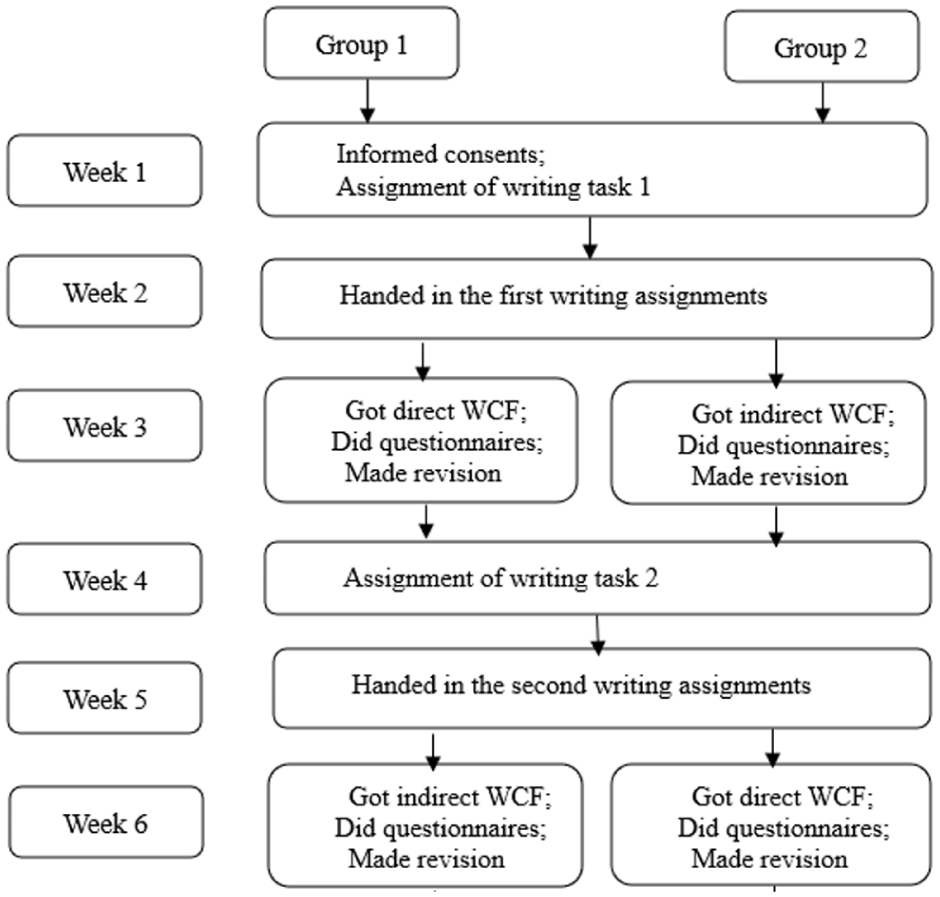
Research procedure.
In Week 1, the research aims were explained, and the participants provided signed consent. Questionnaires were not anonymous, so we could link emotional responses to revision behavior, but confidentiality was assured. The first IELTS writing task was assigned, and the participants were asked to write their essays by hand on paper and hand in their assignments the next week. In Week 2, assignments were collected and photocopied (Karim & Nassaji, 2020). Feedback was given on the photocopies, with Group 1 receiving direct WCF and Group 2 indirect WCF. Following S. Li and Vuono (2019), our focus was on linguistic errors. Moreover, considering that teachers often provide feedback on diverse errors rather than on errors of a single type, comprehensive WCF was used to ensure ecological validity (Karim & Nassaji, 2020). Thus, in this research, direct WCF means pointing out all or most of the linguistic errors in students’ writing and providing the correct forms without giving metalinguistic explanations, and indirect WCF means underlining the linguistic errors only. See Figures 2 and 3 for examples of direct and indirect WCF, respectively.
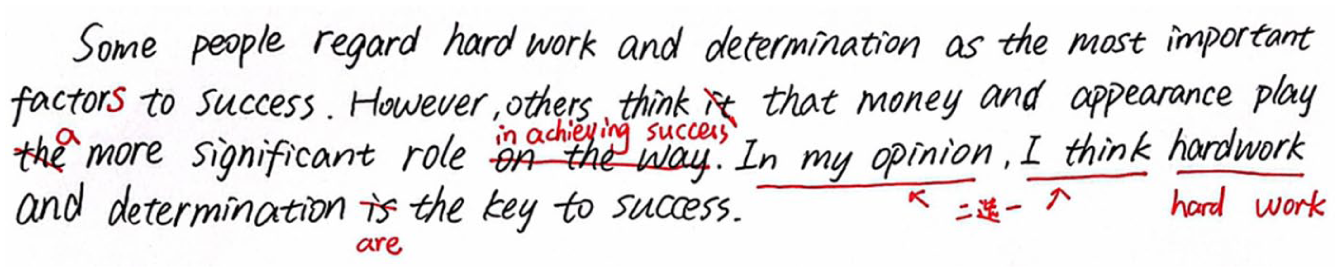
An example of direct WCF.
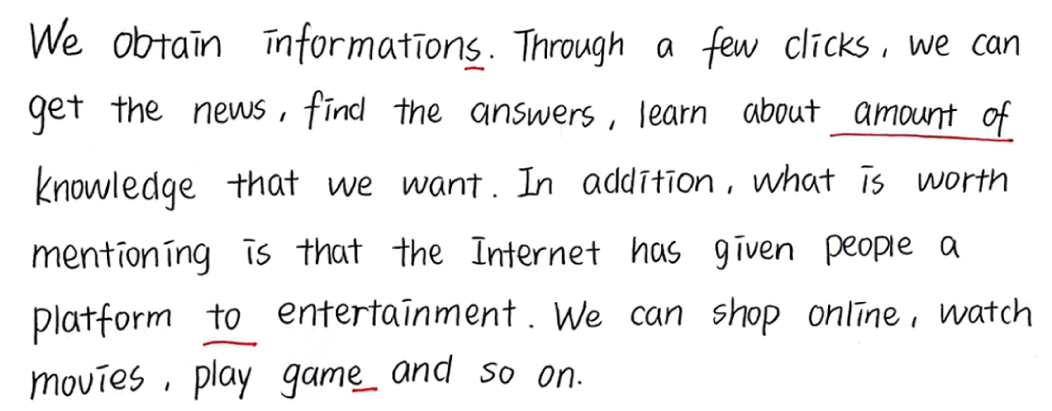
An example of indirect WCF.
In Week 3, the students got both corrected and original versions back, filled out the online AEWCF Questionnaire via an online survey platform immediately after they saw WCF, and then made revisions on their original texts. Unlike Karim and Nassaji (2020), we did not retrieve the corrected photocopies from the students during their revision, since in real teaching contexts, teachers commonly leave feedback to students to deal with, which was also acknowledged by Karim and Nassaji (2020). We let the participants decide whether to refer to feedback when revising or not. Both the photocopies and the original texts were collected at the end of the sessions.
From Weeks 4 to 6, the procedure was repeated using a second IELTS task with reversed feedback types for each group.
4. Results
Before data analysis, the internal consistency of the questionnaire data was checked (Table 2). To compute Cronbach’s alpha for the AEWCF Questionnaire items, two data sets were created. Data Set 1 was questionnaire answers under the direct WCF condition, and Data Set 2 was questionnaire answers under the indirect WCF condition. Cronbach’s alpha for Data Set 1 demonstrated that the questionnaire items for each emotion all had good internal consistency, while Cronbach’s alpha for Data Set 2 was similar, except that Cronbach’s alpha for the emotion of surprise in Data Set 2 was .674, just under .70. This lower level of consistency could be explained. Students might be surprised because they received more WCF than they expected or because their writing turned out to be better with less WCF than they had expected. Therefore, under the emotion of surprise, statements like “I am surprised that I made so many mistakes” and “I am surprised that my essay was better than I had imagined” contradict each other, hence the lower consistency compared with items under other emotions.
Cronbach’s α for Questionnaire Items in Direct and Indirect WCF Situations.

4.1. Emotional Responses to Direct and Indirect WCF
The descriptive statistics (Table 3) revealed that in the direct WCF situation, the strongest emotions were curiosity (M = 21.40), contentment (M = 21.16), happiness (M = 20.55), hope (M = 19.92), followed by surprise (M = 18.03), relief (M = 17.03), and, finally, anxiety (M = 13.60) and disappointment (M = 12.49). Ranked by strength, the emotions the participants felt upon receiving indirect WCF were curiosity (M = 21.37), happiness (M = 20.45), contentment (M = 20.05), hope (M = 19.43), surprise (M = 17.81), relief (M = 16.91), anxiety (M = 15.00), and disappointment (M = 13.39). Thus, the rankings of the emotions in the two WCF situations were almost the same except for the two emotions of contentment and happiness. With the four strongest emotions under both WCF conditions being all positive, the descriptive results revealed that overall, participants experienced stronger positive emotions than negative emotions.
Descriptive Statistics of Academic Emotions Toward Direct and Indirect WCF.
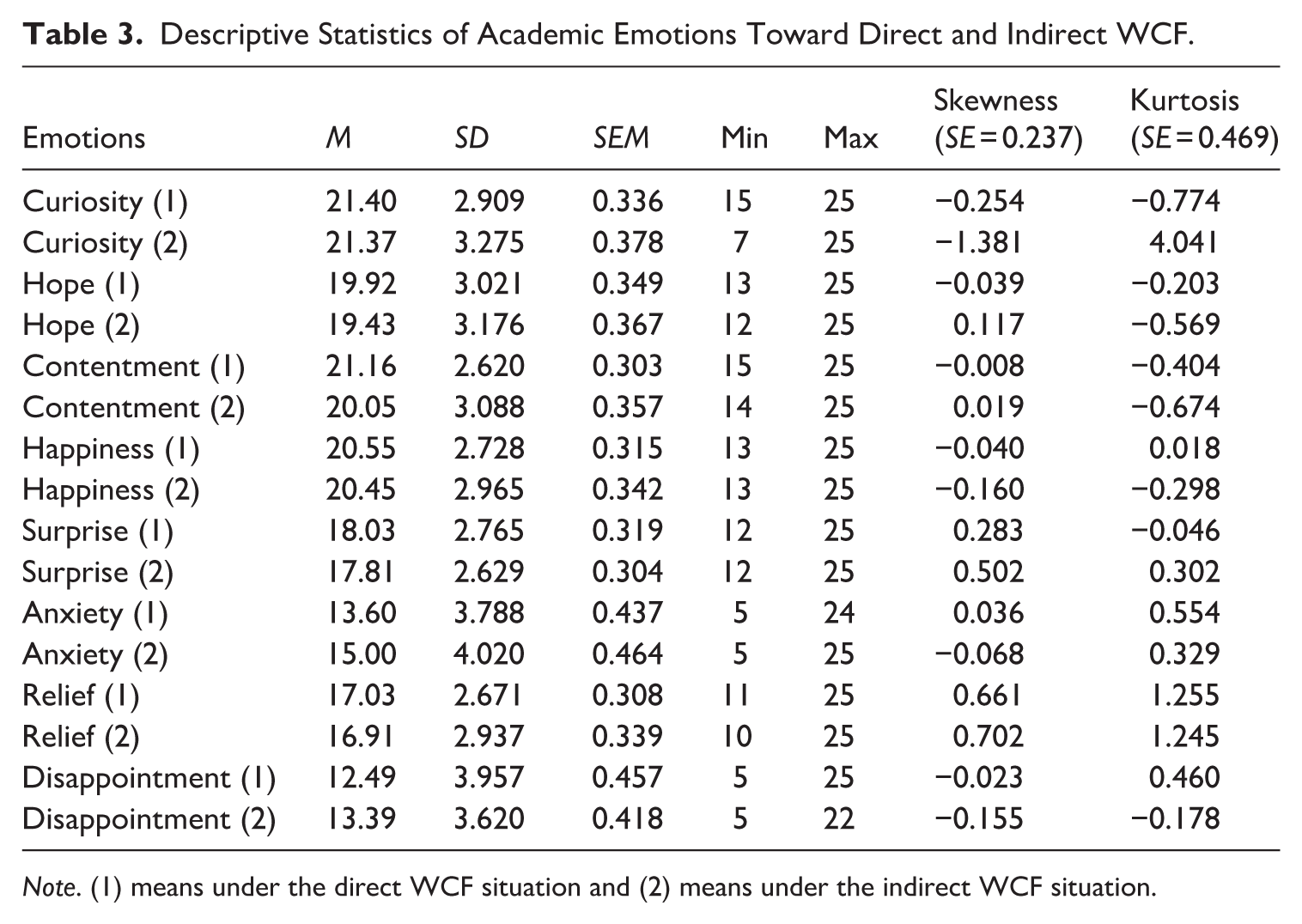
Note. (1) means under the direct WCF situation and (2) means under the indirect WCF situation.
To address RQ1, paired-samples t-tests were conducted (see Table 4) to compare the participants’ emotional responses to direct and indirect WCF. While no significant differences were detected in the strength of curiosity, hope, happiness, surprise, and relief, there were significant differences between contentment (t(74) = 2.93, p = .005, Cohen’s d = .34) and anxiety (t(74) = −3.62, p < .001, Cohen’s d = −.42) in the two feedback conditions. To be more specific, participants reported higher contentment (Mcontentment(1) = 21.16) and less anxiety (Manxiety(1) = 13.60) when receiving direct WCF, compared with when they received indirect WCF (Mcontentment(2) = 20.05, Manxiety(2) = 15.00). It is also worth noting that, despite their statistical significance, the effect sizes for these differences were modest (Lovakov & Agadullina, 2021).
Paired-Samples t-Test Results of Academic Emotions Toward Direct WCF and Indirect WCF.
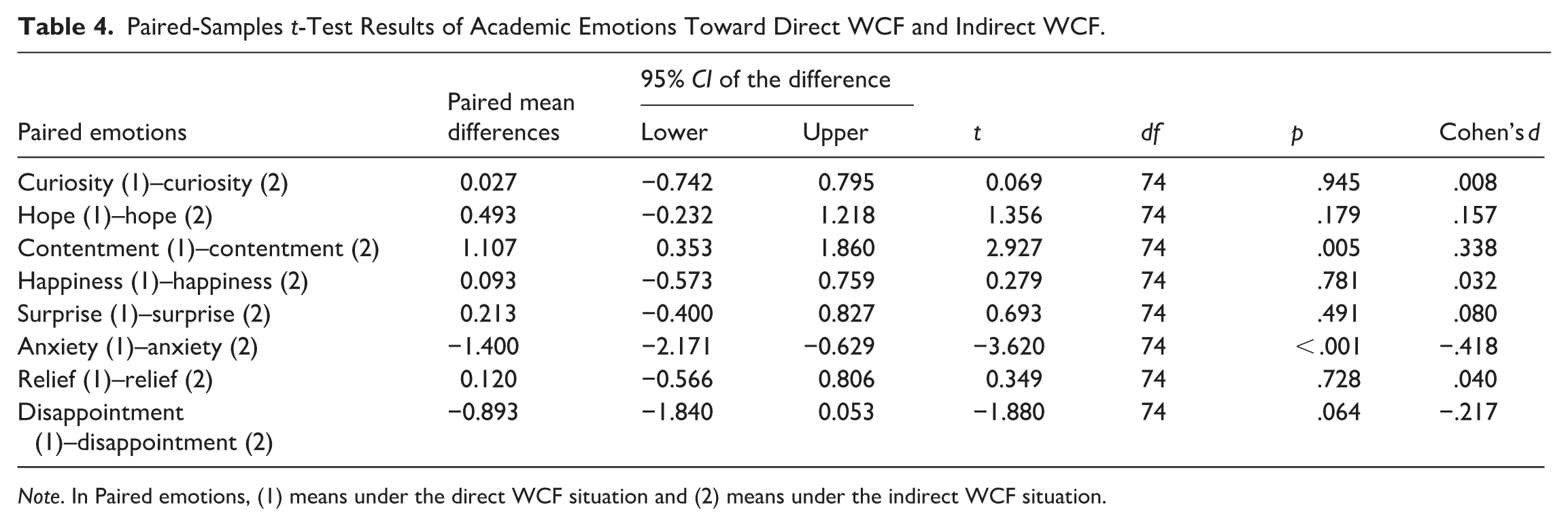
Note. In Paired emotions, (1) means under the direct WCF situation and (2) means under the indirect WCF situation.
Moreover, the participants demonstrated more emotional strength in all five positive emotions in the direct WCF situation than in the indirect situation. Regarding negative emotions, the participants showed less anxiety and disappointment under direct WCF conditions. Therefore, overall, the participants’ emotional responses to direct WCF were more positive than their emotional reactions when given indirect WCF.
4.2. Revision upon Receipt of Direct and Indirect WCF
To address RQ2, the analysis was divided into two parts: an initial examination of the participants’ revision behavior and an analysis of how context affected the relationship between emotions and revision, which follows in the next section. The mean of the total number of words produced in the texts under the first topic was 242.25 and the standard deviation was 51.81, while the figures under the second topic were 251.35 and 46.02, respectively. The mean text length and standard deviation under the two different feedback situations were: direct WCF (M = 247.96; SD = 47.12); indirect WCF (M = 245.64; SD = 51.20).
Following Karim and Nassaji (2020), the errors pointed out by WCF included both grammatical (e.g., third person singular errors and article use errors) and nongrammatical errors (e.g., spelling errors and word choice errors). All the errors identified by WCF in each text were counted as the number of errors. An error ratio was calculated by the total number of errors divided by the total number of words written × 100 (e.g., Karim & Nassaji, 2020; Van Beuningen et al., 2012), while a revision rate was calculated by the total number of revisions made divided by the total number of WCF.
Descriptive analysis and paired-samples t-tests (Tables 5 and 6) were carried out to examine students’ revision behavior in the two WCF situations. The participants made similar numbers of errors (M(1) = 14.04, M(2) = 13.03) in the two feedback situations with no significant difference (p = .35). However, the revision rate (0.671) in the indirect WCF condition was significantly higher than the revision rate (0.574) in the direct WCF condition (t(74) = 2.02, p = .047, Cohen’s d = .23).
Descriptive Statistics of Revisions in Direct and Indirect WCF Situations.
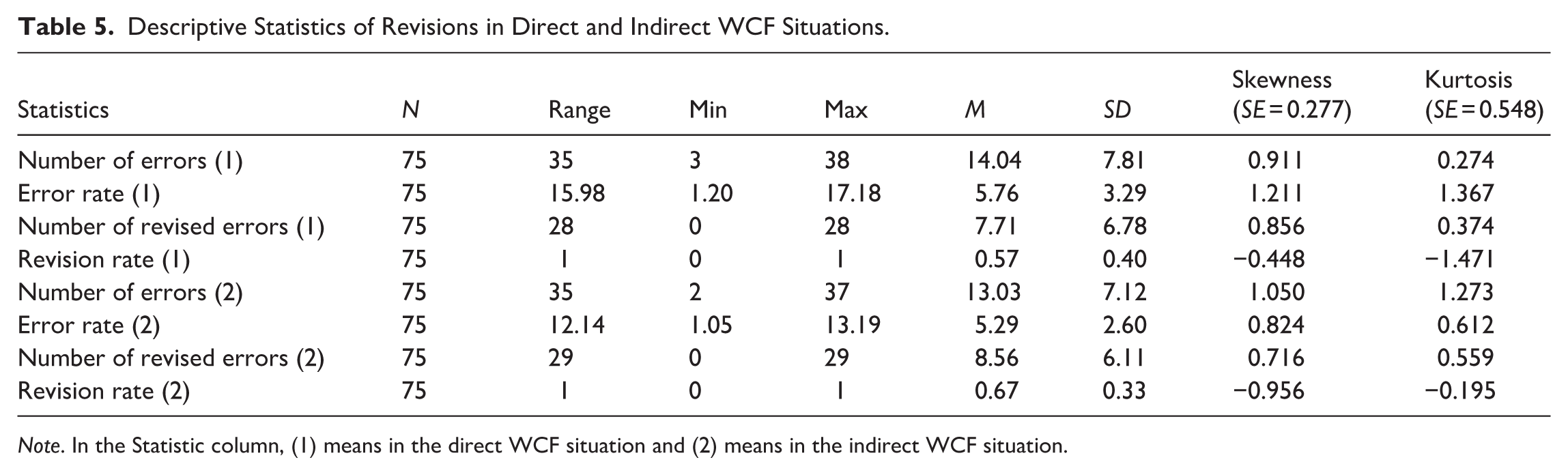
Note. In the Statistic column, (1) means in the direct WCF situation and (2) means in the indirect WCF situation.
Paired-Samples t-test Results of Revision Rates in Two WCF Situations.
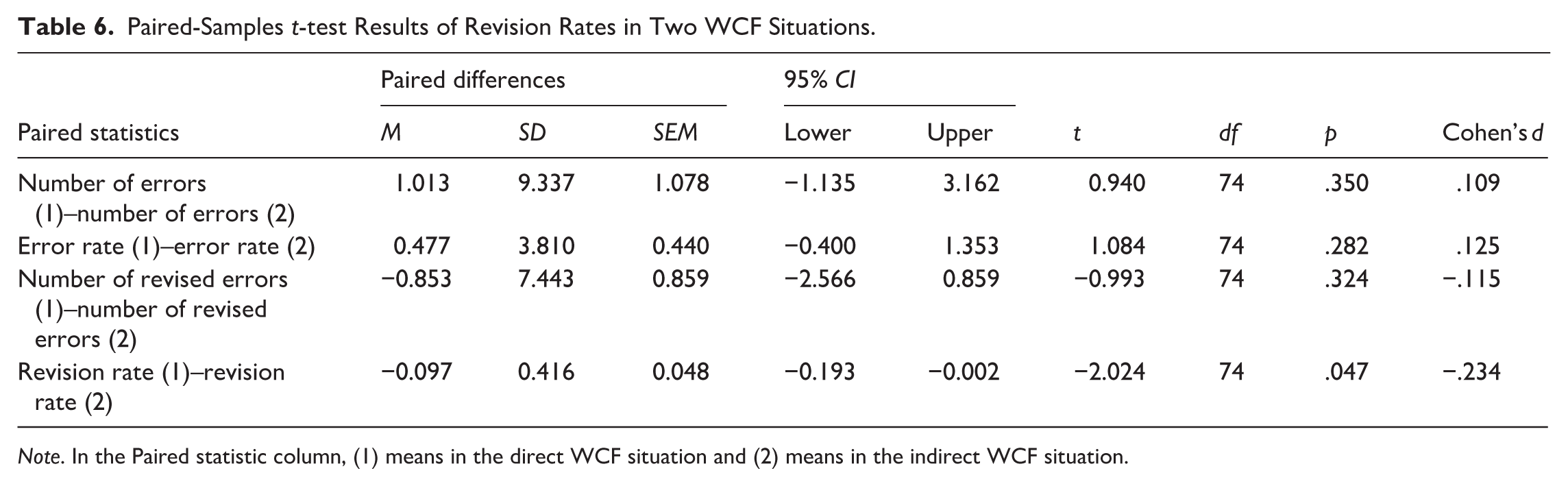
Note. In the Paired statistic column, (1) means in the direct WCF situation and (2) means in the indirect WCF situation.
4.3. Effect of Feedback Context on the Emotion–Revision Relationship
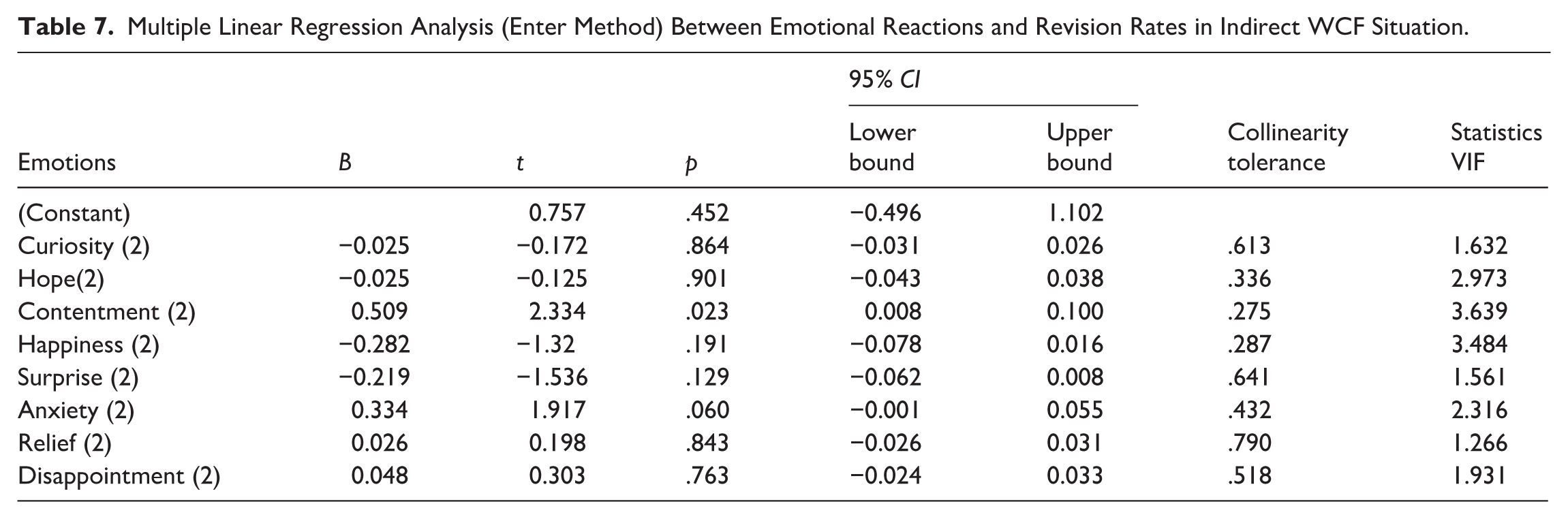
A multiple linear regression analysis (enter method) was performed to examine the contributions of eight emotional reactions to students’ revision rates under direct and indirect WCF conditions. The enter method relies on sound theoretical justification for including the selected predictors and is regarded as appropriate for theory testing (Field, 2020). Given that the emotional variables in this study were derived from prior research findings and empirical evidence, and they have been proposed to influence revision by previous studies (e.g., Mahfoodh, 2016), the enter method was appropriately employed in the analysis. The model used revision rates as the dependent variable and emotional responses as predictors for each feedback type. The results showed that under the direct WCF condition, no single emotion entered the regression equation at the p < 0.05 level, indicating that emotions played a marginal role in the students’ subsequent revisions when they received direct WCF from their teachers.
As for the indirect WCF situation (Table 7), when revision rates served as the criterion and the eight emotions were set as the predictors, contentment (B = 0.509, t = 2.334, p = .023) entered the regression equation at the p < .05 level. In other words, in the indirect WCF scenario, more contented participants seemed to spend more effort on revising their writings based on teachers’ feedback. Therefore, the feedback context (direct WCF or indirect WCF) appears to shape the relationship between emotions and revision. Collinearity diagnostics indicated that tolerance values ranged from 0.275 to 0.790, and variance inflation factors (VIFs) from 1.266 to 3.639, suggesting no severe multicollinearity issues (all VIFs < 10).
Multiple Linear Regression Analysis (Enter Method) Between Emotional Reactions and Revision Rates in Indirect WCF Situation.
Considering that a differential pattern was observed across feedback conditions, a moderated regression analysis was conducted to formally test whether feedback types moderated the emotion-revision relationship. Specifically, we created interaction terms between feedback type and each of the eight emotions, and entered them into a regression model for predicting revision rates. The results revealed that none of the interaction terms reached statistical significance (all p > .05). However, this study involved 75 participants, a sample size that is well-documented to be underpowered for detecting interaction effects, which typically require substantially larger samples than main effects (McClelland & Judd, 1993). The absence of statistically significant interactions in the current sample should therefore be interpreted with caution, rather than as definitive evidence against the moderating role of feedback context.
5. Discussion
This quantitative study looked at students’ emotional reactions to teachers’ use of different feedback types: direct and indirect WCF. It also examined whether the feedback contexts shaped by different WCF types influenced the relationship between emotions and subsequent revision behavior. Clarifying these relationships can empower teachers to proactively address emotional issues and ultimately maximize the benefits of WCF for L2 learning.
5.1. Students’ Emotional Reactions to Different Feedback Types
As can be seen from the quantitative data, the students’ emotional reactions to teachers’ feedback were positive overall, regardless of feedback types. The order of the eight emotions according to strength was curiosity, contentment, happiness, hope, surprise, relief, anxiety, and disappointment, with the four most strongly felt emotions being curiosity, contentment, happiness, and hope, which were all positive. This accords with Kim et al.’s (2020) summary of previous research that students generally had positive attitudes toward teachers’ WCF. A comparison between emotions in WCF situations and general academic emotions might generate some useful implications. Pekrun et al. (2002b) conducted interviews with 50 university students, asking about their emotions in academic settings. The negative emotion reported most often was anxiety, while the positive emotions ranked according to strength were enjoyment, relief, satisfaction/contentment, hope, curiosity/interest, and pride. Surprise, a more neutral emotion, was also mentioned but not that frequently. Our list is roughly in line with Pekrun et al.’s (2002a) list, with the emotions of happiness/enjoyment, relief, contentment, curiosity, anxiety and surprise appearing on both lists of emotions. However, it is noteworthy that curiosity, contentment, and surprise, which did not come top in Pekrun et al.’s (2002a) list, became the leading emotions in our list of WCF emotions. In other words, WCF arouses students’ curiosity, contentment, and surprise more than in general academic situations. Markey and Loewenstein (2014) pointed out that curiosity is a crucial motivator to drive educational attainment. Therefore, this finding indicates that the benefit of WCF could also be attributed to the fact that it could trigger the learning–facilitating emotion of curiosity among students.
Regarding students’ emotional reactions to teachers’ use of different WCF types, the questionnaire data suggested that the participants felt more contented and less anxious when receiving direct WCF than indirect WCF. Teacher feedback is still the most important source of feedback for EFL students in Chinese universities (Yu et al., 2020), and students show a marked preference for teacher feedback (Zacharias, 2007). Through feedback, students also feel their teacher’s concerns for them (Han & Hyland, 2019). Therefore, students’ appraisals of the value of WCF are high. When the participants received direct WCF, they found that the teacher had already corrected all their mistakes, making it easier for them to make revisions (Han & Hyland, 2019), leading to a higher level of appraisals of control. Thus, high appraisals of both value and control were associated with positive emotions, as reflected by greater contentment and less anxiety. In contrast, indirect WCF withheld the way to correction, so the students were unsure about how to correct the underlined parts. When they struggled with how to correct the mistakes, this might frustrate them (Kruk & Kałużna, 2024) and undermine their confidence in their own ability to handle the feedback. Since they valued the teacher’s feedback but lacked control over whether they could make the best use of the feedback, this might have contributed to higher levels of anxiety.
5.2. Emotional Reactions, Revision, and Feedback Context
In this research, the students’ emotional reactions to direct feedback were more positive than their emotions upon receiving indirect WCF. Considering that emotions can help explain their preference for the types of WCF (Zhang et al., 2021), our finding lends support to Lee (2005)’s research which corroborates that more students prefer direct WCF. However, it is worth noting that despite students’ more positive emotions toward direct WCF, within similar class time, the revision rate was significantly lower under the direct WCF condition than that in the indirect WCF situation. This is not consistent with Van Beuningen et al. (2012)’s study, which showed a higher correction rate (78%) when students received direct feedback than that (64%) in the indirect feedback condition using error codes. This inconsistency might have resulted from differences in research design. In Van Beuningen et al.’s (2012) study, after receiving the directly or indirectly corrected versions of their initial texts, the students were required to incorporate the feedback and produce a revised piece of writing. However, in our research, the students did not need to copy their original essays because the photocopies of their assignments were already provided. Students were only encouraged rather than required to correct the mistakes in their original texts. As mentioned previously, with no explicit requirement for revision, this is more likely to reveal how students’ emotions influence their revision behavior.
According to Fredrickson’s (1998) broaden-and-build theory, positive emotions broaden individuals’ thought–action repertoires, enabling them to draw upon greater physical, intellectual, and social resources. Therefore, theoretically, the revision rate in the direct WCF situation should have been higher than that in the indirect WCF condition since students’ emotions were more positive in the former scenario, but our findings contradicted this assumption. Such inconsistency might be attributed to the different feedback contexts. The direct WCF had already provided the correct forms on the photocopies, and it seemed to be unnecessary to copy them onto their original writing. In contrast, indirect WCF engaged students in problem solving (Ferris & Roberts, 2001) and spurred them to correct the errors. Thus, the current findings suggest that in WCF situations, the influence of positive emotions, as proposed by the broaden-and-build theory, appears to be shaped by contextual factors, more specifically, the types of WCF provided in this study. A key implication revealed is that the feedback contexts created by teachers’ different feedback interventions might not only influence what emotions students experience but also how emotions affect their revision behavior.
As for the relationship between discrete emotions and revision behavior, context also matters. Under the direct WCF condition, emotions seemed to exert a minor influence on students’ revision behavior. Revision in the direct WCF situation might be influenced by other contextual factors such as teachers’ requirements, or learners’ individual differences like their attitude to the value of copying teachers’ words. For example, some students might assume that it was not necessary to correct the mistakes on the photocopies since the teacher had already corrected all the mistakes. Rather than copying teachers’ words, it might be more fruitful to spend time learning the direct WCF. On the other hand, under the indirect WCF condition, increasing contentment led to a stronger intention to correct the errors. Going beyond Mahfoodh’s (2016) findings, this study revealed contentment as a discrete emotion significantly affecting revision behaviors.
According to the broaden-and-build theory, when students experience contentment, they like to integrate and savor (Fredrickson, 1998). In other words, after receiving indirect WCF, contentment would provide students with more psychological strength to integrate themselves into the current WCF situation and savor their own success by reviewing and interacting with the feedback. However, this result did not align with the CVT reasoning. Pekrun et al. (2002b) proposed that while positive activating emotions facilitate learning, positive deactivating emotions yield equivocal effects, as they may decrease immediate motivation and distract attention while potentially enhancing long-term motivation for pursuing academic goals. Nevertheless, as indicated by the multiple linear regression analysis, contentment spurred students to revise their writing upon receipt of indirect WCF, whereas happiness did not. A plausible interpretation for the incongruity might be that contentment, as a more present-oriented emotion than other positive emotions such as happiness and joy (Cordaro et al., 2024), drove students to focus on their writing and prompted them to revise their work. According to Fredrickson (2001), both joy (high activation) and contentment (low activation) broaden thought–action repertoires, but they produce different cognitive outcomes: joy encourages playful and creative exploration, whereas contentment promotes savoring and integrating current experiences. Gable and Harmon-Jones (2010) also note that high-intensity positive affect (e.g., happiness and joy) narrows attention. Thus, contentment, with low activation, is more instrumental in writing revision, which demands calm and focused, deliberate processing. This finding again highlights the importance of considering contextual factors when examining the effects of the positive and deactivating emotion of contentment.
This study sheds some new light on researching learners’ emotional reactions to feedback in L2 learning. As illustrated by Figure 4, feedback context plays a prominent role throughout the whole process of L2 feedback practice. As prior research (Mahfoodh & Pandian, 2011; Mercer & Gulseren, 2023; Zheng et al., 2020) has indicated, contextual factors of feedback, such as types of feedback and the broader instructional settings, would influence how students process and utilize the feedback. This influence has been mostly explained from cognitive perspectives. For example, Bitchener and Knoch (2009) contend that direct feedback is of more value because it reduces possible confusion students might experience in dealing with indirect WCF. On the other hand, Ellis (2009) believes that indirect WCF guides learners through error detection and correction, which is conducive to long-term acquisition. With growing scholarly attention to the role of emotions in learning, it is worth investigating the effect of feedback contexts on learning from the perspective of students’ emotional experiences. Our study shows that teachers’ use of different feedback types could trigger different emotional reactions. According to CVT, appraisals of control and value in a certain feedback context led to distinctive achievement emotions, while other emotions (e.g., social emotions and epistemic emotions) might directly arise from the context itself. For example, students’ curiosity about why teachers made a certain correction could have undergone no appraisals. Instead of investigating students’ emotional reactions to teacher feedback in general, it would be more fruitful to look at how specific feedback contexts might shape learners’ emotions. It is where teachers could do something in advance to create more favorable emotions among students. Moreover, context is likely to shape the effect of emotional reactions on learning, such as revision and the transfer of skills to new writing tasks. Therefore, anticipating the effects of emotions cannot rely solely on existing emotion theories, as evidenced by the discrepancy between the effect of contentment in the indirect WCF situation and the predictions of CVT. It is always necessary to take context into account when discussing the role of emotions in L2 feedback situations. More research on how specific contexts influence the role of emotional reactions in students’ learning is needed, to inform teachers of which emotions to cultivate for better learning outcomes.
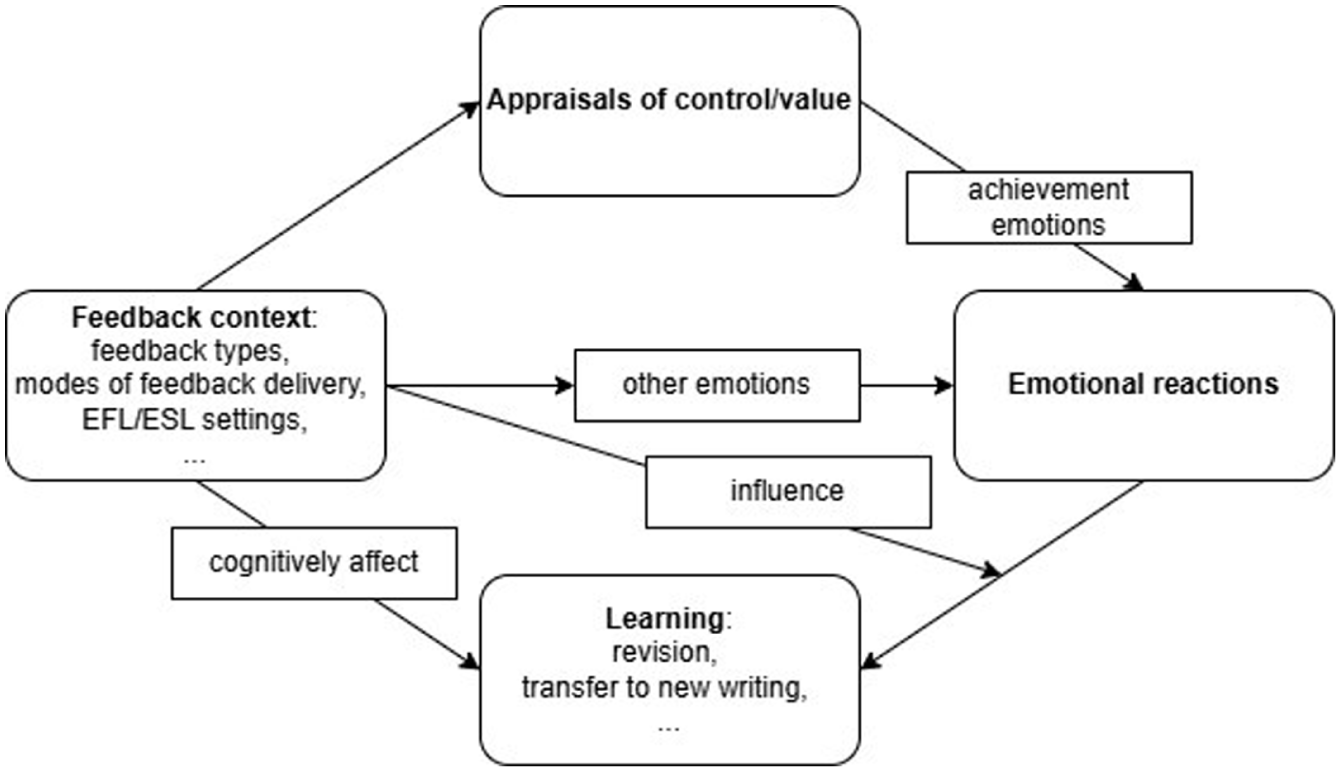
The interplay of feedback context, emotional reactions, and learning.
Despite the useful insights, this study is not without its limitations. First, it only focused on the effect of emotions on a single learning indicator: revision rate. It should be noted that revision does not equal acquisition, and only behavioral engagement was measured. Future studies could evaluate the effect of emotions on other dimensions of learning, such as revision accuracy, depth, or transfer to new writing. Second, this research focused on students’ emotions toward feedback on the essays they wrote independently, which could reflect their real writing proficiency. Therefore, the participants who used AI to eliminate all errors in their writing were excluded from the final data. Future studies could examine the interplay of emotions, feedback context, and learning in AI-assisted feedback contexts, given the ongoing popularity of AI-assisted feedback. Third, the interaction effect was tested, but did not reach significance. Replication with a larger sample is needed to formally establish the moderating role of feedback type. Fourth, the difference in difficulty between the two writing tasks was marginally significant, which might have exerted a certain impact on feedback emotions. In addition, the strict inclusion criteria have resulted in a relatively small sample in our study. The single-site sampling might further lead to the distinct features of the participants, such as their relatively strong English learning motivation, extensive WCF experience, and their relationship with the teacher. Thus, replication across diverse institutional contexts, proficiency levels, and cultural settings is recommended.
6. Conclusion
While previous research has noted the effect of contextual factors on students’ emotional reactions to feedback in L2 learning, little is known about how teachers can preemptively shape students’ emotional responses to feedback by adjusting contextual factors, such as feedback types, at the outset. To address this gap, this study employs a quantitative approach to investigate how students emotionally react to direct and indirect WCF in L2 writing, and whether the feedback context influences the relationship between these emotions and subsequent revision behavior. The results indicated that direct WCF made students more contented and less anxious than indirect WCF. Under the direct WCF condition, emotions seemed to exert a marginal influence on students’ revision rates, whereas under the indirect WCF condition, contentment led to higher revision rates. This distinct pattern across contexts showed that the link between emotions and revision behavior varied depending on whether feedback was provided directly or indirectly. The results demonstrated that contextual factors such as feedback types could affect students’ emotional responses and the relationship between emotions and revisions. Thus, a valuable direction for future ISLA research is to examine the interplay of feedback context, emotional responses, and learning, to enable teachers to proactively intervene in students’ emotional reactions.
This study provides some meaningful pedagogical implications. Feedback exerts a powerful influence on students’ achievement, but it is difficult to implement feedback within a mass higher education system and mounting evidence suggests that students are generally not dissatisfied with feedback (Winstone & Carless, 2019). As an important part of feedback in higher education, WCF in L2 writing is worth more effort from both teachers and researchers to improve the well-being of learners. This study suggests that teachers can manipulate feedback contextual factors to provide emotionally sensitive feedback. Such a belief, coupled with knowledge about students’ emotions toward different pedagogical interventions, will enable teachers to ease the detrimental effect of emotions on students’ learning as much as possible. In terms of implementing feedback, teachers could provide different types of WCF in different situations to better accommodate students’ emotional needs. For example, indirect WCF could be used at the beginning of the semester to help cultivate students’ independent learning. When a high-stakes exam is approaching, direct WCF could be provided instead to alleviate students’ anxiety. Moreover, given that the emotion of contentment is conducive to active revision, when providing indirect WCF, teachers could improve students’ sense of contentment by adding some short affective comments (Tang & Liu, 2018) at the end of their assignments to improve their willingness to revise. Finally, it is essential to improve students’ awareness of their own emotions under different WCF conditions and provide training on emotion regulation (Han & Hyland, 2019).
Footnotes

Ethical Considerations
This research has been approved by the Faculty Ethics Committee of the Faculty of Humanities and Social Sciences at City University of Macau (ref.: FHSS250014).
Funding
The authors disclosed receipt of the following financial support for the research, authorship, and/or publication of this article: This study was supported by the 2023 New Teacher Education Construction Project of Education for Promoting High-Quality Development of Basic Education Research and Practice sponsored by Department of Education of Guangdong Province, under the project “Research and Practice on Teaching Reform of Core Subjects in Secondary Schools under the Background of New Teacher Education” (No. 49).
Declaration of Conflicting Interests
The authors declared no potential conflicts of interest with respect to the research, authorship, and/or publication of this article.
Data Availability Statement
Data and materials collected in this study are available upon reasonable request.