







Abstract
While the multidimensional nature of reading engagement has been widely acknowledged in the English as a first language context, the constructs of reading engagement have remained inadequately investigated empirically in the English as a foreign language context, and research on the predictive effects of these constructs on learning achievement is limited in the area of learning English as a foreign language. The first purpose of this study was therefore to develop the English as a Foreign Language Reading Engagement Questionnaire (EFL-REQ) and validate its psychometric properties among college EFL learners. The second purpose was to assess the predictive effects of the EFL-REQ dimensions on English learning achievement. A series of psychometric tests was conducted with a large sample of college EFL learners in China (n = 1, 341) who completed a survey questionnaire. Exploratory factor analysis results provided support for the hypothesized four-factor structure of the EFL-REQ (i.e. behavioral, emotional, cognitive, and social reading engagement). Findings of confirmatory factor analyses and model comparisons revealed acceptable model fit (e.g. CFI = .952, TLI = .943, GFI = .904, NFI = .941, IFI = .953, RMSEA = .075), reliability, construct validity, and measurement invariance of the first-order four-factor EFL-REQ. Hierarchical regression analysis results also provided evidence that the EFL-REQ dimensions positively predict students’ English learning achievement, but with only a relatively weak effect size (R2 = .012-.034). Across the individual EFL-REQ dimensions, emotional reading engagement significantly and positively predicted learning achievement, while social reading engagement showed a significant negative predictive effect, and cognitive reading engagement did not significantly predict English learning performance. These results contribute to a nuanced understanding of the differential role of the EFL-REQ dimensions in English learning achievement in the Chinese EFL context. Implications of these results were discussed.
Keywords
1. Introduction
Reading engagement as a multifaceted construct encompassing several dimensions of participation in reading activities has been widely conceptualized as students’ active coordination of their cognitive strategies, social interactions, and motivational processes (Deng et al., 2020; Guthrie & Wigfield, 2000; S. McGeown & Smith, 2023; X. C. Wang, 2023). It has been acknowledged in the literature that reading engagement is a pivotal factor influencing both students’ school academic success and their lifelong literacy skills (Alrawashdeh et al., 2024; Castillo et al., 2022). For example, Rahim and Hashim (2015) emphasized that reading engagement may constitute the dominant element influencing effective learning at all educational stages.
Despite its importance, previous reading engagement studies have predominantly been conducted in learners’ first language contexts. Relatively few empirical studies have examined reading engagement in the English as a foreign language (EFL) domain. For instance, Lau (2011) employed the reading strategy inventory to examine self-regulated reading among Hong Kong secondary students, while Yulia and Sulistyo (2019) conducted interviews with university student teachers in Indonesia to explore behavioral, affective, cognitive, and social dimensions of student reading engagement. X. C. Wang (2023) analyzed the Programme for International Student Assessment (PISA) data to capture reading engagement domains such as reading diversity, frequency, enjoyment, and strategies. These studies either investigated reading engagement without a unifying theoretical framework or adopted measures of reading engagement that have usually not undergone rigorous psychometric validation in relation to a specific learning context. Additionally, there is a lack of reliable and valid measures of student reading engagement within the EFL context that incorporate multidimensional indicators. Against this research backdrop, given the critical role of reading engagement in successful foreign language learning, the current study aims to develop and validate the English as a Foreign Language Reading Engagement Questionnaire (EFL-REQ) grounded in J. A. Fredricks et al.’s (2016) theoretical framework on learning engagement, which conceptualizes engagement through behavioral, cognitive, social, and emotional dimensions. The EFL-REQ thus focuses on four key aspects of the English reading engagement in the EFL context. Specifically, the current study was guided by the following two research questions:
Research question 1: Is the EFL-REQ a reliable and valid instrument for measuring university EFL learners’ English reading engagement?
Research question 2: To what extent do the EFL-REQ dimensions predict English learning achievement?
2. Theoretical and empirical framework
Engagement is broadly recognized as a multidimensional construct, including at least three components: behavioral, cognitive, and emotional engagement (J. A. Fredricks et al., 2004). Engagement involves not only visible behaviors but also internal emotional and cognitive elements (Mercer, 2019). For instance, students can look like they are paying attention while still feeling bored or distracted. In addition, J. A. Fredricks et al. (2016) emphasized the necessity of integrating the social dimension into engagement, given the crucial role that social interactions play in students’ academic learning (e.g. Ryan & Pintrich, 1997). Subsequent empirical work suggested that social engagement was indeed a distinct dimension of student learning engagement (e.g. J. A. Fredricks et al., 2016; Henry & Thorsen, 2020; Lambert et al., 2017). The present study builds upon previous conceptualizations of student learning engagement (e.g. J. A. Fredricks et al., 2016; Mercer, 2019), emphasizing how each engagement dimension can be distinctly operationalized, interpreted, and identified in an EFL reading context, which will be explained in detail below.
Reading engagement entails the interaction between the readers and the environment, including the amount of text read, evidence of comprehension, and the use of metacognitive strategies in the reading process (Reschly & Christenson, 2006; Unrau & Quirk, 2014). Guthrie and other scholars (Baker et al., 2000; Guthrie & Wigfield, 2000; Guthrie et al., 2004, 2006) portrayed engaged reading as an intrinsically motivated, strategy-used, comprehension-oriented, and interaction-included process, which generally corresponds to behavioral, cognitive, emotional, and social reading engagement dimensions. It has been reported in the literature that engaged readers are more likely to participate actively in reading tasks, demonstrate enthusiasm and pleasure in reading activities, employ better use of cognitive strategies for deeper understanding, and communicate with characters and significant others (Lutz et al., 2006). In EFL reading settings, however, these dimensions do not necessarily operate as parallel and equivalent components. The salience and functional pathways of reading engagement dimensions tend to be shaped by contextual constraints such as instructional arrangements and assessment-oriented practices (e.g. Dewaele & Li, 2020; Hiver et al., 2021; Oga-Baldwin, 2019), which in turn influence how engagement is sustained.
2.1. Behavioral reading engagement
Behavioral reading engagement refers to observable involvement in academic reading tasks, such as effort, persistence, concentration, and attention (Unrau & Quirk, 2014). In the context of first language reading, behavioral reading engagement indicators include students’ self-reported time, effort, persistence in reading, or teachers’ observations of students’ reading commitment, concentration, frequency and long-term persistence (Guthrie et al., 1999, 2012; P. S. McGeown et al., 2015). P. S. McGeown et al. (2015) found that behavioral reading engagement had an impact on adolescents’ reading comprehension, summarization skills and text reading speed after accounting for variation in word reading skill. A.-Y. Kim and Kim (2017) also observed that students’ behavioral engagement in reading literacy activities contributes to growth in reading skills. In second language acquisition, behavioral reading engagement is usually considered a cornerstone of effective learning because it manifests a learner’s willingness to take responsibility for their own learning (Gan & Wang, 2024; Oxford, 2016). In this case, behavioral reading engagement is typically described as learners’ participation in assigned second or foreign language reading activities including following up on teacher-distributed materials, independently working through exam-oriented texts (Lin et al., 2021; Oga-Baldwin, 2019; X. Wang, 2022), as well as learners’ self-directed reading outside class (An et al., 2021).
In previous reading engagement studies, measurements of reading behavioral engagement usually consist of student self-report instruments or teachers’ ratings of student engagement about the frequency and breadth of students’ reading (J. Fredricks et al., 2011; Hiver et al., 2024; Lin et al., 2021). Nevertheless, some researchers (e.g. Unrau & Quirk, 2014) pointed out that appearing behaviorally engaged in reading may not really mean that a student is actually engaged in reading, indicating a need for using more direct assessments of student behavioral reading engagement.
2.2. Emotional reading engagement
In the classroom context, student emotions can be incited from interest and enjoyment in the learning materials, teacher or peer feedback, and a sense of achievement and epiphany (Wigfield & Tonks, 2002). Emotional reading engagement encompasses a range of feelings, such as interest, boredom, happiness, sadness, and anxiety (J. A. Fredricks et al., 2004). In a study of Chinese secondary school students’ reading engagement profiles, Lin et al. (2021) defined emotional reading engagement as learners’ joyfulness towards reading activities. Furthermore, positive emotions such as reading enjoyment tend to be linked to sustained engagement in reading activities (Dewaele & Li, 2020; Feng & Hong, 2022), whereas negative emotions such as reading boredom or anxiety may negatively affect the mobilization of strategic reading processes (Feng & Hong, 2022; Jiang & Dewaele, 2019).
In extant reading engagement research, some researchers, such as Guthrie et al. (2012, 2013), conflated emotional reading engagement with reading motivation since reading motivation can be expressed as a general sense of autonomy and purpose (e.g. a broad intention to learn English well) (Reeve & Lee, 2014; Svalberg, 2009). From this perspective, emotional reading engagement can be understood as a the transition from a motivational inclination to learn to active involvement in a reading activity (J. Li & Cui, 2025; Pekrun & Linnenbrink-Garcia, 2012), learners’ readiness to initiate interaction around meaning of the reading material, and their visible enjoyment of the reading process (Oga-Baldwin & Nakata, 2017; Svalberg, 2009). In other words, motivation is the catalyst for reading engagement, which in turn impacts reading processes and reading performance (Guthrie & Klauda, 2015).
2.3. Cognitive reading engagement
Researchers in educational psychology particularly emphasized two aspects of cognitive engagement: 1) psychological investment in learning, which involves students’ desire to master academic tasks and their avoidance of challenges (e.g. Connell & Wellborn, 1991; Newman et al., 1992); 2) the awareness of using strategic and metacognitive strategic approaches in learning, which encompasses elements of self-regulated learning theory (J. A. Fredricks et al., 2004; Gan et al., 2025; Luo & Gan, 2023; Pintrich & De Groot, 1990; Zimmerman, 1990, 2013). To differentiate cognitive engagement from motives that initiate or sustain learning actions, Sinatra et al. (2015) specifically described cognitive engagement as self-regulating, setting learning goals, or persisting on challenging tasks. Meanwhile researchers examining first language reading engagement tended to define cognitive reading engagement as ‘willingness to exert the mental effort needed to comprehend texts and accomplish difficult reading tasks’ (Guthrie et al., 2012, p. 602), which involves text decoding such as word recognition, lexical access, sentence parsing, and semantic proposition formation during reading (Barus et al., 2022; Grabe & Yamashita, 2022), and use of higher-level cognitive skills such as summarizing, skimming, and scanning (Lin et al., 2021). It is believed that cognitively engaged readers tend to use a variety of cognitive and metacognitive reading strategies to assist comprehension, for instance, figuring out the meanings of difficult words in the lines and collocation contextually, decoding sentence structures via translingual inquiry instead of translation, or integrating new information with old (Miyamoto et al., 2019).
In a systematic review on language engagement research, Hiver et al. (2024) defined cognitive engagement as the sustained mental effort in problem-solving, and argued that learners’ cognition is mobilized when they direct their attention intentionally, selectively, and persistently toward accomplishing a specific academic task. According to Hiver et al. (2024), in instructed language learning settings, indicators of cognitive engagement include negotiation of meaning such as exchanging ideas, informing and explaining, offering feedback, and providing direction. Specifically, there has also been a body of research examining cognitive reading engagement among EFL readers. The overall results of these studies suggest that cognitive reading engagement reveals EFL learners’ depth of strategic investment during English reading, including activating prior knowledge, inferring meaning from context, elaborating, rereading, and selectively attending to key information (Barus et al., 2022; Guo et al., 2023; Hiver et al., 2021; Zhou et al., 2021). Furthermore, the deployment of specific cognitive strategies during reading is often conditioned by lexical resources, reading confidence, and perceived task demands (Alshammari & Alrashidi, 2024; Guo et al., 2023). Consequently, cognitive reading engagement may be less stable and less readily observable than behavioral participation in many classroom contexts (Sulis, 2024).
2.4. Social reading engagement
Social engagement is the foundation for inter-learner bonding and is typically reflected in the learner’s interaction with peers and teachers in the classroom, as well as the extent of the learners’ readiness to participate in co-operative classroom activities with others (Lambert et al., 2017). Students’ social reading engagement is associated with sharing understanding of reading materials with peers or teachers, and can be facilitated by relationships of trust in which students value the views of others and co-construct classroom atmospheres as they negotiate the meaning of what they are reading (Carless, 2015; Lutz et al., 2006; Mercer, 2019). Consequently, socially engaged readers are not passive interpreters of their environmental practices or surroundings but assume an active role in the reading process by asking questions, making predictions, and using a variety of strategies to overcome difficulties. This is because the socially engaged reading process comprises not only reciprocally and transactionally contacting the contents inside reading materials, but also exchanging ideas and comprehension with social companions like classmates, teammates, or teachers (Ivey & Johnston, 2013). Seen in this light, promoting students’ social reading engagement can be fulfilled through activities like discussion or asking questions in English reading classes.
In second language acquisition, compared with the other three types of reading engagement, social reading engagement remains the most contested and least elaborated dimension, particularly in an EFL context (Hiver et al., 2021; Oga-Baldwin, 2019). On the one hand, social reading engagement in the EFL classroom is often defined as the quality of interaction regarding language problems, including peer scaffolding during reading tasks and willingness to exchange ideas about the text (Peng & Woodrow, 2010); on the other hand, as instructional priorities and evaluative systems tend to be closely aligned with standardized testing, socially oriented reading practices are not usually systematically supported or directly rewarded. Under such circumstances, their association with test-based achievement indicators may be weak or even negative, particularly when interactive time competes with individually optimized test preparation (B. Yang & Moskovsky, 2021). In the present study, social reading engagement is thus viewed as learners’ interaction surrounding reading in English, including discussing texts with peers, explaining content to classmates, seeking clarification from teachers, and sharing or recommending reading materials.
3. Existing measures of reading engagement in the literature
The assessment of student reading engagement necessitates rigorous measurement tools to grapple with its multidimensional and domain-specific nature (Hiver et al., 2021; M.-T. Wang et al., 2016). Especially pertinent to the current study are the four measures related to reading engagement, which are discussed in the sections below.
Wigfield et al. (2008) developed the Reading Engagement Index (REI), which is grounded in the expectancy-value theory (Wigfield & Eccles, 2000). The REI is a teacher-rating tool designed to assess native English-speaking children’s reading engagement through behavioral, motivational (i.e. intrinsic motivation, social value, self-efficacy) and cognitive (effort, strategy use, conceptual orientation) dimensions. The 8-item REI, employing a 4-point Likert scale from 1 (not true) to 4 (very true), has been validated for use in American primary school students, with a reliability coefficient of α = .92. Nevertheless, whether the REI can be applied in an EFL context remains unknown, especially given the overlap between the concepts of reading engagement and reading motivation.
Guthrie et al. (2013) used the reading engagement scale (RES) to examine American public middle schools’ seventh-grade students’ involvement in reading activities. The RES includes two subscales: 1) dedication (α = .87) and avoidance (α = .85). Dedication denotes the time, effort, and persistence put into reading such as ‘I spent as much time as needed to complete my reading homework’ whereas avoidance refers to having an aversion toward reading and minimizing time and effort spent on reading like ‘Every day, l tried to get out of reading.’ While confirmatory factor analysis results suggested that RES was a reliable and valid instrument used to measure students’ reading engagement in English as a first language context, it failed to address a full range of cognitive reading strategies that may impact students’ reading performance.
Mokhtari et al. (2018) developed the Metacognitive Awareness of Reading Strategies Inventory to test the level of American students’ cognitive reading engagement from Grades 6–12. MARSI-R included three subscales: Global reading strategies (5 items), Problem-solving strategies (5 items), and Support reading strategies (5 items). The Cronbach’s alphas of the MARSI-R’s 3 subscale strategies ranged from .69 to .74, indicating good internal consistency. While MARSI-R has been shown to be a valid reading strategies measurement, it failed to address the social and emotional aspects of the reading process, particularly in an English as a foreign language context, where emotional states tend to determine whether students engage in reading and use effective reading strategies (Graham et al., 2018).
Finally, S. McGeown and Smith (2023) developed the reading engagement scale (RES) to measure the reading behavior of native English-speaking children aged 8–11 years in the UK. The RES included four subscales: behavioral (frequency/ diversity/ duration), affective (emotion/ immersion/ empathy), cognitive (strategies), and social (social participation) dimensions, with 24 items rated on a 4-point Likert scale. The Cronbach’s alphas of McGeown and Smith’s RES ranged from .61 to .79. As the RES was designed to target English-speaking children in the first language context, whether it fits with EFL college learners remains an open question.
4. The present study
Previous research in general education has shown that J. A. Fredricks et al.’s (2016) theoretical framework on student learning engagement has a four-factor structure, namely, behavioral learning engagement, cognitive learning engagement, emotional learning engagement, and social learning engagement. Although this framework has been widely applied in general education (e.g. M.-T. Wang et al., 2016), it has been underutilized and has not been well tested in an EFL reading context. Thus, in the present study, we tested Fredricks and her colleagues’ four-factor learner-engagement framework in an EFL reading context and examined how well the hypothesized EFL-REQ factor structure fit the data using exploratory factor analysis (EFA), confirmatory factor analysis (CFA), and multi-group confirmatory factor analysis (MGCFA). In addition, we examined the predictive effects of the EFL-REQ dimensions on students’ English learning achievement.
4.1. Context and participants
A total number of 1,346 college students from a northern China university were recruited to participate in this study by means of convenience sampling. Informed consent was obtained from all participants prior to data collection, and they were assured of anonymity and risk-free participation. Five respondents who indicated they did not participate voluntarily were excluded, yielding a final sample of 1,341 participants (1,081 female, 80.6%; 260 male, 19.4%), including 532 freshmen (39.7%), 376 sophomores (28.0%), 325 juniors (24.2%), and 108 seniors (8.1%). As detailed in Table 1, participants’ ages ranged from 17 to 24 years (M = 19.62, SD = 1.55), with the majority being non-English majors (n = 797) compared to English majors (n = 544).
Demographic information of participants.
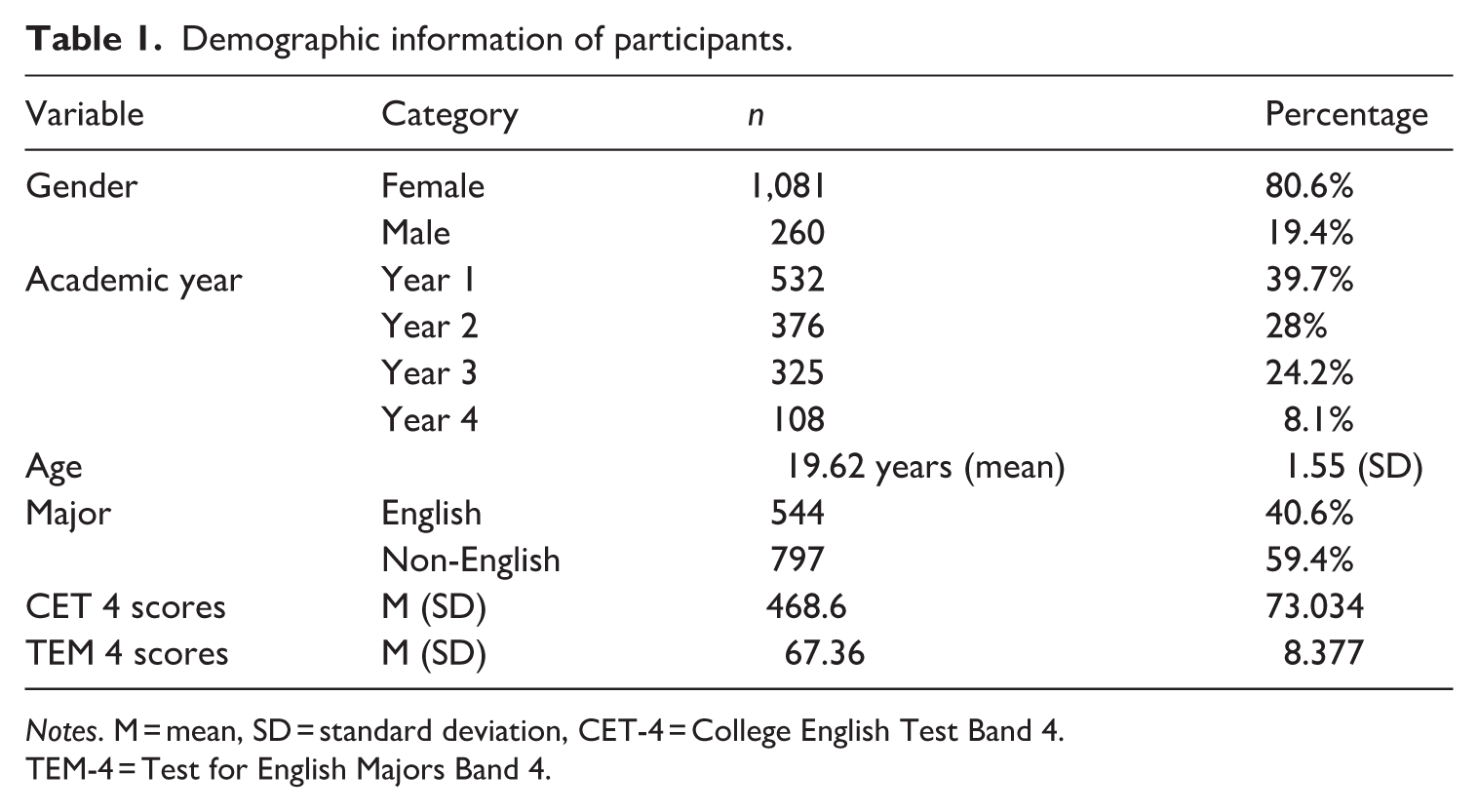
Notes. M = mean, SD = standard deviation, CET-4 = College English Test Band 4.
TEM-4 = Test for English Majors Band 4.
At the time when this study was conducted, the participants who were non-English major students were taking the College English Course as a compulsory course, which was aimed at enhancing students’ English language skills in listening, speaking, reading, writing, and translation. The participants who specialized in English took not only general English-language skills courses but also subject-content courses such as English literature, English linguistics, and business English.
4.2. Instruments
4.2.1. The English as a foreign language reading engagement questionnaire (EFL-REQ)
The English as a Foreign Language Reading Engagement Questionnaire (EFL-REQ) was developed to include four latent constructs of students’ engagement in English reading (i.e. behavioral reading engagement, emotional reading engagement, cognitive reading engagement, and social reading engagement) based on the multidimensional engagement framework proposed by J. A. Fredricks et al. (2016). Informed by J. A. Fredricks et al.’s (2016) framework and second language (L2) reading theories (Grabe & Yamashita, 2022), the EFL-REQ items were adapted from existing well-established and validated questionnaires on reading or learning engagement (e.g. J. A. Fredricks et al., 2016; Guthrie et al., 2013; S. McGeown & Smith, 2023; Mokhtari & Reichard, 2002; X. C. Wang, 2023; M.-T. Wang et al., 2016; etc.). As Dörnyei and Taguchi (2010) suggested, such an item-generation procedure lends construct validity to a scale. Specifically, a few items borrowed from S. McGeown and Smith (2023) were modified so that they were focused on English reading among Chinese university students rather than the original native English elementary schooling context. For example, the item ‘I read fiction books in my own time’ was reworded as ‘I read the English textbook in the class’ to fit with our research context. We also borrowed and adapted some items from Mokhtari et al. (2018). For example, the item ‘Re-reading to make sure I understand what I’m reading’ from Mokhtari et al. (2018) was reworded as ‘If the English reading material is difficult, I re-read to increase my understanding’ to fit with our participants’ EFL reading experiences.
The initial item pool was drafted in English and subsequently translated into Chinese via Brislin’s (1970) back-translation protocol. Three English language education experts from mainland China reviewed the translated version for clarity and alignment with the College English course context. Based on their comments, 2 items were removed due to redundancy or ambiguity, and 32 items were retained. Specifically, the behavioral engagement subscale included 9 items, for example, ‘I read the English coursebook in English class’; the emotional engagement subscale consisted of 8 items, for example, ‘I feel happy when reading English materials’; the cognitive engagement subscale included 9 items, for example, ‘If the reading material is difficult, I re-read to increase my understanding’; the social engagement subscale included 7 items, for example, ‘I explain to classmates what the English materials mean.’ All items were rated on a 7-point Likert scale ranging from 1 (strongly disagree) to 7 (strongly agree) (C. Li et al., 2024; Oga-Baldwin & Nakata, 2017).
4.2.2. Validation measures
4.2.2.1. Intrinsic motivation for English learning
To examine the concurrent validity of the EFL-REQ, participants completed the Intrinsic Motivation for English Learning Questionnaire, which included four items adapted from the survey in Oga-Baldwin and Nakata’s (2017) research to assess intrinsic motivation for English learning, such as ‘I want to be good at English.’ Each item was rated on a 7-point Likert scale ranging from 1 (strongly disagree) to 7 (strongly agree). The Intrinsic Motivation for English Learning Questionnaire demonstrated high internal consistency with a Cronbach’s alpha coefficient of .90.
4.2.2.2. English learning achievement
The participant’s English learning achievement was measured by their College English Test Band 4 (CET-4) scores. The CET-4 has been internationally recognized as a standardized and valid test of Chinese college students’ English proficiency organized by the National College English Test Committee (Jin, 2022; Ministry of Education, 2020; C. Wang & Sun, 2020; Y. Wang et al., 2021; H. Wang et al., 2023; K. Yang et al., 2024; Zhang, 2019). The CET-4 typically comprises four sections: listening comprehension (35%), reading comprehension (35%), translation (15%), and writing (15%) (Ministry of Education, 2020).
4.3. Data analysis
Initially, the dataset (n = 1, 341) was randomly split into two subsamples. The first subsample underwent EFA with principal component analysis and promax rotation to identify the preliminary factor structure of the EFL-REQ. The second subsample was analyzed using CFA to validate the factor structure derived from the EFA. Internal consistency, convergent and discriminant validity were assessed via Cronbach’s α, composite reliability (CR), average variance extracted (AVE), and heterotrait–monotrait (HTMT). Pearson correlation was exploited to verify the concurrent validity of the EFL-REQ.
Descriptive statistics (e.g. means, standard deviations, skewness, kurtosis) were used to assess participants’ overall EFL reading engagement. Measurement invariance tests (i.e. configural, metric, scalar, and residual) were conducted across subgroups (i.e. gender, academic year, and major) to assess whether the EFL-REQ structure operated equivalently across gender, major, and academic year subgroups. Linear hierarchical regression analyses were employed to explore the relationship between the EFL-REQ dimensions and English learning achievement.
5. Results
5.1. Exploratory factor analysis (EFA)
To explore the underlying factorial structure of the EFL-REQ, an exploratory factor analysis (EFA) was conducted using the first half of the dataset (n = 671). Principal component analysis with promax rotation was applied. Bartlett’s test of sphericity yielded a significant result, χ2(496) = 20,204.57, p < .001 (Bartlett, 1954), and the Kaiser–Meyer–Olkin (KMO) measure of sampling adequacy was 0.952, indicating excellent suitability for factor analysis (Hair et al., 2010; Tabachnick & Fidell, 2001).
The initial EFA results revealed a five-factor structure, with the fifth factor comprising items 11, 15, 16, and 23. These items were all negatively worded and reflected disengaged experiences (e.g. boredom, wasted effort or perceived difficulty), which, as a group, contradicts Svalberg’s (2009) and Oga-Baldwin and Nakata’s (2017) conceptualization of EFL engagement as a positive orientation and an active state toward the target language. Consequently, these negatively worded items were removed to preserve the construct validity and internal consistency of the measurement model of the EFL-REQ.
Additionally, items with a factor loading below the .40 threshold (e.g. item 22 ‘After I read the English material, I can retell the main idea in English’) (DeVellis, 2003), or showing significant cross-loadings (e.g. items 5–8) (Krishnan, 2011) were also deleted. The refined EFA results produced a four-factor 23-item model of the EFL-REQ (see Table 2), which was clearly consistent with the engagement framework proposed by J. A. Fredricks et al. (2016). Consequently, the final four EFL reading engagement factors were labeled as: (1) Behavioral Reading Engagement (4 items, α = .89); (2) Emotional Reading Engagement (5 items, α = .96); (3) Cognitive Reading Engagement (7 items, α = .92); and (4) Social Reading Engagement (7 items, α = .94). These Cronbach’s α values indicated high internal consistency.
EFA results of the EFL-REQ.
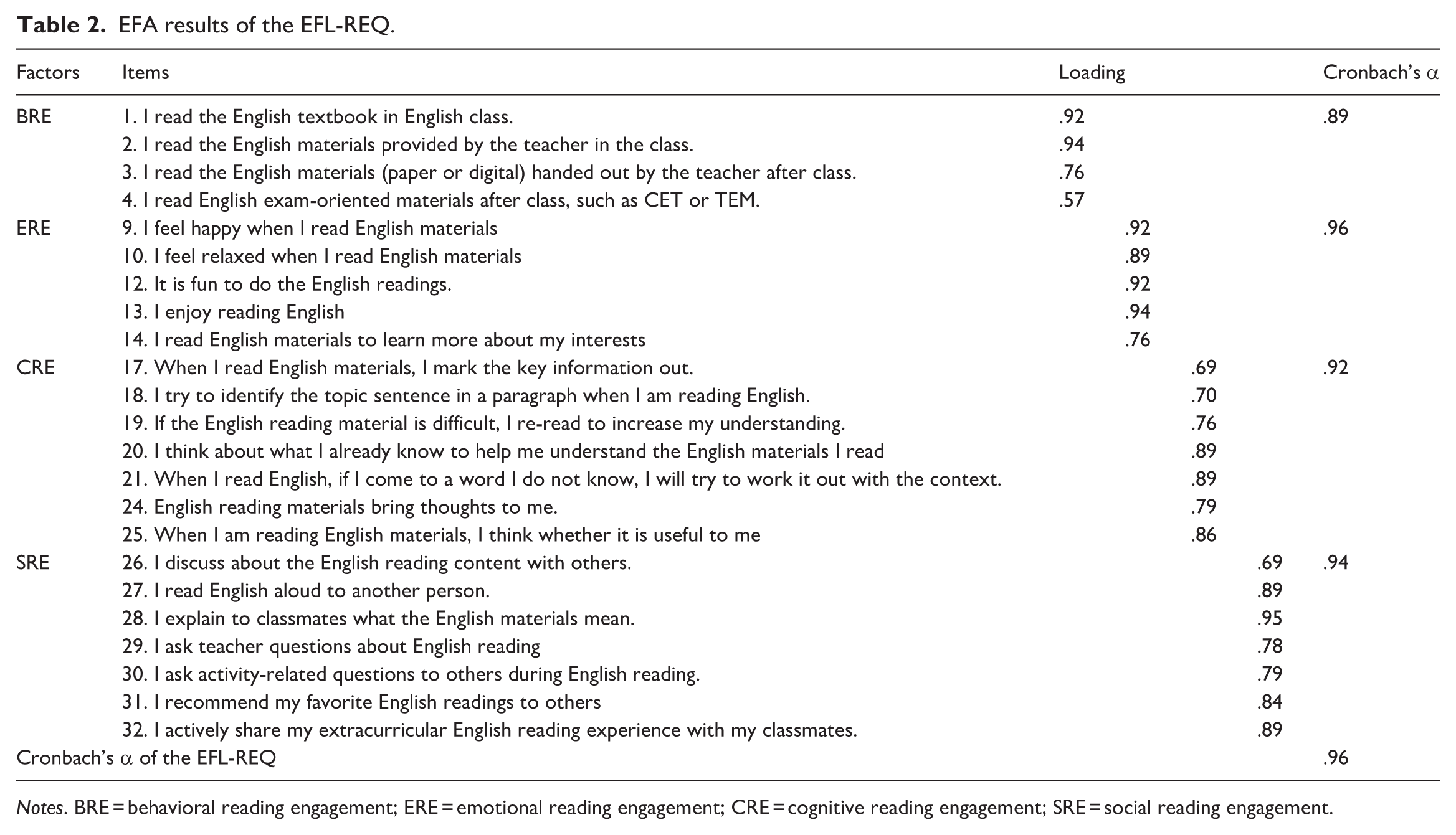
Notes. BRE = behavioral reading engagement; ERE = emotional reading engagement; CRE = cognitive reading engagement; SRE = social reading engagement.
5.2. Confirmatory factor analysis
Confirmatory factor analysis was conducted using the second half of the dataset (n = 670) to test the validity of the four-factor EFL reading engagement model derived from the EFA using AMOS 26.0. Initial CFA results suggested a relatively unsatisfactory model fit (χ2 = 1,873.011, df = 224, χ2/df = 8.362, SRMR = .0876, RMSEA = .105, CFI = .879, TLI = .864, GFI = .791, NFI = .866, IFI = .88). An examination of the standardized regression weights and error covariances indicated the necessity for adjustments. Two items from the cognitive reading engagement factor and two items from the social reading engagement factor were removed due to low factor loadings. Additionally, modification indices revealed covariances among item pairs (i.e. BRE 3 and BRE 4, ERE1 and ERE2, and CRE4 and CRE5). In this case, following the recommendation of Collier (2020), we refined the measurement model by calculating modification indices (MI) in Amos. Based on the MI value, three pairs of errors from the constructs BRE, ERE, and CRE, respectively, were correlated to reduce item redundancy in the measurement of variables. The decision to correlate these errors was based on both statistical and theoretical considerations. Statistically, the MI values indicated that allowing these error terms to correlate would lead to a substantial improvement in the model fit. Theoretically, the correlated error terms were associated with items that exhibited similar concepts or contexts within their respective constructs (i.e. BRE, CRE, and ERE), a phenomenon referred to as method effects (Brown, 2015).
The refined four-factor EFL-REQ model, consisting of 19 items (see Appendix A), demonstrated an improved fit (see Figure 1). Model fit indices for the revised model were all good or acceptable, with χ2 = 677.91, df = 143, χ2/df = 4.741, CFI = .952, TLI = .943, GFI = .904, NFI = .941, IFI = .953, RMSEA = .075, and SRMR = .0837 (Hu & Bentler, 1999; R. B. Kline, 2010, 2024; Marsh, 2007; Richter et al., 2020). These results indicated an adequate model fit (T. J. Kline, 2005). Although the χ2 remained significant (p < .001), the ratio remained acceptable given the large sample size (Kenny, 2020). The modifications applied to the CFA thus resulted in a refined 19-item four-factor EFL-REQ model that demonstrates strong alignment with the empirical data and overall satisfactory model fit.
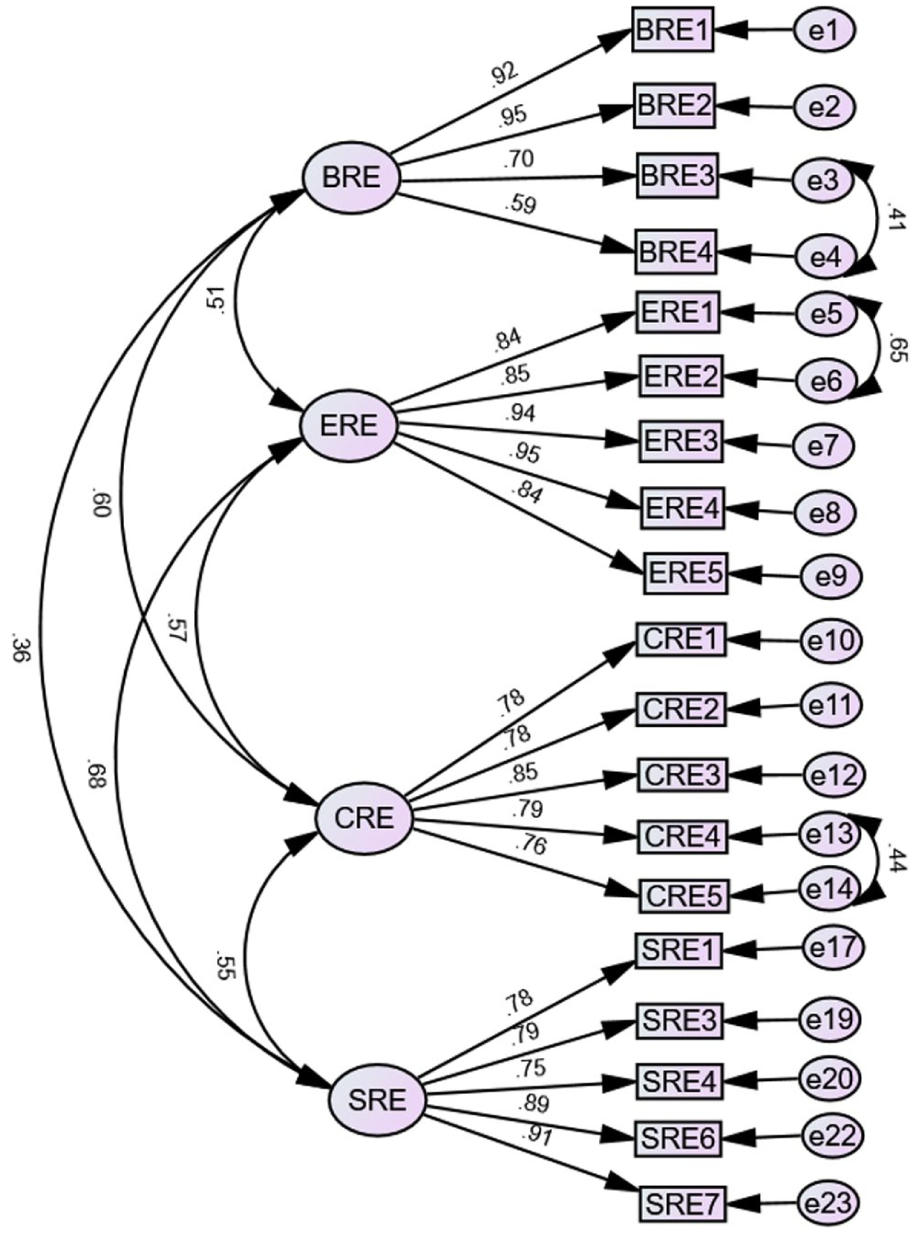
The four-factor EFL-REQ model.
5.3. Descriptive statistics
Table 3 presents the descriptive statistics, internal consistency, and intercorrelations for the four EFL-REQ factors. Behavioral reading engagement obtained the highest mean score (M = 5.36, SD = 1.23), followed by cognitive reading engagement (M = 5.13, SD = 1.15), emotional reading engagement (M = 4.27, SD = 1.37), and social reading engagement (M = 4.01, SD = 1.32). Data normality was assessed in accordance with Byrne’s (2010) recommendations, which suggest that skewness and kurtosis values should lie within ±2.0 and ±7.0, respectively. These results confirmed that the distributions of all four EFL-REQ factors met the criteria for normality.
Descriptive statistics, reliability, and correlations between the EFL-REQ factors.
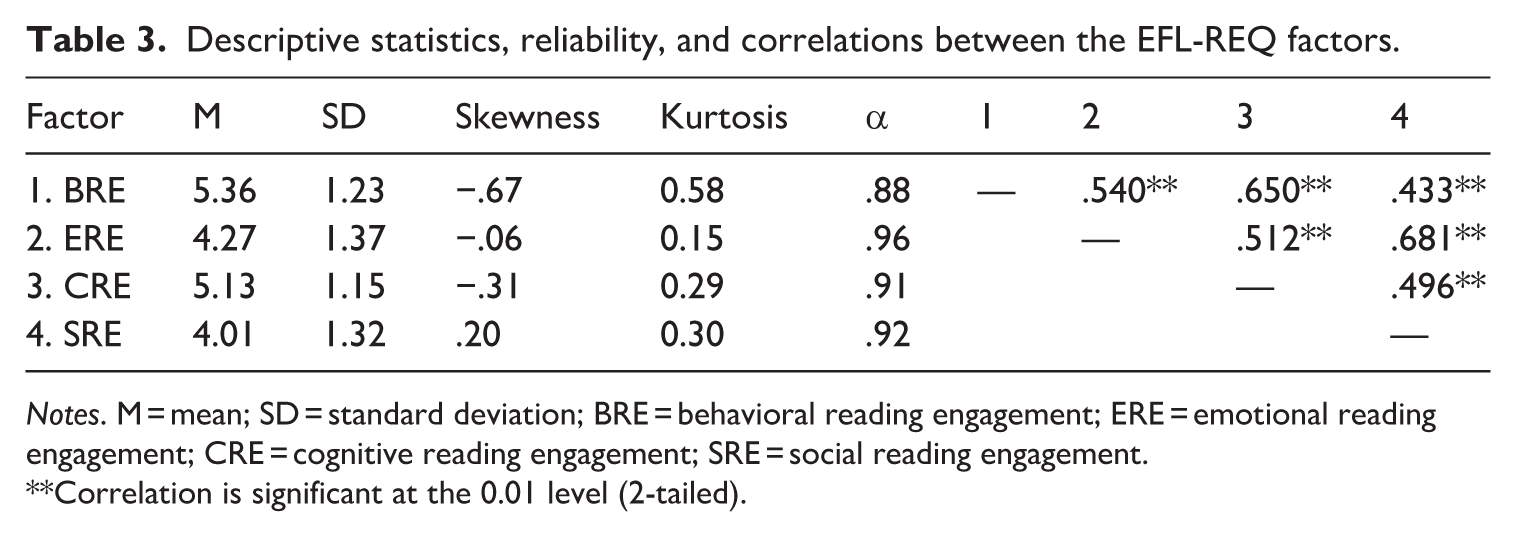
Notes. M = mean; SD = standard deviation; BRE = behavioral reading engagement; ERE = emotional reading engagement; CRE = cognitive reading engagement; SRE = social reading engagement.
**Correlation is significant at the 0.01 level (2-tailed).
The relationships between four dimensions of the EFL-REQ were both positive and statistically significant. The highest correlation was found between ERE and SRE (r = .681, p < .01), while the lowest was between BRE and SRE (r = .433, p < .01), demonstrating the interconnected yet distinct nature of the EFL-REQ subscales.
5.4. Model comparisons
Researchers usually use model comparison as an approach for evaluating construct validity by testing the hypothesized model against alternative plausible models (Mueller & Hancock, 2008). Two alternative plausible models were therefore tested below: a second-order four-factor EFL-REQ (Figure 2) model, and a unidimensional one-factor EFL-REQ model (Figure 3).
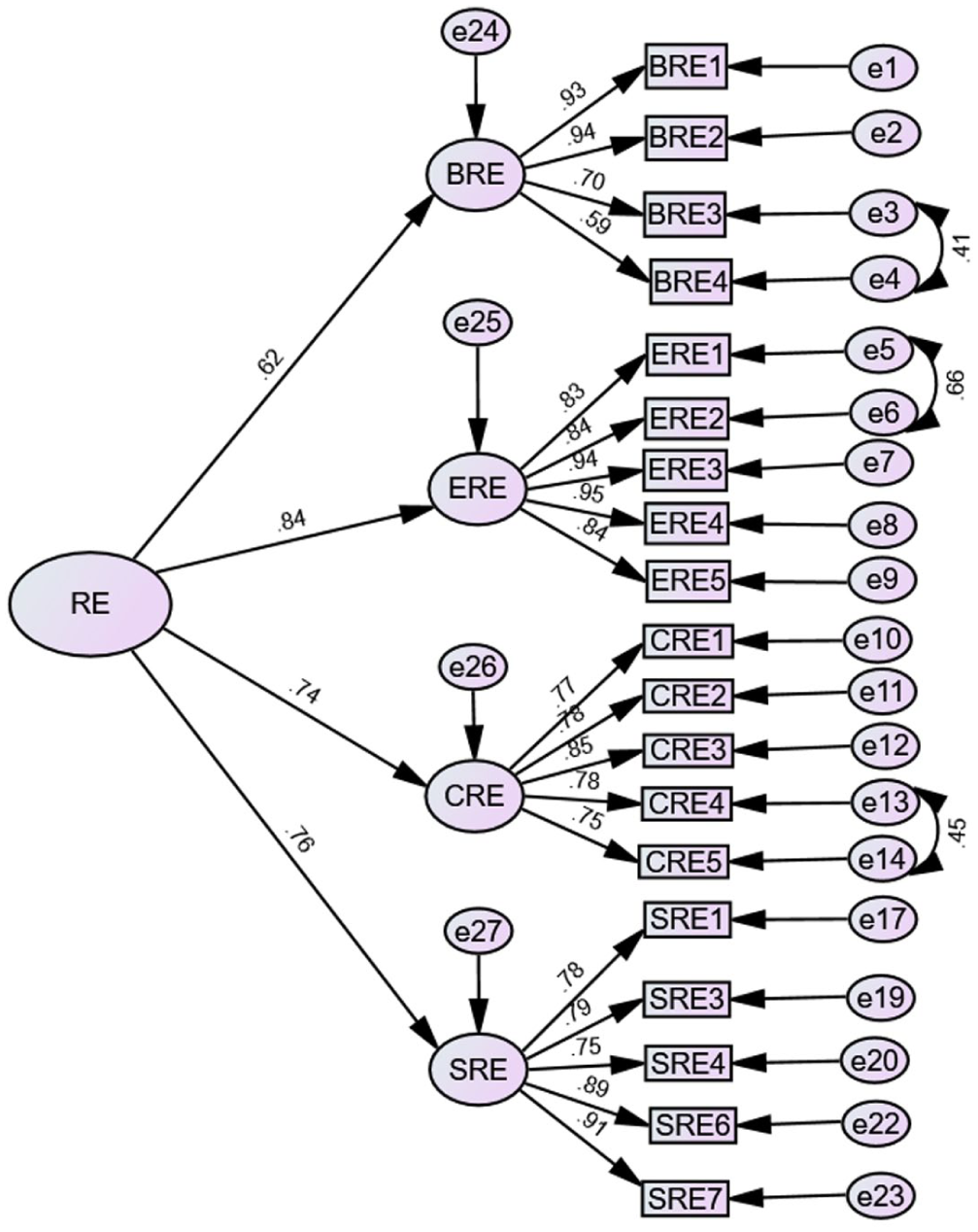
The second-order four-factor model of the EFL-REQ.
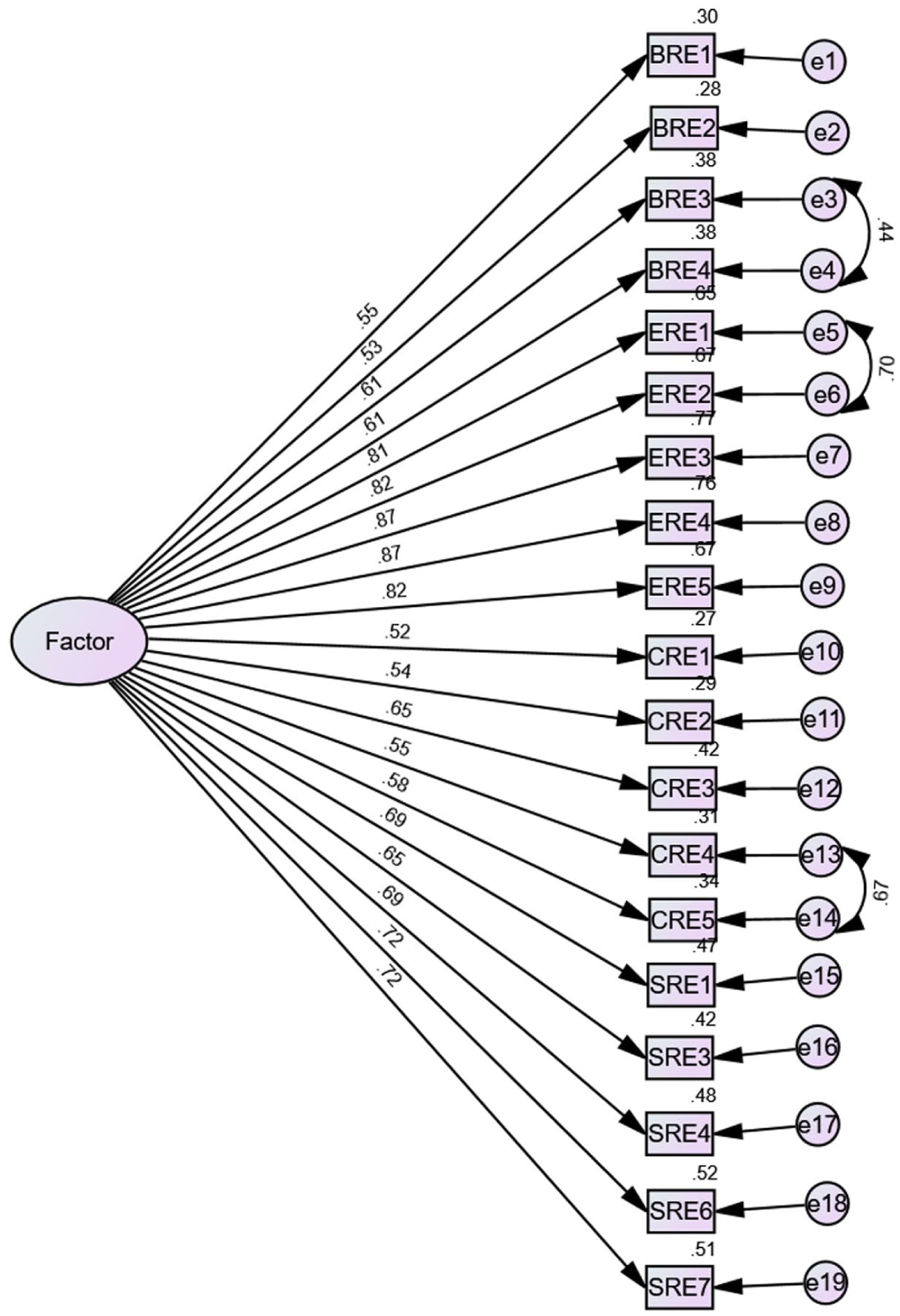
The unidimensional one-factor model of the EFL-REQ.
As can be seen in Figure 2, the second-order four-factor EFL-REQ model yielded the following fit indices: χ2 = 754.307, df = 145, χ2/df = 5.2, SRMR = .0932, RMSEA = .079, CFI = .946, TLI = .936, GFI = .893, and NFI = .934, indicating a relatively acceptable fit, though less robust than the first-order four-factor model (Figure 1). Standardized loadings from the four factors to the higher-order latent variable ranged from .619 to .840 (Figure 2), exceeding the .50 threshold.
As shown in Figure 3, the fit indices for the unidimensional one-factor EFL-REQ model were poor: χ2 = 3699.67, df = 149, χ2/df = 24.83, SRMR = .1214, RMSEA = .189, CFI = .684, indicating that a unidimensional structure did not adequately represent the data. These results led us to conclude that the first-order four-factor EFL-REQ model demonstrated superior suitability over both the second-order and one-factor models for representing the structure of EFL reading engagement in an EFL context. In other words, the first-order four-factor EFL-REQ model demonstrated stronger fit indices (e.g. including lower values for χ2/df ratios and RMSEA or SRMR, as well as higher values for CFI and TLI), thus reflecting a more accurate alignment with the data.
5.5. Convergent and discriminant validity
To further establish the construct validity of the first-order four-factor EFL-REQ model, both convergent and discriminant validity were evaluated following the confirmation of the factor structure through CFA (Hinkin, 1998). Convergent validity was assessed through CR and AVE, with acceptable thresholds set at CR > .70 and AVE > .50 (Fornell & Larcker, 1981; Hair et al., 2010). As shown in Table 4, the CR values for the four dimensions were 0.875, 0.947, 0.893, and 0.915, all exceeding the recommended threshold of 0.70. Similarly, the AVE values for the dimensions were 0.645, 0.782, 0.625, and 0.685, respectively, each surpassing the benchmark of 0.50. These results confirmed that the items within each factor were correlated, thereby supporting the convergent validity of the four-factor model.
Convergent validity and HTMT ratio of correlations among the EFL-REQ factors.
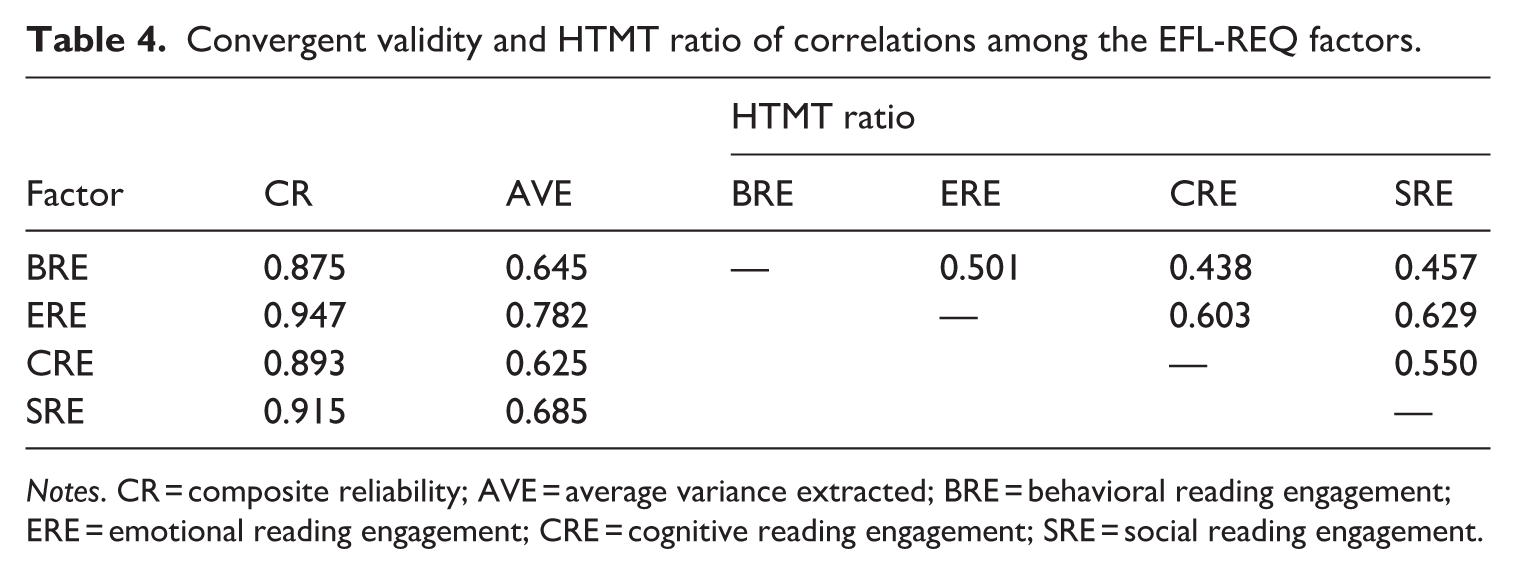
Notes. CR = composite reliability; AVE = average variance extracted; BRE = behavioral reading engagement; ERE = emotional reading engagement; CRE = cognitive reading engagement; SRE = social reading engagement.
Discriminant validity was evaluated using the heterotrait–monotrait (HTMT) ratio of correlations (Henseler et al., 2015), which assesses whether the dimensions are distinct and not excessively interrelated. The HTMT ratio for each pair of factors should not exceed the standard threshold of 0.90 (Henseler et al., 2015). As shown in Table 4, the HTMT ratios between all factor pairs ranged from 0.438 to 0.629, remaining well below the 0.90 criterion. These findings demonstrate robust discriminant validity, indicating that the four-factor EFL-REQ model adequately distinguishes between the behavioral, emotional, cognitive, and social dimensions of the EFL reading engagement.
5.6. Concurrent validity
The concurrent validity of the EFL-REQ was assessed by the correlation coefficients between the EFL-REQ dimensions and intrinsic motivation for English learning. As shown in Table 5, all four EFL-REQ dimensions were positively and significantly related to intrinsic motivation for English learning (p < .01), with emotional reading engagement having the highest correlation coefficient (r = .667, p < .001) and social reading engagement having the lowest coefficient (r = .483, p < .001). The two remaining EFL-REQ dimensions, i.e. behavioral and cognitive reading engagement, were also found to display strong positive correlations with intrinsic motivation for English learning (r = .601 and .654, p < .001). These results supported the concurrent validity of the EFL-REQ.
Pearson correlations of reading engagement factors with intrinsic motivation for English learning.
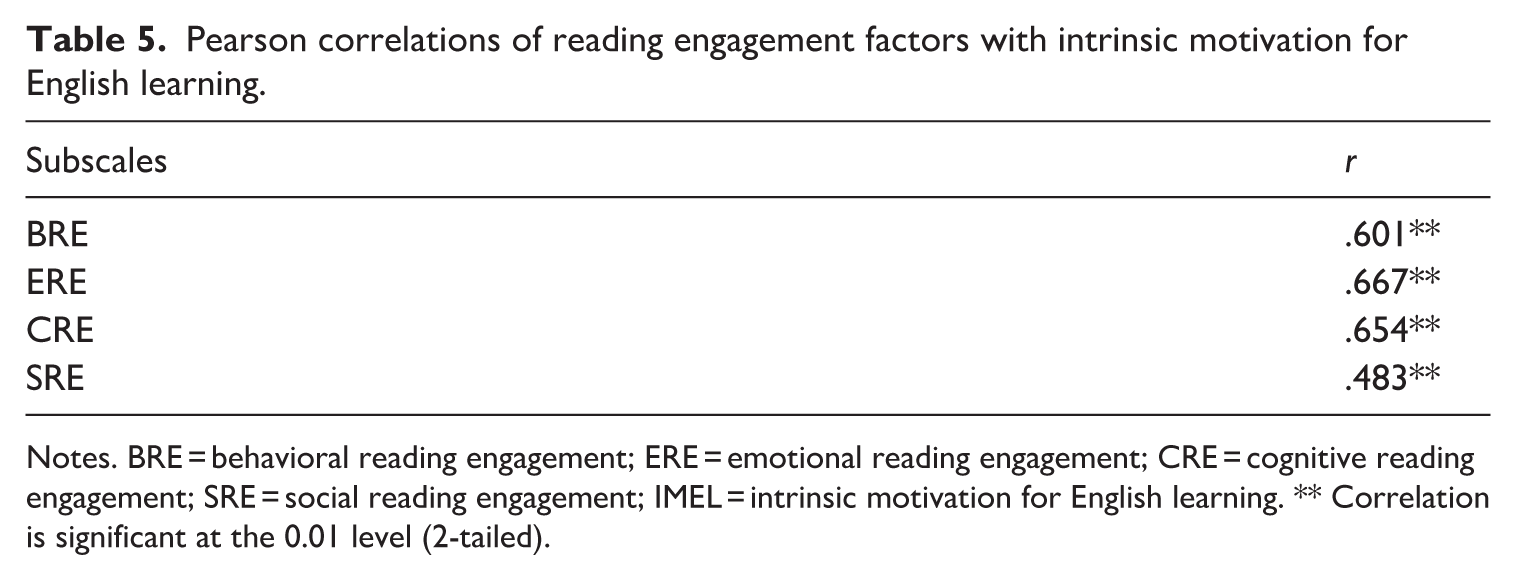
Notes. BRE = behavioral reading engagement; ERE = emotional reading engagement; CRE = cognitive reading engagement; SRE = social reading engagement; IMEL = intrinsic motivation for English learning. ** Correlation is significant at the 0.01 level (2-tailed).
5.7. Measurement invariance tests
Multi-group confirmatory factor analyses (MGCFAs) were conducted to test the measurement invariance across gender (G), major (M), and academic year (Y) using configural, metric, scalar, and residual invariance (Brown, 2015; Byrne, 2010; Cheung & Rensvold, 2002; Fischer & Karl, 2019; T. J. Kline, 2005; Milfont & Fischer, 2010; Putnick & Bornstein, 2016). To ensure that the construct across distinct groups is measured consistently, the equivalence of factor loadings, intercepts, and residual variances (errors) of the observed variables was set to be equal, respectively (J. F. Chen et al., 2005). The criteria for justifying whether the invariance differed from an unconstrained model (configural invariance model) are ΔCFI⩽ .01 and ΔRMSEA⩽ .01 (Cheung & Rensvold, 2002).
As shown in Table 6, the baseline models (G2 [χ2 = 1457.899, df = 286, CFI = 0.951, TLI = 0.942, RMSEA = 0.055, SRMR = 0.084], M2 [χ2 = 1449.328, df = 286, CFI = 0.951, TLI = 0.941, RMSEA = 0.055, SRMR = 0.079] and Y2 [χ2 = 2216.257, df = 619, CFI = 0.935, TLI = 0.928, RMSEA = 0.044, SRMR = 0.083]) showed good model fits, indicating that all students had the same interpretation of the EFL-REQ. The changes in fit index of the metric, scalar, and residual models (ΔCFI and ΔRMSEA) were far below 0.01, suggesting that the EFL-REQ was invariant between male and female students, between English majors and non-English majors, as well as between Year 1–4 students.
Structural equivalence (baseline/configural) and invariance (metric/scalar/residual) model comparisons for the EFL-REQ across gender, major and academic year.
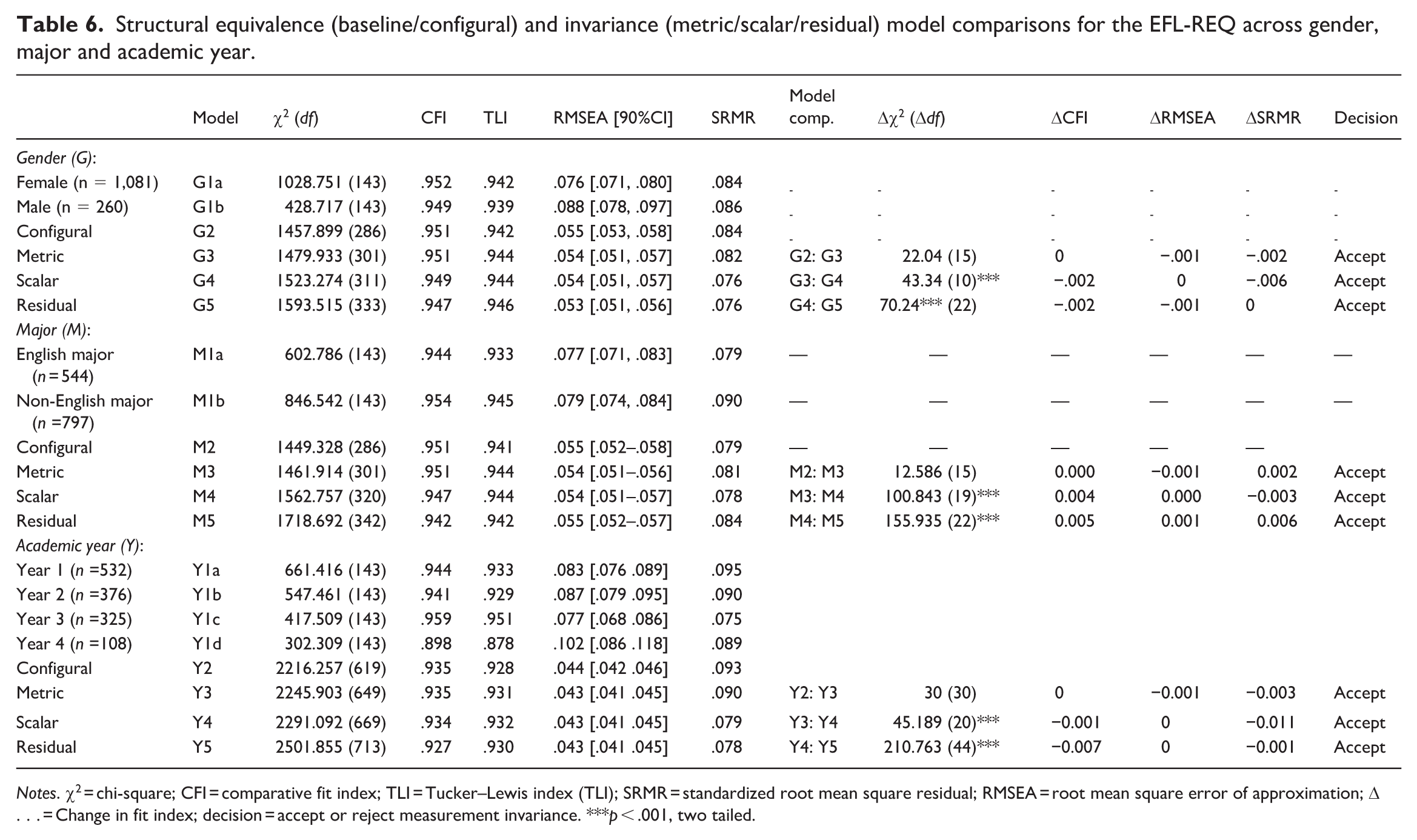
Notes. χ2 = chi-square; CFI = comparative fit index; TLI = Tucker–Lewis index (TLI); SRMR = standardized root mean square residual; RMSEA = root mean square error of approximation; Δ . . . = Change in fit index; decision = accept or reject measurement invariance. ***p < .001, two tailed.
5.8. Predictive effects of the EFL-REQ dimensions on English learning achievement
To further explore the unique contribution of the EFL-REQ dimensions to English learning achievement, two hierarchical regression analyses were conducted. Note that in many universities across China, first-year students are not usually permitted to participate in the College English Test Band 4 (i.e. the CET-4) (Q. Chen et al., 2020); L. Li & Li, 2025). Therefore, as only Year 2 and Year 3 students reported the value of English learning achievement (measured by the CET-4 scores), the valid total number of students reporting the CET scores in the current study was 451 (N = 451). In Models 2, 3, 4 and 5 (Table 7), the four EFL-REQ dimensions (i.e. BRE, ERE, CRE and SRE) were added as predictors step by step. Model 1(RE) showed that EFL reading engagement as a whole was significantly associated with English learning achievement (β = .121, t = 2.586, p < .05). Model 1 explained a total of 1.2% of the variance in English learning achievement (R2 = .012, F [4, 446] = 6.688, p < .05). Variance inflation factors (VIFs) for all predictors were below 2.2, indicating no serious multicollinearity issues (Menard, 2000).
Hierarchical regression analysis results (n = 451).
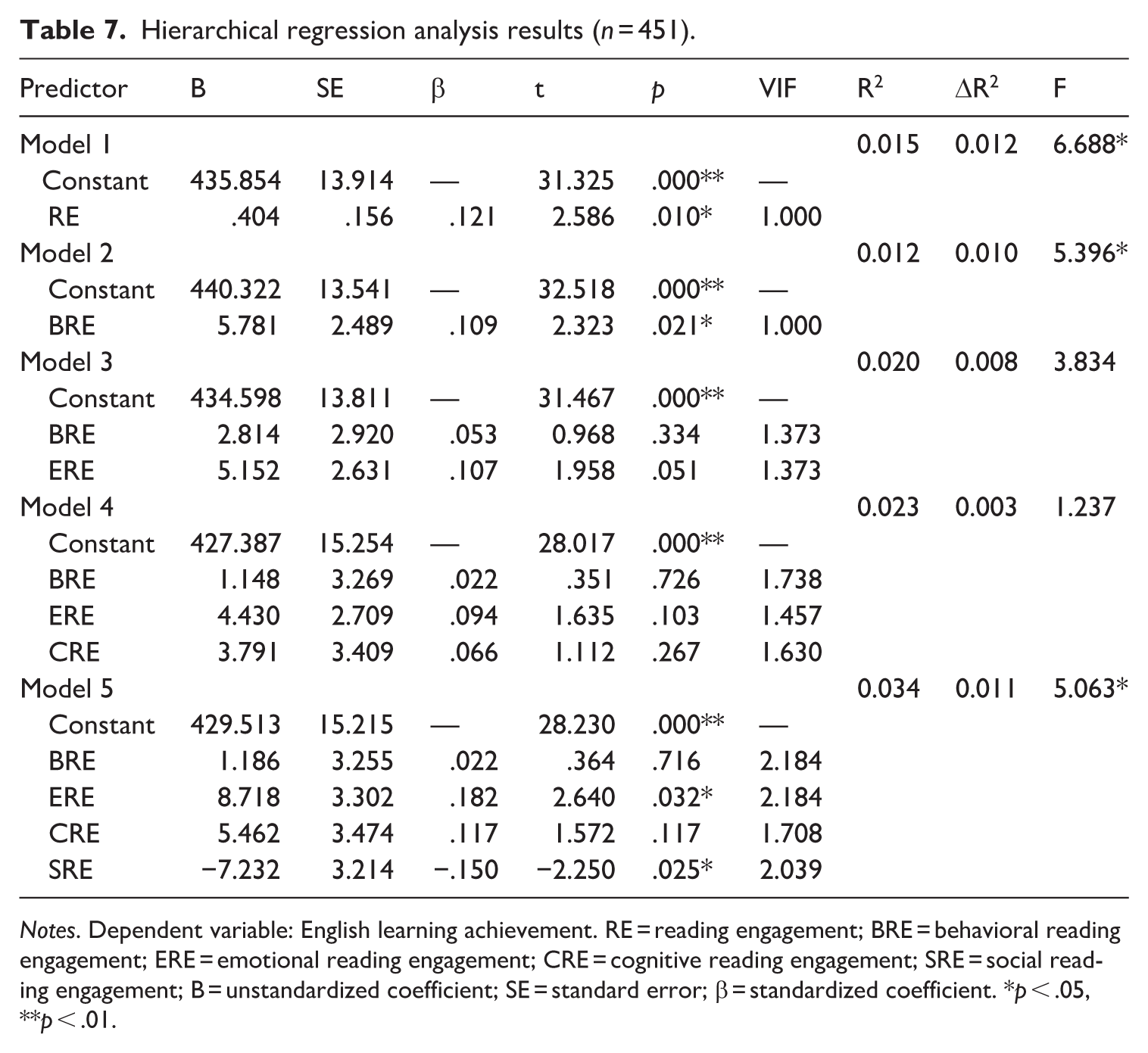
Notes. Dependent variable: English learning achievement. RE = reading engagement; BRE = behavioral reading engagement; ERE = emotional reading engagement; CRE = cognitive reading engagement; SRE = social reading engagement; B = unstandardized coefficient; SE = standard error; β = standardized coefficient. *p < .05, **p < .01.
In terms of the individual EFL-REQ dimensions, BRE was positively significant only in Model 2 (β = 0.11, t = 2.323; p < .001). BRE’s effect was no longer significant once additional predictors were added. Note that ERE became a significant positive predictor of English learning achievement in Model 5 (β = 0.182, t = 2.64, p < .05), indicating its unique contribution when the other three EFL-REQ dimensions were included. CRE was not a significant predictor in any model. SRE, however, emerged as a significant negative predictor in Model 5 (β = −.15, t = −2.25, p < .05). These results showed that BRE initially predicted English learning achievement in Model 2, but its influence diminished in subsequent models. In contrast, ERE and SRE were significant predictors in Model 5, with ERE positively predicting and SRE negatively predicting English learning achievement.
In the final model including the four engagement dimensions, the explained variance was small, R2 = .034, ΔR2 = .025, F(4, 446) = 3.916, p = .004. To address concerns about coefficient instability under high intercorrelations among predictors (Cohen et al., 2003), we further report the semi-partial (part) correlations for each dimension in the final model, along with their squared values (sr2) (H. Kim & Florack, 2021; H. Kim et al., 2021; Miller et al., 2019; Vitta et al., 2025). The unique variance explained was 0.03% for behavioral engagement (part = .017), 1.51% for emotional engagement (part = .123), 0.53% for cognitive engagement (part = .073), and 1.10% for social engagement (part = −.105) (see Appendix B).
6. Discussion
Relying on J. A. Fredricks et al.’s (2004, 2016) learning engagement framework, this research aimed to develop and validate the EFL-REQ in the area of EFL reading among Chinese college EFL students. The study also aimed to examine the extent to which the EFL-REQ might predict EFL students’ English learning achievement. Findings of this research identified a first-order four-factor structure of the EFL-REQ, including behavioral reading engagement, emotional reading engagement, cognitive reading engagement, and social reading engagement with robust reliability and validity. The structural measurement invariance test results provided empirical evidence for the structural consistency of the EFL-REQ across gender, academic year, and academic majors, thus supporting the EFL-REQ’s generalizability in broader EFL learning settings. Indeed, our findings offered compelling evidence for strong internal consistency and construct validity for the EFL-REQ. Consistent with J. A. Fredricks et al.’s (2016) engagement framework, these findings reflect the multidimensional nature of the EFL-REQ as a psychometrically sound instrument. Importantly, treating reading engagement as a multi-faceted construct allows us to investigate how each component individually affects students’ English reading performance or English learning achievement in an EFL context.
The concurrent validity of the EFL-REQ was assessed by examining the correlations between the four EFL-REQ dimensions and students’ intrinsic motivation for English learning. The results of the significant positive correlations between all four EFL-REQ dimensions and intrinsic English learning motivation were consistent with prior research in the literature (e.g. Ainley, 2006; J. A. Fredricks et al., 2004; Oga-Baldwin & Nakata, 2017; Unrau & Quirk, 2014), which suggested that intrinsic learning motivation is closely linked to student learning engagement. Guthrie and Wigfield (2000) also observed that being motivated is fundamental for sustaining efforts to engage in reading activities, using a range of strategies to increase reading comprehension, and achieving cognitive objectives associated with particular reading tasks.
Hierarchical regression analysis indicated that the EFL-REQ dimensions as a whole had a predictive effect, although a small one, on the English learning achievement, supporting the predictive validity of the EFL-REQ. This result aligns with the prior research (e.g. Lin et al., 2021; Oga-Baldwin, 2019; X. C. Wang, 2023; Wigfield et al., 2008) that showed that learners who were more engaged in reading tended to perform better in academic learning. Note that the explanatory power of reading engagement dimensions for the CET-4 scores in the current study was relatively limited, with the final model’s R2 ranging between 1.2% and 3.4%. This indicates that the students’ CET scores could be influenced by multiple factors, with reading engagement potentially contributing only a small yet detectable incremental explanation. Seen in this light, a possible explanation for the generally positive but small predictive effects of the EFL-REQ dimensions on English learning achievement is that reading engagement dimensions, as relatively distant predictors (Yue & Saad, 2025), may be more effective as a facilitating condition for developing students’ reading comprehension rather than contributing directly to their global English learning achievement (A.-Y. Kim & Kim, 2017). In other words, the reading engagement dimensions may function primarily as supportive or mediative conditions that foster students’ language achievement, rather than exerting a direct influence on their English learning achievement (H. Wang et al., 2023; Xu & Feng, 2024). This helps to explain that even the EFL-REQ dimensions with relatively greater contributions, i.e. ERE and SRE, exert only limited unique explanatory power (sr2 = 1.51%, 1.10%), with most variance stemming from shared components across dimensions.
With regard to the individual EFL-REQ dimensions, emotional reading engagement emerged as the most impactful positive factor influencing English learning achievement. This implies that students who exhibited greater emotional involvement in reading tasks generally achieve higher in their English learning. The result was consistent with J. A. Fredricks et al.’s (2004) discovery that a strong emotional connection to school boosts school participation and learning effort, with elevated levels in these areas leading to more favorable academic outcomes.
Unlike emotional reading engagement, social reading engagement in this study was found to have a negative effect on the students’ English learning achievement. This negative predictive effect could possibly be interpreted in conjunction with the nature and characteristics of the social learning practices Chinese students usually experience. Previous research has suggested that in exam-oriented learning environments, high-frequency social interactions often serve primarily as emotional support or peer companionship rather than systematic academic collaboration (Luan et al., 2025; Tan & Ren, 2025; Yin et al., 2023). Consequently, such social interactions tend to lack academic depth or deviate from learning content, and may even distract attention, encroach on study time, and lead to declining performance (Szabó & Prohmvitak, 2025). As observed by Dong and Wang (2025), in exam-oriented EFL settings, learners tend to reallocate limited time and attention toward activities they perceive as most directly linked to good exam scores. Consequently, the social reading engagement activities included in the EFL-REQ’s (e.g. such as peer discussions, explaining texts to others, and asking questions to teachers) may not translate into higher learning performance as exams primarily demand test-relevant skills and entail individual preparation activities usually perceived as most directly linked to satisfactory exam scores. This might also help to explain why the mean score of the social reading engagement was the lowest among the four EFL-REQ dimensions in the current study.
The result that the students’ cognitive reading engagement did not significantly predict English learning performance in this study can be interpreted with reference to the exam-oriented learning environment and the pedagogical implications of the CET-4 in particular. As a highly standardized English achievement test, the CET-4 has been designed to measure whether students have mastered the linguistic knowledge listed in the College English Syllabus in China. Within this test structure, the deep cognitive strategies students may employ during reading may not directly translate into test score advantages (Y. Wang et al., 2021; Wu et al., 2025). For example, Lei et al. (2018) reported that high-achieving students who possessed higher self-efficacy often attained high test scores without excessive cognitive reading effort, which aligns with Appleton et al.’s (2006) and Xu and Feng’s (2024) findings that cognitive engagement sometimes did not significantly influence learning achievement.
For the small R2 values observed in the present study, Wei and Hu (2019) proposed that a new effect size benchmark is needed in the applied linguistics field, rather than using Cohen-Mansfield’s (1988) criteria, as the latter might not be applicable anymore. They argued that for R2 in a regression model, 0.005, 0.01, 0.02, and 0.09 respectively, represent the small, typical (medium), large, and very large benchmarks for the effect size R2. Thus, in our case, the R2 = 0.034 represents a large to very large effect size, indicating that it does contribute a significant portion to students’ English learning achievement. This criterion has been successfully applied by some researchers (e.g. Dewaele & Botes, 2019; Wei et al., 2020). Collectively, despite the relatively small independent effects of each EFL-REQ dimension, the sr2 (unique variance) indicators still offered valuable insights into the role of different reading engagement dimensions within the context of a test-oriented learning environment (H. Kim et al., 2021; Miller et al., 2019). Importantly, this finding does not diminish the theoretical or pedagogical significance of reading engagement; rather, it underscores the need to situate reading engagement within a broader network of cultural, motivational, and contextual influences when seeking to understand and enhance students’ English learning achievement.
7. Implications and conclusions
This study contributed to the literature by revealing that the four EFL-REQ dimensions were interrelated but empirically distinguishable for university EFL students, confirming the multidimensional nature of EFL reading engagement. The study, therefore, substantiates that the EFL-REQ, as a psychometrically satisfying instrument, is capable of assessing behavioral, emotional, cognitive, and social engagement in the domain of EFL reading. The research findings indicate that, while reading engagement is a significant factor influencing English learning achievement, the mechanisms by which its various sub-dimensions affect learning achievement exhibit significant differences. On the other hand, the results suggested that the level of reading engagement itself might not fully account for the variability in English learning achievement, indicating the potential influence of other potential variables. Future research could use the EFL-REQ to examine the links between EFL reading engagement and other learner and contextual factors such as reading self-efficacy, reading emotion, and classroom instructional practices. Additionally, comparative EFL reading engagement analyses across different disciplinary backgrounds as well as across different institutional or cultural contexts (Oga-Baldwin & Nakata, 2015, 2017) would further illuminate the generalizability of the EFL-REQ.
Pedagogically, as a domain-specific instrument, the EFL-REQ can be used by teachers as a diagnostic tool in EFL classrooms for identifying both strengths and weaknesses in students’ English reading engagement profiles. Dimension-specific scores can inform targeted EFL reading instructional planning and implementation in the classroom. For instance, students’ low behavioral reading engagement could be addressed by integrating extensive reading tasks, increasing reading frequency, and exposing learners to a greater range of authentic EFL materials (Guthrie et al., 2012). For students who exhibit low emotional engagement, teacher interventions can include selecting reading topics that align with learners’ interests, providing positive feedback, and cultivating a psychologically safe classroom climate that lowers anxiety while promoting linguistic risk-taking (T. Kim & Schallert, 2014; Oga-Baldwin & Nakata, 2017). Consequently, the EFL-REQ can serve both as an assessment tool and a guide for teacher pedagogical activities in the EFL classroom.
From a self-regulated learning perspective, the EFL-REQ subscales represent a set of psychological tools to be appropriated by the EFL learners to help themselves to learn on their own (Compernolle, 2015). There is therefore the important potential for the EFL-REQ to be used by EFL learners themselves as a self-diagnostic tool to monitor and evaluate their engagement in EFL reading, and track trajectories of changes in reading engagement over time, as well as their impact on EFL reading achievement.
Several limitations of this study should be acknowledged. The first limitation relates to the use of convenience sampling in the study. The participants were students from a single university in mainland China. The sample might thus not be representative of Chinese undergraduate students. In addition, the sample was characterized by a gender imbalance reflected in a higher proportion of female students. Further research is recommended to include students from more diverse universities so as to have a better representation of Chinese college students.
Second, the cross-sectional research design of this study may limit our ability to establish causal relationships between the EFL-REQ variables and learning achievement. Therefore, we can only establish associations between the EFL-REQ dimensions and English learning achievement, but cannot infer explicit causal inference. For example, it is difficult to fully disentangle using the cross-sectional data whether higher reading engagement leads to higher achievement or whether higher achievement facilitates higher reading engagement. We suggest that future research should utilize a longitudinal or experimental research design to better capture how the EFL-REQ dimensions contribute to learning achievement over time.
Third, although several engagement dimensions were found to be statistically significant predictors in the regression analyses, the overall proportion of variance explained in English learning achievement (R2) was relatively low. This indicates that English learning achievement could be a complex outcome influenced by multiple factors. Variables not included in the present study, such as students’ prior English proficiency and vocabulary knowledge, might play a more substantial role in determining English learning achievement. Future research is therefore encouraged to incorporate a broader range of control variables to more comprehensively elucidate the mechanisms underlying students’ English learning achievement.
Fourth, in this study, the CET-4 scores were used as a proxy indicator of English learning achievement. Although the CET-4 is a rigorously validated standardized assessment of students’ general English learning achievement (Zhang, 2019), our results indicated that the EFL-REQ dimensions might be more closely linked to reading achievement than to students’ general English learning achievement. Future research should thus examine how individual EFL-REQ dimensions contribute to students’ EFL reading comprehension performance.
Fifth, guided by J. A. Fredricks et al.’s (2016) learning engagement framework, the current study focused on EFL reading engagement as a positive orientation and an active state toward EFL learning (Oga-Baldwin & Nakata, 2017). We therefore removed several negatively worded items, which were generally indicative of reading disengagement. This decision helped to reduce potential method effects and also suggested that the EFL-REQ focuses on capturing the positive facets of students’ reading engagement. It will be interesting, however, for future studies to explore how reading disengagement may affect students’ reading comprehension or overall learning achievement.
Finally, the data for this study were collected using self-report questionnaires, which might be susceptible to socially desirable responding. Future research can employ alternative data collection procedures, such as semi-structured interviews or observations, to avoid the potential gap between self-reports and EFL learners’ actual reading processes.
Footnotes
Appendix A
Declaration of conflicting interests
The authors declared no potential conflicts of interest with respect to the research, authorship, and/or publication of this article.
Funding
The authors received no financial support for the research, authorship, and/or publication of this article.
