







Abstract
Autism spectrum disorder (ASD) is among other things characterized by specific impairments in emotion processing. It is not clear, however, to what extent the typical decline in affective functioning is related to the specific autistic traits. We employed The Autism Spectrum-Quotient (AQ) to quantify autistic traits in a group of 500 healthy individuals and investigate whether we could detect similar difficulties in the perception of emotional expressions in a broader autistic phenotype. The group with high AQ score was less accurate and needed higher emotional content to recognize emotions of anger, disgust, and sadness. Our findings demonstrate a selective impairment in identification of emotional facial expressions in healthy individuals that is primarily related to the extent of autistic traits.
Keywords
Introduction
Altered affective functioning is usually assumed to be an intrinsic feature of autism spectrum disorders (ASD). One specific impairment considers identifying and interpreting of emotions from facial expressions (Buitelaar et al., 1999; Gross, 2004). Since an accurate perception of facial expressions is essential for establishing typical interpersonal relationships, this impairment might account for problems in social and communication development typically reported in these disorders (Crespi and Badcock, 2008; Frith, 2003). The inability to identify emotions is usually thought to be related to the lack of eye contact and diminished attention to the human face in people with autism (Klin et al., 2002; but see Rutherford and Towns, 2008). In addition, some cognitive models, such as the Weak Central Coherence (WCC), explain this atypical behaviour by the existence of a specific cognitive style – rather than integrating available information and hence processing it in a holistic way (Wang et al., 2012), people with autism tend to focus more on specific parts of information. Empirical evidence has been provided in support of this notion, demonstrating processing with more attention to detail (Behrmann et al., 2006; Fugard et al., 2011; Neumann et al., 2006; Stewart et al., 2009) and to non-feature areas of the faces (Pelphrey et al., 2002).
To estimate emotion processing in humans experimentally, facial emotion recognition paradigm is usually employed. When testing individuals with autism, the results of this commonly used approach are, however, inconclusive and often contradictory (see recent review by Harms et al., 2010). Beside a number of studies that clearly show deficits related to labelling facial emotional expressions and provide evidence that the processing of basic emotions is indeed altered (Bölte and Poustka, 2003; Buitelaar et al., 1999; Gross, 2004), others have not shown such impairments (Castelli, 2005; Jones et al., 2011; Tracy et al., 2011), and difficulties were sometimes restricted to specific emotions (e.g. Ashwin et al., 2006; Humphreys et al., 2007; Law Smith et al., 2010).
The possible origin of such contradictory findings might concern a very divergent symptomatology at the individual level within this group, and differences with regard to intelligence and cognitive functioning in general (Yeargin-Allsopp et al., 2003). Most studies tried to account for the latter by testing individuals with high-functioning autism (HFA), in which these differences are minimal. However, since autism is a spectrum disorder, people diagnosed with it exhibit a wide range of intensity and types of behaviours, significantly differing with regard to their symptoms despite the same classification. The traditional, categorical view of autism has been challenged by a more quantitative view proposing a continuum of social-communication disability, between autism and normality (Baron-Cohen, 1995; Wing, 1988). In this view, still under debate, behaviours associated with ASD are also present in the non-clinical broader autistic phenotype at a subclinical level (Ingersoll, 2010; Piven et al., 1997; Wheelwright et al., 2010). To test this idea, Baron-Cohen et al. (2001) developed an instrument that enables the measurement on this continuum. They introduced the Autism-Spectrum Quotient (AQ), which is a short, self-administered scale created for identifying the degree to which any individual adult of normal IQ may have autism-like traits. As such, this tool is useful for establishing the degree to which an individual possesses autistic features. Several recent studies suggest similar behavioural patterns in high-AQ individuals and people with ASD (Grinter et al., 2009; Stewart et al., 2009; Poljac et al., 2011; Reed et al., 2011). Grinter et al. (2009), for instance, showed that individuals with high levels of autistic traits display a similar profile of embedded figures test to that seen in autism. Reed et al. (2011) observed similar relationship between individuals with high-AQ score and ASD individuals on a perceptual learning task and the Navon letters task. Accordingly, they concluded that AQ is a valid instrument for the identification of those individuals from the non-clinical population who have comparable performance profiles as ASD.
One additional difficulty arises when opting for testing the emotion processing in autism: It is hard to disentangle the influence of autism traits from those generated by disparity in experience between individuals. Although the ability to recognize facial expressions is known to be the result of specific and specialized neural networks for decoding emotional configurations (e.g. De Haan et al., 2002), the role of experience is also important in the identification of emotional dimension. In fact, it has been shown already that both these components contribute to emotional decoding development (Balconi et al., 2011). While autism has frequently been related to atypical emotion processing, it is still not clear whether this is directly related to autism traits per se, or, alternatively, that differences in patterns of social communication formed by experience contribute to dissimilar functioning as well. Wallace et al. (2011) observed a recognition deficit related to the emotion of sadness and showed that this deficit is strongly linked to both symptomatology (specific characteristics of the disorder) as well as social functioning (strongly based on experience) in individuals with ASD.
Therefore, it seems sensible to use a more quantitative approach to investigate the extent to which the traits associated with the autism spectrum are related to altered emotion processing. Moreover, minimizing the influence of experience by testing individuals who function normally in everyday lives and have developed typical social skills (did not avoid social contacts) would allow for testing the specific contribution of autistic traits, without confounding variables, such as the amount of social involvement. This approach would hence possibly allow to disentangle the influence of experience from that of the autism traits. Accordingly, the current study investigated emotion processing in faces of healthy individuals differing in their degree of autistic traits as assessed by the AQ scale. We investigated their perception of what are generally agreed to be the six basic or universal emotions: anger, disgust, fear, happiness, sadness and surprise (Ekman, 1999), both in terms of accuracy (i.e. how often the emotion has correctly been identified) and the sensitivity (i.e. how explicit the expression of the emotion must be to be correctly identified). If the difficulties with regard to the recognition of facial emotional expressions reported in autism are mainly related to the autism traits and less to the experience at the individual level, then the AQ score should predict the pattern of emotion recognition. Specifically, we expected that those individuals with the higher amount of autism spectrum traits would perform worse on the Emotion Recognition Task (ERT, Montagne et al., 2007).
Methods
Participants
A total of 500 students from the undergraduate psychology programme at the University of Leuven took part in the current study for course credit. The study has been carried out in accordance with the ethical standards laid down in the 1964 Declaration of Helsinki and approved by the Ethics Committee of the Faculty of Psychology, University of Leuven. Participation was voluntary and all the participants gave their written informed consent prior to the inclusion into the study.
AQ
A Dutch version (Ponnet et al., 2001) of the AQ (Baron-Cohen et al., 2001) was employed to quantify the amount of autism traits. The questionnaire estimates the presence and the extent of autism traits in healthy individuals and consists of 50 statements arranged across five subscales: willingness of adequate social interaction and interest, the degree of repetition, attention to detail, degree of empathy and imagination. Four forced choices are offered to indicate whether participants ‘definitely agree’, ‘slightly agree’, ‘slightly disagree’ or ‘definitely disagree’ with each statement. When Simon Baron-Cohen et al. at the Cambridge Autism Research Centre published the test in 2001, the original test administration showed that 80% of people with either Asperger syndrome (AS) or HFA had a score between 32 and 50, whereas in a control group, only 2% of people scored within that range. The authors suggested that the AQ is a valuable instrument for rapidly quantifying where any given individual is situated on the continuum from autism to normality.
ERT
The ERT is a computer task used to evaluate emotion processing, that is, recognition of emotional facial expressions. Montagne et al. (2007) developed the task that includes colour pictures of the faces of four actors (two males, two females) that each poses six emotional expressions (anger, disgust, fear, happiness, sadness and surprise) and a neutral face. These images were used to create computer-generated morphs of 19 intermediate images between a neutral face (0% emotion) and a full-blown expression (100% emotion). This procedure includes the algorithms designed by Benson and Perrett (1991). In the morphed images, both the dimension of shape and texture underwent gradual transitions. The images were then used to construct short video clips that incrementally increase in time following an increase in the degree of intensity of the expression by 10% steps. For each actor, and each of the six emotions, there were nine video clips (0%–20%, 0%–30%, 0%–40%, 0%–50%, 0%–60%, 0%–70%, 0%–80%, 0%–90%, 0%–100%; Figure 1). More detailed descriptions of the task can be found in the original report of Montagne et al. (2007).

The Emotion Recognition Task. Depicted is a gradual transition from neutral face to a face with the full-blown emotion of happiness.
Benton Facial Recognition Test
To assess overall face recognition, the short form of the Benton Facial Recognition Test (Benton et al., 1994) was administered. This test detects possible generalized disorders of face perception, and it consists of a booklet with a single target face on each page, below which a set of six faces is presented. The first six trials comprise of an identical face that participants must select among five distracters. In each of the remaining seven trials, three faces matching the target photograph but with different orientation or lighting conditions could be distinguished from three incorrect alternatives. Accordingly, the maximum number of correctly identified faces is 27. All the faces are physically similar and unfamiliar, without spectacles or facial hair.
Procedure
Participants completed the AQ questionnaire prior to the ERT. The individual AQ scores were used as a selection criterion for the inclusion into the ERT, 5% highest and 5% lowest scores were selected (25 students each). A total of 21 students (13 female) with a score well above the average (the group mean AQ score 28.58 ± 3.88) and 18 students (12 female) that scored significantly below the average (the group mean score 6.27 ± 0.87) took part in the ERT. They had no known history of neurodevelopmental or psychological disorders. Participants first performed four practice trials, followed by the main experiment. In the main experiment, video clips containing morphed images of emotional expressions were presented in an incremental order, starting with 0%–20% intensity levels and ending with 0%–100% expressions (see Figure 1). This means that the participants first saw the 24 presentations (the six emotions in each of the four actors) of the lowest level of emotional expression (0%–20%), followed by the second set of 24 trials with video clips involving 0%–30% intensity levels, throughout all the levels until they reached the final sequence of video clips, in which the neutral face changes into a full-blown expression (0%–100%). The order of presentation of emotions and actors was randomized within each level. Participants were required to make a forced choice between one of six emotional expression labels that were displayed on the screen during the whole time of presentation in each trial. The duration of the animation in the video clips varied between approximately 0.5 s (low intensity) and 2 s (high intensity). Although the moving expressions were created in an artificial manner, they appear very similar to natural expressions. After the animation, the last frame remained on the screen until the participant made a response, at which time the new trial was automatically initiated. In total, each participant performed 216 trials without time restriction. The procedure was identical for both groups (for complete ERT task assessment, see Montagne et al., 2007).
Results
AQ
The distribution of the 500 AQ scores administered to all the participants in the present study resembled the normal distribution, with an average score of 15.04 (SD = 5.45). Assigning the students to a high- and a low-AQ group based on the individual scores resulted in the high-AQ group with scores well above average (this group had a mean score 28.58 ± 3.88), and the low-AQ group with scores significantly lower than the average (mean score 6.27 ± 0.87). Two participants had a score of 39, which according to Baron-Cohen et al. (2001) is highly unusual for control groups, since they observed that only about 2% of controls who participated in their study had the score above 32, as opposed to 80% of people with AS/HFA. We observed no significant differences in age between the two groups (average age 20 ± 1.62 and 19.88 ± 2.32 years, respectively).
Benton Facial Recognition Test
Participants did not differ significantly with regard to their score on the short form of the Benton Facial Recognition Test; the recognition rate was comparable with the average scores of 24.50 in the low-AQ group and 24.7 in the high-AQ group. According to the normative test data, both groups scored within the normal range.
The perception of facial emotional expressions: ERT
To estimate the participants’ perception of emotional facial expressions, two different measures were used: accuracy and sensitivity. Recognition accuracy was defined as the percentage of correct answers for each emotional expression at each intensity level. Perceptual sensitivity was defined as the level of emotional intensity that was required to correctly identify a specific emotion, estimated by fitting a Gaussian distribution to the data (maxim likelihood method; Wichmann and Hill, 2001).
Recognition accuracy
A repeated measures analyses of variance (ANOVAs) was performed with the group as a between factor and emotion as a within factor with six levels. Figure 2 depicts the average accuracy of recognition for both groups and for all six basic emotions. Overall, the participants with low-AQ scores were significantly more accurate (67%) in recognizing the facial emotional expressions (F(1,37) = 17.65; p < 0.001) than the high-AQ participants (62%). Furthermore, the accuracy levels varied considerably between different emotions in each group (F(5,33) = 258.41; p < 0.001). Specifically, in both groups, happiness is the most accurately recognized emotion (on average, 94.59% correct), followed by anger (73.26% correct) and disgust (65.57%), while the emotion of fear shows least accurate recognition (43.69%). Importantly, significant interaction was observed between group and emotion (F(5,33) = 2.87; p = 0.029). As the pair-wise comparisons showed, this effect was due to a significantly better performance of the low-AQ group for the emotions of anger (F(1,37) = 5.69; p = 0.02), disgust (F(1,37) = 8.36; p = 0.006) and sadness (F(1,37) = 5.798; p = 0.02) than the high-AQ group, but not that of fear, happiness or surprise (all Fs < 3.05, p values > 0.08).
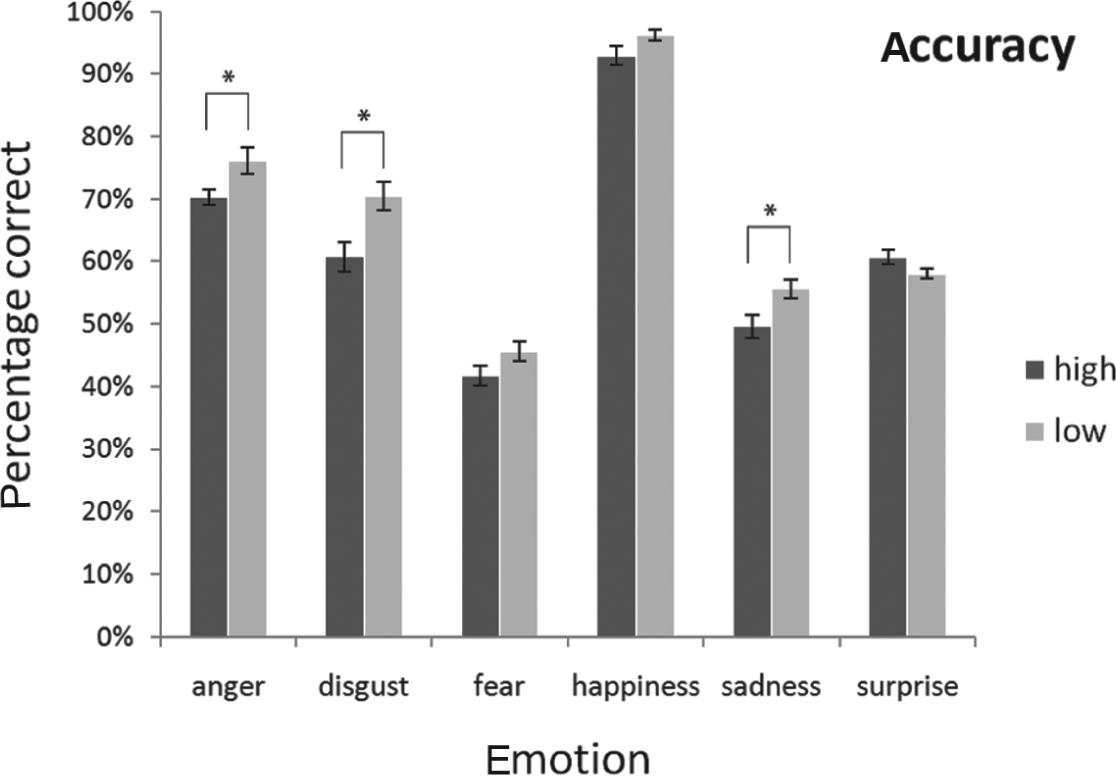
The accuracy of recognition of the six basic emotions in high and low AQ groups. Emotions of anger, disgust and sadness have a significantly lower recognition rate in the high AQ group compared to the low AQ group. In both groups the recognition rate differs for individual emotions, the highest accuracy for the emotion of happiness, the lowest for the emotion of fear. Error bars represent 1 SE, ‘*’ represents significant differences between the groups.
Identification accuracy of the six emotions varied across the different levels of emotional intensity of the presented video clips. Consistent with the reported findings in other studies using ERT (e.g. Poljac et al., 2011), increased intensity of emotional expression in a face always resulted in a higher recognition rate of all emotions in both groups. However, the rate of increase differed between individual emotions and between the groups (Figure 3). In trials with high emotional content (100%), the performance of the two groups did not differ, irrespective of the emotion displayed, except for disgust that showed a just significant level (p = 0.047). As can be seen in Figure 3, the largest differences were found for the medium (40%, 50% and 60%) levels of emotional intensity. The analysis of variance showed significant differences between the groups for the emotions of anger, disgust and sadness (all p values <0.01). The perception of emotions at these levels seems, therefore, to be the origin of the observed differences between the individual emotions and overall differences between the two groups.
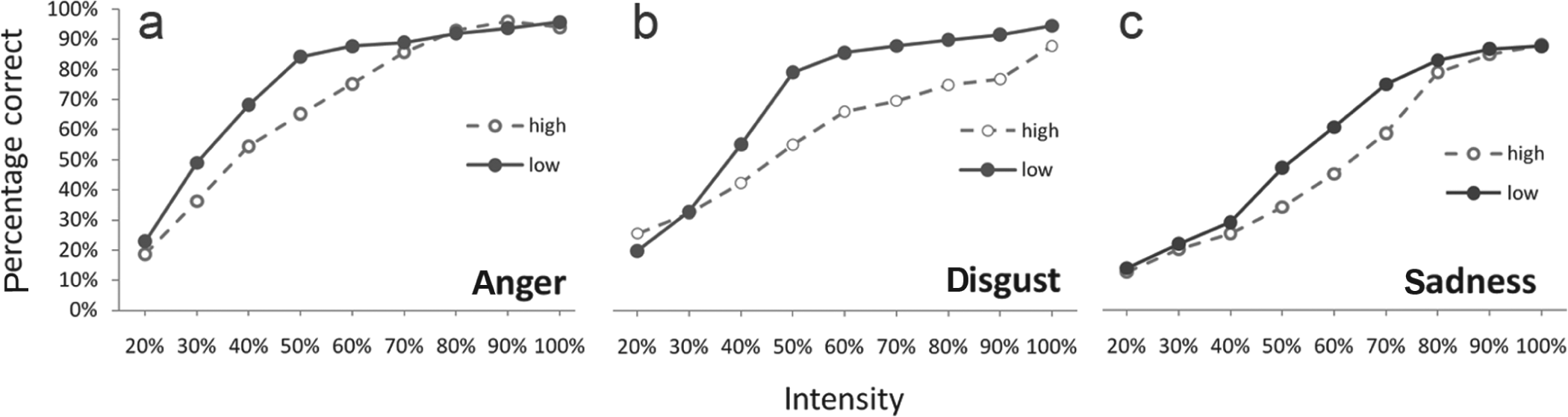
The accuracy of responses for all levels of emotional intensity (x-axis, levels from 20-100% emotional content in the face) for the emotions of anger (a), disgust (b) and sadness (c). A general trend for all emotions is an increase in the recognition rate associated with an increase of the emotional content, but the two groups differed with regard to the recognition rate increase, with main differences observed in the medium intensity range.
Perceptual sensitivity
Identification of the emotion of happiness is possible already at very low levels of intensity, while for other emotions such as fear, more emotional content in a face is necessary for correct interpretation (Figure 4). The level of emotional intensity required for a specific emotion to be correctly identified was the second measure we used to compare the two groups. We observed significant differences for this perceptual sensitivity between individual emotions (F(5,33) = 60.63; p < 0.001) and between the two groups (F(1,37) = 6.15; p = 0.018), as well as a significant interaction effect between the variables emotion and group (F(5,33) = 4.16; p < 0.01). Similar to recognition accuracy, the high-AQ group needed more intense emotional expressions to correctly identify anger, disgust and sadness, (F(1,37) = 4.48, p = 0.043; F(1,37)=7.29, p = 0.01 and F(1,37) = 6.6, p = 0.014; respectively).
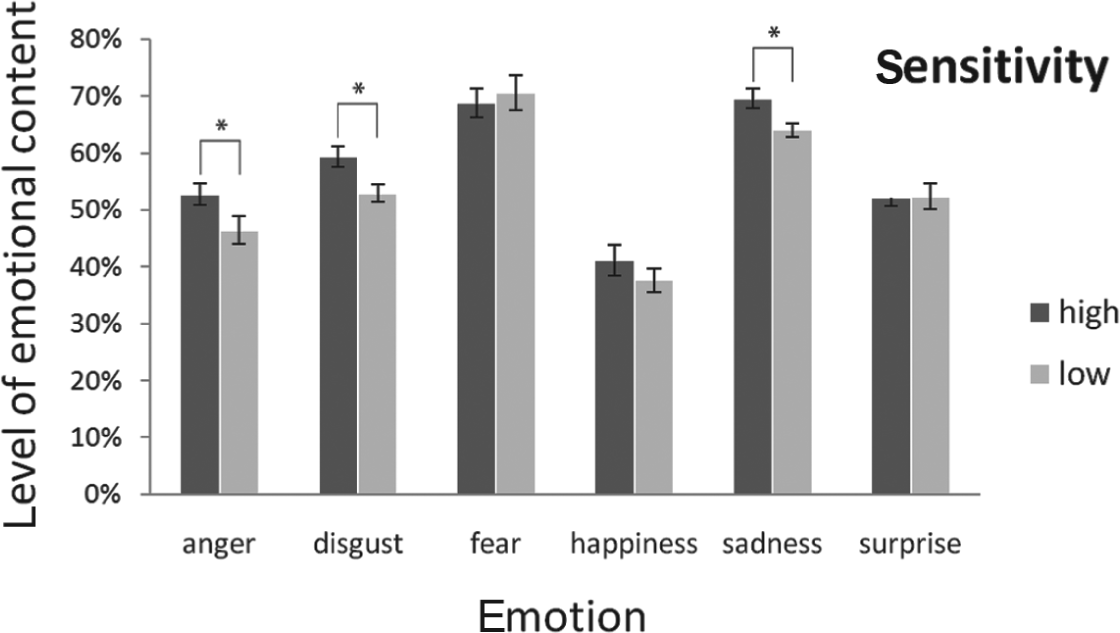
The level of emotional content necessary to correctly identify each emotion in the experimental groups. The pattern resembles the findings in previous studies, that the emotion of happiness required the lowest amount of emotional content to recognize it correctly, while the emotion of fear was most difficult to identify. There are significant differences between the two groups for the emotions of anger, disgust and sadness. Error bars represent 1 SE, ‘*’ represents significant differences.
Discussion
The present study investigated the recognition of facial emotional expressions in healthy individuals with high or low level of autism traits, as measured by AQ. The results demonstrated a reduced accuracy as well as a decreased sensitivity for the emotions of anger, disgust and sadness in the high-AQ group. These findings indicate that, compared to the group with low-AQ scores, individuals with more autistic features generally experienced difficulties in recognizing these particular emotional expressions correctly and that they required more intense expressions to do so.
The current findings are in line with the recent studies on affective processing in people with high-functioning ASD showing a similar impaired recognition of disgust and anger (Ashwin et al., 2006; Law Smith et al., 2010). In addition, Wallace et al. (2011) found a comparable decline in the recognition of sadness. They concluded that the limited experience in social interactions, specifically in identifying and processing emotions in others, is a likely source of the observed altered affective behaviour in this group. The lack of experience, as they further argued, is in particular reflected in the lower sensitivity to subtle emotional expressions, since those are more usual in social interactions than stereotyped fully expressed emotions. While social interactions and experiences undoubtedly influence the development of emotion processing, in the present study, we provide evidence that observed differences in interpretation of facial emotional expressions are also highly related to the extent of autism traits at the individual level. Clearly, individuals with autism and related disorders usually engage less in social situations than typically developing individuals. Although we cannot exclude the possibility that also our experimental groups differed in this respect – as we did not assess any measures on social skills – we had no a priori reason to assume any such differences: Both groups involved healthy psychology students with no history of neurodevelopmental or psychological disorders that might cause a significantly different way of engaging in social interactions. Further studies might help us validating this assumption. Nevertheless, the difference observed between the compared groups was that, unlike the low-AQ group, the high-AQ individuals share similar traits with people with autism: Baron-Cohen et al. (2001) also found higher AQ scores among ASD individuals. Our findings therefore clearly indicate that these traits are related to the affective behaviour.
With regard to the methodology, the questionnaire employed in this study seems to be a suitable measure to evaluate the influence of autism traits on behaviour without confounding variables and might provide a valuable contribution to understanding autism as well (Stewart et al., 2009). Crucially, similar to what has previously been reported for some other cognitive processes (Fugard et al., 2011; Kunihira et al., 2006; Poljac et al., in press; Stewart et al., 2009), AQ was sensitive enough to detect the differences in emotion processing. The exact nature of traits that AQ measures is, however, still under debate, as there are claims that it might be the same deficit that underlies both AQ performance and other perceptual tasks. For instance, there are suggestions that WCC (Happé and Frith, 2006) might influence both the AQ score and perceptual tasks as well (Reed et al., 2011). A number of studies have linked autism with impairments in general cognitive functioning, particularly with impairments in the area of social cognition. In their recent study, Couture et al. (2010) showed that individuals with HFA were impaired on a variety of social cognitive tasks relative to the non-clinical controls.
Indeed, while a declined performance in affective tasks might occur as a consequence of a compromised intelligence, or impaired general cognitive functioning (Mathersul et al., 2009; Montagne et al., 2005; Wakabayashi et al., 2006), the observed decreased performance on a number of emotions in the high-AQ group in our study is most likely not related to such deficits. Although there was no explicit assessment of cognitive functioning in the present study, significant variations that would have influenced the results are highly unlikely. The sample of students in the current study was very homogeneous, except for the difference on autism traits. If our groups had differed in general cognitive functioning, then one would expect to see differences in how they process faces in general. The results on the Benton Facial Recognition Test of the two groups in our study evidently indicate that this is not the case. While the deficits in basic face processing can influence the perception of emotions in faces, the observed compromised performance in the high-AQ group in this study is most likely not related to such deficit, as both groups had normative scores on this cognitive task. Besides, Kunihira et al. (2006) showed earlier that dissimilar AQ scores do not necessarily predict a difference in general cognitive functioning. Moreover, it is difficult to see why such cognitive decline in one group would result in a selective problem for anger, disgust and sadness. One additional point regarding our participants needs further elaboration. The high number of female participants in our study reflected the gender distribution in the undergraduate psychology students. Although gender has not significantly affected the performance, generalizing our findings must be done cautiously for two reasons: the prevalence of autism is higher in males, and male and female individuals seem to differ with respect to facial emotion recognition (Montagne et al., 2005).
The present findings confirm that the main differences in emotion processing are most likely related the perception of low and medium levels of emotional intensity, similar to the earlier reports (Poljac et al., 2011; Wallace et al., 2011). Importantly, our data might help understanding the inconsistent earlier observations regarding processing of facial expressions in autism, by addressing a possible methodological limitation of the previous studies. Images used in these studies were usually pictures of faces that displayed fully expressed emotions, which might have resulted in ceiling effects, and hence were not sensitive enough to reveal difficulties in emotion processing. Cartoon-like presentations of facial expressions typically contain exaggerated representations of emotions, and children with autism seem to process this information in a very usual way, similar to controls (Evers et al., 2011; Rosset et al., 2008). This is in large contrast to typically subtly expressed emotions and dynamic presentations that best approach the usual real-world context. Indeed, in a standard social context, emotional expressions build-up from neutral face and also frequently change from one expression to another. This dynamic aspect of emotional expressions in faces proved to be useful, in general, when employed in laboratory conditions, facilitating the perception of facial expressions (Harwood et al., 1999). Dynamic presentations have been used in previous research only by few studies (Law Smith et al., 2010), and these proved to be a more efficient way of estimating emotion processing. Dynamic presentations not only enable the measurement of impairment in terms of recognition and identification but also show how intense the expression must be to identify it correctly, which would not be possible using static pictures.
In conclusion, the current study presents an important finding on emotion recognition, particularly in terms of relating non-clinical broader autistic phenotype at a subclinical level to emotion processing. The growing body of work has shown already that high-functioning individuals with ASD experience difficulties with processing facial emotional expressions. Our study seems to support the notion that the ability to recognize emotions is highly related to the extent of autism traits. In addition, the AQ seems to be a useful instrument to study cognitive functioning of autism-related disorders as it allows us to reduce possible confounding factors usually associated with differences in experience and strategies that individuals with autism might develop across their lifespan. Furthermore, this study encourages the use of dynamic tasks in emotion perception research as they enable detection of differences not only in recognition but also in the sensitivity of perception.
Footnotes
Acknowledgements
Ervin Poljac and Edita Poljac contributed equally to this study. We thank Tine Leesen at the University of Leuven for help with data collection.
Funding
The present study was supported by the Netherlands Organisation for Scientific Research [Rubicon grant no. 446-09-024] awarded to Edita Poljac and by the Flemish Government [Methusalem programme; grant no. METH/08/02] awarded to Johan Wagemans.