







Abstract
Many autistics report being distressed by eye contact, but eye-tracking studies suggest that eye contact is associated with hypo-arousal rather than hyper-arousal in autism. Within a live face-to-face paradigm combining a wearable eye-tracker with electrodermal activity sensors, 80 adults (40 autistics) defined words in front of an experimenter either staring at their eyes (direct gaze condition) or looking elsewhere (averted gaze condition). Autistics did not differ from neurotypicals in their eye behaviours nor their skin conductance responses. Autistics did not appear distressed when they were looking at the experimenter’s eyes in the direct gaze condition. However, neurotypicals, compared to autistics, might experience more stress when looking at the experimenter in the averted gaze condition, even after controlling for social anxiety and alexithymia. In comparison to autistics, neurotypicals might be hyper-aroused when they look at someone avoiding eye contact. Based on a bidirectional perspective on interactional difficulties in autism, we speculate that the neurotypicals’ distress when their attempts to eye contact are not reciprocated could make their behaviour insistent, which, in turn, could make the autistics uncomfortable. In our study, participants’ partner remained passive, displaying no specific reaction when a mutual gaze was shared or not. Future studies should test different partner reactions to gaze in various social contexts.
Lay abstract
Autistics are usually reported to share less eye contact than neurotypicals with their interlocutors. However, the reason why autistics might pay less attention to eyes looking at them is still unknown: some autistics express being hyper-aroused by this eye contact, while some eye-tracking studies suggest that eye contact is associated with hypo-arousal in autism.
This study is based on a highly controlled live face-to-face paradigm, combining a wearable eye-tracker (to study eye behaviours) with electrodermal activity sensors (to assess potential stress). We draw a nuanced picture of social attention in autism, as our autistic participants did not differ from our neurotypical group in their eye behaviours nor their skin conductance responses. However, we found that neurotypicals, compared to autistics, seemed to be much more distressed when their interlocutor did not gaze at them during the experiment.
Our study encourages to consider social interaction difficulties in autism as a relational issue, instead as an individual deficit. This step might be first taken in research, by implementing paradigms sensitive to the experimenter’s role and attitude.
Keywords
Introduction
Following the preferences expressed by our participants diagnosed with autism, we use identity-first language and refer to them as autistics and autistic adults (consistent with the French-speaking autism community preferences, see Geelhand et al., 2023). Many autistic adults report being overwhelmed when engaging in eye contact with another person (e.g. Hawkins, 2017; Trevisan et al., 2017; Vance, 2019). These testimonies are in line with the idea that direct gaze usually triggers an excessive emotional reaction in autistic adults; such hyper-arousal would lead, in turn, to active avoidance of the eye region (e.g. Tanaka & Sung, 2016). However, the experimental evidence for this hyper-arousal view is rather equivocal. Some studies do report that group differences in eye contact between autistic and neurotypical adults correlate with reflexive avoidance (e.g. Kliemann et al., 2010), high social anxiety scores (e.g. Corden et al., 2008) or hyper-activation of the amygdala (e.g. Dalton et al., 2005; Kliemann et al., 2012). Yet, several other studies find that autistic adults do not actively avoid other people’s gaze (e.g. Georgescu et al., 2013; Sawyer et al., 2012; Von dem Hagen et al., 2014). In comparison to neurotypical adults, autistics also exhibit lower – and not higher, as would be predicted by the hyper-arousal theory – electrodermal activity (EDA) in front of direct gaze stimuli (e.g. Hubert et al., 2009). Furthermore, when reduced attention to the eye region is reported, it is not always correlated with avoidance reactions (e.g. Clin et al., 2020; Hernandez et al., 2009).
There could be methodological explanations as to why experimental evidence is at odds with informal reports of eye aversion in autism. All the studies cited above assessed autistic gaze behaviour using videos or still pictures. However, there is growing evidence that results obtained in such laboratory contexts cannot be fully extended to real-life behaviours (see Freeth et al., 2013; Grossman et al., 2019; Hietanen et al., 2020). Hypotheses about live interaction should clearly be tested in live face-to-face paradigms. An increasingly popular step in this direction is to use wearable eye-tracking devices in live settings (see Valtakari et al., 2021 for an overview). The first studies using this methodology report that autistic adults pay less attention to the eyes (Hanley et al., 2015), especially when being watched (Cañigueral et al., 2020; Freeth & Bugembe, 2019). However, these studies do not include any arousal measure, and hence remain silent as to whether this group difference is due to an avoidance behaviour (e.g. Tanaka & Sung, 2016) or to a non-normative response to eye contact (e.g. Kylliäinen et al., 2012).
A measure of physiological reactions, concomitant with live eye-tracking, would be a straightforward way to investigate why autistic adults tend to look less at the eyes of other people. EDA is a peripheral index of the autonomic nervous system functioning (leading to fight or fly behaviours), easily measured through the skin conductance, that is, by changes in electrical conductivity in the skin over time (see Boucsein, 2012 for details). Skin conductance responses (SCRs) are reliable (see Gaigg et al., 2018) and especially relevant, as they allow to link fearful reactions in EDA to specific events, such as eye contact. Studies on EDA in autistic adults remain scarce and based, again, on non-live settings. Still, this literature shows either no group arousal differences (Gaigg et al., 2018; Maras et al., 2012) or hypo-arousal in autistic adults (Arora et al., 2021; Hubert et al., 2009; Mathersul et al., 2013).
In sum, either previous paradigms failed to capture the hyper-arousal autistic actually experience in live situations, or autistic adults are atypically hypo-aroused in front of direct gaze. However, if the latter possibility turns out to be correct, it would still need to be reconciled with reports that eye contact does trigger distress reactions in autistics. One line of explanation could be that the link between experienced and reported distress might be disrupted by alexithymia (namely, by difficulties in identifying and describing own emotions), which is common in autism (see Kinnaird et al., 2019 for a review). For instance, Gaigg et al. (2018) reported that alexithymia, and not autism, is associated with both reduced SCRs and a reduced concordance between subjectively reported and objectively measured levels of arousal. Moreover, difficulties in understanding and identifying their own emotions may prompt some autistics to react aversively to their emotional experiences and consequently experience more anxiety (Maisel et al., 2016; Oakley et al., 2022). Due to the interactional nature of eye contact, social anxiety could be at play in autistics’ negative reports (for a review, see Spain et al., 2018).
Current study
Participants were fitted with eye-tracking glasses and skin conductance sensors and were assigned to one in two conditions (between-groups design): throughout the task, they faced an experimenter who either consistently looked at their eyes (direct gaze condition) or consistently looked away from them (averted gaze condition).
We expected that, in the averted gaze condition, there would be no difference between our neurotypical and autistic participants in the amount of visual attention to the eye region; in this condition, we also expected a low number of SCRs in both groups, associated with no specific distress. In the direct gaze condition, we expected neurotypicals to pay more, and autistics to pay less, attention to the experimenter’s eyes. Depending on whether one favours the hyper- or the hypo-arousal theory, reduced attention to the eyes should be correlated with either many (hyper-arousal) or few (hypo-arousal) SCRs in autistics as compared to neurotypicals. Furthermore, we examined whether alexithymia or social anxiety plays a moderating role on the SCRs associated with eye contact.
Methods
Ethics approval and consent to participate
All procedures performed in this study and involving human participants were in accordance with the ethical standards of the Institutional Research Committee (Erasme-ULB Ethics Committee, approval code: P2018/625/CCB B406201838210) and with the 1964 Helsinki declaration and its later amendments or comparable ethical standards. Participants gave their written consent to be involved in this study after having been informed of their rights and all aspects of the sessions (number, length, content and collected data).
Experimental task
Each participant was accommodated, individually, at a table in a quiet room, in front of an experimenter, and instructed to define 20 words displayed on paper cards by the experimenter; participants were asked to avoid ‘dictionary-like’ definitions and encouraged to rather explain how they understand and appropriate the words at hand (cf. Supplemental methods for more details). As an example, the experimenter talked about the first word, then put down the card, unveiling the next word, and asked the participant to define it. The experimenter remained benevolently passive (i.e. serene, patient and carefully listening); participants were warned that the experimenter would neither comment nor react to their answers. For one half of the participants in each group (autistics vs neurotypicals), throughout the task, the experimenter consistently looked at the participant’s eyes (direct gaze condition); for the other half, the experimenter consistently looked away from the participant (averted gaze condition). We intended to make this task interactional by putting our participants’ image at stake: what they would say might inform the experimenter’s opinion on who they are, and how cultured they might be. In accordance with previous studies that have showed that autistics are concerned for their reputation (e.g. Cage et al., 2016a, 2016b), several autistic participants appeared concerned about the social evaluation of their performance during and after the experiment (I must appear so stupid: I have forgotten to talk about . . .). However, using this specific paradigm, we aimed at preventing participants from experiencing stress because of the setting in three respects: first, it does not highlight the socioemotional value of the encounter; second, its structure is highly predictable; and third, it is not cognitively overloading, as our participants were prompted to say anything that was passing by their minds, without any objective evaluation.
Apparatus
Participants’ eye movements were recorded (at a 100 Hz rate) with Tobii Pro Glasses 2, a wearable eye-tracker. It provided us with binomial variables which indicated whether the experimenter’s eyes, face or body was fixated or not. Data quality has been checked: we reached 84% of valid data and data quality in both groups is broadly similar (see Table 1). Participants’ skin conductance was recorded (at a 15 Hz rate) by Shimmer3 GSR+ sensors attached with hook-and-loop fastener straps on the palmar side of the proximal phalange of their index and medium fingers of their non-dominant hand. Every skin conductance difference comprised between 0.1 and 1 µSiemens between two values separated by 1 s and followed by a recovery time was coded as a ‘SCR’. See Supplemental methods for data preparation and synchronisation details.
Participant characteristics.
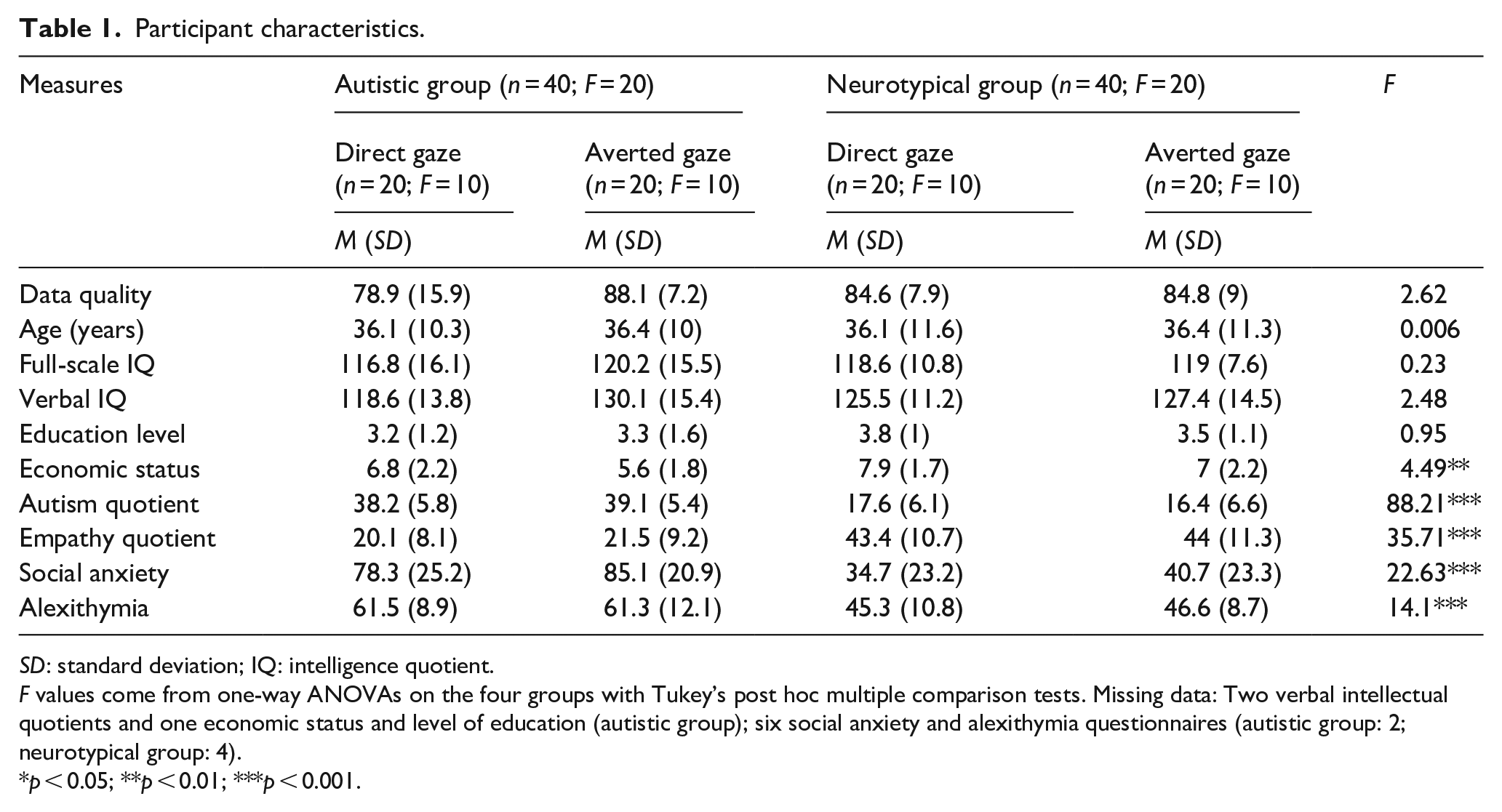
SD: standard deviation; IQ: intelligence quotient.
F values come from one-way ANOVAs on the four groups with Tukey’s post hoc multiple comparison tests. Missing data: Two verbal intellectual quotients and one economic status and level of education (autistic group); six social anxiety and alexithymia questionnaires (autistic group: 2; neurotypical group: 4).
p < 0.05; **p < 0.01; ***p < 0.001.
Participants
Participant characteristics are reported in Table 1. The autistic group was composed of 40 adults (20 women), aged 20–55 years (M = 36.25; SD = 9.98) and groupwise matched by full-scale intellectual quotient (FIQ) and verbal intellectual quotients (VIQ), as assessed by Wechsler Adult Intelligence Scale IV (WAIS-IV; Wechsler, 2008), to a neurotypical group consisting of 40 adults (20 women), aged 21–55 years (M = 36.23; SD = 11.33). For every recruited autistic participant, another autistic and two neurotypicals were recruited: the four were pairwise matched by age and gender and dispatched into four subgroups, following a group (autistic vs neurotypical) × condition (direct vs averted gaze) design.
We recruited 80 participants to make sure our study would be able to detect group differences. Indeed, Freeth and Bugembe (2019) reported a significant Group × Experimenter eye gaze direction interaction on the proportion of time spent fixating the experimenter’s face (F(1,23) = 4.85, p = 0.038,
Participants were recruited through our laboratory database, flyers (published on social media or pinned in public places) and personal networks. Inclusion criteria were being a native French speaker, being verbally fluent, having no intellectual delay and having normal or corrected-to-normal vision and audition. All autistic participants received a clinical diagnosis of autism or Asperger syndrome from multidisciplinary teams (composed of doctors, psychologists and social workers) specialised in diagnosing autism and officially habilitated to do so by the Belgian State, based on the Autism Diagnostic Observation Schedule (ADOS) (Lord & Jones, 2012) and the Autism Diagnostic Interview-Revised (ADI-R) (Rutter et al., 2003) criteria. To be included in the neurotypical group, participants needed to have no history of developmental delays, psychiatric diagnoses or neurocognitive impairments. There was a minority of childhood bilinguals (n = 9 in both groups).
Participants were asked to complete five predesigned self-administered questionnaires: the Adult Autism Spectrum Quotient (Baron-Cohen et al., 2001); the Cambridge Behaviour Scale (Baron-Cohen & Wheelwright, 2004), assessing the empathy quotient; the Liebowitz Social Anxiety Scale (Liebowitz, 1987), identifying three levels of social anxiety (mild, moderate or severe); the 20-item Toronto Alexithymia Scale (Bagby et al., 1994), grouping participants into three alexithymia profiles (not alexithymic, potentially alexithymic and alexithymic) and our laboratory questionnaire, adapted from the revised Family Affluence Scale (Currie et al., 1997, 2008; Hartley et al., 2016; Torsheim et al., 2016). The latter provides a proxy for the participant’s socioeconomic background: the education score is a 0- to 6-point scale (0 –no primary school achieved; 6 – the doctoral degree) and the economic status score is a 0- to 13-point scale (0 – very low; 13 – very high). Note that we did not attempt to match our groups by the socioeconomic variables: autistics, even if they are intellectually able, often encounter difficulties in their academic and working lives because of their autism, which can negatively impact their socioeconomic status (e.g. Jennes-Coussens et al., 2006; Taylor & DaWalt, 2017).
Data acquisition
All the adults were individually evaluated by a trained Master’s student in Neuropsychology (n = 75), blind to participants’ diagnosis and to the aims of the study, or by first author (n = 5). To maximise data quality, participants were encouraged to come to our laboratory, and most did (n = 55). However, some participants could not visit the laboratory, for personal or practical reasons, and were thus tested at their home (n = 25), in a quiet and comfortable room. Overall, only six interruptions occurred during the task (e.g. a participant’s cat jumping on the table; the postman knocking at the door): interrupted trials were discarded. Data reported here were collected at the beginning of an experimental session, before three other tasks. When a WAIS-IV IQ score no older than a year was not available, the IQ test was administered during another experimental session.
Statistical methods
All statistical analyses were implemented in R (R Core Team, 2019). The independent variables were group (autistic vs neurotypical) and condition (direct vs averted gaze). The dependent variables were eyes, face, mouth and the overall experimenter (proportion of fixations on those experimenter’s regions for each trial from each participant) and SCRs (proportion of SCRs for each trial from each participant). The variables were analysed with forward stepwise multilevel linear regressions, with by-participants and by-items intercepts in the random structure, using the lme4 (Bates et al., 2015) and the lmerTest (Kuznetsova et al., 2017) packages. We started from the null model and incrementally augmented it with group, condition and their interaction, keeping the random structure unchanged, until we reached the theoretically motivated maximal model. Post hoc comparisons of least-square means were carried out with the emmeans package (Lenth, 2019, version 1.4) with Tukey adjustment for multiple comparisons. Figures were created using the effects (Fox & Weisberg, 2019), the ggplot2 (Wickham, 2016) and the gridExtra (Auguie, 2017, version 2.3) packages.
Community involvement
This study hypotheses have been inspired by autistic adults’ firsthand testimonies, and the interpretation of the results has been driven by our participants’ feedbacks. Some of them also contributed to recruiting by spreading the flyer on social media or directly talking to friends.
Results
In this study, we investigated the correlations between the proportion of fixations on the experimenter’s eyes, face, mouth and overall experimenter (proportion of fixations on those experimenter’s regions for each trial from each participant) and the proportion of SCRs (proportion of SCRs for each trial from each participant). Table 2 sums up the mean proportions of each dependent variable (expressed in percentage) per group × condition. The results were identical for eyes, face (including eyes and mouth) and overall body (including face and hands). We were primarily investigating the specific debate between eye avoidance and eye indifference, so that we decided to report here the eye region analyses only and leave the other analyses for Supplemental results.
Mean proportions in percentage of each dependent variable.
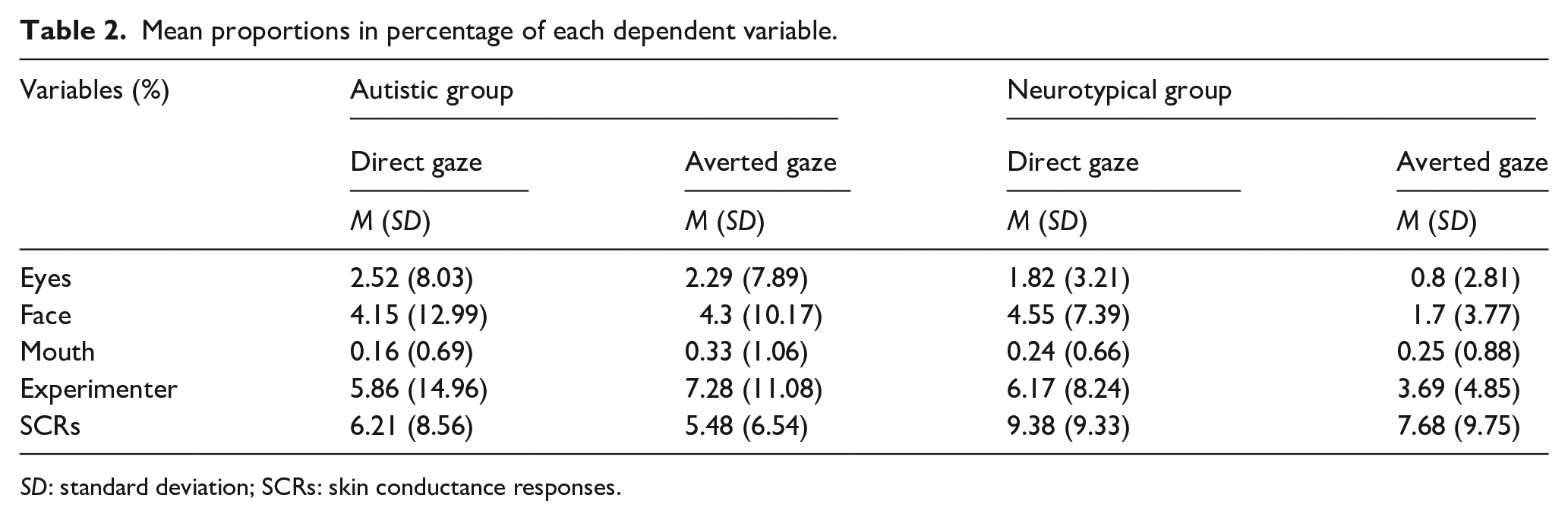
SD: standard deviation; SCRs: skin conductance responses.
First, we tested whether group or condition predicted fixations on the experimenter’s eyes (see Figure 1(a)). Stepwise comparisons of multilevel models revealed no difference in fixations between groups and conditions (all ps > 0.4). Likewise, there was no significant difference between groups and conditions (all ps > 0.12) in SCRs (see Figure 1(b)). To control for social anxiety and alexithymia, we built two different models, adding social anxiety scores or alexithymia scores as fixed factors to the maximal models. Adding social anxiety did not affect the absence of group or condition differences for fixation on the eyes (all ps > 0.285) nor SCRs (all ps > 0.813), nor did adding alexithymia on fixation (all ps > 0.489) or SCRs (all ps > 0.221).
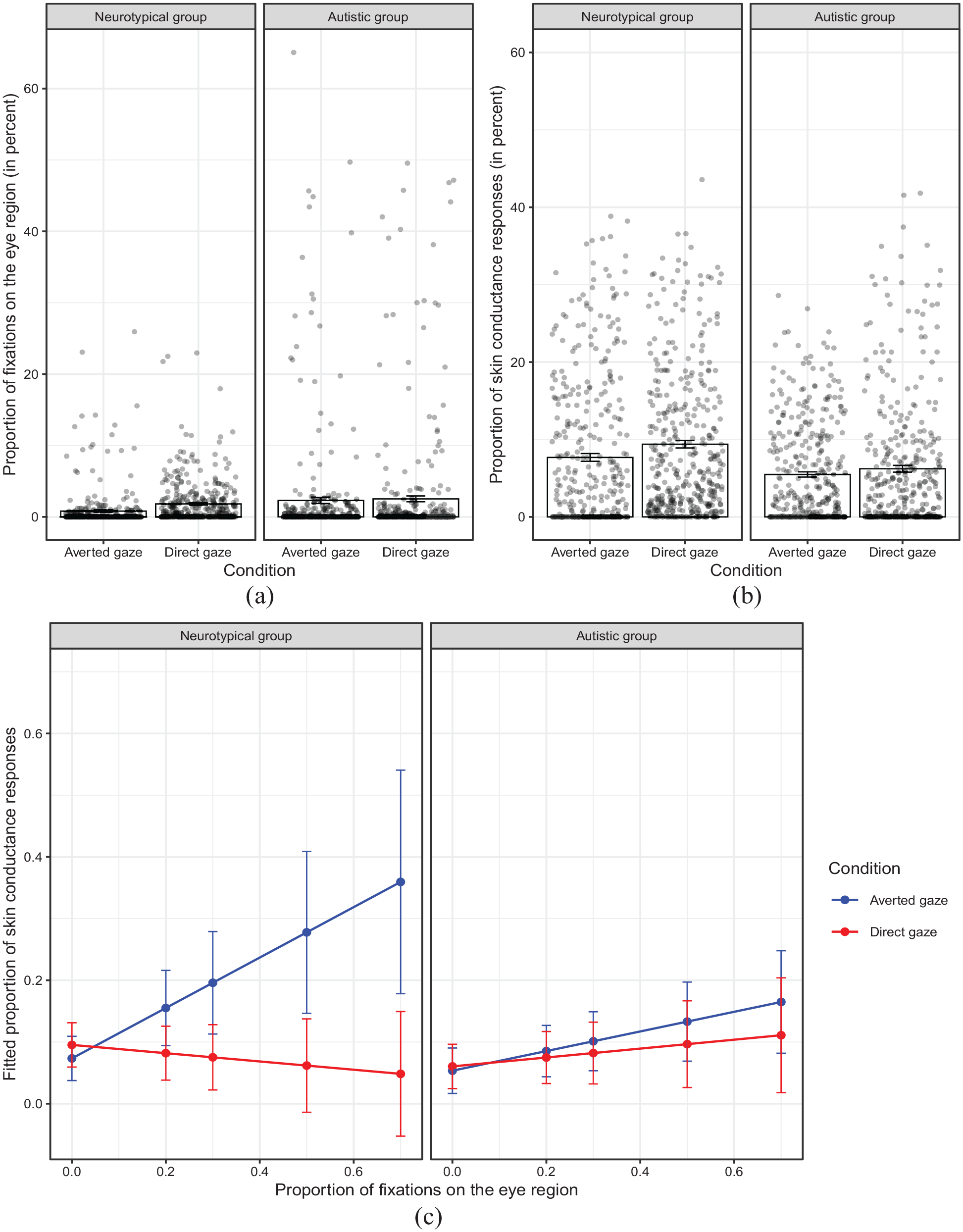
Group, condition and individuals’ proportions of fixations on eyes and skin conductance responses. Average proportions per group and condition of (a) fixations on the eye region and (b) skin conductance responses. (a and b) Dots represent individuals’ proportions per trial. Vertical bars represent standard errors of means. (c) Fitted proportion of skin conductance responses by proportion of fixations on the eye region. Vertical lines represent 95% confidence intervals.
Next, we tested whether SCRs can be predicted by the fixations on the eye region. Stepwise comparisons of multilevel models revealed significant eyes × group × condition interaction (χ2(1) = 5.1, p = 0.024). Figure 1(c) shows that the maximal model predicts that, in the neurotypical group, the proportion of SCRs increases along with fixations on the eye region in the averted gaze condition (β = 0.41, 95% CIs (0.15–0.67)) but not in the direct gaze condition (β = −0.07, 95% CIs (−0.21 to 0.07)); post hoc slope comparisons confirmed that this difference is significant (p = 0.008). To control for social anxiety and alexithymia, we built two different models, adding social anxiety scores or alexithymia scores as fixed factors to the maximal model, to determine whether group and condition differences remained once these variables were controlled for. Adding social anxiety or alexithymia did not affect group differences: in the neurotypical group, the proportion of SCRs increases along with fixations on the eye region in the averted gaze condition (social anxiety and alexithymia: β = 0.42, 95% CIs (0.16–0.67)) but not in the direct gaze condition (social anxiety: β = −0.02, 95% CIs (−0.17 to 0.12); alexithymia: β = −0.02, 95% CIs (−0.18 to 0.12)); post hoc slope comparisons confirmed that this difference is significant (social anxiety: p = 0.016; alexithymia: p = 0.015).
Discussion
Our live face-to-face paradigm simultaneously assessed autistic and neurotypical participants’ eye behaviours and SCRs, in front of an experimenter with a direct or an averted gaze.
As we expected, in the averted gaze condition, neurotypical and autistic participants attended to the same extent to the eye region. Contrary to the previous live eye-tracking studies (Cañigueral et al., 2020; Freeth & Bugembe, 2019; Hanley et al., 2015), we also found that both groups also attended to the same extent to the eye region in the direct gaze condition. Moreover, our groups did not differ from each other on SCRs in either condition (as in Maras et al., 2012). Controlling for social anxiety or alexithymia in the models did not impact the results. It is possible that their explanatory value for autistics’ eye gaze behaviours found in other studies (e.g. Clin et al., 2020; Cuve et al., 2021) could be due to paradigm choices – live face-to-face versus videos (but see Rubo et al., 2020).
It should be noted that the proportions of fixations on the eye region are quite low, but this is to be expected in participants who are talking instead of listening (Freeth & Bugembe, 2019; Freeth et al., 2013; Gobel et al., 2015; Haensel et al., 2020; Hessels et al., 2019; Vabalas & Freeth, 2016). Furthermore, those fixation proportions are congruent with the task we set up. As one of our objectives was to investigate spontaneous attention to the eyes, we did not prompt or incite our participants to look at the experimenter. Moreover, our setting was highly predictable, participants’ attention was drawn to the printed words and no socioemotional topics were involved, so that the participants did not need to monitor the experimenter. While it is possible that a potential floor effect masked subtle differences in fixation on eyes between groups, it should be noted that we obtained exactly the same results regressing fixations on face and overall experimenter (see Supplemental results), for which fixation rates are higher (face, M = 3.67%, SD = 9.29%; overall experimenter, M = 5.72%, SD = 10.54%).
However, an intriguing group difference emerged in SCRs when fixations on the eye region were taken into account. In the averted gaze condition, the probability for neurotypical – but crucially not autistic – participants to experience distress increases along with the probability to look at the eye region of the person in front of them. The eye contact theory predicts that neurotypicals are biased for orienting to direct gaze and seeking eye contact (Hessels et al., 2017) as they would experience rewarding effects when sharing mutual gaze (for a discussion, see Conty et al., 2016; Senju & Johnson, 2009). Accordingly, having one’s look at the eye region not being reciprocated could be negatively valued, something several neurotypical participants emphasised during the debriefing session at the end of the task. We should highlight, however, that this trend mostly concerns values that are extrapolated from our data. Therefore, other studies should explore it further by prompting higher proportions of fixations on the eyes, for instance, by including other measures of arousal, such as pupillary responses.
Contrary to what one could have expected from informal descriptions of autistic adults, and contrary to the predictions of both the hyper- and the hypo-arousal accounts, fixations on the eye region (or, for that matter, the overall facial region; cf. Supplemental results) did not trigger more or less SCRs in autistic participants when the experimenter was directly looking at them. As both groups fixated at the experimenter’s eyes to the same extent, it is unlikely that autistic participants missed the experimenter’s rather conspicuous gaze behaviour, and post-experimental feedback from the participants confirmed that they were conscious of being watched or not. Our results do therefore support neither the hyper- nor the hypo-arousal hypothesis: autistic adults are likely to experience the same emotional reaction to other people’s gaze than neurotypicals.
To be sure, group effects may obliterate individual differences, which could partly explain why our results do not concord with informal reports that eye contact triggers distress in autistic adults. However, a complementary and probably more provocative speculation is that something else than direct gaze provokes the reported strong aversion. A growing number of researchers (for a discussion, see Davis & Crompton, 2021) adopt the double empathy perspective on social interactions in autism (Milton et al., 2021) by including the neurotypicals’ behaviours, and conceptualising some of the autistics’ interactional difficulties as misunderstandings, breakdowns in reciprocity or dynamic interpersonal mismatches (also see Bolis et al., 2017). If autistic adults report being so uncomfortable when somebody looks in their eyes, could it not be because, as shown in this study, neurotypical adults are hyper-aroused when their attempts at eye contact are not reciprocated? In other words, it is possible that neurotypicals, in their will of establishing eye contact, behave in such an insistent way that they risk making autistics, who are not inherently driven to the eye region, highly uncomfortable. In our study, the attitude of the participants’ interactional partner remained stable, displaying no specific reaction when a mutual gaze was shared or not: this could explain why autistic participants did not experience a high distress in front of direct gaze. However, future studies are needed to fully investigate this idea: different partner behaviours and attitudes in response to gaze, and various social contexts, could further seek to test it.
Limitations and future directions
Data were collected among a sample of autistics with linguistic and intellectual profiles within the typical range, so that the results reported here should not be extended to the whole autism community.
The task we employed (defining words) involved only minimal social interaction. Even though, in post-experimental debriefing, several autistic participants appeared concerned about the social evaluation of their performance (I must appear so stupid: I have forgotten to talk about. . .), it makes sense to speculate, in line with the double empathy perspective outline above, that autistic participants’ EDA would be different in more socially demanding contexts.
There is also evidence that people display more fixations on their interactional partner when these are speaking (Freeth & Bugembe, 2019; Freeth et al., 2013; Gobel et al., 2015; Haensel et al., 2020; Hessels et al., 2019; Vabalas & Freeth, 2016). In our task, participants were doing most of the talking, which probably reduced fixations on the experimenter. Some studies have also found that people look less at live than at videocall partners (Cañigueral et al., 2020), and also that disengaging from eye contact can benefit the performance during cognitively demanding tasks (Buchanan et al., 2014; Kajimura & Nomura, 2016). Further studies should investigate these factors using social tasks, different modalities and including passive listening phases.
We believe that our study also contributes to considering social interaction difficulties in autism as a relational issue, instead as an individual deficit: future studies should test different partner reactions to gaze avoidance to elucidate the implication of the experimenter’s behaviour on the participants’ distress and propensity to share eye contact. Finally, objective measures of emotional response, of the kind used here, should be combined with more subjective self-reports.
Conclusion
Many autistics report being distressed by eye contact. However, the existing experimental record does not support the hypothesis of an atypical hyper-arousal in front of direct gaze in autism. Using a live face-to-face paradigm, we simultaneously assessed autistic and neurotypical participants’ eye behaviours and SCRs in front of an experimenter with a direct or an averted gaze. We found that autistics were not distressed by sharing an eye contact with the experimenter. Instead, neurotypicals might show a strong reaction to non-reciprocated eye contact. We speculated that the neurotypical’s uneasiness in front of the absence of shared direct gaze could alter their behaviour in front of autistic individuals, which, in turn, could cause distress in autistics.
Supplemental Material
sj-docx-1-aut-10.1177_13623613221148553 – Supplemental material for Neurotypical, but not autistic, adults might experience distress when looking at someone avoiding eye contact: A live face-to-face paradigm
Supplemental material, sj-docx-1-aut-10.1177_13623613221148553 for Neurotypical, but not autistic, adults might experience distress when looking at someone avoiding eye contact: A live face-to-face paradigm by Elise Clin and Mikhail Kissine in Autism
Supplemental Material
sj-docx-2-aut-10.1177_13623613221148553 – Supplemental material for Neurotypical, but not autistic, adults might experience distress when looking at someone avoiding eye contact: A live face-to-face paradigm
Supplemental material, sj-docx-2-aut-10.1177_13623613221148553 for Neurotypical, but not autistic, adults might experience distress when looking at someone avoiding eye contact: A live face-to-face paradigm by Elise Clin and Mikhail Kissine in Autism
Footnotes
Acknowledgements
The authors thank the adults who participated in this research and all the people who assisted in recruiting participants. They thank Alex Vásquez, for his assistance in using MATLAB, and Edouard-Charles Jacquet for helping with data collection.
Author contributions
E.C. conceived the paradigm, formulated the research goals, created the material, recruited the participants, organised the sessions and administered part of them, trained and supervised the research assistant, carried eye-tracking and electrodermal data coding and extraction, synchronised and analysed the data, and wrote the article. M.K. collaborated with first author in designing the paradigm, analysing the data and writing the article.
Availability of data and materials
The datasets generated and analysed during the current study are available from the corresponding author on reasonable request.
Consent for publication
Written informed consent for publication of her photograph was obtained from first author.
Declaration of conflicting interests
The author(s) declared no potential conflicts of interest with respect to the research, authorship, and/or publication of this article.
Ethical approval
All procedures performed in this study and involving human participants were in accordance with the ethical standards of the Institutional Research Committee (Erasme-ULB Ethics Committee, approval code: P2018/625/CCB B406201838210) and with the 1964 Helsinki Declaration and its later amendments or comparable ethical standards.
Funding
The author(s) disclosed receipt of the following financial support for the research, authorship, and/or publication of this article: E.C. is a FRESH grantee (Fonds pour la Recherche En Sciences Humaines) of the Belgian Fonds de la Recherche Scientifique (F.R.S.-FNRS) and the holder of the Van Buuren-Jaumotte-Demoulin prize, granted by the Fonds David et Alice Van Buuren and the Fondation Jaumotte-Demoulin. M.K. is a 2019–2022 Francqui Foundation Research Professor. The research material acquisition was also supported by grants from the Fonds d’Encouragement à la Recherche (FER) of the Université libre de Bruxelles (ULB), the Fonds David et Alice Van Buuren and the Fondation Jaumotte-Demoulin. The funding sources had no involvement in designing the study, collecting, analysing and interpreting the data, writing the report or deciding to submit the article for publication.

Supplemental material
Supplemental material for this article is available online.
References
Supplementary Material
Please find the following supplemental material available below.
For Open Access articles published under a Creative Commons License, all supplemental material carries the same license as the article it is associated with.
For non-Open Access articles published, all supplemental material carries a non-exclusive license, and permission requests for re-use of supplemental material or any part of supplemental material shall be sent directly to the copyright owner as specified in the copyright notice associated with the article.
