







Abstract
While prevailing theories suggest social interaction difficulties are inherent to autism, the theory of the double empathy problem (DEP) proposes these difficulties arise from a mismatch between different neurotypes. The theory predicts more challenging communication between individuals with and without autism, but better communication among individuals with autism. While individuals with autism indeed report better communication, experimental studies testing the theory are largely lacking. In this study, 106 adults (55 with autism) completed an empathic accuracy task in which they watched video clips of an interaction between an individual with and without autism and inferred the individuals’ thoughts. Contrary to our hypothesis, adults with autism were not better at estimating the thoughts of other adults with autism. Instead, they were generally less accurate than adults without autism. Individuals with autism were also perceived as more difficult to estimate. In conclusion, this study did not find support for the DEP theory. Further research is needed to understand the reported ease of communication among individuals with autism.
Lay abstract
Autism is associated with social interaction and communication difficulties. Whereas most previous theories have attributed these difficulties to an inherent deficit in individuals with autism, the theory of the double empathy problem (DEP) argues that they may be the result of a mismatch between people with different communication styles. Although the experiences of individuals with autism strongly support this theory, little is known about how accurate or efficient communication is between individuals with autism. In this study, a total of 106 adults, both with and without autism, watched videos featuring individuals with and without autism, who were filmed while they got to know each other. Afterwards, those filmed individuals rewatched their own videos and indicated the thoughts they had during the interactions. The accuracy was determined by comparing the inferred thoughts to the actual thoughts reported by the individuals in the videos. Contrary to expectations, individuals with autism were not more accurate at inferring the thoughts of other individuals with autism. Instead, individuals without autism were generally more accurate in estimating thoughts than individuals with autism. In addition, individuals with autism were experienced as more difficult to read. The results of this study did not provide evidence for the DEP theory. More research is needed to understand why individuals with autism experience better communication with others with autism.
Background
According to the Diagnostic and Statistical Manual of Mental Disorders, Fifth Edition, Text Revision (DSM-5-TR), persistent difficulties in social communication and interaction across multiple contexts are central to autism spectrum disorder (henceforth autism) (American Psychiatric Association, 2022). Various theories have attempted to explain these difficulties as inherent deficits within individuals with autism. 1 The theory of mind hypothesis of autism is perhaps the most influential cognitive theory, stating that difficulties inferring the mental states of others may explain social communication difficulties in autism (Frith et al., 1991). However, in recent years, such theories have faced significant criticism (Dinishak, 2016; Holt et al., 2021; Plastow, 2012a, 2012b). As an alternative that moves away from a deficit-based perspective, Damian Milton proposed the theory of the double empathy problem (DEP) (Milton, 2012). With this, he criticized autism being defined as a deficit in theory of mind and social interaction, reframing difficulties as mutual misunderstanding and a bi-directional breakdown in interaction. According to this theory, individuals with different dispositions and ways of processing the world are more likely to experience misunderstandings than those who share similar ways of experiencing the world. While individuals with autism may struggle to communicate with individuals without autism, the reverse is also true. Thus, rather than being a deficit within individuals with autism, these difficulties reflect a bi-directional breakdown in understanding and communication. Furthermore, communication between individuals with autism, just as between individuals without autism, has a greater potential for success than cross-neurotype communication (Milton, 2012; Milton et al., 2022).
The experiences of individuals with autism align with the DEP theory. They report better communication (Crompton et al., 2020a; Cummins et al., 2020) and higher levels of rapport (Crompton et al., 2020c; Foster et al., 2025; Rifai et al., 2021) with other individuals with autism than with individuals without autism. In addition, they report better understanding the thoughts of other individuals with autism and feeling that their own thoughts are better understood by them (De Laet et al., 2026). These findings are definitely promising and seem in line with the DEP theory. However, it should be noted that these findings reflect participants’ experiences, and that the reported perceptions of better communication and greater success in inferring thoughts do not necessarily indicate that communication or mentalizing is objectively more successful. Individuals with autism also report a greater sense of belonging, feeling more like themselves, and experiencing less need to camouflage when interacting with others with autism (Crompton et al., 2020a; Watts et al., 2024), which may provide an alternative explanation for why they perceive communication as better.
While the DEP theory is popular among individuals with autism, it has received limited empirical and critical attention. Originally introduced in sociology (Milton, 2012) and later adopted in psychology, and more specifically in autism research, it was not initially formulated for empirical testing. Critics have noted that the theory lacks a formal structure with clear, testable predictions and is often used as an umbrella term for diverse social cognitive constructs (Livingston et al., 2025). Experimental research is needed to address this issue and empirically examine (the breadth of) the DEP theory. More specifically, different aspects of communication between individuals with autism, individuals without autism, and cross-neurotype interactions need to be compared. So far, only a handful of studies have investigated the efficiency and accuracy of communicative aspects across these groups.
Four studies focused on verbal communication, of which the first was the seminal study by Crompton et al. (2020b). They compared three groups on how accurately they could pass on information in a communication chain. They found no significant difference in accuracy between the autism and no autism groups, but mixed groups had significantly lower accuracy. These findings provided initial support for the DEP theory. However, the sample was limited. Crompton et al. (2025) attempted to replicate these findings in a larger sample but were unable to do so, as they found no differences between the groups.
Geelhand et al. (2024) used a collaborative referencing task, and although they expected same-neurotype dyads to be more efficient, they found only that dyads of individuals without autism were faster than both mixed-neurotype and autism dyads. In addition, individuals with autism used more words when communicating with a partner without autism than with another individual with autism. The authors interpreted this as evidence that individuals with autism adapt their communication style based on their partner’s neurotype.
Finally, Jameson and Bean (2025) conducted an online study focusing on linguistic convergence. They found that pairs of individuals with autism exhibited greater overall syntactic convergence across the full interaction (though not at the task level) than pairs of individuals without autism, while no differences were observed relative to mixed pairs. Greater semantic divergence was observed for mixed pairs than for the other pairs. The authors concluded that, overall, the results were nuanced and did not provide consistent support for the DEP theory.
Other studies have examined nonverbal communication by investigating inferences about mental states and emotional expressions using stimuli created by individuals with and without autism. These studies found that the mental states and emotional expressions of individuals with autism were more difficult to identify, both for individuals with and without autism (Brewer et al., 2016; Cheang et al., 2024; Edey et al., 2016). In conclusion, experimental studies testing the DEP theory are scarce, and there is little empirical evidence for the DEP theory.
In the current experimental study, we focused on another important aspect of communication, namely the theory of mind, more specifically the ability to infer another person’s thoughts. In his seminal work on the DEP theory, Damion Milton criticized defining autism as a deficit in theory of mind and argued that both individuals with and without autism have difficulty understanding each other (Milton, 2012). Within this study, we used an empathic accuracy task to experimentally test this. The empathic accuracy paradigm has been successfully applied in both clinical and nonclinical populations and provides an ecologically valid method to study the ability to mentalize and infer someone’s thoughts (Demurie et al., 2011; Ponnet et al., 2008; Roeyers et al., 2001; Rum & Perry, 2020).
In this task, individuals are filmed in both unstructured (getting to know each other) and structured (figuring out the rules of a game) interactions while unaware they are being filmed. Afterward, they write down the thoughts they had during the interactions. Other individuals watch these videos and attempt to infer what the filmed individuals were thinking. Previous research found that individuals with autism have lower accuracy scores than individuals without autism (Demurie et al., 2011), which is most prominent in unstructured interactions (Ponnet et al., 2008; Roeyers et al., 2001). However, these studies only included individuals without autism in the videos. To address this, we included both individuals with and without autism. Unlike most previous research on social interaction, particularly in autism studies (Long et al., 2026), the empathic accuracy task uses individuals’ actual thoughts as the ground truth, rather than researcher-defined correct answers.
Based on the assumption of the DEP theory that autism-related social interaction difficulties are better explained by mutual misunderstanding between individuals with and without autism, rather than a theory of mind deficit inherent to autism, we expected participants to be more accurate in inferring thoughts in same-neurotype pairs than in mixed-neurotype ones. We also examined two additional variables. First, we also assessed the accuracy of estimating the level of rapport between individuals in the video. Second, we assessed the perceived difficulty of estimating someone’s thoughts given previous research highlighting discrepancies between individuals’ subjective experiences and objective measures of communication efficiency. For both outcomes, we expected to find a within-neurotype advantage. Finally, participants were not informed about the diagnosis of the participants in the videos. Anecdotally, individuals with autism report they can easily recognize others with autism. Therefore, we examined participants’ ability to identify which interaction partners had autism at the end of the task.
Method
The sample size, included variables, hypotheses, and planned analyses for this study were preregistered on the Open Science Framework (OSF; https://osf.io/fek9p). Analysis scripts, model comparisons, and all data necessary to replicate the findings reported in this manuscript are also available on the OSF (https://osf.io/mrkyu). The faculty’s statistical service was consulted to determine the appropriate analysis. The study was approved by the Ethical Committee of the Faculty of Psychology and Educational Sciences at Ghent University (ref: 2022/040).
Participants
A total of 55 adults with autism and 54 without autism took part in the main study. An additional 22 participants contributed to the creation of the stimulus video. Details on these participants are provided in the Supplementary Material S1.
Participants in the main study were eligible if they were between 18 and 60 years of age, spoke Dutch, lived in Belgium, and had an estimated IQ above 80. Individuals without autism were excluded if they had a neurological or psychiatric history. Some participants had previously participated in a study within our research group and had consented to retain their IQ data. Furthermore, participants with autism could take part if they had an official clinical autism diagnosis and were asked to share their diagnostic report if they felt comfortable doing so, which in some cases included IQ information. For those without available IQ data, IQ was assessed using a short version of the Wechsler Adult Intelligence Scale-IV-NL (Wechsler, 2008).
The data of three individuals without autism were excluded: two due to an estimated IQ below 80, and one because of an official psychiatric diagnosis, resulting in a final sample of 55 individuals with autism and 51 individuals without autism. Participant demographics are summarized in Table 1. Data on socioeconomic status and race/ethnicity were not recorded. We aimed to collect Autism Diagnostic Observation Schedule -2 (ADOS-2) (Lord et al., 2012) data for all participants, but due to unforeseen circumstances, this was only possible for a few. Autism traits were further assessed using the Dutch versions of the Autism Spectrum Quotient (AQ) (Baron-Cohen et al., 2001; Hoekstra et al., 2008) and the Comprehensive Autistic Trait Inventory (CATI) (De Laet et al., 2023; English et al., 2021). No individuals without autism scored above the clinical AQ cutoff of 32.
Demographic Data of Participants.
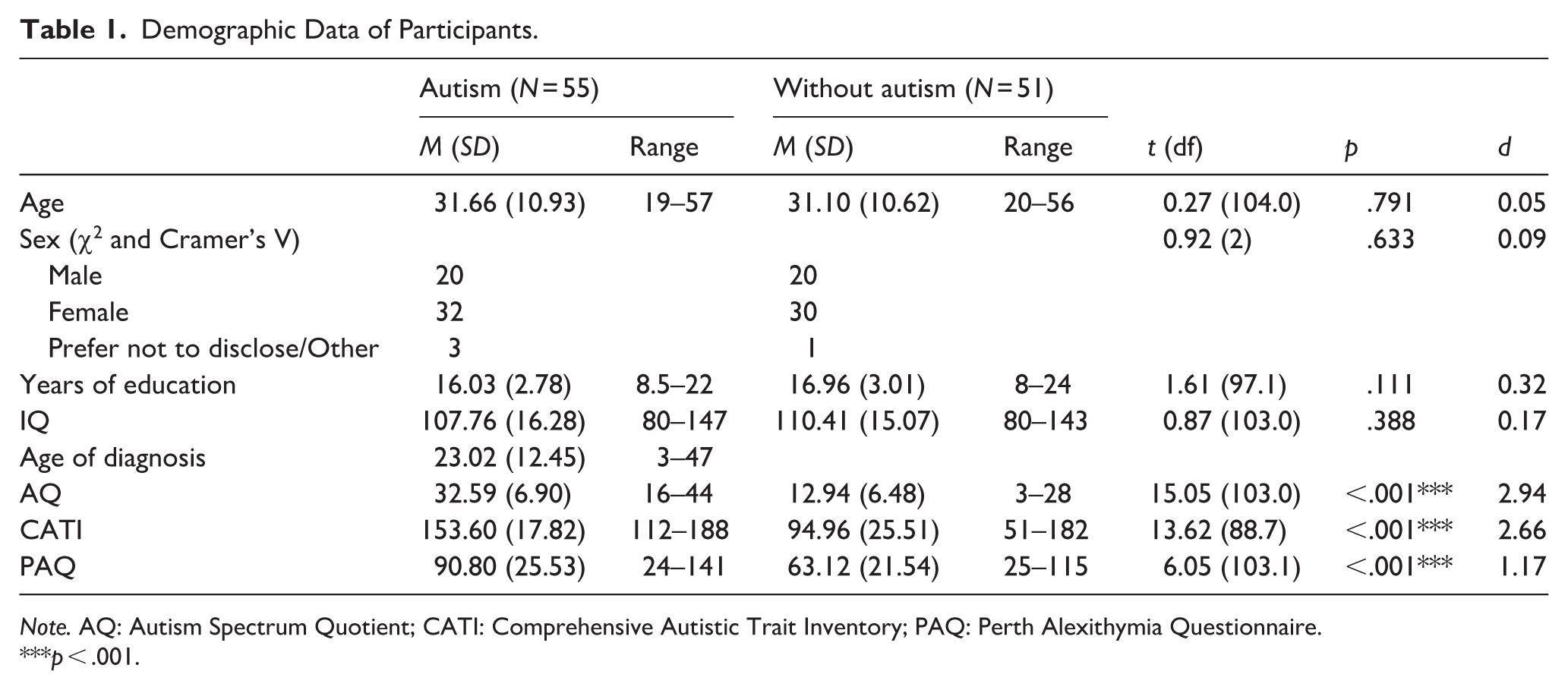
Note. AQ: Autism Spectrum Quotient; CATI: Comprehensive Autistic Trait Inventory; PAQ: Perth Alexithymia Questionnaire.
p < .001.
Participants were recruited through social media, autism organizations, and a database of participants within our research group. They received monetary compensation for their participation.
Stimulus Video
See the Supplemental Material S1 for a detailed description of the video-creation process. The procedure was based on the study by Demurie et al. (2011). Five dyads, each consisting of one individual with autism and one without autism, were filmed without their awareness. Four of the dyads were mixed-sex, with one female-female dyad. Participants were recorded during two types of interactions: an unstructured conversation in which they got to know each other, and a structured interaction where they figured out the rules of a game. Afterward, participants rewatched their video, reported all the thoughts they had during it, and completed eight items from the Closeness Questionnaire (Berry & Hansen, 1996) to indicate the level of rapport they experienced with their interaction partner.
To create the final stimulus video, video clips were selected based on the relevance of the thoughts within the context. In addition, individuals with and without autism rated how likely the thoughts were within the context. The most and least likely thoughts were excluded. Ultimately, two video clips were selected for each dyad: one from the unstructured interaction and one from the structured interaction, containing a total of 38 thoughts.
The final stimulus video began with a practice round featuring a video clip from a pilot video, with two individuals without autism containing two thoughts. This was followed by the unstructured and structured clips for each interaction dyad. Each video clip was shown twice. First, both video clips of a dyad were presented uninterrupted. Then, the two video clips were shown a second time, pausing each time a thought occurred. At these moments, a red circle appeared around the person having the thought. See Figure 1 for an example still from the video. A Latin square design was used to counterbalance the presentation order of dyads.
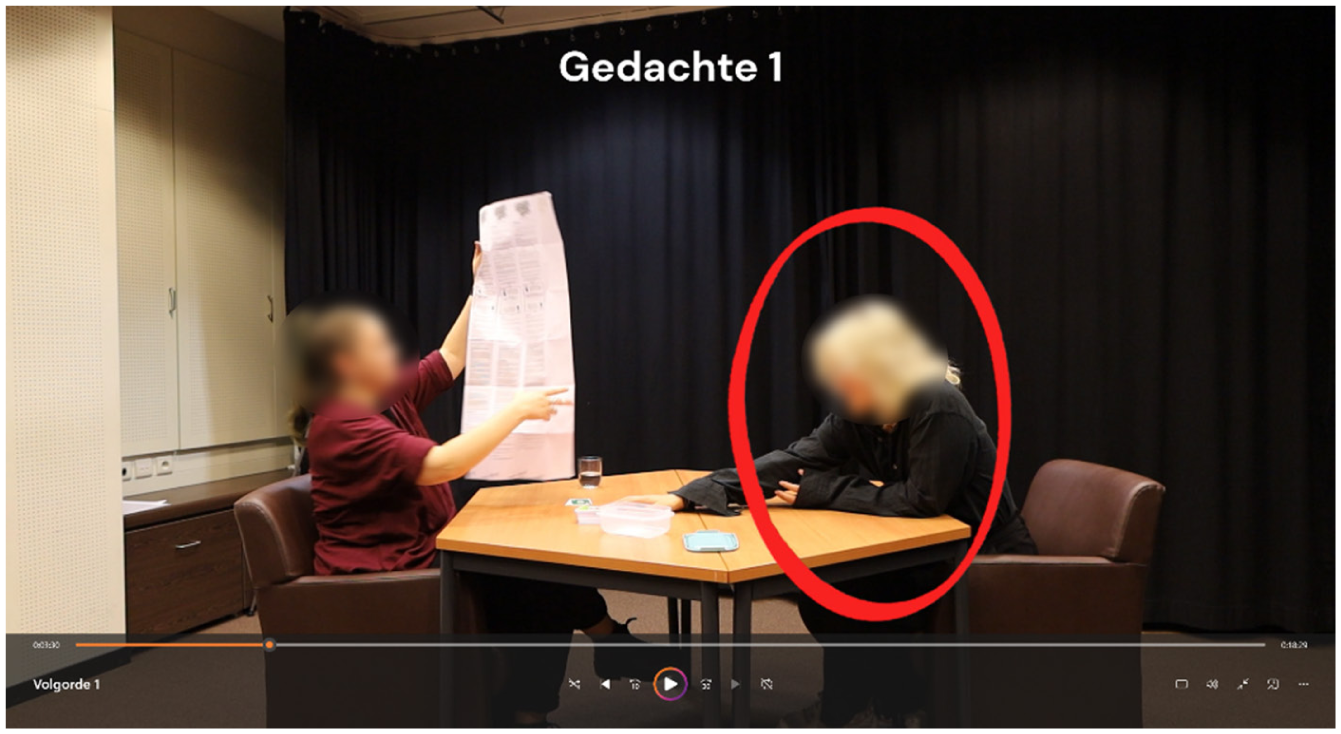
Still from the stimulus video.
Procedure
Before participating in the study, IQ and autism-related information was collected. Participants first signed an informed consent. The task was introduced to the participants, who were instructed to guess the thoughts of the individuals in the stimulus video. Participants were not informed about the possible diagnosis of the individuals in the video. To clarify the task, they were given an example of a thought: “Wow, this game is difficult.” They then completed the practice round. Participants did not receive feedback on the answers they gave. Next, participants viewed pictures from the stimulus video and indicated whether they recognized any of the individuals, to rule out autism identification based on prior familiarity. One participant recognized two individuals with autism. Excluding this participant did not change the results, so they were retained in the final analyses.
After the introduction, the following procedure was repeated for each of the five dyads: First, participants watched the video clips and inferred the thoughts of the first dyad. Participants then answered two Closeness Questionnaire items (Berry & Hansen, 1996) for each person in the video, rating on a nine-point scale how much they enjoyed the interaction and how forced it felt. Next, participants rated how difficult they found it to estimate the thoughts of each individual in the video. Participants were allowed to take a break after completing the questions for each dyad, and a self-paced break was mandatory after completing all questions for the third dyad.
Finally, participants completed a series of questions and questionnaires. They were asked what they thought the study investigated and whether they noticed anything about the individuals in the stimulus video. Some suspected that individuals with autism were included in the videos. Excluding these participants did not affect the main analysis but led to minor differences in secondary analyses, described in Supplemental Material S2. Participants were again shown pictures from the stimulus video and asked if they thought any of the individuals might have an autism diagnosis, and if so, who. They then answered demographic questions about sex, age, official diagnoses, and years of education (from when they learned to read). Four participants reported fewer than 8 years of education, which is highly unlikely given Belgian education laws. These datapoints were removed. Furthermore, participants with autism answered questions about their age at diagnosis and formal diagnostic label. Participants were also asked whether they personally knew individuals with autism, how many, and their relationship to them.
Finally, participants completed questionnaires on alexithymia traits (the Dutch version of the Perth Alexithymia Questionnaire [Preece et al., 2018; Walentynowicz et al., 2021]), autism traits (AQ [Baron-Cohen et al., 2001; Hoekstra et al., 2008] and CATI [De Laet et al., 2023; English et al., 2021]). At the end of the session, participants received a debriefing. The entire test session lasted an average of 1 hour and 20 minutes.
Accuracy Rating
Four independent raters (one of whom had an autism diagnosis), who were unaware of the study’s goal, evaluated each inferred thought on a scale from 0 to 2. A score of 0 indicated no overlap between the inferred and actual thought, 1 indicated partial overlap, and 2 indicated a close match. The intraclass correlation coefficient among the four raters was .86 indicating good inter-rater reliability.
Analysis
All data were analyzed in R (RStudio Team, 2020). To compare individuals with and without autism on demographic variables and questionnaire scores, t-tests and chi-square tests were conducted.
For the main analysis, the accuracy score was calculated as the mean for each thought for each participant across the rating of the four independent raters. Due to technical issues, for one thought for four participants, the circle indicating whose thought was to be interpreted incorrectly pointed to the wrong individual. These data points were excluded.
In the secondary analyses, we assessed (a) the accuracy of estimating the rapport experienced by the individuals in the video and (b) the perceived difficulty of inferring their thoughts. For rapport accuracy, both the individuals in the video and the participants watching the video rated two items from the Closeness Questionnaire. The item on how forced the interaction felt was reverse coded, and the two item scores (forced and enjoyed) were summed. The absolute difference between the actual and inferred summed scores (range: 0–16) served as the rapport accuracy score, with lower scores indicating higher accuracy. Perceived difficulty was measured on a 0 (very easy) to 100 (very difficult) scale.
For the main analysis and the secondary analyses, mixed-effects models were used. In the main analysis, predictors included the diagnosis of the participant watching the video (autism, no autism), the diagnosis of the individual in the video (autism, no autism), and the interaction structure (unstructured, structured). The model included all two-way and three-way interactions between predictors and random intercepts for both the participant and the individual in the video. In both secondary analyses, the predictors were the participant’s diagnosis, the diagnosis of the individuals in the video, and their interaction. Random intercepts for the participant and the individual in the video were again included. Sum coding was applied.
The best-fitting model for each dependent variable was selected based on the distribution of the data and how well the model satisfied statistical assumptions. The models compared were linear mixed-effects models, Poisson models, and negative binomial models. Due to taking the mean accuracy score of four independent raters, the accuracy scores were not integers (required for Poisson and negative binomial models) but instead ranged between 0 and 2 in steps of 0.25. The data were transformed to range from 0 to 8. While linear mixed-effects models were chosen for rapport accuracy and difficulty estimating thoughts, a negative binomial model was selected for the accuracy of estimating thoughts. Where appropriate, follow-up pairwise comparisons with Bonferroni correction were conducted.
An exploratory analysis was conducted for the main dependent variable of accuracy inferring thoughts by adding additional predictors to the model. The preregistered predictors of sex and the number of individuals with autism participants knew were included. In addition, participants’ perceived difficulty in estimating someone’s thoughts was also included, as well as Perth Alexithymia Questionnaire (PAQ) scores as alexithymia may influence how well someone can estimate others’ thoughts. Finally, the accuracy of participants’ diagnosis guesses for the individuals in the video was added as a binary variable indicating whether the diagnosis was correctly identified. This was included to examine whether correctly identifying someone’s diagnosis influenced the accuracy.
The responses to the question of whom participants perceived as having an autism diagnosis were also examined. First, a t-test was conducted to compare participants with and without autism on the number of individuals they perceived as having an autism diagnosis. This was followed by a generalized linear model with a Poisson distribution to analyze how many diagnoses were correctly estimated. The model included the participant’s own diagnosis, the diagnosis of the individual in the video, and the interaction between these two predictors.
Finally, a separate exploratory analysis was conducted on the accuracy of estimating thoughts among participants with autism, including two preregistered predictors: age of diagnosis and the number of additional diagnoses. However, due to convergence issues in both the original model and the models including these predictors, the results could not be reliably estimated and are therefore not reported.
Results
Accuracy Estimating Thoughts
The model showed a significant main effect of the diagnosis of the participant watching the video (p = .002); adults without autism had higher accuracy scores than adults with autism. In addition, a significant main effect of structuredness was found (p < .001); overall participants were more accurate in estimating individuals’ thoughts in structured interactions than unstructured ones. The main effect of the diagnosis of the individual in the video was not significant. None of the interaction effects were significant except for the interaction between structuredness and the diagnosis of the individual in the video (p < .001). Table 2 provides an overview of the full results, and Figure 2 of the nontransformed averages.
Results of the Analysis of the Dependent Variable Accuracy Estimating Thoughts.
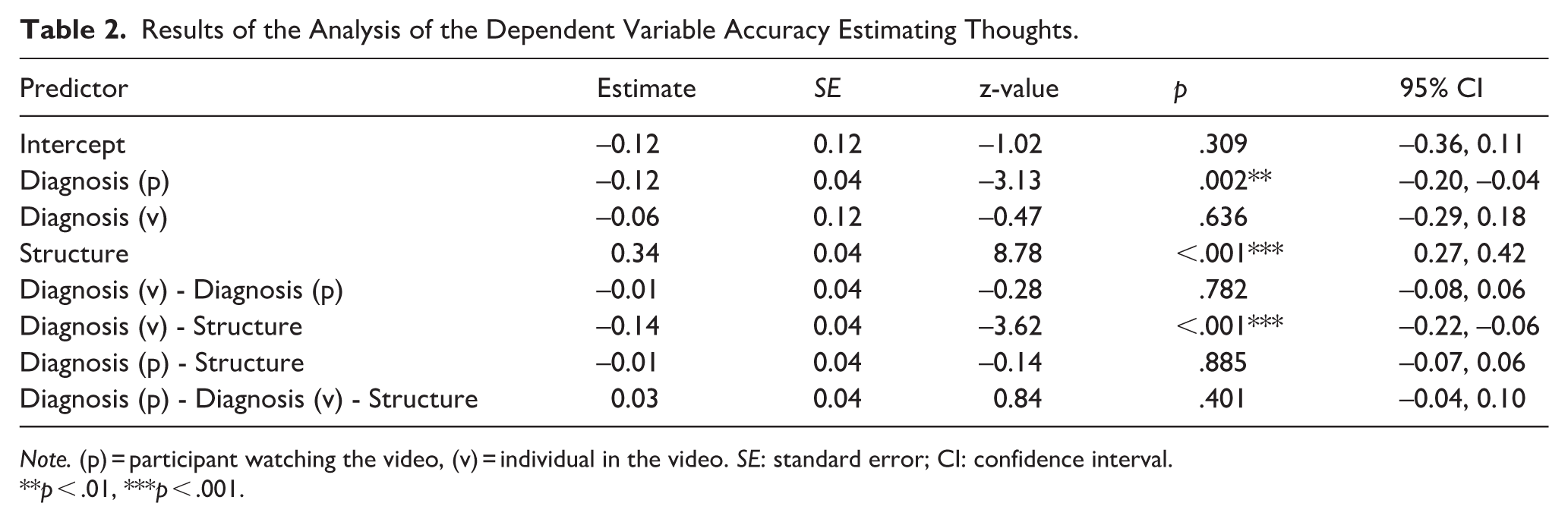
Note. (p) = participant watching the video, (v) = individual in the video. SE: standard error; CI: confidence interval.
p < .01, ***p < .001.
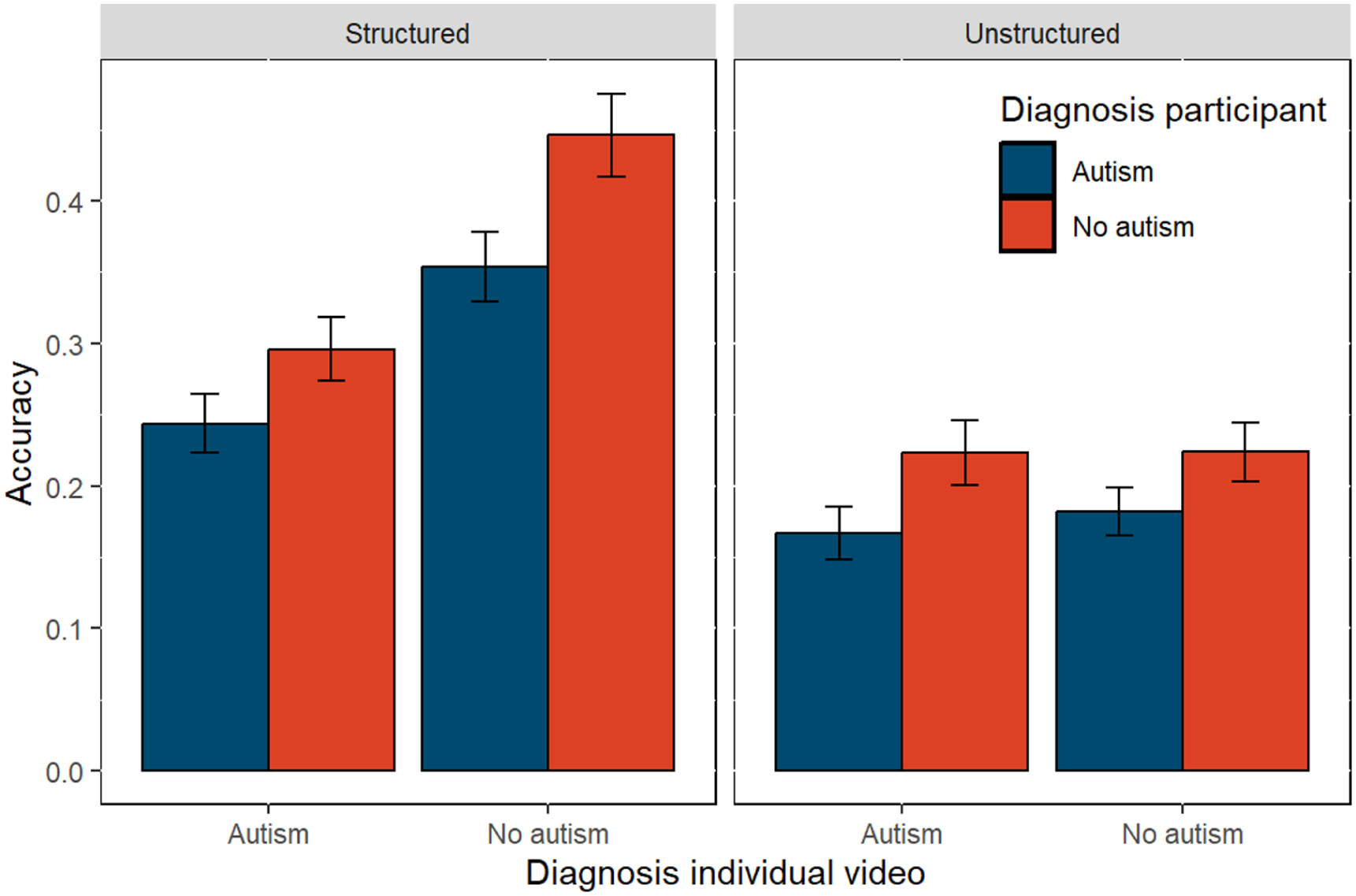
Average nontransformed accuracy scores for participants with and without autism estimating thoughts.
To interpret this interaction effect, we performed follow-up comparisons on the interaction effect between structuredness and diagnosis of the person in the video, which showed that inferring thoughts in structured interactions were more accurate than those in unstructured interactions, both when the person in the video had autism (ratio = 1.50, SE = 0.16, z = 3.83, p < .001) and when the person did not have autism (ratio = 2.64, SE = 0.30, z = 8.43, p < .001). However, this effect was stronger when the individual in the video did not have autism. No significant differences were found between individuals with and without autism within structured interactions (ratio = 0.67, SE = 0.16, z = -1.62, p = .422) and unstructured interactions (ratio = 1.19, SE = 0.30, z = 0.67, p = 1).
Secondary Analyses
Rapport Accuracy
The model revealed no significant effect of the diagnosis of the participant (t(102,11) = 0.48, p = .630, b = 0.07, 95% CI [−0.21, 0.35]), the diagnosis of the individual in the video (t(8.00) = 1.05, p = .324, b = 0.79, 95% CI [−0.66, 2.23]), or the interaction between those two (t(936.31) = 0.94, p = .348, b = 0.08, 95% CI [−0.08, 0.23]). A one-sample t-test showed that participants did not score above chance-level accuracy, as determined by a simulation (M = 5.33, chance level = 5.65) (t(1053) = -2.90, p = .998, d = -0.09).
Perceived Difficulty
The model revealed no significant effect of the diagnosis of the participant (t(102.64) = 1.47, p = .144, b = 1.97, 95% CI [−0.65, 4.59]). However, a significant effect of the diagnosis of the individual in the video was found (t(8.00) = 2.85, p = .021, b = 3.78, 95% CI [1.14, 6.41]). Overall, participants reported greater difficulty in estimating the thoughts of individuals with autism than the thoughts of individuals without autism. No significant interaction between these two predictors was found (t(936.57) = −1.73 p = .084, b = −1.02, 95% CI [−2.18, 0.14]). See Figure 3 for an overview of the averages.
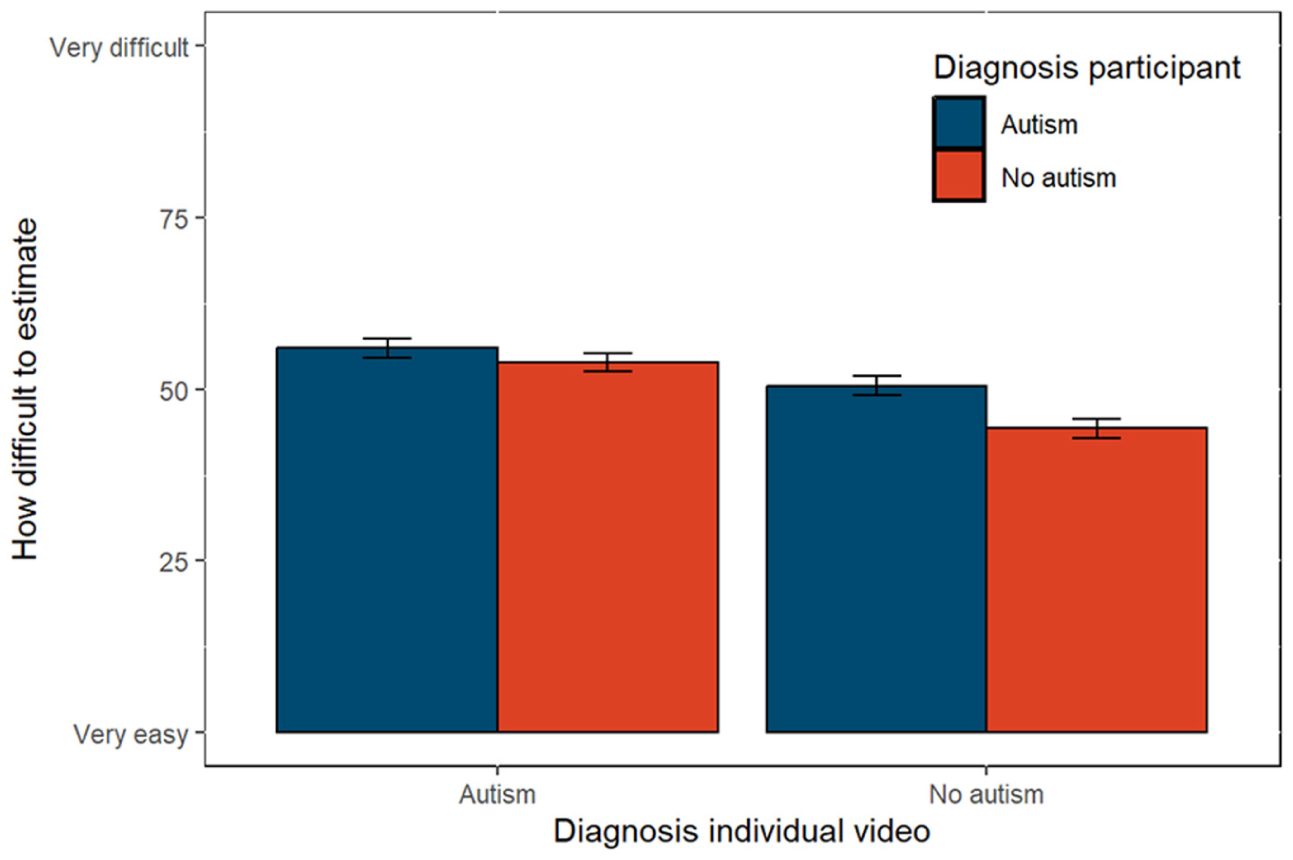
Average experienced difficulty for participants with and without autism.
Exploratory Analyses
The exploratory analysis including additional predictors in the accuracy model did not reveal any further significant effects for sex, diagnosis accuracy, reported ease of estimating thoughts, number of individuals with autism they knew, or alexithymia.
For the question of whom participants estimated to have an autism diagnosis, a t-test revealed that participants with autism indicated significantly more often that a person in the video had autism compared to participants without autism (t(93.6) = 2.87, p = .005, d = 0.55). On average, individuals with autism identified 4.07 out of 10 individuals as having autism, whereas individuals without autism identified 3.04 out of 10. The model examining the correctness of estimating the diagnosis revealed a main effect of diagnosis of the person in the video; individuals without autism were more often correctly identified than those with autism, irrespective of the diagnosis of the participant (p < .001). None of the other effects were significant (all p > .070). The full results of all exploratory analyses are provided in the Supplemental Material S3.
Discussion
In this study, we used the empathic accuracy task to examine how accurately participants with and without autism inferred the thoughts of others, both with and without autism. Based on the DEP theory, we expected higher accuracy scores for within-neurotype inferences than for cross-neurotype inferences. Contrary to our expectations, we found no evidence for a within-neurotype advantage. Instead, we found that individuals without autism were overall more accurate at inferring thoughts, and that inferring the thoughts of individuals with autism was generally experienced as more difficult. This is at odds with both the predictions of the DEP theory (Milton, 2012) and the previously reported experiences of individuals with autism (Crompton et al., 2020a; Cummins et al., 2020; Watts et al., 2024); however, it is largely in line with previous experimental studies on this topic (Brewer et al., 2016; Cheang et al., 2024; Crompton et al., 2025; Edey et al., 2016; Geelhand et al., 2024).
Instead of a within-neurotype advantage, we found that individuals with autism were, in general, less accurate than individuals without autism in inferring thoughts regardless of the neurotype of the person in the video. This finding is consistent with previous research using the empathic accuracy task (Demurie et al., 2011; Ponnet et al., 2008; Roeyers et al., 2001). However, the crucial difference with these previous studies is that the individuals in the videos were always individuals without autism, whereas in our study, we included both individuals with and without autism in the videos. While previous findings could be interpreted as resulting from a mismatch in neurotype between the participant watching the video and the individual whose thoughts were being inferred, this explanation does not apply to our findings.
In line with previous studies (Ponnet et al., 2008; Roeyers et al., 2001), we found thoughts from structured situations are more accurately inferred than those from unstructured situations. The benefit of structure is likely explained by contextual cues that provide more information about what someone might be thinking (e.g. thoughts related to the game). Interestingly, we found the beneficial effect of structure to be more pronounced when thoughts had to be inferred from an individual without autism than from an individual with autism. It may be that individuals with autism have thoughts that are less aligned with the context than those without autism, making them less predictable.
We also asked participants how difficult they found it to infer the thoughts of the individuals in the videos. Individuals with autism were consistently perceived as more difficult to estimate regardless of the participant’s neurotype. This finding also contradicts expectations of the DEP theory but aligns with findings from studies on nonverbal communication that included individuals with and without autism as stimuli. These studies found that mental states and emotional expressions of individuals with autism were harder to identify, both for individuals without autism (Brewer et al., 2016; Cheang et al., 2024; Edey et al., 2016) and for individuals with autism (Brewer et al., 2016; Edey et al., 2016). In addition, our results align with a large body of research on first impressions showing that individuals with autism are rated less favorably than individuals without autism, both by individuals without autism (Morrison et al., 2020; Stagg et al., 2023) and by individuals with autism (Alkhaldi et al., 2021; Geelhand et al., 2021; Grossman et al., 2019; Morrison et al., 2020), based on judgments from brief interactions, short video clips, static images, or even speech characteristics.
As individuals with autism were experienced as more difficult to estimate thoughts from, it is possible that some individuals with autism in the videos (who were not explicitly told, but may have inferred, that their interaction partner was neurotypical) were camouflaging, which could have made their thoughts harder to interpret. However, despite individuals with autism being experienced as more difficult to read, their thoughts were not inferred less accurately. Interestingly, while no interaction effect emerged in the main analysis, an additional analysis excluding participants who suspected autism in the videos revealed a significant interaction: Individuals with autism found it easier to estimate the thoughts of individuals without autism and more difficult to infer the thoughts of other individuals with autism (see Supplemental Material S2 for the full results).
While direct comparisons are difficult because other experimental studies employed different methodologies, our findings of no within-neurotype advantage in estimating others’ thoughts are largely in line with findings from previous experimental studies on reciprocal interaction. The seminal study by Crompton et al. (2020b) found more accurate communication in a communication chain task within same-neurotype groups, with mixed groups performing less well. These findings were not replicated in a follow-up study using the same task with a larger sample (Crompton et al., 2025), where no differences between group types were observed. Geelhand et al. (2024) applied a collaborative referencing task and failed to find that dyads of individuals with autism are more efficient than mixed-neurotype dyads. The most recent study is an online study conducted by Jameson and Bean (2025), focusing on linguistic convergence. They found that pairs of individuals with autism exhibited greater overall syntactic convergence (but not semantic convergence) across the full interaction than pairs of individuals without autism, but not compared to mixed pairs. They concluded that their findings did not offer consistent support for the DEP theory.
Taken together, this study contributes to the growing body of experimental literature that does not offer support for the DEP theory. A wide variety of methodologies have been employed to investigate different aspects of the DEP theory experimentally, and while each offers unique insights into the theory, the variation also makes it more difficult to directly compare these studies. However, although methodologies vary, most experimental research on the topic has not found support for the DEP theory.
These findings are difficult to reconcile with the reported experiences of individuals with autism. Studies have consistently shown that individuals with autism report smoother and better interactions with others with autism (Crompton et al., 2020a; Cummins et al., 2020). More specifically, they report being better able to understand the thoughts of others with autism and feeling that their own thoughts are better understood by them (De Laet et al., 2026). How can this notable difference be explained? The experienced smoother interactions between individuals with autism may perhaps result from a sense of belonging and feeling accepted rather than the interaction actually being more efficient. It may also reflect an in-group bias, in which individuals ascribe more positive characteristics (e.g. mutual understanding) to their own group and more negative characteristics (e.g. misunderstanding) to the out-group, regardless of the actual quality of communication (Calanchini et al., 2022; Everett et al., 2015; Payne et al., 2024).
It is important to note that in these studies that assessed experiences of individuals with autism, participants were explicitly asked about their experience with another person with and without autism, which means that they, per definition, were aware of the diagnosis of the other person they refer to. Being aware of the fact that the other person has autism or not may affect the outcomes. In fact, in all studies that found unambiguous support for a within-neurotype advantage (studies on experiences: Crompton et al., 2020a; Cummins et al., 2020; Watts et al., 2024), rapport (Crompton et al., 2020c; Foster et al., 2025; Rifai et al., 2021), and the one experimental study by Crompton et al. (2020b), participants were aware of each other’s diagnosis.
In our study, we did not inform the participants about the diagnosis of the individuals they saw in the videos, and we found that both participants with and without autism were equally bad at indicating which individual had autism. This also contrasts with anecdotal reports from individuals with autism who indicate they can easily recognize others with autism. Compared to participants without autism, participants with autism were more likely to judge someone as having autism, while participants without autism were more likely to judge someone as not having autism. However, the accuracy of these judgments did not differ between the two groups.
To date, only one study has directly examined the effect of diagnosis awareness in groups of individuals with autism, without autism, and mixed groups and found no general effect on communication accuracy. However, the absence of overall group differences in accuracy may explain the lack of effect. In addition, rapport scores increased with diagnosis awareness (Crompton et al., 2025). The fact that unambiguous support for a within-neurotype advantage is coming exclusively from studies in which participants were aware of their partner’s neurotype, and that most consistent support is coming from experience-based studies, seems to suggest that this awareness may be crucial.
Further research is strongly warranted to rigorously test this, but we tentatively suggest that increased awareness, rather than genuinely better interaction, may explain the existing findings and the notable differences between experience-based and experimental studies to date. First, awareness of the other person’s neurotype or diagnosis may lead to an experience of a shared identity and/or an in-group bias, both of which may contribute to the more positive interactions typically reported among individuals with autism. Previous research has indeed shown that individuals with autism often camouflage their traits in interactions with individuals without autism, while they tend to feel more at ease and authentic when interacting with others on the spectrum (Alaghband-rad et al., 2023). Second, when inferring others’ thoughts, people often use their own perspective as a reference point. Knowing that you interact with a person who has the same neurotype may help to better understand the other person’s perspective due to a shared frame of reference and lead to better interaction. We strongly plead for future research that systematically investigates this to better understand which factors may contribute to better understanding and interaction between different and same neurotypes.
Limitations
This study also has some limitations. First, the participants were all adults without intellectual disability; hence, we cannot generalize our findings to children and/or individuals with high support needs.
Second, participants’ rapport estimation scores did not differ from chance level. This may be due to the difficulty of inferring rapport from brief video clips, particularly given that the actual rapport ratings were based on approximately 20 minutes of interaction, potentially rendering this measure of rapport less valid in the current context.
In addition, the stimulus dyads were not balanced in terms of the number of same-sex and mixed-sex dyads. Although the focus of our study was on estimating the thoughts of the individual with or with autism shown in the video, we cannot exclude the possibility that differences in communication between same-sex and mixed-sex dyads (Martin & Craig, 1983; Sandhu et al., 2009) may have influenced the results.
Moreover, all video dyads were of mixed neurotype, which may have influenced the results. Individuals with autism report greater camouflaging in interactions with individuals without autism (Alaghband-rad et al., 2023), and mixed-neurotype dyads show lower self-reported and observer-rated rapport than same-neurotype dyads (Crompton et al., 2020c). Related work also suggests that interactional behaviors differ between same- and mixed-neurotype contexts (Heasman & Gillespie, 2019; Rifai et al., 2021). Although participants were unaware of the diagnoses and showed low accuracy in estimating them, which may partially mitigate this limitation, future research should include same-neurotype dyads to test whether thought inference varies by dyad type.
Furthermore, each video was presented twice to participants to give them more time and information to be able to estimate thoughts. However, participants without autism might have benefited more from this second presentation due to potential differences in memory and predictive coding in autism. Related, previous research has identified differences in autobiographical memory and metacognitive abilities in autism (Carpenter & Williams, 2023; Westby, 2022). Because collecting the thoughts of individuals in the videos required reliance on autobiographical memory and metacognition, this may have influenced the results.
Finally, while the paradigm offers ecological validity by videotaping individuals without their awareness and using their actual thoughts as ground truth rather than researcher-defined correct answers, it did not capture reciprocal communication or the inference of thoughts during real-time reciprocal communication. Although the current study provides important first insights into the DEP theory, further research on reciprocal interaction is needed to examine different aspects of communication and to gain a more comprehensive understanding of the DEP theory.
Conclusion
In conclusion, the current study did not find support for the DEP theory. Participants with autism were not better at estimating the thoughts of others with autism. Instead, they were less accurate irrespective of the diagnosis of the individuals in the videos. The current state of findings points to a striking discrepancy between subjective experiences and findings from experimental studies, warranting further research on the role of awareness of the other person’s neurotype.
Supplemental Material
sj-docx-1-aut-10.1177_13623613261451897 – Supplemental material for Inferring Thoughts by and of Individuals With and Without Autism: An Empathic Accuracy Study
Supplemental material, sj-docx-1-aut-10.1177_13623613261451897 for Inferring Thoughts by and of Individuals With and Without Autism: An Empathic Accuracy Study by Hannah De Laet, Annabel D. Nijhof and Jan R. Wiersema in Autism
Supplemental Material
sj-docx-2-aut-10.1177_13623613261451897 – Supplemental material for Inferring Thoughts by and of Individuals With and Without Autism: An Empathic Accuracy Study
Supplemental material, sj-docx-2-aut-10.1177_13623613261451897 for Inferring Thoughts by and of Individuals With and Without Autism: An Empathic Accuracy Study by Hannah De Laet, Annabel D. Nijhof and Jan R. Wiersema in Autism
Supplemental Material
sj-docx-3-aut-10.1177_13623613261451897 – Supplemental material for Inferring Thoughts by and of Individuals With and Without Autism: An Empathic Accuracy Study
Supplemental material, sj-docx-3-aut-10.1177_13623613261451897 for Inferring Thoughts by and of Individuals With and Without Autism: An Empathic Accuracy Study by Hannah De Laet, Annabel D. Nijhof and Jan R. Wiersema in Autism
Footnotes
Acknowledgements
The authors thank Lieze Denys and Marieke Melkebeke for their help with data collection and stimulus development. The authors also thank those who contributed to the selection and accuracy ratings of the thoughts, and finally, all participants in this study.

Ethical Considerations
The study was approved by the Ethical Committee of the Faculty of Psychology and Educational Sciences at Ghent University (ref: 2022/040). The study was performed in accordance with the ethical standards as laid down in the 1964 Declaration of Helsinki and its later amendments or comparable ethical standard.
Consent to Participate
All participants gave written informed consent to participate in the study.
Consent for Publication
All participants gave written informed consent to publish the results of this study.
Author Contributions
Funding
The authors disclosed receipt of the following financial support for the research, authorship, and/or publication of this article: This work was funded by Research Foundation—Flanders with grant number 11I2322N.
Declaration of Conflicting Interests
The authors declared no potential conflicts of interest with respect to the research, authorship, and/or publication of this article.
Data Availability Statement
Supplemental Material
Supplemental material for this article is available online.
Notes
References
Supplementary Material
Please find the following supplemental material available below.
For Open Access articles published under a Creative Commons License, all supplemental material carries the same license as the article it is associated with.
For non-Open Access articles published, all supplemental material carries a non-exclusive license, and permission requests for re-use of supplemental material or any part of supplemental material shall be sent directly to the copyright owner as specified in the copyright notice associated with the article.
