







Abstract
The few previous studies investigating regulation of gender in trans-specific healthcare are mainly based on text material and interviews with care-providers or consist solely of theoretical analyses. There is a lack of studies analysing how the regulation of gender is expressed in the care-seeker’s own experiences, especially in a Nordic context. The aim of this study is to analyse narratives of individuals with trans experiences (sometimes called transgender people) to examine how gender performances can be regulated in trans-specific care in Sweden. The conceptual framework is inspired by trans studies, a Foucauldian analysis of power, queer phenomenology and the concept of cisnormativity. Fourteen interviews with people with trans experiences are analysed with constructivist grounded theory. The participants’ experiences indicate that gender is constructed as norm-conforming, binary and stable in trans-specific healthcare. This gendered position is resisted, negotiated and embraced by the care-seekers. Norms and discourses both inside and outside trans-specific care contribute to the regulation and limit the room for action for care-users. We conclude that a trans-specific care that has a confirming approach to its care-users, instead of the current focus on gender norm conformity, has the potential to increase the self-determination of gender performance and increase the quality of care.
Keywords
Introduction
Many people with trans experiences want access to medical procedures such as hormone treatment, hair removal, vocal training, breast surgery and genital surgery (Cole et al., 1997; Murad et al., 2010; Smith et al., 2005). In many countries, the clinical evaluation that precedes access to gender-conforming medical procedures regulates gender performances, and research has shown how gender norms guide access to medical procedures (Bremer, 2011; Dewey and Gesbeck, 2015; Spade, 2006; Stone, 1991). Researchers have argued that discourses of uncertainty and ambiguity regarding ones gender are subjugated and negated in the evaluation, and instead discourses concerning certainty, maturity, stability and polarisation regarding gender identity are privileged (Hird, 2003; Rosqvist et al., 2014; Wiseman and Davidson, 2012). Studies have also shown that practitioners within trans-specific care express essentialist ideologies about sex/gender and that trans experiences are pathologised and understood in terms of problems (Davis et al., 2015; Spade, 2006).
Sweden is often highlighted as a progressive country in terms of gender equality, with a welfare system that includes trans-specific care in the general healthcare insurance. Thus, Swedish trans-specific care provides a good example for investigating the regulation of gender. Previous research has shown that trans-specific care and related legislation tend to reproduce gender norms and create unnecessary suffering for people with trans experiences in a Swedish context (Bremer, 2011) and internationally (Spade, 2006). A government report has shown how care-seekers within trans-specific care in Sweden have to exhibit signs of how they have adopted the character of the gender they identify with (The National Board of Health and Welfare, 2010: 53). Furthermore, analyses of preparatory work leading up to the Swedish legislation concerning legal gender reassignment have shown that the system premiers unambiguous gender and relies on a practice in which experts have to evaluate the individual’s need for care, motivated by the risk of regret (Alm, 2006).
Most studies of the regulation within trans-specific care have examined the regulation of gender performances from a care-provider’s perspective or have examined preconditions and practices within trans-specific care theoretically (noted by e.g. Spade, 2006). Studies that combine theoretical work with care-seekers’ narratives about trans-specific care are largely lacking in a Nordic context (see, however, Bremer, 2011). Through analysing narratives of individuals with trans experiences, we aim to analyse how gender performances can be regulated in trans-specific care in Sweden. This study will contribute to the current knowledge by showing how care-seekers experience these social processes and also to better understand how the regulation functions within the trans-specific care.
Point of departure and conceptual framework
Trans studies is a growing, diverse, academic field, that developed during the 1990s out of a critique of how trans subjects were portrayed, especially within medical discourses (Stone, 1991; Stryker and Aizura, 2013). Sandy Stone’s (1991) ‘The “Empire” Strikes Back: A Posttranssexual Manifesto’ marks one of the important starting points for trans studies. Stone discusses how the medical community constructed the category transsexualism as a ‘correctable problem’, and how western discourses have constructed one correct (desirable) body for each of the two categories of gender – man and woman. While medicine has not paid so much interest in or contributed to the field of trans studies, trans studies has from the start investigated and analysed medical practices and discourses (see, for example, Stryker and Aizura, 2013). In this interview study, originating from the field of public health, we situate ourselves within the field of trans studies and are inspired by the theoretical approaches and the ethical discussions in this field.
As described above, several studies have shown how gender is normatively constructed within the trans-specific care (e.g. Bremer, 2011; Davis et al., 2015; Spade, 2006). However, researchers have sometimes argued that wanting or having gender-conforming medical procedures is to adhere to gender normativity (Rubin, 1998; Spade, 2006) and that trans-specific care counteracts a ‘liberating and politicized project of gender equality’ (Spade, 2006: 318). Locating the problem in the act of having gender-confirming medical procedures can be argued to stem from a failure to see how individuals without trans experiences also have their genders disciplined and conform to gender norms (Spade, 2006) and puts the burden of refusing gender on persons with trans experience alone (Rubin, 1998). If, instead, locating the problems concerning gender normativity in the process in which access to gender-confirming medical procedures is negotiated and also seeing how people without trans experiences have their genders regulated, it would make us able to keep the critique of the medical practices expressed in these previous studies, but not ‘paint transsexuals as brainwashed victims who have failed to figure out that they are only undermining a revolution that seeks to save them’ (Spade, 2006: 318). Our theoretical point of departure can then also account for how the medical construction of transsexualism as a pathological position at the same time constructs the cis-position as ‘healthy’, natural and stable (Spade, 2006).
Previous studies concerning trans have been criticised for ‘picnicking’ on trans identities (Spade, 2006; Wilchins, 1997). To avoid such an exploiting use, where the lives of persons with trans experiences are ignored, we aim to ground our theoretical discussion in experiences, which also gives us the opportunity to show how the regulations of gender performances are embodied and experienced (see also Rubin, 1998; Spade, 2006). However, basing the knowledge production on experiences does not mean that we understand experiences as pre-discursive, but instead as connected to socio-political discourses and contexts. The theoretical frameworks of previous studies can, despite the critique put forth, be useful to us, especially a Foucauldian analysis of power and how the trans-specific care is an institution in which gender performances are regulated and disciplined (Rubin, 1998; Spade, 2006). With this in mind, our conceptual framework draws on two different lines of theories: theories drawing on Foucauldian notions of power and governance to analyse the regulation of gender performances and phenomenological theories to understand the embodied experiences of being oriented towards and inhabiting trans-specific healthcare spaces (Ahmed, 2006).
Gender is in this study seen as embodied and continuously (re)constructed in relation to social contexts and power structures (Cosgrove, 2000). Such an understanding means that we see the trans-specific healthcare as an institution that contributes to the forming of desirable gendered subject positions and as disciplining gender performances. However, the understanding of gender as continuously (re)constructed should not be interpreted as we argue that everyone with trans experiences should see their gender identities as changing or fluid. As already stated, medicine is a powerful institution, with its pathologisation of trans experiences as ‘pathological’ and ‘unhealthy’ (see Davis et al., 2015; Foucault, 1973).
Norms and normalisation is understood as disciplinary of individuals and is taken into account as complex sets of social regulations that are constructed as self-evident and natural (Spade and Willse, 2015). We understand the regulation within trans-specific care as not merely a top–down control. Regulation often functions through more diffuse governing techniques in which norms and discourses, both within and outside trans-specific care, are crucial in the construction of some gender positions and identities as more desirable, natural and recognisable and others as pathological (Butler, 2009; Foucault, 1982; Spade, 2006). From this perspective, power does not necessarily stem from an intentional instigator, instead it is closely connected to the construction of knowledge and truth (e.g. psychiatric knowledge production about trans) and is the effect of a relational interplay between power and resistance. While power subordinates, it is also essential in the formation of the subject, for example, through categorising practices like the separation of sick from healthy (Foucault, 1982). Thus, the trans-specific healthcare is an institution where evaluators and care-seekers are involved in a complex social interplay, evaluating and resisting the other’s attempts to affect one’s own range of actions.
We use the concept of orientation to analyse how bodies are oriented towards trans-specific care. Ahmed (2006) describes a queer phenomenological approach to orientation in which bodily orientation is connected to repetitive bodily actions and also depends on lines (paths) already taken. So bodily orientation is not casual, but repetitive bodily actions in spaces create lines (which could be understood as ‘the normative’; Ahmed, 2006: 66) and make certain things and actions available to some but not others.
Using the concept of ‘trans experiences’, we wish to focus on experiences instead of defined identities. We define trans experiences as experiences of transcending the societal norm of a ‘linear gender’. In the same way as Ahmed (2006) is analysing how a queer sexual orientation deviates from the ‘straight line’, Bremer (2011) argues that trans experiences can be seen as experiences of deviating from the normative ‘linear gender’. Linear gender is the social expectation that the assigned gender at birth is in line with the gender identity and that the body appears to be in line with that identity (Bremer, 2011). Furthermore, cisnormativity can be described as the social discourses and practices that assume that an individual’s body and gender appear to be in line. Cisnormativity contributes to the construction of trans experiences as unintelligible and can also be a part of institutional pathologising discourses in which individuals with trans experiences are seen as being in need of correction (see, for example, Enke, 2012; Kennedy, 2013; Spade, 2006). Cisnormativity as an analytical concept has the potential to problematise the normative category and how that category, the linear gender or the cis-position, is defined through repeated construction of the deviant position (see, for example, Spade (2006), who, however, did not discuss cisnormativity). Such focus is often lacking, and instead a non-linear gender or trans experiences are often the only categories that are seen as being in need of explanation, while the normative categories are naturalised (Kennedy, 2013; Spade, 2006).
The concept gender-confirming medical procedures is used with regard to trans experiences, as many persons with trans experiences understand the medical procedures not as changing or correcting their gender identity, but as confirming it. We have chosen to use medical procedures instead of, for example, ‘treatment’ to avoid pathologising connotations. The concept gender conformity is used to denote a normative gender performance with respect to, for example, clothing, body language, hairstyle and accessories.
Passing and living in stealth can for some people be the goal of having gender-confirming medical procedure. To be passing is to be perceived by others as having the gender identity you identify with and can thus be connected to certain privileges, which, however, can be taken away if the trans experiences are revealed (Serano, 2007). To live in stealth means that you are passing in the gender you identify with and are not telling others about your trans experiences. Passing and stealth can be important to live liveable lives; however, the concepts have also been problematised from a critical perspective arguing that they are based on cisnormative assumptions in which the gender presentation has to be linear for subjects to be recognisable (see Butler, 2009; Spade, 2006).
Methods
Context – the Swedish model
In Sweden, trans-specific care is included in the general healthcare insurance (for a detailed description of the Swedish trans-specific healthcare, see Rosqvist et al., 2014). To gain access to gender-confirming medical procedures, you need to go through a clinical evaluation, which is generally run through psychiatric clinics. Real-life experience can be a part of the evaluation process and means that you should live according to your gender identity for 6–12 months. Legal gender reassignment is closely connected to the medical process, and, to gain access to genital surgery, you need approval from the Legal Advisory Board at the National Board of Health and Welfare. Also, to get a legal gender reassignment approved, it is advantageous to have a statement from an evaluating psychiatrist. Sterilisation has been a legal demand to get access to legal gender reassignment, but the demand was removed from the law in 2013.
Study design
This is a qualitative interview study inspired by constructivist grounded theory, emphasising that the research is socially constructed and affected by both the situatedness of the researcher and what the participants bring to the research situation (Charmaz, 2014).
At the beginning of the research process, I.L. met three trans activists and discussed what they thought was important to consider in research concerning trans, health and healthcare. A preliminary interview guide was prepared, and two pilot interviews were conducted with individuals with trans experiences. The participants in the pilot interviews were found through I.L.’s network. The interview guide was adjusted according to the input from the participants and after I.L.’s reading of the transcripts. The study includes 14 participants; of these, one is the person from the second pilot interview.
Sampling procedure
The data collection was conducted between November 2014 and September 2015. Networks for trans persons were used to contact potential participants and included the following: The Swedish Federation for Lesbian, Gay, Bisexual and Transgender Rights (RFSL), Full Personality Expression Sweden (FPES) and Gender-Sex Identity-Diversity (KIM). To minimise the participants’ dependency in relation to healthcare providers, we did not look for participants through the health services. Advertising material was sent to networks for people with trans experience (RFSL, FPES and KIM), and representatives from the networks disseminated the material on their websites, email lists and through other information channels. The material was disseminated in other social forums online, and therefore not all participants were connected to the above networks.
The advertising material contained brief information about the study and contact information to I.L. When the presumptive participants contacted us, we sent them a letter with comprehensive information about the study comprising a description of the aim of the study, how the interviews were to be conducted, how data will be handled and the anonymisation of the interview material. The presumptive participants were asked to contact us again if they were still interested in participating in the study, after which I.L. booked a time for an interview.
Participants
Participants were people with trans experience who have had encounters with the trans-specific healthcare or have considered seeking such care. The 14 participants lived in different parts of Sweden. Ten participants had experiences of meeting an evaluating team, one had tried to get a referral to a team and three had considered seeking trans-specific care. The participants who had met the evaluating team had gone through the evaluation and the medical procedures within the past 7 years. Their ages ranged from 23 to 69 years. Seven people defined themselves as women, four as men and three participants defined themselves as non-binary or intergender. Ten had started or completed university studies, of which four were still students. Six were at the time of the interview in paid employment, one was unemployed, one was retired and two were on a long-term sick leave (for more details, see Appendix).
Data collection
The participants chose place for the interviews, which included cafés, libraries, participants’ homes and workplaces and I.L.’s office. Before the interviews started, the interviewer (I.L.) carefully went through the information letter and obtained written consent from the participants.
The interviews were semi-structured with open-ended questions around the following themes: experiences of healthcare, good health and ill health, close relationships and experiences of stigmatisation, offence and discrimination. The interviews were tape-recorded and carried out according to an emergent design, in which each interview was initially analysed before the next was performed (Charmaz, 2014). Small changes in the interview guide were made after the interviews and during the analysis process. The interviews lasted between 55 and 135 minutes and were transcribed verbatim. The data collection continued until saturation was reached, meaning that new data no longer revealed more information useful to answer our aim or research questions (Charmaz, 2014).
Ethical approval
The Regional Ethics Committee in Umeå approved the study (Dnr: 2014/61-31Ö).
Analysis
In the first analytical step, I.L. and L.H. read the transcribed interviews thoroughly and discussed the content and preliminary interpretations. Memos were written during and after the discussions and compared with each other. In the second analytical step, the transcripts were imported to MAXQDA 11 for initial coding. The initial coding was done with segment-by-segment coding in line with Charmaz (2014), in which we quickly labelled text segments with codes that were close to the material with limited abstraction. In the third analytical step, we conducted a focused coding where the relevant initial codes were recoded (Charmaz, 2014) with focus on the aim and by comparing initial codes with focused codes. The fourth step in the analysis consisted of axial coding, and by comparing focused codes, finding common themes and abstracting the content, we created categories.
Methodological considerations
From our epistemological perspective, in which we understand research as a construct to which both the researchers and the participants contribute, we argue that transparency is an important concept for the assessment of knowledge production. Through transparent descriptions of the study process, we aim for the reader to be able to follow the interpretative process and assess usefulness and transferability to other contexts. This study’s strengths include the involvement of several researchers from different disciplines, which has made it possible to approach the material from different perspectives. The diversity of the material in terms of age, geographical location, socioeconomic position and gender identity has contributed to a broad range of experiences.
A critical aspect of the study is that isolated individuals may not have been reached, because we recruited participants through networks. However, based on the response to the advertising material and the narratives of the participants, we have at least reached people outside the biggest cities. People with both good and bad experiences have been participating in the study, and the open-ended questions also made it possible to talk about both positive and negative experiences. All the participants were by the interviewer read as white, which is a limitation and should be addressed in future studies.
Results and discussion
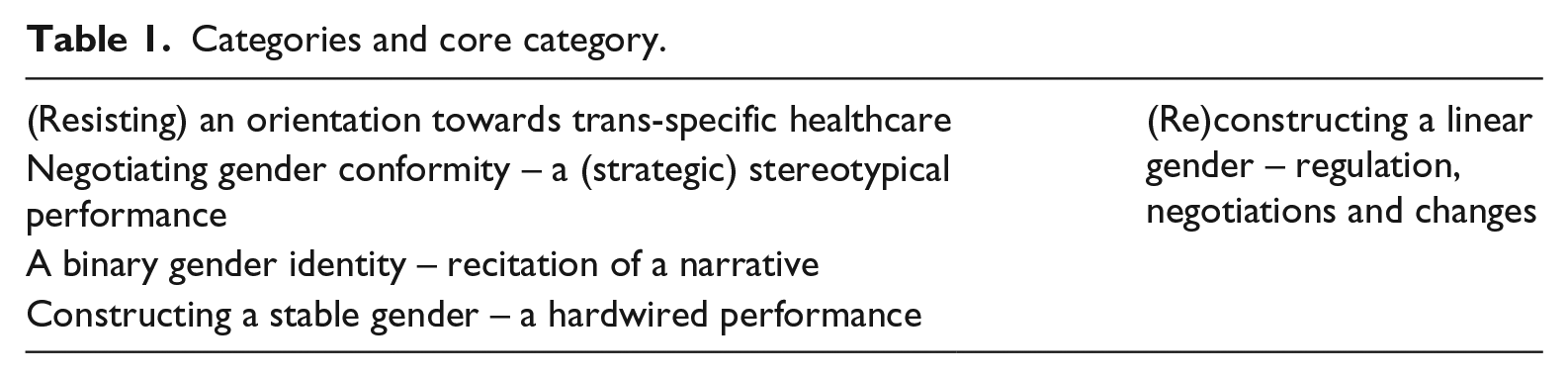
The analysis resulted in four categories building up the core category, (Re)constructing a linear gender – regulation, negotiations and changes (Table 1). The first category mainly takes place outside the trans-specific care and works as an important context describing why and how the participants orient themselves towards the trans-specific healthcare, whereas the three following categories concern the trans-specific care space.
Categories and core category.
(Resisting) an orientation towards trans-specific healthcare
Of those participants who had decided to seek trans-specific care, the motives were very similar; seeking and getting care was vital and felt almost to be unavoidable. Johanna explains, ‘It was like I reached a certain point where I could not take it anymore’. Johanna and several participants experienced the orientation towards trans-specific care as almost the only available action. However, among both care-seekers and those considering seeking care, there were experiences of a more ambivalent orientation towards trans-specific care. This included considerations of advantages and disadvantages before seeking care and fearing that the trans-specific care would create suffering through pushing them into an undesirable gender position. All participants who defined themselves in non-binary ways expressed this resistance. While it is sometimes assumed that individuals identified as non-binary are not interested in gender-confirming medical procedure, this was not a result in this study, as all participants had considered seeking trans-specific care. Among non-binary identified participants, the reasons for not seeking care included fearing being rejected because of their non-binary identity and that the evaluation was going to be humiliating and create ill health. Mio said, ‘But it also feels like people have become ill by going through the evaluation; people do not feel taken care of, or respected’.
The participants with non-binary gender identities still considered seeking care in the future, which was mainly related to changes in trans-specific care, that it is slowly opening up for non-binary identified individuals to have gender-confirming medical procedures. Importantly, the new guidelines for trans-specific care emphasise that people with a non-binary identification should have access to trans-specific care (The National Board of Health and Welfare, 2015).
The goal of gender-confirming medical procedures differed in some respects among the participants, but there was a common desire to be read by others as the gender they identified with. Alex explains, ‘Sometimes you need to pass in order to end up in a gender role so that you get treated in the way that you want’. Many of the participants elaborated on the concept of passing and argued that it is a problematic concept that implies that there are specific ways to be feminine and masculine. Some of the participants, however, described a longing to pass and that passing is a precondition for being treated in certain ways in society:
It would have been fun to be able, somehow, to live in stealth in relation to people you do not know, that they interpret you as a woman and they see nothing else. It had in one way been nice and very relaxing but I do not know. (Johanna)
To not be identified as a person with trans experience can be connected to a longing not to be questioned, to avoid intrusive questions and to having your gender identity affirmed. Some of the participants described this as a longing for relaxation. Thinking with Ahmed (2006), such a longing can be understood as a quest for comfort and increased possibility to take up space. In addition, not having passing privilege can be connected to a risk of violence, offence and stigmatisation (Bockting et al., 2013). The desire for passing has, therefore, to be acknowledged and affirmed at the individual level, and healthcare has an important responsibility for this. Simultaneously, many of the participants talked about a utopian world where striving towards passing is not necessary. Alice described it in this way:
In a perfect world, you do not need it, then you should be accepted for who you are. But, at the same time, you still want to be seen as the gender you want to belong to. So it’s a difficult question.
Elaborating on this implies that the participants are living in cisnormative contexts where passing is the only way to get your gender identity fully acknowledged, or recognisable. To be open about your trans experiences is in a cisnormative context to be out of line (cf. Ahmed, 2006; Bremer, 2011).
The orientation towards trans-specific care can for some people be a linear orientation, a bodily action that can extend the reach of the body by increasing the possibility of a linear presentation, of passing. For others, for example, for non-binary identified individuals, an orientation towards trans-specific care does not promise such possibilities, but instead risks creating bad experiences. This orientation and the reasons and goals for seeking trans-specific care have to be interpreted in relation to what possibilities there have been to occupy non-normative gender positions within trans-specific care. As Spade (2006) discusses, there can be many different reasons for seeking trans-specific care, but the standards within the healthcare system have made it impossible to seek care with (explicit) goals that contradict the normative gender positions. In the next section, we will look more closely at these standards and normative positions.
Negotiating gender conformity − a (strategic) stereotypical performance
In line with trans activists, we argue that the medical procedures should be called confirming procedures instead of changing or correcting. However, many participants did not describe the approach of the evaluation teams as confirming; instead, they described experiences of meeting demands for being gender-conforming. As Anna described it, ‘It was like I had to fit into a category’.
The participants’ experiences show how trans-specific care constructs stereotypical gender positions and how certain performances and attributes were associated with a certain gender identity. Examples from the different participants show how the position ‘woman’ was constructed as being inhabited by someone with make-up, pink blouses, long hair, time invested in her hairstyle and who sits with her legs together. For example, Anna said,
It was not enough that I had clothes from the women’s clothing department, they had to be very feminine; they could not be androgynous even. […] It was not until I had a pink blouse that I was complimented by the evaluator and psychologist.
In vocal training, women were taught to talk as though they were uncertain and use specific words such as ‘adorable’. Based on advice concerning surgery, the women should reject a penis and desire a vagina and breasts. Even if the road to the surgical procedures was described as long, some participants paradoxically experienced a pressure from the evaluators to undergo genital surgery, for example, Louise: ‘[the evaluation was] extremely gender binary, /…/ they tried to force me to undergo things I did not want to undergo’.
Based on the participants’ experiences, the position ‘man’ was, on the other hand, constructed as someone who wears jeans, spreads his legs when sitting down and does not colour his hair. For example, an evaluator told Mark that to become more masculine, he should stop colouring his hair, since that made him look queer. In vocal training, the men were taught to talk in direct ways. These experiences show a discourse within trans-specific care that constructs man/woman as oppositional and mutually exclusive categories (see also Dewey and Gesbeck, 2015; Hird, 2003; Wiseman and Davidson, 2012). With the use of feedback, advices and concrete demands regarding clothes, attributes and expression, these norms were transferred to and disciplined the participants. Mark explained, ‘What I thought was hard with the real life experience was that I was not allowed to be androgynous in any way. I had to be, like, excessively masculine’. Participants who had requested to read their medical records could also see how gender conformity was being taken into consideration in the evaluation process.
Some male participants experienced that the evaluators took for granted that they never wanted to be pregnant, which not only disregard the fact that men with trans experiences might already have been pregnant but also connects to a cisnormative discourse in which a man cannot desire to be pregnant. Bremer (2011) has also argued that a pregnant man is not seen as ‘a real man’ and transcends the limits of a linear gender. Previous pregnancy was also discussed as a possible contraindication for being eligible for gender-confirming medical procedures in the preparatory legal work and, while the legislators decided that was an unreasonable demand (SOU, 1968:28), still it seems like these discourses exist within trans-specific care today.
One way for the care-users to navigate and negotiate the expectation of gender conformity was to occupy strategic positions, which they believed increased their probability of gaining access to care. These strategies included choosing clothes, attributes and using a body language that they considered to be gender-conforming, when meeting the evaluating team (see also Davy, 2010; Dewey and Gesbeck, 2015). However, outside of the evaluation room and after their access to medical procedures was secured, the participants described how they had a different gendered presentation. Anna described,
But after that [approval from the Legal Advisory Board] I felt that I could decide for myself how I wanted to look, and I did not need to have long hair anymore so I cut my hair short. Because long hair was something the healthcare had decided that I should have. And from the very beginning I had chosen to present myself as quite androgynous, feminine androgynous and that was what I liked, but it faded away, which made me feel bad because I did not get to be myself.
Occupying strategic gender positions could increase the possibility of getting access to care, but to follow advice from the evaluators could also create the feeling of losing yourself, as seen in the above quote. Generally speaking, the standards within the evaluation triggered embodied experiences and the participants described stomach pain, anxiety and tiredness before meeting the evaluation team.
Furthermore, a few participants described how they withheld their applications to the Legal Advisory Board until the law no longer demanded sterilisation, and thus resisted expectations of gender conformity. The motive was either an unwillingness to have genital surgery and sterilisation or an explicit political motive, arguing that sending in an application when the law contained a demand for sterilisation would be an affirmation of a system they did not approve of.
Passing was also used in the regulation within trans-specific care. For example, Louise said this in relation to the evaluator’s acceptance (after first facing resistance) of her wish not to have genital surgery: ‘The more you pass in your desired gender, the easier they [the evaluators] can accept that something does not match’. The passing imperative may even be ‘stronger’ for people with trans experience compared to people without trans experience. Annika explains that ‘it is not enough to pass, to look exactly like a cis-woman, then you are not woman enough. I do not think many cis-persons would meet their demands’. Similarly, Spade (2006) argues that passing is an essential part of the regulation and that there is a ‘requirement of being even more “normal” than “normal” people when it comes to gender presentation’. This could stem from cisnormative discourses in which it becomes essential to construct the trans position as separate from the butch woman or the gay man (Spade, 2006). Swedish government reports have explicitly stated that the goal of gender-confirming medical procedures is that people should be passing in society (SOU, 1968:28; The National Board of Health and Welfare, 2010: 54). As seen in the first category, care-seekers may strive for passing. However, if trans-specific care and the evaluators express a demand for passing and connect that to a demand for certain gendered performances, trans-specific care is far from ‘confirming’ in their approach and instead gender conformity seems to be in focus.
A binary gender identity − recitation of a narrative
Identifying in a binary way was described as crucial to secure access to care, Elias, for example, described it like this:
I identified as intergender for quite a long time, also when I sought care. But then [during the evaluation] I strongly emphasised that I was transsexual. I would not say that I faked, but I chose to present my trans identity in a way which assured me that I would get care.
For Elias, the transsexual position is a gender binary position that is crucial to (temporarily and strategically) occupy to assure access to care. Similarly, Spade (2006) argues that this ‘recitation of the transsexual narrative’ can be a strategic position which can increase the possibility of getting access to care (see also Davy, 2010). Some researchers have interpreted the recitation of the transsexual position as a proof that everyone seeking trans-specific care strives for gender conformity and is more invested in the gender binary than someone who does not seek such care. Such interpretations fail to account for the conscious, strategic aspect of this positioning and for the fact that individuals without trans experiences are implicated in the narrative and that the normative position (a binary gender) is created alongside the deviant (Spade, 2006).
The construction of a binary gender identity as desirable within trans-specific care was also experienced in seemingly contradictory ways. Anna explained that the evaluators commented on her face as being androgynous and that she therefore ‘will not have such a hard time’. Here, the healthcare providers saw androgyny as an advantage. So while androgyny (for example, addressed in relation to Real Life Experience, as Mark described above) and non-binary identification were seen as negative, androgyny in terms of bodily potential was interpreted as positive. However, both can be interpreted in relation to the normative goal of crossing all the way to the other side of the constructed dualism between men and women (Fausto-Sterling, 2000). The perceived androgynous body is understood as closer to the other node providing good prospects for crossing all the way to the opposite node of the binary, while intentional or desired androgyny or an intergender identification is seen as a threat to the binary construction of gender. Similarly, the discourse that a person with a trans experience should cross all the way to the ‘other side’ also recurs in legal preparatory works (Alm, 2006; SOU, 2007:16).
Constructing a stable gender − a hardwired performance
Another way for the evaluators to evaluate diagnostic success was to ask about the care-seeker’s behaviour as a child, which Elias described in this way: ‘Well, they wanted the whole, well the classic childhood story. Like how you were as a child, what kind of toys you played with’. Participants also described how this assessment could involve the family, Elias again,
And we had a meeting with the relatives as well,/…/ Then they [the evaluators] began to pose question to my relatives about how I was when I was a child, which I thought was very; well it felt like they wanted to get at something, and it was not at all as they had presented it, like a meeting where relatives could raise questions. Instead, they started to ask questions about me, like some of my relatives should tell on me.
The focus on gendered childhood behaviour can be connected to the discourse of a stable gender. Within such a discourse, if a person in need of gender-confirming medical procedures can describe ‘cross-gender behaviour’ from early in life, this is often interpreted as a sign of diagnostic success. Spade (2006) discusses how the need to recite this particular narrative hides the fact that anyone can transgress gender norms at any point of time in life, regardless of whether the person has transgressed those norms before or not. Connected to the same discourses, psychiatric researchers (see, for example, Landén et al., 1996) have divided transsexualism into primary and secondary transsexualism on the basis of childhood desires, constructing the primary position, which includes the childhood transgression of gender norms, as more genuine and true (Kroon, 2008).
Waiting was a major concern for the participants in their experiences of trans-specific care. Waiting can have an intentional aspect in trans-specific care; care-seekers standing a test of time could be interpreted by the evaluators as revealing a genuine need (Linander et al., 2017). The intentional aspect of waiting can also be interpreted in relation to the discourse about a stable gender in which gender is seen as fixed and not possible to change. Therefore, if individuals with trans experience ‘have for some time behaved according to the other gender’ (SFS, 1972: 119), that could be seen as ‘evidence’ for their wish to have gender-confirming medical procedures (cf. Butler, 2004: 85; Hird, 2003).
The construction of gender identity as stable relates to an understanding of gender identity as a hardwired or inherent characteristic (see Davis et al., 2015) or, as Spade (2006) argues, ‘[i]t produces a naturalized, innate gender difference outside power’. Understanding gender as inherent has been a dominant discourse within medicine, but has also been challenged by feminist researchers arguing for a social constructionist understanding of gender (see, for example, Fausto-Sterling, 2000). If the trans-specific healthcare relies on biological essentialist understandings of gender identity, it risks obscuring the social processes involved in gender performances, for example, how certain performances have higher status, creating incitements to perform gender in certain ways. Such understanding also conceals experiences of changing gender identity and gender expression.
(Re)constructing a linear gender − regulation, negotiations and changes
By rewarding certain gender performances and downgrading others, trans-specific care (re)constructs a linear gender through discourses of a norm-conforming, binary and stable gender. The position, in which gender is constructed as linear, is negotiated, resisted and embraced by the participants. While many of the participants do understand their genders as norm-conforming, binary and stable, when such a position becomes the only one rewarded within trans-specific care, the room for action and the possibilities of self-determination regarding gender performance are limited. In addition, the incitement for care-seekers to follow the advice and demands of the evaluators are connected to the evaluators’ positions as gatekeepers, regulating access to medical procedures.
Discourses and norms, both within and outside the trans-specific care, contribute to the regulation and limit the room for action for care-seekers in the trans-specific care. For example, Elias described, ‘On the other hand, I did not want to be the one who took a risk. To put my diagnosis at stake by testing to see; how queer can I be [in order to get access to care]?’ Although no evaluator has explicitly told Elias that he cannot be queer if he wants access to gender-confirming medical procedures, a queer presentation can be seen as illegitimate or impossible to desire. Instead, gender conformity is constructed as desirable and natural within cisnormative discourses. That discourse may, or may not, be at play in the specific evaluation context. But, as Elias says, taking the risk may not be worth it. Trans-specific care also has a historical context where a linear gender has been understood as natural and healthy. So regardless of whether the individual evaluator allows for a queer presentation or not, the societal norm and the medical discourse affect people’s behaviours and limit the room for action and as such contribute to the regulation of gender performances within trans-specific healthcare.
Even if gender is constructed as linear within the dominant discourses, there are possibilities for resistance and negotiations, both for care-seekers and care-providers. However, such actions come with a risk of sanctions for the care-seekers; in this specific case, the most prominent risk is not getting access to care, in both absolute and relative (e.g. prolonged evaluation time) terms. Based on the participants’ experiences, the room for negotiation and resistance is greater outside trans-specific care but, as we have shown, the participants also sometimes occupy strategic positions within trans-specific care to negotiate and navigate their way to medical procedures (see also Davy, 2010). The (strategic) reciting of certain narratives (sometimes in a very embodied way) can be seen as performative acts, making you recognised as a legitimate transsexual and in need of care. However, as Spade (2006) argues, these strategic positions can be costly. Reproducing a specific narrative can restrict access for persons not being able or willing to adopt these positions. However, for others (for example, researchers) to argue that people ought to put up active resistance to these strategic positions is to put the responsibility on individual bodies and subjects and to ignore the fact that people without trans experience also reconstruct this narrative (Rubin, 1998; Spade, 2006).
One effect of the social processes within trans-specific care is that when trans embodiment and experiences are defined as pathological, their opposites, that is, linear gender and cis embodiment, are simultaneously constructed as healthy (see also Butler, 2004; Davis et al., 2015). In addition, if non-linear embodiment is understood as pathological or possible to ‘fix’ with medical procedures, the potential disruption of cisnormative discourses can be averted (see also Davis et al., 2015). Since the diagnostic processes may include ‘a way of thinking which conceals the presence of [the] social in diagnosis, closing off critical analysis of the complex ways they are structured by history, culture, politics and value judgements’ (McGann, 2011: 337), it can be difficult for evaluators to be self-critical and resist cisnormative discourses. Instead, understanding the diagnostic process as a socially situated practice of negotiation could increase the opportunities for resistance towards cisnormative discourses among care-providers and hence increase the level of self-determination among care-seekers. Thus, the healthcare providers have to develop such understandings to provide the best quality of care for people with trans experiences.
Some of the experiences of participants going through the evaluation during the last couple of years indicate that there is more room for self-determination (in some teams), and there were also examples of care-providers negotiating cisnormative discourses and showing a more confirmative approach, for example, a speech therapist ‘apologized for some of their surveys or forms that were very gender-binary and assumed certain performances’ (Elias). Experiences of participants meeting different evaluating teams indicate that there can be geographical differences in this respect (see also The National Board of Health and Welfare, 2015). This indicates a very vulnerable care, where people are dependent on the geographically closest team with few practitioners setting the agenda. The possibility to explore this further is limited with this material, but geographical differences must be addressed in future studies.
Implications – a more confirming and less conforming evaluation
This study could be used to adapt healthcare practices so as to reduce suffering and increase self-determination within the evaluation process. The participants had several suggestions for reforms concerning trans-specific care, for example, concerning the need for improvements Annika said,
Patient- and individual-focused care. It’s precisely what it isn’t; it is just a package solution for stereotypical transsexuals.
Our participants’ experiences show that it is important that the new guidelines concerning non-binary gender identified people’s access to care are implemented, and that the practices within trans-specific care change so that individuals identified in non-binary ways are assured the same quality of care as those identifying in binary ways, regardless of geographical location. We also see a need for more informed healthcare providers concerning gender norms and cisnormativity, as well as more informed about the social aspects of a diagnostic process. An awareness and critical thinking concerning gender and cisnormativity could minimise the reconstruction of these norms within the trans-specific care.
Based on the participants’ experiences and our theoretical discussion, we argue for a trans-specific care that is more confirming and less conforming in its practice. With the use of confirming, we want to emphasise an approach by healthcare providers in which the needs and wishes of the individuals seeking care are in focus and guide the medical practices. Hopefully, a confirming approach can increase the self-determination regarding gender performance and the quality of care.
Footnotes
Appendix
Acknowledgements
The authors would like to thank the participants of this study for generously sharing their experiences.
Declaration of conflicting interests
The author(s) declared no potential conflicts of interest with respect to the research, authorship, and/or publication of this article.
Funding
The author(s) disclosed receipt of the following financial support for the research, authorship, and/or publication of this article: This work was supported by the Swedish Research Council (grant no. 344-2011-5478).