






Abstract
Norm violations engender both negative reactions and perceptions of power from observers. We addressed this paradox by examining whether observers’ tendency to grant power to norm followers versus norm violators is moderated by the observer’s position in the hierarchy. Because norm violations threaten the status quo, we hypothesized that individuals higher in a hierarchy (high verticality) would be less likely to grant power to norm violators compared to individuals lower in the hierarchy (low verticality). In 14 studies (Ntotal = 1,704), we measured participants’ trait verticality (sense of power, socioeconomic status, testosterone) and manipulated state verticality (power position, status, dominance). A meta-analysis revealed that higher ranked participants granted less power to norm violators than lower ranked individuals, presumably because the former support social stratification. Interestingly, these effects occurred for trait but not state verticality. Overall, negative reactions to deviants may be driven by hierarchy-maintenance motives by those in privileged positions.
Social norms create order and stability in societies and play a pivotal role in regulating group processes. As a result norm violations are frowned upon because they can thwart order and harm group functioning (Feldman, 1984). However, norm violators appear powerful in the eyes of observers because of their apparent autonomy and free will (Stamkou & van Kleef, 2014). We addressed this paradox by examining whether the tendency to grant power to norm violators is moderated by an observer’s hierarchical position. We draw on theories of hierarchy maintenance and power motivation to propose that responses to an actor’s norm-violating behavior depend on the observer’s relative position in the hierarchy (i.e., their verticality).
Verticality can be defined as having or striving for control over others or having access to valued resources (Hall, Coats, & Smith LeBeau, 2005). Because norm violations threaten the status quo that benefits those higher up in social collectives, we hypothesized that individuals in a higher hierarchical position would show a lower tendency to grant power to norm violators rather than to norm abiders compared to individuals in a lower hierarchical position. We tested this idea in 14 studies that involved a variety of common operational definitions of observers’ verticality, such as power, status, and dominance (Magee & Galinsky, 2008), and a range of everyday norm violations (Turiel, 1983). 1 In what follows, we elaborate on the function of norms and reactions to norm violations, and then we delineate why individuals’ verticality may relate to their tendency to maintain the status quo and their readiness to support norm followers over norm violators.
Social Norms and Reactions to Norm Violations
Social norms help regulate societies and keep them orderly. They can be defined as principles that are consensually accepted by members of a group and that guide and constrain behavior to generate proper and acceptable conduct (Cialdini & Trost, 1998). Norms facilitate the functioning of individuals across multiple levels. On the interpersonal level, they prevent one from embarrassment and increase the predictability of others’ behavior (Cialdini & Goldstein, 2004). On the group level, they give expression to the group’s central values, coordinate disparate activities, and ensure group survival (Kiesler & Kiesler, 1970). On the society level, they regulate expectations regarding who is to carry out what types of activities in certain hierarchical systems (Feldman, 1984). Consequently, following norms and living up to expectations help preserve the social order. In doing so, individuals help protect the hierarchical status quo. But how do norm violations shape social hierarchies?
Existing theoretical perspectives and empirical findings are inconsistent with regard to how people react to norm violations (van Kleef, Wanders, Stamkou, & Homan, 2015). On the one hand, research shows that norm violations trigger negative affective and behavioral reactions in observers. For instance, norm violations evoke anger and blame (Helweg-Larsen & LoMonaco, 2008; Kam & Bond, 2009; Ohbuchi et al., 2004). Additionally, they invite various types of sanctions and interventions across a wide range of cultures (Gelfand et al., 2011). These reactions suggest that violating norms is perceived as disruptive and harmful to the group and society at large, and that norm abidance is preferred. Indeed, research indicates that members who follow the norms of a group are strongly endorsed and likely to emerge as leaders (Anderson & Kilduff, 2009; Feldman, 1984; Hogg, 2001; Platow & van Knippenberg, 2001; B. van Knippenberg & van Knippenberg, 2005). Similarly, Kirkpatrick and Locke (1991) have proposed that individuals who show high integrity by adhering to the rules are more likely to emerge as leaders, an argument that is consistent with the finding that leaders who show a lack of integrity are more likely to fall from grace and lose their status (Yukl, 2010). Individuals who follow or embody the norms of a group are considered more committed to the group’s ideals and thereby more trustworthy (D. van Knippenberg, 2011). Furthermore, norms, like hierarchy itself, create a clear and well-defined paradigm of behavior, which reduces uncertainty (Friesen, Kay, Eibach, & Galinsky, 2014). Given that uncertainty reduction is a fundamental human motive, members who observe the rules should be viewed in a positive light and those who break the rules should be degraded (Hogg, 2000).
On the other hand, despite these various negative reactions, norm violations can also bring about positive outcomes for the transgressor. One set of studies showed that individuals who violated prevailing norms were perceived as more powerful than individuals who behaved according to the norms (van Kleef, Homan, Finkenauer, Gündemir, & Stamkou, 2011). Another series of studies showed that individuals who entered a boutique wearing gym clothes rather than appropriate attire or who attended a black tie event wearing a red rather than a black tie were ascribed higher status (Bellezza, Gino, & Keinan, 2014). The reason why violating a norm fuels perceptions of power is because it implies that one is autonomous and has high volitional capacity (Stamkou & van Kleef, 2014).
In addition to inspiring perceptions of power, norm violations may fuel power affordance, the process of advancing another person’s position in the hierarchy by granting them power. Indeed, recent studies have shown that norm violators get afforded more power as long as the norm violation benefits observers (Popa, Phillips, & Robertson, 2014; van Kleef, Homan, Finkenauer, Blaker, & Heerdink, 2012). For instance, a confederate who stole coffee from the experimenter’s desk was afforded more power than a confederate who took coffee upon invitation, but only when he also offered coffee to the participant (van Kleef et al., 2012). In keeping with the finding that the observer’s personal involvement modulates reactions to norm violators, other studies showed that observers are more likely to express their disapproval to the degree that the deviant behavior affects them personally (Brauer & Chekroun, 2005; Chekroun & Brauer, 2002). Likewise, newcomers in groups are more likely to sanction a norm violator in public rather than in private and when observed by a high- rather than low-status audience, because these conditions offer strategic opportunities to enhance one’s acceptance by the group (Jetten, Hornsey, Spears, Haslam, & Cowell, 2010; Noel, Wann, & Branscombe, 1995). These findings suggest that observers react towards norm violators, at least partly, in a self-serving manner. As a result, we predict that those who are higher in a hierarchy will see norm violators as threatening their hierarchical position and reject their claim for status.
Verticality, Norm Violators, and Maintenance of Hierarchy
The quest for status is a fundamental human motive (Anderson, Hildreth, & Howland, 2015; Barkow, 1975). Being at the top comes with the luxury of material, psychological, and social benefits (Anderson, Willer, Kilduff, & Brown, 2012). This explains why individuals in higher standing positions are highly sensitive to a possible status loss and strongly motivated to maintain their position (Blader & Chen, 2011; Y. R. Chen, Brockner, & Greenberg, 2003; Y. R. Chen, Peterson, Phillips, Podolny, & Ridgeway, 2012). In support of this argument, those who perceive themselves to have high status become angry when confronted with a competing claim for high status (Troyer & Younts, 1997). Similarly, upper class and high-power individuals tend to be less generous and charitable and more likely to take valued goods from others, behaviors that indicate that they are less willing to share their resources (Dubois, Rucker, & Galinsky, 2015; Lammers, Stapel, & Galinsky, 2010; Piff, Kraus, Côté, Cheng, & Keltner, 2010; Piff, Stancato, Côté, Mendoza-Denton, & Keltner, 2012; Rucker, DuBois, & Galinsky, 2011). Likewise, higher socioeconomic-status (SES) individuals show less support for redistributive policies that aim to reduce social inequality (Brown-Iannuzzi, Lundberg, Kay, & Payne, 2015) and restorative justice interventions that intend to enhance social opportunity (Kraus & Keltner, 2013).
Social dominance theory (SDT; Sidanius & Pratto, 1999) maintains that human societies often organize as hierarchical systems, with those on top of the hierarchy holding hierarchy-enhancing beliefs that organize their behavior in ways that preserve the status quo and satisfy their need for social dominance. Dominance, however, rarely remains uncontested—those who are at the bottom of the hierarchy may endorse hierarchy-attenuating beliefs that challenge the status quo by supporting policies that mitigate social inequality. SDT further contends that this constellation of beliefs and behaviors constitutes an ideology that legitimizes inequality (Pratto, Sidanius, & Levin, 2010). Support for social inequality, or social dominance orientation (SDO) is asymmetric across different strata of a hierarchy, because higher status groups have the most to lose and so experience the most threat when confronted by possible loss of status. SDO reveals high-verticality individuals’ concern over the maintenance of the status quo, which as a group-level process synchronizes with processes operating at different levels of analysis (e.g., reduced generosity in interpersonal relations or reduced support for redistributive policies) to jointly reinforce existing hierarchies.
Empirical evidence appears to be consistent with the propositions of SDT. For example, SDO is positively correlated with legitimizing beliefs, such as political conservatism and support for severe punishment of lawbreakers (Mitchell & Sidanius, 1995). Moreover, higher SDO individuals tend to attach much importance to values supporting tradition, stability, and respect for social norms as an expression of social control and security (Barnea & Schwartz, 1998) and are less interested in principles that stress tolerance (Cohrs, Moschner, Maes, & Kielmann, 2005). There is also evidence that individuals in high-power positions make more conservative decisions when the status quo is perceived to be in jeopardy (Maner, Gailliot, Butz, & Peruche, 2007). In contrast, individuals in low-power positions are more likely to favor material allocation that facilitates social change (Scheepers, Spears, Doosje, & Manstead, 2006).
The previous findings suggest that across different facets of social life, from individual motivations and interpersonal processes to sociopolitical attitudes and intergroup ideologies, individuals who rank high are keen to maintain social hierarchies. As a consequence, behavior that threatens the stability of the extant status hierarchy, such as norm-violating behavior, would be particularly punished by individuals who stand on top of the hierarchy. These high-ranking individuals may reject a norm violator’s claim to power to defend their own position in the hierarchy.
Hypotheses and Overview of Studies
Given that norm-violating behavior evokes negative reactions while norm-following behavior reduces uncertainty, norm violators should generally be afforded less power compared to norm abiders (Hogg, 2000; van Kleef et al., 2015). However, the relative preference for norm followers over norm violators may be stronger among high- rather than low-verticality observers, because following norms helps keep the social hierarchy intact and preserve the place of high-verticality individuals (Feldman, 1984; Sidanius & Pratto, 1999). We therefore predicted a main effect of an actor’s behavior on power affordance, such that norm violators would be afforded less power than norm abiders (Hypothesis 1), but also an interaction effect between actor’s behavior and observer’s verticality, such that the amount of power afforded to norm violators would be relatively lower for high-verticality observers (Hypothesis 2).
To test Hypotheses 1 and 2, we carried out 12 studies where we manipulated an actor’s behavior as norm violating or norm following. We also operationalized observers’ verticality in two different ways: as an enduring personality trait that was measured in terms of personal sense of power, socioeconomic status (SES), or prenatal testosterone exposure (a correlate of dominance) in Studies 1 to 6; and as an ephemeral, transient state that was experimentally manipulated as a position of power, status, or dominance in Studies 7 to 12 (Ellyson & Dovidio, 1985; Hall et al., 2005; Hall, Schmid Mast, & Latu, 2014; Schmid Mast, 2010). A meta-analysis across these studies revealed that individuals were less likely to afford power to norm violators than to norm abiders, and that this effect was stronger among individuals with higher trait—but not state—verticality. To replicate these findings while controlling for study-to-study variance, we implemented both a trait and a state operationalization of verticality in Study 13. Finally, in Study 14 we explored the role of SDO as a common denominator that predisposes individuals with higher trait verticality to more strongly support norm-following actors.
It is noteworthy that the operationalizations of verticality employed in our studies captured the breadth of the analytical levels involved in our theoretical rationale. For example, we measured basal testosterone as a physiological correlate of desired dominance (individual level), personal sense of power as asymmetric control over resources in social relations (interpersonal level), and SES as subjective perception of one’s relative standing in society (societal level). In the final study we also measured social dominance orientation (intergroup level), not as an operationalization of verticality, but as an attempt to link the effects of verticality observed in the previous studies to higher level processes, such as support for group inequality as a condition that sustains social hierarchies.
Certain phases of the experimental procedure were similar across studies. All studies started with a brief description of the study, after which participants indicated their participation consent and answered a few demographic questions. In studies where verticality was measured, participants were subsequently exposed to the actor’s behavior manipulation and replied to a trait verticality measurement embedded among other questions either at the beginning of the study (Study 2) or at the end of the study (Studies 1 and 3–6); in studies where verticality was operationalized as a state, participants were first exposed to the verticality manipulation and then to the actor’s behavior manipulation (Studies 7–12). Then, participants indicated whether they would afford power to the actor and answered questions checking whether the manipulations were successful. At the conclusion of the study, participants were compensated with money or course credits and debriefed.
Participants were either Dutch citizens recruited via an online system of the University of Amsterdam (www.test.uva.nl) or American citizens recruited through Amazon’s Mechanical Turk (www.mturk.com) and Crowdflower (www.crowdflower.com). Basic demographics for each study are displayed in Table 1. Participants were excluded from the sample if they had missing data on the questions measuring trait verticality or power affordance, had incorrectly replied to conspicuous questions checking the verticality manipulation, or had recently participated in a similar study. Excluded participants per criterion are presented in Table S1 (online supplementary materials).
Demographics and operationalization of independent variables per study.
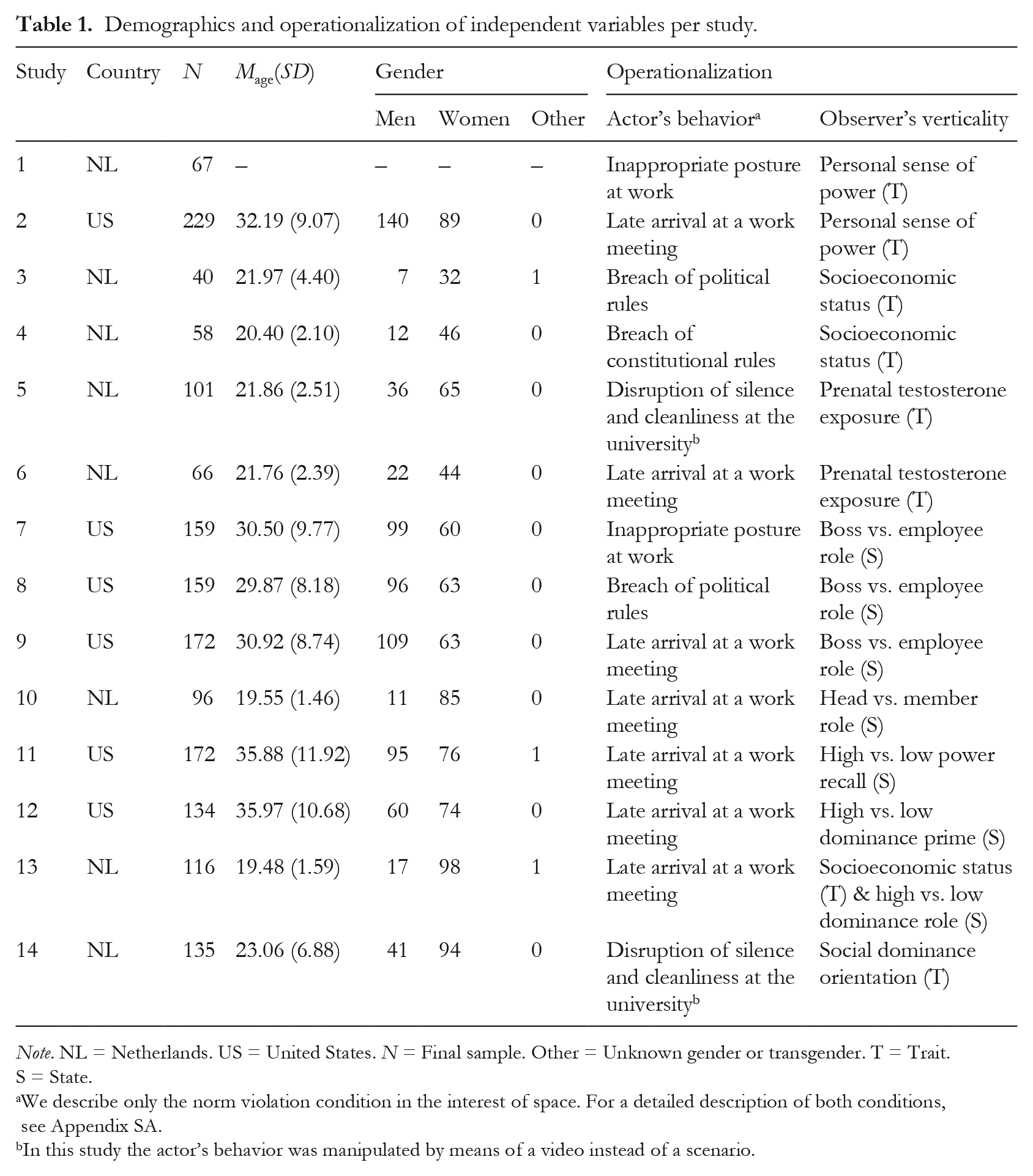
Note. NL = Netherlands. US = United States. N = Final sample. Other = Unknown gender or transgender. T = Trait. S = State.
We describe only the norm violation condition in the interest of space. For a detailed description of both conditions, see Appendix SA.
In this study the actor’s behavior was manipulated by means of a video instead of a scenario.
Studies 1 to 12
Method
Design, materials, and procedure
In all studies we manipulated an actor’s behavior as a between-subjects factor by means of a scenario or a video displaying a person who either violated or adhered to certain social norms. We operationalized observer’s verticality as an enduring trait in the first six studies and as a transient state in the last six studies. This resulted in a simple between-subjects (actor’s behavior: norm violation vs. norm adherence) factorial design with a continuous moderator (observer’s trait verticality) in Studies 1 to 6, and a 2 (actor’s behavior: norm violation vs. norm adherence) x 2 (observer’s state verticality: low vs. high) between-subjects factorial design in Studies 7 to 12.
Actor’s behavior
To manipulate the actor’s behavior, we used a range of conventional norms whose content depended on the context of the scenarios or the video clip. For instance, the actor arrived late (vs. well on time) for an organizational meeting, talked loud (vs. softly) in the university library, or interrupted his conversation partner (vs. waited till his conversation partner finished). To ensure that the actor’s behavior would be perceived as norm violating or adhering, in almost all studies the actor would verbally stand in favor of a rule breaking attitude (i.e., “Rules are there to be broken”) or a rule following one (i.e., “Rules are there for a reason”). The context of the study scenarios varied from a meeting between colleagues or classmates to elections of a political leader or a student representative. A detailed description of the scenarios and snapshots from the video we used is provided in Appendix SA (online supplementary materials).
Observer’s trait verticality
We measured participants’ trait verticality by means of three commonly used operationalizations that tap into one’s dispositional hierarchical standing.
In Studies 1 and 2 we measured personal sense of power (PSP) using an eight-item scale developed by Anderson, John, and Keltner (2012). Sample items are “In my relationships with others . . . I can get others to do what I want” and the reverse-coded “… my ideas and opinions are often ignored” (α = .83 in Study 1 and α = .91 in Study 2).
In Studies 3 and 4 we measured subjective socioeconomic status (SES) using a six-item scale provided by Griskevicius, Tybur, Delton, and Robertson (2011). Example items are “I grew up in a relatively wealthy neighborhood” and “I have enough money to buy things I want” (α = .75 in Study 3 and α = .81 in Study 4).
In Studies 5 and 6 we estimated prenatal exposure to testosterone by measuring participants’ digit ratio (Manning, 2002). Digit ratio has been considered a biological marker of dispositional dominance as it correlates with self-report measures of dominance but also with several dominance-related traits, such as risk taking under conditions of a status threat (Manning & Fink, 2008; Millet, 2011; Ronay & Galinsky, 2011; Ronay & von Hippel, 2010). Specifically, we calculated digit ratio by dividing the length of the fourth digit by the length of the second digit on participants’ right hand. Images of participants’ hands were acquired via a flatbed scanner at the conclusion of the study, and second and fourth digits were subsequently measured from the ventral proximal crease of the digit to the tip of the finger. Two coders rated the same subset of 10% of the images, and after interrater reliability was established to be substantially high, one of the coders went on to rate the remaining 90% of the images (Carney, Hall, & Smith LeBeau, 2005). The interrater reliability was α = .92 in Study 5 and α = .96 in Study 6.
Observer’s state verticality
We manipulated participants’ state verticality using procedures that modulate one’s situational hierarchical standing. Accordingly, in Studies 7 to 10 participants were asked to assume they had a high or low ranking role (e.g., boss or head of a committee vs. employee or member of a committee) and write down how they would feel, think, and act in this role (Anderson & Berdahl, 2002; Rucker et al., 2011). In Study 11, participants recalled an autobiographical experience of high or low power and wrote down the name of the person(s) involved as well as their own feelings, thoughts, and actions (Galinsky, Gruenfeld, & Magee, 2003). In Study 12, we implemented an implicit verticality manipulation by using a standard priming technique. In a word-search puzzle, participants had to find 10 dominance or submissiveness words that were presented among other neutral words. After completing the word-search puzzle participants were asked to recall and write down the words they had found (S. Chen, Lee-Chai, & Bargh, 2001). A detailed description of the verticality manipulations we used is provided in Appendix SB (online supplementary materials).
Power affordance
We assessed power affordance by measuring perceptions of the actor’s legitimate power in Study 1 and readiness to support the actor as leader in Studies 2 to 12. The legitimate power scale measures the perception that someone has a legitimate right to influence others and that others have an obligation to accept this influence (French & Raven, 1959), both of which are important precursors to power affordance. This scale consisted of four items: “This person can make others feel . . . that they have commitments to meet,” “. . . that they should satisfy their job requirements,” “. . . that they have responsibilities to fulfill,” and “. . . that they have tasks to accomplish” (α = .90; Hinkin & Schriesheim, 1989). The leader support scale consisted of four statements that were derived from scales measuring leadership endorsement (Rast, Gaffney, Hogg, & Crisp, 2012; Shepherd, Kay, Landau, & Keefer, 2011) and were adjusted to fit the context of each scenario: “I would vote for this person,” “I would be a strong supporter of this person,” “I think this person would be an effective leader,” and the reverse-coded item “I would vote against this person.” The average reliability of the leader support scale was .90 with a range of .81 to .96.
Actor’s behavior manipulation check
We checked the manipulation of the actor’s behavior using a scale measuring perception of norm violation. In Studies 1, 3 to 6, and 9 to 12, we used the items “I think this person . . . behaves inappropriately,” “. . . breaks the rules,” and the reverse-coded items “. . . behaves appropriately” and “. . . complies by the rules” (mean α = .89 with a range of .62 to .96). In Studies 7 and 8 we used the item “This person’s behavior is . . . norm violating” and the reverse-coded item “. . . appropriate” (mean r = .66, p < .01, with a range of .57 to .76). In Study 2 the manipulation check questions were omitted because of a programming error.
Observer’s verticality manipulation check
We checked the manipulation of participants’ verticality using a scale tailored to the context of each study. In Studies 9 and 11, we asked participants the extent to which they were feeling “independent,” “in charge of others,” “in control,” “responsible,” “powerless,” “submissive,” and “dependent,” with the last three items being reverse-coded (mean α = .91). In Study 10, we asked participants “How much influence did you have in the role you assumed” and “How much power did you have in the role you assumed” (α = .69). In Studies 7 and 8 we did not include a manipulation check because the procedure we used has been repeatedly validated in the past and is routinely used in the power literature (Magee & Galinsky, 2008). In Study 12 we did not include a manipulation check because we used a priming task that activates the concept of power on a nonconscious level.
Response scales
All items in our questionnaires were answered on 7-point Likert scales ranging from 1 = strongly disagree to 7 = strongly agree or 1 = not at all to 7 = very much, depending on the phrasing of each questionnaire. Exceptions were the norm violation manipulation check scale used in Study 3 and the verticality manipulation check scale used in Study 10, which both ranged from 1 to 100. We averaged participants’ responses across the items of each scale and created composite scores that we used in the following analyses.
Analytic Strategy
After checking our manipulations, we followed a three-stage procedure to test Hypotheses 1 and 2. First, we carried out a multiple regression analysis per study where power affordance was predicted by actor’s behavior, observer’s verticality, and the interaction between them. Actor’s behavior was coded as −1 for the norm violation condition and 1 for the norm adherence condition. Verticality was centered at the sample mean when it was a continuous moderator (Studies 1–6) and it was coded as −1 for the low verticality condition and 1 for the high verticality condition when it was a categorical moderator (Studies 7–12).
Second, we entered the unstandardized regression coefficients and their 95% confidence intervals (CI) obtained from the individual regression analyses into three separate meta-analytic models that estimated the overall main effect of actor’s behavior, the overall main effect of observer’s verticality, and the overall interaction effect of actor’s behavior and observer’s verticality on power affordance. Even though we formulated no hypothesis about the effect of observer’s verticality, we report it in order to provide a complete picture of the results. Third, we examined whether different operationalizations of observer’s verticality (trait vs. state) might create heterogeneity among the observed effect sizes by using the operationalization of verticality as a meta-analytic moderator.
Meta-analytic models and software
Meta-analysis combines the results of different studies by means of fixed- or random-effects models. Fixed-effects models gain statistical precision by incorporating information about sample sizes into the calculations and typically yield stronger effects because they are more powerful. However, fixed-effects models offer generalization only to the same study designs with new participants from the same population, whereas random-effects models offer generalization to new studies that test the same hypothesis but have different study designs (Raudenbush, 2009). Because of the variety of methodologies used and the great heterogeneity among the effect sizes (as discussed in the following lines), it was clear that study-level variance should be taken into account as in the random-effects approach. We therefore calculated the basic results in the second analytic stage using both random- and fixed-effects approaches for comparison purposes and we conducted analysis of moderator variables in the third analytic stage using a fully random-effects approach (Rosenthal, 1995). Both random- and fixed-effects analyses were performed using the Comprehensive Meta-Analysis software Version 2 (Borenstein, Hedges, Higgins, & Rothstein, 2009).
Results
Manipulation checks
A series of analysis of variance (ANOVA) performed in each study showed that participants in the norm violation condition considered the actor’s behavior more norm violating than participants in the norm adherence condition, indicating a successful manipulation in Studies 1 and 3 to 12 (see Table 2 for estimates per study).
Effect of actor’s behavior on perceived norm violation (manipulation check).
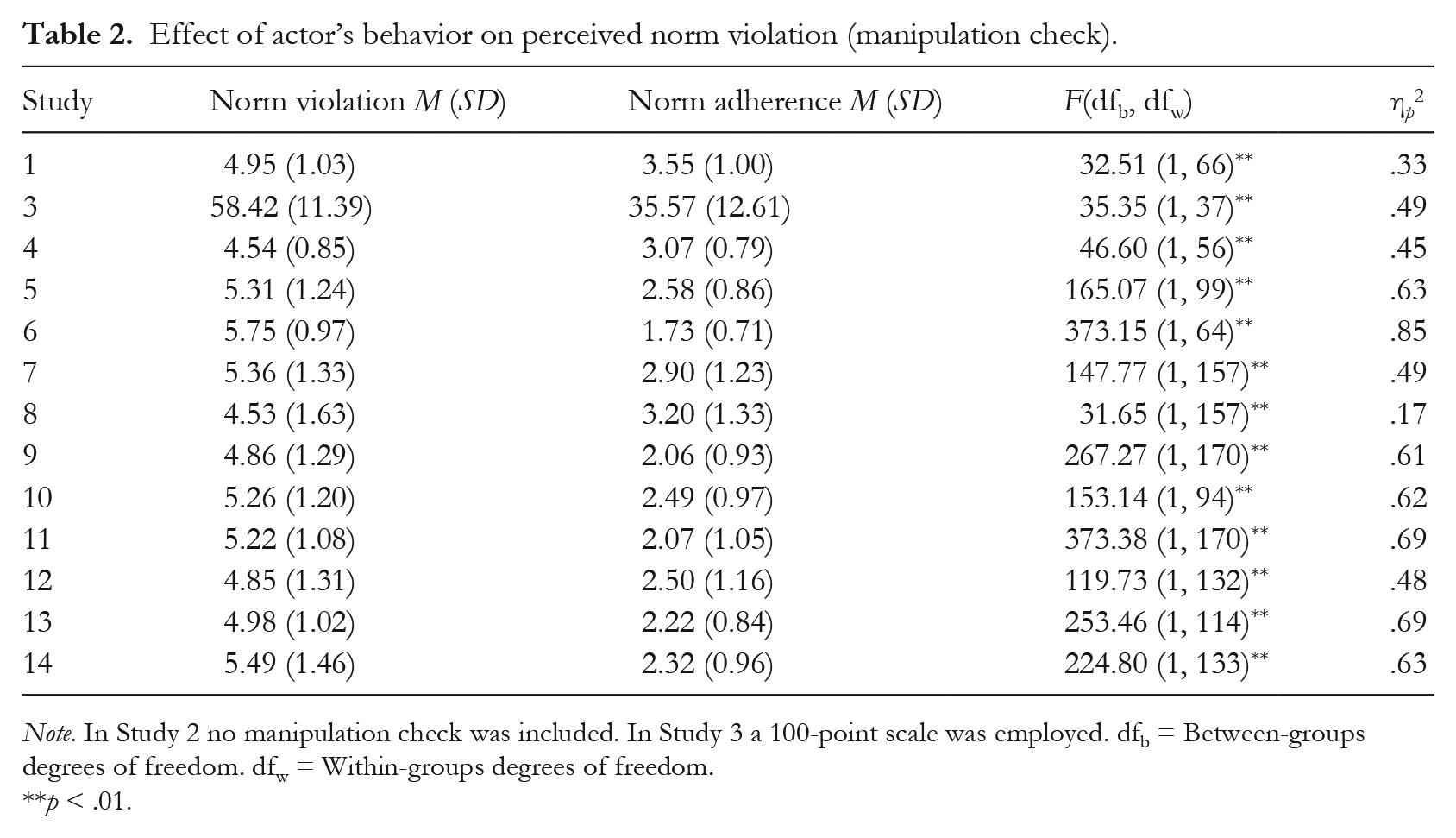
Note. In Study 2 no manipulation check was included. In Study 3 a 100-point scale was employed. dfb = Between-groups degrees of freedom. dfw = Within-groups degrees of freedom.
p < .01.
Participants in the high-verticality condition felt more dominant than participants in the low verticality condition, indicating that the observer’s verticality manipulation was successful in Studies 9, 10, and 11 (see Table 3 for estimates per study). 2
Effect of observer’s verticality on self-reported dominance (manipulation check).
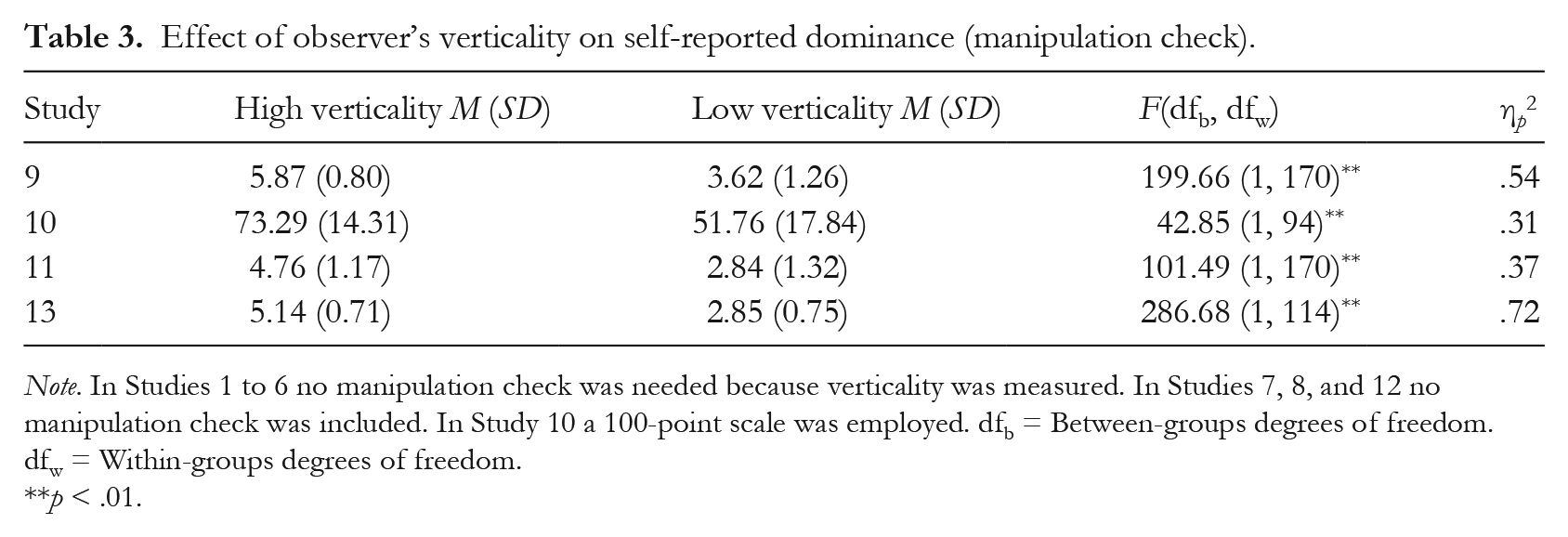
Note. In Studies 1 to 6 no manipulation check was needed because verticality was measured. In Studies 7, 8, and 12 no manipulation check was included. In Study 10 a 100-point scale was employed. dfb = Between-groups degrees of freedom. dfw = Within-groups degrees of freedom.
p < .01.
Actor’s behavior and observer’s verticality effects on power affordance
We report the results testing Hypotheses 1 and 2 as a meta-analysis because the procedures of Studies 1 to 12 were largely identical, and reporting them as separate studies would entail considerable repetition (the results of the individual regression analyses are displayed in Table 4). Furthermore, the meta-analytic report provides a more reliable and complete picture than each study in isolation, and the greater quantity of data included in the meta-analysis provides the statistical power needed to obtain reliable estimates of the effect sizes.
Main and interaction effects of actor’s behavior and observer’s verticality on power affordance.
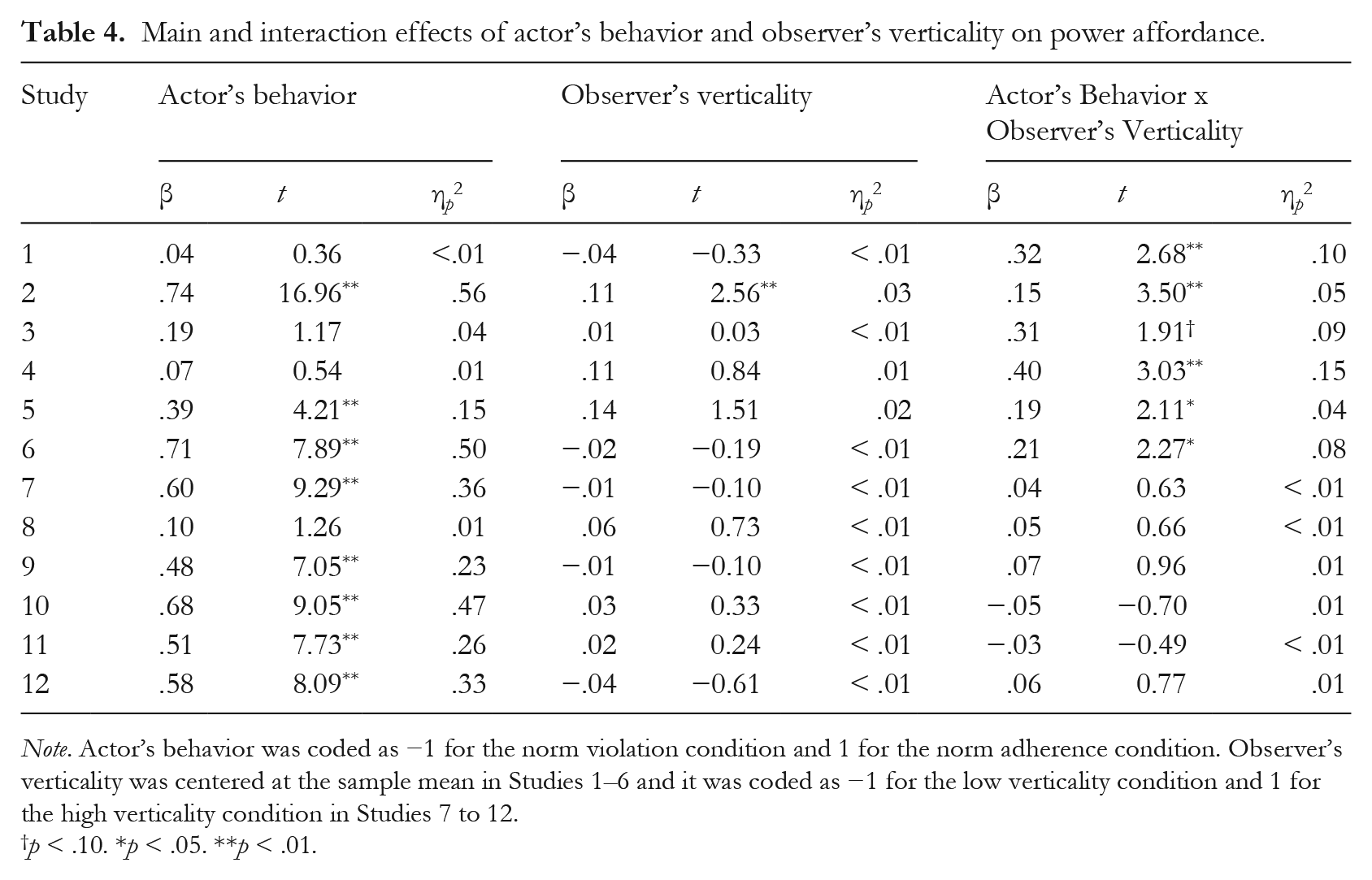
Note. Actor’s behavior was coded as −1 for the norm violation condition and 1 for the norm adherence condition. Observer’s verticality was centered at the sample mean in Studies 1–6 and it was coded as −1 for the low verticality condition and 1 for the high verticality condition in Studies 7 to 12.
p < .10. *p < .05. **p < .01.
Meta-analytic results: Overall effects
The overall effect size estimates are displayed in Table 5 along with the heterogeneity statistics that describe the dispersion of the observed effects. In line with Hypothesis 1 that predicted a main effect of actor’s behavior, both random- and fixed-effects models showed that participants across studies were less willing to afford power to actors that violated rather than followed the norms. Consistent with Hypothesis 2, the main effect of actor’s behavior was qualified by a significant interaction with observer’s verticality, such that the preference for norm followers over norm violators was stronger among higher verticality observers as compared to lower verticality observers. Both main and interaction effects, however, showed significant heterogeneity, so we examined the influence of moderators in the next stage. The overall main effect of observer’s verticality was not significant. The overall effects reported in Table 5 are largely consistent with the study-per-study effects reported in Table 4.
Meta-analytic main and interaction effects of actor’s behavior and observer’s verticality on power affordance.
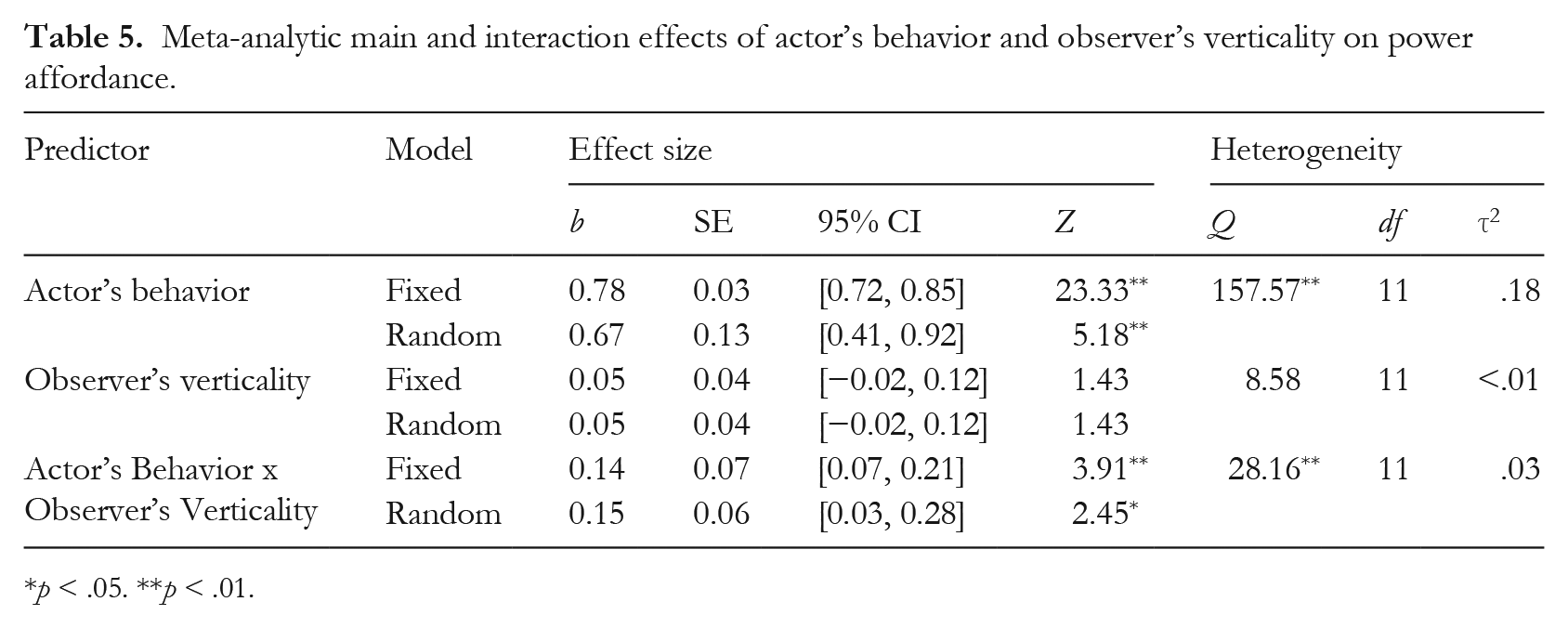
p < .05. **p < .01.
Meta-analytic results: Moderator analysis
We investigated whether operationalization of observer’s verticality had an impact on the main effect of actor’s behavior and then on the interaction effect between actor’s behavior and observer’s verticality by running two fully-random-effects analyses with verticality operationalization as a categorical moderator (trait vs. state).
The first analysis showed that the way we operationalized verticality did not influence the preference for norm followers over norm violators, Qbetween(1) = 0.42, p = .52. In both trait and state verticality studies, participants would afford less power to the norm-violating actor, b = 0.58, SE = .19, 95% CI [0.20, 0.96], Z(6) = 2.97, p < .01 in trait verticality studies, and b = 0.75, SE = .19, 95% CI [0.38, 1.13], Z(6) = 3.94, p < .01 in state verticality studies.
The second analysis showed that the operationalization of verticality had an impact on the relatively stronger rejection of norm violators among higher verticality observers as compared to lower verticality observers, Qbetween(1) = 12.23,p < .01. Exploring the pattern of the moderation indicated that in studies that employed a trait operationalization of verticality (Studies 1–6), there was a stronger rejection of norm violators among higher verticality observers than lower verticality observers, b = 0.34, SE = .07, 95% CI [0.20, 0.48], Z(6) = 4.79, p < .01. In contrast, in studies that employed a state operationalization of verticality (Studies 7–12), there was no difference between high- and low-verticality observers in the relative preference for norm followers over norm violators, b = 0.03, SE = .05, 95% CI [−0.07, 0.14], Z(6) = 0.64, p = .52.
To further examine this moderated interaction effect we carried out simple-effect analyses that tested the effect of target’s behavior on power affordance for high and low levels of observer’s verticality within each individual study. The simple-effect analyses were conducted differently in studies where verticality was a continuous moderator (Studies 1–6) and in studies where verticality was a categorical moderator (Studies 7–12). Specifically, in Studies 1 to 6 the effect of actor’s behavior on power affordance was estimated for lower and higher levels of verticality by centering participants’ verticality scores at one standard deviation above and one standard deviation below the sample mean, respectively (Aiken & West, 1991); in Studies 7 to 12, the effect of actor’s behavior on power affordance was estimated separately within the low- and high-verticality conditions. Next, the effect size estimates obtained from the simple-effect analyses were entered into two separate random-effects meta-analytic models where verticality level (low vs. high) was coded as a moderator in order to assess its impact on the relative preference for norm followers over norm violators.
The meta-analytic results of the simple-effect analyses are displayed separately for Studies 1 to 6 and Studies 7 to 12 in Figures 1 and 2, respectively. Meta-analytic results are commonly presented in a figure (forest plot) that depicts both the individual and overall effects. The left parts of the figures present the regression estimates of the simple-effect analyses for each individual study and the overall effects across high and low levels of verticality. The right parts of the figures graphically present these effects with their confidence intervals within a range of two SDs and relative to a reference line set at 0. The individual effects are presented with an empty square and the overall effects are represented with a solid diamond. When the confidence intervals of an effect fall on the right side of the reference line, participants afforded less power to the norm violator than norm follower; when they fall on the left side, participants afforded more power to the norm violator than to the norm follower; and when they fall in between, there was no significant difference.

Power affordance as a function of actor’s behavior and observer’s trait verticality level in Studies 1 to 6. PSP, SES, and T stand for personal sense of power, socioeconomic status, and prenatal testosterone exposure, respectively. NV and NF stand for norm violator and norm follower, respectively.
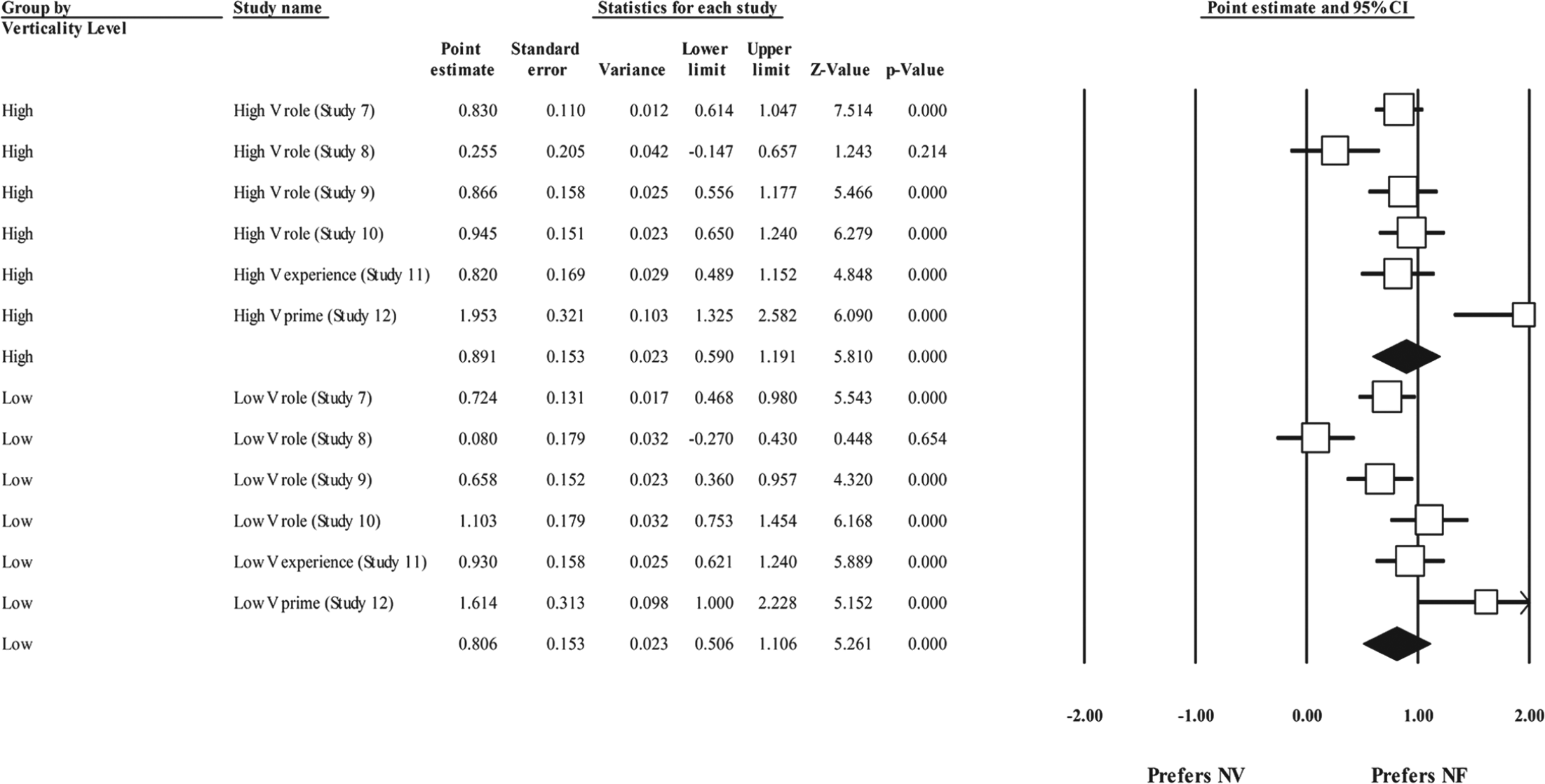
Power affordance as a function of actor’s behavior and observer’s state verticality level in Studies 7 to 12. V stands for verticality. NV and NF stand for norm violator and norm follower, respectively.
The overall effects suggest that, in Studies 1 to 6, lower verticality participants did not differ in their preference to afford power to norm followers and norm violators, whereas higher verticality participants clearly afforded less power to norm violators than norm followers. In contrast, Studies 7 to 12 showed that both low- and high-verticality participants afforded less power to norm violators than norm followers. The difference in the overall effects between lower and higher verticality participants was marginally significant in Studies 1 to 6, Qbetween(1) = 3.07, p = .08, and it was not significant in Studies 7 to 12, Qbetween(1) = 0.15, p = .70.
Discussion
The meta-analysis of Studies 1 to 12 demonstrated that people generally afford less power to norm violators, in keeping with Hypothesis 1. Moreover, in support of our central argument and Hypothesis 2, higher verticality people prefer norm followers to norm violators to a greater extent than lower verticality people, but only when verticality reflects an enduring personality trait rather than an ephemeral state. For lower verticality individuals there was no difference in the power they would afford to norm followers and norm violators.
In the next study we wanted to replicate these findings by comparing directly the effects of the different verticality operationalizations. So in Study 13 we pitted a trait measurement and a state manipulation of verticality against each other. This design also allowed us to control for study-to-study variability, since the manipulation of actor’s behavior and the sample remained constant.
Study 13
We expected that the negative effect of norm violation on power affordance would be qualified by participants’ trait verticality, such that high-verticality perceivers would favor norm followers over norm violators to a greater extent than low-verticality perceivers. Participants’ state verticality was not expected to moderate the effect of norm violation on power affordance.
Method
The procedure of Study 13 was similar with the procedure followed in the studies where we manipulated verticality with the difference that at the beginning of the study we measured participants’ SES as well. After the verticality manipulation, we manipulated the actor’s behavior and then we assessed power affordance, perceived norm violation, and experienced dominance.
Participants first replied to demographic questions that included the SES scale we used in Studies 3 and 4 (α = .96). Next, participants were randomly assigned to a 2 (actor’s behavior: norm violation vs. norm adherence) x 2 (observer’s verticality: low vs. high) between-subjects factorial design. Actor’s behavior was manipulated with the same scenario as in Studies 9, 11, and 12. Participants’ verticality was manipulated by means of a writing task where participants recalled an autobiographical experience of low or high dominance. Power affordance was measured with the same scale as in Studies 2 to 12 (α = .89). Perceived norm violation was assessed with the same items as in Studies 1, 3 to 6, and 9 to 12(α = .93). Experienced dominance was assessed with the Dominance–Submissiveness Scale (Wiggins, 1979), which asked participants to report the extent to which they were momentarily feeling each of 16 states, for instance, “assertive,” “domineering,” “bashful,” and “forceless,” with the last two being reverse-coded (α = .86).
Analytic Strategy
We first checked whether the manipulations of actor’s behavior and observer’s verticality were successful. We also checked whether participants’ SES influenced the likelihood of being assigned to the low- or high-verticality conditions. To test whether the interaction between an actor’s behavior and observer’s verticality depends on the operationalization of verticality, we ran two separate regression analyses—the first included trait SES as a moderator, and the second included state dominance as a moderator.
Results
Manipulation checks
Participants in the norm violation condition perceived the actor as more norm violating than participants in the norm adherence condition (see Table 2). Also, participants in the high-verticality condition reported feeling more dominant than participants in the low-verticality condition (see Table 3). A logistic regression model showed that participants’ SES did not influence their likelihood of being assigned to the low- vs. high-verticality condition, χ2(1) = .61, p = .43.
Trait SES versus state dominance
In the first analysis, we regressed power affordance on actor’s behavior (coded as −1 for the norm violation condition and 1 for the norm adherence condition), SES (centered at the sample mean), and the interaction between them. This analysis showed a main effect of actor’s behavior, b = 0.45, t(113) = 4.27, p < .01, η p 2 = .14, and an interaction effect between actor’s behavior and participants’ SES, b = 0.27, t(112) = 2.75, p < .01, η p 2 = .06. To explore the nature of the interaction we carried out simple-effect analyses that tested the effect of actor’s behavior on power affordance for participants of lower and higher SES. The simple-effect analyses showed that the tendency to afford more power to the norm-following than the norm-violating actor was significant for higher SES participants, b = 0.73, t(112) = 5.05, p < .01, η p 2 = .15, but not for lower SES participants, b = 0.17, t(112) = 1.15, p = .25.
In the second analysis, we regressed power affordance on actor’s behavior, observer’s state dominance (coded as −1 for the low-dominance condition and 1 for the high-dominance condition), and the interaction between them. This analysis showed only a main effect of actor’s behavior—participants were inclined to afford less power to the actor who violated than the actor who adhered to the norms, b = 0.44, t(113) = 4.26, p < .01, η p 2 = .14. In line with the meta-analytic results, the interaction between actor’s behavior and state dominance was not significant, b = −0.05, t(112) = −0.48, p = .63. The results of both analyses are depicted in Figure 3.
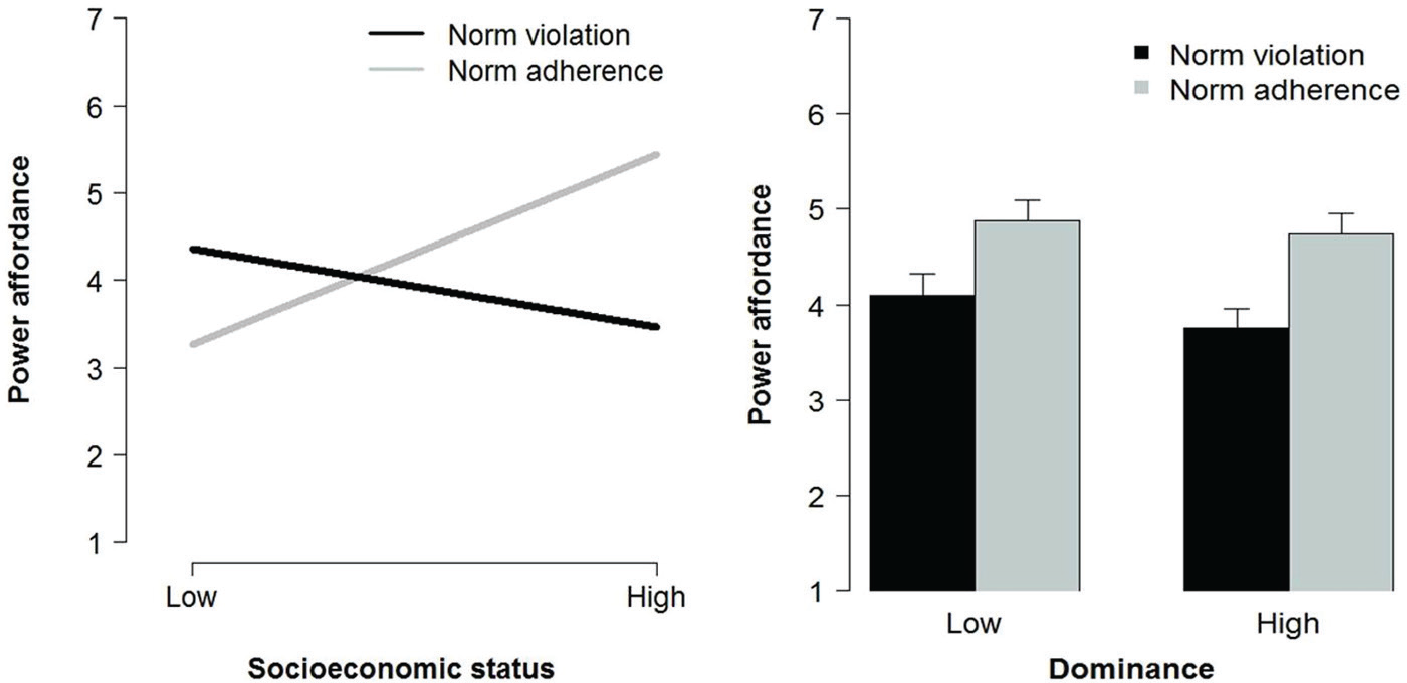
Power affordance as a function of actor’s behavior and observer’s trait verticality (socioeconomic status, left panel) and observer’s state verticality (dominance role, right panel) in Study 13. Means in the left panel are plotted at two standard deviations below and above the mean of trait socioeconomic status. Error bars in the right panel represent standard errors.
Discussion
Our investigations so far have consistently shown that norm violators are less likely to be granted power than norm followers. However, this relative preference is stronger among individuals who structurally reside in the upper rather than lower hierarchical strata. Interestingly, temporary changes in one’s hierarchical position do not appear to play a significant role in shaping people’s relative preferences for norm followers over norm violators. A possible explanation for this difference is that trait verticality measurements tap into stable beliefs that have been instigated, developed, and reinforced through social learning experiences, whereas state verticality manipulations are temporary and largely devoid of social context. Manipulations of verticality may therefore not influence concerns about hierarchy maintenance, which we theorized lie at the heart of high verticality people’s stronger tendency to reject norm violators.
People at the higher end of verticality may believe that society is reasonably divided into different social groups, and that some are superior to others by nature. Such beliefs would motivate higher standing individuals to perpetuate social inequality through the development of an ideology that legitimizes the existing status quo. On the contrary, lower standing individuals might show greater resistance to the status quo by adopting a more permissive attitude towards agents of social change, such as norm violators. To test the influence of these ideological beliefs on reactions to norm violators, we measured SDO in the final study. SDO is a personality trait that refers to individuals’ orientation towards social inequality and has been associated with several verticality traits, such as SES and prenatal testosterone exposure (McIntyre et al., 2007; Sidanius, Levin, Liu, & Pratto, 2000).
Study 14
Based on the foregoing considerations, we predicted that higher SDO individuals would prefer norm followers over norm violators to a greater extent than lower SDO individuals.
Method
After replying to demographic questions, participants were presented with a video displaying a student who either violated or followed prevailing university norms. Next we measured participants’ tendencies to afford power to the actor using the same power affordance scale used in Studies 2 to 13. Next, we measured norm violation perception with the same four-item scale used in the other studies. After a 30-minute-long filler study we measured SDO with a 16-item scale developed by Pratto, Sidanius, Stallworth, and Malle (1994). Sample items are “Some people are just more deserving than others” and the reverse-coded “We should try to treat one another as equals as much as possible” (α = .91). We did not measure SDO at the beginning of the study because we did not want to raise participants’ awareness of our interest in dominance-related questions. Importantly, the actor’s behavior manipulation did not influence participants’ SDO scores.
Results
After the manipulation of actor’s behavior was shown to be successful (see Table 2), we tested whether SDO moderated the effect of actor’s behavior on power affordance in a similar way that other trait verticality measures did. We therefore regressed power affordance on actor’s behavior (coded as −1 for the norm violation condition and as 1 for the norm adherence condition), participants’ SDO (centered at the sample mean), and the interaction between them. Results showed that participants who watched the norm adherence video were more likely to afford power to the student than participants who watched the norm violation video, b = 0.32, t(132) = 2.76, p < .01, η p 2 = .06. Furthermore, this main effect was qualified by a significant interaction with SDO,b = 0.23, t(131) = 2.17, p < .05, η p 2 = .04. Simple-effect analyses showed that participants of higher SDO were less likely to support norm violators than norm followers, b = 0.57, t(131) = 3.52, p < .01, η p 2 = .09, whereas participants of lower SDO did not favor norm violators versus norm followers, b = 0.07, t(131) = .43, p = .67. These findings are presented in Figure 4.
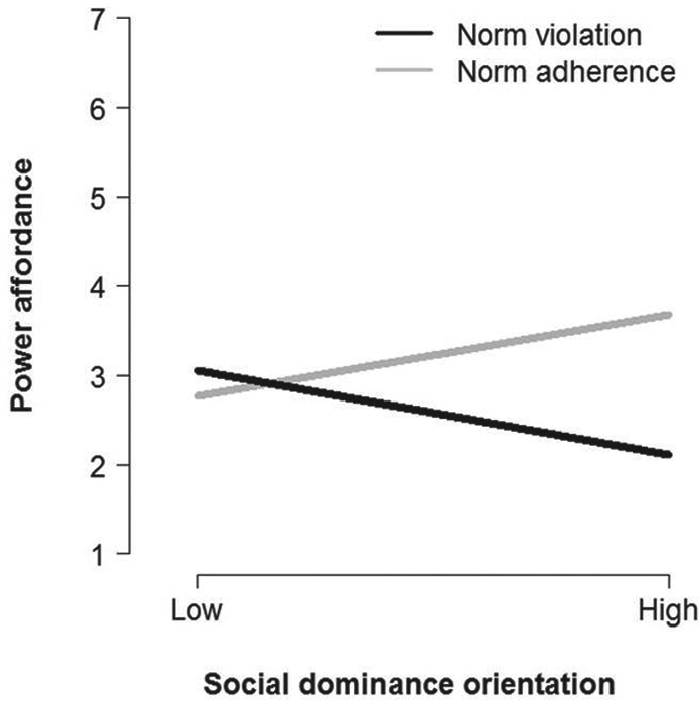
Power affordance as a function of actor’s behavior and observer’s social dominance orientation in Study 14. Means are plotted at two standard deviations below and above the mean of social dominance orientation.
General Discussion
Social norms keep anarchy at bay and lay the foundations of hierarchical relations in groups. Norm violations can jeopardize the stability of the hierarchical status quo and endanger the position of individuals who stand high in the hierarchy. Drawing on theories of hierarchy maintenance and power motivation (Y. R. Chen et al., 2012; Sidanius & Pratto, 1999), we set forth the idea that individuals’ support for norm violators depends on their own position in the hierarchy, in other words, their verticality. High-verticality individuals’ vested interest in the maintenance of hierarchies manifests itself at different levels of analysis, including individual motivations, interpersonal relations, group processes, and social policies. A meta-analysis of the first 12 studies supported our hypotheses: individuals afforded less power to norm violators, and this preference was stronger among high- rather than low-verticality individuals.
Across our studies, this relative preference was contingent on the operationalization of verticality. In studies where verticality was treated as a stable trait, higher verticality individuals rejected norm violators, whereas lower verticality individuals did not favor one over the other. In contrast, in studies where verticality was treated as a transient state, both high- and low-verticality individuals preferred norm followers over norm violators to the same extent, even though manipulation checks indicated that our manipulations of verticality were successful. Replicating these findings, Study 13 showed that individuals tended to afford less power to norm violators, but this tendency differed between high- and low-verticality individuals only when we took into account individuals’ trait verticality—not when we considered the same individuals’ manipulated state verticality. Finally, Study 14 provided suggestive evidence that the preference for social dominance, which is associated with the desire for privileged positions in society, was related to lower power affordance to norm violators.
The current findings have important implications for theorizing on leadership emergence and hierarchy maintenance. On the one hand, the finding that people generally bestow power on norm followers supports traditional leadership theories that attribute the emergence of leaders to specific behavioral styles. Following group norms signals commitment to the group, high integrity, and strong moral principles, which are all key traits to leadership emergence (Kirkpatrick & Locke, 1991). Breaking the rules, in contrast, causes uncertainty about issues that were normally regulated by the rules. And since uncertainty about important matters is aversive (Hogg, 2000), it is sensible that people commonly refrain from granting power to rule breakers. If rule breakers have a lower potential to gain power, they may also have a lower chance to be liked, hired, and positively evaluated for their performance by high-verticality individuals. This means that deviant attitudes would be less prevalent, while conformist attitudes would steadily strengthen the existing status quo, resulting in the maintenance of hierarchies.
On the other hand, we move beyond traditional approaches by highlighting the trait verticality of the individual who affords power as a key factor in determining another individual’s leadership potential. The higher people’s dispositional verticality, the more they reject norm violators. This finding contributes to a growing literature on the motivational underpinnings of hierarchy maintenance (Magee & Galinsky, 2008). Compared to individuals with lower dispositional verticality, individuals with higher dispositional verticality may be more sensitive to the potential status loss involved in having a norm violator move up the hierarchy, and consequently they may be more motivated to defend their relative standing. Residing in the upper echelons of society likely comes with the development of ideas, beliefs, and attitudes geared towards preserving the status quo and maintaining the existing hierarchy. By contrast, dwelling in the lower echelons of society may relate to less negative and more permissive attitudes towards individuals whose actions may imperil the status quo. In support of this argument, our final study explored the role of ideological beliefs about social inequality and generated similar results to the studies that measured trait verticality: higher SDO individuals supported norm violators less than norm followers, whereas lower SDO individuals did not differentially favor one over the other.
The development of an ideology that favors social inequality likely develops over time, as individuals habitually engage in social interactions that affirm and solidify their hierarchical rank. This implies that an ideology that legitimizes hierarchical differences between groups is not something that can be readily injected into individuals’ minds by assigning them a temporary hierarchical position. This may explain why the preference for norm followers over norm violators was not moderated by verticality in the studies where we manipulated participants’ momentary states. This tentative conclusion is also consistent with recent meta-analyses and reviews indicating that trait and state operationalizations of verticality may indeed produce different outcomes (Hall et al., 2014; Sturm & Antonakis, 2014).
Limitations
The previous arguments could explain why trait and state verticality produced differential effects on reactions to norm violators in our studies. Alternatively, however, one could argue that state verticality did not moderate the effect of norm violation on power affordance because the state verticality manipulations we used involved imagined or embodied situations in which participants had little at stake. One could imagine creating a relatively high-stakes situation in the lab where participants interact with someone in the complementary verticality role, which would make the threat of a status loss more palpable. In such situations state verticality might influence participants’ reactions to norm violators the way trait verticality did.
Another situation that could alter our results is an experimental setting where participants interact with a norm violator whose conduct has direct implications for their outcomes. Such a situation could lead participants to afford power to norm violators given the spatial and temporal proximity to possible benefits of the norm-violating act. For instance, in van Kleef et al.’s (2012) study, participants likely afforded higher power to the norm-violating confederate because they directly benefited from his behavior (e.g., upon stealing coffee from the experimenter’s desk, the norm violator offered the participant coffee as well), whereas in our studies, participants could only think of the indirect benefits of having a norm violator on top of the hierarchy (e.g., being upgraded to a higher position in case of a status quo change).
Future research could tie up these loose ends by manipulating the observer’s state verticality and the target’s behavior in the context of face-to-face interactions. Future studies could also provide direct evidence for the presumed psychological mechanism underlying our results, namely that high- and low-verticality individuals experience different levels of threat when observing a norm violator, and that these feelings of threat subsequently inform their differential responses to norm violators. An experimental design that crosses a manipulation of experienced threat and target’s behavior could provide direct evidence for the proposed mediating process.
Conclusion
In sum, the current research integrated processes that emerge from interpersonal power differences and societal structure preferences to understand the dynamics of granting power to norm violators. Our investigations showed that one’s leadership potential is subject to another’s position in the hierarchy, which may give rise to certain self-serving motives. Accordingly, we demonstrated that, while the disadvantaged offered equal chances to norm abiders and norm violators to reach the top, the privileged were reluctant to afford power to norm violators. By blocking norm violators’ way to the top, high-standing individuals may achieve a short-lived goal of preserving their own little niche in the hierarchy—a strategy that eventually reinforces and perpetuates the social hierarchy in the long run.
Footnotes
Funding
The author(s) disclosed receipt of the following financial support for the research, authorship, and/or publication of this article: This research was supported by a research grant from the Public Welfare Foundation “Propondis” awarded to the first author and a research grant from the Netherlands Organization for Scientific Research (NWO, 406-11-024) awarded to the first, second, and fourth authors.
Notes
References
Supplementary Material
Please find the following supplemental material available below.
For Open Access articles published under a Creative Commons License, all supplemental material carries the same license as the article it is associated with.
For non-Open Access articles published, all supplemental material carries a non-exclusive license, and permission requests for re-use of supplemental material or any part of supplemental material shall be sent directly to the copyright owner as specified in the copyright notice associated with the article.
