







Abstract
Low socioeconomic status (SES) students have a lower sense of belonging to college than high-SES students. Due to the importance of sense of belonging in the college pathway, understanding the reason for this relation is particularly important. Here, we argue that in addition to having less access to resources, low-SES students in the college context also perceive themselves as having lower prestige than their high-SES counterparts. Thus, in the present research, we tested perceived prestige as a mediator of the link between subjective SES and sense of belonging to college. We conducted 3 studies in 2 different countries (USA and China), and these investigations provided evidence that the lower students’ subjective SES, the lower their self-attributed prestige, and that prestige mediated the relation between students’ subjective SES and their sense of belonging to college. The implications of these findings for understanding the collegiate experience of low-SES students are discussed.
The need to feel socially connected to others is a fundamental aspect of human life (Baumeister & Leary, 1995) and has crucial implications for psychological functioning (Allen & Kern, 2017) and physical health (Cohen & Janicki-Deverts, 2009). In educational contexts, sense of belonging to an educational community has been shown to have an impact on achievement, self-efficacy, well-being, and intrinsic motivation (Freeman, Anderman, & Jensen, 2007; Ostrove & Long, 2007; Pittman & Richmond, 2007; Stebleton, Soria, & Huesman, 2014; Walton & Cohen, 2007, 2011; Yeager et al., 2016). Research has documented that in such contexts, the experience of sense of belonging not only depends on individual factors (e.g., self-esteem; Ma, 2003), but also on students’ membership to different social groups. In particular, all things being equal, low socioeconomic status (SES) students experience a poorer sense of belonging to college than high-SES students (Kim & Sax, 2009; Ostrove & Long, 2007; Reay, Crozier, & Clayton, 2009; Ribera, Miller, & Dumford, 2017; Rubin, 2012; Soria & Stebleton, 2013; Soria, Stebleton, & Huesman, 2013; Stebleton et al., 2014). However, how SES is related to students’ sense of belonging remains unclear. The purpose of the present paper is to examine a potential mechanism underlying the association between SES and sense of belonging to college
Students’ SES and Sense of Belonging
Why should SES impact students’ sense of belonging to college? Existing research has documented the differential access to economic, material, social, and personal resources as a potential explanation for the aforementioned association. For example, as compared to high-SES students, low-SES students have fewer economic resources and thus, more concerns about their financial situation. These concerns are likely to prevent low-SES students from participating in social activities and experiencing social integration (Rubin & Wright, 2017). In addition, since low-SES students are usually older than high-SES students, they often have to work off campus and to take care of their family (Terenzini, Springer, Yaeger, Pascarella, & Nora, 1996). Consequently, they have less time to devote to the college community and have fewer friends (Terenzini et al., 1996), which ultimately impairs their social integration (Rubin & Wright, 2015, 2017). In addition, a recent line of research has shown that due to low familiarity with the cultural codes of higher education emphasizing independence, low-SES students also have fewer personal resources (i.e., they have a more interdependently shaped self-construal) to meet the expectation of this environment than higher SES students (Stephens, Hamedani, & Destin, 2014). All in all, this lack of economic, material, social, and personal resources are important explanations of the link between low-SES students and a relatively poor sense of belonging to college.
In line with the analyses of Kraus and colleagues (Kraus, Piff, Mendoza-Denton, Rheinschmidt, & Keltner, 2012), we argue that in addition to differential access to resources as a function of SES, students are attributed value and prestige on the basis of their SES that, in turn, is likely to impact their sense of belonging to the prestigious context of higher education. That is, individual differences among low- and high-SES individuals cannot be understood without considering the structural dynamics of society (Kraus & Park, 2017). Indeed, one of the reasons why low- and high-SES individuals differ in terms of motivations and perceptions is that the hierarchical structure that these groups live in shapes their perceptions of the environment (for a review, see Kraus et al., 2012; see also Goudeau, Autin, & Croizet, 2017). Thus, both high- and low-SES students develop perceptions that correspond to, justify, and reproduce the hierarchy of the society in which they live (Jost, Banaji, & Nosek, 2004).
The Prestige of High- and Low-SES Students in the College Context
In our vertically hierarchized societies, an individual who seeks to reach the top of the hierarchy can use different strategies (Anderson, Hildreth, & Howland, 2015; Cheng, Tracy, Foulsham, Kingstone, & Henrich, 2013). Displaying “skills and knowledge valued by the group, which in turn, brings respect, admiration, and, ultimately, high social rank” (Maner, 2017, p. 527) is one of them. In academia, those skills and knowledge refer to academic achievement or intelligence (Maner, 2017). In other words, a student who seeks to reach a high social rank must see his or her competence recognized by others (i.e., students and teachers). Such a recognition can be labeled as prestige. Indeed, prestige can be defined as the amount of recognition freely conferred to an individual by others as a consequence of his qualities and/or performances (see Barkow, 1989; Blader & Chen, 2014; Bogardus, 1924; Goode, 1978; Henrich & Gil-White, 2001; Leopold, 1913; Maner & Case, 2016; Wegener, 1992).
As regularly suggested in the scientific literature, the social groups supposedly located at the bottom of the hierarchy (e.g., females, low-SES individuals, ethnic minorities) suffer from a lack of recognition in comparison with those supposedly at the top (e.g., males, high-SES individuals, ethnic majorities; see Berger, Cohen, & Zelditch, 1972; Blader & Chen, 2014; Fiske, 2010). For example, low-SES students are associated with important and recurrent negative stereotypes regarding their competence (see Cuddy et al., 2009; Durante & Fiske, 2017; Fiske, Cuddy, Glick, & Xu, 2002). These stereotypes result in poorer competence evaluations from their teachers (Baron, Albright, & Malloy, 1995; Batruch, Autin, & Butera, 2017; Darley & Gross, 1983) and peers (Jonsson & Beach, 2015; Régner, Huguet, & Monteil, 2002; Varnum, 2013). In addition, beyond competence evaluation, low-SES children have been shown to be less appreciated and less chosen as friends than high-SES children, regardless of the perceiver’s own SES (Shutts, Brey, Dornbusch, Slywotzky, & Olson, 2016).
In line with earlier predictions by Cheng and Tracy (2013) regarding a positive link between SES and prestige, the aforementioned results suggest that a prestige gap exists between low- and high-SES students in education, and that this gap seems to be perceived by both high- and low-SES individuals (Durante, Tablante, & Fiske, 2017). Indeed, people are likely to develop self-perceptions that match the position they occupy in a hierarchy (Jost, 2001; Jost et al., 2004). Thus, low-SES individuals also have lower self-esteem (Kraus & Park, 2014; Twenge & Campbell, 2002), lower self-efficacy (Ramos-Sánchez & Nichols, 2007; Wiederkehr, Darnon, Chazal, Guimond, & Martinot, 2015), and lower self-assessed intelligence (Ivcevic & Kaufman, 2013), compared to their high-SES counterparts, particularly when their belonging to a lower ranked group is made salient (Kudrna, Furnham, & Swami, 2010). These mechanisms have led some authors to describe the self-concept of low-SES individuals as an “undervalued self” (Kraus & Park, 2014).
Since intelligence seems to be particularly important in order to determine one’s prestige in the college context (Maner, 2017), we believe that the suggested prestige gap might particularly be true in this environment. Indeed, as regularly documented in the literature, low-SES students are underrepresented in higher education in comparison with high-SES students (Hearn & Rosinger, 2014). This discrepancy means that the college context seems, by default, a high-SES environment, and that daily collegiate life entails constant reminders to low-SES students of their minority status (Martin, 2015; Orbe, 2004). Several studies have documented that in such a context, low-SES students experience an identity threat that strongly impacts their academic experience, including their sense of belonging (Browman & Destin, 2016; Janke, Rudert, Marksteiner, & Dickhäuser, 2017; Jury, Smeding, & Darnon, 2015; Jury et al., 2017; Spencer & Castano, 2007; Stephens, Fryberg, Markus, Johnson, & Covarrubias, 2012; Stephens, Townsend, Markus, & Phillips, 2012). Altogether, these results suggest that in the college context, low-SES students should perceive less prestige in the eyes of others (i.e., less recognition from them) than high-SES students.
Prestige and Sense of Belonging
In order to feel connected with others, individuals need to feel safe regarding both their social relations with their peers (e.g., perceived similarity, familiarity, and trust; Zhao, Lu, Wang, Chau, & Zhang, 2012) and their own identity. Recently, Cheng, Tracy, and Henrich (2010) demonstrated that the higher an individual’s prestige in the eyes of others, the more social acceptance s/he perceived from others. In a related way, Destin, Rheinschmidt-Same, and Richeson (2017) demonstrated that the extent to which individuals feel uncertain regarding their status identity—“the subjective understanding, meaning, and value that people attach to their SES” (2017, p. 276)—predicts their sense of belonging. More specifically, the more students are uncertain of their status identity, the less they feel socially connected with their peers. Since prestige is positively associated with social acceptance, in the present research we hypothesized it as a mediator of the relation between students’ SES and their sense of belonging to college. In other words, we expect low (vs. high) SES students to have self-perceptions that match the place their group occupies in the hierarchy, and thus, to have low (vs. high) self-attributed prestige. In turn, the lower an individual’s own perceived prestige, the lower his/her sense of belonging is expected to be. We conducted three studies to test the hypothesized indirect effect, namely, that the positive relation between students’ SES and sense of belonging to college can be explained by students’ perception of prestige. 1
Study 1
Method
Participants
Two hundred and thirty-five U.S. undergraduates participated in the study (104 male, 131 female; Mage = 19.36, SD = 1.35). The sample size for this study (and the subsequent studies) represents the maximum number of participants that were available within the time frame established for using the university participant pool. Ethnicity was 49% Caucasian, 6% African American, 30% Asian, 8% Hispanic, and 7% other or unspecified.
Procedure and materials
Participants completed the measures online during the first 3 weeks of the spring semester.
Participants’ SES
Subjective SES is known to be a particularly powerful predictor (more than other SES measures) of psychological outcomes (e.g., mental health; see Adler, Epel, Castellazzo, & Ickovics, 2000), including our main dependent variable, sense of belonging (see Bond et al., 2007; Stebleton et al., 2014). As a result, participants’ subjective representation of their SES was measured using the MacArthur Scale of Subjective Social Status (Adler et al., 2000). Participants were asked to indicate their perceived position on a 10-runged “social ladder” in which higher rungs represent people who have higher SES in terms of income, education, and occupation in relation to other people (M = 6.16, SD = 1.86). It should be noted that this measure focuses specifically on subjective SES, and results should be interpreted accordingly.
Perceived prestige
Participants’ perceived prestige was measured with the Prestige subscale extracted from the Dominance and Prestige Scales developed by Cheng et al. (2010). This measure was chosen for its good convergent and discriminant validity (Cheng, Weidman, & Tracy, 2014), and is comprised of nine items assessing individuals’ perceived prestige (e.g., “I am held in high esteem by those I know,” “My unique talents and abilities are recognized by others”). Participants indicated on a 7-point scale (1 = not at all, 7 = extremely), the extent to which the statements accurately described them (α = .83; M = 5.15, SD = 0.84). It should be noted that we have opted for a general framing of the perceived prestige measure instead of a specific one because we believe SES not only confers prestige in the context of university, but also prestige in society in general.
Sense of belonging
Participants completed a 17-item measure assessing their sense of belonging to college (Walton & Cohen, 2007). They used a 7-point scale (1 = strongly disagree, 7 = strongly agree; α = .92; M = 4.99, SD = 0.90) to indicate the extent to which they agreed with the sentences provided (e.g., “I fit in well at [name of the university],” “I feel comfortable at [name of the university]”). Intercorrelations among the variables of interest are presented in Table 1.
Intercorrelations among variables in Study 1, Study 2, and Study 3.
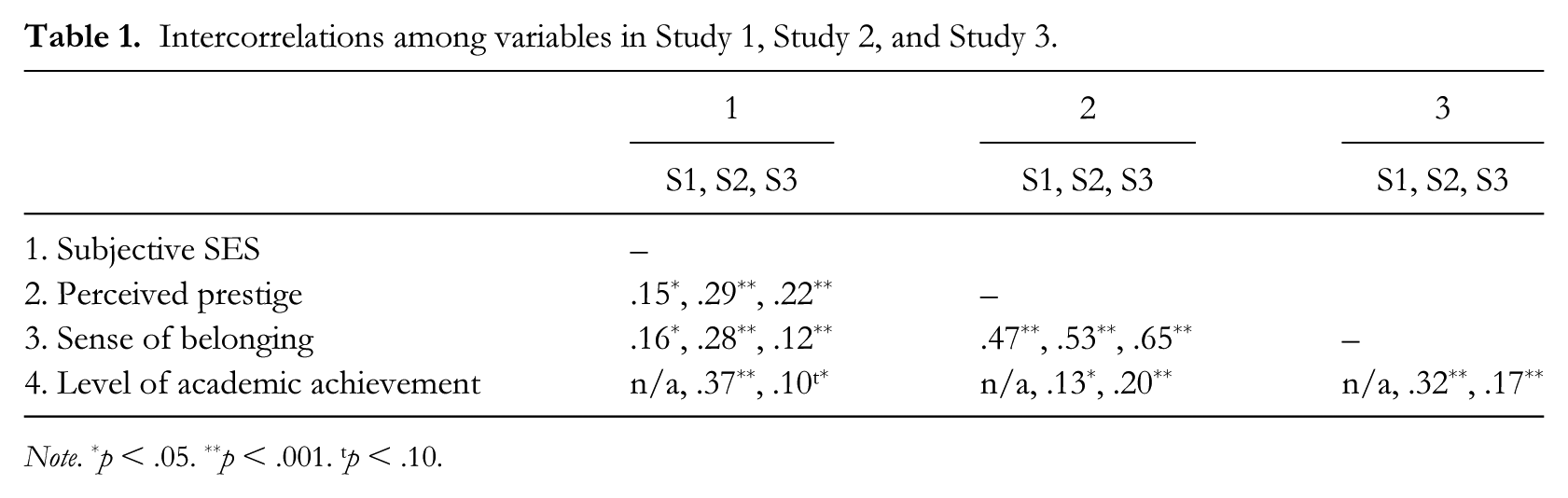
Note. *p < .05. **p < .001. tp < .10.
Results and Discussion
All of the variables were standardized. Full information maximum likelihood method was used for analyses to avoid loss of information due to missing data (Enders, 2006). All data were analyzed using the lavaan package (Rosseel, 2012) for R (R Core Team, 2014). The data for this study, as well as for Studies 2 and 3, were collected in the context of larger projects; none of the findings from the research herein have been presented in any prior work. 2 In this and all subsequent studies in this research, no data exclusions were used, all data were collected before any analyses were conducted, and all variables analyzed are reported.
We tested the hypothesized model (see Figure 1). Results revealed that participants’ subjective SES positively predicted their sense of belonging, β = .17, z = 2.56, p = .010, 95% CI [.03, .29], and perceived prestige, β = .14, z = 2.21, p = .027, 95% CI [.01, .27]; the higher an individual’s subjective SES, the higher his/her perceived prestige and the more s/he felt a sense of belonging to his/her university. In addition, the higher the perceived prestige, the higher the sense of belonging, β = .46, z = 7.94, p < .001, 95% CI [.34, .57]. Testing perceived prestige as a mediator revealed a significant indirect effect, β = .07, z = 2.13, p = .033, 95% CI [.005, .12], confirming that the lower sense of belonging experienced by students who perceive their SES as low could be partially explained by their lower perceived prestige. It should be noted that the direct effect of SES on sense of belonging remained marginally significant, β = .10, z = 1.70, p = .088, 95% CI [−.01, .21].
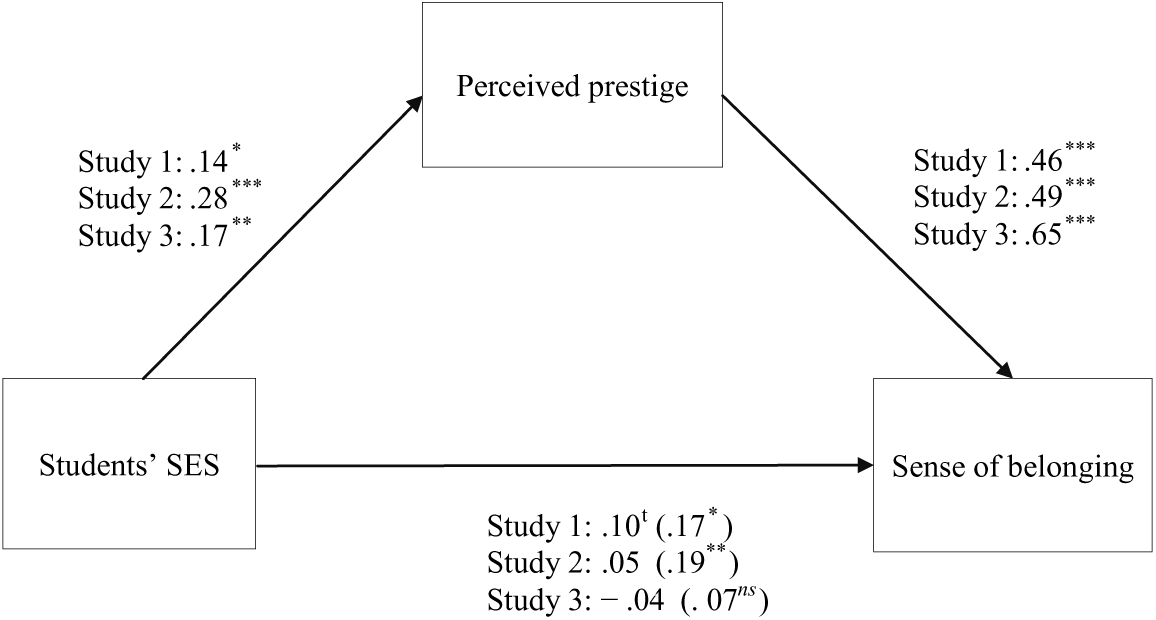
Indirect effect of participants’ subjective SES on sense of belonging through perceived prestige.
This study provided evidence indicating that the lower students’ subjective SES, the lower their sense of belonging to college. The present results also indicated that this link could be explained by students’ perceived prestige, suggesting an interpretation of the differences among low- and high-SES students in college in terms of group value (Kraus & Park, 2017). Study 2 was conducted in order to replicate these results while controlling for students’ level of academic achievement. Indeed, one may argue that the positive relations of students’ subjective SES to their perceived prestige and sense of belonging may actually be due to their shared association with their actual academic achievement. Level of achievement has been shown to predict sense of belonging (e.g., Soria & Stebleton, 2013; Walton & Cohen, 2007). Thus, the results of Study 1 may simply indicate that high achievers (who are often higher SES students; Koza Çiftiçi & Melis Cin, 2017) have both more prestige in college and more sense of belonging. Replicating the results while controlling for the influence of students’ level of academic achievement would enable us to rule out this explanation.
Study 2
Method
Participants
Three hundred and twenty-seven U.S. undergraduates participated in the study (204 female, 123 male; Mage = 19.69 years, SD = 1.69). Ethnicity was 43% Caucasian, 6% African American, 32% Asian, 10% Hispanic, and 9% other or unspecified.
Procedure and materials
Participants’ subjective SES (M = 6.03, SD = 1.87), perceived prestige (α = .82; M = 5.07, SD = 0.85), and sense of belonging (α = .92; M = 4.88, SD = 0.92) were assessed in the same way as that used in Study 1. Participants’ level of academic achievement was estimated based on their self-reported grade point average (GPA; M = 3.30, SD = 0.50). As in Study 1, the questionnaire was completed during the first 3 weeks of the spring semester. Intercorrelations among the variables are presented in Table 1.
Results and Discussion
The regression model included all of the variables of Study 1 plus the level of academic achievement. Because none of the interactions involving students’ self-reported level of achievement were significant in the preliminary analyses, these ones were removed from the final model (Yzerbyt, Muller, & Judd, 2004).
Results revealed that participants’ subjective SES, β = .19, z = 3.36, p = .001, 95% CI [.07, .29], and level of achievement, β = .25, z = 4.43, p = .001, 95% CI [.13, .35], significantly predicted their sense of belonging to college. Participants’ subjective SES also significantly predicted their perceived prestige, β = .28, z = 4.86, p < .001, 95% CI [.16, .39]; academic achievement was not related to perceived prestige, β = .02, z = 0.37, p = .71, 95% CI [−.09, .13]. In addition, the higher the perceived prestige, the higher the sense of belonging, β = .49, z = 10.52, p < .001, 95% CI [.39, .58]. Finally, the indirect effect was significant, β = .14, z = 4.40, p < .001, 95% CI [.07, .19], while the direct effect was no longer significant, β = .05, z = 1.02, p = .31, 95% CI [−.04, .14] (see Figure 1).
These results indicate that, regardless of their level of academic achievement, students’ subjective SES is positively associated with their sense of belonging and that this link can be explained by perceived prestige. Thus, these findings both replicate those of Study 1 and address the third variable explanation grounded in level of academic achievement.
Despite the consistent results obtained in the first two studies, we identified two limitations. First, as with most studies in psychological science, these studies were conducted in a Western, educated, industrialized, rich, and democratic (i.e., WEIRD) society. As noted by Henrich, Heine, and Norenzayan (2010), U.S. undergraduates have been overstudied, and the use of more diverse subject pools can strengthen the confidence in research findings. As recently shown by Chiu, Chow, McBride, and Mol (2016), sense of belonging in school varies across cultures, with students in more egalitarian cultures having a higher sense of belonging in school compared to students in more hierarchical cultures (see Hofstede’s [2011] power distance cultural dimension). Moreover, research has also documented that whereas Western countries are typically low in power distance, Asian countries are typically high in power distance (i.e., the unequal distribution of power is accepted as natural, its legitimacy being irrelavant; Hofstede, 2011). Thus, testing the link between subjective SES and sense of belonging in a Chinese sample is a good way to see if our findings could generalize outside of the American context.
Second, in our first two studies, participants started with the completion of the subjective SES measure. This may have activated their stigmatized identity, thereby triggering a social identity threat for those who perceived their SES as low (Clark, Thiem, Barden, Stuart, & Evans, 2015; Danaher & Crandall, 2008; Kudrna et al., 2010). This might be at least partially responsible for the association between subjective SES and both perceived prestige and sense of belonging.
In this regard, Study 3 had two goals. First, Study 3 aimed to replicate the results obtained in Studies 1 and 2 with a different sample, specifically a sample from a high power distance culture (i.e., China). Second, in Study 3 subjective SES was assessed either before or after the perceived prestige and sense of belonging measures to determine whether the order of assessment had any impact on the focal variables and findings. As in Studies 1 and 2, an indirect effect of subjective SES on sense of belonging, via perceived prestige, was anticipated.
Study 3
Method
Participants
Three hundred and ninety-four Chinese students participated in the study (304 female, 90 male; Mage = 20.64 years, SD = 1.62). Participants came from four different universities, and most majored in social sciences (85%).
Procedure and materials
Participants completed a questionnaire during one of the last weeks of the spring semester. Participants’ subjective SES was assessed with the same instrument as in Studies 1 and 2. However, because of differences in self-construal (with Chinese individuals having a more interdependent self than Americans; see Oyserman, Coon, & Kemmelmeier, 2002, for a meta-analysis), participants were asked to indicate where their family stands on this scale (instead of themselves, as in Studies 1 and 2; M = 5.14, SD = 1.46). Participants were randomly assigned to one of two order conditions. In one condition (n = 128), participants started the questionnaire with the subjective SES measure (SES-first condition); in the other (n = 266), participants finished the questionnaire with the subjective SES measure (SES-final condition). Participants’ perceived prestige (α = .82; M = 4.89, SD = 0.76) and sense of belonging (α = .90; M = 4.64, SD = 0.77) were measured in the same way as in the previous studies. All measures were first translated into participants’ first language, Mandarin, by a native speaker and were then back-translated into English by other bilingual researchers. These back-translated items were compared to the original items and validated by a fourth expert. Participants’ academic achievement was collected through a self-report measure of students’ average score (out of 100) in the last semester (M = 85.19, SD = 5.87). Intercorrelations among the variables are presented in Table 1.
Results and Discussion
The regression model included four predictors: participants’ subjective SES (mean-centered), experimental condition (coded −0.5 for the SES-final condition and +0.5 for the SES-first condition), the interaction between these two predictors, and participants’ level of achievement (mean-centered). As in Study 2, since none of the interactions involving participants’ level of achievement were significant in the preliminary analyses, they were removed from the final model (Yzerbyt et al., 2004).
Sense of belonging
Neither the main effect of experimental condition, β = .05, z = 1.06, p = .29, 95% CI [−.04, .15], nor its interaction with subjective SES, β = −.08, z = −1.50, p = .13, 95% CI [−.19, .02], were significant. Unexpectedly, the main effect of participants’ subjective SES was not significant either, although it was in the expected direction, β = .07, z = 1.18, p = .24, 95% CI [−.04, .17]. Only the level of achievement significantly predicted sense of belonging to college, β = .17, z = 3.30, p = .001, 95% CI [.06, .26].
Perceived prestige
A main effect of experimental condition, β = .11, z = 2.17, p = .030, 95% CI [.01, .20], indicated that participants who started with the subjective SES measure (M = 5.00, SE = 0.06) perceived their prestige as higher than participants who finished with the subjective SES measure (M = 4.83, SE = 0.04). In addition, participants’ subjective SES, β = .17, z = 3.10, p = .002, 95% CI [.06, .27], and level of achievement, β = .19, z = 3.80, p < .001, 95% CI [.09, .28], significantly and positively predicted perceived prestige. The interaction between participants’ subjective SES and the experimental condition was not significant, β = −.05, z = −0.85, p = .40, 95% CI [−.15, .05].
Test of the indirect effect
The presence of a total effect (i.e., the main effect of students’ subjective SES on sense of belonging) is not a precondition for testing the presence of a hypothesized indirect effect (see Hayes, 2009), and the results indicated that the higher an individual’s perceived prestige, the higher his/her sense of belonging, β = .65, z = 16.28, p < .001, 95% CI [.57, .72]. Thus, further analyses were conducted to test the hypothesized indirect effect linking students’ subjective SES to their sense of belonging through perceived prestige. This indirect effect was significant, β = .11, z = 3.04, p = .002, 95% CI [.03, .17], whereas the direct effect was not, β = −.04, z = −1.00, p = .32, 95% CI [−.12, .04] (see Figure 1). 3
To sum up, the present findings suggest that, in a new context, regardless of their level of academic achievement, students’ subjective SES is linked to their sense of belonging to college through their perceived prestige. As such, the results replicate the key findings of Study 2. It is worth noting that the order of the SES measure did not moderate the effect of subjective SES on perceived prestige, β = −.05, z = −0.85, p = .40, 95% CI [−.15, .05], nor the partial effect on sense of belonging, β = .09, z = 0.97, p = .33, 95% CI [−.08, .25]. Therefore, the mediation is not moderated (Muller, Judd, & Yzerbyt, 2005). Moreover, the difference in the indirect effect between the two levels of the experimental condition (Mediation package in R; Tingley, Yamamoto, Hirose, Keele, & Imai, 2014) was not significant (p = .53, 95% CI [−.09, .05]), providing further evidence that the relations in the model do not depend on subjective SES salience.
Interestingly, it should be noted that the participants who started with the SES measure perceived their prestige as higher than participants who finished with the SES measure. We think that this may be because the measure of subjective SES was in reference to the perception of family rank, which besides capturing SES also possibly rendered students’ family ties more salient. This family salience may have increased for all students, independent of their SES, the extent to which they felt respected and approved by others.
Ancillary analysis
As the total effect of students’ subjective SES on sense of belonging was not significant in this third study, we conducted a random-effect meta-analysis in R, using the Metafor package (Viechtbauer, 2010) to investigate the reliability of this link across the three studies. We used the Sidik–Jonkman method, which is preferred for meta-analyses including a small number of studies (Inthout, Ioannidis, & Borm, 2014). This analysis confirmed the positive link between students’ subjective SES and their sense of belonging, B = 0.14, SE = 0.04, z = 3.24, p = .001, 95% CI [0.05, 0.22]. Moreover, estimates for heterogeneity showed low heterogeneity across studies, T² = 0.002, I² = 0.31, and Q (df = 2) = 2.24, p = .33.
General Discussion
Sense of belonging to an educational community has a crucial impact on a number of important educational outcomes (e.g., achievement, motivation, well-being; see Freeman et al., 2007; Ostrove & Long, 2007; Pittman & Richmond, 2007; Stebleton et al., 2014). Importantly, this sense of belonging is not equal across groups in the college context, with previous research consistently demonstrating that low-SES students experience a poorer sense of belonging to college than high-SES students (Kim & Sax, 2009; Ostrove & Long, 2007; Rubin, 2012; Stebleton et al., 2014). This prior research has also documented that differential access to economic, material, social, and personal resources explains this effect (Rubin & Wright, 2015, 2017; see also Johnson, Richeson, & Finkel, 2011). In the present research, we use a structural analysis of social class (see Kraus & Park, 2017; Kraus et al., 2012) to examine whether the difference in perceived prestige between low- and high- (subjective) SES students could contribute to explain the difference in sense of belonging. That is, the purpose of the present work was to examine correlational evidence for the hypothesis that perceived prestige could be a mechanism explaining the link between students’ subjective SES and their sense of belonging to college.
The results obtained in the three studies supported this mediational hypothesis. Indeed, they confirmed that, regardless of their level of academic achievement, students’ subjective SES positively predicts their sense of belonging to college, and that this link could be explained by the prestige that students feel they have in the eyes of others. This result is consistent with recent research findings showing that in the college context, even the most competent low-SES students face important uncertainty regarding their recognition by others (see Destin et al., 2017), an uncertainty that is likely to generate several negative outcomes in college (see Croizet & Claire, 1998; John-Henderson, Rheinschmidt, Mendoza-Denton, & Francis, 2014; Jury et al., 2017; Spencer & Castano, 2007). Furthermore, we investigated this mediational mechanism in culturally diverse samples that differed with regard to power distance, which has been shown to have an impact on sense of belonging (Chiu et al., 2016). Results showed that the observed relation between students’ subjective SES and sense of belonging through perceived prestige also exists outside the American context. Studying the antecedents of students’ sense of belonging in a Chinese sample is particularly timely, given the relatively new emphasis on mass education in contemporary China, and the subsequent social class–achievement gaps that are emerging accordingly (Mok & Wu, 2016).
Some limitations of this work should be noted. First, the present studies were correlational and imply that causality cannot be generated. In particular, on the basis of the present results, one cannot exclude the possibility that the low level of prestige perceived by students who appraised their SES as low could actually be explained by their lower sense of belonging to college instead of the opposite relation. To address this issue, it would be valuable in future research to manipulate students’ subjective SES and prestige (e.g., Kraus, Horberg, Goetz, & Keltner, 2011) or to conduct a longitudinal study. In addition, to extend the present work by using a behavioral measure of students’ actual social belonging (e.g., involvement in the college community, number of extracurricular activities) would nicely complement these data. Second, an integrative approach simultaneously testing the two mediational paths from students’ subjective SES to sense of belonging, namely through resources (either economic, material, or personal) and prestige, would help to separate the unique contribution of each mediator. Third, it should be acknowledged that there is a conceptual proximity between subjective SES and perceived prestige. Indeed, even if subjective SES and prestige capture different meanings (i.e., social standing for SES, recognition freely conferred to an individual by others for prestige), both constructs are related to the notion of general social status. The weak to moderate correlations between the two measures observed in all three studies (.15 < r < .29), combined with earlier work showing that the constructs have distinct consequences on several outcomes (e.g., Anderson, Kraus, Galinsky, & Keltner, 2012; Krueger, Tran, Saint Onge, & Rogers, 2019), support the distinctiveness of these constructs. However, it remains possible that the similarity between the SES and prestige measures could at least partially explain their association in the present research. For this reason, replicating the results with another (more objective) measure of SES would reinforce our interpretation. Finally, it should be acknowledged that the results obtained here did not reflect the effect of SES per se, but only the effect of its subjective component, and conclusions should be drawn with this in mind.
Research examining the influence of students’ SES in the college context has received increased attention recently (Jury et al., 2017). Designing interventions in order to help these students reach a higher level of achievement is of great concern for researchers and practitioners alike (Harackiewicz et al., 2014; Harackiewicz, Canning, Tibbetts, Priniski, & Hyde, 2016; Stephens et al., 2014; Yeager et al., 2016). Interestingly, many of the interventions that have been successfully tested thus far specifically address the lower sense of belonging that low-SES students experience in higher education. For example, in a large-scale intervention, Yeager et al. (2016) had first-year college students read stories about older students’ struggles when transitioning to college. The stories were designed to highlight two main points. First, that almost everyone, regardless of their background characteristics, experiences difficulty and questions their belonging to college and, second, that students can overcome these challenges by creating social ties to other individuals in their college. The results showed that the disadvantaged students participating in the intervention were more likely to feel integrated within the college context and, ultimately, reached a higher level of achievement than those in the control group. In the same vein, the present research emphasizes how important it is that students experience a strong sense of belonging to college, and that perceived prestige could have an important role. Thus, to improve low-SES students’ sense of belonging, a future intervention could focus on overcoming specific barriers in terms of perceived prestige. For instance, based on a similar kind of intervention (see Stephens et al., 2014), first-year college students could be invited to a panel discussion in which former successful low- and high-SES students share thoughts and feelings about their college experience. Throughout the discussion, low-SES panelists could mention how they struggled at the beginning with their perception that others did not particularly recognize their qualities and/or performances and how they eventually overcame this obstacle to finally succeed.
From a general standpoint, understanding the mechanisms, such as perceived prestige, that could explain low-SES students’ lower level of sense of belonging is particularly of value. It opens up a deeper understanding of the psychological barriers faced by low-SES students in the college context, and facilitates ideas for the development of interventions that may ultimately help these students to increase their level of achievement and success.
