







Abstract
This article aims to firstly introduce a computational approach, named multi-layer moving plate method (MMPM), to dynamic analysis of viscoelastically connected infinitely long double-plate systems subjected to moving loads. The Reissner-Mindlin plate theory is utilized to describe the displacement field through the thickness of each plate, whilst quadratic serendipity shape functions are employed to represent unknown fields in finite element analyses (FEAs). The governing equations of motion of connected double-plate system are established in a moving coordinate system attached to the moving load. As a consequence, the paradigm can absolutely eradicate the update process of force vector since the applied load is taken into account as “stationary” in its coordinate system. First, several numerical examples for static, free vibration and dynamic analyses are exhibited to verify the accuracy of the proposed MMPM. Then, the influences of various parameters such as load’s velocity, damping coefficient, stiffness coefficient, and plate thickness on the dynamic responses of double-plate system are examined in great detail.
Keywords
Introduction
The double-beam/plate systems have broad applications in reality, such as floating-slab railway tracks, track-bridge system, sandwich beams/plates composed of an interconnected layer, vibration absorbers, and “sandwich” type composite road and airport pavements. Indeed, with the increasing use of previously mentioned structures, extensive research works have been carried out to have a thorough understanding of their mechanical behavior, namely static, free vibration and dynamic ones, and so on. In this regard, Seelig and Hoppmann (1964) developed a theoretical model to study the free vibration of elastically connected parallel beams using the Fourier series. Experiment results were also perfomed to prove the accuracy the theoretical formulation. Kessel (1966) investigated the resonance conditions of an elastically connected double-beam system subjected to a cyclic moving load on the upper beam. Next, Kessel and Raske (1967) also analyzed the damped response of an elastically connected double-beam system under a cyclic moving load. Rao (1974) studied the free vibration response of Timoshenko double-beam systems considering the effect of rotary inertia and shear deformation using the eigenfuntions. Hamada et al. (1983) reported a study on free and force vibration properties of an elastically connected Bernoulli-Euler uniform double-beam system. In that study, the free and force vibration of a system of two elastically connected parallel beams were analyzed using a generalized method of the finite integral transformation and the Laplace transformation. Moreover, Oniszczuk (2000a) used the classical Bernoulli-Fourier method to formulate the exact theoretical solution for the free vibration of two simply supported parallel beams joined by a Winkler elastic layer. Cheng et al. (2001) proposed a new element called bridge-track-vehicle element for investigating the vibration of railway bridges under moving train. A bridge-track-vehicle element consists of vehicles modeled as mass-spring-damper systems, an upper beam element to model the rail and a lower beam element to model the bridge deck. The two beam elements are interconnected by a series of springs and dampers to model the rail bed. Hussein and Hunt (2006) presented the model of floating-slab tracks on rigid foundation. The model consists of an upper Euler–Bernoulli beam to account for the rails and a lower Euler–Bernoulli beam to account for the slab. Galuppi and Royer-Carfagni (2012) solved the time-dependent problem of a simply-supported laminated beam, composed of two elastic layers connected by a viscoelastic interlayer. Mirzabeigy et al. (2016) analyzed the free vibration of two parallel beams connected together through variable stiffness Winkler-type elastic layer by means of the differential transform method. Brito et al. (2019) presented a direct boundary element method formulation for bending of Euler–Bernoulli double-beam system connected by a Pasternak elastich layer. Bhatra and Maheshwari (2019) proposed double beam model to study the dynamic response of rails on damped tensionless foundation with geocell inclusion subjected to moving load having constant velocity.
Besides the endless research attempts on using beam members as introduced above, many publications regarding analyzing dynamic responses of double-plate systems have been also conducted. For instance, Chonan (1979a, 1979b) employed the integral transform technique to study the response of two thick strip plates attached together by a flexible core subjected to a moving line load. Kukla (1998) utilized the Green’s function method to obtain an analytical solution of the free vibration problem of a system of line connected rectangular plates. In another work of Kukla (1999), the author also applied the same method to resolve free flexural vibrations of a rectangular double-plate system connected by an elastic non-homogeneous layer. The free and force vibrations of two rectangular membranes joined by a Winkler elastic layer were studied by Oniszczuk (1999). Subsequently, by applying the Navier method, Oniszczuk (2000b) analyzed the free transverse vibration of a system of two simply supported rectangular thin plate connected by a Winkler elastic layer. De Rosa and Lippiello (2009) used an analogous resolution method to investigate the free vibrations and the vibration modes of simply supported rectangular plates resting on two models of elastic soils, namely Hetényi and generalized Pasternak-Kerr-type soils. Zbiciak et al. (2017) studied the vibrations of sandwich beams and plates resting on deformmable foundations subjected to moving loads using ABAQUS finite-element program. Song et al. (2018) presented a mixed Rayleigh-Ritz method associated with penalty method to solve the dynamic problem of sandwich plate with isotropic face plate and a viscoelastic core subjected to moving loads. Guo and Lu (2019) performed an experiment to study the vibration of sand-wich-type composite pavement which consists of cross-tensioned concrete pavement, asphalt sand stress-absorbing layer, and continuously reinforced concrete pavement layers from the top to the bottom.
Obviously, in most of above reviewed works, analytical methods have been used for the performance. Nonetheless, no research work has been done on the dynamic analysis of a system with two rectangular plates connected by a Winkler viscoelastic layer subjected to a moving concentrated load, especially in utilizing numerical approaches. Such these methods have proven to be superior the analytical methods in various complicated engineering problems with multiple degrees of freedom (DOFs) and multi-moving loads, etc.
Relating to the dynamic analysis of infinite double-beam/plate systems subjected to moving load, the standard FEM has been prevalently employed to solve such problems. Nevertheless, this approach encounters a numerically implemented complication in dealing with the applied load as it moves from one finite element into another one. Particularly, its load position has to be updated at every time step due to the change of contact point with discretized elements. Furthermore, the FEM model needs to be artificially added some boundary conditions to truncate the infinitely long beam/plate at the ends. However, the moving load/vehicle will soon reach the artificial boundary at the downstream end. In order to handle this issue, Koh et al. (2003) proposed a one-dimensional Moving Element Method (MEM) for solving the dynamic responses of the high-speed rail system. In that work, the rail beam was discretized into a new class of finite elements in a moving coordinate system which was attached to the moving load/vehicle. These novel elements were referred to as moving ones. The main benefit is that the moving load/vehicle is treated as static in the moving coordinate system. Hence, the tracking of its position can be avoided completely, and the moving load will never come to the downstream boundary end. Due to its advantages, this method has become popular and been broadly used. In particular, Ang and Dai (2013) extended the MEM to analyze the dynamic response of high-speed train-track system accounting for inhomogeneous viscoelastic foundation. Ang et al. (2014) then examined the dynamic responses of high-speed train-track system accounting for the jumping wheel phenomenon using the MEM. On the same thread, the extensions of MEM for dynamic analysis of high-speed train-track system in various situations involving the train moving at non-uniform speeds, the train experiencing heavy braking and abrupt braking, the train traveling over a discretely supported track and unsupported sleepers were also performed in the studies of Tran et al. (2014, 2016, 2017a, 2017b), Dai et al. (2018a, 2018b). More recently, Cao et al. (2018a) developed a three-dimensional high-speed train-track model using the MEM for dynamic analysis of train-track system. For two-dimensional problems, Koh et al. (2006, 2007) developed the MEM to investigate the in-plane dynamic responses of an annular disk and a half-space continuum under moving load, respectively. Xu et al. (2009) presented the two-dimensional MEM for analyzing the random vibration of pavement subjected to moving vehicle. In this study, a Kirchhoff plate resting on a viscoelastic foundation is employed to model the pavement system and the moving plate element stiffness matrix was formulated in a coordinate system which was attached to the moving load. More recently, the extensions of MEM for investigating the static and dynamic responses of homogenous Mindlin plates and functionally graded plates supported by a viscoelastic foundation subjected to moving loads were performed in the research works of Luong et al. (2018, 2020). Furthermore, the MEM has been also successfully developed by Cao et al. (2018b) for the dynamic analysis of laminate composite plates.
Although the MEM succeeded in addressing the dynamic problems of one-dimentional and two-dimentional systems subjected to moving loads/vehicle as afore-introduced studies, its extension to the dynamic analysis of the double-plate system connected by a viscoelastic layer has been not still carried out yet thus far. Accordingly, this paper presents a new computational approach, namely multi-layer moving plate method (MMPM), as a first contribution to the science community in this interesting area to treat the dynamic problems of sandwich plates which consist of two plates connected by a viscoelastic layer subjected to a moving load. The displacement field through the thickness of each plate is modeled by the Reissner-Mindlin theory, whilst unknown fields in FEAs are handled by quadratic serendipity shape functions. The governing equations of motion of double-plate system are formulated in a coordinate system glued together with the moving load. Consequently, a MMPM-based finite model is derived. Results obtained by the suggested methodology for static, free vibration, and dynamic analyses of double-plate system are compared with those of previously published paradigms available in the literature for verifying the accuracy of MMPM. Next, the dynamic responses of an infinitely long double-plate system connected by a Winkler viscoelastic layer under a moving load are investigated in detail. In addition, the effects of diverse factors such as load’s velocity, damping coefficient, stiffness coefficient, and plate thickness on the dynamic behavior of the system are examined.
Theoretical formulation
Governing equations of motion of connected double-plate system
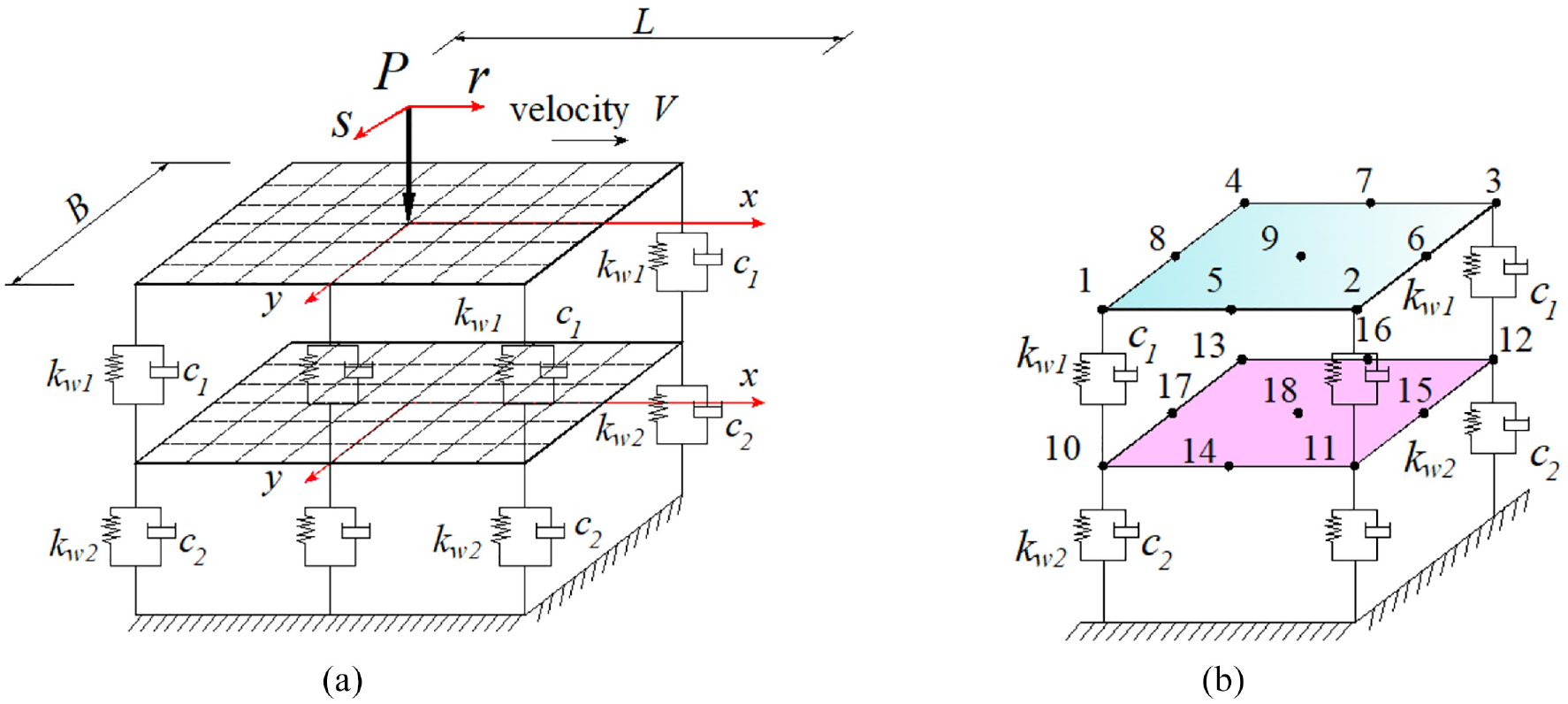
Let us consider a system which consists of two infinitely long plates joined by a viscoelastic Winkler layer with the vertical spring stiffness
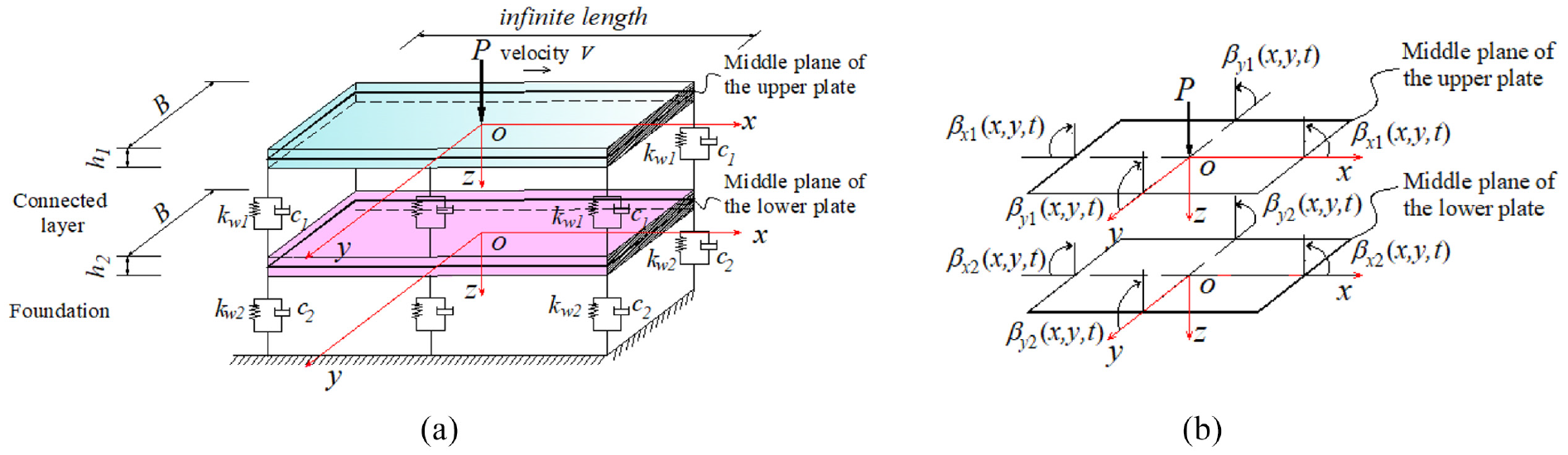
(a) The model of two infinitely long plates joined by a viscoelastic Winkler layer under a moving load and (b) positive directions of rotations
Assume that both plates are of the same width B and thickness
According to the Reissner-Mindlin plate theory (Mindlin, 1951), the displacement field at any points across the thickness of each plate can be represented as

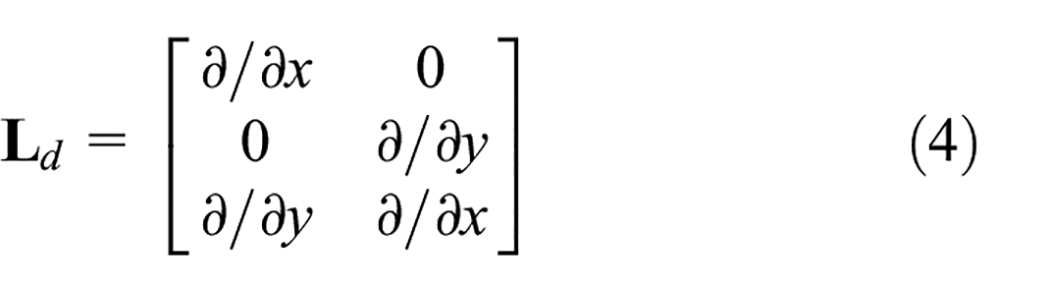
Then, the curvature


where
Using the dynamic version of principle of virtual work, the D’Alembert-Lagrange equations of motion of the upper and lower plates are respectively established as follow
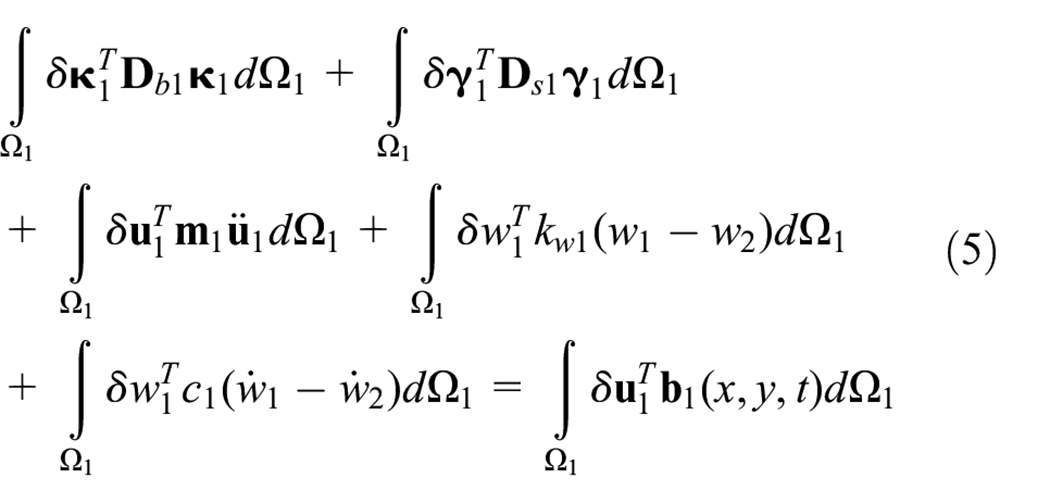
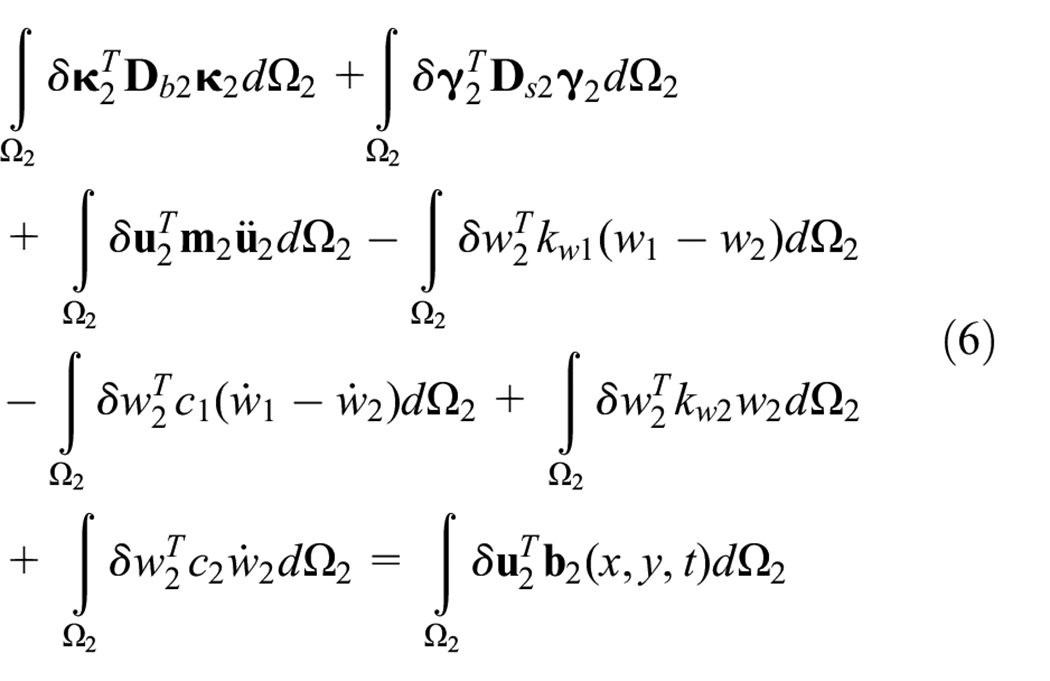
where the single dot over a symbol denotes the velocity, and the double dot symbolizes the acceleration;
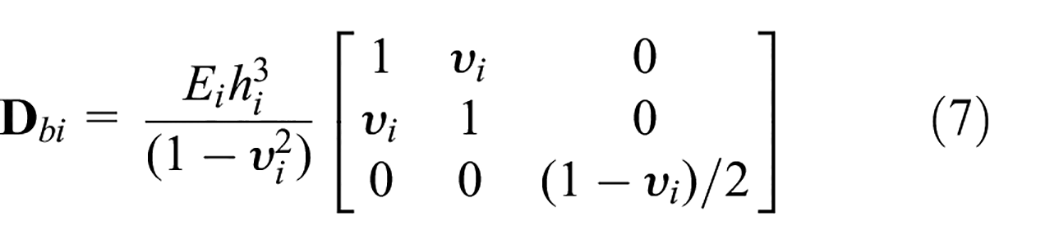
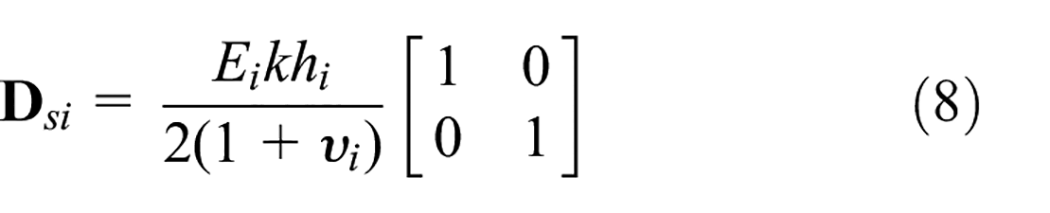
in which
The load vectors


where
Multi-layer moving plate method (MMPM)
In this study, a new computational approach, namely multi-layer moving plate method (MMPM) is proposed to analysis the dynamic response of connected double-plate systems subjected to moving load. A new class of multi-layer finite plate elements, which consists of the coupling system of two layers of upper and lower plate elements connected by a viscoelastic layer, is formulated in a moving coordinate system attached to the moving load, in lieu of utilizing a fixed coordinate system as that of the standard FEM. The new elements are herein reffered to as the multi-layer moving plate elements. Note that the multi-layer moving plate element is not a physical one due to the detachment with its material. It is therefore referred as a conceptual element that “flows” along with the moving load in the double-plate system. The main advantage is to simply treat the moving load/vehicle as “stationary” at the node in the multi-layer moving plate element mesh mesh to avoid the updating of force vectors due to change of contact point on the plate. Another advantage of the MMPM is that as the moving load/vehicle is fixed in the multi-layer moving plate element mesh, the number of elements used in the MMPM model is independent of the distance traversed by the load/vehicle in the time duration considered. Hence, the MMPM requires comparatively lesser elements and is more computationally efficient than the FEM does in general. For a more thorough discription, below are details of the MMPM.
The serendipity quadrilateral nine-node (Q9) element as shown in Figure 2 is adopted in this study due to the compatibility of both the deflection and slope on adjacent elements (Bathe, 2014). The shape functions of Q9 element in the natural coordinate
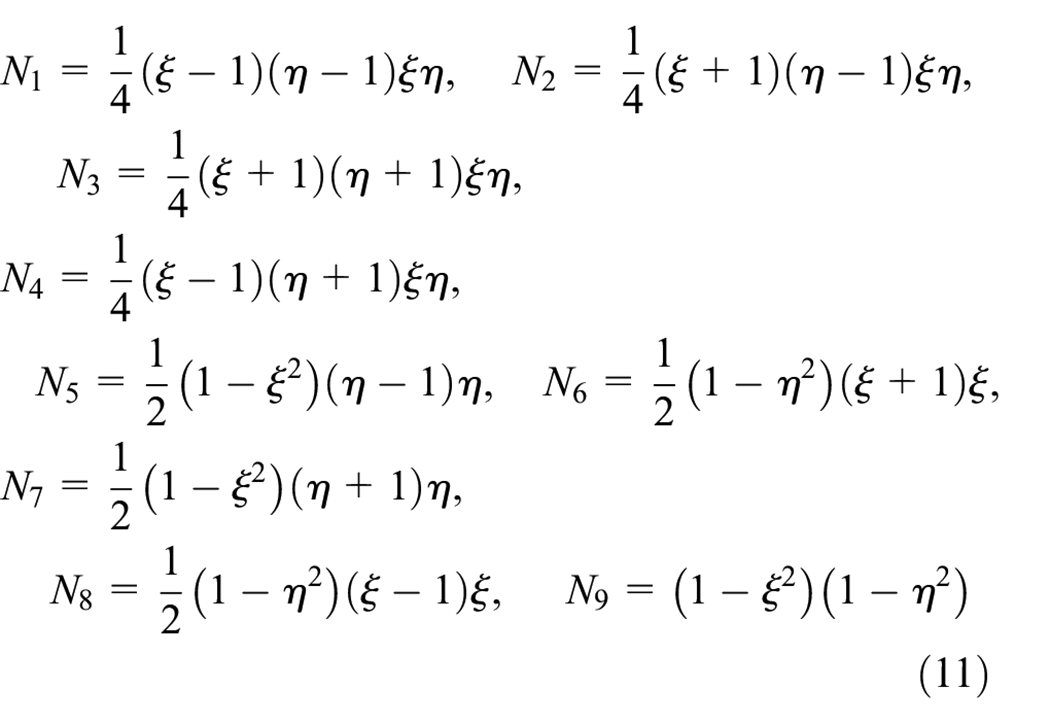
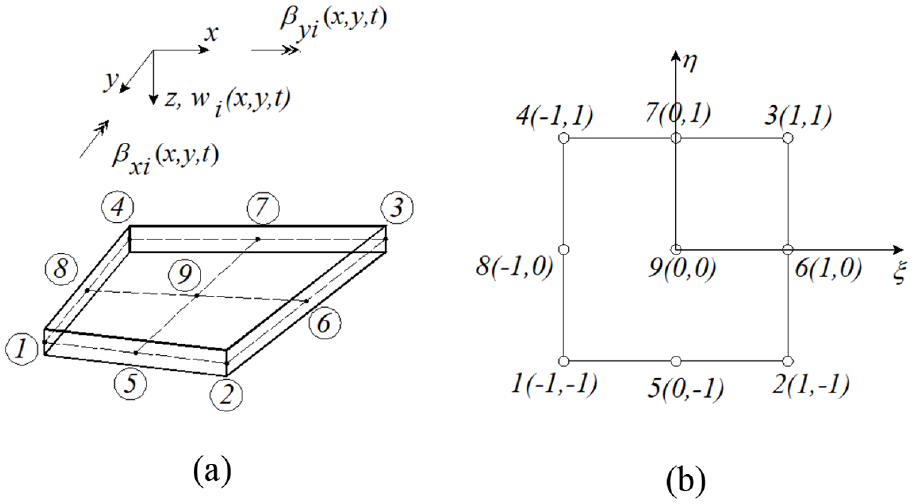
Serendipity quadrilateral nine-node (Q9) element: (a) Q9 element in the global coordinate
With regard to the numerical modeling of MMPM, a truncation with length L and width B of the infinitely long double-plate system is discretized into a number of multi-layer moving plate elements, which consist of the coupling system of two layers of upper and lower plate elements modeled by the coupling of two layers of Q9 elements connected by a viscoelastic layer, as shown in Figure 3. It should be noted that both truncated upstream and downstream ends are far enough against the contact point of the load so that there are no influences on stress resultants within the plate (Koh et al., 2003).
(a) Discretization of the truncation of infinitely long double-plate system and (b) a multi-layer moving plate element which consists of the coupling system of two layers of upper and lower plate elements connected by a viscoelastic layer.
To keep track of the load position, a moving coordinates system
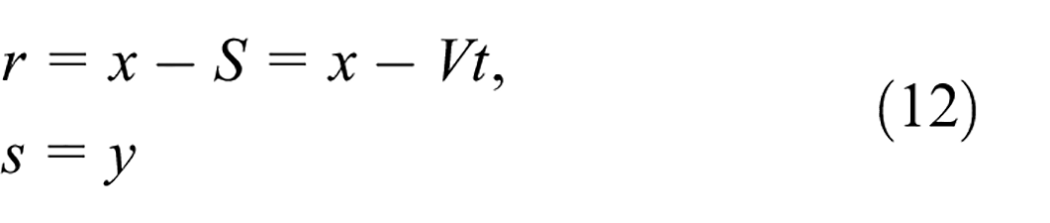
In view of equation (12), the governing equations defined in equations (5) and (6) are rewritten in the moving coordinate system
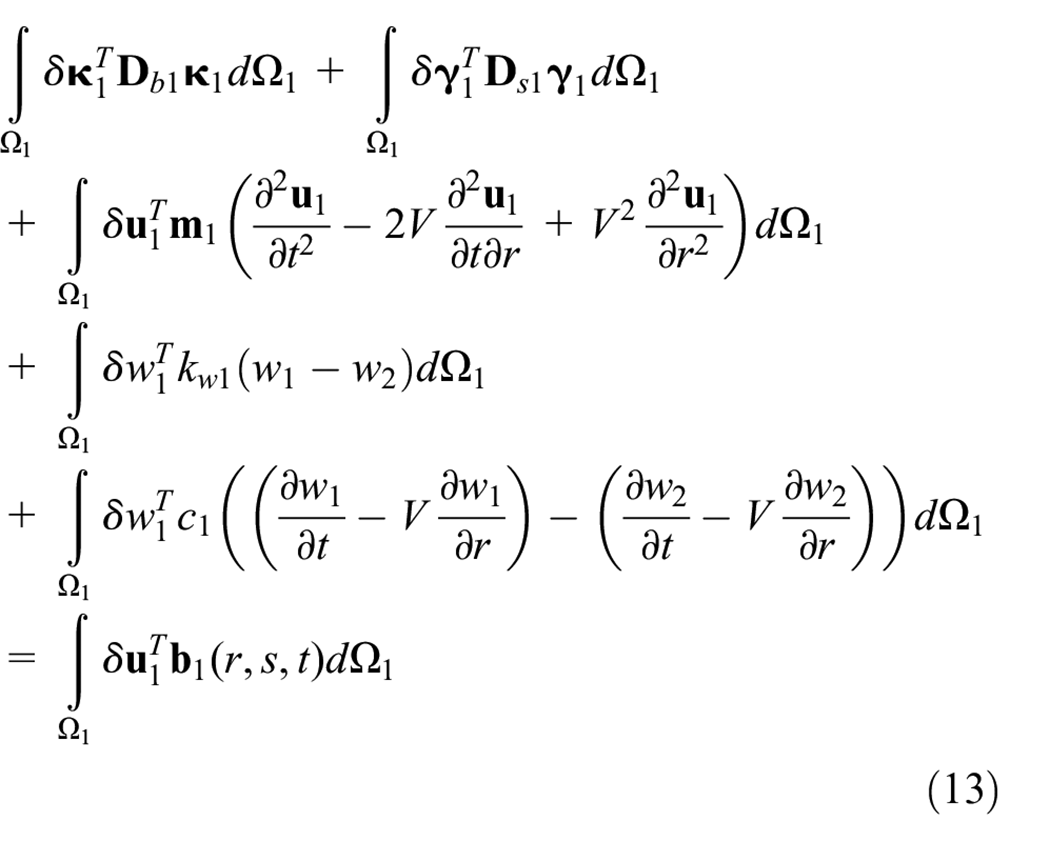
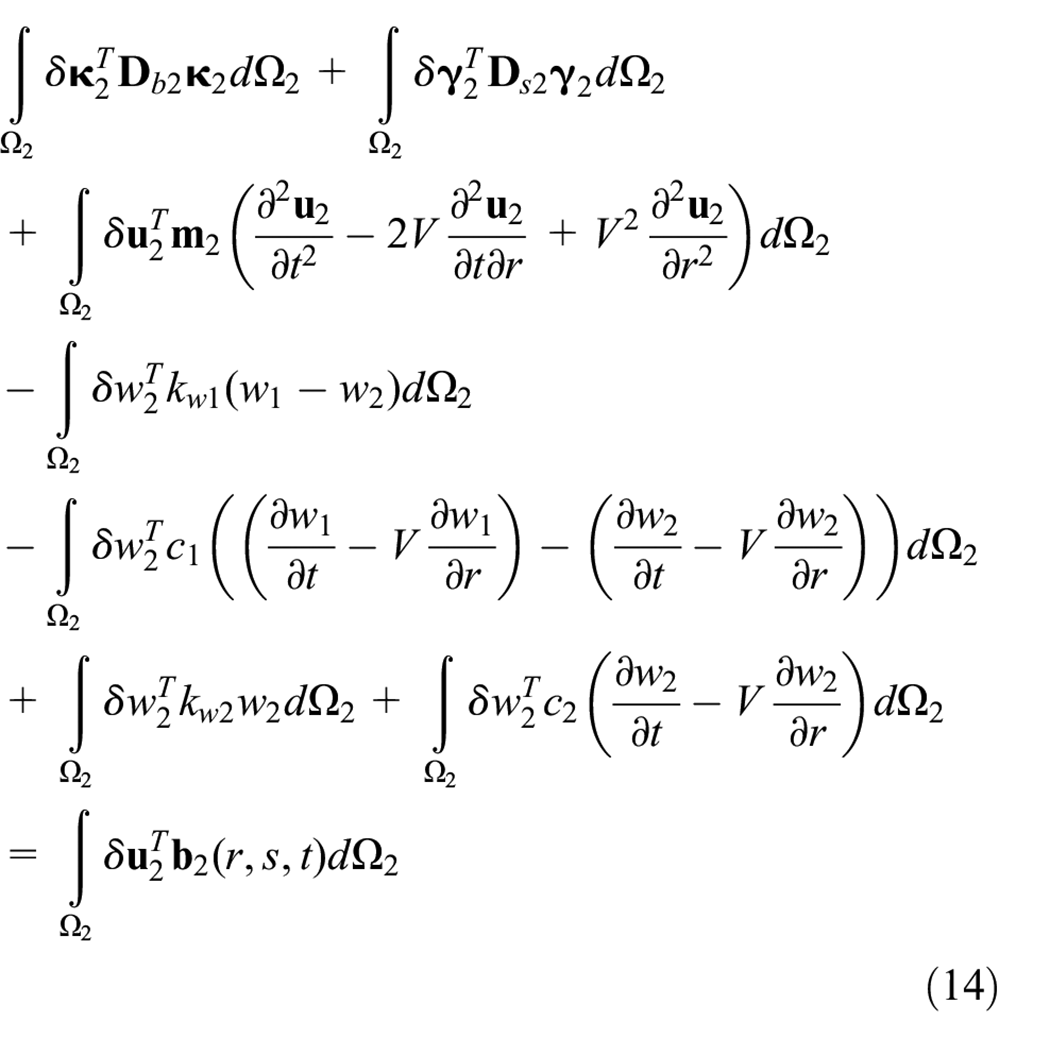
in which
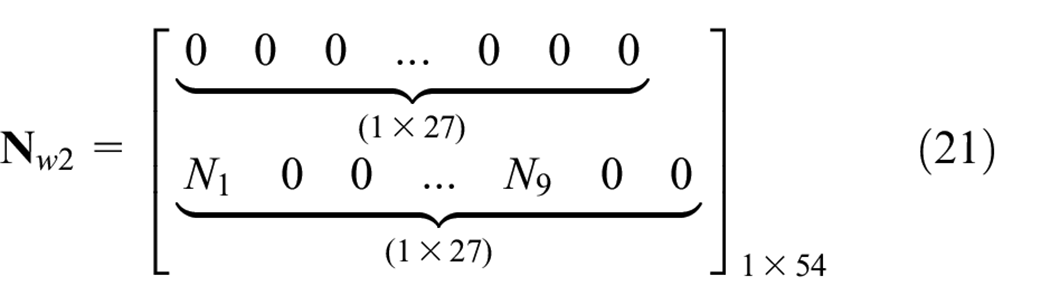
A muli-layer moving plate element consists of two layers of Q9 element as shown in Figure 3(b). Note that each node has three DOFs, and this element is thus of 18 nodes with 54 DOFs. The nodal displacement vector
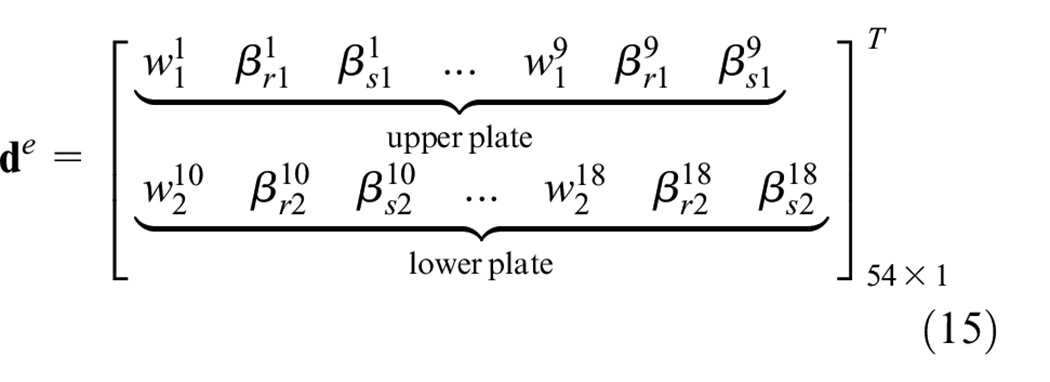
where
The displacement vector


in which
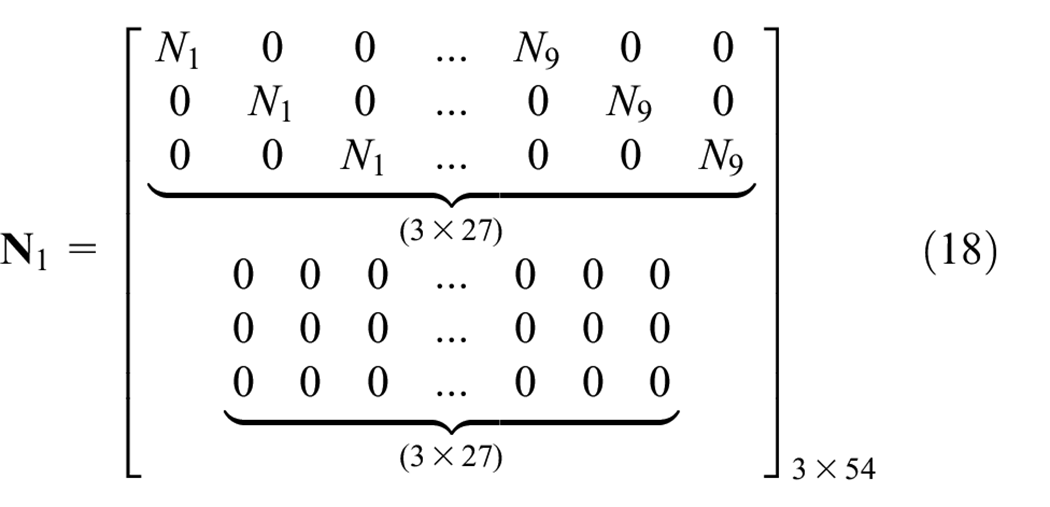
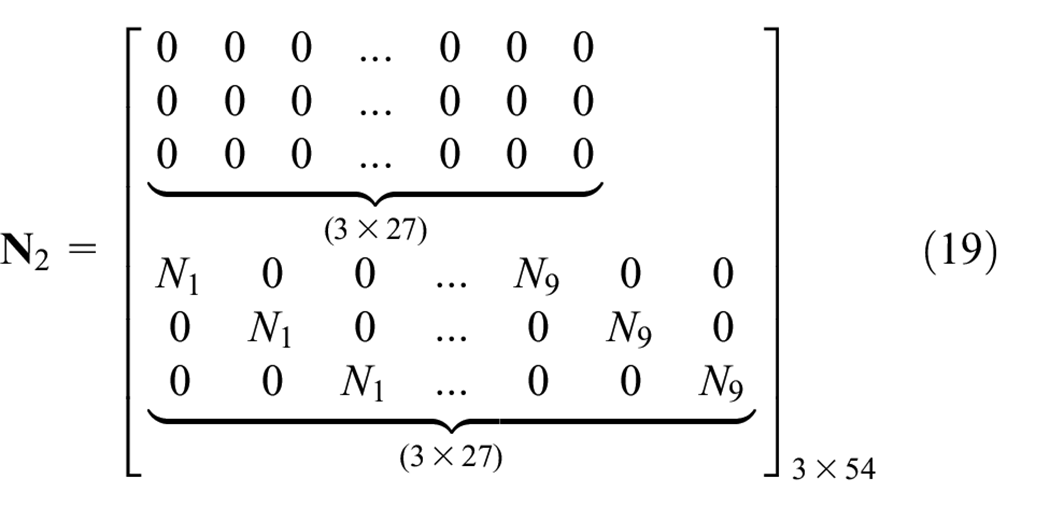
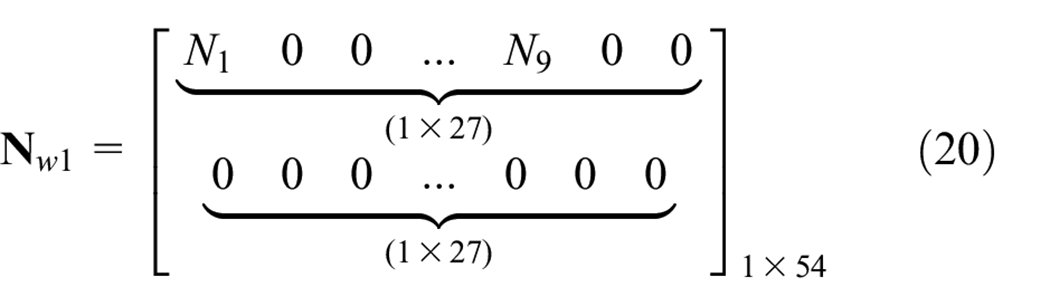
The bending and shear strains of the ith


in which




Substituting equations (16), (17), (22), and (23) into equations (13) and (14), and using the simple rearrangement, the governing equations of motion of the upper and lower plate elements are respectively given as
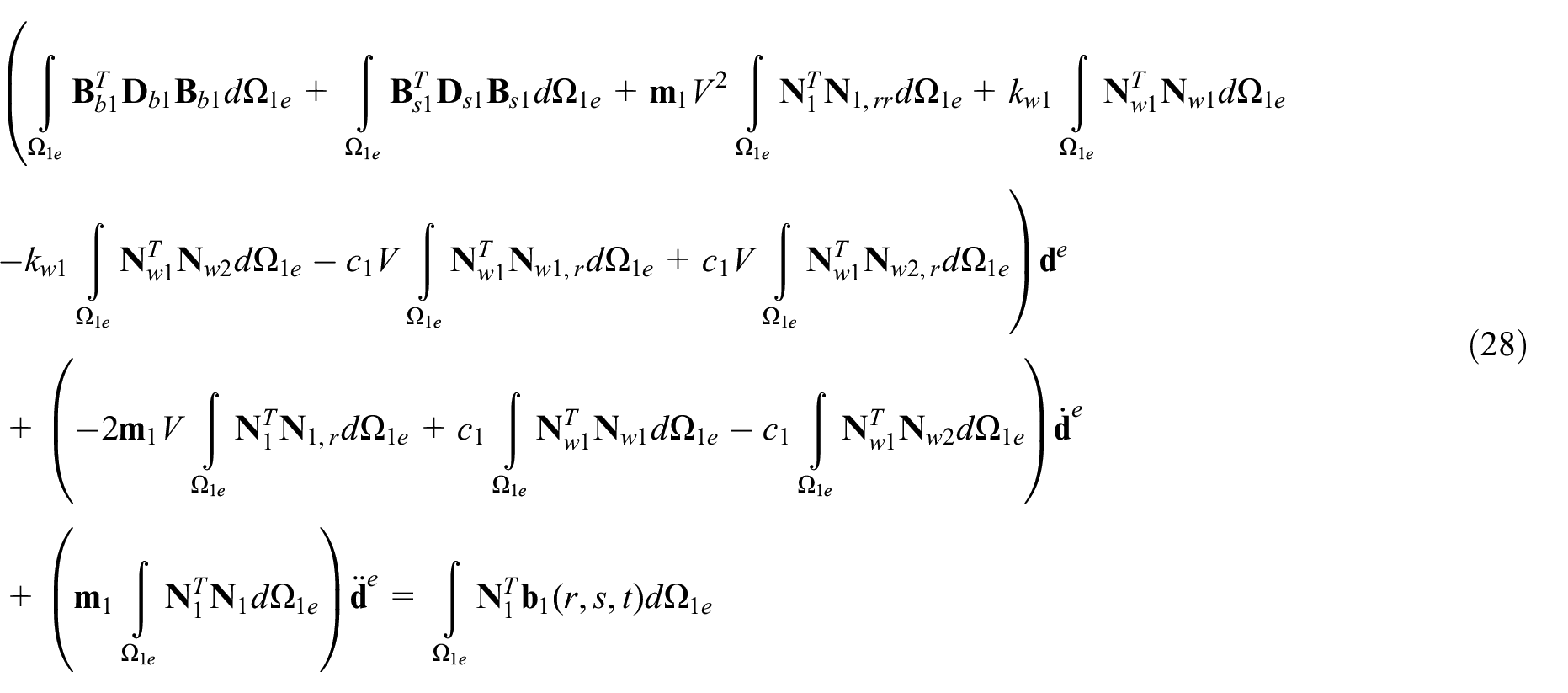
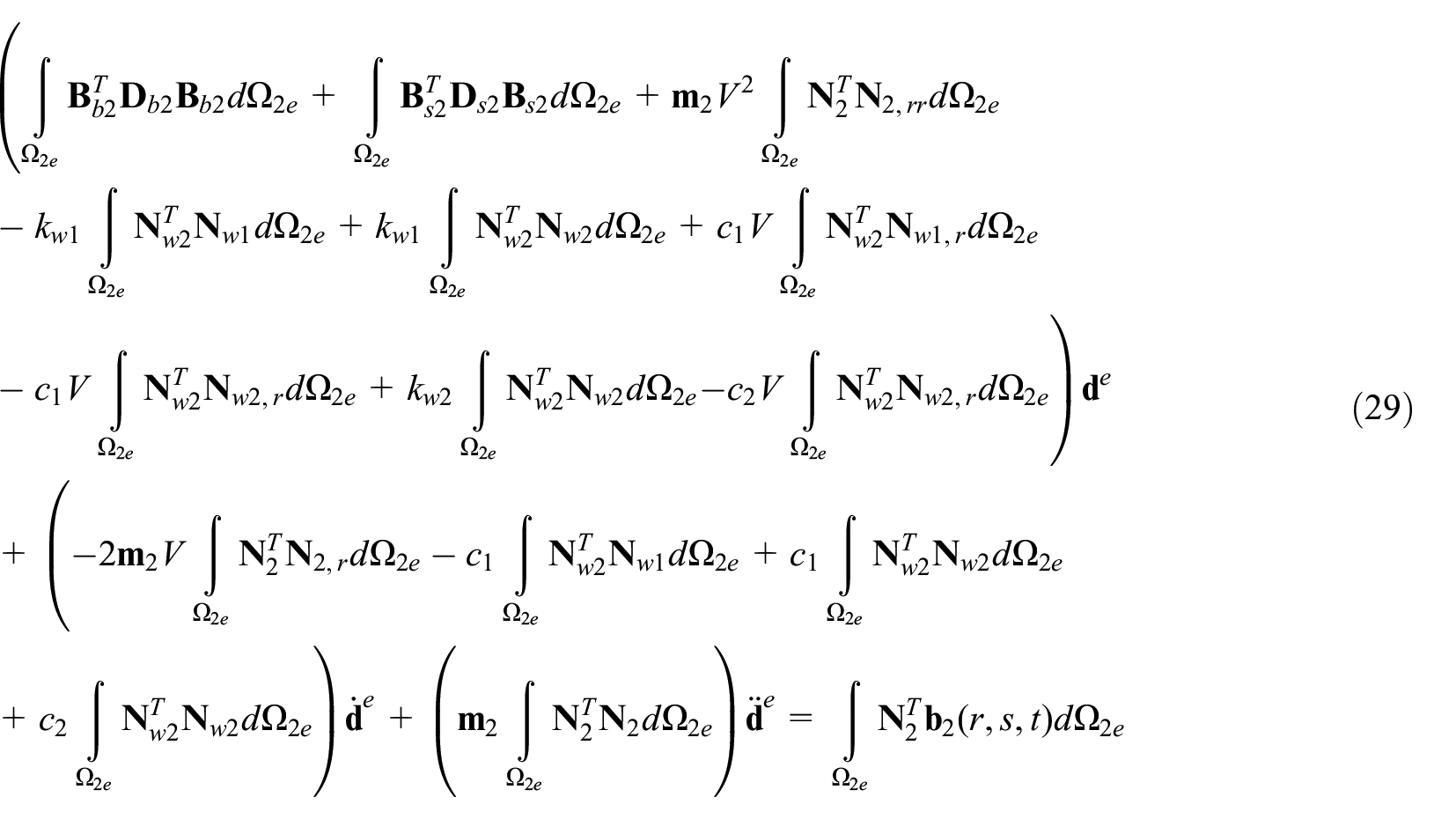
Equations (28) and (29) can be expressed in the following form:


with the element mass
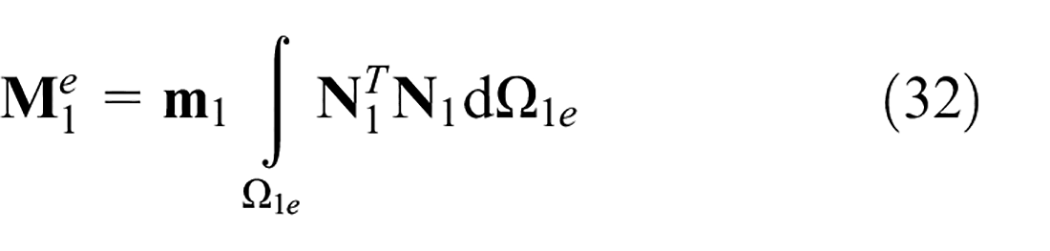
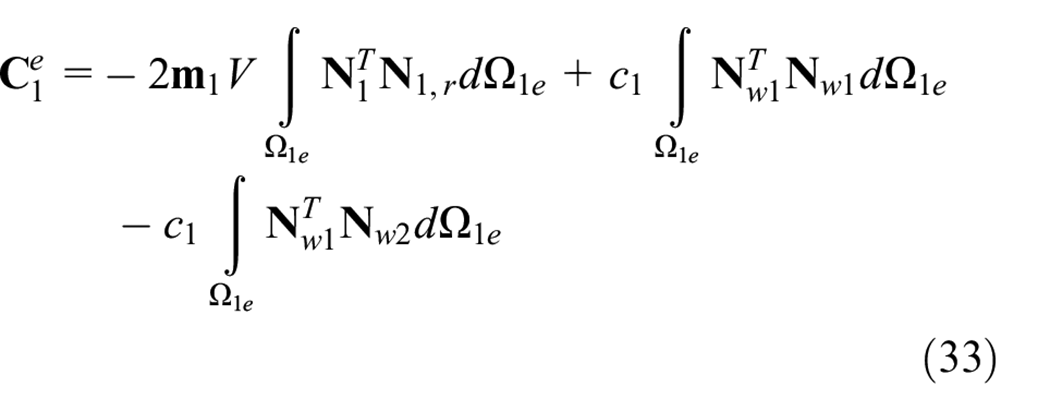
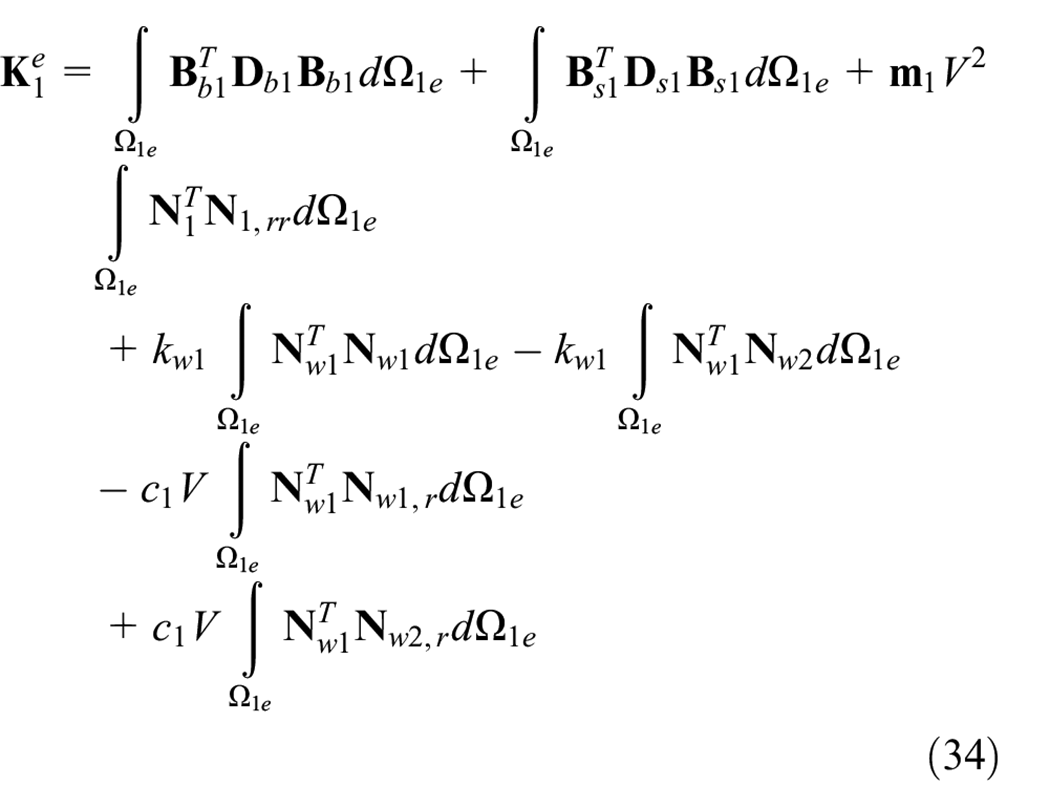
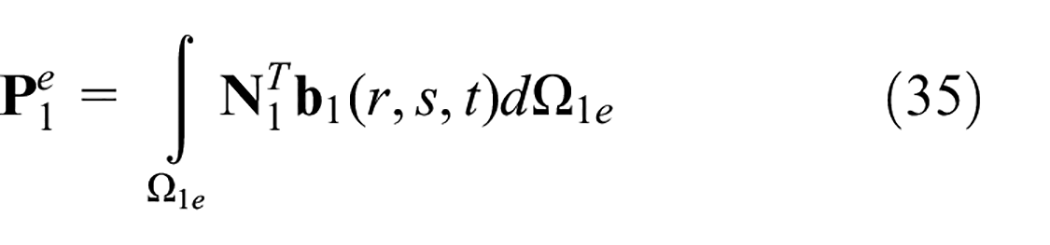
and the element mass
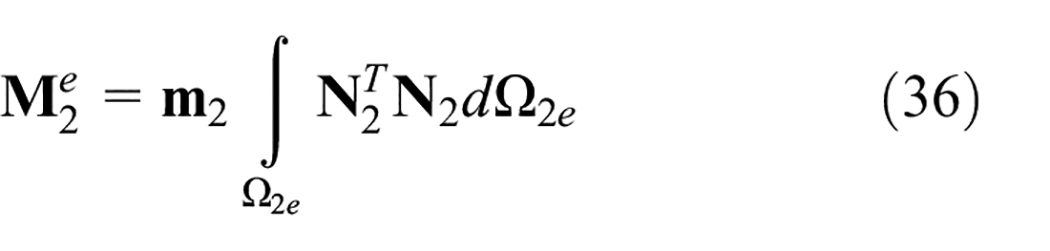
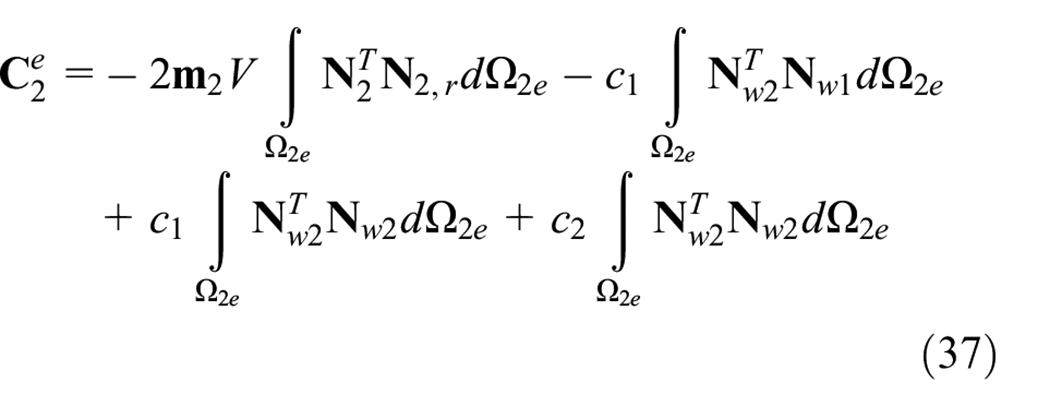
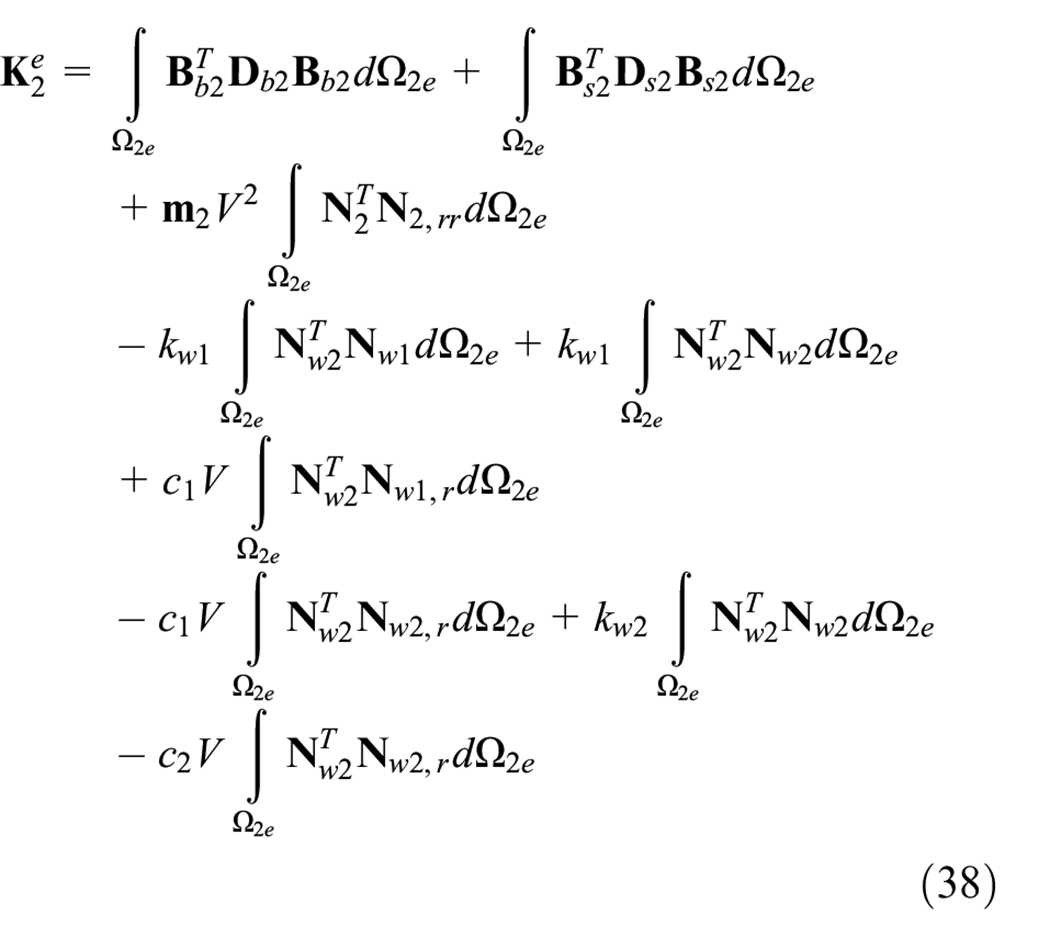
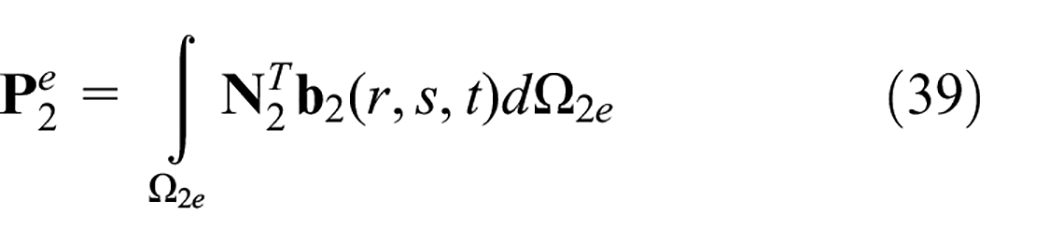
in which
Finally, the structural matrices of a typical multi-layer moving plate element can be obtained as




The governing equations of motion of the double-plate system are derived by assembling all element matrices in corresponding global ones, and expressed as follows

where
The MMPM for the static and free vibration analyses can be respectively obtained from equation (44) as


where
Numerical results
Static and free vibration analyses
In this section, the static and free vibration analyses of the double-plate system are investigated to verify the convergence and accuracy of the proposed MMPM. Results gained from this approach are compared with those of other publications available in the literature. The material properties of two plates, in all examined numerical examples, are given as
Firstly, the static analysis of a simply supported square double-plate system is examined. Two plates have
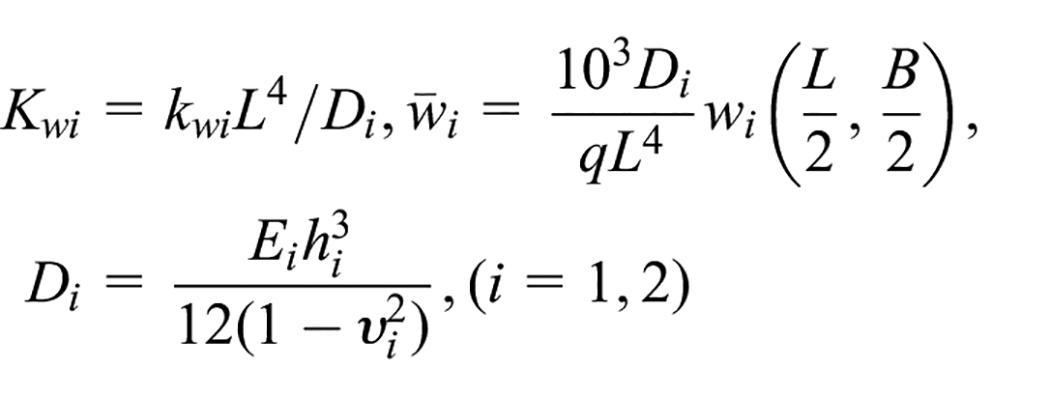
For the purpose of verifying the accuracy of the MMPM, the foundation stiffness coefficient
Convergence of non-dimensional central deflections
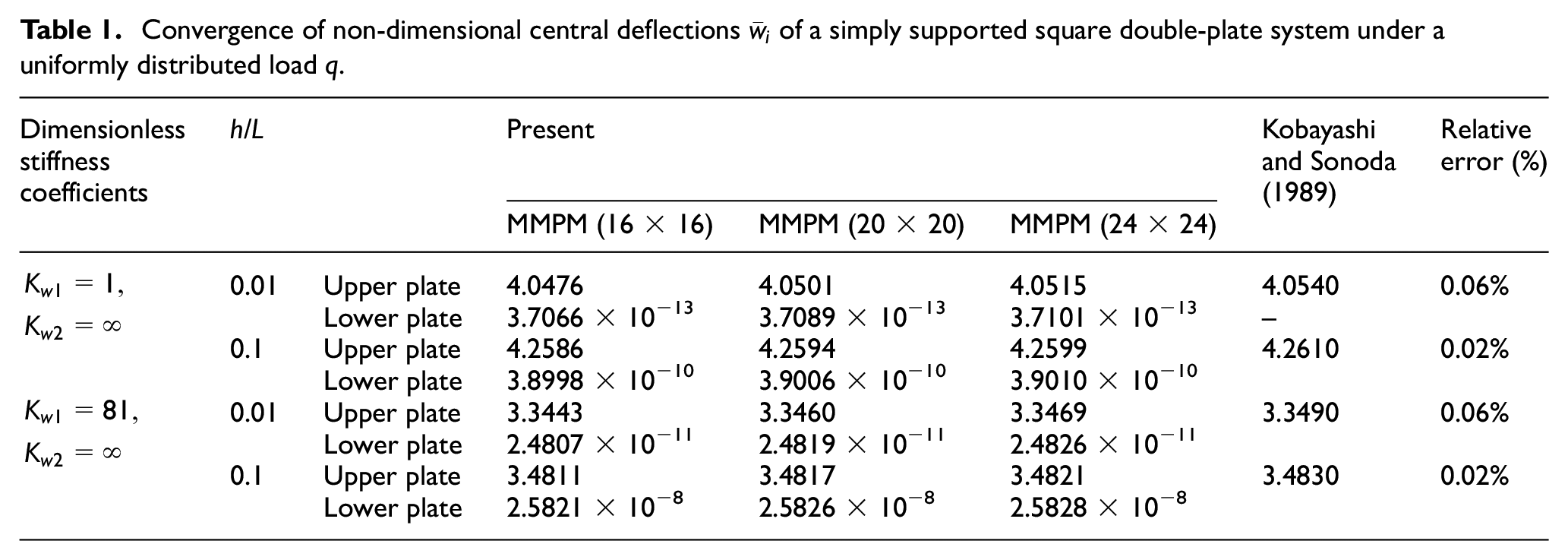
Secondly, the free vibration of a rectangular double-plate system with various boundary conditions is investigated. For the comparison purpose, both plates have the same length
The convergence of six lowest natural frequencies
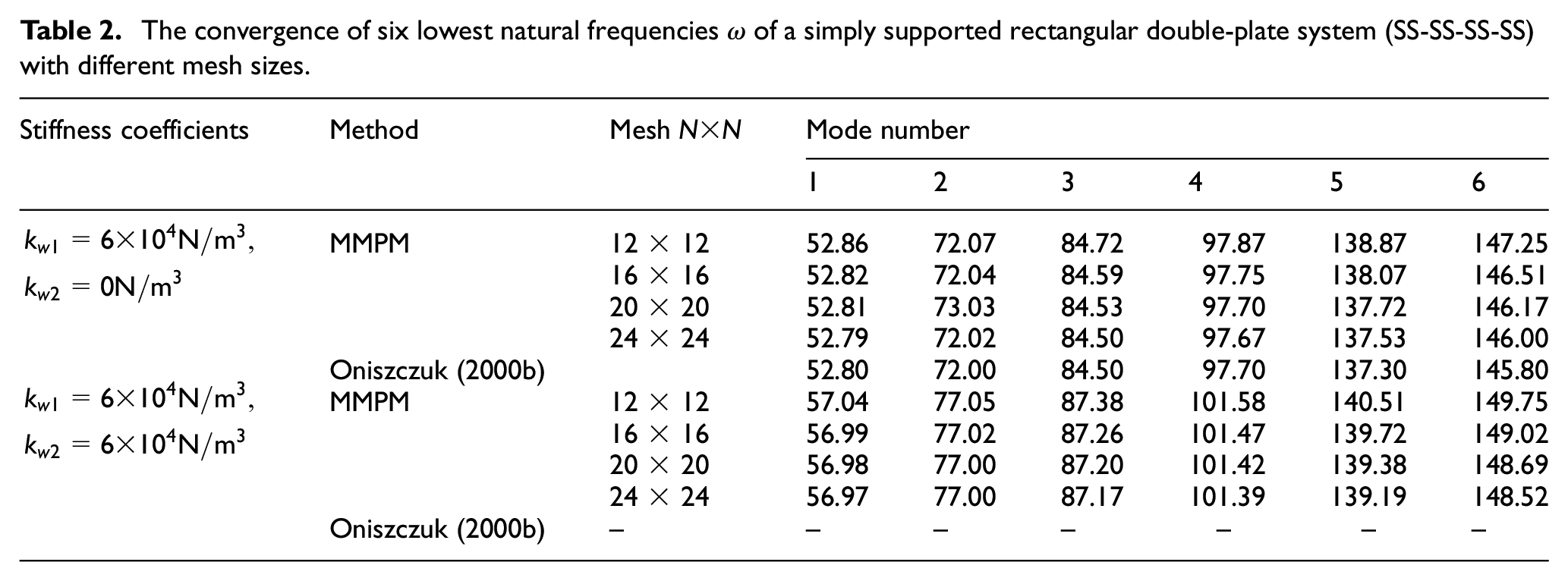
Finally, to further investigate the natural frequencies of a rectangular double-plate system with different boundaries, a mesh density of
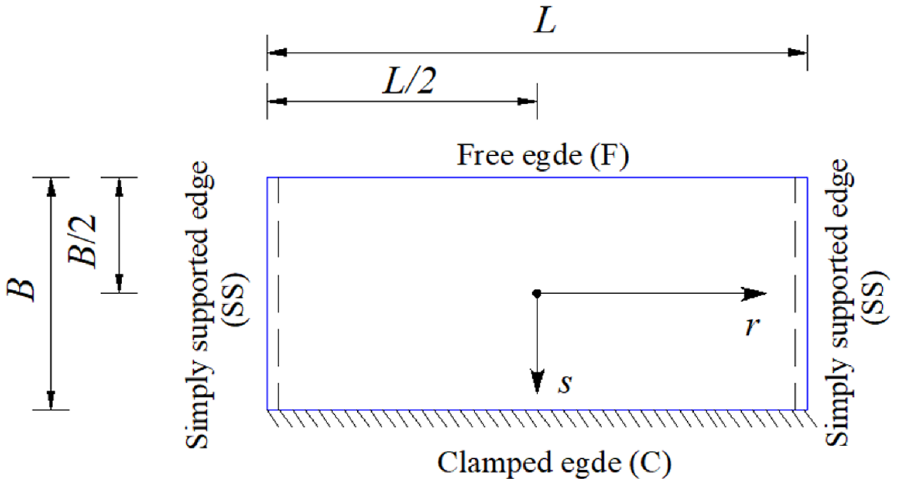
A SS-C-SS-F rectangular plate with coordinate convention.
Six lowest natural frequencies
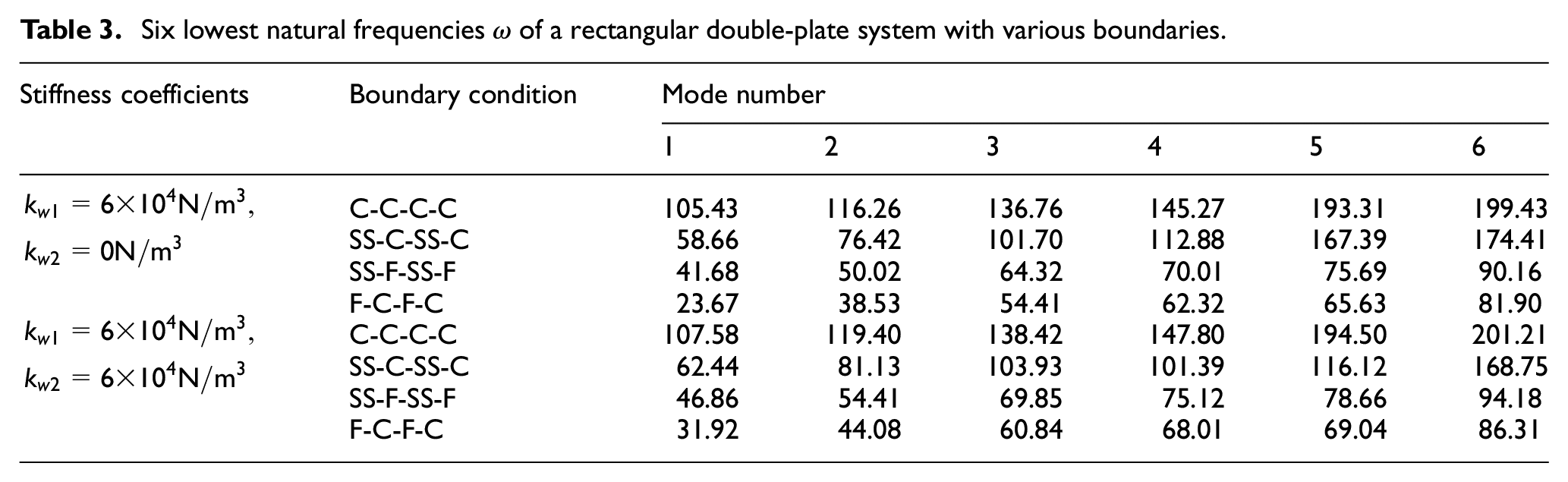
Dynamic analysis
In this part, the performance of the MMPM for the dynamic analysis of connected double-plate systems subjected to a moving load is investigated. The content of this section is presented as follow: first, the dynamic analyses of connected double-plate system subjected to a moving load are investigated to verify the accuracy of the proposed MMPM. Then, the effects of various parameters on the dynamic responses of connected double-plate system subjected to a moving load are examined.
With respect to the numerical modeling of MMPM, a truncation of infinitely long double-plate system with length
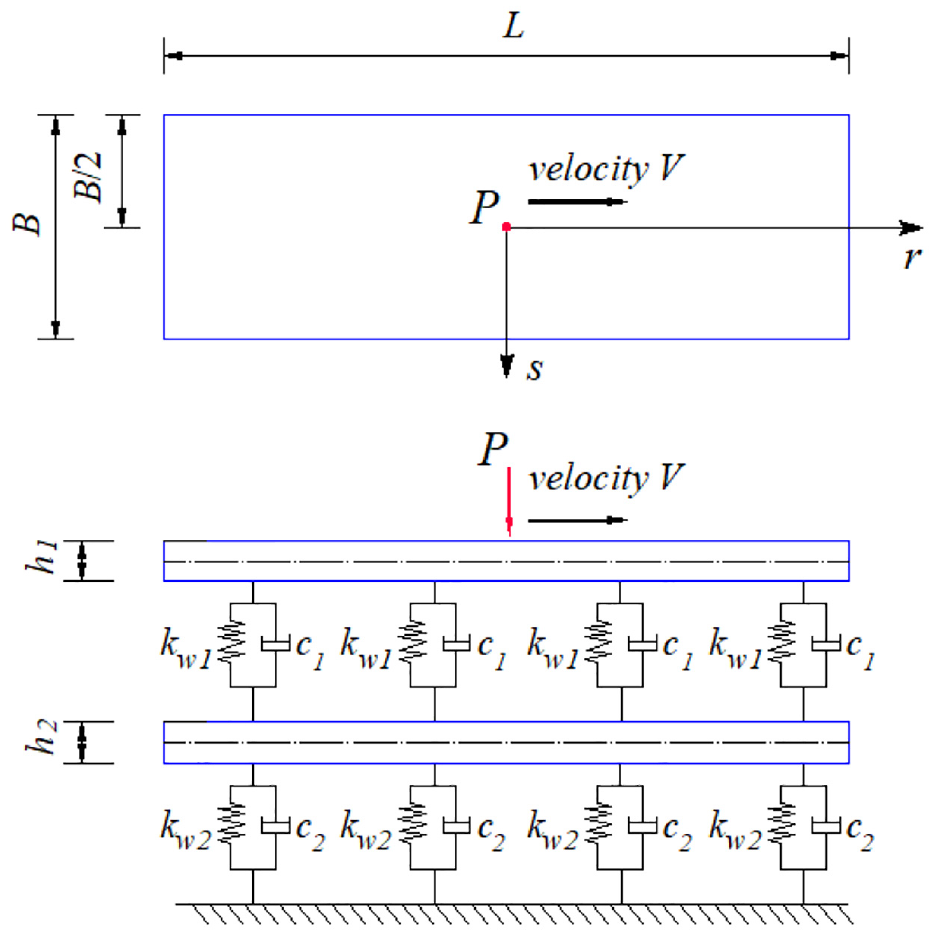
A truncation of infinitely long double-plate system resting on viscoelastic foundation under moving load.
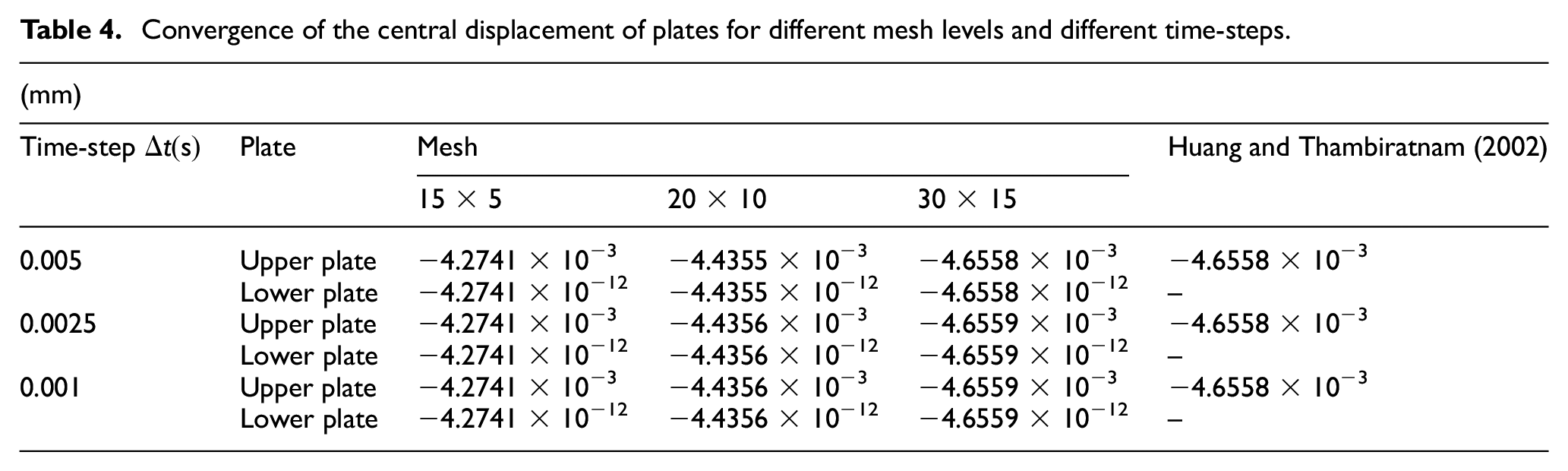
To the best knowledge of the authors, there have been no any reports for such a problem available in the literature. Thus, for verification, the stiffness and damping coefficients of connected layer and foundation in a special case are respectively given as
Convergence of the central displacement of plates for different mesh levels and different time-steps.
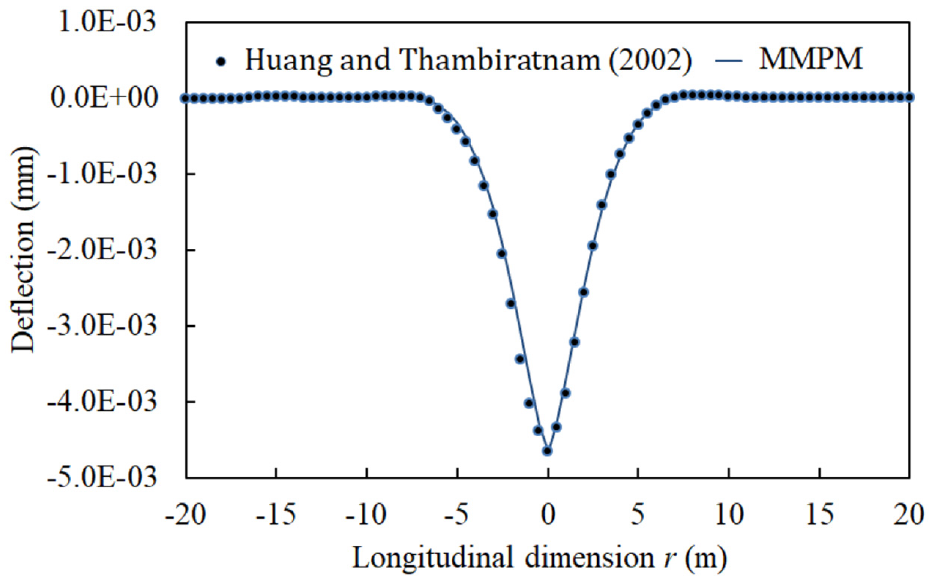
Deflected shape along longitudinal midline of the upper plate.
Next, the effects of load’s velocity and damping coefficient on the dynamic responses of a double-plate system resting on a viscoelastic foundation are examined. Figure 7 plots the deformed shapes along the longitudinal midline of upper and lower plates with three different load’s velocities for without damping (the damping coefficients
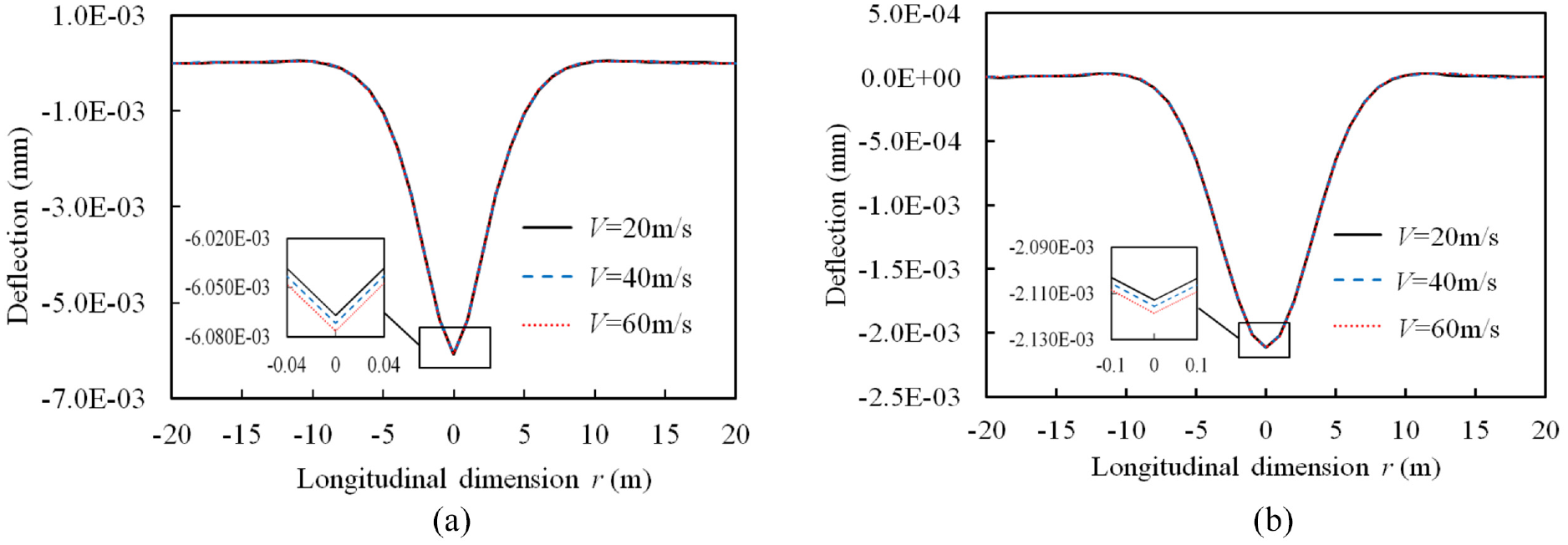
Deformed shapes along the longitudinal midline of plates with differnent load’ velocities for without damping (
Figure 8 shows the deformed shapes along the longitudinal midline of plates for the case of
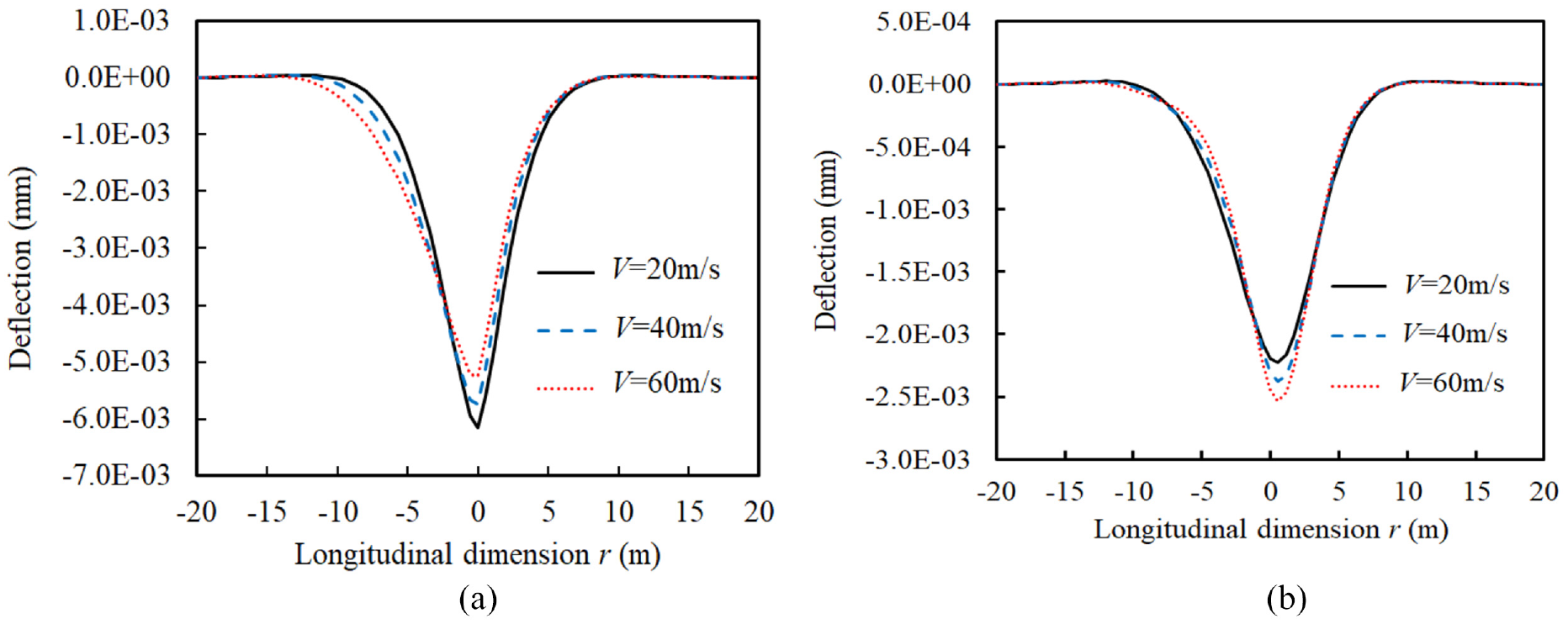
Deformed shapes along the longitudinal midline of plates with differnent load’ velocities for large damping (
Figure 9 presents the responses of two plates with three different damping coefficients for the load’s velocity
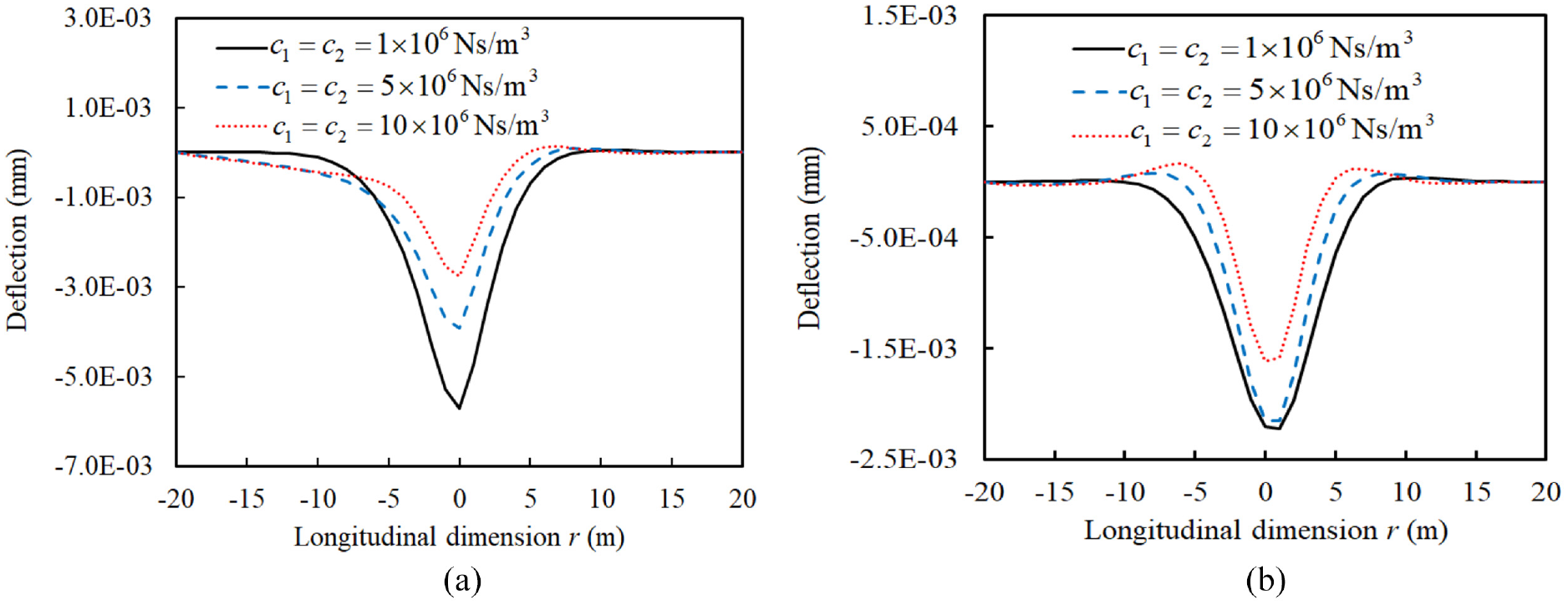
Deformed shapes along the longitudinal midline of plates with differnent damping coefficients: (a) upper plate and (b) lower plate.
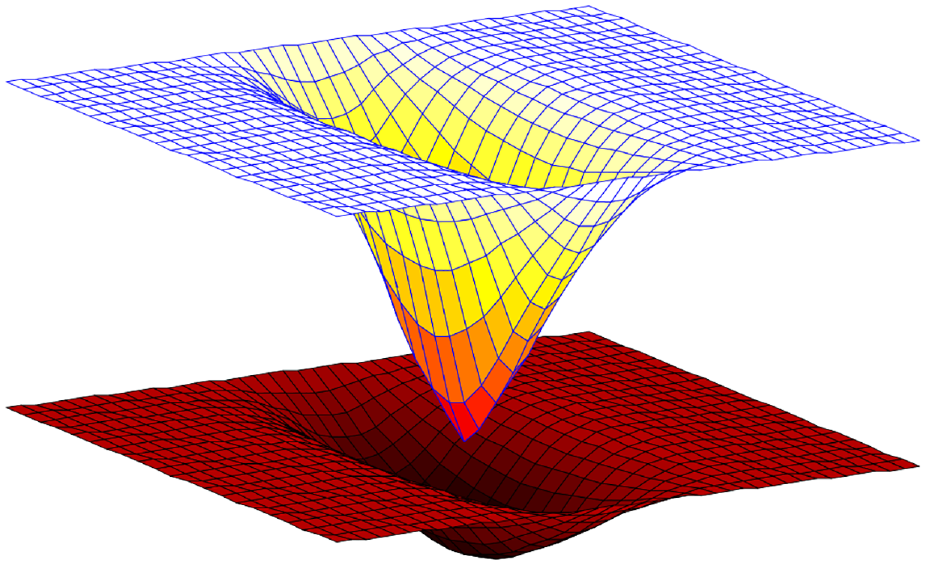
Three-dimensional deformed shapes of double-plate system for damping coefficients
Then, the effects of connective layer stiffness and foundation stiffness on the response of double-plate system are investigated. Figure 11(a) and (b) show the variations of center displacement of the upper and lower plates. As expected, it can be seen from Figure 11(a) that the displacements of the upper and lower plates approach each other when the connective layer stiffness increases, and they are equal to each other as the connective layer stiffness is extremely large. In addition, Figure 11(b) shows the displacements of the upper and lower plates decrease when the foundation layer stiffness increases. As the foundation layer stiffness is extremely large, the displacement of lower plate reaches zero, and there is only the response of the upper plate.
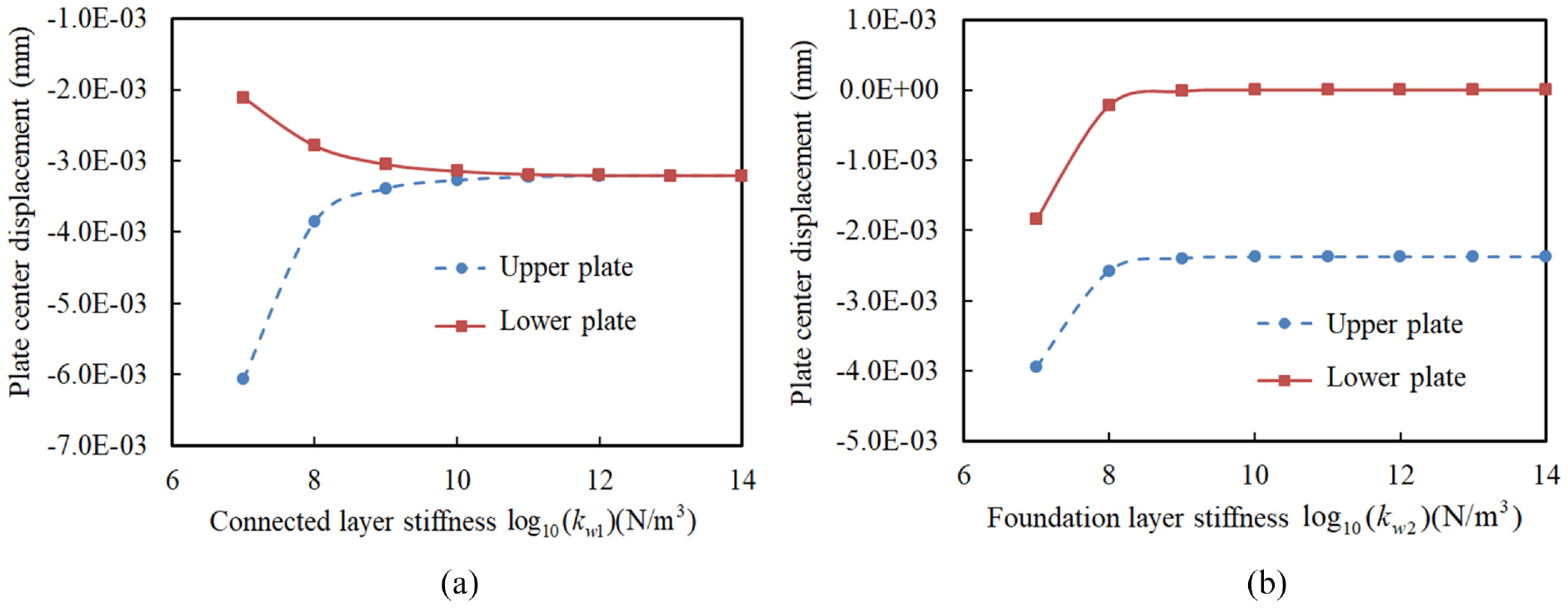
The central displacements of upper and lower plate: (a) when the connected layer stiffness increases and (b) when the foundation layer stiffness increases.
Finally, the effect of plate thickness on dynamic responses of a double-plate system is examined. The variations of central displacements of upper and lower plates against the increase of upper and lower plate thicknesses are plotted in Figure 12(a) and (b), respectively. It is observed from these figures that the general trend is the displacements of both plates decrease as the thicknesses of upper and lower plates increase. The displacements of two plates significantly decrease and reach zero when the upper plate thickness is extremely large. Also, as expected, the displacement of lower plate reaches zero when the lower plate thickness is extremely large, and there is only the displacement of the upper plate.
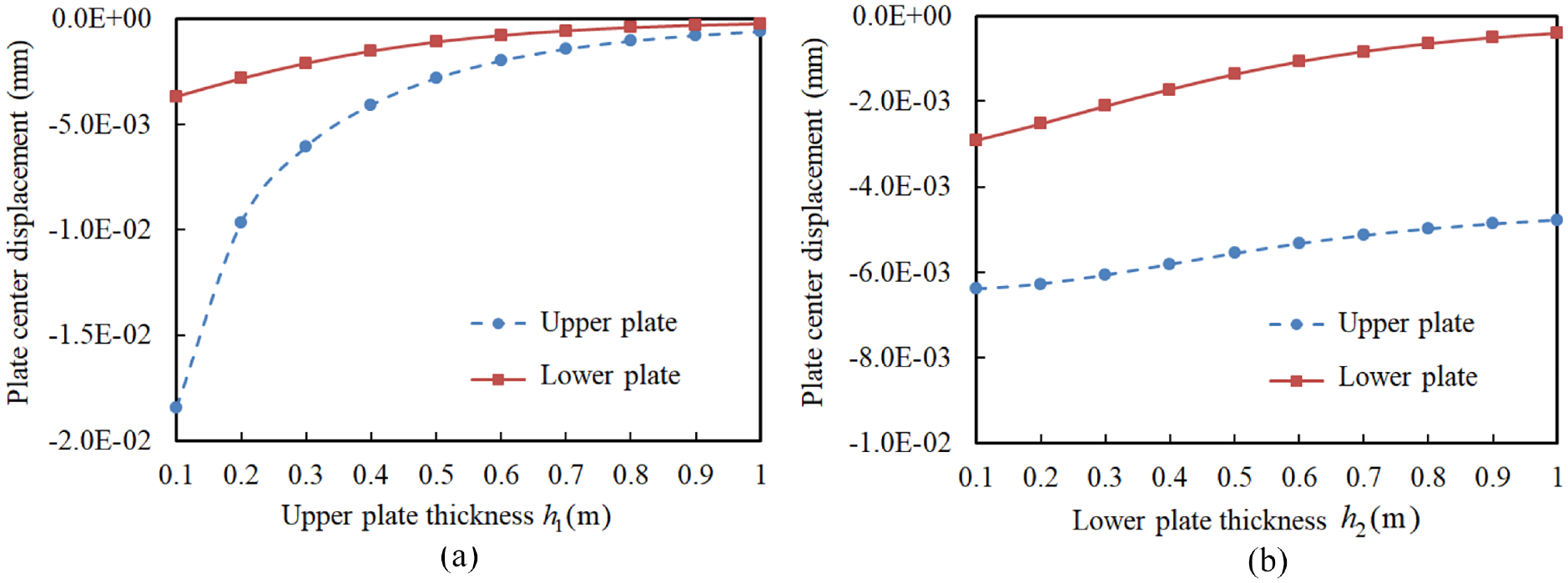
The central displacements of upper and lower plates: (a) when the upper plate thickness
Conclusion
A new multi-layer moving plate method (MMPM) for analyzing dynamic responses of infinitely long double-plate systems resting on a viscoelastic foundation induced by moving load has been successfully developed in this paper. In the suggested MMPM, the displacement field in each layer of the double-plate system is modeled by the Reissner-Mindlin theory, while quadratic serendipity shape functions are utilized to describe unknown fields in FEAs. The dynamic version of principle of virtual work is utilized to formulate the D’Alembert-Lagrange equations of motion of the upper and lower plates. Through presented theoretical formulas and illustrated examples, several noteworthy conclusions can be withdrawn as follows
(i) The proposed MMPM can completely exclude the update process of moving load. Furthermore, the moving load will never come to the downstream boundary end of the truncated model. Additionally, outcomes obtained by the MMPM have shown its accuracy and reliability compared with those of previously released methods.
(ii) In case of without damping, the deformation of the double-plate system is symmetric, and the displacement of two plates slightly increases as the load’s velocity raises. For damping, the deformation of the double-plate system becomes asymmetrical, and the responses of two plates are also different together. In addition, when the load’s velocity increases, the displacement of the upper layer lessens, whilst the displacement of the lower layer raises.
(iii) For a constant damping coefficient, the dynamic response of the double-plate system is significantly affected by the load’s velocity, especially for the large damping coefficient.
(iv) The displacements of both the upper and lower plates are inverse proportion to the layer stiffness and plate thickness. That displacements approach each other when the connective layer stiffness and the upper plate thickness increase, and they are equal to each other as the connective layer stiffness and the upper plate thickness are extremely large. In addition, the displacement of lower layer reaches zero when its thickness and the foundation stiffness become infinite, and there is only the response of the upper plate.
Footnotes
Declaration of conflicting interests
The author(s) declared no potential conflicts of interest with respect to the research, authorship, and/or publication of this article.
Funding
The author(s) disclosed receipt of the following financial support for the research, authorship, and/or publication of this article: This research is funded by Vietnam National University Ho Chi Minh City (VNU-HCM) under Grant No. B2019-20-13: “Development and application of a combined boundary element method and moving element method BEM-MEM for the dynamic analysis of very large floating structures”.
