






Abstract
Background: The impact of unemployment and precarious employment on the health of young people is not well understood. However, according to social causation, higher socio-economic positions and thus better working conditions are beneficial to health in general. We tried to synthesize the results of studies that test this hypothesis in the case of young people. Methods: We conducted a scoping study mapping all the academic articles published in the period 2006–2016 in Europe. The literature was searched in PubMed/Medline, Science Direct, Web of Science and Scopus. Results: We identified 1770 studies, of which only 46 met the inclusion criteria. There are more studies that focus on the relationship between unemployment and health than between precarious employment and health (28 and 16, respectively). The vast majority of the studies (44) found support for the social causation hypothesis, the most common health outcomes being mental health disorders, health risk behaviour, poor quality of life and occupational injuries. The causal mechanisms behind this association relied mainly on the life-course perspective, the breadwinner model, and the lack of social and economic benefits provided by standard employment. Conclusions:
Introduction
The current economic crisis, which began in Europe between 2006 and 2010, has hit Southern European countries particularly hard. The crisis has been characterized by increasing unemployment rates and new and growing forms of precarious employment, such as flexible and temporary work, insecure and informal jobs [1–3]. Precarious employment is understood to be tightly linked to unemployment. High unemployment rates reduce workers’ bargaining power and capacity to refuse poor employment and working conditions, thus increasing the precariousness of employment overall [4]. This new situation in the labour market has been associated with increasing psychosocial risks for the working population [5,6].
In the last three decades, in almost all European countries, young adults have been exposed to precarious and temporary jobs, and youth unemployment has been higher than general unemployment rates [7]. Young adults are particularly vulnerable in the labour market as they lack both work experience and appropriate working opportunities [8]. From a life-course perspective, young adulthood is a period of constant transition in labour market activity [3], between short-lived employment periods and different career paths and employers [9]. Although modern societies provide increasing and more equal education opportunities, young people face fewer possibilities for labour market participation due to high unemployment rates, and more insecure and deprived working conditions [10]. Moreover, unemployed young people have an increased risk of experiencing unemployment in the future [8].
Several studies have shown how unemployment may influence the present and future health of young people. Young unemployed adults seem to have poor psychological health [11], poor quality of life [12,13] and higher prevalence of risk behaviours, such as smoking, excessive alcohol consumption and less-healthy lifestyles [3]. It has been found that unemployment at a young age is linked to later-in-life sickness absence and disability pension. The negative effects of unemployment tend to be exceptionally harmful when the most disadvantaged young people become unemployed [10]. Temporary employment, job insecurity or poor employment protection also seem to affect the quality of life and the life satisfaction of young people, as well as increasing the probability of occupational injury risks, mental health disorders and other physical health problems [14,15].
Two competing explanations have been developed to account for the association between health and socio-economic positions: the ‘health selection’ hypothesis, differences in health status lead to differences in socio-economic position; and the ‘social causation’ hypothesis, differences in socio-economic circumstances imply differences in health status. In accordance with the ‘social causation’ hypothesis, Bartley [16] emphasizes four mechanisms by which unemployment might affect health: (relative) poverty and financial anxiety; social inactivity and lack of participation; health-related behaviour; and the effect that a spell of unemployment may have on subsequent risk of sickness absences (of more than 60 days). From the four mechanisms, the first one seems to be directly linked to economic recession. Other authors [17–20] have explained the relationship between precarious employment and health based on arguments such as material and social deprivation or exposure to hazardous work environments. Finally the life-course perspective [10] has also been used to explain the association, portraying the transition from youth to adulthood as more diversified and individualized than before and unemployment as a life event with (long-term) consequences such as health problems, marginalization and social exclusion.
In a context of high unemployment rates and a prevalence of temporary and insecure jobs in the young population, the association between unemployment/precarious employment and health represents an important scientific and also political issue. Failure to mitigate high unemployment and eradicate precarious employment among young adults might incur substantial financial costs, in addition to health and social costs, for contemporary welfare states [8,21,22]. Therefore, and giving the significance and complexity of this issue, a review and integration of existent research studies in the above subject could be useful to obtain a synthesis of key concepts and main empirical evidence, and outline gaps in the existent literature. The aim of the present scoping study is to review the existing literature on the relationship between youth unemployment/precarious employment and health, and to highlight research gaps.
The review follows the following specific objectives. First, it aims to examine the relative importance of the ‘social causation’ hypothesis in the literature for the emergence of health inequalities: how this has been portrayed, possible limitations and contributions. Identifying the contribution of social causation to health inequalities is central to the promotion of effective policy measures directed at the prevention or reduction of social inequalities. Signalling the causal limitations of studies testing this hypothesis could contribute to refining future research in this topic. Second, it attempts to identify research gaps in the existing literature, make suggestions for improving comparability between studies and contribute to the causal interpretation of research results while signalling future lines of research. Finally, it seeks to explore how the relationship between unemployment/precarious employment and health in young people has been portrayed in the literature before and after the economic crisis.
Methods
Scoping studies generally aim to map the key concepts, theories and gaps underpinning a research area and the main sources and types of evidence available [23,24]. The main difference with systematic reviews is that scoping studies do not necessarily focus on a well-defined research question and thus an identifiable study design. Scoping studies tend to address broader topics where different research designs might be applicable, are less likely to address very specific research questions or to assess the quality of included studies [24].
We scoped published articles that examined the relationship between unemployment/precarious employment and health with the aim of identifying research gaps in the literature. We actually followed three steps in carrying out the scoping review: (1) identifying the research question; (2) searching and screening existent studies; (3) charting and analysing the collected data (25)
Identifying the research question
Our research question was “What is known from the existing literature about the effects of unemployment/precarious employment on the health of young people?”.
We first determined what aspects should be included when applying the term “health” and decided on physical and mental health problems as well as health risk behaviour and quality-of-life indicators. We then defined these four new terms, “physical problems”, “mental health problems”, “health risk behaviour” and “quality of life”. Under the term “physical problems” we considered occupational accidents/injuries or illnesses and chronic diseases like chronic allergies, back pain and migraines, while the term “mental health problems” was limited to conditions such as anxiety, depression, insomnia, etc. The term “health risk behaviour” included tobacco smoking, alcohol consumption and being overweight, while the term “quality of life” was limited to both subjective and objective measures of life satisfaction and well-being.
Identifying relevant studies
After acknowledging the research question to be addressed, we identified primary studies suitable for answering the question. To achieve this, we adopted a strategy that involved searching for research evidence via different databases: Medline, Science Direct, Scopus and Web of Science. We included only those academic articles published between January 2006 and March 2016. The start date was chosen because it was felt that this covered the period before 2008, when most European countries started to experience a generalised economic crisis.
We started by using search terms such as “unemployment”, “precarious employment” and “health” and applied the corresponding filters “young” and/or “youth”. As familiarity with the literature increased, we redefined search terms and undertook more sensitive searches of the literature. The specific terms used were “youth unemployment AND health”, “unemployment AND health AND young”, “precarious employment AND health”, “precariousness AND health”, “work-related factors AND health AND young”, “working conditions AND health AND young”.
Selecting the studies
An article was considered for inclusion in the study if it met the following criteria: (1) it examined the relationship between health and employment/working conditions; (2) it was a research study, both quantitative or qualitative, that included a description of the methodology used; (3) the target group was limited to or included young people between 18 and 35 years old; 1 (4) it referred to European data; (5) it was written in either English or Spanish; (6) it was published in a peer-reviewed scientific journal.
We excluded theoretical and reviewing articles, conference presentations or articles without an available abstract. We also excluded articles related only with health or with employment/working conditions that did not look at the relationship between the two factors.
All articles were screened and assessed by a single reviewer. A second reviewer double-checked the inclusion choices. Disagreements about title, abstract or full text were settled in discussions between the two reviewers.
Charting the data
The next stage of the work involved “charting” [25] key items of information obtained from the primary research articles being reviewed. Following the principles of a scoping study, no systematic assessment of the quality of evidence was sought. Our charting approach was similar to a “narrative review” [26], used to capture dominant and important themes that emerged.
For each eligible study, two reviewers synthesised the data using a data extraction form that we developed. We extracted and charted data on: (i) general characteristics (author(s), title, year of publication and journal); (ii) methodological aspects (study design, main objective, reference population and sample, study variables); (iii) results; (iv) practical/theoretical implications; and (v) limitations and suggestions for future research.
Analysis of the data
Having “charted” the information, we first elaborated a basic numerical analysis of the extent, nature and distributions of the studies indicated in the review. We mapped the distribution of studies geographically and by time; the type of effects included in the review; and the research methods adopted. We were thus able to identify the main areas of interest, and consequently the significant literature gaps.
Second, the literature was organized thematically, according to the studied variables and, subsequently, according to the different causal mechanisms explaining the examined relationship. The results were then resumed to emphasize consistent or contradictory empirical evidence, or the lack of empirical evidence in light of the hypothesized relationship. Finally, we highlighted the political and research implications included in the reviewed studies.
Results
Extent, nature and distribution of the studies
The database search retrieved 1770 articles. After duplicates were removed, this left 1220 unique search results. Of these unique search results, 1112 records were excluded by title and abstract checks. From the 108 remaining articles, 64 were removed because they did not meet the eligibility criteria. This left 46 [12, 35-79] in the actual review (see Figure 1). Common reasons for exclusion were lack of pertinence, not meeting the inclusion criteria and treating unemployment as a dependant variable.
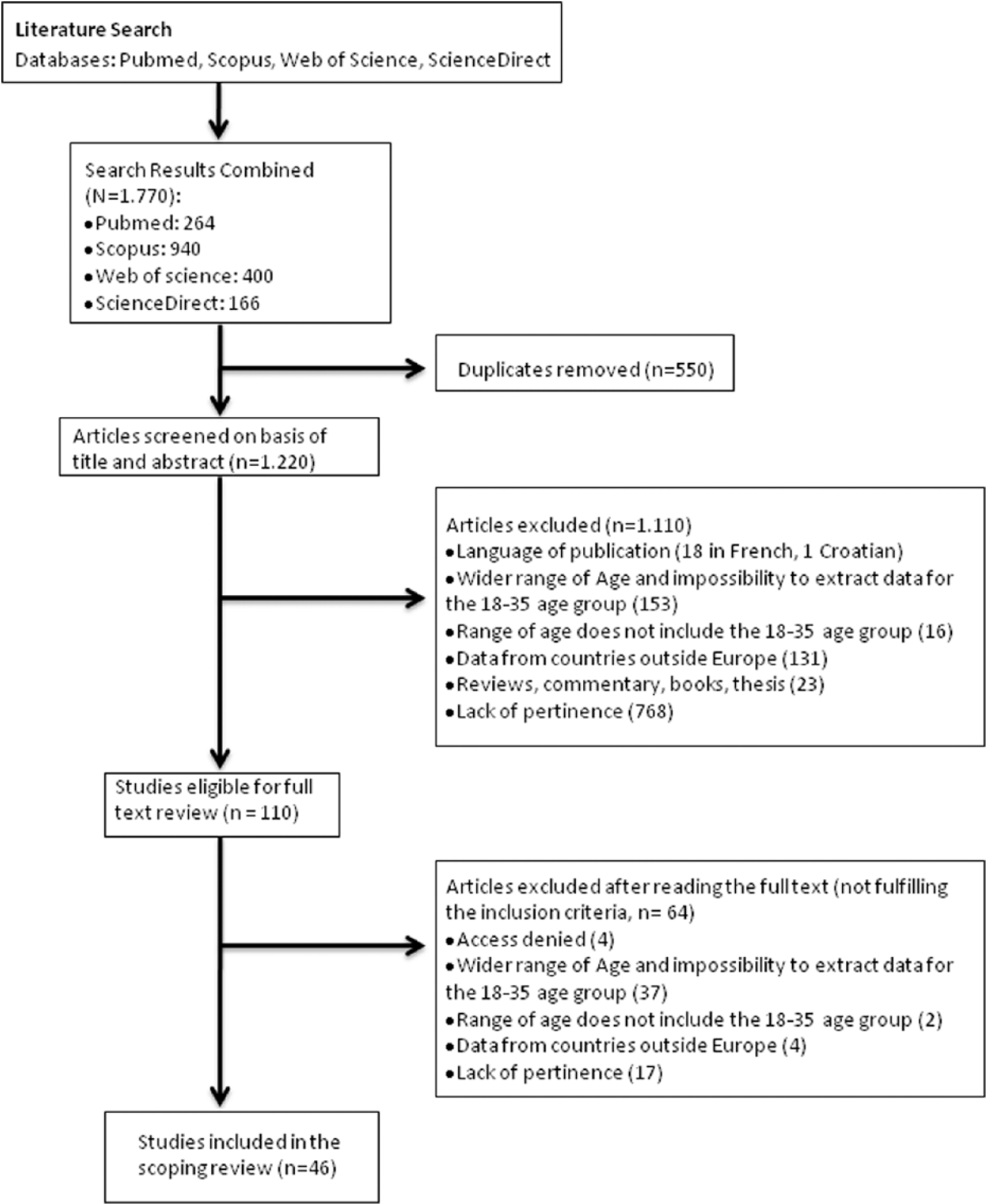
Flow chart of the literature search.
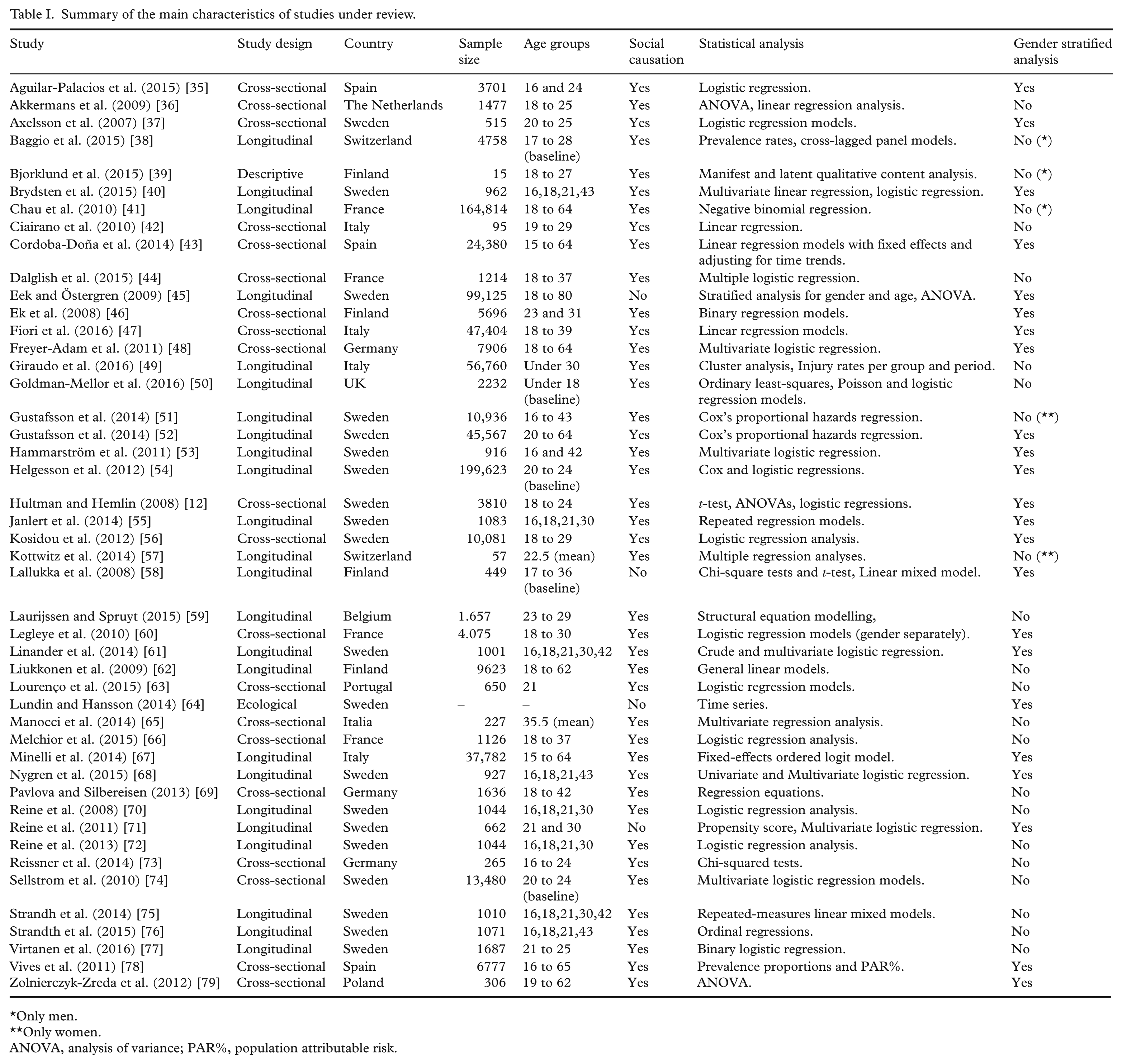
Of the 46 selected articles, only one used a qualitative approach. We identified 20 cross-sectional studies, 24 longitudinal studies and 1 ecological study (see Table I). The vast majority of the studies were carried out in Western European countries (36 studies), of which 24 were performed in Nordic countries (9 analysed the same Swedish cohort), and 12 in countries such as Germany, Switzerland, France, England or Holland. Only nine studies focused on Southern Europe (Italy, Spain and Portugal) and just one on Eastern Europe, specifically on Poland. No more than five studies were published before the end of 2008, when the current economic crisis started to take hold throughout Europe. Seventeen articles were published between 2009 and 2013. From 2014, the scientific publications in this line of research have considerably increased: 10 in 2014; 10 in 2015; and four so far in 2016. There are 27 studies that stratified their results by gender.
Summary of the main characteristics of studies under review.
Only men.
Only women.
ANOVA, analysis of variance; PAR%, population attributable risk.
Unemployment and precarious employment, and different health outcomes
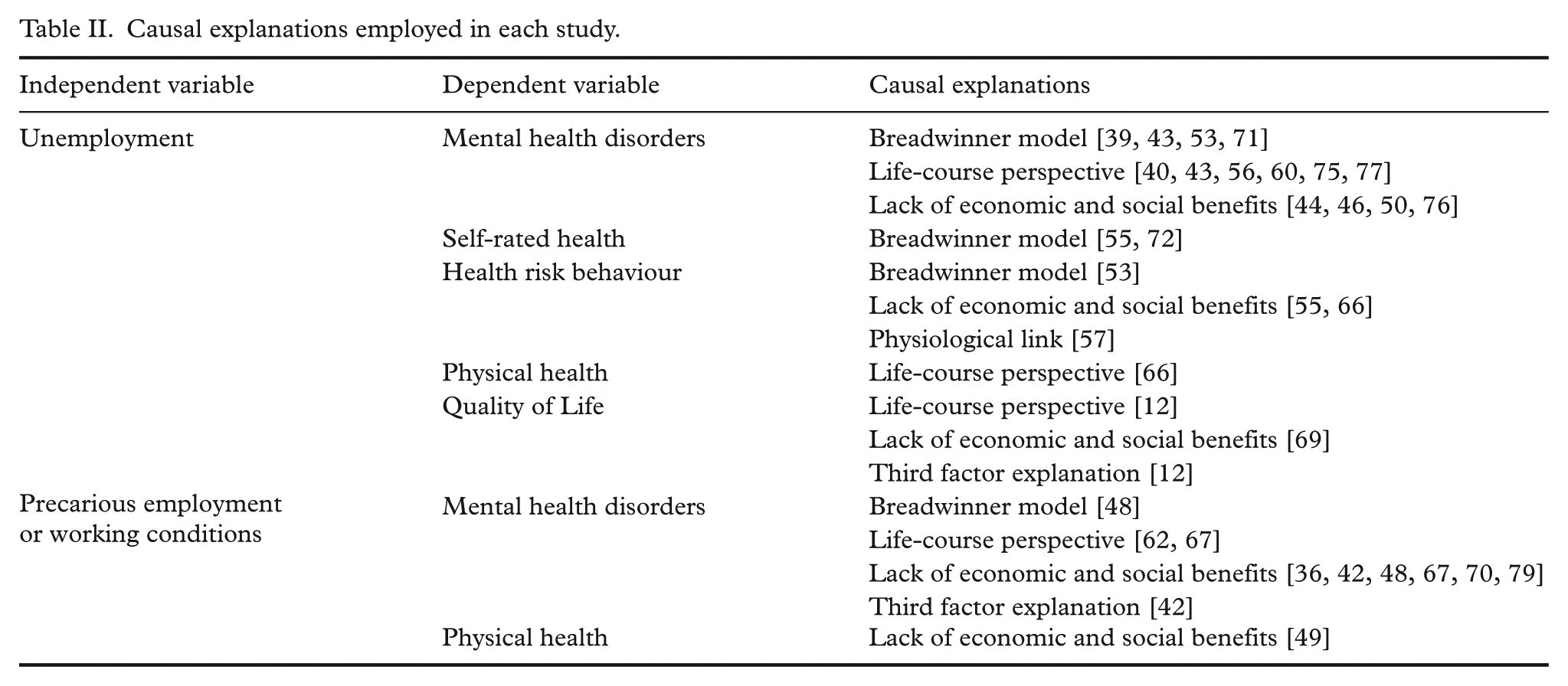
We have structured the analysis of results on the independent variables and highlighted the different health outcomes (see Table II). The independent factors were summarised through two conceptual constructs: unemployment status (employed/unemployed) or length of unemployment (28 articles); and working conditions or precariousness (psychosocial risks, working hours or type of contract) (16 articles). Only two articles analysed both of these constructs. The reported outcomes were: mental health problems (27 articles, of which four were on suicide attempts), measured with a variety of instruments including GHQ-12, DSM and IMHS; self-rated health (six articles); occupational injuries (five articles); quality of life (four articles); behaviour risk factors such as alcohol consumption, tobacco smoking or being overweight (four articles).
Causal explanations employed in each study.
For each study, we assessed whether or not the authors found support for social causation. There are two studies that found no association between unemployment and health outcomes. However, both articles present clear methodological limitations. One uses a small sample while the other employs aggregate data, so their results must be interpreted with caution. Two studies found a very weak association between working conditions/precariousness and risk behaviour, as they looked at a very specific health outcome (being overweight), in which case, other individual characteristics might intervene in the explanation. All of the other studies found support for social causation.
From the articles that examined the effect of unemployment status and/or length of unemployment, the most common health outcomes, for both men and women, were: mental health disorders (six studies), health risk behaviour (three studies) and poor quality of life (two studies). Two studies offered evidence of a strong association between being a NEET (youth Not in Employment, Education or Training) and mental health or health risk behaviour. Some studies highlighted health risk behaviour and mental health outcomes only in men. Others found an association with mental health, self-rated health and health risk behaviour, only in women.
Some of the studies that examined the impact of working conditions and precariousness found association with mental health disorders (four studies), suicide ideation (one study) and occupational injuries outcomes (one study), for both men and women. Others found an association with mental health and occupational injuries (two studies) or with general health (one study), only for men. Just one study, which focused only on women, found an association with health risk behaviour.
As shown in Table II, most studies (29 studies) exposed a wide range of causal mechanisms explaining the relationship between the studied variables, while some (17 studies) do not provide an explicit account for it. Those studies that analysed the impact of unemployment relied mostly on explanations such as the life-course perspective (eight studies), the breadwinner model (seven studies), the lack of economic and social benefits when unemployed (six studies), and on a combination of life-course perspective and third factor explanations (one study). The studies that analysed the effect of working conditions and precariousness made use of the lack of economic and social benefits, when working in precarious conditions (eight studies), the life-course perspective (two studies), the breadwinner model (one study) and a combination of lack of economic and social benefits and third factor explanations (one study) to account for the association.
Only four studies, particularly from Spain, Italy and France analysed the impact of economic recession on the association, and reached different conclusions. Three of them compared two cross-sectional surveys before and after the beginning of the economic crisis: one study found a worsening of mental health disorders and a stronger association with unemployment rates after the onset of the crisis; a second found an increase in suicide attempts after the crisis that, in men, seems to be related with increasing unemployment rates; a third one found that mental health improved during the crisis, but it was still associated with unemployment. Finally, the fourth study found that unemployment and precariousness were associated with suicide risk in young adults, an age group severely hit by the economic crisis.
Implications and future lines of research
The implications for policy and research that were identified in the reviewed studies were grouped into three categories. The first highlights the need to invest in public policies or governmental programmes to reduce long-term youth unemployment (eight articles), improve the transition from education to the labour market (seven articles) promote better education programmes (three articles) and enhance the psychosocial resources of young adults (three articles). The second emphasizes the need to enhance working conditions and promote employment stability and security (10 articles). The third suggests increased access to primary care and improved mental health services (seven articles).
Future lines of research were also identified in the reviewed studies. They basically consisted of more studies examining the impact of precarious employment (six articles). These included gender stratified analyses (five articles), conducting cultural, economic and country-related contextual analyses (seven articles), exploring the effectiveness of social security systems (unemployment benefits and active labour-market programmes) and of specific behaviour change and mental health interventions (four articles). All cross-sectional studies (20 studies) highlighted the importance of longitudinal studies to establish the directionality of the causal relationship between unemployment/precarious employment and health.
Discussion
This study aimed to review the effects of unemployment and precarious employment on the health status of young people. As a scoping study, it does not include a quality assessment of the reviewed articles, and thus does not provide a definitive analysis of the strengths/weaknesses of the examined association. It does, however, account for the scale of association and the main explanations provided.
After reviewing the literature, we can say that social causation seems to play a significant role in engendering health inequalities. Most studies found support for this hypothesis, in particular with respect to mental health effects and health risk behaviours. The most common explanations for the link between unemployment/precarious employment and health were the lack of economic and social benefits when unemployed or working in precarious conditions, the life-course perspective that emphasises the need for educational and economic incentives in the transition process to adulthood, and the changing social roles in present societies, particularly in respect to the male breadwinner role [43]. The male breadwinner model refers to an ideal of the family in which men earn a family wage and provide, while wives do domestic labour and care for family members. In today’s society these roles have become more equilibrated and even started to get re-inverted, mainly due to the increasing incorporation of women in the labour market.
Complementary to these, the reviewed literature highlighted the physiological link for health risk behaviour and the need to take into account third factor explanations such as personality traits, job and family history, work–family relation and country-related contextual variables (five articles). The physiological link refers to the biological mechanisms behind the relationship between unemployment and health risk behaviour. A third factor, also known as a confounding or mediator variable, can adversely affect the relation between our independent and dependent variables. This may lead to incorrect analyses of results as the results may show a false correlation. A third factor, not measured, may influence both independent and dependent variables.
In terms of methodology, further research should aim to incorporate a gender perspective into the analysis. In spite of the labour market’s gender segmentation, especially in Southern European countries [27], the high prevalence of unemployment and work flexibility among women [28], and gender inequalities in health related to unemployment, precarious employment and working conditions [29–31], only half of the reviewed articles took this variable into account. Other social stratification variables such as cultural/ethnic origin, social class, education and age could also affect the relationship between unemployment/precarious employment and health. More longitudinal studies are needed to confirm the social causation hypothesis as well as qualitative studies to better understand the mechanisms explaining the association.
Further research should also aim to include more indicators on precarious employment. The current labour market is characterized by frequent transition from unemployment to precarious and informal employment and vice versa, especially among young adults. Thus, a more in-depth analysis of precarious and informal employment is required in order to know its impact on health and health inequalities [32] and especially in the case of young people. Some studies leave serious doubts about the causal interpretation of their results. It is thus crucial to address problems of third factor explanations, measurement errors, the subjectivity of self-reported measures, missing values and simultaneous estimation of reciprocal and bidirectional causal paths.
As youth unemployment has become an important policy issue all over Europe, studies examining the social determinants of health for this population segment should develop explicit policy implications and recommendations to help alleviate this situation. Examples of such policy measures include: active labour market programmes to prevent long periods of unemployment (one article); training programmes (two articles); enhancing young people’s psychosocial resources (three articles); extensive social security measures to offset the economic consequences of unemployment (two articles); work re-design to reduce social stressors at work and increase job control, social support and autonomy (three articles); specific health programmes and services to cope with inequalities in health (three articles); and support for youth career initiatives (one article).
More comparative studies are also needed to further explore the impact of the economic crisis on the health of young people, as only four of the studies, three of which were from Southern Europe, attempted to give an account of this.
Strengths and limitations of the scoping study
The main strength of this scoping study is its focus on an important academic and political issue, namely the impact of unemployment/precarious employment on the health of young people. As far as we are aware, this is the first study analysing the existing literature about this relationship. Overall, the study aimed to map the key concepts and empirical evidence in this research subject, and to identify gaps in the literature.
When considering possible sources of bias, it should be noted that nine studies were made using the same cohort [33] for the analysis of the causal relationship between unemployment and health in young people. This might give the false impression of valid results from different studies, although the data are more or less the same and the results are not totally independent. Regarding the limits for generalization of the reviewed studies due to their sampling design, it should be noted that the countries and regions in which the studies were conducted were primarily in Northern Europe, probably because of the availability of longitudinal datasets. Therefore, further research needs to consider carefully whether the results from our study can be generalized to different contexts (other welfare systems, labour market regulations, health care provision or economic situations).
Another possible limitation of our study is its focus on peer-reviewed articles since our aim was to give an overview of the academic research from 2006 onwards. Articles that were not published in peer-reviewed journals or other grey literature such as reports by specialized agencies or non-governmental organizations were not included in the study. Although we are fully aware of the relevance of this type of literature, we decided not to include it mainly because of the absence of peer-review and the difficulty to verify the information derived from these sources.
Another limitation might be that only one reviewer excluded all thematically irrelevant studies and assessed the full text of the remaining articles according to the inclusion criteria. Nevertheless, the second reviewer double-checked the inclusion choices by reviewing the abstracts and disagreements were settled in discussion between the two reviewers.
Keypoints
- Young people are especially vulnerable to health problems when unemployed or working in precarious conditions.
- Active labour market and training programmes, inclusive social security measures, improved working conditions and targeted health programmes are important for addressing this vulnerability.
- Further research should strive to enhance the causal model by including a gender perspective, longitudinal data, more indicators on precariousness and third factor explanations.
Footnotes
Acknowledgements

Declaration of Conflicting Interests
The author(s) declared no potential conflicts of interest with respect to the research, authorship, and/or publication of this article.
Funding
The author(s) disclosed receipt of the following financial support for the research, authorship, and/or publication of this article: The research leading to these results has received funding from the European Union Seventh Framework Programme under grant agreement n° 613257.