






Abstract
The current method of extricating a driver after a collision in motorsport remains controversial. The current setup and deployment of both vehicles and personnel are outdated and in certain circumstances potentially dangerous to drivers. This analysis, based on current literature and the specialist expertise of the authors, endeavours to address the issues and make evidence-based recommendations.
Introduction
Professional motorsport continues to evolve with continuing advances in technology and subsequent speed of the vehicles. Unfortunately, with greater speed, the chance of suffering major injury if an impact occurs also increases. One of the most demanding situations the rescue team in motorsport have to face is that of a seriously injured casualty who has become trapped in an inaccessible vehicle. 1 The current regulations of the Federation Internationale de L’Automobile (FIA) for open wheeled cars in Formula One (F1), Grand Prix 2 (GP2) and Grand Prix P3 (GP3) World championships are stringent and warrant a specific configuration of deployed extrication teams.
F1 cars are single seated, open cockpit, open wheel racing cars that are used in F1 racing throughout the world; the GP2 series races consist of open wheeled cars introduced to act as feeder series into F1 and are less powerful, and subsequently not as fast as Formula 1 cars. Just as GP2 acts as a feeder into F1, GP3 acts as a feeder event into GP2, with a corresponding decrease in power and speed compared to GP2.
Unfortunately, there is no sound basis for this particular deployment methodology in terms of usage of vehicles or manpower, or the formal extrication manoeuvre, and more importantly it lacks an evidence base. The current model has teams deployed at up to four locations, with each location consisting of four vehicles: Medical Intervention Car (MIC), Extrication team, Disencarceration vehicle and Ambulance (Figure 1) and 14 personnel.
Current deployment model.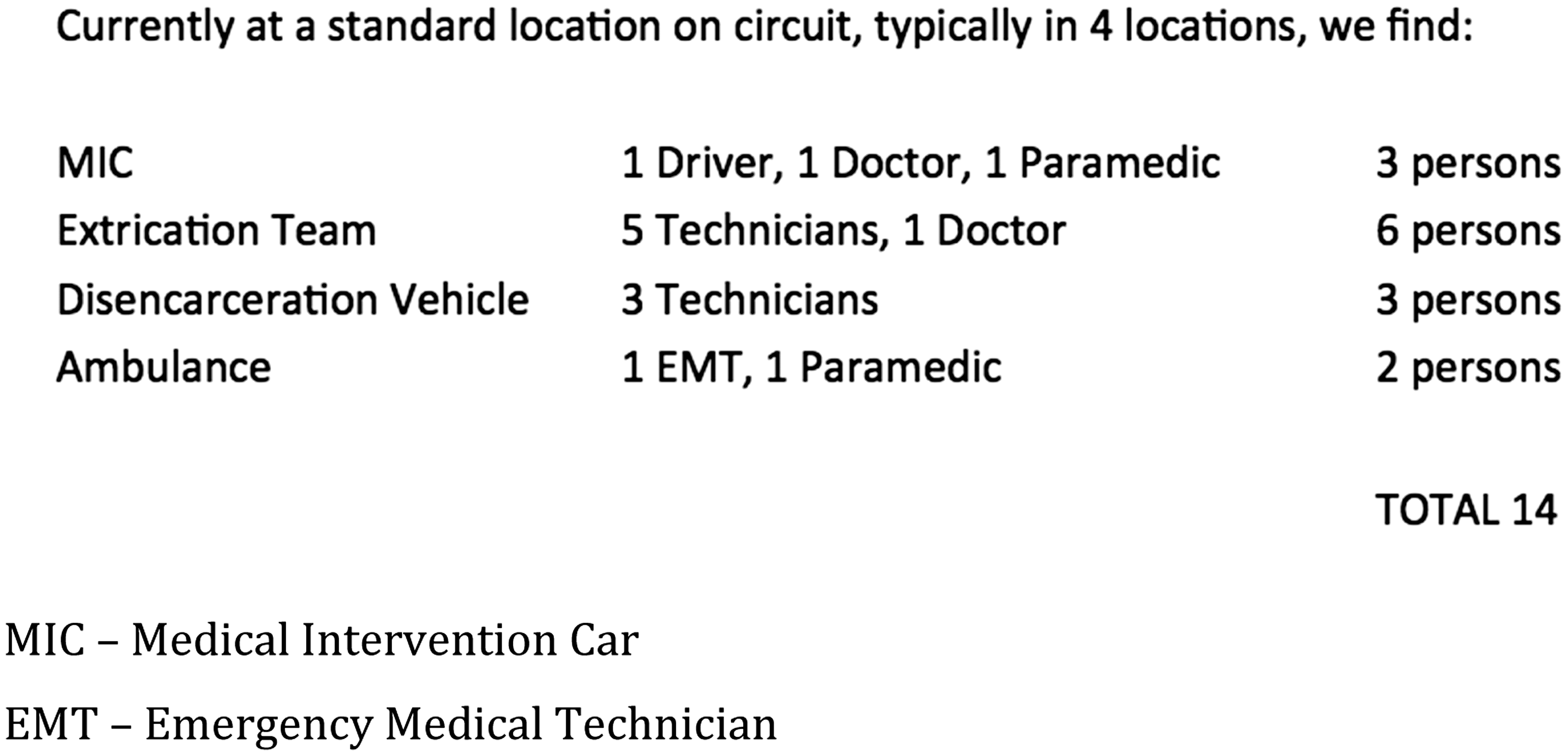
The definition of extrication is the removal of a person from a vehicle, removing them from entanglement or difficulty in as safe a manner as possible. It should be undertaken in such a way as to maintain maximal whole spine stability without interrupting any airway or resuscitation manoeuvres required for the injured party and can be subdivided into rapid extrication (RE), formal extrication, and self-extrication.
Rapid Extrication
When the injured driver has imminent threat to life from airway obstruction, cardio-pulmonary compromise or environmental risk such as from a fire, they are rapidly removed from their seat, as lifesaving treatment is paramount and takes precedence over spinal instability with the grab loops on the racing suits being utilised for this. Nevertheless, cervical spine movement is limited by good technique and teamwork.
Formal extrication
This is a smooth and careful procedure, in which a cervical spine collar and a Kendrick Extrication Device (KED) (acting as a spinal support) is applied to the driver before being safely lifted from the vehicle. The KED is a device that folds around the patient and is held in place by straps across the forehead, chest and the thighs. It was developed for initial stabilisation when a long backboard is not applicable and provides effective spinal immobilisation in both adult and paediatric patients.
2
In Formula 1 cars, the driver’s seat acts as the spinal support and is designed as such with the correct straps and attachments (Figure 2).
F1 seat and harness.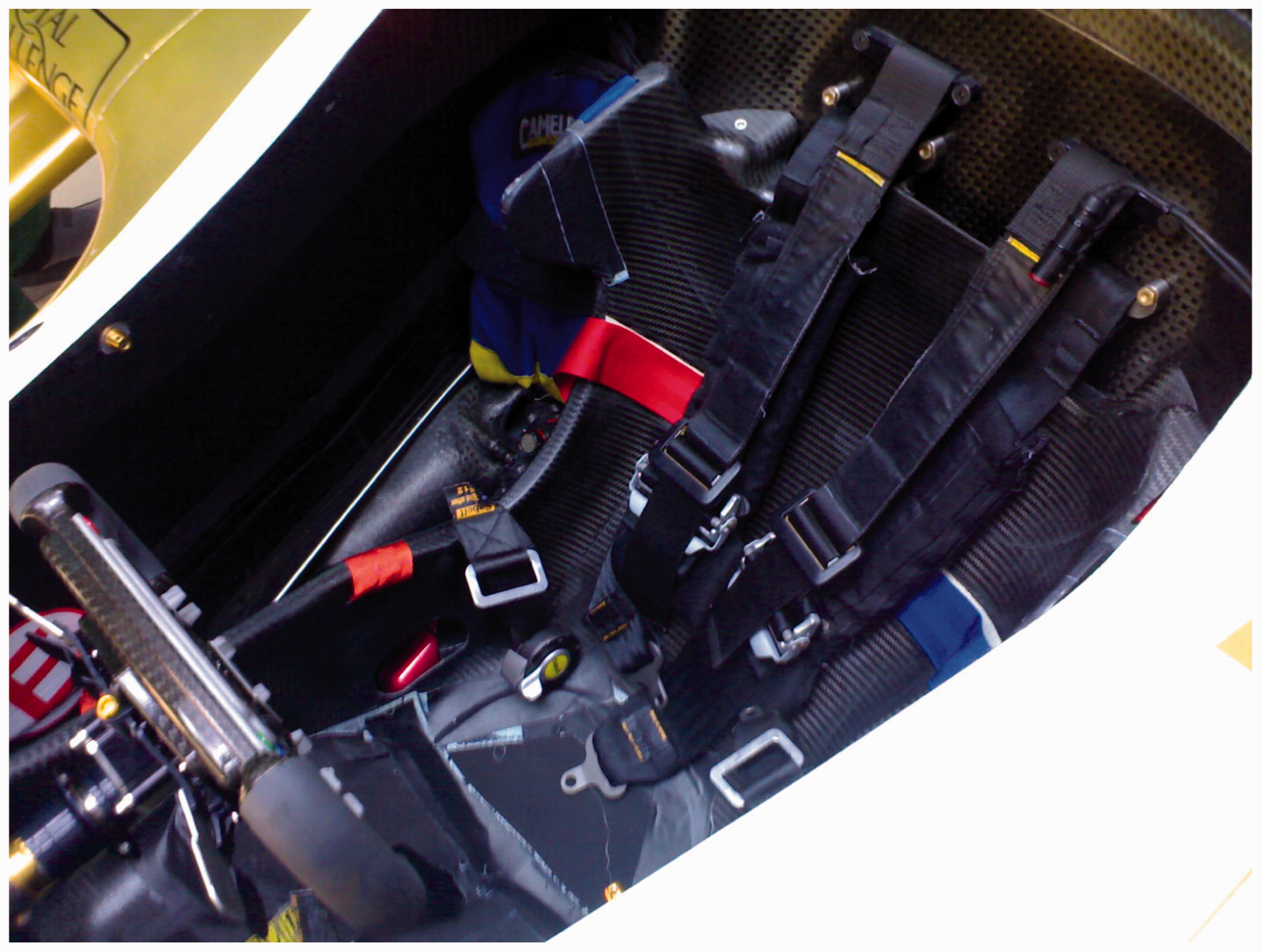
Self-extrication
This is where the driver extricates themselves to a place of safety (Figure 3). The all or nothing scenario is the usual, with little requirement for formal extrication. The usual modus operandi is self, or unfortunately in recent times, RE.
Driver has self-extricated and is lying alongside vehicle.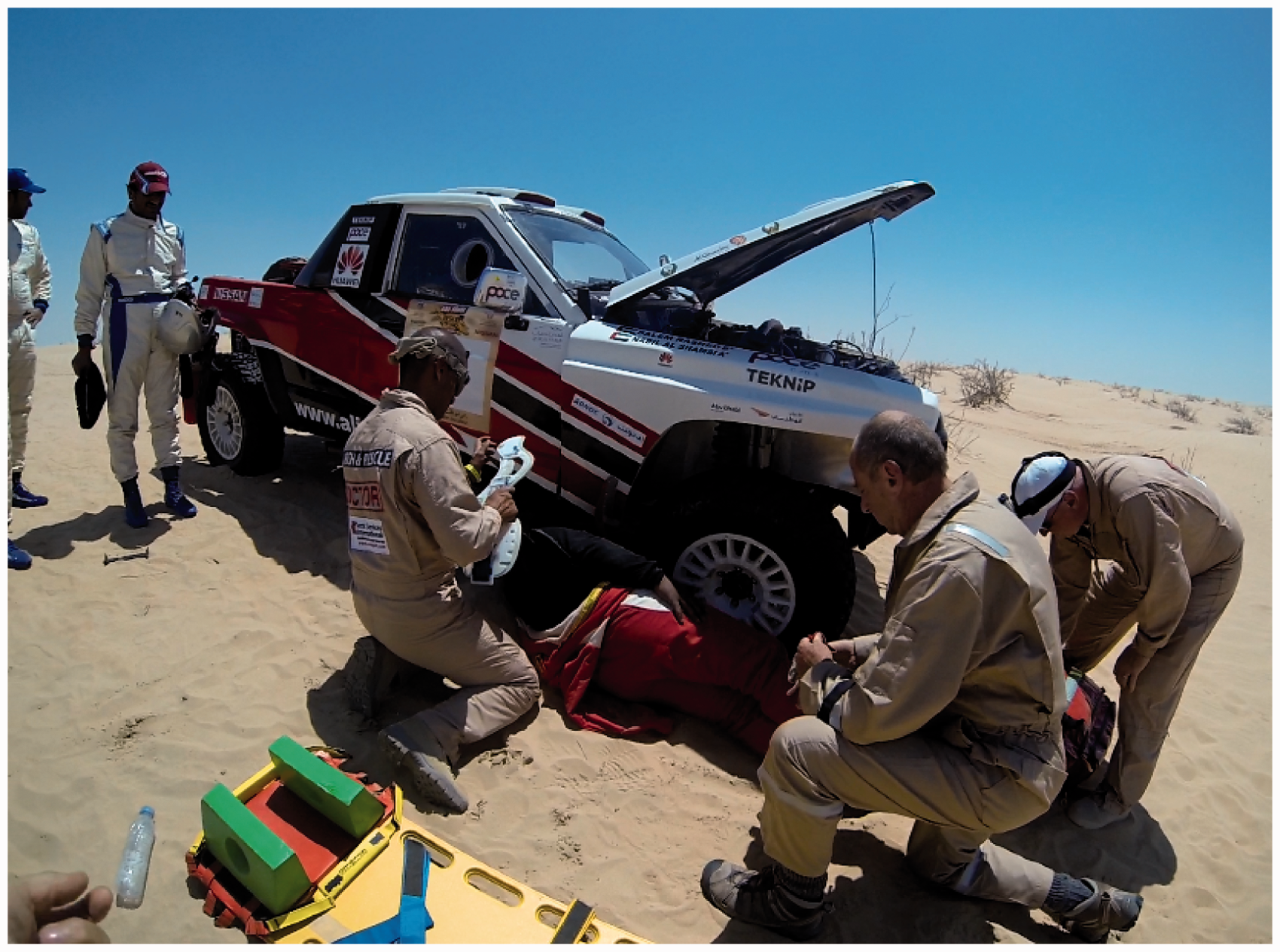
The case against current regulations for extrication
In 2013, there were numerous accidents during the World Rally Championship, but only six required deployment of extrication teams and all occupants were able to self-extricate without the help of the extrication teams. There was one RE required during the World Endurance Championship on the only activation of the extrication team. Thus, the 2013 World Rally season saw only seven extrications, with no formal extrication at all.
This current setup mandates separate teams for extrication in Formula 1 and GP2, with a large, and we would argue surplus, manpower requirement, as the manpower is required to undertake formal extrication, which we believe is unnecessary.
Formal extrication usually takes between 5 and 7 min to undertake which carries the real risk of decompensation over time, iatrogenic pain, spinal movement and airway compromise. This is of paramount importance as in the pre-hospital environment time to definitive care is a critical factor. Most drivers are fine after an accident and self-extricate.
Dixon et al. 3 undertook biomechanical analysis of spinal immobilisation during pre-hospital extrication. Sensors were placed on patients and extricated by a six-man team in nine different variations including slow formal extrication. Their results demonstrated that conventional extraction techniques record up to four times more cervical spine movement during extrication when compared to controlled self-extrication. The main area of concern using the formal extrication method is that the principle behind the extricable seat design and formal extrication process is flawed, as the car is almost never on all four wheels and there is hardly ever any surrounding space for manoeuvre, absence of fire hazard or seat damage and the car is often, buried in Armco (protective impact barriers).
It has been estimated that up to one-quarter of spinal cord injuries may be significantly worsened during transport or early treatment. Hence, the American College of Surgeons recommends full spinal immobilisation during extrication after a motor vehicle accident. 4 However, this recommendation does not take into account the potential detrimental effects of iatrogenic injury caused by immobilisation during extrication, especially as Dixon et al.’s 3 study demonstrates the amount of movement that occurs during formal extrication.
Two main principles are followed during the extrication process to prevent motion of the spine and further injury: maintain spinal alignment and minimise body twisting.
The same study by Engsberg et al., 4 demonstrated that the least cervical spine movement occurred when the driver was allowed to extricate themselves without assistance with cervical spine collar in place.
Shafer and Naunheim 5 have undertaken extensive experimentation on models to determine the extent of cervical spine motion during extrication. Volunteer patients were marked with an infrared motion capture system and extricated from a vehicle by experienced paramedics. The least movement was demonstrated to occur when the driver had a cervical collar applied and was allowed to extricate themselves from the vehicle on their own and lay down on a back board. Ben-Galim et al., 6 demonstrated that even cervical spine collars can be detrimental when applied. They provided evidence that extrication collars can result in abnormal distraction within the upper cervical spine in the presence of a severe injury. However, they did not demonstrate any evidence of instability or neurological compromise.
It is now recognised that the most vulnerable part of the driver in F1 cars is the head and neck as it is in this area where the most serious injuries in the past few years have been seen. Karbi et al. 7 studied the extrication, immobilisation and radiological findings of patients with cervical spine injuries; one-third of patients had injuries to C1 or C2 vertebrae where any movement could lead to paralysis or death. The authors concluded that the most effective way to deal with spinal injury was prevention.
Head injury has also been noted to cause agitation, and in this scenario forced head restraint or manual fixation of the head can cause further injury and it may be necessary to remove the fixation.
From the authors’ experience in both Formula 1 and rally cars, nearly all drivers can be extricated with a simple short board or a KED and there is almost never a need to cut the roof off the car which translates to less cutting at the roadside on a normal motor vehicle collision (MVC). Historically, the removal of the roof has been undertaken by the firecrew and is medically unjustified in nearly all cases. Cutting gear should be for disentanglement only.
Indycar experience over the past 25 years shows a simple short board behind the driver, with a simple thoracic strap and neck collar, is both similar in technique and results described by Cline et al. 8 Extrication from these cars takes less than a minute and there has been no associated paralysis in the 25 years this technique has been utilised. This, therefore, contradicts the rationale behind formal extrication using a full seat and extricable seat, reinforced by the fact that studies have demonstrated that drivers who self-extricate move less than when they are manhandled by an extrication team.
In Norway, the KED device has been removed from all ambulances and collar usage is limited to where a driver complains of neck pain. All are encouraged to self-extricate with no apparent increase in morbidity. Pre-hospital entrapment is a risk factor for complications and delays transport to the hospital. The RE method, described by the Norwegian Air Ambulance, combines winching and cutting of both front reinforcement poles in the car and using two larger vehicles to pull car wreckage apart to extricate patients. Previous studies indicate that RE is an efficient alternative to previously existing methods.9,10
Proposal for extrication
At any accident scene, rapid removal of the casualty to hospital improves their chances of survival. The term the ‘Golden Hour’ was first introduced in 1961, but because of misinterpretation as to what period this actually referred to, a second concept, the ‘Platinum Ten Minutes’ was proposed as the time taken to move a casualty to the ambulance. To achieve this rapid removal, the ambulance and medical personnel must work in harmony with the rescue personnel to secure the scene and remove the casualty safely without causing injury either to the casualty or other personnel on the scene. 11
The authors recommend the removal of the requirement for separate extrication teams. The skills required for extrication and disincarceration can be combined alongside a core medical skill set into one or two vehicles removing the need for a separate extrication vehicle with all personnel trained in extrication and rescue (Figure 4). This would result in a decrease in both manpower and vehicle requirement.
Proposed extrication deployment model.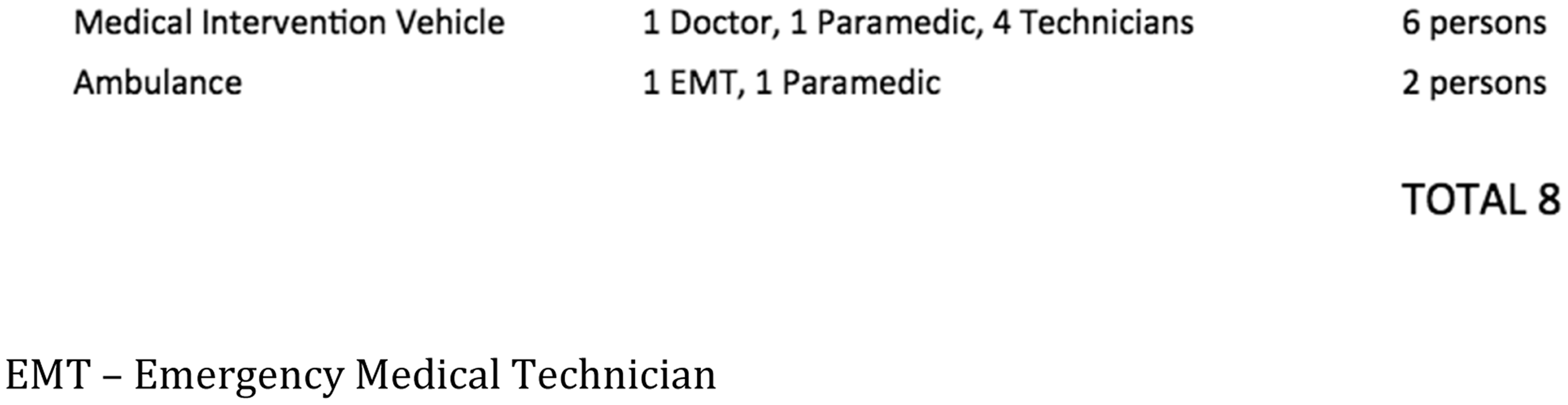
Conclusion
There is a place for slow measured formal extrication but that place is limited in professional motorsport and the evidence for this procedure is weak or inconclusive. It is conceivable that formal extrication could cause further harm or treatment delay to an injured driver. If cervical collar and self-extrication or short spinal board immobilisation could be used, it should be permitted as normal practice. Proper consideration should be given to RE where mechanism of injury warrants high suspicion of injury. The place for slow formal extrication is limited.
Footnotes
Authors’ contribution
Both SP and MK conceptualised, undertook the literature review and wrote the manuscript.
Declaration of conflicting interests
The author(s) declared no potential conflicts of interest with respect to the research, authorship, and/or publication of this article.
Funding
The author(s) received no financial support for the research, authorship, and/or publication of this article.
Provenance and peer review
Not commissioned, externally peer reviewed.