







Abstract
Cognitive biases have been identified as drivers of the excessive use of force, which has determined current affairs across the globe. In this article, we argue that the police are facing serious challenges in combating these biases. These challenges stem from the nature of cognitive biases, their sources and the fallacies that mislead police professionals in the way they think about them. Based on a framework of expert decision-making fallacies and biases, we argue that these fallacies limit the impact of efforts to mitigate cognitive biases in police conflict management. In order to achieve a systemic understanding of cognitive biases and their detrimental effects, the article concludes that implementing reflexive structures within the police is a crucial prerequisite to effectively reflect on external influences and to limit bias and fallacies from further unfolding in a self-referential loop.
Keywords
Introduction
“Cognitive bias” has been identified as a driving factor concerning the use of inappropriate force by the police, especially towards people of color and other minoritized groups (Boxer et al., 2021; Dukes and Kahn, 2017; Kahn and Martin, 2020; Peeples, 2020). Combating cognitive biases that negatively affect police–citizen encounters poses serious challenges for the police (Peeples, 2020). This may be due to the ubiquity of bias concerning human cognition and the various forms it presents (Nickerson, 1998). In criminal justice, cognitive biases have been studied in several subject areas, including wrongful convictions (Burke, 2007), biased prosecution practice in general (Burke, 2007) and forensic science (Dror, 2020a; Kukucka et al., 2017; Nakhaeizadeh et al., 2015). Regarding conflict management in law enforcement, cognitive biases have been introduced as a lens through which police conduct and misconduct in conflict situations can be understood (Fridell and Lim, 2016; Nix et al., 2017). Concerning the use of force, biases are a responsible factor for making errors in decisions (Dror, 2007; Mears et al., 2017).
After all, it is the human police officer who observes, interprets and acts on data perceived around interactions with citizens. Therefore, professional practice in the field is mediated by human and cognitive factors, with bias in police conflict management being a major concern. It seems that bias is a fixed element within the system of policing, which is reluctant to change (Boxer et al., 2021). In the current theoretical analysis, we argue that the challenges associated with combatting bias in the system of policing are rooted in the nature of cognitive biases, their sources and the fallacies that mislead us in the way we think about them. Dror (2020a) recently introduced a framework of analysis of expert decision-making fallacies and biases that point towards the self-stabilizing entanglement of cognitive biases and fallacies. The model structures fallacies and biases into three categories that allow us to understand the systemic anchoring of judgement and decision errors within the system of policing. Based on this framework, we argue that our assumptions about cognitive biases and their sources may be compromised by several fallacies about the nature of biases, which limit the impact of efforts to mitigate cognitive biases in police conflict management. Based on this analysis and in the light of a systemic understanding, we conclude by advocating for reflexive structures within the police and external influence from outside the police as the main drivers to combat bias within law enforcement.
Sources of cognitive biases in police conflict management
Biases may arise from many sources (Dror, 2020a). Depending on the source, different approaches are needed to combat the biases that stem from these sources. Recently, in the context of forensic science, Dror (2020a) proposed a framework that organized the sources of biases into three categories. We see value in adopting this framework for a better understanding of how cognitive biases and logical fallacies about them affect police conflict management (see pyramid on the left side in Figure 1). The pyramid within which the sources of bias are arranged illustrates that sources of cognitive biases at the top are based on those sources below.
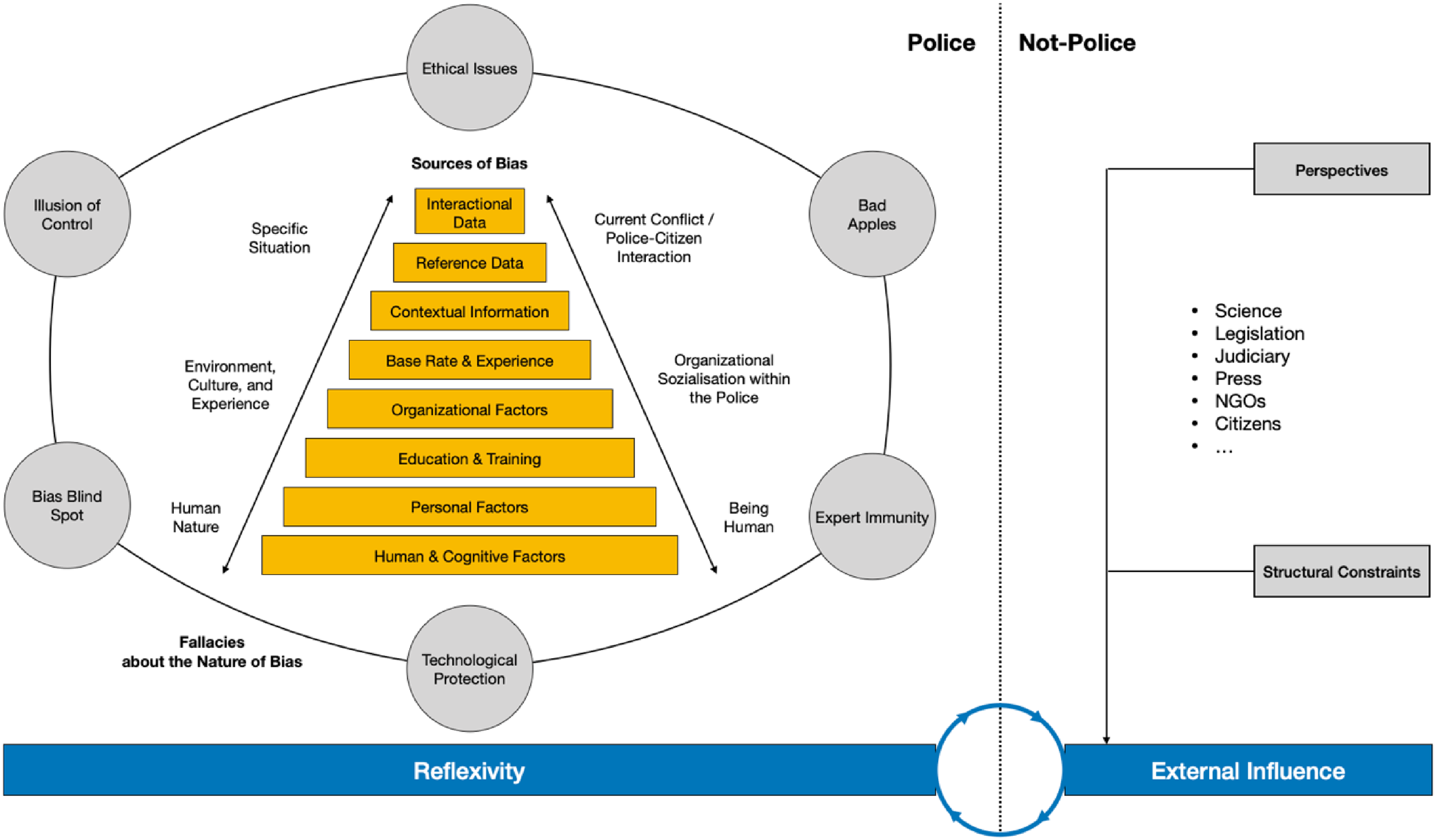
Sources of bias and fallacies in police conflict management. NGO, non-governemental organization. Modified from Dror (2020a).
The first category relates to the specific situation, how it is perceived, processed and interpreted. The second category relates to the individual managing the conflict (i.e., interacting, using force, etc.). For instance, causes of biases include individual experience, training, personality or motivation. The final category captures sources that relate to human nature, the “cognitive architecture of the human brain” (Dror, 2020a: 7999). These are the sources we all share, independent of a specific role, such as a police officer managing conflict with a citizen.
The outer circle in Figure 1 depicts fallacies about the nature of cognitive biases. The figure as a whole shows the big picture, which differentiates the system of policing from those systems that are not the police. Before we turn to the fallacies and the systemic issues involved, we describe the different sources and how they affect police conflict management and its outcomes for citizen contact.
Interactional data
When they encounter citizens, police officers constantly process data about the interaction. They perceive subjectively relevant data, which consciously and unconsciously influence their decision-making. Some data comprise information that is relevant for police officers to manage potentially on-going conflict; other data distract officers from focusing on the conflict at hand. All citizens belong to a certain social group and corresponding associations can evoke emotions on the side of the police officer, which in turn influence the interaction between the two parties (Makin et al., 2018). Social groups encompass a variety of different social identities, such as political orientation, race, family name, profession or geographic location. Perspectives that are diametrical to those of the officer can have potential for conflict (Staller, Koerner and Zaiser, 2021). Also, as proposed by the emotional contagion argument (Makin et al., 2018), aggressive and disrespectful civilian behaviors can influence officer decision-making towards complementary action, which interferes with the actual resolution of the conflictual situation.
Reference data
The data police officers perceive during an encounter are influenced by the reference data police officers possess. Such reference points determine filters through which police officers perceive and interpret behavioral and situational cues throughout the police–citizen encounter. Reference data constitute a target, which police officers are at risk of fixating on, as they interpret it as actual evidence of the unfolding situation they are attempting to navigate. Falling prey to confirmation bias and not working from relevant information, police officers might judge the situation in a way that matches a narrative emanating from their reference point and then “reason backwards”. For instance, a citizen who is known to police for repeated encounters and arrests, calls 911 as a victim of a violent assault. Responding officers might “reason backwards” from the caller's history and make the situation fit that reference point. They might conclude that the caller must, in fact, be the instigator of a physical altercation with a citizen without any criminal or local record, who is afforded more credibility and might be treated as the victim rather than the perpetrator (Stolzenberg et al., 2021). Likewise, a person in crisis with a long-standing history of mental illness and emergency apprehensions might report physical or sexual abuse by a family member to no avail. Police might “work backwards” from the stigma associated with mental illness and determine the allegation to be “just another psychotic episode”, rather than the actual crime that it is.
Attribution effects might both feed from and reinforce subconscious references to criminal and local records. Focusing on background knowledge of a citizen, in order to fill the gaps and make sense of a dynamically evolving situation, a police officer might overestimate the attributed personality and underestimate the situational determinants of a citizen's behavior (Ross and Nisbett, 2011; Tetlock, 1985). A common example used to illustrate the fundamental attribution error is set in traffic and corresponds, in the dynamics it depicts, with situations that police officers may encounter in the course of traffic enforcement. The driver of a motor vehicle is late for an existentially important appointment and is pulled over by the police for speeding. The officer attributes the infraction to poor planning and possibly bad habits, depending on whether the driver has had prior speeding tickets. Without regard for the driver's explanation of a series of challenges he had to overcome this day, the officer might benchmark the observed behavior with that of a malignant speeder with little regard for other motorists and ultimately choose to not use discretion and give the driver the maximum fine. The commonalities in these examples lie in the underlying structural aspect that the police officer's decision is driven by the target they expect or want rather than the actual data emerging from the interaction.
Contextual information
Experts are often exposed to irrelevant contextual information, which may cause bias (Dror, 2020a). The causation of bias by contextual information is not unique to police officers (De Lange et al., 2018; Luck and Ford, 1998; Richter et al., 2018; Stein and Peelen, 2015). In the realm of police conflict management, such information may be a criminal record associated with a citizen (Stolzenberg et al., 2021) or knowing their race, which has been shown to cause bias and stereotyping (Kahn, McMahon et al., 2017; Kahn, Steele et al., 2017; Zhang and Zhang, 2021). Also, a citizen’s name itself may be suggestive of a specific social group or minority population evoking bias and stereotypes (Boettner and Schweitzer, 2020; End, 2017). When cognitive shortcuts rely on biases about the dangerousness of racial minorities, they can contribute to disparities in the use of force. These biases may interact with those held by citizens, creating a greater potential for such disparities (Mears et al., 2017). Irrelevant contextual information also includes a citizen’s appearance, as indicated in a study investigating the effects of appearance factors associated with contemporary hip-hop culture (Dabney et al., 2017). The results showed that a “hip-hop appearance” was a predictor of more severe formal outcomes imposed by police officers when compared with other relevant predictors.
The problem with task-irrelevant contextual information is that it can cause many types of biases that impact police–citizen interactional decision-making in many different ways. Bias can lead to overlooking or underweighting the absence of data, not properly confirming judgements, or not considering alternatives for the interactional behavior of the citizen. For example, the lack of trust in the police in racial and minority groups may lead to different behaviors compared with citizens who trust the police. This has to be taken into account, given that recent data from the USA and Germany showed that, whereas white citizens generally feel safe around the police, people of color do not (Abdul-Rahman et al., 2020; Graham et al., 2020; Pickett et al., 2021). At this point, we want to emphasize that contextually irrelevant information biases humans in general, usually on an unconscious level without any awareness of the impact. The expectation biases what and how information is represented and processed in the brain (De Lange et al., 2018; Luck and Ford, 1998; Richter et al., 2018; Stein and Peelen, 2015). These biases also impact experts and cannot be counteracted by willpower alone (Dror, 2020a).
Base rate and past experiences
An important asset that subject-matter experts bring to their work is their experience from previous situations. However, such experience brings expectations to new situations, which might not be relevant to the current encounter but, nevertheless, still impact the interpretation of the current dynamics. In policing, experiences from previous police–citizen encounters shape expectations about the outcome of future conflictual situations (Behr, 2019b). For example in Germany, police officers are tasked with combatting certain organized criminal structures, which are officially labeled “family clans” (“Familienclans”) (Dienstbühl, 2019). The base rate of associations between a certain name and involvement in criminal activity in certain regions can bias the perception and interpretation of a citizen’s interactional behavior (Boettner and Schweitzer, 2020). The problem is that police behavior can be impacted by factors that have nothing to do with the current conflict situation, but rather with base rates generated from previous, unrelated situations. This influences how the current conflict is managed. The essence of the base rate is that perception and decisions are not based on the specific situation itself. Biases stemming from the base rate and past experiences are even more potent when the similarity to past situations is superficial and in the eye of the beholder, here the police officer, rather than in reality (Shafffi et al., 1990)
Organizational factors
Organizational factors that cause bias have been well documented in a variety of domains. When it comes to law enforcement, where conflict has to be managed between two opposing actors, cognitive biases may emerge from self-serving or my-side and other-side bias. In a conflict, we often evaluate our own perspective favorably. At the same time, we evaluate our counterpart's perspective unfavorably (Simon et al., 2020). An organizational culture that nurtures the divide between society and the police through an “us versus them” narrative (Boivin et al., 2018) may foster such biases. The same is true for another narrative prevalent within the police; narratives about the dangers of the police profession (Branch, 2020; Staller and Körner, 2021), “war stories” (Kurtz and Upton, 2017; Rantatalo and Karp, 2018), and seeing the police as the “thin blue line” that protects society from chaos (Wall, 2020), are maintained inside police institutions.
The impact of organizational factors applies to a variety of contexts, structures and frameworks that can bias conflict management in police–citizen interactions. For example, police institutions have a clear hierarchy and chain of command. A recruit in training can be at risk of “behaving like his field training officer wants the behavior to be seen” (Hoel and Christensen, 2020) and might not challenge these views. As such, managerial authority may create a source for bias. Furthermore, equipment, such as firearms (Farmer and Evans, 2020) or conducted-energy devices (Ariel et al., 2018), may also bias decisions concerning the use of force. Other organizational aspects include time pressure, stress, the expectation to reach certain arrest targets and many other factors that can impact the work carried out on the streets in police–citizen encounters.
Education and training
Training and education play a crucial role in police conflict management (Koerner and Staller, 2020). They can cause bias explicitly through learned content, but also implicitly through “hidden curricula”. For example, researchers in Germany have analyzed content of use of force training curricula and documented a significantly higher share of content relating to coercive behavior compared with de-escalating behavior (Staller et al., 2019; Staller, Koerner, Heil et al., 2021). The ratio between training in the use of force and de-escalation transfers into real-life situations and can bias decisions made between the two (Li et al., 2020).
Personal factors
Personal factors like motivation, personal ideology and beliefs impact biases and as such influence decision-making (Dror, 2020a). For example, xenophobic attitudes bias interactional decision-making with individuals from certain groups just as much as stigma-informed beliefs about individuals with mental illness (Behr, 2019a; Murray and Schaller, 2016; Wittmann et al., 2021). Also, people vary in their tolerance towards risks and ambiguity (Saposnik et al., 2016). Owing to the high subjectivity in the way they shape police–citizen encounters, such personal factors have a greater role in determining corresponding behaviors. By contrast, in areas in which objective quantification and standard operating procedures (SOP) govern conduct, such as use of force models, these factors are reduced. However, it is important to note that even when SOPs and technology are used, human biases are still at play. SOPs cannot be completely objective because humans are involved in developing, evaluating and refining them, as well as in applying them. The same holds true for technology that supports policing and conflict management. Other personal factors may include the police officers’ attitudes towards honor (Pomerantz et al., 2021) and authority (Klukkert et al., 2008).
Human and cognitive factors
As humans, we try to make sense of the world and as such, we see the world in our own subjective way. Beyond many cognitive processes and the way our brains are wired, there are biasing effects related to social interaction, in-group and availability biases, processing fluency and other biasing influences that impact all of us (Goldstein and Gigerenzer, 2002; Oppenheimer, 2008; Ross et al., 1977).
Fallacies about the nature of biases
No one will refrain from combatting cognitive biases to optimize decision-making in the context of police conflict management. Yet, cognitive biases persist in the domain of policing, and we seek to understand the reason for this through certain fallacies about the nature of biases. These fallacies limit our capacity to recognize the described biases and take action to counter them. Dror (2020a) recently identified six fallacies about the nature of biases in forensic science. We argue that these fallacies also apply to police conflict management. We exemplify this by discussing occurrences in Germany where—as in other states around the world—police actions, including the use of force, have been increasingly criticized for being biased against certain races and minorities. The ongoing public discussion allows us to showcase commonly held, incorrect beliefs about biases and how these beliefs limit our efforts to mitigate recognized biases.
Ethical issues
There is an incorrect belief that biases are an ethical issue of corrupt or deviant individuals (Dror, 2020a). They are not. Cognitive biases impact honest and dedicated individuals—and of course police officers. It is important to acknowledge that cognitive biases are not a matter of dishonesty, intentional discrimination or of a deliberate act arising from underlying ethical issues (Nickerson, 1998). Cognitive biases are not about ethical issues, such as personal character, integrity or intentional misconduct. In this context, it is essential to differentiate intentional professional misconduct, such as the stealing of ammunition by a police trainer to privately attend a firearms workshop (Locke, 2021), from innocent biases. For instance, some police use of force trainers have been found to primarily attend special forces workshops even though the content offered does not apply to the conflict situations encountered by their pupils, which require more communicative–de-escalating approaches to conflict management (Staller, Körner, Abraham et al., 2021).
Bad apples
The bad apples fallacy refers to the incorrect belief that errors and biases are a matter of competence, shifting the responsibility towards an individual police officer and away from any systemic issues. In Germany—and other countries—several incidents involving racist police officers sparked public outrage in 2020, leading to public and scientific debates about this issue (Hunold and Wagner, 2020). Although individual cases of racist police conduct accumulated in 2020, the minister of the interior in Germany, Horst Seehofer, recurrently referred to individual bad apples within the police institution as the culprits. He explicitly denied there was a systemic problem (Vooren, 2020). This fallacy impacted the conduct of a nationwide study on police racism. Whereas the scientific community vehemently advocated for a study conducted by an external university on the prevalence of police racism, the Ministry of the Interior commissioned a three-year study with a focus on motivation, attitudes and violence in everyday police life (BMI - Presse, 2020). Based on the belief that police conduct rooted in implicit and explicit bias is limited to only few bad apples, a research project investigating systemic issues has not been implemented and is therefore still missing in Germany.
Expert immunity
There is the incorrect belief that subject-matter experts are immune to biases (Kukucka et al., 2017); however, research in the domain of forensic science shows that this is not the case (Dror et al., 2018). There is also evidence that experts are more susceptible to specific biases, since the development of expertise itself leads to the creation of certain biases (Dror, 2020a). Although these cognitive processes often enable experts to see solutions where others do not (Mangels et al., 2020), these mechanisms may also create bias leading experts in the wrong direction. For example, experience and training in conflict management lead experts to engage in more selective attention, use of schemata, and rely on heuristics and expectations arising from past base rate experiences. Such utilization of top-down cognitive processes creates a priori assumptions and expectations about the police–citizen interaction at hand. Furthermore, experts in conflict management may perceive conflict situations from a limited perspective based on what they train (Staller et al., 2018). In the context of policing, a recent study showed that experienced officers build their “own” expertise on locally specific profiles based on their experiences, which can lead to racially biased policing practices. At the same time, they claim to operate under a neutral policy of “color blindness” (Welsh et al., 2020). As pointed out previously, the greater the frequency of stopping people of color, the more likely they are to be fearful rather than feeling safe (Pickett et al., 2021). As a result, experiences of use of force incidents are more likely, which manifests strategies and expertise in applying force. This process is also reflected in an analysis of police stops in New York City (Morrow et al., 2017). The findings suggest that minority citizens may be exposed to a racial or ethnic “double jeopardy,” whereby they are subjected to both unconstitutional stops and disparate rates of use of force during those stops.
Technological protection
People hold the incorrect belief that the use of technology eliminates bias. Although the use of technological systems can reduce bias (Kleinberg et al., 2018), it is important to keep in mind that systems are built, implemented, used and interpreted by humans, and as such are prone to biases (Mayson, 2018). There is a danger that people will incorrectly believe that using technology is a guaranteed protection against being susceptible to and affected by bias (Dror et al., 2012). Also, technology may introduce, replicate or amplify biases (Ajunawa, 2020). For example, in predictive policing “offender-based predictions exacerbate racial biases in the criminal justice system and undermine the principle of presumed innocence” (Shapiro, 2017: 458). As such, the bias does not lie in the supporting technology (input, algorithm, etc.), but in the prediction itself, where it projects the inequalities of the past into the future (Browning and Arrigo, 2021; Mayson, 2018).
This problem extends to the use of data and evidence in general. Meticulously collected data (such as crime statistics) provide the basis of evidence-based approaches to policy and practice within the police. However, bias may arise through implementing “finalized knowledge” (Koerner and Staller, 2021) that stems from scientific evidence. The rise of evidence-based policing as a method of making decisions about “what works in policing” (Sherman, 2013) advocates the use of technology, which, in turn, can introduce such biases. Although using scientific evidence unarguably has benefits, evidence-based practice per se is not immune to bias (Every-Palmer and Howick, 2014; Wieringa et al., 2018). In medicine, the very domain that informed evidence-based policing (Sherman, 1998), bias has been demonstrated in tested and proven hypotheses, study designs and selective publications (Every-Palmer and Howick, 2014). Concerning the use of crime statistics in Germany, a reflexive approach to interpreting data has been suggested (Derin and Singelnstein, 2019). The use of technology, data and algorithms does not protect from the bias introduced through these systems or from applying them in a messy, naturalistic decision-making environment. We suggest that these aspects actually consolidate biases through their implicitly transported, hegemonial claim to the truth (Staller and Koerner, 2021).
Bias blind spot
The bias blind spot refers to the incorrect belief that other experts are affected by bias, but not oneself. This fallacy is well-documented in the literature (Jones et al., 2018; Kukucka et al., 2017; Pronin et al., 2002; Zapf et al., 2018) and can be expected to apply to police officers and people who have belief in them as well. For instance, people deny that bias would influence their own and officers’ inferences and memory of a criminal encounter, yet, they do not extend the same benefit to the average American (Jones et al., 2018). Concerning prosecution of the inappropriate use of force in Germany, recent evidence indicates that state prosecutors hold biased perspectives towards police officers, compared with citizens involved in use of force incidents (Abdul-Rahman et al., 2019, 2020). German police insinuations defending themselves against demands for transparency or external control (Heidemann, 2020) may be another indicator of the bias blind spot.
Illusion of control
The illusion of control describes the incorrect belief that we can overcome our biases by willpower alone, once we are aware of and acknowledge them. An example in Germany is the government's argument that there is no such thing systemic racism within the German Border Police. As a reason for their assertion, the government elicited the fact that problematic racist practices are addressed by intercultural competence training that every officer has to go through (Heute im Bundestag, 2021). The argument showcases the illusion of control: because police officers are made aware of problematic practices in police–citizen encounters, they appear to be non-existent, beyond single cases (of bad apples). However, combating and countering these biases requires a sequence of specific steps; willpower alone is not enough to deal with the various manifestations of bias (Dror, 2020a). A systematic review of interventions that attempt to reduce stereotypes and prejudices in real-word contexts found that robust data are lacking (FitzGerald et al., 2019). The same is true for implicit bias training within the police (Peeples, 2020). Accordingly, caution is advised when it comes to programs that aim at reducing biases: although this may be an important step, it is not enough (Onyeador et al., 2021). Dror (2020a) further argues that combating bias under the illusion of control may actually increase it owing to “ironic processes” (Wegner, 1994): efforts to minimize bias by willpower make it more salient, which can actually increase its effect.
Entanglement of biases and fallacies as a major problem for change
Dror's framework outlined several sources of biases alongside three categories (human–organization–situation) that affect police conflict management. In addition, it identified six fallacies about these sources, which hinder steps taken to mitigate the impact of cognitive biases in police conflict management. The existence of biases is not new in the context of policing. Implicit bias training flourishes around police institutions (Peeples, 2020). However, officer-based anti-bias training does not seem enough to effectively bring about change away from biased police conflict management practices (Boxer et al., 2021; Jackson, 2018; Kahn and Martin, 2020). The perseverance of cognitive biases in policing may be due to the different categories of biases and the entangled nature of biases and fallacies. The outlined fallacies about the nature of biases protect them from the effects of anti-bias measures. On the other hand, biases influence the way fallacies are perceived and interpreted. This entanglement of biases and fallacies is exacerbated and stabilized by snowballing and cascading effects (Dror, 2018). This can be seen on a vertical level in the pyramid (Figure 1), when biases based on human nature, perpetuated by an organization, coalesce in a conflict situation in a police–citizen encounter. It can also be seen on a horizontal level because bias does not impact individuals in isolation or just one aspect of police work. It often cascades from one person to another, from one aspect of police work to another, and influences different elements of policing as a whole (Dror, 2020a). As people and various situations are affected, they, in turn, influence others, becoming influencers themselves as they perpetuate the bias at a social level. Ultimately, biases have not only been passed on, but also have gained momentum and snowballed to a larger scale.
For example, the narrative of criminal and dangerous minorities (in Germany: “Clankriminalität”; Rauls and Feltes, 2021) is mainly reiterated through training and organizational socialization (source category: organization). It flourishes based on innate human availability bias (source category: human nature) and unfolds in conflict situations when contextual information (e.g. a person’s name) biases decision-making on how to approach and interact with an individual (source category: situation). Highly sophisticated crime analysis reports and operational procedures written by experts who claim an “evidence base” (Dienstbühl, 2019) suggest an objectivity to the phenomenon, which undermines any effort to combat underlying biases within this issue both at the organizational and the individual level. The claimed evidence base becomes a reference for training and education and will justify counterproductive practices because it cascaded from crime analysis into instruction and snowballed to a regional or national scale. The fallacy of technological protection and expert immunity ironically protect the bias and its entanglement. Figure 1 illustrates the self-stabilizing system of entangled biases and fallacies.
As a result, the solution to the problem does not lie in better or more knowledge-based arguments or perspectives. Such entanglement cannot be countered by the mere transfer of knowledge from the outside to the inside (Koerner and Staller, 2021; Körner and Staller, 2019). Rather, in the sense of social systems theory, systems such as law enforcement perceive (or not) irritations from their environment on the basis of their own selection filters (Luhmann, 1986). Law enforcement's openness to external data, for example, is conditional on its own closedness. Although this social system is certainly capable of resonance, this openness is self-referential, structurally determined and based on system memory. Biases and fallacies are embedded within this systemic structure and thus are both a solution and a problem—depending on the perspective. “Working backwards” from expectations based on previous behavior, situations with other individuals, statistical data and social identity towards conflict resolution in a citizen encounter may be perceived as a viable solution from within the police. Outside the system of law enforcement, however, it is framed as the problem. This explains the inertia of organizational change, as well as the tendency to deny findings that question existing organizational routines and structures (Koerner and Staller, 2021; Körner and Staller, 2019). We therefore argue that to combat biases and fallacies requires a systemic understanding of the police.
Conclusion: systemically combating bias in police conflict management
To combat biases, fallacies and their entanglement in police conflict management during citizen encounters, we advocate for two different points of departure with two different approaches, which complement each other in their effort towards a single main goal. The starting points relate—from a systems perspective—to the system of law enforcement (inside versus outside) and aim at: (a) fostering insight to implement changes, and (b) mitigating the stabilizing entanglement of biases and fallacies.
The first approach within the system of policing is fostering, enabling, advocating and living reflexive practice, at both the individual and the organizational level. This encompasses an acknowledgment of the existence of biases, in order to move beyond fallacies about their nature (Dror, 2020a). It also breaks up the entanglement of biases and fallacies within the system of policing. As a result, this approach allows for the implementation of structures that limit bias in unfolding its impact.
Reflexive practice goes hand in hand with the second approach we propose: external influence. This approach entails the implementation of constraints, such as legislature and policies that reduce and prevent biases and fallacies from unfolding their impact. It also includes external scrutiny and qualitative transparency (Almazrouei, 2020; Dror, 2020b). From a reflexive perspective, such structural measures are viewed as: (a) a necessity to effectively combat bias and fallacies within police conflict management; and (b) a source of alternative perspectives that challenge prevailing assumptions within the police system (Figure 1). The main goal for both approaches is to enable, allow and restrict police officers to solely focus on relevant information in the police–citizen interaction, which is centered around the current behavior of the individual. “Working backwards” (Dror, 2020a) from expectations based on previous behaviors, situations with other individuals, statistical data and social identity needs to be eliminated.
Footnotes
Declaration of conflicting interests
The author(s) declared no potential conflicts of interest with respect to the research, authorship, and/or publication of this article.
Funding
The author(s) received no financial support for the research, authorship and/or publication of this article.
