






Abstract
This investigation explores the question, when is social media use social interaction? The results of three studies indicated that social media use was rarely considered social interaction. After using social media for 5 or 10 minutes, Study 1 (N = 116) demonstrated that infrequent, directed social media behavior (e.g. chatting, commenting) predicted having a social interaction and feeling related. Study 2 (N = 197) used event sampling to examine participants’ social interactions with friends (n = 2388) and found 96.5% of social interactions did not take place on social media. Study 3 (N = 54) used experience sampling to record participants’ experiences over 5 days (n = 1332). Social media use and social interaction occasionally co-occurred, but only 2% of social interactions took place through social media. Social interactions through social media were usually talk-focused, one-on-one exchanges with closer relational partners, and rarely undifferentiated, broadcasted, or passively consumed information shared with acquaintances.
Keywords
Although the term social media predates the advent of Web 2.0, it is typically associated with recent brand-named platforms, like Facebook and Twitter (Baym, 2015). From the telegram to the smart phone, the social processes of meaning-making (Baym, 2015) and relationship maintenance (Jensen, 2015) are central functions of media in general. At the broadest level, social media use is social (Jensen, 2015), yet the distinct types of use and distinct affordances of platforms influence the degree and quality of the social experience.
Interactivity is a similarly contested term (Brabham, 2015). Although social media is often subsumed under the banner of interactivity, social media platforms only offer loose approximations of specific human actions and relationships, such as interactions with friends (Brabham, 2015; Marwick, 2012). When an interaction on social media is reduced to platform specific actions such as a like or a favorite, it can obscure the richness and nuance—in short, the messiness—of the social experience (Brabham, 2015).
These two issues are brought to bear in public conversations on the impact, role, and consequences of social media in society. The present investigation will argue that it is important to avoid false equivalence between social media use and social interaction, particularly in conversations about the potential consequences of social media use. The Longitudinal Study of American Youth (Miller, 2013) reported that adults from Generation X now have as many mediated social interactions as face-to-face (FtF) interactions, but the research methods equate use with interaction. Comparisons of FtF interactions to Facebook use in relation to loneliness (e.g. Kross et al., 2013) or social connection (e.g. Ahn and Shin, 2013) also imply such equivalence. This comparison may be as misleading as comparisons between people watching and having a conversation. Rarely has the question been asked, is it appropriate to directly compare social media use to FtF interactions if little of social media use is actually social interaction? While acknowledging the social nature of media at the broadest level, this article will establish and test theoretical criteria for identifying the types of social media behaviors that are most consistent with a conceptual definition of social interaction. Additionally, it will demonstrate that social media use and social media interactivity are not equivalent to social interaction. In doing so, it will quantify the portion and type of social media use that can be accurately described as social interaction.
Conceptual definitions of social interaction
The study of social interaction has a long and rich history in sociology (Collins, 2004), social psychology (Wheeler and Nezlek, 1977), and communication (Duck, 1991). Historically, there is a tension between overly restrictive and overly encompassing definitions of social interaction. On one side of the continuum is social attention, defined as the awareness of the presence of others, and subsequent adjustments in behavior in response to that awareness (Schlenker, 1980). On the other side of the continuum is interpersonal communication as conceptualized by Miller and Steinberg (1975), who believed that even with extensive knowledge of another person “some people may never communicate interpersonally with anyone” (p. 27). Two points segment this continuum. The first lies between mutual acknowledgment and intentional engagement with others. The second is between scripted, impersonal, or role-based social interactions and social interactions with acquaintances.
Social attention occurs at the moment of awareness that others are present and can observe the self. At this point, the private self or self-as-ego becomes the public self (Schlenker, 1980). This awareness does not require mutual acknowledgment by co-present other(s). A colloquial term for social attention is people watching—a pastime done with relative anonymity in public spaces. Social attention through social media has been called social surveillance (Marwick, 2012) and virtual people watching (Joinson, 2008). As social attention increases, individuals modify their self-presentation, especially when attention begets mutual observation and acknowledgment (Schlenker, 1980). Although few would contend that social attention constitutes social interaction, some would suggest it is communication (e.g. Bavelas, 1990).
Moving conceptually from social attention toward social interaction, Goffman (1963) defined unfocused interaction as mutual acknowledgment between two or more strangers or familiar others, such as an exchanged nod, smile, or greeting. During unfocused interactions, each person tacitly monitors the other to ensure nothing abnormal or threatening is about to transpire (Schaller, 2008). Other-directed behavior and mutual acknowledgment are necessary conditions of unfocused interaction, distinguishing it from social attention, which can be completely one-sided. Sender-based definitions of communication concur that intentionally sent messages of greeting or acknowledgment are communicative when verbal and/or nonverbal messages are both sent and received (Motley, 1990). Provided mutual awareness and communicative exchange, much of public behavior can be characterized as unfocused interaction.
The second point of distinction lies between impersonal, role-based interaction and social interactions with acquaintances. Goffman (1963) privileged focused social interaction, wherein relational partners share a mutual focus of attention and engage in conversation. Focused social interaction requires that conversation partners recognize one another as unique individuals. According to Goffman (1963), when individuals communicate solely based on roles they occupy, they are not engaging in focused interaction (e.g. “a brief commercial transaction at a ticket window”) (p. 17). Focused interactions are also privileged over routine impersonal interactions in interpersonal communication theories that view social interactions as relationally consequential actions (Duck and Montgomery, 1991). Routine impersonal interactions with occupants of interchangeable role positions, such as Goffman’s clerk, have been studied as schemas, memory organization packets, and scripted exchanges with interchangeable others.
It is important to note that the conceptual definition of a social interaction is often dependent upon the conceptual definition of a relationship. For a network tie to be a relationship, both individuals must identify, differentiate, and recall the characteristics of one another beyond role or categorical characteristics, and that the tie must be stable over time and context (Collins, 2004; Reis, 2001). The ability to distinguish an individual from their role position is what makes relational meaning possible (Collins, 2004; Duck, 1991). Recently engaging in conversation, or having done so with some frequency in the past is a necessary condition for qualifying a tie as a relationship (Morgan, 2009; Roberts and Dunbar, 2011). The ability to maintain a coherent FtF relationship through conversation defines (Duck and Sants, 1983), creates and sustains (Morgan, 2009), and may even limit the number of relationships a person can be said to possess (Roberts and Dunbar, 2011).
Cognitive appraisal and impression management processes begin at very low levels of social attention (Schaller, 2008; Schlenker, 1980). Inquiry into civil inattention, mutual acknowledgment, and the public self begin where social attention begets unfocused interaction. Limiting the definition of social interaction to Goffman’s focused social interactions is appropriate for research on collaborative meaning-making, mutually dependent conversational behaviors, and, particularly, the construction of relationships (Duck, 1991). When researchers wish to investigate relational or socially derived phenomena, such as belongingness, inclusion, loneliness, acquaintanceship, and friendship, limiting the definition of social interactions to focused interactions is a reasonable and theoretically informed standard (Collins, 2004; Duck and Montgomery, 1991). Therefore, the conceptual definition of social interaction presented here requires (1) mutual acknowledgment by both partners of a shared relationship, (2) conversational exchange, and (3) focused attention by both partners on that exchange.
Defining mediated social interaction
One challenge to the study of social media is keeping up with the introduction and continual modification of platform capabilities. Platform affordances can be studied by disaggregating affordances from platform (Larsson, 2015; Smock et al., 2011). Since the advent of text-dependent modes of communication, researchers have acknowledged that computer-mediated communication varies by several dimensions, including synchrony, social presence, and reach (Baym, 2010). Such dimensions allow for comparisons across media, which is important for distinguishing when social media use is social interaction. Synchrony is the amount of time delay between messages, with FtF and Skype conversations being completely synchronous and email being mainly asynchronous. Social presence is the degree to which media convey social cues, including nonverbal behavior and personally identifying information or images, engendering a sense of relatedness or connection. Reach is the number of individuals who could receive or do receive any given message. Given the conceptual definition of social interaction, social media use is more likely to qualify as mediated social interaction when synchronous with higher social presence, and lower, or at least specified, reach.
Short message services (SMS), texting, and one-on-one chats (e.g. Facebook chat, instant messenger [IM]) all meet the conceptual definition of social interaction. Text messaging and SMS are synchronous and low reach media, often reserved for close relational partners (Ling et al., 2012). SMS use accompanies an expectation of greater synchrony (Hall and Baym, 2012), contributing to social presence. Chat programs tied to social media (e.g. Facebook chat) as well as independent programs (e.g. IM) function similarly to SMS. Greater use of private messages and wall posts is motivated by a desire to socially interact with Facebook friends (Bryant and Marmo, 2012; Smock et al., 2011). Social presence can be conveyed through affinity signaling and seeking during text-only exchanges, wherein the frequency of signs of affinity is associated with increased liking and social attraction (Grebe and Hall, 2013). As such, both SMS and chat-programs meet the three conditions of social interaction when they include conversations between relational partners who jointly attend to the interaction.
Although affordances vary by platform, the two central activities of social media are browsing and broadcasting. Browsing, or scanning friends’ updates, tweets, or photos, is the most time-consuming social media activity (Ancu, 2012; Tosun, 2012). Browsing is made possible by network members’ broadcasts (Bazarova, 2012; Larsson, 2015). Indeed, broadcasts are partly motivated by a desire to remain digitally visible to friends (Trottier, 2012). However, neither browsing nor broadcasting meets the conceptual definition of social interaction. Rather, both are akin to social attention or unfocused interaction. First, the condition of mutual acknowledgment of the existence of a relationship would not apply to all social media friends or followers. Some Facebook friends or Twitter followers meet the conditions of an acquaintance but few would be considered friends (Manago et al., 2012). Although relational maintenance is a common motivation for using Facebook (Bryant and Marmo, 2012; Jensen, 2015), it is estimated that only 21% of Facebook friends are close connections (Manago et al., 2012). Second, the conversational requirement states that social interaction requires that both individuals are able to produce, send, and receive messages. A Facebook user’s imagined audience (i.e. individuals who users think will read broadcasts) is just a quarter of the actual size of the real audience (Bernstein et al., 2013). Because few social media friends or followers engage with any given broadcast, users tend to assume their audience is restricted to small number of friends with whom they directly interact. Also, many Facebook and Twitter posts are simply unseen by the potential audience. Beyond restrictions logging on within a similar time interval and not seeing posts due to unsubscribing from certain friends, Facebook’s newsfeed algorithm selectively shows users’ their own Facebook friends’ posts. Third, broadcasts do not appear to foster relational connection (Bazarova, 2012). More frequent broadcasts are associated with less closeness between relational partners in general (Burke and Kraut, 2014), even between specific friends (McEwan, 2013).
Two types of social media interactivity complicate the wholesale exclusion of browsing and broadcasting: acknowledgment and redistribution (Larsson, 2015). The conversational condition of social interaction requires both parties to exchange information, and broadcasts can be easily acknowledged through a like/favorite or through a direct comment. These two common responses are not equivalent in terms of effect on relationship (Burke and Kraut, 2014) and in terms of meeting the conceptual definition of social interaction. Directed communication (i.e. comments, wall posts) between relational partners is more common among close friends (Bryant and Marmo, 2012), is associated with greater tie strength over time (Burke and Kraut, 2014), is motivated by a desire to keep in touch (Smock et al., 2011), but it constitutes a minority of Facebook activity (Ancu, 2012). By contrast, one-click acknowledgment does not strengthen relationship ties (Burke and Kraut, 2014), perhaps because likes/favorites are initially presented as a total count—extra effort is required to identify the source. Acknowledging a post without directed comment is not a social interaction because it fails the condition of exchange and focused attention by both partners.
Given these conditions, social media use can be mapped on prior categories of social behavior (Figure 1). SMS/chatting and directed communication through social media would qualify as focused social interaction. This would also include sharing photos with tags of others, sharing private messages, and directly commenting on others’ posts or pictures (Burke and Kraut, 2014; McAndrew and Jeong, 2012). Happy birthday messages, re-tweets, and re-posts are most similar to routine impersonal interactions. Happy birthday messages are often scripted, and are characteristic of more casual or acquaintance relationships (Bryant and Marmo, 2012). One-click messages (i.e. likes/favorites) are unfocused interactions, most similar to acknowledgment, like head nods to familiar individuals in a crowd, but do not qualify as social interaction.

Theoretical Model of Social Behavior.
Study overview and research questions
This multi-study investigation hypothesizes that a minority of time spent on social media can be characterized as social interaction, and that a minority of daily social interactions take place on social media. To offer empirical support for Figure 1, the present investigation predicts that social media use is more likely to qualify as mediated social interaction when the function is more synchronous, lower reach, and enabling higher social presence. To test these predictions, three studies were conducted. Using an undergraduate student sample (n = 57) and an online sample of MTurkers (n = 59), Study 1 explores the proportion of time spent on Facebook, Twitter, and Instagram to determine how users apportion their time on social media, and which social media activities qualify as social interaction from users’ perspective. Study 2 (N = 197) uses event sampling of social interactions with one best, one close, and one casual friend to examine under what conditions participants believe that a mediated social interaction meets the operational definition of social interaction. Study 2 also explores whether mediated interactions differ from other types of interactions based on the characteristic of the relational partner and the purpose of the interaction. Study 3 uses experience sampling (N = 54) to examine the portion of social interactions that take place through social media and the portion of social media use that is considered social interaction.
Study 1: method
Procedure
A total of 116 participants included undergraduate participants (n = 57), who were given partial course credit (<.5% of final grade) for participation, and MTurk participants (n = 59), who were given US$.50 for completion. Inclusion criteria established for MTurkers were that they were from the United States, >18 years old, had >90% completion satisfaction rate, and had an active social media account on at least one of three social network sites (i.e. Facebook, Twitter, Instagram). Similarly, student participants were required to be >18 years old and have an active social media account. Student participants signed up for a 20-minute timeslot in groups of 1–5. Upon arrival, they were orally consented and randomly assigned to one of two conditions (i.e. 5/10 minutes on social media). After reading the online information statement, MTurkers were randomly assigned to the same conditions. Participants chose which of three social media platforms they used. Both groups of participants completed the same instrument after the time on social media was over. The undergraduate sample was told when time was up. MTurkers were asked to spend the assigned time. 1 Data were screened for suspect responses. Participants responding with the same, non-midpoint response on four consecutive items that included a reverse-coded item were removed from the data set. Two students and 10 MTurkers were removed prior to analysis.
Participants
MTurkers were 63% female, with a mean age of 34.9 years (standard deviation [SD] = 12.1, range = 19–67, mdn = 31, mode = 31). Participants were allowed to check all race/ethnicity categories they wished. Participants reporting race/ethnicity were primarily White/Caucasian (84%), and other categories included Asian-American (8%), Black (4%), Latino/Hispanic (2%), and Native American (2%). Students were 53% female, with a mean age of 19.1 years (SD = 1.1, range = 18–24, mdn = 19, mode = 19). Participants reporting race/ethnicity were primarily White/Caucasian (69%), and other categories included Asian-American (9%), Latino/Hispanic (11%), Black (7%), Native American (2%), and mixed race (2%).
Instrumentation
Upon completing the 5- or 10-minute period of time, participants indicated the degree to which they felt related to others on a 5-item measure on a Likert-type scale (e.g. I feel connected to other people; I feel isolated from others [R]; I feel involved in others’ lives) (α = .80). Higher scores were indicative of experiencing greater social presence.
Social media use
Participants were asked to apportion the time they spent on social media in percentages in response to the following prompt, which varied depending on the experimental condition:
You just spent (5/10) minutes on a social media site. We would like to know what you did during that time. What percent of your time did you spend doing each of the following activities? 5% of the time would be about (15 s/30 s). 10% of time would be about (30 s/1 m). The numbers must add up to 100% of the (5/10) minute time.
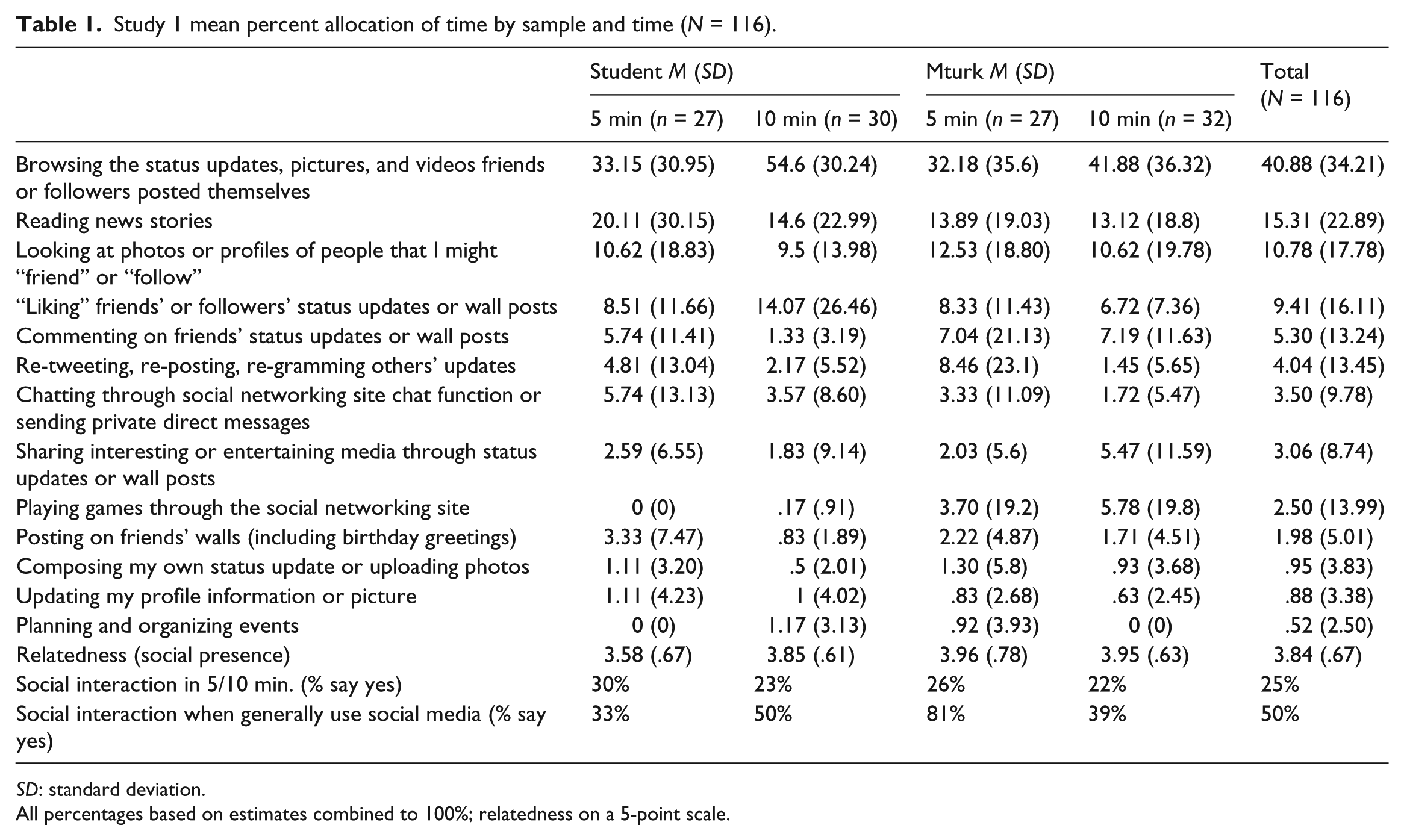
Participants could report any portion of time (0–100%) for each activity, provided the total added up to 100%. Activity proportions are reported in Table 1.
Study 1 mean percent allocation of time by sample and time (N = 116).
SD: standard deviation.
All percentages based on estimates combined to 100%; relatedness on a 5-point scale.
Social interaction
Participants responded yes/no to the question, “Given what you did in the last 5/10 minutes, would you say you socially interacted with another person during that time?”
General social media use
After completing this section, participants were then asked to apportion their time on social media typically using the same items and scale, and then asked the same question about social interaction based on their typical use of social media.
Study 1: results
In the 5- or 10-minute period, participants spent the most time browsing (40.88%) followed by reading news or other stories (15.31%), looking at the profiles of new possible contacts or friends (10.78%), and “liking” and “favoriting” others’ updates (9.41%). A multivariate analysis of variance tested whether participants from each sample (i.e. student/MTurk), at different times (i.e. 5/10 minutes), or using a different social media platform (i.e. Facebook/Twitter/Instagram) apportioned their time differently. Multivariate F test indicated that activity portion did not differ by sample, F(13, 89) = .51, p = .91. Responses differed by time spent on social media: participants assigned to the 10-minute condition browsed more, F(13, 89) = 4.55, p = .035, η2p = .044, and looked at profiles of potential new contacts less, F(13, 89) = 6.24, p = .014, η2p = .058. Portion of time spent on activities differed by platform, F(13, 89) = 2.13, p = .019. Participants who used Twitter spent more time re-tweeting, M = 16.33%, SD = 26.96, compared to participants re-posting in Facebook, M = 2.09, SD = 8.89, and Instagram, M = .00, F(13, 89) = 8.85, p < .001, η2p = .149. Participants who used Instagram spent more time looking at other users’ profiles and photos, M = 29.29%, SD = 33.22, compared to Twitter, M = 13.80%, SD = 16.63, and Facebook users, M = 9.01%, SD = 15.78, F(13, 89) = 3.41, p = .037, η2p = .063.
To explore the association between social presence and social media activity, ordinary least squares (OLS) regression examined whether the portion of time was associated with feelings of connection, controlling for participants’ age, sex, and race/ethnicity (White = 1, non-White = 0). The portion of time participants spent using the chat function was positively associated with feelings of relatedness, B = .016, standard error [SE] = .006, β = .22, t(97) = 2.49, p = .014, R2 Δ = .05, but no other activity was associated with relatedness.
A total of 75% of respondents did not believe they had socially interacted during the 5 or 10 minutes of social media use. Logistic regression determined whether portion of time was associated with reporting having had a social interaction. Participants who engaged in two activities were more likely to indicate they had interacted: chatting through social media, B = .117, SE = .035, WALD = 11.19, p < .001, β(Exp) = 1.13, and posting on others’ walls, B = .118, SE = .052, WALD = 5.13, p = .024, β(Exp) = 1.13, Cox and Snell R2 = .25.
Logistic regression was repeated using participants’ typical apportionment of time. Half of respondents believed they socially interacted when they typically used social media. Participants who typically engaged in three activities were more likely to believe they usually socially interacted on social media: chatting through social media, B = .047, SE = .025, WALD = 3.67, p = .045, β(Exp) = 1.05, posting on others’ walls, B = .066, SE = .032, WALD = 4.28, p = .038, β(Exp) = 1.07, and “liking” others’ photos or posts, B = .026, SE = .016, WALD = 2.81, p = .048, β(Exp) = 1.07. Users who typically engaged in more browsing, B = –.019, SE = .010, WALD = 3.56, p = .03, β(Exp) = .98, and looking at photos and profiles of other users, B = –.040, SE = .024, WALD = 2.77, p = .048, β(Exp) = .96, Cox and Snell R2 = .25, were less likely to indicate they usually socially interacted.
Study 1: discussion
Most social media time is spent browsing the newsfeed, which contains the broadcasts of others, in support of past research (Ancu, 2012; Tosun, 2012). When combining browsing with looking at the feed of other users, an activity particularly prevalent on Twitter, participants estimated that over 50% of social media time was spent passively consuming information others’ had shared. Notably, browsing took up an increasing portion of time as participants spent more time on social media (i.e. 10 compared to 5 minutes). More time on social media was not associated with a greater likelihood of having a social interaction. The more time participants spent browsing or looking at others’ profiles typically, the less likely they had socially interacted.
By contrast, some of the least time-consuming activities were associated with increased feelings of social presence and were perceived as social interaction. Chatting occupied less than 4% of the estimated time, but was the best predictor of relatedness and social interaction. Another form of direct communication—posting on others’ walls—was positively associated with social interaction in the short time and in general, supporting past research (Burke and Kraut, 2014; Smock et al., 2011). Although participants did not believe that time spent “liking” was associated with social interaction in a short time, “liking” was associated with perceptions of social interaction in general. Re-posting, re-tweeting, and re-gramming others’ updates were negatively associated with social interaction in general, suggesting that participants did not see redistribution as synonymous with social interaction.
Although Study 1 offers a micro-level assessment of social interaction in relation to social media use, it offers no comparison to other forms of social interaction. Another limitation of Study 1 was no definition of social interaction was provided to participants. Study 2 examines the degree to which the conceptual definition of social interaction allowed for social media use with friends, and re-addressed Study 1’s questions by examining how social media was used when mediated social interactions had occurred.
Study 2: methods
Data from Study 2 come from a study on friendship published elsewhere (Hall et al., 2011). Participants were 197 undergraduates offered course credit or extra credit for participation. Four students who dropped out prior to completion were not included in analyses. Participants were 51% male, and were on average 20.7 years old (SD = 2.10, range = 18–29). Participants were primarily White (89%), and 4% were African-American, 2% Asian, 1.5% Latino, and 3.5% mixed race.
Participants identified three same-sex friends (i.e. best, close, casual), and reported social interactions with these friends over 5 days using a paper-and-pencil event sampling diary. Consistent with past operational definitions (Duck, 1991; Wheeler and Nezlek, 1977), social interaction was defined as “an exchange or conversation with another person in which both people attended to one another and adjusted their behavior in response to one another.” Participants were asked to narratively record the interaction immediately after it occurred: “Describe in your own words, what was the purpose of this interaction? What topics were discussed? Was the overall interaction positive or negative?” These instructions encouraged a detailed description of interactions to aid in recall when completing the online portion of the study. At the end of each day, participants completed an online questionnaire about every social interaction they had had that day. Participants reported an average of 14.47 interactions with three friends during the 5-day period, SD = 5.92, range = 3–29 interactions, resulting in 2388 interactions. The online entries were cross-checked against written diaries to ensure the validity of the online responses. Participants interacted with best friends the most often, M = 6.37, SD = 3.39, followed by close friends, M = 4.62, SD = 2.44, and casual friends, M = 3.39, SD = 1.96.
On the online questionnaire, participants were given seven options for identifying how the interaction took place (i.e. FtF, phone-talk, phone-text, email, IM, social media, other). Participants were asked to “describe why you were interacting with your friend” on a 5-point scale (1 = NO!, 2 = No, 3 = Maybe, 4 = Yes, and 5 = YES!). For the present investigation, a three-item talk factor (i.e. We were there to talk to each other; We were checking in; We were catching up; α = .71) was used to compare interaction purpose by medium.
Study 2: results
In a one-perceiver many-targets design, participants evaluate two or more members of their social network. This design is best served by multilevel modeling, wherein characteristics of the focal person are treated as level-2 predictors, and characteristics of the interaction are level-1 outcomes. This controls for non-independence by nesting interactions by participant.
Participants reported social interactions occurring most often FtF (61.4%), followed by telephone calls (16.0%). Of the four media options, text messaging was most frequently used for social interaction (15.5%), followed by social media (3.5%), instant messaging (2.8%), and email (.8%). Controlling for participant sex, age, and race/ethnicity (White = 1, non-White = 0), results demonstrated that participants were more likely to interact FtF with best friends, B = .364, SE = .094, WALD = 14.95, p < .001, β(Exp) = 1.44, compared to close or casual friends. Participants were most likely to interact with casual friends via social media, B = .624, SE = .194, WALD = 10.36, p < .001, β(Exp) = 1.87, compared to best or close friends.
To determine how participants used social media when they indicated they had had a social interaction, written diary entries were consulted. Half of entries provided no specific details on how they used social media. For the remaining half, the first author coded the written narrative entries for type of use. A second independent coder recoded entries for three categories the first author had identified: exchanging private messages (62%), wall posts (27%), and uploading or commenting on photos (4%) (kappa = 1.00).
Controlling for participant sex, age, race/ethnicity, and type of friendship, results demonstrated that talking was the main purpose of FtF social interactions, B = .136, SE = .046, WALD = 8.75, p = .003, β(Exp) = 1.15, compared to other ways of interacting. By contrast, interacting through social media was unassociated with the purpose of talking, B = .129, SE = .092, WALD = 1.96, p = .161, β(Exp) = 1.13.
Study 2: discussion
When individuals were asked to record all social interactions with three friends over 5 days, most social interactions occurred FtF (61.4%), and very few occurred through social media (3.5%). Overall, the frequency with which various media were used resembled percentages reported elsewhere (e.g. van den Berg et al., 2012), yet this study shows a higher portion of social interactions taking place through texting (18.3%). A close examination of social interactions taking place on social media indicated that individuals mainly engaged in directed private messages (62%) or directed public messages, like wall posts (27%) and shared photos (4%). Finally, when the primary purpose of a social interaction with friends is talking, it was more likely to take place FtF. That is, when someone wanted to talk with a friend, they were more likely to do so FtF. When social interactions occurred via social media, they were often with causal, not close or best, friends.
Event sampling methodology requires participants to record every instance of an event meeting specific criteria. Study 2 may have minimized the recording of mediated social interactions because it relied upon participants to remember and write down interactions. More salient interactions may have been ones that took place FtF. With experience sampling methods (ESM), participants are contacted at random intervals throughout a day to find out what they are doing at that moment. Study 3 used ESM to examine how often social media is used at random moments in a day, and when the use of social media is considered social interaction.
Study 3: methods
Participants were 54 undergraduate students who were offered partial course credit and US$15 in exchange for completing the experience sampling study. Participants were 54% female and were 19.2 years old on average (SD = 2.10, range = 18–24). Participants were primarily White (87%), and 5% were Black, 4% Asian, 2% Latino, and 2% mixed race.
For five consecutive days, participants were text messaged at five random intervals of time to complete a short survey through their mobile device (n = 1322). The first question asked participants, “Have you had a social interaction with anyone in the last 10 minutes?” Social interaction was not defined for participants. If participants responded affirmatively, they were asked, “How were you interacting?” with four choices: FtF, telephone, text or chat, and social media. Participants were instructed before beginning the study that chat through social media (e.g. Facebook chat) would be considered chat, not social media use. After responding to this question, all participants were asked, “Have you used social media in the last 10 minutes?” The 10-minute span of time was used to be comparable to the phrasing of the social interaction question. The final question asked, “how close and connected do you feel to other people right now?” on a 7-point scale (1 = Not at all connected, 7 = Extremely connected).
Study 3: results
Participants indicated that they had socially interacted in the last 10 minutes 66% of the time they were contacted (n = 873). Social interactions took place FtF (74.6%), through text or chat (16.8%), via voice calls (6.5%), and through social media (2.1%). Participants indicated that they had used social media in the last 10 minutes 24.8% of the time (n = 321). Some participants who had socially interacted had also used social media in the last 10 minutes (27.5%). That is, participants socially interacted and used social media within the same 10-minute interval occasionally, but rarely engaged in mediated social interaction. Using multilevel modeling to account for sample non-independence, feelings of relatedness were predicted by social media use and social interaction occurrence. When participants reported they had socially interacted in the last 10 minutes, they reported increased relatedness, B = .854, SE = .080, t = 10.64, p < .001. Social media use did not explain variance in relatedness, B = –.123, SE = .086, t = −1.43, p = .15.
Study 3: discussion
Similar to the results of Study 2, Study 3 indicated that social media use was rarely considered social interaction. Individuals believed they socially interacted through social media in only 2.1% of their total social interactions. Furthermore, ESM demonstrated that individuals used social media quite frequently, sometimes in the same 10 minutes that they socially interacted, but did not consider their social media use to be social interaction. Although social media use was unassociated with feelings of relatedness, social interaction was positively associated with relatedness.
General discussion
This multi-study investigation demonstrates that social media use is not equivalent to social interaction. When using social media for a short period of time (i.e. 5/10 minutes), 75% of participants indicated they did not socially interact (Study 1). When asked to document all social interactions with one best, one close, and one casual friend over the course of 5 days, 96.5% of social interactions took place in some way besides social media (Study 2). When individuals were surveyed at random times over the span of 5 days, they were found using social media about 25% of the time, but 98% of all social interactions took place in some other way than via social media. Whether given a conceptual definition (Study 2) or allowed to use their own definition of social interaction (Studies 1 and 3), individuals believed that the vast majority of social interactions occurred in some other way than through social media.
When social interactions took place through social media, participants were typically chatting or posting on each other’s walls. Although chatting occupies a small portion of time on social media (3.5% in Study 1), it is the strongest predictor of feelings of relatedness and the perception that a social interaction had taken place. When participants reported they had used social media to interact with one of three friends (Study 2), they were most often using a chat program (62%). Text-based chat not only meets the conceptual definition of social interaction, it is a critical route toward digital intimacy (Marwick, 2012), affinity seeking (Grebe and Hall, 2013), and relationship maintenance (Hall and Baym, 2012). For young adults, chatting is an increasingly common way to connect through mobile devices and social media (i.e. 15–16% of all social interactions in Studies 2 and 3). Therefore, chat and SMS are clear examples of mediated social interactions. Furthermore, directed social media use was believed to be a form of social interaction. Posting on friends’ walls was associated with having socially interacted during the short time period and in general (Study 1) and 27% of mediated social interactions with friends were through wall posts (Study 2), which supports past research linking these activities with social interaction (Bryant and Marmo, 2012; McAndrew and Jeong, 2012; Smock et al., 2011).
Very few other social media activities contributed to the perception that one had socially interacted. Routine impersonal interactions, such as re-posting, re-tweeting, and re-gramming others’ updates decreased perceptions of having had a social interaction, and sharing media or news stories was not considered social interaction either (Study 1). Unfocused interaction, such as the Facebook “like,” was not associated with social interaction or feelings of relatedness, which suggests it is not a relationally consequential action (Burke and Kraut, 2014). Browsing was a common behavior, increasing as participants spent more time on social media, yet increased time browsing others’ updates, profiles, or photos was associated with decreased perceptions of social interaction in general (Study 1). Findings confirm that broadcasting should not be confused with self-disclosure, relational development, or social interaction (McEwan, 2013).
Directions for future research
The present investigation offers empirical and theoretical guidance for study of mediated social interaction. Future work should seriously consider whether common social media use measures, whether frequency counts or Likert-type scales are meaningful or valid. Whenever possible, researchers should avoid grouping all forms of use together. It is simply inappropriate to ask users to count the number of “interactions” on social media. Social media use is only rarely considered social interaction at all, and should not be confused as such theoretically or operationally. Most social media use is akin to people watching and media consumption. This is not to say all future research should adopt an overly strict definition of social interaction. Rather, researchers should carefully align the conceptual and operational definitions of social interaction when investigating social media use, particularly when they plan to compare it with synchronous social interaction. For new media researchers, Figure 1 draws from the theoretical tradition of social interaction research, and offers empirically supported categories of mediated and non-mediated behaviors. For researchers interested in social interaction, rather than excluding all mediated social interaction from consideration (e.g. Moskowitz and Sadikaj, 2013), study designs should consider which mediated social interactions to include when using ESM or event sampling.
Although there appears to be a growing awareness that social media use is an assembly of tools (Smock et al., 2011) or affordances (Larsson, 2015), the present investigation suggests that research is missing an opportunity to study what people are commonly doing with social media. Broadcasting and browsing are common and necessary components for social media to function (Trottier, 2012), but these are not only loose approximations of social interactions (Brabham, 2015), they are not considered social interaction whatsoever by users themselves. Studies that wish to compare social surveillance to the same in-person behavior should seek more analogous comparisons. A more apt comparison to mediated social surveillance in offline-contexts would include people watching and routine public verbal and nonverbal greetings. Although seeking information about another person with little risk of detection may be a unique capability of social media (Marwick, 2012), people watching, both virtual and in person, is an extension of social tendencies of keeping tabs on others (McAndrew and Jeong, 2012), which is a central part of everyday public life (Marwick, 2012). Comparisons between online and offline behaviors should be as equivalent as possible to increase the insight of future research on broadcasting and browsing.
The present investigation gives credence to the argument that social interaction is more likely to take place with relational intimates for the purpose of conversation (Duck, 1991; Goffman, 1963). Best friends were more likely to engage in FtF conversations compared to close or causal friends, and casual friends were more likely to interact through social media compared to close or best friends (Study 2). When friends got together to interact FtF, it was often to talk for its own sake (Study 2). All social interactions were associated with feelings of relatedness, but general social media use was unassociated with feelings of relatedness (Study 3). Unfocused interactions, such as happy birthday messages, may be an example of relational maintenance (Bryant and Marmo, 2012), but were unassociated with feelings of having had a social interaction (Study 1). As predicted, the less personal, one-on-one, and relationship-specific the activities conducted on social media, and the more undifferentiated and passive consumption of content that takes place, the less likely social interaction was perceived to have occurred.
These conclusions are not meant to blindly prioritize FtF social interaction over mediated social interaction, or social interaction in general over social media use. Social interactions contribute to feelings of relatedness and help in developing closeness, no matter the medium. The more important question to guide future research is, what is the theoretical basis for social media’s influence interpersonal, social, and emotional outcomes? For example, one long-standing and important question for media and interpersonal scholars alike is whether social media use has negative socio-emotional consequences. Without parsing social media use from social interaction, it might seem that mediated social interactions are of less value or have detrimental consequences, like loneliness or belongingness (e.g. Ahn and Shin, 2013; Kross et al., 2013). Yet, social interactions very rarely take place through social media, and use, in itself, appears to have little to no influence on socio-emotional outcomes. Without a more careful theoretical foundation for explaining why social media affects users, research risks comparing behaviors that are simply not equivalent. Passively browsing information on Facebook is simply not comparable to having a conversation, theoretically or from the perspective of users themselves. Social interactions have long been considered relationally consequential actions (Duck, 1991), co-constructed by mutually dependent engaged in collaborative meaning-making (Collins, 2004). It is consistent with this perspective that socially derived outcomes, such as belongingness, inclusion, and loneliness, are both cause and consequence of social interaction, whether mediated or not. New media research should move beyond the exploration of general social media use toward a more careful affordance-based approach, grounded in theory, to better understand the relational consequences of social media.
Footnotes
Funding
The author(s) disclosed receipt of the following financial support for the research, authorship, and/or publication of this article: A portion of this research was supported by University of Kansas intramural funding GRF#2301064.