







Abstract
Scholars have long been interested in how social media platforms shape user communication and behavior. We add to this literature by critically analyzing the TikTok platform. We argue that the principles of mimesis—imitation and replication—are encouraged by the platform’s logic and design and can be observed in the (1) user sign-up process and default page, (2) icons and video-editing features, and (3) user and video creation norms. These memetic features alter modes of sociality, contributing to what we theorize as imitation publics on TikTok. This analysis extends the meme’s theoretical and methodological utility by conceptualizing the TikTok platform as a memetic text in and of itself and illustrates a novel type of networked public.
“I’m a savage (yeah). Classy, bougie, ratchet (yeah). Sassy, moody, nasty (hey, hey, yeah). Acting stupid, what’s happening? What’s happening? I’m a savage” (Megan Thee Stallion, 2020). Odds are, you are familiar with this song. You likely sang the tune and visualized the associated dance as you read the lyrics. If so, you have the social media platform TikTok to thank. Launched in China as Douyin in 2016 and internationally as TikTok in 2017, TikTok has rapidly become one of the most widely used social media platforms in the world and the subject of much conversation. TikTok became accessible in the United States in 2018 after the company merged with Musical.ly, another lip-syncing application. Currently, TikTok is the seventh most-used platform of the 2010s, boasting 100 million monthly active US users and 800 million monthly active world-wide users (Iqbal, 2020; Sherman, 2020). However, TikTok is not without controversy. TikTok was briefly banned in India for problematic content (e.g. pornography, predatory behavior; Iqbal, 2020), then permanently banned after a clash with the Chinese government (Petersen, 2020). Scholars have identified hate speech on the platform (Weimann and Masri, 2020). In 2019, the United States launched a national security investigation into TikTok, citing concern over if and how the Chinese company was collecting and using US data, censoring content, and spreading misinformation (Roumeliotis et al., 2019). And, at the time of this writing, President Donald Trump has announced plans to ban TikTok in the United States unless ByteDance, the parent company, sells off TikTok’s US portion (BBC, 2020b). Despite these controversies, TikTok’s cultural impact is undeniable.
TikTok is unlike any other social media platform. Described as a “lip-syncing” application (Perez, 2020: para. 3), the platform is most similar to the now-defunct Vine, where users act out scenes from their favorite television show, movie, or cultural moment (e.g. impersonating Kourtney Kardashian saying “Working is just not my top priority”). Unlike Vine, TikTok allows videos up to 60 seconds (compared to 6 seconds), enables video editing to occur within the site, provides hundreds of sounds and effects to aid in video creation, and prompts users to engage content, not creators or friends. Although TikTok does enable users to create profiles, follow friends, and send direct messages, interpersonal connections are downplayed on the platform. Creative interaction is also prioritized over discursive interaction. Thus, while TikTok has some markers of the standard and more popular social media platforms, such as Facebook, Instagram, and Twitter (e.g. profiles, friend lists, shareable posts, network formation; see boyd, 2011; Papacharissi, 2014), its emphasis on video creation uniquely affects how sociality unfolds and networks develop on the platform.
TikTok’s distinctive technical structure and unparalleled user adoption provide a warrant to theorize if and how the platform redefines the nature of online networks. To do so, this study adopts a grounded theory approach and follows the walkthrough method to critically analyze how TikTok’s digital structure influences communicative and interactive processes. Through this process, we observed that imitation and replication are digitally and socially encouraged by the TikTok platform, positioning mimesis as the basis of sociality on the site. We thus argue that TikTok extends the Internet meme to the level of platform infrastructure (see Shifman, 2013) and helps us theorize imitation publics on TikTok, wherein networks form through processes of imitation and replication, not interpersonal connections, expressions of sentiment, or lived experiences. Collectively, this analysis extends our understanding of networked publics (e.g. boyd, 2011; Bruns and Burgess, 2011, 2015; Jenkins et al., 2015; Papacharissi, 2014), contributes to the growing interest in memetics (e.g. Shifman, 2013; Tuters and Hagen, 2020; Wiggins, 2019), and is one of the first to critically analyze the social media platform TikTok, providing one explanation for TikTok’s rapid success.
Digital affordances and networked publics
The theorization of sociality and networked publics on TikTok necessarily requires the consideration of digital affordances and the relationship between technological objects and social/behavioral outcomes (boyd, 2011; Davis, 2020). Van Dijck (2013) explained that sociality, or the ability to be social online, is not simply “rendered technological” by moving to an online space (p. 20). Rather, communication and interaction are both enabled by and constrained to the coded structures of each mediated platform. That is, although social media platforms do not make people communicate or engage in specific ways, platform design can “request, demand, encourage, discourage, refuse, and allow particular lines of action and social dynamics” through including or excluding certain digital features (Davis, 2020: 11). For example, Twitter’s 280-character limit encourages discursive brevity whereas Facebook allows more detailed posts; Instagram requires visual communication in posts whereas Twitter allows posts that are just text.
Accordingly, scholars have long been interested in how digital technology affords the possibility of a networked public sphere (Benkler, 2006; Bruns and Burgess, 2011, 2015; Papacharissi, 2010, 2014; Zulli et al., 2020). boyd (2011) provided a foundational reference for understanding networked publics, suggesting that social networking sites (SNSs), such as Facebook and Twitter, are central mechanisms for articulating these networks online. Social media serve many of the same functions as offline networks, such as allowing people to gather for social, cultural, and political purposes, while also expanding interactive possibilities by connecting individuals who have similar interests and beliefs but who may be geographically dispersed (boyd, 2011; boyd and Ellison, 2007). In particular, boyd (2011) identified user profiles, friend lists, public commenting tools, and stream-based updates inherent to most social media sites as salient components to the construction of networked publics.
Adding to boyd’s (2011) research, scholars have sought to compare and contrast digital features across social media platforms to determine how they afford different modes of sociality. Papacharissi (2009) examined community development and user identity formation across Facebook, LinkedIn, and ASmallWorld. Van Dijck (2013) similarly assessed the similarities and differences of Facebook, Twitter, Flickr, YouTube, and Wikipedia to see how users adapted to each platform’s technological evolution. Research has also paid considerable attention to how specific digital features, like the hashtag, facilitate and mobilize publics. The hashtag was initially designed to filter discussions and contextualize conversations that occur in the online context (Bruns and Burgess, 2011). Importantly, scholars argue that the hashtag serves as a conduit for distributed individuals to locate, self-organize, and collectively contribute to the information streams on many SNSs resulting in issue and affective publics that converge around a topic or event, such as the #BlackLivesMatter and #MeToo movements (Bruns and Burgess, 2015; Bruns et al., 2016; Papacharissi, 2014; Segerberg and Bennett, 2011).
Although much is known about how SNSs enable and shape networked publics in conjunction with user practices, the rapid transformation of digital technology and the creation of entirely new SNSs necessitate that scholars reexamine the nature of these publics—the technology that enables/constrains them and the form they now take. Thus, we offer TikTok as an illustrative example of how techno-social configurations continue to influence sociality in new and impactful ways.
TikTok
TikTok is currently one of the most influential and widely used social media platforms in the world (Iqbal, 2020). TikTok is available in 154 countries and 39 languages. TikTok was the second most popular free application download in 2019, with its usage only increasing in 2020; TikTok was downloaded 113 million times in February 2020 alone and has surpassed the engagement rate of Instagram and Twitter (Marketing Hub, 2020). Although TikTok enjoys a wide user demographic, the platform is the most popular among women aged 18–24. Indeed, at the time of this writing, the two most followed TikTok users are Addison Rae, a 20-year-old female with 71.7 million followers, and Charli D’Amelio, a 16-year-old female with 103.2 million followers.
Scholarship on TikTok is still in its infancy. Through a critical analysis of TikTok’s media coverage, Kennedy (2020) suggested that the platform can be read as a celebration of girlhood. Zhang (2020) argued that TikTok should be perceived as a video encyclopedia, similar to Wikipedia, where anyone can contribute to content creation but a centralized service provider and algorithm still control the flow of information on the site. Through a content analysis of TikTok accounts run by Chinese provincial health committees, Zhu et al. (2019) found that the platform functions as an important but underused method for disseminating health content. Finally, Weimann and Masri (2020) exposed TikTok’s darker side by content analyzing posts from far-right extremist groups. We add to this literature by considering how TikTok’s digital structure influences user behavior and shapes networked publics.
Method
We frame our analysis and discussion of TikTok using a grounded theory approach and the walkthrough method. Grounded theory is an inductive qualitative research approach aimed at theory development (Glaser and Strauss, 1967). Grounded theory works from the perspective that knowledge emerges from symbolic interactions (such as the dynamic relationship between SNS design and user behavior) and contextually bound truths. Theoretical insights are inductively driven by the empirical data collected for analysis rather than deductively applied to and tested through data. Grounded theory thus blurs the lines between “generating theory and doing social research [as] two parts of the same process” (Glaser, 1987: 2).
We followed the walkthrough method to systematically examine and theorize how the TikTok platform shapes user behavior and networked publics. The walkthrough method combines critical technology and cultural studies and involves “engaging with an app’s interface to examine its technological mechanisms and embedded cultural references to understand how it guides users and shapes experiences” (Light et al., 2018: 882). This approach recognizes that technical systems implicitly and sometimes explicitly configure content production and consumption in specific ways (Davis, 2020). Although users often adapt or extend the features of social media to fit their needs, they are still directed toward certain types of engagement depending on a platform’s interface design, layout, features, and overall flow.
The walkthrough method involves three general stages: registration and entry, everyday use, and suspension, closure, and leaving (Light et al., 2018). Consistent with this method, we worked through TikTok’s sign-up process and explored TikTok’s interface and design, paying particular attention to page layouts, features, and video creation options. Because TikTok algorithmically filters content based on user patterns (see Marr, 2018), the two authors created different profiles to engage this walkthrough process. The second author created a TikTok account in January 2020 and became a “regular user” of the site to experience the video-editing process and content tailoring based on active participation. The first author created an account in June 2020 and avoided specific platform engagement (to the best of her ability) to observe the general platform design, user and platform patterns, and activity flows. For example, when prompted to select content genres as part of the sign-up process, the second author identified specific genres to receive tailored videos; the first author selected all the genres to receive the broadest selection of videos. The second author liked, commented, and shared videos to activate personalization; the first author did not engage in any of those activities during the analysis period. Observations of TikTok’s everyday use primarily occurred between 29 June and 10 August 2020, and took the form of noting (1) the content being posted to the platform, including which video types or styles appeared to be common, if any (2) how users interacted and communicated on the site, (3) if and how networks were formed on TikTok, and (4) how the algorithms filtered content based on different engagement patterns (Light et al., 2018).
TikTok as a memetic text
The goal of this project was to assess if and how TikTok’s design influences user behavior and public formation. Through this walkthrough analysis, we observed that imitation and replication—the driving forces of mimesis—are latent in TikTok’s platform design. Accordingly, we argue that TikTok can be read as a mimetic text in and of itself, extending Shifman’s (2012, 2013) Internet meme to the level of platform infrastructure. To provide a theoretical foundation for our analysis, we briefly review the meme concept.
Richard Dawkins introduced the meme in his 1976 publication The Selfish Gene. Signifying “that which is imitated” and likened to biological evolution, Dawkins (1976) conceptualized cultural memes as units of information—music, ideas, catchphrases, fashions, slogans, religions, and so on—that are stored in the brain, transmitted from human to human, and passed down from one generation to another, contributing to the creation and propagation of cultural phenomenon. Shifman (2012, 2013) extended Dawkins’ (1976) cultural meme to include the digital context, noting that theorizing memes as an Internet phenomenon is both appropriate and useful. The Internet distinctively facilitates the spread and scale of social and cultural content as images, videos, jokes, trends, and movements can gain unparalleled cultural significance in a matter of minutes online (e.g. #BlackLivesMatter, YouTube videos; Shifman, 2012). Digital technology also better enables researchers to track the spread of memes through network analyses and timestamps on posts, which addresses, in part, a chief criticism that memes are an ill-defined unit of analysis (see Heylighen and Chielens, 2009; Johnson, 2007). For Shifman (2013), then, memes and digital culture are a “match made in heaven” (p. 365).
Internet memes are defined as “units of popular culture that are circulated, imitated, and transformed by individual Internet users, creating a shared cultural experience” and as “groups of content items that were created with an awareness of each other and share common characteristics” (Shifman, 2013: 367). With this definition, Shifman usefully provides some concreteness to the meme—what the meme is and how it survives online (e.g. repacking, remixing, mimicking). Importantly, and perhaps inadvertently, Shifman is also suggesting that memetic processes, defined as the “the mechanisms by which memes propagate” (Yoon, 2008: 903), can support online networks, a point substantiated by other scholars as well (Tuters and Hagen, 2020). Indeed, publics can further constitute themselves as a collective when they (1) identify noteworthy content items and (2) participate in their transmission through imitation (e.g. creating an iteration) or circulation (e.g. spreading the content item through likes and shares). Moreover, because many memes in the vernacular sense (e.g. images with overlaying text) function enthymematically where individuals fill in the meaning based on shared knowledge or beliefs (see Wiggins, 2019), memes require users to be culturally, socially, and politically in the know, which situates publics as an important contributor to mimesis (e.g. a group of people must understand the joke for it to be humorous and spreadable).
With this baseline discussion in mind, we now turn our attention to how imitation and replication were observed in TikTok’s digital structure, thus influencing user behavior and initiating what we theorize as imitation publics. In particular, TikTok’s sign-up process and default page, icons and features, and user/video norms all illustrate how imitation and replication can be encouraged at the platform level. With this analysis, we flip the focus from how specific texts become memes through imitation and replication (e.g. YouTube videos, Shifman, 2013) and how subcultures enthymematically use memes as argumentative tools (e.g. political memes; Tuters and Hagen, 2020; Wiggins, 2019), and instead, interrogate the digital mechanisms and processes that uniquely engender mimetic behavior.
TikTok sign-up process and default page
TikTok’s set-up process and default page prompt users to engage with content conducive for imitation and for the purpose of imitation. As users join TikTok, they are first directed to indicate their topical interests to receive “personalized video recommendations” from TikTok’s complex machine learning and artificial intelligence algorithm (see Marr, 2018). A few examples of the content areas that are suggested include animals, comedy, travel, food, sports, beauty and style, and art. This initial query sets the technological stage for users to encounter video content they find particularly appealing, and presumably, more replicable. After selecting content genres, users are directed toward TikTok’s default page with no further prompts to set up a profile. User profiles are included on TikTok; however, they are not a dominant feature nor are they particularly informative. Users only have 80 characters to construct a discursive identity on TikTok and that information is only accessible insofar as users are motivated to click on a profile after viewing a video. Moreover, we observed that many users merely linked their other social media accounts in their bios (e.g. Instagram, YouTube) rather than note actual identity markers, such as age, relationship status, or profession, presumably to extend any social capital they garner on TikTok to other online platforms (e.g. spreadability of content; Shifman, 2013).
Particularly noteworthy is that TikTok’s sign-up process and default page do not instruct users to follow friends or transfer their offline publics to the platform. In fact, following any particular person for interpersonal connection is structurally downplayed on TikTok altogether, which is a sharp departure from how other popular SNSs facilitate networked publics (see boyd, 2011). For example, the default pages on Facebook and Twitter feature the content posted by users’ selected “friends.” When users log into Instagram, they are initially shown images and stories from people they follow. Facebook, Twitter, and Instagram also actively recommend additional connections based on the makeup of users’ online network (i.e. friends of friends). Comparatively, on TikTok, the default page is titled “For You” and features videos that have been algorithmically curated to correspond with each user’s interests and engagement habits, not videos posted by friends. Through liking, commenting, and sharing videos, in addition to the sign-up prompt where users select preferred content genres, TikTok begins to filter and promote content tailored to user engagement (Marr, 2018). Users can certainly follow their friends on TikTok, and many do, but viewing that content requires additional navigation through the platform.
At this foundational level, we observed that user sociality and engagement on TikTok are initially structured around memetic processes, rather than interpersonal connections, which necessarily begins with “memetic selection through content selection bias” (Yoon, 2008: 904). According to Shifman (2013), the selection of content genres or items in the digital era is “increasingly becoming a visible part of the [memetic] process itself” (p. 365), which TikTok’s sign-up process and content filtering algorithms explicitly facilitate. By being prompted to select content genres as the basis for platform participation, and then receiving tailored video content based on engagement patterns, users are more likely to encounter content they find appealing, which can spur mimesis, either sharing or remixing a video. Moreover, by not suggesting that users follow friends or readily showing content from a user’s connections, networks on TikTok are initially being configured at the content genre rather than interpersonal level.
TikTok icons and features
TikTok’s icons and video-editing features also demonstrate how platform design can promote an ethos of memetic transmission (see Figure 1). First, on the right side of the “For You” screen are the follow, like, comment, and share icons common on most SNSs. However, we observed during our analysis that if users watched or engaged with a video multiple times, indicating that some element of the video—content, music, effects—resonated with them, the share icon transformed from a white arrow into a green message button prompting users to share the video. By changing the share icon’s color and form, the user’s attention is immediately drawn to the possibility of distributing the video. And, options to share videos are plentiful. TikTok includes options to send videos through text, direct message, and email, in addition to sharing directly to Snapchat, Instagram, Twitter, Facebook, and WhatsApp. Through this sharing feature, TikTok videos can be transmitted much farther much faster (e.g. content transmission, Dawkins, 1976).
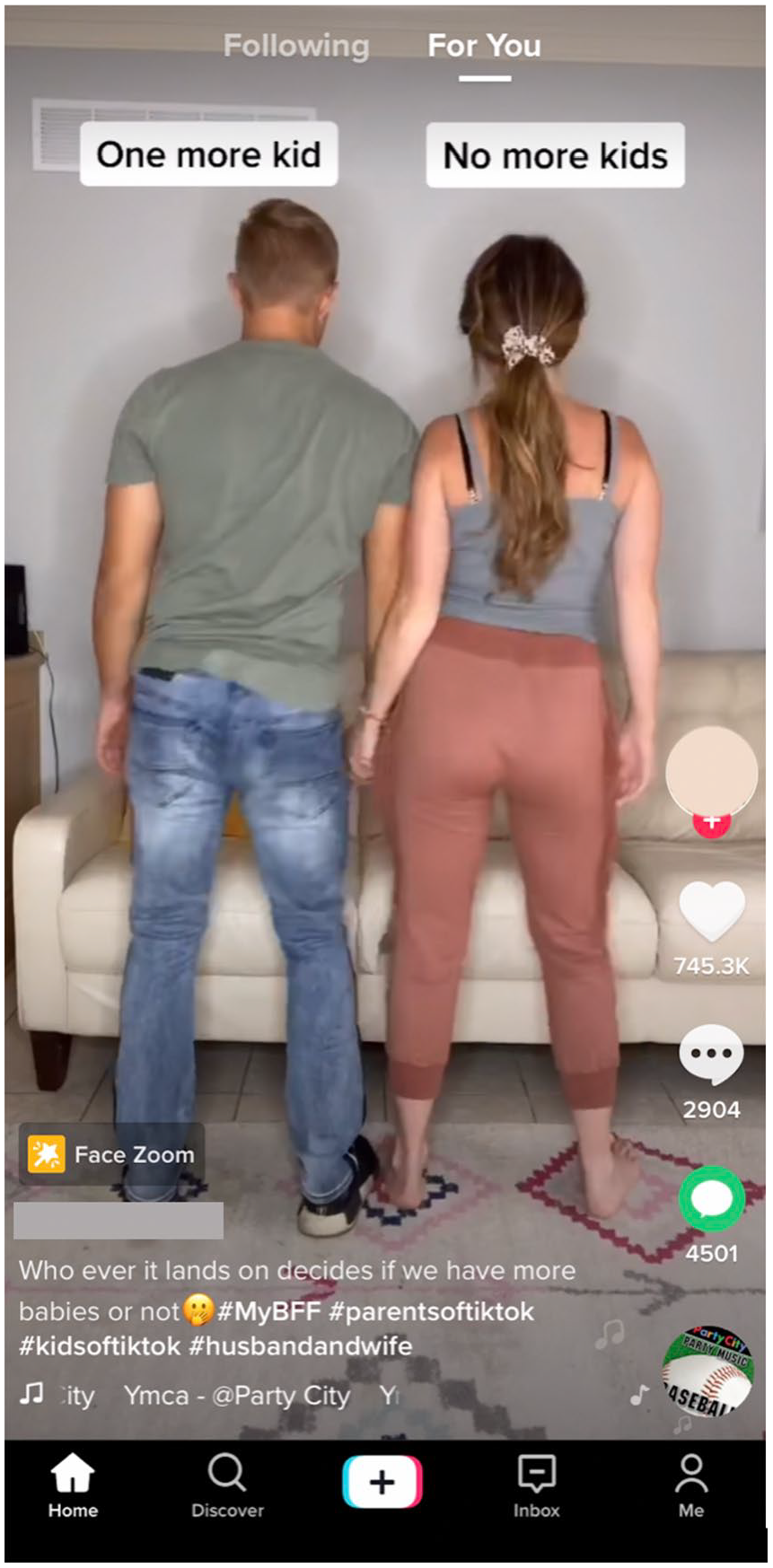
Example of TikTok’s “For You” page.
Another TikTok icon that encourages uses to engage in imitation and replication is the “sound” icon. Sounds are incorporated with every TikTok video and can include songs, words from a movie/television show, political/cultural moment, or an original sound created by the user. These sounds are highlighted in two ways on the “For You” page: a rotating record-player icon with musical notes cascading up the right side of the screen and the sound’s name rolling across the bottom of the screen. The sound icons are the only moving icons on TikTok videos and they similarly draw users’ attention to this feature. By clicking on either of the two sound icons, users are taken to a page that houses every video made with that sound. That is, engaging the sound icon connects users to a network of people who have identified with and replicated the sound in their videos. A pulsing suggestion to “Use This Sound” is also located at the bottom of the screen. If a user adopts a sound, their video will automatically be included in the sound collection. In this way, TikTok’s digital structure facilitates “groupings of content items” (Shifman, 2013: 367) that are similar in sound but different in terms of uses and iterations, or, put another way, video mutations (Dawkins, 1976). TikTok promotes sound imitation by digitally suggesting that users contribute to a sound grouping. And, by promoting videos with the same sound by engagement or popularity, TikTok extends memetic “competition” (see Dawkins, 1976; Hofstadter, 1983) to the platform level. Users are likely to click on the first video in a content grouping, which simultaneously boosts the video’s view count and further promotes its imitation and replication by other users.
Video “effects” on TikTok also position imitation as the basis for participation and sociality on the platform. A main feature, and thus the appeal of TikTok, is that video editing occurs within the site. Indeed, TikTok has hundreds of video effects (e.g. green screen, sparkle, hair tint, nose-painting, face-stretch) that aid users in video creation. However, none of the effects are labeled on the application. Effects are loosely categorized under the headings “Trending,” “New,” “Green Screen,” “Interactive,” “Editing,” “Beauty,” “Funny,” “World,” and “Animal,” but TikTok provides no detail as to what each effect entails and there are dozens of effects within each category. Users thus have two options for determining the scope of an effect: click on different ones to ascertain their properties or copy an effect that another user has applied to their videos where they are labeled, which is the more efficient route to take. Much like how TikTok notes sounds, the platform also names the effects if they are used in a video. If a user finds an effect appealing after viewing a video, they can save the effect as a “favorite” for future use (same with sounds). Effects thus become popular or trending as users replicate the effects, promoting their use even more. Linking effects to specific videos rather than labeling them in the effects library also positions video engagement as the basis for video creation. By watching videos, users are provided with a template for how an effect should or could be used, which incidentally promotes imitative behaviors; copying a video that used an effect because the video showed the user how an effect can be used.
TikTok’s sharing, sounds, and effects features illustrate how mimesis can be encouraged at the platform level. Memes must be transmitted for them to gain cultural significance (Dawkins, 1976; Shifman, 2013). TikTok provides a plethora of sharing options and noticeably prompts users to disseminate content by changing the share icon’s color and shape. The many sharing options extend the reach of TikTok videos, contributing to unparalleled video/cultural dissemination. In addition, video creation on TikTok is geared toward imitation and replication as both sounds and effects are (1) included with and explicitly named on videos, (2) automatically linked on the platform, which contributes to the content groupings necessary for cultural phenomenon to become memes, and are thus, (3) an influential means through which users develop their videos, encouraging imitative behaviors.
Users and video creation norms
Through its digital structure (i.e. sign-up process, default page, video-editing features), we observed that TikTok promotes user behavior and video creation in accordance to the principles of mimesis. In particular, mimesis can be observed in the logic behind video creation and the content of videos. First, users presumably create TikTok videos to gain visibility (among other reasons) and can do so through one of two means. On one hand, it appeared to be particularly advantageous for users to merely remix popular videos rather than create their own, as evident by the saturation of similar videos on TikTok. Because TikTok links sounds and effects on the platform, copying similar features and video concepts automatically puts users in conversation with those who have obtained widespread attention. Thus, there is a greater chance for an average user’s video to be found, liked, and then shared if the sounds and effects are replicated from and linked to an already popular video. On the other hand, there is still value in creating original video content if it starts a series of imitation and replication. If one develops an imitable dance to a catchy song, there is a good chance that it will eventually grab the attention of someone who has a large TikTok following (e.g. Charli D’Amelio, Addison Rae). In that situation, we observed that influencers often gave credit to the originator of a sound or dance, which, for lay users, can boost their follower count, engagement rate, and encourage others to replicate the content (e.g. a series of imitations). Accordingly, we observed that the logic of video creation on TikTok is both based in and geared toward the memetic process.
The most common TikTok videos that were observed also illustrated mimesis at work. On any given day, we observed users replicating the same type of video or similar video concepts using a sound or effect over and over again. These videos primarily took the form of “challenge” videos, whether that be dancing or “check” videos where users described and projected identities in a roll-call fashion (e.g. “Texas check,” where users perform their Texas identity as a means of competition and acknowledgment; see Moore and Haasch, 2020). Also common were duet or chain videos, where people reacted or added to other users’ TikTok videos, and experience videos, where users described similar experiences applying the same sound. These videos illustrate physical imitation—copying dance moves— reactive imitation—capitalizing and expanding on someone else’s video—and narrative imitation—describing the same type of experiences. There are two likely explanations for the popularity of these challenge videos, both of which are based in memetic logic. First, many of the most followed TikTok users, such as Charli D’Amelio, Addison Rae, and celebrities, start or participate in these challenges, effectively establishing their significance on TikTok and in mainstream culture (e.g. TikTokers being featured on television shows; Gemmill, 2020). These videos receive a great amount of visibility, which increases the likelihood that average TikTok users will see them and want to replicate the content.
A second explanation for the prevalence of challenge TikTok videos is “liveness,” defined as the “live transmission” that “guarantees a potential connection to our shared social realities as they are happening” (Couldry, 2003: 7). Most social media code into their infrastructure opportunities for “live” engagement (Zulli, 2020). TikTok actualizes liveness by housing editing capabilities within the platform, making video creation user-friendly and relatively “immediate.” Because users can always post and access content, digital liveness generates a sense of “unpredictable flow and potential eventfulness” (Lupinacci, 2020: 2) as if something could always be happening. Liveness also represents the perception that through social media “we achieve a shared attention to the realities that matter to us as a society” (Deller, 2011: 223). In the context of TikTok, challenge participation is likely predicated on a desire to be relevant during “live” cultural moments as “everyone” is doing them. Through challenge imitation and replication, users can announce “here I am” to the TikTok world, simultaneously propelling the trend and marking their place in a socio-cultural moment. Due to liveness and the fear of missing out, in addition to their imitable nature (e.g. users do not have to be too creative to copy dance moves), challenge videos on TikTok can perhaps be considered the more “fit” memes that exist on the platform (see Aunger, 2001).
Imitation publics
The above analysis illustrates how a social media platform can be read as a memetic text—one that encourages imitation and replication at the platform level. Although interpersonal connections are downplayed, users still interact with each other as they view and share content, replicate TikTok challenges, and create duet videos with strangers. Accordingly, TikTok helps us conceptualize imitation publics, which we broadly define as a collection of people whose digital connectivity is constituted through the shared ritual of content imitation and replication.
Imitation publics on TikTok can form in two ways: through specific video imitation and replication or more general memetic engagement, both of which engender user connectivity and community. First, imitation publics can digitally form as users initiate the video creation process, which includes using sounds and effects promoted and linked on TikTok (i.e. moving icons, a pulsing suggestion to use a sound, only naming effects on videos). Such features prompt imitative behaviors as experiencing sounds and effects through videos provides a template for how these features could/should be used by subsequent creators. Importantly, when users replicate a sound or effect in their TikTok videos, they are automatically connected to other users who have done the same. Thus, it is the process of imitating sounds and effects, regardless of how these features are ultimately used within a video, that creates the shared experience through which publics are digitally and automatically constituted on TikTok (i.e. sound and effect collections).
Second, imitation publics can form through the more general memetic processes that TikTok encourages, such as selecting, liking, and spreading content (see Shifman, 2013). Due to TikTok’s sign-up process and personalization algorithm, such memetic behaviors contribute to video curation and content/user groupings, which TikTok users have begun to unofficially label on the platform. Such imitation publics include Straight TikTok (for mainstream users), Alt TikTok (for users looking for more edgy content; also termed Elite TikTok), Deep TikTok (described as “if deep-fried memes came to life,” see Lorenz, 2020: para. 20), and many more. These communities could be both content (e.g. topic or interest) or visually oriented (e.g. a certain aesthetic). We observed that users referred to themselves as “being on” a particular community in their videos and captions (e.g. “Being on Fashion TikTok check,” #LesbianTikTok), developing videos that aligned with and were imitable by that community. Importantly, we observed that offline identity did not always correspond to engagement with or participation on an imitation public (e.g. straight women identifying as “being on” “Lesbian TikTok”). TikTok users could be on more than one imitation public depending on which content, sounds, and effects they engaged. And, the scope of imitation publics could morph as users develop new content or interests (e.g. memetic mutation, see Dawkins, 1976; Hofstadter, 1983). In these ways, imitation publics on TikTok result from ongoing memetic processes related to selecting and spreading content.
This theorization of imitation publics on TikTok is similar to conceptualizations of networked publics (e.g. affective, issue; see Bruns and Burgess, 2011; Papacharissi, 2014; Segerberg and Bennett, 2011) and participatory cultures, both digital and non-digital (e.g. fan groups; Jenkins et al., 2015), in that they rely on a shared experience. However, due to TikTok’s memetic properties—the digital grouping of content and prompting users to select content genres as the basis for sociality—the energy that drives this collective experience is largely and initially processual, compared to interpersonal (e.g. public formation through disclosure or close ties), discursive (e.g. public formation through talk), affective (e.g. public formation through shared sentiment), or experiential (e.g. public formation through lived experiences). TikTok downplays interpersonal connectivity through the “For You” default page. Users do not need to discursively communicate or express sentiment to find themselves on a TikTok “community.” And, imitation publics are not necessarily issue-bound; they could merely reflect a certain aesthetic. This is not to say that imitation publics are devoid of larger narratives or affective ties, or that users cannot coalesce around interests, issues, or affective intensities on TikTok; we observed that users do share personal information and participate in socially oriented messaging through TikTok videos (e.g. videos where LGBTQ+ users share coming out stories). However, it was also common for the use of effects/songs or engagement with a content/visual genre to be the only thing that connected users as a result of TikTok’s digital features. Therefore, because videos are the main form of communication on TikTok, we argue that it is through the memetic processes inherent to engaging with and creating these videos—selecting interest areas, liking/sharing videos, bookmarking sounds and effects, creating video iterations, replicating challenges, extending videos through duets—that TikTok publics, and simultaneously, user identity vis-à-vis the replication of content/visuals/effects/sounds, begin to form.
Discussion
This analysis demonstrated how imitation and replication can be observed at the level of platform infrastructure, making the process of mimesis the basis of sociality. TikTok users are algorithmically, digitally, and socially encouraged to consume content conducive for imitation and for the purpose of imitation. Given this analysis, several points warrant discussion.
If we accept that TikTok promotes mimesis through its digital features, layout, and platform logic, then we must consider why this mode of communication has been pushed by the platform. The recent infrastructuralization of platforms lends insight into why and how mimesis might be a beneficial communicative and interactive strategy. Social media platforms, once characterized by small-scale connectivity, now reflect large-scale socio-political and economic infrastructures that have become indispensable to human life. Indeed, platforms like Facebook and Instagram have parlayed the ubiquity, ease, appeal, and critical use of their services “to gain footholds as the modern-day equivalents of the railroad, telephone, and electric utility monopolies” (Plantin et al., 2018: 306–307), now providing news and political services, facilitating commercial transactions, partnering with telecommunication companies, and so on. Because social media function as profit-driven eco-systems, platforms often “bind pre-defined communicative acts,” such as naming effects on videos, “to an economic logic,” recognizing that user engagement is first needed to secure economic capital (Plantin et al., 2018: 297). Importantly, and to this end, TikTok has also tied imitation and replication to user profitability. TikTok explicitly informs users of how many followers, videos, and video likes they need to qualify for their brand partnering service (see Figure 2). Such specificity encourages users to create content with the hopes that they too can profit from their videos. From this platformization perspective, mimesis is a particularly advantageous strategy for both the platform and users as imitation and replication engender content production and spreadability in unparalleled ways.
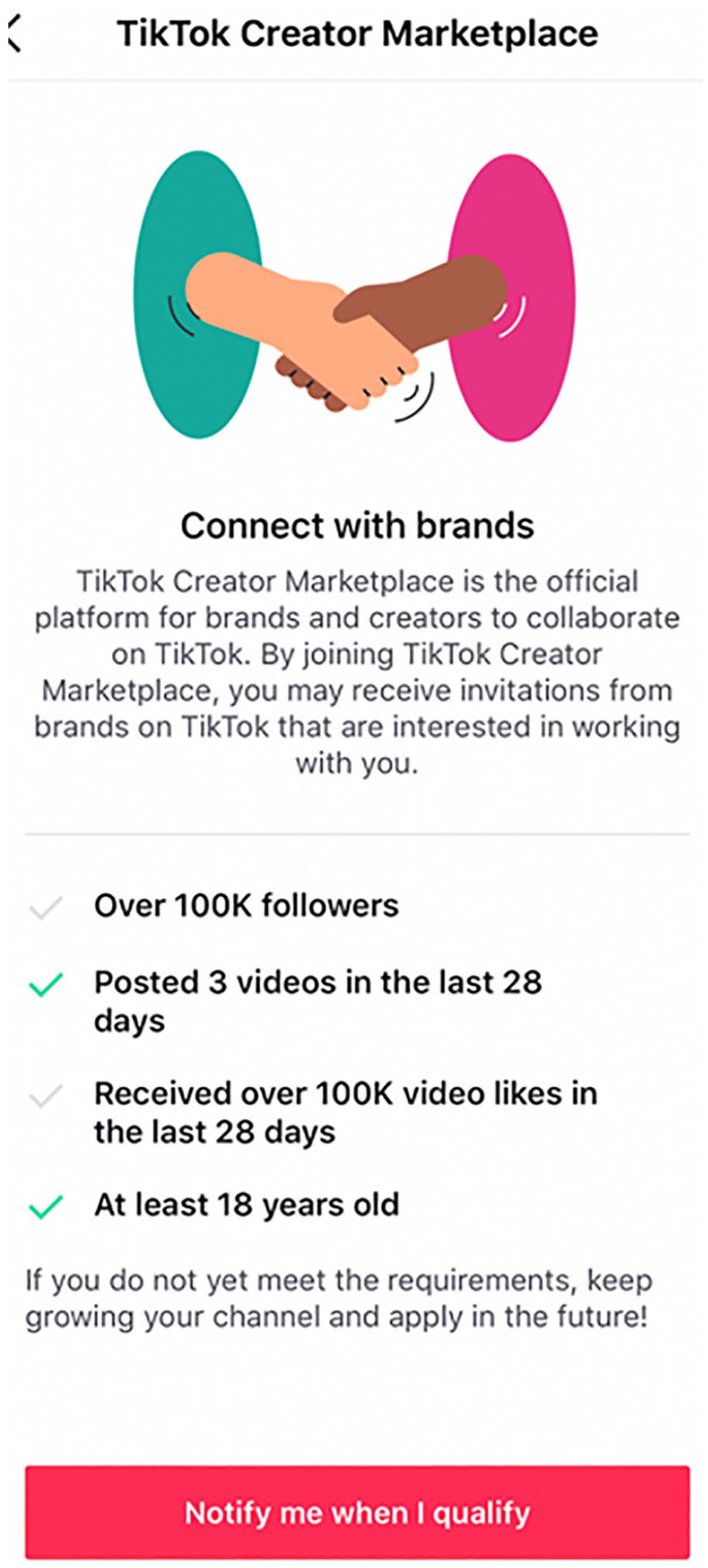
TikTok instructions for brand partnerships.
TikTok’s memetic properties have also made a significant impact on the music industry, further illustrating how platform design is embedded in and can influence socio-cultural norms/systems. Over the last 2 years, TikTok has staged the ground for obscure artists such as Lil Nas X, Doja Cat, and Megan Thee Stallion, among others, to achieve mass visibility and record-breaking hits (Leight, 2019). Because TikTok is an extension of Musical.ly, popular culture songs are an essential component of the platform and included in most videos, especially dance challenges. Hearing or reading the lyrics of certain songs now conjure up dance moves to the extent that artists are developing songs with TikTok challenges and imitation in mind (e.g. Justin Bieber’s “Yummy” was said to be written for TikTok; Thompson, 2020). Bridges and choruses of popular music are being shortened to accommodate TikTok’s 15- to 60-second video limits. Lyrics and tunes are being designed with corresponding movements with hopes that TikTok users will attach a song to a dance challenge. Although the digital context has always been conducive for grassroots artists, TikTok uniquely promotes artists through mimesis, and, in turn, artists are tailoring their songs to become more replicable.
There is also vast potential for other sectors, such as health, non-profit, or political, to capitalize on TikTok’s memetic properties (see Zhu et al., 2019). For example, during the COVID-19 pandemic, Vietnamese officials created a TikTok dance demonstrating the proper way to wash hands and engage in social distancing (BBC, 2020a). The dance launched a “challenge” where users imitated the hand-washing procedure, presumably for increased visibility, but incidentally promoting/spreading safe behaviors. During the 2020 US presidential election, TikTok users claimed to have dismantled attendance at President Donald Trump’s Tulsa, Oklahoma rally using the platform to falsely register for tickets (Lorenz et al., 2020). Due to imitation publics on TikTok, public service or activist messages through this platform could be much more persuasive than in other formats. Indeed, scholars examining Facebook use and social interaction have found that people who observe their social networks posting about political behaviors are more likely to engage in political activities offline so they too can share on social media (Bond et al., 2012). Follow this work, TikTok users may be more inclined to adopt behaviors or participate in civic activities if they are packaged as “challenges” or “checks” that they can replicate. If “liveness” does indeed drive some of the challenge participation on TikTok, then users will be looking for videos to imitate, regardless of the content, so they too can be relevant in whatever challenge is circulating on the platform (see Lupinacci, 2020). TikTok videos could thus be a novel format for health, public service, and political messages insofar as they draw on imitation and replication.
Beyond the strategic messaging implications of this analysis, theorizing TikTok as a memetic text has both theoretical and methodological value. Many meme theorizations focus on the specific texts that are remixed and circulated in digital and non-digital contexts (e.g. one video or image; Shifman, 2013; Tuters and Hagen, 2020; Wiggins, 2019). Consequently, even the Internet meme as a unit of analysis was still relatively murky.What can be a meme? How/when do we know if an artifact is a meme? To answers these questions, scholars typically needed to wait until after a text was widely circulated to categorize it as a meme. Positioning TikTok as a memetic text means that the videos produced on the platform or specific features like effects and sounds all have memetic potential, either by spurring imitation or being imitated, lending much more concreteness to the nature, form, and location of memes in the digital context (i.e. TikTok videos on TikTok). At the very least, memetic tracing becomes more efficient as TikTok marks the originator of sounds and categorizes video sounds and effects by their engagement metrics. Such TikTok metrics are particularly useful for determining when and how a meme began and its level of cultural significance.
Moreover, conceptualizing memetic networks based on how digital and non-digital subcultures circulate singular texts is limiting as it does not take into consideration how memetic processes in general, such as imitating effects or sounds but applying them to different content, in different ways, and for potentially different purposes, incidentally, and in TikTok’s case, digitally contributes to public formation. Previous theorizations of memetic networks positioned memes and memetic literacy as an enthymematic mode of speech used by publics or subcultures with shared values or ideologies; publics circulating a meme to collectively express dissent or further a political argument (e.g. graffiti during the World Wars, the triple parentheses meme on 4chan; Tuters and Hagen, 2020; Wiggins, 2019). Imitation publics on TikTok are much broader and start from the shared experience of engaging in mimesis, not necessarily from an enthymematic, argumentative, or ideologically laden position, although that is certainly possible.
This examination is an initial step in understanding the TikTok platform. We recognize our reading of TikTok as a memetic text as just that: one reading. TikTok’s design and user adoption are evolutionary, thus the continued examination of TikTok as a socio-cultural, economic, and political phenomenon is warranted. Given the nuanced, but subjective nature of walkthrough analyses, our understanding of TikTok would greatly benefit from more generalizable methodological approaches. Topically, future scholars should examine the specific content of and user motivations for creating TikTok videos (e.g. entertainment, artistic expression, political dissent). Scholars will do well to consider how imitation publics on TikTok are used for collective action and the types of imitative behaviors/videos deployed in service of social and political goals. Future research should also be probative of TikTok’s strategic messaging potential, assessing if/how imitation and replication are being adopted by politicians, news organizations, health and educational systems, commercial businesses, and to what effects. And, scholars should interrogate how users understand, interact with, or push back against TikTok’s machine learning and content sorting algorithm that can lead to users “being on” an imitation public. For now, this analysis usefully adds to the literature on mimesis and the processes driving networked publics, further illustrating how technology affects sociality.
Footnotes
Acknowledgements
The authors would like to thank Victoria Nonnon for sparking their interest in TikTok.
Authors’ Note
The authors agree to this submission, and this article is not currently being considered for publication by any other print or electronic journal.
Funding
The author(s) received no financial support for the research, authorship, and/or publication of this article.
