






Abstract
While a consumer revolution in virtual reality (VR) has piqued the interest of many fields, industries, and professions, it is unclear when, how, and to what degree the technology can elicit empathy. To better understand how the relationship between VR and empathy is communicated and defined, we performed qualitative and quantitative thematic analyses on popular (N = 640) and academic articles (N = 53) that included both terms. Findings revealed empathy is an aspirational term for journalists and researchers to showcase the potential of immersive media for prosocial change. Writers in both corpora suggested that empathetic experiences could lead to prosocial action through VR, but do not consistently define or measure empathy, given the inherent complexities surrounding the term. Drawing on seminal research in the field, we conclude with a definition of empathy related to immersive media.
Introduction
An article by the World Economic Forum, publicizing the formation of a “Global Futures Council” on virtual reality (VR) and augmented reality, states one reason for immersive media’s future success is that they can do the “impossible” through empathy (Lopez and Bailenson, 2019). To support this, the authors refer to the popular journalist/documentarian Chris Milk (2015), who called VR the “Ultimate Empathy Machine.” Milk argued people can take novel perspectives and empathize with those of dissimilar races, genders, or backgrounds.
This claim of VR’s potential exposes a persistent issue: when, how, and to what degree can it elicit empathy. Although recognized as one of the innovation’s most powerful outcomes, empathy has nuanced meanings. For some, it is “walking in another’s virtual shoes” (Archer and Finger, 2018). For others, it puts “the individual at the centre of every experience” while linking “virtual, physical and emotional realities” (Goodman, 2016). These assertions suggest that VR will enhance humanity, without necessarily providing evidence to confirm such claims.
The role of empathy in immersive technology and its impact on prosocial change is central to our study. Because there is a growing gap in how empathy is publicly represented, defined, and understood (Zaki, 2019), we examine definitions of empathy in relationship to VR from popular and academic presses. We analyze these outlets to better understand the efficacy of claims that VR can change beliefs and behaviors through empathy. The results suggest interconnected definitions of the term, which communicate the potential of immersive experiences to be used for prosocial action.
Attempts to define and measure empathy
Consistent with the hype that often accompanies the adoption of new technology, media makers have made bold claims about VR’s power to create experiences that increase empathy. However, empathy is a multifaceted term derived from decades of psychological research (Zaki, 2019). For example, early theorists (Kohler, 1929; Mead, 1934) deemed cognitive empathy as the process of understanding another person’s perspective. Affective or emotional empathy (Eisenberg and Miller, 1987; Hoffman, 1984; Mehrabian and Epstein, 1972) describes an observer’s emotional response to the affective state of others (Davis, 1983). More recently, empathy is approached as a cognitive and affective construct. Goleman (2008) suggests “compassionate empathy” allows individuals to “not only understand a person’s predicament and feel with them, but are spontaneously moved to help, if needed.” This perspective echoes contemporary claims about VR’s empathetic effects, but also highlights how empathy retains overlapping conceptualizations and definitions.
Measuring empathy has also evolved over time. One benchmark in empathy measurement, the Interpersonal Reactivity Index (IRI) (Davis, 1983), created a foundation upon which many other researchers built. The IRI has four subscales: perspective-taking—adopting psychological viewpoints of others; fantasy—transporting oneself into the feelings and actions of fictional characters; empathetic concern—feeling sympathy and concern for those less fortunate; and personal distress—measuring personal anxiety and discomfort in stressful interpersonal situations. Later attempts to measure empathy incorporated physiological responses (Levenson and Ruef, 1992); somatic scales based on non-verbal cues (Leslie et al., 2004); and self-reported psychological assessments via questionnaires such as the Empathy Quotient (Baron-Cohen and Wheelwright, 2004). The variety of measures reflects a “multiplicity of empathy conceptions in psychology” and other fields (Stueber, 2019) because each tends to operationalize a different definition of the term. This leads to difficulty assessing and finding significant correlation between such scales of “empathic accuracy” (Stueber, 2019). Despite this, and the fact that most measures were not designed specifically for virtual experiences, they have been applied to a host of studies involving immersive media.
Empathy in virtual spaces: presence, immersion, and embodimentSubstantial research has been conducted to uncover how the features and affordances of virtual environments impact empathetic behavior. For example, scholars have attempted to connect empathy to the degree of presence, immersion, embodiment, and flow (Shin, 2018) as well as dispositional and situational variables in VR (Ahn et al., 2013; Herrera et al., 2018). These investigations differ on how they gauge empathy, but collectively strengthen the argument that virtual experiences have a strong effect on empathy-related outcomes.
Presence (or “telepresence”) is the psychological sense of being in a remote location through interaction with a medium, based on an action and the perceptual feedback resulting from that action (Minsky, 1980). Heeter (1992) later extended this definition to virtual environments, positing that presence manifested personally, socially, and environmentally to create a closer parallel to experience in the physical world. Research in VR also stresses the power of immersion, or how closely the technology approximates reality in transporting people into an experience (Biocca, 1995). Shin and Biocca (2018) further found that technological immersion is dependent on user traits, particularly their intentions, which may strongly influence empathetic measurement in VR. Finally, research in online embodiment finds that social effects of creating an online body can predict future behavior and self-efficacy beliefs (Bandura, 2000). For example, creating an avatar like one’s physical self can alter an individual’s VR experience (Bailenson et al., 2008), while creating idealized or fantasized identities can facilitate interpersonal interactions (Davis and Chansiri, 2019).
Presence, immersion, and embodiment arguably enhance empathy by creating experiences that are psychologically real, technologically smooth, and experientially meaningful. These ingredients encourage prosocial change through VR because they aid natural perceptions and actions in the lab (Herrera et al., 2018; Van Loon et al., 2018) and the field (Kors et al., 2016). However, since such data come from a variety of disciplines (e.g. education, religious studies, psychology, communication), these features are not conveyed to the public uniformly, which may lead to mixed interpretations of VR’s ability to facilitate or build empathy. Without substantial evidence that VR is a more powerful communication platform than its media predecessors, the technology runs the risk of being perceived as a gimmick (or ironically a panacea) which jeopardizes its legitimization, adoption, and use.
Thus, there remains a need to identify the gaps in academic and media coverage of the relationship between empathy and VR, specifically to assess the claims and complexities surrounding the development of the former in the latter. To address this, we qualitatively and quantitatively analyzed articles from popular and academic presses in response to the following questions:
Method
Qualitative analysis
We first conducted an inductive qualitative analysis of primary themes (Thomas, 2006) related to VR and empathy by mainstream journalistic outlets and the enthusiast press, followed by an examination of the academic literature on those subjects.
Data collection: popular corpus
Consistent with prior work (Foxman, 2018), we collected popular press articles from the top five US publications listed for most-read VR news sites (Fields, 2017), Alexa data insight’s business news sites, computers/tech websites, newspapers (e.g. The New York Times), games news and reviews (e.g. IGN), and the blogging platform Medium. Early adopters of commercial VR turned to these outlets to promote and make sense of the technology and associated concepts, like empathy.
For each website, a manual Google search was performed for articles with “Virtual Reality” and “empathy” as key terms. When an outlet exclusively focused on VR, only “empathy” was searched. Queries and data collection occurred in December 2018.
Inclusion criteria
Articles were eliminated that did not directly address both VR and empathy. For instance, a Wired election blog was removed because, while it mentioned a VR experience about the Republican debates and lack of empathy by Donald Trump, it neither connected the topics nor addressed their relationship (Lapowsky, 2015). Items including the terms only in advertisements were also excluded. Finally, duplicate articles within the same publication were deleted. From an original set of 1689 links, the final corpus consisted of 640 articles from 22 outlets. Table 1 summarizes the corpus by publication type; Figure 1 traces publication frequencies over time.
Popular corpus composition.

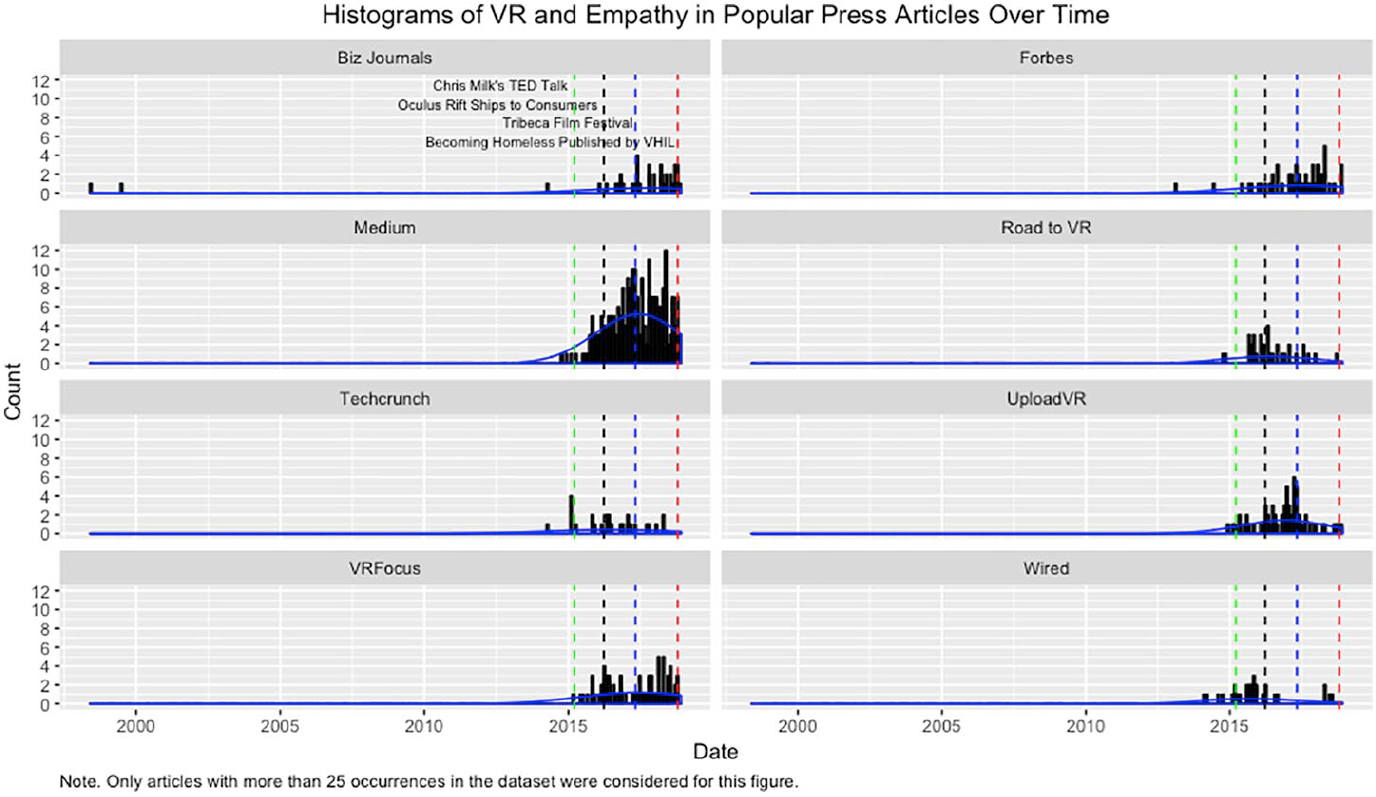
Histograms of articles over time. VHIL is Stanford’s Virtual Human Interaction Lab.
Data collection: academic corpus
The authors’ university library system identified papers that contained the terms “virtual reality” and “empathy” as subjects. This initial search produced 50 articles, and several criteria created the focal dataset.
First, we excluded six irretrievable articles, one piece that reviewed work from the existing dataset, and one non-English article. We then supplemented our initial search with proceedings that commonly index VR articles (Association for Computing Machinery). This added 11 articles to our database for a final set of 53 articles. We used all sections of the academic research article in our analyses except for the references. Articles used in this corpus are located in Supplemental Table S1.
Thematic reviewing procedure
Two reviewers performed an inductive qualitative critical analysis of the popular corpus to identify common themes and discourses (Thomas, 2006). They read each article to identify themes surrounding VR and its relationship to empathy: how outlets defined the concept; how they represented its impact on industries and consumers; how they related empathy to specific institutions and practitioners; and finally, the relationship between VR, empathy, and prosocial change. Following the critical tradition (Van Dijk, 1993), reviewers also scrutinized institutions and figures wielding power within the media landscape to specify the uses and effects of the emerging medium. Rather than setting forth an initial set of categories, reviewers allowed them to emerge as they read.
We used the same procedure to identify how researchers defined empathy. Recognizing that the popular press may cover the results of these studies without explaining the research process, comparisons were not made between popular and academic press concerning coverage of measurement. The reviewers did, however, code the academic press for measures of empathy to determine how researchers report claims about VR as an instrument to boost empathy.
Because such qualitative analyses are premised on themes emerging naturally from the text, we sought “trustworthiness” in our findings (Lincoln and Guba, 1985). Following Lincoln and Guba’s (1985) suggestions of prolonged engagement, persistent observation, and researcher triangulation (see Nowell et al., 2017), we ensured credibility with our coding by having two independent raters meet periodically for peer debriefing during reading and analysis phases. Coders also read the entirety of each corpus, strengthening the credibility and validity of their interpretations. They compared, discussed, and checked codes to see whether they could cogently reconstruct similar findings. Such methods and steps to ensure coding trustworthiness have been used in a variety of inductive thematic analyses (e.g. Fjællingsdal and Klöckner, 2017; Kors et al., 2016), including multimethod projects (e.g. Fox et al., 2018). The qualitative analysis thus represented a deep reading of the nuances of the popular and academic press’ framing of VR and empathy, as well as their perceived impact on prosocial change.
Automated text analysis
A quantitative analysis served two purposes: to reinforce the findings of the qualitative analysis and explore unanticipated themes. To identify them, we used the meaning extraction method, which relies on principal component analysis (PCA) to reveal latent topics from a corpus by tracing the word patterns that cluster statistically (Chung and Pennebaker, 2008).
The Meaning Extraction Helper (MEH) performed the meaning extraction (Boyd, 2018). This program removes low base-rate and function words (e.g. a, the) that naturally co-occur in English texts (Blackburn et al., 2018). The output from MEH produces a matrix of n-grams that identifies whether a word is present (coded as 1) or absent (coded as 0) in a corpus. We retained unigrams in the popular corpus that were found in at least 25% of the articles, which produced 165 unique words. We retained unigrams that were in at least 85% of documents from the academic corpus (n = 26 unigrams). Since the academic corpus was markedly smaller than the popular corpus, we increased the inclusion threshold to allow for themes to emerge, to ensure that the data were representative and reliable, and to achieve PCA convergence. The reliability and validity of our models were paramount over less conservative thresholds, though we acknowledge that more components might arise if other inclusion criteria were used.
Consistent with prior work that has used natural language data to form internally consistent and reliable components of word patterns (Blackburn et al., 2018; Chung and Pennebaker, 2008), we retained items that had varimax rotated loadings of at least the absolute value of 0.20. The popular corpus—Kaiser-Meyer-Olkin (KMO) measure of sampling adequacy = 0.813; Bartlett’s test of sphericity: χ2(13,530) = 27,041.27, p < .001—and academic corpus—KMO = 0.569; Bartlett’s test of sphericity: χ2(325) = 718.10, p < .001—were well-structured for PCA. One article in the popular corpus was excluded from the automated text analysis because it contained a relatively low word count (<100 words).
Results
Thematic analysis: popular corpus
Our thematic analysis of the popular corpus revealed many interconnected metaphors and interpretations of empathy. Empathy was described as everything from “what makes us human” (Bonasio, 2016) to “the emotion that allows us to understand the people around us, and to share feelings” (Dempsey, 2018). Together, four overarching discursive themes emerged to construct a common, if complicated, conception of VR and empathy in the popular press: features and affordances of VR to facilitate empathy, key actors, metaphors, and impact. While these themes overlapped within articles, each is dissected.
Theme 1: features and affordances of VR and empathy
Journalists extolled VR and empathy’s connection. Nearly 84% of the articles (537/640) saw VR and empathy as having a constructive relationship. While this was expected in enthusiast outlets, it was echoed in most publications. Given this plurality, how were VR and empathy linked? Below, we convey the characteristics by which VR was judged to have an incrementally positive impact on how to empathize.
Perspective-taking and embodiment
Popular press writers viewed the idea of occupying someone else’s body in VR as an instrumental affordance of the medium. This trait was fairly prevalent, coded in nearly 16% of articles (100/640). Although embodiment has long been studied as it relates to gaming and virtual worlds experienced through computer screens, evangelists touted VR’s technological prowess in facilitating embodiment: “Virtual reality is uniquely effective at creating . . . [an] immersive perspective-taking experience . . . where users can inhabit digital bodies that look nothing like them . . .” (AppliedVR, 2016). Further, writers suggested that this affordance would catapult the medium into mainstream use: “That could be key to VR fulfilling its destiny . . . allowing us to absorb someone else’s perspective by acting out their life in our own skin” (Constine, 2018). Thus, writers signaled that embodiment contributed to VR’s commercial and practical success.
Immersion and presence
Articles suggested immersion was the bridge between the technology and the development of empathy: “Virtual reality is the really special place where technology and empathy collide. It creates an immersive universe for storytelling unlike any that has come before it” (Graham, 2015). The technical features of immersive devices were lauded for enhancing empathy: “[T]he 360° nature of virtual reality creates the illusion that the spectator is within the image . . . It is from this that empathy and suspension of disbelief stem” (Ducros, 2017). Further, presence provided a new sense of space for the user: “Presence, the feeling of ‘being’ in a mediated space, is the wow factor of virtual reality” (Humphrey, 2017).
While empathy and VR were positively connected, there was a clear tension. Presence, embodiment, and immersion were considered empathy drivers, which is substantiated by research (Bailenson, 2018), but were not situated within the processes of how humans could empathize with each other, nor used to detail how empathy develops more broadly.
Theme 2: actors and institutions of empathy
Discussions of VR and empathy tended to focus on journalistic experiences and documentaries, especially since institutions like The New York Times and CNN invested in the technology. At the same time, these outlets rarely covered their own work. Instead, VR proponents such as Chris Milk and Nonny de la Peña were invoked to interpret the relationship between VR and empathy. Both were well-represented in the corpus (121 articles and 43 articles, respectively).
De la Peña and Milk’s popularity is reasonable since they collaborated with news outlets (e.g. The New York Times, Wall Street Journal) and advocated for the connection between virtual worlds and empathy. In one article, de la Peña noted that “the immersive power of virtual reality” is “its ability to generate intense empathy on the part of the viewer—to wring from the audience the intense emotional connection that these stories deserve” (The New York Times, 2016). Crucially, this is evidence of “serious” VR use beyond frivolity or novelty: “Virtual reality isn’t just a gaming gimmick, it could improve empathy levels, and even reduce racial bias . . .” Between . . . Milk and . . . de la Peña, much light has been shed on stories that would not have been told otherwise . . . (Apodaca, 2016)
Part of the legitimization of VR’s use by journalists is its capacity to increase empathy, thus justifying investment in the technology.
Finally, the third figure named frequently in the corpus was Dr. Jeremy Bailenson, the director of Stanford’s Virtual Human Interaction Lab. Bailenson appeared in nearly one of every 14 articles. Pieces also mentioned the lab’s “Becoming Homeless” project (Herrera et al., 2018), which was designed for “figuring out how much of an effect this technology can have on people’s level of empathy in the long term” (Stanford Medicine, 2018). Such studies exemplified how university research adds credibility to VR’s relationship to empathy.
References to research institutions and journalists publicized the broad empathetic potential of VR, particularly to connect citizens to stories from around the world. The writing in the popular corpus exhibited a set of productive actors covering serious work, rather than entertainment, to promote this potential.
Theme 3: metaphors of empathy
The empathy machine
Journalists articulated and connected empathy to VR through a set of metaphors and comparisons. The most frequent association was the portrayal of VR as an “empathy machine,” which appeared in 174 articles and characterized empathy more than any other explication. The term stems from Milk’s (2015) talk, where he used his work to suggest that VR is the best means to elicit empathy in a viewer because it provides users an unmediated experience, which facilitates compassion and human connection. Milk’s assertions are mirrored in the popular corpus and underscore the idea that empathy can be mechanized and operationalized through VR. Freeman (2015) wrote, “Virtual reality is the ultimate empathy machine. It enables us to experience things we wouldn’t typically see in the real world and provides the opportunity to gain a new perspective.” In other words, according to popular press writers, VR is empathy or at least the utmost technical manifestation of it.
Not all authors agreed with the metaphor; some debated the extent, efficacy, or even the necessity of the engine. In Medium posts, it was decried as a “cynical tactic designed to exploit other peoples’ pain and struggles” (Kozuch, 2019). How and by whom such a machine would be deployed was also questioned. However, the idea that VR was an important technological evolution to elicit empathy in viewers was pervasive, even if the implications of such an evolution remained generally uninterrogated.
Walking in someone else’s shoes
A second metaphor, walking in another’s shoes, was tied to the concept of connecting humans to each other: Virtual reality allows the user to walk in someone else’s shoes instantly from the comfort of their own home . . . [It] connects humans to other humans in a profound way I’ve never before seen in any other form of media . . . (Dittmer, 2017)
Empathy in the metaphor, therefore, was about feeling what others feel from an intimate and personal perspective (Bailenson, 2018). This type of embodiment gave insights into experiences and thoughts that were outside of one’s own skin. It implies an ease to the empathetic experience; a user can proxy another’s life and perspective through VR. At the same time, issues of privilege and access (e.g. whether the user had the right to such an experience), plus the difficulty of living the life of another (both within and outside of the headset) remained absent through the metaphor.
Empathy and transport
A transportive experience—where one can go—was also crucial for VR to arouse empathy. A Forbes article stated that “the ability to interject yourself into different kinds of situations instantaneously . . . is why some call VR an empathy machine” (High, 2018). The results were considered transformative as people could envision catastrophes and create a “global consciousness” (High, 2018). This assumed that if VR exposed users to new experiences and places they would or could not normally go, the encounter would have lasting impact on their worldview.
Empathy as skill
Finally, empathy was understood as a skill, which VR could build and strengthen, particularly regarding training and education. One Medium post directly stated, “Empathy can be a learned communication skill, just like public speaking, writing, recognizing nonverbal cues, or conversational turn-taking” (Krohner, 2015). Here, empathy was not inherently drawn out, as was the case with walking in another’s shoes, but could be developed through VR. Further, it was considered part of a regime of 21st century “soft skills” (Bonasio, 2017) used in everything from patient care to customer service.
Together, these four metaphors set the caveats and bounds of what empathy could do. While providing insights into potential impact, each metaphor identified empathy as a trait to be drawn out or reinforced through immersive technologies. Consequently, journalists tied the term to VR devices, rather than independently focusing on it.
Theme 4: empathy’s impact on prosocial change
The impact of VR and empathy on prosocial change was connected to the prior associations and attributions. Walking in another’s shoes or building up empathy as a skill were recognized as ways to achieve deeper respect for people (e.g. different genders, races). Alternatively, empathy enabled viewers to visit new locales, inciting actions against global conflict and climate change. Figure 2 illustrates these connections.
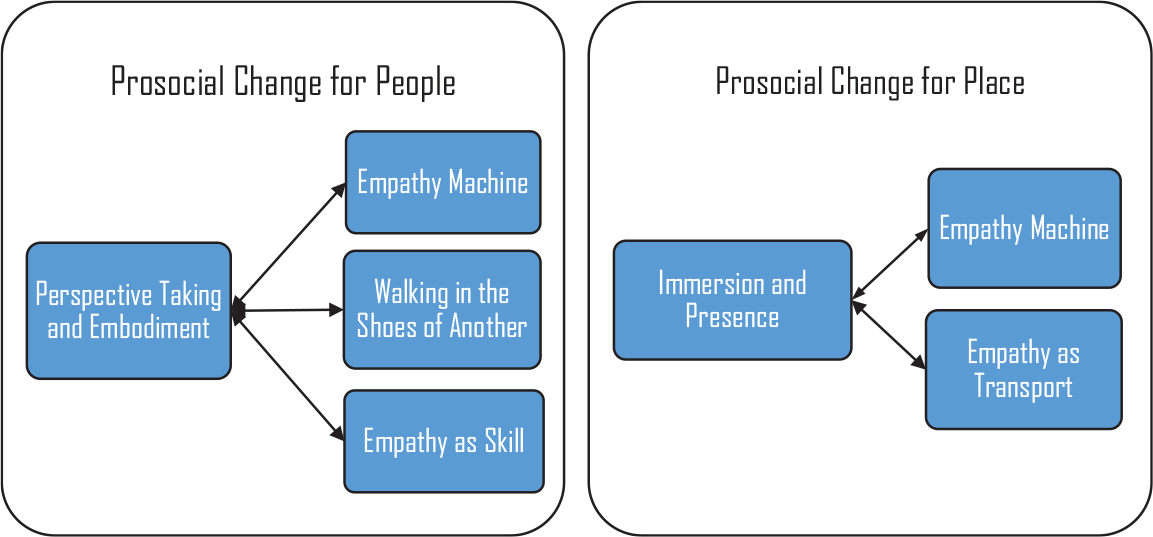
Discursive themes of prosocial change. Writers who discussed perspective-taking and embodiment typically used the empathy machine, walking in another’s shoes, and empathy as skill metaphors (left panel). Writers who discussed immersion and presence used the empathy machine and empathy as transport metaphors (right panel).
Prosocial change for people
By allowing users to inhabit the body and life of another, VR’s empathetic experiences could generate greater appreciation of different races, genders, the elderly, the homeless, the disabled, and the prison population, among others.
[P]ut people in each other’s shoes to increase empathy. A man can see himself . . . as a woman, or a person can see herself as a different race. Sighted people can perceive the world the way that someone with cataracts or macular degeneration does. (Downey, 2016)
One article similarly suggested students could better understand and empathize with those struggling with dementia based on enthusiastic, if inconclusive, anecdotes from a pilot study working with seniors (Haptical, 2018). In fact, most articles pointed to how the technology could lead to deeper compassion. The notion that empathy had such broad prosocial impact reflects a kind of homogenization (e.g. marginalized groups may be better understood through an empathetic experience). The assumptions portrayed in the popular press seem difficult to validate and generalize problems of different groups, at least when it comes to empathy.
Prosocial change for place
Journalists reported that transporting someone to a place far from the comforts of home helped them to empathize with the afflictions of war, climate change, and other calamities. Two VR experiences—about Syrian refugees and wildlife conservation in Africa—were described as presenting “a world so complete in its presence you feel a deep, moving empathy for the people and their struggle to live in harmony with nature” (Fink, 2018). After such exposure, there was optimism that donations would increase—articles mentioned that Clouds Over Sidra doubled donations at a conference after it was viewed. More broadly, transporting the observer to battlegrounds and wildlife reserves was significant because it was an experience they might never have otherwise: “. . . [Y]ou really don’t want to take somebody to a war zone and put their life in danger, or to a refugee camp—it’s simply not practical . . .” (Haidamus, 2015).
Thus, places beset by tragedy and conflict comprised most potential virtual trips to induce empathy, such as following poachers in Africa, earthquake sufferers in Nepal, and populations devastated by natural disasters. VR might also give insight into environmental crises such as climate change (Markowitz et al., 2018). One article described a nature production as creating a “visceral understanding of environmental issues through immersive data storytelling, and the physical sense of presence and increased empathy that VR provides” (Business Journal, 2018). Overall, they suggest that transportation might propel social action.
Together, most journalists were optimistic that VR could have broad and vital influence by eliciting empathy. At the same time, even if VR was the answer to societal woes, direct, long-term, and extensive effects beyond specific anecdotes surrounding fundraising remained underreported. This occurred in part because much research on the subject is ongoing and therefore cannot guarantee the monumental change portrayed by some mainstream media.
Thematic analysis: academic corpus
Consistent with the popular press coverage discussed, academic articles related empathy to the features and affordances of VR (e.g. Herrera et al., 2018), metaphors (e.g. Kors et al., 2018), and claims of impact (e.g. Schutte and Stilinović, 2017). Researchers either implicitly or explicitly explored prosocial impact through the concept of perspective-taking inherent to studies of empathy. In most of the academic work, empathy was assumed to be a prosocial construct, a subset of prosocial behavior, or a “facilitating component . . . to increase . . . prosocial behavior” (Kors et al., 2016: 91). Consistent with popular press, more than half of the academic articles (30/53) did not offer an explicit definition of empathy but instead focused on how VR could affect or relate to it. Below are key findings from our qualitative thematic analysis.
Defining empathy
The most cited references used to define (and measure) empathy (11/53) were from Davis (1980) who described it as one’s responsiveness to the experiences of another and the ability to relate to another’s point of view, or perspective-taking. Articles that addressed empathy through this perspective-taking lens presented specific behavioral or psychological variables that explained how it could be accomplished.
Empathy was associated with other traits and emotions, which emphasizes the multifaceted nature of the term (Zaki, 2019). For example, psychologists Wallach et al. (2010: 4) wrote, “empathy and presence use the same projective ‘tool set.’” Similarly, in a study of persuasive games, designers Kors et al. (2016: 92) explained, “With this feeling of being ‘somewhere’ else, the feeling to stand in ‘someone’ else’s shoes becomes possible, which in turn presents ample opportunity to also think and feel like this other person (i.e. empathy).” For these authors, it was unclear whether presence is equivalent to or aids empathy. Further, these attributes could be either appearances of an empathetic response or a reaction to the novelty of the experience. Thus, a set of connections between empathy and other related concepts emerged: from presence to facial expressions and compassion. These relationships further reinforced the difficulty of defining the term within any single field or subfield.
Measuring empathy
As expected, measuring empathy and the means to do so resulted in mixed findings. Only half (27/53) of the papers in the academic corpus offered any measures of empathy in their research. When they did, the most common tool (n = 11) was the IRI (Davis, 1983). Due to the robustness of the IRI, researchers have adapted and used it in many fields. In studies where the IRI was not used, authors created their own self-reported benchmarks and employed field-specific measures of empathy (e.g. Ando et al., 2011) or different methodological approaches such as semi-structured interviews and/or biofeedback (Kim et al., 2009). Scholars in fields like history, philosophy, and design approached the subject more theoretically.
Acknowledging empirical limitations
A final theme emerged in the papers’ limitations sections. Studies frequently concluded that measures of empathy might tap a host of psychological dimensions and/or that the operationalization of empathy was lacking across the relevant literature. In addition, authors stated other contributing factors (instead of empathy) that might affect findings. For example, self-association (along with issues in self-reporting) appeared in several discussion sections; VR experiences also made subjects more self-aware, rather than empathetic toward others, which reinforced preexisting pro- and anti-social tendencies.
Our qualitative themes reveal a web of convergent concepts when defining empathy and VR. Their relationship is nuanced and built upon decades of research. This pattern also extended to tempered language around findings about prosocial change. While many scholars discovered prosocial benefits to VR, such as feeling more connected and willing to sign petitions about homelessness (Herrera et al., 2018), conclusions were incremental and appropriately contextualized within each study. As might be expected, these accounts differ from the more generalized and aspirational coverage espoused by the popular press.
Automated text analysis
The number of components in each corpus was determined by the combination of scree plots, variance explained data, and when the simplest solution was thematically interpretable.
Popular corpus
Eight components were extracted from the popular corpus, cumulatively explaining 11.79% of total variance, an amount consistent with other evaluations of natural language (Millar and Hunston, 2015). Table S2 in the Supplemental Materials contains extracted components, and italicized words below are items from each component.
Many articles described VR content creation, particularly elements that play a role in developing and experiencing an immersive world (e.g. audience, viewer, story; Component 1). By describing play and what can happen with the technology (e.g. create real and important experiences; Component 2), readers are presumably told about the possibilities of how to sense, create, and feel genuine VR experiences (Component 5). These three components are functional in nature and describe characteristics of audience, technology, and experience.
Two components also related to VR hardware, such as the characteristics of immersive video (Component 3), headsets in the current marketplace, and headset manufacturers (Component 4). Relatedly, writers mentioned the commodification of VR through connections to industry (Component 6). By putting VR in economic terms (e.g. company, market), writers acknowledged that industry is a major contributor to VR’s popularity and plays a vital role in its future. These components collectively underscore the importance of communicating industry as an economic driver and producer of VR.
Finally, the aspirational nature of VR was also mentioned in two components. Words such as impact, powerful, and important clustered in Component 8, which described the perspective-taking potential of virtual experiences. The ability to “put yourself in someone else’s shoes” and understand their point of view was often mentioned by the popular press. Consistent with the qualitative analysis, writers described the aspirational nature of VR for empathy by suggesting that it may have an impact on emotion in the future (Component 7), but they struggled to articulate exactly how the technology may accomplish this.
Together, the PCA data confirm that empathy is defined by the popular press as an aspirational form of communication between people and technology. However, the relationship between VR and empathy is also defined by ties to industry and the desire to convince readers virtual experiences are real, meaningful, and impactful.
Academic corpus
Three components were extracted from the academic corpus, explaining 35.18% of total variance (Table S3 in the Supplemental Materials). The first component described positive empirical effects for the relationship between VR and empathy: An interaction in VR can provide a high level of support to others is a research finding reflected in the empirical data. The second component describes how scholars justify their use of VR in their studies. Work in a virtual environment can provide support for their research question. Finally, Component 3 shared a consistent theme with the popular corpus by describing the potentiality of VR. Words such as future, give, allow, and empathy indicate that academics view the relationship between VR and empathy as aspirational.
All told, there are several commonalities across corpora. First, writers for the popular and academic presses justified the use of VR in prosocial settings. As one might expect, justifications emerged through different means, since the audiences of these presses were dissimilar. For example, the qualitative analysis suggests that the popular press uses key figures (e.g. researchers, practitioners) to describe serious use cases for empathy. Academics, as observed in the automated text analysis, addressed VR through research questions, empiricism, and prior evidence. Second, both presses also converged on the potentiality of the medium and the belief that a prosocial empathetic experience could be developed or enhanced with VR. The qualitative analysis of the popular press revealed that the relationship between VR and empathy is aspirational for users. The automated text analysis furthered such observations by showcasing how VR and its related industry could relate to empathy in users.
Together, the automated text analyses largely echoed the qualitative coding, especially for the academic corpus. In the popular corpus, however, the automated text analysis identified unanticipated themes, including key headset manufacturers and discussions about the medium’s future. This latter theme is different from potentiality because it focuses less on prosocial change and more on the medium. Specifically, it highlights expectations of the medium’s hopeful longevity as expressed by the popular press. These findings suggest that qualitative and quantitative techniques have complementary value in understanding complex phenomena such as VR, empathy, and prosocial change.
Discussion
In seeking a definition of empathy by the popular and academic press in relation to VR (RQ1), the results of our multimethod analysis do not elucidate a singular explication of the term. Instead, mirroring prior research, empathy perseveres as a composite of different attributes over time. Empathy is represented as something that can be developed in individuals, engendered in technology, and lead to prosocial action and change. Like VR itself, the idea of empathy is embedded in an aspirational language of potentiality. At the same time, both presses often do not fully articulate the manifold qualities and boundaries of empathy. While they effectively communicate that it temporarily transports the viewer into the shoes, life, and place of another, rarely do they delve into the nuances of the term, leaving a discrepancy between its potential and actual usefulness to instigate prosocial change. This gap is filled in by the popular press, which suggests empathy can be mechanized through VR. The academic literature, in contrast, focuses justifiably on outcomes to specific research questions. The impact of such discourse may lead to a perception that empathy can be deployed or found, rather than cultivated and negotiated between individuals.
The “empathy machine” metaphor indicates another significant factor in the popular and academic conceptions of empathy and VR. Particularly in mainstream media, empathy is attributed to technology rather than being scrutinized as an ability unto itself. For instance, our thematic and automated text analyses suggest that the mainstream press believes that empathy can be fostered through immersion, which academic discoveries support, but this association also fosters the emerging immersive media industry. The popular press automated text analysis specifically highlights the prevalence of economic drivers; this finding is bolstered by the qualitative analysis of press coverage where empathy was used to define the serious nature of VR content, moving it from the realm of a game or toy to sincere work. The academic press did not address industry issues to the same degree; the automated text analysis of the academic corpus confirms that researchers are largely concerned with communicating the value and findings of the VR/empathy relationship for their scholarship. However, because academics approach empathy primarily in relation to their research interests, the popular press reportage more broadly generalizes the medium’s potential to be an empathy driver.
The revelations from both corpora also accentuate the hope for an empathetic experience to produce tangible change and impact. Writers reported on experiments pointing to VR’s potential for eliciting empathy, and the term has been interpreted as one of the many means for solving endemic prosocial problems. RQ2 asked how popular and academic presses articulate the relationship between empathy and VR for prosocial change, and the data emphasize the need for a more universal understanding of what researchers mean by empathy, as well as an articulation of how it manifests outside of the lab. It is also important to identify what is meant by empathy development via a VR experience (compared to other forms of media). The popular press tended to focus on empathy’s broad potential, while most academic studies were field-specific, often without explicit measures or clear definitions of empathy. However, the aspirational language highlighted in the automated text analysis of both corpora, along with the link between empathy’s use and prosocial causes, supports a common notion that VR is an important and potentially transformative technology that may prompt changes in attitudes and behaviors.
Media outlets suggest that through empathy—building it as a skill in medical workers or putting a donor or legislator in the shoes of an oppressed minority—VR can realize its full purpose. However, our analyses also indicate that the relationship between VR and empathy is subtle and complicated inside and outside of the lab. While research into specific attributes of empathy is vital, we must also investigate how to create empathy, successfully utilize it, and then create effective measures for longitudinal change in virtual environments. Despite public enthusiasm, further testing of the connections between the technology and empathy is necessary. For example, building on the IRI subscales could engender more robust results and tests of whether VR is truly an “empathy machine.”
From a critical perspective, an interrogation of the power structures underlying the associations and technologies present in the popular interpretation of empathy is missing. The actors deploying VR devices, their interests in retaining discursive power over its uses, and ultimately how they shape the use of empathy as a tool for prosocial change are often unexamined. Only in Medium articles, which include publications by academics, students, journalists, and enthusiasts, are there major critiques of these issues, questioning the propriety of those in the Global North (e.g. the United States, Europe) wielding the tools to create empathy over those in the Global South (e.g. South America, Africa), or whether empathy is even the appropriate emotion to instigate political and prosocial action. Indeed, empathy was often used within the popular corpus to deepen the institutional norms of specific industries—technology, journalism, and global advocacy among others—as a new frontier to extend their influence.
We observed a similar range of themes and terms to articulate the use of VR to build empathy (RQ3). Scholars were careful not to tout the benefits of VR and empathy to preserve scientific rigor, which allowed popular literature to assume and conjecture about the capabilities of the medium, potentially inflating expectations. Herrera et al. (2018) provide one notable exception as they define empathy and explicitly investigate the relationship between it and media. Researchers should be aware of the necessity for precise language when discussing empathy, and it is incumbent on journalists to examine, relay, and further interrogate academic studies. In short, academics and reporters should collaborate to communicate the complexities of empathy to the public.
Finally, the attributes associated with empathy, from walking in another’s shoes to immersion and presence, deserve further critical assessment. Temporarily putting someone in the shoes of another may not be the best means of comprehending prosocial causes or inciting lasting prosocial change. The concept and metaphor need to be contextualized in the larger socio-cultural issues of power and access that surround the diffusion of VR innovations (Foxman, 2018). Without probing this concept more deeply, empathy will endure as a term that merely describes a potential future, rather than being a necessary component of it.
Limitations and future directions
Our research did not attempt to collect all articles related to VR and empathy, but instead, we obtained a large sample of how this topic is covered. Publications using words like “empathize” or “empathetic” were not included, nor those that may reflect empathetic dynamics but failed to overtly mention “empathy.” Therefore, our data are qualitatively representative of communities that mention VR and empathy explicitly, and quantitatively reliable based on statistical thresholds for factor analysis with natural language. We were deliberately strict with our inclusion criteria to offer cogent explications of murky concepts. Future research should explore articles that have unique conventions and perspectives on VR and empathy, especially given the complexities and rich scientific literature that surround the term but may not explicitly use it. Future research should also explore different n-gram sizes. Unigrams are often the most common text analysis unit in the social sciences (Blackburn et al., 2018; Tausczik and Pennebaker, 2010), but bigrams or trigrams may add new topics.
Finally, scholars should explore the institutions that play an important role in the construction of this term. Definitions of empathy may remain obscure because journalists and academics hold dual roles: promoting immersive technology while trying to make sense of it journalistically or empirically. This tension also affects non-profits, medical research, digital technology companies, and marketers where immersive media is closely aligned.
Conclusion
This article evaluated popular and academic characterizations of empathy in relation to VR. At its most elemental level, empathy is not a singular attribute, but a social, psychological, and technological phenomenon. These facets of empathy produce a Venn diagram of overlapping concepts, founded on decades of research into what it is, how it relates to immersive media, and its efficacy for prosocial change. Our findings similarly revealed that empathy is layered in its explication, often described aspirationally and associated with institutions and industries invested in VR technologies. Empathy is an important trope for discerning how immersive technology can impact the broader public, yet currently we worry it is too often affixed to VR rather than being interrogated for its own value and purpose.
Our article indicates the need for a coherent and universal definition of empathy as it relates to VR. While acknowledging the inherent complexities in constructing a single definition of a nuanced relationship, we draw on prior social (Herrera et al., 2018; Shin and Biocca, 2018), psychological (Bailenson, 2018; Zaki, 2019), and technological (Cummings and Bailenson, 2016; Slater and Wilbur, 1997) scholarship and our findings to recommend the following definition: Empathy is a psychosocial dynamic that, when mediated, can facilitate proxying the thoughts, feelings, experiences, sensitivities, or perspectives of another entity, to the degree that technology, behavior, and social characteristics make such perspective-taking salient. Our definition connects research on cognitive and affective empathy from psychology, with ongoing research into how social dynamics and immersive media may assist a psychosocial process. Most models trying to simplify complex phenomena are imperfect (e.g. Box, 1976), but we hope that our conceptualization establishes a baseline understanding for academe, industry, and the public to negotiate such ideas cooperatively.
Supplemental Material
sj-doc-1-nms-10.1177_1461444821993120 – Supplemental material for Defining empathy: Interconnected discourses of virtual reality’s prosocial impact
Supplemental material, sj-doc-1-nms-10.1177_1461444821993120 for Defining empathy: Interconnected discourses of virtual reality’s prosocial impact by Maxwell Foxman, David M Markowitz and Donna Z Davis in New Media & Society
Footnotes
Acknowledgements
We would like to thank our industrious research assistants Christopher St. Louis and Waseq Rahman, along with the editors and reviewers of this issue.
Funding
The author(s) received no financial support for the research, authorship, and/or publication of this article.
Supplemental material
Supplemental material for this article is available online.

Author biographies
References
Supplementary Material
Please find the following supplemental material available below.
For Open Access articles published under a Creative Commons License, all supplemental material carries the same license as the article it is associated with.
For non-Open Access articles published, all supplemental material carries a non-exclusive license, and permission requests for re-use of supplemental material or any part of supplemental material shall be sent directly to the copyright owner as specified in the copyright notice associated with the article.
