







Abstract
This three-wave panel study examined the prospective and bidirectional relationships between parental control of social media use, and parents’ and adolescents’ perceived time spent on social media over a 2-year period. Adolescents (52% males, T1: Mage = 12.19, SD = 0.52) and one of their parents (96% mothers, T1: Mage = 45.26, SD = 4.28) completed annual surveys (T1: N = 498, T2: N = 477 and T3: N = 440). Data were analysed using cross-lagged panel models. More adolescent time spent on social media predicted small decreases in parental control 1 year later, but parental control did not predict adolescent time on social media. More parental time spent on social media predicted small increases in adolescent time spent on social media 1 year later, but adolescent use did not predict parent use. Examining factors related to parental use, rather than restriction, may be more effective to reduce adolescents’ social media use.
Social media use is widespread among diverse countries, ages and genders (Ortiz-Ospina, 2019). It is estimated that around 48% of the entire world population use social media (Statistica, 2021), but it is currently the younger generations who invest the most time on these platforms (Smart Insights, 2019). Despite being under the platform-specified minimum age for a social media account (i.e. 13 years), more than half of preadolescents (i.e. 10–12 years old) have an account on at least one platform (Fardouly et al., 2018; Ofcom, 2017). The number of social media users grows to 89–96% during adolescence and young adulthood (Anderson and Jiang, 2018; Australian Bureau of Statistics, 2016; Office for National Statistics, 2017). On average, young people report spending around 2 hours per day browsing platforms, such as YouTube, Instagram and Snapchat (Common Sense Media, 2015; Statistica, 2019).
Meta-analyses often find significant but small cross-sectional relationships between self-reported time spent on social media and users’ mental health or wellbeing (Huang, 2017; Saiphoo and Vahedi, 2019). Longitudinal research on the relationship between self-reported time spent on social media and mental health finds mixed results (Course-Choi and Hammond, 2021; de Valle et al., 2021), suggesting that there may be important mediators and moderators of these relationships that need to be considered. For example, a recent longitudinal study of adolescents found an indirect path from more time spent on social media to increased body image concerns via increases in appearance comparisons made on social media (Jarman et al., 2021). Thus, spending more time on social media may negatively impact adolescents’ wellbeing because it provides them with more opportunities to engage in potentially harmful behaviours, such as making negative comparisons with others (Verduyn et al., 2020).
It is common for parents to report concerns about the amount of time their children spend on social media platforms (Hammons et al., 2021; Krcmar and Cingel, 2016; Toh et al., 2019) and to seek advice for ways to reduce adolescent screen time. Parents are important sources of influence for media use, especially during childhood and early adolescence (Coyne et al., 2017). The two types of parental influence that are often examined in the literature on more traditional forms of media (e.g. television) are parental modelling of media use and parental control or mediation of adolescents’ media use. However, research on the influence of parents on the time that their adolescent spends on social media is sparse and primarily cross-sectional. The present three-wave panel study examined bidirectional relationships between both parental control of time spent on social media and parents’ own perceived daily time spent on social media, with early adolescents’ perceived daily time spent on social media over a 2-year period.
Parental modelling
Developmental theories, such as social cognitive theory (Bandura, 2001), suggest that people can learn behaviour via observation of others. Thus, one way that parents can exert influence over their child’s social media use is to model use themselves. Decades of research suggests that, when it comes to traditional forms of media (e.g. television), parents’ media habits are associated with their children’s media habits (Gorely et al., 2004; Lauricella et al., 2015; Wong et al., 2020). However, less is known about the relationship between parent and child use of newer forms of media, such as social media. One cross-sectional study found a small to moderate positive association between parent-reported and adolescent-reported time spent on social media (Vaala and Bleakley, 2015). Another recent cross-sectional study found that adolescents were more likely to report privacy-respecting behaviours on social media (e.g. asking permission before posting information about someone on social media) if they reported that their parents also engaged in those behaviours with them (Reich et al., 2021). Thus, there is some evidence for a link between parent and adolescent social media behaviours.
Parental restriction
Another way that parents can exert influence over their child’s social media use is to control or restrict the amount of time they spend on those platforms. In communication research, this is often termed restrictive parental mediation of media use and it is just one of many different strategies that parents may employ (Valkenburg et al., 2013). The World Health Organization (2019) recommends that parents restrict screen time for children under 5 years old, but recommendations are less clear for older children and early adolescents. Parents are more likely to use restrictive techniques if they are concerned about the potential negative impact of media use on their children, and to some extent, if they use media less themselves (Krcmar and Cingel, 2016; Nikken and Schols, 2015).
A recent meta-analysis of research on the cross-sectional relationship between parental mediation strategies and child general media use found a small but significant relationship between more parental restriction and less child time spent on media (Chen and Shi, 2019). This relationship weakened as children aged but remained significant into the adolescent period. However, parental restrictive mediation was only found to significantly reduce time spent watching television and using the Internet more broadly, not time spent playing video games or on social media. Only three studies reported in the meta-analysis examined parental restrictive mediation and time spent on social media. One study found no relationship between early adolescents’ reports of parental restrictive mediation and their time spent on social media (Len-Ríos et al., 2016), while another study found a significant but small relationship between adolescent reports of parental restriction of Internet use more broadly and their own frequency of social media use (Shin and Kang, 2016). The third study asked young adults to recall the extent to which their parents put restrictions on the time they spent on social media when they were young to determine whether they experienced parental restrictive mediation or not (Panek, 2014). Only 18.4% of the sample reported parental restriction of social media use and they were less likely to spend time on social media as adults, although the effects were small. Another recent cross-sectional study not included in the meta-analysis found that parent reported control of the time their child spent on social media was associated with less reported time spent on social media by preadolescents (Fardouly et al., 2018), while another cross-sectional study also not reported in the meta-analysis found no relationship between parental Internet restriction and adolescent time spent on social media (Vaala and Bleakley, 2015). Thus, the research is mixed on whether parental restriction of media use is associated with time spent on social media by adolescents.
Longitudinal research
Most research on the potential influence of parents on adolescents’ media use has been cross-sectional and is thus unable to determine the direction of relationships. As proposed by the transactional model of development (Sameroff, 2009), a parent’s behaviour may be just as likely to be influenced by their child, as the child’s behaviour is to be influenced by the parent. While parental restrictions may reduce the amount of time that adolescents spend on social media, their level of restriction may also depend on how much time their children spend on social media and how compliant their children are to following parental rules. Furthermore, while parents may model social media behaviours to their children, parents may also spend more time on social media to connect with their children and to monitor their children’s online activities. Research is yet to examine the relationships between parents’ own social media use and adolescents’ social media use longitudinally. In regard to parental restriction, one longitudinal study found that parental restrictive rules around Internet use predicted decreased social media disorder symptoms (i.e. addictive social media behaviours) 1 year later among adolescent girls but not boys (Koning et al., 2018). Social media disorder symptoms did not predict parental restrictions over time. Our recent longitudinal study focusing on technology use (i.e. watching television, playing video games, browsing the Internet and social media) and sleep found that when controlling for sleep variables, more preadolescent time spent on technology (including social media) predicted decreases in parental control of technology use 1 year later; parental control did not predict preadolescent time spent on technology (Richardson et al., 2021). The relationships found in that study were not moderated by gender. Thus, the direction of the relationship between parental restriction and adolescent social media use may depend on the type of social media activity being examined (e.g. symptoms of social media disorder versus time spent on social media). Further longitudinal research is needed to better understand the relationship between different parental factors and adolescent use of social media, particularly during early adolescence when most youth start using social media.
The present study
The aim of the present study was to examine the unique and bidirectional relationships between parental control over time spent on social media, parents’ own perceived daily time spent on social media, and early adolescents’ perceived daily time spent on social media using a three-wave panel design. Based on our earlier findings examining technology use more broadly (Richardson et al., 2021), we hypothesised that greater adolescent time spent on social media would predict less parental control of the time they spent on social media, but parental control would not predict adolescent time spent on social media. Based on previous correlational research (Reich et al., 2021; Vaala and Bleakley, 2015), we hypothesised that parental time spent on social media would be positively and prospectively related to adolescent time spent on social media, but we did not make specific hypotheses on the direction of that relationship given the lack of existing longitudinal research.
Method
Participants and procedure
Data from Australian adolescent males and females and one of their parents/guardians were used in the current study. These data were part of a larger longitudinal project examining predictors of emotional functioning during adolescence (i.e. the Risk to Adolescent Wellbeing [RAW] Project). Because parent time spent on social media was not measured in Wave 1, the present study used data from Waves 2–4 of the broader project. However, for ease of interpretation, in the current article these waves will be referred to as Time 1 (T1), Time 2 (T2) and Time 3 (T3), each of which was collected approximately 12 months apart over a 2-year period. Of the 498 adolescent (52.0% male, Mage = 12.19 years, SD = 0.52, range = 11–13 years) and parent (95.6% mothers, Mage = 45.29 years, SD = 4.28, range = 21–61 years) pairs that completed the study at T1, 477 adolescent (52.2% male, Mage = 13.20 years, SD = 0.53, range = 12–14 years) and parent (95.6% mothers, Mage = 46.37 years, SD = 4.31, range = 22–62 years) pairs completed the relevant measures at T2 and 440 adolescent (52.0% male, Mage = 14.80 years, SD = 0.53, range = 14–16 years) and parent (96.8% mothers, Mage = 47.46 years, SD = 4.28, range = 23–63 years) pairs completed the relevant measures at T3. All adolescents were in Grade 7 at school at T1. Most adolescents (n = 411, 82.5%) and parents (n = 419, 84.1%) identified as Caucasian, 33 (6.6%) adolescents and 46 (9.2%) parents identified as Asian, 6 (1.2%) adolescents and 9 (1.8%) parents identified as Middle Eastern, and 48 (9.6%) adolescents and 24 (4.8%) parents identified as ‘other’. English was the first language for most participants (n = 480, 96.4%) and the majority (~80%) of the sample came from middle- to high-income families.
Participants were recruited via flyers distributed in schools, sports clubs and medical centres in the city of Sydney. Informed assent was received from adolescents and informed consent was received from their parent/guardian prior to their involvement in the study. Parents and adolescents completed separate online surveys in their natural environment (e.g. at home) each year, which included the measures described below. As part of the larger project, both adolescents and parents also completed clinical interviews via the phone and adolescents completed an in-person lab session each year, but those components of the project were not included in the present study. Each year, families were paid AUD100 for their involvement in the project and the adolescents were given a small gratitude bag with the project logo on it, which contained age-relevant products (e.g. food, stationary, toys). To maintain interest in the study, each year adolescents were sent birthday cards and festive season cards from the project team and participants were given the opportunity to enter project specific competitions. The first wave of data described in this study was collected between August 2017 and July 2018, with each consecutive wave collected approximately 1 year later. This study was approved by Macquarie University’s Human Research Ethics Committee.
Materials
Social media accounts
Parents and adolescents were separately presented with a list of popular social media platforms (Instagram, Facebook, Twitter, Snapchat, Google+, Vine, Tumblr, Pinterest, YouTube and other) and were asked to indicate which platforms they had an account on. If they chose ‘other’, they were asked to specify the platforms. Parents and adolescents were also provided with the option ‘I ’don’t have any social media accounts’.
Perceived daily time spent on social media
Similar to previous research (Fardouly and Vartanian, 2015; Tiggemann and Slater, 2014; Tiggemann and Slater, 2015), parents and adolescents were asked to separately indicate how much time they spent on a normal day browsing each of the social media platforms that they had an account on. Responses for each platform were made on a 10-point scale: no time (0), less than 5 minutes (1), 5–15 minutes (2), 15–30 minutes (3), 30 minutes–1 hour (4), 1–2 hours (5), 2–4 hours (6), 4–6 hours (7), 6–8 hours (8), 8–10 hours (9) or 10–12 hours or more (10). Responses for each platform were summed to create a measure of overall perceived daily time spent on social media for both parents and adolescents.
Parental control
Parents indicated how much control they have over the amount of time their child spends on social media with the response options no control (my child decides) (0), a little control (1), moderate control (2) and a lot of control (I set clear rules for my child) (3). They also had the option N/A, my child does not use social media.
Results
Preliminary analyses
Data aggregation and preliminary descriptive analyses were undertaken using SPSS. Data were examined for error outliers using boxplots. Three extreme outliers were identified for the adolescent time spent on social media variables, one at each wave. Those three scores were removed from further analysis after closer inspection because they represented an amount of time spent on social media each day that was not possible or likely (i.e. 18–37 hours/day). Data for the parent and adolescent time spent on social media variables were coded as missing for those who indicated that they did not have any social media accounts at that wave. Data for the parental control measures were also coded as missing if the adolescent reported having no social media accounts at that wave. Given that most adolescents were under the minimum age requirements (i.e. < 13 years) to have accounts on most social media platforms at T1, there were more missing data at T1 than T2 and T3 for the adolescent time spent on social media measures (T1 = 24.1%, T2 = 14.7% and T3 = 16.9%) and parental control measures (T1 = 29.5%, T2 = 4.8% and T3 = 13.3%), but not for the parent time spent on social media measures (T1 = 6.6%, T2 = 10.0% and T3 = 17.9%). Missing data were handled with pairwise deletion in SPSS and using full information maximum likelihood (FIML) estimation in Mplus. None of the study variables were normally distributed (Shapiro–Wilk’s p < .001). Thus, Spearman’s rho and the MLR robust maximum likelihood estimator were used to estimate descriptive and cross-lagged analyses, respectively. Given the large number of comparisons in the current article, significance levels were adjusted to account for a paper-wide 5% false discovery rate using Benjamini and Hochberg’s (1995) procedure. The first raw p-value to exceed the Benjamini–Hochberg-adjusted p-value corresponding to a false discovery rate of 5% was p = .024.
Descriptive statistics
The total number of adolescents and parents who used each social media platform and the average time they spent on each platform at each wave are reported in Table 1. Of the total sample, 378 (75.9%) adolescents had at least one social media account at T1, 426 (89.3%) at T2 and 414 (94.1%) at T3. Of the adolescents who used social media, on average, they had 2.29 (SD = 1.38) accounts on different social media platforms at T1, 2.55 (SD = 1.41) different accounts at T2, and 3.74 (SD = 1.65) different accounts at T3. As shown in Table 1, the most popular social media platforms among adolescents at each wave were Instagram, YouTube and Snapchat. Adolescents also reported spending the most time (~30 minutes to 2 hours per day) on YouTube, Instagram and Snapchat at each wave. There were many ‘other’ responses at T3, which were primarily for the platform TikTok. For the parents, 465 (93.4%) had at least one social media account at T1, 448 (93.9%) at T2 and 409 (93.0%) at T3. Of the parents who used social media, on average, they had 2.70 (SD = 1.44) accounts on different social media platforms at T1, 2.66 (SD = 1.34) different accounts at T2 and 2.92 (SD = 1.42) different accounts at T3. As seen in Table 1, the most popular platforms among parents (primarily mothers) at each wave were Facebook, Instagram and Pinterest. However, on average, Facebook was the only platform they reported spending more than 15 minutes on per day at each wave.
Number (and percentage) of adolescents and parents who use each social media platform and the mean (and standard deviation) time spent on each platform at each time wave.
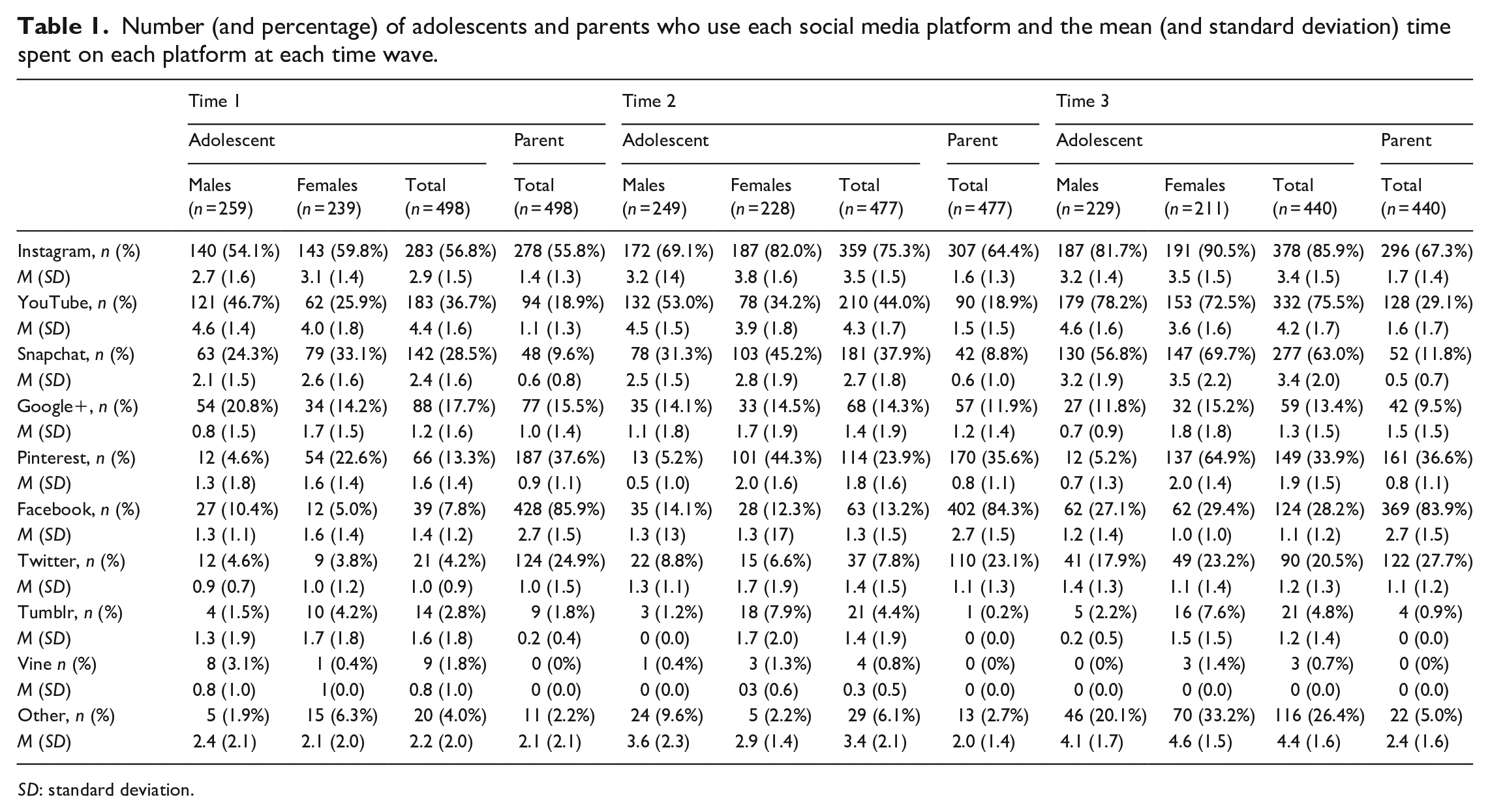
SD: standard deviation.
Correlations
Mean scores and Spearman’s correlations for the study variables at each time wave are reported in Table 2. There were small to medium negative associations between parental control and adolescent time spent on social media at each time wave. There were no significant relationships between parent time spent on social media and adolescent time spent on social media, or parent time spent on social media and parental control within or between waves at any measurement occasion. See the Supplementary Materials for correlations reported separately for adolescent males and females.
Means (standard deviations) and correlations between the study variables at each time wave.
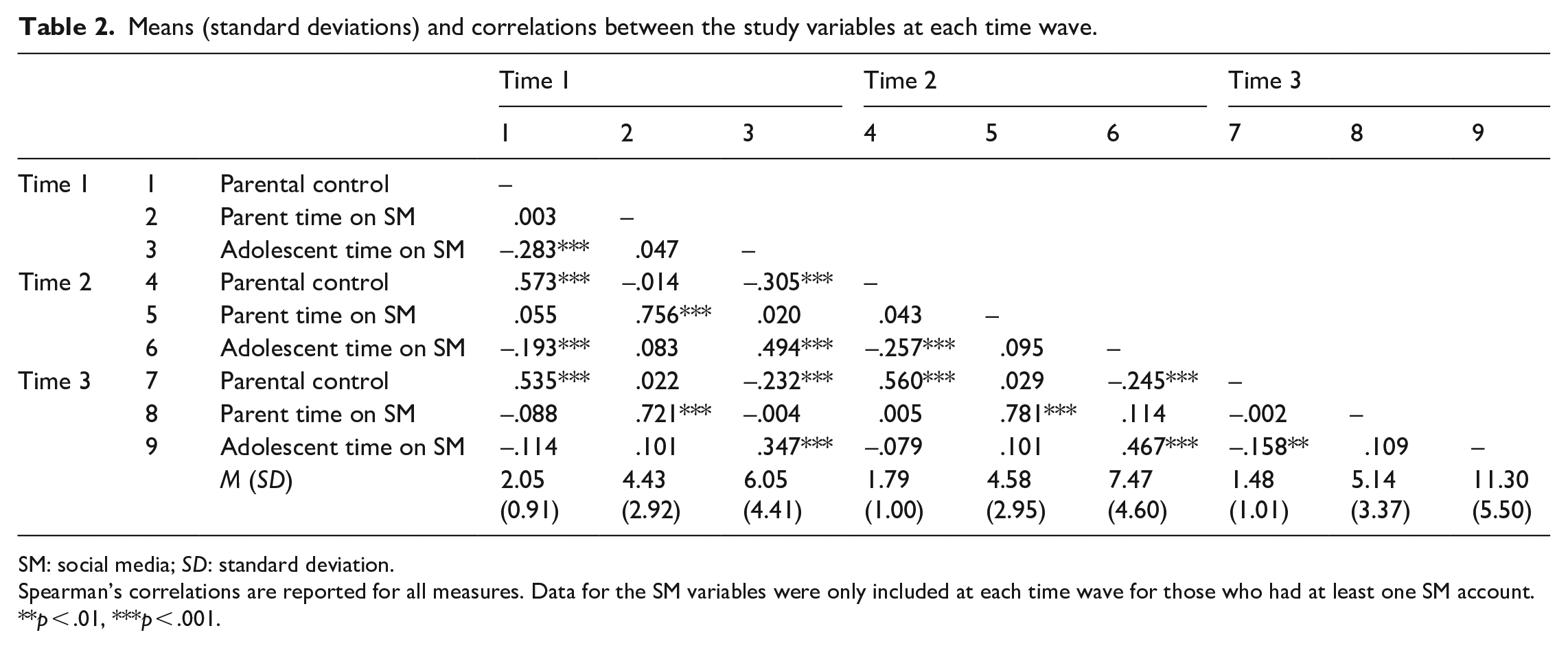
SM: social media; SD: standard deviation.
Spearman’s correlations are reported for all measures. Data for the SM variables were only included at each time wave for those who had at least one SM account.
p < .01, ***p < .001.
Cross-lagged analyses
Cross-lagged panel models were conducted with Mplus version 8.1 (Muthén and Muthén, 1998–2019). A model was specified with the observed parental control, parent time spent on social media, and adolescent time spent on social media variables to examine the temporal relationships between those variables over time. All variables were standardised prior to running the models to avoid convergence errors. The assumption of stationarity was tested by comparing models with all parameters estimated freely versus models that constrained all parameters to equality between waves. Model comparisons were based on the Satorra–Bentler scaled chi-square difference test and decrements in model fit, with significant chi-square difference tests and decreases in the comparative fit index (CFI) greater than .01 denoting worse model fit (Cheung and Rensvold, 2002). The assumption of stationarity over time was met as constraining parameters to equality between waves did not worsen the model fit (p = .120, ΔCFI = .005). We also tested for moderation by adolescent gender in a multigroup framework comparing models holding stationarity between waves with and without parameters constrained to equality between the male and female samples. Models constraining all parameters to equality between the male and female samples did not worsen the model fit (p = .325, ΔCFI < .001), suggesting that adolescent gender did not moderate the model tested in this study.
The final model, maintaining stationarity over time, resulted in acceptable model fit (CFI = .95, Tucker–Lewis index [TLI] = .93, root mean square error of approximation [RMSEA] = .06 and standardised root mean square residual [SRMR] = .07; Hu and Bentler, 1999). As seen in Figure 1, all autoregressive paths were significant, with medium to large effects, suggesting that the variables were stable over time. More adolescent time spent on social media predicted small decreases in parental control over time (T1–T2: b = –.141, standard error [SE] = .034, p < .001; T2–T3: b = –.146, SE = .034, p < .001). More parental perceived daily time spent on social media also predicted small increases in adolescent perceived daily time spent on social media 1 year later (T1–T2: b = .074, SE = .031, p = .016; T2–T3: b = .064, SE = .026, p = .014). No other cross-lagged paths were significant. 1 The pattern and significance of results did not differ when controlling for English as a first language or when controlling for the total number of social media accounts held by adolescents and parents at each wave.
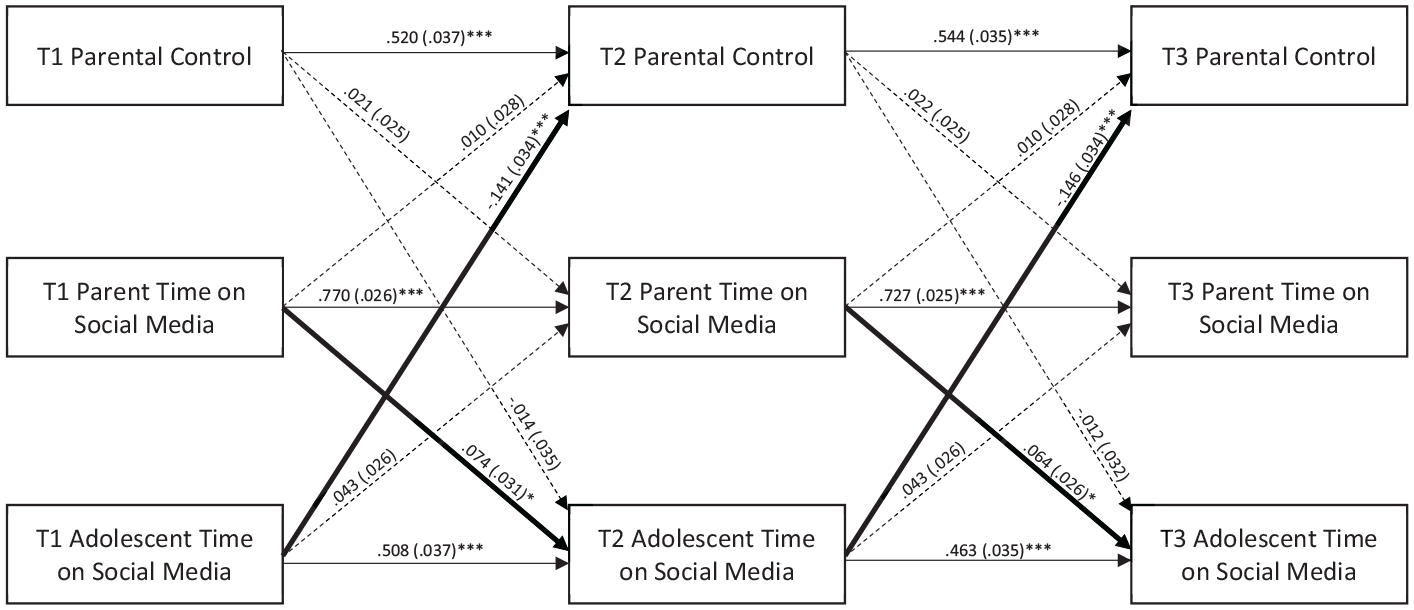
Cross-lagged model testing bidirectional relationships between parental control of social media use, parent time spent on social media and adolescent time spent on social media. Correlations between variables at each wave were included in the model but not reported in the figure for simplicity. Significant paths are indicated with solid lines and non-significant paths are indicted with dotted lines. Unstandardised beta coefficients are reported based on standardised variables; these parameters are interpreted as the predicted change in the outcome variable based on a 1 standard deviation increase in the independent variable. ***p < .001; *p < .024.
Discussion
The present study examined the prospective bidirectional and unique relationships between parental control of time spent on social media, parent perceived daily time spent on social media and adolescent perceived daily time spent on social media over three-time waves. Preliminary results indicated that as expected, social media use increased as the children developed through early adolescence and most parents (~93%) used social media throughout the course of the study, although we did find that platform preference varied between parents and children. Consistent with research conducted in the United Kingdom and the United States (Anderson and Jiang, 2018), the most popular social media platforms used by adolescents at each wave were Instagram, YouTube and Snapchat. The most popular platforms used by parents (primarily mothers) were Facebook, Instagram and Pinterest. The number of social media accounts held by adolescents and parents at each wave had no impact on the results of the study.
Examining time spent on social media more broadly (i.e. averaged across all social media platforms), we found no significant cross-sectional relationships between parent and adolescent time spent on social media at each wave, although this relationship appeared to strengthen over time. Thus, our cross-sectional associations may have been weaker than those of Vaala and Bleakley (2015), due to the younger age of our participants. However, we did find a prospective relationship between those variables. More parental time spent on social media relative to other parents predicted increases in adolescents’ time spent on social media 1 year later, although the effects were small. In contrast, adolescents’ use of social media did not predict parents’ use over time. One suggestion from these findings is that parents may model social media behaviours to their children over time. However, we cannot determine whether parental modelling was responsible for the relationships found in our study. More parental mobile media use has been linked to poorer mother-child interactions (Radesky et al., 2015). Thus, adolescents may spend increasing amounts of time on social media because they have less interactions with their parents while their parents spend time on social media. However, parents may also spend time on social media when they are not in the presence of their children. Thus, it is possible that the prospective relationships between parent and adolescent time spent on social media may be due to a third variable, such as parent mental health or parent–child relationships (Huang, 2017; Sampasa-Kanyinga et al., 2020). Further research is needed to examine potential mediators and moderators of the prospective relationships between parent and adolescent social media use. Adolescent gender did not moderate our findings, suggesting that parents, or primarily mothers in the present study, may influence the social media behaviours to their sons and daughters to a similar extent.
Consistent with some of the correlational literature (Fardouly et al., 2018; Panek, 2014; Shin and Kang, 2016), we found a small to moderate negative association between parental control of time spent on social media and adolescents’ time spent on social media at each wave. We also found prospective relationships between those variables over time, but not in the direction often proposed in cross-sectional research. Consistent with our earlier findings examining technology use more broadly (Richardson et al., 2021), more time spent on social media by adolescents relative to their peers predicted decreases in their parents’ perceived control over the time they spent on social media 1 year later, but parental control did not prospectively predict adolescent time spent on social media. Furthermore, adolescent gender did not moderate these relationships. Consistent with the transactional model of development (Sameroff, 2009), our findings suggest that parents’ behaviours can be influenced by their children, highlighting the importance of examining bidirectional relationships between parent and child behaviours.
Heavy social media use among adolescents has been associated with poorer parent–child relationships (Sampasa-Kanyinga et al., 2020). Thus, the results of the present study may be due to parents finding it harder to enforce rules around the social media use of adolescents who spend more time on social media than their peers. Furthermore, our results suggest that parental control or restrictive mediation may not be an effective strategy for reducing adolescents time spent on social media. Adolescents often use social media on their smartphones (Anderson and Jiang, 2018) and can thus access those platforms anywhere, including environments when they are away from their parents (e.g. travelling to and from school). Thus, parents may find it difficult to monitor and regulate their adolescents’ use of social media and determine whether they are abiding by their rules. Although parents naturally report using less restrictive mediation of media use as children develop through adolescence (Padilla-Walker et al., 2012; Rosen et al., 2008), the results of the present study suggest that parents should be encouraged to explore other techniques for reducing their adolescents’ time spent on social media, such as engaging in modelling or encouraging their child to engage in other offline activities. Autonomy supportive parenting, in which parents support their child to be self-initiating and autonomous, has been consistently associated with better child psychosocial functioning (Vasquez et al., 2016). Further research could examine the role of autonomy supportive parenting on adolescents’ social media use.
Although not a central aim of the present study, it is interesting to note that there were no cross-sectional relationships at each wave and no prospective relationships between parents’ control of the time their adolescent spent on social media and their own time spent on social media. Cross-sectional research finds that parents report more restrictive mediation of social media if they have less social media literacy (Daneels and Vanwynsberghe, 2017). Thus, it may be expected that parents who use social media less will place more restrictions on the time their child spends on those platforms. However, that was not the case in the present study. This may be because participants in the present study were primarily from middle- to high-income families, and research suggests that this demographic monitor and/or restrict their children’s media use to a greater extent and report more concerns regarding their children using social media (Auxier et al., 2020; Garg and Sengupta, 2019). Thus, the lack of significant findings may be due to parents being motivated to control their child’s time spent on social media due to their concerns about such use, regardless of how much time they spend on social media themselves. Further qualitative and longitudinal research could explore factors influencing parents’ motivation for placing restrictions around their adolescents’ use of social media.
Limitations and future directions
There are several limitations to the present study that should be noted. First, we only collected information from one parent or primary caregiver, and they were primarily mothers. Future research should measure restrictive mediation and use of social media from both parents and consider the role of siblings to gain a more nuanced understanding of the influence of families on adolescents’ social media use. Second, like most previous research, we used a self-report rather than objective measure of time spent on social media, and our measure combined categorical rather than continuous responses, which limit our ability to interpret specific amounts of daily perceived time spent on social media. Research suggests that although there is a strong positive correlation between subjective and objective measures, people may overestimate their time spent on social media (Junco, 2013). Future research could include objective measures of time spent on social media to increase external validity. Third, we only measured the parents’, not the adolescents’, perception of the amount of control they had over their child’s social media use. Research suggests that parent and child reports of parental monitoring of media use are poorly correlated, yet equally good predictors of children’s screen time (Beyens and Valkenburg, 2019; Gentile et al., 2012). Future research could test whether the relationships found in the present study are evident when measuring adolescents’ perceptions of their parents’ restrictive mediation of social media use. Fourth, we only examined one form of parental mediation using an item created for this study. Other forms of parental mediation, such as active mediation (i.e. having open discussions about media use), are likely to be more influential during the adolescent period. Future research could use validated measures of different types of parental mediation strategies for social media use collected from both parents and adolescents (e.g. Ho et al., 2020). Finally, our sample consisted of primarily Caucasian adolescents from middle- to high-income families. Research suggests that parental mediation practices and their own use of technology can vary based on socioeconomic status and ethnicity (Garg and Sengupta, 2019). Future research should examine whether the findings of the present study generalise to families from other cultures and income groups.
Conclusion
Social media use is widespread among adolescents (Ortiz-Ospina, 2019) and parents often report concerns around the amount of time their adolescents spend on those platforms (Hammons et al., 2021; Toh et al., 2019). The present three-wave panel study examined the bidirectional relationships between parental factors, such as parental control of time spent on social media and parents’ own perceived time spent on social media, and early adolescents’ perceived time spent on social media over a 2-year period. Parents’ level of control was predicted by the amount of time their adolescent spent on social media. Parental control of time spent on social media did not influence the amount of time their child spent on social media. Less time spent on social media by the parents, did however, predict small decreases in the adolescents’ time spent on social media 1 year later. Further longitudinal research is needed to examine these relationships using validated, and where possible, objective, measures of those constructs. However, the results of the present study suggest that parental restriction may be an ineffective strategy to reduce adolescents’ time spent on social media. Further research is needed to explore the potential benefits of less parental time spent on social media for adolescent social media use and to examine potential mechanisms responsible for this relationship.
Supplemental Material
sj-docx-1-nms-10.1177_14614448221076155 – Supplemental material for Investigating longitudinal and bidirectional relationships between parental factors and time spent on social media during early adolescence
Supplemental material, sj-docx-1-nms-10.1177_14614448221076155 for Investigating longitudinal and bidirectional relationships between parental factors and time spent on social media during early adolescence by Jasmine Fardouly, Natasha R Magson, Ronald M Rapee, Ella L Oar, Carly J Johnco, Cele Richardson and Justin Freeman in New Media & Society
Footnotes
Funding
The author(s) disclosed receipt of the following financial support for the research, authorship, and/or publication of this article: The Australian Research Council funded this research (grant number FL150100096).

Supplemental material
Supplemental material for this article is available online.
Notes
Author biographies
References
Supplementary Material
Please find the following supplemental material available below.
For Open Access articles published under a Creative Commons License, all supplemental material carries the same license as the article it is associated with.
For non-Open Access articles published, all supplemental material carries a non-exclusive license, and permission requests for re-use of supplemental material or any part of supplemental material shall be sent directly to the copyright owner as specified in the copyright notice associated with the article.
