







Abstract
By presenting a case study based on the argumentative analysis of news in the press, this article introduces and discusses strategic manoeuvring with contextual frames. Drawing on the linguistic notion of frame, I introduce the concept of contextual frame to refer to the news context, that is, the background against which a certain event is presented as a piece of news. I argue that newspapers and journalists make use of contextual frames in the apparently neutral genre of news reporting to propose specific interpretations of the facts at issue, which become the basis for explicit comments and editorials. To show how this works, I investigate in detail a case of newspaper coverage of a complex episode using the pragma-dialectical notion of strategic manoeuvring and the Argumentum Model of Topics (AMT) to analyse argument schemes. I show that, in the use of contextual frames, there is a prominent relation between presentational devices (the lexical choices that build up the frame) and topical potential; contextual frames provide the implicit material premises (endoxa) which are at the basis of argumentations through which newspapers interpret and comment on the news.
Keywords
Introduction
Among daily newspaper genres, news articles are often viewed as ideally non- argumentative and separated from comments and columns. 1 Indeed, inevitably, newspapers construct news (Fitzgerald et al., 2008; Pounds, 2010); thus, even the selection of facts and the way they are presented may play a role in an argumentative discussion (see Walton, 1999; Gatti, 2002). 2 Generally speaking, argumentation is a discourse activity in which interlocutors are ideally committed to give reasons to support their claims and are open to critical evaluation. Because argumentation is a mode of discourse (Smith, 2003), it can appear in different types of discourse, among which newspaper articles are often included (see Walton, 2007).
In this article, I claim that one of the aspects through which the media reconstruction of facts bears consequences at the level of argumentation is the relation of news to the linguistic frame corresponding to their contextual background. In this relation, I use the term context to refer to the news context, namely the broader framework in which a single piece of news is placed, rather than to the context of the news event (or news production), as analysed in Van Dijk (2008, 2009). In other words, when using the term contextual, I am not referring to the context in which media argumentation is produced, which an analyst of argumentation should take into account at various levels when doing an analytical overview of the discourse (see Van Eemeren, 2010; for a definition of context in this sense, see also Rigotti and Rocci, 2006). I am referring to the fact that each piece of news is defined as such against a context of states of affairs, presumably already known by the readers.
I want to contribute to explaining how news reporting may indirectly become a form of advancing an argument (see Richardson, 2007). More particularly, I claim that the event/contextual frame relation is part of the journalist’s or the newspaper’s strategic manoeuvring (Van Eemeren, 2010; Van Eemeren and Houtlosser, 2002), namely of the effort to present facts in a correct (reasonable) way but still aiming to win the newspaper’s cause, thus presenting a certain interpretation of events themselves. As I will argue, the news–context relation can be thought of as a sort of game of Chinese boxes. In this game, putting a certain event into one or the other contextual box (frame) significantly changes its interpretation, even when the reconstruction of the events is seemingly neutral.
I will intensively investigate this specific form of strategic manoeuvring by analysing a single case study of media news reporting and comments. The article is constructed as follows. First, I shall discuss what I mean by contextual frames and why I think they can be an instrument for strategically manoeuvring. The case study referred to in this article will then be presented. The results of the analysis are discussed in the next section, followed by the Conclusion section, which summarizes the main findings and comments on their limitations and strengths.
Strategic manoeuvring with contextual frames
The notion of frame is generally known from Goffman (1974), but it has been used in somewhat heterogeneous ways in a variety of traditions (Koenig, 2005; Rocci, 2009). I refer in particular to the linguistic analyses of Fillmore and his colleagues, who have provided several examples of frames – see, for example, the commercial transaction frame, to which the nouns Buyer, Seller, Goods and Money and the verbs to buy, to sell, to charge, to spend, to pay and to cost are directly ascribable (Fillmore, 1976; Fillmore and Atkins, 1992). To evoke a frame and its corresponding scenario it is not necessary to make every single term pertaining to this frame explicit; for example, saying ‘You paid too much money for this old chair’ is sufficient to activate the commercial frame and evoke our scenario or ‘prototypical scene’ of a bargain. In other words, from the cognitive point of view, frames need not be complete, because journalists can count on their readers’ contextual knowledge (Van Dijk, 2004) to fill in gaps. As I will show in the penultimate section, for example, if a victim described as a seasoned intelligence officer died ‘in service’, this automatically evokes in the readers an articulated and, so to speak, definite scenario of the life of intelligence officers, including their duties and responsibilities.
In this article, I will only focus on those frames which represent the background scenario or context of the episode considered. I will call them contextual frames. As anticipated in the Introduction section, each piece of news is defined as such against a context of states of affairs; I reserve the term contextual frames for the news context. For example, newspapers could describe the introduction of bike sharing in London in the contextual frame of ‘eco-friendly attitudes now spreading all over Europe’; or they may use the phrase ‘Boris Bikes’ and, thus, insert the news in the contextual frame of ‘Boris Johnson’s [the Mayor’s] initiatives for the city of London’. To provide a more detailed example of what I mean by contextual frame, I shall consider one of the positions that emerged in the environmental conflict over the Kishon River in Israel as discussed by Shmueli and Ben Gal (2003: 224):
The Rowing Club had this to say: ‘Due to the pollution, the club has difficulty functioning and is in a serious crisis, on the brink of closure’. (emphasis added)
The position of the Rowing Club, one of the disputants in the considered conflict, framed the pollution of the Kishon River basin as the cause and the context in which their difficulty had arisen. Saying ‘Due to the pollution’ evokes the frame of an area which has become unhealthy because of human exploitation. Putting the serious crisis of the Rowing Club in this contextual frame suggests they are not culpable for their problem.
The Kishon River example shows that there may be a connection between the choice of a contextual frame and a precise strategy pursued by the speaker to justify a position. This is why argumentation is relevant even to the apparently descriptive communicative genre of news reporting. For the purposes of this article, I assume the extended pragma-dialectical theory of argumentation (Van Eemeren, 2010), which claims that the arguer’s dialectical aim to solve their difference of opinion on the merits by means of a critical discussion is always paired with a rhetorical goal. Each arguer (take the journalist or newspaper as an example) wants to win his cause; at the same time, he is committed to doing it reasonably. Maintaining the balance between the commitment to reasonableness and the attempt at being effective means that the arguers have to manoeuvre strategically in all moves that are carried out in an argumentative discussion (Van Eemeren and Houtlosser, 2002). In particular, strategic manoeuvring manifests itself in the discourse through three aspects: ‘A particular choice made from the available topical potential, a particular way in which the opportunities for framing the addressee’s perspective are used [audience demand], and a particular way in which presentational possibilities are exploited [presentational devices]’ (Van Eemeren and Houtlosser, 2009: 6). Because the three aspects are always connected, Van Eemeren (2010) proposes picturing them in a triangle to highlight their mutual interdependence.
The hypothesis of a connection between frames and strategic manoeuvring is not completely new. Van Eemeren (2010: 125–6) argues that the modern concept of frame is a construct that presents the three aspects of strategic manoeuvring as intertwined starting from a certain use of presentational devices: ‘Framing always involves an interpretation of reality that puts the facts or events referred to in a certain perspective.’ Following Greco Morasso (2009), he highlights that the theoretical reflection on frames has the merit of showing that the linguistic characterization of an issue is never neutral, because the definition that we give of a certain issue is always deeply connected with its interpretation and with the value we attribute to it. According to Greco Morasso (2009), in fact, there is a connection between frames and cultural premises which may be then used in argumentation to build up arguments in favour of a certain standpoint.
Following on along this stream of research, in this article I argue that contextual framing, starting from presentational devices – in the case of written journalism, from the linguistic characterization of an issue 3 – creates cultural premises which are then used by the journalist to support a certain standpoint. In this sense, the connection between presentational devices and topical potential becomes prominent in this specific use of contextual frames. Van Eemeren (2010: 93–4) defines the available topical potential as ‘the (not always clearly delineated) repertoire of options for making an argumentative move that are at the arguer’s disposal in a certain case and at a particular point in the discourse’. As this author notes, for example, there are usually different arguments the arguer can chose from for defending his or her standpoint in an argumentative discussion; so the arguer has some freedom to choose the line of defence that suits him or her best. Similarly, the use of contextual framing allows the selection of adequate material starting points, that is, shared views and values, which can be used to construct arguments. The strategic function of such topical choice, allowed by the use of presentational devices, is to support a certain interpretation of the news and therefore to put forward a line of defence for a certain standpoint. 4
In order to explain how the presentational devices used in framing are connected to the topical selection of material starting points used in argumentation, I need to complement the extended pragma-dialectical theory of argumentation with the Argumentum Model of Topics (AMT), which analyses the inferential configuration of arguments in detail; this helps elicit all their procedural (formal) and material premises (Rigotti and Greco Morasso, 2010). This model is situated in the tradition of studies on argument schemes or loci 5 (Rigotti, 2009). The level of detail permitted by the AMT will allow discovering how the contextual frame that the journalist selects in reconstructing a certain event may be activated as a premise for an argument. For reasons of space, I will describe the AMT model while using it as an analytical tool (see penultimate section).
Before moving on to the analysis of the case considered, it is important to note that the strategic function of contextual frames as a means to manoeuvre strategically fits the macro-context represented by the communicative activity type in which the argumentative discussion is developed (Van Eemeren, 2010). Our case study is rooted, generally speaking, in media argumentation (Burger and Martel, 2005; Walton, 2007) and, more in particular, in the newspaper genre of news reporting. In this context, the journalist cannot chose overtly to advance and defend a standpoint, as one would expect in a column or editorial; for this reason, using contextual frames becomes an expedient choice to respect the limits of the activity type, at the same time hinting at a certain interpretation of the facts that may also be used to support precise standpoints in more direct forms of argumentation. In this sense, the traditional distinction between news and comments (see, e.g., the Reuters Handbook of Journalism, 2008) becomes to some extent blurred; as we will see, editorials and comments may rely on contextual frames used in news reporting as a point of departure for explicit argumentation.
The case study
The case study I have selected for this article is particularly interesting in understanding the event–contextual frame relation as a means for manoeuvring strategically in media argumentation. The case-study approach is motivated by the pursuit of a nuanced view of the considered phenomenon (Flyvbjerg, 2001). I have chosen to analyse in depth a single case of news coverage in order to show how strategic manoeuvring with contextual frames works and what its effects are at the level of how news is understood and interpreted. We are certainly in need of further research to develop the results I am going to present here.
This case study relies on empirical data (newspaper articles) which are part of a larger database set up in the framework of a research and teaching project concerning media argumentation developed at USI-University of Lugano (Switzerland) in the years 2004–10 (see Rigotti and Greco, 2005) within the framework of the project Argumentum (www.argumentum.ch).
The case took place during the war in Iraq which began in March 2003. In February 2005, an Italian journalist known for her pacifist opinions, Giuliana Sgrena, was kidnapped during a visit to Iraq. After about one month, she was freed thanks to the intervention of the Italian government; they negotiated with the kidnappers and presumably paid for her liberation. At the practical level, this was made possible via the intervention of the Italian Intelligence Service (henceforth, Sismi). Unfortunately, the head of the Sismi cell in Iraq, Nicola Calipari, was killed on the same night of Sgrena’s liberation. On the way back to Baghdad Airport, the car they were travelling in came under fire in disputed conditions. It was shot at by US soldiers who had set up a roadblock to protect the convoy transporting the US ambassador. According to Mrs Sgrena’s testimony, Calipari threw himself on her to protect her, and died shortly after.
The two events – Sgrena’s liberation and Calipari’s death – were announced by the Italian media about one hour apart on the night of 4 March 2005. Following Van Dijk (1985), it could be argued that at the level of news schemata (roughly, the macro-syntax of news discourse), in this case two Main Events (Sgrena’s liberation and Calipari’s death) were interpreted as a coherent unit, or Episode. Indeed, the two events were perceived as so important because they were connected: they were interpreted as opposite poles (life and death, joy and sorrow) of one and the same Episode, which deeply moved the Italian population and caused a vivid debate about the necessity of having Italian troops in Iraq.
The case study reconstructed here is based on analyses of Italian newspapers published on 5 and 6 March 2005, namely the two days immediately following the event. As a source of information for the analytical reconstruction of argumentation in these articles, however, I could rely on a broader collection of data (Rigotti and Greco, 2005), including a longer time-span (5–9 March) and international newspapers (several European and American newspapers in English, French, German and Spanish were included).
As said, this case study is particularly relevant in understanding the role of the category of contextual frame in strategic manoeuvring, because different contextual frames were activated to explain and to some extent justify the circumstances of Calipari’s death: the war, the operations to liberate Mrs Sgrena, the (alleged) American attitude to preemptive war, the American–Italian controversy over the legitimacy of negotiating with kidnappers, etc. These different contextual frames were selected by journalists and newspapers which had a specific interpretation of the facts in mind.
But there is another reason why this case study is particularly interesting in understanding how media construct their interpretation of facts: the two Main Events constituting this Episode were both, in many ways, unexpected and came as a puzzle for both the left-wing and the right-wing ideological orientations (Rigotti and Greco, 2005). On the one hand, in fact, Mrs Sgrena, a well-known left-wing pacifist (at the time she worked and she still works for the self-defined communist newspaper Il Manifesto), was freed by the intervention of a right-wing government, aligned with the US invasion of Iraq which she had severely criticized. Following her liberation, Il Manifesto apologized for previous negative comments about the alleged inefficiency of the government.
On the other hand, right-wing newspapers had to cope with the fact that Calipari had been killed by US troops, that is, by an ally of the Berlusconi government. The American government immediately said that the incident was due to a mistake; but the circumstances of this mistake were not clear at that time and are still disputed today, despite the conclusion of the joint Italian–American investigation into the causes. According to the Wall Street Journal Europe (7 March, p. A5), the incident was ‘an acute embarrassment for Mr. Berlusconi’s government’ and, arguably, it was at least equally embarrassing for the newspapers that supported the government. It raised many controversial issues: the level of stress of American troops, their training and living conditions during the war and their behaviour to civilians. More generally, many prickly questions arose about the reasonableness of having Italian troops in Iraq.
In such a complex scenario, several argumentative texts were blossoming in newspapers in Italy and around the world. Figure 1 is a descriptive overview of the events in connection to newspaper genres and types of argumentation which emerged in the newspapers considered. As it visually appears, the Sgrena–Calipari Episode is made even more complex daily through the introduction of new relevant facts in the news of the following days. Over time, once the reconstruction of facts has been established, articles progressively become explicit argumentative essays commenting on what happened.
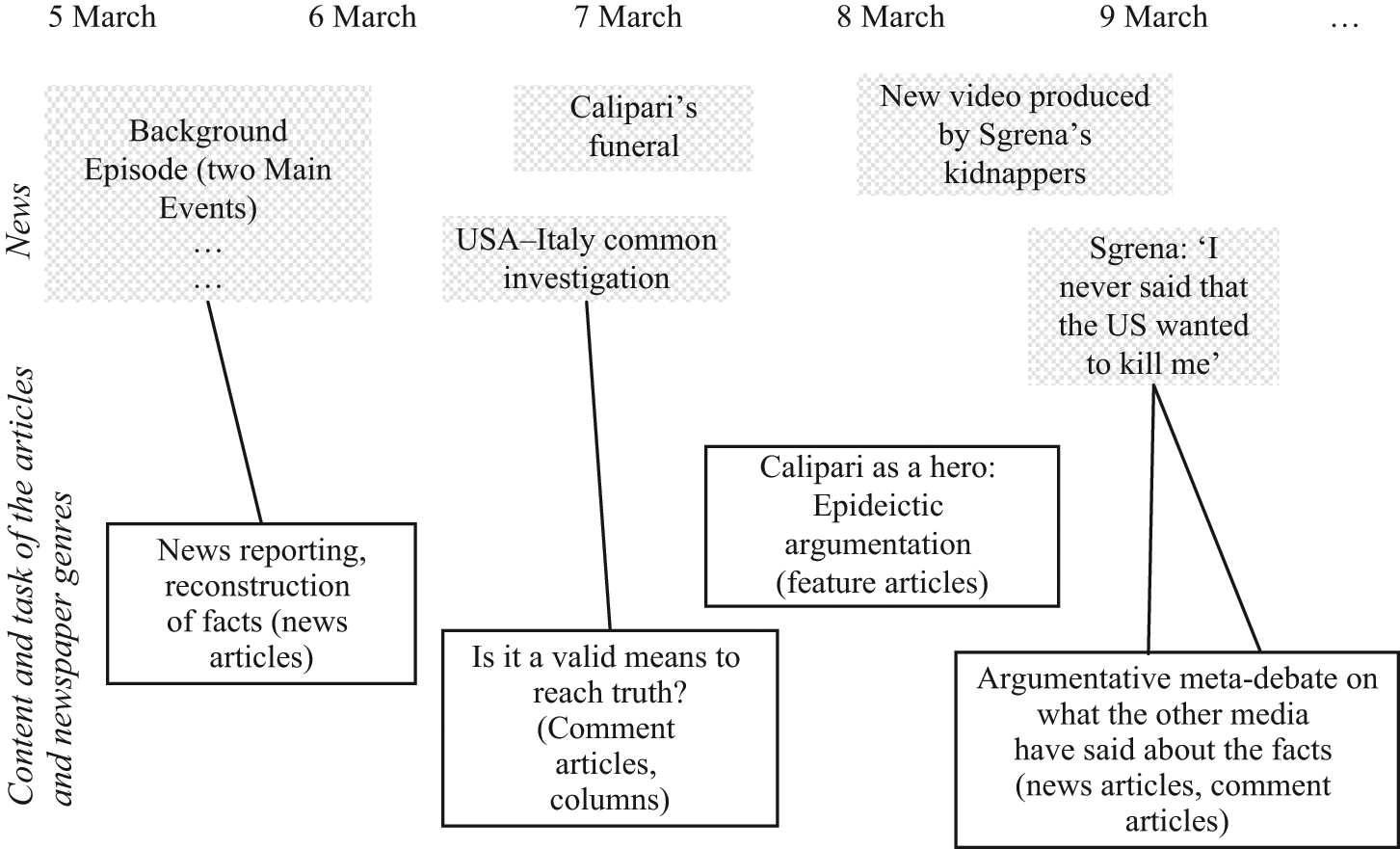
Types of newspaper genres and argumentative discussions in the days following the Sgrena–Calipari Episode (adapted from Rigotti and Greco, 2005).
Contextual frames and strategic manoeuvring: Reconstruction and evaluation of the Sgrena–Calipari Episode
The analysis of the corpus showed that the basic categories used to place the Sgrena–Calipari Episode and, in particular, the Main Event of Calipari’s death, into one or the other meaningful contextual frame, were action and event. As it will be shown in the following analysis, if the Episode – and, in particular, Calipari’s death – is seen as the result of an action, certain consequences will follow at the level of interpretation. Otherwise, if it is seen as an unintentional event, the interpretation will sensibly change. From the analysis of the corpus, three main contextual frames have been identified that carry three very different interpretations of the Episode in question: a) Calipari’s life in the Italian intelligence service and his missions; b) the war in Iraq; c) the American way of dealing with (presumed) enemies. In what follows, I shall discuss these three frames and show how they are used in journalists’ strategic manoeuvring. Each part of the reconstruction will be backed by representative examples taken from the corpus. The English translations from the Italian original texts are all mine except for the last one, which is adapted from an English version of the newspaper article (see J. Piccolo, www.universitadelledonne.it).
Contextual frame 1: The life and commitments of an intelligence officer
On 5 March 2005, the (right-wing) newspaper Libero devoted the front page to the description of the Sgrena–Calipari Episode; in the case of this newspaper, the news report and comment have been associated ever since the first day of news coverage. It is worth mentioning that the editorial on the same page was entitled ‘Berlusconi frees Mrs. Sgrena too’ (‘Berlusconi libera anche 6 la Sgrena’). ‘Too’ is referring to the fact that Berlusconi’s government was previously credited with the liberation of two kidnapped Italian volunteers, Simona Pari and Simona Torretta (on 28 September 2004).
Let us consider a significant excerpt of the article devoted to the reconstruction of events:
(1) At this moment, more than a single thought should be addressed to Nicola Calipari, dead in service in order to protect a hostage who had just been freed.
7
In this account, one of the Main Facts, namely Mrs Sgrena’s liberation, has to be understood as the intended result of a purposeful action; while Calipari’s death is an event, characterized as an undesired side effect. It is a sad, unwanted event; still, it is a ‘justifiable’ one. Calipari, in fact, was an intelligence officer who ‘died in service’. His behaviour was brave and he deserves praise; his death is an unfortunate side effect of his job. In other words, the contextual frame is the life of an intelligence officer; Calipari’s death becomes an incident in this frame. Via the linguistic choices (presentational devices), Calipari is presented as the main character, while Mrs Sgrena is a secondary one; she is referred to as ‘a hostage’ rather than with her proper name. In fact, in this frame, Sgrena’s personal identity is not as important as her being a hostage whom Calipari had a duty to protect.
If these lexical choices outline the contextual frame of the life and commitments of an intelligence officer, an important implication follows: the establishment that made war in Iraq and sent Calipari there (i.e. the Italian government) is not to blame for Calipari’s death. This consequence is left implicit in this newspaper article but it can be elicited from what is explicitly said. The reconstruction of the standpoint and the main argument advanced by Libero could be the following (I adopt the representation proposed by Van Eemeren et al., 2002):
1. The Italian government is not to blame for Calipari’s death. 1.1 Because Calipari’s death was included in the possible side effects of his job.
This line of argument elaborates on the implications of undertaking a professional commitment, which entails a certain degree of responsibility and awareness. In any professional field, if one accepts a job he or she equally accepts all of its implications, including risks; this is usually made explicit in professional contracts. Framing Calipari’s death in this way by means of precise presentational devices at the lexical level has some effect on the topical potential: this contextual frame builds up the premises necessary to reason that Calipari’s death is an accident for which the Italian government is not to blame (Figure 2).
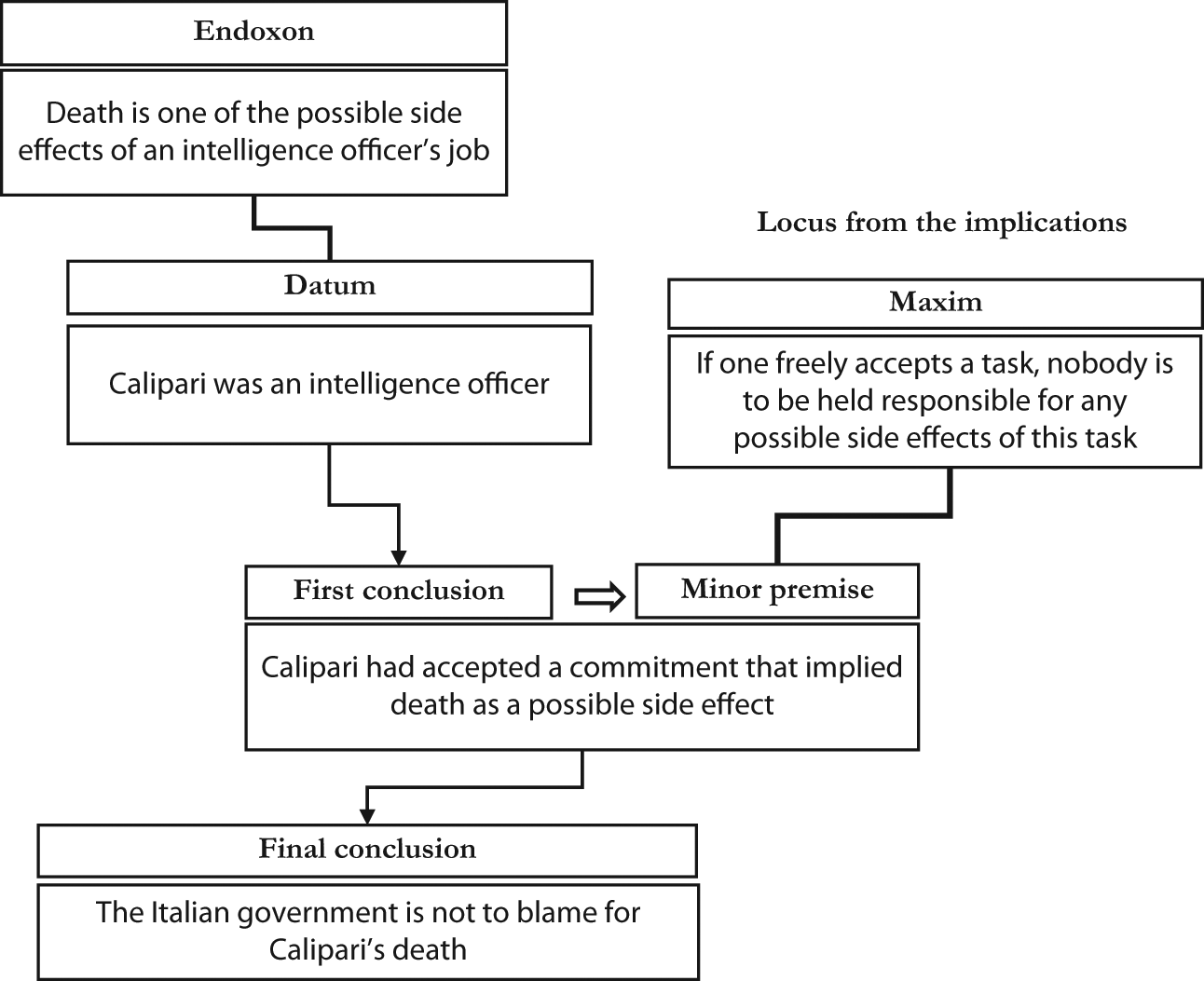
AMT-based reconstruction of argumentation with the first contextual frame.
I will now go into detail on the inferential structure of the journalist’s strategic manoeuvring by means of an analysis based on the Argumentum Model of Topics (see earlier). The analysis of the inferential configuration of this argument is presented in Figure 2. On the right of the diagram, the procedural principle (maxim) on which the argumentation is based is specified: ‘if one freely accepts a task, nobody is to be held responsible for any possible side effects of this task’. This is one of the maxims of the locus from the implications (see Rigotti, 2009), which highlights how making a commitment implies accepting all of its possible undesirable side effects. So if a person freely makes a commitment, nobody else is to blame for the occurrence of a side effect. The reasoning follows with a syllogistic structure: ‘Calipari had accepted a commitment that implied death as a possible side effect’; therefore, ‘The Italian government is not to blame for Calipari’s death.’
This is only part of the argumentation, however. In fact, that ‘Calipari had accepted a commitment that implied death as a possible side effect’ needs further justification; different from the maxim, this is not an inferential rule but a factual statement that must be backed by contextual knowledge. And precisely this backing is provided by the contextual frame selected by Libero. The AMT representation allows consideration of the contextual or material premises that are implicitly or explicitly used in argumentation on the left of the diagram, in which a second line of reasoning is developed in support of the former one. This is why in Figure 2 the ‘First conclusion’ on the left becomes the ‘minor premise’ on the right. In this way, the crossing of material and procedural premises that is characteristic of argumentation is accounted for in the AMT (Rigotti and Greco Morasso, 2010).
The endoxon, an Aristotelian term indicating a shared opinion among the interlocutors, refers in this case to common knowledge about the job of an intelligence officer: ‘Death is one of the possible side effects of an intelligence officer’s job.’ The datum is a piece of factual knowledge (‘Calipari was an intelligence officer’), which combined with the endoxon produces the conclusion that ‘Calipari had accepted a commitment which implied death as a possible side effect’.
Considering the whole diagram in Figure 2 now, we see that the two lines of reasoning combined in this quasi-Y structure are crossing in such a way that the contextual frame provides the material starting point (endoxon in particular) to reconstruct an argument about the interpretation of facts. Therefore, the construction of a contextual frame via the use of certain presentational devices is a well-weighted choice in relation to the topical potential of Libero’s strategic manoeuvring to emphasize the merits of Sgrena’s liberation and minimize the ‘side effects’ that it has required. Without saying this explicitly, Libero discharges the US government from direct responsibility on the facts. The headline mentioned above (‘Berlusconi frees Mrs. Sgrena too’), which opens the front page of the newspaper, also contributes to focus on the positive achievements of the Italian government rather than on the incident that occurred during the night of the liberation.
So much for the contextual frame of the life and commitments of an intelligence officer’s job. In the following two sections, I will show how modifying the contextual frame allows for the selection of different material premises for other argumentations. In this way, I will further elaborate on the relation between presentational devices and topical potential in strategic manoeuvring with contextual frames.
Contextual frame 2: War in Iraq
The second way of strategically manoeuvring the interpretation of the Episode is to put it into the contextual frame of the war in Iraq. In this frame, Calipari’s death is seen as a consequence of the war; notice for example that, at the level of presentational devices, Calipari’s death is said to have been caused by ‘friendly fire’, a military phrase that refers to unintentional firing towards friendly forces, normally in the context of a conflict. However, at the time of the facts the war was officially finished, while the presence of US troops in Iraq was considered only as a temporary measure to help with the pacification of the country. Thus, as we shall see, selecting war as a contextual frame for the Sgrena–Calipari Episode is not a neutral choice.
The two most representative examples of this frame in the corpus are presented by the two left-wing newspapers Repubblica and L’Unità. I will start by quoting the first example, published on 5 March by l’Unità:
(2a) This is Iraq. Giuliana Sgrena is free, she is alive, but too much went wrong in this story. Because this is war. So it was; but please, stop talking about freed Iraq or pacified Iraq. There – we saw it yesterday – very often life has no meaning and people die for nothing.
8
In 2a, the phrasing (see ‘Because this is war’) is a presentational device used to presuppose that the war is not over. The same interpretation is brought forward on the same day by journalist Cinzia Zambrano, who has the task of reconstructing facts (pp. 2–3). In concluding her intervention (p. 3), Zambrano uses several words that construct the contextual frame of war: war, conflict, attack, enemy in gun’s sight:
(2b) The abduction is now concluded, thus, in the most unexpected way; the abduction of a journalist who went to Iraq to tell about a war that was pointless to make; a conflict that is still not finished today; a country in which security is utopia, as proven also by the attack launched yesterday because of a tragic mistake, because of a hand moving too fast – a hand guided by fear of being in the enemy gun’s sight [. . . ].
9
The second excerpt is from the newspaper Repubblica. The editorial published therein on 5 March ended with a sentence which outlines the contextual frame of war: ‘This is Iraq, this is Baghdad, this is war.’ This sentence is cited on 6 March as part of the editorial by the editor Eugenio Scalfari, titled ‘The drama of a meaningless war’:
(3a) (Page 35). ‘This is Baghdad, this is war.’ We did not need the Sgrena-Calipari episode to be aware of this principle; yet this episode counts as its tragic confirmation. [. . .]. One thing is clear: war is continuing, Iraqi instability is evident, the self-government of that country is far from being within reach; even less is pacification.
10
As a conclusion of his editorial, Scalfari declares:
(3b) Concerning Iraq, facts are that war is continuing and it is not only a cruel war but also a stupid one. It has been like that since it began and it is like that still today. And who knows for how long it will be.
11
In both passages (2 and 3) the Sgrena–Calipari Episode is interpreted as an unexpected event occurring in the contextual frame of the war in Iraq (this is Iraq, this is Baghdad, this is war); it is interpreted as an undesirable consequence of war itself. Two different yet interrelated standpoints are advanced exploiting this contextual frame. The first one results as a factual standpoint about the situation in Iraq:
2. War in Iraq is not finished (despite the declared victory). 2.2. Because we still see its effects (we have seen one in the friendly fire on Calipari).
The argument that supports this standpoint suggests that, if one can witness the effects of war, such as friendly fire and tragic mistakes, their cause (the war) must be continuing (see Figure 3). Exploiting the contextual frame of war, an argument from effects to cause (a subcategory of the locus from the efficient cause according to Rigotti, 2009) is put forward to prove that war is still continuing in Iraq: ‘Security in Iraq is utopia, as demonstrated also by the attack triggered yesterday’; ‘also’ is probably referring to other episodes that the readers have present in their memories at that moment in time.
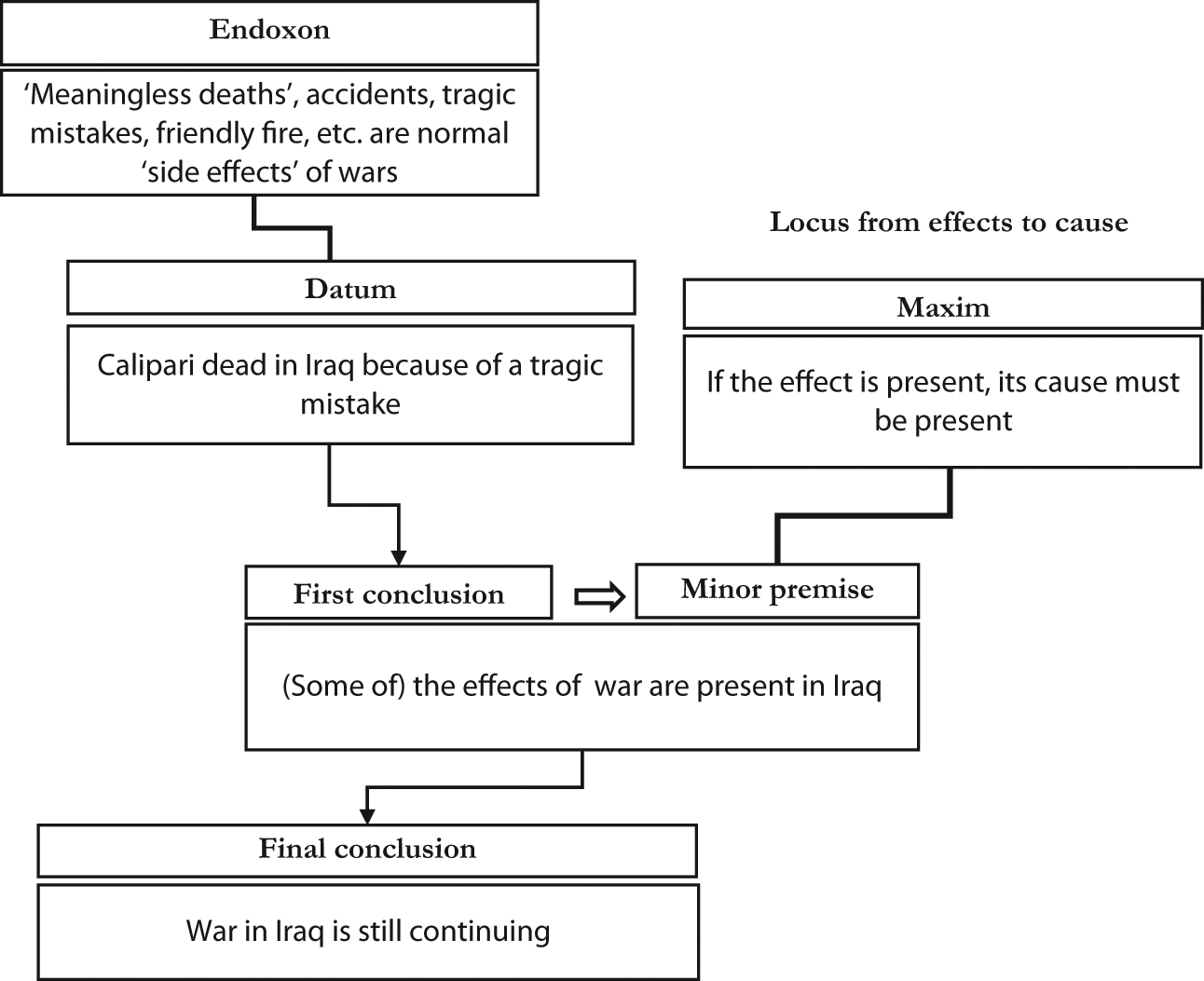
AMT-based reconstruction of argumentation with the second contextual frame.
Also in this case, the choice of a contextual frame determines the endoxon (‘meaningless deaths’, accidents, friendly fire, etc. are normal ‘side effects’ of wars), which defines what can be considered the effects of war. The endoxon is not stated explicitly in the article, yet it can be reconstructed as presupposed content. Selecting a contextual frame, thus, is strategic at the level of topical potential in the journalist’s strategic manoeuvring: in fact, once this premise is established, Calipari’s death can be represented as one of the effects of war in Iraq. Then, the Maxim shows, if the effects of war are present, it can be concluded that war in Iraq is still continuing. And this conclusion exactly corresponds to standpoint 2.
Another standpoint is connected to this one, which we might formulate as follows:
3. War in Iraq is meaningless 3.1. Because it is still continuing
The relevance of argument 3.1 to standpoint 3 is due to the fact that the US and its allies originally portrayed the Iraqi conflict as a blitz war and declared victory quite soon after defeating the Iraqi conventional forces. 12 As a matter of fact, however, the situation in Iraq was still unsettled and unstable even after the establishment of a new government. In this sense, demonstrating that war is not finished and Iraq is not pacified means contradicting one of the arguments used by George W. Bush and his entourage in proposing the war itself. So this is an indirect way to show that war is meaningless, although the link between these two standpoints is never made explicit.
The validity of such link depends on two factors: a) Does the Sgrena–Calipari example really demonstrate the fact that Iraq is not pacified? How is this fact important in relation to other consequences of the post-Saddam situation?; b) The second factor that is crucial for evaluating the soundness of argumentation in this case is how much the American government insisted on the issue of rapidity of the war and pacification of Iraq (beside other aspects, such as the alleged presence of weapons of mass destruction). If this is not the only argument used, then defeating this one is not necessarily equal to demonstrating that the war was meaningless. This article does not set out to comment on these aspects; I would just like to make the point that these would be important aspects in evaluating journalists’ argumentation about Standpoint 3. In any case, the selection of war as a contextual frame is a choice that allows journalists to put war itself into question.
Contextual frame 3: The American attitude towards preemptive war
The third and final contextual frame identified views the understanding of the events as an instance of the Americans’ alleged usual way of dealing with presumed enemies. This contextual frame was put forward by Il Manifesto, the newspaper for which Giuliana Sgrena used to work. Il Manifesto is declaredly a communist newspaper and has never hidden its anti-American views. On 6 March, the editorial by Rossana Rossanda presented the provoking title: ‘Preemptive homicide.’ A picture of Giuliana Sgrena getting off the plane which brought her from Baghdad to Rome dominates the front page of Il Manifesto. The only words on this page are: ‘La mia verità’ (‘my truth’), clearly alluding to Sgrena’s unique role as a journalist and a direct witness of the facts. In Mrs Sgrena, Il Manifesto had a direct source that no other newspaper had. Her truth is important because of her exclusive position to know.
I shall now report a large portion of Rossanda’s editorial that appeared on 6 March, which is largely devoted to the reconstruction of facts. It must be said that this article presents a certain degree of ambiguity, as the journalist argues for a certain interpretation of the facts but then seems to retreat her standpoint when she says that we will never get to know the truth: ‘certainly no theory can be ruled out and it is doubtful that we’ll ever know what really happened’. Although her position is not clear-cut, I propose to take the title of the article, ‘Preemptive homicide’, as a hint as to her standpoint. As can be argued from this title, for Rossanda the Episode (including Calipari’s death) is to be interpreted as the result of a human action rather than as an accidental event:
(4) She is alive in spite of the hail of fire from an American tank that unexpectedly hit the secret service vehicle transporting her to the airport. A hail of bullets that struck to kill. Of the three agents one, Dr Calipari, died as he threw himself over our comrade to protect her, and two are wounded, Giuliana too suffered light injuries. It is not an accident. [. . .] then various newspapers outdid themselves to provide justifications: a tragic error, an accidental error, a mistake and even a ‘snag’. And to top it off: Fini’s ‘atrocious joke of fate’. No, fate has got nothing to do with it. We are facing something that was not supposed to happen, an unforgivable ‘collateral effect’, a homicide that will end up classified as manslaughter, even if yesterday the Roman D.A. opened up a file for it under the rubric ‘voluntary homicide’. Giuliana was never so close to dying during the kidnapping as she was during this American shooting [. . .]. And it is scary, in my opinion, to think that someone in a command position, however much convinced that one should not negotiate over hostages, like the Americans and the English, may have ordered his subordinates: ‘Liquidate those Italians when they pass by’. Certainly no theory can be ruled out and it is doubtful that we’ll ever know what really happened. It might be that things were both simple and cruel at the same time: that either out of negligence, fear or too much whisky, the soldiers in the tank failed to stick to the information they had certainly received and applied their national motto: shoot first, then go see. If their government theorizes preemptive war and makes it, why shouldn’t the troops apply the same system? The primal information they have internalized is that the United States are above any rule.
13
What happened to Calipari is not interpreted as an event but as the result of an action which had been to some extent intentional. In other words, what happened to Calipari was not an accident. Calipari was murdered. This hypothesis was first suggested by Il Manifesto on 5 March through a headline written in capital letters on the front page of the newspaper: ‘Calipari murdered’; on 6 March Rossanda develops this interpretation. I thus propose reconstructing the standpoint and argument of Rossanda’s text as follows:
4. It is likely that the US soldiers who opened fire on Calipari’s car were making a preemptive attack. 4.1. The American national motto is ‘shoot first then go see’ (do preemptive attacks).
Also in this case, in order to support this factual standpoint, Rossanda manoeuvers strategically with a contextual frame. She frames the Episode within the context of the ‘usual behaviour’ of US troops or, even more generally, of the Americans’ usual attitude towards preemptive war. ‘Preemptive war’, ‘liquidate’, ‘shoot first, then go see’ are the lexical choices that build this frame at the level of presentational devices, together with the phrases ‘National motto’ and ‘primal information’, which suggest that preemptive war is to be intended as a general orientation towards enemies.
This frame is exploited as a basis for direct argumentation based on locus from the whole to its parts to prove that Calipari was murdered (see Figure 4). According to the maxim used in this case, ‘If it is common for an entire institution to behave in a certain way, then it is expected that each sub-unit of that institution will behave in the same way’. In this sense, if Americans theorize the right of making preemptive wars, each sub-unit governed by the American government, including the group of soldiers who killed Calipari, must behave accordingly – thus, preemptively. Recalling the ‘usual behaviour’ of Americans is clearly a choice at the level of topical potential; this choice allows Rossanda to suggest that it cannot be ruled out that the American troops opened fire on purpose, because that would be in line with their ‘national motto’. Rossanda develops this line of argument by means of a rhetorical question: ‘If their government theorizes preemptive war and makes it, why shouldn’t the troops apply the same system?’
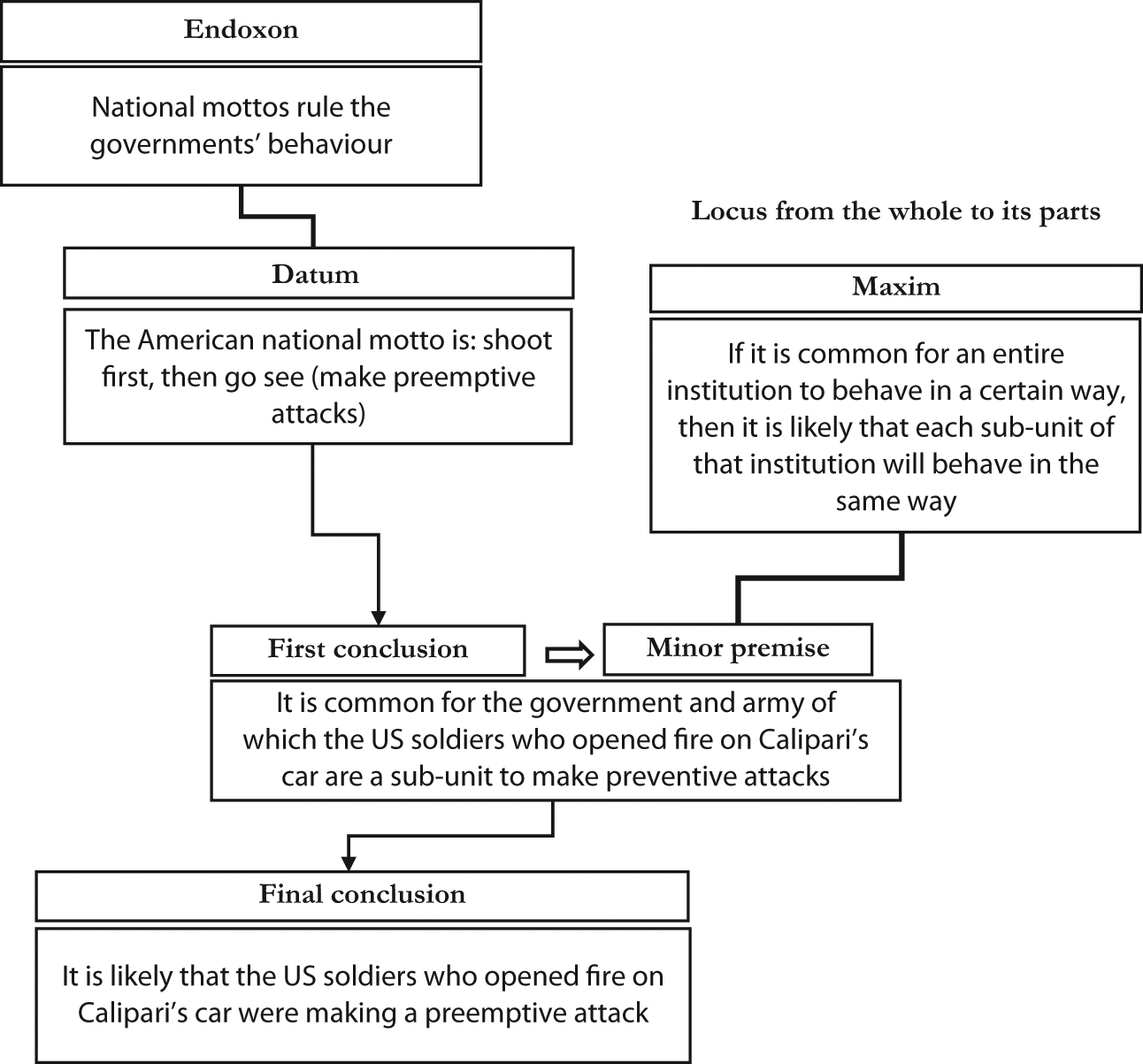
AMT-based reconstruction of argumentation based on the third contextual frame.
This position was severely criticized in other newspapers over the following days; Sgrena herself was accused of having said that the US troops wanted to kill her ‘without backing up the claim’ (see Wall Street Journal Europe, 7 March), but she denied this later (9 March; see Figure 1).
The fact that Rossanda’s standpoint was criticized is partly due, probably, to the fact that her line of argument is not completely clear. First, as said, she seems to retract her standpoint when she says that ‘it is doubtful that we’ll ever know what really happened’. Second, the applicability of the maxim in the specific case of preemptive behaviour is questionable: preemptive is a qualification that is normally applied to wars, but is it relevant to other types of action, like the one which the US troops would have allegedly done by shooting at Calipari? Finally, there could be discussion on whether there exists something like a ‘national motto’ or ‘primordial information’, which mechanically rules troops’ behaviour. Framing the situation in this way is clearly an attempt to create a ‘social fact’ (Van Eemeren, 2010: 126): the existence of such an American national motto.
Conclusions
I would like to first present a synoptic view of the different types of contextual frames, the standpoints and loci used in the argumentation. This allows comparison of the results that emerged from the argumentative analysis at a descriptive level (Table 1).
Synoptic table summarizing the argumentative analysis at a descriptive level.
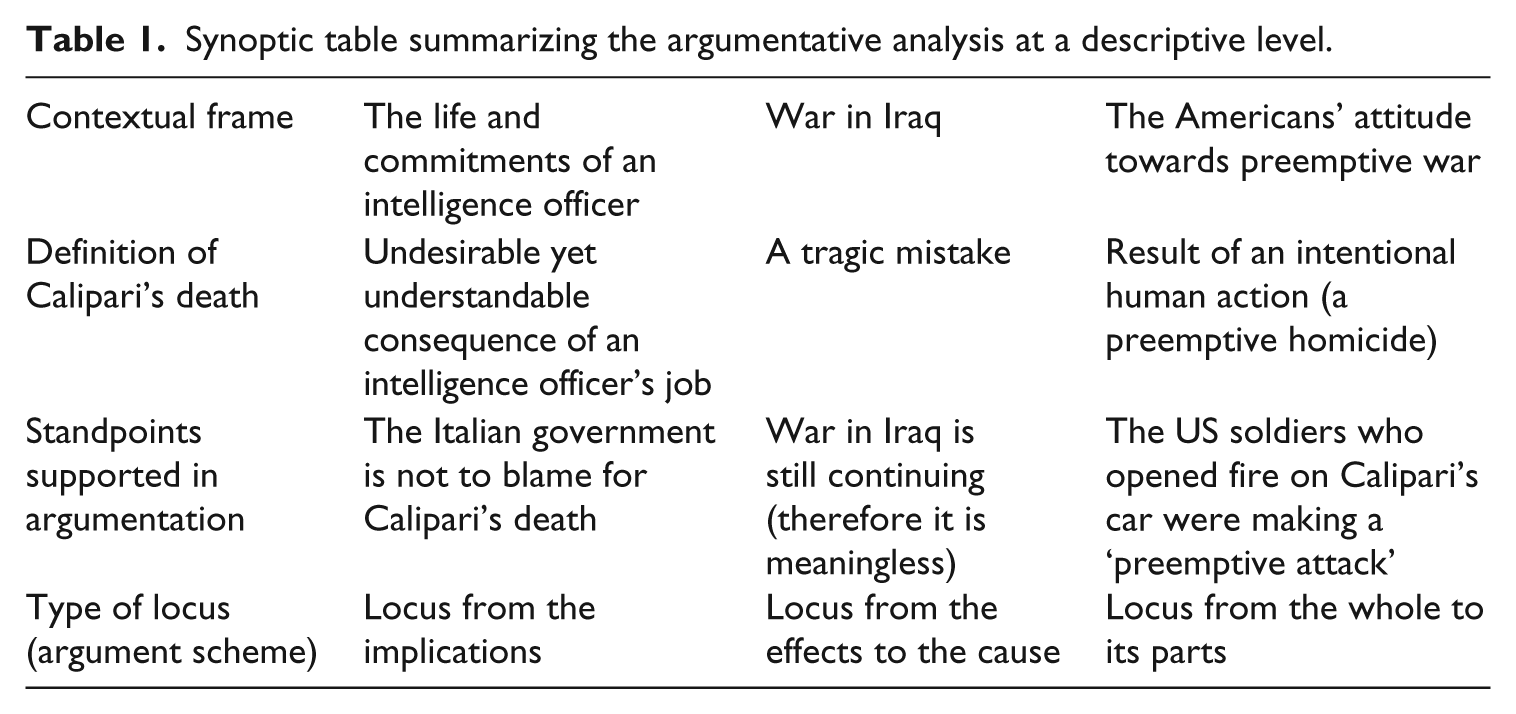
The analysis of the Sgrena–Calipari case study has shown the collocation of events in one or the other Chinese box (out of metaphor, one or the other contextual frame) bears important implications at the argumentative level, being a part of the arguer’s strategic manoeuvring. As pointed out by Van Eemeren (2010), framing includes all aspects of strategic manoeuvring. However, we found that in the specific case of contextual frames used in newspaper articles there is a prominent relation between presentational devices and topical potential. The contextual frame is built via the use of presentational devices and partly relies on the readers’ contextual knowledge (Van Dijk, 2004). The frame is then exploited in more explicit argumentative passages (comments or editorials) to construct material starting points; such frame-dependent premises are used in arguments that support standpoints providing interpretations and judgements about the episode reconstructed in the news. The choice of a contextual frame, in other words, allows a specific topical choice of certain premises and a given perspective on the event which is then assumed as a basis for more explicit and direct argumentation. The selected contextual frame, in particular, is reflected in the endoxon which grounds the argument scheme from the material point of view (see Figures 2, 3 and 4).
The choice of focusing on a single case study has certainly allowed an extensive study and familiarity with this specific moment of news coverage. It is equally clear, however, that focusing on a single case study leaves many questions open as to how this type of strategic manoeuvring with contextual frames is used in other cases of media coverage.
In concluding, I note how the three main contextual frames identified in this case could be placed along a continuum constituted by the dichotomy event–human action:

The more Calipari’s death is interpreted as the result of an action, the more it is linked to human responsibility and, possibly, guilt. The more we deal with a mere event, the less human beings are held responsible for it; thus, all issues about their culpability are left out of the argumentative arena. This is arguably a type of relationship that goes well beyond this specific case study and can be retraced in other institutional contexts (to quote a prime example, the juridical one); it might be described as a dichotomy bearing particularly important argumentative consequences. Finding out how this and other dichotomies work at the argumentative level is one of the directions of research relevant to the study of discourse in society.
Footnotes
Acknowledgements
A draft version of this article was presented during the STALDAC 2010 Conference at the University of Cambridge, UK, 8–10 April 2010.
The foundation of the present study was laid at the Institute of Linguistics and Semiotics (ILS) at USI-University of Lugano in the years 2004 to 2010. I am grateful to Eddo Rigotti and the students of the course on media argumentation (2005–8) for the useful discussions on earlier versions of this article.
This article was finalized while I was benefiting from a Swiss National Science Foundation fellowship (SNSF PBTIP1-133595) and working at University College London and the University of Surrey, UK.