






Abstract
Within the theoretical framework of Pragma-Dialectics, this research investigates prototypical argumentative patterns based on pragmatic argumentation that manifest themselves in the spokespersons’ argumentative replies at the regular press conferences of China’s Ministry of Foreign Affairs. As is shown by the research results, constrained by the institutional point of the communicative activity type (justifying China’s attitude and actions regarding controversial issues) and its institutional preconditions, argumentative patterns based on pragmatic argumentation prototypically occur in three variants, viz. the ‘solvency type’, the ‘maintenance type’, and the ‘counter-plan type’; it can be observed that in complex pragmatic argumentation each of these three variants may also occur in combination with other variants.
Keywords
Introduction
In contrast with China’s longtime maintained diplomatic doctrine of ‘keeping humility and showing respect’ (韬光养晦, Tao Guang Yang Hui), since 2016 China has dealt with diplomatic matters in a more ‘progressive’ way, in line with Xi Jinping’s thought about China-specific ‘great-power diplomacy’. 1 This new diplomatic attitude is demonstrated by the spokespersons’ unyielding (uncompromising) argumentative replies at the regular press conferences of China’s Ministry of Foreign Affairs (MoFA ) (see van Eemeren et al. 2022; Wu, 2021), through which China releases diplomatic information and responds to international criticisms. According to Wu (2023), in trying to reconcile the pursuit of effectiveness with maintaining reasonableness in responding to the questions advanced by journalists, the spokespersons have two kinds of options for determining the difference of opinion they would like to resolve. The first one is agreeing to resolve the difference exactly as it is, according to the questioning journalists, posed or suggested by their opponents. The second option consists of disagreeing to resolve the difference as posed or suggested by their opponents. In going for this second option they have, again, two options: (a) redefining the difference in such a way that they can resolve it more easily; (b) exempting the difference from the need to resolve it. In Wu (2017, 2019a, 2019b), the spokespersons’ use of the second option has been analyzed with a focus on the prototypical modes of strategic maneuvering employed by the spokespersons, viz. strategic maneuvering by personal attack, by dissociation, and by declaring a standpoint unallowed or indisputable. In Wu (2021) and van Eemeren et al. (2022: 125–144) it is shown how these modes of strategic maneuvering contribute to an uncompromising detached confrontational argumentative style and what kind of strategic considerations are involved.
In the current research, taking place within the theoretical framework of Pragma-Dialectics, we focus on an argumentative pattern prototypically adopted in the spokespersons’ argumentative replies: an argumentative pattern based on pragmatic argumentation. In what follows, we will first introduce the concept of argumentative pattern and the basic argumentative pattern based on pragmatic argumentation. Then, taking into consideration the critical questions associated with the use of pragmatic argumentation, several sub-types of pragmatic argumentation are distinguished. Next, the institutional point and preconditions of the exchanges between spokespersons and their audience are discussed. After that, the prototypical argumentative patterns making use of pragmatic argumentation are summarized and exemplified.
Argumentative patterns based on pragmatic argumentation
The pragma-dialectical notion ‘argumentative pattern’ stems from the observation that in actual argumentative practices, depending on the kind of difference of opinion to be resolved, the type of standpoint at issue (descriptive, evaluative, or prescriptive) and the specific procedural and material starting points the parties must act upon in the communicative activity type concerned, the argumentation advanced always takes on certain identifiable patterns which can be instrumental in reaching the kind of outcome that is aimed for (van Eemeren, 2016). At the core of these argumentative patterns are particular types of argument schemes, used separately or in a combined way. Based on this observation, van Eemeren (2016: 14, 2017: 19) characterizes an argumentative pattern as ‘a constellation of argumentative moves in which, in order to deal with a particular kind of difference of opinion, in defense of a particular type of standpoint a particular argument scheme or combination of argument schemes is used in a particular kind of argumentation structure’.
As indicated by van Eemeren (2016: 15), certain argumentative patterns can be typical of the way in which argumentative discourse is generally conducted in a specific (cluster of) communicative activity type(s). This is in principle the case when ‘the argumentative pattern concerned is immediately connected with the institutional preconditions for strategic maneuvering pertaining to the communicative activity type that is examined’. Such a pattern is in Pragma-Dialectics referred to as a prototypical argumentative pattern (van Eemeren et al., 2014).
Since the theoretical concept ‘argumentative pattern’ was expounded (van Eemeren, 2016), a series of studies has been carried out focusing on prototypical argumentative patterns in different communicative domains, particularly the political domain (Andone, 2016; Garssen, 2016), the medical domain (Pan et al., 2018; Snoeck Henkemans, 2016), and the legal domain (Feteris, 2016). In 2017, van Eemeren collected the most representative studies of argumentative patterns across various communicative domains in Argumentative patterns viewed from a pragma-dialectical perspective.
In the research mentioned above argumentative patterns ensuing from the use of pragmatic argumentation are discussed most frequently. As we see it, this emphasis is by no means incidental. As a subtype of causal argumentation,
2
pragmatic argumentation is widely used to support a prescriptive standpoint in communicative activity types where policy decisions are made and justified. The prescriptive standpoint that an action should be carried out (or not be carried out) is in pragmatic argumentation defended by pointing out that the result of carrying out this action is desirable (or undesirable) (van Eemeren, 2016: 17, 2017: 23). In the ‘positive’ variant a positive standpoint is defended (‘Action X should be carried out’), in the ‘negative’ variant a negative standpoint (‘Action X should not be carried out’). The pragma-dialectical definition of the argument scheme of pragmatic argumentation in its positive/negative version is as follows (van Eemeren, 2017: 23):
1 Standpoint Action X should (not) be carried out 1.1 Because Action X will lead to positive (negative) result Y (1.1’) And (Actions of type X [such as X] that lead to positive (negative) results of type Y [such as Y] must (not) be carried out)
In accordance with the critical questions pertinent to the argument scheme of causal argumentation, the following critical questions can be used to evaluate the soundness of pragmatic argumentation:
(a) Do actions of type X lead to results of type Y?
(b) Is result Y really positive (i.e., desirable)/negative (i.e., undesirable)?
(c) Does action X not have any major negative (i.e., undesirable)/positive (i.e., desirable) side-effects?
Due to their relevance to the acceptance of the argumentation, these critical questions are likely to be anticipated in the discourse when it seems necessary to do so. This applies, of course, in the first place to the critical questions that are most pertinent in the institutional context in which the discourse takes place (van Eemeren, 2017: 25). Among the three critical questions, the first one is crucial: if this question cannot be answered well, responding to the other two questions would not seem relevant. Besides, in some communicative domains in most cases the second question does not need to be dealt with, since it can be taken for granted that an audience engaged in that communicative domain will automatically agree that result Y is positive (i.e., desirable) or negative (i.e., undesirable).
To ensure acceptance of either of the two versions of pragmatic argumentation, arguers very likely respond to them by argumentative moves they think tenable to the other parties’ critical scrutiny. When these argumentative moves involve argumentation, as they usually do, they may make use of a variety of argument schemes. For instance, in responding to Critical Question a, to show that the causal relation is to be considered acceptable (and should therefore be accepted by the other party) a sub-scheme of symptomatic argumentation, viz. majority argumentation, could be used; in responding to Critical Question b, another sub-scheme of symptomatic argumentation could be used to show that certain authoritative organizations or experts have certified that result as desirable or undesirable (and it should therefore be accepted); in anticipation of Critical Question c, arguers may use analogy argumentation, comparing action X with a similar action that has been taken without causing any major negative (or positive) side-effects.
Because the institutional preconditions of the communicative activity type and the need to respond to the pertinent critical questions need to be satisfied, one can imagine that in an institutional context such as China’s MoFA’s press conferences more complicated prototypical argumentative patterns based on pragmatic argumentation may come into being, involving also other types of argumentation, which are coordinatively or subordinatively linked to the pragmatic argumentation advanced. As a consequence, as indicated by van Eemeren (2017), rather than being single and pragmatic in toto, the argumentation structure that comes into being will then be complex, with the pragmatic argumentation being included in a more elaborate argumentative pattern.
Institutional point and preconditions of spokespersons’ exchanges
The institutional point of a communicative practice, conventionalized in a certain communicative activity type, reflects the institutional rationale this communicative practice is intended to realize (van Eemeren, 2010: 129). Diplomatic press conferences like China’s MoFA’s regular press conferences can be viewed as a communicative practice taking place in a zone of communication in which the political and the media domain overlap, so that it is a hybrid communicative activity type. Therefore, a perspective should be adopted in which the different genres of communication utilized in the two domains are given their due. The institutional point of China’s MoFA’s press conferences can then be described as explicating and promoting the Chinese government’s stances and policies by deliberating about them before the international general audience. On a more concrete level, two major institutional goals can be recognized, each of which is in a certain way instrumental in realizing this institutional point. The first institutional goal is to clarify and explain the Chinese government’s stances and policies; the second to refute criticisms and put an end to doubt concerning the Chinese government’s stances and policies.
In realizing the institutional point of this communicative activity type and reaching its institutional goals, argumentative discourse in this communicative practice is constrained by a set of institutional preconditions. These preconditions are associated with the conventionalization of the communicative activity type. They are extrinsic constraints on the argumentative discourse. Van Eemeren (2010: 152) distinguishes between ‘primary’ and ‘secondary’ institutional preconditions. Primary institutional preconditions are as a rule official, usually formal and often procedural; secondary institutional preconditions are as a rule unofficial, usually informal and often substantial.
In the Workbook for governmental press conferences, published by The State Council Information Office of the People’s Republic of China (2015), a set of rules is listed that guides and regulates the governmental spokespersons’ replies. The following more or less official rules constitute the primary institutional preconditions of China’s MoFA’s spokespersons’ argumentative replies:
The spokesperson has the right of refusing to answer questions from journalists. When challenged with politically sensitive questions or questions a spokesperson is not in a position to answer, the spokesperson is debarred from having to provide relevant information or comments.
The way the spokesperson expresses himself/herself should not go to extremes. That means radical or harsh expressions should not be used, unless they are unavoidable.
The spokesperson has the responsibility to tell the truth to the public and should therefore be honest and sincere.
The spokesperson should firmly stick to the stances taken by China’s government.
The spokesperson should keep his/her emotions in control; he/she should not give a personal or emotional response.
The spokesperson should not slander others, nor accuse others when lacking evidence for it.
The spokesperson should not infringe on the personal reputation of others if this can be avoided. Any information or comment regarding someone’s personal life which may unnecessarily harm his/her personal fame should not be mentioned at a governmental press conference.
(The State Council Information Office of the People’s Republic of China, 2015, 37–64)
Apart from these more or less procedural preconditions, in dealing with international affairs the spokespersons often refer explicitly or implicitly to the ‘Five Principles of Peaceful Co-existence’ 3 upheld by China. The five principles are: (1) mutual respect for each other’s country’s territorial integrity and sovereignty; (2) mutual non-aggression; (3) mutual non-interference in each other’s country’s internal affairs; (4) equality and cooperation for mutual benefit; and (5) peaceful co-existence. 4 These principles are part of the primary institutional preconditions of China’s MoFA’s press conferences constraining the spokespersons’ argumentative replies.
As for the secondary institutional preconditions, a substantial convention should in any case be taken into account: in their argumentative replies, the spokespersons need to address both a ‘primary’ and a ‘secondary’ audience. According to van Eemeren (2010: 109), the term primary audience refers to the people the arguer considers the crucial audience to reach, and the secondary audience consists of other persons addressed by the arguer; the audience officially addressed is in fact a secondary audience when it is, like the questioning journalists at China’s MoFA’s press conferences, just instrumental in reaching the primary audience. The immediate opponents the spokespersons sometimes argue with in their replies (often brought to the fore by the questions of the journalists) can be seen as another kind of secondary audience, invoked in the questions but, again, not the audience the spokespersons are out to convince.
The institutional point of China’s MoFA’s regular press conferences is to explicate and promote the Chinese government’s stances and policies to the international general public by deliberating about them. The spokespersons’ primary audience in trying to realize this institutional point consists of the general public worldwide. This primary audience is a third party that is not actually present at the press conferences. It is for the spokespersons the audience intended to judge the acceptability of their argumentative discourse. In their efforts to give the impression of acting reasonably in convincing their primary audience, the spokespersons often conduct, via an exchange with the secondary audience consisting of the journalist asking the questions, an implicit critical discussion with the opponents that constitute a secondary audience invoked by the journalist. In most (if not all) cases this means that, although the spokespersons’ argumentative replies may seem to be directed at their immediate opponents, they are in fact aimed at convincing the international general public (via the journalists) of the incredibility of their opponents’ standpoints.
Prototypical argumentative patterns based on pragmatic argumentation
When utilizing pragmatic argumentation as their main argument to gain acceptance from the other party, arguers are likely to anticipate and respond to critical questions pertaining to this type of argumentation. Due to the constraints of the institutional preconditions, the critical questions pertaining to pragmatic argumentation may vary to some extent in different communicative activity types (compared to their context-free ‘standard’ version introduced in Section ‘Argumentative patterns based on pragmatic argumentation’). As a consequence, the argumentative patterns based on pragmatic argumentation, which largely arise from the arguers’ anticipation of critical questions, may vary across different communicative activity types.
The spokespersons’ argumentative replies at China’s MoFA’s press conferences are aimed at convincing the international general public of the incredibility of their opponents’ standpoints. What critical question(s) pertaining to pragmatic argumentation should in that context be addressed and how, depends largely on the spokespersons’ perception of the international general public – a rather vague collection of tacit people. We revealed in Wu (2017, 2019a, 2019b, 2023) that in most cases the spokespersons take the liberty of assuming that the international general public (and sometimes even their immediate opponents) will automatically agree with the ‘desirability’ (or ‘undesirability’) of the outcome China aspires to reach concerning the issues discussed. This is because this outcome is either in line with China’s widely acknowledged diplomatic doctrines (such as the Five Principles of Peaceful Co-existence) or in accordance with claims China presumes others should agree with (such as ‘Taiwan is part of China’). This explains why the spokespersons hardly address the second critical question pertaining to pragmatic argumentation: ‘Is result Y really positive (i.e. desirable)/negative (i.e. undesirable)?’
In principle the spokespersons are still likely to address the third critical question: ‘Does action X not have any major negative (i.e. undesirable)/positive (i.e. desirable) side-effects?’. However, as we have observed from the empirical data, in practice the spokespersons seldom respond to this critical question. As we see it, this ‘neglect’ is largely influenced by the fourth primary institutional preconditions introduced in Section ‘Institutional point and preconditions of spokespersons’ exchanges’: ‘The spokespersons should firmly stick to the stances taken by China’s government’. To guarantee that they do this, the spokespersons need to be very cautious, refraining from discussing the issue of whether action X will have any major negative (i.e., undesirable) or positive (i.e., desirable) side-effects, because this may easily backfire.
While the second and third critical question are as a rule not addressed, the spokespersons always respond to the first critical question: ‘Do actions of type X lead to results of type Y?’. As we have made clear in Section ‘Argumentative patterns based on pragmatic argumentation’, responding to this question is basic to the use of pragmatic argumentation. It cannot really be avoided: doing so would make the pragmatic argumentation a vain attempt. A useful perspective in considering how the spokespersons would respond to the first critical question is provided by the system of ‘stock issues’ used in American academic debate.
Stock issues are issues commonly discussed on given types of propositions (Freeley and Steinberg, 2005: 512). As indicated by Garssen (2016), the stock issues discussed in American debate textbooks are closely related to what is at issue in defenses of policy statements such as the spokespersons’ replies at diplomatic press conferences. Shaw (1916) identified for policy propositions 14 issues. This list has later been reduced to four to six issues. Freeley and Steinberg (2005) mention for policy proposals three stock issues: harm, inherency, and solvency. Based on the six stock issues proposed by Klopf and McCroskey (1969: 66–68) (problem, inherency, plan, practically, advantages-disadvantages, and counterplan), Garssen (2016) examines pragmatic problem-solving argumentation used in parliamentary debates and lists five critical questions representing these six stock issues.
At China’s MoFA’s press conferences, the differences at issue between China and other countries can be roughly divided into two categories: negative situations and positive situations. When the situation is negative, the problem (or ill) stock issue and the plan (or cure) stock issue can be used to respond to the first critical question of pragmatic argumentation. When it comes to a positive (‘affirmative’) situation, since no existing problem is mentioned, these two stock issues are not applicable, but the comparative advantages case stock issue can be. It is worth noting that since more than one country is involved in the conflicts, the spokespersons can draw a comparison between different actions; the counterplan stock issue can therefore also be used in responding to the first critical question.
From the perspective of the protagonists, the characteristics of the four types that are likely to be used by the spokespersons in responding to the first critical question pertaining to pragmatic argumentation are as follows:
Problem: a significant problem situation exists, requiring remedy.
Plan: the proposed method can solve the problem(s).
Comparative advantage case: compared with the current situation/method, the plan proposed by the affirmative can better attain desirable goals.
Counterplan: the plan presented by the negative is not competitive with the affirmative’s plan and is thus not a policy alternative.
In combination with empirical observation of the spokespersons’ actual use of pragmatic argumentation, by taking the stock issues perspective three types of argumentative patterns based on pragmatic argumentation can be distinguished that are prototypically used by the spokespersons at China’s MoFA’s press conferences: ‘Solvency’ type (in connection with the use of problem and plan stock issues), ‘Maintenance’ type (in connection with the use of comparative advantage stock issue), and ‘Counter-plan’ type argumentative patterns (in connection with the use of counterplan stock issue).
‘Solvency’ type argumentative patterns
When the ‘solvency’ type of argumentative pattern based on pragmatic argumentation is exploited to support the prescriptive standpoint ‘Action A should (not) be supported’, the spokespersons first indicate in their replies the existence of an urgent problem situation, and then claim that a certain action does (or does not) improve this problem situation. The basic argument scheme utilized is as follows:
1 Standpoint: Action X should (not) be supported
1.1 Action X leads (does not lead) to positive result Y.
1.1a There is an undesirable situation Z. 1.1b Action X does (not) improve the undesirable situation Z. (1.1’) And (if action X leads (does not lead) to positive result Y (such as improving the undesirable situation Z), it should (not) be supported.)
Critical questions to evaluate this type of pragmatic argumentation are:
Is there indeed a problem situation Z?
Is situation Z really undesirable?
Does action X improve the undesirable situation?
From the empirical data it can be observed that when pragmatic argumentation is advanced on the first level of the defense in case the ‘solvency’ variant is chosen in responding to critical question a and b, causal argumentation or/and argument from example is/are prototypically used, while in responding to critical question c on the second level of defense, symptomatic argumentation in the form of authority argumentation or majority argumentation or/and analogy argumentation is/are prototypically employed. In Table 1 the basic pattern of the ‘solvency’ type and its prototypical extensions are presented.
Prototypical argumentative patterns of ‘solvency’ type of pragmatic argumentation in spokespersons’ replies.
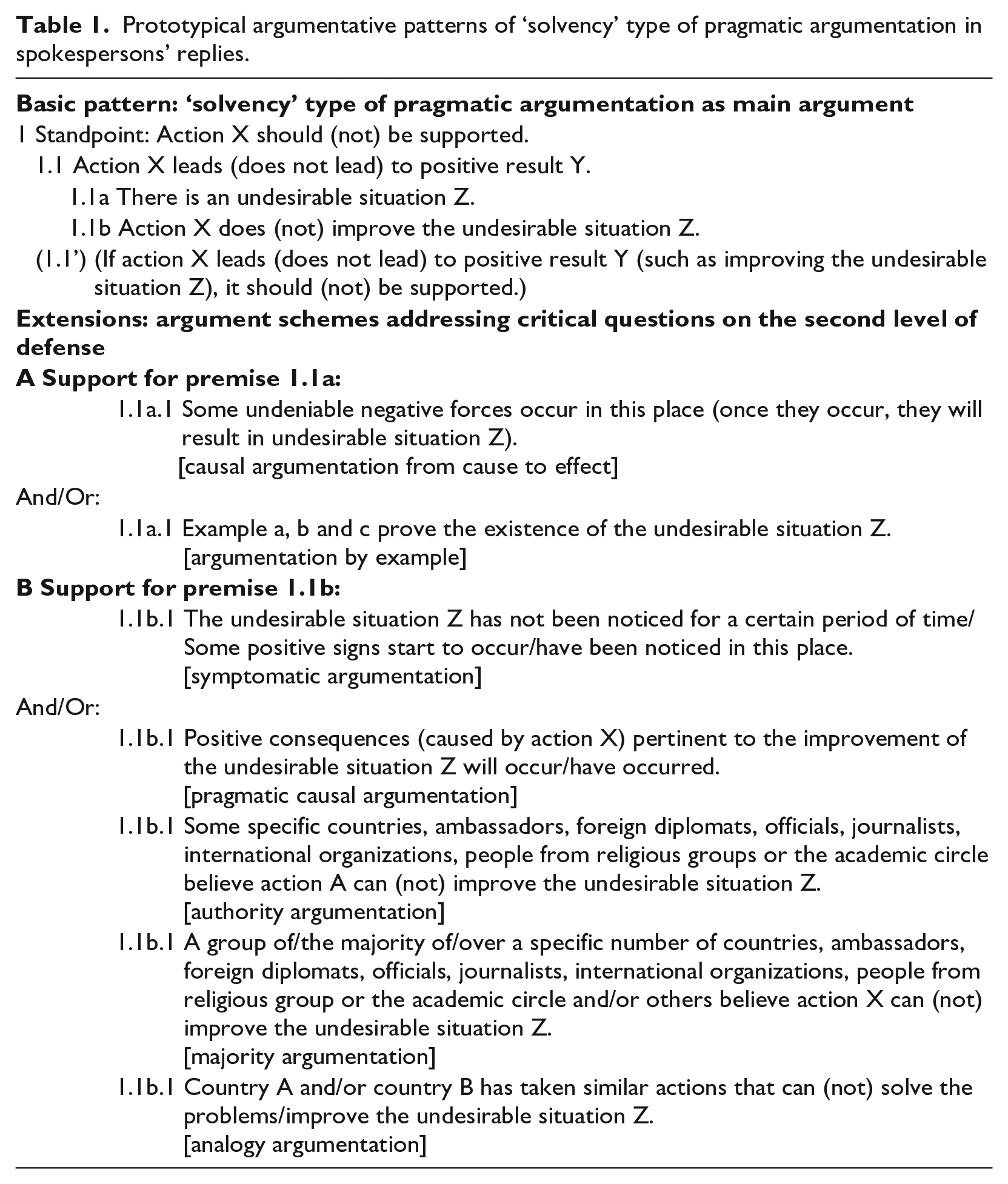
To demonstrate how this type of argumentative pattern is represented in the spokespersons’ replies, we provide an example in which a prototypical argumentative pattern is adopted with causal argumentation and symptomatic argumentation on the second level of defense to support pragmatic argumentation.
Example 1
Q: According to reports, there is a report by the US think tank the Jamestown Foundation saying that Xinjiang’s spending on security-related areas tripled for the year 2017, which seems to contradict China’s statements that it is aimed to provide vocational training for people in Xinjiang. What is your response? A: Regarding the vocational education and training in Xinjiang, as we said many times, the chairman of the Xinjiang Autonomous Region has briefed on the relevant situation in an interview. I would like to advise you to have a thorough reading of that. As you mentioned, the US think tank seems very interested in the figures of the inputs in the security area in Xinjiang. I don’t know where they got these figures. I wonder whether this think tank also knows about how much the local government has invested in developing the economy and improving people’s livelihood, and how much the people have benefited from that. What I want to tell you is that since the 1990s, Xinjiang has long been plagued by ethnic separatism, religious extremism, and violent terrorism from at home and abroad. These three evil forces have plotted, organized and conducted thousands of violent terrorist attacks including bombings, assassinations, poisoning, arson, assaults, unrests and riots, causing the deaths of a large number of innocent people and police officers, as well as immeasurable property damage. In recent years, Xinjiang has worked for the general goal of ensuring social stability and long-term security and increased inputs and made major achievements in fighting against terrorism and safeguarding stability. Just as the chairman of the Xinjiang Autonomous Region said, in the past 21 months, no violent terrorist attacks have occurred, including those endangering public security. Public security has notably improved, and people are now feeling more secure. I’m not clear about the specific figures of Xinjiang’s inputs in the security area, but I do know that life is precious and invaluable.
In Example 1, the journalist casts doubts on Xinjiang’s spending on security-related areas and questions China’s vocational training in Xinjiang. Instead of resolving the difference of opinion suggested by the journalist, the spokesperson denies the necessity of conducting a discussion on this difference by launching a personal attack on his/her opponent (the US think tank mentioned by the journalist). In this way, the argumentative exchange with the immediate opponent is stopped at the empirical counterpart of the confrontation stage (Wu, 2017). In the critical discussion with the international general public that takes place simultaneously, the spokesperson defines the difference as pertaining to whether China’s actions in Xinjiang are legitimate and necessary. In the pragmatic argumentation utilized on the first level of defense, in anticipation of the first critical question (‘Does China’s actions bring positive results to Xinjiang?’), the spokesperson advances a series of argumentative moves in which various argument schemes are used. The structure of the complex pragmatic argumentation can be represented as follows:
(1) (China’s actions, including increasing inputs in fighting terrorism and safeguarding stability, should be supported.)
(1.1) (Because China’s actions lead to positive result to Xinjiang.)
(1.1a) (Xinjiang has been in an undesirable situation since the 1990s.)
1.1a.1a Xinjiang has long been plagued by ethnic separatism, religious extremism, and violent terrorism from at home and abroad. 1.1a.1b Three evil forces have plotted, organized and conducted thousands of violent terrorist attacks.
1.1a.1b.1 Bombings, assassinations, poisoning, arson, assaults, unrests, and riots. (1.1a.1c) (These attacks have had major negative consequences.)
1.1a.1c.1a Causing the deaths of a large number of innocent people and police officers. 1.1a.1c.1b Causing immeasurable property damage. (1.1b) (China’s actions improve this terrible situation.)
1.1b.1 In the past 21 months, no violent terrorist attacks, including those endangering public security, have occurred.
1.1b.1.1 The chairman of the Xinjiang Autonomous Region has said that in an interview. (1.1’) And (if China’s actions lead to positive result such as improving the undesirable situation in Xinjiang, they should be supported.)
This structure shows that, in order to defend that Xinjiang had been in a undesirable situation, the spokesperson employs on the second level of the defense causal argumentation by stating the causes of this undesirable situation. It is noteworthy that on the third level of defense, to respond to the audience’s potential doubt on what specific terrorist attacks are carried out by the ‘three evil forces’, argumentation by example is used. Meanwhile, to defend that there are indeed some major negative consequences, argumentation by example is employed again. In premise 1.1a.1c.1a, the spokesperson mentions the loss of many people’s lives and in premise 1.1a.1c.1b the loss of property. These two premises, from two different perspectives, manifest in collaboration the negative consequences of the terrorist attacks.
After giving a description of the undesirable situation in Xinjiang, the spokesperson defends the claim that China’s actions have improved the undesirable situation. On the second level of this defense, symptomatic argumentation is employed. That no violent terrorist attacks have occurred in the past 21 months is presented as a sign that the situation has been improved. In anticipation of potential doubts regarding the truth of argument 1.1b.1, on the third level of defense authority argumentation is used in which the chairman of Xinjiang Autonomous Region is quoted.
‘Maintenance’ type argumentative patterns
In exploiting the ‘maintenance’ type of argumentative pattern, instead of discussing the existence of the undesirable situation, the spokespersons state or assume as a rule that there exists a (relatively) desirable situation and Action X is (not) instrumental in maintaining that desirable situation. The argument scheme then utilized is as follows:
1 Standpoint: Action X should (not) be supported.
1.1 Action X leads (does not lead) to positive result Y
1.1a There is a desirable situation Z. 1.1b Action X does (not) maintain the desirable situation Z. (1.1’) And (if action X leads (does not lead) to positive result Y (such as maintaining the desirable situation Z), it should (not) be supported.)
Critical questions to evaluate this type of pragmatic argumentation are:
d. Is there indeed a situation Z?
e. Is situation Z really desirable?
f. Does action X maintain the desirable situation Z?
As can be observed from the empirical data, in the case of the ‘maintenance’ type of pragmatic argumentation on the first level of the defense, in responding to critical question d and e, authority argumentation or/and argumentation by example is/are prototypically utilized in support of 1.1a ‘There is a desirable situation Z’. In responding to critical question f, spokespersons tend to employ causal argumentation, symptomatic argumentation, or/and analogy argumentation that constitute support for 1.1b ‘Action X does(not) maintain the desirable situation Z’. In Table 2, the basic pattern of the ‘maintenance’ type and its prototypical extensions are represented.
Prototypical argumentative patterns of ‘maintenance’ type of pragmatic argumentation in spokespersons’ replies.
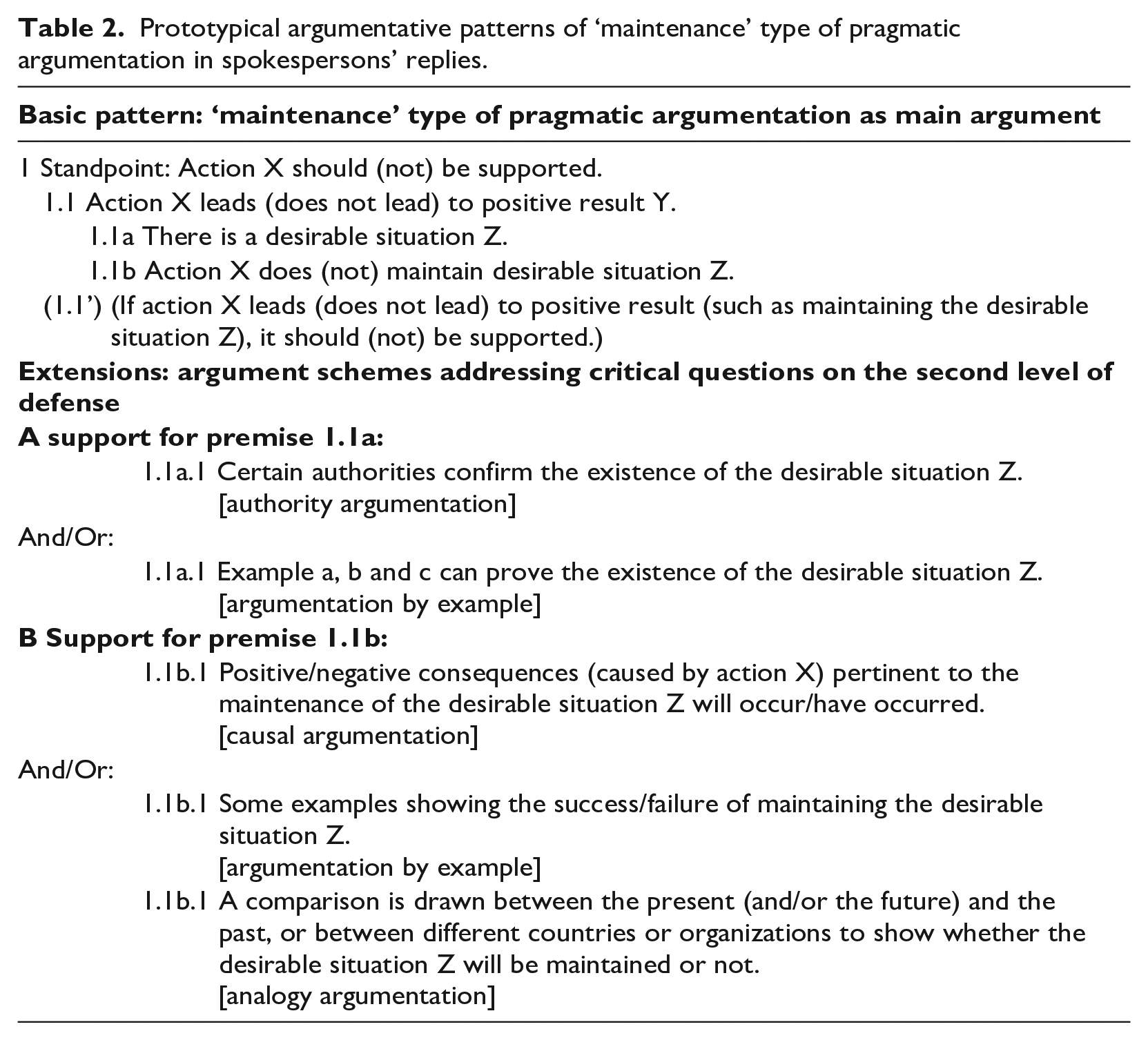
The prototypical argumentative pattern of the ‘maintenance’ type is represented in Example 2:
Example 2
Q: According to the Wall Street Journal, forty-five trade associations, including the US Chamber of Commerce, the National Retail Federation and the Information Technology Industry Council, signed a petition letter sent to the US government, urging it not to move forward its tariff plan on Chinese imports, as it would hurt the US economy, consumers and competitiveness. There are also reports saying that forty-three top economists at the IGM Forum held by the Chicago Booth School of Business believed that imposing tariffs will not improve Americans’ welfare, but may prove to be harmful to the majority. According to the European media, the US trade representative said that if the EU wants to be exempt from the US tariffs on steel and aluminum, then it must ally with the US in fighting steel overproduction by China. What is your response? A: I would like to further highlight a few points in response to your question. First, the China-US economic relations are in nature mutually beneficial, and such relations have opened up immense markets and created a significant number of jobs for the two countries over the course of forty years. Trade with China has also considerably lowered the average expenditure burden for US families. I have some numbers for you. In 2015, China-US trade cooperation helped each American family save 850 US dollars on average. If the US had benefited nothing from such relations, how could the China-US trade have sustained such rapid growth. Second, China never intends to seek surplus. The current trade imbalance between China and the US is a result of many factors, and shall be addressed by opening markets wider to each other and making the pie of cooperation bigger, instead of by waging a trade war or forcing others to buy or sell. Third, trade war will only produce losers. The legendary impenetrable ‘super armor’ that shields one from any harm simply does not exist. You mentioned a petition from the US trade associations, opinions of the US economists and reactions of other countries. I believe that their responses made the point quite clear. According to a US opinion poll, half of the US population opposes raising tariffs on steel and aluminum products. There are also people believing that imposing tariffs would deliver a heavy blow to downstream industries of the US manufacturing sector, causing a loss of 180,000 jobs of other economic sectors.
In Example 2, the journalist requests the spokesperson to respond to the US’ tariff plan on Chinese imports. The difference of opinion pertains to whether the US domestic petition to move forward this plan is acceptable to China. Agreeing to resolve the suggested difference, the spokesperson advances argumentation justifying why the US’s imposing tariff on Chinese imports should not be supported. In this case, the argumentative exchanges between the spokesperson and the immediate opponent (the US) and these between the spokesperson and the international general public more or less overlap, although the latter ones are more significant to the spokesperson. The spokesperson concentrates in the pragmatic argumentation overwhelmingly on the importance of maintaining the current desirable situation. To the latter end, a series of argumentative moves making use of different argument schemes is advanced. The structure of this complex pragmatic argumentation can be represented as follows:
(1) (The US’s imposing tariff on Chinese imports should not be supported.)
(1.1) (The US’s action leads to negative result.)
(1.1a) (The China-US economic relations have been in a desirable situation so far.)
1.1a.1 Immense markets have been opened up. 1.1a.2 Over forty years a significant number of jobs for the two countries have been created. 1.1a.3 The average expenditure burden for US families has been considerably lowered.
1.1a.3.1 In 2015, China-US trade cooperation helped each American family save 850 US dollars on average. (1.1b) (US’s action will not help maintain the desirable situation.)
1.1b.1 It will deliver a heavy blow to downstream industries in the US manufacturing sector. 1.1b.2 It will cause a loss of 180,000 jobs in other economic sectors.
1.1b.1.1 & 1.1b.2.1 The US trade associations, opinions of US economists and reactions of other countries prove that. 1.1b.1.2 & 1.1b.2.2 According to a US opinion poll, some people believe that. (1.1’) And (if the US’s action leads to negative result such as failing to maintain the desirable situation, it should not be supported.)
As this structure shows, the spokesperson uses argumentation by example from three different perspectives (1.1a.1, 1.1a.2, 1.1a.3) to defend that until now the China-US economic relation has been in a desirable situation. In anticipation of potential doubts on premise 1.1a.3, the spokesperson again uses argumentation by example, citing the exact figure of what each American family has saved on average due to the China-US trade cooperation in 2015.
To defend the claim that the trade war is detrimental to maintaining the desirable situation, the spokesperson adopts causal argumentation on the second level of the defense. Since the trade war may cause severe damage to the US manufacturing sector and a loss of hundreds of thousands job opportunities in other sectors, the desirable situation mentioned in premises 1.1a.1, 1.1a.2, and 1.1a.3 cannot be maintained. In order to respond to the question ‘whether damage and loss would indeed be caused by a trade war’, the spokesperson adopts authority argumentation and appeals on the third level of the defense to public opinion. The authority the spokesperson appeals to, including US trade associations and top economists, is mentioned in the journalist’s question. In order to convey to the international general public an impression of objectivity, favored in most diplomatic practices, no authority from the Chinese side is mentioned, but a US opinion poll.
‘Counter-plan’ type argumentative patterns
In using the ‘counter-plan’ type of pragmatic argumentation as a response to the first critical question, ‘Do actions of type X lead to results of type Y?’, spokespersons first indicate that there exists a desirable/undesirable situation Z, and then make a comparison between the Action X’ suggested by the other party and Action X suggested by the spokesperson for improving (or maintaining) the undesirable (or desirable) situation Z. By doing so, the spokespersons intend to prove that Action X is the only action that will lead to positive result Y, and should therefore be supported. In most cases action X’ is mentioned simply because it is explicitly proposed by the other party or mentioned by the journalist, and known to have been considered by the international general public. Avoiding a discussion of Action X’ would make the spokespersons’ replies seem insincere, which would go against the thirrd institutional precondition: ‘The spokesperson has the responsibility to tell the truth to the public and should therefore be honest and sincere’. The argument scheme employed in this type is as follows:
1 Standpoint: Action X should be supported/Action X’ should not be supported.
1.1 Action X does lead to positive result Y/Action X’ does not lead to positive result Y.
1.1a There is a desirable/undesirable situation Z. 1.1b Action X’ does not improve the undesirable/maintain the desirable situation Z. 1.1c Action X does improve the undesirable/maintain the desirable situation Z. (1.1’) And (if action X’ does not lead to positive result Y (such as improving the undesirable/maintaining the desirable situation Z), but action X does, action X should be supported.)
Critical questions used to evaluate this type of pragmatic argumentation are:
g. Is there indeed a situation Z?
h. Is situation Z indeed undesirable/desirable?
i. Does action X’ not improve the undesirable/maintain the desirable situation Z?
j. Does action X improve the undesirable situation Z/maintain the desirable situation Z?
As can be observed from the empirical data, in responding to critical question g and h on the first level of the defense of ‘counter-plan’ type pragmatic argumentation, argumentation by example or/and authority argumentation are prototypically utilized to support 1.1a ‘There is a desirable/undesirable situation Z’. In responding to critical question i, spokespersons prototypically employ causal argumentation, authority argumentation, or/and majority argumentation supporting 1.1b ‘Action X’ does not improve the undesirable/maintain the desirable situation Z’. In responding to critical question j, to support premise 1.1c ‘Action X does improve the undesirable/maintain the desirable situation Z’, analogy argumentation, authority argumentation, majority argumentation, and argumentation by example are prototypically used. In Table 3, the basic pattern of the ‘counter-plan’ type and its prototypical extensions are presented.
Prototypical argumentative patterns of ‘counter-plan’ type of pragmatic argumentation in spokespersons’ replies.
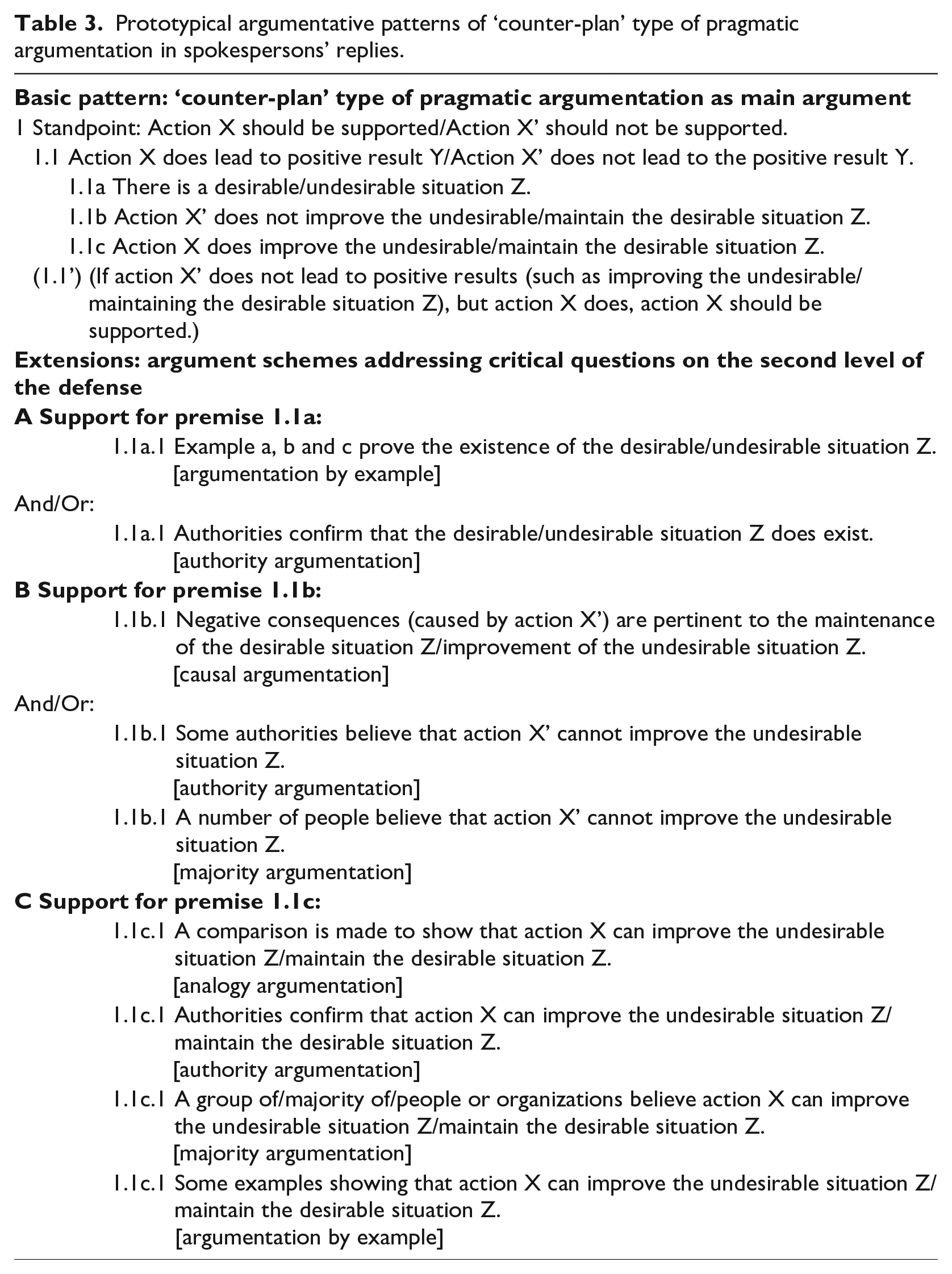
A typical example of the spokespersons utilizing the ‘counter-plan’ type of argumentation pattern based on pragmatic argumentation is the following:
Example 3
Q: According to reports, the Trump administration said that it was considering more sanctions on the DPRK [Democratic People’s Republic of Korea] to cut it from the global financial system. What is your response to that? A: The situation on the Korean Peninsula is very tense, almost approaching a tipping point. This is not in line with the interests of any side. During his meeting with Secretary of State Tillerson and when attending the China Development Forum, Foreign Minister Wang Yi elaborated on China’s positions clearly. At the current stage, the Peninsula situation is at another crossroads where are two prospects. One is that the relevant parties could continue with their assertive and escalatory moves, leading to conflict or even potential war. The other choice is that all sides can cool down and jointly pull the Korean nuclear issue back to a path of political and diplomatic resolution. Within the framework of the Six-Party Talks, positive and important progress had been made on the issue. In the September 19 Joint Statement reached in 2005, the DPRK for the first time promised to abandon all its nuclear weapons and existing nuclear programs. It served as a roadmap for politically resolving the Korean nuclear issue in a gradual way. Considering the current circumstance, any level-headed mind will not find it difficult to choose a more promising and more practical and viable path forward. Foreign Minister Wang Yi said that any chance of dialogue must be seized and any hope for peace must not be given up. In order to alleviate tensions, China proposed a ‘dual-track approach’ to promote denuclearization of the Peninsula and establish a peace mechanism in parallel and a ‘suspension for suspension’. We hope that all parties give serious considerations to our proposal, calm down, work together to find a path out of the current crisis and transform crisis into opportunity, and jointly pull the Korean nuclear issue back to the right track of peaceful resolution through dialogue and consultation. This serves the common interests of all parties.
In Example 3, the journalist introduces the action America is going to take against the Democratic People’s Republic of Korea (DPRK), that is, ‘more sanctions on the DPRK to cut it from the global financial system’. The difference of opinion the spokesperson is suggested to resolve concerns whether the American action is desirable. Clearly the spokesperson agrees to resolve this and argues for a negative standpoint. By doing so, he/she actually starts at the same time the two critical discussions (with the US as the immediate opponent and with the international general public) about the same difference.
In defending his/her unexpressed standpoint that ‘relevant party’s action (US’s action) should not be supported’, the spokesperson first defines the following starting points: ‘Any chance of dialogue must be seized and any hope for peace must not be given up’ and ‘(All parties) should calm down, work together to find a path out of the current crisis and transform crisis into opportunity, and jointly pull the Korean nuclear issue back to the right track of peaceful resolution through dialogue and consultation’. Based on these starting points, the spokesperson utilizes pragmatic argumentation of the ‘counter-plan’ type in which it is argued that the US’s claimed action will not lead to positive results while the action proposed by China (‘dual-track approach’ to promote denuclearization and ‘suspension for suspension’) will lead to positive results. In the spokesperson’s use of the pragmatic argumentation the US’s action (X’) is negated by defending that this action is undesirable and that China’s action (X) is desirable. The argumentation structure of this example is as follows:
(1) Standpoint: (Relevant party’s (US’s) action should not be supported.)
(1.1) ((US’s) action will not lead to positive result.)
1.1a The Korean Peninsula is in a very tense situation. 1.1b Relevant party’s (US’s) assertive and escalatory actions (sanctions) are less promising, less practical and viable.
1.1b.1 They may lead to conflict or even potential war. (1.1c) (China’s proposed actions (‘dual-track approach’ and ‘suspension for suspension’) may lead to a peaceful resolution.)
(1.1c.1) (They (‘dual-track approach’ and ‘suspension for suspension’) proved effective within the framework of the Six-Party Talks.)
1.1c.1.1 Within the framework of the Six-Party Talks, positive and important progress was made.
1.1c.1.1.1 In the September 19 Joint Statement reached in 2005, the DPRK for the first time promised to abandon all its nuclear weapons and nuclear programs. (1.1’) And (if relevant parties’ action does not lead to positive result such as easing up the tense situation, but China’s action does, relevant parties’ action should not be supported.)
From this structure it can be concluded that to prove that the US’s actions are not desirable (in responding to critical question i: ‘Does action X’ not improve the undesirable/maintain the desirable situation Z?’), the spokesperson adopts in 1.1b.1 causal argumentation by stating that these actions may lead to conflict or even war. In responding to the potential critical question j (‘Does action X indeed improve the undesirable/maintain the desirable situation Z?’), the spokesperson utilizes twice symptomatic argumentation (in moving from 1.1c.1.1.1 to 1.1c.1.1 and in moving from 1.1c.1.1 to 1.1c.1). It is noteworthy that throughout the replies, the spokesperson never mentions ‘the US’. Instead, the words relevant party are used, although it is clear to the international general public (and to the US) that this refers to the US. The spokesperson thus avoids being accused of slandering other countries, which would go against the sixth institutional precondition.
Conclusion
In this article the contextually motivated variants of pragmatic argumentation in the Chinese spokespersons’ replies to journalists at the MoFA’s press conferences and the ensuing prototypical argumentative patterns have been examined within the theoretical framework of Pragma-Dialectics. Whether this is part of their new diplomatic attitude or not, it is striking that in their responses the spokespersons define the difference of opinion at issue in the question in a way that is favorable to defending the position of the Chinese government. In their strategic maneuvering to realize their aim of convincing the general international public, which is their primary audience, they subsequently tend to defend the Chinese position by employing an argument scheme that serves their purposes best and opting for the use of variants of that argument scheme that generate critical questions which are easy to deal with. On the next levels they complete their initial defense by adding objectifying types of argument that should bring the discussion to an undisputable end.
Based on the institutional point of the MoFA’s regular press conferences, we have listed seven primary institutional preconditions that, together with some secondary institutional preconditions, affect the spokespersons’ possibilities for strategic maneuvering in the actual practice of diplomatic press conferences. Depending on the contextual constraints thus imposed upon their argumentative discourse, three variants of pragmatic argumentation prove to manifest themselves emphatically in the spokespersons’ argumentative conduct: pragmatic argumentation of the ‘solvency’ type, pragmatic argumentation of the ‘maintenance’ type, and pragmatic argumentation of the ‘counter-plan’ type. The differences among these three types of pragmatic argumentation lead to systematic changes in the critical questions pertinent to evaluating the argumentation concerned on the first level of the defense, and therefore to the way in which this defense will be conducted.
Starting from the prototypical argumentative patterns ensuing from the use of the three variants of pragmatic argumentation on the first level of the defense, the argument schemes have been identified that are employed by the spokespersons on the second level of their defense. When the ‘solvency’ variant is used as main argument, in support of the first premise, prototypical argumentative patterns with causal argumentation, argumentation by example, and symptomatic argumentation, and in support of the second premise, causal argumentation, authority argumentation, majority argumentation, and analogy argumentation come into being. In prototypical argumentative patterns with the ‘maintenance’ variant as main argument, authority argumentation and argumentation by example are used to support the first premise, and symptomatic argumentation and analogy argumentation to support the second premise. When it comes to the ‘counter-plan’ variant, argumentation by example and authority argumentation are employed to defend the first premise, and causal argumentation, authority argumentation, and majority argumentation to defend the second premise, while the third premise is defended by means of analogy argumentation, authority argumentation, majority argumentation, and argumentation by example.
Footnotes
Acknowledgements
The authors are grateful to Frans H. van Eemeren and Manfred Kienpointner for their useful suggestions.
Declaration of conflicting interests
The author(s) declared no potential conflicts of interest with respect to the research, authorship, and/or publication of this article.
Funding
The author(s) disclosed receipt of the following financial support for the research, authorship, and/or publication of this article: This article is a result of the research project ‘Analysing Chinese diplomatic argumentative discourse in the New Era: Toward a new research paradigm based on Pragma-Dialectics’ (Project No. 22BYY072) sponsored by The National Social Science Fund of China.