






Abstract
Standard test questions allow the questioner to confirm an answer as correct, displaying their greater epistemic authority over the answerer (as in the canonical case of the classroom, where the teacher knows more than the pupil). But the instructional power of test questions may prompt their use even when that asymmetry is neutralized or reversed, and the recipient ought to know as much as, or indeed more than, the questioner. I describe how (and why) staff who support clients with intellectual impairment use what I call ‘recipient-side’ test questions, where the questioner claims final authority over matters in the recipient’s experience, even though it is the recipient who has prior entitlement and access to it. When recipient-side test questions fail, questioners may revert to the standard test question asymmetry by hinting at, or openly asserting, their own epistemic authority.
Keywords
In educational environments, teachers and other practitioners may ask ‘test questions’ (the term ultimately comes from Searle, 1969) to which they already know the answer. The motivation is usually to get the pupil to rehearse some recently learned bit of knowledge. Typically, to ask such ‘known information’ questions (as Mehan, 1979, calls them), the teacher will deploy a three-part Initiation–Response–Evaluation sequence, pervasive in educational settings and first identified in the 1970s (Sinclair and Coulthard, 1975). For example:
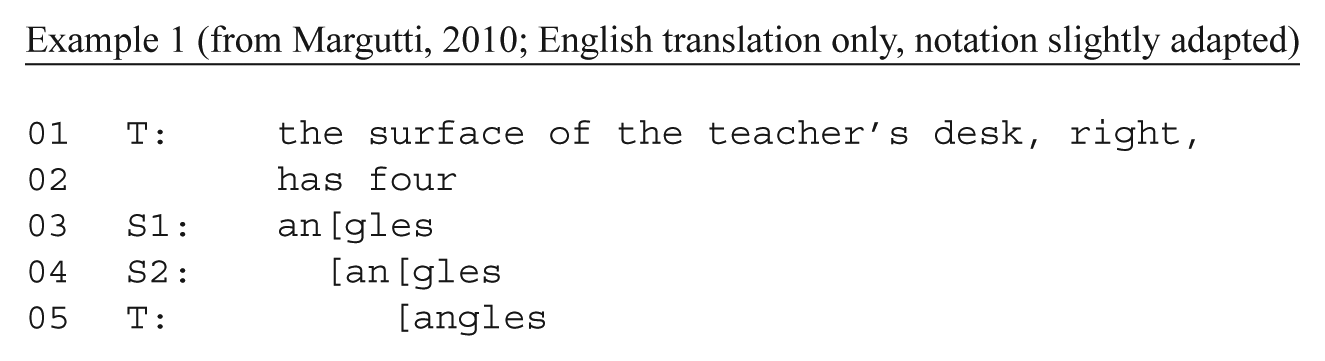
We shall see that the issues of who knows what in such an exchange may be more complex than they appear at first sight; but we start off by noting that the teacher seems to be asking her pupils (in the form of what Koshik, 2002, calls a deliberately incomplete utterance: four . . .) to tell her what a word is. But when the pupils do provide a candidate for the missing word, it is she who arbitrates, and confirms it as correct. So her initial question seems redundant, in the sense of a genuine query. That is the essence of a test question: even though the pupil might produce an answer, the pre-existing asymmetry in knowledge means that it is the teacher who judges the answer’s correctness. The pupils’ grasp on the matter is recently acquired and testable, while the teacher’s is prior and authoritative.
All this is, of course, familiar (the literature on test questions is extensive; for recent research projects which make use of the concept, see Hargreaves, 2012; Margutti, 2006, 2010; Radford et al., 2011; Waring, 2012). Often the teacher is using the test question to consolidate understanding, get the pupil to rehearse a bit of knowledge, or perhaps to articulate some prior experience that will help engender fellowship in the classroom. In all of these, the teacher is the arbiter. But I want in this article to explore the case where the test question is about matters to which recipient and the questioner have, in principle, equal knowledge; or indeed where it is the recipient who is, at least ostensibly, the more authoritative. The teacher in Example 1, when she asks her pupils to supply the term ‘angles’, is authorized to confirm their answer as correct by dint of her superior knowledge of geometry. But if she were to ask a pupil (say) what their favourite pop song was, she would not be in the same authoritative epistemic position – it would be odd for her to ‘confirm’ the pupil’s answer. Nevertheless, there are occasions on which a teacher (or someone in a similar position) will do just that. I will call these recipient-side test questions.
To prefigure the real cases we shall examine below: the questioner might ask the recipient what they want for dinner, where the answer ought to lie entirely in the recipient’s preferences; or about some activity that they have both just done jointly (say, planting flowers or constructing a fence), and on which the recipient will have her or his own perspective. To ask a standard test question in either of these cases is a puzzle, since it seems that the asymmetry in epistemic authority, if there is one, would favour the recipient, not the questioner.
Territories of knowledge
Heritage (2012a, 2012b) gives us a robust framework in which to set the problem. According to his persuasive analysis, the defining feature which determines whether an utterance is to be treated at all by its recipient as a question requiring an answer is the perceived asymmetry between them in what Heritage calls their ‘real world territories of knowledge’ – what they can be expected to know and not know. Crudely, the more the utterance issues from someone who is to be seen as not-knowing (‘K minus’ in Heritage’s scheme) about the topic (say, the health of their interlocutor’s family), the more the recipient will be expected to provide something which will be understood as an answer. As Clift (2012) notes, this formulation is of a piece with Conversation Analysis’s ‘dissolution of the relationship between form and function’ (p. 69): the asymmetry in real knowledge trumps such apparently standard markers of questions such as grammatical form or intonation (for evidence of this, see Heritage, 2012a).
But what you know, and what you show that you know, are two different things. Heritage’s (2012a) scheme distinguishes between someone’s epistemic status (what they know, as inferable from their real-world situation) and their epistemic stance (what is conveyed by the form of their utterance). Heritage only glancingly touches on test questions (or ‘exam’ questions, Heritage, 2012a, where, as he puts it: ‘there is only one “K+” individual in the room’, p. 20). But we can use his analysis to see that the standard test question is one in which an answer is solicited with a low epistemic stance, that is as if the questioner were less knowledgeable (‘K-’) than the answerer. The twist, in the standard test question, is that this is false.
Were the questioner really less knowledgeable than the recipient, they would treat what they receive as an ‘informative’ answer, that is, react to it with a news-receipt like ‘oh’ or an assessment like ‘great!’ and so on; or, equally, the interaction would progress in some other way that accepts the epistemic priority of the answerer. What casts the speaker’s utterance as a test question, and licenses the answer to be treated not as informative but merely as correct (or false), is all parties understanding that the questioner’s stance was not the same as their status. As Drew, in a commentary on Heritage, puts it (again about a teacher): ‘[she] can be expected to know the answer herself, so that the interrogative construction of her question belies her actual epistemic status; she will be understood not to be seeking information but engaged in instructing the children’ (Drew, 2012: 62). The real world territory of knowledge of the geometry teacher (in example 1) is understood, from the beginning, to trump her temporary epistemic stance and warrant her (otherwise odd) later confirmation of her pupils’ answer as correct.
On this reading, what happens in recipient-side test questions is that there is no apparent need for the parties to collude in treating the question as issuing from someone who doesn’t know the answer: the question is openly about something in the answerer’s domain, as much as (or more than) it is in the questioner’s. Yet the questioner later reveals him-/herself to have been knowledgeable all along, once the answerer responds. That this revelation is met without consternation shows that there is, as it were, retrospective collusion between the parties. They collude not at the issuing of the question, but after its answer, granting the questioner epistemic rights that originally they had not claimed.
For the questioner to arbitrate on the correctness of a reply to a question, in the recipient’s ‘territory of knowledge’, seems inappropriate; the recipient’s recent actions, and still more their private experiences, are areas in which it is the recipient who holds the trump cards of prior knowledge and greater epistemic entitlement. Yet, as we shall see, a test question can even under those circumstances be deployed for educational or therapeutic purposes. The deciding factors seem to be the degree of competence that the questioner attributes to the recipient; and the questioner’s institutional role in their willingness to pursue the questioning in a series of supportive hints.
Data and analysis
The data come from video recordings made at a residential service for adults with intellectual disabilities, and at an outdoor service which offers supervised gardening activities to members of vulnerable groups, including adults with intellectual disabilities. I shall call these service providers ‘Comber Hall Way’ (CHW in the examples), and ‘GardenSpace’ (GS), respectively. Approximately 40 hours of video were shot at these sites, on and off over a period of four years. 1 In the residential service, the responsibilities of the staff are to attend to the residents’ health and safety, organize meals and outings, and oversee the proper functioning of the house. In the outdoor service, staff instruct and encourage service users in a variety of simple gardening jobs (e.g. weeding, filling pots with compost and so on).
Formal ethical oversight was given by my own university and by the centres involved, and written informed consent was obtained from staff and service users before filming began. All names and identifying details reproduced here in the transcripts have been changed.
A standard test question exchange
Before getting on to analysing recipient-side test questions, it’s worth noting that test questions of the standard kind are common in this environment. For example, the client may be asked to repeat back instructions that the staff member has just issued, or to recall something that the staff member had told them, as in the following example. In such cases it is obviously the staff member who has the greater epistemic status, though the question is posed as coming from a low epistemic stance.

These are standard, classroom-like test questions, issuing from Kath’s prior knowledge of the joint plans. At lines 3, 6 and 10, she takes a low epistemic stance (asking Alec to tell her where they’re going), but reveals her higher epistemic status at line 13 (reminding him that she had in fact told him, and presumably arranged, the destination earlier). The interview proceeds for some while after this example, and Alec eventually acquiesces in agreeing that they are in fact going to the pub and not the racecourse. In such a standard test question, the parties collude in setting aside the questioner’s prior and privileged knowledge, but allowing it to re-emerge when it comes to arbitrating on the answer. What, then, of cases where the questioner does not have such prior and privileged knowledge?
Recipient-side test questions
Recipient-side test questions are (unlike standard test questions) those that ask about something that is truly within the recipient’s domain, but whose answers are nevertheless assessed by the questioner as being right or wrong. In Heritage’s terms (2012b), the questioner’s low epistemic stance is, unlike standard test questions, consistent with a low epistemic status. But nevertheless the answers are, like those in standard test questions, treated by the questioner as being theirs to judge as correct or not.
In my data, such questions were of two kinds, one more radical than the other. The more radical (but less common) were those that asked about the recipient’s private experiences, which in principle the questioner could not know. The less radical (and more common) were those that asked about something that, although better known at first hand by the recipient, would turn out to be at least partly in the public domain. I will deal with the less common kind first, because it brings the asymmetry of knowledge more sharply into focus.
Recipient-side test questions about private experience
On occasion, support staff ask the clients questions about their wants and preferences. These are matters over which the client would normally be expected to have sole authority (the distinction being between what Labov and Fanshel, 1977, called ‘Type A’ experiences from their own biographies, versus ‘Type B’, known to all; or between Pomerantz’s (1980) distinction between information known first- or only second-hand). The questioner’s low epistemic stance (displayed by what they say to solicit an answer) ought to be the same as their low epistemic status (what they really don’t know, in the real world). As Heritage (2012b) argues, this display of an informational imbalance is what drives the conversation forward, as participants work to even it out. But, on occasion at least, the staff reveal themselves, in judging the answer as correct or false, to have been on the same informational level all along, even though the matter was ostensibly private.
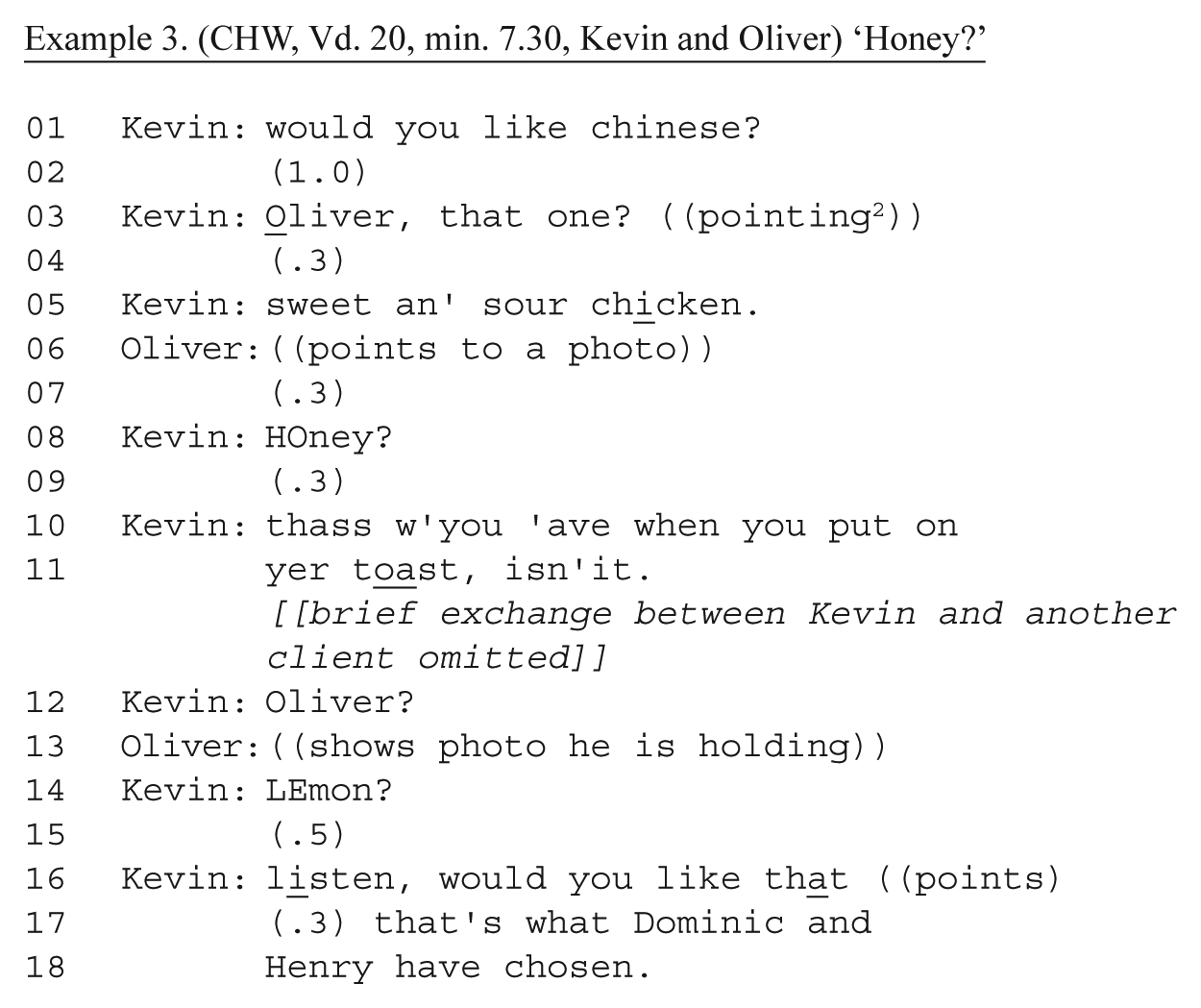
Staff member Kevin is asking the clients what they would like for the evening meal. To help them decide, there are pictures of food items spread out on the table (Chris Walton, the ethnographic researcher who shot the video, reports that the photos are somewhat indiscriminate – they include images of such things as salt and flour as well as obvious dishes like fish fingers or spaghetti).
In the next example, staff member Tim and resident Alec are in the kitchen preparing food. Tim is asking Alec which potato peeler he wants to use.
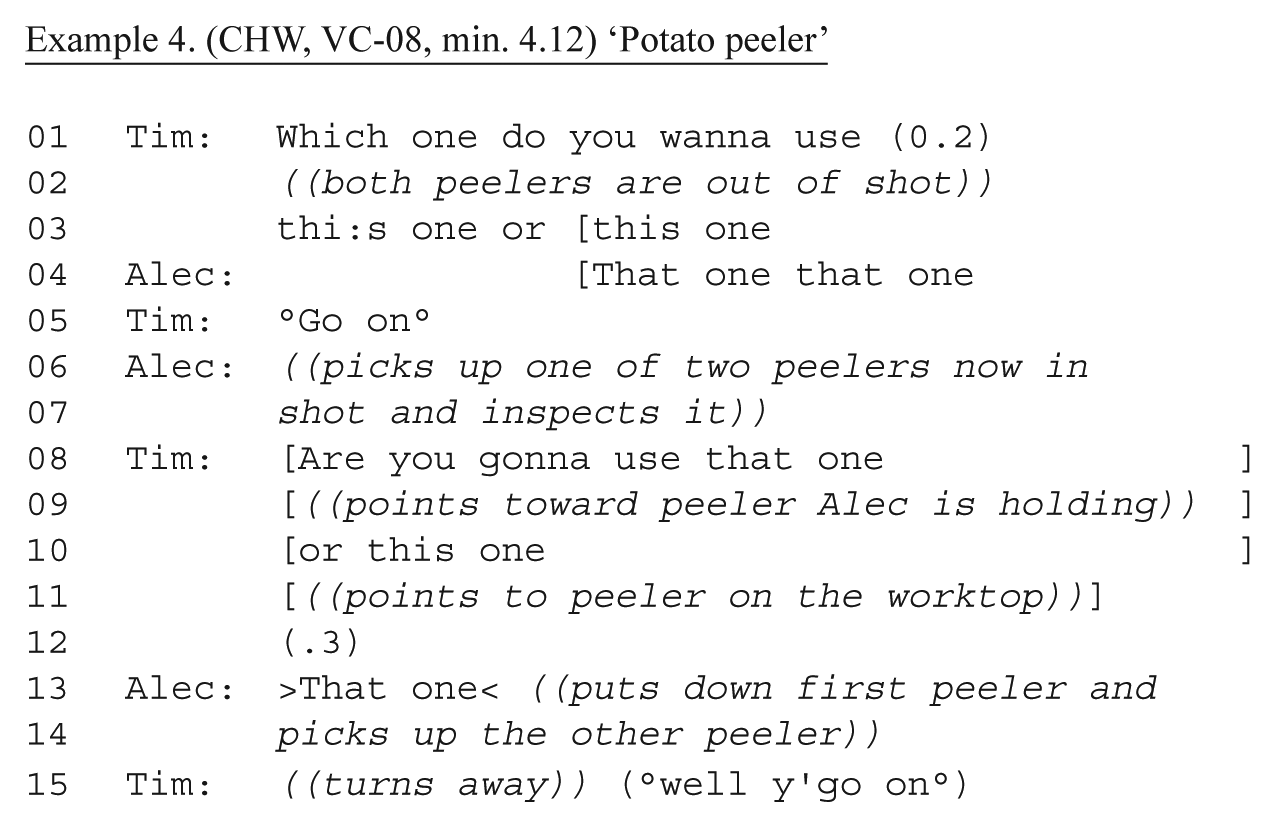
In both cases, the client is being asked about his own private experience – in Example 3, what Oliver wants to eat, or, in Example 4, which kitchen instrument Alec wants to use. But in each case the staff member does not accept the client’s report.
In Example 3 the staff member twice treats the client’s answer as questionable (lines 8–11: HOney? . . . thass w’you ’ave when you put on yer t
The staff members’ warrants for epistemic authority are twofold. Again Heritage’s framework helpfully sharpens the distinction: he distinguishes between a speaker’s epistemic experience and their expertise (Heritage, 2011). In terms of the staff members’ experience, it is a matter of their better judgement – in the first case, the probable real-world likelihood is that the client does not, in fact, really want honey for his evening meal, and has held up a card mistakenly or at random, or has misunderstood the question. In the second case, it turns out that the staff member had reason to know that, in fact, the first peeler was unsuitable (see Antaki et al., 2008, for a fuller account of that episode). So world-knowledge is one warrant. The other is the questioners’ institutionally provided– for expertise: they are cognitively ‘normal’ staff members employed to oversee clients, like Oliver and Alec, with an intellectual impairment. Together these two warrants are high-denomination epistemic cards to play. Certainly they are sufficient here to trump the recipient’s report even of such a strong suit as their wants and preferences, and allow the staff member to treating the question as having been a test. And, a fortiori, they are certainly sufficient to overturn recipients’ reports of less private matters, as we shall see now.
Recipient-side test questions about recent events
The kind of recipient-side questions about wants and preferences I described above were much rarer than questions about recent practical experiences. One very large class of these more common questions was to do with the day’s institutional activities, where the staff member asked the client to describe what he or she had done that day. 3
Clearly, this information ought squarely to be in the recipient’s domain, and one would normally expect a recipient who is K+ (in Heritage’s terms) not only to answer easily, but be taken to be authoritative. In such cases the questioner’s low epistemic stance ought accurately to reflect their low epistemic status. However, the questioner does not always defer to the recipient, even in such cases. The extract below shows an example.
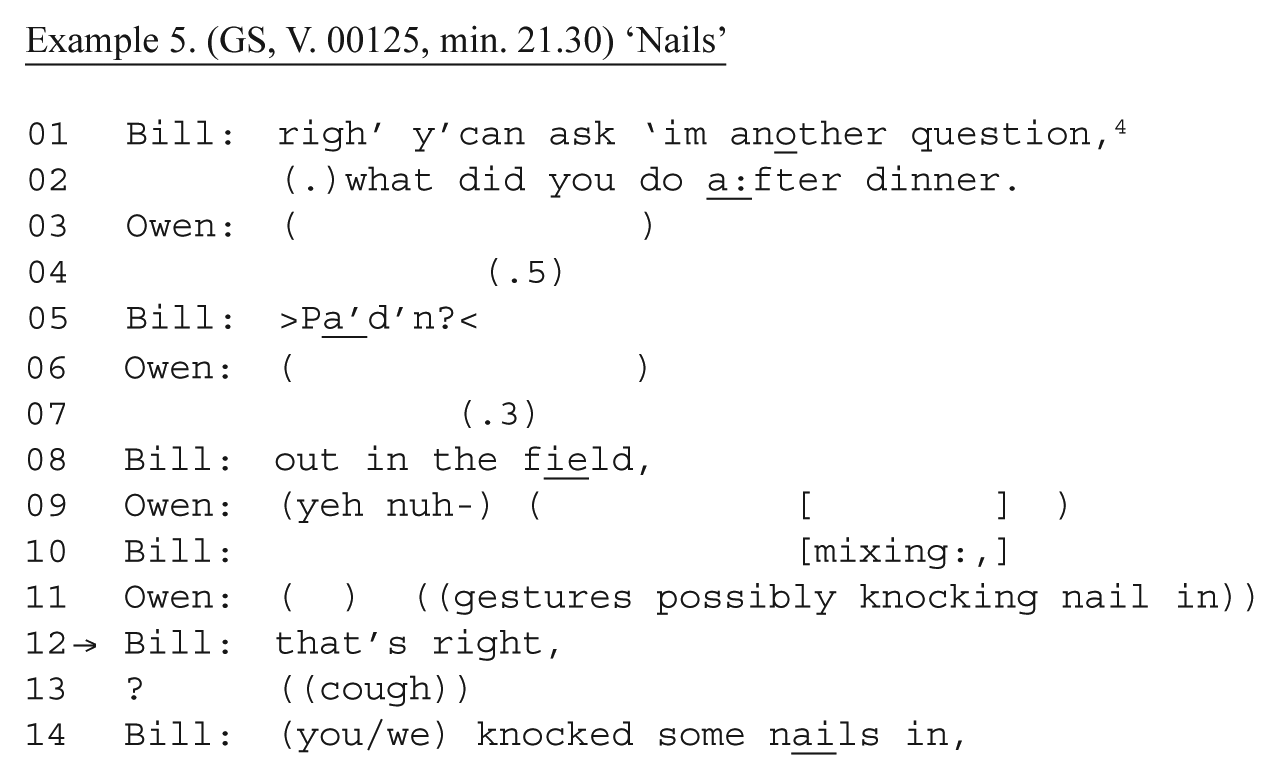
Staff member Bill asks client Owen to describe what he did after dinner. We will return in a moment to see how Bill copes with Owen’s inarticulate responses by various hints; here, just note that when Owen eventually does provide an answer (by miming), Bill assesses it as correct (line 12–14: that’s right, (you/we) knocked some nails in). It is Owen’s experience, but Bill who arbitrates.
Here is another example:
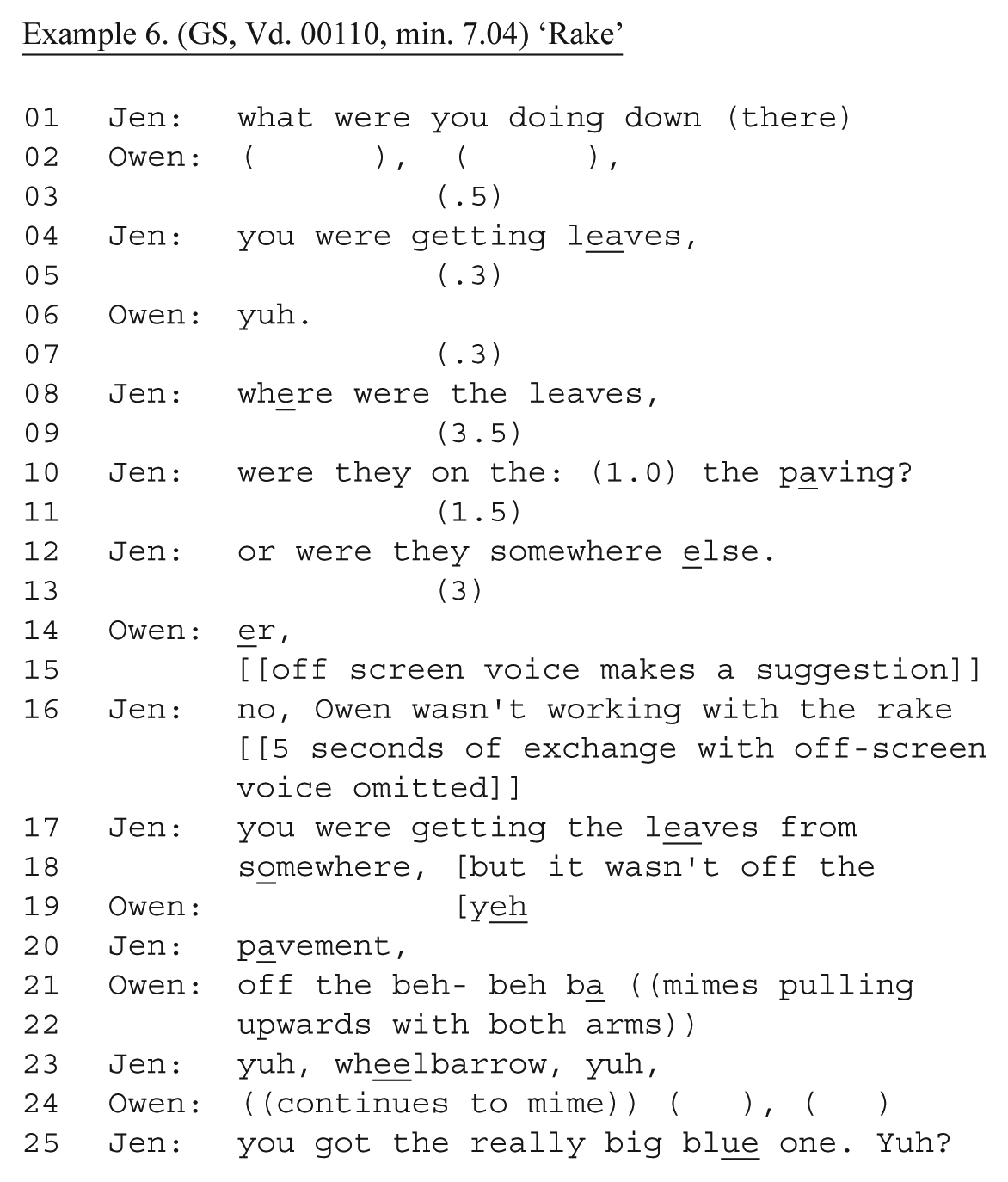
Staff member Jen asks Owen to describe what he was doing in the garden, and systematically shepherds his answer to a description that she herself eventually articulates and confirms (line 23: yuh, wheelbarrow, yuh). Again, as in the ‘nails’ in Example (5) earlier, the point to note is that it is the questioner who is the arbiter, even to the extent of supplying detail (line 25: the really big blue one), which may or may not have been in the answer itself.
Increasing the questioner’s epistemic status
Standard test questions can fail, and recipient-side test questions can fail too, even though, by definition, the recipient ought to know the answer. The questioner could simply register the failure and move on, but this hardly ever 5 happened in my data. Rather, the questioner would try to help the recipient by making the question more like a normal test question, with a right or wrong answer that they, the questioner, would provide if necessary.
Such help, though, meant dropping the public fiction of the staff not knowing the answer. The staff would increase their epistemic status in two ways (while still maintaining a low epistemic stance, in the form of a question). One was to use a first-person plural, making plain their (the staff member’s) own involvement in the activity, and therefore their knowledge of it; and the other was to shepherd the client towards the answer by providing increasingly explicit hints – a process that the pioneering paper by McHoul (1990) referred to, in general, as ‘clueing’ (p. 355 and following).
Evidence that the questioner had first-hand knowledge: ‘We’
First-person plurals – referring to the event that the questioner is asking about as one that they shared with the recipient – effectively reduces the epistemic gradient between them. It asserts that the questioner has some sort of access to what the recipient did, if only by being around at the time (it shifts the epistemics from Type A to Type B events, in Labov and Fanshel’s terms). Effectively, it turns the recipient-side question into more of a standard test question, where the questioner is known to be in command of the facts at the start. We can see this, possibly, in the last lines of Example 3 earlier, when the staff member possibly says we knocked some nails in (although it’s difficult to choose between you and we on repeated hearings). It is clearer in Example 7:
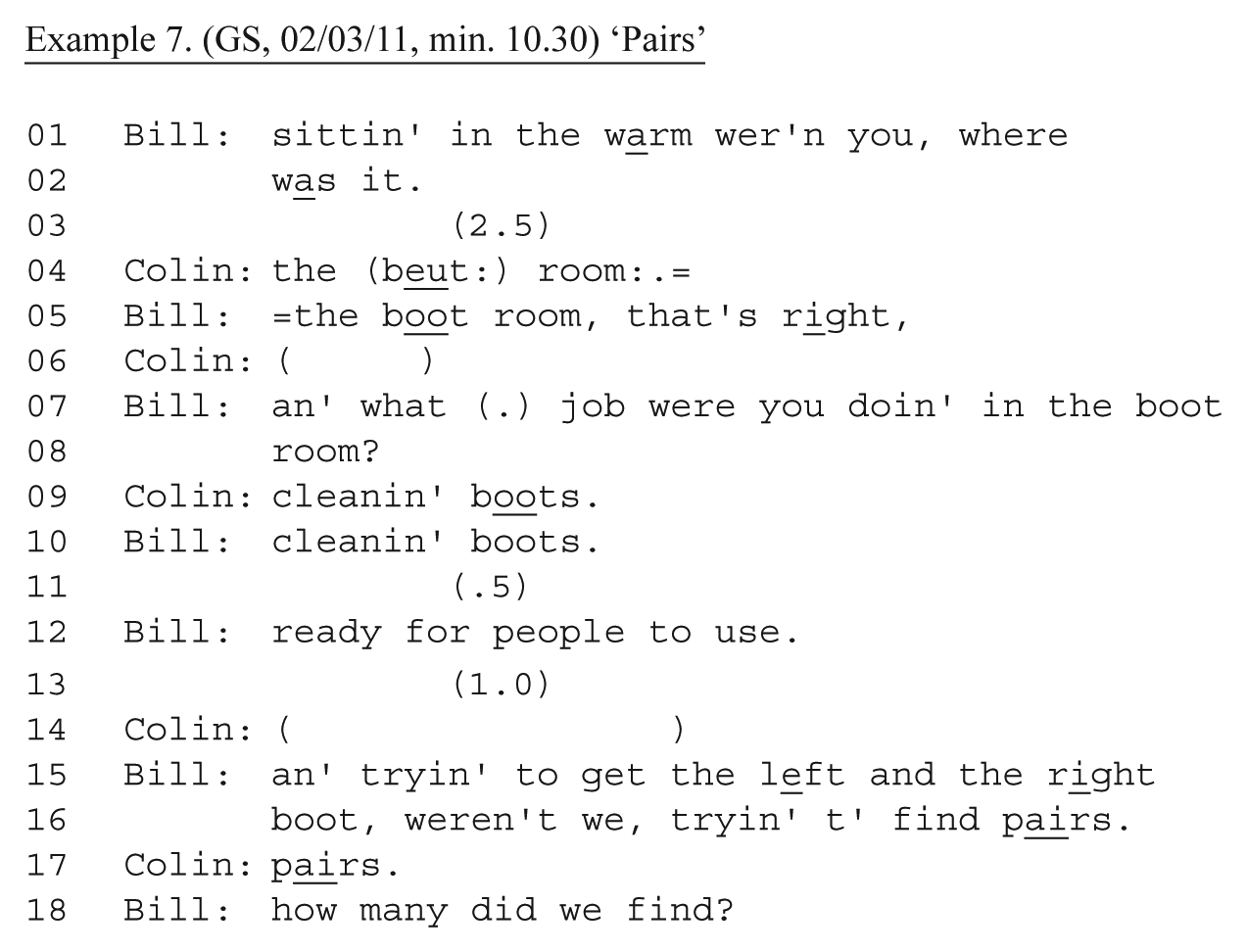
In Example 7 above, staff member Bill is inviting client Colin to describe his day, and establishes that he was in the boot room – again note that it is Bill who arbitrates on this (line 5: the boot room, that’s right), although the information is, in principle, in Colin’s domain. Bill leaves space for Colin at line 11, and again at line 13, to elaborate on what he was doing, but Colin is silent at 11 and his utterance at 13 is not intelligible. Insofar as it has yielded no intelligible answer, the question is failing. Now we see Bill try to reduce the recipient-sidedness of the test by asserting his own knowledge of the matter (changing his stance from K– to K+, in Heritage’s terms). He uses a ‘we’ formulation in an embedded tag question (a format which presumes confirmation; see Hepburn and Potter, 2010). This successfully solicits a well-formatted confirmatory response from Colin, and Bill continues with an open-ended question (line 18) as the conversation proceeds. His epistemic status is now out in the open, as one who was there, involved in the action. The shift to K+, relaxing the pressure on Colin as sole and unsupported authority, seems to help.
Evidence that the questioner was involved: Hints
Revealing that the questioner was there with a ‘we’ (as above) is one way of claiming K+ status and changing the test question from a recipient-sided one to a standard one (or at least to a kind of confirmation check). The other way, which I saw a great deal of, was for the staff member to issue very broad hints at the answer – hints that could only come from someone who already knew, with some specificity, what the answer was.
Examples 5 and 6 show the use of turn-extensions (Schegloff, 2007) as hints. Consider the arrowed lines in these extracts from the examples earlier:
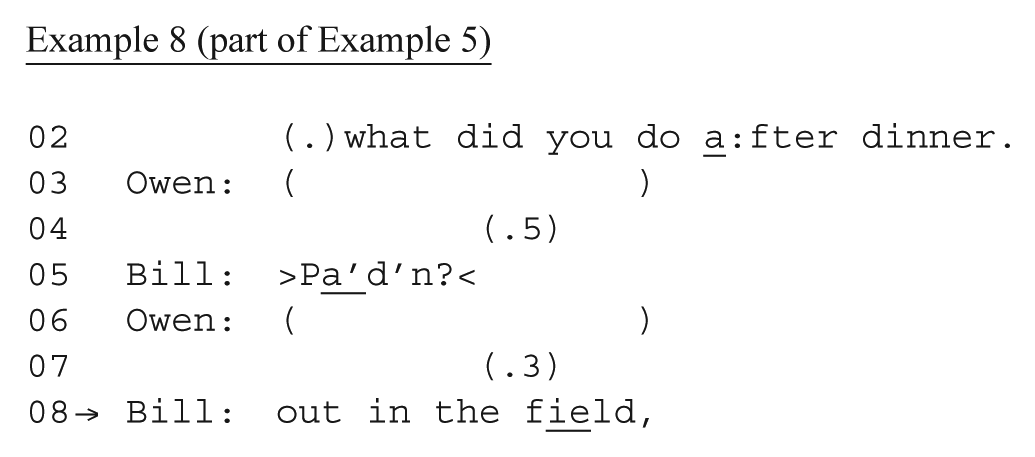
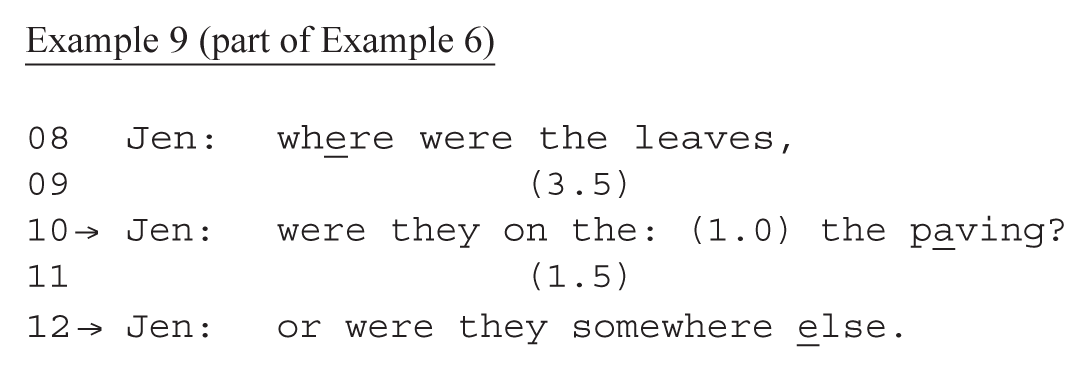
In both cases the questioner’s turn is designed as an extension of the turn that issued the question, effectively deleting the non-appearance of an answer. That is a more interactionally tactful practice than the other large class of hints that staff used, inviting specific answers via what Koshik calls designedly incomplete utterances (Koshik, 2002). Here are two examples:
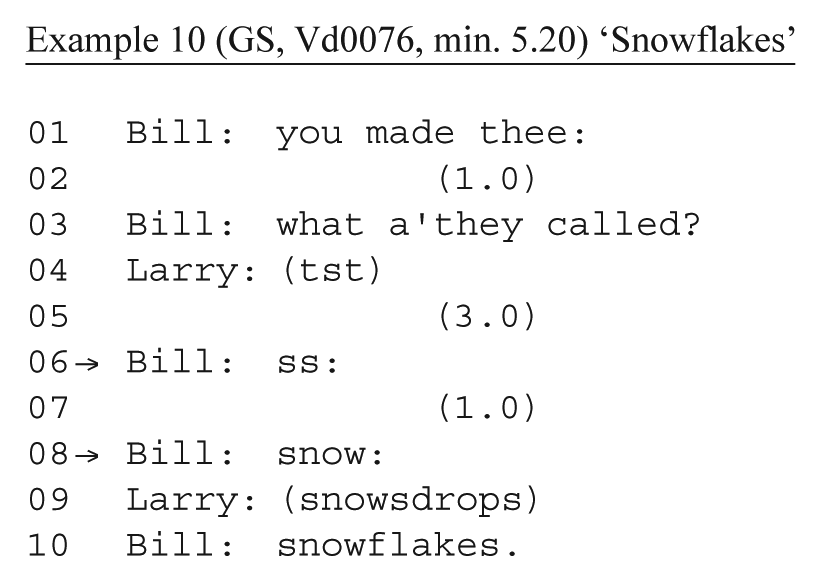
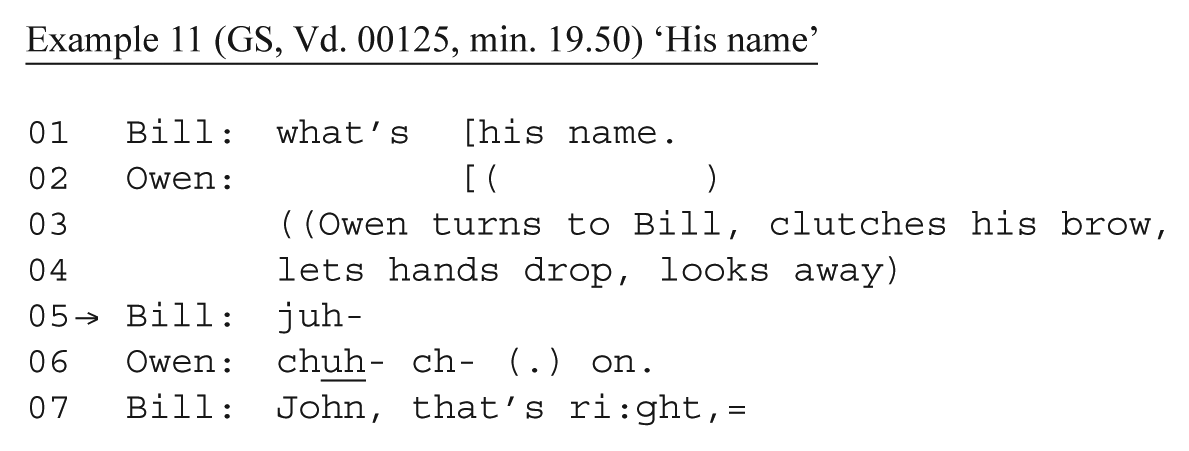
When the questioner issues such hints as in the arrowed turns in the examples above, their epistemic stance is slipping. They are revealing that, in fact, they really do already have the answer (otherwise they would be unable to give such hints). It moves the question from its apparently innocent recipient-sidedness to a standard test question, with no ambiguity.
Evidence that the questioner was involved: Outright statements for confirmation
On occasion, presumably because the staff judged that the client was (temporarily or otherwise) too impaired to articulate an answer in their own words, they would follow up failing recipient-side test questions with straightforward assertions of the answer, formatted in such a way as to project agreement. Here is an example:
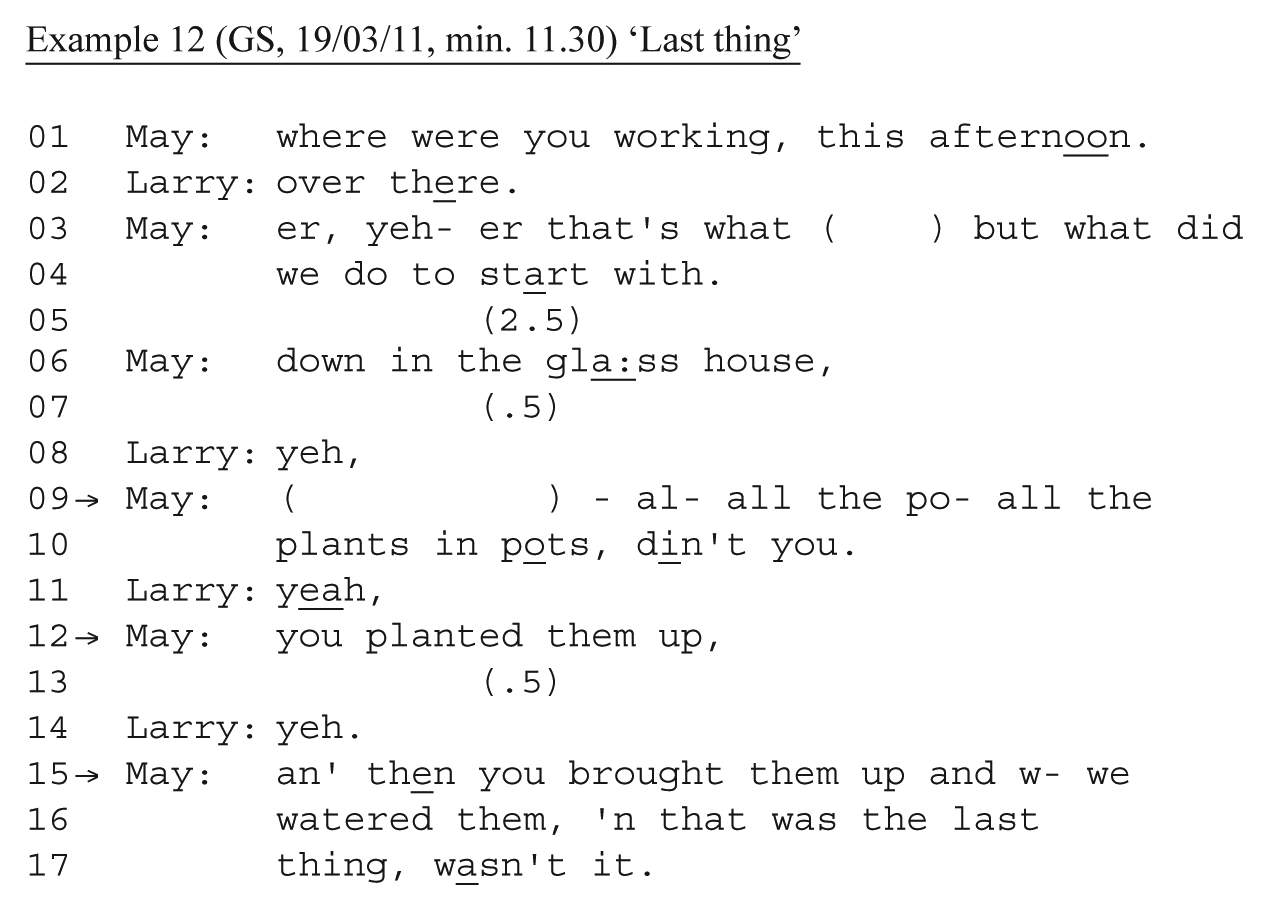
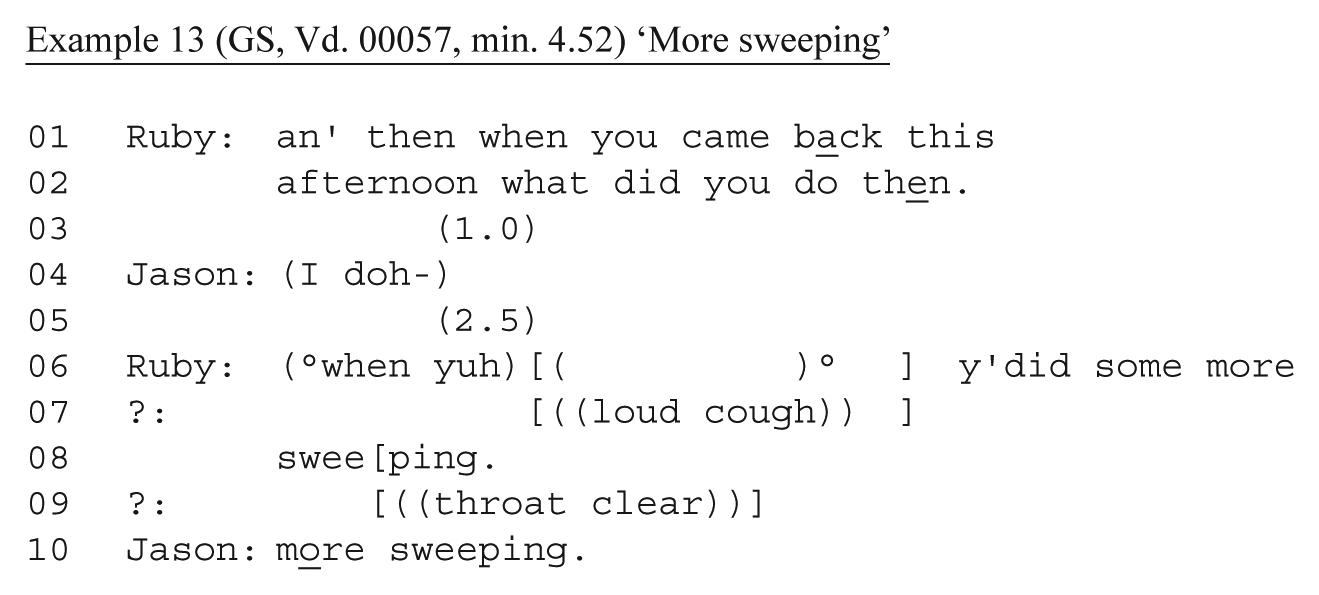
When the questioner declares him-/herself so openly as knowing what the answer is, as May does in Example 12 in lines 9, 12 and 15, or Ruby does in Example 13 at line 6, then the fiction of having a low epistemic status to match the question’s low epistemic stance is thoroughly abandoned. And, once again, the greater structure afforded to the recipient helps them generate an answer, albeit a mere confirmation of what the questioner has asserted.
Evidence that the questioner was involved: Withdrawal of the question
As back-handed confirmation that the questioner, in recipient-side test questions, actually does know the answer, consider what is revealed in Example 14 below. Staff member May is asking Jonathan what he did that day:
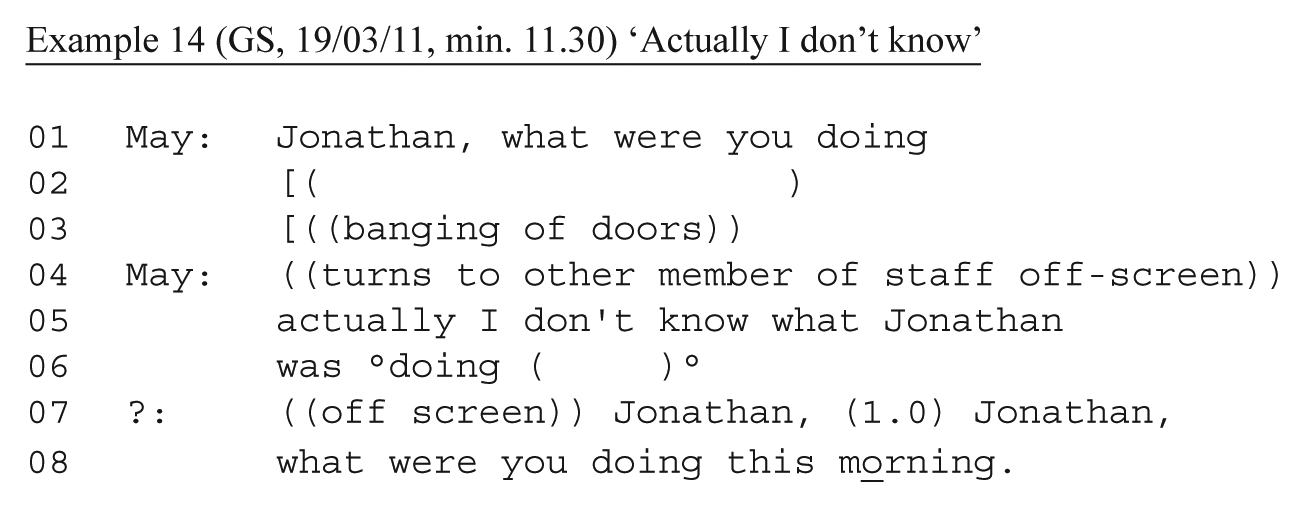
This is useful negative evidence: a questioner withdrawing, on realizing that she doesn’t know the answer. May at line 5 makes clear to her fellow staff member that she would not be able to assess the accuracy of Jonathan’s answer (and that staff member, who later events reveal does know, duly takes over). Her route to helping the recipient develop an answer (by offering hints, or showing that she had been there) is blocked, and that upcoming interactional impasse is sufficient for her to retreat.
In summary then, we see questioners deal with failed recipient-side test questions by giving up the fiction that they genuinely don’t know the answer, and admitting their high epistemic status. They acknowledge that they were present at the events they’re asking about, or they provide hints as to the answer. By revealing their own expertise, they turn the question into a standard test question, where all parties know that the questioner is already in possession of the facts. That seems to help.
Discussion
The aim of this article was to describe a variant of the standard test question, and to speculate on its interactional effects. In the standard test question, to use Heritage’s (2012a, 2012b) terms, as he (Heritage, 2012a: 20) and Drew (2012: 62) point out, all parties know that the questioner is already aware of the answer, by dint of their real-world ‘territories of knowledge’. Thus the teacher asking her class to supply the name ‘angle’ for a concept she has just instructed them in (Example 1) is straightforwardly presumed by all parties already to know the answer. In such standard test questions, the recipient colludes with the questioner’s false low epistemic stance and answers the question as if offering new information. On the other hand, in the recipient-side variant I explored here, the questioner’s initial epistemic low stance ought to be true and designed genuinely to solicit information. For example, the questioner might ask the recipient what he wants for dinner (as in Example 3), which is ostensibly genuinely unknown to the questioner. Yet the questioner is nevertheless allowed to judge the answer, when it comes, as right or wrong. That is the puzzle.
In the settings from which I draw my examples, the solution is all too obvious. The interactions are between care staff and people with intellectual impairments. There is perhaps no mystery in the answerer’s acquiescence in letting the questioner arbitrate on apparently private matters. The questioners have institutionally provided-for, real-world, authority by virtue of being cognitively ‘normal’ people, supporting people with intellectual impairments. To use Heritage’s terms again, the questioners have two kinds of epistemic warrant: one, their actual knowledge of the client’s world, by virtue of their oversight over their lives; and the other, their institutional expertise, which includes an obligation to educate and encourage the people they support.
It would be in order to look across at non-institutional conversations among ‘ordinary’ interactants, where questioners may have neither of these epistemic advantages over their recipients. Inspection of a British corpus of telephone calls mostly among adult family and friends (the Holt corpus) reveals arguably only one or two standard test questions, and nothing that could count as a recipient-side one. It may be that the institutional domain affords greater scope for a questioner to know as much, or better, about their recipient’s experiences or desires.
An exception, outside institutional life, which approaches the cognitive asymmetry between staff member and adult with intellectual impairment, might be the case of the parent and the child. Here is an example:
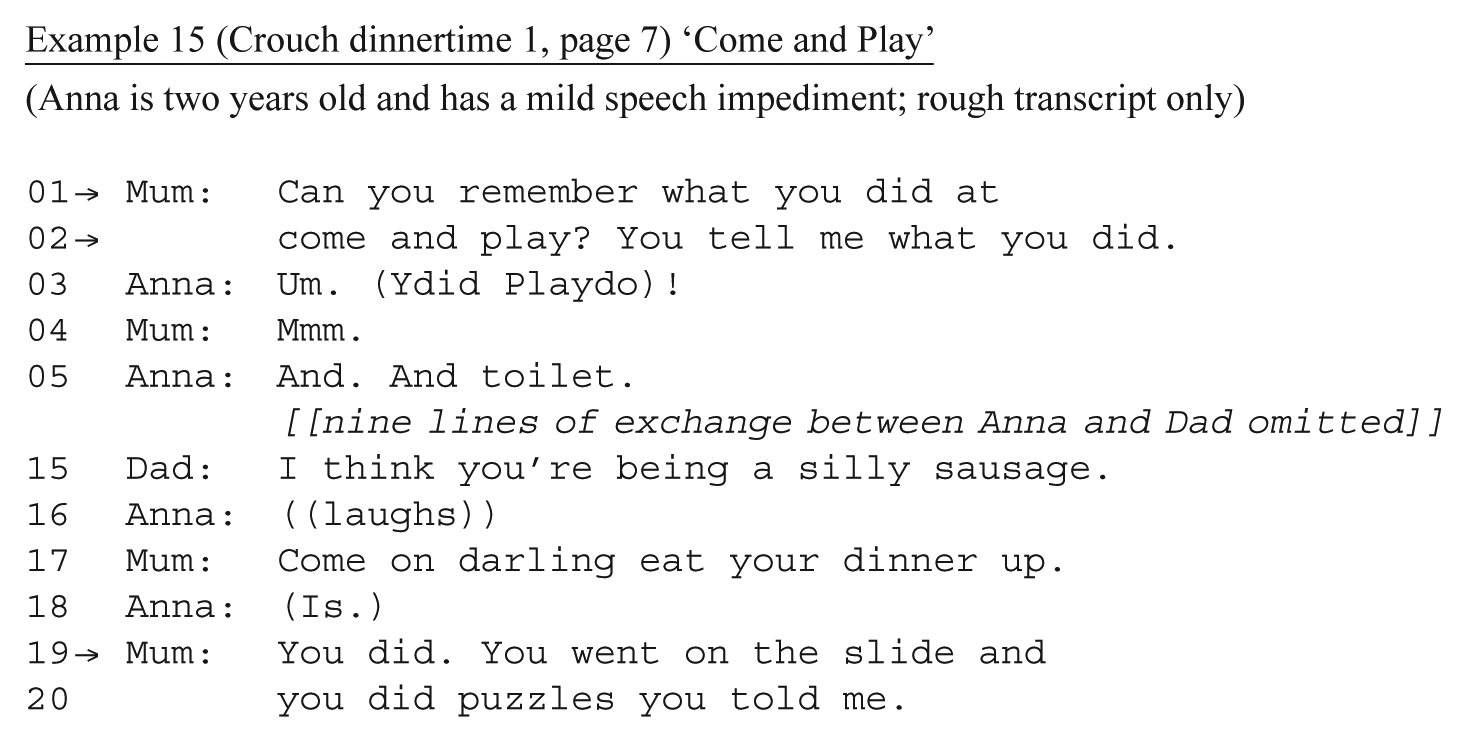
Mum’s question in line 1 is apparently directed at knowledge held principally (and perhaps exclusively) by Anna. Anna answers apparently satisfactorily, but the conversation is sidetracked for a while. When (at line 19) Mum returns to orient to the matter, she insists that there was more to Anna’s activities than she had reported, revealing that she (Mum) had known the answer all along. That recasts her original, apparently genuine, question as, in fact, a recipient-side test question. It’s an open issue whether this is a format of questioning much used by parents with their children, or other pairs of interactants in a similarly asymmetric relationship.
Whether the recipient is a child or an adult with an intellectual impairment, the implication of the recipient-side test question is that priority ought to be given first, in the issuing of the question, to the recipient. That low epistemic status is only abandoned after the reply is deemed unsatisfactory in some way (badly formatted, inadequate or wrong). To progress the interaction, the questioner may assert their true epistemic authority by claiming experience (e.g. that they had been present at the events being asked about) or expertise (e.g. knowing the names of flowers ex officio as garden therapy staff). Such assertions reveal more and more clearly that the questioner him-/herself already knows what the answer is. It brings the recipient-side test question back into the fold of straightforward test questions. What had the format of an exchange of genuine enquiry reverts back to Sinclair and Coulthard’s pithy description: ‘A teacher rarely asks a question because he wants to know the answer; he asks a question because he wants to know whether a pupil knows the answer’ (1975: 36–37; as cited by Margutti, 2010: 320).
Ownership of knowledge is a delicate matter, and as Heritage and Raymond (2005) point out, a site for contestation. Nevertheless, in the bulk of the exchanges we have seen in this article, there is little resistance from the recipient. This speaks to the institutional nature of the talk, and is one more piece in the mosaic of asymmetric talk between people with intellectual impairments and those with fuller membership of interactional society.
Footnotes
Acknowledgements
I am indebted to Piera Margutti and Susan Danby for their close reading of an earlier draft of this article, and for their scholarly and constructive comments.
Funding
I am grateful for financial support from the Economic and Social Research Council and from the British Academy for collection of most of the data in this article.