






Abstract
The article presents an analysis of the ways in which knowledge is displayed, contested and renegotiated in the 2007 French presidential debate between Ségolène Royal and Nicolas Sarkozy. Knowledge displays can be achieved through a series of ‘neutral’ resources, such as informing, explanation or comment, or through face-damaging resources, such as questioning an unknowledgeable interlocutor to prove his inferior epistemic status (K−) and boost one’s own. The article focuses on this latter type of knowledge display where a knowledgeable participant (K+) engages in question–answer sequences with an unknowledgeable respondent (K−) in front of a third party (the audience). The article also undertakes an analysis of the multimodal strategies employed by the (K+) participant to discredit the (K−) opponent (ironic smiles and laughter). The article intends to contribute to the existent literature on epistemic stance by offering a prototypical example of incongruence between the epistemic status (K+) of the questioner and the epistemic stance he adopts (unknowing K).
Keywords
Introduction
In everyday interactions, knowledge display and knowledge negotiation are ubiquitous. By displaying their knowledge, interactants do not necessarily aim at boosting their image, or if this occurs, it is not necessarily aimed at downgrading the interlocutor’s image. Conversely, in adversative contexts such as political debates, knowledge displays can be strategically oriented to attest the competence of the speaker and, implicitly, the opponent’s lack of preparation.
Depending on one’s institutional role, one has rights as well as responsibilities with respect to knowledge (Heritage, 2012a, 2012b, 2013; Heritage and Raymond, 2005; Kamio, 1997; Mondada, 2013; Raymond and Heritage, 2006; Stivers, 2005; Stivers et al., 2011). Considering that the epistemic domain is morally ordered, if such responsibilities are not fulfilled, one can be held accountable for one’s epistemic défaillance, with clear implications for the relationship between co-interactants (Stivers et al., 2011) and also between co-interactants and their audience. This is precisely why being able to prove the opponent has not fulfilled his responsibilities with respect to knowledge is of major importance in political debates.
Questions and goals: Real questions versus known-answer questions
Interactants generally have good command over who can be expected to know what. This prevents speakers from informing already knowing recipients about some state of affairs (Goodwin, 1979; Sacks, 1992; Stivers et al., 2011) and, at the same time, entitles less knowledgeable interactants to pose questions to their assumingly more knowledgeable partners.
In line with the felicity conditions for the non-defective performance of a question, information requests are put forward by unknowledgeable questioners to presumably more knowledgeable recipients when it is not obvious to both interactants that the latter will provide the information without being asked to (Austin, 1962; Searle, 1969). Levinson (1992) and later Stivers et al. (2011) go on to elaborate further conditions for a non-defective performance of a question: in their view, interactants generally ask their interlocutor questions when they presuppose not only the recipient’s epistemic access but also the recipient’s willingness to answer the question.
In adversative contexts these social norms do not apply, and all moves are aimed at winning over one’s opponent. Besides monitoring who knows what, in order to avoid informing already knowing recipients about some state of affairs, in adversative contexts such as political debates, interactants also permanently monitor the epistemic status of their opponent with respect to his epistemic responsibilities. When one of the two interactants fails to fulfil his epistemic obligations, the other can and usually does hold the former accountable for his epistemic defaillance. Sidnell (2005) refers to this as ‘policing knowledge’. In highly adversative contexts, asymmetries of knowledge (Stivers et al., 2011) can be highlighted by the more knowledgeable (K+) candidate who may ask his opponent questions while already knowing the answer to his own question and while presupposing the recipient’s lack of epistemic access. As a matter of fact, in political adversarial contexts where the goal is to win over the opponent, it may be perfectly acceptable to ask the opponent a question you know he cannot answer (Jacobs and Jackson, 1989). This is because acts otherwise judged as defective from the standpoint of a conventional set of felicity conditions may be judged appropriate with respect to the goal behind the act (Jacobs, 1987). 1
In a conversational context where the goal of both interactants is that of boosting their ethos and possibly discrediting the opponent, one may ask questions not for the sake of being provided with new information, but for the sake of proving to an overhearing audience that the candidate does not have definite knowledge of that matter. What is fundamentally at stake is proving that the interviewee-as-candidate does not know what he is expected to know, given his social identity (Roth, 1998, 2005).
Known-answer questions in presidential debates: A tool to unmask the opponent’s ignorance
But what is the nature of such questions, considering they request details that are already known to the questioner and, moreover, details that the questioner assumes the respondent lacks?
Considering the activity where such a conversational exchange takes place, that is, presidential debates, the analyst can make some assumptions about the intentions of the questioner: namely that he wishes to put forward the following standpoint in front of the audience: ‘My opponent is ignorant while I am duly prepared in the field.’ One can make this assumption with surety because the nature of the activity assigns a particular role, a class of intentions, to the questioner (Levinson, 1992: 84–85).
The point of such questions, therefore, is not learning any new information, but obtaining a demonstration of the interlocutor’s lack of knowledge. It goes without saying that politicians running for president put forward argumentations for their standpoints for the sake of the audience, as it is the audience who is the real target to be persuaded, not the political opponent (Kerbrat-Orecchioni, 1990; Vion, 1992). We see, therefore, how proving the opponent’s ignorance can work as a means of demonstrating one’s own competence and being positively assessed by the audience.
After D’Errico and Poggi (2014) and D’Errico et al. (2012b), we distinguish between ‘ignorance’ and ‘stupidity’ (both attacks aimed at downgrading the opponent’s competent side of ethos), and we term such known-answer questions as ignorance 2 unmasking questions.
Namely, by ignorance-unmasking question, we refer to a question asked by a knowledgeable questioner to an allegedly unknowledgeable interlocutor with the purpose of casting bad light on the opponent’s competent side of ethos and, in so doing, casting himself in a positive light. The very fact that one affords to appoint oneself as the examiner of a peer is a cue of epistemic authority over the topic, implicitly communicating to the other and to the audience a certain legitimization to act as examiner due to superior preparation and epistemic rights over the topic.
Recipient-tilted epistemic asymmetry is a major contributing factor in determining whether we are dealing with an assertion or with a confirmation request (Hayano, 2014; Heritage, 2002a, 2012a; Heritage and Roth, 1995; Labov and Fanshel, 1977; Stivers and Rossano, 2010). In a similar fashion, we could say that questioner-tilted epistemic asymmetry is a cue for hearing a question as a known-answer question, while it is the social and sequential context that gives cues on the questioner’s goals and encourages recipients to hear or not the question as an ignorance-unmasking question.
Questioners’ different goals in asking known-answer questions
We differentiate between ignorance-unmasking questions and two different types of known-answer questions (Heritage, 2013; Levinson, 1992; Searle, 1969) already examined in the literature: that is, known-answer questions asked in the classroom by the teacher (Koshik, 2002; Lee, 2007; Macbeth, 2004; Mehan, 1979) and ‘pop quiz’ questions, 3 a form of hostile questioning employed by journalists to discredit political candidates (Roth, 2005). All three types of questions have in common the questioner’s more knowledgeable epistemic status (K+, in line with Heritage, 2012a, 2012b). There is instead a difference in the questioner’s goals, social role and the context in which such questions are asked. In the case of known-answer questions in classroom interaction, the questioner does not know whether the respondent holds the piece of information asked for (think about oral examinations 4 where the questioner’s goal is that of verifying students’ preparation in the field, and usually no prior assumption is made about the outcome of the question). Instead, both in the case of ignorance-unmasking questions and pop quiz questions, the questioner expects a lack of knowledge in the respondent, and this is precisely the reason why he asks such a question. We can say therefore that while in the first case, the questioner’s goal is tutorial, in the second and third cases, the questioner’s aim is to damage the respondent’s image by unmasking his lack of knowledge in front of the audience.
Questioners’ different social roles in asking known-answer questions
As far as the social role and responsibilities of the interactants are concerned, in the first case, it is the questioner’s duty to verify the students’ access to knowledge by means of known-answer questions. Instead, in asking questions aimed to prove the interlocutor’s lack of knowledge, the questioners – political opponent in the case of ignorance-unmasking questions, moderator in the case of pop quiz questions – assign themselves a higher social authority on the basis of their higher epistemic status in that field.
Appropriateness of known-answer questions
While everyone agrees on the appropriateness of known-answer questions in an exam context, pop quiz questions (and possibly ignorance-unmasking questions) are more controversial. Pop quiz questions, for instance, have been referred to in terms of degradation ceremonies (Garfinkel, 1956; Roth, 2005). They share with ignorance-unmasking questions the superior epistemic status of the questioner, his expectation of lower epistemic status in the respondent, as well as the questioner’s goal of degrading and discrediting the respondent. The main difference between these two types of questions is found in the role of the questioner: while the former are asked by a putatively neutral party, the latter are posed by the respondent’s opponent, a party whose best interest is that of eliminating the adversary from the race for presidency. We could say therefore that ignorance-unmasking questions occurring in conflictual contexts between peers who race for two incompatible goals are less blameworthy, or at least more predictable.
Pop quiz and ignorance-unmasking questions also differ when it comes to their pertinence to the topic being discussed. While the former consist of an array of non-pertinent questions to the matter at hand, the latter are topic related and provoked by the respondent’s superficial assertions on the topical matter at hand. While the former have been referred to by the media as ‘questions meant to embarrass and not to enlighten’ (Roth, 2005: 31), the latter are possibly meant to enlighten due to their very goal of revealing – in the respondent – inaccuracies or missing information concerning hot topics for the future of the country. Topic relatedness is further evidence against malice aforethought in ignorance-unmasking questions: the question itself is somewhat provoked by the questioner’s inappropriate dealing with the topic at hand. The same cannot be said about the premeditated array of pop quiz questions, which unexpectedly and unrelatedly pop into the interview.
Ignorance-unmasking questions during the 2007 French presidential debate
To illustrate the use of ignorance-unmasking questions, our focus in this article, we present in the following an excerpt taken from the 2007 French presidential debate between Ségolène Royal, the socialist candidate, and Nicolas Sarkozy, the leader of the Union for a Popular Movement (UMP). The debate 5 was intended to inform and allow the electors to scrutinize both parties’ views on important topics for the future of France; it was moderated by two TV hosts, Arlette Chabot and Patrick Arvoir, and broadcast live from the studio of TV5. The extract we focused on is centred on the topic of nuclear energy.
Our analysis will focus on two ignorance-unmasking questions asked by Royal to Sarkozy concerning nuclear energy. We will analyse the strategies undertaken by the two participants to prove their epistemic superiority and/or to resist the assignment of an inferior epistemic status. Contrary to known-answer questions in classroom interaction which occur within a sequence made up of three actions – question–answer–evaluation (Initiation, Response and Feedback; Sinclair and Coulthard, 1975) – ignorance-unmasking questions occur in a sequence where a fourth element is added, that is, an attempt on the part of the interrogated to resist the negative evaluation assigned by the interrogator. The four-element sequence is composed of A’s ignorance-unmasking question (in first position), B’s response (in second position), A’s feedback (in third position) and B’s attempt to resist the corrections and the assignment of inferior epistemic status (see Figure 1).
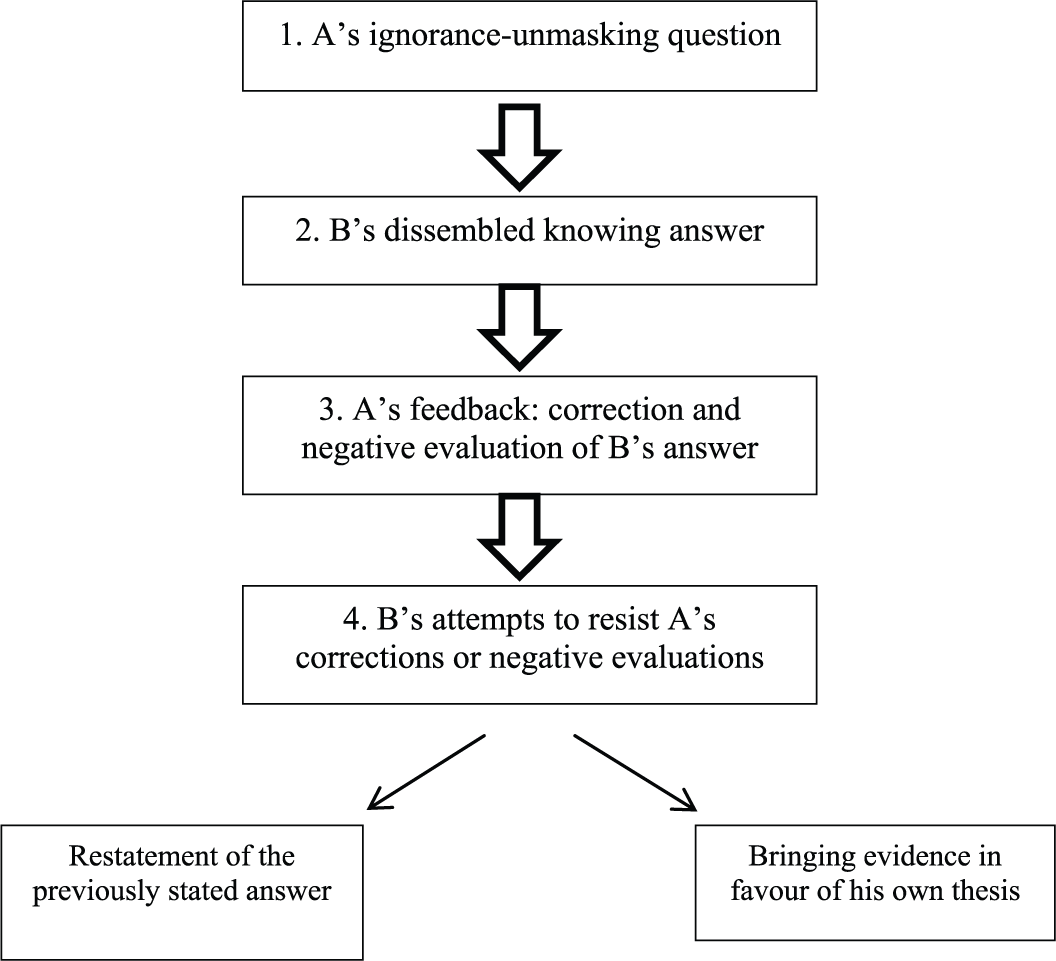
Four-element sequence.
Epistemically speaking, in first position, the knowledgeable questioner (K+) asks a question of a presumably unknowledgeable opponent (K−); in second position, the answerer dissembles his epistemic status and deploys an epistemic stance to appear more knowledgeable than he really is (Heritage, 2012b); in third position, the knowledgeable questioner (K+) corrects the unknowledgeable answerer (K−); in fourth position, the answerer tries to prove to the questioner and audience that he is knowledgeable on the topic at issue (either by simply contradicting the questioner’s version or by bringing evidence in favour of his own thesis).
First ignorance-unmasking question 6
1. Sarkozy: As far as nuclear energy is concerned, do you stand by 2. M. Chevènement or by the Green Parties? 3. Royal: → But do you know,= 4. Sarkozy: = Do you confirm the choice of nuclear energy? 5. Royal: → Do you know what the share of nuclear energy 6. employed by France is? 7. Sarkozy: Yes, but do you confirm the [choice? 8. Royal: → [Of- what is this part? 9. Sarkozy: We have, Madam, thanks to nuclear, an independence over 10. the electricity of [France]of up to fifty per cent. = 11. Royal: [You do not know,] 12. Royal: You defend nuclear energy, [but you 13. Sarkozy: [Yes I, no Madam. No, no, = 14. Royal: → = the share of nuclear, (.) how much is it then? 15. Sarkozy: = we have half of our electri-ci-ty, which is of 16. nuclear origin [Madam. 17. Royal: [No. Seventeen per cent [ 18. Sarkozy: [No, that is 19. not exact. = 20. Royal: = Seventeen [per cent 21. Sarkozy: [That is not exact, Madam. 22. Royal: Of the electri[city is of [nuclear origin. 23. Sarkozy: [That is not exact! 24. Sarkozy: [No:: Madam! 25. [That is not exact. 26. Royal: [Well, listen, anyway, we will see(h). But yes, 27. it is so. Hence what I want. = 28. Sarkozy: = No no Madam.
Displays of epistemic authority by means of ignorance-unmasking question in first position
Royal challenges both the power and epistemic status of her opponent: she not only challenge her opponent’s attempt at power display (she refuses to answer his question in lines 1, 2) but also launches, in turn, a question aimed at undermining his epistemic status (lines 3, 5, 6).
Content questions such as those in lines 3, 5 and 6: ‘But 7 do you know do you know what the share of nuclear energy employed by France is?’ formally constrain answerers to precise indications (numbers). If Sarkozy had been conversationally cooperative, he would have uttered straight away the number the questioner was after; instead, he provides an answer aimed at the first subpart 8 of the question (‘But do you know …?’). Sarkozy’s hasty minimal response (‘oui’, English ‘yes’, in line 7) treats Royal’s content question as a polar question simply aimed at eliciting a ‘yes/no answer’ and can be interpreted as an attempt to halt the topic by refusing to contribute to its development (Jefferson, 1993; Schegloff and Sacks, 1973; Svennevig, 2000). Sarkozy then quickly moves on to reformulate his previous question: ‘but do you confirm the choice?’ (line 7), performing therefore an attempt to shift the topic (a clear sign that he prefers not to answer the question). In any conversational context, whether friendly or adversative, questions require answers, and the lack of an answer does not go unnoticed (Schegloff, 1968). As exemplified here, when answers resist the agendas set by questions, they are seen as evasive and provide questioners with a warrant to renew the question (Clayman, 1993; Heritage, 2002a; see also Hayano, 2014). Royal hence does not allow Sarkozy to get away with his attempt at topic shifting and reiterates the second subpart of her question more explicitly: ‘So what is it?’, leaving no doubt about the fact that she is after precise numbers and not aiming at a mere competence check.
We see how, as the interrogation proceeds, Royal’s questions change configuration, going from closed ‘But do you know do you know what the share of nuclear energy employed by France is?’ (lines 3, 5, 6) to open ‘So what is it (the share)?’ (line 8). Question configuration is indicative of the way the questioner’s orientation towards the recipient gradually changes: if at the beginning Royal orients the question to her recipient as possibly (un)knowing (either K+ or K−), after a few turns she addresses an undoubtedly unknowing (K−) interlocutor, the open question being aimed at revealing her opponent’s ignorance.
Claiming (some) epistemic rights in second position
Sarkozy’s answer, ‘We have, Madam, thanks to nuclear, an independence over the electricity of France of up to fifty per cent’ (lines 9, 10), is twice-approximated. 9 ‘Up to’ (French à hauteur de) is an approximator (Channell, 1994), while the term ‘moitié’ (English ‘half’, easily paraphrasable with ‘fifty per cent’) is an approximator as well. Besides being highly approximative, according to Royal, it is also far from correct: she specifies that the accurate percentage is seventeen and not fifty (lines 17, 20). Accused by Royal of defending nuclear without knowing the actual share of nuclear energy employed by France (lines 12, 14), Sarkozy tries to fight the epistemic inferiority that stems from his twice-approximate reply by giving up on one of the approximators (French à hauteur de, English up to) and reformulating his answer in a less approximate manner: ‘Half of our electri-ci-ty . . . is of nuclear origin’ (lines 15, 16).
Multimodal negative evaluations in third position
In the case of the question–answer adjacency pair, the questioner (here Royal) has a ‘reserved right’ to talk again immediately after giving an answer (Jones, 2008). Royal uses this right to put forward a negative evaluation of her opponent, just like a teacher would have done faced with an erroneous answer from her student: ‘You defend nuclear energy but you do not know the share of nuclear [in France’s energy consumption]’ (lines 12, 14), revealing what the goal of her question was in the first place: to cast a negative light over her counter-candidate, proving that he based his proposals (i.e. augmenting nuclear) on claimed knowledge, while actually lacking expertise in the field. We see how Royal’s question is initially answered by the designated respondent in lines 15 and 16 but consequently corrected by the questioner who self-selected herself and provided the correct answer to her own question: ‘No. Seventeen per cent only’ (line 17, restated in line 20), taking the opportunity to display once again her epistemic authority in the field. Royal both opens and closes the sequence by limiting herself to state ‘Well listen, anyway, we will see. But yes, it is so’ (lines 26, 27). By being the speaker who closes the sequence, she manages to have the last word on the issue, once again claiming epistemic superiority and control over the topic.
Royal’s concomitant body signals multimodally communicate the pointlessness of continuing insisting on the topic. While saying ‘Well listen […]’ (line 26), Royallowers her head and quickly raises both her shoulders in sign of resignation in front of Sarkozy’s inaccuracies and insistence. The raise of her shoulder communicatesimpotence, hopelessness and resignation: she has tried to draw her opponent’s attention to the inaccuracies he stated, but with no success. Sarkozy and his lower epistemic status do not represent a threat to Royal; on the contrary, she can afford to laugh at him. While saying ‘[…] anyway, we will see. But it is so’, she bursts into laughter, multimodally communicating that her opponent is laughable.
To communicate negative evaluations regarding the opponent’s competence, one can choose not to make use of insulting words, but of ridiculization. According to Castelfranchi (1988), this is to ridicule an object or a person who has the pretence of having powers or abilities that in reality he or she does not have and whose incapacity is after all harmless. Not affected by this ineptitude, the one who ridicules (A) feels superior to the one ridiculed (B). Ridiculization acts often occur in front of third parties who are invited to notice the inadequacy of the ridiculed and to join A in laughing at B. Therefore, ridiculing B implies pointing out, in front of an audience, B’s lack of power and B’s naive presumption of having that particular power, with the aim of abasing him. By contrasting A and B, ridiculization could be seen as an indirect strategy to boost one’s own ethos by means of abasing the opponent’s ethos.
Attempts to fight the K− assignment in fourth position
Sarkozy’s only attempt to resist Royal’s assignment of inferior epistemic status is by contradicting the percentage she stated. Sarkozy does not align himself with his counter-candidate’s answer and does not change his initial assertion, but continues to counter-argue for several turns ‘That is not exact, Madam’ (lines 21, 23, 24, 25, 28). Having aligned himself with Royal’s position (‘seventeen per cent’) would have been tantamount to granting epistemic authority to Royal and adopting the epistemic position of unknowledgeable (K−). Therefore, Sarkozy tries to refute Royal’s corrections in an attempt to fight the assignment of a K− epistemic status, as well as the negative evaluation that would stem from it.
The fact that Sarkozy asserts twice that half of the electricity is of nuclear origin, as well as his numerous confutations of Royal’s percentage, is indicative of the fact that he is not willing to give up on his (claimed) epistemic authority in the field.
Although neither of the two candidates support their affirmations with evidence coming from authoritative sources, it is interesting to note their different degree of commitment to the information offered: in Royal’s case, the commitment to the truth of her statements is strengthened by the quotation of detailed numbers and percentages (Fedel, 2003; Riccioni et al., 2013). Royal’s high degree of precision (seventeen per cent) could be interpreted as a marker of her high degree of certainty, while Sarkozy’s low degree of precision (the double approximator ‘up to’ + round number) signals his high degree of uncertainty.
Second ignorance-unmasking question
1. Sarkozy: Do we continue with nuclear? 2. Royal: From one day to another we will not close down the nuclear 3. [plants. On the other hand, on the oth- 4. Sarkozy: [So you confirm the EPR.
10
5. Royal: No. I will suspend the EPR as soon as I am elected, 6. Sarkozy: So this means you will suspend the new plants, 7. and you will prolong the old ones. 8. Royal: But the EPR is not a n[ew, is not a plant. 9. Sarkozy: [Yes! 10. Sarkozy: Of course! 11. Royal: But you are mixing everything up. [The EPR is a prototype. 12. Sarkozy: [But (.) no, Madam. 13. Royal: → EPR is a prototype of which [generation ? 14. Sarkozy: [It is not a prototype, 15. it is the fourth generation, [(………………….)We have = 16. Royal: [No, it is the third = 17. Sarkozy: = just sold it to Finland, Madam. 18. Royal = generation. 19. Royal: What ? 20. Sarkozy: The French must understand. The French must 21. understand. (.) Classic nuclear plants, have 22. a certain lifespan. This lifespan, so, 23. according to experts, it goes from thirty years to 24. fifty years coverage. 25. We were forced to launch the nuclear plants of 26. fourth generation, the EPR process was 27. bought, [by, by Finland, [and we are building = 28. Royal: [It is the third generation. 29. Royal: [No, Finland has its own prototype. 30. Sarkozy: = in France. Seven years will pass between the moment 31. when I signed the EPR and the moment when the first plant 32. is to be launched. Seven years. If you go back on the choice 33. of the EPR, Madam, that means that you will be forced 34. to honour your promise to keep the same percentage of 35. nuclear power and to prolong the lifespan of the old plants. 36. This means that you will assume the responsibility of 37. keeping the old plants functioning for longer because 38. you refuse to adopt the progress which is represented by 39. nuclear plants of the latest generation. This is not 40. very reasonable. 41. Royal: You have you have a very approximative 42. approach, allow me, you have a very approximative 43. approach, on a topic (which is) extremely (.) 44. technical, but, at the same time, extremely serious 45. as we are dealing with nuclear energy. So, you have 46. just said a series of errors, it can happen, but you have to 47. revise your topic a bit, as it is not 48. the fourth, but the third generation, 49. Finland already has a prototype and actually the point 50. is seeing whether it would not be more intelligent 51. to cooperate with several countries and move on 52. straight away to an investment in the fourth generation, 53. first point, this is why I will re-open the public debate 54. on energy, in the Parliament, but also with the citizens 55. [because the French, 56. Sarkozy: [We had this debate in the Parliament! 57. Royal: No, [it is, wait, do not interrupt me, I listened to = 58. Sarkozy: [I did it. I conducted this debate in the Parliament = 59. Royal: = you. I, 60. Sarkozy: = when I signed the EPR. And the position of 61. the Finnish, by the way, consisted in telling us, Madam, 62. allow me to tell you, I know the file. Very well 63. that you are selling us this prototype. But you, the 64. French, are you going to get it? 65. I may not know the file, Madam 66. but I am pretty consistent.
Displays of epistemic authority by means of ignorance-unmasking question in first position
Sarkozy asks Royal whether she will confirm the European Pressurized Reactor (EPR; line 4). At Royal’s answer that she will suspend the EPR as soon as she is elected (line 5), Sarkozy tries to lower the reliability of his opponent by pointing to an unwise action that Royal plans to adopt: suspending the new plants and prolonging the lifespan of the old ones. The inference Sarkozy makes, namely that EPR is a new plant, gives Royal once again the opportunity to correct him (line 8) and to negatively assess his knowledge of the field (line 11).
After having duly corrected Sarkozy’s assertion, Royal takes up the role of questioner while Sarkozy is forced to take up the role of answerer. Royal already had the occasion to attest Sarkozy’s lack of preparation by means of her first ignorance-unmasking question. Her second ignorance-unmasking question (‘EPR is a prototype of which generation?’ in line 13) is aimed at further highlighting Sarkozy’s ignorance in the field of nuclear energy.
Sarkozy’s reply, ‘It’s not a prototype, it’s the fourth generation’ (lines 14, 15), is corrected by Royal in the following turns: ‘No, it’s the third generation’ (line 16 and consequently line 28). Here too, Royal’s question is not aimed at acquiring information from someone who has already demonstrated lack of knowledge, but it functions instead as a device to lay bare this ignorance and thereby further discredit Sarkozy’s knowledge of the subject matter. Now that she has caught her opponent unprepared, it will be in her best interest to project the most damaging image on Sarkozy by asking him further questions on the topic. Due to our knowledge of the nature of the activity (presidential debate) and of the candidate’s intentions, we can interpret these questions as aimed at damaging the opponent’s image by pointing to an inconsistency between Sarkozy’s real epistemic status (K−) and the one expected from a future president (K+). By means of ignorance-unmasking questions, Royal aims to put forward the following claim: ‘My opponent is not adequate to become president’.
Claiming (some) epistemic rights in second position
We understand of course why Sarkozy resists Royal’s line of argument aiming to prove that he is unknowledgeable (K−) and inadequate to become president: Sarkozy’s ‘understanding, like ours, rests on the reconstruction of the intended line of argument, and given the goals that the activity assigns to him, he must try to thwart that line of argument’ (Levinson, 1992: 85). In the attempt to prove that he is the knowledgeable candidate (K+) while his opponent is not (K−), Sarkozy contradicts Royal and states that it is not a prototype but the fourth generation. To support his thesis, he adds further details on the topic: ‘We have just sold it to Finland, Madam’ (lines 15, 17). but this statement proves to be incorrect as well (for details see Note 10).
Further displays of epistemic authority in third position by means of negative multimodal evaluations of the opponent
Royal rejects Sarkozy’s answer and corrects it (‘it is the third generation’, lines 16, 18). In front of Sarkozy’s argumentation in support of his thesis (lines 15, 17), Royal limits herself to performing an ‘open class’ repair initiator (Drew, 1997) ‘What?’ (line 19), a kind of repair usually emerging in contexts where the interlocutor faces hearing and understanding problems. Here, in saying ‘What?’, Royal’s aim is that of showing a failure to understand how something as nonsensical as Sarkozy’s statement came to be said. She resorts to facial expression to fully communicate her negative evaluation of the opponent: her face and head display a full array of disagreement signals, ranging from frowning to shaking her head. In stating ‘What?’, her frown – a typical multimodal behaviour during disagreement – converts to raised eyebrows, indicating surprise, incredulity even. Concomitantly to her eyebrow raising, her eyes open widely 11 and her lips part, facial actions typically occurring in the expression of surprise (Ekman et al., 1990), an emotion defined in terms of disconfirmed expectations. Hearing Sarkozy’s statement that France has just sold the EPR to Finland, obviously not in line with the information held by her, triggers surprise in Royal. Undoubtedly, such a blatant display of surprise in front of one’s opponent statement is, first, aimed at communicating disagreement and, second, at questioning the credibility of the opponent himself. In addition, Royal performs a headshake, which further emphasizes her disagreement with the speaker.
Sarkozy tries to take on the role of a knowledgeable speaker (K+) who explains to an unknowledgeable audience (K−) the findings of experts concerning the lifespan of nuclear plants (lines 21–24), but once he repeats the inaccurate statement about having set off the fourth generation of plants (lines 25, 26), concomitantly to his statement, the camera focuses on Royal who looks at the speaker with slightly canted head. 12 Royal combines head canting with a refrained ironic smile (her lips are stretched with tensed mouth angles). Although refrained, the smile is still perceivable due to its visible cues: horizontally stretched lips and lifted cheeks. Her gaze lingers 13 for about three seconds on her interlocutor; she is watching an enjoyable, amusing performance: that of her opponent stating inaccurate data and making a fool of himself.
In such an adversative context, the combination of head canting, gaze fixation and suppressed ironic smile is to be interpreted as a display of power and ironic compassion towards the object of the smile, therefore once again as a negative evaluation of inadequacy that Royal multimodally proclaims concerning her opponent. A few seconds later, Royal intervenes but limits herself to short overlaps (‘It’s the third generation’ in line 28 and ‘No, Finland has its own prototype’ in line 29), representing a full repeat of her already stated corrections, marking her disagreement (Voghera, 1992) as well as her unwillingness to expand on the current matter (Svennevig, 2000: 190).
Attempts to fight the K− assignment in fourth position
For obvious reasons, Sarkozy tries to resist Royal’s claim to epistemic authority indexed by her ignorance-unmasking question and tries to fight the unknowledgeable status (K−) that Royal has assigned him. He therefore deploys a series of strategies to prove that he has epistemic authority in the field. As already mentioned, he tries to take on the role of a knowledgeable speaker (K+) who explains the findings of experts concerning the lifespan of nuclear plants (lines 21, 22, 23, 24) to an unknowledgeable (K−) audience (‘The French must understand’, lines 20, 21).
Despite Royal’s overlapping corrections (lines 28, 29), Sarkozy keeps the turn and concludes with an accusation of unreasonableness, blaming Royal’s refusal of progress and her choice to run old plants (lines 32, 33, 34, 35, 36, 37, 38, 39, 40).
While in the case of the first ignorance-unmasking question Sarkozy limits himself to contradicting Royal on the issue of the nuclear energy percentage (up to 50% vs Royal’s 17%), in the second case he upgrades his claimed epistemic authority on the matter by mentioning that he took part in the debate in the Parliament and that he knows the file (line 62), hence complying with the norm according to which speakers should make assertions only when they have sufficient knowledge and the right to do so (Heritage and Raymond, 2005; Stivers, 2005; Stivers et al., 2011: 14).
Repetition of the negative evaluation expressed in third position by the Knowledgeable Speaker concerning her Unknowledgeable Interlocutor
Royal replies by advancing her overall assessment of Sarkozy’s performance, classifying his approach to such an important issue as nuclear energy as ‘very approximate’ (lines 41–45). She adopts a didactic stance (D’Errico et al., 2012a), picking on every inaccuracy stated by Sarkozy and countering them one by one (‘[…] it is not the fourth, but the third generation’, ‘Finland already has a prototype’ […]; lines 47, 48, 49). Royal assesses Sarkozy’s responses (‘You have just said a series of errors’; ‘you have to revise your topic a bit’, lines 45, 46, 47), and she is magnanimous and willing to pass over the opponent’s défaillances (‘It can happen’, line 46). Royal’s statement is interpreted as ironic due to the exaggerated discrepancy between what the context would require as appropriate (a high level of preparation from a candidate running for presidency) and the message conveyed explicitly (‘It can happen [not to be duly prepared in some fields of great importance in the country’s economic and environmental welfare]’). Royal piles it on with her multimodal behaviour: while stating ‘It can happen’, she performs a quick shoulder raise, paraphrasable initially, 14 with ‘It’s not important’. In such an adversative context, the shoulder raise acquires, on second reading, an ironic meaning. We can say that such a signal functions in this context as an irony booster, augmenting the ironic effect already conveyed by the ‘condoning’ statement ‘It can happen’. The shoulder raise is immediately preceded by a refrained asymmetric smile, typically ironic, performed by Royal while stating the word ‘errors’ in line 46.
The combination of the two contiguous signals – ironic smile and shoulder raise – apparently conveys two contradicting meanings: ridiculization on the one side and little importance on the other. But this contrasts with our ‘common ground’ notions, namely that generally, one does not opt for a marked mode of communication (such as irony) to convey something not worthy of consideration, in the same way as one would generally not laugh (with damaging intent) at something not worthy of consideration. The message intended by Royal is twofold – on one hand, it conveys a critique of the irony target (Sarkozy), while on the other, she reiterates her superior authority in the field, which gives her the right to laugh at her opponent.
In line with her superior epistemic status, Royal feels entitled to assess her own proposal concerning an immediate investment in the fourth generation as “more intelligent” (line 50), as well as to use the deontic verb ‘must’ (French falloir) in advising her interlocutor ‘to revise [his] topic a bit’ (line 47), alluding at presidential candidates’ ‘responsibilities of “knowing” in order to be seriously considered, or even qualified, as a candidate for political office’ (Roth, 2005: 39).
Further attempts to fight the K− assignment
Sarkozy does not counter the discrediting evaluation put forward by Royal but disrupts the topic by picking up on the last sentence of Royal’s turn, in which he performs a follow-up (‘We had this debate at the Parliament’, line 56), taking the opportunity to enhance the competence side of his ethos (Poggi, 2005), so severely damaged by Royal’s attacks.
Sarkozy attempts to claim some direct, first-order access to the issue. If initially he employs the inclusive ‘we’ pronoun (‘We had this debate in the Parliament’, line 56), he then switches to the first person pronoun ‘I’, restating his exclusive authority on the matter: (‘I conducted this debate in the Parliament when I signed the EPR’, lines 58, 60) as well as his knowledge in the field: (‘I know the file’, line 62). We see how Sarkozy, in making such a topic change appear to be a follow-up to Royal’s topic earlier, allows himself to express his primacy over the topic (‘I conducted this debate in the Parliament when I signed the EPR’, lines 58, 60). The role of his statements is twofold: Sarkozy claims direct access to the matter and, at the same time, presents the matter as settled: the EPR has been signed and there is no need to further insist on the topic. As mentioned by Heritage and Raymond (2005), by designing their second assessment so as to convey that their position is as already settled […], second speakers can undercut any relative inferiority in epistemic rights that sheer ‘secondness’ might otherwise convey; indeed they can advance a claim of primary epistemic rights in the matter under evaluation. (p. 23)
Furthermore, Sarkozy alludes to an inconsistency in Royal’s claims, namely that France is selling the EPR prototype to the Finnish people but is refusing, in turn, to adopt the same prototype (lines 60–63). Sarkozy distances himself from hisopponent’s behaviour by stating that he, on the contrary, is consistent (‘I am pretty consistent’, line 66).
Ignorance-unmasking questions in epistemic competitions: A strategy to self-bestow epistemic primacy upon oneself
As mentioned by Heritage (2002b), Heritage and Raymond (2005) and Raymond and Heritage (2006), sequential positioning is one of the possible ways an interactant can claim epistemic primacy, as saying it first carries an implied claim that the speaker has epistemic rights over the topic.
In addition to this possibility, as we have just seen, in competitive contexts such as political debates with an audience watching, one can also display one’s epistemic primacy through means of ignorance-unmasking questions. The very fact that one can afford to question one’s opponent on the topic at hand is a signal of the questioner’s epistemic primacy over that topic, as only experts in the field could afford to ask their interlocutors known-answer questions of the type teachers ask pupils. 15 Such a move can be counterproductive if the opponent does manage to provide the correct answer to the question, demonstrating that he also has epistemic access to the topic and attracting positive assessments from the audience. This is why this type of known-answer questions can only be employed when the questioner is absolutely certain of the opponent’s ignorance on the topic, functioning as an ignorance-unmasking question.
Once Sarkozy’s ignorance in the field has been ascertained by means of two ignorance-unmasking questions, the environment is ‘ripe’ for putting forward assessments concerning his ‘performance’. Royal self-bestows upon herself the right to evaluate Sarkozy’s preparation on the topic and issues negative evaluations after every answer he provides to her questions.
Determining whose view is more authoritative with respect to the matter at hand is extremely important, as superior epistemic access gives one rights to make decisions over the matter. One cannot advance opinions and solutions over something one does not have epistemic access to. This is why Royal tries to prove that Sarkozy does not have sufficient access to the topic of nuclear energy and therefore he should not be entitled to have a say in that field.
Dissembling epistemic status
As mentioned by Heritage (2013), speakers act as to preserve consistency between the epistemic stance they encode in a turn at talk and the epistemic status they occupy relative to the topic […], hence unknowing (K–) speakers ask questions, and relatively knowing (K+) speakers make assertions, however, non-congruent actions are also possible. (p. 559)
Heritage (2012a, 2012b, 2013) also touches on the possibility of speakers dissembling their epistemic status in order to appear more, or less, knowledgeable than they really are.
Such incongruities between status and stance are possible, especially in adversative contexts where interactants aim to downgrade others’ epistemic status in order to upgrade their own (Zuczkowski et al., 2014). In the extracts under analysis, we saw a knowledgeable speaker asking questions she already knew the answer to and a less knowledgeable speaker making assertions in a field he is not acquainted with, pretending to be more knowledgeable than he actually is.
In contexts between peers who are expected to have equivalent epistemic status and authority, ignorance-unmasking questions are aimed at renegotiating epistemic authority.
Conclusions
As widely proven in conversation analysis (CA), questioners who are more knowledgeable than answerers may deploy a variety of resources to communicate their superior knowledge. In this article, we focus on ignorance-unmasking questions and multimodal negative evaluations of the opponent (ironic smiles, laughter or ironic shoulder raise) as resources that political candidates employ to boost their epistemic status and renegotiate their epistemic authority 16 on the topic at hand.
Such questions originate in an adversative context from a knowledgeable questioner (K+) and are directed to an unknowledgeable answerer (K−). We term this type of questions ignorance-unmasking questions, as they are triggered by something inaccurate said by the opponent and which makes the questioner doubt the opponent’s preparation in the field.
Unlike real questions whose aim is to equalize knowledge between the two interactants – or to put it in Heritage’s (2012a, 2012b) terms, balance the epistemic seesaw – the aim of ignorance-unmasking questions is that of increasing the distance between the two epistemic positions, with questioner occupying the upper, superior epistemic position and answerer the lower, inferior position. While real questions – where the questioner holds no information – are characterized by the questioner subordinating himself to his answerer (Hayano, 2014), in asking an ignorance-unmasking question, the questioner takes the opportunity to subordinate the answerer. By means of ignorance-unmasking questions, the opponent’s epistemic authority is challenged and contested by the questioner, while the epistemic authority of the latter is displayed and reinforced.
The type of question analysed in this article is a clear instance of epistemic status trumping linguistic form in action recognition by the interlocutor and by the audience (Heritage, 2012a, 2013). Despite the interrogative format of Royal’s turns, her contributions are not to be heard as real questions but as repeated attempts to unmask her opponent’s ignorance on the matter of nuclear energy.
Footnotes
Appendix 1
Declaration of conflicting interests
The author(s) declared no potential conflicts of interest with respect to the research, authorship, and/or publication of this article.
Funding
The author(s) received no financial support for the research, authorship and/or publication of this article.
Notes
Author biographies
 .
.