






Abstract
Using interactional sociolinguistics, I analyze two versions of a narrative chronicling the humorous antics of a prankster called Zimmerman who, along with the narrator, was a seminary student in the Midwestern United States in the 1950s. To explore the interactional function of telling stories about pranks, I compare two versions: one which is more performative (Schiffrin, 2006), the other which feels more like a summary, calling attention to differences in narrative evaluation accomplished through use of such linguistic features as reference, deixis, and contextualization cues (i.e. laughter). I argue that both versions accomplish moral positioning for the narrator, and work to construct and negotiate his identity as someone who values cleverness, finding humor in the playful defiance of authority. However, by contrasting a telling in which this evaluation is accomplished internally (the more performative version) to one in which evaluation is largely external, I hope to highlight how evaluative devices contribute to meaning-making through narrative performance in the relatively understudied genre of prankster tales.
Keywords
Introduction
The Zimmerman stories center on a prankster named Tom Zimmerman who flouts authority and seeks out opportunities for making people laugh by always doing the unexpected within the rigid context of the seminary, where he was a student in the Midwestern United States in the 1950s along with my father. Often told by my father (whom I here call Frank) at family gatherings, these stories are often told in a chain, and the story that I analyze here, ‘Dancing Silverware’, is often told as the first in a series of tales. Elaborate descriptions of a series of pranks often follow, for example the time when Zimmerman left eggshells in the hallway, knowing that the disciplinarian would be walking barefoot so as to be able silently to sneak up on the boys and observe their behavior without detection.
Like all narratives, these tales provide insight into who the narrator is choosing to present himself to be in that moment. Schiffrin’s (1996) foundational work on ‘narrative as self-portrait’ provides the following rich visual imagery about how we can conceive of narrative as a means by which we show and display ourselves: telling a story allows us to create a ‘story world’ in which we can represent ourselves against a backdrop of cultural expectations about a typical course of action; our identities as social beings emerge as we construct our own individual experiences as a way to position ourselves in relation to social and cultural expectations. (p. 170)
In telling the Zimmerman stories, Frank showcases how much he values cleverness by demonstrating the humor he finds in Zimmerman’s playful defiance of authority. Further, in selecting these from among all the stories that he could have told, he also showcases both his ability to recognize such cleverness and his abilities as a performer. Crucially, the different versions communicate these meanings through different linguistic means.
When told in family gatherings, these stories are ‘performed narratives’, described by Schiffrin (2006) as being designed for a broad audience, with either explanatory or illustrative functions, and as being ‘full of performance features and evaluative devices that enhance their point’ (p. 273, emphasis added). And the first version I analyze here is rich with performative and evaluative devices, including referring expressions designed to heighten dramatic tension; deictic elements evoked to illuminate the physical and metaphorical distance between characters (which serve to reinforce the drama); and evaluative contextualization cues such as laughter, stress, and pitch that heighten the performance.
And while these features are less present in the second version here considered, I suggest that a comparison of these versions showcases something about just how difficult prankster stories are to tell. As Bauman (1986) tells us, ‘practical jokes are built on complex structures of information management, involving dimensions of backstage activity, frame manipulation, fabrication, concealment and varying degrees of access to information about what is going on’ (p. 35). Thus to tell a story about who knew what, when, and why is to navigate a labyrinth, and to delight your listeners as you guide them through it showcases narrative ability. Note that I contrast these two versions not to focus on ways in which the second telling is less successful, but instead to throw into relief ways that the same functional ends may be accomplished through different linguistic means. Ultimately, I suggest that together, these observed differences illuminate some of the interactional functions of telling stories about pranks.
To build this argument, I begin with a review of the narrative literature with focus on research about function, and an eye to investigative work which has been done on the prankster genre. Then I describe the two versions of ‘Dancing Silverware’, first by comparing two brief characteristic excerpts and then by more systematically comparing the two versions feature-by-feature and side-by-side. To understand the impact of different attitudes of the narrator with regard to his text, I compare the use of such aspects of language as laughter, emphasis, and intonation, which serve as contextualization cues (Gumperz, 1982) or means of recognizing and interpreting the narrator’s intentionality. I then layer in analysis of lexical choices such as referring expressions (how the speaker chooses to refer to the other people and things in the story world), which reveal information about the speaker’s attitude toward the referent (Schiffrin, 2006). Ultimately, I show how such differences constructed as details in the two versions have an impact on the evaluative weight or meaning(s) of the narratives.
Telling and retelling prankster narratives
While it has been well established within the interactional sociolingusitic and discourse analytic tradition of research that storytelling is a means by which humans organize and understand the world, the genre of prankster tales (although frequently noted in the data) has received relatively little analytical attention in the US context. For example, in his ethnography of a firehouse in Washington, DC, McCarl (1985) notes that one of his research participants stated: ‘I couldn’t imagine a fire house without either a shit-stirrer or a prankster’ (p. 63). And while Sherzer (2002), in his comprehensive exploration of forms of speech play in context, notes that ‘[trickster narratives] are found the world over and spread very easily’ (p. 54), his analysis focuses on the Native American context. While it is not the intention of this investigation to claim that this story about a prank is characteristic of the prankster tales told by Midwestern men of my father’s generation broadly, there are undoubtedly ways that the cultural context has shaped its rendering and purpose. I pursue an understanding of context here by close consideration of the function(s) of telling and retelling stories about pranksters in the context of one family interaction, and invite more such inquiry in future.
Bauman’s (1986) work on the oral tradition of Texas horse traders is perhaps the most systematic study of pranks in the US context in the sociolinguistic literature. He defines practical jokes as ‘enactments of playful deceit in which one party or team (to be called trickster) intentionally manipulates features of a situation in such as a way as to induce in another person or persons (called the victim or dupe) a false or misleading sense of events, behavior that brings about discomfiture (confusion, embarrassment, etc.)’ (p. 36). In the community he researched, he noted that for the winners, such tellings presented an opportunity to display (if playfully) their dominance and control. For the losers, recounting the joke was an opportunity to demonstrate their ability to be a good sport. But in this case, the narrator was witness. What are the identity implications then?
To pursue this question, I draw from Labov (1972) and Labov and Walletsky’s (1997/1967) work on the structures of narratives, but I do so in order to better understand the function they serve, following researchers like Holmes (2005). For example, Vasquez (2007) identifies the following social, as well as personal, functions of narratives:
to entertain, to express solidarity, to establish social relationships to highlight and resolve tensions, to justify or explain one’s actions (or those of others), to construct a particular social, cultural (or professional) identity, to instruct, to establish social norms, to demystify and/or make sense of life events. (p. 657)
Vasquez goes on to explain that evaluation is central to understanding a narrative’s function because ‘in essence, the function of evaluation is to encode point(s) of view: that is, the narrator’s own, or those of other individuals in the narrative’. Evaluation can take many forms (i.e. it can be expressed grammatically, lexically, prosodically, etc.), can be explicit or implicit, and can occur at any place within the story. In these two versions of Dancing Silverware, evaluation is crucial, and crucially it is accomplished differently.
Of the kinds of retellings described by Sherzer (1983), these are examples of ‘the telling of the same narrative content in one way for one purpose in one context and in a different way for another purpose in another context’ (p. 260). Hymes’s classic exploration ‘Breakthrough into performance’ (1981/1975) is similarly a comparison of two versions of the same Coyote myth, in his case, told by two different narrators. His analysis revealed that while one narrator (Mr Simpson) ‘focused on a moral (in keeping with the pedagogic function of myths)’, the other narrator (Mr Smith) ‘focused on a character in a characteristic situation (in keeping with the nature of the continuing interest in tales)’ (p. 45). In these two versions of Dancing Silverware we have the same narrator, but the first telling features a character in a characteristic situation, and the second more strongly highlights a moral. To begin to explore why, I will first consider how this is accomplished linguistically.
Data
The events of ‘Dancing Silverware’ take place in the seminary’s cafeteria as the boys are supposed to be quiet as punishment for a previous wrongdoing. Frank and his group of friends sit at one end of a long room, and at the other end is the disciplinarian, watching them from a podium to ensure that they eat in silence. In the midst of the tension, Zimmerman reaches under the table and pulls some strings attached to a fork, knife, and spoon that he had rigged up over heating pipes on the ceiling. He had set this up in advance, knowing that it would appear to the disciplinarian that these pieces of silverware were magically dancing in the air.
While these stories typically emerge naturally out of interaction at family gatherings, the versions analyzed here were elicited on two separate occasions in the fall of 2002 as part of a research project on narrative retellings. My father currently lives in Arizona and I live in Washington, DC, so this narrative was elicited over the phone (using a recording device with his consent). Despite the artificiality of the context, the dominant characteristic of the first telling of ‘Dancing Silverware’ is its exuberance, and my father’s very evident enjoyment in the telling of it, even though he was well aware that I had heard this story many times before, was accustomed to telling it to a much larger audience, and spontaneously.
However, several weeks later, when I phoned to elicit a retelling, I called unexpectedly and asked for the same stories without any explanation. I had made the (rather misguided) decision that it was methodologically important and necessary to let the narrator decide why the retelling was being occasioned, and that it was best not to respond even when he asked me directly ‘why do you need it again?’. After offering possible explanations such as ‘did your recorder not work?’, which I did not take up, he seemed to have decided that in eliciting the story again within such a short period of time, I must have missed the point of the story. And in its more explicit conveyance of ‘the point’, the second version serves as a richly illuminating point of linguistic comparison, calling attention to the evaluative features which this narrator employs to accomplish the interactionally meaningful task of rendering a prankster narrative.
Luckily, my error in methodological judgment in eliciting this retelling led to some very illuminating data (and fortunately, my father holds no grudge about the slight awkwardness of the situation). This ‘happy accident’ highlights the ways in which evaluation is cued in the two versions. His being much more explicit in the second version, for example through meta-commentary external to the world of the story through use of statements like ‘well, I guess they are funny to me because’, highlights evaluative and other aspects of performance that might otherwise go unnoticed in a single narrative, but reveal themselves through juxtaposition.
Overview of the differences in the versions of ‘Dancing Silverware’
To illustrate the performative character of the first telling, Example 1 presents an evaluative section after the complicating actions of the narrative have been recounted. Frank’s enjoyment in the telling of this story is evident through contextualization cues such as heightened pitch and stress in line 81, laughter in line 83, and even a snort in line 84 when his admiration for Zimmerman’s cleverness in always getting away with things culminates in an expression of delight.
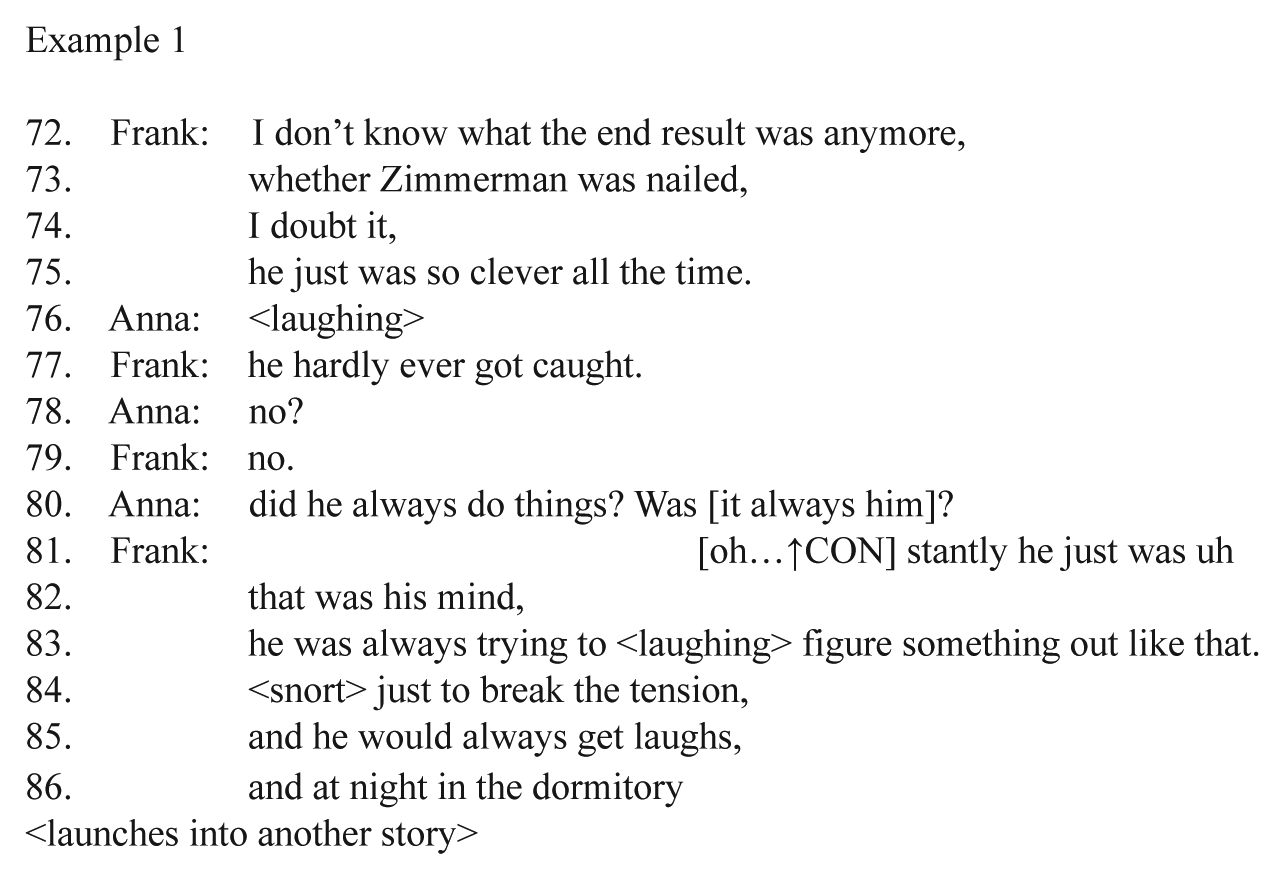
Despite the artificiality of the elicitation, we see here at the end of the narrative in line 86 that Frank seizes the opportunity to continue the chain by launching into another Zimmerman story, as he would do in a more relaxed setting and which he does not do after the second version.
The second version is also much shorter: it is 290 words long, as compared to 496. Overall, there is much less laughter and repetition, and the performative elements are stripped down, as may be felt even in this brief excerpt presented as Example 2 below:

Here, there is much less involvement on the part of the narrator in the story world, less interaction with the listener (the interactional world), and a great deal of attention to the factual world, a sense of just the ‘what happened’ (Schiffrin, 2006), as will be described in more detail in the discussion section of this article.
Comparing the two versions
I now proceed with a side-by-side comparison of the narratives, beginning with their abstracts (Labov, 1972; Labov and Walletsky, 1997/1967), which reveal choices made by the narrator that prime questions about groups and membership. Such choices in the clauses that set the stage for the experience also contribute to the listener’s sense of invitation into the story world. Note: for ease of presentation, I have left off speaker names as all are spoken by Frank (a complete transcript of both narratives may be found in the Appendix).
Referring expressions
Use of an inclusive pronoun like ‘we’, or a referring term like ‘Zimmerman’ rather than ‘Tom Zimmerman’, or ‘Tom’ particularly in this crucial point of the narrative may reflect knowledge of and familiarity with this person. In the first version, the pronouns ‘we’, ‘us’, and ‘our’ give a sense of the closeness of the group of boys and their solidarity, which (as we will see) is very different from the pronoun ‘my’ in the second.

In the first version, not only do the pronouns ‘us’, ‘we’, and ‘our’ call attention to the fact that Frank is speaking as one of a collection of figures within the story world (Goffman, 1981), they also signal something about his relationships within that world.
They position Frank and Zimmerman as part of a collective, a group, which becomes significant in interpreting the events of the story and how he feels about them.
In the second version, the distance invoked by use of the pronoun ‘my’ is echoed in the formality of the register, casting this as ‘one of the highlights of my adolescence’ rather than ‘the story of when we were fourteen or fifteen years old’. In fact, even in his meta-commentary notice that he refers to this telling as ‘one of the things that sticks out in my mind’ instead of a story. But even more striking than this are the referring expressions used to introduce the protagonist.
In the first version, the first mention of our protagonist is the referent ‘Tom Zimmerman’, which receives a rich description including adjectival phrases like ‘a
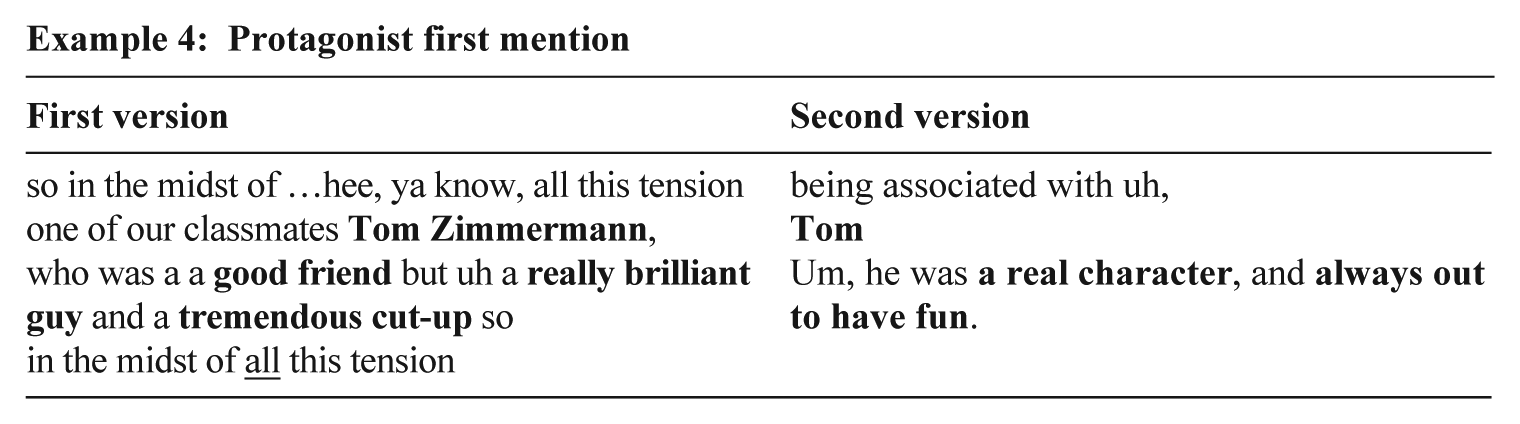
The omission of the descriptors ‘one of our classmates’ and ‘a good friend’ results in a different relationship between the narrator and the protagonist in the second version, layering in a sense of distance between them, which is reinforced consistently when he is referred to only and always as ‘Tom’ (instead of ‘Zimmerman’ used almost exclusively in the first version).
When I asked my father about this difference, he explained that within the seminary, and especially as teammates in sports (Zimmerman and he were both on the basketball team), it would have been a term of endearment to refer to each other using last names. ‘Zimmerman’ would have been the name he would have used to refer to him back then. ‘Tom’ is perhaps the name he would use now looking back. Thus, ‘Tom’, while it may seem more familiar, actually indexes distance both relationally and temporally.
This seemingly small linguistic choice becomes significant, given his status as witness to the events and neither protagonist nor antagonist. As a friend, rather than ‘associate’, the narrator is a figure in the story world with relationships to other figures therein. Thus, in the first version, we are brought into identification with Zimmerman, we feel his courage in taking on the institution (reinforced through intimidating and powerful portrayal of the disciplinarian, as I will now explore), but in the retelling, the referring expressions seem to highlight the narrator’s status as witness. We as listeners understand the significance of the protagonists’ actions through his proffered explanations, not through our own experience of his narrative performance.
Zimmerman’s nemesis in the world of the story is the disciplinarian, whose first introduction into the world of the story is considered in Example 5 below:
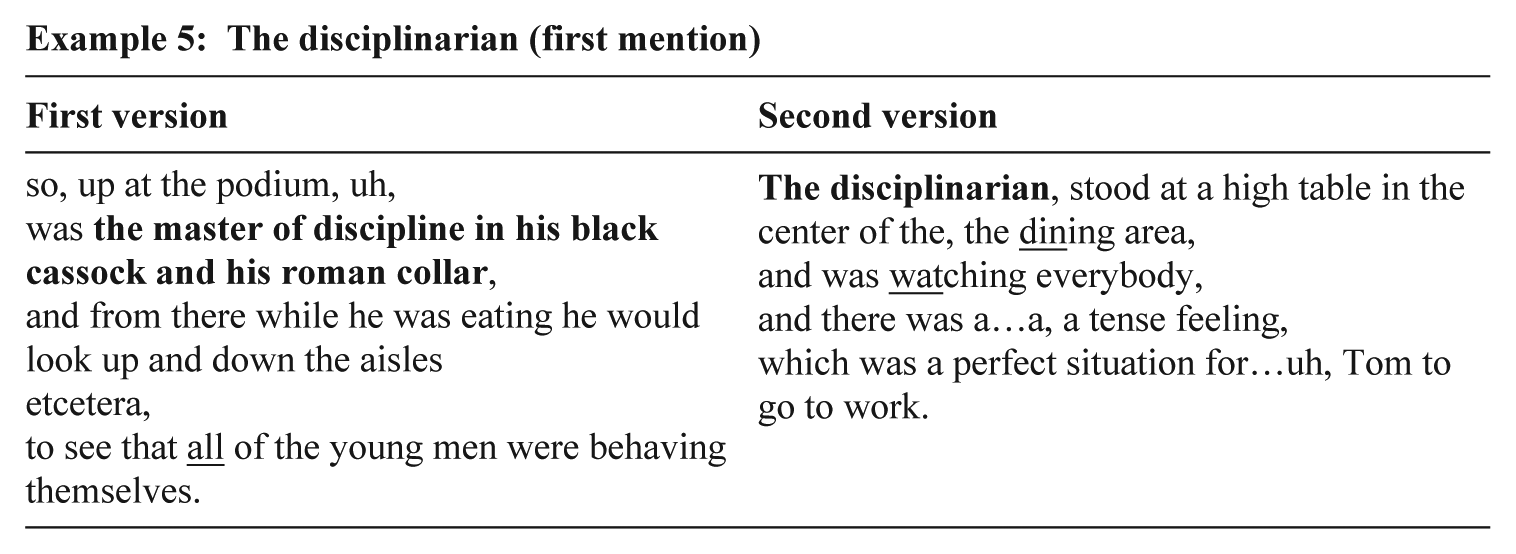
In neither version are we given a name for this figure, which serves to emphasize the symbolic distance between him and the boys. And while in both versions referring expressions reinforce his institutional authority, in the first telling, descriptors such as ‘black cassock and roman collar’ more strongly evoke his religious identity, symbolizing the authority that he represents. Another important difference between the tellings is the use of his full title ‘master of discipline’ (in the first version) as compared to ‘the disciplinarian’ (in the retelling). ‘Master’ invokes a frame of fear and oppression which creates tension in a way that naming the tension explicitly (as he does in the second version: ‘there was a tense feeling’) does not.
Moreover, in both tellings, our protagonist is referred to more frequently than the antagonist, making him more salient as a referent and as a character (Table 1). By simply being more salient referentially than the antagonist, our allegiance as listeners is subtly recruited and reinforced. Further, the protagonist is referred to using his name (rather than a pronoun) more frequently than is the antagonist in the first version: 5 out of 11 references or 45% as compared to the antagonist, who is more often referenced through ‘he’, receiving a noun phrase only 29% of the time. As this is a small data sample, these patternings can only be suggestive, and thus, their interpretive potential is best understood in context and through the strategic alternation (as will be explored in greater detail to follow), but one thing that does leap off the page is the near absence of the antagonist in the second version. Our protagonist is mentioned or referred to nine times, while the antagonist is only mentioned once, a strategy which cannot cultivate or sustain dramatic tension and which also appears to be linked with use of deixis as I will now explore.
Referring terms for protagonist and antagonist.

Deixis
Deictic elements embed the point of view of the speaker and serve to guide the attention of the listener. From the Greek ‘to point’, deixis can involve use of adverbs of time and place such as here/there; then/now; up/down; and verbs and tenses that give information about the vantage point of the speaker like: go/come; went/came. Crucially, such elements also reveal contextual information about the speaker’s relationships to events and characters in the story world (and to the hearer). For example, the symbolic distance between the boys and the ‘master of discipline’, as we explored in Example 5, is reinforced through use of deictic descriptors of place like ‘up’, in placing him ‘up at the podium’, which serves to locate the boys relatively as ‘down’. Use of ‘there’ in ‘and from
In the second telling, although we are told that the disciplinarian is ‘at a high table’, and thus above everyone, we are not given any information about what he is doing up there, nor are deictic pronouns employed to reinforce his relational physical (and metaphorical) distance.
In both versions, the most dramatic use of deixis co-occurs with the Most Reportable Event (MRE), the moment of climax of the story during the core complicating actions, the moment when Zimmerman and the disciplinarian collide, represented in Example 6 below. In the first version, a deictic shift exploits the disciplinarian’s perspective, from whose vantage point the silverware appears to be ‘dancing’.
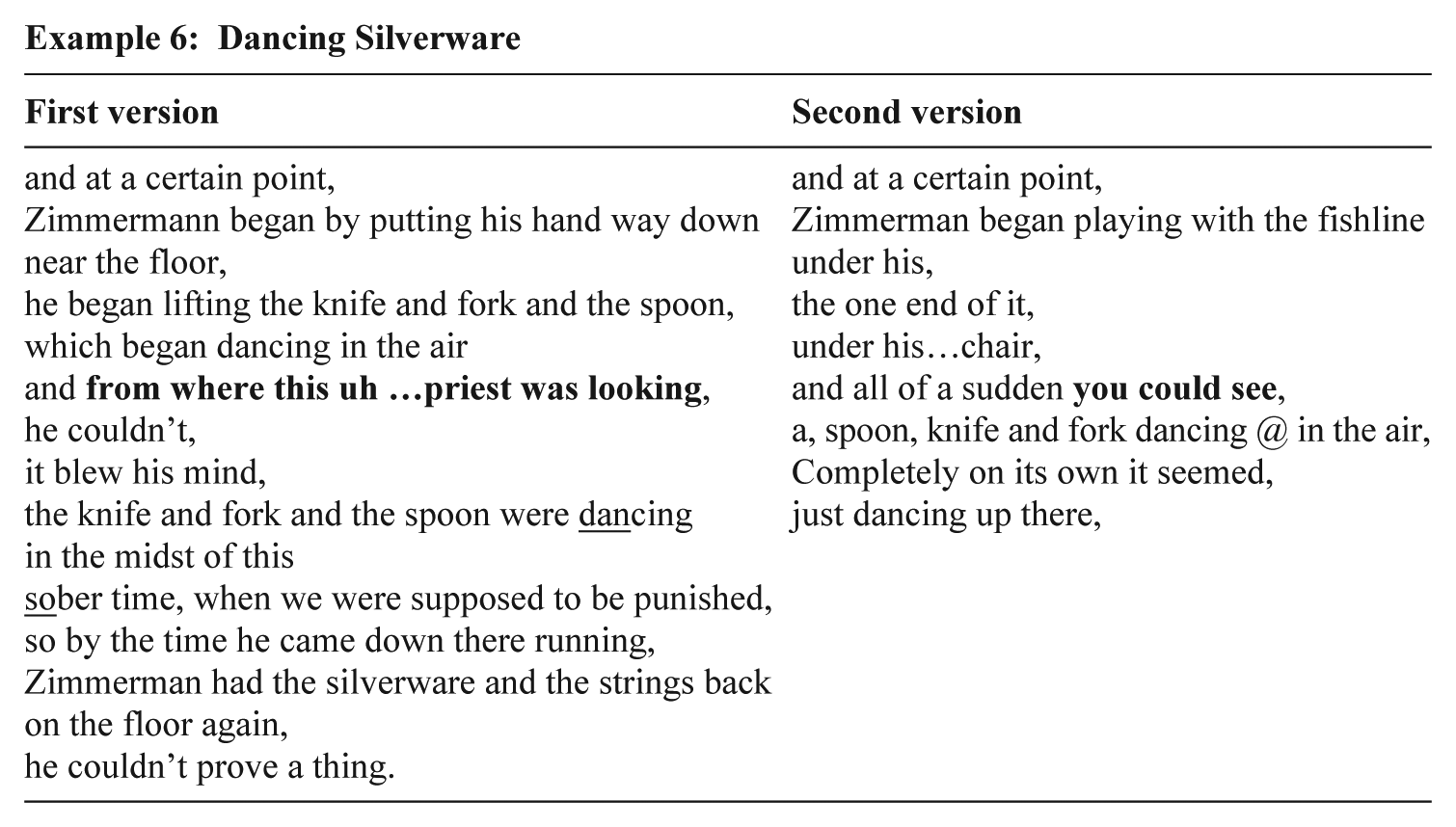
In the second version, while we shift to the deictic center of an omniscient ‘you’, the priest’s perspective is the most humorous precisely because he is the character in the story whose information state does not have any of the backstage knowledge necessary to make sense of this vision (Goffman, 1959). Thus his incomprehension and confusion about what he is seeing is comedic, but it is also dramatic because his is the gaze that is the most potentially threatening and dangerous. Recall from the preceding discussion that ‘master of discipline’ was the referring expression used to introduce the antagonist in the first telling. ‘He’ is used in all subsequent instances of referring to this character, except here at the MRE of the first telling, when he is invoked by use of ‘this priest’. Here at this crucial moment is the only time this referring expression occurs. Although likely highly unconscious on the part of the narrator, such alternation of referring expression precisely at this moment cues the religious institutional frame, which highlights the drama of the crisis of faith we are invited to imagine him experiencing as he is confronted with magic.
Here the narrator does not need to explain the comedy or the heightened sense of tension, nor does he have to recruit our alliances and antipathies as listeners because these have been crafted linguistically. By contrast, when in the second telling, we are told ‘and all of a sudden
Evaluation
Evaluation is the ‘so-what?’ of the story. ‘Evaluative devices say this to us: this was terrifying, dangerous, weird, wild, crazy; or amusing, hilarious, wonderful; more generally, that it was strange, uncommon, or unusual – that is, worth reporting. It was not ordinary, plain, humdrum, everyday or run-of-the mill’ (Labov, 1972: 371). Evaluative clauses contain the significance of the story and the meaning to the speaker, and thus communicate this information to the listener. When evaluative clauses from Dancing Silverware are placed side-by-side (Example 7 below) the quantity and quality of evaluation are salient.
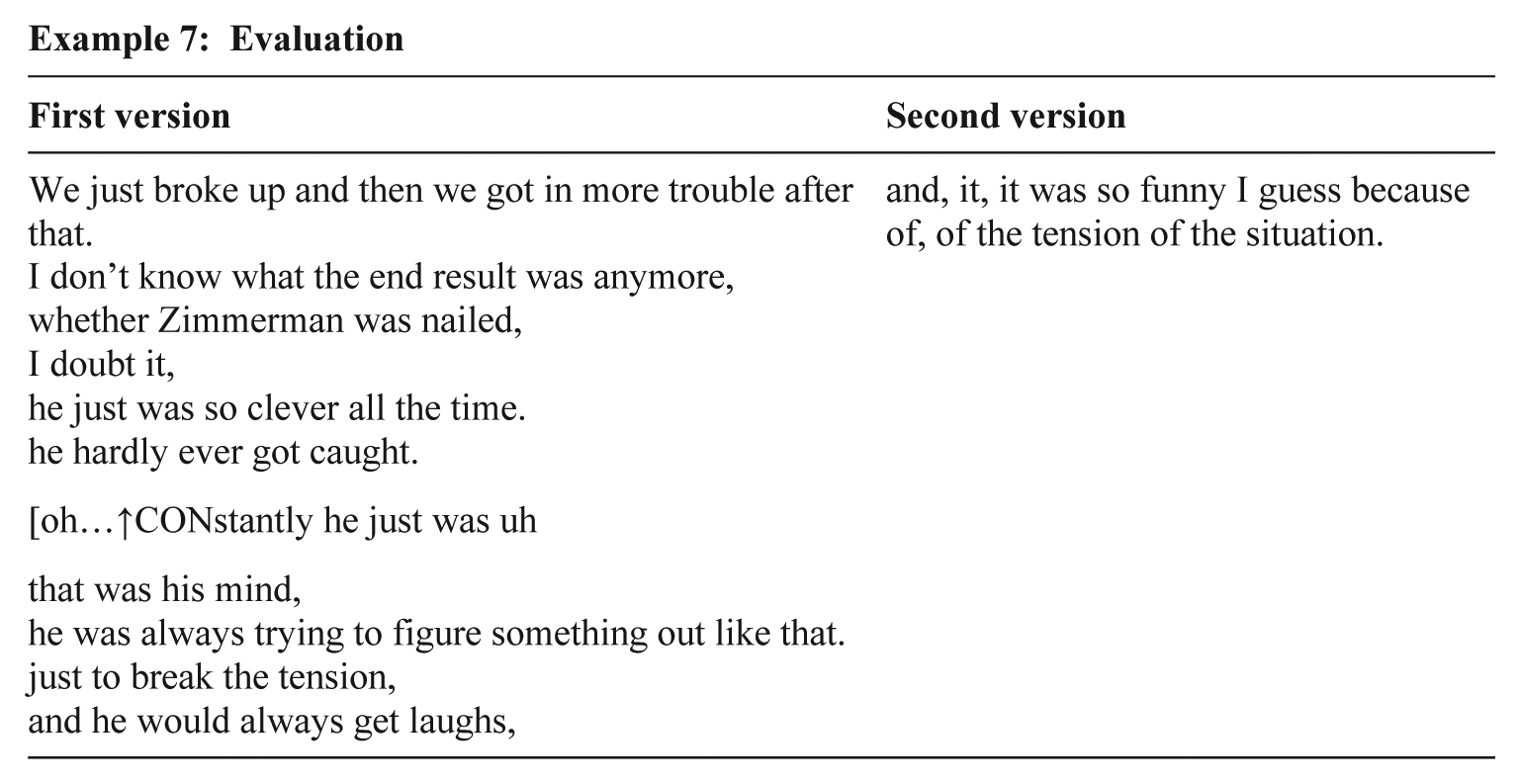
In the first version, a series of evaluative clauses appear after the complicating actions (Labov and Walletsky, 1997/1967) of the narrative have finished. Although in the past tense, we seem to be gently brought from the word of the story into the world of the interaction as the narrator looks back and savors the humor of the events: ‘he just was so clever all the time’, ‘he was always trying to figure out stuff like that’, and ‘he would always get laughs’ being just a few of the examples. Although pulling us out of the world of the story, the narrator does so in a very engaged and performative way, for example the word ‘CONstantly’ features a dramatic rise in pitch and emphasis, further prosodic cues which serve together with the laugher and the snorting as contextualization cues (Gumperz, 1982), signaling the narrator’s enjoyment and appreciation of the cleverness of our protagonist.
In the second telling, it seems to have been the narrator’s perception that such meanings had not been extrapolated from the first occasion of his telling this story. Thus, he seems to have decided that his second telling needed to communicate this information at all costs. The externally evaluative clause ‘it was so funny I guess because of, of the tension of the situation’ accomplishes this by pointing directly to his reasons for selecting this narrative as being worth telling. This evaluative clause (unlike in the first version that was still involved in complicating actions) here serves as the coda – the takeaway message for the listener, something along the lines of: this story is humorous and it shows cleverness in staging a prank.
As we have been discussing, there are many ways that this narrator shows that he values cleverness, and finds humor in Zimmerman’s defiance of authority in ‘Dancing Silverware’. Simply selecting this prank in the first place to craft a narrative around telling (and retelling) out of all the possible events over the course of his life is a powerful way to send this message. This message is reinforced linguistically through choices at the level of narrative structure, referring expressions, deixis, and evaluative clauses as I have shown. Additionally, as I will now explore by reference to Goffman’s participation framework (1981), such meanings are also communicated and reinforced through different speaking roles in the different versions. The roles of author and principal – the voice who has chosen these ideas to present and who stands behind the ideas – are made much more salient in the second as compared to the first version. Such a strategy serves to cue the listener to the ‘so what?’ of this story about a prank.
Discussion
In illuminating the ways that speakers can move dynamically in talk from speaking as one’s own self to representing a character (figure in Goffman’s terminology) in a story world, Goffman suggests four capacities that account for the relationships that speakers assume to their talk and with their interlocutors: animator, author, figure, and principal. Thus, narrators have multiple voices from which to speak as they render a narrative: they may jump from simply animating the thoughts or words of another, to presenting themselves as a character or figure in the world of a story, to speaking as the principal – the person who stands behind the story and associated meanings, and the person who has authored these meanings – selecting now as the moment and this narrative as the means for sharing them. I follow Schiffrin (2006) to consider how these choices also work with the different worlds identified by Davies and Harré (1990) to differently position the narrator (Table 2).
Production format.

In this analysis, I have argued that in the second version, meanings are accomplished more explicitly through external evaluation, or what we might describe as metalinguistically rather than linguistically. Another way to say this is that the second version resides primarily in the factual world through the voice of an author, rather than in the story world as figure. Consequently, these two tellings feel very different at the level of the interactional world, and their meanings are experienced differently.
For example, in the first version of ‘Dancing Silverware’, Frank begins the abstract by initially calling attention to his role in the interactional world as animator by saying ‘
In the second version, by explaining his choice of this story as interesting, dramatic, and funny, the narrator calls more direct attention to his role as author, and actively demonstrates his sense of humor by telling the listener explicitly why he thinks this prank is funny (and why he chooses to tell the story of it more than 50 years later). He offers a direct explanation of his choice of story as a candidate for telling, rather than demonstrating his sense of humor through his performative abilities as a storyteller.
For example, in the second telling, rather than laughing, the narrator explicitly names and explains the humor: ‘it, it was so funny I guess because of, of the tension of the situation’, speaking from the factual world, and at the level of author, he who designed what was said. Labeling humor also signals his orientation to authority at the level of principal – he who is committed to the meanings behind what is said. Frank is committed to the values espoused by this character of cleverness and defiance of authority, but his use of the lexical item ‘funny’ is not only a much less performative linguistic strategy than laughing, it operates in different world. To laugh is to participate in the events of the story or in the world of the interaction; to call something funny is a more didactic strategy, one that functions interactionally; to position the narrator as instructing.
Such differences may be accounted for when we recall the occasioning of this story as something I explicitly elicited without explaining why, having previously requested the exact same story not two months before. He seems to have decided that in addition to misunderstanding the moral, that I have also underestimated the reportability of his story. As Labov tells us (1972),
There are a great many ways in which the point of a narrative can be conveyed – in which the speaker signals to the listener why he is telling it … it is necessary to know why this narrative – or any narrative – is felt to be tellable; in other words, why the events of the narrative are reportable. (p. 370)
Any narrator must prove that he deserves to keep the floor for as long as he does, and he must prove that his story is the most appropriate and relevant possible. He must avoid Labov’s dreaded ‘so what’ rejoinder, and prove that his narrative is reportable. If important for spontaneous stories, tellability is all the more relevant for elicited narratives. In asking to hear this story, I have explicitly requested a reportable event, and in requesting the same exact story again, I put more of a burden on the narrator to establish this reportability. If the values are more explicitly indexed in the second telling, this may explain why and also why the narrator adopts a more academic register and a more didactic positioning.
While in the first version, tellability is accomplished by dramatizing the events through use of reference and deixis, speaking as a figure in the world of the story, in the second version, the speaking role of author remains salient as he explicitly states that the narrative is both funny and dramatic, justifying his abilities as a narrator to select and tell a good story. Given that ‘techniques are used to display a relationship between the story and prior talk and thus account for, and propose the appropriateness of the story’s telling’ as Jefferson (1978: 220) tells us, I suggest that this second version helps us to see how these techniques (considered through discourse, speaker role and also at the level of ‘worlds’) are employed in the first telling, but also something about why.
Although Frank never explicitly states his opposition to the institutional power, or the ways in which power for its own sake can be a dangerous thing, in telling these stories, he communicates that he identifies with a clever character who challenges authority within the rigidity of the institution. In so doing, he invites his listeners to adopt the same orientation to this figure in the story world. However, what the second version highlights, and which might have been lost in the performance of the first version, is his ability to recognize this cleverness. As witness, he is in the position of being able to freely proclaim and admire the genius of this prankster, without appearing to brag about it (had he perpetuated it) or be stung (had he been the victim).
If the second version more clearly showcases his ability to recognize, remember, and appreciate cleverness and bravery in the defiance of institutional power, the first establishes his ability to craft and perform a compelling narrative. Thus together, they show us something about why such stories are told and retold, and what they mean, and they establish Frank as possessing of the qualities required of a performer of prankster tales.
Conclusion
As this comparison of two versions of the same story has shown, narrators have many choices when they tell a story, which have very real social and interactional meaning. To show this, I have explored distinct uses of emphasis and intonation that can serve as contextualization cues and are key for recognizing the narrator’s intentionality. Additionally, I have shown how linguistic features like choice of a pronoun can operate in different worlds and accomplish different positionings for the speaker, depending on what speaking roles and positions are activated. Finally, I have shown how deixis and point of view draw the attention of the listener differently, and lexical choices in reference construct details which have an impact on the evaluative weight or meaning(s) of narratives. Ultimately, these seemingly small and insignificant linguistic choices have been shown to play a significant role both within the world of the story and in the storytelling interaction, providing insight into who the narrator is showing himself to be and how this is accomplished, and ultimately something about why this might be important. With just one example of the telling and retelling of narratives which seem to function (among other things) as serving to construct and negotiate shared group values, we have seen how this can work especially well when the narrator was neither victor nor perpetrator, allowing him to embrace his role as a very capable recognizer of cleverness and captivating renderer of why such a thing should be savored and celebrated over time.
Footnotes
Appendix
Acknowledgements
I would like to thank Deborah Schiffrin for encouraging me to proceed with this analysis and to Deborah Tannen for helping me find the ‘so what?’. I would also like to thank Inge Stockburger for reading a very early draft of this article, to my students at Georgetown University – especially to the Language and Society Spring 2012 class for their input, and finally to Adam Jaworski for giving me the temporary use of a quiet place to write at Cardiff University. I am also very grateful to the participants at Narrative Matters in Fredericton, New Brunswick for their feedback on an early presentation of findings. Also, I am tremendously indebted to the generous feedback provided by the anonymous reviewer of this article. Finally, to my father for sharing these stories and to my mother for her careful eyes for feedback on my analysis. This article is dedicated to you both.
Funding
This research received no specific grant from any funding agency in the public, commercial, or not-for-profit sectors.