






Abstract
This article offers an analysis of the Spanish derivative morphology potential for graduating attitudinal meanings regarding the expression of political crisis and of contested meanings of human rights violations in the discourse of recent Chilean History. This study is framed in the typological principles of Systemic Functional Linguistics and in the
Introduction
This article aims to demonstrate how Spanish derivative morphology, particularly suffixes, have a critical role when authors graduate their attitudinal meanings to express difficult and contested social processes and events regarding political crisis and human rights violations in recent discourse of Chilean History. Chile, like many other Latin American countries experienced a traumatic civil-military dictatorship during the seventies and the eighties. In the Chilean case, the dictatorship (1973–1990) was led by General Augusto Pinochet and was signaled by a violent coup d’état that overthrew the socialist government of Salvador Allende. The disputed collective memories regarding human rights violations during the dictatorship and the representation of Allende’s government as responsible for the failure of a long desired social change that brings a more egalitarian society, are still a place of political dispute among Chileans (Harmer, 2011; Lira, 2013; Stern, 2006).
In this study we examine how graduation of the evaluations presented by historians in a disciplinary book aimed for a general public, and by a commission of an official document of human rights violations is built in the discourse. As it has been proposed for the English language from a Systemic Functional Linguistics’ approach (Hood, 2010, 2019; Martin and White, 2005), we postulate that in the Spanish language meanings of graduation of attitudes as force and focus can be realized through repetition of lexical items, sub-modification of attitudinal and ideational items, by infusion or as sub-modification at the lower rank of the word structure. In this article we first briefly demonstrate how the two first graduation resources – force and focus – are useful resources that authors use for building contested positionings regarding recent Chilean history discourse about human rights violations. Secondly, and as the main focus of this study, we analyze how authors critically rely on resources that function at the rank of the morpheme as suffixes for building meanings of crisis and violence in the discourse of history. Spanish suffixes have been extensively described by grammarians; however, they have received very little attention at a discursive level and in relation to a particular field.
Accordingly, we analyze meanings of force and extreme force as quantification and intensification realized by extreme degree suffixes -ísimo/a/s. Next, we examine meanings of force as quantification and intensification realized by Spanish suffixes -ada, -azo, which are also working as part of ideational grammatical metaphors at the group rank. To do this analysis we take into account a trinocular typological perspective, proposed by Halliday (2003), which implies considering the text as the starting point “from above,” the level of the clause “from around,” and the rank of the group, word and morpheme “from below.”
There are only partial and initial descriptions of appraisal resources for the Spanish language. In particular, this contribution has been done by discourse analysts who have applied the system of
As discourse analysts we believe that it is crucial to understand how meanings are constructed in a particular language and in the specific genre and field in which they are taking place. In this sense, we agree with the principle that the fundamental goal of every description of a language should be to understand how grammar makes meaning, and hence, how the lexicogrammatical resources are discursively motivated. Therefore, as discourse analysts interested in understanding how the representation of social and political crisis and violence is constructed in historical discourses as part of a process of “historizing memory” of recent past in the Chilean society (Oteíza, 2018; Oteíza and Castro, 2019; Oteíza and Pinuer, 2016), we aim to demonstrate “that very small parts of language” as derivative suffixes have a critical role in prosodically building more or less intensified and/or quantified attitudinal positionings in a congruent and incongruent manner in the discourse.
First, we briefly present the
In our analysis we demonstrate how resources of graduation work as constellations of patterns in the discourse of history that contribute to the building of meanings of political crisis, instability and extreme violence at the discourse semantic level. Finally, we offer the conclusions of our analysis along with a proposed systematization of the Spanish graduation resources identified, organized as a system network.
The appraisal system from a trinocular vision of language
The subsystem of
The semantic subsystem of
The subsystem of
As a second main typological SFL principle states, this study examines written Spanish historical data at the discourse semantics and lexicogrammar strata, taking into account the trinocular vision proposed by Halliday to analyze language. This implies reasoning from above, taking as a point of departure higher levels of context and discourse semantics, from the same level −clause− and from below −rank− (Caffarel et al., 2004; Halliday and Matthiessen, 2014; Martin et al., 2010).
This trinocular vision also contributes to the understanding of grammatical metaphors and the inter-stratal phenomenon that it involves. The flexible or permeable “division” between lexicogrammar and semantics is crucial for the interpretation of the inter-stratal tension from an ideational and interpersonal perspective regarding its rhetorical potential (Martin, 2020). For Halliday, the interpersonal and ideational grammatical metaphors are conceptualized as incongruent or marked expressions “in relation to what is normative in a variety of languages and have lower probability values” (Taverniers, 2017: 356). In this manner, the metaphoric power of language relies on the fact that its content plane can be stratified into lexicogrammar and semantic strata, which allows “variation in expression and in meaning,” that in turn “opens up the way toward recognizing a scale of incongruence” (Taverniers, 2017: 357). This tension between literal and figurative meanings tends to occur in syndromes or in grammatical configurations rather than in lexical items in isolation in the discourse.
Martin (2020) explores this inter-stratal tension looking at both grammatical and lexical metaphors, reconsidering that they work as a cline; that is, that lexical and grammatical metaphors work in combination to create ideational and interpersonal meanings, which also posits a challenge to the understanding of the meaning of the metaphors, due to the fact that “there are not only two layers of meanings to unpack (lexicogrammar symbolizing discourse semantics) - but in addition two domains and their relation to one another to be interpreted” (Martin, 2020). This is exemplified in the nominalizations “escalate of violence”/la escalada de violencia or in “a whirl of agitation”/un torbellino de agitación as it will be explained in the following section.
Analysis and discussion
The analysis has been conducted in a large corpus of written historical discourses regarding recent Chilean history (1960–1990). This period was characterized by strong social and political movements: a left- wing coalition government led by socialist President Salvador Allende (1970–1973), overthrown by a coup d’état lead by Chilean military men with the contribution of the United States; and a civil military dictatorship commanded by General Augusto Pinochet (1973–1990), that committed severe human rights violations in the country. The corpus considered for the analysis is composed by (i) History written by specialists to a general public and (ii) official report emanated from a Commission that was established by the Chilean State after the end of the civil-military dictatorship: The National Truth and Reconciliation Commission (Government of Chile, 1991), known as the Rettig Report.
Graduation : Raising or lowering the value of attitudes
As Martin (1992) points out regarding the English language, the realization of interpersonal meanings in the clause structure is at least potentially non-discrete. The realizations of interpersonal meanings can accumulate in the discourse, amplifying the degree of the positions expressed. As a consequence of the apparent association of gradable systems and prosodic realization, Martin (1992) presents the question of which grammatical systems allow for meaning by degree. Martin’s focus was on the grammaticalization of grading and its relation to interpersonal meaning, and one of the primary distinctions he made was between graded and gradable items that speakers have available to express attitude by degree along a scale of high, median and low values: “an absolute idiot; quite an idiot; a bit of an idiot” (Martin, 1992: 367).
Martin and White (2005) propose that, in English, non-scalable experiential meanings or evaluative meanings can be graduated by force or by focus. Experiential and evaluative meanings can be intensified or diminished in their volume as force or, alternatively, “sharpen” or “soften” in their categorical meanings as focus. These categories have been further elaborated by Hood (2010) in her work regarding the discourse strategies that writers deploy when trying to present themselves as “objective” and, at the same time, with a clear critical position when writing research articles. In her study, Hood stresses the fact that very frequently non-scalable experiential or evaluative meanings graduated by force or focus can then irradiate certain evaluation to the rest of the text, infusing negative or positive evaluation in a cumulative manner; therefore, when analyzing meanings of graduation, as well as any other evaluative meaning, it is key to take into consideration the co-text. Hood further elaborates the resources of focus, indicating that it is possible to add different degrees of valeur as authenticity or specificity; or to activate degrees of fulfilment as completion or actualization to non-scalable items in a discourse (2010, 2019).
The complete proposal of the system of
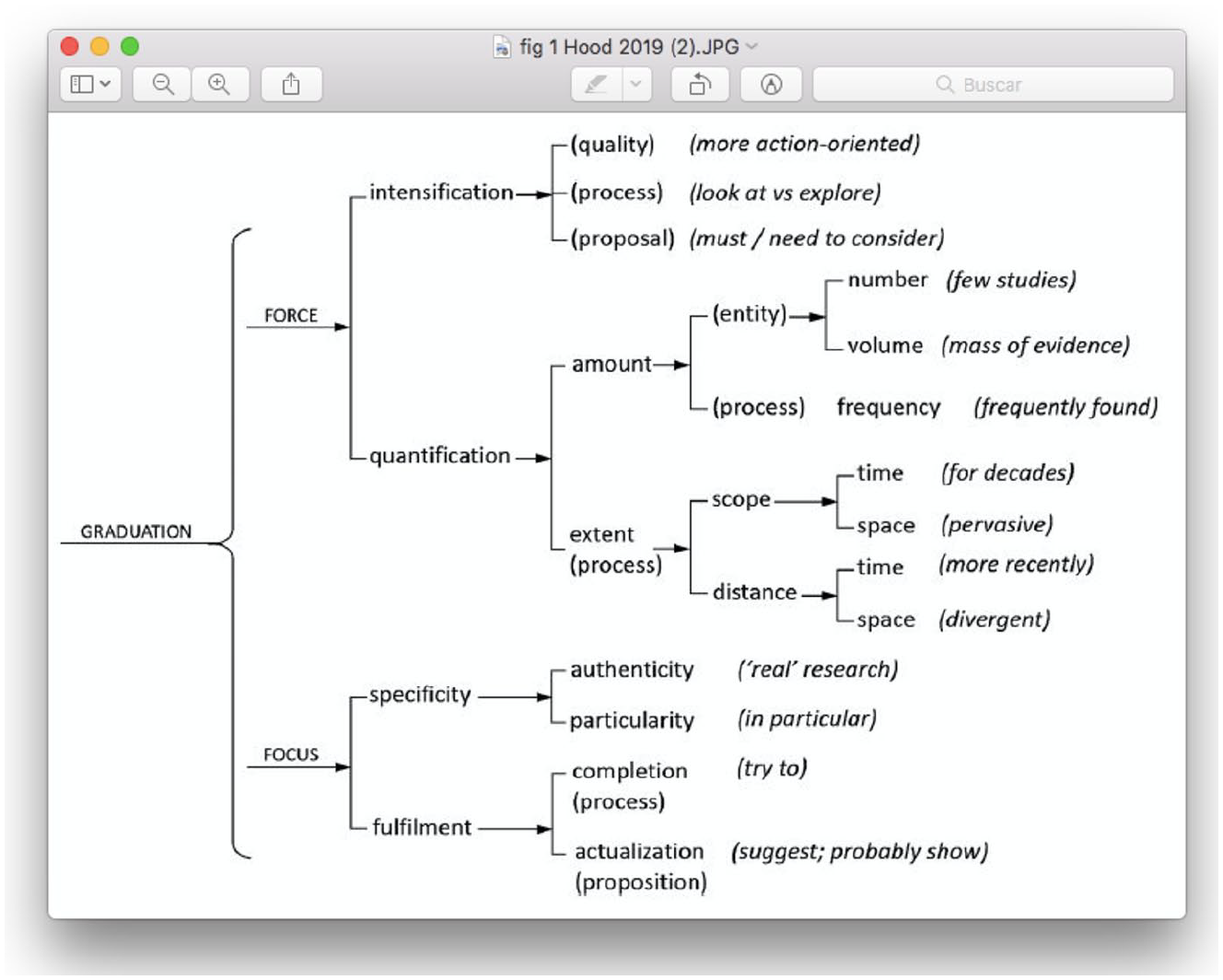
Sub-system of
In a Romance language close to Spanish, Vian (2008, 2009) provides a description of graduation resources in Brazilian Portuguese, identifying those elements that are different from English in order to contribute to a typology of this language. As resources of affixation, Vian (2008) identifies the use of several Greek and Latin prefixes, suffixes and diminutive suffixes, among others, that can be employed to graduate the meanings carried by the root. In terms of suffixation, Vian refers the use of two resources. First, suffixes that intensify the meaning of the root, such as the suffix -ão, that allows to intensify the characteristic of a noun (e.g. Eu tinha perdido um tempão. . ./ “I had spent a lot of time”), and the suffix -aço, that can also be added to evaluative lexical items (e.g. você está fodidaço / “you are so fucked up”). Second, the author mentions the use of diminutives suffixes, such as -inhas, -ela, that reduce the evaluative force of the modified item (e.g. esses caras fazendo piadinhas / “these guys making silly jokes”).
In the next section we first briefly present how a polarized country deals with the trauma of human rights violations through the voice of the authors in charge of The National Truth and Reconciliation Commission (Rettig Report, 1991). The analysis shows how this group of professionals chosen in 1990 by the President of Chile, Patricio Aylwin, from the right and center political parties, strive to sound “objective” by means of graduating resources, to a highly divided Chilean society that was just trying to recover from 17 years of dictatorship and dealing with a disputed reality of human rights violations. Next, we concentrate on the role suffixes play at the rank of the morpheme creating meanings of graduation about different levels of social crisis and violence that we propose need to be considered from an inter-stratal tension perspective.
Justification and legitimization: Graduation by sub-modification and repetition
In this section, the analysis examines some instances of the Rettig Report (1991) from above (that is, from the co-text), in order to explore how the cumulative semantics of force and focus contribute to build evaluative rhetorical positionings of historical actors, events and processes located in a symbolic and chronological time and space (Oteíza and Pinuer, 2013) regarding the field of recent Chilean past of human rights violations. In Example 1 it is possible to see how the Commission in charge of investigating human rights violations that ended in death during Pinochet’s dictatorship justified and legitimized themselves in front of Chilean society and how these meanings are achieved partly via graduation as force: Example 1 We allow ourselves to say why we accepted the noble task with which we have been honored. We knew that it would be difficult, and that our own limitations would make it more so. We nonetheless accepted it Nos permitimos decir por qué aceptamos el noble cometido con que se nos honró. Sabíamos de sus dificultades y cómo a ellas se aliaban nuestras propias limitaciones. Aceptamos, a pesar de ello,
In this Example 1 it is possible to appreciate, as Hood (2010) mentioned, that a proposal can be intensified by force: the Commission accepted their limitation “without hesitation.” However as the instances in bold show, force can also work intensifying a proposition via repetition, so the Commission is also portraying an invoked positive self-representation through the repetition of “variety,” “diverse,” “different,” “different,” trying to present themselves as being objective and of representing the “whole Chilean society,” in a time of strong social and political polarization of the country. This lexical accumulation that creates a saturated evaluative prosody (Martin and White, 2005), could also show the Commission’s justification of the impossibility of building a narrative that harmonizes the various memories of a traumatic recent past in the Chilean society.
In the following Example 2, the Commission continues with a positive self-representation that allows them not only to legitimize their role, but most of all to show their ideological positioning regarding human rights violations regardless of the different political perspectives that were just emphasized in the previous lines. It is crucial for them to make their complete rejection of the human rights violations committed by state agents during Pinochet’s dictatorship explicit. This evaluative mechanism is achieved mainly by graduating attitudes via repetition and sub modification, which are resources that have been identified in the English language (Hood, 2010; Martin and White, 2005) and in Brazilian Portuguese language (Vian, 2008, 2009) for realizing meanings of graduation: Example 2 We Creemos,
In example 2, it is possible to appreciate how the authorial voice of the Rettig Commission relies on resources of graduation as force and focus to explicitly express what unites them as a group that shares the moral duty of protecting fundamental human rights that every human being should have. In this manner, the intensification of a process (“to believe”) and of an attribute (“should be”) are key in the portrayal of the experiential meaning regarding basic human rights that are “inalienable.” The resource of focus as fulfilment: completion “
After showing how graduation has a role in building evoked and inscribed attitudes in the justification and legitimation of a commission that knew that Chilean society had high expectations regarding this Report, as a starting point of truth and restoration concerning thousands of people that were assassinated or “disappeared” during the dictatorship, we will turn our attention to other sections of the Rettig Report in which authors inform about the brutal human rights violations committed during this dictatorship. In the following sections of the document we will not “hear” again the voice of the commission, but an account of events of human right violations, and in order to do this, authors needed different resources for graduating attitudes. That is why we would like to change our attention to an area that is particularly productive in Spanish: graduation at the rank of morphology through suffixes.
A violence difficult to believe: Graduation by extreme degree suffixes
In the following examples taken from different sections of the Rettig Report, we would like to show the prominent role of graduation realized through extreme degree suffixes -
Traditional grammatical Spanish description identifies two suffixes to achieve the extreme degree of a property:
In the following example 3, the suffix -ísimo/ísima is applied over a quantifier (mucho / “many”). In terms of the discourse-semantic system of graduation, this quantifier is expressing high force: quantification of things. That graduation is in turn reinforced and correalized by the suffix. As the entity quantified in this example corresponds to evitable cases of human right violations during the dictatorship as result of inefficiencies of the Chilean Judicial system, it is possible to identify an evoked negative evaluation in the discourse-semantic system of Example 3 If the Courts had respected the constitutional mandate to act immediately; or complied with the legal mandate to rule within 24 hours (. . .) or, lastly, they had fulfilled the rule of the Auto Acordado to issue a sentence before the harm caused by prison reached huge proportions, death, disappearances and torture could have been avoided in Si las Cortes hubieran respetado el mandato constitucional de actuar de inmediato; o acatado el mandato legal de fallar dentro de 24 horas (. . .) o, en fin, hubieran cumplido la norma del Auto Acordado de dictar sentencia antes de que el mal causado por la prisión adquiriera grandes proporciones, la muerte, la desaparición y la tortura se podía haber evitado en
In this example, the suffix -ísimo/ísima is amplifying the graduation realized by the quantifier (mucho / “many”), which reaches its maximum degree (muchísimo / “so many”). This sort of “extreme quantification” of things is the result of a two layered graduation: the quantifier realizes graduation as submodification (that is, using a quantifier as an additional lexical item at the rank of the group) and, at the same time, the suffix realizes graduation as sub-modification at the lower rank of the word structure (that is, using a suffix within the same lexical item, with no additional items, nor repetition or listing of expressions). 3
Table 1 shows the realization of muchísimos (“so many”), at discourse-semantics and lexicogrammar strata, as well as along the rank. At discourse-semantic level, the co-text selected was the figure, composed in this case by an occurrence and two entities (Hao, 2020; Martin, 2020). At lexicogrammar level, the co-text selected can be analyzed, in terms of the system of
Realization of muchísimos (“so many”) at discourse-semantic and lexicogrammar strata.
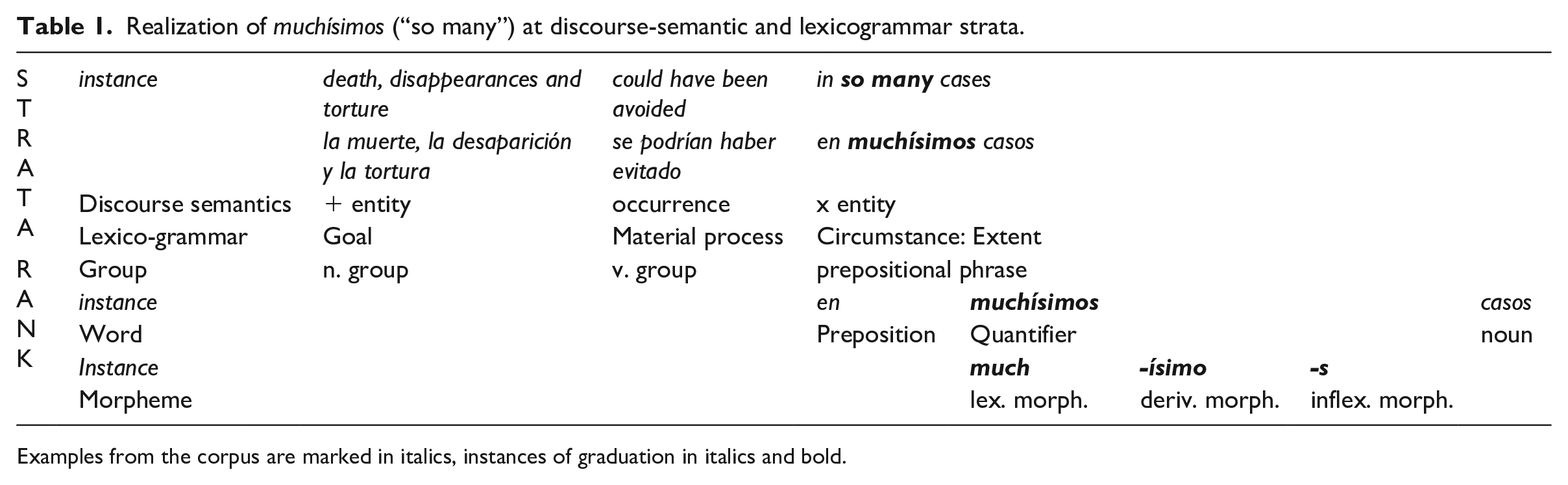
Examples from the corpus are marked in italics, instances of graduation in italics and bold.
As we can see considering the co-text, the use of this instance of extreme quantification seeks not only to depict the abundance of “death, disappearances and torture” committed during the Dictatorship, but also to express the way the Chilean Judicial System failed to fulfill its ultimate task: to provide justice and to protect the rights of Chilean citizens. The extreme degree suffix -ísimo is, in this way, used also to express the extreme degree of the state violence exerted during the referred period, both by acts and by omissions.
The sense of utmost violence is also achieved in the discourse of the Commission through the modification of adjectives when referring to procedures of torture carried out during the dictatorship. Example 4 below shows the use of the suffix -ísimo/ísima over the adjective prolongado (“prolonged”) that expresses the duration of intervals of time. In terms of graduation, the adjective is expressing Force: quantification of time scope. As in the case of muchísimo in example 3, here the suffix is amplifying this graduation, conferring it upon the maximum degree possible: Example 4 It was also common to hang detainees by the arms, without their feet touching the ground, for Asimismo fue común el colgar a los detenidos de los brazos, sin que sus pies tocaran suelo, por espacios de tiempo
The quantification of time scope expressed by the adjective is indicating a period of time that is larger than it should be considering the situation expressed by the co-text (detainees undergoing situations of torture). Considering this, we can identify an evoked negative appreciation of integrity (see note 1), in the discourse-semantic system of
In this case we can also observe a two-layered graduation: the quantification of time scope is realized as sub-modification through the adjective (prolongado / “prolonged”) and, at the same time, is amplified through the extreme degree suffix (prolongadísimo / “very (+extreme) prolonged”).
Table 2 shows the realization of prolongadísimo (“very (+extreme) prolonged”) in example 4. We consider as co-text a figure in the discourse-semantic stratum that is realized as an embedded material clause at lexicogrammar level. Within this material clause, the instance of graduation is realized as part of the Circumstance. At group rank, the “extreme quantification” of temporal scope is congruently expressed as part of a prepositional phrase and as an adjective at word rank. At the morpheme rank, the lexical morpheme prolongad-, that conveys the meaning of “extended in time” (Real Academia Española (RAE), 2020) is modified by the extreme degree suffix -ísimo, that maximizes the quality expressed by the root.
Realization of prolongadísimo (“very (+extreme) prolongated”) at discourse-semantic and lexicogrammar strata.

Examples from the corpus are marked in italics, instances of graduation in italics and bold.
In the same way the Commission resorts to extreme quantification when alluding to the processes of torture, it also makes use of this resource when referring to the places in which these processes of torture took place, using the extreme degree suffix ísimo/ísima over adjectives that express by themselves quantification rather than qualities, such as numeroso (“numerous”) and variado (“varied”). Traditional grammatical description (NGLE, 2009) indicates that such “quantifier adjectives” express properties of quantifiers when used in their plural form.
Example 5, following, presents the modification by the extreme degree suffix of the adjective numeroso (“numerous”). Morphologically, this adjective is formed by the noun número (“number”) and the suffix -oso, meaning that “the matter, property or, in general, the notion designated by the noun is possessed in abundance” (NGLE, 2009). As in previous cases, the extreme degree suffix maximizes the property expressed by this derived adjective. 4
Example 5 It would be impossible to summarize here all the places of torture in the country during the period we analyze. They were Sería imposible resumir aquí todos los lugares de tortura que hubo en el país durante el periodo que analizamos. Fueron
In terms of graduation, in this example we can identify a quantification of things expressed in the nominal root of the derived adjective (número / “number”) as well as in the “abundance meaning” of the suffix -oso. The extreme degree suffix maximizes the quantification expressed by the adjective. As in previous examples, an “extreme quantification” is achieved by a two-layered graduation: first as sub-modification (the meanings conveyed by the adjective as an additional lexical item) and then by graduation as sub-modification at the lower rank of the word structure (the suffixation of the adjective).
As the things quantified are places of torture, we can identify a flagged negative appreciation of integrity about the processes of torture committed during the dictatorship. This evaluative meaning is also amplified by the extreme degree suffix.
Table 3 presents the stratal and rank realization of numerosísismos in example 7. At lexicogrammar stratum, the graduation is realized as an Attribute in a relational clause in the system of
Realization of numerosísimos (“very (+extreme) numerous”) at discourse-semantic and lexicogrammar strata.

Examples from the corpus are marked in italics, instances of graduation in italics and bold.
These examples show the attempts of the Commission to depict the real magnitude and systematicity of the practices of torture carried out during the dictatorship, in a socio-historical context in which this situation was not acknowledged or was even denied as a fact from a vast part of Chilean society. Later on, the publication of the so called Valech Report in 2004, showed through specific data not only the great extent of these practices but also the horror undergone by the victims, which the authors of Rettig Report expressed through resources of extreme quantifications mentioned before.
To conclude this section, we present an example of resources of extreme graduation used to expose the gravity of the human rights violations committed during the period, by means of the extreme degree suffixation of qualifying adjectives. Example 6, below, shows the use of the extreme degree suffix over the adjective grave (“severe”).
Example 6 Some of the results and effects of these actions, organized as intelligence operations, involved Algunos de los resultados y efectos de estas actuaciones, organizadas como operativos de inteligencia implicaron
In terms of attitude, the adjective grave (“severe”) is realizing an inscribed negative appreciation of integrity, as is presenting an ethical evaluation about the human rights violations committed during the dictatorship. As the extreme degree suffix is intensifying the quality expressed by the adjective, this negative evaluation is amplified.
At the same time, grave (“severe”) can be situated in a grading scale of evaluation. That is, we can identify a series of lexical items that express the meaning conveyed by the adjective, each in a different position over a cline (see Figure 2). Its position in this cline infuses the meaning expressed by the adjective with high force of intensification.
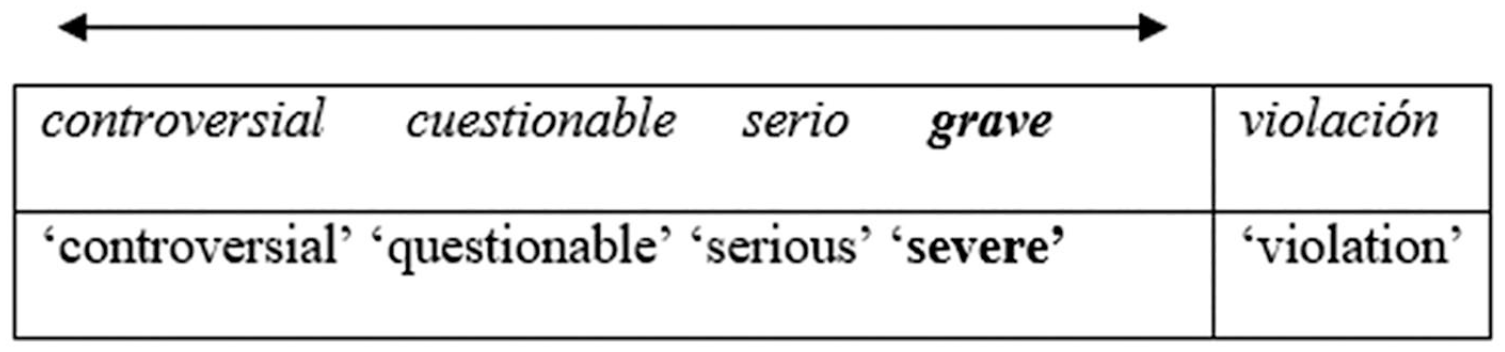
Grading scale of evaluation of the meaning of grave (“severe”).
As in previous examples, we can identify a two-layered graduation, this time expressed as an “extreme intensification” achieved by means of infusion and suffixation: first through the grading scale of evaluation previously identified, and then through the suffixation that maximizes the quality expressed by the adjective. 5
It is important to note that, in this example, gravísimas (“very (+ extreme) severe”) as an instance of attitude and graduation, is realized as part of an experiential grammatical metaphor. As mentioned before, a grammatical metaphor involves an inter-stratal tension in the realization of meanings from the semantic-discourse stratum to the lexicogrammar. In this example, gravísimas violaciones a los derechos humanos (“very (+extreme) severe violations of human rights”) constitutes an occurrence at discourse-semantics level, and therefore, should typically be realized at lexicogrammar as a verb or verbal group (e.g. violar los derechos humanos / “to violate human rights”). In this case, however, the occurrence figure in discourse semantics is realized at lexicogrammar as a nominal group (violación / “violation”), in a process of trans-categorization known as nominalization.
Table 4 below displays the congruent and metaphorical realizations of the nominalization in example 6. First, the congruent realization is presented as a material clause (torturaron / “tortured”) in lexicogrammar, in which the instance of graduation functions as a Circumstance of degree, congruently realized as an adverbial group. The metaphorical realization shows, instead, a Thing at lexicogrammar realized as a nominal group at group rank. At word rank, we can identify the intensification realized as an adjective (gravísimas / “very (+extreme) severe”) modifying a noun (violaciones / “violations”). At morpheme rank, the lexical root grav is modified by the derivational extreme degree suffix -ísimo and the inflexional suffix -s, indicating plural.
Congruent and metaphorical realization of gravísimas violaciones (“very (+extreme) severe violations”) at discourse-semantic and lexicogrammar strata.

Examples from the corpus are marked in italics, instances of graduation in italics and bold.
Table 5 below presents a summary of the examples analyzed in this section. It shows how instances of quantifiers and adjectives, ungraded by the extreme degree suffix, convey meanings in the subsystem of
Overview of meaning of graduation and attitude in instances with and without extreme degree suffix -ísimo/ísisma.
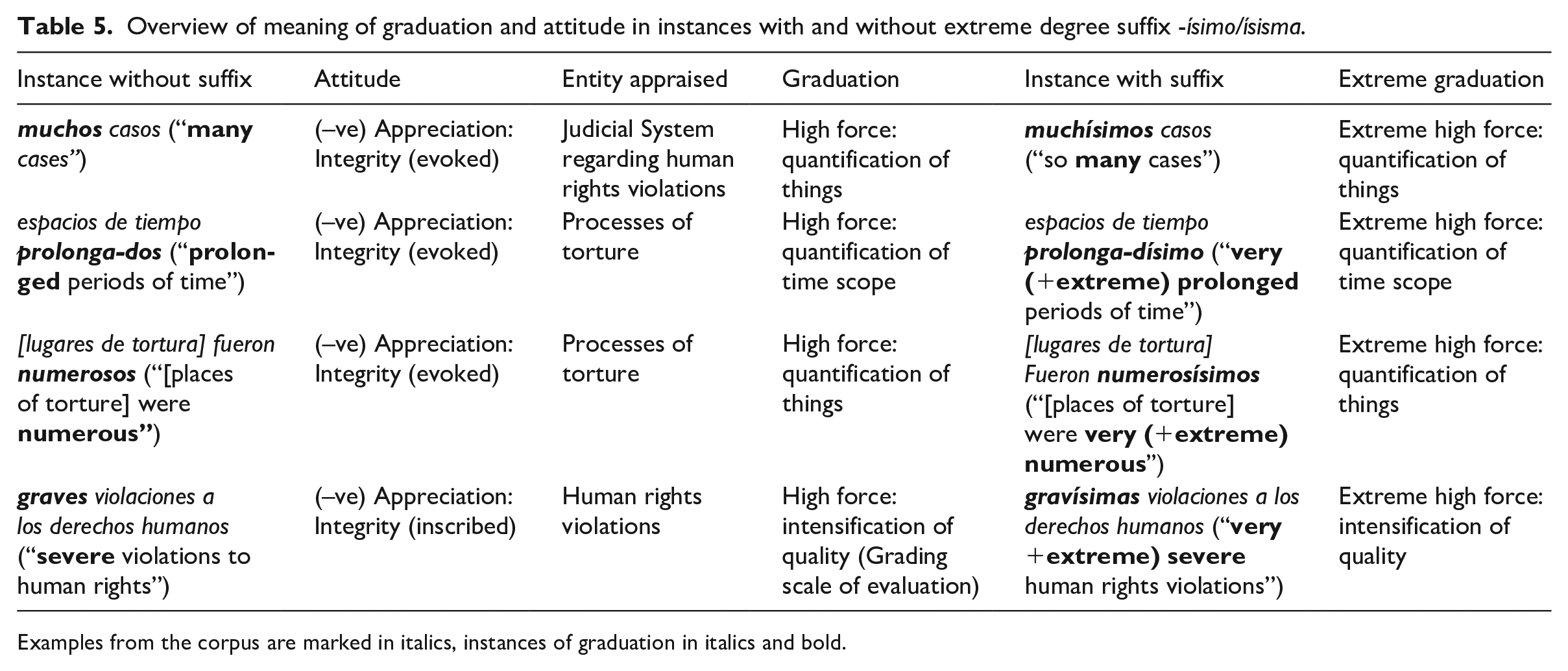
Examples from the corpus are marked in italics, instances of graduation in italics and bold.
Crisis and violence: The role suffixes -ada and -azo
In this section we will explore how authors build events of political and social crisis, in this case taking into account disciplinary discourse written by historians regarding the period prior to the dictatorship: the decade of the sixties and Salvador Allende’s government (1970–1973). When dealing with meanings of social instability, crisis and social unrest, the use of certain suffixes, such as
Among the different meanings associated to the Spanish suffix
In the corpus we found instances of the suffix -ada with the meaning c.1. This suffix functions as a graduating resource when dealing with meanings of negative integrity or conflict regarding the construction of a historical period in the discourse. Therefore, the meanings that can be of interest in terms of the possibility of having a role in Spanish graduation is the following: /
In the following example 7 we would like to show how the period of the sixties, previous to Allende’s socialist government and when Latin America is experiencing the impact of the Cold War, is portrayed in the discourse.
6
In this example it is possible to appreciate that the suffix -ada works primarily at the rank of the morpheme, but also at the rank of the word, the group, the clause, and finally also at the level of the discourse semantics. Let’s explore how this functions step by step in this extract taken from a specialized history text: Example 7 From the second half of the decade of the 1960s, coincident with Desde la segunda mitad de la década de 1960, coincidente con
In Example 7, “triggered” (se desencadenó) and “precipitated” (se precipitó) are both in middle voice, thus there is no grammaticalization of agency. Chilean society is presented as one which mirrored the social processes that occurred both in Europe and in the United States (“coincident with”). The causal connection is realized implicitly by the processes “precipitated” and “triggered,” which make the nominalization “a whirl of agitation” the effect of another nominalization: “the revolutionary wave.” High force as temporal intensification is infused in “triggered” and “precipitated,” adding the meaning of movement and acceleration, in this case, of social, political and economic processes, with an invoked evaluation of high conflict that conveys a negative connotation associated with chaos, crisis and lack of social stability (Oteíza, 2019). However, if we take into consideration the inter-stratal tension that is happening in combination with the lexical metaphor, it is possible to appreciate that the grammar is working at the discourse semantics level in an incongruent way because what is built as a nominal group as “the revolutionary wave” is working at the discourse semantic level with a meaning that could be unpacked as a clause such as “people revolt many times and repeatedly.” From a field perspective, “the revolutionary wave” also works as a lexical metaphor of a natural phenomenon: “waves” of the sea. Therefore, “the revolutionary wave” refers to an activity that is nominalized as a recurrent and dynamic historical process, which is a very familiar trope in historical discourses in general, and useful for representing the social and political crisis and chaos that Chilean society was experiencing. The negative attitudinal meaning can be only achieved if we consider the lexical and grammatical metaphor in combination, and if we take into consideration the rhetorical attitudinal effect created by the co-text. This stratal tension is illustrated in Figure 3:
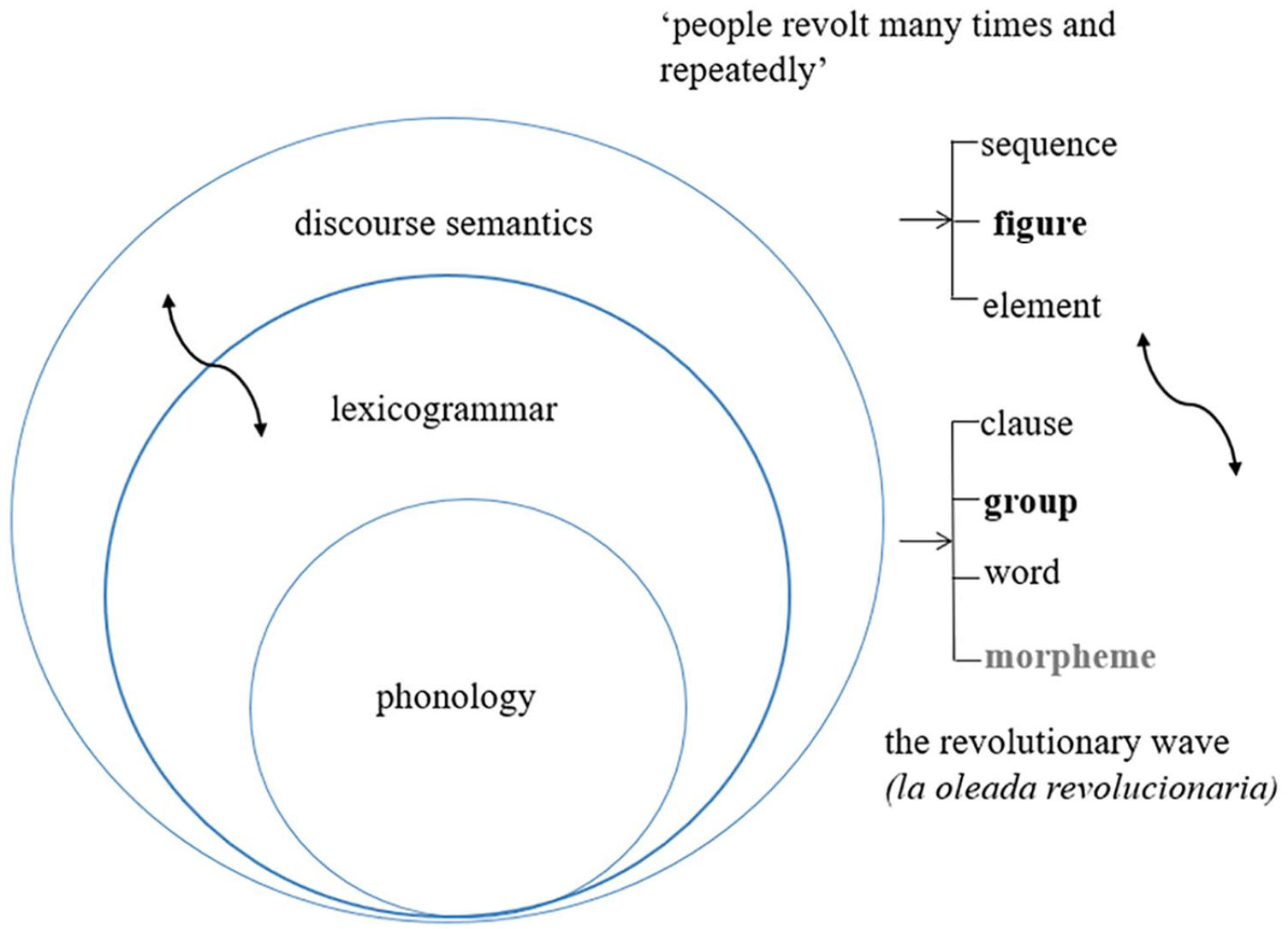
Experiential grammatical metaphor (stratal tension) 8 of “the revolutionary wave.”
If we look at this example 7 from above, that is, taking into consideration the co-text and its context of register as field (history), the experiential grammatical metaphor or nominalization “the revolutionary wave” works in the co-text as part of evaluative syndromes. As Taverniers (2017: 359) points out, “nominalization does not occur on its own, but it is part of a larger set of shifts that occur simultaneously”; in other words, one change “calls” the other. In this manner, graduation works at different levels: at the level of the co-text, at the level of the clause, at the rank of the group, the word and the morpheme contributing to portray an attitudinal meaning of high negative conflict and integrity.
This inter-stratal tension is demonstrated in more detail in Table 6, in which we show the levels of language content plane- discourse semantics and lexicogrammar- and inside this, the rank scale, to better understand the graduation role of the -ada Spanish suffix in the nominalization, from a lexical metaphorical point of view and from a grammatical metaphorical perspective:
Realization of la ole
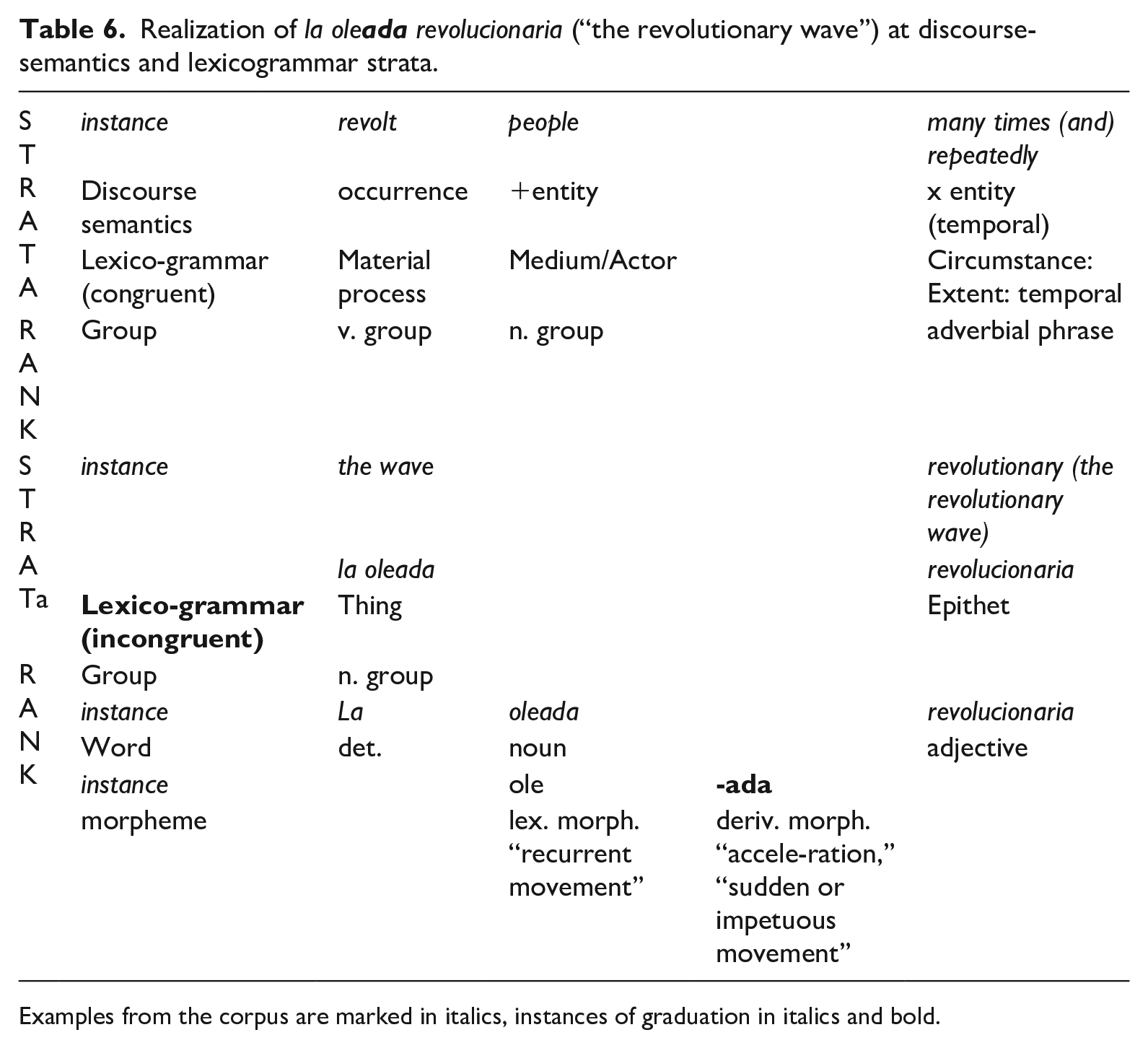
Examples from the corpus are marked in italics, instances of graduation in italics and bold.
The suffix
In our corpus the clearest example, which is part of the construction of the social crisis and instability of Salvador Allende’s government in the discourse is the following: Example 8 On June 29 [1973] there was a new uprising - the El 29 de junio [1973] se produjo un nuevo alzamiento – el
It is also possible to propose that the morpheme -azo, as in example 8, instantiates a coupling of graduation and attitude, because a violent action will be most likely considered as a negative evaluation of appreciation of high power and high conflict, regarding the political and social situation that in this case the Popular Unity government of Salvador Allende in Chile was experiencing. In this instance, the suffix -azo is part of a nominal group that also works as a lexical 9 and grammatical metaphor. It means that “the military attack with tanks” in an attempt to take control over the government. The stratal tension is illustrated in the Figure 4 and the strata realization is shown in Table 7:
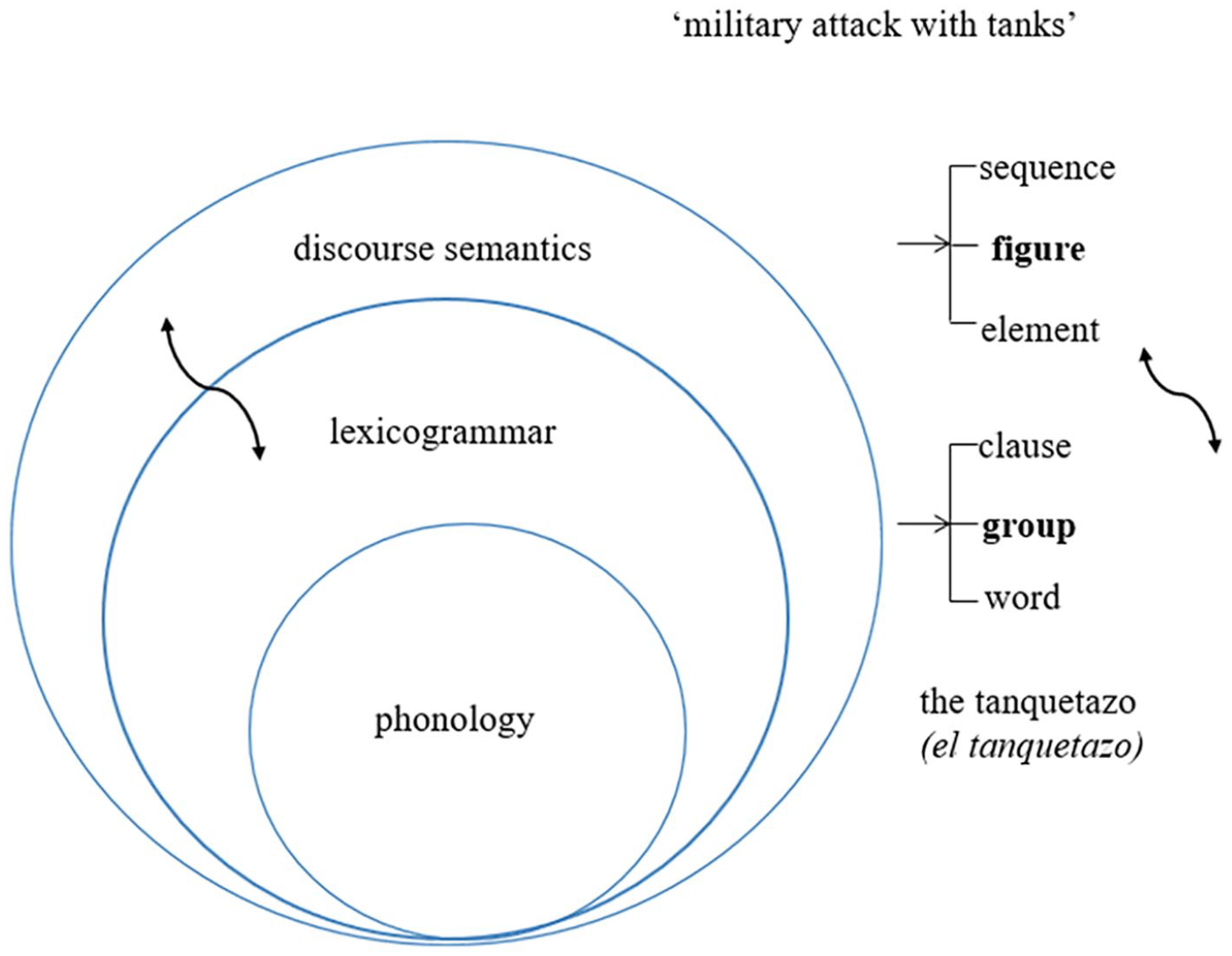
Experiential grammatical metaphor (stratal tension) of “the tanquet
Realization of el tanquet

Examples from the corpus are marked in italics, instances of graduation in italics and bold.
Final remarks
In this article we offered an analysis of the potential of some Spanish derivative suffixes for building graduation of negative attitudinal meanings regarding the representation of political crisis and extreme violence in Chilean recent History. We first demonstrated that several resources for building force and focus by means of sub-modification and repetition identified for the English language by Martin and White (2005) and Hood (2010, 2019), also work for the Spanish language, as it was shown and established from a SFL perspective (Caffarel et al., 2004; Halliday and Matthiessen, 2014). Suffixes have been proved to be productive resources for building meaning of graduation by sub-modification at the rank of the word structure by a morpheme in written Spanish language, in combination with other resources that work at different rank levels of the lexico-grammatical stratum and in turn in the discourse semantic stratum, creating prosodic interpersonal meanings that accumulate in the co-text.
Extreme degree suffixes -ísimo/a/s, which maximize pre-existent resources of graduation by means of suffixation, resulting in what we have called “extreme graduation” as force of intensification and quantification, have proved to have a critical role regarding the discursive representation of human rights violations that were committed during General Pinochet’s dictatorship, as reported by The National Truth and Reconciliation Commission in 1991. These disputed systematic acts of state brutality, for which at the beginning of the transition to democracy there was no evidence of the 1.100 centers of detention and torture along the country and the almost 40.000 cases of torture (Government of Chile, 2004, 2011), were built in the discourse with the “help” of the suffixes that contribute to maximize evoked evaluations of negative integrity, pushing the cline of explicitness from evoked evaluations to provoked ones. That is to say, resources of extreme graduation contribute to the rhetorical effect of promoting an evaluative interpretation more explicitly than non-extreme resources, in cases where the nature of the text demands an objective positioning of the authors.
On the other hand, as it has been shown in examples 7 and 8, suffixes such as -ada and -azo, function not only at the rank scale of the morpheme, but fundamentally at different lexicogrammatical and discourse-semantic levels, due to its role as part of lexical and experiential grammatical metaphors codified at the rank scale of the group. In this manner, it is in the inter-stratal tension of lexicogrammar and discourse-semantics that the highly graduated meaning of negative appreciation of conflict and integrity expressed as an incongruent realization such as “the revolutionary wave”/ la oleada revolucionaria can be explained. It is only through the combination of resources that contribute to the building of an incongruent expression that the discourse can afford to graduate with a high force as intensification a negative attitude regarding a historical situation.
In the next Figure 5 we present a system network that organizes the resources of graduation by suffixation identified in the written Spanish corpus of recent Chilean History of social crisis and human rights violations:
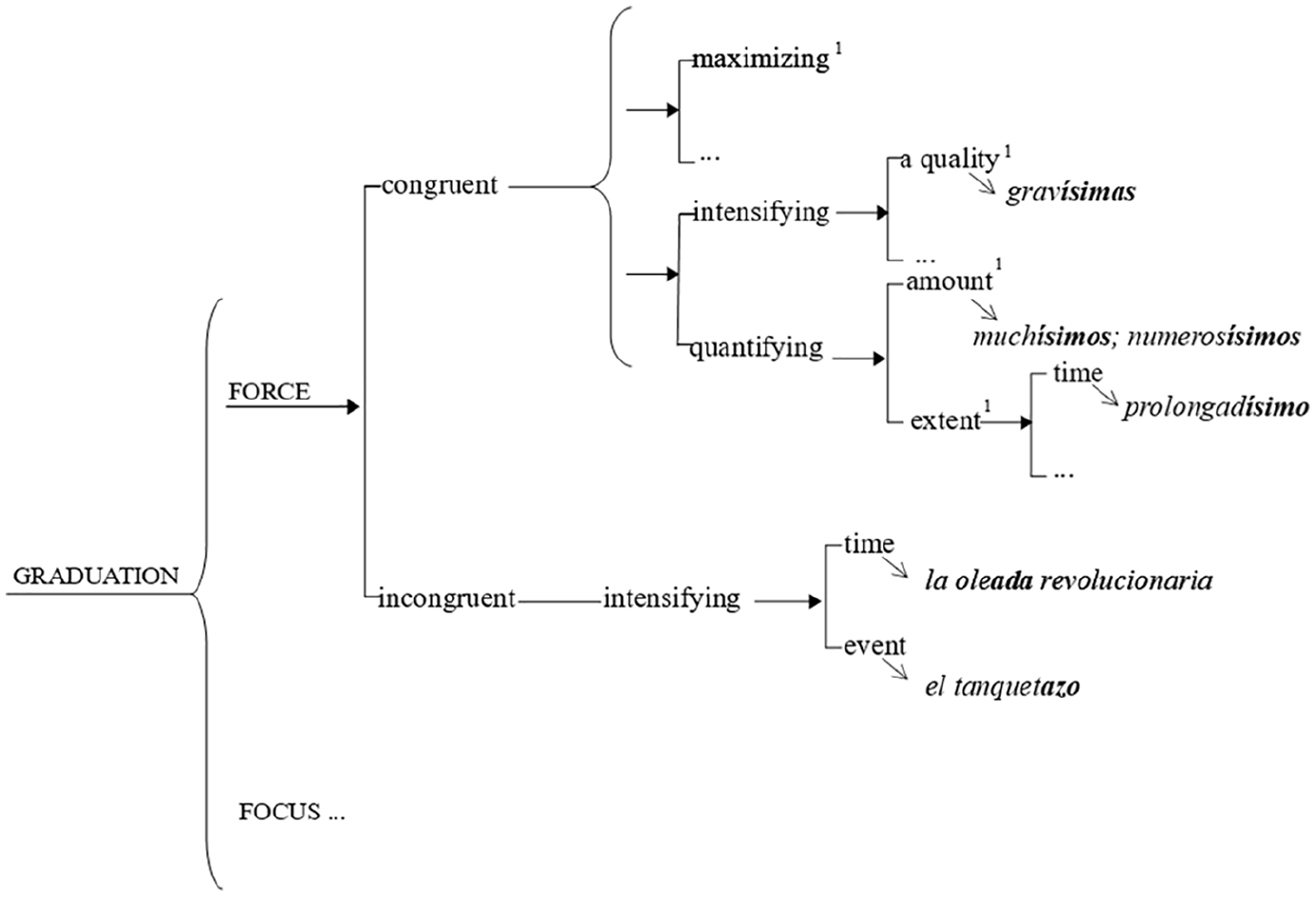
Network system of Graduation as force in Spanish language: role of suffixes.
In this article we have described the role that Spanish suffixes such as -ada, -azo and -ísimo/a/s have in building graduation by suffixation at the discourse semantic stratum. As we show in the network system in Figure 5, one main distinction among the functioning of these suffixes is that some of them tend to work in congruent realizations and others in incongruent ones. In this way, suffixes -ada and -azo can graduate at the rank level of the morpheme, word and group and also be involved in an inter-stratal tension of an experiential grammatical metaphor that works in combination with a lexical metaphor intensifying as time and event in an incongruent manner. On the other hand, the extreme degree suffixes -ísimo/a/s can contribute to intensify qualities and to quantify as amount and extent in a congruent manner. Spanish suffixes can graduate by sub-modification at the word rank structure playing a part in the building of constellation of patterns of evoked and inscribed interpersonal meanings in the co-text.
The intersubjective analysis of Spanish morphology captures the prominence that derivative resources have to carry out meanings that project beyond the range of the word and the clause insofar they collaborate to show attitudes and positions in the discourse.
In Spanish language, as has been demonstrated for English, writers have the option of using sub-modification in the group rank or relying on repetition at the clause or text level to graduate attitudinal meanings. The use of suffixes as sub-modification in the lower rank of the word structure, which also has the potential to function in a higher level of a group in the case of certain suffixes that work in nominalizations, is another option available to users of Spanish. In other words, among the potential of language resources to graduate in Spanish, suffixes play a prominent role in building a rhetoric of negative evaluative effect in a less overt manner when authors attempt to convey meanings that are difficult to accept, believe or agree with, particularly in relation to social disputes and high levels of violence and brutality in a society.
Footnotes
Acknowledgements
We would like to acknowledge the valuable suggestions we received in the anonymous review process of this article.
Declaration of conflicting interests
The author(s) declared no potential conflicts of interest with respect to the research, authorship, and/or publication of this article.
Funding
The author(s) disclosed receipt of the following financial support for the research, authorship, and/or publication of this article: This article presents findings from research grant FONDECYT 1170331 (National Funds for Science and Technology Development, Chile).