






Abstract
In this article we explore the semantic category of graduation, specifically force (appraisal theory), which builds the symbolic dimension of time in historical discourses. Our aim is to provide a more refined and extensive theoretical framework to analyse the symbolic construction of time in historical discourses – one that allows us to take into consideration how social, political and economic processes and events are represented and valued in historical discourses. We propose that this symbolic ‘scenification’ of time is constructed in the discourse by a combination and accumulation of congruent and metaphorical lexico-grammatical resources. In this manner, meanings of quantification of time as duration and sequencing tend to be expressed in a more congruent way, whereas meanings of intensification of time as accelerating, deepening and expectation tend to be expressed in a more metaphorical manner by means of processes and nominalizations. The chronological dimension of time imbricates the symbolic dimension in a way that allows historians and sociologists to legitimate particular historical memories of the recent Chilean past.
Introduction
This article presents part of the analysis from a larger study concerning the logogenetic valorative reconstruction of historical memories in recent Chilean history and official reports of human rights violations. The historical periods contemplated in this research are Allende’s Popular Unity government (1970–1973), Pinochet’s dictatorship (1973–1990) and the transition to democracy during the governments of the central-left wing party of the ‘Concertación’ (1990–2009). We are particularly interested in the pasts that are constructed in the recent Chilean historical discourse, considering that the legitimation of certain memories also contributes to our understanding of present and future societies (Achugar, 2009; Wodak, 2011). We postulate that in national discourses of recent history written by historians and sociologists, the reconstruction of memories in the discourse is realized, in part, through the valorative symbolic representation of the time framework. That is, temporal phases are key constituents of the historical explanation, which, in terms of linguistic theories of ‘appraisal’ (Martin and White, 2005), is constructed from determinate evaluations of Judgement, Appreciation and Affect with different levels of engagement.
Taking into consideration that the re-signification of past events is not established once and for all but rather evolves with time, it is impossible to analyse historical dynamics as a linear process (Jelin, 2007; Ricoeur, 2010). Moreover, the notion of ‘historizing memory’ is of particular importance and, according to Jelin (2002: 69), implies ‘the selection and emphasis of certain dimensions and aspects of the past that different actors rescue and privilege, and of the changing emotional and affective interpretations that this implies’. The national narratives of recent history imply a challenge for historians and sociologists due to the fact that it is difficult to think critically about this recent past, in part because its reconstruction is part of the public sphere of a specialist community (Franco and Levín, 2007). In the last few decades there has been a growing recognition of the importance of legitimating more local sources of the study of history and memory (oral sources, testimonies, among others) as well as the value of the interpretative character of the discipline. Furthermore, many authors have emphasized the ethical need for making the ideological positions in the discourse explicit (e.g. Franco and Levín, 2007; Jelin, 2002, 2007; Stern, 2006).
As valorative symbolic representation of the time framework has the potential to legitimate perspectives of historical memories, and due to its fundamental role in the discourse of history, we postulate the necessity of developing further levels of delicacy for the dimension of time in the systemic network of graduation in appraisal theory (Hood, 2010; Hood and Martin, 2007; Martin and White, 2005).
As Martin (2008, 2010) suggests, meanings are built through combinations of meaning (coupling), which reflects in part the simultaneity of metafunctions in systemic functional linguistic theory (Halliday, 1994; Halliday and Matthiessen, 2004). We have found in the analysis that the coupling of features across simultaneous appraisal systems in recent national historical discourse is more common between the sub-systems of attitude and graduation. Specifically, coupling is done between the subsystem of graduation as force (its time dimension in particular) and the attitudinal meanings of Judgement, Appreciation and Affect that collaborate to construct historical explanations in the discourse. In addition, we attempt to demonstrate in our analysis that the dimension of time as force can be codified in more or less congruent ways 1 in historical discourses. We argue that the congruent forms typically take the form of prepositional and nominal phrases, whereas the more metaphorical instances are codified by means of nominalizations and processes. Therefore, on one hand, time can be codified in a more congruent and prototypical way by means of prepositional and nominal phrases, adjuncts, verbal morphology, among others, such us: in September of 1970; in the twentieth century; in the past; the electoral campaign of 1970; later on; soon; a few months after. On the other hand, time can also be codified in historical discourses through processes and nominalizations like: the revolutionary wave (nominalization) precipitated (process) a whirlwind of agitation in Chilean society; a gradual increase in the inflationary rhythm; a growing environment of unrest, among others. In this manner, we attempt to show in the following sections that it is the chronological dimension of time that is usually realized in a more congruent manner, and that other instances of time, expressed mainly by nominalizations and processes in conjunction with one another, allow authors to construct a more symbolic representation of time – or as Lechner (2006) calls it, a particular ‘scenification’ 2 of the time framework that gives a determinate valuation to the period, process or event constructed in the discourse of history. For example, the representation of Allende’s period constructed through the nominalization a ‘frenzied loss of control’ of the revolutionary process (un desembocamiento del proceso revolucionario) carries the meaning of a violent change that accompanied the historical process, and thus time is constructed in the discourse by force, as an intense change that gives to the discourse not only the sense of urgency, but also a negative evaluation of the abnormality and instability of the social and political environment during the Popular Unity government in Chile. We show that taken together, the symbolic construction of time in historical discourses and the chronological codification of time constitute mechanisms of (de)legitimation (Van Leeuwen, 2008; Van Leeuwen and Wodak, 1999; Wodak, 2011) of social, economical and political processes. Consequently, the manner in which the past, present and future are symbolically represented in the discourse of history operate as a discursive legitimation of certain historical memories of the recent national past.
In sum, we postulate that the symbolic representation of time imbricates all the temporal instances of a discourse, thereby building a specifically valorative prosody of recent historical memories. These recent ‘pasts’, and the attitudes and values about them, are still in a process of construction in Chilean society (Hiner, 2009; Lechner, 2006; Stern, 2006). This in turn influences the ‘acquired gaze’ or ‘trained gaze’ (Bernstein, 1999) of readers’ sensibilities regarding recent historical memories and how present and future are conceptualized in historical discourse (Oteíza and Pinuer, 2010).
This article is organized into the following sections: it starts with a brief discussion of the historical and political context of Chilean recent national history and an explanation of the corpus analysed. Second, we introduce appraisal theory and its theoretical and methodological potential to better interpret social and political problems and their representation in discourse, focusing further on the analysis of the system of graduation, specifically, on the sub-system of force and the necessity of developing a more detailed semantic network to deal with the dimension of time in historical discourses. Third, we present the discursive analysis itself, providing examples from the historical discourses analysed to demonstrate how different semantic resources of FORCE for expressing time, with more or less congruent realizations, collaborate to build a valorative prosody of recent historical memories in the discourse. Finally, we present some conclusions to our analysis in an attempt to provide a more refined theoretical framework to analyse the symbolic construction of time in historical discourses that can then facilitate analysis of historical explanations that are favoured in historical discourses in Chilean society.
Brief historical and political context of recent national Chilean history
In 1970 Salvador Allende, who represented a political coalition from the left denominated Popular Unity (Unidad Popular), was elected president by a democratic election. Allende proposed ‘a peaceful road to socialism’, which had the particular characteristic of not involving an armed struggle as with other revolutions in Latin America. He and the Popular Unity coalition that he represented planned to carry out several social and economic reforms that attempted a considerable redistribution of income to the poorest sectors of Chilean society. The Popular Unity government, which assumed power during the years of the so-called Cold War, was seen as a unique socialist initiative and aroused interest and expectation in many countries; it also evoked intense hostility from the United States and the right and centre political sectors of Chilean society that considered it a threat to democracy and a potential path to a ‘Marxist dictatorship’. Consequently, Allende’s government was boycotted by the Chilean right, with economic and political support from the USA – even before Allende assumed his role as president (Loveman, 2001).
On 11 September 1973, a coup d’etat led by Augusto Pinochet took control of the country, resulting in President Allende’s death. 3 During Pinochet’s military dictatorship (1973–1990) more than 30,000 people were tortured and imprisoned, and around 3000 were assassinated or ‘disappeared’. These human rights violations were investigated during the ‘Concertacionistas’ governments of Presidents Patricio Aylwin and Ricardo Lagos, through the creation of two commissions – one called The National Commission on Truth and Reconciliation of 1991 (Rettig Commission), which investigated the cases of human rights violations that resulted in death, and one called The National Commission on Torture and Political Prison of 2004 (Valech Commission), which investigated the cases of systematic and institutionalized torture and political imprisonment that happened especially during the first years of Pinochet’s dictatorship.
Different historical memories compete in Chilean society regarding the impact of the coup d’etat and the human rights violations that took place during Pinochet’s dictatorship. As Steve Stern (2006) states, the events that started on 11 September are remembered by Chileans as ‘salvation’, ‘rupture’, ‘persecution and awakening’ and as a ‘closed box’, which all constitute key social mental frames used to understand how different social actors give value and meaning to the past.
This article deals particularly with the analysis of the symbolic representation of time of the Popular Unity government of President Salvador Allende (1970–1973), from the perspective of the sociologist Tomás Moulian (Chile actual: Anatomía de un mito, 1997) and the historians Correa, Figueroa, Jocelyn-Holt, Rolle and Vicuña (Historia del siglo XX chileno. Balance paradojal, 2001). Both books are well known in Chile and have been read by many in the general public and at universities. Moulian’s book could be considered a sociology essay, while the volume by Correa et al. is an historical textbook. Many excerpts from these books are quoted in recently published history textbooks for primary and secondary education in the country (Oteíza, 2009a, 2011, in press). They include little information about the primary and secondary sources with which the historical interpretation has been built and therefore do not represent rigorous historical studies, although they are widely consumed.
Analytic framework
The analysis presented in this article is informed by the complementary theoretical approaches of appraisal theory (Hood, 2010; Hood and Martin, 2007; Martin, 1997, 2000; Martin and Rose, 2007; Martin and White, 2005; White, 2000, 2003) and critical discourse studies, taking into consideration, in particular, the mechanisms of legitimation (Van Leeuwen, 2008; Van Leeuwen and Wodak, 1999; Wodak, 2011) that these authors privileged in their historical discourses. Both theoretical frameworks consider language as part of a human activity, and thus, as a social practice of meaning creation; this also implies that discourse and social realities are in a dialectal relationship (Fairclough and Wodak, 1997; Volóshinov, 2009 [1929]). Consequently, from the perspective of systemic functional linguistics (SFL), the grammar and discourse of language is conceived as a set of resources which ‘make’ meanings, more so than as rules to organize structure (Martin and Rose, 2008). In other words, this theoretical orientation moves towards an analysis of ‘meanings in context and towards rhetorical effects rather than towards grammatical forms’ (Martin and White, 2005: 94). As Martin and White (2005) point out, the purpose of developing appraisal theory was to expand traditional accounts regarding issues of speaker/writer evaluation, certainty, commitment and knowledge, and to also consider how the textual voice positions itself with respect to other voices and other positions in the discourse. Hence appraisal theory deals with aligning or disaligning stances that are negotiated among real or potential interlocutors.
Appraisal theory represents a development of discourse semantic resources enacting the interpersonal variable of ‘tenor’, as well as an extension of Halliday’s focus (1994) on
In appraisal theory ideational and textual meanings are also considered because they may contribute to interpersonal meaning or are built simultaneously with interpersonal meaning in the discourse. Consequently, the ideational choices indicate valuations of
Appraisal theory, which constitutes a system of interpersonal meanings situated at the level of discourse semantics, organizes evaluation in three main semantic domains:
According to Hood (2010) and Martin and White (2005), the system of also play a dialogistic role in that they enable speakers/writers to present themselves as more strongly aligned or less strongly aligned with the value position being advanced by the text and thereby to locate themselves with respect to the communities of shared value and belief associated with those positions. (Martin and White, 2005: 94)
At the same time, the semantic system of
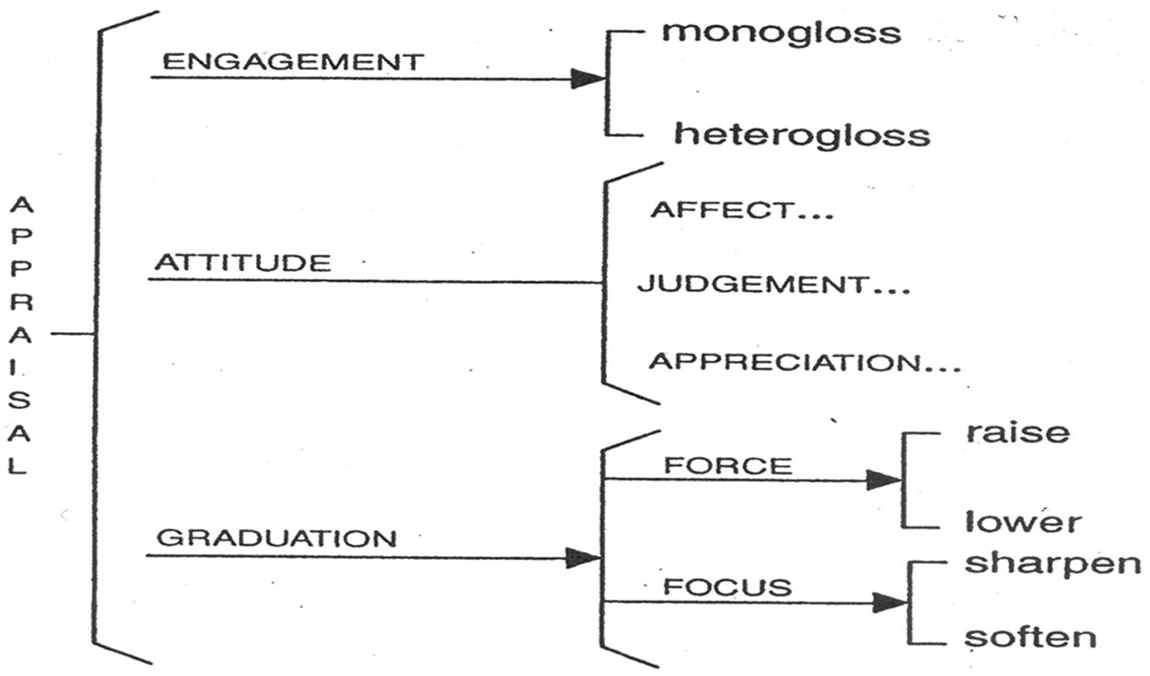
General outline of the
Hood and Martin (2007) propose a temporal dimension as part of the sub-system of force of the semantic system of

The network of
Extending this perspective, we consider that the temporal dimension has a more fundamental and global role in the interpretation of the discourse of history due to the fact that authors fashion a symbolic representation of the time framework, which is critical to the construction of the argument and the evaluative orientation of the discourse. Therefore, we attempt to demonstrate through the analysis of recent historical discourses of Chilean national history that it is necessary to distinguish between more or less congruent ways of expressing meanings of time, which in turn are also related to a more chronological or symbolic representation of time in the discourse. We also aim to highlight the necessity of developing further levels of delicacy for the dimension of time as force in the network system of
Analysis and discussion
Chronological instances of time in historical discourse
As noted above, it is possible to deal with the dimension of time on a cline from more congruent forms of realization to less congruent or metaphorical (grammatically speaking) realizations in historical discourses. A common strategy is for temporal instances to build time from specific valorative perspectives, a phenomenon that we have denominated ‘the symbolic valorative construction of the time framework in the discourse of history’ (Oteíza and Pinuer, 2010). In this manner, for example, prepositional and nominal phrases such as In this context (En este contexto) are part of the symbolic construction of time because they imply a (re)scenification of the past based on the selection of certain factors that build the argumentation of historical explanations. These types of expressions collaborate to make discourses more interpretative in nature. Frequently, such temporal references position events previously mentioned in the discourse as constituting the causes or explanation of other previous events. In this context functions in this way as a marker of causality that reunites all the events and processes previously manifested as a ‘contextual amalgam’. That is, it presents them as undifferentiated causes that naturalize historical explanations presented by authors in the discourse. Other expressions such as Under this circumstance (Ante esta circunstancia), In the political, economic and social situation (Ante una situación política, económica y social), after all that was previously mentioned (todo lo anterior), In the middle of these events (En medio de estos sucesos) among others, have been identified in the analysis of history textbooks as phrases that combine in their meaning the temporal dimension and the logico- semantic meaning of causality among clauses to construct historical explanations (Oteíza, 2006, 2011).
Coffin (2006; Derewianka and Coffin, 2008) categorizes the representation of the temporal dimension of history in history textbooks and identifies five prototypical functions: sequencing (‘before’, ‘after’); segmenting time (by naming it, e.g. ‘The Cold War’); setting in time (a particular point of time like ‘in 1973’); duration (how long an event lasts, such as ‘for 30 years’, ‘for a long time’) and phasing (indicates the beginning, continuation and end of the phases of an event (‘at the beginning of the sixties’). This classification is also useful in organizing the chronological codification of time in historical discourses written by historians and sociologists as a more specialized discourse intended for other experts in the field, university-level students and the general public. In Table 1 it is possible to see typical instances of time taken from the data analysed in correspondence with Coffin’s classification of time.
Chronological instances of time in historical discourse and Coffin’s classification of time (2006).

Some examples are arguable because we believe that certain time codifications can function with more than one role in the discourse; it is possible that one instance like second half of the sixties functions as an instance of phasing and also as an instance of segmenting time.
As summarized in Table 1, the temporal dimension in historical discourses is expressed by means of several congruent grammatical structures to express phasing, setting in time, segmenting time, sequencing and duration. Nevertheless, and although these instances of time are necessary and prototypical in the construction of historical explanations, they are not by far the only ones nor the most important ones when authors (both historians and sociologists) attempt to build a more symbolic representation of time as well as a more complex explanation of historical events, as we aim to demonstrate in the following section.
‘Less’ chronological and ‘more’ symbolic representations of time
It is possible to observe that causality and other historical explanations are not only explicitly codified by means of conjunctions and conjunctive phrases between clauses, but that there are other metaphorical resources in the system that build the argument inside clauses. In this manner, the historical genres of a more explanatory character present a broader range of nominalizations which act as causes of effects that are subsequently explained in the discourse and that are realized, in part, by the reasoning inside clauses (Martin, 1991), as shown in example 1.
Example 1
4
From the second half of the decade of the 1960s, coincident with Desde la segunda mitad de la década de 1960, coincidente con
In this example the causal connection is realized by a process ‘precipitated’, which makes the nominalization ‘a whirlwind of agitation’ the effect of another nominalization ‘the revolutionary wave’; this functions in this particular case in an indirect manner, because the direct agent of the clause is ‘The Chilean society’.
Example 2 demonstrates that temporality can also be expressed by means of a process followed by a nominalization (turned into (process) a ‘
The sequence of events became La sucesión de hechos se volvió
The symbolic representation of time is realized in part through material processes (unleashed, precipitated) that have the meaning of movement and acceleration, in this case of social, political and economical processes. With the notion of ‘acceleration’ we aim to capture the idea of social, political and economic processes that are portrayed in the discourse as if they ‘increase in speed’, so that time advances at a more rapid pace; this then has a negative connotation associated with chaos, crisis and lack of social stability. The semantic category of ‘deepening’, which is related to ‘acceleration’, codifies the idea that social, political and economic processes and events become more profound, and that they have reached an extreme manifestation or a critical point with a higher impact in society. The meaning of time is evoked as a kind of secondary meaning conflated with the meaning of ‘deepening’ in this type of process. As a result, by accumulation, historical discourses create a sense of rapid progression of time towards a situation of uncontrollable crisis. Processes can also infuse urgency and drama in the discourse regarding Allende’s government and function as instances of force, which may or may not also have a role as logical metaphors. For example, force as time that expresses the meaning of deepening can be codified by processes such as sharpened (agudizaron); deepened (profundizaron); increased (aumentaron), among others; and force as time that expresses the meaning of acceleration can be codified by processes like increasing (aumentando); enhanced (potenciado); it was intensified (se intensificó); it was accentuated (se vio acentuado); it was accelerated (se aceleraron), among others.
It is also possible to find, as it is shown in example 3, that material processes (sharpened, to deepen) are frequently followed by a nominal group (the requirements; the changes) which are thus themselves graded: Example 3 . . . (They) . . .
Nominalizations like ‘increment’ in increment in the expressions of discontent (
In addition to the functioning of processes as signals of a temporal dimension, there are processes that carry a strong meaning of ‘flagging’ what is going to happen in the near future – with expressions like indication of what would come (indicio de lo que vendría). Temporality is expressed in terms of expectation in the historical discourse, ‘predicting’ or ‘presaging’ the failure of Allende’s government and the generalized social chaos that the society is experiencing, thus explaining and justifying the military coup. This clearly has an impact on the memories that could be made more legitimate in historical discourses (Oteíza, 2009a, 2009b, 2010), as exemplified in examples 4, 5 and 6 by the process of ‘presaging’ in 4 and ‘predicted’ in 5 and 6: Example 4 Example 5 . . . . . . Example 6 [Before Allende is elected president] The party [Christian Democrats, centre] debated between those who, like the adolescent militants, had gone out to the streets to El partido [Demócrata Cristiano, centro] se debatía entre quienes, como los militantes juveniles, habían salido a
Additionally, there is a premonition of the failure and the horror of Pinochet’s dictatorship and their human rights’ violations (part of the closed box of the recent national past), as we can see in the following example: Example 7 . . . . . . presagiando de esta manera el
In the following section we would like to highlight, as noted at the beginning of this article, that the non-congruent resources of
The symbolic representation on time framework: Coupling of the semantic domains of force and attitude
As we attempted to demonstrate in the previous section, meanings of quantification of time as
Symbolic representation of time framework in historical discourses. a

In Tables 2 and 3 we attempt to show the coupling of temporal segmentations and settings in time with the particular evaluations that authors build for each. In the third column we included the more salient evaluations of
The notation (-) signals a negative evaluation, (+) signals a positive one, and (+/-) signals a more neutral evaluation or one that is not clearly marked as positive or negative.
From a different perspective, the sociologist Tomás Moulian (1997) refers to Allende’s government as an historical period less than fully socially valued, which is built in the discourse through the lexical metaphor of ‘adolescence’. This adolescence is the ‘Chilean pacific route to socialism’ that ends in an ‘aborto’, namely the military coup d’etat. Moulian evaluates Allende’s government with negative
Example 8 The El Example 9 The El
The following example 10 shows an extract of Moulian’s representation of the terror that Chilean society endured during Pinochet’s dictatorship. In this example, the symbolic construction of time regarding the notion of ‘terror’ is conveyed mainly through the semantic weight of processes (remains) and attributes (permanent, remembered, finite). Time is built in the future as duration and also as a deepening feeling of insecurity (uncertainty).
Example 10 The El
We summarize the symbolic representation of time in Moulian’s discourse in Table 3.
Symbolic representation of time framework in historical discourses (sociologist Tomás Moulian).

In Figure 3 we attempt to capture the cline and potential conflating of chronological and symbolic constructions of time in historical discourses. On one hand, the more congruent realizations are often responsible for building meanings of duration and sequencing of processes and events as Coffin (2006) has identified. On the other hand, meanings that build more symbolic ‘scenifications’ of the temporal dimension in historical discourses tend to be instantiated by less congruent or metaphorical realizations that portray the meaning of progression of time in the past or expectation of time in the future. Meanings of progression can also be expressed by processes and nominalizations that convey meanings of accelerating or deepening historical situations and events.

Time dimension in historical discourses.
We propose, as shown in Figure 4, a more delicate network system for the dimension of time as a category of force (graduation) proposed by Hood (2010) and Hood and Martin (2007) to better manage the interpretative ‘scenification’ of time in historical discourses and, in turn, its crucial role in constructing mechanisms of de/legitimation of historical memories. Two parameters of Coffin’s classification of time, duration and sequencing are included in the system network due to their role in the construction of certain meanings of graduation in the discourse. We have indicated in bold what we have added as a proposal for a more delicate analysis.
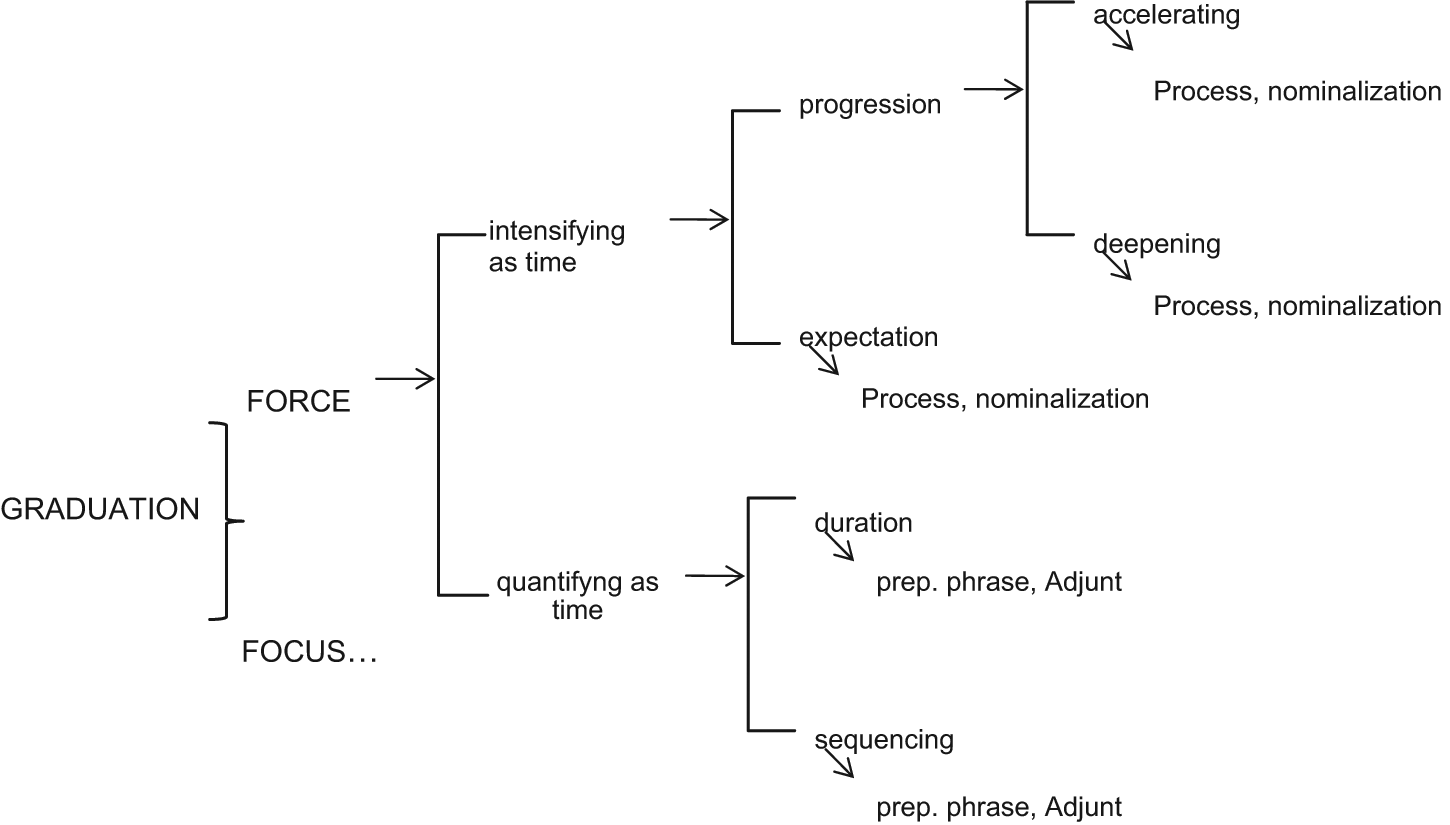
Network of
Conclusions
The reconstruction of memories in the Chilean discourse of the recent national past is realized, in part, through the symbolic valorative representation of time in the discourse. The symbolic representation of social time that authors build in historical discourses allows a scenification of the past, and the evaluation of it collaborates with the legitimation of certain historical memories. Historical genres of a more explicative and interpretative character have a strong temporal dimension, in which chronological temporality imbricates a more symbolic dimension of time in the discourse.
Consequently, in genres that construct the interpretative and political character of history in a more explicit manner, it is possible to appreciate a symbolic construction of time in conjunction with the construction of evaluations of historical memories. The chronology expressed mainly by prepositional phrases (in 1967; in 1970; at the end of the sixties) is building the recent temporal dimension of time in the discourse along with other instances of time codified especially through nominalizations like detonation of cruelty; increment in the expressions of discontent; increase of expectations; and processes such as sharpened; increased; accelerated. The two together build the valorative symbolic representation of time in the discourse of recent national history. We find that the codification of the temporal dimension in more explanatory and interpretative genres is realized by processes and nominalizations.
The valorative symbolic representation of Allende’s government in recent Chilean history has a negative evaluation of appreciation (high conflict, low power, negative integrity) and negative evaluation of affect that emphasizes a temporal construction of a conflict (temporal gradation of the crisis and chaos that the country experienced). As a result, by accumulation, the historical discourse creates a sense of rapid progression of time towards a situation of uncontrollable crisis. The historical memory of the past brings together the government of Salvador Allende, the coup d’etat and the violations of human rights during Pinochet’s dictatorship. All these events tend to be represented as a closed box (Oteíza, 2009b; Stern, 2006) where events of a very different nature and with diverse social actors participating are seen as a critical past – one to which we, as Chilean society, do not wish to return and should not return. Positive aspects of Allende’s government and the massive popular participation in his government (social movements and new subjects’ participation) tend to be forgotten by Chilean society.
Which are the ‘pasts’ that are constructed in the recent Chilean historical discourse? As many historians and sociologists have stated, history is a dynamic discipline involving ever-changing interpretations of the past; consequentially, the representation of actors and events and the ones that are silenced or excluded, as well as the symbolic valorative representation of time, respond to an ideological interpretation. We postulate that the attitudes and values or axiological cosmologies of the recent past are still in a process of construction, although historians and sociologists included in this analysis continue to represent in their discourses Allende’s government as a period of crisis and chaos, in which Allende’s failure is part of this obscure past of the coup d’etat, Pinochet’s dictatorship and human rights violations.
In sum, we have attempted to demonstrate that certain historical memories are legitimated in the discourses analysed, and that these legitimations are constructed in part by the symbolic valorative representation of time. For this reason, it is important to have a delicate system of analysis that permits this symbolic representation to be considered. The semantic analytical categories proposed here show the different ways of constructing the recent past in history discourses.
Footnotes
Funding
This article presents findings from research grant FONDECYT 1090464 (National Funds for Science and Technology Development, Chile) entitled ‘Logogenetic Valorative Prosody in the discourse of history’.