







Abstract
We present the results of a 5-day, observation and interview-based, multi-sited field study of the 2012 Democratic National Convention. We combine literatures on journalistic and political fields with scholarship on performance theory to provide a framework for understanding conventions as contemporary media events. Through analysis of field notes, photographic documentation, and interview data, we detail the layered production of performance in the journalistic and political fields, revealing how performances were directed both internally and across fields for strategic advantage, as well as for co-present spectators and the public at-large. We argue that conventions provide ‘boundary spaces’ where actors from different fields gather and perform distinct democratic roles, as well as mediated, integrative spaces for the polity. Media events provide occasions for networked practices of ‘active spectatorship’ that offer citizens a means of control over the publicity of elites.
Introduction
During the 2012 Democratic National Convention, spectacular forms of journalism and politics were omnipresent at physical locations throughout Charlotte, North Carolina. To take journalism alone, the ‘CNN Grill’, a former Mexican cantina commandeered for live broadcasts by the network’s personalities, stood near a towering, 4-story-high MSNBC stage set up in an open-air shopping mall. Bloomberg News took over a former Gold’s Gym and set up a multi-media center called ‘Bloomberg Link’, which played host to private cocktail parties, panels, and live broadcasts. The Huffington Post even created a meditative relaxation studio called ‘Oasis’. These spaces were highly visible accents on the more traditional forms of journalistic production that took shape around the speeches of the Democratic Party’s influential figures. Inside the Time Warner Cable Arena, celebrity television journalists stood on perches high above the floor or sat behind desks in skyboxes looking down upon, or being framed by, the stage below with its towering three-story liquid crystal display (LCD) backdrop. Meanwhile, their print brethren sat in nosebleed seats observing the proceedings or obtained temporary credentials granting them access to raucously participating delegates on the arena floor.
This article argues that these disparate scenes should be interpreted as a series of performances, propagated by an array of actors, and directed toward multiple audiences. In doing so, we draw on the idea of ‘performance’ as the attempt of social actors to convince others of the meaning of situations and the legitimacy of their actions within them (Alexander, 2004: 529). While we address both material and mediated performance, the former is of particular interest here, given the extensive work on media events (Dayan and Katz, 1992) and their digital extensions (Kirk and Schill, 2011; Lipscomb, 2012) that generally has not considered how events are produced at specific locales. We argue that the convention was a defined and ritualized moment when the performative infrastructures of the journalistic and political fields became spatially co-located in what we call a ‘boundary space’. Actors in these separate, yet intertwined, fields performed for their own fields and for one another to vie for status, authority, and strategic advantage. In turn, these actors both convened and performed for a wider mediated public sphere that was not physically co-present at the convention, but that they needed the consent of to legitimate their authority and role in democratic processes.
This article also argues that the spectatorship practices around media events such as conventions have changed for both live and mediated audiences. Alexander (2010) shows how conventions provide stages for political performances aimed at fusing candidates, cultural values, and audiences in ways that enable politicians to become ‘collective representations’ that are vessels for civic hopes and desire. While Alexander and scholars influenced by his work (Jacobs and Townsley, 2011) generally focus on elite performance in the political and journalistic fields, we argue that digitally networked social media provide new opportunities for both live and mediated audiences to exercise performative scrutiny. The new forms of mediated co-presence on social platforms such as Twitter enable audiences to engage in critical practices of what we call ‘active spectatorship’, a concept that combines the integrative framework of media events (Dayan and Katz, 1992) with the trials of legitimation and authenticity that are central to performance theory.
This article proceeds in four parts. We first discuss the literature on media events, cultural performance, and the political and journalism fields, which helped guide our observations and analysis of the convention. We then discuss our methods for this field study, the first of a contemporary political convention. Three empirical sections that detail the layered production of performance in the journalistic and political fields follow. We conclude with a discussion of how the convention served as a boundary space and provided a forum for networked practices of active spectatorship.
Media events and political performances
The nature and role of the party convention has changed over the last century. As a result of the nominating reforms set into motion by the McGovern-Fraser Commission following violence at the 1968 Democratic National Convention in Chicago, the drama of producing a nominee began to play out in the voting booth (Polsby, 1983). With the demise of delegates horse-trading for a nominee on the convention floor, Farrell (1978) argues that the 1976 Democratic and Republican national conventions served as ‘legitimation rituals’ for their parties, which anointed candidates who embodied and enacted a central theme for governance (see also Pomper, 2007). Later, scholars (Smith and Nimmo, 1991) read conventions through the lens of spectacle, analyzing the rhetorical strategies that manufactured political unity.
These scholars share common ground in noting a transition from the institutional to the symbolic roles of conventions. Panagopoulos’ (2007) edited volume, for instance, charts the rise of conventions as ‘media events’ and details the work of the image specialists involved in their production. This work builds from Dayan and Katz’s (1992) classic book on media events, which are shared rituals that interrupt daily life, are broadcast live, follow pre-planned scripts that both reveal and reify social order, and ultimately build social solidarity. Dayan and Katz argue that media events such as conventions are premised upon the co-production of organizers, broadcasters, and audiences. Organizers produce the basic script, storyline, and stage for the performance and then must convince broadcasters to adopt their understandings of the event. Journalists are guided in their coverage by their sense of news values, professional self-understandings, commitment to serving a generalized public, and routines of media production. Finally, audiences must tune in and embrace their interpellation as citizens of a legitimate social order. By no means is this alignment assured. Journalists can reject the staging of the media event entirely in refusing to cover it, provide their own gloss onto its significance, or craft multiple and conflicting narratives of the event (Zelizer, 1993). Citizens can refuse to watch or re-interpret the dominant message of the media event, which theorists have argued is the norm in pluralistic societies (Couldry, 2012).
A recent body of literature on cultural performance can be usefully combined with the literature on media events, although scholars have only taken initial steps at doing so (Alexander, 2004). Alexander’s (2010) developed application of his theoretical work in The Performance of Politics illustrates the insights of performance theory through an interpretation of the 2008 election cycle, including political performances at the Republican and Democratic National Conventions. Alexander argues that politicians and journalists, as well as their respective audiences, are embedded within a larger ‘civil sphere’ structured by a distinct democratic cultural logic and constituted through the workings of a set of communicative and regulatory institutions (see also Alexander, 2006). The civil is but one of a number of distinct spheres in a pluralistic society which constitute its boundaries and which its actors must be attuned to, such as religious, market, and family spheres. The civil is distinct from these other domains in that it encompasses the cultural logic of democracy, organized around the cohesive values of equality, liberty, and justice.
These values and their attendant ideal expressive practices are premised upon deep cultural backgrounds that shape what is legitimate in public life and the scripts that candidates can perform. Successful political performance means fusion between what particular actors do and these background representations. Candidates strive to become the vessels for the civic hopes and desires of citizen audiences through symbolically achieving identification with civic qualities. For example, candidates craft performances in the hopes that audiences will consider them honorable, rational, and inclusive. Conversely, candidates seek to pollute opponents by linking them to anti-civil qualities, such as by portraying them as self-interested, irrational, and parochial. Alexander argues that journalists, in turn, are intermediaries that critique performances and channel them to wider publics. In this way, journalists and their political counterparts enact the ‘performance of politics’ that secures legitimate rule on the basis of the meaning and morality of the civil sphere.
The literature on performance generally concerns itself with the deep cultural contexts that structure public discourse and performance. As such, Alexander’s (2004) work on ‘cultural pragmatics’ lacks a meso-level appreciation for the different standards of evaluation that field actors and audiences bring to performances within the civil sphere. The communication literature offers a way to conceptualize the interactions and negotiations between journalists and political actors through the concept of ‘fields’. Cook (1998) argues that the news media form an ‘organizational field’, ‘a set of different organizations that see themselves and are seen by others to cover a given area of social life’ (p. 69). Cook argues that journalists occupy a distinct field with a coherent logic, shared values and processes for generating the news, and standardized and predictable news products. It is this very predictability that makes journalists key players in the governance process. Actors in the political field adapt their practices to the journalistic field’s unspoken procedures, routines, and assumptions. At the same time, journalists are reliant upon political actors for information and access, which shapes both content and the distribution of cultural and economic capital in the journalistic field (Benson and Neveu, 2005).
Despite a massive literature on ‘fields’ (Benson, 2006; Fligstein and McAdam, 2012, Krause, 2011), and Bourdieu’s (1999) own theoretical exploration of journalism’s relationships with external fields, we lack both analytical understanding of and empirical evidence on relations between fields in the journalistic and political domains.
Methods
In their influential body of work, the Langs’ (1968) made a powerful case for field research around what they called ‘critical political events’, calling for studies that were ‘by design, open-ended in an effort to “explore” rather than test specific propositions’ (p. 39). Lang and Lang (1968) conducted mixed method panel studies, field observations, media ethnography, and interviews with news producers at the 1952 conventions. Since then, however, the study of mass-mediated events such as conventions has largely remained the province of scholars using rhetorical and qualitative discourse and content analysis, as well as a few works based on interviews with producers (Garrett, 2007).
While we took inspiration from the Langs’ field research around the 1952 conventions, we developed a new design instead of replicating their earlier study. Given the vast and well-documented changes in media that have enabled many more people to be producers than in the age of broadcast media, ongoing changes in the journalism and media sectors that have resulted in the proliferation of new actors and types of media work, and shifts in the political field and political parties toward more decentralized forms, our approach was to rely primarily on field observation of the event itself as a phenomenon of media production and performance.
To that end, our team of three researchers observed 5 days of official and unofficial events at dozens of sites throughout Charlotte. We focused our observations on what we inductively determined to be the four primary locales where journalists, delegates, and political actors gathered and intermingled: the convention center that hosted workspaces for the press and delegates; the office space for credentialed and un-credentialed citizen and professional journalists called the PPL; the Charlotte EpiCentre, a massive four-story complex featuring restaurants, shops, and other amenities that was the site of media production for outlets such as CNN, MSNBC, and Bloomberg; and the convention arena where Democratic Party actors delivered their speeches and from which the press broadcast daily. We received media credentials for the convention, which provided access into all the official Democratic National Committee (DNC)-related sites, including the convention center and arena, as well as sites such as the Google Hangout and the FOX News broadcast area. We did not have access to private media work and entertainment spaces such as the CNN Grill, which we attempted (but ultimately failed) to access as members of the public.
Our three-person research team arrived in Charlotte on 1 September 2012, to observe the Occupy Wall Street South rally and march. We spent the remainder of the week attending DNC-related events in Charlotte. Each of our research days in downtown Charlotte began around 9:00 a.m. at The PPL and ended after the arena activities at approximately 11:30 p.m. During the day, some researchers conducted interviews with individuals working out of the PPL space, where we spoke with independent journalists, representatives of civil society organizations, reporters from community newspapers, and students pursuing various reporting projects around the DNC. At the same time, other researchers were inside the convention center interviewing delegates about their media use and observing the workspaces of the legacy media outlets. Others were observing broadcasts at the FOX News or MSNBC stages.
On the first two nights of convention speeches, two researchers went inside the arena and one watched the convention on MSNBC while observing the Twitter hashtag #DNC2012. In the arena, researchers observed interactions between media workers and delegates, the designated areas for print and radio journalists, and the conduct of journalists and producers in the temporary studios that large networks set up to showcase their presence at the convention. As media attendees sitting in the third tier of the arena, we observed the speeches, staging, jumbotrons, crowd work, and audience reactions at the convention itself. On the convention’s final day, we conducted observations at several sites in and around the convention arena. During the evening, all of the researchers were in the arena, yet situated at different locations. Taken together, the three researchers individually conducted more than 70 hours of observation over 5 days, informally and formally interviewed more than 50 individuals, and produced approximately 50 single-spaced pages of field notes and jottings.
Journalistic production
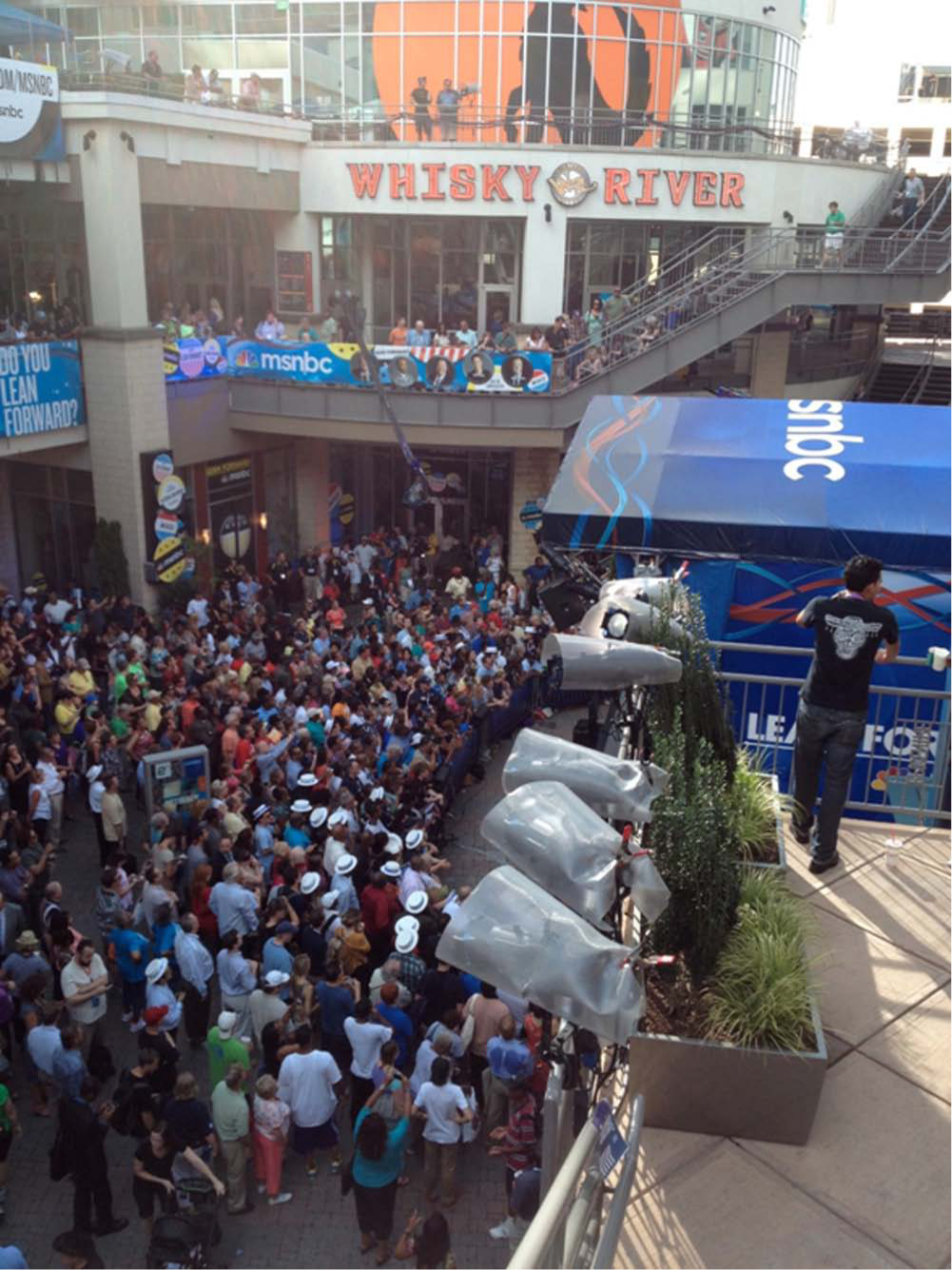
At the end of a dark, cavernous walkway ringed by restaurants and stores hawking designer clothes rose an enormous stage flanked by a large video screen on stage right and a three story tall banner wrapped around elevator banks on stage left. On the banner were the visages of MSNBC anchors Chris Matthews, Al Sharpton, Ed Schultz, Rachel Maddow, and Lawrence O’Donnell displayed on mock political pins. Chris Matthews sat hunched over a massive half circle-table, a scrolling teleprompter displaying white sentences in the recesses of stage left. Around the stage stood a crowd, fifteen deep in parts. The audience around me waved and jumped up and down as the video cameras on stage panned the crowd before and after commercial breaks. Mobile phones repeatedly shot into the air to capture Matthews and the profiles of his guests. (First author’s (D.K.) field notes, 5 September 2012)
A casual walk through downtown Charlotte on any given day of the convention revealed many instances of journalistic performance in the course of their media production. No media outlet created as extravagant a staged event for their embodied and mediated audiences as MSNBC, however. Soon after arriving in Charlotte, we came upon the ‘media zone’ set up in the Charlotte EpiCentre. At the center of the complex was a massive MSNBC space that featured a sizable broadcast stage, a jumbo screen broadcasting the network’s programs, and signage that transformed the EpiCentre into a wall of promotional advertising (see Figure 1). Visitors to the MSNBC space were seemingly enthralled by the performance. A sizable display featuring mock campaign buttons that spelled out ‘Lean Forward’ (the network’s tagline) consistently attracted crowds of people taking photos with their smartphones and cameras. Other visitors posed for pictures in front of the stage, careful to ensure that the network’s logo was properly positioned in their shot. Even when the stage was empty, throngs of people idled around it, curiously investigating the set up.
The MSNBC stage during a Chris Matthews Broadcast (September 5, 2012).
However, the main attraction was Chris Matthews, who performed his 5:00 p.m. broadcast live from the stage during the convention. Hundreds gathered for these events, with many enthusiastically reacting to Matthews and the cameras that swooped overhead. At some of these broadcasts, employees handed out old-fashioned campaign hats featuring the MSNBC logo, which became ubiquitous throughout the city during the convention. Employees also distributed campaign-style buttons with the network’s logo, slogan, and the faces of its featured pundits through the assembled crowds. MSNBC sought to create an aura of enthusiasm around its convention coverage by using the embodied audience as a backdrop for its broadcast. While observing one of Matthews’ live convention broadcasts, for instance, the researchers observed all the camera work that went into staging shots of Matthews and his guests, so they were framed by people cheering and waving wildly toward the cameras. This reflects an established production practice in media events coverage. For example, Lang and Lang (1953) revealed how broadcasters used in situ audiences in their coverage of the MacArthur Day parade to create the impression of ‘a universal, enthusiastic, overwhelming ovation’ (p. 8) for the general.
In contrast, FOX News offered a qualitatively different performance of its identity as a news brand. The following are field notes from the second author (L.M.) from a taping of Fox & Friends:
FOX News set up their on-site stage directly in front of the NASCAR Hall of Fame (the heavy-handedness of the symbolism astounds). This space was accessible only to credentialed journalists and delegates – if you didn’t have access to Time Warner Cable Arena, then you didn’t have access to FOX News’s space. Their set was very minimalist. It consisted of a stage about 3–4 ft. off the ground, with a small table and four chairs for the various guests/pundits. Three cameramen recorded the show and one additional camera was mobile to record events happening around the stage… The stage, as well as the ‘roof’, was lined with banners that read ‘America’s ELECTION HQ’, as well as the FOX News logo. Additionally, a tall vertical blue banner was hung beside the stage that read ‘2012 Democratic National Convention’ and featured a red icon of the U.S. with stars rising above it and a spotlight highlighting the Midwest … Approximately 20 people were present to watch the taping of Fox & Friends. Other than an African-American security guard, the crowd was completely white and middle-aged. One man held a sign that read ‘No Hope, No Change, No Jobs, No Obama’ on one side and ‘I’ll Keep my Freedom, My God and Money. You can keep the Change’ on the other. However, none of the crowd would be featured in the show’s taping, since the cameras were focused in the other direction….the commentators were facing the crowd with the NASCAR Hall of Fame to their back. Only the commentators and the Hall would be visible in shots. (6 September 2012)
The spatial location of FOX’s media production at the DNC reflects its political orientation. Ideologically counter to MSNBC and serving as a national ‘social movement orchestrator’ for conservatives (Skocpol and Williamson, 2012: 132), FOX’s decision to set up its live broadcast stage in an area off limits to casual passersby seemed like a deliberate decision to create the impression for embodied and mediated audiences of the networks’ outsider status at the DNC. At the same time, the network seemingly sought to trade off of the cultural connotations of National Association for Stock Car Auto Racing (NASCAR) to reinforce its ideological distance from the Democratic Party. This was different than how FOX News performed its identity at the Republican National Convention (RNC) in Tampa. There, the network chose to set up shop in the Tampa Bay History Center across the street from where the convention was held and was only prevented from setting its broadcast stage up outside by Hurricane Isaac (Peterson, 2012).
In addition to performing for their embodied and mediated audiences, actors in the journalistic field seemingly performed their status for political actors, delegates, and one another (processes of distinction, e.g. Darras, 2005). As noted above, a number of journalistic actors created imposing and highly visible spaces for their media production, performances that seemed directed not only at live and mediated audiences, but other journalists. CNN installed a large, lighted ‘CNN Grill’ sign above the first floor windows of a restaurant in the EpiCentre, and draped the second-floor windows with massive red and blue posters that listed the 50 states. The CNN Grill, like the ‘Bloomberg Link’ located on the fourth floor of the EpiCentre, was created by elites in the journalistic field seemingly to perform and solidify their power and status for others in the field. Spaces such as these were ways that outlets such as CNN signaled to the field, and the delegates and other members of the public in attendance, that they had resources and were investing them as important arbiters of political rituals.
These performative sites also provided the material infrastructure for the intermingling of elites from different fields, which also served to reinforce the status of their networks. CNN seemingly created a space that was coveted among actors of both the journalistic and political fields. Only the elites of both fields could gain entry, the access to which was both a performance and function of that status. CNN (2012) even published a list of celebrities, journalists, and politicians who appeared at the Grill, making visible this elite intermingling, which was also apparent during broadcasts that featured these elites as a backdrop. In this sense, having access to the elites of other fields is what makes one an elite in one’s own field. At the same time, the CNN Grill served a number of media production purposes. For a network looking to secure interviews and access to the major players and celebrities at the convention, the Grill provided both encouragement in its grand stylization and a ready-made stage with a command of national audiences.
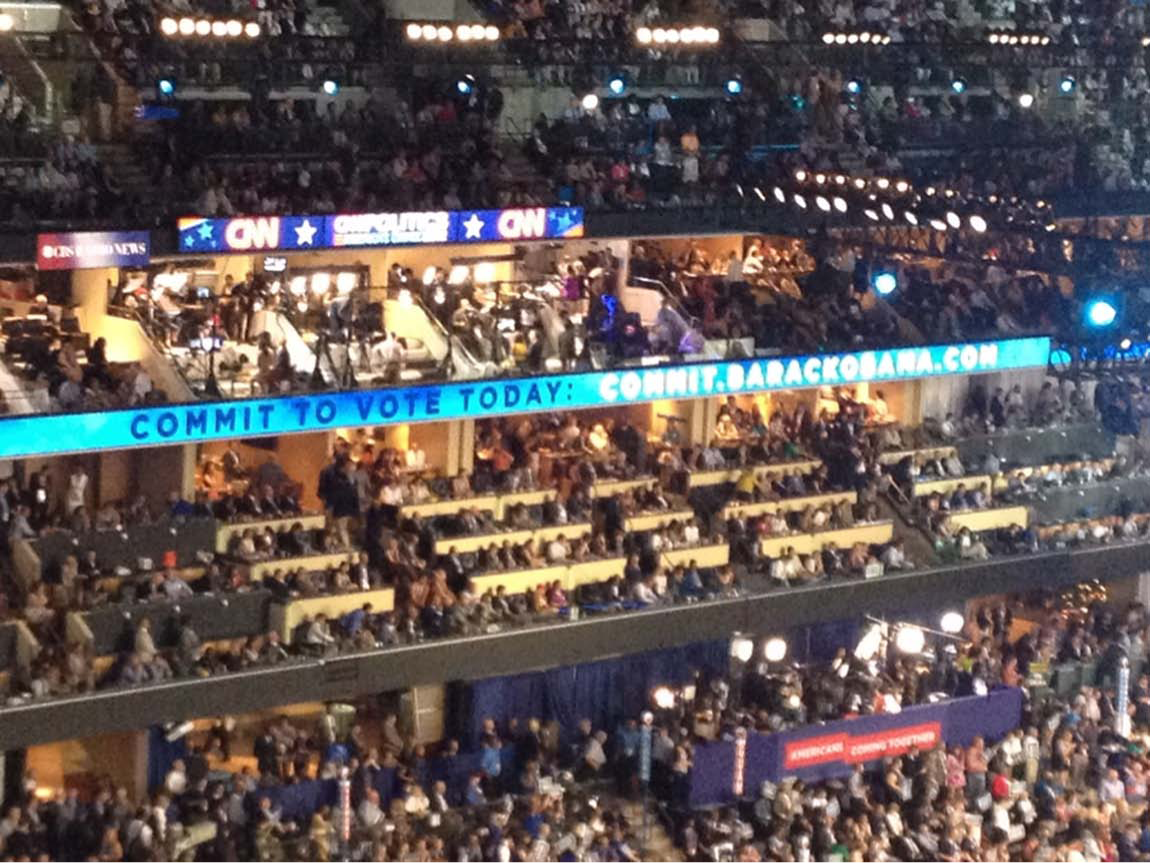
Despite the intermingling of these actors at spaces such as the Grill, at sites of explicit political performance, journalists reverted to the core organizing logic of their field: professionally organized skepticism of political actors in the public interest. It is worth noting explicitly that this is how journalistic production was institutionally and materially organized in the spaces of political performance. The logic of the journalistic field requires an organized skepticism in order to appear legitimate in the eyes of political actors, the general public, and other journalists. This was evident in the detached commentary of the anchors who sat in judgment of the political performances in the arena. Media production, in turn, instantiated this professional skepticism and public authority. The cameras of journalists were positioned according to the stable genre of convention coverage: anchors looked down onto the stage to scrutinize political performances (see Figure 2). From the vantage of the researchers, high atop the Time Warner Cable Arena, the authority and legitimacy of broadcasters as representatives of the public were clearly being performed from their journalistic overlooks.
Organized skepticism through media production (September 5, 2012).
Live and mediated spectatorship
Before speeches from major actors, neon-yellow vested workers passed out signs through all of the sections (Tuesday – all the sections in the first tier, Thursday – all the sections in both the first and second tiers). When Governor O’Malley gave his speech on Tuesday, which featured a back-and-forth chant with the crowd of ‘Forward/Not Back’, ‘Forward/Not Back’ signs were passed out to the crowd. ‘We Love Michelle’ signs were passed out before Michelle Obama’s speech on Tuesday. A series of ‘Fired Up/Ready to Go’ signs were passed out after a particularly moving video featuring campaign supporter Edith S. Childs. These signs were seemingly intended to portray an enthusiastic, supportive, and unified audience – a construction that appeared in moments that were carefully scripted and artfully, diligently coordinated. (L.M., reflections on field notes, Thursday, 6 September)
Delegates occupied a liminal space at the intersection of the journalistic and political fields. They were simultaneously political actors, media producers, and part of the audience journalists and party elites appealed to. This section argues that these live spectators were active agents with at times divergent goals, objectives, publics, and concerns from those of the party they are members of. These findings accord with surveys conducted during the 2008 conventions, which found that delegates had overlapping affiliations with interest groups, social movements, and civil society organizations (Masket et al., 2009). As we show, delegates engaged in different communicative practices on the basis of their organizational affiliations and identities, of which a partisan identity is only one aspect.
As explicitly political actors, the 5556 delegates formed a significant part of the live audience that convention organizers sought to coordinate. While Didion’s (1988) classic account of the 1988 conventions portrayed delegates as passive spectators excluded from the process, our observations suggested that delegates generally embraced their roles in the live audience. They seemed both emotionally and ideologically invested in the convention as the party’s representatives in thousands of communities across the country. Many cheered with genuine emotion at the performances on stage and embraced their enthusiastic spectator roles at the appropriate moments when they were goaded on by the coordinating work of the event’s producers. The Obama campaign and Democratic Party directed their media production toward this audience, not simply the mass-mediated audience. Videos designed to keep the live audience engaged and introduce themes such as health care or an upcoming speaker were interspersed with speeches throughout the convention.
Furthermore, the delegates that formed a large part of the live audience were media producers, extending the performances of the political actors on the stage through their social networks. The convention was an opportunity for Democratic Party elites to craft and disseminate messages that the thousands in attendance would extend through their social media networks on platforms such as Facebook and Twitter and ultimately carry to the doorsteps of voters in their own communities. However, members of this live audience were not simply passive conduits or dupes of strategic messaging; they actively filtered the Democratic Party’s performances through the lens of their own particular concerns.
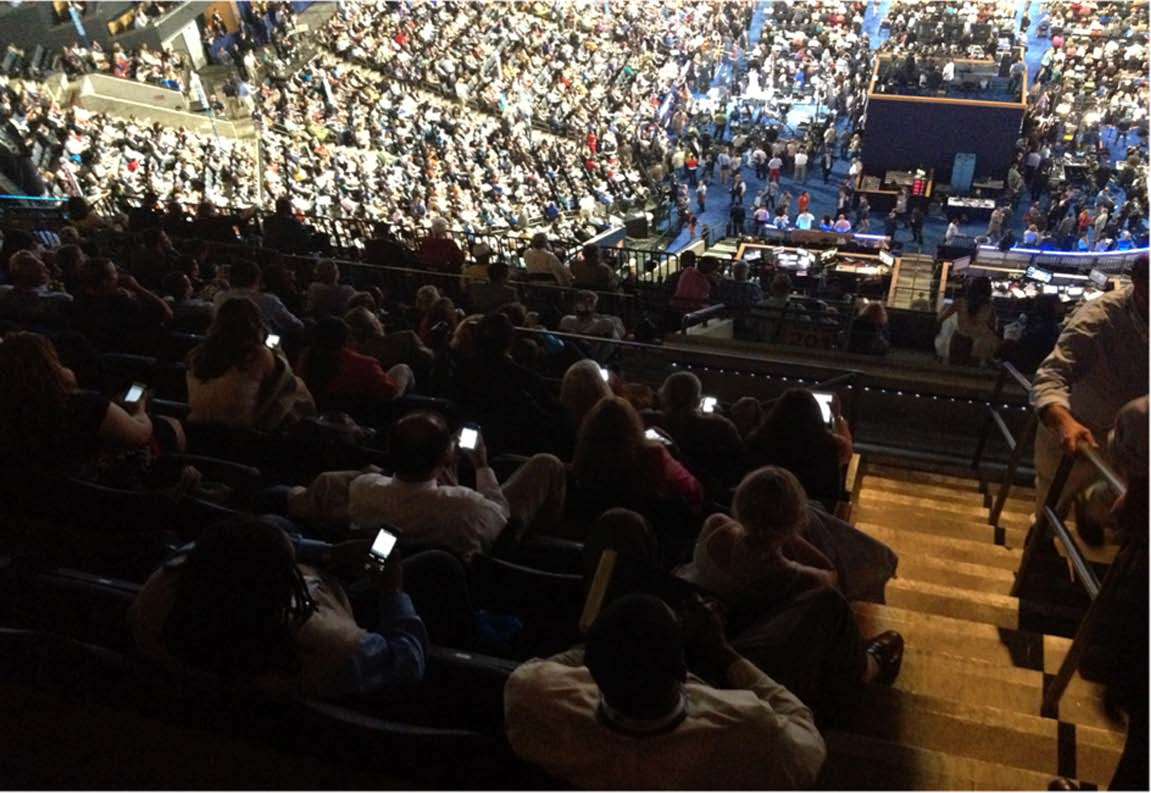
This was apparent in the interviews we conducted with more than 35 individuals from approximately a dozen delegations. Nearly every convention delegate interviewed told us that they were documenting and sharing their experiences via Facebook, Twitter, or blogs (see Figure 3). When asked whom they were sharing with, many referred to local communities ‘back home’, which signals the continued relevance and importance of geographic ties. As one middle-aged Texas delegate said, ‘I’m sending pictures on Facebook that will interest friends back at home, my family’. This delegate extensively chronicled speeches of figures that had relevance to Texans, such as San Antonio’s Mayor Julian Castro. As delegates communicated via social media, they also had to navigate their role as representatives of the party within their diverse social and professional networks. For instance, one Pennsylvania delegate said, ‘I try not to get too political, but I want to share my experiences of the convention’. This reflects both how citizens talk about politics cautiously (Mutz, 2006), and navigate social media contextually, aware of the multiplicity of relationships that are often crudely gathered together on platforms such as Facebook (Nissenbaum, 2009). Other delegates communicated more purposively with targeted audiences. A late 20s Nebraska delegate spoke of sharing photographs of the evenings’ speakers and relaying their pro–Lesbian, Gay, Bisexual, and Transgender (LGBT) statements to ‘members of the LGBT community and other progressive friends that I have’ through his Facebook page. A middle-aged African American delegate from California shared pictures and stories to Facebook group pages focused on labor issues in an effort to generate enthusiasm for President Obama’s reelection effort. Members of other delegations acted in more official organizational, not personal, capacities on social media. A member of The Democrats Abroad, for instance, stated that the group purposively developed a ‘strong online presence during the convention’ and created a Twitter hashtag to allow members who could not be there to have easy access to live experiences of the convention.
Active spectatorship at the convention (September 6, 2012).
Both the institutional press and the official producers of the event recognized that delegates were simultaneously party members and citizens with their own social ties and commitments. Journalistic outlets drew on delegates as sources of firsthand experiences of the event. For example, C-SPAN contacted several delegations to gather the Twitter handles of their members. The network then incorporated delegates’ posts into its broadcasts as the perspective of eyewitness citizen observers. Meanwhile, the party’s media producers touted the convention itself as being an ‘open’ event and actively invited the live and mediated audience to use social media to participate in the convention’s proceedings. This meant that convention organizers’ media production was directed at the live audience of delegates in an effort to spur attendees to extend the performances on stage and in the arena outward through their social networks. As one senior-level convention staffer working on the digital team for the event stated in an interview, ‘Communications are more authentic when they come through your social networks. We want to people to be excited and communicate with their friends and family’. The fact that so many delegates cited having home communities that they were posting for is especially relevant given that political representation is tied to geography. Field notes reveal the ways that event organizers saw delegates as important media producers in their own right:
In the arena, a random collection of social media: photo booths that allow people to show their faces with the Obama logo and post to social networks. Questions of ‘Why We Nominate’ displayed on the digital billboards with solicited audience responses scrolling by. Hashtags prominently featured on the digital screens: #Nominate, #DNCDelegate, @barackobama. (D.K. field notes, 6 September 2012)
At the same time, on the digital screens that ringed the stadium, there were promotions urging the audience to tweet to the official hashtag at #DNC2012. Unlike Facebook which is premised on personal ties, #DNC2012 was a much wider public forum that included the spectators watching the event online or on television. The hashtag gathered the media production not only of the delegates and spectators in the arena who used it, but audiences across the world who convened to extend, debate, or critique the official political performance of the party, as evidenced by the millions of tweets that scrolled down the researchers’ Twitter apps during important speeches. During the president’s speech alone, Twitter traffic peaked at more than 50,000 tweets a minute. Indeed, the firm itself was an active presence promoting the platform at the convention and positioning itself as an explicitly political and journalistic tool:
The new media firms such as Twitter and Politico had much more accessible spaces than [newspapers] Tribune, Globe, and NYT, which were located in the back corner of the basement by the forklifts (a too convenient metaphor.) We had a conversation with the representatives of Twitter, who set up shop in a small space with the rest of the press corps in the basement of the convention center – a huge, cavernous, concrete space that stretches for what feels like acres. Twitter’s representative tells me that they identified the handles of delegates in advance, so as to be able to promote ‘inside’ content that includes tweets and photos. Twitter also has a pre-selected list of government and policy leaders, convention organizers, and party members that it will also work to monitor and promote. Twitter is also providing statistics for journalists and the news media as to the number of tweets per minute and the ‘news index’ of trending topics. They are sampling all of Twitter for volume and sentiment, particularly looking through the lens of [the 2012] candidates. They are also working with two polling firms to conduct sentiment analysis as well as the tweets/minute and volume; for example Clinton: 22k/minute, M. Obama, 28k/per minute. (D.K. field notes, 6 September 2012)
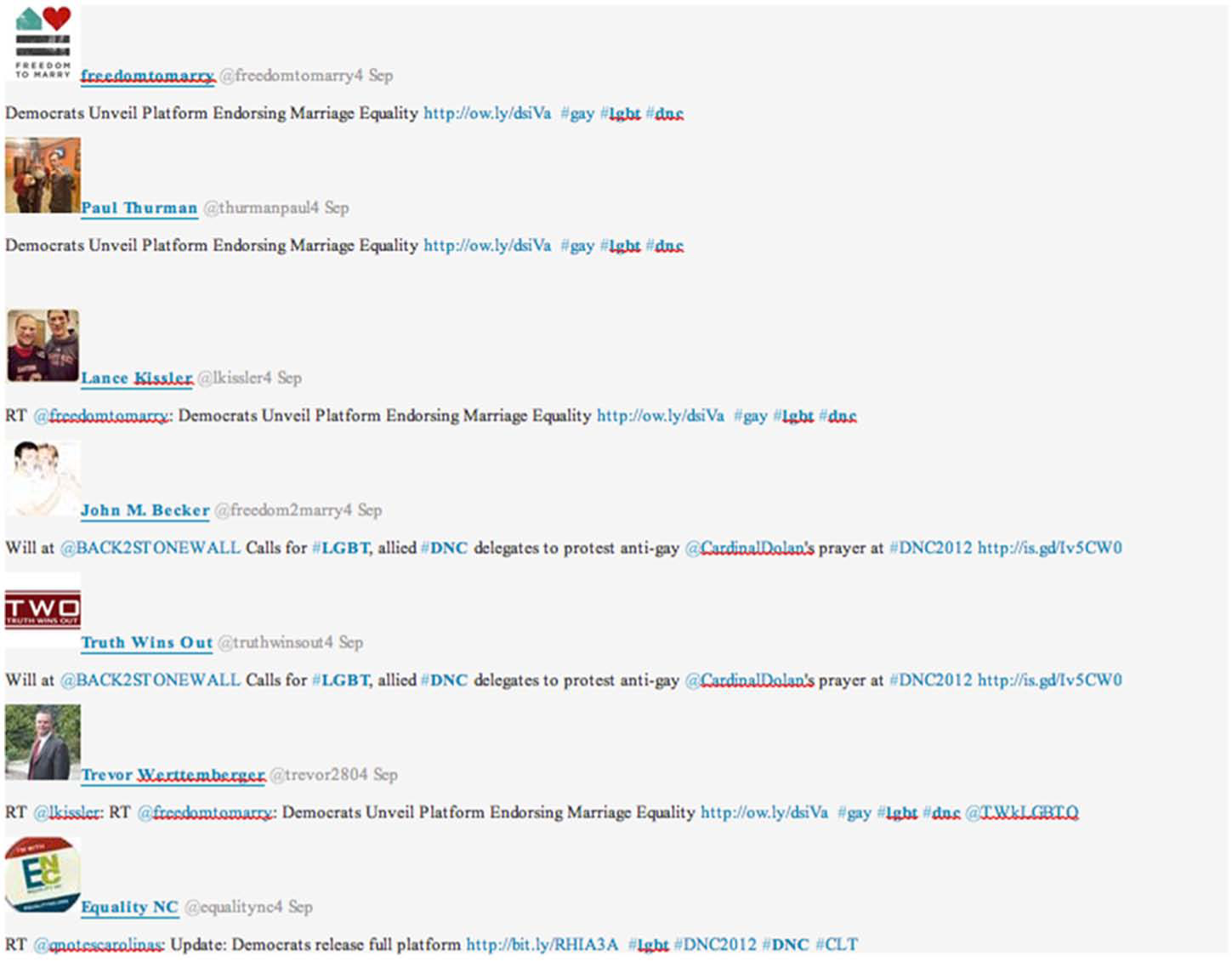
These large, unwieldy conversations certainly created some incredible Twitter statistics. At the same time, it is important that the extraordinary volume of tweets does not overshadow the myriad ‘side’ conversations that took place around a variety of hashtags which allowed for more contextual communication between party actors and its extended network of allies, such as aligned civil society and social movement groups (for a summary of research on Twitter see Murthy, 2013). For example, Planned Parenthood’s #YesWePlan became a vehicle for conversations surrounding reproductive health, while other groups combined a cause hashtag such as #obamacare, #labor, and #union with #dnc. An illustrative example stems from Twitter users leveraging the #dnc and #lgbt hashtags to start discussions around the Democrats’ embrace of LGBT issues. Importantly, aligned groups in the extended Democratic Party network were autonomous and did not simply embrace the messages of the party’s official actors. This provided opportunities for critical practices of spectatorship as variously aligned publics convened around the mediated event. For example, the tweets listed below were posted immediately following the official announcement of the DNC’s platform in which the party embraced marriage equality but are interspersed with protests against Cardinal Timothy M. Dolan’s planned benediction (see Figure 4).
Embracing and critiquing the party’s performance on Twitter (September 4, 2012).
These Twitter posts reveal that these spectators were not only delegates and supporters of the party, but also activists and representatives of civil society organizations. There are many narratives that emerge around conventions, and party supporters, attendees, and delegates are active agents who engage in their own meaning making and strategic action through their networked media practice. This means that conventions are not fully scripted events, and delegates and other attendees are not simply passive, willing foot soldiers who do party elites’ bidding.
The political field and the mass audience
The production of conventions for mass-mediated audiences has received significant scholarly attention, so we will provide comparatively less discussion here. The staging of the convention was designed with the production values of television in mind and the primary audience was journalists and their mass-mediated publics. The important point here is that even in an age of networked, digital media, the professional press and the mass audiences they still convene remain of primary concern to political actors. From a democratic standpoint, this indicates that professional news outlets still have some control over the publicity of official state actors and quasi-state actors such as political parties. As such, these performances are still subject to the gaze of professional journalists who evaluate, critique, and scrutinize the proceedings of conventions according to the cultural and moral structures of the civil sphere (Alexander, 2010).
The primary audience for the media event was clear during the crucial 10:00–11:00 p.m. hour when the major networks guaranteed commercial-free coverage. The speeches and videos were timed to fit within the allotted hour of coverage, so much so that it was a significant topic of pundit conversation when Bill Clinton’s speech went over. By contrast, the other hours of the convention were the political ‘undercard’, featuring speakers from the party’s extended network of civil society and advocacy groups. The major networks offered no coverage of these speeches, and cable outlets often only used them as a backdrop for their anchors or pundits to talk over, occasionally tuning in to listen to particularly engaging speakers especially between the hours of 8:00 p.m.–10:00 p.m. (for the history of the genre of convention coverage, see Wrighton, 2007).
The practices around ‘credentialing’ clearly indicate the primary audience for the political performances at the convention. All the performative spaces within the political field were carefully managed by a scripted set of access points delineated by a technical mediator: the credential. The credential is what marked the member of the media from the delegate and both from members of the public at-large. Credentials marked the relative status of members of the media, given the differential levels of access provided to the performative stages of the convention by the formal credentials committee. Credentials were essential for accessing and moving across sites from the convention arena and center to the FOX News broadcast area and the Google Hangout. Credentials were a source of status and authority given that they determined possibilities for witnessing and movement. MSNBC capitalized on the symbolic role of the credential by creating logoed lanyards with a ‘credential’ that gained the holder access to the MSNBC Experience; it proved a popular marketing creation that we observed on visitors all over Charlotte.
Above all, the credential was essential to securing access to the official political performances at the convention. The political actors’ primary audience was revealed beyond any doubt the final night of the convention. When the threat of inclement weather necessitated moving the convention from the Carolina Panthers’ Bank of America stadium to the smaller arena, tens of thousands of people holding ‘community credentials’, which were given out by local field offices to people who volunteered for the campaign, lost the opportunity to see the president’s live speech. On that day, we witnessed hundreds of people standing in line to attend the alternative convention ‘watch parties’ the DNC hastily arranged in Charlotte. These people were generally older African Americans and often much more formally dressed than the credentialed media. Credentialed media, including the research team, was unaffected by the move indoors:
Before we entered the arena, we passed through lines of people that had come to Charlotte even though they could no longer get in (we were not sure whether they were aware of the move of the final night’s events). I was struck by feelings of privilege and guilt. In large part because these people holding ‘community credentials’, the lowest on the totem poll, were lined up in the humid air around the Convention Center. They were primarily African American; some were dressed up, others wore knock-off Obama gear. It is telling that when the performance moved inside it was these people who were left out; it shows that it is the mediated public that was important. Us with media credentials had no problems accessing the event. (D.K., field notes, 6 September 2012)
Boundary spaces and active spectatorship
The findings above suggest that we can think of the convention in terms of providing both a physical site and ceremonial occasion for the interaction of actors from the political and journalistic fields. The convention provided an opportunity for actors to engage in structured differentiation amid mutual dependence (for historical work on differentiation, see Benson and Neveu, 2005). In providing a material and symbolic site for this differentiation amid interaction, the convention served as a ‘boundary space’. Boundary spaces are material or mediated sites that provide actors from different fields with defined places to gather and work in patterned ways, but in a cultural context that enables these actors to mark and maintain their difference. In naming the convention a boundary space, we wish to both build on and differentiate this concept from other works that have looked at physical or mediated spaces of collaboration. Star and Griesemer cite the importance of ‘boundary objects’ to affording the collaboration of heterogeneous actors. Galison refers to ‘trading zones’ as spaces that support concerted action despite heterogeneity. Turner’s ‘network forum’ concept blends the ‘gathering’ element of the trading zone with the ‘object’ orientation of the boundary object in order to theorize cooperation, the generation of new networks, and development of new, shared languages (for a review and synthesis of these concepts, see Turner, 2006). By contrast, a ‘boundary space’ names a site such as the convention where fields are premised on differentiation and performative interaction based on distinct roles, not necessarily concerted action.
For example, the DNC provided a ritual space that satisfied the performative requirements of each field in enabling journalistic and political actors to maintain their respective field identities and perform their relationships vis-à-vis the other field. Differentiation is key given that the performances of political and journalistic actors are evaluated by other actors from their home fields and the external publics from which these fields derive their legitimacy. Unlike studies of ‘boundary work’ and journalism (Gieryn, 1983), our observations concerned work at the boundary, not the enlarging or protecting of a domain of jurisdiction. In other words, while existing work looks at the ways field boundaries can be traversed by actors for strategic gain (Eyal, 2010) or the creation of new, interstitial fields that trade off the capital of the fields that mark their boundaries (Medvetz, 2012), the convention offered a physical space that supported the intermingling of actors from different fields and a symbolic context that enabled these actors to adopt different roles and perform different scripts in routine ways.
The need for differentiation reflects how audiences judge performances in the political and journalistic fields according to different criteria. Fields texture the civil sphere, setting bounds on collusion between political and journalistic actors, and providing differing standards for public evaluation. Political actors and journalists are both accountable to the underlying civic values of equality, liberty, and justice that Alexander details, but they are also accountable to different field logics and their claims for public legitimacy rest on different grounds. Political actors differentiate their performances from those of journalists in articulating firm and explicit moral commitments and political values. Journalists intermingle with but do not become expressly political actors in adopting a role of performative skepticism with respect to the political field.
This institutionally organized performative skepticism is one reason that we value the journalistic field’s independence with respect to the political field. This is not a new idea; Dayan and Katz said as much in Media Events and Alexander suggested as much in The Performance of Politics. However, these works lacked the explicit meso-level theorizing of the news media as an organizational field. Conventions are one-way, mass-mediated performances that are firmly rooted in the democratic civil sphere. As such, they are sites for the reification, dissemination, and continual reinterpretation of the civic structural values of equality, liberty, and justice. Journalists stand in judgment of the ceremonial tendencies of the political center at conventions and are called upon to provide the authentication of the ritual, evaluating these performances on civic grounds.
The networked audiences that convene around media events, both in the arena and around hashtags such as #DNC2012, are also involved in performative evaluation as they engage in practices of active spectatorship. In calling these practices active spectatorship, we note that the public is ‘active’ in voicing critique or endorsement, but also remains in a spectator role. Active spectatorship may involve the extension of the messages of political elites. For example, networked audiences may embrace and disseminate the frames from the performative center in their tweets about the speeches of political actors or the interpretations of journalists. These are moments that express shared partisan affiliation, ideological commitment, or strategic interest. Conventions also provide opportunities for the airing of partisan conflict, dissensus, critique of journalistic intermediaries, and questioning of the prevailing social order. There is a marked range of debate that plays out over social media, as civil society and movement actors, rival party factions, and citizens convene around hashtags such as #DNC2012 to contest the performances of political actors and journalists. In turn, actors outside the ritual center can choose to publicly reject reverent narration, contest political values, refuse conciliatory broadcast narratives, or engage in uncivil discourse. However, this power is not all encompassing in being bounded by the structural values of the civil sphere and the performative context of the convention.
At the same time, citizens are not participants in conventions except in highly delimited ways, such as being rhetorically invoked by political actors or parties’ display of tweets on jumbotrons inside arenas. This does not mean that active spectatorship is democratically deficient. As Green (2010) has argued in his attempt to reclaim the value of spectatorship, it is important that political actors do not control the means of their own publicity. The networked spectators that convene around mediated conventions provide a source of public accountability. The democratic gaze is newly active and social, and conventions provide a diverse array of social media users with a common occasion for media production and performative evaluation.
Conventions help to symbolically organize democratic politics and provide key ritual moments in the institutionalized contests that legitimate the transfer of civic power. Networked publics convene around these ritual events and engage in critical practices of performative scrutiny. Active spectatorship, then, is premised upon a pluralistic media sector where the public has control over at least one means of publicity over the powerful, including those journalistic actors who collude to produce media events. Social media offer opportunities for public critique and accountability over both political and journalistic actors, and often in a context free from the strictures of professionalism and market values. Consequently, active spectating has de-centered elite authority and control over the images and narratives of political rituals.
Footnotes
Acknowledgements
The authors are indebted to Jeffrey Alexander, C.W. Anderson, and the anonymous reviewers of Journalism: Theory, Practice & Criticism for detailed readings of earlier drafts of this article. The authors also thank participants in USC Annenberg’s Civic Paths research group for comments on a draft version of this article.
Funding
This research received funding from the School of Journalism and Mass Communication at the University of North Carolina at Chapel Hill.