







Abstract
Journalists need to make complex economic issues comprehensible for their readers. One possibility to do so is using personalization and putting company representatives (e.g. CEO, spokesperson) instead of the company as an organization in the focus of their work. Especially in times of crisis, the use of personalization could increase because crises are often associated with great uncertainty and complexity. Therefore, this study examines personalization in corporate coverage during crisis and non-crisis periods. To this end, we analyzed the coverage of four different German print media before, during, and after six selected corporate crises using a quantitative content analysis. The study shows that journalists focus more on internal stakeholders of companies at times of crisis compared to non-crisis periods. In general, the internal stakeholders journalists focus on are the CEOs as well as members of the board and supervisory board. Interestingly, in times of crisis, the coverage about the CEO declines, whereas the members of the board and supervisory board receive more attention.
As one result of globalization, the dynamics and complexity of the economic world have increased (Mast, 2012; Strömbäck and Esser, 2014). At the same time, the coverage of economic issues by the news media has fundamentally changed over the last 25 years (Mast, 2003; Park and Berger, 2004). Since the 1990s, economic coverage rose rapidly and became increasingly diverse (Brettschneider and Vollbracht, 2011; Van Dalen et al., 2018). This occurred not only in terms of quantity and variety but also in complexity and quality. For readers, it becomes more and more difficult to understand the various issues and their complex structures. At the same time, the public shows a great interest in the activities of companies, and stakeholders gather information about companies from mass media (Van Dalen et al., 2018; Zerfaß et al., 2016). One possibility for journalists to make relevant (economic) issues more comprehensible to their readers and easier to understand is the use of personalization, because it is – among other things – an appropriate way of reducing complexity (Balmas and Sheafer, 2013; Brettschneider and Vollbracht, 2011; Hoffmann and Raupp, 2006). Personalization can be broadly defined as a shift in focus from issues to people, and at the same time away from organizations toward individuals (Adam and Maier, 2010; Eisenegger, 2010; Van Aelst et al., 2012). In other words, individuals are increasingly in the center of communication.
Organizations may also benefit from using personalization in their communication, since there is evidence that the media is using personalization as a selection criterion (news value research, for example, Eilders, 2006; Staab, 1990; Wayne and Murray, 2009). Therefore, using personalization might be a reasonable strategy for organizations to help place their issues and points of view in the media and thereby help to keep (or even gain) a good reputation.
In general, corporate coverage plays an important role in the reputation of companies (Coombs, 2007b). Particularly in times of crisis, these reputations can be threatened (Coombs, 2007a), and the importance of the media and their reporting should not be underestimated. Every company has different interests and stakeholder groups. Shareholders expect rising stock prices and high returns, employees want safe jobs, and customers demand good products. Most available information about companies is provided by the media.
It is striking that personalization in corporate coverage, especially in connection with crises, has rarely been investigated to date (for exceptions, see Brettschneider and Vollbracht, 2011; Eisenegger and Konieczny-Wössner, 2010). This study aims to investigate how journalists cover corporate crisis situations versus non-crisis situations and wants to contribute to personalization research by investigating how personalization is used in media coverage of companies. To this end, we analyze the degree of personalization in the reporting of German print media about corporate crises. We examine the coverage of corporate crises in six German companies. Therefore, we focus on the crisis period itself, but also include the periods before and after the crisis to analyze the differences and similarities in terms of how media coverage about corporate crisis is personalized compared to non-crisis periods.
Crisis communication and crisis coverage by the media
Coombs (2007b) describes a crisis as ‘a sudden and unexpected event that threatens to disrupt an organization’s operations and poses both a financial and a reputational threat’ (p. 164). As most people learn about a crisis from news coverage, journalists and their reports play a crucial role in the development of a crisis. Crises also influence the ability of a company to act and can lead to disruptions in company activities (Coombs, 2007b). Whether an event ultimately becomes a crisis depends decisively on the perception of the stakeholders, who determine whether a company is guilty or not (Benoit, 1997). In the end, an event only becomes a crisis if it is perceived as such.
One approach for dealing with crises is Coombs’(1995, 2007a, 2007b) situational crisis communication theory (SCCT). Based on attribution theory (Weiner, 1986, 2006), SCCT links the crisis situation to specific crisis management strategies intended to protect the organization’s reputation. Attribution theory works on the assumption that individuals consider to whom they should attribute blame while thinking about the causes of a particular situation (Weiner, 1986).
An appropriate crisis management strategy should therefore be used to influence the stakeholders’ attributions in favor of the company (Coombs, 2007b). To be able to identify the extent to which stakeholders hold the company accountable, SCCT offers a systematization of crisis accountability and divides crisis types into three clusters. If the company itself is also a victim of the crisis and stakeholders attribute minimal responsibility to the company, the ‘victim cluster’ can be applied. Examples of this cluster are natural disasters, rumors, or other external sources that damage the organization. A second cluster is the ‘accidental cluster’. This includes crises where the company’s actions leading to the crisis were unintentional, and therefore low or moderate responsibility is attributed to the company. Technical errors leading to a malfunction are an example of this cluster. A crisis can be assigned to the ‘preventable cluster’ if organizations knowingly place people at risk, violate laws and regulations, or take inappropriate actions. In this case, high responsibility is attributed to the company (Coombs, 2007b; Coombs and Holladay, 2001, 1996).
All crises have in common that they are subject to intense public scrutiny. In particular, the media follow closely what is said and done by the company. The media are usually the trigger rather than the cause of a crisis. However, the media can cause a dramatization of the coverage and accelerate the crisis process (Holbrook and Kisamore, 2018). It is especially the timeliness of crises that makes them attractive to journalists. They also have a high news value for the media. Usually, journalists rely heavily on information from the Public Relations departments of companies. However, studies show that journalists investigate more intensively when a company suffers a crisis because of a high news value. They invest more time and effort, rely on several different sources, and look for exclusive information (Ingenhoff and Thiessen, 2010; Seidenglanz and Bentele, 2004). Hoffjann (2007) also highlights journalists’ interest in the conflict-stabilizing aspects of their reporting to maintain the news value for a longer time. If the information needs of journalists are still not satisfied despite intensive research, they have to revert to their own assumptions. There is a risk for companies that the media will further strengthen the negative effects of the crisis through their active coverage (Holbrook and Kisamore, 2018).
Ideally, crises are characterized by a rapid increase of the media’s interest and the interest of the general public in the first few days. Subsequently, a multi-day plateau phase is reached, during which the crisis intensity remains almost unchanged. In the third stage, public and media attention slowly decreases, before the topic disappears from the public agenda. To be able to define periods of crisis and non-crisis, a definite end of a corporate crisis has to be available for the media to cover. Considering crises as a process, three phases can be distinguished: pre-crisis, in-crisis, and post-crisis. In the pre-crisis phase, the preventive crisis management of an organization becomes relevant. In the in-crisis phase, the triggering event ultimately occurs, and, in the post-crisis phase, the crisis management goes into a renewal (Coombs, 2007a). In an ideal case, the crisis is finally settled for the company. However, recognizing the end of a crisis is not easy for both the company and the public. Although the transition to the post-crisis phase is characterized by diminishing media interest and decreasing pressure to act, these declines are usually not as significant as the upturn seen in the in-crisis phase. We therefore define a crisis as being terminated when it is no longer addressed in media coverage and the case has come to a conclusion – at least in public perception.
Personalization in times of crisis
In crisis situations, an appropriate communication style of the concerning organization is crucial. Personalized communication can help these organizations by emotionalizing and attracting the attention of recipients (Brettschneider and Vollbracht, 2011; Lee and Oh, 2012). Facts, numbers, and events can get under the listener’s or reader’s skin and can be better remembered if they are articulated by a person (Otto and Maier, 2016). The focus on individuals in communication, when organizations put their leaders up front or the media explicitly focus on the chairperson of a corporation instead of the corporation itself, is known as personalization. Personalization can be found on three different levels: (1) personalization of a company’s media coverage (medial), (2) personalization of a company’s public relations (strategic), and (3) personalization of the stakeholders’ perceptions (receptive) (Brettschneider and Vollbracht, 2011; Eisenegger, 2010). For example, it focuses on (1) how organizations and corporations as well as their CEOs and other managers are covered by the media (e.g. Brettschneider and Vollbracht, 2011; Denner et al., 2018; Park and Berger, 2004), (2) how (leading) individuals are (strategically) placed in corporate communication (e.g. Zerfaß et al., 2016), and (3) what effects personalization has on the perception of stakeholders (e.g. Denner et al., 2019). Personalization can occur from a subjective and an objective perspective. The distinction is based on the assumption that individuals in communication processes either take the position of the active speaker (subject) or represent the object of the communication (Eisenegger, 2010).
The concept of personalization has been analyzed for quite some time in political communication research (Adam and Maier, 2010; Holtz-Bacha et al., 2014; Van Aelst et al., 2012; Wilke and Reinemann, 2001). However, there is no consistent definition of personalization: a broad range of different conceptualizations and definitions of what exactly personalization is are used (Adam and Maier, 2010). In this context, we distinguish two perspectives on personalization. The first perspective describes personalization as a trend, referring to an increase in personalized journalistic coverage (e.g. Brettschneider and Gabriel, 2002; Kaase, 1994; Karvonen, 2010) or personalized organizational communication over time. The second perspective deals with (e.g. journalists’ or public relations practitioners’) decisions in specific situations whether to use personalization to communicate an issue (e.g. Adam and Maier, 2010; Otto and Maier, 2016). For example, journalists have to decide whether to focus on specific persons or on organizations, parties, or institutions in a news story.
Regarding the conceptualization of personalization, there seems to be a broad consensus that personalization is a multidimensional construct (Van Aelst et al., 2012). In their work, Van Aelst et al. (2012) reviewed different concepts, as well as different operationalizations of personalization and findings on how the concept is used and consequently elaborate their own conceptualization. They come to the conclusion that personalization consists of two dimensions: individualization and privatization. The dimension of individualization describes how individuals become more central in media coverage while institutions or organizations become less relevant. Privatization refers to the description of people in highly ranked positions as ordinary persons. A CEO who is described as a passionate do-it-yourself enthusiast or a fierce nature lover would be an example of privatization. Each of the two dimensions can be further divided into two sub-dimensions.
For individualization, there is a higher visibility of individuals in general and a more highly concentrated visibility of leaders. If the CEO of a company is cited in the press, this can be understood as an expression of individualization (Brettschneider and Vollbracht, 2011; Van Aelst et al., 2012). Because the CEO is the highest representative of a company, this is a form of a more highly concentrated visibility of leaders. Privatization consists of, on the one hand, a shift to more personal characteristics, such as non-professional traits. On the other hand, it consists of a shift to personal life, such as private life and personal interests. Connecting the two dimensions to the two perspectives on personalization mentioned earlier, there is more individualization and more privatization over the course of time, as for example, journalists choose to use personalized communication in specific situations more often.
When considering how personalization can help organizations to form an adequate and attractive communication style in crisis situations, it is also necessary to consider the crisis type because different crisis situations are linked to different attributions of responsibility. Following the SCCT (Coombs, 2007b), effective corporate crisis communication needs to evaluate the type and specifics of the crisis being faced and consequently adjust the applied strategies appropriately. Considering the high attribution of responsibility in preventable crises, the affected organization needs to show a high will for reparation to protect its public image and reputation. In cases of low or even no attributed responsibility, the necessary efforts for image repair and protection might be distinctively lower.
Organizations may use personalization in specific situations as a strategic tool by referring to individuals (e.g. the CEO) in their communication and establishing a relationship between a cause and a responsible or affected person (Szyszka, 2010). Therefore, it can be particularly important if the cause is a crisis to strategically use individuals, especially leaders, in an organization’s external communication. Following the assumption that the reputation and image of the CEO or other leaders can influence the perceptions and evaluations of the company among different stakeholder groups (Pollach and Kerbler, 2011), personalization may have a positive influence on stakeholder perceptions in general (Brettschneider and Vollbracht, 2011). In crisis situations, the management of the crisis might especially appear more robust if a leader is present and involved in external crisis communication (Denner et al., 2019), particularly in situations where the integrity of an organization or its reputation is at risk (Eisenegger, 2010; Eisenegger and Konieczny-Wössner, 2010; Imhof, 2010; Lucero et al., 2009). Research supports that idea; crisis communication managers hope to gain beneficial effects through individualized statements (i.e. Brettschneider and Vollbracht, 2011; Eisenegger and Konieczny-Wössner, 2010). These statements might emphasize how seriously an organization is treating the critical incident. In turn, appearing to take the crisis management seriously might positively affect the public perception of the affected organization (Denner et al., 2019). The public perception of how an organization handles a crisis is almost always influenced by the media because they are the mediators between the organization and the public. By strategically using personalization, organizations may benefit from media selection logic: evidence that the media is using personalization as a selection criterion for news can, for example, be found in news value research (e.g. Eilders, 2006; Staab, 1990; Wayne and Murray, 2009). Journalists interpret features that are related to incidents and use certain criteria to decide on the selection, size, and positioning of a news story (O’Neill and Harcup, 2009). Consequently, they assign meaning to the features based on these selection criteria (Harcup and O’Neill, 2016; Kepplinger, 2008). These features are called news factors, because they give an incident news value by contributing to journalists considering an incident worthy of publication. Personalization is one of these news factors which drive journalists’ news selection and is in this context associated with the reduction of complexity, arousal of curiosity, and it also serves as an attention heuristic (Hoffmann and Raupp, 2006). Personalization can also serve as a tool for journalists to make events more interesting for the recipient and to create proximity to the private world of the persons depicted as well as to increase the comprehensibility of news coverage (Balmas and Sheafer, 2013; Brettschneider and Vollbracht, 2011; Hoffmann and Raupp, 2006).
Besides a large corpus of content analyses in mediated political communication (e.g. Balmas and Sheafer, 2013; Holtz-Bacha et al., 2014; Kriesi, 2012; Langer, 2007; Lengauer and Winder, 2013; Reinemann and Wilke, 2007; Wilke and Reinemann, 2001), research also underlines the relevance of personalization for corporate reporting in news media. Park and Berger (2004) focused on a longitudinal perspective and looked at how CEOs were presented in the four leading newspapers in the United States from 1990 to 2000 and found that the coverage of CEOs increased over time. They also found evidence for increasingly positive reporting about CEOs. Brettschneider and Vollbracht (2011) also took that perspective and examined the coverage of companies in Germany from 2002 to 2007. They found a general increase in topics related to management and an increase in the share of news coverage of CEOs and other top executives. The authors cite a total of four possibilities to measure increasing personalization in corporate coverage using content analysis: personalization increases when (1) the CEO’s share of the coverage increases over several years; (2) personality-related aspects become more important; (3) the share of the entire management board in corporate reporting increases over several years; and (4) the proportion of management issues increases in importance compared with other topics (Brettschneider and Vollbracht, 2011). Regarding the medial representation of organizational leaders and differences in the situational depiction, Denner et al. (2018) show that there is a wide range of how CEOs are presented in German news media articles. However, they found that rather strong personalization patters are dominant: there is a strong focus on CEOs as leaders who are presented as individualists, planners, or spokespeople for a whole industry.
Looking at existing research that relates personalization with crisis research, we see that personalization in crisis situations has not been in the center of attention so far and has only been analyzed occasionally (Eisenegger, 2010; Eisenegger and Schranz, 2013). We believe that crises might have an impact on journalists’ decisions whether to use personalization in their reporting.
In this study, we are interested if and how the use of personalization in corporate coverage differs between crisis and non-crisis periods. Therefore, we focus on the dimension of individualization to see if there is a more extensive focus on individuals – especially leaders – in those periods than on organizations as a whole. The most basic indicator of personalization is a reference to those individuals in media coverage. In corporate coverage, a focus on leaders would mean a focus on, for example, the CEO, the chairperson of the board, or members of the management board. The empirical findings from the existing studies of German-speaking corporate coverage have shown that the share of personalization was particularly high in crises (Brettschneider and Vollbracht, 2011; Eisenegger and Konieczny-Wössner, 2010). We therefore ask the following research question:
RQ1. Does the amount of coverage about internal stakeholder differ between crisis and non-crisis periods?
If organizations choose to use personalized statements in their communication (e.g. their press releases), they also have to decide which individual should speak out on the issue. Studies show that the CEO is frequently deployed as a high-ranked representative of a company in external communication. This can be understood as a form of individualized, leadership-oriented personalization. Another reason for letting a leader (e.g. the CEO) communicate is the strong link between the image of the CEO and the reputation of the company itself (Gaines-Ross, 2000; Garbett, 1988; Mazur, 1999; Sauerhaft and Atkins, 1989; Stewart, 1998). A visible company leader can therefore be understood as an instrument to improve and sharpen a company’s image or profile (Park and Berger, 2004; Szyszka, 2010), particularly in times of crisis. It also lets the crisis management appear more serious. This arises from the perceived importance that the organization ascribes to the crisis. Involving the CEO is especially helpful in situations where the integrity of an organization or its reputation is fundamentally at risk (Lucero et al., 2009). There are also other representatives of a company who could speak up in times of crisis: the chairperson of the board, a member of the board, an employee, or other members of the company. If the company is represented by a leading individual, they also appear in the media coverage of the company. Especially the CEO, as the highest-ranked official of a company, is often present in the company’s external communication. We pose the following question:
RQ2. Which internal stakeholders of companies are in the focus of journalistic coverage during crisis and non-crisis periods?
Insights from political reporting show that one of the most striking changes over time in the reporting of election campaigns in German daily newspapers has been the increase in visualization. Since 2002, photos of the chancellor candidates have been increasingly used in election campaign reporting (Reinemann and Wilke, 2007). Visualization in corporate coverage has not yet been investigated. However, visualization is an important indicator for personalization, since it makes an article more vivid (Esser, 2008). Therefore, this article is intended to provide first insights into the visualization of corporate coverage:
RQ3. Are internal stakeholders pictured more frequently during crisis or non-crisis periods?
Print media are among the most important sources of business information. The media covering business topics include special-interest magazines and decision-makers’ magazines as well as national newspapers. One example of a decision-makers’ magazine in Germany is the WirtschaftsWoche (WIWO) (Mast, 2012). Strong personalization is one of the central features of magazines because the reporting often relies on features, reports, and visual material. Almost all stories are linked to people who have a certain degree of fame (Wolff, 2006). The Handelsblatt (HB) is the most important daily business newspaper in Germany (Mast, 2012). Daily newspapers also frequently report on business issues, even when these newspapers have a general-interest orientation and do not explicitly address readers with a special interest in economic issues. The business press, in contrast, is aimed primarily at a professional audience (Mast, 2012). Because national newspapers and business media have different areas of focus, we look at how they may differ in the use of personalization:
RQ4. Does the amount of coverage about internal stakeholders differ between daily newspapers and business focused press in crisis and non-crisis periods?
Method
To answer the research questions, we conducted a quantitative content analysis of journalistic coverage about companies in German newspapers. As our aim was to compare crisis and non-crisis periods, we selected companies that experienced a severe crisis in the last 10 years. In order to ensure the comparability of the cases, we had several criteria for the selection of these crises: we only included (1) severe crises (and, for example, no minor incidents) that were (2) internally caused and avoidable ( ‘preventable crisis’, Coombs, 2007b, 2010) and that had been (3) resolved for 6 months at the time of data collection. Moreover, there had to be (4) a fair amount of regular coverage of the companies during non-crisis periods and (5) journalists must have covered the crises. We applied these criteria to companies (and their subsidiaries) listed in the German stock index (DAX) and identified six companies (and therefore crises) that met all these criteria:
ThyssenKrupp’s (2011–2014) anticompetitive agreements with several companies in the German rail equipment sector;
The sex scandal at ERGO Insurance subsidiary HMI in 2011 (they rewarded their top salesmen with sex orgies);
Corruption at commercial vehicle producer MAN in 2009 (they bribed authorities in order to obtain orders for buses);
Surveillance affair and data scandal of Deutsche Telekom (2008–2009) (managers, members of the supervisory board, and journalists were spied on in order to uncover information leaks within the company);
Corruption affair at Volkswagen in 2005 (members of the works council were bribed with special payments and brothel visits);
Corruption scandal at Infineon in 2005 (top managers were accused of corruption, infidelity, and tax evasion).
We chose HB and WIWO for our analysis, because both speak primarily to an audience with a high economic interest. In addition, daily newspapers play an important role in economic reporting in Germany (Mast, 2006). We selected quality newspapers that are assumed to be important for the public debate and are used by journalists of other, smaller media for orientation. The German newspapers Frankfurter Allgemeine Zeitung (FAZ) and Sueddeutsche Zeitung (SZ) are important leading media that fit these aims. They have a high-quality claim and a broader audience approach. With this selection, both conservative and left-oriented opinion was covered, as SZ has a moderately left-oriented editorial line and FAZ is directed primarily toward an economics-oriented clientele (Eilders, 2000; Esser, 2009; Mast, 2012).
Since we are interested in the comparison between crisis and non-crisis periods, we are focusing on a situational and not on a longitudinal perspective on personalization. For each crisis, we analyzed the coverage during three periods: the crisis period itself as well as the time span before and after the crisis. We define the beginning of a crisis as the day when the cause of the crisis appears in the media for the first time and the end of a crisis when the topic is no longer present in the media. For the non-crisis period, we analyzed both 6 months before (pre-crisis) and six months after (post-crisis) the crisis. Therefore, the length of the crisis itself depends on the individual case, whereas the pre-crisis and post-crisis are of equal length (each 6 months).
We used GENIOS, an online media database, for a free-text search within the four selected newspapers and selected all articles where the name of one of the respective companies appeared in the text. This procedure resulted in 4529 articles in the four newspapers for the three periods across all six investigated crises: 937 articles for the pre-crisis period, 2355 articles for the crisis period, and 1237 for the post-crisis period. We draw a random sample of n = 70 for each company: 20 for pre- and 20 for post-crisis as well as 30 articles for the crisis period. Consequently, the total sample size is 420 articles.
The median of the article length was 349 words. The vast majority of the 420 articles coded (89%) were published in the economical division of the newspaper, whereas 5 percent could be found on the title page and 6 percent in other divisions. Eighty-four percent of all articles were news stories, 10 percent were comments and columns, 5 percent were features and portraits, and 1 percent were other forms. For each article, we coded whether it referred to the respective crisis. Our data show that in the pre-crisis period, none of the articles covered the respective crisis; in the crisis periods, 81 percent of the selected articles dealt with the crisis; and in the post-crisis period, 3 percent of the articles reported on the crisis.
We coded at three levels for every article (article, individual statements, and pictures). At the article level, we coded formal characteristics (e.g. medium, length, style, date, company) as well as the topic of the article. At the statement level, we coded all statements about or from internal stakeholders. We do not distinguish between objective and subjective personalization and code both. The third coding level was the picture level: We coded up to eight persons on each picture.
The coding period lasted from 20 December 2016 to 20 January 2017. As the coding was performed by a single coder, we calculated the intracoder reliability. Lombard et al. (2002) recommend using a sample of at least 10 percent of the total sample for the reliability test. Hence, we draw a random sample of 42 articles of the 420 sample articles and the coder re-coded them 14 days after the coding was completed. The Holsti coefficient reached an average value of 1 for formal categories and .83 to 1 for content-related categories.
Results
RQ1 asks if the amount of coverage about internal stakeholders differs between crisis and non-crisis periods. Overall, the share of articles referring to at least one internal stakeholder was 73 percent (e.g. CEOs, board members, supervisory board members, managers, spokespersons, or employees). Our data reveal a significant higher share of personalization in crisis periods (79%) compared to non-crisis periods (68%), χ2(1) = 6.23; p ⩽ .05. Twenty-one percent of the articles in crisis periods were not personalized compared to 32 percent in non-crisis periods. Pre- and post-crisis periods did not differ significantly (χ2(1) = 0.17; p > .05). With regard to our first research question, our study shows that journalists focus more on internal stakeholders of companies at times of crisis compared to non-crisis periods.
To address our second research question (Which internal stakeholders of companies are in the focus of journalistic coverage during crisis and non-crisis periods?), we analyze the references to internal stakeholders in the articles. In total, there were 1066 mentions of economic actors in our sample. Overall, results show that companies’ CEOs were named most frequently (40%), followed by members of the board (24%) and members of the supervisory board (15%). Other internal stakeholders, like spokespeople, managers, or shareholders only played a minor role and each group of people appeared in less than 3 percent of the articles. In a second step, we compared the references to internal stakeholders in crisis and non-crisis periods. Surprisingly, our data show that there were more statements about the CEO (50%) in non-crisis periods than in crisis periods (35%). It looks like the CEO is being taken out of the ‘line of fire’ in times of crisis. Interestingly, the share of coverage about board members rose to 29 percent during a crisis compared to 17 percent in non-crisis periods. The same applies to members of the supervisory board: their share of statements was 19 percent during a crisis and 10 percent in non-crisis periods. The differences between the phases are significant (χ2(3) = 39.27; p ⩽ .001). Again, there are no significant differences between pre- and post-crisis periods (χ2(3) = 2.38; p > .05). Referring to RQ2, or data reveals that CEOs as well as members of the board and supervisory board are the internal stakeholders that journalists focus on; interestingly, in times of crisis, the coverage about the CEO declines, whereas the members of the board and supervisory board receive more attention.
RQ3 asks if internal stakeholders are pictured more frequently during crisis or non-crisis periods. To answer this question, we analyzed all pictures attached to the articles. 138 articles included at least one picture; in total, we coded 150 different pictures. For every picture, we coded up to eight persons; 26% of all images did not show any persons. The CEO was shown most frequently (in 27% of all images), followed by employees who account for 15 percent of the people depicted. Others, like spokespeople, politicians, or experts were pictured in 13 percent, while members of the supervisory board could be found in 6 percent of the pictures. Members of the board appeared in 4 percent of the pictures. 13 percent of the persons could not be identified. Regarding the question whether this visualization differs between crisis and non-crisis periods, our data show no significant differences (see Table 1): The amount of visualization of the different actors remains relatively stable. Regarding RQ3, the analysis of the images does not show any differences in picturing the different internal stakeholders between crisis and non-crisis periods.
Individuals shown in the images (%).
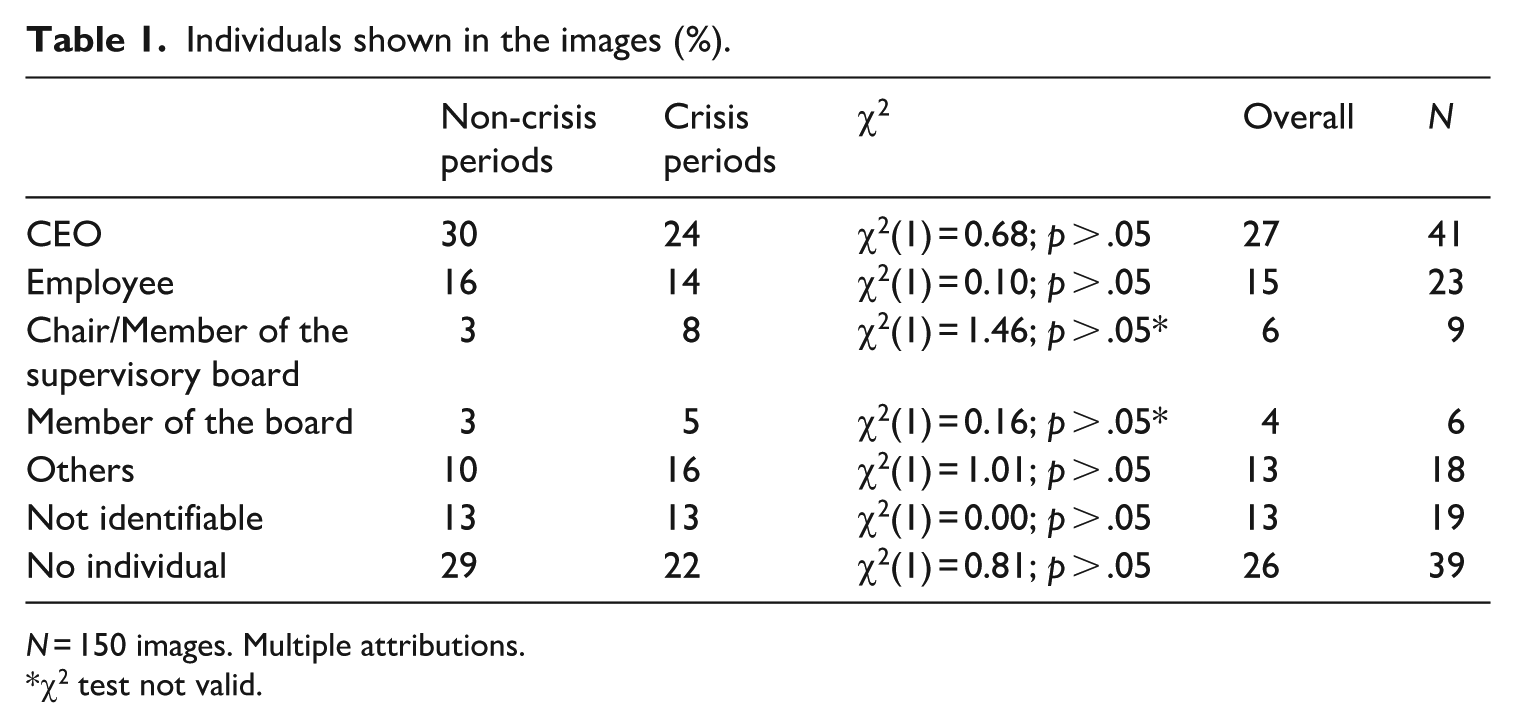
N = 150 images. Multiple attributions.
χ2 test not valid.
RQ4 concerns the question whether the amount of coverage about internal stakeholders differs between daily newspapers and business focused press in crisis and non-crisis periods. To this end, we compared articles mentioning an internal stakeholder with articles not referring to them. Results show that internal stakeholders appeared in 77 percent of the articles in the two daily newspapers (FAZ and SZ) and in 79 percent of the articles in the business focused press (HB and WIWO). Regarding potential differences during crisis and non-crisis periods, we see slightly more coverage about internal stakeholders in daily newspapers during crisis (74% in non-crisis periods, 82% in crisis periods). However, these values do not differ significantly, χ2(1) = 2.01; p > .05. The amount of personalization in articles of the business focused press, on the other hand, differs significantly, χ2(1) = 15.16; p < .001. While in non-crisis periods, 67 percent of the articles refer to internal stakeholders, in crisis periods the share rose to 94 percent. There were no significant differences between pre- and post-crisis periods. With regard to our final research question, our data reveal that the overall share of personalization does not differ between daily newspapers and business focused press; however, our finding that journalists focus more on internal stakeholders of companies at times of crisis compared to non-crisis periods is mainly caused by the coverage of the business focused press.
Discussion
This article examined how journalists report about internal stakeholders of companies, for example, the CEO, members of the board, and members of the supervisory board in crisis and non-crisis periods. Our results show that in crisis periods, journalists focus more on internal stakeholders of companies compared to non-crisis periods. The assumption of Eisenegger and Konieczny-Wössner (2010), that high personalization rates are an indicator of crisis, could be confirmed in this study. This finding is also in line with news value research. Crises per se have a high news value, but personalization is an important news factor as well and helps attracting recipients’ attention (Eilders, 2006; Staab, 1990; Wayne and Murray, 2009). It seems that journalists shift the focus more to individuals during crises to make the event more comprehensible and less complex for the recipients (Denton and Woodward, 1998; Hoffmann and Raupp, 2006), and consequently more attractive for their audience.
Of all analyzed internal stakeholders, the CEO is mainly in the focus of journalistic reporting. However, this depends on the period: he or she dominates all other stakeholders in non-crisis periods whereas in times of crisis, the coverage about the CEO declines. It seems that CEOs are more interesting for the media in routine times. One reason for the increasing reporting on these leading representatives in non-crisis periods compared to crisis periods might be that journalists want to present the widest possible picture of the crisis situation and therefore also reported on other leaders in the companies beyond the CEOs. For the respective companies, a too intensive focus on the CEO during a crisis might be unavoidable and permanently connect the CEO to this threatening and negative event, which might, in turn, affect the corporate reputation negatively (Eisenegger and Imhof, 2008). Therefore, companies might try to remove the CEO from the media firing line. However, we did not find any significant differences between pre- and post-crisis periods with respect to personalization (neither for internal stakeholders overall, nor for the CEO), meaning that coverage goes back to ‘normal’ when the crisis has passed. In this context, it would be interesting to analyze press releases of organizations in order to see if organizations really remove certain people from the firing line or try to especially use certain people in order to provide personalized material for journalist. In addition, a qualitative approach would also be insightful to further examine the various functions of personalization in crisis and non-crisis periods for journalists and organizations alike. Whereas the focus on the CEO decreases during crises, the focus on other leading members of the organization increases. Members of the board and members of the supervisory board received more coverage during crises compared to non-crisis periods. Besides the argument, that journalists want to present the widest picture possible, another reason for this shift could be that the board and supervisory board members are somehow personally involved in the crisis and the media is looking for the responsible person(s) or a scapegoat.
Regarding the visualization of internal stakeholders, our study shows that CEOs were most frequently displayed in pictures accompanying news articles, which corresponds to the dominance of this group with regard to personalization in the text. Interestingly, the number of pictures of CEOs was the highest in the post-crisis period. A possible explanation for this may be that the CEO stands for a ‘new start’ after the crisis – either in the old form or after a crisis-induced CEO change in the form of a new face. Besides CEOs, ordinary employees were also often pictured in the photographs. It is possible that articles with topics such as job cuts, salary negotiations, or strikes are visualized using pictures showing employees to give the story a personal touch. Future research could extend the analysis of accompanying pictures of corporate news coverage in order to see how closely the pictures are related to the actual content of the news story, for example, if there are just filling material or space holders or if they add meaning to the story. Another interesting question is how journalists choose the pictures for their news articles, this again requires a different form of analysis.
Of course, this study has some limitations. First, the results of this study are based on the six analyzed companies and crises. We do not believe that our findings are valid for every single crisis type. For example, Volkswagen and Infineon were dealing with corruption scandals; therefore, the focus of the media in the crisis period could have been on individual members of the executive board. Hence, other cases of corporate crisis need to be analyzed to make comparisons (e.g. to victim crises). Second, the study is also limited by the selected news media and only displays a small part of the news coverage. To get a more comprehensive picture, future analyses could be extended to other media types (television, social media, etc.). As we analyzed only German print media, we cannot draw conclusions about other countries. Furthermore, a stronger focus on pictures could be applied in future studies, since we only examined whether the images showed persons and who is depicted. It could be analyzed more deeply how different individuals are portrayed in those pictures.
Another limitation lies in the selection of the crises. Crises are in general difficult to compare as their causes are very specific and they follow unique patterns. We focused only on crises that were caused endogenously. Hence, it would also be interesting to examine exogenously caused crises as well as personalized corporate coverage and compare them to endogenous crises. We also did not take endogenously caused crises into account where the CEO is responsible for the crisis (because of, for example, drug abuse, tax evasion, or other misbehavior). We assume that such cases would be very difficult to compare to other crises regarding the amount of personalization because the journalistic coverage would be inevitably centered on this very person.
Footnotes
Funding
The author(s) received no financial support for the research, authorship, and/or publication of this article.
