







Abstract
Academic scholarship on alternative media remains Western-centric, presenting the view that such media features counter-hegemonic content and contributes to social movements and active citizenship. This paper synthesizes the work of scholars from the Global South/ non-West for the first time, analyzing top-cited journal articles produced by authors from the regions of Africa, Asia, Latin America, and the Middle East to discover, using the inductive approach, how “alternativeness” is conceived of and represented in the non-West. This stands out from research that theorizes alternative media deductively, from the top-down and often through the Western lens, or country-specific research that is highly contextualized. From observations of each region’s political regimes, ownership structures of mainstream media, driving forces behind its alternative media, the types of content it produces, and its overall impact on society, this study identifies where alternative media in different non-Western regions may differ from how it is typically conceived of in the West, and introduces a five-factor framework that accounts for such variations in “alternativeness”, namely relating to (1) the nature of the mainstream media, (2) the nature of the political system, (3) who is producing the alternative media, (4) how the alternative media is produced, and (5) the goal or purpose of the alternative media. Ultimately, this paper offers a unique comparative view of alternative media systems from the non-Western perspective that scrutinizes the concept of “alternativeness” and how it is derived.
Introduction
A majority of articles about alternative media in academic scholarship is Western-centric. This presents issues on multiple fronts – evaluating journalism through Western lenses may result in erroneous perceptions that alternative systems are deficient or lacking (Wang, 2010), and less representation of non-Western journalism realities also reduces understanding of their functioning and obscures situations that might be happening on the ground that the international community should be attentive to. According to a review of the academic database Scopus conducted by the authors at the start of this study, of the English-language articles pertaining to alternative media found within communication science across an 18-year period from 2004 onwards, a high 78.9% of the 1273 academic articles were written by Western-affiliated scholars from mainly North America and Europe.
The affiliations of these scholars subsequently impact their work and understanding of alternative media. They tend to define such media as counter-hegemonic to the mainstream, contributors to social movements and public debate on issues, and capable of enhancing democracy (Downing, 2001; Harcup, 2011). This presents a notable gap in research, where representations of alternative media by scholars in the Global South/ non-West are much fewer in comparison. Where they do exist, they have tended to focus on alternative media in specific countries (Lee et al., 2015; Makinen and Kuira, 2008; Perez-Arredondo, 2019); no study has yet synthesized this content to discover how “alternativeness” may look different across regions in a comparative analysis.
Indeed, how “alternativeness” is defined and the extent to which the media is and can be “alternative” are specific to country and region (Wu, 2021a: 15). Journalism realities in the non-West may operate outside the liberal-democratic ideological framework, where “undemocratic political regimes and restricted press freedom” may hinder the creation of a watchdog press (Márquez-Ramírez et al., 2020: 69). Where the press establishes partnerships with the government and aligns itself with its goals, even alternative media might have to tread carefully and remain “quite mainstream”, with the knowledge that the government consistently monitors what gets published in the news (Wu, 2021a: 8).
In their development of a framework that defined the key dimensions of alternative media in theoretical terms, Holt et al. (2019: 866) notably called for more “international comparative studies of alternative news media in different media systems” to help understand “general characteristics of alternative news media across contexts”. This paper does exactly that, reviewing how each region perceives its alternative media, the roles that it plays, and the reasons for its unique definitions of “alternativeness” as it is influenced by factors within its political, economic, social and cultural contexts. It does so through a systematic qualitative analysis of the top 10 most cited journal articles, obtained from the Scopus journal database over an 18-year period, about alternative media in the regions of Africa, Asia, Latin America, and the Middle East, penned by scholars from those regions.
Dominant definitions of “alternative media”: A social construct
To understand how alternative media is conceived of in Western-centric literature, it is first necessary to understand the media environments they are found within. Journalism tends to be viewed from a liberal-democratic ideological standpoint that is founded on the principles of “classical” liberalism (Hackett and Zhao, 1998: 146) – this perspective stresses respect for civil liberties and political rights, the creation of spaces for popular participation in decision-making and a more open and accountable government (Robinson and White, 1998: 19–21). It also stresses the need for “specialized organs” independent of the political field, such as the media, to protect the citizens from abuses of political power (Blumler and Gurevitch, 1995: 13). Even while it is important to acknowledge that “the West” is not a homogeneous entity and press systems vary in different parts of Europe and North America, it is notable that the liberal strand of democracy did have its roots in the West, specifically during the Age of Enlightenment in Europe, and later in America, during the 18th century (Wu, 2010), thereby leading to references of its liberal nature in journalism studies.
Not surprisingly then, Western-centric literature defines alternative media as being premised on “participatory communication and radicalized professional practices of journalism” (Atton, 2006: 574), standing apart from mainstream media as independent entities, and tending to be non-hierarchical, non-commercial, small-scale, focused on the community, and delivering content that may be critical of the status quo (Rauch, 2016). Such media is seen as crucial to democracies, presenting counter-hegemonic content not covered by the mainstream media because of the censorship the latter might face from the state and/or corporations (Downing, 2001).
Indeed, Holt et al. (2019: 860) define alternative media as those that “position themselves as correctives of the mainstream news media”. Alternative media may rise to play the role of critiquing mainstream media and professional journalism, highlighting their perceived bias and lack of objectivity (Cushion et al., 2021). That said, some may be hyperpartisan in nature and associated with radical groups from the liberal Left and conservative Right, generating concern about group polarization and the amplification of extremist ideas (Heft et al., 2020); this is a common view brought up in Western-centric research.
Additionally, alternative media can increase citizen participation. The Internet has enabled it to widen its distribution networks, allowing marginalized groups to articulate themselves on a large scale (Jackson and Welles, 2015), and creating networks of resistance that can contribute to the formation of a “counterpower” that “challenges the power embedded in the institutions of society” (Castells, 2012: 15).
There is reason however, to believe that the nature of “alternativeness” across different parts of the world may not be consistent with that depicted in Western-centric literature. Alternative media is “as much concerned with how it is organized within its socio-cultural context as with its subject matter” (Atton, 2002: 10). This necessitates the need to first understand the environment within which that media is found. Steppat et al. (2023) note that structural features found within political information environments impact the perceived alternativeness of the media.
This is coupled with the fact that journalism, as it is practiced in the real world, may differ greatly across countries, with “systemic actions, practices and interactions that define newswork and news processes” (Mujica and Bachmann, 2015: 316; Zelizer, 2004). Journalists work within a framework of news norms, values and routines that they are familiar with (Shoemaker and Reese, 1996), and news production processes, editorial decision-making, and management characteristics may also be standardized to suit the local context (Mujica and Bachmann, 2015). Indeed, as Mutsvairo et al. (2021) point out, “every culture of journalism is unique” (p. 997) and that much of the world’s population “[does] not get to live in established democracies with a functioning market economy and social welfare system” (p. 1000). Wu (2024) echoes the view that outside of the liberal West, journalists may be “working under a different set of conditions and/or constraints, beholden to different types of political and economic pressures” (p. 1053). They may also take on the character of the times, for instance, Chadha and Bhat (2022) note the rise of hyper-partisan outlets in India that have risen to challenge and “correct” the news presented by mainstream media that is supportive of the right-wing leadership of Narendra Modi (p. 1284), and Medeiros and Badr (2022) discuss how alternative media journalists in Brazil and Egypt strongly commit to political positions as they face constraints from their far-right governments. Contextual understanding is therefore crucial to adequately defining and evaluating the concept of alternativeness.
Methodology
Guiding this paper were these research questions:
This paper used the method of systematic qualitative analysis to answer the questions above. This is a method used by scholars like Tandoc et al. (2018) and Tinmaz et al. (2022) to identify parameters of abstract concepts like “fake news” and “digital literacy” respectively.
To determine the sample to be examined, journal articles related to alternative media were obtained from the Scopus database using its API key, by searching for keywords that are core to the subject matter, namely “alternative media”, “alternative news media”, “alternative press”, “alternative news”, “alternative medium” and “alternative news medium”. The search was further restricted to journal articles written in English from the subject category “communication science”. Because some world regions did not have articles pertaining to that topic before 2004, to ensure comparability between regions, a decision was made to only keep articles published from 2004 to 2021, resulting in 1273 articles. The study’s analysis was then conducted in 2023.
To determine the articles for analysis, the corpus was arranged by regions of the non-West, based on author affiliations – this was deemed as the best way to segment the articles, given that examining them by the contents of their abstracts often yielded mentions of multiple countries at once, which made the categorization of the articles more challenging and inconsistent. Certain exclusion criteria were applied to then select the articles for analysis, a method used to shrink the sample down in meaningful ways (Tinmaz et al., 2022). Here, the decision was made to sort the articles by citation counts, with the top 10 most cited articles downloaded for analysis, since this would also indicate the impact that each article has had in the scholarly community. Whenever the contents of the paper did not correspond with the geographical affiliation of the author (e.g. a Latin American scholar might be based in Brazil but working on alternative media in the US), then the article would be skipped, and the next article with the right geographical location would be selected instead, resulting in the selection of 40 articles pertaining to the regions of Africa, Asia, Latin America, and the Middle East.
The papers were then read in their entirety and coded based on central themes that emerged, with the goal of understanding how alternative media is conceptualized in each region – by looking at descriptions of what they viewed as “alternative” – and the factors in the political, economic, social and cultural spheres that influenced their alternativeness. For instance, “alternative” in a region might be viewed as leaning left or right, and factors such as historical experiences in the political sphere, and philosophical traditions in the social and cultural spheres might be influencing factors. An inductive approach was used to identify such themes, where codes and categories were not predefined but were instead formed during the data analysis process, enabling concepts and conclusions to surface (Braun and Clarke, 2006).
Findings
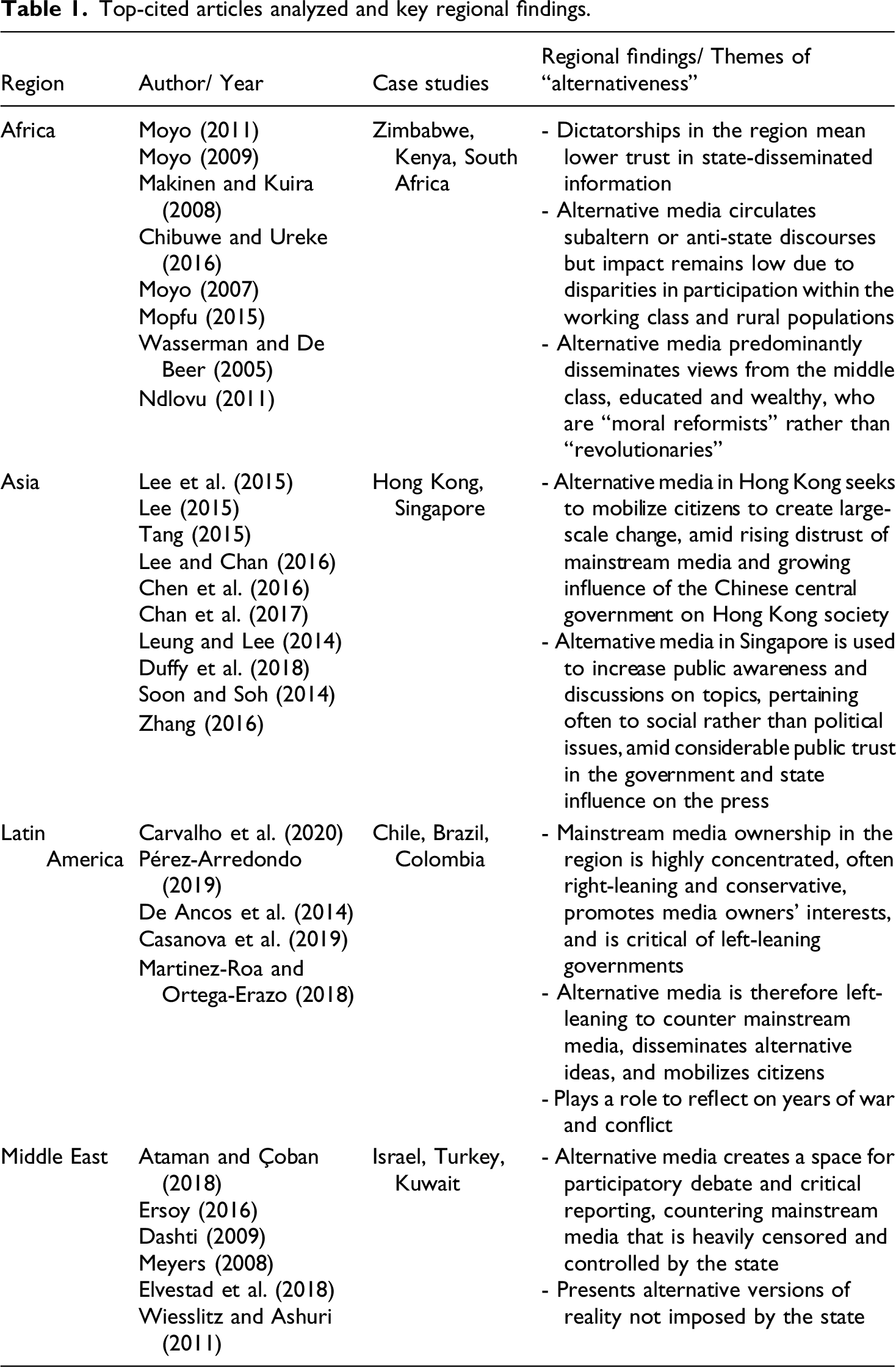
By analyzing the top-cited articles and the articles referenced within them from each of the regions of Africa, Asia, Latin America, and the Middle East, the following observations were made on how alternative media has been conceptualized and discussed in different regions in the non-West. It should be noted here that not all 40 articles in the top-cited list have been referenced here; only those that held substantive insights to the research questions of this paper have been mentioned. Additionally, where specific countries are mentioned, these reflect the countries actually studied by the authors of the top-cited articles. A table, presented later, contains information on which articles these are, and the key findings of this paper.
Africa
Top-cited articles about alternative media in the African region tended to focus on moments of political tension and strife, particularly during or after elections. This region is home to countries that feature dictatorships (Moyo, 2011) and highly regulated press systems controlled by their leaders through legal and extra-legal measures, such as the state ownership and control of news organizations (Moyo, 2009); this is unlike in the liberal West where freedom of the press is constitutionally protected. Consequently, there is low public trust in the state and widespread beliefs in the breakdown of the legal system and the credibility of elections (Moyo, 2011). Media bans may also be enacted “in the interest of public safety and tranquility” (Makinen and Kuira, 2008) when crises in politics occur. Much emphasis is placed on social media and the Internet as a means for the people to form a “parallel market of information” outside of that which is state-disseminated, participating in political discourse, often for purposes of political mobilization and advocacy (Moyo, 2009), with the ability to create “counter-hegemonic spaces” that can influence public opinion (Moyo, 2011). The Internet is seen to have “liberative potential” in contexts of “political repression”, given its easy entry and exit and ability for users to remain anonymous (Chibuwe and Ureke, 2016).
It is within this context that alternative media is spoken about – Makinen and Kuira (2008) examined the media ban and post-election crisis of Kenya in 2008 and the role of social media, websites and weblogs to enhance citizen communication and participatory journalism at that time; Moyo (2009) referred to how citizens utilized SMS and weblogs to exchange information during Zimbabwe’s 2008 election to generate widespread public opinion; and Moyo (2011) looked at how blogs were used to mediate citizen experiences during the violent election of Zimbabwe in 2008.
Mainstream media tends to be in the domain of the state in that region, with its content controlled by the government. In Zimbabwe for instance, laws do not permit the entrance of private players into the print or broadcast media sectors, and the collapsed economy has made the media unviable as a business (Moyo, 2009). Alternative media, therefore, occupies largely the online space, and plays the role of enabling “subaltern or anti-state discourses” to be articulated and circulated, speaking about the “harsh realities of Zimbabwean life and politics” (Moyo, 2011: 746), and forming counter-hegemonic public spheres where opinions could be formulated and sustained (Moyo, 2007). Hence “alternativeness” tends to form the articulation of a “different worldview and orders of reality” (Moyo, 2011: 749). Mopfu (2015: 82) speaks of alternative media on the Internet enabling the discussion of the 1980s genocide in Zimbabwe, for example, a topic that was “silenced by the ruling elite”. Similarly, in South Africa, alternative or independent media was responsible for much of the critical journalism during the apartheid period (Ndlovu, 2011; Wasserman and De Beer, 2005).
The extent to which this “alternativeness” has impact, however, should be noted; this impact may be limited due to two reasons. First, there are access disparities (Moyo, 2011). In Zimbabwe, for instance, the Internet reaches “only a small portion of the population” (Moyo, 2011). In Kenya, a majority of the population does not have Internet access either, described as “prohibitively expensive for the majority”, and many sites and weblogs are “managed by Kenyans living overseas and by foreigners residing in the country” (Makinen and Kuira, 2008: 332–333); this limits the demographics who might actually participate in and be impacted by alternative and citizen media, thereby limiting the extent of political mobilization and social change.
Second and relatedly, alternative and citizen media tend to be seen as “elitist” (Moyo, 2011), where the “middle class, educated and wealthy population” disseminates their views while the majority of the population may have limited participatory possibilities (Makinen and Kuira, 2008), including the working class and the rural population; this limits their ability to “conceptualize the alternative in truly radical ways” (Moyo, 2011: 758). This becomes a self-limiting aspect of “alternativeness” in the region – the middle class are “not revolutionaries seeking to uproot the political and economic status quo” but are rather “moral reformists who are concerned with the particular leadership style or the grammar of politics” (Moyo, 2011: 758). This conceptualization of “alternativeness”, defined by a select group in the population, thus makes it different from that presented in Western-centric research. It also challenges the Western conception of alternative media as being a key driver of potentially large-scale social change.
Asia
The top-cited articles on alternative media in Asia hailed from the regions of East and Southeast Asia; articles from South Asia had comparatively fewer citations. The Asian region is home to varied political systems where freedom of speech, of the press, and of assembly may be constitutionally protected like in Taiwan and Hong Kong (Wu, 2022); where journalists may face constraints in reporting tied to government attitudes towards sensitive topics such as religion in India (Kumar, 2019) and the royal family in Thailand (McCargo, 2003); and/or where the press may be strictly controlled by an authoritarian style of governance, like in China, Singapore, and Malaysia (Wu, 2023).
Most cited studies in this region pertain to Hong Kong and Singapore, potentially due to their statuses as global cities in Asia; citations of the papers from Hong Kong were significantly higher than those from Singapore, given the greater freedom of the press there. In Hong Kong, the use of alternative media during the Umbrella Movement, a 79-day pro-democracy protest that took place in Hong Kong in 2014, has been most commonly cited. Alternative and social media were seen to be able to mobilize people to “participate in collective actions against political authorities and established institutions” (Lee et al., 2015: 359). Indeed, these media take on a political role, particularly when controversial issues of public relevance arise, generating increased political participation from the people and high-tension debates (Lee, 2015; Lee and Chan, 2016; Lee et al., 2015; Tang, 2015). This fuels the emergence of counterpublics that may use such media platforms to “interconnect, discuss issues, construct collective identity, articulate common goals, and engage in collection actions” because their freedom to express their opinions are stifled in the mainstream media (Lee et al., 2015: 360). The ability to share political information and connect to a variety of public actors has therefore enhanced democratic engagement there (Chan et al., 2017; Chen et al., 2016).
This comes amid citizen distrust towards the mainstream media in the face of increasing political control from the authoritarian Chinese central government, through efforts to control the press such as by co-opting media owners, building personal relationships with journalists, and setting up norms of political correctness (Leung and Lee, 2014); this control runs counter to the liberal press model upheld by news professionals in the city from the time of British colonization, when there was minimal government intervention in the press system and a critical press was able to develop (Wu, 2018). Due to rife media self-censorship under Chinese influence and erosion of press freedom, alternative media on the Internet has “become the sites where critical views can be freely expressed and the performance of mainstream media monitored and critiqued” (Leung and Lee, 2014: 345). This desire of alternative media to challenge power and socially mobilize reflects how alternative media is conceived of in the West. Media outlets such as the Hong Kong In-media and The House News have been pro-democracy alternative news websites with close ties to the social movement sector and offered critical commentaries that pushed for “progressive socio-political changes” (Leung and Lee, 2014: 345); these have however also faced stricter scrutiny and/or closure with the enactment of the territory’s National Security Law in 2020.
Top-cited articles about Singapore focus on alternative media taking on a different form compared to Hong Kong. Notably, the Singapore media operates under close government scrutiny, with Singapore’s founding father Lee Kuan Yew noting that “freedom of the press, freedom of the news media, must be subordinated to the overriding needs of Singapore, and to the primacy and purpose of an elected government” (Chua, 1998: 151), as Singapore gained independence from the British in the 1960s and struggled as a port city with no natural resources, dwindling jobs, and a multiracial society prone to conflict (Wu, 2018). The traditional mainstream media in Singapore has been described as “largely compliant” and even while internet-based news sites are “less circumscribed by state influence”, they are “still subject to government scrutiny” (Duffy et al., 2018: 1135), with the same laws applying to content disseminated online as they would to traditional media like print and broadcast (Soon and Soh, 2014), and citizens and journalists viewing the government’s monitoring of the press as contributing to the economic and social benefits reaped by the country (Duffy et al., 2018; Wu, 2018).
This does not mean that alternative media sources in Singapore are always aligned with government agendas – alternative and social media have been used to raise awareness and garner support for certain causes (Tan, 2008). For instance, during elections, online alternative media was able to “force traditional media to revise their practices in order to appear more balanced and less biased”, resulting in greater coverage of opposition parties as they gained more publicity online – this has meant that mainstream media was “no longer the main agenda setters on election issues” (Zhang, 2016: 373). Impact of alternative media in the city-state has therefore led to richer public debate on issues and “online voices [have] succeeded in framing the issues with their own interpretations” (Zhang, 2016: 377). That said, it does not contribute to large-scale social movements and protests because of “legal barriers and the political apathy of citizens” (Zhang, 2016: 375), and there exists a culture of self-censorship among the populace to not rock the boat or ruffle feathers (Wu, 2021b). This makes the role of alternative media quite different from how it is conceived of in the liberal West. The authorities also tend to have greater reach and influence, even online, because of their ample resources, and are able to counter opposing views with much success (Zhang, 2016).
Latin America
Top-cited articles on alternative media in Latin America have noted the highly concentrated ownership of mainstream media in their countries and their respective political agendas. In Brazil, for instance, mainstream media has been described as “conservative” and “one of the most concentrated in the world” (Carvalho et al., 2020: 221; Moreira, 2016), taking sides against the political Left while “championing neoliberal policies as corresponding to the ‘national interest’” (Carvalho et al., 2020: 221).
In Chile, the mainstream media is also “heavily monopolized” (Pérez-Arredondo, 2019: 239) and has been described as “conservative” and “right-wing leaning”, with Copesa and Edwards Holdings owning, managing, and distributing almost 90% of the newspapers and their digital versions available to the population (Pérez-Arredondo, 2019: 240). Similarly in Paraguay, de Ancos et al. (2014) note that media there is concentrated in the hands of five business family groups and has the lowest rate of newspapers per capita in all of South America, with the media groups working as “promoters of the interests of the economic elites that own them, to the point of becoming pressure groups on the political power” (de Ancos et al., 2014: 231).
The political leanings of mainstream media in the region have been tied to some shared historical experiences. South American countries like Brazil, Argentina, Bolivia, Chile, Ecuador, Paraguay, Peru, Uruguay, and Venezuela, despite displaying very different political styles that practice varying extents of populism and socialism (Cameron, 2009; Lupien, 2013), saw the rise of the political Left to the presidency; this saw Latin American elites with power in the mainstream media portraying these leftist governments as putting “democracy in jeopardy” (Carvalho et al., 2020: 222) and performed the role of political opposition to them (Farah, 2010). Their political positions tended to be very clear, acting “in collusion with or opposition to certain dominant groups” (de Ancos et al., 2014: 232).
Resultantly, alternative media in the region became a means to counter the right-leaning mainstream media. In the early 2000s, social media and the rise of blogs played a big role (Carvalho et al., 2020). Harlow and Johnson (2011: 1370) noted alternative media’s offer of a “participatory, interactive approach to news coverage that could prompt greater credibility among readers”, becoming effective sites of ideological resistance (Gumucio-Dagron, 2012).
In Chile, for instance, the student movements, which have prompted much political change to take place in the country, have always taken to alternative media outlets to disseminate their ideas and opinions, and used it to challenge the criminalization of their movement, given that the mainstream media was so heavily monopolized and bound by elite interests (Pérez-Arredondo, 2019). It was through alternative media that they could construct alternative media frames – describing themselves as “qualified political actors” fighting for everyone’s well-being, rather than be seen as irrational mobs that were not legitimate political actors (Pérez-Arredondo, 2019: 250). Seoane and Hornidge (2020: 295) similarly discussed the alternative media coverage of the riots in Brazil in June 2013 as distinctly different from the “conservative political editorial lines that prevailed” in the mainstream media of that country, which enabled the disseminating of information critical to the establishment. The nature of alternative media as left-leaning is hence more clearly defined in this region than in Western-centric literature that refers to the association of alternative media to radical groups from the Left and Right.
This is also a region not unfamiliar with conflict and dictatorships. During those times, alternative media may rise to allow a greater expression of opinion, such as in Brazil in the 1960s and 1970s, when it underwent a military dictatorship (Kucinski, 1991), or in Colombia, when alternative media, particularly community radio stations, rose to “heal the wounds of the war” (Casanova et al., 2019: 1392) and “build a place of peace” (p. 1395), particularly after the last peace agreement was signed between the government and the FARC-EP guerrilla in 2016 after 4 years of dialogue. The rural communities in Colombia could be reached through this medium to be heard and informed – enabling citizen reflections on peace and conflict – and become “partners in conflict resolution and reconciliation” (Casanova et al., 2019: 1392; Martinez-Roa and Ortega-Erazo, 2018; Pereira and Cadavid, 2011).
Middle East
Top-cited articles pertaining to alternative media in the Middle East focus on the authoritarian nature of governments there, creating “government-controlled mainstream mediscapes” (Ataman and Coban, 2018: 1018), where the media may experience “censorship and repression, self-censorship, surveillance, monitoring and control, gatekeeping, propaganda/ disinformation, acts of terror, anti-terror laws, the criminalization of encryption and/or anonymity, hate speech and harassment, and organized crime” (Carlsson and Pöyhtäri, 2017: 12).
In Turkey for instance, social media accounts are monitored, people arrested for their social media posts, media outlets closed, and journalists and media workers jailed for voicing critical or dissenting views of the establishment (Ataman and Coban, 2018). Turkey’s “conglomerate press”, owned by large holding companies with close ties to political parties or that prioritize economic interests of their owners have left journalists with “no room for editorial independence” (Ersoy, 2016: 253). Alternative media therefore becomes an avenue through which journalists seek “ways to circumvent censors” (Hem, 2014: 5) – such as by using specially protected hardware and encrypted software and applications (Leistert, 2012) – to create a space of sharing and collaboration, “linking activists from different spheres of society to movements” and “creating common forums for participatory debate” (Ataman and Coban, 2018: 1018).
In the Gulf countries of Bahrain, Kuwait, Oman, Qatar, Saudi Arabia, and the United Arab Emirates, the narrative of state-controlled mainstream media systems continues, where broadcasting and traditional press are government regulated (Dashti, 2009). The Internet has become a place for alternative media writing, forums and weblogs to emerge to provide up-to-date news and analysis, including analysis on the political situation (Dashti, 2009). There, they may formulate opinions and exchange views without direct influence or control of political institutions (Al-Qarni, 2004), much like the roles that alternative media plays in the liberal West; free and open communication between men and women are also allowed for the first time online, previously deemed “impossible and forbidden” (Dashti, 2009: 98), enabling the creation of larger communities. Alternative media in Kuwait, for instance, has been able to utilize “critical language” to describe the royal family, make claims of corruption of high-ranking government officials, and “monitor, refute and criticize” the local press for inaccurate reports; banned articles by local columnists and satirical cartoons of the royal family and political system of the country have also been able to circulate online (Dashti, 2009: 107).
Alternative media research in Israel is also highly cited, noting the role of alternative media to present a different version of reality not imposed by the state. It notes the situation of Israeli journalism, where mainstream media had aligned itself with Zionist ideology, given the birth of the new state in 1948, and journalists were “unable to position themselves as critical observers” (Meyers, 2008: 379), reflecting the journalistic cultures of many developing nations (Zelizer, 2004). Publication policies were “restrained and attentive to the authorities’ requests” (Meyers, 2008: 379) and were supportive of the Zionist ideal, applicable to journalists working in the party-affiliated newspapers and privately owned commercial newspapers (Meyers, 2008). This reduced trust in the media and set within a national context of conflict, led to more skepticism about traditional media in Israel (Elvestad et al., 2018).
From the late 1950s, a slow evolution of a “professional journalistic consciousness” in Israel (Meyers, 2008: 380) saw alternative media outlets like Haolam Hazeh emerge to provide an alternative point of view and ways to understand Israeli reality that was detached from the establishment, through “critical reporting” and “constructing an alternative reality populated by alternative heroes and alternative cultural trends” (Meyers, 2008: 387). Alternative media in Israel is also seen to highlight realities that may be marginalized or denied by mainstream media, such as issues of human rights of Palestinians at checkpoints set up by the Israeli army (Wiesslitz and Ashuri, 2011). This point on painting alternative realities comes across more strongly in literature pertaining to this part of the world than in Western-centric research.
Discussion and conclusion
Top-cited articles analyzed and key regional findings.
First, the regions analyzed reveal that the shape the alternative media takes on is dependent on
Relatedly, the nature of the mainstream media in a country is dependent on the
This study also discovers, as a key influencing factor of “alternativeness”, the question of
Another influencing factor of “alternativeness” is
Finally, another factor influencing “alternativeness” is
From the five influencing factors mentioned above, it may be seen that alternative media tends to rise to counter the offerings of mainstream media, often in response to the political system and its regulation of or influence on the press; this is what amplifies the drive of these media outlets to disseminate more alternative perspectives and ideas. That said, who is producing the alternative media, with what purpose, and how they are producing it may directly affect the product of these media outlets and their subsequent impact on society.
Indeed, this paper reiterates that “alternative media” cannot be understood as a monolithic term across contexts; the nature of “alternativeness” is diverse and may vary across both space (i.e. in different parts of the world) and time (i.e. shaped by different moments in history). Relatedly, there is no one way to understand the impact and effectiveness of alternative media, given the involvement of different parties and the different roles that alternative media may play in their societies. Comparisons between regions are therefore not meant to draw out deficiencies, but rather to deepen understanding of differing systems.
While one may note that a semblance of these five influencing factors have appeared in research from Western scholars – for instance, Holt et al. (2019) discuss how alternative media may differ from mainstream media in its content and style, its content producers at the micro level, its publishing routines and media organization at the meso level, and its function and impact on the societal structure at the macro level – this study offers a comparative analysis that originates for the first time from the Global South/ non-West, revealing a five-factor framework of influences on “alternativeness” deemed most significant by scholars there, based on circumstances unique to these regions.
Limitations to this study must be considered, however. The decision to use the Scopus database and to analyze journal articles in English might favour Western-centric research where English is the lingua franca; this database however provided a common corpus and system of citation that facilitated the comparative analysis. Additionally, top-cited articles selected were determined based on author affiliations rather than regions discussed in the contents of the articles – this is tied to several articles discussing more than one region of the world, which made them difficult to place within specific geographical categories – this might mean that some top-cited articles written by scholars not from those regions might have been left out. This was an issue that was inherent to this research method and hence this study cannot assert that it has accounted for all the voices of top-cited scholars for each region, but rather those that were aligned in article title, author affiliation, and geographical location.
Another limitation would relate to the decision to choose only top-cited articles for this study, rather than to offer a more complete view of articles produced in the region with a larger sample that would be more representative. Even among the top-cited articles in the sample, only those that offered substantive insights into this paper’s research questions were referenced, to ensure relevance. This also meant that extensive elaborations on individual countries could not be had, but the article strived to provide an overview of the literature instead, as was its intended goal. It is hoped that this study can provide useful information to scholars keen to enhance their knowledge of alternative media across regions, leading potentially to more transregional research in the field as media environments and popular movements globalize.
Footnotes

Funding
The authors received no financial support for the research, authorship, and/or publication of this article.
Declaration of conflicting interests
The authors declared no potential conflicts of interest with respect to the research, authorship, and/or publication of this article.