







Abstract
Powerful political actors in the international system quite frequently adopt unilateral policies whose implications extend beyond their respective borders. Examples include financial market regulation as well as taxation, trade and environmental policies. They do so to avoid lowest common-denominator outcomes in areas where they desire more ambitious international policies, and to motivate or coerce other countries to shoulder a part of the burden associated with problem solving. This article explores whether and how such unilateralism affects public opinion in other countries, arguing that such analysis can point to external constraints on unilateralism and is worthwhile also for normative reasons. Empirically, we examine the effect of a major unilateral European Union (EU) climate policy initiative, which regulates emissions from aircraft, on public opinion in India and the United States, the two largest democracies outside the EU. Based on survey experiments, we study the effects of cost and sovereignty considerations on people’s evaluation of the EU’s new policy. The results show that both types of concern play a significant role and may act as a constraint on unilateral European climate policy.
Introduction
In many areas of international policy-making, governments’ preferences differ with respect to how ambitious new policies should be and which countries should contribute how much to solving a given problem. Examples include international regulatory efforts in areas such as taxation, terrorism, trade and environmental protection. Powerful political actors in the international system who seek more ambitious policies in such areas, but encounter resistance from other countries, quite frequently decide to still move ahead via unilateral measures.
Such unilateral measures often impose economic and political costs on third parties (countries) and thereby enlist them, in many cases involuntarily, in the respective problem-solving effort. The ‘trading-up’ argument holds that, under certain conditions, unilateral policies adopted in one political unit can generate costly impacts and, by implication, incentives for other units to adopt similar policies. Such responses in turn may lead to international coordination or even harmonization of policies (Bernauer and Caduff, 2004; Vogel, 1995). While the incentive mechanism in this argument operates via trade flows and market access, the policy-diffusion literature has outlined additional mechanisms that may also cause policies to spread internationally (Gilardi, 2010).
In this article, we complement such research examining the implications of unilateralism for third countries at the regulatory policy level with a public opinion perspective. While unilateral policies normally influence other countries via collective actors such as firms, interest groups and even government as a whole, the analysis of effects on public opinion is also important for the following two reasons.
First, with a view to fundamental theoretical models explaining government decision-making in democracies, e.g. the median voter model (Downs, 1957), we should expect that public opinion matters at least to some extent when third country governments decide on whether to oppose, tolerate or follow policies unilaterally adopted by another country. Second, normatively, public opinion in democracies is important in its own right because the government is expected to pursue policies that the majority of voters want. The analysis of public opinion reactions in third countries to unilateral policies by other countries can thus produce a benchmark for assessing whether government reactions are in line with voter preferences.
We examine the impact of unilateralism on public opinion in third countries with an empirical focus on climate change mitigation. Reducing greenhouse gas (GHG) emissions is a paradigmatic global collective goods challenge that involves international burden-sharing on a massive scale. The opportunity costs of reducing GHG emissions by 60–80% within the next decades, as recommended by the most authoritative scientific body in this area, the Intergovernmental Panel on Climate Change, are estimated to be in the order of 1% of gross domestic product per year in advanced industrialized countries. They are also likely to require financial transfers from richer to poorer countries in the order of around one hundred billion US dollars per year (Landis and Bernauer, 2012).
One key obstacle to solving the global climate change problem is that some countries are less willing than others to reduce their GHG emissions (Bernauer, 2013; Landis and Bernauer, 2012). In view of the current stalemate in global climate politics, we need to understand whether unilateral climate policy initiatives, particularly those by the European Union (EU), the only large frontrunner in global climate policy at present, could motivate other major emitters to follow suit, or at least avoid them undermining such initiatives (European Environment Agency, 2012; World Resources Institute, 2012).
A World Bank survey of public opinion on climate change policies.
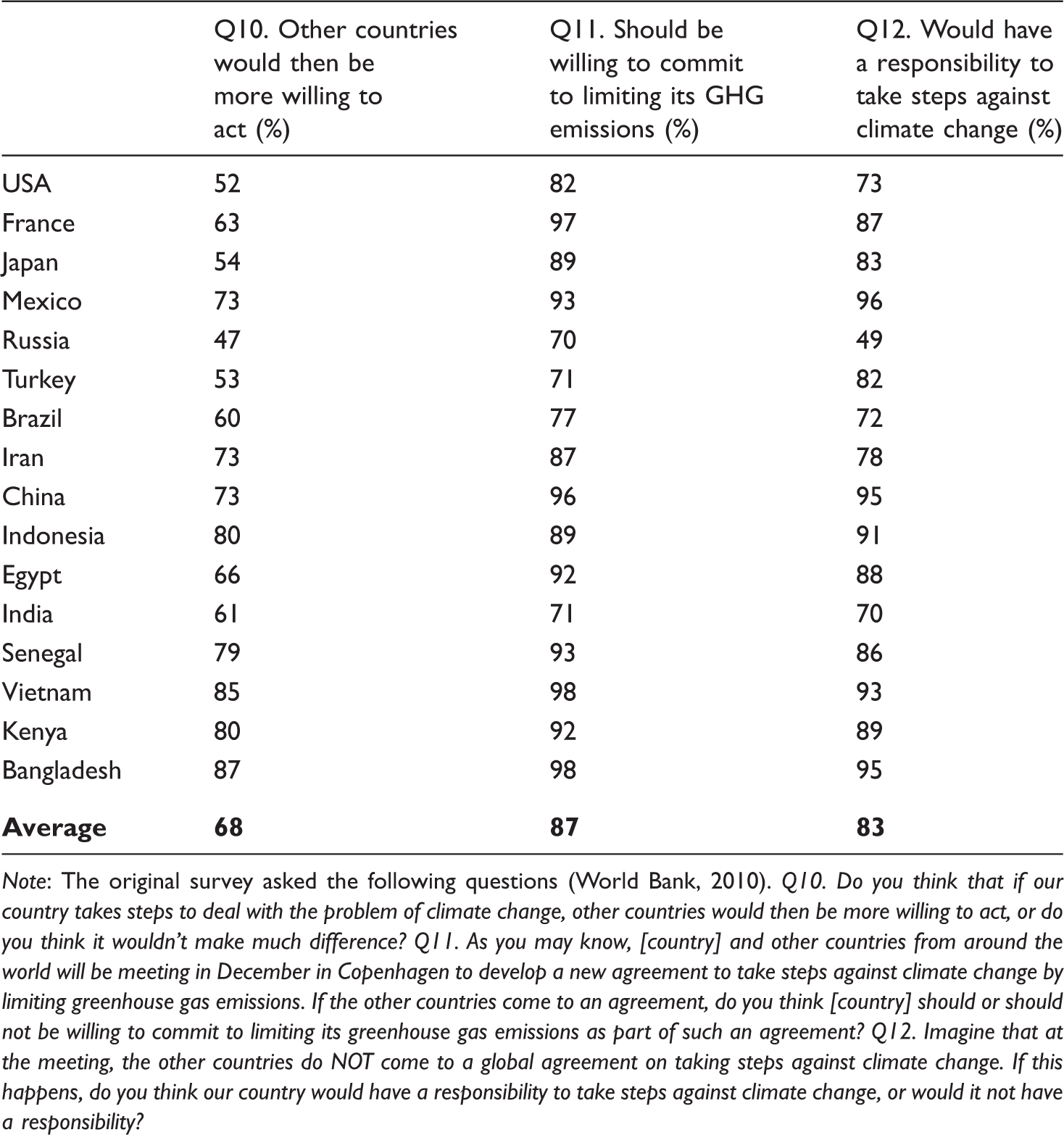
Note: The original survey asked the following questions (World Bank, 2010). Q10. Do you think that if our country takes steps to deal with the problem of climate change, other countries would then be more willing to act, or do you think it wouldn’t make much difference? Q11. As you may know, [country] and other countries from around the world will be meeting in December in Copenhagen to develop a new agreement to take steps against climate change by limiting greenhouse gas emissions. If the other countries come to an agreement, do you think [country] should or should not be willing to commit to limiting its greenhouse gas emissions as part of such an agreement? Q12. Imagine that at the meeting, the other countries do NOT come to a global agreement on taking steps against climate change. If this happens, do you think our country would have a responsibility to take steps against climate change, or would it not have a responsibility?
Climate policies that have direct implications for third countries are ideal candidates for exploring the limits of unilateralism. The most widely discussed such policy focuses on consumption-based measures (Peters et al., 2011), and border carbon adjustments in particular; that is, special taxes on imports of carbon intensive goods. Such measures are very controversial because of their implications for the international trading system and have thus far not been implemented by any major economy.
Yet, the EU has recently installed a policy that has wide-ranging effects of a similar nature. It has subjected all airlines operating flights between, from and to member countries of the EU to its cap-and-trade Emissions Trading System (ETS), no matter whether the airlines are based in the EU or not. This means that the EU is unilaterally applying its rules for aircraft emissions not only within, but also beyond EU borders. GHG emissions from aircraft have grown strongly in the past decades (Intergovernmental Panel on Climate Change, 1999; Leggett et al., 2012). Climate scientists agree that there is an urgent need to reverse this trend.
The relevant EU laws entered into force in 2009. All airlines that take off and land in the EU+3-countries (EU-27 plus Iceland, Liechtenstein und Norway) are allocated a cap (i.e. a total emissions budget), independently of their home country (which may be located outside the EU+3). This total emissions budget is allocated to individual airlines in the form of emission permits. If an airline does not use up its permits (because it uses more fuel-efficient airplanes or operates less flights in, to or from Europe) it can sell them to other airlines. If it exceeds its emissions budget, it can purchase additional emission permits in the ETS. At the end of a given budgeting period each airline must be able to present enough permits for its de facto emissions. In the case of a deficit it faces a fine in the order of €100 per ton of excess CO2, which is far above the current carbon price in the ETS, but is the standard fine in the EU’s ETS.
The total emissions budget for 2012 for all airlines operating flights in, to or from the EU+3 was fixed at 97% of a historical average of around 220 million tons of CO2. This cap will be progressively reduced to 95% until 2020. At the same time, the share of emissions permits that are allocated for free will be reduced as well. In 2012, 85% of the permits were allocated for free, based on historical emissions, and 15% were auctioned. Those permits that were allocated for free were not allocated according to the so-called grandfathering principle (historical emissions), but according to a best available technology principle. This principle favors airlines already using fuel-efficient airplanes.
The EU Commission allocates emission rights to individual airline companies and monitors compliance and sanctions violations. Enforcement of the first emissions budgeting period started in April 2013.
In late 2012, partly due to strong opposition from China, India, the United States, 1 and a few other countries, the EU suspended the application of the new rules to flights from and to destinations outside the EU (but enforces the rules within the EU). It also noted, however, that the (partial) suspension was only temporary, was meant to allow for the re-opening of previously failed negotiations on the issue in the International Civil Aviation Organization (ICAO), and would be lifted if global negotiations in the ICAO did not lead to an agreement on regulating airline emissions soon.
Will the new EU policy motivate other countries to adopt similar policies, unilaterally as well, or via a global agreement negotiated within ICAO? Or will it result in negative responses, for instance retaliatory policies by other countries against the EU that could undermine the EU initiative? Assuming that public opinion matters (Scruggs and Benegal, 2012; Tjernström and Tietenberg, 2008) in climate policy, particularly but not exclusively in democracies, we should, for the generic analytical and normative reasons mentioned above, be interested in how the new EU policy regulating GHG emissions of aircraft affects public opinion in non-EU countries that are directly affected by this policy.
In the following section, we argue that the impact of the new EU policy on public opinion in third countries is most likely to materialize via two mechanisms: concerns over cost implications and concerns over infringements on sovereignty. We then describe the empirical approach for evaluating these arguments, present the results and discuss their implications.
Economic and political costs of the new EU policy to other countries
The analysis in this article focuses on two mechanisms through which the EU’s new policy could affect public opinion in other countries: economic and political costs. Both mechanisms are straightforward. They are reminiscent of explanations of public support for European integration that have focused on identity versus economic rationality arguments (Christin and Trechsel, 2002; Hooghe and Marks, 2004).
The new EU policy amounts to an additional operational cost that airlines are likely to pass on to consumers. Current estimates are in the range of €5–10 for a flight within Europe, and €20–90 for long-distance flights. Hence the new EU policy imposes an economic burden also on other countries’ citizens flying to or from Europe. Political costs imposed on other countries can manifest themselves in the form of a perceived infringement on those countries’ sovereignty. This perception could arise not only because the EU policy regulates emissions by airlines from any (not only EU) country. The regulation also subjects emissions during the entire flight to the EU ETS, i.e. also those emissions occurring in the airspace of the airlines’ home country.
Both economic and political cost implications are very visible in statements by policy-makers and airline executives. To name only a few,
2
the president of Airlines for America, an association of the leading US airlines, Nicholas E Calio, stated: ‘Congress has spoken – US airlines should not be subjected to this illegal scheme that amounts to little more than a cash grab for the EU as none of the funds collected are required to be used for environmental purposes’. He also stated that the EU ETS is ‘a breach of US sovereignty that actually limits our ability to build on our strong environmental record by investing in new and more fuel-efficient aircraft’.
In a letter sent by 19 US-based aviation industry groups to US President Obama in September 2012, the industry voiced its concerns as follows: [i]f this EU breach of U.S. sovereignty … over our airspace and international waters – goes unanswered, it almost certainly will result in other such schemes affecting a variety of sectors of the U.S. economy.
Stakeholders from other countries have made similar statements that touch both on economic and political implications of the EU’s new policy. Thai Airways president Piyasvasti Amranand said: [i]f nothing changes, this will cost us THB200 million – THB300 million baht (€4.9 million – €7.35 million) a year starting 2013.
He also stated: I do agree with the idea of reducing carbon emissions but the way EU has come up with the calculation for making airlines pay is something we feel is unfair.
India’s aviation minister argued We would request the delegates to oppose any unilateral environment measures imposed by a state or group like the EU ETS and work with ICAO (International Civil Aviation Organisation) to evolve global environment protection on the basis of equity and consensus.
In view of these arguments, and to the extent they do not only reflect parochial views of particular airline companies affected, we expect more negative responses in non-EU countries when economic costs imposed by the EU policy on these countries are regarded as high. Because airlines are likely to pass on the additional cost to consumers, i.e. airline passengers, we should expect the views of airline executives to be congruent with the views of airline customers, who are also citizens and voters. As to political costs, we expect negative responses when unilateral policies are viewed as a violation of sovereignty; i.e. interference with a country’s right to decide on its own which policies to enact in its jurisdiction.
The two mechanisms are distinct: EU regulation applied to GHG emitters based in non-EU countries may, as a matter of principle, be regarded by non-EU countries as a violation of their sovereignty even if the economic implications as such are minor. Moreover, in principle, economic costs affect airlines and individual consumers alike, whereas political costs affect individuals in their capacity as citizens and voters.
Survey experiments: Effects of economic and political costs on public support
Several survey embedded experiments were fielded in India and the United States between 1st October and 20th November 2012. We opted for survey experiments, rather than standard surveys, because the former are more appropriate for identifying causal effects, rather than only correlations (Druckman et al., 2011; Mutz, 2011; Scruggs and Benegal, 2012). Participants were recruited on the crowd-sourcing platform Amazon Mechanical Turk (AMT) whose socio-demographics are well identified (Amazon Mechanical Turk, 2012; Berinsky et al., 2012; Mason and Suri, 2012; Ross et al., 2010). After recruitment through AMT, the online survey was implemented using a survey platform called Unipark (Unipark, 2012). 3 Treatments containing varying information on cost and sovereignty implications of the EU policy were randomly assigned to participants. We then evaluated statistically whether and how much these treatments affect support for and opposition to the new EU policy, relative to control groups that received no treatment.
Treatments.
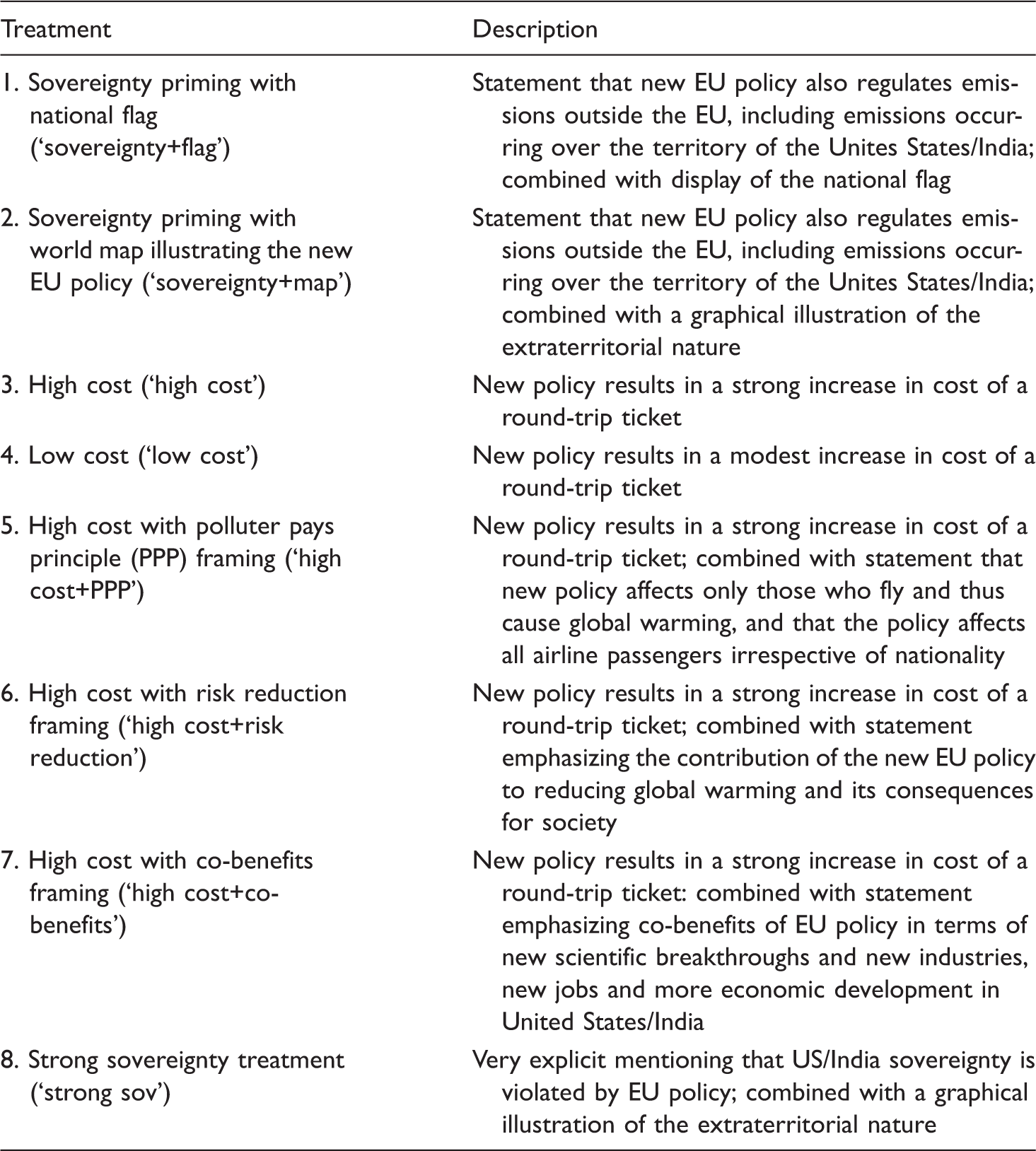
The ticket-price increase in the high and low cost stimuli, which varies between 30 and 200 USD for the US and between 500 and 2500 INR for India, is based on expert estimates of cost implications for airlines and passengers. 4 The information on implications for sovereignty is along the lines voiced by policy-makers and airline executives, some of which we mentioned earlier. The control group received no information treatment.
Response items (Contents in Table 3 are worded for the US sample).

We expect that all versions of the sovereignty priming (treatments 1, 2 and 8 in Table 2) affect support for the EU’s policy negatively and increase support for retaliation by making the alleged infringement on the respondent country’s sovereignty salient. For treatment 8 we used a slightly different control group, where the introduction did not mention the EU at all – the intention was to make the sovereignty treatment as extreme as possible and avoid a priming for sovereignty of the control group.
For treatment 3, we also expect a negative effect on support for the EU policy and a positive effect on support for retaliation, due to aversion against the strong ticket-price increase described as a result of the EU regulation. The effects of treatments 4, 5, 6 and 7 are expected to be negative as well, but smaller relative to the effects of treatment 3, since the ticket-price increase is lower (treatment 4), or the price increase is accompanied by a reference to causal responsibility (5), or potential benefits of the policy (6, 7). 6
Results
In the survey experiments with participants from India, we find that high costs (i.e. high ticket-price increases) imposed by the EU’s restrictions on aircraft emissions decrease levels of support for the new policy by about seven percentage points (see Figure 1). Conversely, high costs do not significantly affect support for retaliation which is either diffuse (non-sector specific) or sector specific (e.g. imposing higher landing fees on EU airlines).
Effects of cost and sovereignty considerations on individual support for/opposition to EU regulation of aircraft emissions among participants from India. The treatments (vertical axis) are described in detail in the ‘Survey experiments' section and online supplementary materials. The first two estimates (based on t-tests, 95% confidence intervals shown by whiskers) from the top of each graph indicate average effects of sovereignty violation treatments; the estimate displayed at the bottom is for the most extreme and explicit sovereignty treatment. (See the ‘Survey experiments' section and online supplementary materials for the complete description of the explicit sovereignty treatment.) The third and fourth estimates from the top are for low and high cost implications, the fifth to seventh estimates for high costs combined with a polluter pays, a climate risk reduction, and an economic co-benefits framing. Where whiskers cross the 0-line the estimated treatment effect is not statistically significant at the 5% level. Treatment effects on four response items are measured: attitudinal and behavioral support for the EU policy, support for sector-specific and non-sector specific (diffuse) retaliation (i.e. opposition). All panels indicate differences in means between treatment and control groups. All response items are scaled from 0 to 1, so that differences in means can be read as percentage changes in support/opposition.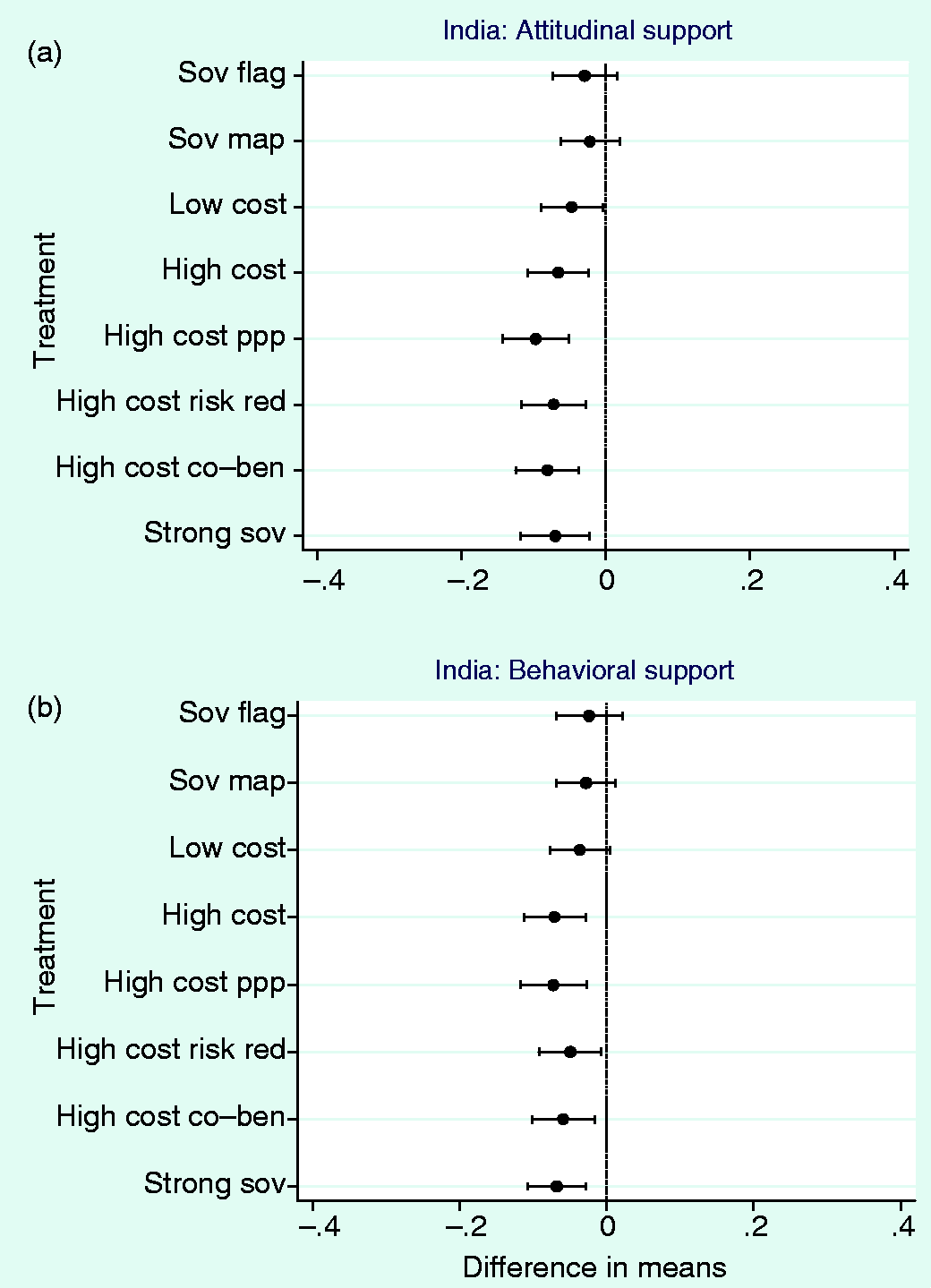
Associating high costs with framings that might mitigate the negative effect on policy support (treatments 5, 6 and 7), for the most part, did not have the expected effect. We find that combining high costs with a ‘polluter pays’, a ‘climate risk reduction’ or an ‘economic co-benefits’ frame still leaves us with a negative effect of high costs on support for the new EU policy – only the effect on support for specific retaliation turns insignificant with two of the three frames.
Interestingly, in contrast to the sovereignty rhetoric of policy-makers and airline executives opposing the new EU rules, two of the three treatments that emphasized sovereignty violations (treatments 1 and 2) do not have a significant effect on support and opposition (retaliation). Only the third sovereignty treatment (treatment 8), which is very strong and explicit, causes a significant decrease in support for specific retaliation (by approximately seven percentage points) and an increase in support for retaliation (by six to seven percentage points).
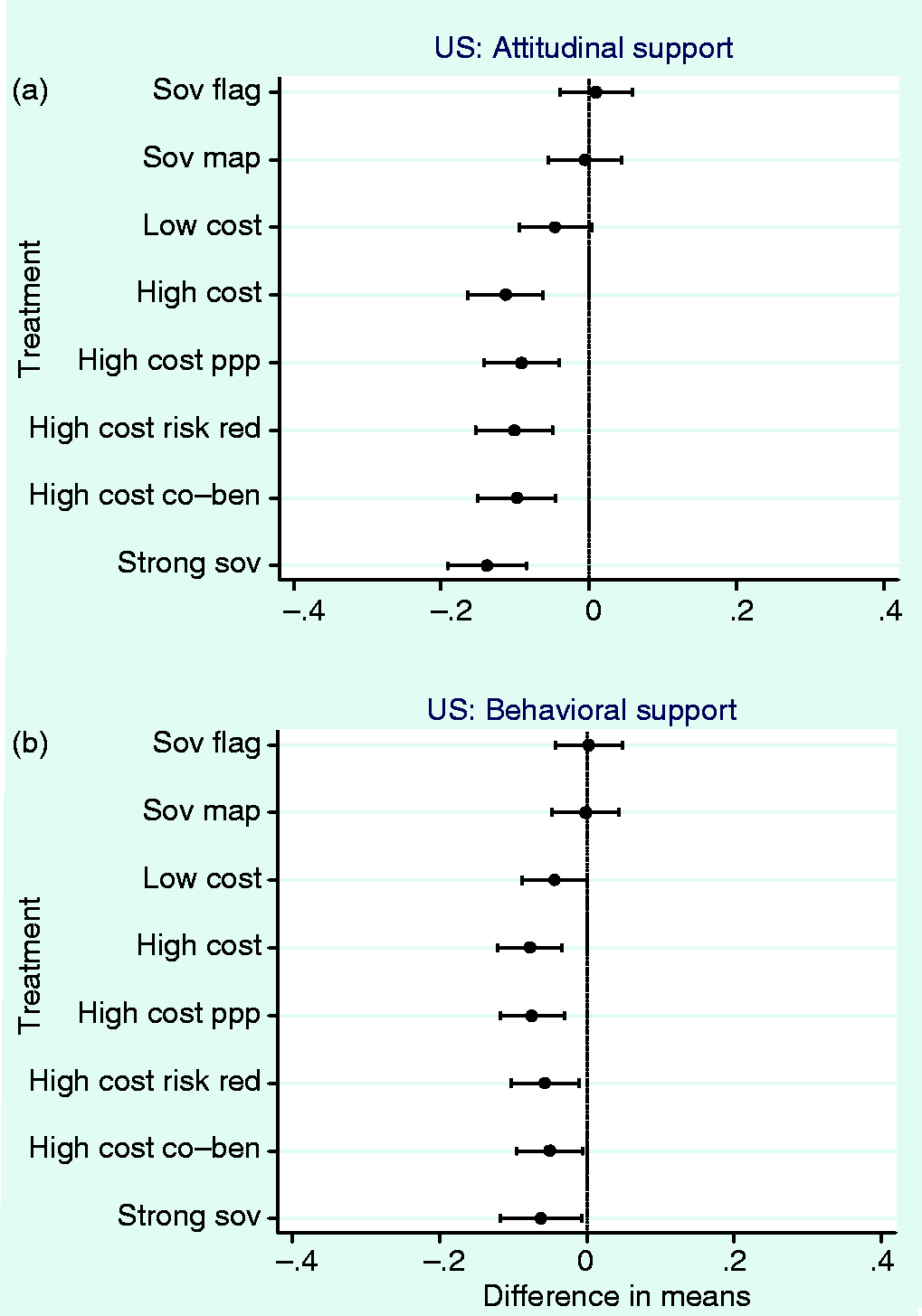
The main finding from the survey experiments in the US (Figure 2) is that the reactions of US respondents are similar to those of participants from India. High costs induce less attitudinal and behavioral support for the EU policy; the decrease of public support is 15 and 22 percentage points, respectively. Polluter pays, climate risk reduction and economic co-benefits framings of high costs do not change these negative effects. Compared to respondents from India, US participants are more supportive of sector specific retaliation: all framed and unframed cost treatments increase support for specific retaliation by about eight percentage points. Very similar to our findings for India, support for diffuse retaliation is low and is not significantly affected by the cost treatments. Again, only the most extreme and explicit sovereignty treatment has a significant effect, lowering support for the new policy and increasing support for retaliation by 6–14 percentage points – this effect is somewhat stronger for US respondents than those from India, notably because it significantly increases support for diffuse retaliation.
Robustness checks
As noted in the previous section, participants in our survey experiments were recruited on the crowd-sourcing platform AMT. The socio-demographics of our samples are quite similar to national distributions with respect to age and gender, but are biased in terms of education levels, political ideology (in the US case – approximately 75% Democrat in our sample), and income (the India sample is richer than the national average). 7
The convenience sampling approach we use and the resulting overrepresentation of some parts of society could potentially affect the external validity of our findings under two combined conditions: (a) if we attempted to make statistical inferences for the entire population of India and the US, and (b) if average treatment effects were contingent on those variables on which the sample bias is occurring (relative to the said population) (Druckman and Kam, 2011: 53). In our study, however, we are interested in sampling average treatment effects, and not in a representative description of public opinion in India or the United States per se. In agreement with Druckman and Kam (2011) and Berinsky et al. (2012), we thus believe that large and heterogeneous convenience samples from the two countries of interest here are appropriate.
Nevertheless, for robustness check purposes, we carried out an additional set of treatment-effect estimations after splitting the samples along several covariates in which we see discrepancies between population and sample profiles. 8 We were particularly concerned about the possibility that the direction of treatment effects (i.e. whether those treated are more or less supportive or opposed than the controlled) might differ between the split subgroups in each of these demographic covariates. The ‘Robustness checks’ section and Tables S6 and S7 in the online appendix summarize the results of these additional difference-in-means tests.
In conducting these robustness checks, we found that both the statistical significance and the direction of sample average treatment effects remain mostly the same after splitting the samples; that is, there are no contradictory treatment effects between the split subgroups in the covariates mentioned above. 9 Though these split samples may not be representative for this part of the Indian or US population either, this robustness test yields insights into treatment effects on those population groups for which our total sample is skewed. Nevertheless, we should remain cautious not only with regard to ‘from what’ we are generalizing, but also ‘to what’ we are generalizing. Our results are particularly robust in telling us how individuals represented by our samples are responding to cost and sovereignty aspects concerning the new EU policy for GHG emissions from airlines. But they should be interpreted with caution when it comes to describing how much the population of India or the United States as a whole supports or opposes the new EU policy.
Conclusion
The findings reported in this article are broadly in line with results from research focusing on sovereignty and economic costs as determinants of policy preferences in other areas, for instance European integration (e.g. Hooghe and Marks, 2004). That is, we find that both political (sovereignty) and economic costs matter.
Specific to the climate policy context, our results imply mixed news for frontrunners in climate policy, particularly in areas where unilateral policies affect other countries. High costs imposed on individuals in other countries reduce public support for the EU’s policy there, and they increase support for sector specific retaliation. Framing those costs with the PPP, climate risk reduction or economic co-benefits does not mitigate the negative effect of a high cost increase. Improved framing of the EU’s unilateral climate policy is, therefore, unlikely to reduce opposition by non-EU countries – unless third country airlines hold much more positive views of EU policy in this area than the median voter and industry pressure prevails over median voter demand, a rather unlikely scenario. These effects are clearly undesirable from the viewpoint of those hoping the EU’s unilateral move could motivate – via positive effects on public opinion in third countries – other governments to follow up with similar policies at national and/or international levels, or at least to refrain from trying to actively undermine EU climate policy concerning GHG emissions from aircraft.
The more positive news, from the perspective of those seeking stronger climate policies, is that our high cost treatments are at the extreme end of current expert estimates of cost implications for airlines and passengers from non-EU countries (see Table S1 in the online supplementary material); and only the most extreme and explicit sovereignty treatment induces significant negative reactions. In addition, we observe very little support for non-sector specific retaliation, which could impose higher costs on Europe if it escalated into a trade war. This means that in what we think is a more realistic scenario, with moderate cost and sovereignty implications, publics in non-EU countries are unlikely to push their respective governments toward aggressive responses that could not only prevent a reduction of GHG emissions from aircraft in non-EU countries, but could also undermine the EU effort as such. By implication, this also means that opposition from voters and consumers in third countries against the unilateral EU policy is likely to remain rather weak unless the airline industry and government succeed in whipping it up via extreme (and arguably unrealistic) statements about cost implications and violations of sovereignty. Overall, and particularly in view of low carbon prices in the ETS, which imply low compliance costs, this suggests that ambitious unilateral initiatives by frontrunners are feasible (The New York Times, 2013).
Our findings also suggest that the signing of a law by US President Obama in November 2012, which bars US-based airlines from complying with the EU’s policy and severely challenges the latter, has responded more to fierce lobbying by airlines than to public opinion. It is interesting to note in this context that an open letter to the US President, written by leading US economists in March 2013, even argues in favor of following the EU’s policy (Reuters, 2013). It states that ‘[w]hile we recognize the barriers to a uniform global price on all carbon emissions, pricing emissions in the aviation sector via ICAO would be a good start … Absent such an agreement in ICAO this year, US airlines will face a growing patchwork of international regulation and compliance costs, while aviation emissions will continue to rise and contribute to dangerous climate change’.
To systematically examine how much interest group lobbying has in fact influenced policy-choices, relative to pressure emanating from public opinion, future analyses will have to complement research on public opinion effects with research on the relevant national and international regulatory processes.
Finally, it would be very interesting to examine other areas of policy-making where unilateral policies impact on third countries, for instance, taxation policy, financial market regulation, or sanitary and phytosanitary standards in agricultural trade. Estimating and comparing political and economic cost effects of different types of unilateral policies on public opinion in third countries within a single survey experiment is probably too complex a task. But conducting a series of similar survey experiments for different policy areas could produce important insights into how much political and economic cost considerations matter across different policy areas.
Footnotes
Acknowledgments
The research for this article was funded by the ERC Advanced Grant ‘Sources of Legitimacy in Global Environmental Governance’ (Grant: 295456) and supported by ETH Zurich. We are grateful to three anonymous reviewers, the editors of EUP, Brilé Anderson, Patrick Bayer, Tobias Böhmelt, Jeanie Bukowski, Vera Eichenauer, Kenneth Scheve, Gabriele Spilker, Dustin Tingley, Michael Tomz and Stefan Wehrli for their very useful comments on previous versions of this article and their technical support.
Notes
References
Supplementary Material
Please find the following supplemental material available below.
For Open Access articles published under a Creative Commons License, all supplemental material carries the same license as the article it is associated with.
For non-Open Access articles published, all supplemental material carries a non-exclusive license, and permission requests for re-use of supplemental material or any part of supplemental material shall be sent directly to the copyright owner as specified in the copyright notice associated with the article.
