







Abstract
Do parties respond to voters’ preferences on European integration in elections to the European Parliament? In this article, we argue that political parties do respond to voters’ Euroskeptic attitudes, but that party type conditions responsiveness. In particular, we posit that larger parties are more responsive and that governing parties are less responsive to aggregate Euroskepticism. To test our theoretical expectations, we use data from the Euromanifestos Project and European Election Study from 1989 to 2009 for 252 parties across 26 European Union Member States. Our findings have important implications for understanding democratic representation in the European Union and the second-order nature of elections to the European Parliament.
Introduction
Since the 1970s, the level of Euroskepticism has increased among citizens in the European Union (EU) Member States. At the same time, we have seen growing support for Euroskeptic parties, such as the United Kingdom Independence Party (UKIP), French Front National (FN, National Front), and the Dutch Partij voor de Vrijheid (Party for Freedom). Yet, it is less clear if there is a link between rising levels of Euroskepticism and parties in general becoming more Euroskeptic. In this article, we seek to understand if there is a relationship between public Euroskepticism and parties’ positions on the EU and, moreover, if this relationship is conditioned by party type. These findings have important implications for understanding both the linkage between parties and voters as well as the nature of this relationship in second-order elections.
The relationship between parties and voters is one of the underlying features of democratic systems (Huntington, 1968; Schattschneider, 1942). We expect parties to aggregate and articulate interests (Key, 1964) and to function as an important linkage between the public and decision makers (Dalton et al., 2011; Lawson, 1980). Recognizing the dynamic nature of the relationship between voters and parties, Stimson et al. (1995) developed the concept of dynamic representation to describe how a party shifts its position in response to changes in public opinion. We argue that parties do respond to voters’ Euroskepticism, but that it is conditioned by party type. Parties that are more focused on policy, for example, may be less responsive to the electorate as a whole (De Swann, 1973; Strøm and Müller, 1999; Wittman, 1973, 1983).
A considerable amount of recent research has focused on the relationship between parties and voters. While some scholars have examined the relationship between the issue priorities of voters and the issue emphasis of parties, others have focused on the preference congruence between voters and parties.
The first line of research has sought to examine what influences the issues that parties choose to emphasize. In other words, if voters care about an issue, do parties then emphasize this issue? Spoon and Klüver (2014), Klüver and Spoon (2014), and Wagner and Meyer (2014) have all shown that parties do respond to issue priorities of voters in their election manifestos, but that they are conditioned by electoral context, party type and party organization, respectively. Similarly, van de Wardt (2014) finds that parties de-emphasize issues when their supporters’ preferences are divided. Other scholars have, moreover, looked at the relationship between citizens’ issue priorities and government policy (see e.g. Bevan and Jennings, 2014; Hobolt and Klemmensen, 2008; Jones and Baumgartner, 2004).
The second line of research has sought to understand how changes in parties’ policy preferences are influenced by changes in voters’ preferences (see e.g. Adams et al., 2004, 2006, 2009; Ezrow and Hellwig, 2014). Importantly, however, responsiveness is not uniform. Scholars have found that party responsiveness to voter preferences is conditioned by party type (Adams et al., 2006; Ezrow et al., 2011), electoral system (Steenbergen et al., 2007), politicization of the issue (Steenbergen et al., 2007), and party organization (Schumacher et al., 2013). In the European context, Steenbergen and Scott (2004) find that parties were more responsive to their supporters once the EU’s role became more important following the ratification of the Maastricht Treaty in 1993.
Building on this research, we argue that when voters are more Euroskeptic, parties will respond by becoming more Euroskeptic. Importantly, however, we theorize that party type conditions responsiveness. We find that, in general, political parties are unresponsive to Euroskepticism, but that certain party types do respond to Euroskepticism. Specifically, we find that governing parties are no more responsive to increasing Euroskepticism than opposition parties, but that larger parties are more responsive to Euroskepticism than smaller parties. To understand this relationship, we examine parties’ responsiveness to voters’ Euroskepticism from 1989 to 2009 in 26 EU Member States. In particular, we analyze the responsiveness of 252 parties across five European elections. We measure party position on the EU using data from the Euromanifestos Project (EMP), and measure aggregate Euroskepticism using the European Election Studies (EES).
Party responsiveness to Euroskepticism
Do parties respond to voters’ preferences? Political parties are typically rational, goal-oriented actors that seek to win both votes (Downs, 1957) and office (Riker, 1962). This desire to win elections thus drives parties’ behavior. Importantly, parties may have different underlying goals (Strøm and Müller, 1999). They may want to win office for varying instrumental reasons. A smaller party, for example, may seek to obtain office to gain credibility, whereas a larger party may seek office to influence policy outcomes (see West and Spoon, 2013). We therefore make no assumption about the underlying motivation of parties’ vote- and office-seeking goals, but instead simply recognize that parties seek to win elections and that there is a variation in motivation across parties.
The vote- and office-seeking goals, importantly, will motivate parties to listen to the public. Scholars have found that parties are generally responsive to voters’ preferences. If public opinion moves right, for example, parties’ preferences will follow (see e.g. Adams et al., 2004, 2006, 2009; Ezrow and Hellwig, 2014). Adams et al. (2004) specifically find that parties are more responsive to voters when their preferences shift away from the party’s policy positions. To bring these voters back into the party, parties shift their preferences toward the voters.
Scholars have come to differing conclusions when looking at the responsiveness of parties in European elections. Before turning to this discussion, we must consider the nature of elections to the European Parliament (EP). This extensive literature has demonstrated that these elections are largely considered second order (Reif and Schmitt, 1980). Voters generally have little interest or knowledge in European issues, pay hardly any attention to them, and often do not vote. Average turnout in the 2009 and 2014 EP elections, for example, was about 43%, which is considerably lower than average turnout in national elections. In addition, voters typically behave differently in EP elections. Governing parties tend to lose votes, whereas small parties often perform better (Hix and Marsh, 2007, 2011; Reif, 1984; van der Eijk and Franklin, 1996). These effects are largely attributed to the low salience context of European elections.
When looking at parties’ responsiveness to voters, Spoon and Klüver (2014) find that parties are less responsive to voters in EP elections than in national elections. Even when voters’ identify European issues as the most important issue or problem in the election, parties are less likely to respond by increasing the emphasis of European issues in their manifestos. Isolating the responsiveness of parties to voters in only the European context, Steenbergen et al. (2007) demonstrate that parties do respond to voters’ preferences, but that responsiveness varies across the electoral context. Similarly, Steenbergen and Scott (2004) show that after the entry into force of the Maastricht Treaty in 1993, parties were more responsive to the policy preferences of their supporters. When parties’ positions were further from their voters, they lowered the salience of European integration. Arnold et al. (2012), moreover, find that the electorate’s position concerning the EU influences parties’ positions on the EU.
Are some parties more responsive? Political parties vary in many important ways – size, governing status, internal organization, ideological breadth, and issue focus. Scholars have developed different party types based on these characteristics: the mass, cadre, branch, and caucus party (Duverger, 1954); the electoral–professional party (Panebianco, 1988); the ‘catch-all’ party (Kirchheimer, 1966); the cadre party (Katz and Mair, 1995); and most recently, the niche party (Meguid, 2005). The different parties may have varying goals based on their characteristics. These goals, moreover, influence parties’ behavior (Strøm and Müller, 1999). A policy-focused smaller party, for example, may only be willing to enter into a governing coalition with an ideologically proximate larger party, thus limiting its governing opportunities.
Compared to smaller parties, larger parties tend to be ideologically broad and office seeking, whereas smaller parties are often more ideologically consistent and focused on policy (Cox, 1997; Downs, 1957; Harmel and Janda, 1994; Kirchheimer, 1966). 1 With a ‘catch-all’ approach, larger parties will often broaden their policy appeal to attract voters (Kirchheimer, 1966). They are typically willing to change their ideology over time to maximize their votes (Harmel and Janda, 1994; Przeworski and Sprague, 1986). David Cameron’s decision to hold a referendum on the UK’s membership in the EU in an effort to appeal to the supporters of UKIP is an example of this. Conversely, smaller parties tend to be more ideologically focused. They may be less willing to sacrifice their ideology to win votes (Kitschelt, 1988). In fact, being ideologically consistent may be best achieved by being smaller as there are fewer supporters to which the party must appeal (Cox, 1997: 171). As a result of the difference in goals, scholars have found that smaller parties often behave differently in comparison to larger parties in election campaigns and in government (e.g. Bale and Bergman, 2006; Bolleyer, 2007). The Swedish Green Party (Miljöpartiet de gröna), for example, has consistently chosen to not participate in a governing coalition with the Swedish Democrats, as doing so would mean compromising on its core policies (Bale and Bergman, 2006). Following this research highlighting the difference between smaller and larger parties, we argue that larger parties will be more responsive to voters’ Euroskeptic views.
Next, we turn to governing status. Although most governing parties are larger, many smaller parties have participated in governing coalitions, such as green and regional parties in France, Germany, Belgium, Finland, and Italy. Thus, size and governing status are not necessarily one and the same. When parties are in the opposition, they are more likely to respond to the policy preferences of voters as they hope to regain their support. However, once in government, parties have less incentive to change their policy positions for multiple reasons. First, they were elected on a set of stated policy positions with which voters are familiar, and if they were to change them while in government, they could risk losing the next election. 2 Moreover, if a governing party were to change its position, it may be harder to convince voters that it is sincere in its policy preferences, as it could be accused of ‘flip flopping’ (Burden, 2004; Tavits, 2007). Nanou and Dorussen (2013) and Klüver and Spoon (2014) make a similar argument in their research. Second, research suggests that governing parties are constrained in the positions they can take on European integration by pressure to toe the line from Brussels. In examining governing party positioning on the EU Constitution Treaty referendum, Crum (2007: 66) writes, ‘government parties are bound to endorse Treaty revisions because these revisions are established only with the approval of every government involved. The ratification that follows basically involves the government getting the result of the international negotiations approved at home.’ Finally, scholars have found that established parties tend to have less Euroskeptic positions and that it is these parties that tend to be in government (Marks et al., 2002; Taggart, 1998). 3 Thus, governing parties, because of their need to maintain a coherent policy agenda, fulfill obligations to Brussels, and their underlying position on Europe, are less likely to be responsive to voters’ Euroskepticism.
Research design
The dependent variable for our hypotheses is each party’s position on the EU in its EP election manifesto. This variable is derived from the EMP data (Braun et al., 2010; Schmitt and Wüst, 2012). The EMP collects and codes parties’ manifestos from EP elections. In order to identify a party’s stance on a particular issue, the EMP codes ‘quasi-sentences’ from a party’s Euromanifesto into policy dimensions. These are ‘a set of words containing one and only one political idea’ (EES, 2009: 20). Once a ‘quasi-sentence’ is classified into a policy domain, it is then coded as either positive or negative. Importantly, there are some dimensions, such as per501 that focuses on environmental protection, which are only positive. In the final data set, the EMP reports the percentage of ‘quasi-sentences’ on a particular policy domain that are positive and negative, where applicable. This data is available for the manifestos of parties that competed in the EP elections from 1979 to 2009. Due to data constraints concerning our independent variables, we utilized Euromanifestos data from 1989 through 2009. The data set thus includes 252 parties in 26 EU Members states across five elections. 4 However, as many of the parties (150) appear more than once, we treat the data as panel data (Steenbergen et al., 2007).
To operationalize our dependent variable—a party’s position concerning the EU—we calculated the difference between the percentage of ‘quasi-sentences’ that are coded as positive toward the EU (per108) and the percentage of ‘quasi-sentences’ that are coded as negative (per110) toward the EU in each party’s manifesto (see Schmitt and Wüst, 2012). This follows the procedure used by Klingemann et al. (2006) and Braun et al. (2010) for determining a party’s EU position. In order to reduce difficulty in the interpretation of the findings, we then rescaled this variable to a 0–10 scale using the following equation: ((Difference in Positive and Negative Comments) + 100)/20. Thus, a larger number indicates that a party is more positive about the EU than negative. Theoretically, this variable can range from 0 to 10; in our data set, however, the range is from 2.78 (UKIP in 2004) to 6.57 (Lietuvių Demokratų Partija, Lithuanian Democratic Party in 2004). The mean for this variable is 5.13 with a standard deviation of 0.35. As Figure 1 demonstrates, the mean is slightly pro-Europe, and the distribution of the observations shows that most of the parties have an EU position of greater than 5. Over time, the parties’ average EU positions have remained relatively constant, with a brief dip in 1995 to 4.98.
Distribution of dependent variable. Note: The figure shows the distribution of the dependent variable. The solid line is the Kernel density plot.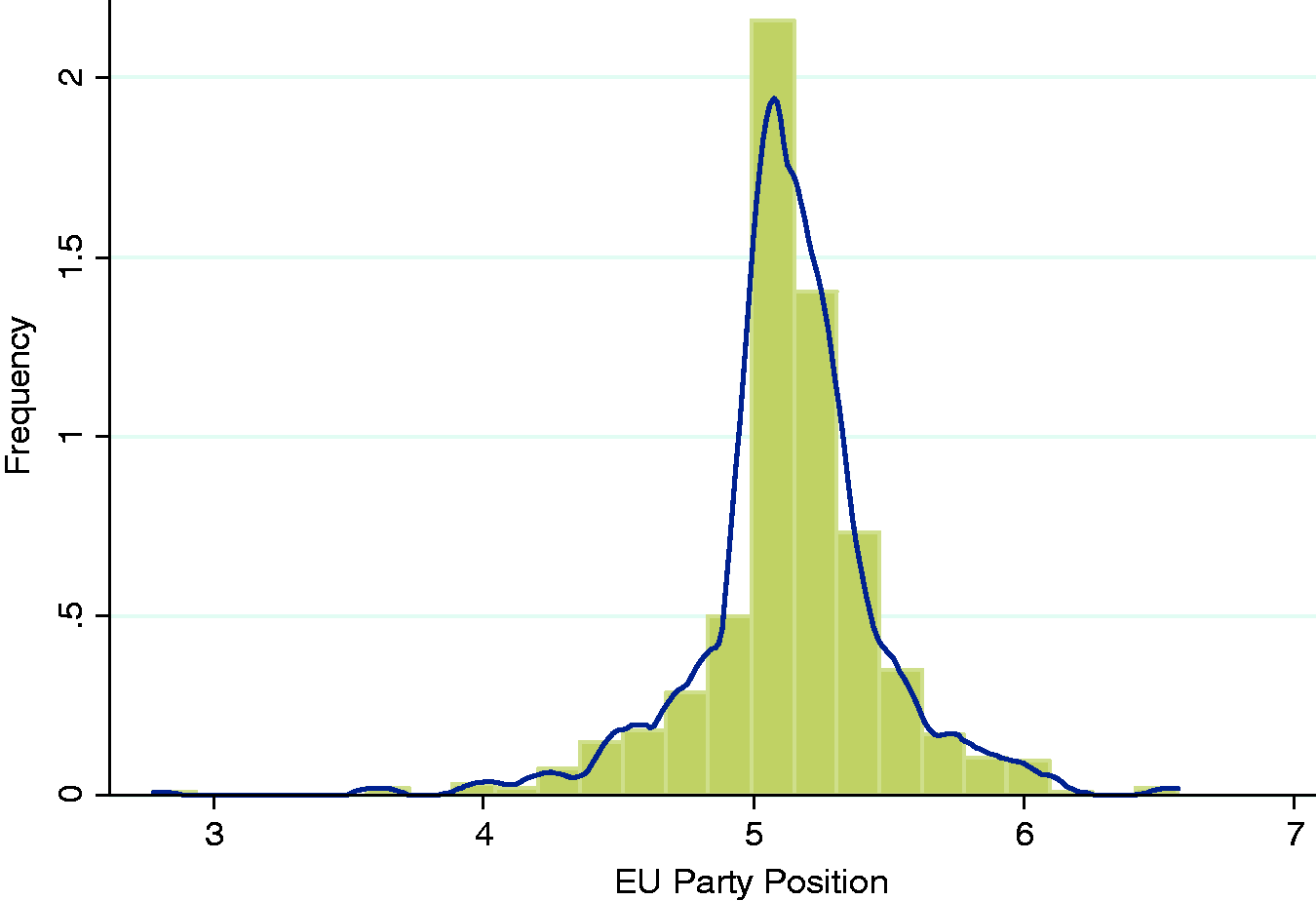
To test the above three hypotheses, we use three independent variables. For H1, we derive the main independent variable from the EES (Egmond et al., 2013; Schmitt et al., 1997, 2007, 2009; van der Eijk et al., 1993, 1999). The main independent variables used in examining H2 and H3 are developed using a combination of the EMP, Comparative Manifestos Project (Klingemann et al., 2006), and Parlgov (Döring and Manow, 2012) data.
H1 specifies that political parties respond to the level of Euroskepticism. To test this hypothesis, we use the aggregate level of Euroskepticism in a given year as the independent variable. This measure is based on the question ‘Generally speaking, do you think that (YOUR COUNTRY)’s membership of the EU is a good thing, a bad thing, neither good nor bad, don’t know?’ This question was asked in each of the EES from 1989 to 2009. As parties are looking for a clear assessment of voters’ Euroskepticism, we measure Euroskepticism as the percentage of respondents in a given EES Voter Study who answered this question with the response ‘a bad thing.’ 5
As we hypothesized that as the aggregate level of Euroskepticism at time t−1 will affect party position concerning the EU at time t, it is thus necessary to lag our measure of aggregate Euroskepticism. We therefore matched aggregate Euroskepticism in a country at time t−1 with party position on the EU at time t. For example, we matched the measure of Euroskepticism in Germany in 1989 with the party manifestos in 1994. We included this lag as the relationship between the level of Euroskepticism and changes to party manifestos is unlikely to be simultaneous (see Hobolt and Klemmensen, 2008; Spoon and Klüver, 2014). Rather, parties need time to respond to voters. 6 Theoretically, this variable can range from 0 to 1.0; the range of this variable in our data set is 0.01 (Portugal in 1999) to 0.47 (the Czech Republic in 2004). The mean for this variable is 0.11 with a standard deviation of 0.09.
In H2 and H3, we examine how party characteristics condition the effect of Euroskepticism. First, H2 proposes that as voters’ Euroskepticism increases, larger political parties will be more Euroskeptic in their manifestos. To test this hypothesis, we interact aggregate Euroskepticism and the size of a political party. We measure aggregate Euroskepticism in the same manner as for H1. In line with previous research (see Hix and Marsh, 2007), party size is measured using the party’s vote share in the previous national election. Party size ranges from 0.0001 (Unión de Centro Democrático, Union of the Democratic Centre, in Spain in 2004) to 0.52 (Partit Nazzjonalista, Nationalist Party, in Malta in 2004). It has a mean of 0.15 and a standard deviation of 0.13.
H3 states that parties in government are less responsive to the overall level of Euroskepticism. The independent variable for this hypothesis is an interaction term between the lagged overall level of Euroskepticism and whether a party is a member of the current government. We measure lagged aggregate Euroskepticism, the first component of this interaction term, in the same manner as we measured Euroskepticism for the independent variables in H1 and H2. The second constituent part of this interaction term is a dichotomous variable with a value of 1 for a party that is currently in the government and 0 for a party that is not currently in government.
We also include a number of control variables in the analysis. To begin, we incorporate several variables that focus on individual party characteristics. First, as research suggests that a party’s left–right position is associated with its position concerning the EU (Hooghe et al., 2002), we control for a party’s position on a left–right spectrum. We computed a party’s position on the left–right spectrum using data from the EMP. This data provides a left–right score (referred to as RILE) for each party in the data set. RILE scores range from −100 to +100, with −100 being the most left. We rescaled these data to a 0–10 scale using the equation ((RILE) + 100)/20. Further, we utilize two control variables for parties that are more likely to be Euroskeptic. We first include a dichotomous variable for whether a party is part of the far-right party family. Many scholars have demonstrated that far-right parties, such as the French Front National, are opposed to European integration as it compromises national sovereignty (see e.g. Taggart, 1998). Next, we have a variable for whether a party is a single-issue Euroskeptic party. Although many different types of parties can be considered Euroskeptic, we isolate those parties that can be considered single-issue Euroskeptic parties that may, furthermore, be archetypal ‘associative issue owners’ (Walgrave et al., 2012) on the issue, in that there is a spontaneous association between an anti-European position and these parties in the minds of many voters. 7 The correlation between the left–right variable and the far-right party variable is only 0.18.
Second, to control for the possibility that political parties are responding to the positions of other parties within the system, we use a lagged measure of the average EU position of the party system. In calculating the system average, the focal party is not included. As this measure is based on the rescaled lagged dependent variable, it ranges from 0 to 10. In our data set, the variable ranges from 4.74, the most anti-EU (Greece in 1994) to 6.89, the most pro-EU (Italy in 1989).
Third, we utilize two time-related variables. First, we use a dichotomous variable for the Lisbon Treaty. Following the signing of the Lisbon Treaty in 2009, and the reforms of the co-decision procedure, the EU’s powers were extended and the EP became more influential in European policy making. As a response to the increasing role of the EP, Euroskepticism has risen among both the public and parties. Thus, we control for the post-Lisbon period in order to account for this possible ‘era effect.’ Second, we control for the number of years each state has been a member of the EU at each time point in the data set. To control for a possible nonlinear effect of the length of time in the EU on party position, we also include its squared term. See the online appendix for the descriptive statistics of all variables included in the analysis.
Our dependent variable has a normal distribution (see Figure 1), indicating that a model based upon ordinary least squares (OLS) regression would be most appropriate. However, as this data is time series cross-sectional, it is important to control for the effect of the dependent variable at time t−1 on the value of the dependent variable at time t0. The simplest approach to this issue would be to use an OLS regression with a lagged dependent variable (parties’ position on the EU at t−1) and panel corrected standard errors (Beck and Katz, 1995, 1996). Unfortunately, this method reduces the N of this study and can have autocorrelation problems in panel data (Plümper et al., 2005). As an alternative to this method, we rely upon a Prais–Winsten transformation technique for OLS with robust standard errors. A Prais–Winsten regression is a feasible generalized least squares regression that addresses autoregressive(1)s and, through transformation, is able to use the first observation that would otherwise be lost by using a lagged term. This circumvents the problem of a reduced N and increases the efficiency of the model (Park and Mitchell, 1980). Additionally, the data used in this study is panel data with parties nested within countries and years. Therefore, the error terms may not be independently and identically distributed. To account for this likelihood, we have clustered our standard errors by country year.
Analysis
Model 1 shows the results of the analysis of H1, which argued that when Euroskepticism among the public is higher, parties will be more Euroskeptic. 8 As the dependent variable ranges from 0 to 10, with lower values signifying more Euroskeptic manifestos, a negative coefficient suggests that the variable is associated with more Euroskeptic manifestos. The coefficient for our Euroskepticism variable in model 1 is negative, demonstrating that when Euroskepticism among voters is higher, parties are more Euroskeptic. 9 This finding, however, is not statistically significant.
Party responsiveness to Euroskepticism.
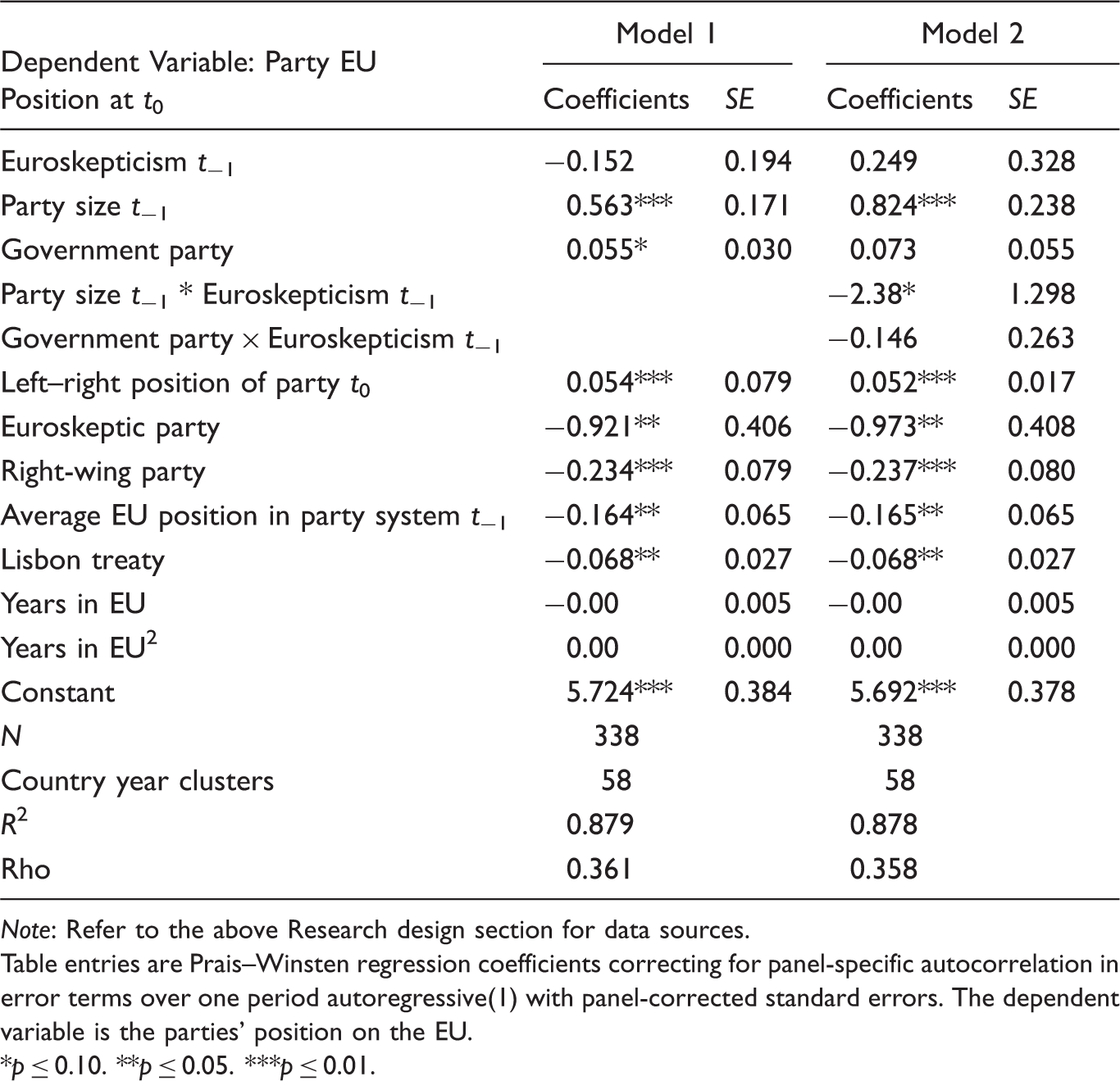
Note: Refer to the above Research design section for data sources.
Table entries are Prais–Winsten regression coefficients correcting for panel-specific autocorrelation in error terms over one period autoregressive(1) with panel-corrected standard errors. The dependent variable is the parties’ position on the EU.
p ≤ 0.10. **p ≤ 0.05. ***p ≤ 0.01.
Model 2 displays the results of the analyses of H2 and H3. The main independent variables are interactions between the aggregate level of Euroskepticism and the type of party (larger parties and government parties, respectively). H2 proposed that when aggregate Euroskepticism is greater, larger parties will be more negative toward the EU in their manifestos. As model 2 shows, the interaction between a party’s vote share and the level of aggregate Euroskepticism is statistically significant and negative. This confirms H2 and follows our expectation for vote- and office-seeking parties (Downs, 1957; Kirchheimer, 1966; Riker, 1962).
To more fully understand how party size conditions the effect of Euroskepticism on a party’s EU position, we computed a marginal effects plot, as recommended by Brambor et al. (2006). Figure 2 demonstrates how the public’s Euroskepticism influences parties’ EU position. More precisely, the figure shows the marginal effect of voter Euroskepticism at t−1 on parties’ EU position at t0 as party size varies. The dashed lines represent the 90% confidence intervals and the tick marks along the X-axis are the distribution of the party size variable. Figure 2 clearly shows that Euroskepticism has a greater effect on a party’s EU position as party size increases. The effect is the strongest as party size increases from 1% to 10%. Roughly 50% of the parties in our data set fall in this range of party size. In sum, this figure demonstrates that larger parties are more responsive to Euroskeptic public opinion than smaller parties, and thus highlights the Downsian nature of these parties.
Effect of party size on party EU position. Note: This figure is based on Model 2. It shows the marginal effect of voters’ Euroskepticism on party EU position as party size varies. The dashed lines are the 90% confidence intervals. The tick marks along the X-axis are the distribution of the party size variable.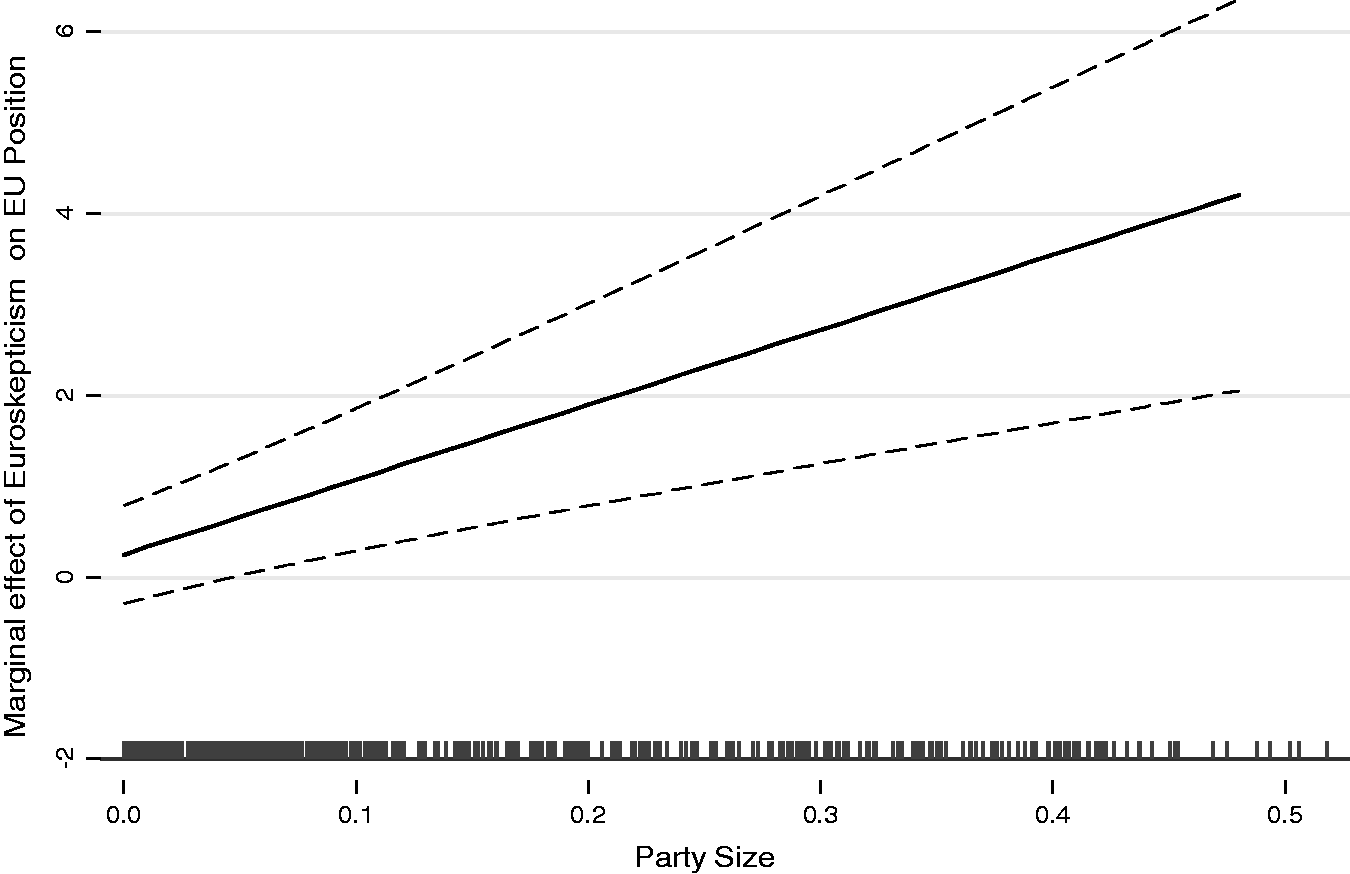
To illustrate these results, we can examine the responsiveness of two Finnish parties. In 1999, Finland had the third highest level of Euroskepticism in our data set, with a value of 0.30. In the previous national election, the Sosialidemokraattinen Puolue (Social Democratic Party, SDP) received 24.47% of the vote and in 2004, the party’s EU position was 5.11. In the same years, the Vasemmistoliitto (Left Alliance) received just 10.88% of the vote and had a more pro-EU position of 5.23. Thus, the larger SDP was more responsive to voters’ Euroskepticism than the smaller Left Alliance.
H3 stated that aggregate levels of Euroskepticism in a country will have less influence on government party manifestos than on opposition party manifestos. The coefficient for the interaction between the aggregate level of Euroskepticism and whether a party is a government party is negative, but statistically insignificant. These findings go further than our expectation, and demonstrate that opposition parties and governing parties do not differ in responsiveness to aggregate Euroskepticism. This result confirms the pro-Europe nature of most governing parties (see, e.g. Crum, 2007; Marks et al., 2002).
Turning to our control variables, several are statistically significant. First, we find that right-wing parties are more pro-Europe. This finding can be explained by the fact that many mainstream right parties are in government and governing parties tend to be more pro-EU (Crum, 2007; Marks et al., 2002). Second, we find that both far-right and Euroskeptic parties are more Euroskeptic. Third, our results demonstrate that parties also respond to the positions of other parties in the party system. When the party system is more Euroskeptic, any individual party in the system will also be more Euroskeptic. Our finding, moreover, demonstrates that parties respond to the lagged positions of other parties in the party system, which extends Adams and Somer-Topcu’s (2009) findings with respect to party positioning on the left–right dimension. Finally, our dichotomous variable for the Lisbon Treaty is negative and significant. This demonstrates that after the signing of the treaty in 2009, parties, on average, were more Euroskeptic. This follows from our expectations that, as the powers of the EU in general and the EP in particular increase, parties’ Euroskepticism will also increase.
Conclusion
In this article, we have sought to understand the nuances of party responsiveness to Euroskeptic public opinion. In line with previous research (see Arnold et al., 2012; Steenbergen et al., 2007; Steenbergen and Scott, 2004), we argued that political parties do respond to public opinion concerning the EU; however, this effect is not uniform across all party types. Using EES and Euromanifestos data, we find that party-type conditions party responsiveness to aggregate Euroskepticism. 10 Our results follow other recent research on party responsiveness (see Adams et al., 2006; Ezrow et al., 2011; Steenbergen et al., 2007). When aggregate Euroskepticism is higher, larger parties will have more Euroskeptic manifestos than smaller parties. At the same time, parties in government do not differ from opposition parties in terms of responsiveness to the level of Euroskepticism among the public.
Our findings have several implications for our understanding of political responsiveness, the nature of European elections, and democratic legitimacy in the EU. First, this research informs our understanding of party responsiveness. Building on Arnold et al. (2012), Steenbergen et al. (2007), and Steenbergen and Scott (2004), we offer some additional evidence that parties respond to more than only the left–right positioning of the public and that the level of responsiveness is conditioned by party characteristics.
Second, these findings suggest that EP elections may be shifting from second-order elections to first-order elections. Previous research has argued that EP elections are second-order (see Reif, 1984; Reif and Schmitt, 1980), and thus parties will be less likely to respond to citizen preferences during these elections (Spoon and Klüver, 2014). Our results show some responsiveness among parties to public attitudes toward the EU in second-order (EP) elections. This finding suggests that political parties may take European elections more seriously than previously believed, and are, at least on some issues (mainly that of the role of the EU), responsive to the public during EP elections. This implies that European elections may be growing in importance to both the public and political parties, thus offering some evidence that they are no longer wholly second-order elections.
Finally, these results may assuage some concerns over a perceived lack of democratic legitimacy in the EU. Concerns over a lack of responsiveness and representation in the EU have led scholars to conclude that there is a democratic deficit (see Føllesdal and Hix, 2006). As party responsiveness is considered a key characteristic of democracy (see Dahl, 1971) and of democratic linkage (Dalton et al., 2011; Lawson, 1980), and as we find that parties contesting EP elections do respond to public opinion on the EU, our findings suggest that the EU may suffer from less of a democratic deficit than had previously been thought.
Importantly, this study is only the first step in developing an understanding of party responsiveness in the EU; indeed, there are numerous questions concerning party responsiveness still remaining. First, future research should explore the conditioning effect of issue salience on party responsiveness. That is to say, when the issue of European integration is more salient among the public, do we see a greater degree of responsiveness among parties in European elections? Second, we hope to examine how parties respond to the public on specific issues during EP elections. For example, when the public is particularly in support of the EU addressing a particular issue (e.g. environmental regulation), are political parties also more in favor of that issue being addressed by the EU? Third, we would like to examine how political unity affects party responsiveness – i.e. when parties are more unified in their position on European integration, are they more responsive to the public? Finally, it will be important to explore the effect of change in Euroskepticism on change in the positions of political parties, which can provide us with a more nuanced understanding of representation and responsiveness. Moreover, approaching party responsiveness from the perspective of change in party positions as a function of change in Euroskepticism allows us to more effectively tackle the question of how Euroskeptic parties react to public Euroskepticism. As one would expect Euroskeptic parties to be Euroskeptic regardless of the level of Euroskepticism, it is difficult to assess the level of responsiveness among Euroskeptic parties. However, by examining change in party positions as a function of change in Euroskepticism, it is possible to assess the degree of Euroskepticism within Euroskeptic parties as public Euroskepticism changes.
Footnotes
Acknowledgements
We would like to thank Christine Arnold, Mareike Kleine, and Holger Döring for their helpful and insightful comments. All errors remain our own.
Notes
References
Supplementary Material
Please find the following supplemental material available below.
For Open Access articles published under a Creative Commons License, all supplemental material carries the same license as the article it is associated with.
For non-Open Access articles published, all supplemental material carries a non-exclusive license, and permission requests for re-use of supplemental material or any part of supplemental material shall be sent directly to the copyright owner as specified in the copyright notice associated with the article.
