






Abstract
The effects of electoral rules on party systems have been well known since Duverger first proposed his famous law. Often considered ‘second order’ in terms of issues and voting behaviour, many European Parliament elections are held under different electoral rules to national elections. This article examines the consequences of these differences and hypothesizes that where a more permissive electoral system is used for European Parliament elections, the size of the party system at European Parliament elections will grow towards what we would expect from the European Parliament electoral rules in isolation, and that this will lead to a subsequent growth in the size of the national party system. Using multi-level mixed-effect growth curve modelling support is found for both these hypotheses.
On 7 June 1979 a unique experiment in electoral democracy began. Over the next four days voters from each of the (then) nine members of the European Community cast their ballots in the first direct elections for the European Parliament. The 1979 election – the first ever international election – marked not just a significant milestone in European integration but also the beginning of an important opportunity for the study of elections and voting behaviour. Shortly after the first European Parliament election Reif and Schmitt (1980) proposed their now famous ‘second order election’ hypothesis: that in the absence of any real power to change the forces that govern European integration (because such power lies outside the European Parliament), voters will cast their votes largely according to domestic political concerns. Seven European Parliament elections (a total of 146 country-election observations across 28 countries) and much scholarly attention later, Reif and Schmitt’s argument continues to frame research into European Parliament elections.
Many of the issues surrounding European Parliament elections have been well explored, especially questions of voting behaviour (e.g. Hix and Marsh, 2007, 2011; Hobolt et al., 2009; Marsh, 1998; Reif, 1984; Schmitt, 2005; Stockemer, 2012). However the question of how national party systems have been affected by elections that are held at the national level (even if the institution filled by those elections is a supranational body) with a different electoral systems to those used for national parliamentary elections has been neglected by the academic literature. This article argues that the impact of these ‘second order electoral rules’ follows a simple Duvergerian logic: where the electoral system used for European Parliament elections is more permissive (i.e. has a greater district magnitude) than that used at national elections, the size of the party system at European Parliament elections will grow over successive elections to the size expected from the more permissive electoral system. The growth in party systems at the European Parliament level will also feed back into national party systems, as existing and new parties use European Parliament elections to help overcome some of the obstacles they face from the national electoral system. These effects occur because European Parliament elections are held under more permissive rules and provide an arena where the costs of coordination between voters and elites are lower than the national level, facilitating changes to national party systems.
That this might be the case is easy to see from a cursory glance at the evidence. In the first European Parliament elections in 1979, four parties won seats in (West) Germany and four party tickets (covering five parties) won seats in France. At the 2014 European Parliament elections, 15 parties won seats in Germany and six party tickets (covering 13 parties) won seats in France. 1 Similarly, several small parties, such as the French and British Greens, first achieved representation in the European Parliament before going on to win seats in the national legislature.
In order to examine these arguments more systematically this article first outlines the existing literature on European integration, electoral rules, and party systems before drawing on the more general literature on electoral system effects to develop a theory of why European Parliament electoral rules will have an impact on national party systems. The theory is then tested using multi-level mixed-effects growth curve modelling, which confirms the arguments developed here.
European integration, electoral rules and party systems
Although scholars have primarily focused on electoral behaviour at European Parliament elections, a few scholars have examined the effects of European Parliament electoral systems in different contexts: Kousser (2004) argues that when the rules governing European Parliament elections are less of a barrier to small parties than national electoral systems, voters will alter their voting strategies accordingly. Farrell and Scully (2005) investigate how differing electoral formulas lead to differing electoral outcomes, focusing on differences between member-states rather than the difference between national and European Parliament elections. Shifting the focus away from the elections themselves, Hix (2004) has shown that whether members of the European Parliament (MEPs) are elected by open or closed lists is a good predictor of voting behaviour in the European Parliament. Similarly, Hix and Hagemann (2009) have investigated the effects of different electoral systems on the link between voters and MEPs. With these exceptions, the impact of differing electoral systems, particularly in the classical Duvergerian sense of the number of parties winning votes, has been overlooked.
That this is the case is perhaps understandable. If we accept that European Parliament elections are largely second order elections we might simply expect the party system resulting from European Parliament elections to continue to resemble that of the national party system. Alternatively, we might expect any resulting change in the size of the party system at the European Parliament level to arise from voters using elections which have no impact on the composition of government to cast protest votes for fringe parties. If this is the case, we might expect these changes in the party system to be unrelated to any difference in electoral systems between the national and European Parliament level. In essence this is the conclusion reached in the influential study by van der Eijk and Franklin (1996) which argued that the success of small parties in European Parliament elections can largely be attributed to strategic context rather than the electoral system. Although they do not grant the same role to the electoral system as is proposed here, van der Eijk and Franklin (1996) suggest that by granting small parties an arena in which to compete, over the long-term European Parliament elections might impact national party systems by increasing the number of alternatives available to voters.
The prevailing wisdom however is that European integration in general has had a limited impact on national party systems (e.g. Mair, 2000). There are two areas where scholars have argued that European integration has had an impact on national party systems, and neither of them suggests an increase in the size of party systems. First, because many policy areas are now decided at the European level, European integration has restricted the policy space in which parties can compete (Ladrech, 2002; Mair, 2007a, 2007b, 2013). Second, because of the number of decisions taken in intergovernmental meetings and the fact that parties have not yet come up with mechanisms in response to this development, European integration has increased the power of executives vis-a-vis their parties (Poguntke et al., 2007; Raunio, 2002). There is also a clear consensus that European integration has not had a major impact on national party systems in terms of the political cleavages on which parties compete: many scholars agree that party competition over Europe may have the potential to redraw the lines of party competition, but for the moment at least, it has not actually done so (de Vries, 2007; van der Eijk and Franklin, 2004).
Whilst the above may be true, this article argues that because scholars have tended to look for some sort of ‘European’ impact of European integration on party systems they may have missed an important effect of European Parliament elections on national party systems – the growth of the size of party systems proposed here. This article examines the effect of European Parliament elections simply qua elections rather than specifically as part of the process of European integration, and remains agnostic to the question of whether these changes reflect any ‘Europeanisation’ of national party systems. In order to understand why party systems may change as a result of European Parliament elections it is necessary to turn to the literature on the effects of electoral systems.
Electoral systems and the size of party systems
In the 1950s the French sociologist Maurice Duverger (1954) first proposed what has since become known as Duverger’s law and hypothesis: that the plurality electoral rule tends to result in a two-party system (law) and that more proportional systems tend to result in multipartism (hypothesis). This basic insight has been expanded, systematized and generalized by many scholars in the ensuing decades and has become a cornerstone of electoral research (Clark and Golder, 2006; Cox, 1997; Riker, 1982; Taagepera, 2007; Taagepera and Shugart, 1989). In its generalized form, Duverger’s findings have come to mean that the higher the district magnitude, the larger the resulting party system. 2
As expressed by Cox (1997), Duvergerian effects arise because of the needs of voters and elites to strategically coordinate their electoral behaviour so as not to waste their vote or candidacy by supporting a losing party. As district magnitude increases an electoral system becomes more ‘permissive’ in the sense that it reduces the costs of electoral coordination – a smaller number people need to coordinate their preferences in order for a candidate to win – and so facilitates the entry of smaller and new parties to the electoral arena.
Coordinating preferences at elections is difficult for two reasons – everyone votes at approximately the same time and vote choices remain unknown until after the end of the election. Previous elections, however, provide a wealth of information to voters about the preferences of their fellow citizens and which parties are likely to be successful in future elections.
For this reason, when a new electoral arena like the European Parliament is introduced we would expect the already established party system to provide the starting point for electoral competition. If the electoral system used in the new electoral arena is approximately the same as that used in national elections then we would expect little or no difference to emerge between the new and existing party systems. However if, following the logic of Duverger, we expect the electoral system used in the new arena to produce a party system size that is different to the existing party system (that is Duvergerian effects apply equally to national and European parliamentary elections) then over successive elections the resulting electoral party system might move from being very similar to the existing party system to what we would expect from the electoral system used for the new arena, as elites and citizens adjust to the new rules at play. This leads to the first hypothesis: H1: When the electoral system used at European Parliament elections is more permissive than that used in national elections, the size of the party system at European Parliament elections will grow over successive elections as a function of the electoral rules used in European Parliament elections.
Duvergerian effects and second order elections
It is easy to understand why the second order nature of European Parliament elections might be an obstacle to the theory put forward here. A plausible corollary of European Parliament elections being decided primarily by domestic political concerns is that party systems will continue to resemble existing national party systems. Electoral systems do not operate directly on party systems, they facilitate the actions of political elites and voters. We must look to the motivations of both to understand how electoral rules facilitate party system change.
If elites have no interest in altering the existing party system and/or voters have no interest in shifting their support for existing parties, then we will observe no change in the resulting party system, regardless of the electoral system. If however a sufficient number of people decide that they wish to support a new electoral party (or alter the balance of power between the existing parties) then the ease with which they can do so will be determined by the electoral rules at play.
If the electoral system at European Parliament elections is the same as at national elections then elites and voters may find that the party system is already ‘full’, making the entry of a new party difficult. A more permissive set of electoral rules at the European Parliament level introduces a gap between the existing party system and the potential party system (as determined by the electoral system), allowing space for the entry of new parties. The motivations for elites and voters at European Parliament elections may well be second order in the sense that they are motivated by domestic rather than European political concerns. Whether they are or not does not affect the theory presented here (though it may determine which parties are supported). The theory here simply assumes that some new party or parties wish to enter the party system or existing parties wish to alter the balance of the party system (or both), and that voters are willing to support them. If these assumptions do not hold then the predicted growth of the party system will not occur. The existence of parties which have entered representative politics at European Parliament elections and the fact that voters have voted for them, suggests that these assumptions are not unreasonable.
If the above is correct and support is found for hypothesis 1, the increase in the size of the party system at European Parliament elections in some countries will also have implications for our understanding of the role of European Parliament elections in national politics. If the Duvergerian effects of electoral systems apply in an absolutely strict fashion then we would not expect any change to party systems at the national level as the party system will already be ‘full’. If this is the case, it would have a serious implication for the second order election paradigm as it would suggest that the party system at European Parliament elections was becoming decoupled from the national party system. However understanding different elections as connected occasions in which elites and voters must coordinate their preferences, and the role that electoral systems play in that process, suggests that this will not happen, and that the national party system will grow alongside the European Parliament party system.
Just as European Parliament elections are not run in isolation from national elections, neither are national elections run in isolation from European Parliament elections. European Parliament elections may weaken the effects of a less permissive national electoral system in a similar fashion to the ‘contamination’ effects that the proportional tier of a mixed electoral system has on voting at the plurality level (Cox and Schoppa, 2002; Herron and Nishikawa, 2001). If European Parliament elections are primarily concerned with domestic politics then it should not be surprising if people look to European Parliament elections for information about the preferences of others with regard to national politics. If European Parliament elections are run under more permissive electoral rules than national elections then this will facilitate the entry of new parties (or the growth of support for existing parties) into national politics because European Parliament elections provide an arena in which the potential supporters of such parties can coordinate their preferences at a lower cost than in national elections. The ‘second order’ nature of European Parliament elections may even further lower the cost of coordination because the cost of a ‘wasted’ vote will be smaller in the low stakes arena of the European Parliament. The existence of this secondary arena in which to coordinate electoral preferences may help overcome the Duvergerian effects of a more restrictive national electoral system and the size of the resulting party system at the national level may outstrip what we would expect from the national electoral system in isolation. This leads to the second hypothesis: H2: If the size of the party system at European Parliament elections increases then this will lead to a corresponding increase in the size of the party system at national elections.
Electoral systems and party systems
Although the Duverger effects of electoral systems is one of the most widely cited and examined ideas in the study of elections, its validity has recently been questioned. Some scholars have argued that the frequently observed correlation between the permissiveness of an electoral system and the size of a party system occurs not because of any effects of the electoral system but that electoral systems are in fact endogenous to party systems because they are originally chosen by the parties which run in those elections (Boix, 1999; Colomer, 2005). Although the historical basis of some of these arguments has been criticized (e.g. Kreuzer, 2010), it is not necessary for the theory proposed here to dispute the argument that in most cases electoral systems are endogenous to party systems. It is only necessary to disagree with the implication of this argument – that electoral systems are largely endogenous to party systems means that there are no electoral system effects as proposed by Duverger. Here endogeneity is just as much of a problem for those who argue that there are no Duvergerian effects: they cannot directly address the question of what would happen if an electoral system was imposed exogenously.
European Parliament elections provide a unique opportunity to examine the Duvergerian effects of electoral systems. Although the electoral systems used in European Parliament elections are ultimately decided by the member-states (and so do not entirely overcome the endogeneity problem), they are at least influenced by exogenous factors such as EU law and seat allocation in the European Parliament.
Throughout the history of European integration, various attempts have been made to introduce uniform electoral procedures to elect the European Parliament. Long before the first European Parliament elections were held, article 138(3) of the Treaty of Rome (1958) declared that: ‘The Assembly [European Parliament] shall draw up proposals for elections by direct universal suffrage in accordance with a uniform procedure… The Council shall… lay down the appropriate provisions, which it shall recommend to Member States for adoption…’
After repeatedly failing to reach agreement on any uniform procedures the general principle was reasserted in the Maastricht Treaty (Section E, Article 40 of the provisions amending the Treaty of Rome) before being amended by the Amsterdam Treaty (Article 38) to include the watered down provision that European Parliament elections be held using ‘uniform procedure… or in accordance with principles common to all Member States [emphasis added]’. In 2002, the European Parliament and Council finally agreed these principles: that elections to the European Parliament would be held using some form of proportional representation, that member-states were free to establish constituencies provided they did not affect proportionality, and that electoral thresholds could not exceed 5%. At the time of the agreement this simply affirmed the status quo of arrangements for electing MEPs. Importantly however, this decision restricted the choice of electoral system for European Parliament elections available to member-states joining the EU after 2002.
More importantly however, one determinant of the permissiveness of the electoral system used in each member-state is established exogenously: the number of seats each member-state has in the European Parliament. The number of MEPs allocated to each member-state has been negotiated in the various EU treaties but is essentially determined in proportion to relative population size. This, combined with the decision of most member-states to implement a single national constituency, has been a pivotal factor in determining the district magnitude of the electoral system used for European Parliament elections.
European Parliament elections provide the perfect opportunity to test the arguments of those who have disputed the causal effects of electoral systems. For example, Colomer (2005) argues that the growth of a party system occurs before the introduction of a more proportional electoral system and will not continue to grow following its introduction: the only effect of the permissiveness of an electoral system is to reinforce existing party systems. If hypothesis 1 is correct and the European Parliament party system size of those member-states using more permissive electoral systems does increase (which contradicts what would be predicted by Colomer), it will show not only the effects of European Parliament elections but also the more general validity of the Duvergerian effects of electoral systems.
Data and methodology
Analysis is conducted in two stages on a dataset of the eight European Parliament elections held between 1979 and 2014, which yields 145 country-election observations (excluding, because it has only held one election, Croatia) and 102 domestic elections that have followed European Parliament elections. 3 The first stage analyses the effects that differences in electoral systems have on the size of the party system at European Parliament elections. The second stage analyses the effect that changes in the size of the party system at the European Parliament level has on the size of the party system at the national level.
Data was gathered on the mean district magnitude and size of party system, measured using Laakso and Taagepera’s (1979) effective number of electoral parties (NV), for each European Parliament and national election. The effective number of electoral parties rather than the effective number of parliamentary parties is used because the main concern of this analysis is how votes are cast, rather than how those votes are translated into seats. Data on the effective number of electoral parties is taken from the ParlGov database (Döring and Manow, 2012) supplemented by new calculations for more recent elections. Data on mean district magnitude at national elections is taken from Bormann and Golder (2013). Mean district magnitude for each European Parliament election are new calculations based on official information. Summary statistics for the size and change in the effective number of electoral parties and district magnitude are shown in the online appendix.
The dependent variable for the analysis is the effective number of electoral parties at each election. As the size of the party system at the European Parliament level is expected to grow from the existing national party system, the model also includes the effective number of parties at the national election preceding each country’s first European Parliament election.
Following the literature on electoral systems, the effect of district magnitude is expected to have diminishing returns as district magnitude increases, which suggests a log transformation of district magnitude (e.g. Taagepera and Shugart’s (1989)
The analysis at the European Parliament level is conducted using a multi-level mixed-effects growth curve modelling approach (Rabe-Hesketh and Skrondal, 2012: 343–349). This method models a change in the dependent variable as a function of a time variable (in this case, the number of European Parliament elections that each country has had) which is allowed to vary at the country level, producing an equation of the development of each party system over successive European Parliament elections for each country. The multi-level growth curve approach accounts for between country differences that are likely to affect the change in size of party systems (such as the ‘demand’ for new parties) with country level random effects, enabling the construction of a parsimonious model that only includes time and electoral system variables at the fixed effects level.
In order to determine the appropriate shape of the growth curve, a non-parametric (local polynomial regression) model is fitted to the data. The results for European Parliament party systems, shown in Figure 1, suggest that most of the change in the effective number of electoral parties occurs between a country’s third and sixth elections, with the curve approximating a logistic function with the point of maximum growth occurring around the fourth election.
Local polynomial regression fit of the change in the effective number of electoral parties at European Parliament elections.
The non-parametric curve is closely approximated in a parametric analysis by centring the variable measuring the number of European Parliament elections on the fourth election and transforming it with a logistic function (where x is the European Parliament election variable):
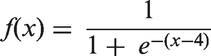
A comparison of model fit between models specified with a linear, quadratic and logged European Parliament election variables confirms the superiority of this approach.
The first step in each stage of the analysis is a simple growth curve model which models changes in party system size for each country as a function only of time, which provides a base point for model comparison. The second step introduces the measure of district magnitude difference. Changes in party size at the European Parliament level are expected to manifest themselves over successive elections, with diminishing returns as the European Parliament party system reaches that expected from the European Parliament electoral system, suggesting an interaction between the time and the difference between district magnitude variables, which is added to the model in the third step of analysis. In summary, the fixed effect portion of the model is specified as follows:

The fourth stage of analysis introduces a set of control variables which might also plausibly explain the change in the size of European Parliament party systems – differences in electoral thresholds between national and European Parliament elections, differences in turnout between national and European Parliament elections, and change to the size of the national party system between European Parliament elections.
The effect of an increase in European Parliament party system size is expected to operate more directly on national elections, with changes at a European Parliament election impacting on the size of the party system at the next national election. The second stage of analysis models the impact of European Parliament party system size on national elections following European Parliament elections. A multi-level model is run with variables measuring the national party system size before a European Parliament election and the size of the party system at the European Parliament election in a multi-level model, controlling for changes to electoral system at the national level using the same difference of log magnitudes measure used for European Parliament elections. The fixed effect portion of the model is specified as follows:

Results
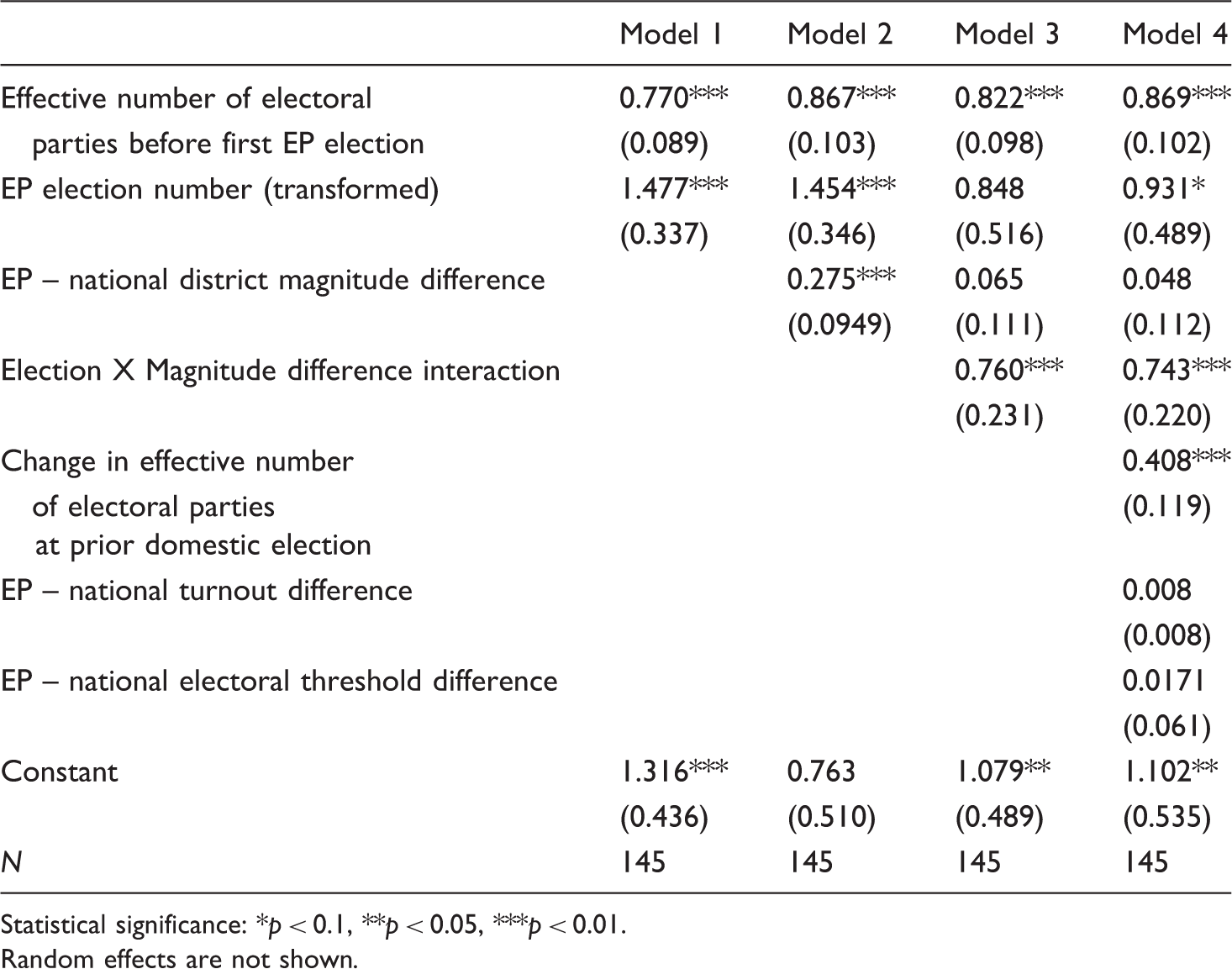
Results from multi-level mixed-effect growth curve models analysing changes in party system size at European Parliament elections.
Statistical significance: *p < 0.1, **p < 0.05, ***p < 0.01.
Random effects are not shown.
Model 2 adds the variable measuring the difference between the European Parliament and national electoral systems to the model as an initial test of the effect of electoral system differences. The coefficient is statistically significant and positive, indicating that the difference between electoral systems has on average increased the size of the party system at European Parliament elections.
Model 3 introduces the interaction term between the variables measuring the number of elections and differences in electoral systems and shows that as expected, the interaction between the two is statistically significant. Figure 2 illustrates this interaction and shows the marginal (average across all countries) effect of the difference between the electoral systems at the European Parliament and national level. The result shows the effect of a one unit increase in the difference between the logged European Parliament mean district magnitude and the logged national mean district magnitude (which is an electoral system at the European Parliament level that has a mean district magnitude that is e times greater than the national mean district magnitude). This is predicted to lead to a growth of 0.81 more effective electoral parties across the eight European Parliament elections than if the electoral systems were the same, an average growth of 0.1 effective parties per election, though again the effect is non-linear and occurs mostly between the third and sixth election elections.
Predicted difference in the effective number of parties at European Parliament elections when the difference between the logged European Parliament mean district magnitude and the logged national mean district magnitude is one across eight European Parliament elections.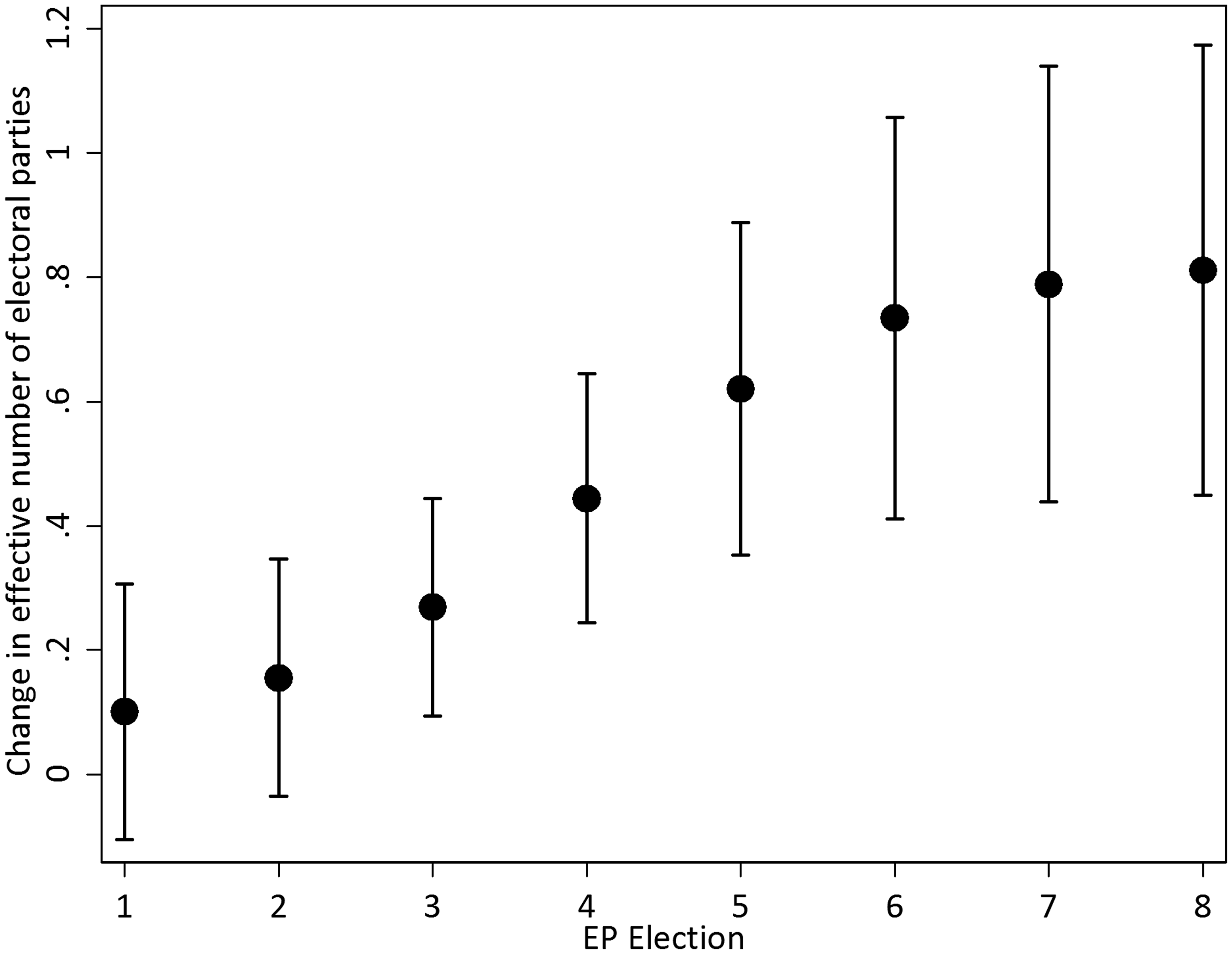
An alternative way of visualizing these results is by comparing what the expected party system would be at the first European Parliament election and after eight European Parliament elections for different levels of district magnitude differences between national and European Parliament electoral systems. These results are illustrated in Figure 3, which shows that at the first election there is very little effect of different electoral systems but by the eighth election a clear difference has emerged. As the European Parliament electoral system becomes more permissive than the national electoral system, the expected difference in the size of the party system after eight elections increases, with an effective doubling in the size of the size of the party system predicted for the largest level of difference between electoral systems.
Predicted effective number of electoral parties at the first and eighth EP election by the degree of differ between the district magnitude of the European Parliament and national electoral systems.
Model 4 adds the three control variables to the model. Neither different levels of turnout nor differences in electoral thresholds have a statistically significant effect on the size of the European Parliament party system. Unsurprisingly, changes in the size of the national party system (which may result from prior changes in the size of the European Parliament party system, as examined in the second part of the analysis) also affect the European Parliament party system, though these do not affect the size nor statistical significance of the impact of any of the variables included in Model 3.
These results offer support for hypothesis 1: the size of the party system at European Parliament elections grows as a function of the differences between electoral systems used at European Parliament and national elections. It is also important to note that the main effect of time is also statistically significant in Model 3. This indicates that although the party system in member-states with a more permissive European Parliament electoral system grow more than those who use a more comparable electoral system, even those with equivalent electoral systems are predicted to grow by 0.79 effective electoral parties over eight European Parliament elections, suggesting that as well as an effect of district magnitude there is also a more general ‘European Parliament’ effect on the size of the party system.
The final model provides a very accurate estimation of the changes in European Parliament party system size. Figure 4 illustrates the predicted and observed changes in the size of the European Parliament party system size (for reasons of space and because the older member-states have had more elections and so are more illustrative of the results, restricted to the 15 pre- 2004 EU members). Two countries in particular are worth examining in more detail because of changes introduced to the European Parliament electoral system in each country after several European Parliament elections had already been held: France and the UK. Between 1979 and 1999 France conducted European Parliament elections with a single national constituency, with a mean district magnitude of 83.4 across the five elections. In 2004, France introduced eight regional constituencies, with a mean district magnitude of 9.75. Following the logic of the Duvergerian effects of electoral systems we would expect this to result in a reduction in the size of the party system, which is both what is predicted by the model and observed in the data.
Predicted and observed changes to the effective number of electoral parties at European Parliament elections for the pre-2004 EU member-states.
The UK offers the opposite case. The four European Parliament elections held prior to 1999 were held using single member districts elected by a plurality voting rule (except for Northern Ireland, which elected its three MEPs in a single constituency by Single Transferable Vote, and continues to do so). In 1999, a more proportional electoral system was introduced, with 12 regional constituencies electing an average of 7.25 MEPs each (falling to six by 2009 due to a reduction in the number of British MEPs). Again, following the logic of the Duvergerian effects of electoral systems we should observe an increase in the effective number of electoral parties. The model predictions as well as the data support this expectation.
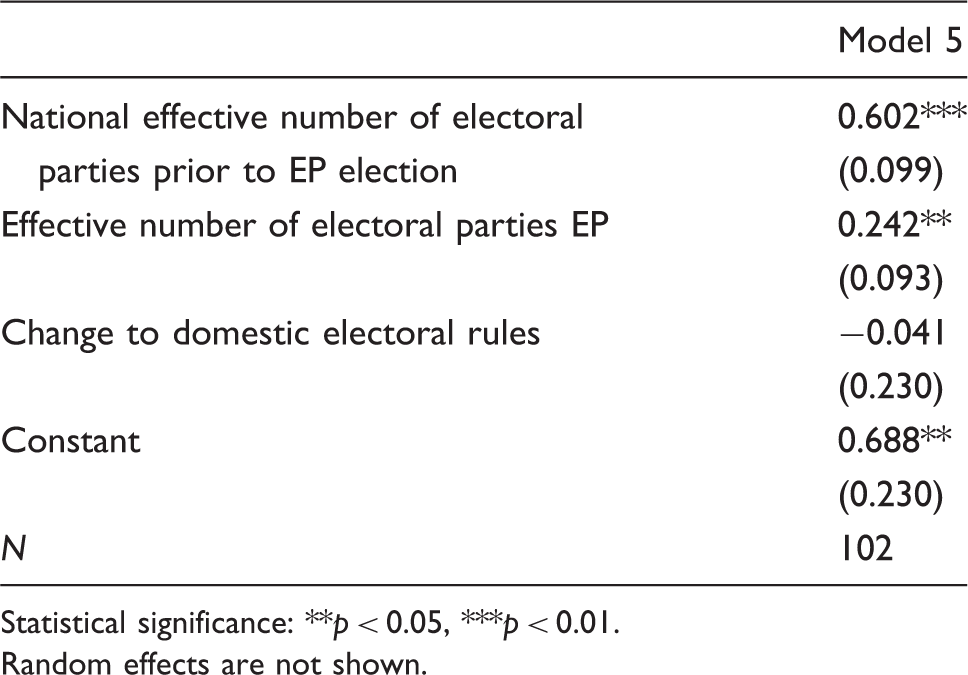
Table 2 shows the results for stage two of the analysis, investigating the feedback effect of change in the size of the party system at European Parliament elections on the size of party system at the national level. The results show that, accounting for prior party system size at the national level, the effect of the European Parliament party system size on subsequent national party system size is statistically significant, supporting hypothesis 2. The effect of changes to national district magnitude is not statistically significant, though this is likely due to the fact that for the vast bulk of cases the electoral system is reasonably stable and large differences are only observed for a handful of cases. The impact of the party system at the European Parliament level is illustrated in Figure 5. Each additional effective electoral party at the European Parliament level is expected to result in an additional 0.24 effective electoral parties at the national level. This suggests that although the European Parliament party system does feed back into the national party system as expected, the relationship is not simply a case of one for one substitution and that the European Parliament party system may be acting as a more expansive parallel national party system.
Predicted effect of European Parliament party system size on the effective number of electoral parties at national elections following European Parliament elections. Results from multi-level model analysing changes in party system size at national elections following European Parliament elections. Statistical significance: **p < 0.05, ***p < 0.01. Random effects are not shown.
Conclusion
This article set out to analyse two questions: does the electoral system used in European Parliament elections affect the size of the party system at European Parliament elections, and do changes to the size of party systems at the European Parliament level feed back into party systems at the national level. The evidence strongly supports an affirmative answer to both of these questions. Where more permissive electoral systems are used for European Parliament elections there has been more growth in the size of the party system. The growth of European Parliament party systems has in turn led to an increase in the size of party systems at national elections.
It is important not to overstate these results. The analysis here does partially support the earlier argument put forward by van der Eijk and Franklin (1996) that the success of new parties and the resulting change in the size of the party system can be attributed to the strategic context of European Parliament elections. Regardless of differences in electoral systems between the national and European Parliament level, party systems tend to grow over consecutive European Parliament elections. Where the present analysis differs from the earlier analysis by van der Eijk and Franklin is the finding that electoral systems do have an influence on changes to party systems: party systems tend to grow more when the electoral system used for European Parliament elections is more permissive than that used for national elections.
That this is the case is an important finding for scholars of both European Parliament elections and electoral systems more generally. Although a great deal of attention has been paid to voting behaviour in European Parliament elections, the importance of the relationship between national and European Parliament electoral systems has been overlooked by most of the existing scholarship.
These findings also have important implications for European democracy. Some scholars, most notably Peter Mair (2007a, 2007b, 2013), have argued that the process of European integration has narrowed the lines of political competition because it shifts political competencies away from the arena of national electoral competition, undermining the foundations of political representation through political parties. The findings here suggest that there may be reasons to be more optimistic about the future of representative democracy in Europe. This is not to disagree with Mair’s prescient diagnosis of the crisis of European political parties, simply that as well as a source of decline, European integration may also prove a facilitator of renewal. By providing an arena in which there is less need to vote strategically, European Parliament elections assist the entry of new parties and the redistribution of support between existing parties, providing a possible remedy to the decline of the traditional party system.
Following the fourth European Parliament election, van der Eijk et al. (1996) argued that the unique nature of European Parliament elections provide an important comparative resource that can give us insights into not just how voters make decisions on the European level but how the institutional and contextual factors condition vote choices more generally. The findings here have two implications for more general research on the effects of electoral rules. First, it supports the general validity of Duvergerian effects against those who have argued that we only observe the correlation between electoral and party systems because of endogeneity. When the implementation of electoral rules is influenced by exogenous factors, as is the case in European Parliament elections, we observe changes to party systems along Duvergerian lines.
Second, the questions raised here about the impact that electoral rules for second order elections have on national party systems have implications for more general research on the effects of electoral systems. Elections and electoral systems are often studied as if they exist in a vacuum. Although European Parliament elections may be unique as supranational elections, many countries have experience with using different electoral systems for different elections, whether for different chambers of parliament, for presidents and legislatures, or regional and local elections. How these different elections interact in determining political outcomes is a neglected area of the study of politics which has tended to assume that only the electoral system for the most important political arena matters. The results here suggest that we may have been wrong to do so: the electoral rules of ‘second order’ elections may well have important consequences for first order politics.
Footnotes
Declaration of conflicting interests
The author(s) declared no potential conflicts of interest with respect to the research, authorship, and/or publication of this article.
Funding
The author(s) received no financial support for the research, authorship, and/or publication of this article.
Notes
References
Supplementary Material
Please find the following supplemental material available below.
For Open Access articles published under a Creative Commons License, all supplemental material carries the same license as the article it is associated with.
For non-Open Access articles published, all supplemental material carries a non-exclusive license, and permission requests for re-use of supplemental material or any part of supplemental material shall be sent directly to the copyright owner as specified in the copyright notice associated with the article.
