







Abstract
Ethnographic studies of collective trauma often overlook the ways emotion surfaces beyond speech, in silences, atmospheres, and bodily cues. This paper introduces Emotion-as-Method (EAM), a layered ethnographic framework that treats emotion as both evidence and method, functioning simultaneously as an analytic framework for interpreting data and as a research approach practiced throughout fieldwork. EAM specifies six analytic constructs (mood and intensity, collective affect, safety and trust, shame and stigma, agency and disempowerment, and trauma responses) read across three layers: self-report, behavioral–linguistic, and contextual. The unit of analysis is the episode, a bounded moment where shifts in voice, posture, or atmosphere become analytically visible. Triangulating across layers distinguishes convergence and dissonance, revealing how trauma is lived, withheld, or transformed within wider infrastructures of memory and power. By formalizing these practices, EAM offers ethnographers a transferable scaffold that strengthens methodological rigor and expands how qualitative research can witness and interpret collective trauma.
Introduction
When studying collective trauma, ethnographers work with painful living memories and fragile relationships, with archives that spill into present-day political disputes, and within sociopolitical environments where vulnerability, power, and political agendas converge (Alexander et al., 2004; Erikson, 1991). This creates significant methodological and ethical challenges, including the lack of an integrated framework for observing and interpreting affect. Existing scholarship provides well-developed methodological and analytical approaches to coding trauma narratives, including narrative analysis (Riessman, 2008), thematic coding (Braun and Clarke, 2006), and grounded theory approaches (Charmaz, 2006), alongside theoretical frameworks on testimony and traumatic memory (Caruth, 1996; Felman and Laub, 1992; Herman, 2015); it is less equipped, however, to trace trauma as all at once: an embodied individual experience, with contextual, recurring, and atmospheric dynamics continuously shaped by politics; with its shifts from passive, internalized states (fear, shame) to more active, outward expressions (anger, resistance). What is needed are methods that are systematically attentive, contextually responsive, and ethically grounded (Appuhamilage, 2020; Cruz, 2016; Wetherell, 2012).
EAM has been developed and can be applied in contexts, where collective trauma is shaped by political and institutional forces, and where power influences what can be felt, spoken, and witnessed. These include settings where violence, grief, and rupture are lived collectively in the past and now, and carried across generations to the future, such as war and forced displacement; in places like court hearings or journalists’ interviews, where survivors navigate suspicion and disbelief and make pragmatic decisions about what can be said and what must remain unsaid; transitional justice and post-conflict contexts, where commemorative rituals and memory infrastructures determine whose losses are publicly mourned and whose remain unspoken; and educational settings serving divided and unreconciled communities, where contested histories can either deepen division or open pathways toward shared understanding. In these spaces, collective trauma is lived, constructed and reproduced by stories and testimonies, but also by what is stored in the body and held in silence.
This paper emerges from two parallel streams that have shaped both the need for and the development of EAM. The first is the ongoing EU-funded project MAGnituDe 1 on affect in contexts of war and forced displacement, within which new SensArticulate methodologies are being developed and piloted by an international research cohort. Across this collaboration, recurring ethical and methodological challenges in researching emotions have been identified, alongside a shared need to strengthen the conceptual foundations of the field. The second stream builds on the author’s earlier work with traumatized communities, where it became evident that reducing the expectation to speak and incorporating non-verbal and arts-based methods created space for participants to respond more freely, supported greater agency, and generated embodied forms of knowledge that verbal transcripts could not capture (Appuhamilage, 2020; De Smet et al., 2024). EAM’s six constructs and three analytical layers were built from patterns first observed in this fieldwork and subsequently refined through engagement with affect theory, trauma studies, and qualitative methodology.
Although collective trauma scholarship richly analyzes emotions as a subject, it less often interrogates how emotions are methodologically studied (Appuhamilage, 2020; Cromby, 2012; Kahl, 2019). In standard ethnographic practice, emotions are typically captured in transcripts, as in this excerpt from fieldwork in 2024 in Lebanon: When I asked about getting rid of it /abortion, a.n/, the nurse told me (stops, looks down) to be ashamed… (long pause) Later, somehow, my neighbor stopped speaking to me (long pause, she sighs) … as if she might get 'infected'… (nervous laugh and then a long silence, hands clenched in lap).
Across feminist theory, affect studies, qualitative methodology, and ethnography, scholars have long argued that emotion is not a distraction from rigorous research but a constitutive dimension of knowledge production itself. Theoretically, Ahmed (2013) shows that emotions are not private states but relational and political forces, while Massumi (2015) and Ticineto Clough (2009) treat affect as a primary analytical register. Methodologically, Baillie Smith and Jenkins (2012) call for ‘emotional methodologies’; Bondi (2016) demonstrates how emotional dynamics structure researcher–participant relations; Cromby (2012) argues that attention to feeling strengthens rather than weakens rigor; and Dickson-Swift et al. (2009) describe qualitative research as emotional labor. Empirically, Gray (2008) and Meloni (2020) show how researchers’ own emotional responses can become data. Together, these contributions establish that emotion is not something that happens alongside research but an essential part of what produces it.
Yet most of these studies remain grounded in talk-centered designs that privilege coherent narratives and measurable symptoms, struggling to interpret silence, embodied traces, and body language (Ellingson, 2017; Henry, 2006; Puvimanasinghe et al., 2015). Overlooking these dimensions risks diminishing survivor accounts and causing ethical harm, including re-traumatization (Campbell et al., 2008; Connolly and Reilly, 2007; Nguyen, 2011). For the ethnographic researcher, this creates a concrete responsibility: to recognize when a participant is nearing the limits of what they feel safe sharing, to adapt accordingly, and to treat the encounter as an ethically accountable space rather than a neutral site of data extraction (Birch and Miller, 2000; Guillemin and Gillam, 2004).
Emotion-as-method: Framework, scope, and purpose
In contrast to talk-centered approaches, EAM treats emotional expression as situated evidence in its own right by proposing an ethnographic framework that systematically and with equal importance observes silence, hesitation, posture, and atmosphere alongside speech. Because method is never neutral — it carries affect and shapes both researcher and participant (Bourdieu et al., 1999; Dickson-Swift et al., 2009; Tamas, 2009) — it can also become a practice of care and accountability, reframing memory-work as shared rather than solely individual. As no methodological approach can guarantee unmediated access to another person’s emotional experience (Cromby, 2012; Wetherell, 2012), EAM is not about certainty, but an attempt to provide a structured way of noticing and interpreting what unfolds in the research encounter as a whole event, not limited to the exchange of words only. Its purpose is not to classify what participants are experiencing, but to help researchers notice, respond ethically, and situate what they observe within the political and institutional conditions that shape it.
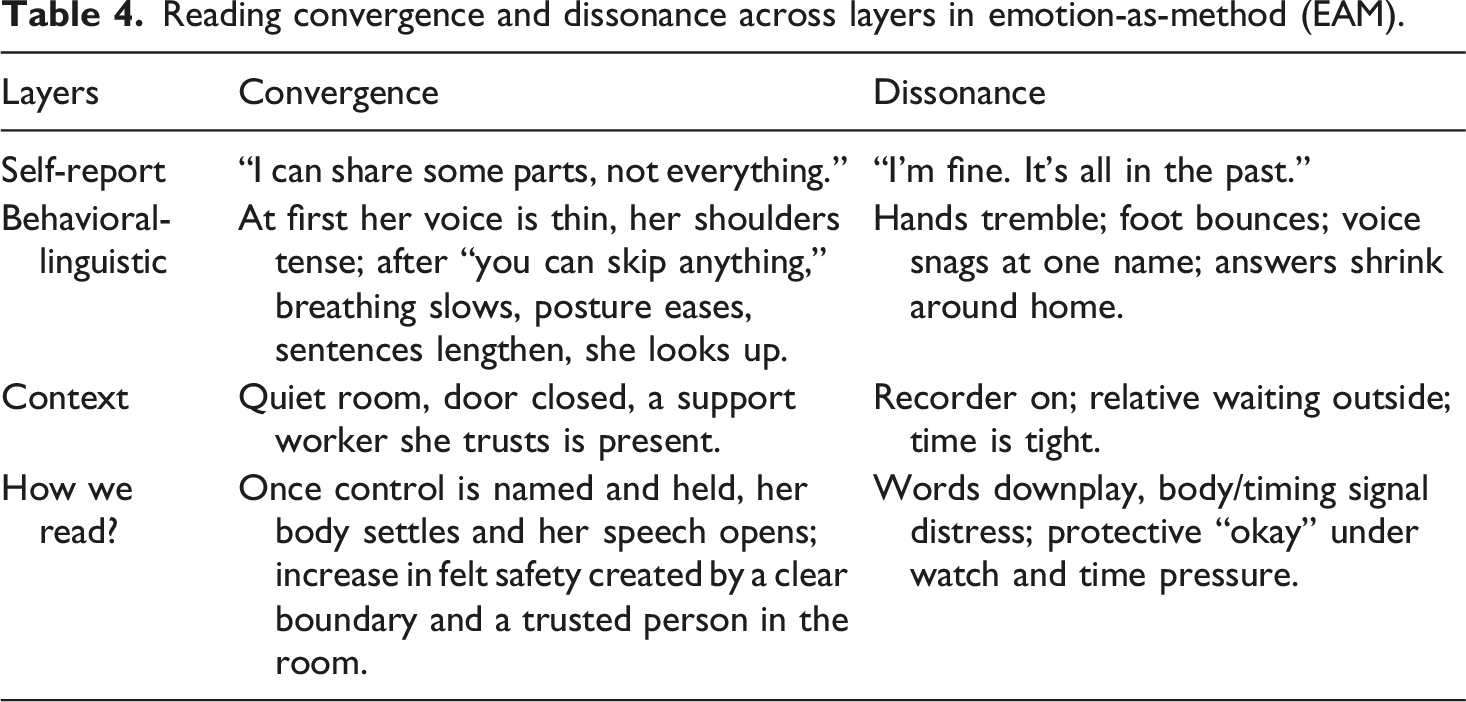
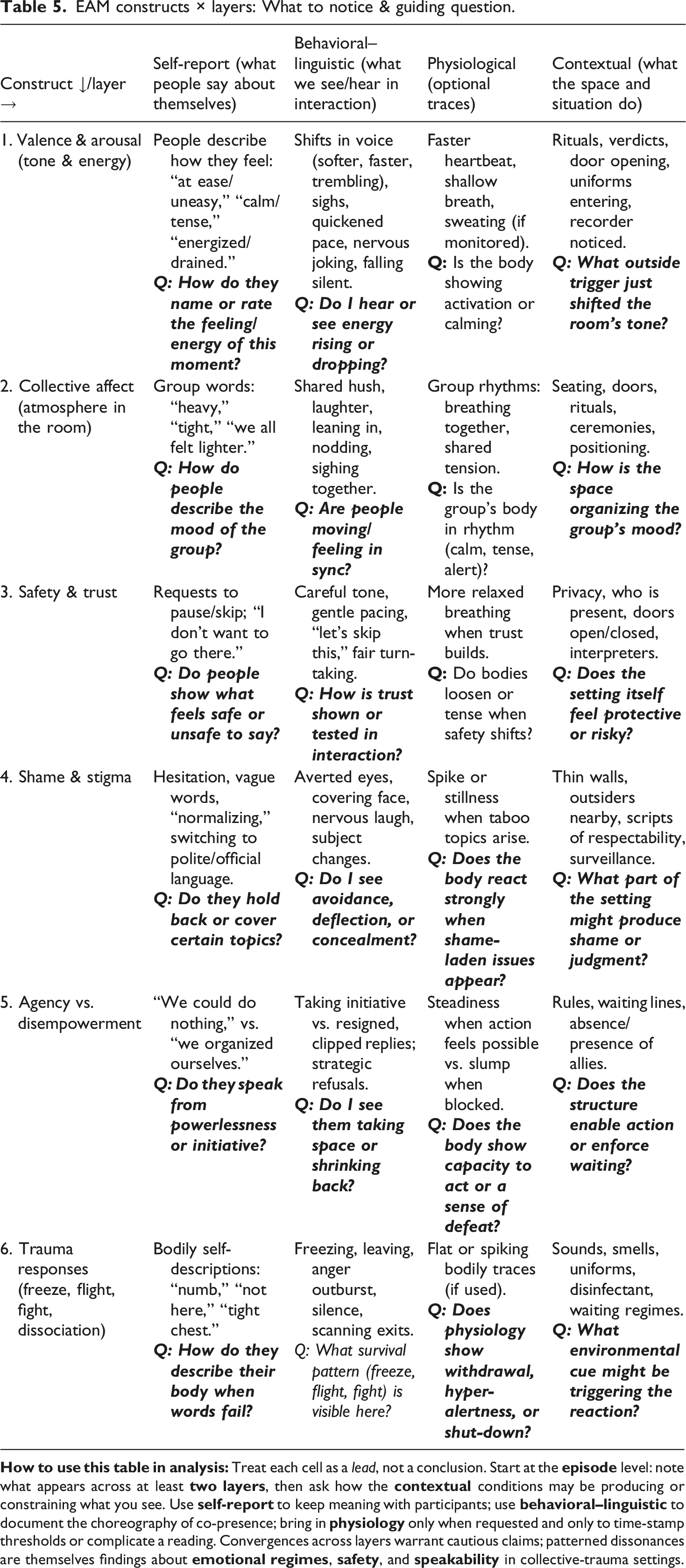
EAM identifies six analytical constructs that frequently appear in collective-trauma settings, distributed across three complementary analytical layers, with the episode as the basic unit of analysis: a brief stretch of interaction in which something shifts in what people say, how they move, or the feel of the space. Each episode is read across layers to identify convergence (alignment of cues) or dissonance (mismatch of cues), which often signals dynamics of power, surveillance, or shame. EAM functions both as an analytic framework and as a research approach, shaping fieldwork from the outset: how encounters are designed, how rooms are arranged, how consent is structured, and how researchers attune to embodied cues in real time. It is designed primarily for contexts where political and institutional forces shape how trauma is expressed, interpreted, and addressed, but it also applies to any research encounter where these forces influence what can be felt and spoken, whether or not those affected can openly share their experiences.
The range of contexts in which EAM can be applied is best understood through the concept of a spectrum rather than a fixed category. At one end are events such as war, genocide, and forced displacement, forms of harm that are unambiguously collective in scale, social organization, and intergenerational effects. At the other end are experiences that are individually lived but produced and sustained by shared social and institutional forces, such as reproductive stigma under restrictive legal regimes, criminalized identities, or certain forms of forced migration, where the causes are deeply political but the experience often remains isolated because the very systems producing the harm also prevent collective expression or recognition. What matters for EAM’s applicability is not whether trauma is openly shared or publicly acknowledged, but whether the conditions shaping what people feel, say, or remain silent about are structured by broader political and institutional forces, and whether those conditions leave traces that attention to embodiment, atmosphere, and relational dynamics can make visible.
EAM reframes emotion not as a private state but as a relational practice, helping researchers notice moments when people move from silence or paralysis toward agency and collective voice. This shift helps avoid reducing trauma to medicalized or extractive categories, which decolonial scholars have shown can reproduce colonial patterns of knowledge extraction from marginalized communities (Tuhiwai Smith, 2021), and makes visible how emotions shape social life and how social life, in turn, shapes emotion. The sections that follow develop each component in detail.
Why and how studying emotions as relational matters in collective trauma research
Tracing emotions in motion
Collective trauma refers to the psychological, emotional, and social impact on communities following socio-political ruptures, that is historically situated events with identifiable perpetrators, contexts, and consequences (Alexander et al., 2004; Erikson, 1991; Volkan, 2018). It is a social wound that reshapes how a community understands itself, its values, and its sense of continuity, lived not only in individual experience but also in altered relationships, institutions, and shared emotional climates over time (Das et al., 2000; Erikson, 1991). It can be understood through three interconnected dimensions. First, it disrupts the social fabric, breaking down shared trust, continuity, and meaning, which affects the relationships and structures that hold a community together (Erikson, 1991). Second, responses to trauma become shared through grief, memory, and meaning-making, and carried forward through communal practices, rituals, and institutions (Connerton, 1989; Halbwachs, 2020). Third, it shapes how a community redefines itself across generations, influencing how it understands its past and imagines its future (Alexander et al., 2004; Volkan, 2018). These three dimensions distinguish collective trauma from individual trauma, even though individual experiences are often shaped by broader political conditions.
Communities transform trauma into memory through narrating, commemorating, and sometimes suppressing these events (Assmann, 1995; Connerton, 1989; Halbwachs, 2020). Memory is sustained through cultural forms, such as museums, memorials, ceremonies, school curricula, and media, which shape what is remembered and how it is felt (Olick, 2007). Each collective memory carries an emotional script of codes where some losses are publicly mourned while others remain unspoken (Ahmed, 2004; Butler, 2004; Lutz and Abu-Lughod, 1990). These scripts shape how survivors tell their stories. In interviews, participants may follow official narratives, resist them, or move between public and more private, vulnerable accounts. Emotion emerges not only through words, but through tone, pauses, gestures, and silence, and often reflecting the cultural and political work that memory performs. EAM encourages researchers to pay attention not just to what someone says, but how they say it: pauses, changes in tone, shifts in language, and silences are part of the data. A move from personal memory to formal or public language is not a change to be ignored, because this shift itself is data, showing how macro-level trauma narratives shape what can be said in this room, at this moment. In the study of collective trauma, emotions unfold along the following arc: (1) Traumatic event → (2) collective trauma → (3) collective memory → (4) emotional coding → (5) testimony (researched) encounter → (6) observed emotion in EAM
What emerges in a research encounter carries a history of experiences, relationships, and social forces that shape both what is felt and how it can be expressed, which is what distinguishes EAM from approaches that treat interviews as sites of verbal information extraction, and why seemingly minor changes in the research setting may be entangled with wider dynamics of memory politics (Alexander et al., 2004; Halbwachs, 2020; Latour, 2005; Wetherell, 2012). Ahmed (2013) argues that emotions circulate between people and become attached to particular figures and stories, shaping political attachments; however, this circulation happens within social landscapes already shaped by power, inequality, and historically established hierarchies, where some emotions are acknowledged while others are silenced (Tolia-Kelly, 2006). Decolonial scholars have shown that these hierarchies are built into how knowledge is produced: the emotional experiences of communities shaped by colonial histories are routinely pushed aside, while only emotions recognized within dominant traditions count as valid evidence (Maldonado-Torres, 2017; Mignolo, 2009; Wilson, 2001). EAM responds by attending to whose silence is taken seriously, whose distress is recognized as testimony, and whose emotional responses are treated as meaningful data rather than interference, making it not only a methodological but a political approach.
Affect versus emotions — differences in definition and research approach.
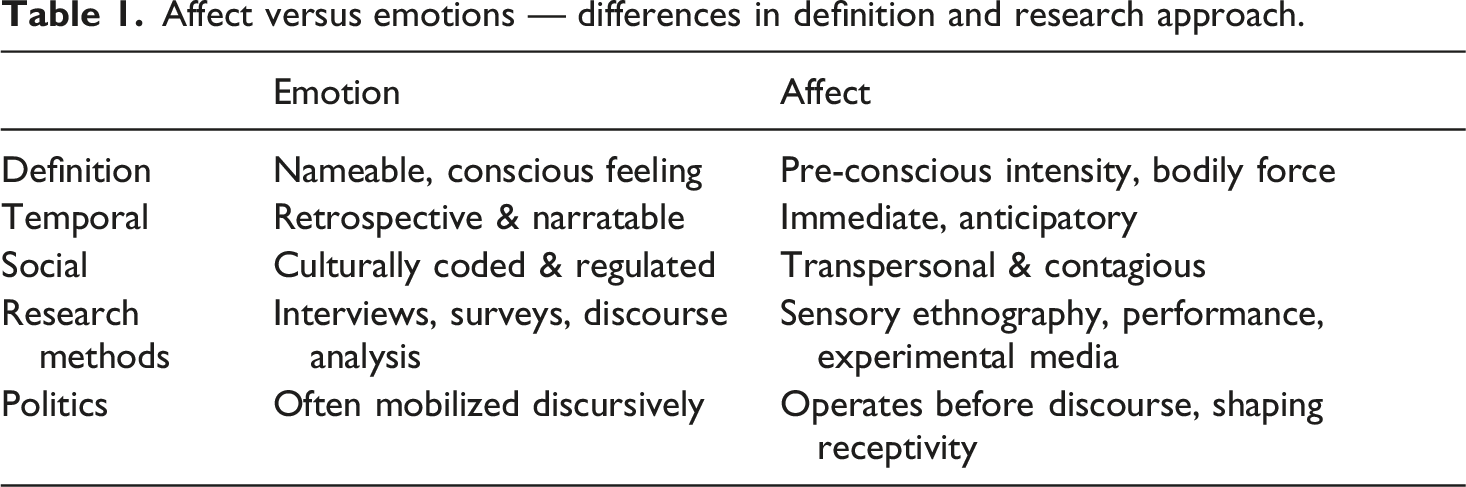
Testimonies and interviews as affective and emotional sites
In ethnographic research, interviews and focus groups are not neutral acts of ‘fact-gathering’ but situated affective events in which researchers participate in co-constructing a narrative (Dickson-Swift et al., 2009; Fontana and Frey, 2005; Kvale and Brinkmann, 2009) and, in the context of collective trauma, a memory (Eastmond, 2007). Within ethnography specifically, the interview is shaped by the same relational dynamics of trust, power, and presence that characterize fieldwork more broadly (DeWalt and DeWalt, 2011; Hammersley and Atkinson, 2019). Emotions may surface loudly and unmistakably, as overt grief, anger, or pride, but just as often they emerge through silence, avoidance, or formalized, bureaucratic speech. Embodied cues matter too: a shoulder tightening at a phrase, or a nervous laugh after something almost unsayable, are reminders that traumatic memory is not only spoken but lived in the body.
Shifts in emotional state can reveal where a story becomes difficult to tell, signaling a transition from an official account to something more personal and vulnerable. A brief remark such as “we don’t speak about that at home” (fieldwork, Lebanon, 2024) can be a powerful signal that some parts of a story carry more risk than others. Changes in how someone speaks, for instance slowing down, using more formal language, or becoming more polite, may suggest they are moving into a safer, more publicly accepted way of telling their story. Paying attention to these shifts helps distinguish between ‘hot memories’, that are vivid, emotionally charged, and often contested and which tend to announce themselves through embodied disruption such as a break in pace, a drop in voice, or a sudden stillness, and ‘cool memories’ that more ritualized, standardized, and formulaic (Connerton, 1989; Eyerman, 2001). But sometimes the speaker breaks away from the script entirely, and rather than waiting for them to return to structured talk, those moments of departure are among the most analytically significant: pointing to where dominant memory frames reach their limits and where something more contested begins to surface (Kidron, 2009; Wetherell, 2012).
Who else is in the room matters, as do material arrangements: the recorder on the table, the open window that makes a conversation public to the street. Formal settings invite formal language; people lean on bureaucratic speech to stay safe (Bohmer and Shuman, 2017; Joniak-Lüthi, 2016; McKinney, 2007). In other settings, the non-said is the point: silence can be a practice of care, a refusal, or a way to hold dignity (Cruz, 2016; Kidron, 2009; Mazzei, 2007).
Several studies emphasize that uneven stories are common for trauma survivors, because people may pause, change details, or contradict themselves not because they are lying, but because depression, anxiety, and time make memory harder to retrieve (Herlihy et al., 2002; Weishut and Steiner-Birmanns, 2024). Yet in asylum hearings or courtrooms, such gaps can easily be taken as proof that testimony has been fabricated (Herlihy et al., 2002). Rather than treating coherence as the measure of truth, EAM asks what the account does in its setting and how it aligns with other traces: bodily signs, the local politics of memory, and what research tells us about how trauma is recalled (Appuhamilage, 2020; Ehlers and Clark, 2000; Herman, 2015).
Reflexivity, positionality, and ethical challenges
As Bourdieu explains, true rigor is not about claiming neutrality, but about staying reflexive, regularly examining how our assumptions and ways of thinking influence the knowledge we produce (in Bourdieu et al., 1999, 621). In recent decades these reflections have often been condensed into positionality statements (Berger, 2015), but as this becomes normalized it risks sliding into tokenism, reproducing the very asymmetries it aims to expose (Berger, 2015; Carstensen-Egwuom, 2014; Guillemin and Gillam, 2004). Positionality can reinforce a West versus ‘Third World’ binary (Robertson, 2002), which from a decolonial methodological perspective, scholars argue is a structural risk because the very categories through which reflexivity is performed are products of Western epistemological traditions that may reproduce the hierarchies they claim to unsettle (Chilisa, 2019; Tuhiwai Smith, 2021). Savolainen et al. (2023) argue that positionality statements should be avoided entirely, and I share the concern when positionality is about formulaic reflexivity; and yet, given the power-saturated nature of emotional life, simply omitting it seems too easy. Instead of providing a checklist of identity categories, EAM treats reflexivity as an ongoing practice: tracing how emotions are embodied, situated, and patterned by race, gender, class, and politics; asking not only what people say they feel, but how affects move and organize experience within relations of power. This requires caution, as turning to the nonverbal must not slip into mystification: emotional transmissions between bodies are always carried on historically saturated terrain, patterned by gender norms, racialized hierarchies, and the politics of who is allowed to show vulnerability and who is expected to stay silent (Appuhamilage, 2020). Reflexivity should therefore be understood as continuous practice, not stated performance: seeking iterative consent, practicing active listening, attending to ‘ethically important moments’ (Guillemin and Gillam, 2004), and being willing to pause, renegotiate, or stop the research encounter when needed.
In collective trauma research, the researcher is never a detached observer but a participant in the very moment they share with research participants. When a participant recounts something unbearable, the researcher may find their own breathing has changed or that they are holding tension in their body. In EAM, these responses are part of what is happening where the researcher’s emotional reactions can function as evidence of the relational field being studied (Gray, 2008; Hubbard et al., 2001), formalized through AC-2 (collective affect). Researchers working in conflict-affected and trauma-saturated settings often become embodied witnesses, carrying stories long after fieldwork ends as ‘long shadows of the field’ (Taylor, 2019), where unprocessed grief and emotional residue shape how researchers interpret what they have seen and heard.
While terms like vicarious trauma, secondary traumatic stress, and cumulative affective strain now appear regularly in the literature (Berger, 2021; Howe, 2022; Loyle and Simoni, 2017), institutions rarely build structures to address them. For this reason, researcher wellbeing is central to the integrity of EAM, because if the researcher’s body is part of the instrument, its condition matters (Dickson-Swift et al., 2007, 2009; Hubbard et al., 2001; Woodby et al., 2011).
When individuals expect stigma, disbelief, or surveillance, they tend to adjust their speech as a form of self-protection (Dalgaard and Montgomery, 2015; Joniak-Lüthi, 2016), aiming to provide a coherent narrative rather than expressing how an experience is actually lived (Bohmer and Shuman, 2017). Before entering the research encounter, memory institutions (for instance museums, schools, courts, and media) quietly set the emotional rules that shape what can be publicly grieved and what is left unsaid (Bosworth, 2023; Halbwachs, 2020; Reddy, 2001). Without a reflexive, power-aware ethical lens, emotions can easily be mistaken for personality traits or pathology, rather than recognized as meaningful, context-bound signals of how collective trauma is lived and managed.
Taken together, the three subsections establish the theoretical ground on which EAM stands: emotions in collective trauma are not private feelings but politically organized capacities, shaped by memory scripts, institutional arrangements, and histories of power that enter the room before a single word is spoken. Testimonies are affective events in which the researcher is always already implicated, namely, not as a neutral observer but as a participant in the co-construction of what can be said. Reflexivity, in this context, is not a methodological courtesy but an ethical and analytical necessity. In Section 4, these insights are translated into an operational framework.
Emotion-as-method (EAM): Framework and research approach
EAM developed out of two closely connected strands: the ongoing MAGnituDe research initiative and author’s earlier ethnographic work with traumatized communities. Across both contexts, a language-focused research revealed limitations in how much the transcript can capture: beside what is said, everything what is left unspoken goes unrecorded: from what participants feel but do not say to the atmosphere of the encounter itself. The framework’s six constructs and three analytical layers were built from repeated observations in the fieldwork and articulated using concepts from affect theory, trauma studies, and qualitative methodology. The overall structure is presented in Figure 1, with each component elaborated in the sections that follow. Overview of the emotion-as-method (EAM) framework.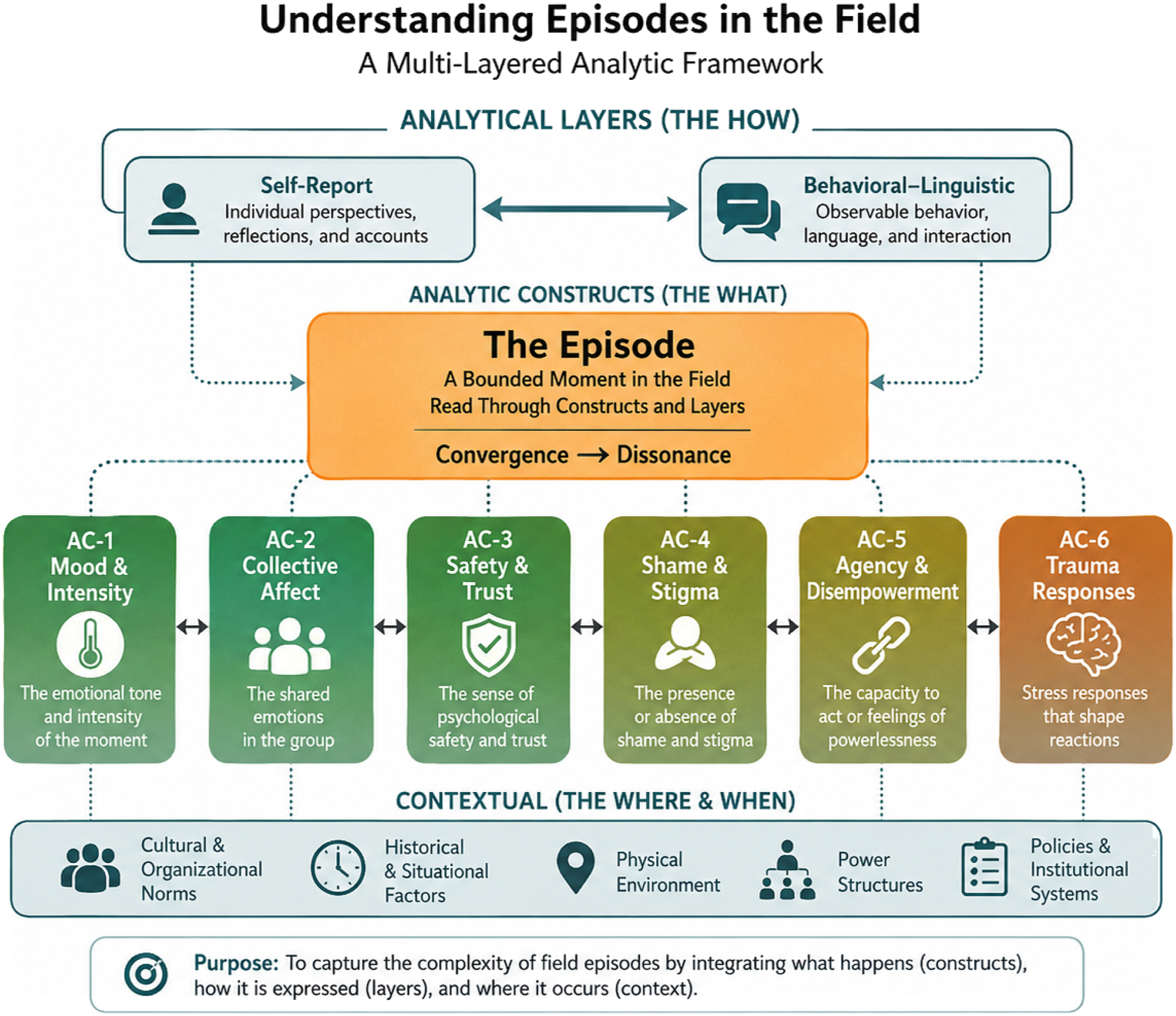
Six analytic constructs (AC): What is tracked in EAM and why
The six analytic constructs form the core of EAM’s observational approach, where each identifies a recurring emotional pattern encountered in collective trauma research. As working concepts grounded in theory and fieldwork, they help researchers attend to what is at stake in a particular moment, not only words and stories, but the full texture of the encounter. EAM is not a clinical tool for diagnosing trauma but a research tool for noticing possible signs of distress in order to respond ethically, adapt the research encounter, and situate observations within their broader political and institutional context. This matters because over-interpreting emotional responses as confirmed trauma can pathologize participants just as surely as ignoring those responses (Kirmayer et al., 2007; Nguyen, 2011). Each construct is examined across three analytical layers, and when these layers do not align, that mismatch becomes meaningful data, potentially pointing to issues of safety, surveillance, stigma, or shame.
AC-1: Mood and intensity
One of the easiest ways to start tracking emotional change in fieldwork is to focus on mood (whether the moment feels comfortable or distressing), and intensity (whether it feels calm or tense). Together, these function as a guiding compass, helping the researcher to register shifts, namely, noticing if a conversation suddenly becomes heavier or when silence takes on a more difficult, almost unsayable expression. In psychology of emotions, comparable dimensions (pleasant vs unpleasant; and calm vs excited) were first outlined by Wilhelm Wundt (in Reisenzein, 2000) and later formalized by James Russell (1980) through the idea of circumplex model of affect. Cross-cultural research (Fontaine and Breugelmans, 2021; Yik et al., 1999) indicates that these dimensions are widely applicable across different contexts, and they align with approaches that understand emotion as assembled from context, bodily change, and expression rather than as fixed internal categories (Scherer, 2005). In EAM they are adapted not to measure or quantify emotions, but to describe and record what the researcher notices. In the fieldnotes [tone -, energy↑] when distress rises and the room feels more charged; [tone+, energy↓] when tension eases, for example after a shared laugh.
Mood and intensity operate along a continuum, and noticing these changes can be more important than just looking at the final outcome. These tags are meant to guide attention, not to draw final conclusions. For the meaning making, mood and intensity need to be understood in relation to the context and what is unfolding in the interaction.
For that reason, tags should always be accompanied by fuller description: how the speaker’s voice changes, how the atmosphere in the room shifts, and what has just happened in the moment (for example, a name is mentioned, someone enters the room, or a document is placed on the table). In this process, two important points should be kept in mind. First, a charged atmosphere, with strong emotions, is not automatically negative or harmful. On the contrary, it may signal that people are reclaiming a sense of collective voice or strength, not only expressing fear or anger (Ahmed, 2004; Cvetkovich, 2003), as they are given the space to vocalize their story. Second, visible distress does not necessarily mean that the person in front of us has been harm, re-traumatized, triggered. In collective trauma research, moments of sadness can be appropriate, meaningful, and even necessary. The researcher’s responsibility is to remain attentive to participants’ safety and to ensure they have choice and control over how the conversation proceeds (Wetherell, 2012).
AC-2: The atmosphere/the space (collective affect)
Collective affect aims to describe feeling or atmosphere of a space, including shared emotional tone created by the interaction of bodies, objects, words, and routines, all existing before, during and after anyone speaks. People sense atmosphere quickly and often respond to it before they consciously name what they are feeling; only later might they describe it and give it a name (for instance anger, grief, hope, or pride). In affect theory, Massumi (2015) describes these as pre-conscious intensities that move between bodies before they become identifiable emotions. Ahmed (2013) argues that emotions do not simply float around but become attached to certain people, words, and objects, which, over time, build up shared meanings, so that a single name, symbol, or image can carry strong emotional force almost instantly.
While in most of the testimony research, atmosphere remains ignored, it should never be perceived just as a background especially in the context of collective trauma, where harm causing trauma (for instance genocide) is usually remembered and reproduced through shared arrangements like rituals and commemorations. This idea was suggested by Durkheim’s (2016) concept of collective effervescence or Collins’s (2014) theory of interaction ritual chains; and several scholars in memory studies (Connerton, 1989; Hodgkin and Radstone, 2003; Zembylas, 2016) debate how memory gatherings are not spontaneous, but shaped and maintained by shared rituals, repeated practices, and institutional frameworks that guide how people come together, remember, respond, and often, how they feel. If it is constructed, patterned and organized, this means that it can also be studied and analysed (Ahmed, 2004; Stewart, 2011). Focusing on collective affect, shifts attention in studying trauma beyond individual psychology, as shifts in tone, pace or posture are no longer observed as individual clinical condition but connected to larger systems of power and memory, and how this shape what people are able to feel, express, and act on.
If using EAM, alongside standard fieldnotes, keep a separate ‘atmosphere log’ is useful, as this is where researcher’s observations tone or intensity (from AC-1) shifts along with the setting, could be recorded, for instance: “People speak more quietly when they notice the door is open,” or “The room goes silent when asylum papers are placed on the table.” Over time, these notes help trace how emotional shifts are connected to material details and institutional signals, making visible how space, authority, and objects shape what participants feel able to express.
AC-3: Safety and trust
In trauma research, safety is usually perceived as the starting point for any kind of repair (Herman, 2015): what people are willing to say, and how deeply they are willing to go, depends on whether the situation feels safe enough. Safety is not just a private feeling of comfort but is shaped by relationships and institutions: in any research encounter, both researcher and participant negotiate what is spoken and what is withheld, what is renamed, and what is left unsaid. Researcher’s task is therefore not only to gather narrated memories, but to see how people manage risk and triggers as they speak: noticing hesitations, shifts in tone, careful wording, and moments of silence not as obstacles to data collection but as signs of how people are navigating threat in real time. Trauma-informed frameworks extend this awareness into research design itself, influencing everything from how a room is arranged and who is present, to how findings are interpreted, shared, and checked with participants (SAMHSA, 2014). Safety and trust also determine what kinds of data are even possible, because in contexts marked by stigma, disbelief, or surveillance, people often adjust what they say to protect themselves, and what may seem like detachment can actually reflect fear of consequences rather than a lack of experience (McKinney, 2007; Tamas, 2009). Safety is further shaped by gender, legal status, and community position, among others, and thus, uneven, which links linking small moments in the research encounter to wider structures of power. When people feel safer, they will open up, trust more, and consequently share more; when this feelings drops or disappear, they may withdraw, restrict their answers, or fall silent.
In contexts of collective trauma, there is also a political reason to centre safety and trust: they remain fragile and contested, making participant-led conditions essential for meaningful testimony and ethical analysis. When a possible trauma response is perceived by the researcher, any adjustment (such as slowing down or changing direction) should, wherever possible, be discussed with and confirmed by the participant rather than decided unilaterally. Participants remain the primary authority on their own experience, except in some cases (for instance with children or others who may find it difficult to express their needs), the researcher may need to act more protectively based on what EAM makes visible. Even then, the aim is to maintain safety and well-being, not to diagnose (Herman, 2015; SAMHSA, 2014). A key function of EAM is to help the researcher recognize when it is important to pause and invite a direct, participant-led conversation about how to proceed.
AC-4: Shame and stigma
Shame is a ‘master emotion’ in research on collective trauma (Scheff, 2000) because it can silence people more effectively than external restrictions on speech, such as rules, pressure, or fear of consequences (Leys, 2007). While fear points outward toward a visible threat, shame turns inward, making people monitor themselves, namely, tightening what they say, how they say it, and whether they speak at all. Feminist scholars have shown that shame does not have to remain with those who experienced harm but can be shifted away from survivors toward the institutions, cultures, or publics that enabled the violence (O’Shea Brown, 2021; Probyn, 2005). Stigma distributes shame unevenly, determining whose suffering is acknowledged and whose is dismissed, shaping the boundaries of belonging and exclusion (Butler, 2016; Nussbaum, 2009). It can appear before a single word is spoken, as people anticipate disbelief, blame, or moral judgment and begin self-censoring in advance.
By adding shame and stigma as analytic constructs, EAM opens space for different ways of telling. Testimony does not have to rely only on direct verbal disclosure, but can be composed gradually, slowly and indirectly through objects, documents, gestures, or signals offered by the places, where it is happening. During research encounter, it rarely appears as clear and straightforward state of participant, but it rather shows as hesitation around certain topics, shortened replies, a sudden shift of topic, or in the body through posture, gaze, or stillness. Like stigma, it operates along a continuum, from barely visible self-monitoring to full withdrawal from the encounter. Noticing this dynamic and changes, rather than simply concluding whether it is present or not, helps the researcher understand how strongly it shapes the moment.
Shame and stigma are always relations, meaning that they depend on who is present, where the conversation is happening, and what is at stake. Observing both in relation to other factors, shifts the researcher’s gaze from seeing participants as shy or reserved toward recognizing how institutions enforce silence, and how small changes in timing, setting, or audience can open or close possibilities for narration, relocating shame from the person who was harmed to the policies, institutions, and actors that caused or enabled it.
AC-5: Agency and disempowerment
Traumatic experience may break the social bonds that hold communities together, turning trust into suspicion and hope into paralysis (Erikson, 1991). Sharing memories and listening to each other can begin to ease this, opening small moments where people feel able to act again. As Spinoza (2005) suggests, people’s ability to act depends on the emotional conditions around them, for what agency does not always look like open resistance; it can be small and quiet, such as feeling less alone, caring for others, or working together to solve a problem. Disempowerment, on the other hand, is often created by everyday systems and situations, for instance unclear rules, or repeated efforts that lead nowhere. These experiences shape how people feel and act, often limiting their sense of control. In EAM, the researcher’s role is to notice how these shifts happen in real time and whether an interaction helps people feel more able to act or leaves them more discouraged.
AC-6: Trauma responses (fight/flight/freeze/dissociation)
Ethnographic traces of trauma responses in EAM.
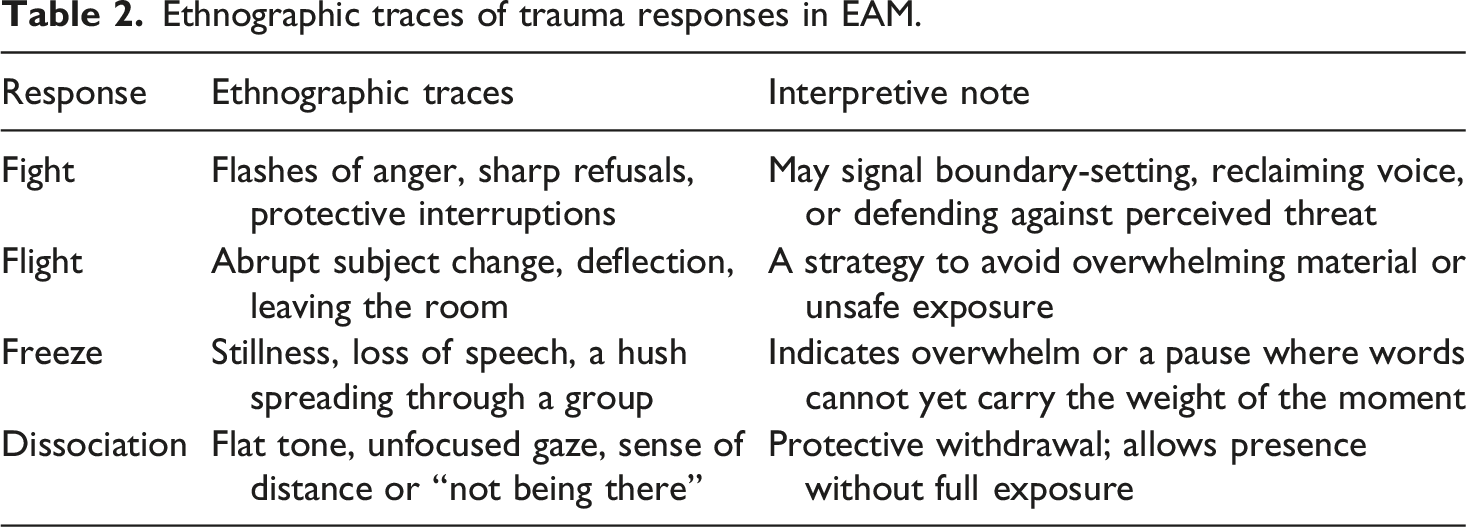
For social science researchers, these moments are not about pathologizing but about understanding how trauma continues to shape the body and social life, so trauma responses are considered alongside other constructs; for example, a sudden freeze (AC-6) may coincide with heightened intensity (AC-1) or cues of shame and stigma (AC-4). Reading these cues together helps show whether reactions are linked to personal memory, social pressure, or institutional surveillance. Rather than assigning clinical meaning, EAM focuses on how these responses shape the interaction, for example, how a sudden freeze or shift in tone affects what can be said, and what they reveal about safety, recognition, and the ongoing presence of trauma in the community. Keeping this question open helps avoid two risks: overlooking signs of distress, or treating embodied responses as definitive evidence of trauma (Nguyen, 2011).
Analytical layers
In EAM, no single sign is treated as proof on its own. Instead, each situation is interpreted through three complementary analytical layers that together provide the basis for interpretation. These layers are: 1. 2. 3.
A fourth dimension runs through all three layers: the researcher’s reflexive responses. As outlined in Section 3.3 and AC-2 (collective affect), the researcher’s bodily and emotional reactions are also part of the analysis. While working across the layers, the researcher notes their own affective state at key moments, ie. what they felt, how their body responded, and any shifts during the encounter. These reflections cut across all three layers, shaping how behavior is interpreted, how context is attended to, and how self-reports are understood. They are recorded in fieldnotes and, when relevant, included in convergence and dissonance memos as part of the interpretive record. By reading across these layers, no single cue is taken to represent the whole picture, and differences between layers are especially important. A person may verbally describe feeling calm while their body language suggests tension, or the broader institutional setting may explain reactions that neither words nor behavior alone fully clarify. These divergences are not treated as inconsistencies to be corrected; they are analysed as evidence of how safety, surveillance, power, or constraint operate within the encounter.
Self-report: Meaning, authorship, micro-consent
Self-report is the layer where participants describe their experiences in their own words, using the language, metaphors, and expressions that feel natural to them. As language is never neutral, the task is to design prompts that allow participants to choose their own words or resist predefined categories, while still creating enough consistency to trace patterns across encounters. Structure should support the research process without overriding the participant’s voice. EAM suggests using three types of prompts:
Behavioral–linguistic: Performance, choreography, co-presence
What is observed in behavioral-linguistic layers of EAM analysis (example).
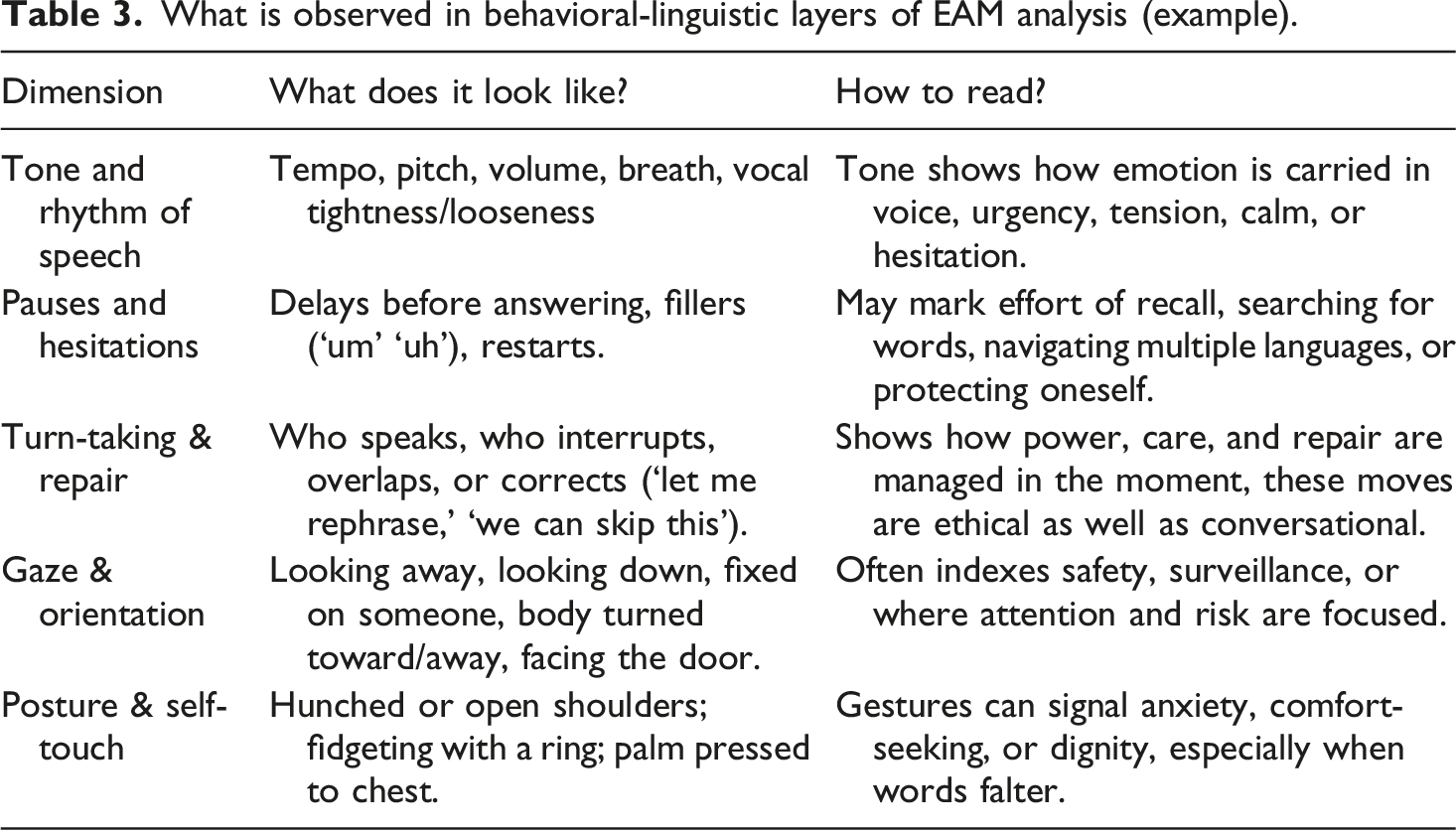
Contextual: Time, situations, and (Infra)structure
Emotions in collective trauma are shaped by the times and places in which they occur. Context explains why a pause that feels routine in one setting can feel heavy in another, or why silence in a courtroom carries a different weight than silence in a classroom. Emotions stick to places, objects, and bodies (Ahmed, 2004), and atmospheres arise not only from the dynamics between researcher and participants but also from how space is organized, who is present, and what hierarchies are active (Anderson, 2009). Time shapes emotion in similar ways: collective memory is sustained through shared temporal markers, such are commemorations, anniversaries, rituals, institutional schedules, that give rhythm to how trauma is remembered and expressed (Halbwachs, 2020). Studying emotion without attending to its time and place risks misreading calm as compliance rather than comfort, or agitation as disruption rather than civic energy. The contextual layer is built from three complementary sources. The first is pre-fieldwork research: before entering the field, the researcher maps the institutional, legal, and political landscape, for instance relevant laws, historical events, memory infrastructures, and social norms, so that what emerges in an encounter can be read against this backdrop. The second is in-room observation: during the encounter, the researcher attends to material and spatial cues, including who is present, where people sit, what documents are visible, whether doors are open or closed, noting how these details shift the atmosphere. The third is what participants themselves say or choose not to say: references to institutions, officials, laws, or community expectations are treated not as background information but as contextual data that directly shapes the interpretation of embodied and atmospheric cues. These three sources are recorded in the atmosphere log (AC-2) and fieldnotes, and brought into the analysis when reading each episode across layers.
Integration logic: Episodes, triangulation, and sequencing
In EAM, the episode is the basic unit of analysis: a short, contained stretch of interaction (for example a pause in speech, a change in tone, a sudden silence, a ritual gesture) that is examined closely in context. Each episode is interpreted through the six constructs, which help clarify what may be at stake: Is safety being negotiated? Is stigma shaping what can be said? Is agency beginning to emerge? To avoid abstract claims such as ‘a pause means sadness,’ EAM always asks: what does this sign mean here, in this specific setting? This keeps interpretation tied to observable conditions rather than reducing the moment to a psychological diagnosis. EAM works at the level of observable cues and their contextual conditions, not at the level of confirmed inner states, because what a participant is actually feeling at any given moment may be more complex, more ambivalent, or simply different from what any external observation can capture, and this irreducible gap between observation and experience is something EAM acknowledges rather than claims to close (Cromby, 2012; Wetherell, 2012).
While constructs explain why something may be happening, layers show how to read the scene. The goal is not to code isolated keywords but to reconstruct the moment with enough detail that a reader can understand what shifted and when. The analytical procedure unfolds in five steps, and unlike the six analytic constructs, which form EAM’s observational vocabulary, these steps describe how each episode is processed: 1. 2. 3. 4. 5.
Reading convergence and dissonance across layers in emotion-as-method (EAM).
EAM constructs × layers: What to notice & guiding question.
Putting EAM to work
The following example draws on fieldwork conducted in Lebanon in 2024, during an interview with a woman discussing her experience of social isolation following an abortion. Lebanon’s legal framework criminalizes abortion in almost all circumstances, and religious and social norms reinforce a shared cultural script in which abortion carries deep moral stigma, enforced not only through law but through medical practice, community surveillance, and family silence (Sabbagh et al., 2025). This case is chosen deliberately over more immediately recognizable examples of collective trauma such as war or forced displacement: if EAM can make collective dimensions visible in a setting where trauma is institutionally silenced and individually lived, it demonstrates the framework’s analytical reach more convincingly than a case where collective suffering is already publicly acknowledged. The shame this woman carries is not simply her own, but is institutionally produced, collectively enforced over generations, and experienced by women across the country in isolation from one another, precisely because the system that generates the stigma also prevents those affected from speaking to each other about it. This is the form of collective trauma identified at the lower end of the spectrum defined in Section 2: while it is individually lived, it is organized by shared political and institutional forces. The case demonstrates how EAM’s five analytical steps work together in practice, showing concretely what becomes visible when silence, posture, and atmosphere are treated as evidence alongside words.
The interview took place in a room at a community organization, with chairs facing each other and a small table between us. When we entered, three women were in the room: one left soon after to make coffee and later returned with it, another worked at the organization, and the third was the woman I was there to speak with. After they stepped out, we remained alone, though the door stayed open and we could hear voices and movement from the next room as others continued their work. The conversation began cautiously. She spoke in a careful, measured way as we talked about her work and daily life. The atmosphere shifted when her voice became softer and her body more still, with longer pauses between her words. At the same time, I became more aware of my own body, leaning in slightly and my breathing slowed, as she began to speak about her experience of the abortion.
Silence is not an absence of data but a meaningful response shaped by stigma and surveillance. Agency is present but constrained, visible in how she manages risk within these conditions. Reading across layers shows how words, silence, and atmosphere together reveal the broader structures shaping the encounter. Rather than a purely individual experience, this moment reflects shared social and political conditions, placing it within the scope of collective trauma. Had I only analyzed words, I would have recorded ‘ashamed’ and social isolation. Reading across layers shows how silence and atmosphere are themselves testimony, that reveal not only the weight of stigma on one woman’s memory and belonging, but how that weight is collectively organized through law, medical authority, and community silence. This is particularly important in work with trauma survivors, where responsibility for healing and social reintegration is still too often placed on survivors themselves rather than on the surrounding systems.
Methodological principles and future directions
Ethnographic research has long recognized that the conditions under which knowledge is produced are inseparable from the knowledge itself. The four principles reflect this tradition, focusing on the commitments that support EAM’s analytical integrity rather than on what it cannot do.
The first is interpretive humility. The meaning of a gesture or silence always depends on context, a person’s history, the situation or moment itself, and the risks present. Because no single cue speaks for itself, EAM relies on reading across multiple layers and staying open to different possible interpretations until patterns become clearer. This openness is not a weakness but a core strength of ethnographic work, helping keep interpretation grounded in lived complexity. At the same time, aware of limitations, EAM does not claim to have an access to the participant’s inner experience that can never be fully known. It therefore aims only to read what is observable more carefully and systematically (Cromby, 2012).
The second is that EAM is a learned practice. It requires set of skills, such are attentiveness and careful observation to atmosphere, and reading bodies, and interaction, that is only develop intentionally and over time through fieldwork, reflection, and discussion with others. It is also collective as sharing and discussing episode analyses within research teams helps test and refine interpretations.
The third is a commitment to study trauma through non-clinical approach. While it recognizes the knowledge and draws on clinical insights (in AC-6), EAM does not intend to diagnose, describing only what is observable without assigning labels or going beyond the researcher’s expertise. Trauma affects people in different ways, and EAM as a research tool cannot replace existing clinical assessment (Herman, 2015; Kirmayer et al., 2007). Maintaining this boundary requires ongoing reflection and discussion with others, especially to avoid over-interpreting what is observed (Nguyen, 2011).
The fourth is recognizing that the researcher’s emotional responses are part of the data. Working in trauma-intensive settings means researchers absorb not only what is said but also what is left unsaid, for instance the tensions held in silence, the atmosphere of the room, the shift in their own breathing. EAM makes this explicit through AC-2, treating researcher attunement as analytically productive rather than noise to be suppressed. This carries institutional implications: researcher wellbeing in emotionally demanding fieldwork is not a private concern but a shared responsibility that institutions, supervisors, and research teams are obligated to support.
Conclusion
EAM represents a methodological effort to advance ethnographic research on collective trauma by placing emotion at the centre of analysis and shifting attention beyond coherent speech to include embodied, atmospheric, and relational dimensions of encounters. By making these often-overlooked signals and conditions visible and analysable, EAM extends what can count as data in ethnographic practice and provides a structured, replicable process for moving from observation in the field to grounded analytical claims. In the context of collective trauma research, this approach helps reduce the risk of misinterpretation (pathologizing silence, mistaking performance for disclosure, or equating coherence with truth), all of which can have serious consequences for participants and their communities.
Three directions follow from this work. First is comparative application: EAM should be taken up by different research teams across varied contexts to assess where its constructs travel well and where they require adaptation. Second, future work could involve participants more directly in interpreting convergence and dissonance, therefore reflecting together on what a silence meant or whether an atmosphere of distrust was accurately perceived, and strengthening EAM’s connection with participatory and decolonial approaches that place community at the centre (Chilisa, 2019; Tuhiwai Smith, 2021). Third, if EAM helps reveal the conditions that shape what people feel able to say, then those conditions can be improved by adjusting the setting, who is present, and how interactions are timed.
By expanding what counts as data and offering a structured way to analyse affective dynamics, EAM generates findings that are not only analytically stronger but also practically useful with informing how institutions design testimony processes, how educators address historical trauma, and how policy environments either enable or restrict meaningful disclosure. The broader aim of EAM is therefore not only to strengthen ethnographic analysis, but to support more ethical, reparative, and structurally aware engagement with communities living through collective trauma.
Footnotes
Acknowledgements
The author would like to thank the displaced women, grassroots humanitarian workers, and healthcare providers who generously shared their time, experiences, and perspectives.

Funding
The author disclosed receipt of the following financial support for the research, authorship, and/or publication of this article: Funded by the European Union (Project: 101178269 — MAGnituDe — HORIZON-CL2-2024-DEMOCRACY-01). Views and opinions expressed are however those of the author only and do not necessarily reflect those of the European Union or European Research Executive Agency. Neither the European Union nor the granting authority can be held responsible for them.
Declaration of conflicting interests
The author declared no potential conflicts of interest with respect to the research, authorship, and/or publication of this article.
Data Availability Statement
No new data were collected or analyzed in this study. This article is conceptual and draws on existing literature.