







Abstract
Summary
Ever since the pandemic first broke out in 2020, there has been a swift shift from offline to online mode of education. The present study is aimed at examining the online learning experience among a sample of social work students in India (n = 202) in order to understand the crucial factors that can help improve their learning experience and so that they become effective social workers in the future.
Findings
The results have highlighted several independent factors such as the mode of connecting to the internet, number of hours of online classes per day, type of field work, rural/urban location of the students, and hours of sleep, among other variables, that are significantly associated with important indicators of the online learning experience of students.
Applications
The results point to the urgent need to reduce the number of hours of online classes, educate students on the importance of sleep, improve internet accessibility along affordability of learning tools such as laptops, especially for those residing in rural areas, and promote classroom discussion during online classes, so as to improve the online learning experience of social work students in India and to produce effective social work practitioners.
Introduction
The emergence of online distance learning has been rightly termed as a revolution (Kurzman, 2013). The pandemic that struck the world in 2020 has indirectly fueled this revolution to a significant extent. However, the free flow of human and financial capital along with the flow of goods and information has also been affected as a result of the spread of this deadly virus (O’Leary & Tsui, 2020). Several higher educational institutions around the world have shifted from classroom learning to online distance learning due to the outbreak of COVID-19. In this context, the prime objective of this study is to document the online learning experience of a sample of social work students in India and to record their feedback, so as to provide valuable suggestions for improvement. Online education or online learning can be defined as access to learning experiences through the use of some technology (Moore et al., 2011). In particular, a course in which a minimum of 80% of the content is delivered through the internet is called an online course (Bejerano, 2008). Online education often includes the use of video conferencing, chat rooms, and online discussion boards, to name a few (Palvia et al., 2018). The history of online education is closely connected with the history of computer networking with special reference to the invention of email, which is seen as a predecessor of online education (Harasim, 2000). In fact, emails have been used in the past to offer online education to students (Aguilera-Hermida et al., 2021). According to Harasim (2000), online education is marked by three modes of delivery: (1) adjunct mode, which is the use of technology to improve distance or traditional learning such as the use of the internet for distributing notes and assignments; (2) mixed mode, which involves a complete integration of networking into the curriculum and in which the course might be divided into two halves, one involving offline or face-to-face learning, while the other half would involve the use of online lectures or seminars; and (3) totally online mode, as a part of which the entire course is conducted online (Harasim, 2000). One of the recognized best practices concerning online education is student satisfaction related to the technology, level of access, curriculum/course design, learning outcomes, and interaction and support (Finch & Jacobs, 2012). The crux of this article is connected to this essential matter.
Review of literature
The history of online and technologically assisted social work education goes back to the 1960s in America when the University of California, Berkeley, began using the television for developing educational material related to group work and case work (Lee et al., 2019). The use of video tapes by the University of Chicago to educate social workers in the 1970s and the use of live satellite broadcast in the 1980s by the University of Wisconsin-Maddison, to teach students off campus, are also some of the earliest efforts to take social work education to the online realm (Lee et al., 2019). The 1980s and 1990s also witnessed the use of hyper-text cum computer-based teaching and learning of clinical skills to be used in counseling settings (Coe Regan & Youn, 2008). In fact, by the year 1989, there were reports of video and audiotapes, apart from fax machines and emails, being used as instruments to teach social work (Siegel et al., 1998). Now, the spread of the internet and increased accessibility of computers have led to an increased interest in online social work education, at least in the west (Moore et al., 2015).
With the improvement in computing technology, today, it is possible to conduct online classes through virtual classrooms and video-call platforms such as Google Classroom, Zoom, Slack, Cisco, and WebEx (Pokhrel & Chhetri, 2021). It is interesting to note that it is not just academic courses that have adopted online teaching and learning as a result of the pandemic but also professional courses such as social work (Dinh & Nguyen, 2020) and medicine (Muflih et al., 2021) that involve practical components as well. Although there is evidence to suggest that certain improvements in voice and pitch management could enhance the students’ online learning experience (Mahmood, 2021), there are doubts whether it is a viable replacement for face-to-face or in-person learning (Kronenfeld et al., 2021).
It is important to note that social work education in India has also come a long way since its origin in the year 1936, when the Tata Institute of Social Sciences was set up (Dash, 2017). Its evolution and growth since the 1990s is similar to that which has been observed in Taiwan (Chang et al., 2010), and with the adoption of the government's model curriculum in 2001 (Nadkarni & Sinha, 2016), social work gained the recognition it deserved as more and more universities and colleges around the country began offering the program.
Social work education in India
As far as the technical requirements for applying for a social work program in India are concerned, for the Bachelor of Social Work program, students who have cleared their 12th grade exams from any stream, and students who have a 3-year undergraduate degree from any stream, for the Master of Social Work program, are technically qualified to apply for admissions. However, the rate of intake and other requirements such as clearing an entrance test followed by an interview generally varies from one institution to the other. Although most universities do have a library, not all are developed enough to provide access to online library resources to students. The effectiveness of teaching also varies from institution to institution. Most urban-centered and well-paying institutions attract the most qualified and experienced staff and also possess the necessary infrastructure facilities, thereby contributing to a higher-quality learning experience for the students. While undergraduate students are expected to study five papers per semester or 10 papers per year, postgraduate students are expected to study six papers per semester or 12 papers per year. Students from both programs are also placed in field work agencies during every semester.
Online social work education in India
The origin of online social work education in India dates back to the year 2004 when the Bachelor of Social Work program was offered as an online distance program by the Indira Gandhi National Open University (Dash, 2018). The same university in 2008 began offering the first online or distance education-based Master of Social Work program, and as of the year 2018, 25 universities across 14 states in India were offering social work education through the online distance learning mode (Dash, 2018). This number is now sure to have grown with the advent of the pandemic and due to the increased improvement in available technology for online teaching and learning. Currently, there is a paucity of specialized curriculum for online social work education in the country, and as a result, universities offering social work programs employ their own pedagogy in this regard. For example, the Indira Gandhi National Open University (2018) offers students the option to opt for the medium of instruction (either Hindi or English) and has listed out self-instructional print material as the primary tool for teaching and learning along with audio and video material as a supplementary tool for the same. It may be noted that while universities such as IGNOU that have been offering online social work education even before the pandemic are more accustomed to it and have a system in place, due to the dramatic shift from offline learning to online learning caused by the pandemic (Daniel, 2020), apart from these 25 universities, most other universities were unprepared for this, and as a result, online lecture appears to be the primary pedagogy employed by most teaching staff in India. It is important to note that lack of internet connectivity and lack of access to the internet in particular have been previously identified as barriers to online learning (Muilenburg & Berge, 2005). While classroom interaction or discussion has been reported to improve learning among students (Murphy et al., 2009), there is a need to investigate the quality of online discussion in online classrooms in India. As far as assessment is concerned, the model curriculum developed by the University Grants Commission (2001) is used as a reference even in the online scenario. According to the model, the mode of assessment varies from paper to paper, although examinations and assignments constitute the two dominant methods (University Grants Commission, 2001). The only major difference since the outbreak of the pandemic is the use of the online learning system for lectures. The lack of innovation, especially in the pedagogy required for this shift, is unfortunately apparent.
There are some studies that have described innovative pedagogies that could perhaps be replicated in other parts of the world. For example, Kourgiantakis and Lee (2020) have reported on their own innovative work in the North American context, including the use of online role-play wherein the students play the role of a social worker with themes surrounding the COVID-19 pandemic and anti-racism. The authors have also discussed the practice of creating an online discussion board to promote cross-cultural social work practice. Gad (2022) reports on research regarding e-learning for social work students in the Middle East. The focus was on students’ experiences with e-learning, and the findings include a proposed conceptual model of e-learning in social work education. The author has proposed a conceptual model of e-learning for social work students that broadly covers opportunities, partnership, competence, and employability. There are several such innovative pedagogies that can be tested and applied to improve online social work education. One must also remember that the type of pedagogy employed also depends on the country in question and the existing infrastructure facilities. In the context of international interest in online education for social work students, the present study contributes to ongoing research by focusing on the experiences of social work students in India.
Theoretical framework
The researchers have adopted a theory of online learning (Hrastinski, 2009) as the theoretical base for the present study. This theory by Hrastinski (2009) lays emphasis on enhancing learners’ participation in order to enhance online learning. The theory also highlights the importance of having access to physical tools such as a computer, for improving the online learning experience of students. According to Hrastinski (2008), online learner participation can be classified into six level-accessing e-learning environments, writing, quality writing, writing and reading, actual and perceived writing, and taking part in a dialogue. Hrastinski (2019) also notes that whether the form of higher education is online or otherwise a community of inquiry framework is an ideal framework for higher education, wherein there are open, purposeful, and disciplined discourses, as well as reflection. The researchers are curious to know whether elements of this framework are in use in the Indian context and in the present study.
In developing countries such as India, device ownerships (computers) and issues with internet connectivity have also been observed to hinder online learning (Mathrani et al., 2021). The researchers have also developed their tool for data collection based on this theory and believe that this theory could help in interpreting the findings as well. It is also hoped that the findings from this study will contribute to this theory and the literature on online learning among social work students in particular and students in general.
Materials and methods
The study is primarily quantitative in nature, and the researchers have opted for an exploratory research design, which has been adopted since the main objective of the present study is to secure initial and undiscovered information on the online learning experience of social work students in the country. Since the present study is exploratory in nature (Singh, 2021), an online survey was used to ensure objectivity and to enhance the generalizability of the research.
Study participants
The researchers purposively selected 14 colleges/universities/institutes offering a social work program (either an undergraduate or postgraduate program, or both), from different parts of the country to ensure diversity in the sample, which is very important, and to further improve the generalizability of the findings. The questionnaire was then sent to only those online groups from the selected colleges/universities/institutes, whose student members met the inclusion criteria. Initially, a total of 208 responses were received, of which six responses had to be discarded as they were error ridden. Thus, the final sample included 202 responses (n = 202). Only those who were at least 18 years of age were currently pursuing an undergraduate or postgraduate degree in social work from a government-recognized college/university/institute in India, were attending online classes, and were included in the study.
Important variables
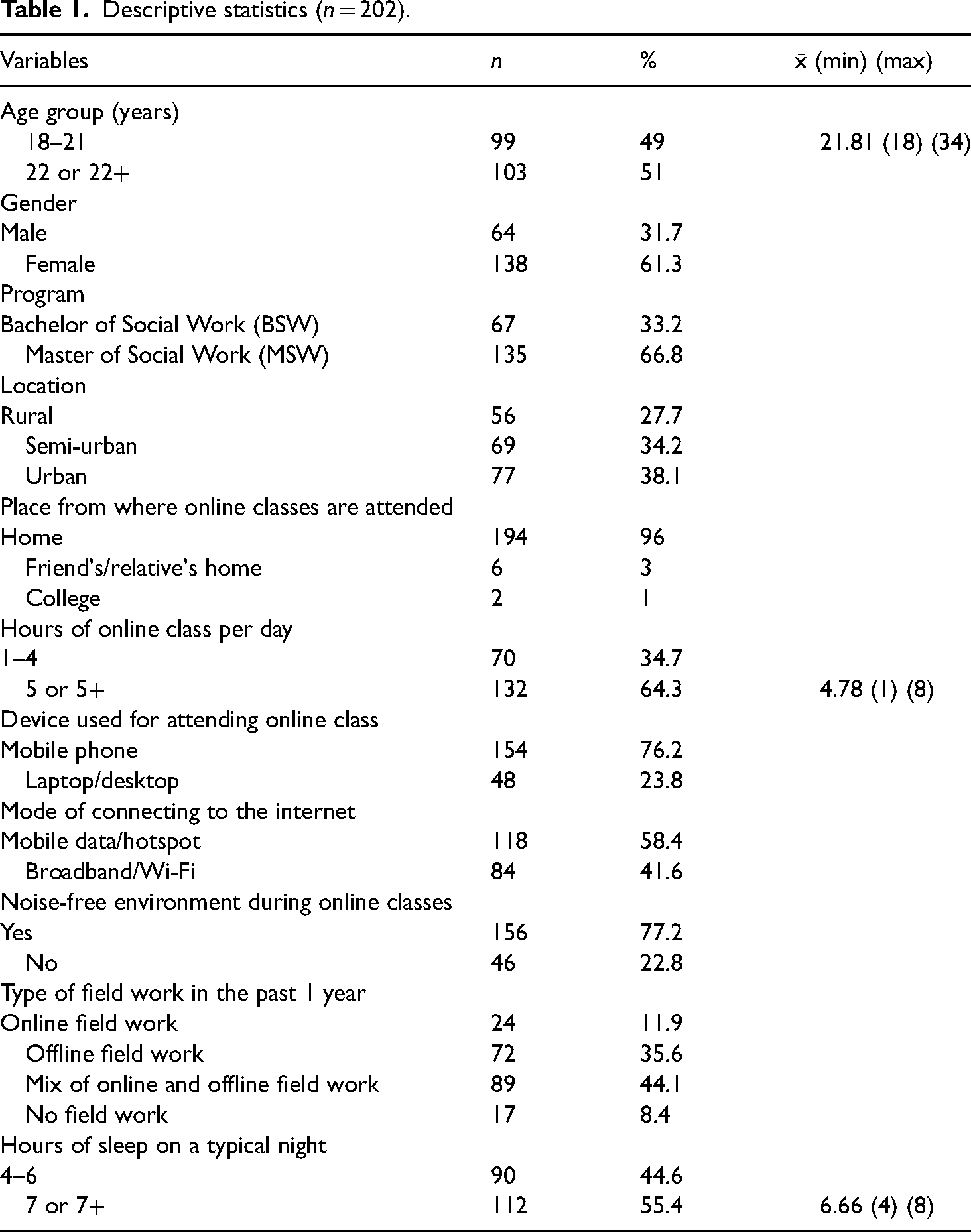
Since the main objective of the present study is to understand the online learning experience of the students of social work, apart from the variables related to the basic details of the respondents and variables associated with the factors related to their course (as seen in Table 1), other variables related to the online classes, such as the ability to understand the content being taught in the class, the quality of online discussions in the classroom, the quality of internet connectivity, the extent to which the respondents felt comfortable with online classes, and the ability to focus during online classes, were also included in the study (as seen in Table 2). This also included the variable hours of sleep, because the previous studies suggest that sleep along with other factors (Wolfson & Carskadon, 2003) could hamper students’ online learning experience (Rahman, 2021). These variables were included and treated as important variables after reviewing previous studies and after conducting informal discussions with students of social work who were attending online classes when the data was collected. It may be noted that the respondents’ place of dwelling has been classified into three categories, rural, semi-urban, and urban, to better understand the impact of living in a village (rural), living in a slightly more developed but still partly rural area (semi-urban), and living in a town/city (urban area) on their online learning experience. The researchers have explored the relationship between many of these variables, especially factors such as the ability to understand and its association with the number of hours of online classes per day, the ability of the students to focus and its association with having a noise free environment, and so on.
Descriptive statistics (n = 202).
Results of the Kruskal–Wallis test (n = 202).
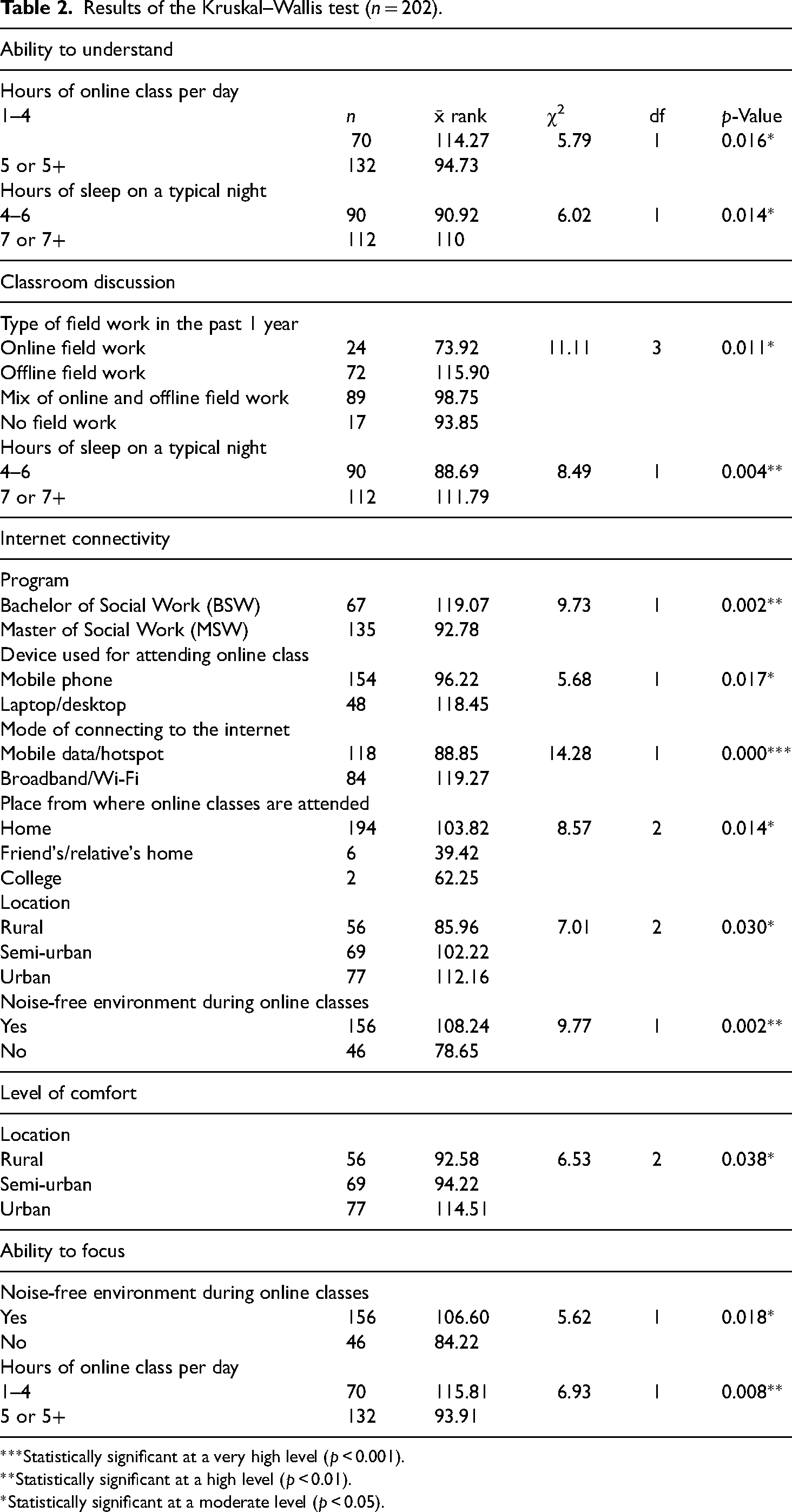
***Statistically significant at a very high level (p < 0.001).
**Statistically significant at a high level (p < 0.01).
*Statistically significant at a moderate level (p < 0.05).
Tools of data collection
An online questionnaire was developed to collect data from the respondents. The questionnaire had two parts. The first part of the questionnaire contained questions relating to the basic details of the respondents (seen in Table 1). Those questions were included after reviewing previous studies. These have all been treated as the independent variables in the present study.
The second half of the questionnaire contained five statements (seen in Table 2), the responses of which were measured on a five-point Likert scale, with the responses ranging from strongly agree (4) to strongly disagree (0). These five statements have been treated as the dependent variables in the study, with a higher score being indicative of a better online learning experience in each of those domains/factors. The rationale behind introducing these statements was that there have been a few studies that indicate that the quality of online learning experience of students could be connected to factors such as good internet connectivity along with the ability to focus during online classes (Hussein et al., 2020), quality of the teaching/instructor (Hussein et al., 2020), and classroom discussions during online classes (Wilson et al., 2007), to name a few. Each respondent took about 15–20 min to complete the survey. Before finalizing the questionnaire, a pre-test was conducted with five social work students. No major changes were made to the questionnaire. The data was collected in February 2022.
Data storage and analysis
The collected data in an Excel form was stored online in a secure Google account following which it was exported to PSPP, a data analysis software (Yagnik, 2014). Apart from the descriptive statistics (Table 1), a series of Kruskal–Wallis tests were also carried out (Table 2).
Results and discussion
Descriptive statistics
The descriptive statistics covering the basic characteristics of the respondents along with other independent variables can be observed in Table 1. It may be noted that due to the ongoing pandemic, field work initiatives for social work students around the world have been impacted with some countries having to modify the standards of field education as a result of the outbreak (Morley & Clarke, 2020). In India, while some institutions have opted for a purely online field work for their students, others have opted for a purely offline field work, and in some cases, institutions have adopted a mix of offline and online field work, based on the number of daily cases being reported and the status of vaccination of the students.
Results of the Kruskal–Wallis test
The Kruskal–Wallis test is a non-parametric analysis of variance. The researchers opted for Kruskal–Wallis test as some of the variables in the study were found to be non-normally distributed and because the Kruskal–Wallis test has been widely reported to be more powerful than the one-way analysis of variance test, in the case of asymmetric variables (Hecke, 2012). Furthermore, the dependent variables are ordinal in nature. It may be noted that although all the independent variables were included in the analysis, only the statistically significant ones have been reported in Table 2, in order to avoid overcrowding of the table.
Ability to understand
Since clarity in teaching has been found to be associated with student satisfaction and achievement (Hines et al., 1985), it is widely viewed as a key factor with regard to the online learning experience of students. From Table 2 that shows the results of the Kruskal–Wallis test, it can be inferred that an increase in the number of online classes per day, beyond a certain limit (5 or more than 5 hours), is detrimental to the ability of respondents to comprehend what the teachers are teaching in class (p < 0.05), which is indicative of online learning fatigue that warrants further investigation in the future. Apart from this, the number of hours of sleep was also found to be associated with the factor “understandability,” with those respondents who slept for 7 or more than 7 hours, being able to have a greater understanding of topics being covered in class (p < 0.05) when compared to those respondents who slept for fewer hours. This is in line with a previous study where a positive relationship between normal sleep and academic performance was identified (Abdulghani et al., 2012).
Classroom discussion
˘Little is known on how satisfied or unsatisfied students are with the amount of online classroom discussion and more importantly significant factors that might be associated with it. One of the critical components of social work education is field work. The results of the Kruskal–Wallis test (Table 2) suggest that students who’ve only had online field work and those who have had no field work experience are more unsatisfied with the level of online classroom discussion (p < 0.05). This is understandable as they have had no face-to-face field work interactions and, as a result, require classroom discussion to stimulate their interest and satisfaction with online learning. Similarly, those who typically sleep for fewer hours are also unsatisfied with the amount of classroom discussion (p < 0.01). It is pertinent to note that existing literature has shown that the measures of sleep and social interaction experience are related (Totterdell et al., 1994), and with the hectic online life of many students since the beginning of online classes, sleep patterns have been impacted due to increased screen time, among other factors (Bruni et al., 2021).
Internet connectivity
In India, there are still several parts of the country that are yet to be connected with high-speed internet. This is particularly true in the case of rural areas whose residents constitute less than one-third of the fourth-generation mobile network technology market in the country (Jha & Saha, 2021). Moreover, broadband connections in rural homes are also a rare sight. Therefore, it is not entirely surprising to note that those who are living in rural areas are less satisfied with the quality of internet connectivity for attending online classes (p < 0.05) as seen in the results of the Kruskal–Wallis test (Table 2). Specifically, those who are using mobile network/hotspot to connect to the internet as opposed to a broadband/Wi-Fi connection are less satisfied with their internet connection (p < 0.001), and so are those who use a mobile phone rather than a laptop/desktop (p < 0.05). Since many households in rural India are yet to experience broadband/Wi-Fi or high-speed fourth-generation mobile internet connection, and as many cannot afford a laptop/desktop connected to a broadband/Wi-Fi internet connection, many are reliant on the third-generation mobile network, which is inferior in terms of speed when compared to Wi-Fi (Gass & Diot, 2010). These factors are undoubtedly major barriers that prevent students from enjoying a good online learning experience.
The other hurdle is a form of internet hogging wherein several people in the same household might be simultaneously using a common internet connection such as a mobile hotspot or even a slow broadband/Wi-Fi connection, for attending online classes, work-related online meetings, or streaming bandwidth-intensive content. This is a possible explanation for why those who reported lower satisfaction with their internet connection also felt that they were not in a relatively noise-free environment for attending online classes (p < 0.01), with those attending online classes in their friend's/relative's house, reporting a similar concern with regard to internet connectivity (p < 0.014). Simply put, when there are too many people using the same internet source, that too while using bandwidth hungry applications, the internet speed/quality can be affected (Zheleva et al., 2015). The other interesting finding is that those who are pursuing an undergraduate degree in social work (BSW) are more satisfied with their internet connectivity as opposed to those who are pursuing a postgraduate degree in social work (MSW) (p < 0.01). This is explained by a cross-tab analysis that indicates that majority (59.7%) of the respondents pursuing an undergraduate degree in social work (BSW) use broadband/Wi-Fi to connect to the internet instead of the less effective mobile data/hotspot. On the other hand, less than one-third (32.6%) of the respondents pursuing a postgraduate degree in social work (MSW) use broadband/Wi-Fi for attending online classes.
Level of comfort
As highlighted previously, access to the internet is a very important component of online education. Apart from this, there are also other factors such as irregular power supply, affecting the regular powering of electronic devices in rural India, that act as barriers. Such factors explain why respondents living in rural areas are less comfortable while attending online classes when compared to those living in semi-urban and urban areas (p < 0.05). The constant threat of power outages combined with poor internet connectivity is bound to cause discomfort to rural students as borne out by the results of the Kruskal–Wallis test in Table 2.
Ability to focus
A noise-free environment is essential for the students to be able to focus and, in particular, to improve their academic performance (Shield & Dockrell, 2003). This is why those who have stated that they are able to attend online classes in a noise-free environment also feel that they are able to focus during online classes (p < 0.05). Apart from this, those who are attending 5 or more than 5 hours of online classes on a typical day are finding it more difficult to focus during online classes as seen through the results of the Kruskal–Wallis test (p < 0.01). This is further evidence of online learning fatigue, affecting the online learning experience of the students.
Implications for practice
The pandemic has forced more and more offline activities to be shifted online. The education sector was one of the first to adopt this shift following which there have been studies conducted examining it (Lei & So, 2021). However, social work is a unique field of education cum practice, and the paucity of studies examining this shift, especially almost 2 years after this shift began in developing countries such as India, motivated the researchers to undertake the present study. The findings of the study have reflected the need for intervention at different levels. The present study provides statistical evidence for online learning fatigue among students who are having to attend 5 or more than 5 hours of online class on a typical day. In fact, majority of the respondents in the present study fall under this category.
In India, many institutes of higher education also function on Saturdays. The effects of this have been reflected on the variable “ability to understand” and its association with hours of sleep as indicated by the results of the Kruskal–Wallis test (p < 0.05). Moreover, majority of the students in the present study have 5 or more than 5 hours of online classes per day (Table 1) which could also be preventing students from engaging in meaningful discussions as part of the community inquiry framework explained by Hrastinski (2019). In the light of this finding, it is suggested that the government and institutes of higher education could consider reviewing the number of required online teaching hours per semester, and there could be a cap/limit placed on the maximum number of online classes a teacher can take in a given week. There is also an urgent need to re-examine the amount of workload in the form of online assignments given to students. In one recent nationwide study conducted in America, it was found that field work placements had been greatly disrupted due to the pandemic and that students were expected to transition from offline to online field work without any specific training (Davis & Mirick, 2021). Kelly et al. (2020) however note that simulations of field work and case studies of an interdisciplinary nature can be useful. In the past, there have been instances where the use of tools such as digital video disc (DVD)-based simulations for teaching clinical field work skills have been rated well by the students (Williams et al., 2010). In India, there is a need to find ways to safely resume offline field work or to use simulations to help improve the online field work experiences of students.
When it comes to online classes, there is one facet that is perhaps more important than anything else, and that is good internet connectivity, based on which the online learning experience of students is heavily dependent. The results from the present study point to a serious problem in this context. Those living in the rural areas with poor internet connectivity and without sufficient means to afford a decent laptop/desktop are unfortunately being left behind. They are unable to exercise their right to education despite paying the required college fees. Hence, the government could consider engaging in greater efforts to improve access to the internet, especially for those residing in rural areas. Colleges could consider collaborating with companies and supply laptops at subsidized rates for students hailing from rural areas. Another suggestion is that colleges could work on improving their infrastructure in terms of hostel and internet facilities and make it more affordable, so that more students from rural areas have the option to stay in the hostels and attend online classes without having to experience disruptions in terms of internet connectivity or struggle to focus during online classes owing to a noisy environment, in case of another outbreak in the near or not so near future.
Overall, the results of the present study have also shown that colleges, universities, and institutes offering social work education in the online mode need to restructure their online teaching pedagogy and their course objectives to ensure that it enhances the students’ ability to understand what is being taught and improves classroom discussion and their level of comfort in attending online classes, apart from removing barriers that hinder their ability to focus in class.
Limitations of this study
While this research is specific to India, it contributes to a worldwide picture that is being created by researchers in many different parts of the globe. In addition, several of the issues highlighted in the present study are not specific to India and have global relevance. However, despite these positives, the present study lacks qualitative data which could have further enriched the results. Qualitative tools such as interviews or focus groups are necessary to develop a more in-depth understanding of student experiences.
Conclusion
The findings of the present study highlight the need to reduce the number of hours of online classes, find ways to safely resume offline field work, or use simulations to improve online field work, educate students on the importance of sleep; improve internet accessibility along affordability of learning tools such as laptops, particularly for those residing in rural areas; adopt pedagogies appropriate for online teaching and learning; and promote classroom discussion during online classes, among other factors, to help improve the online learning experience of social work students. It has to be added that the theory of online learning by Hrastinski (2009) was found to be accurate in this case in several aspects. The findings also point to the fact that among the six different levels of online learner participation (Hrastinski, 2008), the lack of an “adequate e-learning environment,” “reading,” and “taking part in a dialogue” are the three levels in particular that are in need of serious improvement to enhance the online learning experience of students. At the end of the day, field work lies at the heart of social work education. This is precisely why online social work education in India has several barriers to cross. Since a major part of the learning in social work occurs in the field, there is a need to find ways to help students understand the content being taught in the online scenario despite the absence of face-to-face field experiences.
Footnotes
Ethical Approval
Ethical approval for this project was given by: A written consent was obtained from all the respondents. Furthermore, the researchers have adhered to the principles laid out in the Belmont Report (Zucker, 2007) and ensured that none of the questions or items in the questionnaire were hurtful, inappropriate, or unethical in any manner. An ethical approval for the present study was also secured by the researchers from St. Joseph's University, Bengaluru, India. The reference number of the letter is 2022-SJRI-2. The researchers have also ensured that the study conforms to the principles embodied in the Singapore Statement on Research Integrity.
Funding
The authors received no financial support for the research, authorship, and/or publication of this article.
Declarations of Conflict of Interests
The Authors declare that there is no conflict of interest.
Acknowledgements
The Authors acknowledge the following for their contribution to this article: The researchers would like to express their heartfelt gratitude to all the respondents who took time from their busy schedule to take part in the study. Thank you one and all.
