






Abstract
After years of neglect, inequality is back on the political agenda. The International Labour Organization has proposed the introduction of so-called social protection floors to tackle poverty in the age of globalization. However, little attention has been paid to the role of the public sector for limiting inequality. This is surprising in the light that new research shows the positive impact of public services such as health care and education for improving or maintaining equality. In some countries, access to public services is even more important in terms of redistribution than taxes and social benefits. Yet while the public sector hardly plays a role in discussions on equality, equality is mostly absent in the debates on public sector reforms. Here the main focus of the discussion is efficiency. The purpose of this article is twofold: on the one hand, it introduces the public sector as a major factor into the debates about inequality; on the other, it sheds light on the consequences of privatization, liberalization, and marketization of public services for equality.
Introduction
After years of neglect, inequality is back on the political agenda. The International Labour Organization (ILO) seized the opportunity during the Great Recession and proposed the introduction of so-called social protection floors to tackle poverty and inequality in the age of globalization (ILO, 2011). Experience from Brazil and from other countries has shown that welfare programs can make a real difference when it comes to improving the situation of the poor (Behrendt, 2010; Deacon, 2013; ILO, 2011). However, little attention has been paid in recent discussions to the role of the public sector for improving equality. Access to public services is barely mentioned in ILO’s Social Protection Floor manifesto (Hall, 2014). This is surprising in the light that new research shows the positive impact of public services such as health-care education on equality. In some countries, access to public services is more important for reducing inequality than taxes and welfare payments. What is more, while the World Bank and the International Monetary Fund (IMF) increasingly embrace the idea of (minimum) social protection floors, the same organizations continue to push for privatization in their loan programs.
Yet while the public sector hardly plays a role in discussions on equality, equality is largely neglected in debates on public sector reforms. Here the main focus of the discussion is efficiency (see, for example, Curristine et al., 2007). The general assumption is that privatization, liberalization, and marketization make sure that more public sector output is produced with less input. Little attention is paid to the consequences of these reforms and of wider public sector retrenchments on social equality even though some evidence suggests that there is a trade-off between efficiency and equality.
The purpose of this article is twofold: on the one hand, it introduces the public sector as a major factor into the debates about inequality; on the other, it sheds light on the effects of privatization, liberalization, and marketization of public services for equality. To do so, the article brings together and analyzes different strands of literatures such as literature on public goods and welfare states, studies on the impact of public sector on income distribution, as well as evidence on the consequences of privatization and liberalization for social equality. The main argument is that the public sector plays an important role in promoting equality and that privatization and the recent wave of public sector retrenchment have the opposite effect.
The article starts with a theoretical and historical account of the public sector and the evolution of public services. The next part presents research on the equality-enhancing effect of public services in the developed and the developing world. The following sections present a summary of the rationale and the political underpinnings of the shift toward privatization, liberalization, and marketization in the 1980s and 1990s. The next section, then, discusses the impact of privatization and associated processes for equality, followed by an assessment of the recent wave of welfare state retrenchment in Europe. The article ends with a brief conclusion.
The evolution of the public sector
The public sector is a contested concept and as such open to different interpretations. What seems to be clear is that the public sector deals with government provision and it is more than government administration. It includes a variety of economic activities that are carried out by public establishments rather than private companies. According to orthodox economic theory, public provision of goods and services is acceptable when they have certain characteristics which hinder the proper functioning of markets. One such characteristic is the fact that consumers cannot be excluded from using the respective good. An often cited example for such a good is air, which under normal circumstances is freely available to everyone, rich and poor (Altvater, 2004: 52–53; Starr, 1998: 15). In other cases, consumers can be excluded, but the exclusion can have a negative effect on those who actually have access to the good in question (the good has positive externalities). Here a prominent example is health care: the absence of a comprehensive public health-care system facilitates the spread of epidemic diseases which when out of control can threaten the life of those who actually have access to exclusive care. The proper functioning of markets can also be distorted when the provision of a particular good involves exceptionally high fixed investments. In such cases, the economic literature speaks of natural monopolies (Baumol, 1977). Prime examples are the network industries such as electricity, water, or railways. Most economists assume that it would be a waste of resources to build two or three parallel networks to force different providers to compete for the market. Up to the 1980s, it was widely believed that in these cases it is preferable that the government or not-for-profit organizations should provide these services rather than private, profit-seeking companies, which could exploit their monopoly position. As Judith Clifton et al. (2003) note, ‘[i]f left to the private market, these public goods would be undersupplied, or expensive, unreliable and potentially against the interests of society’ (p. 23).
In the real world, the extent of the public sector was not so much the result of theoretical considerations than of social conflicts, political pressures, and pragmatic solutions to pressing problems. The expansion of public utilities in the rapidly growing European cities in the late 19th century was, for example, driven by the need to provide services to poor households and to prevent the spread of contagious diseases. Private water suppliers had previously focused on the connection of factories and wealthy neighborhoods. Large or wealthy customers could afford to pay high enough fees to grant a decent return on private infrastructure investments (Millward, 2005: 44). As the prospect of returns on investments was considerably lower for the connection of poor neighborhoods, it was often the local authorities who had to step in and build the communal infrastructures that were necessary to provide the poor with acceptable living conditions. In Britain, this was part of what has been described as municipal socialism (Sheldrake, 1989). As such it was also a correction or an alternative to the prevailing market economy.
After the Second World War and after the traumatic experience of the Great Depression, the pressure to tame markets and provide equal access to essential services became even greater: ‘In the circumstances of the 1940s and 50s, governments could no longer escape the political pressure to stop rail fares, gas, water and electricity tariffs rising faster than wages’ (Millward, 2005: 172). As a result, governments took over network industries such as gas and electricity. In some countries, they also nationalized key companies in the mining, petroleum, production, and banking sectors. In the United Kingdom, nationalization also included the creation of the National Health Service, integrating hundreds of public and private (voluntary) hospitals and providing free health care for all citizens across the country (Lister, 2008: 27). In the developing world, public ownership became an important element in postcolonial nation building and subsequent import-substitution strategies (Kelegama, 1995: 143). However, often nationalization was simply a pragmatic response to private sector failures, introduced to save insolvent companies and associated workplaces (including the nationalization of failing private banks in the recent financial crisis).
During the postwar decades, economists have interpreted the growth of the public sector as a result of economic progress. Because of increasingly saturated markets for mass produced goods, the public sector and especially public services such as education were expected to become key investment areas in the new affluent societies. Fred Hirsch (1977), for example, noted that ‘[a]s demands for purely private goods are increasingly satisfied, demands for goods and facilities with a public (social) character become increasingly active’ (p. 4). William Baumol (2012) went even further and argued that because many public services are highly labor intensive, meaning that workers can only very gradually be replaced by labor-saving technology, the public sector must necessarily increase in relation to the private economy. However, because of burgeoning private sector productivity gains, Baumol (2012) argued that advanced economies can afford to have large public sectors (pp. 62–63). While Hirsch and Baumol welcomed the shift from public to private consumption, others were terrified by the prospect of an ever-expanding state and perceived state-growth as a threat to the free-enterprise economy (Starr, 1998: 30).
In Europe, the growth of the public sector and especially of public services went hand in hand with the expansion of the welfare state. The British sociologist T. H. Marshall (1950) has argued that in modern democracies, citizens have not only civil and political but also social rights, such as the right to basic economic welfare and education. In this conception, access to public services became an essential feature of what has been described as ‘social citizenship’. In France and parts of Southern Europe, the provision of public services was not so much perceived as an individual right of citizens, then as collective responsibility of the state to provide for its citizens in what in French is described as service public (Ambrosius, 2008: 529).
Particularly in Australia, academics have used the concept of the social wage to underline the fact that access to public services is for most parts the result of social struggles and as such should be understood as part of the wider capitalist wage–labor relation. Accordingly, the wage–labor relationship encompasses a market wage paid by employers to their employees as well as a social wage provided by the state as services and benefits. There are competing definitions for the social wage, but according to Peter Saunders (1994) most accounts include ‘expenditures in the areas of education, health, social security, welfare services’, along with ‘expenditures on housing and community amenities’ (p. 163).
Gøsta Esping-Andersen (1991) emphasized the decommodifying effects of modern welfare states, reducing inequality caused by a purely market-based distribution of social wealth. However, he also showed that different welfare state conceptions have different consequences for equality. Focusing on social welfare rather than health care and education, Esping-Andersen argued that because in conservative welfare states social benefits are largely based on previous income-dependent contributions to social insurance funds, they tend to perpetuate rather than alleviate income inequality. Liberal welfare states provide universal benefits but only for those who can prove that they are in need, meaning that the benefits are mainly used to prevent extreme poverty and deprivation rather than redistribute wealth. In contrast, the social democratic welfare regime goes beyond insuring social risks and protecting the most vulnerable. Through its emphasis on universal inclusion and its comprehensive definition of social entitlements, it is ‘committed to equalize living conditions across the citizenry’ (Esping-Andersen and Myles, 2011: 646).
Social democratic welfare states, consequently, promote equality not only through the payment of universal cash benefits that cover more than minimum needs but also through the public provision of social services, which in other systems are provided by unpaid female family members or by fees charging private agencies. As Jonas Pontusson (2005) notes,
[t]the prominence of government-provided services within the welfare mix of the Nordic countries reflects the postwar political dominance of the Social Democratic parties with close ties to the labour movement . . . At least in part these parties conceived the welfare state in terms of satisfying basic societal needs outside the market economy. (p. 148)
As shown in Table 1, countries with social democratic welfare states have comparable high levels of not only social expenditure but also public consumption and equality (reversibly, liberal welfare states have a high level of not only inequality but also private consumption).
Private consumption, public consumption, social expenditure, and equality 1970/1980–2010.
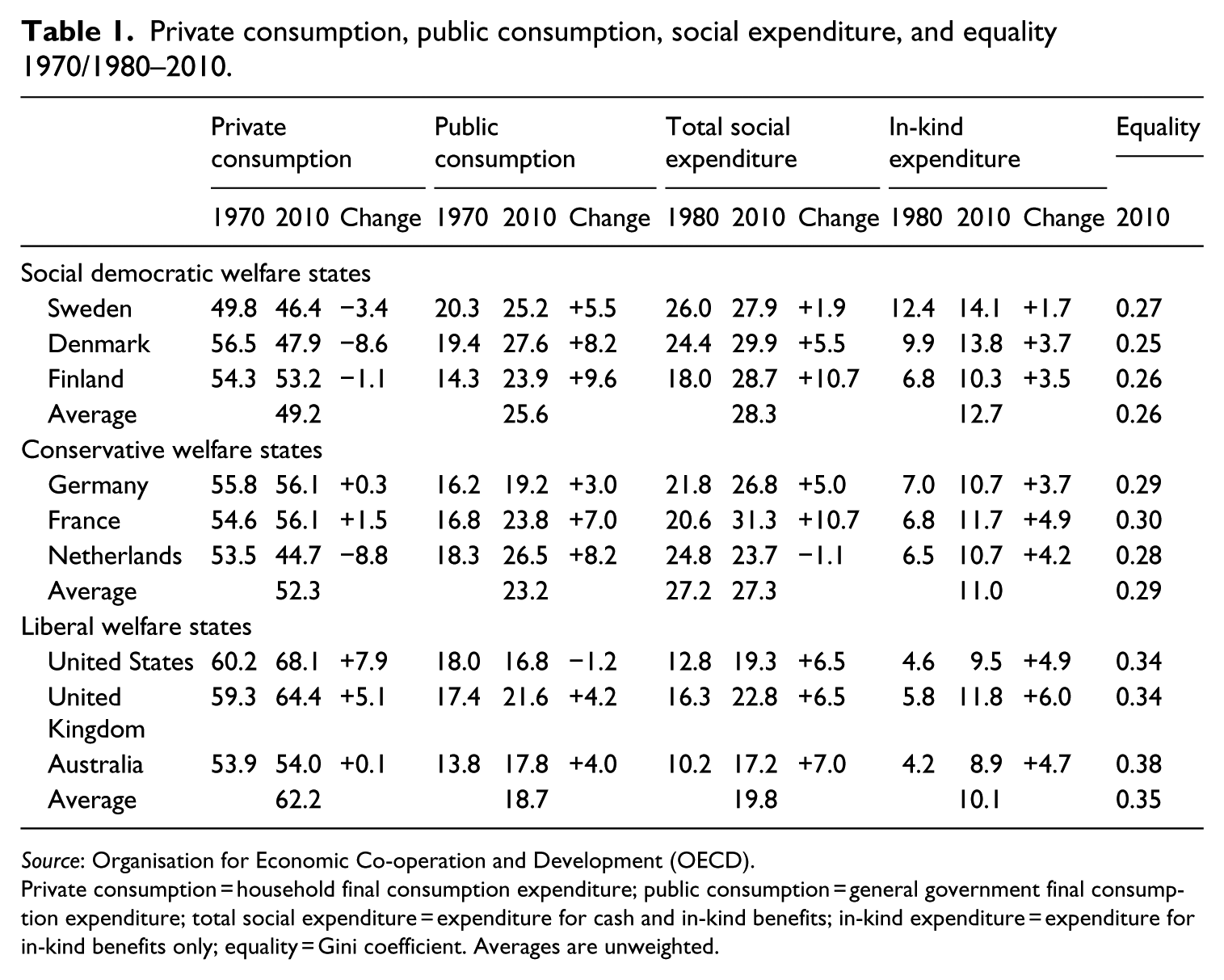
Source: Organisation for Economic Co-operation and Development (OECD).
Private consumption = household final consumption expenditure; public consumption = general government final consumption expenditure; total social expenditure = expenditure for cash and in-kind benefits; in-kind expenditure = expenditure for in-kind benefits only; equality = Gini coefficient. Averages are unweighted.
The public sector and equality
While there is a large amount of literature on public service efficiency, there are only a few studies on the effects of the public sector on equality (one of the few exemptions is Ramanadham, 1988). 1 Part of the problem is that it is difficult to determine the value of freely accessible or subsidized services. However, the Organisation for Economic Co-operation and Development (OECD) has calculated the cash value of social services such as health care, education, social housing, childcare, and elderly care. The value of these services increases disposable household income on average by 29%. For comparison, the share of cash benefits amounts to 23% of disposable income. There are only few OECD countries where the value of cash transfers as proportion of disposable income is higher than that of services (Verbist et al., 2012: 32). 2
Access to public services not only increases household income, it also tends to reduce inequality. Across the OECD, health care, education, social housing, childcare, and elderly care reduce inequality by a fifth, that is, the Gini coefficient is 20% lower when the income effect of these services is taken into account (on average the Gini coefficient falls from 0.30 to 0.24). The effect varies between a 16% decline in Greece and 24% reduction in the United Kingdom (Verbist et al., 2012: 35–36). For other inequality measures, the effect is even larger: the ratio of income that goes to the top 10% and bottom 10% of the income scale drops by one-fourth if social services are taken into account, and that between the top 20% and bottom 20% of the income scale falls by almost one-third (Verbist et al., 2012). Again there is a considerable variation of the effect among OECD countries, reaching from 46% (Mexico) to 17% (Slovenia) in the first case, and from 49% (Mexico) to 19% (Slovenia) in the second (Verbist et al., 2012). In an earlier study focusing on 14 European countries, Maria Vaalavuo (2011) has found a similar effect: the Gini coefficient declines by 18% and the relation between the top and bottom income quintile by 31% when access to services such as health care and education is taken into account (p. 166).
The equality-enhancing effect of public services is not limited to developed countries. Nora Lustig et al. (2013: 10) have found in a study covering six Latin American countries that access to public services such as health care and education reduces inequality more than taxes and cash benefits. 3 In fact ‘governments in Latin America redistribute mostly through public spending on education and health’ (Lustig, 2012: 3–4). Even in Brazil, whose benefits program includes Bolsa familia, health care and education have a greater impact on equality than the combined effect of taxes and social spending (Lustig, 2012).
The main reason for the equality-enhancing effect of public services is that the (cash) value of public services accounts for a significantly larger proportion of the income of poor households than of rich households (in absolute terms, the contribution of public services to household income in the OECD is quite similar across different income segments). On average, the use of health care, education, and other services accounts for 76% of the income of the poorest quintile of the income scale in the OECD countries, as opposed to 14% for the richest income quintile (Verbist et al., 2012: 34). In a broader measure covering total government expenditure allocated to the household sector, Edward Wolff et al. (2003: 21) have found that public consumption in the United States accounts for 97.4% total income of the lowest income decile but only 5.5% of the highest income decile.
Because the lowest income group benefits most from public services, the promotion of public services also reduces poverty. Poverty rates (measured as 50% of median disposable income) fall by 50% if the value of health care, education, and other services is taken into account. On average, poverty rates decrease from 10% to 5% (Wolff et al., 2003: 37). Here, too, there is considerable variation among OECD countries: in Belgium, Ireland, and the United Kingdom, the poverty rate declines by close to 60%, and in Estonia and in Sweden by about 27%. Without the income-enhancing effect of social services, poverty levels range from 6% to 18%, with social services from 3% to 10% (Wolff et al., 2003).
The OECD study only covers social services such as health care and education. If other public services such as transport, water, and energy are taken into account, the equality-enhancing effects of public services are even greater. Even though these services are not freely accessible, in many countries they are subsidized – at least until they are subjected to privatization and liberalization processes. As with the (cash) value of freely accessible services, these subsidies make up for a larger part of the budget of low-income than of high-income earners and have therefore a redistributive effect. Among the rare studies which have explored the distributional effects of subsidized services, Neil Fearnley (2006: 31) has found that in Britain, bus subsidies predominantly benefit lower income households, women, and those aged below 24 and above 60 years.
In addition to redistributing resources quantitatively, the public sector also plays an important role in promoting social equality in a qualitative sense as rich and poor citizens are forced to use the same services. In some cases, the use of public services may even encourage the different social classes to engage with each other, when they, for example, go to the same school or stay in the same hospital. Of course there are strategies to undermine this effect – including, most notable, spatial segregation. However, as discussed below, poor households lose even more when the middle and upper classes abandon the public system and turn to private provision.
As another feature, public services also promote equality by providing comparable decent employment opportunities, especially for low-skilled workers and for marginalized groups such as women, colored people, and migrant workers (Hermann and Atzmüller, 2008). Public employment accounts for 15% of total employment in the OECD and for more than 25% in Sweden, Norway, and Denmark.
4
In a comparison between public and private sector wage systems in Italy, France, and the United Kingdom, Paolo Ghinetti and Claudio Lucifora (2008: 246) have found that average wages in the public sector are not only higher, the public sector also displays lower levels of wage dispersion. The authors also note that especially low-skilled workers (blue collar and service staff) tend to be better off in the public sector as here the gap between public and private sector wages are highest (Ghinetti and Claudio Lucifora, 2008: 248). Other studies have compared the gender wage gap and found that the difference between male and female wages tends to be smaller in the public than in the private sector (Meurs and Ponthieux, 2008). In the developing world, the public sector also tends to provide favorable employment conditions (Ramanadham, 1995: 13). Some may argue that in countries with a high proportion of informal work, public sector privileges fuel inequality rather than reduce it. However, as V. V. Ramanadham (1995) notes,
[p]ublic enterprise practices and policies are . . . generous insofar as the compensation of the employees in the lower emoluments cadres concern . . ., whereas the compensations offered in the higher levels, for example the managerial personnel, do not compare favorably with those in the private sector. (p. 14)
Hence, far from granting privileges, the public sector pay model favors low-income at the cost of high-income staff.
Privatization and liberalization
The perception of the public sector changed in the 1970s. During this period, the discourse of market failure was gradually replaced by the discourse of state failure (Starr, 1998: 27). The discursive shift took place in the background of a major economic crisis that had ended more than two decades of economic growth in postwar Europe and North America. In the wake of the economic slowdown, public sector expenditure tended to increase faster than gross domestic product (GDP) growth, adding to the fiscal crisis of the state (O’Connor, 1973). Given the increasingly scarce resources, which were caused not only by slow growth, but also by tax breaks granted by newly elected conservative governments, an increasing number of economists found that the public sector was inherently inefficient and that this was a major problem. According to Feigenbaum et al. (1998), privatization was part of a broader process which the authors call ‘shrinking of the state’. Thereby they mean ‘reducing the level of state intervention in the society rather than simply reducing the size of the public sector’ (Feigenbaum et al., 1998). In this picture also fits the emerging discourse on the wasteful nature of modern welfare states and the growing abuse of the social safety net by work-shy welfare recipients (Wilding, 1986). Both paved the way for an era of welfare state retrenchment (Huber and Stephens, 2001; Pierson, 1995). Retrenchment, however, did not necessarily result in a decline in government and social expenditure (Obinger and Wagschal, 2010). However, average yearly social and public expenditure growth rates (for nine selected countries) of 0.2% (as proportion of GDP) may not be sufficient to meet growing social and collective needs (see Table 1).
To some extent, the abolishment of public sector monopolies was the result of the invention of new information and communication–based technology which reduced the need to maintain extensive and costly material networks and opened the possibility that various competing providers can use the same infrastructure. However, more than anything else, the ‘shift to privatization was something of a leap of faith’ (Nellis, 2006: 6). As Malcolm Sawyer (2009) notes,
[t]he big push towards privatization can be dated as starting in the early 1980s, and gathering pace from the late 1980s . . . This push . . . has clearly gone on alongside the rise and dominance of neoliberalism at the national and international levels. Privatization epitomizes neoliberalism in terms of the further expansion of markets and competition in economic life, the entry of capital into new areas and the greater importance of the financial sector and of profits and the pursuit of profits at the expense of all other considerations. (p. 70)
Privatization typically started with the divestment of public enterprises in dominantly private sectors such as manufacturing, banking, and mining. However, it was not for long and the same policies were applied to traditional public sectors such as telecommunications, energy, water, and parts of transport. In addition, several governments have promoted marketization and corporatization of public service provision through the establishment of international markets, outsourcing contracts, and in particular through the use of public–private partnerships (Whitfield, 2010). As described further below, rather than using private sector knowledge to promote the public interest, these instruments often benefit the private partner at the cost of public resources. Privatization was not least driven by private equity investors looking for profitable investment opportunities (Huffschmid, 2009: 55–56). As Ursula Huws (2011: 68) has argued, the scope for privatization and commodification is particularly high in those countries that have developed a comprehensive welfare state during the postwar decades. In relative terms, Sweden has the largest private equity market in Europe after the United Kingdom with fast-rising private equity investments in health and social care (Gospel et al., 2010: 57). Because this transformation takes place within the public sector, it cannot be identified in most government statistics.
In the developing world, privatization was widely promoted as part of the Washington Consensus and through the IMF and World Bank support programs that were increasingly linked to the introduction of certain economic policies such as the sale of state assets. About 70% of all structural adjustment loans made by the World Bank during the 1980s contained a privatization component (Cramer, 1999: 2). Here privatization became part of a new development agenda that promised economic growth based on the freeing of markets and the rollback of the state in all conceivable economic areas (Cramer, 1999: 3). As in Europe, privatization started with the sale of national corporations to private investors, but soon also affected public infrastructures, including water networks, and later health and social services.
Privatization and inequality
Privatization has in several ways eroded the equality-enhancing effects of public services. In the European Union (EU), the liberalization of public service markets went hand in hand with a ban on public subsidies and a shift toward market-oriented prices. There is some evidence that prices have increased after liberalization, while other evidence shows a decline. The difficulty is to determine how much of the change in prices was the result of privatization and how much was the result of other developments – such as, for example, increases in oil prices or technological innovations. What seems to be clear is that the belief in falling prices was in many cases overly optimistic. Even supporters of privatization such as John Nellis (2006) have cautioned that ‘under state ownership many governments set utility prices at less than cost-covering levels’ (p. 17). In this view, price increases can have a positive effect when they reflect real costs, which are indispensable for an efficiently working market. In the economic literature, this principle has been widely advocated as cost-recovery. However, even without subsidies, public providers tend to be cheaper than their private competitors. Massimo Florio (2013: 176, 217) has compared the development of gas and electricity prices in various EU member states and has found that one of the most prevalent factors explaining price differences is public ownership. Publicly owned gas and electricity providers tend to offer lower prices than their private counterparts (Florio, 2013). 5
Price increases have a negative effect on equality because they affect the poor more than the rich. The related expenses make up for a significantly larger part of the budget of low-income households. Energy prices are a particular sensible issue. According to the British Department of Energy & Climate Change (2013), households that spend more than 10% of their income for energy bills are considered to be suffering from fuel poverty. After falling in the second half of the 1990s, the number of households affected by fuel poverty in the United Kingdom increased from 2 million in 2003 to 4.5 million in 2011 (Department of Energy & Climate Change, 2013: 18). Profit-orientation and cost-recovery have also meant that households that cannot pay their bills are more frequently disconnected. Christoph Hermann and Richard Pond (2012: 49) report from a case study in the liberalized European electricity market that while previously staff would have worked out a solution with a household who has difficulties to pay the bill, social concerns no longer play a role in the new corporate thinking that replaced the old public service mentality. David Macdonald (2009: 26) reports that up to 9.6 million people had been affected by electricity cut-offs in South Africa between 1994 and 2002 following increasing corporatization and the shift to cost-recovery (Macdonald, 2009).
Insofar as they result in higher costs for service provision, public–private partnerships can also have a negative effect on service users. There is robust evidence that the use of Public Finance Initiative (PFI) in the English health-care sector – the private sector funds and builds and maintains hospital infrastructures in exchange for a yearly fee in 30 years and longer contracts – costs the taxpayer more than if the same investments would have been borrowed by the government; because of higher-than-expected PFI costs, services also had to be cut back to cover the fees (Shaoul et al., 2008). According Mark Hellowell and Allyson Pollock (2007), the first wave of hospital PFI projects was associated with an average 30% cut in bed numbers. Fewer hospital beds mean longer waiting times for patients.
The analysis of average prices may be misleading, however. Liberalization and privatization have typically led to a differentiation in prices. Since large customers make up for the bulk of the business, it is quite rational for profit-oriented providers to offer price discounts to maintain them as clients (Florio, 2013: 337). As Steve Thomas (2002) reports with respect to the British electricity market,
[t]he introduction of retail competition for large consumers allowed them to negotiate better prices, but it seems that much if not all of the price reduction was paid for by small consumers. The extension of retail competition to small consumers seems to have made the problem worse and has also given electricity companies an incentive to discriminate against poor consumers that did not exist while retail supply was a monopoly business. (p. 8)
In some countries, private households have responded to price discrimination by forming buying syndicates, combining the purchasing power of thousands of small users to negotiate similar discounts as those granted to large customers. 6
In the British case, price changes particularly affected households with prepayment meters as opposed to customers who are debit payers. Prices for the latter group have declined much faster than for the former (Waddams Price and Young, 2003: 112). Households on prepaid schemes are generally poor households. Yet even among debit payers there are considerable differences in electricity prices depending on the volume of consumption. In 2007, standard high-usage consumers in the United Kingdom only paid half per kilowatt hour electricity than standard bottom consumption households. Again low-volume users are often low-income households (Florio, 2013: 292–293, 337).
Price discrimination is often linked to problems in accessing information (Florio, 2013: 297). Some elderly citizens, for example, may not be familiar with the Internet and hence have problems in finding the cheapest offer. However, as low-volume users they are also not exactly the focus of advertising activities. In addition, transaction costs caused by surveying changing prices and switching suppliers can eat up possible savings from a new contract. Because of the effort involved in switching suppliers, many users in the now fully liberalized European electricity markets are not even contemplating about changing electricity providers (Van Gyes and Vandekerckhove, 2012: 187). What is even more, there may not be a ‘best deal’ for low-volume consumers such as citizens who only need a standard landline telephone or who can only get a prepaid cell phone. Hence, it is not surprising that Judith Clifton et al. (2011) found in a study on consumer satisfaction in the telecommunication sector in Britain and Spain that ‘those not working, the elderly and the lower-educated were indeed more dissatisfied with prices’ (p. 506).
In social services such as health care, discrimination has particular dramatic consequences. However, here the threat is not so much privatization but the underfunding of public providers and the introduction of fees and co-payments. As Mohan Rao (2009: 268) states with respect to the Indian health-care system, the increasing weakness of the public system encourages those who can afford it to search for help in the burgeoning private health-care industry. Hence, while 50% of the poorest income quintile in India uses public as opposed to private hospitals, only 20% of the highest income quintile relies on the public system (Chakraborty et al., 2013: 14). As Birgit Mahnkopf (2009: 228) notes, services that are mainly provided for the poor are typically of poor quality.
However, profit-oriented public service providers not only focus on large or well-off customers, they also focus on geographic areas where they can achieve high revenues. In the liberalized European postal markets, for example, providers focus on urban areas where they can exploit economies of scale, while closing down post offices and terminating related services in the sparsely populated countryside (Hermann, 2011: 259–60). In Sri Lanka, the privatization of the public bus system has left rural regions with inadequate services: ‘The private bus services, being more profit-motivated, avoid these routes due to the poor returns, unlike the former state owned SLTB [Sri Lanka Transport Board], where the commuter’s interests could not be overlooked and took precedence over profitability’ (Kelegama, 1995: 168).
Mildred Warner (2006: 618) shows in a study on the delivery of municipal services in the United States that rural communities rely more often on public provision than suburban or metropolitan areas because they are not interesting for private contractors. Rural municipalities have experimented with outsourcing of services to private companies until the mid-1990s, but many have returned to public provision by 2002: ‘This return to public delivery . . . provides additional indication of problems with access to alternative market forms of service delivery – especially for rural communities’ (Warner, 2006).
In sum, poor users are highly unattractive in liberalized and privatized public service markets: they have problems to pay bills, they are often low-volume users, and because poor households are frequently located in rural areas or areas that are not easily accessible, it may also cost more to connect them to the network (Estache et al., 2002: 16). Not surprisingly, connection rates of low-income households are much lower in the developing world than of wealthy citizens. Only 10% of the poorest income quintile has access to electricity in low-income countries, but almost 80% of the richest quintile (Estache, 2006: 6).
Privatization not only affects service users, it also has a profound impact on those who deliver the services in their daily work. The search for greater public sector efficiency often takes the form of work intensification, precarisation, and fragmentation of public sector employment relations. The result is increasing wage differentials between managerial staff and nonmanagerial employees, between skilled and unskilled workers, as well as between core and peripheral workers (Hermann and Flecker, 2012: 196–200). A widespread effect of privatization is an upward adjustment of manager salaries to private sector standards. Top managers are therefore among the main beneficiaries of public divestments, especially when they are offered stock options of the newly privatized firms. However, while managers see their incomes increasing, many nonmanagerial workers are confronted with wage cuts, especially newly hired workers (Hermann and Flecker, 2012: 200).
The crisis and public sector retrenchment
In spite of the role of the public sector in promoting equality, a number of European governments responded to the recent crisis with far-reaching privatization and retrenchment programs. Both measures were promoted by the European Commission, the European Central Bank, and the IMF as conditions for emergency credits and financial support offered to struggling governments in Southern Europe and elsewhere during the crisis (Busch et al., 2013: 22–24). The Greek government, for example, announced plans to raise 50 billion euros (22% of GDP) through the sale of state assets, including ports, railways, postal services, and water supply in Athens and Thessaloniki (Busch et al., 2013). However, given the continuous fall of Greek GDP and a highly insecure market environment, sales have not worked out as planned. Apart from the national telecommunication provider OTE and the national lottery, the government has so far mainly sold off real estate and holiday resorts. The Irish government has sold off the country’s main gas supplier, while the Portuguese government has divested two major electricity firms and is planning to sell the national post operator. The British government used the opportunity to privatize Royal Mail – a step that even the notorious Thatcher government did not dare to do. In Spain and Italy, the planned privatization of water and hospitals has made little progress because of sustained resistance from concerned citizens (Busch et al., 2013). 7
While privatization plans are country-specific, a series of governments in Europe have announced cuts in public employment. The Greek government, for example, wants to cut public employment by 25%. The British government shed 420,000 jobs by 2012 and is well on course to reach its goal of cutting 10% of the public sector workforce by 2015 (Hermann, 2013: 6–7). While politicians often defended job cuts with the need to curtail inflated bureaucracies, actually many of the cuts affected health-care and education workers (Vaughan-Whitehead, 2013). The public sector job cuts are part of a wider welfare state retrenchment. In addition to cuts in welfare benefits, governments have also reduced in-kind services, including those services that were covered by the OECD study cited above. Between 2009 and 2012, spending on in-kind services was cut by 29% in Greece, by 19% in Portugal, and by 16% in Ireland (European Commission, 2012: 15). As Zafiris Tzannatos and Yannis Monogios (2013) note with respect to the Greek case, ‘the 40 per cent cuts in hospital budgets . . . has resulted in understaffing and reported shortages of medical supplies as well as increased bribes to medical staff to jump queues in overstretched hospitals’ (p. 279). The main effect of these developments is that ‘[t]hose in need are increasingly unable to see a doctor’ (Tzannatos and Monogios, 2013).
The ‘public sector shock’ (Vaughan-Whitehead, 2013) will likely increase inequality in Europe. The aforementioned OECD study (Verbist et al., 2012) has not only shown that public services reduce inequality, but it has also revealed a ‘strong link between changes in the relative size of health, education and housing services . . . and changes in the effectiveness of these services to reduce inequality across countries’ (Verbist et al., 2012: 59). Comparing data from 2000 and 2007, the authors show that countries which have increased spending on social services during this period have reduced inequality, while countries which have reduced spending recorded a rise in inequality. ‘Belgium and the United Kingdom are two countries which combine a considerable increase in spending with a large extent of inequality reduction’ while ‘Italy and Denmark record a fall in inequality reduction alongside a decreasing size of services’ (Verbist et al., 2012).
The British finding is particular interesting: while the OECD argues that the growth in public sector spending has significantly reduced inequality between 2000 and 2007, the National Office of Statistics has found a decline in public sector productivity over roughly the same period (Phelps et al., 2010). The measurement of productivity in public services is not without problems. Especially when services are freely available, there are no market prices and, hence, no straightforward way to determine the value of output. And without the value of output it is impossible to determine if more or less has been produced with the same inputs (Simpson, 2009). While in the past, output was equated with inputs – which per definition meant that public sector productivity was stagnant – more recently national statistical services have experimented with new methods of measuring output. In Britain, for example, the National Office of Statistics counts output as the number of public sector activities such as pupil attendance or health procedures multiplied by a certain cost factor, reflecting the different costs involved in carrying out these activities (Phelps et al., 2010: 4). There are doubts that these measurements are accurate (Jääskeläinen and Lönqvist, 2011). However, if the measurement is correct, the British findings suggest that efficiency and equity are conflicting goals when it comes to public sector reform.
Conclusion
The creation and expansion of the public sector was foremost a political project to tame markets and to improve the situation of those who have not been served by private service providers. After the Second World War, access to public services became part of what has been described as social citizenship or social wage and as such also an instrument to reduce inequality and promote social justice. During the postwar decades, the expansion of the public sector and the welfare state was seen as an expression of economic and social progress rather than as a liability weighing on the private economy. New research shows that the public sector indeed plays an important role for improving and sustaining social equality – not only in Europe but also in the developing world. Low-income earners benefit more from access to public services than high-income earners because the value of these services makes up for a disproportional larger proportion of their income. In some countries, the provision of public services is more important for reducing inequality than taxes and welfare payments. However, in the 1980s, the discourse on public services shifted and efficiency became the main focus of subsequent public sector reforms. The following privatization, liberalization, and marketization of public services had a questionable effect on productivity, but they certainly eroded the equalizing-effect of traditional public service provision. Research shows that poor households are often disadvantaged when availability of services and prices is determined by markets. As Paul Starr (1998) argues, privatization involves a reordering of claims in the society and a shift of power ‘to those who can readily exercise power in the market’ (p. 38). Given the past experience and a possible trade-off between efficiency and equality, there are strong reasons to assume that the recent wave of privatization and public sector retrenchment in Europe will also boost inequality. In the light of the findings presented in this article, it is high time that the public sector plays a more important role in the debates about tackling inequality, while consequences for equality need to be taken into account when future reforms of public services are discussed.