






Abstract
In many low-income countries, persons with disabilities are consistently denied access to essential services, contributing to a high incidence of poverty among them. The Goal 1 of the Sustainable Development Goals (SDGs) exhorts countries to develop appropriate social protection to serve as a springboard to alleviate poverty among all persons. The government of Ghana has introduced Disability Fund to provide one-off financial support to persons with disabilities through its decentralised political units. This is to enable persons with disability to participate in socio-economic activities. However, after a decade of the establishment of the fund, anecdotal evidence still shows that many persons with disabilities continue to live in deplorable conditions. Therefore, the main aim of this qualitative study was to explore the beneficial impact of the fund on the lives of persons with disabilities in Ghana. A semi-structured interview guide was used to collect data from 48 participants, comprising 20 males and 28 females with disabilities. The narratives from the participants revealed that only a few were able to access the fund. In their quest to access the fund, participants encountered barriers, such as lack of information, delays in disbursement and insufficient funds. The findings underscore the need for re-evaluation of the administration of Disability Fund and its disbursement processes. The implications of the findings for policy reform are extensively discussed.
Introduction
At the beginning of the 21st century, one of the primary targets of the international community was to support developing countries to eradicate poverty in societies. Particularly, the United Nations, through its Millennium Development Goals (MDGs) programme, has led the crusade to promote access to social services and to eradicate inequality and extreme poverty in selected countries. Although several countries such as Ghana have made considerable progress in realising the MDGs, the scope of this programme has been criticised as being limited, and the countries that were selected for the programme could not achieve many of the targets set by 2015 (Fukuda-Parr, 2016; Ruhil, 2017; Sachs, 2012). Particularly, the needs of persons with disabilities have not been realised under the MDGs, which seems to have informed the development of a broader programme to absorb most vulnerable groups (Thomas, 2005). Accordingly, the Sustainable Development Goals (SDGs), which is a transformative agenda intended to alleviate all forms of poverty by 2030, was launched by the United Nations (Independent Commission for Aid Impact, 2017; Sachs, 2012). Under Goal 1 of the SDGs, governments have been exhorted to improve the well-being of citizens through the development of appropriate social protection systems. It was against this backdrop that this study explores the accessibility of a cash transfer programme, the Disability Fund, which was developed by the government of Ghana, and its impact on the lives of persons with disabilities.
Social protection has been recognised as a social risk management (SRM) strategy intended to cushion the living conditions of vulnerable groups such as persons with disabilities (Hodges et al., 2013; Holzmann et al., 2003). For the purposes of this study, social protection has been defined as an SRM programme designed to enable persons with disabilities to participate in economic activities and to break the burden of poverty (Abebrese, 2011; Holzmann et al., 2003). Proponents of SRM programmes argue that the poor are usually at risk of both natural (e.g. flooding) and artificial (e.g. inflation) risks and, as such, they lack the capacity to support themselves against external shocks (Holzmann et al., 2003). Persons with disabilities, especially those from developing countries, may be categorised as individuals who are at risk due to poverty and limited opportunities in societies (McClain-Nhlapo, 2007; Opoku et al., 2017a, 2018; Palmer, 2013). It is apparent that successful social protection programmes can have a direct impact on the lives of beneficiaries with disabilities through reducing the burden of poverty and enabling them to participate in economic activities (Barrientos and Hulme, 2008; Devereux, 2002; Hodges et al., 2013; Holzmann et al., 2003; Levine et al., 2011; Palmer, 2013). In the Ghanaian context, the establishment of social protection programmes by government can empower persons with disabilities to participate in sustainable economic and social activities.
State-engineered social protection programmes have been described as an effective and reliable means of advancing the lives of persons with disabilities in low-income countries. This has been necessitated by the fact that support from informal sources, such as family and community members, to persons with disabilities is insufficient and unstable for them to have a reasonable livelihood. Although informal support exists in traditional Ghanaian society, current developments, such as migration and urbanisation, have affected this form of support (Abebrese, 2011; Opoku et al., 2015). Compounding this situation in the Ghanaian context is the negative attitude towards persons with disabilities (Anthony, 2011; Baffoe, 2013; Opoku et al., 2017a). For example, persons with disabilities are looked down upon due to the perception that their birth is because of punishment meted out on their family members by supernatural forces (Avoke, 2002; Baffoe, 2013; Naami, 2015; Opoku et al., 2015, 2018). Consequently, families make little effort to support members with disabilities to engage in productive activities, such as education and vocational skills training (Opoku et al., 2017b). This situation makes it urgent for government to develop social programmes targeting persons with disabilities to enable them to participate in socio-economic activities.
Study background
The government of Ghana has developed several social programmes for vulnerable groups (Abebrese, 2011; Foli, 2015; Oduro, 2015; Sultan and Schrofer, 2008; Yeboah et al., 2016). For example, the Livelihood Empowerment against Poverty (LEAP), which is a conditional cash transfer programme, was introduced to support the poor and destitute in targeted societies (Foli, 2015). The cash is given to family heads on condition that they will enrol their children in school, register for health insurance and birth certificates, and not allow their children to engage in labour activities (Abebrese, 2011). Although persons with disabilities were identified as one of the targeted groups, it appears that many have not been able to access this fund. In view of this, another arrangement was made, this time for an unconditional cash transfer, namely the Disability Fund, which was purposely established for individuals who are living with disabilities. The Disability Fund was developed in 2005 to project the image of persons with disabilities and alleviate poverty among those who are not formally employed (National Council on Persons with Disability [NCPD], 2010; Sackey, 2009).
In Ghana, disability is defined as a physical, visual or hearing impairment which affects an individual’s daily living activities (Republic of Ghana, 2006). The Disability Fund was designed in a way that it will reach persons with disabilities through the country’s decentralised political structure. Ghana has a decentralised political system, where administrative powers have been devolved from the central government to 275 metropolitan, municipal and district assemblies (MMDAs). These assemblies oversee the socio-economic development of areas under their jurisdiction (Tuggun, 2014). The central government disburses 7.5% of the national revenue on a quarterly basis to the MMDAs for infrastructure projects in their areas (NCPD, 2010; Sackey, 2009). Of the amount given to the MMDAs, 3% of every quarterly allocation has been reserved for persons with disabilities (Agboga, 2015). In almost all districts, there is a fund management committee, made up of five members, namely the district social welfare officer, the district social services officer, a representative of a disabled people’s organisation (DPO) (selected by the Ghana Federation of Disability Organisations [GFD]), and two other government appointees (NCPD, 2010; Tuggun, 2014).
Although all persons with disabilities are eligible to apply, it is believed that being a member and applying through one of the DPOs is ideal. Examples of DPOs include the Ghana Blind Union and the Ghana National Association of the Deaf, which both fall under the umbrella union, the GFD. The DPOs have representatives on the fund management committee, so they will be in a better position to inform their members about the state of their application. Although the Disability Fund is a one-off payment to persons with disabilities, beneficiaries are eligible for more if they can show proof of proper utilisation of what they were given (NCPD, 2010). It is believed that those who have invested in economic activities could be able to apply for more funds to grow and expand their businesses.
Despite the existence of the fund, anecdotal evidence shows that poverty is still widespread among persons with disabilities. For instance, Kassah (2008), Naami (2015), Naami et al. (2012) and Naami and Hayashi (2014) have reported a high rate of unemployment among persons with disabilities, which is a result of societies’ unpreparedness to invest in them. Similarly, Baffoe (2013), Kassah et al. (2014) and Opoku et al. (2018) have found that persons with disabilities are still dependent on family members and others for their daily bread. This appears to have contributed to persons with disabilities being denied recognition as equal members in societies. While much is known about barriers faced by persons with disabilities, little is known about the impact of the Disability Fund and the experiences of persons with disabilities in their attempts to access the fund. It is important to explore the impact of this cash transfer programme designed by the government of Ghana to improve the living conditions of persons with disabilities and to provide information that could lead to improvement of the programme.
Social protection and persons with disabilities
Establishment of cash grants to assist persons with disabilities has been argued to be a fundamental human right to enable these persons to have a sustainable means of livelihood. According to proponents of the social model of disability, society has erected barriers against persons with disabilities, which impedes equitable access to basic services (Anthony, 2011; Avoke, 2002). For instance, many persons with disabilities are unemployed, and they have reported discrimination, exclusion and denial of opportunity to exhibit their talents (Kassah, 2008; Opoku et al., 2017a). Thus, to change the status quo and to achieve an inclusive society, it has been argued that the state has a critical role to play in supporting persons with disabilities to have access to income to invest in productive activities (United Nations, 2007). Therefore, designing social cash programmes for persons with disabilities could help them to invest in business activities to compensate for the injustices perpetrated against them (Devereux et al., 2005; Gooding and Marriot, 2009; Katsui and Kumpuvuori, 2008; McClain-Nhlapo, 2007). It is apparent that the Disability Fund was designed based on this philosophy, and it is intended to alleviate poverty as well as empower beneficiaries to engage in economic ventures.
The peculiarity of the African context, especially in terms of corruption and weak institutions, requires careful consideration and development of robust systems before persons with disabilities can access cash grants. Accordingly, Mackintosh and Blomquist (2003) have suggested that a good cash transfer programme in a developing country should be linked directly to intended targets, proper targeting of beneficiaries, strong political commitment, and development of institutions to manage the fund. Also, Barrett and Kidd (2015) have stressed the need for countries to pay attention to administrative and business processes to achieve the intended goals of cash transfer programmes. For example, they stressed the need for systems to be transparent in registration, enrolment and making adequate payments to all beneficiaries. In addition, McClain-Nhlapo (2007) suggested to countries to involve persons with disabilities in the development of policies intended to alleviate poverty. Presumably, when social interventions are well designed and managed, beneficiaries with disabilities will be able to benefit from them. For example, studies in Mozambique, Namibia and Zambia have reported that cash transfer programmes improved the local economy, and that beneficiaries with disabilities were able to get food on credit, even if they did not have money to buy because of regular patterns in the release of funds (Datt et al., 1997; Devereux, 2002). Similarly, in Zambia, Künnemann and Leonhard (2008) reported that many beneficiaries stopped begging and invested their share of the grant in raising livestock. Aside from selling some of their produce and generating the income to afford three square meals a day, they were able to consume some of the produce, which improved their nutritional levels. This requires policymakers in low-income countries to develop reliable guidelines for the disbursement and management of the cash transfer programmes to enable persons with disabilities to exit the vicious cycle of poverty.
Poverty is still prevalent among persons with disabilities in many low-income countries because of non-existent, or poorly implemented, social intervention programmes. Particularly, in countries where social programmes are available, studies have reported challenges encountered by persons with disabilities in their effort to have access (Banks et al., 2017; Devereux, 2010; Drucza, 2016; Goldblatt, 2009; Gooding and Marriot, 2009; Katsui and Kumpuvuori, 2008; Kuper et al., 2016; Loeb et al., 2008; Mitra, 2010; Mwendwa et al., 2009). For example, in Tanzania, Kuper et al. (2016) found that persons with disabilities were not specifically targeted in existing social programmes and, as such, their needs were not taken care of. In Uganda, improper targeting, lack of engagement and limited utilisation and politicisation of funds was found to impact negatively on access to social support for persons with disabilities (Katsui and Kumpuvuori, 2008; Mwendwa et al., 2009). In South Africa, it was found that persons with disabilities were unable to access disability grants due to administrative challenges, lack of information and inconsistencies in disbursements (Goldblatt, 2009). However, most of these studies were systematic reviews or reports, and they did not involve persons with disabilities sharing their experiences.
In the Ghanaian context, few studies have attempted to assess the impact of the Disability Fund on the lives of persons with disabilities. For instance, Agboga (2015) and Edusei et al. (2017) reported that though beneficiaries were able to invest their share of the fund in business, education and the purchase of healthcare devices, they encountered several challenges to accessibility. For instance, despite the existence of the Disability Fund Management Committee (DFMC), they did not follow up to check whether beneficiaries have properly utilised their share of the fund (Adamtey et al., 2018; Okrah, 2016). Also, it has been reported that few persons with disabilities are able to access the grant, and that those who have benefitted were given little or fixed amounts, regardless of their needs (Okrah, 2016). Beneficiaries could have positive intentions, but giving them insufficient funds might lead to improper utilisation of fund. These studies relied on the accounts of a few beneficiaries, leaders involved in management of the fund and a review of secondary documents, which may not provide an in-depth understanding of the experiences of persons with disabilities. To the best of the knowledge of the researchers, the voice of non-beneficiaries does not seem to have been reported in the literature. Using a qualitative method of data collection, this study sought to answer the following questions:
(a) How does the Disability Fund impact on the lives of persons with disabilities?
(b) What are the challenges faced by participants in accessing the fund?
Method
Design and study participants
This study adopted a qualitative method of data collection to assess the impact of Ghana’s Disability Fund on the lives of persons living with physical, visual or hearing disabilities. They were all members of DPOs and were living in selected districts in the Northern Region of Ghana. Data were collected from participants between November 2015 and June 2016 in four of the 20 districts in the region, namely Tamale Metropolitan, Yendi Municipal, East Gonja and West Mamprusi District. In each district, all the members of the DPOs meet once a month at the district capital to deliberate on how to promote the welfare of their members. It was during such meetings that data were collected from the participants.
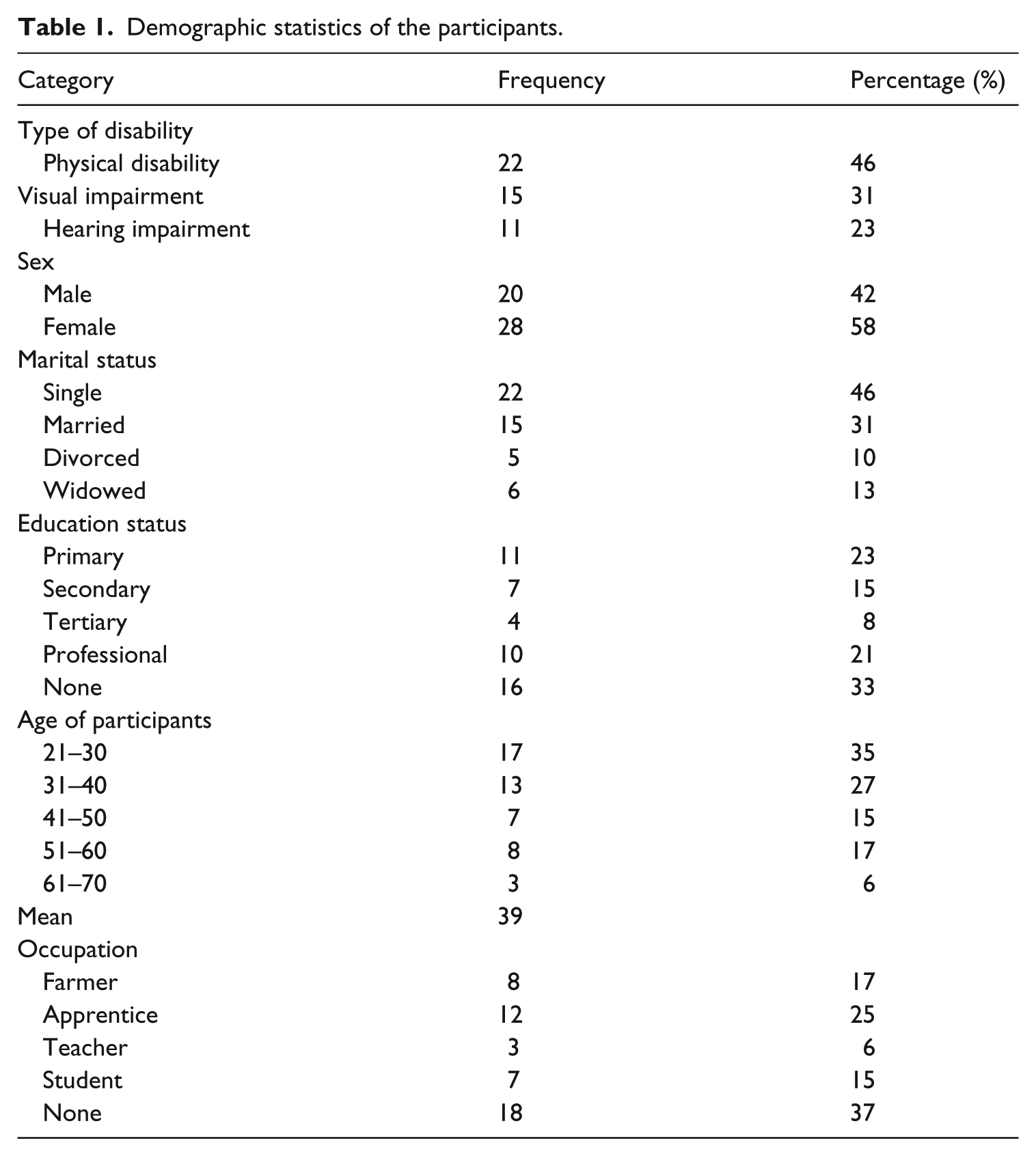
Table 1 summarises the demographic statistics of the participants who took part in the study. While nine participants were executives of DPOs, 39 participants were ordinary members. Twenty-two participants had a physical disability, 11 were hearing-impaired and 15 had visual impairments. Twenty were males; 16 had no formal education, while four had tertiary education; 37% were unemployed. Regarding marital status, 22 were single while 13% were widowed. Regarding age, 17 participants were aged between 21 and 30 years while three were between 61 and 70 years. The average age of the participants was 39 years.
Demographic statistics of the participants.
Data-collection procedure
Approval was sought from the institutional review board at the Institute of Governance, Humanities and Social Sciences, Pan African University, Cameroon, before going to the field to collect data. Afterwards, a letter was sent to the district executives of the GFD. After agreeing to take part in the study, the GFD gave the researcher a letter addressed to executives of the affiliate organisations in the selected districts. Members of the DPOs lived in scattered locations in communities, and so collecting the data during their monthly meetings was the best way to get participants for the study. All the district executives were asked to give their members prior notice about the intended study.
The interviews lasted between 40 minutes and an hour. The study was conducted over an eight-month period, and it produced approximately 40 hours of interviews. During the meetings, the objectives of the study were explained to all members present. Those who wished to take part in the study were asked to raise their hand, and they were led to another room, where the interviews were conducted. Each participant was assigned a code based on disability type and sequence of interview. They signed or thumb-printed on the consent form before they were interviewed. The participants were assured that participation in the study was voluntary, and that they were free to withdraw from the study at any time. The participants were also assured that their identity would be kept anonymous throughout the reporting of the study. Each participant was assigned a code based on his or her disability, which was used in the analysis of the data.
All the participants were interviewed using a semi-structured interview guide, which was developed based on the literature (Devereux, 2010; Gooding and Marriot, 2009; McClain-Nhlapo, 2007; Sackey, 2009). The first author, who is fluent in English and Twi, and a trained research assistant, who is fluent in one of the local languages, Dagbani, and Ghanaian Sign Language, conducted the interviews. The interviews were recorded with the permission of the participants. The discussions focused on availability of the funds, the impact of the fund and challenges in the administration and disbursement of funds. Although the interview guide was in English, the participants were allowed to speak in Twi, which is a common language in Ghana, or Dagbani, and this was translated into English. During the interviews, the research assistant translated for those who communicated in Ghanaian Sign Language or Dagbani.
Data analysis
The first author transcribed the data, and the data were then subjected to thematic analysis. Preliminary coding was performed by the first author, who used as a priori analytical framework developed from the literature. The steps followed were reading through the data, organising and coding the data, searching for patterns and interconnections, mapping and building themes, building thematic data and drawing conclusions (Lacey and Luff, 2001; O’Leary, 2004). The first author transcribed the audio-recorded interviews verbatim after listening to the audio recordings several times in order to ensure accuracy. After transcription, the transcribed interview was sent to the participants to read to confirm whether the recording was transcribed accurately. Some participants were called on the phone to discuss key issues that had emerged, to confirm whether their views were represented accurately. This process helped to involve the participants in the research process, as well as to validate the findings (Creswell and Miller, 2000; Lacey and Luff, 2001). Twenty-one participants gave feedback; they confirmed that the transcripts were accurate. The data were given to an experienced researcher to code, and the coding was compared with that of the first author. The first author met with the researcher to compare how the preliminary codes had been assigned, where the focus was on similarities and differences in the coding, before proceeding to refine the codes into categories. Similar codes were mapped together and were assigned a common sub-theme. The first author met the researcher again to discuss the emerging sub-themes and those which were agreed upon were used. The findings reported here focus on sub-themes which emerged regarding the themes of the impact of the Disability Fund and challenges in accessing it.
Results
The narratives reveal that there are barriers faced by many participants in their efforts to access the fund. It is apparent that the fund is yet to reach most of the participants who need it to support themselves. The two broad themes that emerged from the analysis were impact of the fund and the challenges encountered by the participants in accessing the fund.
The impact of the fund
All the participants confirmed the existence of the Disability Fund, which was established by the government to assist persons with disabilities. However, of the 48 participants, only seven said that they had benefitted from the fund. According to the few beneficiaries, they used the money to support their education, help their businesses, acquire assistive devices or as a means of subsistence. It was interesting to note that while the younger beneficiaries of the fund used their share of the fund to pay for education-related expenses, the older participants used their share either to invest in their businesses or to address other urgent needs: The fund has been helpful, because I used some [of the money] to pay my rent and added the remaining [money] to my working capital. My parents are not working, so they are unable to support me. That is why I applied for the fund. It has helped me, and I now have a place to sleep and work to do. (A male participant with a hearing disability 9) The last time I received the fund was last year. I applied for the fund to pay my school fees. I was given GH¢500 [US$120], which was very helpful to my education. I thank the assembly [the MMDA] and government for their assistance, which enabled me to complete my education. (A female participant with a physical disability 3)
However, most of the participants (41), who have not received the grant, were not optimistic that the fund could reach many needy persons with disabilities. In their opinion, the fund has had little impact on their lives, for several reasons, as explained in the responses below: I don’t know the kind of transformation this fund has brought in our lives. We don’t get the money, so I can’t say that the fund has changed our lives [. . .] The evidence is the number of disabled persons you see begging on the streets. (A female participant with a physical disability 5) Mmm, it is hard to say something positive about the fund. There are problems we are trying to deal with, and I do hope that things become better in the future. It is my prayer that things will change, so that many of us will be supported to start businesses. (A male participant with a hearing disability 8)
While participants who were begging and had not been successful had no plans of abandoning the practice of begging, those who had been given the grant indicated that they had stopped begging on the streets since they had received the grant; they had used the funds to start small businesses: I have stopped begging, and hoping to get more money to grow this business. I knew begging was bad, but didn’t have any option. Since I had the money, I have invested, and hope to keep the business. (A female participant with a physical disability 6) If they want me to stop begging, then they should give me money to work. There is no one taking care of me, so I beg to eat. People are very generous, so I know I will have what to eat if I go to the street. (A male participant with a physical disability 1)
Participants who held leadership positions acknowledged the challenges faced by their members, and they stated that they were in contact with the MMDA to address the problems: The fund is there, but I can’t tell whether it has changed the lives of some of our members. We try to engage the assembly [the MMDA] on the best way to get the money to us. We have many issues to solve before everyone could have access to the fund. (A male participant with a visual disability 8)
Although all participants who had not received the grant spoke about their daily struggles to survive, a few female participants reported that their situation had worsened since the establishment of the fund. They related that non-governmental organisations (NGOs) that had been supporting them had stopped and had directed them to the MMDA for their share of the fund. It emerged that these organisations were no longer providing any form of assistance because they thought government had stepped in to help persons with disabilities. For example, a female participant with a hearing disability said that she was assisted by an Islamic organisation when she was in school, but that the organisation had stopped supporting her as she was directed to go to the MMDA for her share of the Disability Fund (3). Other participants responded as follows: Everybody knows about Common Fund [the Disability Fund], but not us who are in this meeting [. . .] No one is supporting us, because they think the fund is there for us. Many of us do not get the fund, and some go back to the streets to beg. (A female participant with a physical disability, participant no. 10) People talk about the Common Fund [the Disability Fund] for disabled people, but the money doesn’t get to us. They provide the funds, but not to everyone. Hmm, I have been applying for over four years, but yet to receive. All my family members think I’m getting money and pretending that I don’t have money. They are not ready to give me money to cater for myself. To me, I think the fund is not helping us. (A female participant with a physical disability, participant no. 5)
Challenges in accessing the fund
Many challenges were highlighted by the participants, but the most common issues were as follows: insufficient funds given to beneficiaries, lack of information about the Disability Common Fund (DCF) and delays in the release of funds.
Insufficient funds given to beneficiaries
While those who had received the grant said that the amount given to them was little, many participants who had not been given the grant said that they would be content with any amount given to them. For example, according to the seven participants who had received the grant, the amount given to them was too small, and they expressed the need for a larger amount, so they can grow their businesses. A female participant with a visual disability confirmed that the amount received from the MMDAs is small as she needs more money to buy more goods for her shop (6). The two beneficiaries who had stopped begging expressed their frustration at the inadequacy of the amount paid out by the fund, and they explained that it will be difficult to convince those who are begging on the streets to stop the practice. According to them, those who beg on the streets make more money than what beneficiaries receive from the fund. Some beneficiaries expressed their sentiments as follows: I wanted to make a container [a metal shop], so I informed them, but they didn’t give me enough money to make it. They only gave me GH¢500 [US$120]. I begged them to provide me with an amount I could use for the container and also buy goods to stock the container. Er, they didn’t give me much. They will let you calculate and make a list of what you want to do, but at the end, they will only give you GH¢500, regardless of your need. (A male participant with a physical disability, participant no. 2) My mother is in the village. She buys goods from there and sells them in the city. If I decide to join her in such business, GH¢500 is too small to buy many products to come and sell. I always complain at our meetings. I asked them more questions, but they don’t give me any good answer. Sometimes they refuse to answer me. (A female participant with a physical disability, participant no. 3) If they hear that this is the amount given to us, they won’t bother to come and even apply. The money is very little, and I was earning more when I was begging. I promised chairman [a DPO executive] not to go back to the streets, so will manage what I have been given [. . .] The truth is that the money is not enough. (A female participant with a physical disability, participant no. 10)
However, those who had been unsuccessful in their application for the grant said that they were depending on people for their livelihood, and that they would be satisfied with the little amount given to them. While some male participants talked about having children to cater for, female participants talked about plans to start a trade with whatever amount they would get: I will be happy to get something small [. . .] I have children to take care of [. . .] My children are [at] home because I can’t give them money for school. I want them to go to school, but I don’t have the means [. . .] It is sad, so I’m expecting something little to solve these problems. (A female participant with a physical disability, participant no. 19) I was a trader before I became like this [with an amputated leg]. I will start selling foodstuffs in front of my house when they give me the money. It’s not good to stay at home and always rely on people for food [. . .] I really want to work and cater for myself, without looking for people to help me. (A female participant with a physical disability, participant no. 8)
Lack of information about the DCF
In relation to this sub-theme, both executive participants and non-executive participants complained about lack of information about disbursement of the grant. For instance, non-executive participants said that they did not receive any information about the application process. Similarly, the executive participants who received grants on behalf of their members, mentioned that the MMDAs concealed information about the application process and modality for assigning grants to their members. Some non-executive participants (13) accused the MMDAs and the directors of the Department of Social Welfare (members of the fund management committee) for concealing information about the application process and when beneficiaries are supposed to receive their share of the fund: Everything about this fund is like a mystery. We don’t know anything about when we would be given, but we keep hoping that one day it comes to us. At times, we hear that the money has come, and we all rush to meeting, and only to find out that no money has been released. (A male participant with a visual disability, 2) I have not asked, and I think even if I do, I’m not going to get precise information. Very often our leaders direct us to go and see the social welfare director, but we still don’t get clear information. They don’t give us the right information on when we will get the money. The money comes once [in] a while, and only a few are given. (A female participant with a visual disability, participant no. 6)
Similarly, it emerged that there is a lack of disclosure about the amount of money released from the central government to the MMDAs (based on which the 3% reserved for persons with disabilities will be calculated). Some executive participants said that the MMDAs do not tell them the amount that the government has sent to them. According to them, this denies them the opportunity of knowing the amount which is supposed to be disbursed to their members: The Common Fund [the DCF] is given to the districts to support disabled persons, but the problem is that they don’t tell us the amount of money government send. We informed the district to create an account, so that when the government release money, it will come directly into the account. But they said that they are the ones to give us the money. If we should know the amount given to the MMDAs, we will chase them for it, but they are hiding it from us. This is also our concern. (A female participant with a physical disability, participant no. 3) As a leader of an organisation, I don’t know the actual amount allocated to the various DPOs. The social welfare director will call you and give you the money to give it to specific members. I don’t know how the disbursements are done. (A female participant with a physical disability, participant no. 10)
Inability to access the fund
Many participants (31) stated that they had applied for the grant several times, but that they had not been successful. While some older participants accused the committee responsible for disbursement of funds of giving priority to applicants who use the fund to support their education, the executives shared their frustration at how many of their members were unable to access the grant. For instance, a female participant with a hearing disability said that she needed the funds to help her business, but that the committee favoured applicants who needed the funds for education (3). Interestingly, participants who had applied for the grant to support their education claimed that they had not been successful in their applications. Some participants shared their concerns as follows: I heard the government assists persons with disabilities, but for about three to four years I have been applying, but I haven’t received whatsoever fund they talked about. I was there last year to present my problem, but they didn’t tell me anything. I sent an application, but as at now, I’m yet to get a reply. I want to go to school, so want support to go and learn. (A female participant with a physical disability, participant no. 13) Others have been supported, but I’m yet to get help from the government. What I live on is begging, but recently many people are condemning that act, so I have stopped [. . .] I told the chairman [a DPO executive] about my situation, and he told me to write an application letter. I have sent the application and submitted it a long time [ago], but I haven’t heard from them for the past two years. (A female participant with a visual disability, participant no. 2) Have applied for the funds for four years now, but I haven’t received anything. One of our leaders told me that the government is yet to release [the funds]. I heard the money is supposed to come to us quarterly, but that is not the situation on the ground. (A female participant with a visual disability, participant no. 6)
Two executives said that they feel the frustration of their members, and that they try their best to make the authorities understand conditions on the ground: I feel for them, because I’m also disabled. It is not right to keep people waiting for something that’s due them. They are citizens who really want to work, but those in authority have denied them their needs. At times I listen to their stories and had to search for money to solve some of the problems. (A female participant with a physical disability, participant no. 20) As a leader, I’m very disappointed, but I have no power to change the situation. They should involve some of us, so that we can disburse the money to our members [. . .] At times, they call me on phone to ask for information, but there is nothing concrete to tell them. (A female participant with a physical disability, participant no. 5)
Delays in the release of funds
Delays in the release of funds was cited as one of the challenges facing beneficiaries. Both beneficiaries and non-beneficiaries said the waiting time before one receives the grant is too long. The grant is supposed to be disbursed quarterly, but beneficiaries claimed that it took years before they received the grant. Similarly, many participants who had not received the grant confirmed that they had applied for it a long time ago, and that they were yet to receive information about their application: I don’t think that is how government does its work. At times people will be searching for the Common Fund [the DCF], but they will tell us the money is not in. The money is supposed to come quarterly, but it mostly comes once a year. There are times we were told government didn’t release any fund to the assembly [the MMDA]. (A female participant with a physical disability, participant no. 19) I have been applying for the fund for the past five years, but I’m yet to be given. I know few people who are benefitting from the fund. It’s worrying that they have named the fund for disabled persons but we don’t get it, and they are not telling us what is happening to our money. (A male participant with a physical disability, participant no. 1)
Interestingly, while non-executive participants blamed officials at the MMDA for not giving them what is due them, their executives pointed out that government has not been releasing the cash to the MMDAs regularly, and that this affected disbursement of funds. Another executive (a male participant with a hearing disability 9) claimed that the amount given to the MMDAs, and the intervals at which government releases money to the MMDAs, keeps changing and, as such, this makes it difficult for them to calculate the number of people who will benefit from the fund.
Discussion
Social protection has been described as a human right approach to enable the poor and vulnerable such as persons with disabilities, who are mostly excluded from the labour force, to have working capital and a source of livelihood (Devereux, 2010; Mitra, 2010; Palmer, 2013). It has been argued that vulnerable groups that are offered financial assistance will use the funds to start business ventures to support livelihoods. Although this study reported that few participants had access to the Disability Fund, they reported using it to start small businesses to improve their livelihoods. In fact, many of the participants who are yet to receive the fund expressed their desire to invest in productive activities. This seems to confirm several studies which have found that introduction of social intervention programmes is a way to assist persons with disabilities to participate in income-generation activities (Devereux, 2002, 2010; Levine et al., 2011). However, it was found that there are challenges in the administration of the fund and disbursement of funds. Problems identified by the participants were delays in the release of funds, insufficient funds and unavailability of funds. These challenges appear to have contributed to failure of the fund to reach most of the participants and have a meaningful impact on their lives.
As shown by the demographic statistics, most of the participants were unemployed. Without employment, the fund seems to be a valuable resource for the participants to get working capital to participate in economic activities. However, as the study findings indicate, the fund has not been able to serve the purpose for which it was introduced as most of the participants have been unable to access it. Foli (2015) and Gooding and Marriot (2009) pointed out that many governments in low-income countries usually have problems funding social intervention programmes. Perhaps the government may be struggling with funds and is unable to release funds to the MMDAs, who would transfer the 3% quota to persons with disabilities. Also, it is possible that the administrators at the MMDAs could be unenthusiastic about releasing the funds to persons with disabilities, and they could be channelling their share into other projects. Although the study findings do not support this claim, there is evidence of administrators mismanaging disability funds, as reported by Abebrese (2011), Goldblatt (2009), Oduro (2015) and Yeboah et al. (2016).
Information about disability grants is crucial in efforts towards levelling the playing field for all applicants. If information were available, it would guide beneficiaries and empower them to be aware of procedures involved in the administration of grants. However, as found by this study, information about the application process, the amount of the grant and the intervals between release of disbursements from the central government to the MMDAs was unavailable to almost all the participants. Administrators at the various MMDAs seem not to be transparent, as they appear to conceal information about the fund from the participants. The MMDAs serve as a conduit between central government and the DPOs, and therefore the lack of disclosure means that the participants will not know when to expect feedback on their application for funding. This finding is consistent with studies by Goldblatt (2009), Kuper et al. (2016), Loeb et al. (2008) and Sackey (2009), which found that administrative procedures of disability grants and information about them were unclear, which impeded access.
A number of studies have reported that regular flow of social grants to beneficiaries is key to enable them to invest in productive income-generation activities (Banks et al., 2017; Gooding and Marriot, 2009; Mwendwa et al., 2009). This study, however, found that patterns in the release of funds were irregular as many of the participants had to wait for years before receiving the grant. In such instances, it may be difficult for the participants to plan or engage in sustainable economic activities as their source of funding is unreliable to keep them in business. As beneficiaries claimed the amount given to them was insufficient, they may be unable to sustain their business activities. With irregular and meagre cash given to beneficiaries, the Disability Fund initiative could become tokenistic as beneficiaries may use the funds for short-term projects, rather than investing them or engaging in long-term economic activities. Conversely, the participants who are yet to receive the fund may continue to endure hardships. This finding is consistent with studies by Abebrese (2011), Mitra (2010), Mwendwa et al. (2009), Oduro (2015), Sackey (2009) and Sultan and Schrofer (2008), which have reported that irregular flow of funds denies access to social interventions. For instance, in Uganda, Mwendwa et al. (2009) criticised cash transfer as being one-off and a means to score political points, without the government building a sustainable policy which will enable persons with disabilities to have regular inflow of cash, as well as a sustainable means of livelihood.
Although persons with disabilities are not tolerated in most Ghanaian societies (Opoku et al., 2018), they still require support, such as educational assistance and vocational training, from society and other philanthropists to make a living. According to some of the participants, introduction of the fund has denied them the support they used to get from members of society. Although the fund has been introduced, as reported in this study, the participants have been unable to access it. The information about availability of the fund is known in societies which seems to have informed organisations to renege on their support to persons with disabilities. It is possible that organisations which may be interested in supporting persons with disabilities may channel resources into other projects. This appears to be a double loss for the participants, who have been unable to access the fund and have seemingly been denied support from individuals within their societies. As some of the participants pointed out, they will continue to beg to ensure their survival as there seems to be little chance of them receiving funds to trade. As reported by Abebrese (2011), Banks et al. (2017), Gooding and Marriot (2009), Oduro (2015) and Yeboah et al. (2016), inadequacy of funds impedes access, and a significant number of potential beneficiaries remain at risk of not having access.
Conclusion and implications
This study explored the accessibility and the impact of the Disability Fund on the lives of persons with disabilities in Ghana. This study adds to the literature on the impact of social protection on the lives of persons with disabilities in developing countries. Introduction of the Disability Fund is a response to international frameworks, which mandate signatory countries such as Ghana to design programmes to assist persons with disabilities to participate in socio-economic activities. However, this study found that the fund has not been well implemented as its impact on the lives of persons with disabilities remains suspect. The study revealed that there are challenges associated with management and access of the fund and disbursement of funds to their intended targets. Thus, it will be difficult to alleviate poverty among persons with disabilities if they are not able to access the fund that has been developed to improve their well-being. Just as Ghana could not achieve most of the MDG targets in 2015, the country might not be able to alleviate poverty among persons with disabilities, as espoused by the SDGs, if the challenges highlighted in this study are not addressed.
The findings of this study have implications for policymaking in Ghana. Particularly, the Disability Fund has to be reformed before it can achieve its intended goal of enhancing the lives of persons with disabilities. With the Disability Fund being the only intervention programme focused solely on persons with disabilities, it is necessary for the government to strengthen management of the fund and disbursement of funds. As outlined by Barrett and Kidd (2015), the government of Ghana should reform the administrative and business processes governing the management of the fund. Specifically, qualified individuals with a clear understanding of issues of disability should be tasked with managing the funds. Also, it is necessary for the government, through the Ministry of Finance, to transfer the cash directly to beneficiaries. This, according to Barrett and Kidd (2015), will enable the funds to get to deserving beneficiaries on time, it will ensure transparency and it will allay fears of embezzlement of funds by administrators. This will also help prevent unnecessary bureaucratisation, which was found to impede access for the participants. For the purpose of transparency and accountability, as discussed by Barrett and Kidd (2015), and as outlined in the fund’s disbursement guidelines (NCPD, 2010), the Ministry of Finance should release documents on revenue released to MMDAs to DPOs in order for them to be aware of the amount of the grant and the intervals at which the 3% quota for persons with disabilities is transferred. Also, as part of the national identification system to register all Ghanaians, an attempt should be made to collate national data on all persons with disabilities. This will help the government to understand their needs, and perhaps it will take steps to include them in societal activities.
The findings of this study should be interpreted with extreme caution because of some limitations. First, the interviews were conducted on meeting days, and there may be other members who could have different experiences from what was relayed by the participants. Second, the study was limited to a few districts in the Northern Region of Ghana, and the findings may not be a reflection of the situation in other parts of the country. However, recruitment of diverse participants, such as participants with different types of disabilities, and participation of beneficiaries, non-beneficiaries and DPO leaders minimised this limitation. Also, the structure of the DPOs, the management of the fund and the context of the study are similar to those in other parts of the country, thus the validity of the study is ensured. It is recommended that future studies use a quantitative method to expand this study and compare perceptions of persons with disabilities across regions, so as to obtain a holistic understanding of their experiences. Also, all the participants were members of DPOs, who might have similar experiences, which may be different from the experiences of persons with disabilities who are not members of DPOs. Since being a member of a DPO increases one’s chances of accessing the fund, the researcher recruited participants who were members of DPOs and had experience applying for the fund. It is important that future studies include the voice of persons with disabilities who are not members of DPOs. Despite these limitations, this study has provided a snapshot of the perceptions of persons with disabilities regarding access to a state-engineered cash transfer programme.
Footnotes
Funding
The author(s) received no financial support for the research, authorship, and/or publication of this article.
