







Abstract
Across Europe, Muslim leaders face a dilemma in deciding whether to seek recognition and public visibility. Recognition can offer legitimacy, funding, and stability, yet it also exposes Muslim groups to scrutiny and political contestation. While existing research has documented divergent patterns of Muslim public engagement, it has paid limited attention to the decision-making experiences of Muslim leaders themselves, particularly as localized actors navigating subnational political environments. This paper argues that the choice to seek recognition is best understood as a calculation under uncertainty: Muslim leaders weigh the expected probability of success against the perceived risk of backlash that greater visibility might provoke. Drawing on ethnographic fieldwork and over 70 interviews with Muslim leaders and policymakers in Belgium and Switzerland, I develop the concept of institutionally mediated inference to explain how political structures shape the informational cues through which actors form these expectations. In Belgium, recognition is governed by regional executives whose partisan alignments provide clear heuristics of state openness or hostility. In Switzerland, recognition is filtered through practices of direct democracy, where the looming possibility of referenda renders outcomes unpredictable and heightens the perceived risk of backlash. The findings highlight that what appears as disengagement does not reflect indifference toward recognition, but rather a strategic response to the risks that visibility entails. By centering the interpretive agency of Muslim actors, the paper shifts analysis from state-centric accounts of recognition to the reasoning of those navigating it, bridging debates on political opportunity, secularism, and the governance of Islam in Europe.
Introduction
In liberal democracies, minority groups often face a difficult choice when deciding whether to enter the public sphere and engage with the state: collaboration can offer legitimacy, resources, and access to public institutions, yet it also exposes communities to scrutiny and contestation (Vertovec and Wessendorf, 2010; Young, 1990). This tension is especially acute for groups whose public presence can serve as a focal point of political mobilization, such as Muslim communities across Western Europe (Cesari, 2013; Göle, 2011). In recent years, Muslim leadership has increasingly confronted this challenge as they assume political roles that extend beyond their religious responsibilities (Hashas et al., 2018). As researchers increasingly highlight how institutions mediate minority groups’ access to visibility and belonging, the strategies Muslim leaders use to navigate the politics of visibility gain wider theoretical relevance (Meer, 2012; Bloemraad and Scho¨nwa¨lder, 2013).
This paper asks why some Muslim leaders seek visibility and pursue public recognition of their communities while others refrain. Literature on the political behavior of Muslim leaders remains limited, and what research has been done has focused on the relationship they have with home countries or transnational networks rather than the inputs they face locally (Sunier et al., 2016; Sunier and Landman, 2014). Furthermore, when researchers have studied whether Muslim leaders seek recognition, they have often attributed their distances from European state bodies to matters of belonging, transnational ties, or ideology (Emmerich, 2023; Pfaff and Gill, 2006; Özturk and Sözeri, 2018). Instead, I argue that the choice to seek state recognition is best understood as a calculation under uncertainty: in a fraught political environment, Muslim leaders interpret informational cues to weigh opportunities for engagement against the potential risks it brings. These dilemmas unfold not merely as religious questions, but as racialized ones: in contemporary Europe, the governance of Islam often doubles as the governance of visible difference itself (Meer and Modood, 2012; Modood, 2009).
This paper follows my earlier study of mosque recognition politics in Belgium (Mekawi, 2026b), which found that religious leaders sought recognition for reputational, rather than material, incentives. The present study builds on that paper in theoretical and empirical ways. Theoretically, it introduces two underlying expectations that guide religious leaders’ decision-making processes: an assessment of the probability of success and an estimation of potential backlash. It also develops the concept of institutionally mediated inference to explain why similar reasoning processes can yield different outcomes across contexts; this intervention allows the theory to ‘travel’ across national settings while remaining attentive to different institutional configurations. Empirically, the paper applies this expanded framework to Switzerland, testing its explanatory power beyond the Belgian case and assessing the possibilities and limits of its broader applicability.
The comparative analysis proceeds at the subnational level. I first compare the regional territories of Flanders, Wallonia and Brussels in Belgium, which were used to inductively develop the theory. I then conduct a comparison of the Swiss cantons of Vaud and Zurich as a test of ‘subnational politics in different national settings,’ which offers a way of assessing the external validity of subnational theories developed within single-country studies (Sellers, 2019). In both countries, I traced how institutional and political differences shape mosque recognition dynamics within each country. Belgium and Switzerland were selected because they have analytically comparable frameworks for religious recognition, yet delegate authority to subnational governments. This decentralization allows for high within-country variation under a shared national umbrella, an important selection criterion for subnational case studies (Snyder, 2001). Methodologically, the paper draws from two fieldwork stays in both countries, wherein I conducted over 70 interviews with religious leaders, policymakers, and community activists. I use these interviews, as well as policy documents, archival records, and plenary sessions, to carry out a historical analysis of recognition dynamics in each subnational case study.
In Belgium and Switzerland, I find that while authority over religious governance is similarly decentralized, the informational structure surrounding recognition differs sharply. In Belgium, regional executives decide which mosques to recognize, creating a process where partisan control provides clear cues about the state’s willingness to collaborate. In Switzerland, where practices of direct democracy bear consequence, the salience of public referenda make recognition politically unpredictable. In both cases, Muslim leaders rely on the same underlying logic: they assess the likelihood of success against the risk of backlash if they were to seek public recognition, and make their decisions accordingly. The same reasoning processes, however, are then filtered through different institutional set-ups to lead to divergent outcomes across subnational cases.
This study makes multiple contributions. Descriptively, I present an ethnographic, ground-up account of how Muslim leaders navigate a contentious political environment. In so doing, I follow calls to move beyond the dominant focus on the problematization of Islam, and center the agency of Muslim leaders in responding to such discourses (Fadil and Fernando, 2015; Bracke and Hern´andez Aguilar, 2022). Theoretically, I offer a framework for understanding the contingent and uneven pursuit of visibility and recognition among Muslim minorities in Europe, addressing patterns that have been observed by scholars but remain underexplained (Koenig, 2007; Meer and Modood, 2012; Monnot, 2016). Importantly, the findings highlight that the absence of visible public engagement does not necessarily reflect disengagement or a lack of desire for recognition. Rather, Muslim leaders are often constrained by political barriers that make visibility difficult or strategically costly. By shifting attention from intentions to opportunities, the paper extends broader scholarships on how state institutions and local politics can shape and constrain the forms that minority groups’ practices can take in the first place (Kriesi, 1991; Pager and Shepherd, 2008; Schneiberg and Lounsbury, 2017).
Recognition and the politics of visibility
If any group is to be recognized by the state, it’s worth considering what it is to be recognized as and what recognition does. Building on Hegel’s early formulation of recognition as the basis of mutual selfhood, Charles Taylor conceives of recognition as a condition of individual dignity within multicultural societies, while Axel Honneth situates it in the struggle for social esteem and respect (Hegel, 2018; Honneth, 1996; Taylor, 1994). Yet critical perspectives have emphasized that recognition can also reproduce domination, turning difference into a manageable category for the state (Coulthard, 2014; Fraser, 2000; Povinelli, 2002). For minority groups in liberal democracies, recognition inevitably becomes intertwined with visibility. Scholars of ethnicity, religion and secularism have shown how this visibility is structured by norms of civility that privilege certain groups while marginalizing others (Asad, 2003; Fadil, 2013; Bracke and Herna´ndez Aguilar, 2022). For Muslims in Europe, this has meant that visibility can become a source of vulnerability: to appear is to invite regulation, suspicion, and debate over belonging (Cesari, 2013; Göle, 2011).
Several scholars have therefore analyzed the politics of visibility through the concept of infrapolitics, introduced by Scott (1990) to describe a range of subtle, indirect, or hidden practices through which marginalized groups engage in political resistance without entering into direct confrontation with power. Through this lens, strategies of opacity, obstruction, or quiet negotiation, which may appear as invisibility, can be understood as cogent and intentional forms of resistance to dominant institutions (Abu-Lughod, 1990; Bayat, 2013). Such dynamics are particularly evident among minoritized or racialized groups, including migrant communities whose public visibility is closely tied to political vulnerability (De Genova, 2002; Fradejas-García and Loftsdóttir, 2024). Building on these insights, I examine how Muslim leaders respond to the politics of visibility — showing that their decisions to seek or avoid it both reflect how they understand and negotiate the forms of visibility available to them.
I analyze these descisions in relation to policies of recognition for mosques in particular, since mosques are often the institutional sites where struggles over visibility and belonging become most acute. Indeed, since the mass arrival of Muslim migrants to Western Europe in the 1960s and 70s, European mosques have invariably found themselves thrust forward as sites of anti-Muslim mobilization and discrimination (Cesari, 2005; Lundsteen, 2020; Mu¨ller, 2021). Against this backdrop, Muslim groups have gone from passive to active actors. While first-generation migrants largely relied on ‘strategies of invisibility’, choosing to remain out of the public realm and to focus narrowly on religious needs, mosque-communities today have largely abandoned this approach and instead begun to demand the public recognition of their institutions (Koenig, 2007; Rath et al., 2001).
In doing so, they vividly demonstrate the relationship between visibility and recognition. As Brighenti (2007) writes, the “search for visibility is in many cases a search for social recognition”, with recognition appearing as the outcome of “visibility as empowerment”. In other words, Muslim communities seek to assert a right not only to be seen in the public sphere, but to be accepted as legitimate participants within it. Where formal recognition is possible, wherein the state confers some form of approval as a legal status, Muslim communities now use a range of methods to negotiate a similar position to, and symbolically equal with, the historically recognized majority religions (Thompson and Modood, 2022). Even in contexts like France however, where the state is nominally la¨ıc (i.e. strictly secular) and where religious communities are relegated to the private sphere, Muslim groups have sidestepped state-approved frameworks to assert their visibility and demonstrate their belonging as part of the French associational landscape (Parvez, 2017).
Western Muslim religious institutions thus hold a dissonant dual capacity: on the one hand, they play a pivotal role in the incorporation of Muslims from a migrant background and can help mitigate against a host of structural and individual issues facing a marginalized minority group (Dana et al., 2011; Fleischmann et al., 2016). On the other hand, they continue to be embedded in, if often unwillingly, contentious politics that frequently assert their incompatibility with Western values and that reflect wider discourses on Islam’s place in the West as a whole (Lundsteen, 2020; Peucker, 2018). It is precisely for these reasons that it is important to examine the political behavior of Muslim leaders, who often navigate these disparate roles. In response to political and discursive pressures, Muslim leaders are now made to address the general public, testify in front of state authorities, weigh in on controversial issues such as halal slaughter or imam training, oversee religious education in public schools, and of course, speak up and against incidents of radical violence done in the name of their faith (Birt, 2006; Hashas et al., 2018).
Yet despite this growing public role, research on the local leaders who mediate between Muslim communities and the state remains limited. Existing work has tended to emphasize transnational linkages—such as network affiliation or ties to home-country governments—or ideological orientations, for instance around Salafism, to explain why seeking recognition is either sought after and achieved (Emmerich, 2023; Sunier et al., 2016; Yaşar, 2022). While these studies offer important insights, they risk overlooking the locally embedded factors that shape how Muslim leaders engage the state and that contribute to the continued problematization of Muslim communities. In contrast, I seek to explain Muslim leaders’ decision-making as those of localized actors facing uncertain political terrains. In doing so, I approach religious recognition as a form of proactive engagement with visibility, in which Muslim leaders strategically negotiate how and when to appear in the public sphere.
Theoretical framework
In (Mekawi, 2026b), I found that mosque leaders in Belgium make decisions regarding recognition in ways that protect the reputations of their institutions. This is why other inputs, such as material considerations, are insufficient to explain whether or not they seek recognition. Here, I build on my previous work by introducing two expectations through which religious elites structure their decisions: an estimation of the likelihood of success, and an assessment of the risk of backlash.
The first expectation concerns whether recognition is attainable: mosque leaders infer, from their institutional environment, how likely it is that the state will accept their application. Because the state is under no obligation to grant recognition, leaders must also consider what incentive the state has to do so and whether collaboration serves its own political interests.
The second expectation concerns what can go wrong. Even if recognition appears possible, the process itself may trigger a backlash effect: attempting to collaborate with state bodies can run the risk of political discourse turning against the religious institution in question. If policymakers wants to avoid recognizing mosque-communities, they may deflect responsibility by framing mosque institutions as the source of failure — accusing them of lacking transparency, internal cohesion, or of being a threat to the social order. Here, recognitions becomes a trap: by stepping forward, mosque leaders expose themselves to scrutiny they might otherwise avoid by staying in the private realm and foregoing recognition altogether.
Though these two expectations may co-arise, they do not always align. A low prob-ability of success may coincide with a low risk of backlash, while a high probability of success can still carry significant political risk. It is in navigating this uneven relationship between opportunity and exposure that leaders decide whether to pursue, hedge, or avoid recognition altogether. Figure 1 shows how these two expectations can overlap. The logic of recognition: Balancing visibility’s rewards and risks.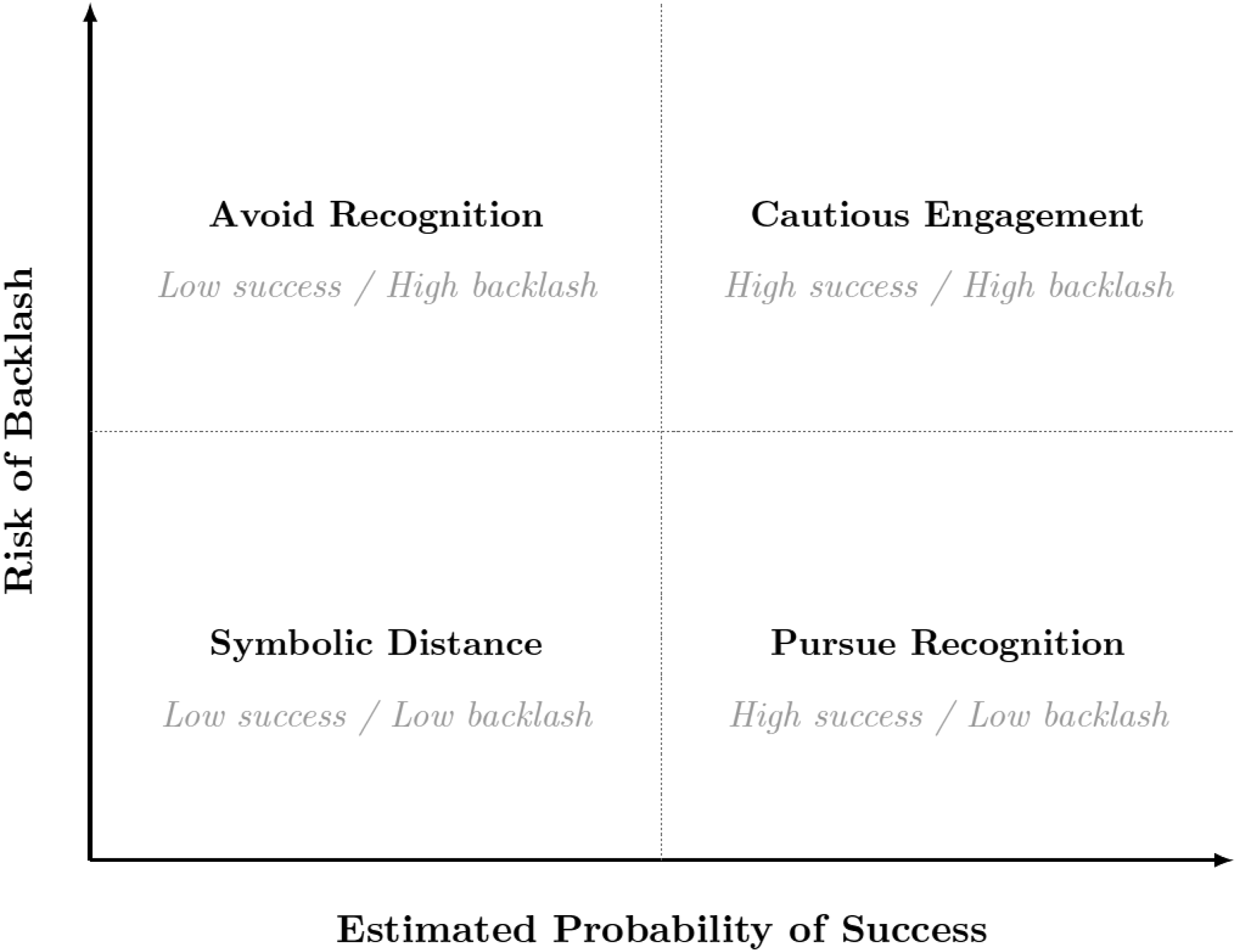
Figure 1 captures the range of strategic orientations available to Muslim leaders as they navigate recognition under uncertainty, and generate theoretical predictions for the political behavior of Muslim elites in each of my case studies. As with any set of expectations, Muslim leaders’ inferential logic does not only vary across space but also over time. Therefore in the case studies, I do not only demonstrate how institutions have different orientations across cases, but how the can also change their expectations and move from one orientation to another in the same case over time.
If seeking recognition hinges on these two expectations regarding success and risk, then how do Muslim leaders form them in the first place? They do so through a shared process of institutionally mediated inference: Muslim leaders interpret signals from their institutional surroundings to anticipate how their claims will be received. The concept of institutionally mediated inference builds on the scholarship on political opportunity theory, which emphasizes how institutional arrangements condition the possibilities for collective action (Cinalli and Giugni, 2013; Kriesi, 1991; Tarrow, 1994). Whereas political opportunity approaches typically focus on how institutional environments enable or constrain mobilization, I foreground the interpretive processes through which actors read institutional cues under conditions of uncertainty. The key point is not that actors reasons differently across contexts, but that the same inferential logic can lead to different conclusions depending on the instutional signals actors observe. In this sense, institutionally mediated inference is intended to demonstrate how identical strategic logics can produce divergent behaviors and outcomes across, and contingent on, institutional settings. Finally, by linking this framework to the aforementioned scholarships on infrapolitics and resistance, which point to why subordinate groups may avoid visibility, I illustrate how actors use institutional signals used to determine when and whether visibility is safe (Bayat, 2013; Scott, 1990).
Observable implications
Combining the universal preference to protect institutional reputation with their concerns over minimizing backlash effects, I expect mosque leaders to discuss their preferences regarding whether or not to seek recognition in Belgium and Switzerland in the following order (Figure 2): How mosque leaders rank preferences in Belgium and Switzerland.
Religious leaders may broadly prefer to obtain recognition, but they would rather stay in the private realm and avoid the state altogether rather than to seek and be denied state recognition. As a result, mosque leaders will seek recognition only if they expect the probability of success outweighs the perceived risk of backlash.
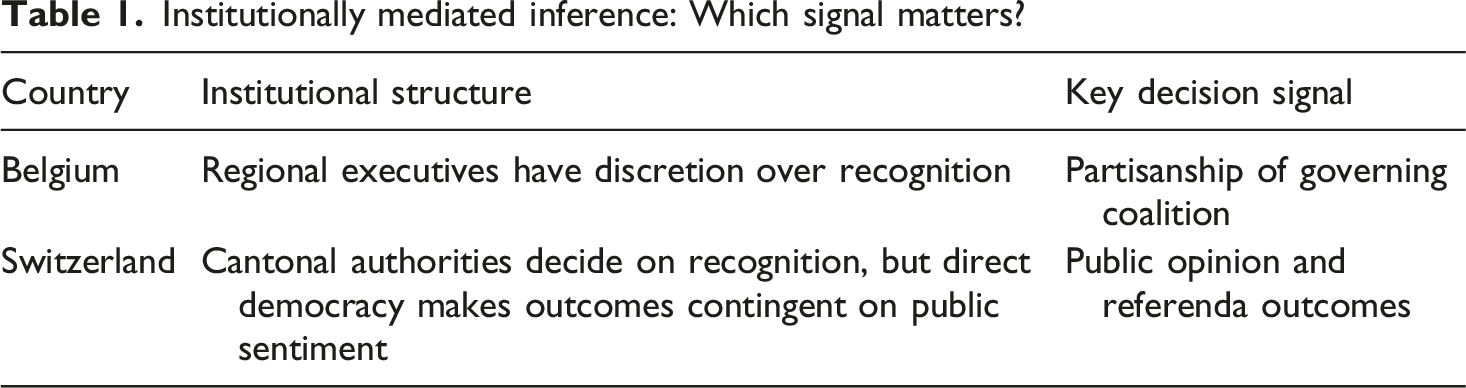
Mosque leaders form these expectations through the information available to them—but, as noted earlier, the kind of information they can rely on depends on the institutional context. In Belgium, recognition is granted at the discretion of elected regional officials, making partisan identity the most meaningful source of information. This explains why regional recognition rates in Belgium vary with partisan background (Mekawi, 2026b). Mosque leaders track which parties govern recognition in their region and interpret those partisan configurations as signals of bureaucratic openness or resistance. The relationship between partisans’ political parties and Muslim minorities provides a clear heuristic for estimating the likelihood of success and the risk of backlash that come with seeking recognition.
In Switzerland, mosque leaders’ decision-making is complicated by the country’s tradition of direct democracy. Any changes to Swiss law, including a change in recognition status, can potentially be put up to a cantonal referendum, meaning the general public plays a direct role on policies affecting Muslim groups. Unlike in Belgium, where regional officials hold ultimate discretion over recognition, even sympathetic cantonal officials cannot guarantee success if public opinion turns hostile. Therefore, in Switzerland, public opinion towards Muslim communities and, in particular, the results of past referenda affecting Muslims as a minority group function as important barometers of societal readiness.
Institutionally mediated inference: Which signal matters?
Case selection
In Switzerland and Belgium, I take advantage of formal recognition systems to study the dynamics involved in the politics of visibility for Muslim leaders. The nature of these regulatory frameworks make them particularly well-suited to examine the political behavior of religious elites for two reasons: first, while public recognition has been studied across multiple European contexts, the possibility for formal recognition in Belgian and Swiss frameworks produces easily measurable outcomes, and can narrow down religious elites’ decision-making into a binary outcome (seek recognition, or not). Furthermore, because recognition in both cases is the competence of subnational governments (regional in Belgium and cantonal in Switzerland), I can conduct subnational case comparisons within national units; subnational case studies allow researchers to identify causal or important factors within complex processes while controlling for institutional or historical characteristics that might otherwise affect outcomes (Sellers, 2019; Snyder, 2001).
Belgium and Switzerland provide contrasting but analytically compatible settings for examining how religious leaders interpret political signals when seeking state recognition. In Belgium, recognition decisions are made at the discretion of regional executives. Since the late 1990s, each of the three regions — Flanders, Wallonia, and Brussels — has gained authority over cultural and religious affairs, including the recognition of local faith communities (Andrea, 2000; Brems, 2020). Once recognized, mosques become eligible for public subsidies and imams’ salaries are paid by the regional government (Sägesser, 2020; Torrekens, 2014). In the years since the policy’s ”regionalization” in 2001, 87 of Belgium’s approximately 300 mosques have been formally recognized (Husson, 2022; Maréchal and El Asri, 2017). Recognition rates have varied significantly, however, between regional units: mosque-communities have been recognized at much higher rates in Wallonia (60%) and Brussels (49%) than in Flanders (16%). This is, again, despite the fact that all three regional governments operate under the same national mandate of state support for religion, and that mosques in all three regions have broadly similar demographic distributions (Mekawi, 2025b).
Unlike Belgium, Switzerland does not recognize individual institutions but rather umbrella associations representing multiple communities; otherwise, Switzerland similarly delegates recognition decisions to its cantons (D’Amato, 2014; Stolz and Chaves, 2018). 1 However, while formal recognition does requires the approval of the cantonal parliament, any citizen may subject a recognition decision to a referendum by gathering the required number of public votes (Monnot, 2013, 2018). Popular participation and public referenda are therefore always a possible, but not mandatory, part of any recognition process. 2 As of yet, no Swiss Muslim association has been recognized; thegroup closest to being formally recognized is the Vaud Union of Muslim Associations (L’Union Vaudoise des Associations Musulmanes, UVAM) in Vaud, which became the first Swiss Muslim association to request recognition in 2019, and is currently awaiting the canton’s response (Abdeleli, 2020). In my Swiss case studies, I compare UVAM’s relationship with cantonal authorities in Vaud to its counterpart, VIOZ, in Zurich. I chose to focus on the Association of Islamic Organizations in Zurich (Vereinigung der Islamischen Organisationen in Zu¨rich, VIOZ) because solely in terms of organizational capacity, it is the association best-positioned to request state recognition: it is Switzerland largest and oldest Muslim umbrella group, and in many ways has the resources necessary to navigate the bureaucratic hurdles of recognition procedures (Banfi and Gianni, 2023; Mekawi, 2025a). As critical to my work as explaining why UVAM became the first and only association to seek Swiss recognition, therefore, is to ask why VIOZ continues to avoid the policy even as it has the resources to engage with it.
Empirical strategy
This paper conducts a qualitative comparative analysis of subnational cases, first in Belgium and then in Switzerland. The study draws from an extensive fieldwork project carried out in both countries. Between 2022 and 2024, I conducted more than 70 interviews with mosque leaders, representatives of Muslim umbrella organizations, and policymakers involved in religious affairs. I spoke to individuals from the major Muslim ethnic groups in each region and canton, and leaders at the mosque, association and network levels. I also spoke to policymakers from previous and current cantonal and regional governments, selecting both career bureaucrats and political appointees. For a full account of my methodological approach, as well as the epistemological issues it raised, please see (Mekawi, 2026a).
In this paper I supplement these interviews with parliamentary records, archival documents, and government reports, which together provide a detailed account of how recognition processes unfold in practice. I use these sources to present historical analyses of each subnational case, wherein I focus on the experience of particular institutions over time in order to present a fine-grained view of how recognition politics are negotiated on the ground. The result is a deep ethnographic account of decision-making within Muslim institutions and their evolving relationships with the state.
Same policy, different politics: Recognition and visi-bility at the subnational level
Partisanship and recognition in Belgium
Through the concept of institutionally mediated inference, I argue that religious leaders form their expectations regarding recognition based on the cues that matter in their institutional context. Because Belgian recognition is the competence of ministerial cabinets within regional governments, the partisan identity of the relevant ministers is the critical determinant of how Muslim leaders anticipate state behavior. To clarify the partisan actors involved and their relationships to Muslim communities, Figure 3 uses data from the 2014 Belgian National Elections Study, a post-electoral survey of federal and regional elections, to show regional parliament vote choice for Muslim and non-Muslim respondents during the 2014 regional elections (Abts et al., 2015).
3
Vote choice for Belgian regional parliaments, 2014.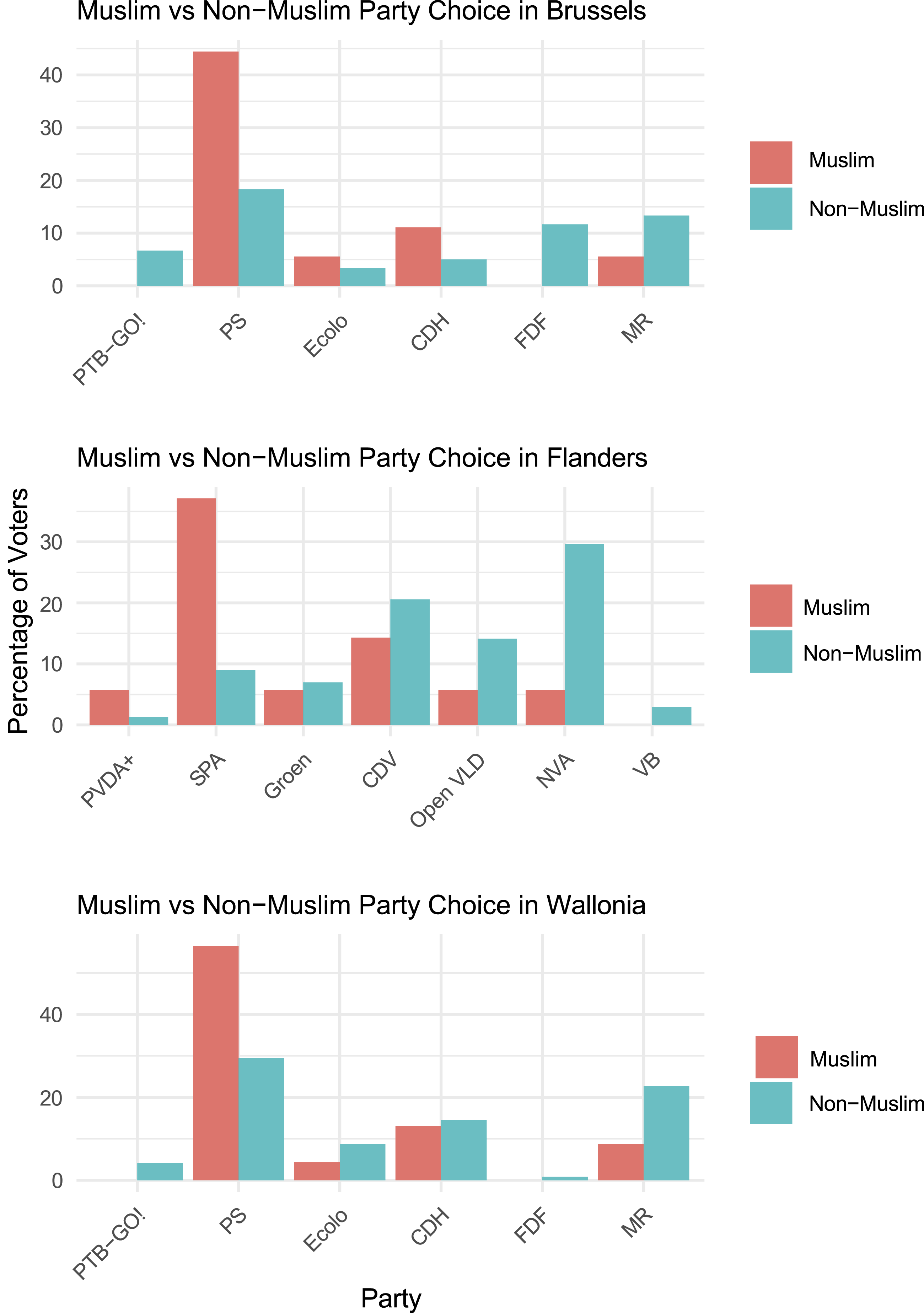
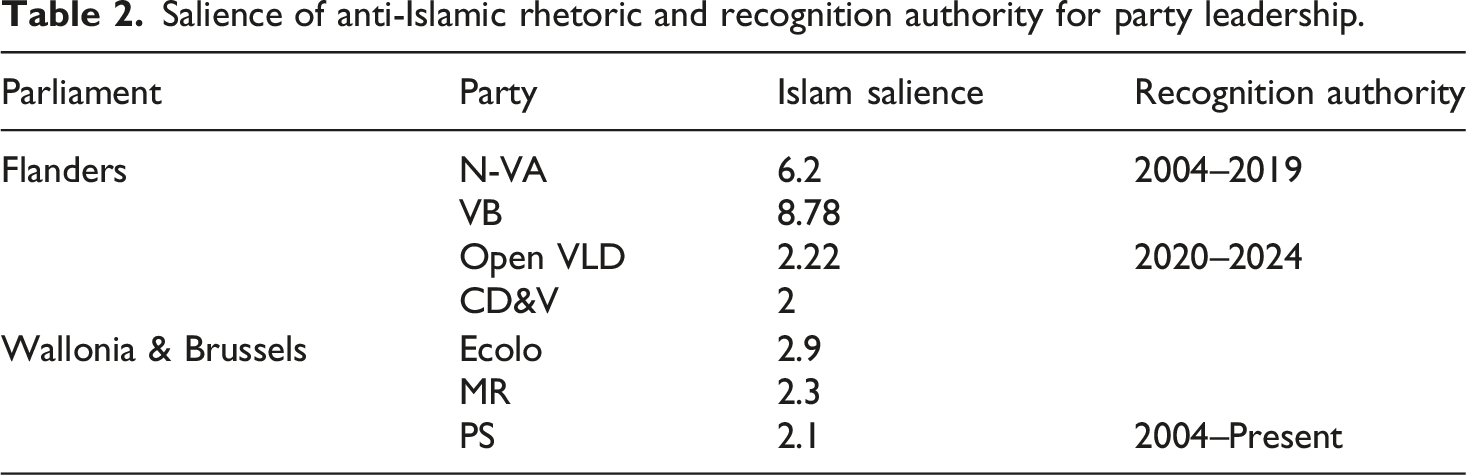
The parties are arranged on the x-axes from furthest left to furthest right. In Brussels and Wallonia, the left-wing Socialist Party (Parti Socialiste, PS) was the most popular among Muslim and non-Muslim voters alike, but it stands out particularly for its relationship with Muslim voters. Meanwhile Flanders’ largest party during the time of my fieldwork, the right-wing New Flemish Alliance (Nieuw-Vlaamse Alliantie, N-VA) received almost no support from Flemish Muslims, who instead tend to vote for the Socialistische Partij Anders (Flemish Socialist Party, SP.A), the PS’s counterpart in Flemish politics. 4
Salience of anti-Islamic rhetoric and recognition authority for party leadership.
Brussels and Wallonia: Recognition and left-wing governance
Even in Brussels, where Muslims make up nearly a quarter of the city and where the Parti Socialiste dominates regional elections, state officials had to initially contend with a degree of distrust from religious elites regarding formal relations with the state. A Moroccan imam confirms that while his community did hold some concerns, they were assuaged after repeated meetings with party officials: At the beginning, a lot of Moroccans didn’t trust the region at all… then there were so many meetings, and also some politicians from [the Parti Socialiste] even came to mosques and held events during Ramadan, stuff like this… and then the mosque presidents who were afraid of the state saw that mosques that did get recognized were not punished, so they began to see the benefits of recognition.
As party officials have demonstrated that the risk of backlash is minimal, the number of Bruxellois mosques that have sought and received recognition has grown at a stable but increasing rate over time. Figure 4 demonstrates this. Mosque application and recognition rates in Brussels.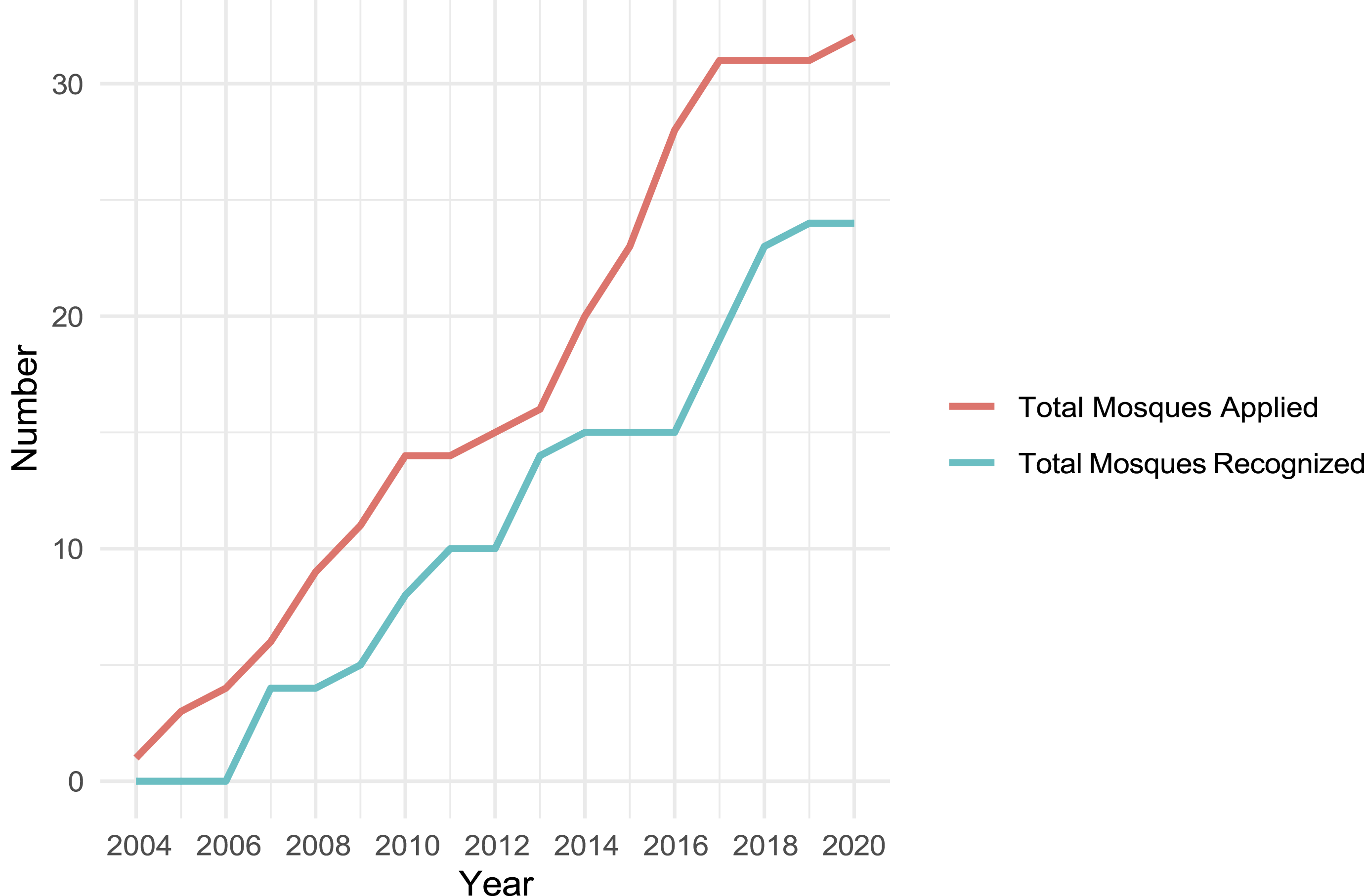
Figure 4 also shows a slight increase in mosque recognition rates between 2016 and 2018, which several interviewees explained through the lens of the 2016 Brussels bombings. In the immediate aftermath of the attacks, recognition became a priority for mosques in Brussels as a reputational safeguard. According to interviewees, the effect was particularly pronounced in Brussels due to the Parti Socialiste’s control of recognition. A former federal official describes a mutually beneficial relationship between mosques and the state in electoral terms, stating that the Socialist Party recognizes mosques at a higher rate in Wallonia and Brussels in order to court Muslim votes: “It’s not about religion, it’s about political party and ideology. It’s about gaining votes. In Brussels, it’s the PS who is in charge of religions and they want to keep Muslims as a friend. They vote for them so the PS recognizes their mosques… it’s the same in Wallonia. Officially they try to follow the la¨ıcit´e of France, they’re a secular nonreligious party. But the Parti Socialiste especially, for voting reasons, electoral reasons, they want to keep Muslims as a friend.”
Not only is the risk of backlash minimal, but the likelihood of success is comparatively high due to the PS’s control of recognition in Brussels and Wallonia. And indeed, a majority of mosques in both regions are currently recognized. Walloon recognition follows similar patterns as Brussels given the PS’s electoral dominance and control of recognition in that region as well. Due to the state’s regulatory approach and partisan make-up, mosque leaders have turned to the Walloon regional government in droves, with 90% of Walloon mosques having applied for state recognition as of this writing (Mekawi, 2026b). In terms of this paper’s theoretical predictions, mosque leaders in both Wallonia and Brussels are clearly in the For us, [recognition] is sending this signal, sending the signal of the state, that we are a region which establishes positive functions with all parts of society… and so we must see in Wallonia, even more so in Brussels, but in Wallonia there is a historically large Muslim community… and so at some point, making the decision to recognize is also sending a message: you are part of the same community as us, you are not from outside this community.
Flanders: (In)Visibility in a right-wing environment
When Flemish recognition began in 2004, the right-wing N-VA’s control of recognition meant that, for Flemish mosques, the likelihood of success was low; at the same time, during the period prior to the heightened politicization of recognition following the Brussels bombings, the risk of backlash was also relatively minimal. The result was what I term
Things changed, however, in the wake of the 2016 Brussels bombings. Success still seemed unlikely, but the risk of backlash then increased dramatically. The attacks brought mosques under heightened political and media scrutiny, turning recognition from a relatively obscure administrative matter into a public test of loyalty and transparency. This shift is best exemplified by the trajectory of the Fatih mosque in Beringen, which demonstrated to religious leaders that recognition did not confer protection, but invited scrutiny.
Fatih is an emblematic institution: it is the second largest mosque in Belgium and it is clearly visible through its dome and two minarets. It was also one of the few Flemish mosques that had sought out and received recognition prior to 2016. Despite its previous vetting by state authorities, Fatih was the subject of intense scrutiny following the attacks because of its Diyanet affiliation. In the months following the attacks in Brussels, members of the N-VA and the far-right VB demanded several times the withdrawal of recognition for Fatih, despite a federal inquiry into the attacks concluding that there were no ties between diaspora networks and radicalism in Belgium. 6 The N-VA minister charged with recognition at the time, Liesbeth Homans, responded to these requests by withdrawing Fatih’s recognition status in 2017 (Coppi, 2017).
The suspension of recognition for Flanders’ largest and most visible mosque created a ‘big controversy’ for Flemish mosques; one major press outlet, for instance, warned of ‘a nest of spies’ working in Fatih (Coppi, 2017). In short, the backlash effect was pronounced. Meanwhile, discussions surrounding the mosque unfolded along partisan lines, with the mayor of Beringen, from the left-wing SP.A, publicly criticizing Minister Homans’ decision to withdraw recognition (Belga, 2017).
The difference in how partisans discussed Fatih’s case was not lost on Muslim leaders. An imam affiliated with a Millˆı Go¨ru¨¸s association argues that the Fatih mosque was targeted by the N-VA because of its engagement with the Flemish public: Fatih camii, the Beringen mosque, was one of the first to say let’s get together with the public, let’s show our belonging here. It was one of the first to get recognized… then the Minister unrecognized this mosque. It’s really about the political party. The N-VA is more and more powerful since 2000, and it’s a right wing party with Flemish nationalism. I mean, they use all kind of reasons to target Muslims or use them as political instruments… and she decided to go after a mosque that was well-known to the Flemish public.
For others, such as a Moroccan imam in the region, the withdrawal of recognition showed the dangers of trying to collaborate with right-wing state officials: They’ll always find a reason, if they want to find a problem. There’s a lot of administrative tasks you have to do [for recognition], so much you have to do, they can always find something, eh?… Flemish people, they wanted to see [Minister Homans] be tough on Muslims, so she went after the biggest [mosque] of all. And this can happen when you invite the state into your mosque, this is why some people would rather stay quiet.
This quote indicates mosque leaders’ preferences with regards to recognition in line with the theoretical predictions of this paper: while religious elites may broadly prefer to obtain recognition, the concerns over backlash effects - well-demonstrated in Flanders by the case of the Fatih mosque - mean that they would rather avoid the public sphere altogether than endure that mosque’s fate.
Far from being an isolated incident, the N-VA went on to withdraw recognition from four more mosques in 2016 and 2017; at every turn, and as with Fatih, state officials supported or opposed these decisions along predictable partisan lines. For instance, when Al Ihsaan, a large Moroccan mosque in the city of Leuven, lost its recognition under charges of promoting Salafism, the city council adopted a motion against the decision, asserting that no such evidence existed and that the mosque plays a ‘positive and constructive’ role in the local community; of the six parties represented in the council at the time, only the members of the N-VA and the far-right VB voted against the proposal (The Brussels Times, 2019).
With the risk of backlash increasing and the likelihood of success being low, mosque leaders chose to
The N-VA’s decision to halt recognition was not reversed until 2021, after Minister Homans’ successor took office. Minister Bart Somers’ election, a member of the liberal Open VlD, represented the first-time that a minister from outside of the N-VA was tasked with recognizing mosque-communities. Following the 2019 regional elections in Flanders, Minister Somers openly stated his desire to begin recognizing mosque-communities, and there was an optimism regarding his approach due to his previous tenure as mayor of Mechelen. There, he had won the World Mayor award in 2016 for his work with immigrant groups in the city, the majority of whom are of a Muslim background (Hope, 2017).
An early indicator of Minister Somers’ approach came shortly after his election, when he decided to reinstate recognition for the aforementioned Al Ihsaan mosque in Leuven (Vanrenterghem, 2019). Whereas only 12 mosques had sought recognition in Flanders prior to 2019, the majority of Flemish mosques began to Many of us applied [for recognition] and I think people will keep applying… [because] the Minister has a background as mayor, let’s say he has a very good past with the Muslim community during the mayorship of Mechelen. I mean, it was chosen as the best city in the world or something, best mayor. I believe he wants to continue this work in the region. I mean he saw that he came to a position where he could solve problems for Muslims in Flanders… so we see that we can work with him, which wasn’t the case before.
The interviewee suggests that within internal deliberations among Muslim leaders, the political calculus towards recognition had changed: the partisan shift in Flanders reshaped their expectations. Minister Somers’s record in Mechelen signaled that applications now stood a better chance of success and faced less risk of backlash, making the pursuit of recognition a worthwhile course of action.
Recognition and direct democracy in Switzerland
Though Swiss Muslim leaders rely on similar reasoning as their Belgian counterparts, their expectations around recognition are shaped by the logic of direct democracy. Because the recognition of religious groups can ultimately be decided by popular vote, the form of institutionally mediated inference differs in Switzerland: instead of political partisanship, religious leaders gauge the feasibility of recognition through public sentiment toward their communities and the outcomes of past referenda.
While Switzerland has seen a proliferation of both national and cantonal referenda affecting Muslims as a minority group, perhaps no such vote has had a more profound impact than the 2009 ban on the construction of minarets by mosque-communities (Dodd, 2015). The campaign that led to the ban — initiated by the right-populist Swiss People’s Party (Schweizerische Volkspartei, SVP) and its allies through the so-called Egerkingen Committee—exposed the degree to which questions of visibility could be transformed into a broader referendum on Muslim belonging. Since then, virtually all discussions about Muslim institutionalization in Switzerland have been refracted through the memory and symbolism of that vote (Cheng, 2015; Mayer, 2018). Figure 5 shows its results at the cantonal level. 2009 minaret ban referendum results by canton.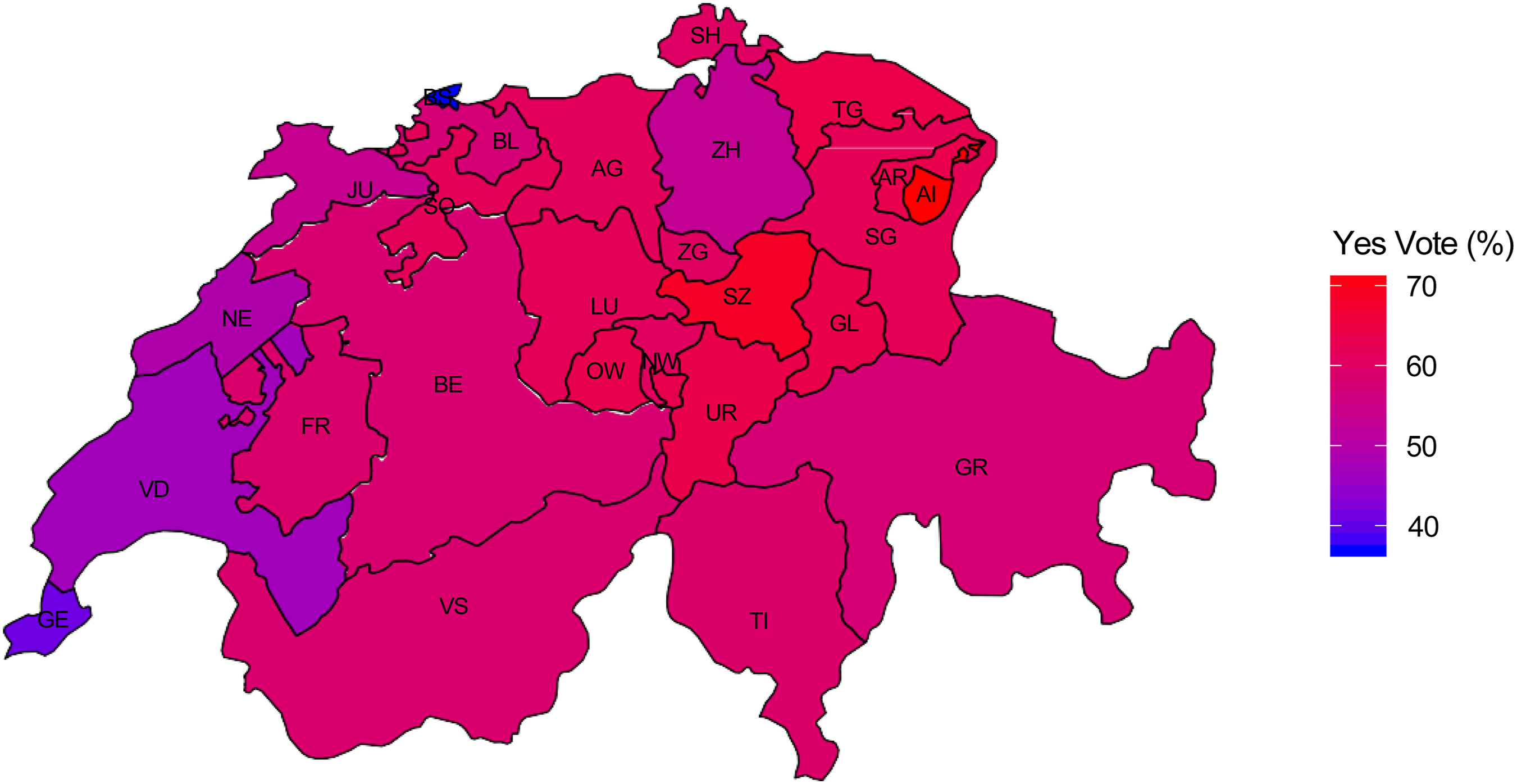
As is standard for a constitutional amendment, the minaret ban needed a double majority to pass: a majority of the popular vote, and a majority of the cantons in favor. As Figure 5 shows, it received both comfortably. The 2009 referendum passed with 57.1% approval from Swiss voters, and only three and one/half cantons of Switzerland’s 26 opposed the initative (Mayer, 2018).
As the cantonal case studies will show, the 2009 minaret ban was repeatedly referenced as shaping religious leaders’ decision-making. Yet even before turning to those cases, the results of the referendum already offer an early indication of the dynamics at play: the only cantons that both rejected the ban and maintain institutional frameworks for formal recognition are Vaud and Basel-Stadt. In Basel-Stadt, the BMK has expressed interest in applying for recognition but continues to restructure internally to meet the policy’s requirements (Banfi and Gianni, 2023). Meanwhile in Vaud, the Union Vaudoise des Associations Musulmanes (UVAM) formally submitted a request for recognition in 2019—the first Muslim association in Switzerland to do so.
UVAM: A pioneering case in Vaud
In the early 2000s, the Vaudoise cantonal government undertook a comprehensive revision of its constitution, addressing a range of issues from voting rights to environmental protection to religious recognition. Pertinently, the constitutional proposals included mechanisms to facilitate further recognition of the canton’s unrecognized groups in response to demands made by the Jewish and Evangelical communities. The new framework was spearheaded by a coalition of the Social Democratic Party (SP) and the Greens and opposed by members of the SVP on several grounds, including the potential for recognition of Muslim groups. Ultimately, however, the constitutional revisions were passed in a cantonal referendum with a 55% majority (Caspary, 2008).
From 2003 to 2014, the cantonal government passed several rounds of legislation on the regulatory details of recognition (Becci, 2021). Officials in Vaud reported that, at every new stage of implenetation, they held meetings with UVAM and other unrecognized religious groups to emphasize that cantonal recognition offers more advantages than limitations.
7
A member of UVAM discusses the association’s relationship with the canton in similar terms: Personally I felt aware that it’s in the interest of the canton that groups apply, that you become a partner… in discussions, we heard that it’s a good thing for recognition to happen, then we have a stronger partnership. It’s still clearly our choice, but personally, I felt that the state wanted this partnership as well.
In other words, the state’s approach to cantonal recognition signaled a good likelihood of success for UVAM’s leadership, since cantonal officials were expressing interest in recognizing the association. As I specified earlier, however, the likelihood of referendums and the resulting political campaigns against Muslim institutions means that cantonal partisanship alone is not a sufficient signal in Switzerland.
In fact, recognition came on the agenda altogether for UVAM following the 2009 minaret ban. Another member recalls that during an emergency meeting held following the vote, members decided on a new approach focused on increasing visibility in response to the referendum: During the campaign for the minarets, the official order of the Swiss federation [of Muslim Associations] was, “don’t talk about it. Don’t be too public. If we talk about it, we escalate things. Don’t escalate things, stay invisible.” That was the strategy. And in my opinion that was totally a false [strategy]. I think we should’ve come out and explained, talked to the public. So after the ban, we decided we need to explain who we are, what we want.
The discussions between UVAM and FIOS, the federal Muslim association, demonstrate the internal deliberations between Muslim communities over which strategies to pursue regarding public visibility. They also reveal why actors interpreting the same institutional environment may nonetheless reach different conclusions about the best approach. For instance, while FIOS recommended avoiding the public sphere to minimize backlash in the lead-up to the ban, and has removed seeking the recognition of Muslim groups as a goal from its statues in the vote’s aftermath, UVAM chose to become more visible in response to the ban.
If the ban was a national referendum affecting Muslim institutions across Switzerland, then why was UVAM the only association to arrive at this conclusion and seek recognition in the years following the vote? Here, one associational member specifically points to the results of the referendum in Vaud. Illustratively, they then contrast this with the Muslim association in Zurich which, despite being much larger, has opted to avoid state recognition: My argument was always that this canton is rather open. The canton is one of only two or three that refused the minaret ban. It’s quite a progressive canton… in Zurich, for example, you have such a strong community. They do work with the state, they are even funded on many projects. VIOZ is bigger and gets much more than we get. But there, the process is extremely politicized so VIOZ stays practical, very pragmatic. They say let’s not do this whole process of recognition.
The vote against the minaret ban in Vaud, one only shared by two and a one/half other cantons, indicated to religious leaders that seeking state recognition is a risk worth taking, and that they are less likely to incur backlash effects. In its aftermath, then, UVAM began to practice
For the association’s leadership, the turning point that finally prompted them to pursue recognition came in 2016. That year, members of the SVP sought to launch a cantonal referendum on an initiative titled ‘Against Religious Fundamentalism’, which accused UVAM of promoting ‘communitarianism’ and ‘Sharia law’ and aimed to block recognition procedures before they could begin. The effort, however, was a notable failure: SVP deputies managed to collect only 3000 of the 12,000 signatures required to trigger a vote, and the referendum never took place (ATS, 2017).
Consequently, as cantonal officials’ overtures towards UVAM, which were clarified both rhetorically and through the procedural details of recognition, signaled a high likelihood of success for the association, the failure of the SVP’s 2016 initiative demonstrated that the risk of backlash was minimal - religious leaders understood that, if they were to seek recognition, it would likely not be taken to and rejected by a public vote (Figure 6). Timeline of key events leading to UVAMs recognition request.
UVAM ultimately decided to apply for recognition in 2019. For their leadership, the SVP’s failure to halt recognition is a clear indicator that they face an acceptable degree of risk. As of yet, however, the canton has not given its response. While the initial estimate of the duration of the decision process was 5 years, cantonal officials say that the concurrent application of two other religious communities, the Anglican and Evangelical Churches, as well as work shutdowns during the COVID-19 pandemic are behind the delay. As UVAM’s leadership await the canton’s decision, it is clear that their hopes for public recognition stem from the symbolic and reputational value that such a status would confer: For me, it’s quite clear what the purpose of [recognition] is… the main point is the fact that the canton gives its stamp and says “okay, you’re clean”. Because that means that for all the people who attack us, who are against us, who are Islamophobic, who say that the Muslim community is a problem, we can counter all of this now. That’s the most important aspect of recognition. Again, it comes back to the minaret vote.
This desire for reputational protection is present for Muslim institutions throughout all my case studies. Elsewhere in Switzerland, however, this same reasoning has led to different outcomes. As an earlier quote suggest, religious leaders in Zurich find the question of recognition too ‘politicized’ to engage with. There, the electoral landscape and the results of past referenda have pushed religious leaders towards avoiding recognition and minimizing visibility altogether.
VIOZ: Collaboration without recognition in Zurich
During the same year that Vaudoise citizens were voting on the constitutional amendments that would ultimately pave the way for UVAM’s recognition application, Zurich was hosting its own referendum that tangentially affected Muslim groups. This 2003 cantonal referendum took place 8 years after VIOZ’s founding and a time when the association represented only fifteen mosque-communities, a fraction of the Muslim institutional landscape in the canton. The referendum, which covered three related proposals, emerged in response to political efforts by the recognized Catholic and Protestant churches to expand church autonomy and increase the church’s access to public funding; VIOZ was not involved in negotiations over the proposal. The Social Democratic Party (SP) and the Greens also added a proposal to create a clearer framework for the regulation of non-recognized communities in response to demands made by Zurich’s Jewish communities (SwissInfo, 2003).
Thus in 2003, cantonal referendums were held in both Vaud and Zurich that promised to facilitate recognition for unrecognized religious groups and that were driven by non-Muslim actors seeking to expand a range of constitutional rights. Like its counterpart in Vaud, the Zurich referendum was met by fierce opposition from the SVP on the grounds that it would open the door for Muslim recognition. The party ran public campaigns against the proposals using the slogan “No Money for Koran Schools”. Unlike in Vaud, however, the SVP is Zurich’s largest party by a significant margin. As such, their efforts there were a success. All three of the Zurich recognition proposals were rejected by a nearly 60% majority in November of 2003, and the failure of the referendum was widely seen as a result of the party’s ‘Koran Schools’ campaign. A member of the Social Democrats (SP) at the time attributed the failure of the referendum to the ‘undifferentiated voting campaign of the [SVP]’, which turned multi-year, bilateral efforts between the churches and the canton into a referendum on Muslim recognition (Baumann, 2003).
For members of VIOZ, the 2003 referendum was their first gauge of political sentiment towards Muslim groups in Zurich, and of the difficulty of getting recognized in such an environment: There was a vote in 2003… And it was a clear no, because the SVP made a big campaign, ‘no government funding for Quran schools’ and messages like this. Flyers, television ads… the [SVP] made a campaign to turn it into a Muslim issue. Then a few years later, the Jewish communities got recognition. So it was clearly about Muslims.
When Zurich voters then voted in favor of the 2009 ban on minarets, it became apparent for VIOZ that, with regards to recognition, the likelihood of success is low while the risk of backlash is high - meaning that the association chose to At first the relationship between [the canton] and religious communities was limited to those that were officially recognized. Then nine years ago, we decided to start collaborating with the Muslim community… because they were the biggest unrecognized community and they were clearly stating a desire to collaborate with the state.
Several successful initatives have thus emerged since 2015, including imam training and chaplaincy programs, that demonstrate the potential for collaborative work between the VIOZ and cantonal authorities. At the same time, these projects raise an obvious question: as VIOZ increasingly receives cantonal support on a number of projects, one best codified through legal recognition, and if both cantonal authorities and Muslim leaders are in agreement over the importance of these collaborations - why does the canton not simply recognize VIOZ? Here, members of VIOZ point to the risk of backlash that seeking recognition would incur. As a board member explains, this is a matter of mutual understanding between VIOZ and the cantonal government: The view of our partners [in government] is that if we start the recognition process now it will hurt us and we will receive a “no” vote. Which will really set us back… if there comes a “no”, it will destroy our reputation. We are waiting for better times. Even if we’re not sure if it will get better in the future, now is not the right time.
Even cantonal officials acknowledge the risk of backlash as the reason for VIOZ’s lack of recognition status. The possibility of triggering a referendum against VIOZ, and the public campaigns against the association that such a vote might entail, is the reason both VIOZ and the canton avoid recognition. As they describe during a group interview, I1: ‘If you ask directly, “would you like to give money to Muslim communities”, the public might disagree. We’d prefer to work in these rather difficult conditions, because we can at least work on parts of the whole situation. I mean, this is also the reason VIOZ never officially applied for recognition… It would involve parliament and a referendum, then it becomes a fully political decision. There’s not simply some criteria to become recognized, it becomes a free decision by the public. I2: ‘And that opens doors to very nasty campaigns by the right’.
Even issues completely outside of VIOZ’s control affect the possibility of backlash. Remarkably, three different interviewees cited the war in Gaza as affecting discussions of Muslim institutions in Zurich. One example of this came only 2 weeks after the October 7 th attacks in Israel, when three members of the right-wing SVP submitted a document to the cantonal parliament describing VIOZ as ‘close to Hamas’. 8 The incendiary accusation is only mentioned in the title - no justification or evidence is provided, nor is Hamas even mentioned a second time in a text that is otherwise an accounting document on VIOZ and the funding it receives on its projects.
As a result of their political environment, members of VIOZ conduct their work on precarious grounds. The association’s leadership clearly see the need for recognition, both as a source of legitimacy and as financial security for their work in Zurich, but are aware of the risk they face: It’s difficult, it’s difficult to even function because we always need to negotiate funding on project by project, it’s really difficult to operate without real stability. As an umbrella association, you need [recognition]… But the worst case scenario is for the canton to say we want to help the unrecognized groups… and it starts a debate on the political level. And the political level is a fear for us, that normal issues about funding turn into eruption. Suddenly it becomes part of the Islam debate on Zurich, and this will take us 20 years backwards. We are finally on a good level of cooperation with the canton, and we can take next steps or we can go back 20 years.
The interviewee ranks VIOZ’s preference over recognition in line with the theoretical predictions of this paper: while the association would generally prefer to be recognized, the concerns over ‘eruption’, or what I term backlash, mean that the association would rather continue to avoid the public politics of recognition altogether than risk seeking it and being denied.
Discussion and conclusion
The comparative analysis of Belgium and Switzerland show that Muslim leaders’ de-cisions to seek or avoid state recognition are matters of interpretive judgment under uncertainty—shaped by what each institutional environment makes knowable. Through the concept of institutionally mediated inference, this paper has shown that political architecture filters the signals through which actors estimate the likelihood of success and the risk of backlash. Institutions, in short, shape inference. In Belgium, where regional executives hold discretionary power, mosque leaders read political color as a signal of state openness and make their decisions accordingly. In Switzerland, where cantonal autonomy and direct democracy expose recognition to the unpredictability of public sentiment, inference is mediated through the memory of popular referenda and the ever-present possibility of backlash. Across both cases, Muslim leaders act on the same underlying logic — balancing the expected probability of success against the perceived risk of backlash — but the institutional setting determines which signals matter, and thus how recognition is understood, pursued, or avoided.
These findings illuminate how Muslim minorities respond to the governance of difference within liberal democracies. However, perhaps the paper’s most surprising finding is how policymakers themselves are aware of, and participate in, the inferential logic at play here. This was especially evident in Zurich, where cantonal officials were aware of the risk of backlash facing VIOZ if it were to push for public recognition. As authorities sought to normalize relations with the associations and collaborate with it on a number of fronts, ones with immediate material benefits to Zurich’s Muslim communities, they effectively accommodated a strategy aimed at limiting exposure while enabling cooperation with state institutions. The findings therefore suggest that, at least in some contexts, actors embedded within dominant institutions themselves can acknowledge and even facilitate the kinds of infrapolitics that minority groups adopt towards the state.
More broadly speaking, two key implications emerge from the Belgian and Swiss case studies. First, if public recognition traditionally renders minorities legible to the state (Scott, 1998), the cases reveal a reverse process by which minorities learn to read the state through its institutions. In this sense, recognition operates as a mode of incorporation through which minorities interpret the terms of membership within liberal democracies (Bloemraad et al., 2008; Brubaker, 1992, 2001). Through the iterative practices of recognition, minority leaders learn what the state expects of them, what forms of visibility are rewarded or penalized, and how to calibrate their engagement accordingly.
Second, the findings emphasize that the decision not to seek public visibility does not signal disengagement or disinterest. What appears as disengagement may, in fact, be a form of self-preservation — an adaptive response to the informational cues and constraints produced by the state itself. The results echo Scott’s (1990) warning that “so long as we confine our conception of the political to activity that is openly declared, we are driven to conclude that subordinate groups essentially lack a political life”. The dynamics observed here instead suggest that the decision to avoid recognition and remain invisible itself constitutes a strategic response to institutional environments in which visibility carries significant political risk.
While this paper highlights the institutional mechanisms that shape this logic in the governance of Muslim institutions, similar dynamics have been observed across a range of minority contexts, including linguistic, ethnic, and racialized groups, where public visibility conditions both access to recognition and exposure to regulation and control (Vertovec and Wessendorf, 2010; Patten, 2014; Liu, 2017). In this sense, visibility is not merely a condition of public presence, but a central mechanism through which groups become legible—and thus governable—within state institutions. Questions of recognition therefore follow from, rather than precede, the politics of visibility. The case of Muslim institutions in Europe thus illustrate a broader dilemma in which visibility simultaneously enables claims to recognition while exposing actors to political risk.
Finally, there are two ways to consider the generalizibility of this paper’s findings beyond the Belgian and Swiss cases. The first is in terms of other national and subnational cases that I speak to. The framework may apply to other national and subnational recognition systems in Europe, such as those in Austria and Italy, as well as to broader cases where local governments define the forms of visibility available to Muslim communities (Aguilar, 2018; Ferrari and Ferrari, 2015; Thompson and Modood, 2022). One limitation may come from the fact that I have focused here on two federal cases, which I have done in order to maximize subnational variation; yet researchers have shown that, even in unitary cases like France, similar variation may occur as local governments depart with mandates set at the national level (Laurence and Vaïsse, 2007; Maussen, 2009). The second form of generalizibility extends to other regulatory arenas in which the visibility of Muslims is negotiated, including citizenship regimes, religious education, and national consultative councils (Ciciora, 2018; Laurence and Vaïsse, 2007). In each of these settings, the management of visibility becomes a differentiated mode of governing diversity, one that shapes who can appear as a legitimate public actor.
Footnotes

Funding
The author disclosed receipt of the following financial support for the research, authorship, and/or publication of this article: College of Literature, Science, and the Arts (Weiser Center Grant); American Political Science Association (Religion & Politics Small Grant; Summer Centennial Grant).
Declaration of conflicting interests
The author declared no potential conflicts of interest with respect to the research, authorship, and/or publication of this article.
Data Availability Statement
Data sharing not applicable to this article as no datasets were generated or analyzed during the current study.
Protection of research participants
As part of their review, the University of Michi-gan Institutional Review Board Health Sciences and Behavioral Sciences has determined that this study is no more than minimal risk and exempt from on-going IRB oversight (HUM00217679).