







Abstract
This study explores communication and retelling skills that are revealed after Mexican-American preschoolers engaged in culturally sensitive read alouds. Participants, highlighted in this article, included two four-year-old preschool children in a Spanish/English dual language classroom. The children selected culturally relevant texts and engaged in story retellings with their respective parent. The findings indicate that children co-constructed Zones of Proximal Development (ZPDs) in response to their parents' caring moves. Participants responded as cared-fors and carers as evident in their use of memorization skills and attention to detail to appropriate vocabulary and effectively retell a story. Additionally, preschoolers extended their ZPDs through imagination and inferencing by inserting events into the narrative and reading between the lines to expand and enrich the original stories. These findings have implications for reframing the way in which educators capitalize on young children's communication skills.
Keywords
Today, students in Ms. Carrizales’ classroom have just finished an interactive read-aloud of Just in Case: A Trickster Tale and Spanish Alphabet Book by Yuyi Morales (2008) and Alicia, a Mexican-American four-year-old preschooler, is eager to retell this story to her mother, who connects to the classroom via FaceTime and sees the cover of the book on the screen of her phone: Alicia: Look at the invitation! Alicia exclaims excitedly as she sets up the stage for the retelling of a tale that begins when Señor Calavera, (Mr. Skeleton) a key character in the story, finds out that he has been invited to Grandma Beetle's birthday party, which sets him off on a quest to find a perfect gift. Mother: Ahh! What else? Alicia: Then, once he was ironing his tie. Then, once he run to get the birthday party. Then, once he ran off to the birthday party in his bike, he saw somebody and it was a ghost. Mother: Ohh!
The complexities embedded in Alicia’s eagerness to retell the story are at the core of the present study where the authors explored the intersections of culture, affect and language in early childhood literacy. Conversations about preschoolers’ language and literacy development are critical at a time when national debates about young children’s education highlight the role of oral language skills, such as vocabulary and narrative production, as foundations of young learners’ linguistic and academic proficiency (Espinosa and Gutiérrez-Clellen, 2013; National Academies of Sciences, Engineering and Medicine, 2017). This study focused on story retellings that situate preschoolers as agentive narrators and meaning-makers and addressed the following research question: What does retelling of a culturally relevant book reveal about Mexican-American preschoolers’ retelling and communication skills?
Research that explores children’s language development through book retelling has often adopted a quantitative focus highlighting literary aspects of children’s recreated stories including types of utterances, connections to comprehension of a plot and accuracy (Gazella and Stockman, 2003; Greathouse, 1991; Young-Suk et al., 2011). Little research has addressed young children’s retellings of culturally relevant stories and retellings as meaning-making spaces (Ebe, 2010). Young children’s reconstruction of a previously heard story encompasses much more than a recounting of a given plot. Studies are needed that dissect culturally diverse preschoolers’ innate retelling skills through an asset perspective. Also, it is important to explore the intricacies of children’s use of language as they retell a self-selected, culturally relevant story because it contextualizes the natural interrelationship between cognition and affect as precursors of higher mental functioning (Lapkin et al., 2010; Vygotsky, 1978).
In line with a contextually situated perspective, this study explored communication and retelling skills that were revealed after Mexican-American preschoolers engaged in culturally sensitive read-alouds. This enquiry represents a fragment of a larger project that involved Mexican-American children and their parents in the selection of children’s books at a Catholic dual language school in South Texas. We use sociocultural theory and an ethic of care framework to analyse aspects of cognitive engagement occurring during retelling activities that materialized as zones of proximal development (ZPD).
Retellings as zones of proximal development: Intersections of affect and cognition
Fazio et al. (1996) define retelling as the construction or recreation of a mental representation of the structure and meaning of a given story. Oral story retellings generally occur in the context of social interaction. Whether they take place in the context of family orally transmitted stories or in academic contexts, retellings involve an audience: a story teller (or reteller) and a listener. From a sociocultural perspective, these are elements commonly discussed in the definition of a ZPD, i.e. Vygotsky’s conceptualized space where we can find a learner and a more knowledgeable other.
In early childhood settings, retellings of a previously heard story require that young children analyse, discover and/or confirm knowledge as they address an audience (one or more individuals). In a sociocultural approach, this is a highly demanding task that results in learning because of the dynamic interweaving of elements of cognition and affect. Vygotsky (1978) proposed that as we enter cognitively demanding interactions we create a zone of proximal development, that is, we learn and this mental journey ‘awakens a variety of internal development processes that are able to operate only when the child is interacting with people in his environment and in cooperation with his peers’ (p. 90). Encounters with parents, care givers and peers are critical to the development of cognitive functioning because we are placed in a position to discover what we know and what we do not know, but also because such encounters are relational, that is, they require affect or the purposeful enactment of an exchange in which affect matters.
In expanding Vygotsky’s assertion that cognitive growth and affect are inevitably interconnected, Goldstein drew parallels between Noddings’ definition of an ethics of care and Vygotsky’s conceptualization of a ZPD. Goldstein (1999) asserts that, ‘the affective qualities of the relationship between teacher and student are what allows the zone of proximal development to take shape in any given situation’ (p. 654). In this research, we identified the socially situated and culturally relevant retelling act as fertile soil from which ZPDs emerge making young children’s language skills widely visible.
Although we recognize that young children’s retellings may sometimes be systematically elicited for varied purposes, including assessment of reading skills, this study focuses on story retelling deliberately designed as a book-based extension activity to ‘develop an awareness of story event sequence’ as children re-create the story (Otto, 2018: 283). Studies that examine children’s retellings in the context of authentic and developmentally appropriate literacy engagement illustrate that ZPDs are co-created (Ebe, 2010; Morrow, 1985; Stoicovy, 2000). Co-construction of knowledge entails the existence of an interpersonal relationship between participating individuals. Noddings (2003) asserts that the caring individual or teacher ‘must see through the eyes of her student in order to teach him’ (p. 70). In the present study, and adhering to a student-centred perspective, the researchers used children’s literature reflective of participating children’s interests and culture.
Within a ZPD, sociocultural scholars highlight the role of adults as more knowledgeable others who purposefully enter a learning space with their students. Far from representing a static construct, a more knowledgeable other can be better defined as a dynamic, bidirectional concept that describes someone’s capacity in relation to a task and its relevant knowledge or skills. In a collaborative exchange, both partners are likely to embody the figure of a more knowledgeable other while creating spaces or zones in which to grow.
ZPDs and the ethics of care in early childhood
Young children are creative communicators who actively use language as a tool to mediate higher mental cognitive and affective processes (Swain, 2006). To capitalize on this natural inclination to explore and learn, experts recommend deliberate exposure to quality language input in encounters with adults who engage them in meaningful and authentic use of oral language skills (NASEM, 2017). Although these encounters, or purposely crafted ZPDs, can be highly abstract, early childhood literature indicates that preschoolers (as young as three) can produce effective oral narratives using ‘relatively decontextualized language that goes beyond the here and now and they benefit from inferential questions that challenge them to reason about everyday situations and storylines in books’ (Kuchirko et al., 2015: 131).
In linguistically and culturally diverse early childhood settings, teachers are urged to learn about children’s situated realities and intentionally incorporate literature infused with familiar referents and relevant themes. Children’s initial connectedness to storylines is key to their intellectual investment in extension activities related to a story in which teachers intentionally and carefully scaffold children’s knowledge and understanding. Thus, through carefully crafted scaffolding moves, teachers gain substantial knowledge about their students, that is, they become acquainted with ‘the abilities, interests, and cultural values, that children bring to learning situations’ (Berk and Winsler, 1995: 31). Gay (2010) reminds us that meaning-making is a relational act that entails ‘using cultural knowledge, prior experiences, frames of reference, and performance styles of ethnically diverse students to make learning encounters more relevant to and effective for them’ (Gay, 2010: 31). Culturally responsive acts materialize as patterns of interaction tailored to what children need at the moment when they actively construct knowledge and externalize their thinking. During reading instruction, for example, teachers use culturally relevant reading materials to engage learners on a more meaningful and personal level (Purnell et al., 2007). Relevant books are texts that engage the child with the story and her/himself (Lohfink and Loya, 2010; McIntyre and Hulan, 2013). As a result, children can relate to and participate in story discussions. These books serve as mirrors that validate the personal cultures of students in the classroom. Factors in text selection include cultural background, the interests of students and non-familiar cultural settings with themes children can relate to (Locke and Harris, 2011; Robinson, 2013).
Literature review
In a Vygotskian perspective, an oral retelling episode provides opportunities for social engagement and gradual learning (Stoicovy, 2000). Studies of young children’s retelling activities have often highlighted ways in which story reconstructions reveal cognitive processing, or comprehension of a previously read story placing special emphasis on the role of adults as scaffolders. For example, Clarke-Stewart and Beck (1999) explored the retelling of a movie story with two five-year-old children and their mothers. The extent to which mothers jointly discussed topics in the story, asked questions and corrected children’s mistakes closely correlated with children’s comprehension of the story as illustrated in their retelling. Similarly, Morrow (1985) concluded that practice and guidance with retelling affected comprehension significantly when examining whether retelling a story with or without practice or guidance would improve comprehension and recall. Greathouse (1991), who also investigated retelling with Kindergarten learners, found that students who engaged in interactive experiences relating to stories read aloud included more story elements in a story retelling exercise.
Although cognitive aspects of children’s retelling have been explored, few studies have approached retelling from a culturally responsive stance with elementary or early childhood learners from minority populations. Stoicovy (2000) described how fifth grade students, identified as ethnic Chamorros in Guam, used retelling from an oral culture in their literacy development and demonstrated how retelling built on students’ oral traditions and literacy development through a collaborative small group setting. Similarly, Ebe (2010) examined the effects of two stories marked with high cultural relevance scores with third grade students learning English as another language. Ebe (2010) and Stoicovy (2000) concluded that comprehension was higher when the story was culturally relevant. With this in mind, research with younger learners from minority populations is needed to explore the critical role of culturally relevant literature on linguistic and cognitive development at an earlier age, specifically in relation to oral narrative skills.
Emergent oral narrative skills
Historically, education research in early childhood has approached culturally diverse children’s language development from a deficit perspective, often highlighting gaps in vocabulary acquisition (Hart and Risley, 2003) and divesting all analyses from the cultural and affective aspects of language learning. As children engage in retellings or reconstructions of previously introduced stories, they use emergent oral narrative skills acquired in their social contexts. The National Academies of Sciences, Engineering, and Medicine (2017) remind us that ‘language learning is a socially embedded process that takes place within families, cultural communities, and other social institutions’ (p. 24). In this sense, the retelling act as a narrative type of expression is deeply dialogical. Senechal (1997) and Reese and Newcombe (2007) highlight the interactive nature of literacy and the influence that caring or dialogic adults exert on young children’s expressive vocabulary acquisition. In Senechel’s (1997) study, children who participated in repeated reading and questioning related to novel vocabulary demonstrated greater command of oral language skills.
Methods and data collection
Our desire to better understand and explore participants’ interests, cultural practices and language development in connection with the books they read guided our decision to adopt a participatory research approach, which sought to relocate participants’ and researchers’ positions of power. To do so, the researchers conducted research ‘with’ the students and parents instead of on them (Bergold and Thomas, 2012; Cornwall and Jewkes, 1995). At the research site, a deliberate effort was made to equate the adjective participatory to relational. In other words, from the onset of this project, we sought to establish caring relationships by collaborating with teachers, students and administrators as ‘more knowledgeable others’ or as experts in their lives, their interests and their preferences. This is important because, as Nodding contends, ‘who the teacher is, who the students are, what they are trying to accomplish separately and together all matter in designing instruction’ (Noddings, 1992: 18) and research. In this process, the initial steps deeply focused on learning about participating children’s cultural practices and the school context.
Participatory research aligns with the authors’ philosophical stance as qualitative researchers and as former early childhood/elementary teachers and researchers. The democratic and dialogic aspects of this approach guided us to better understand children’s experiences, insights and knowledge they brought to the social context (Bradbury-Jones et al., 2018) as we examined the following question: What does retelling of a culturally relevant book reveal about Mexican-American preschooler’s retelling and communication skills?
Data collection consisted of observation, field notes, a student interest inventory, parent interviews, video and audio recordings. As a participant-observer, the first author conducted read-alouds from Monday to Thursday and retelling sessions on Fridays for 11 weeks. Observations focused on actions, scenes, events and interactions, language and gestures, taking ‘mental note of certain details and impressions that would become headnotes until writing field notes at a later point’ (Emerson et al., 2011: 24).
After several observations, students completed an interest inventory (see supplementary Appendix A) indicating topics of interest, cultural practices, experiences (Bredekamp and Copple, 1997; Moll, 1992; NAEYC 2009) and prior readings of culturally relevant books. Then, a 30–45 min telephone interview with parents allowed the authors to gain insights into the families’ experiences and events representative of their culture (Moll, 1992). This information served to inform the selection of culturally relevant literature closely connected to their children’s interests and experiences.
We used Freeman and Freeman’s (2007) cultural relevance rubric (see supplementary Appendix B) to confirm alignment of the selected books with parents’ and children’s responses. Then, we brought a collection of 12 books to the classroom for the young participants to choose from. Out of the 12 titles, 1 to 2 books represented each of the five participants. Later, each child had individual time with the researcher to select the top four choices for a classroom read-aloud. After creating a spreadsheet with all the titles and children’s selections, five books emerged as the most preferred ones. Then, an interview with parents served to confirm that the literature selected represented their family's child’s experiences and background. During this time, the parents also received detailed instructions for the dyadic retelling sessions (parent–child) that would be conducted on Fridays via a FaceTime call after each read-aloud. Prompts such as ‘what was the story about?’ and ‘tell me more’ were suggested to elicit retelling from their child.
Subsequently, the first author, in consultation with the classroom teacher, established a read-aloud routine (Giroir et al., 2015). Before the read-aloud, the first author introduced vocabulary and established a purpose for reading. Then, during the read-aloud, there was a focus on visual elements of the text, comprehension and connections to children’s background knowledge. The after process consisted of a student-guided discussion about the content of the story, scaffolding the conversation to allow for deeper comprehension.
On Fridays, parents connected with their children via a FaceTime or audio call to hear the retelling of the story read that week. The routine consisted of the parent using agreed upon prompts such as, ‘What can you tell me about the story?’ and ‘What else happened?’ Then, children were encouraged to reconstruct the story in conversation with their parents. Essential to this exercise was the participating parents’ undivided attention and engagement, not as a mere listeners, but also as carers who genuinely demonstrated motivational displacement (Noddings, 1992) by showing full receptivity and willingness to listen, understand and capture what their children tried to convey during the retelling.
Field notes documented participants’ reactions to the stories as well as the connections children made to familiar topics portrayed in the selected books. We captured some of the children’s reactions through photographs. This type of instrument was ideal in this setting as it allowed us to more accurately report on young children’s multimodal communication skills. Finally, during a final 30–45 min semi-structured interview, parents provided additional in-depth information regarding children’s interests, family experiences and activities, and traditions.
Setting and participants
This study took place at St Perpetuo Dual Language Catholic school (pseudonym), located in the west-central part of a large urban city in South Texas. The school implements a 50/50 Spanish/English dual language programme starting in PK-3 through to fourth grade and serves predominantly Mexican-American children from various social, linguistic, religious and socioeconomic backgrounds in grades PK to 8. The PK daily schedule included all the core subject areas (Spanish language arts, mathematics, science, social studies and centre time), along with a time for religious instruction. Religion was taught daily, and during this time children learned prayers, songs and stories related to Catholicism, and on Wednesday mornings, children attended Mass. Routines generally included time for hands-on activities in preparation for class at 8:00 a.m.
The original participatory study (from which we selected a fragment of the data to report in this article) included 15 children from a PK-4 dual language classroom, their bilingual (English and Spanish) parents and their teacher. Eleven children were identified as English dominant speakers based on a Home Language Survey and four as Spanish dominant. The teacher, Ms. Carrizales (pseudonym), was in her second year at St Perpetuo. We selected this teacher as a participant for this study based on the principal’s recommendation and perception of Ms. Carrizales as an active learner and effective teacher. The teacher and first author identified eight potential participants based on their inclination to engage verbally. The parents of these eight students received an invitation to participate in the study. Ultimately, six agreed and became a purposeful sample; however, one student became shy during the recording and chose not to speak. As a result, five children remained and for the purpose of this article, data for two children (Alicia and Charlie) were selected to illustrate the patterns identified throughout. Their voices are demonstrated in English as that is their dominant language, although Spanish is also spoken in their home. Additionally, two of the five selected books are highlighted in this report: Niño Wrestles the World (Morales, 2013) and Just in Case: A Trickster Tale and Spanish Alphabet Book (Morales, 2008).
Alicia
Alicia is a third generation Mexican-American child who is the youngest of three siblings, including an 18-year-old sister and a 5-year-old brother. Alicia’s mother identifies as Puerto Rican and the father as Mexican-American. Her mother is a nurse, the father is employed at a local insurance company and both work late into the evening. They both completed college degrees. In Alicia’s home, both parents speak English. In the classroom, Alicia is labelled as a dominant English speaker. Additionally, her teacher indicated she contributes a lot to classroom discussions. She is very verbal and eagerly shares her opinions in the classroom.
Charlie
Charlie is a third generation Mexican-American child. He is the middle of three children with another sibling on the way. Charlie’s mother identifies as Mexican-American and the father as Eastern European. His father works full-time while his mother works part-time. Charlie’s mother attended college but did not complete her degree. His father, on the other hand, finished college. In Charlie’s home, both parents speak English. At school, Charlie is labelled as an English speaker. Charlie is also helpful in the classroom. He is sometimes shy but is very willing to help his classmates.
Data analysis
In order to answer the research question, we used open coding as a process to analyse data. Data analysis involved a systematic process of reasoning and interpretation to develop meaning and understanding (Merriam, 2009). Data analysis took place concurrently to data collection to allow for a work cycle of thinking about the collected data and the strategic generation of new data (Miles et al., 2014). Concurrent collection and data analysis occurred from October until December 2018, listening to video and audio recordings to identify potential emerging themes (Corbin and Strauss, 2007; Miles et al., 2014). Spending time with the data allowed us to listen to the participants’ voices through their words (Corbin and Strauss, 2007). Data were grouped by story with all participants represented, and tables were created to separate the data by child.
From the end of November until December 2018, recordings were reviewed again to continue a second phase of coding. To do so, we identified data segments, or words, that could be categorized and later used to answer the research question (Merriam, 2009). Since preschoolers often speak in spurts as opposed to complete sentences, each word they produced was used for analysis. The researchers combed through each unit or spurt of the transcripts. This conversation consisted of repeating the research questions and jotting down in the margins codes and, words that were relevant to the research question (Merriam, 2009; Miles et al., 2014). A similar process was followed for all data sources for consistent comparison (Merriam, 2009; Miles et al., 2014; Starks and Trinidad, 2007).
Categories and keywords were then grouped through axial coding (Corbin and Strauss, 2007; Merriam, 2009). Then, after the transcripts and codebook were read again, the following themes emerged: communication and retelling skills related to memorization, attention to detail, use of gestures, vocal tone, imagination, inferencing and interpretation, as well text to self-connection. These themes were then compared to existing scholarly literature to name the categories, e.g. communication and retelling skills associated with linguistic capital.
Findings and discussion
In this section, we present two findings as they connect to the research question that guided this study: What does the retelling of a culturally relevant book reveal about Mexican-American preschooler’s retelling and communication skills?
Co-constructing ZPDs: Appropriating vocabulary to effectively retell a culturally relevant story
As we explored preschooler’s retelling and communication skills, we initially drew attention to the ways in which young Mexican-American children and their parents co-constructed ZPDs, and in doing so appropriated vocabulary to effectively recreate a story. To better appreciate the complexity embedded in the retelling act, we reiterate that aside from connecting beyond the here and now, participating children accomplished this task using terminology heard during the read-alouds.
A fragment of one representative retelling episode illustrates how Charlie, one of the participating children, learned elements of a lucha libre (wrestling) story including the title and sequence of events, and just as importantly, he readily transformed receptive vocabulary into its expressive form to comply with the demands of the task allowing his retelling efforts to be more precise and detailed as illustrated below: Charlie: Niño Wrestles the World A superhero. He has to beat all these bad guys (turns to researcher and smiles). Mother: What’s the story about Charlie? Charlie: It’s about a superhero. He fights people. First, he fights the uh, uh, Then, he fights the He throws It’s the Mother: Ok. Charlie: Then he has to defeat the devil. Then the devil flips, and then. Then it’s a superhero Mother: Ahhh … Charlie: Then the babies are winning but oh, Oh, Oh!!! The superhero takes them down Then. What happened? It’s the end of the book.
In many regions of Mexico, lucha libre (wrestling) is a popular form of entertainment characterized by wrestlers’ use of colourful masks, rapid movements and a symbolic battle between good and evil (Huffaker, March 1993). Lucha libre’s (wrestling’s) following has spread beyond Mexico’s borders and is recognized as an intangible cultural Mexican heritage. Therefore, it is no surprise that young Mexican-American preschoolers were drawn to Yuyi Morales’ (2013) depiction of a little boy who fantasizes he fights and defeats imaginary opponents such as La Llorona (Weeping woman) and the Chamuco (devil). This affective connection with the main character drove learning to higher levels in this preschool classroom. In the retelling, participating children were amused and seamlessly navigated semantics and comprehension in dialogue with their parents.
The ZPD became a cultural space in which parent and child as carer and cared for engaged in meaning-making dialogue through retelling. The retelling also positioned another child, Alicia, as a more knowledgeable other who became cognitively and linguistically invested in the retelling of the same story by specifically referring to the Momia de Guanajuato (Mummy of Guanajuato) as the mummy, even though her father several times used overextensions referring to all the characters as monsters saying: I see the monsters, were you scared of the monsters? A question that Alicia addresses using precise vocabulary (mummy instead of monster), a word her father would subsequently mimic, as shown below: Alicia: The mummy … the mummy tried to bite him. He tickled him! Look! Father:But why was the mummy trying to bite him? Alicia: Because he tried to bite him and was fighting him.
Vocabulary from Niño Wrestles the World that Alicia and Charlie used in their retelling.
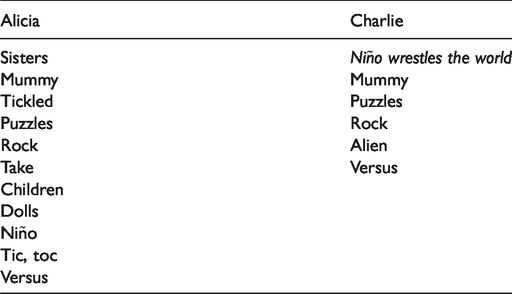
In sum, to effectively retell a story, Mexican-American preschoolers capitalized on their linguistic assets, prior knowledge, their commitment to move the task forward and the caring–carer dynamics that positioned them at the centre of the read-aloud and subsequent retelling sessions. It is worth noticing that without teacher intervention or adult prompting, as confirmed in other studies (Hasson et al., 2012), participants’ discourse mirrored novel vocabulary and expressions to engage in linguistic problem-solving.
The retelling activity, as a meaning-making space, provided an opportunity to set the learning wheels into full motion. That is, children’s role as listeners and cared for evolved into one of knowledgeable narrators and carers, as Nodding (1992) asserts: ‘We must keep in mind that the basic caring relation is an encounter … both members are carers and cared-fors as opportunities arise’ (p. 16–17).
Extending ZPDs through imagination and inferencing: Retelling as re-creation of a story
In addition to their memorization skills and use of precise vocabulary, preschoolers in this study extended their co-created ZPD through retellings that expanded and enriched the original stories. Isbell (2002) asserts that in reconstructing a given story, children often use imagination, extension of ideas, the creation of new settings and plots, and the insertion of new characters. This is illustrated in the following episode where Charlie, in conversation with his mother, reconstructed Just in Case: A Trickster Tale and Spanish Alphabet Book by Yuyi Morales (2008). Charlie explained how Señor Calavera (Mr. Skeleton), the main character, prepared for grandma Beetle’s birthday party by gathering together a variety of unusual presents. The majority, reflecting images formatted as a Mexican lotería, or bingo, follow the sequence of the alphabet: Charlie: … then we have a W or a frame that he (Señor Calavera) (Mr. Skeleton) can hang on his wall and then … Mother: All his gifts fell off!! (Looking at the image through FaceTime). Charlie: Yeah … and then he felt sad …
Throughout the retelling sessions, Alicia also inserted new characters and events. This was reflected when Señor Calavera (Mr. Skeleton) began getting ready for the birthday party: Alicia:He put on a tie on his bone. Mother:What else? Alicia: Then, he saw a princess and the princess was so nice to him. Look it! Mother: Oh, I see. Once, he got a one. He got a puppet. Nope! The princess was going to marry him (Señor Calavera) (Mr. Skeleton)! Marry him! Replied the mother, to which Alicia responded by smiling and laughing. Mother: What else? Charlie: What happened? (He looks around at the pictures and facial expressions show he is thinking) And then they play hide and seek in the clouds.
Conclusions and implications
This study situated book-based retellings within a sociocultural perspective focusing on the intersections of cognition and affect to discuss how young Mexican-American preschoolers co-created ZPDs with a parent. The study demonstrates the close connection between teacher’s intentional and informed scaffolding activities and the enactment of a ZPD as a space where interactions between adult and child during prompted retellings ‘closely resembled a caring encounter’ (Goldstein, 1999: 647). Findings of this study suggest that in response to adults’ caring moves, young children responded as cared-fors and carers by ‘taking on the challenge of intellectual growth and personal transformation’ (Goldstein, 1999: 662). This growth was initially evident as children used memorization skills and attention to detail to appropriate vocabulary and effectively retell a story. We note that, in doing so, they used language to solve problems, self-regulate and effectively comply with the cognitive demands of the task.
Through the use of culturally relevant literature, young learners in this study also developed semantic knowledge stemming from book-sharing activities (Christie et al., 2014; Otto, 2014) to imagine and extend the stories in their retellings. Christie et al. (2014) emphasize that children learn meaning from their prior experiences that assist them to connect to new words. We conclude that children’s production of imaginative language as they reconstructed a story was not coincidental. The findings demonstrate that, as a result of an established caring relationship, children were willing to cognitively invest in the retelling of a culturally relevant story; this investment or desire to participate in learning (García and Wei, 2014; Garza and Arreguín-Anderson, 2018) materialized in unpredictable, divergent thinking on behalf of preschoolers in Ms. Carrizales’ classroom.
As carers, researchers and teachers understood that before asking children to listen to and retell stories, we needed to explore the cultural context through continued conversations. Noddings (1992) asserts that ‘continuing dialogue builds up a substantial knowledge of one another that serves to guide our responses’ (p. 23). In this study, read-alouds of culturally relevant texts allowed children to make connections to what they knew. Then, with the guidance of teacher and parent as carers, they were able to use scaffolding techniques such as prompting to manifest their new learning. The prompting strategies facilitated the application of learned skills (Vygotsky, 1978) as retellers.
This study has important implications for early childhood educators. Existing literature often discusses diverse children’s language knowledge and skills under a deficit perspective, highlighting their ‘lack’ of vocabulary. However, we concur with Pianta et al. (2009) who emphasize the role that educators play in the design of an environment that capitalizes on children’s agency and meaning-making skills to promote semantic development. The process of symbol formation or vocabulary acquisition, as we know it (Otto, 2014), begins with a very direct connection to previous knowledge or direct experience. Books that include familiar referents allow children to connect to new words (Christie et al., 2014), and these new terms translate into an expansive vocabulary repertoire that will eventually be transferred into expressive language. Additionally, a deficit perspective is also often visible in the way retellings are used in K–12 settings mainly as instruments to measure reading comprehension (Reed and Vaughn, 2012). Educators are urged to move beyond the strict adherence to a plot as narrated in the original story and to envision and enact spaces where creativity and imagination can flourish.
In order to change their frame of mind, teachers must adjust their practices in the reading process. For example, they can teach new words within the context that are meaningful for children (Roessingh and Elgie, 2009). As shown in the findings, Alicia pointed out the word mummy even though her father called them monsters. Alicia was fully aware of the meaning of the word monsters; however, she decided to use a more precise word learned through the read-aloud. This association that Honig (2007) calls ‘fast mapping’ indicates that children learn to use new words in their vocabulary based on the correlation they have made in their mind. In this process, the educator serves as a mediator between the book, child and language. The teacher provides the guidance to create cognitive connections (Korn, 1998) between new vocabulary and the child’s known words.
Additionally, children’s engagement in imaginative retelling and recreation of original stories should prompt educators to encourage this type of play with language at home and school. Also, they should invite children to enhance a story through open-ended questions, which allows children to join in the conversation and participate in the story in different ways. This requires the educator to accept children’s responses without judgement. These answers may not be what the listener expects to hear; however, the listener must be respectful and understanding of the reader’s interpretation (Goodman, 1982) as they share their viewpoint in the retelling. Children’s opinions have rich meanings that display their uniqueness in the way they view the world.
Children who are free to imagine and narrate will be likely to engage in increasingly sophisticated language use as they gradually progress from oral to written stories. Close collaboration between early childhood educators and parents is essential if teachers wich to maximize opportunities for language development in every context. Children’s discourse, imagination and interpretations are based on cultural perspectives. Thus, it is essential to include children’s environments and families.
Supplemental Material
sj-pdf-1-ecl-10.1177_1468798420930339 - Supplemental material for Mexican-American preschoolers as co-creators of zones of proximal development during retellings of culturally relevant stories: A participatory study
Supplemental material, sj-pdf-1-ecl-10.1177_1468798420930339 for Mexican-American preschoolers as co-creators of zones of proximal development during retellings of culturally relevant stories: A participatory study by Socorro García-Alvarado, María Guadalupe Arreguín and José Agustín Ruiz-Escalante in Journal of Early Childhood Literacy
Supplemental Material
sj-pdf-2-ecl-10.1177_1468798420930339 - Supplemental material for Mexican-American preschoolers as co-creators of zones of proximal development during retellings of culturally relevant stories: A participatory study
Supplemental material, sj-pdf-2-ecl-10.1177_1468798420930339 for Mexican-American preschoolers as co-creators of zones of proximal development during retellings of culturally relevant stories: A participatory study by Socorro García-Alvarado, María Guadalupe Arreguín and José Agustín Ruiz-Escalante in Journal of Early Childhood Literacy
Footnotes
Acknowledgements
The first author wants to acknowledge the contributions of the Mexican-American families who participated in this study. We thank the educator and school site for allowing us to participate in their daily instructional activities.
Funding
The author(s) received no financial support for the research, authorship, and/or publication of this article.

Supplemental material
Supplemental material for this article is available online.
References
Supplementary Material
Please find the following supplemental material available below.
For Open Access articles published under a Creative Commons License, all supplemental material carries the same license as the article it is associated with.
For non-Open Access articles published, all supplemental material carries a non-exclusive license, and permission requests for re-use of supplemental material or any part of supplemental material shall be sent directly to the copyright owner as specified in the copyright notice associated with the article.
